

Submitted:
04 February 2024
Posted:
05 February 2024
You are already at the latest version
Abstract
This study explores the potential of natural compounds, including Daidzin, Luteolin, and Silibinin, as inhibitors of human monoamine oxidase B (MAO-B) for the treatment of Parkinson's disease. Docking simulations were performed using Autodock Vina with Pyrx program to evaluate the binding affinities of these compounds with MAO-B. Results indicate that Daidzin, Luteolin, and Silibinin exhibit promising binding affinities with MAO-B, with Daidzin demonstrating the highest affinity. Toxicity parameters were further predicted using the PkCSM Server, confirming the low toxicity of these compounds. Overall, the findings suggest that Daidzin, Luteolin, and Silibinin have the potential to be effective and safe treatments for Parkinson's disease through their inhibition of MAO-B. Further experimental validation is warranted to support their therapeutic efficacy in clinical settings.
Keywords:
human monoamine oxidase B (MAO-B)
; PkCSM Server
; Daidzin
; Parkinson's disease
; Docking program
1. Introduction
Monoamine oxidase B (MAO B) is a human enzyme responsible for oxidizing monoamine neurotransmitters like dopamine and phenethylamine. It is primarily situated in the outer membrane of mitochondria and plays a vital role in neurotransmitter metabolism within the brain. It is an enzyme found in humans that catalyzes the oxidation of monoamine neurotransmitters such as dopamine and phenethylamine. This enzyme is primarily located in the outer membrane of mitochondria and plays a crucial role in the metabolism of neurotransmitters in the brain [1,2,3]. According to several studies, Monoamine oxidase B (MAO-B) has been identified as a validated drug target for Parkinson’s disease [4,5,6].
Parkinson’s disease, often referred to as Parkinson’s or idiopathic Parkinsonism, is a neurodegenerative disorder. Motor symptoms of the condition result from the death of cells that synthesize and release dopamine, primarily located in the substantia nigra region of the midbrain [7,8,9,10]. The cause of cell death is unknown [11]. At the onset of the disease, the most apparent symptoms are related to movement and include resting tremors, rigidity, bradykinesia (slow movement), and balance instability. To diagnose Parkinson’s disease, at least three of these cardinal symptoms must be present; tremors are not present in all patients. Additionally, symptoms manifest asymmetrically (one side of the body is more affected than the other). At the disease onset, symptoms may not be immediately recognized as they appear subtly and inconsistently, and the disease typically progresses slowly. Parkinson’s disease is more common in older individuals; most cases occur after the age of 50, but statistics indicate an increasing prevalence and decreasing age of onset [7,8,9,10]. The present communication focused on docking simulations with several natural compounds targeting Monoamine oxidase B (MAO-B).
2. Material and Methods
- Structure of Crystal Human Crystal structure of human Amine oxidase [flavin-containing] B (monoamine oxidase B, MAO B)was taken from Protein Data Bank (PDB Code:6FW0). Docking investigation was performed by Autodock Vina with Pyrx program, using: Grid box Coordinates of binding Center X (50.8904640058), Y(154.92516493), Z(28.4274703834); size_x = 20.1995711195; size_y = 20.1995711195; size_z =20.1995711195
3. Results and Discussion
Monoamine oxidase B (MAO-B) is an enzyme found in humans that catalyzes the oxidation of monoamine neurotransmitters, including dopamine and phenethylamine. It is primarily located in the outer membrane of mitochondria and plays a crucial role in neurotransmitter metabolism within the brain [1,2,3]. Several studies have identified MAO-B as a validated drug target for Parkinson’s disease [4,5,6].
The current study explores the interactions of several compounds with MAO-B using Autodock Vina [12] with Pyrx program to determine their binding affinities with this enzyme. Among the compounds investigated, Daidzin, Luteolin, Silibinin, and Fisetin exhibited excellent binding energy scores with this target. Of particular note, Daidzin demonstrated a binding energy of -10.9 kcal/mol, comparable to the crystal ligand E90 (-11 kcal/mol), suggesting promising potential. Additionally, toxicity parameters were predicted using the PkCSM Server (Preclinical Knowledge-Based Consensus Models) to confirm the potential biological role of the selected compounds with this target [13].
From these toxicity results, based on the specified parameters: Max. Tolerated Dose (Human) (log mg/kg/day),Oral Rat Acute Toxicity (LD50) (mol/kg), Oral Rat Chronic Toxicity (LOAEL) (log mg/kg_bw/day) and Minnow Toxicity (LC50) (log mM) Daidzin, Luteolin, Silibinin, Fisetin are showed low toxicity as reported:
- -
-
Max. Tolerated Dose (Human) (log mg/kg/day):Daidzin: 0.488log mg/kg/dayLuteolin: 0.499 log mg/kg/daySilibinin: 0.65 log mg/kg/dayFisetin: 0.579log mg/kg/day
- -
-
Oral Rat Acute Toxicity (LD50) (mol/kg):Daidzin: 2.738 mol/kgLuteolin: 2.455 mol/kgSilibinin: 2.559 mol/kgFisetin: 2.465 mol/kg
- -
-
Oral Rat Chronic Toxicity (LOAEL) (log mg/kg_bw/day):Daidzin: 4.717log mg/kg_bw/dayLuteolin: 2.409 log mg/kg_bw/daySilibinin: 3.494 log mg/kg_bw/dayFisetin: 1.921 log mg/kg_bw/day
- -
-
Minnow Toxicity (LC50) (log mM):Daidzin: 3.902log mMLuteolin: 3.169log mMSilibinin:2.543 log mMFisetin: 2.273 log mM
Looking at these results all 4 substances show excellent results of low toxicity and Max. Tolerated Dose. As demonstrated by both the docking results and their low toxicity, Daidzin, Luteolin, and Silibinin exhibit the potential to be effective against human monoamine oxidase B (MAO B), a target for Parkinson’s disease, if administered. Of particular note, Daidzin has shown higher binding affinity and the lowest toxicity among the compounds investigated.

Table 1.
Comparison best binding energies scores (kcal/mol) of natural compounds in complex with human monoamine oxidase B (MAO B), evaluated by Blind Docking method with Pyrx program.
Table 1.
Comparison best binding energies scores (kcal/mol) of natural compounds in complex with human monoamine oxidase B (MAO B), evaluated by Blind Docking method with Pyrx program.
| Ligand | Binding Energy (kcal/mol) |
|---|---|
| Daidzin | -10.9 |
| luteolin | -9.7 |
| silibinin | -10.1 |
| Fisetin | -9.5 |
| Crystal ligand E92 * | -11 |
* ~{N}-(3-chlorophenyl)-4-oxidanylidene-chromene-3-carboxamide.
Figure 1.
displays the docking outcomes of Structure of Crystal Human human monoamine oxidase B (MAO B) in conjunction with docked Daidzin -10.9 kcal mol, analyzed by Autodock Vina with pyrx program. On the left side, 2D diagrams illustrate the residue interactions between the protein and Daidzin. Meanwhile, the right side exhibits the Ligand Binding Site of the protein, highlighting the specific location of Daidzin.
Figure 1.
displays the docking outcomes of Structure of Crystal Human human monoamine oxidase B (MAO B) in conjunction with docked Daidzin -10.9 kcal mol, analyzed by Autodock Vina with pyrx program. On the left side, 2D diagrams illustrate the residue interactions between the protein and Daidzin. Meanwhile, the right side exhibits the Ligand Binding Site of the protein, highlighting the specific location of Daidzin.
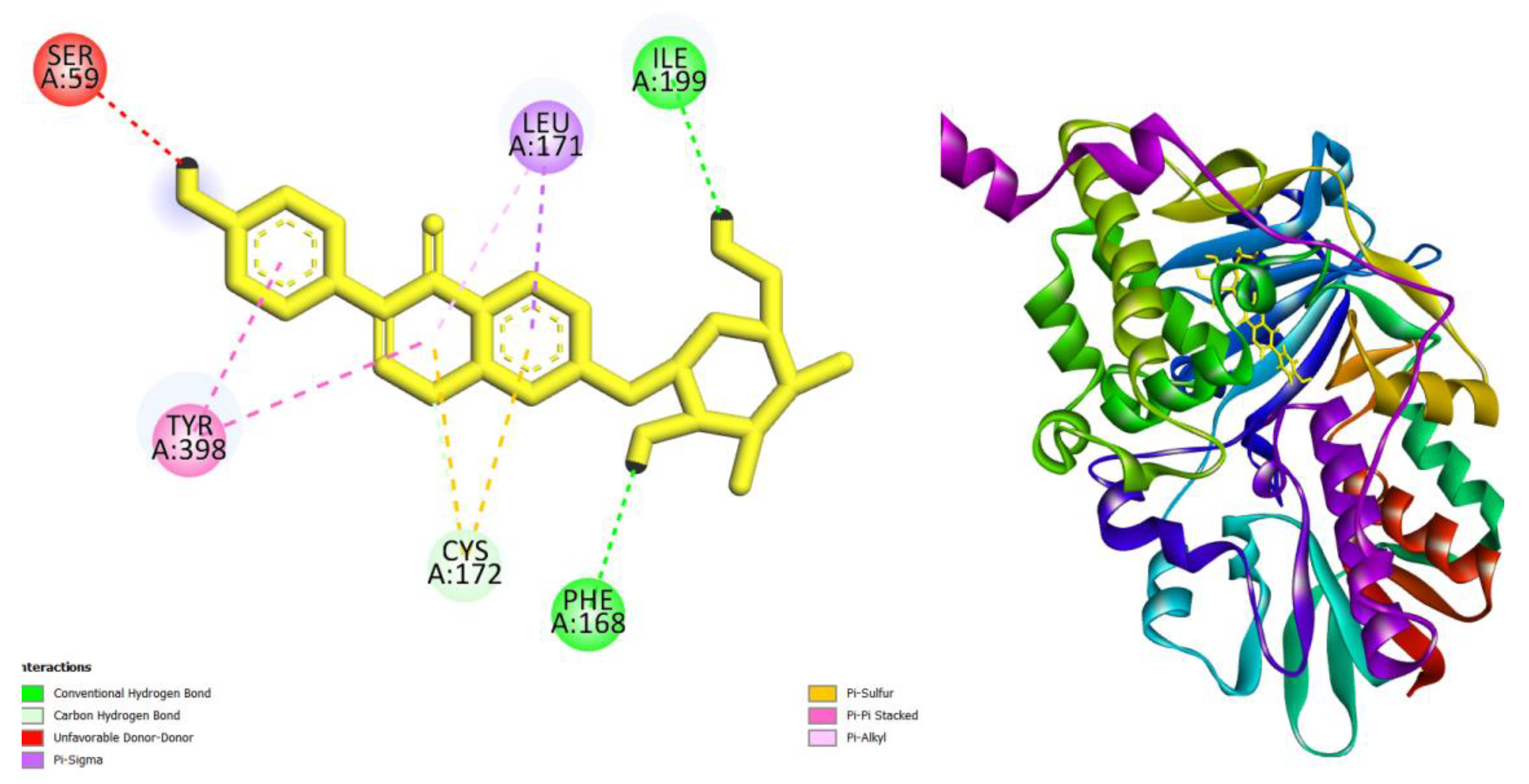
Figure 2.
displays the docking outcomes of Structure of Crystal Human human monoamine oxidase B (MAO B) in conjunction with docked luteolin -9.7 kcal mol, analyzed by Autodock Vina with pyrx program. On the left side, 2D diagrams illustrate the residue interactions between the protein and luteolin. Meanwhile, the right side exhibits the Ligand Binding Site of the protein, highlighting the specific location of luteolin.
Figure 2.
displays the docking outcomes of Structure of Crystal Human human monoamine oxidase B (MAO B) in conjunction with docked luteolin -9.7 kcal mol, analyzed by Autodock Vina with pyrx program. On the left side, 2D diagrams illustrate the residue interactions between the protein and luteolin. Meanwhile, the right side exhibits the Ligand Binding Site of the protein, highlighting the specific location of luteolin.
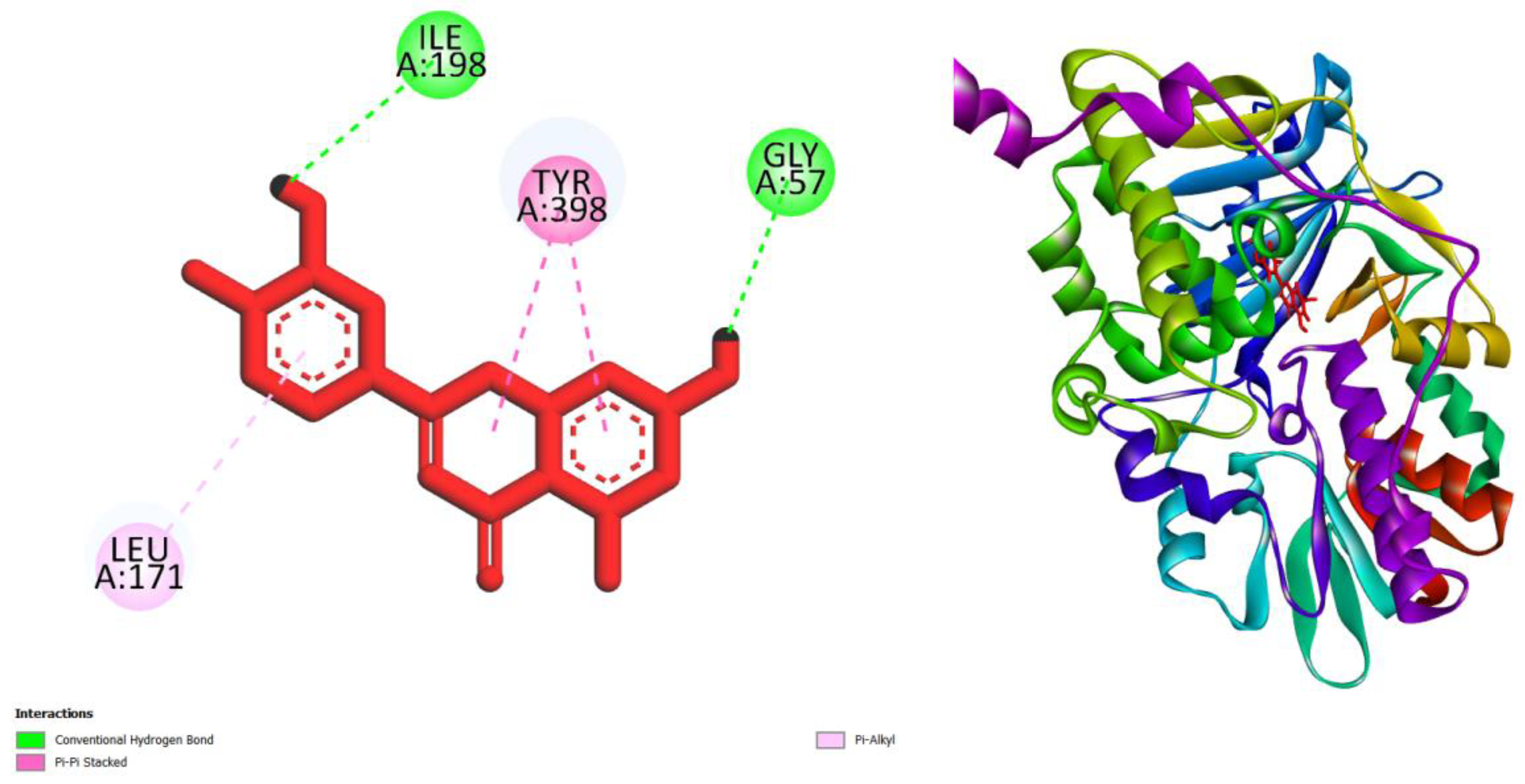
Figure 3.
displays the docking outcomes of Structure of Crystal Human human monoamine oxidase B (MAO B) in conjunction with docked silibinin -10.1 kcal mol, analyzed by Autodock Vina with pyrx program. On the left side, 2D diagrams illustrate the residue interactions between the protein and silibinin. Meanwhile, the right side exhibits the Ligand Binding Site of the protein, highlighting the specific location of silibinin.
Figure 3.
displays the docking outcomes of Structure of Crystal Human human monoamine oxidase B (MAO B) in conjunction with docked silibinin -10.1 kcal mol, analyzed by Autodock Vina with pyrx program. On the left side, 2D diagrams illustrate the residue interactions between the protein and silibinin. Meanwhile, the right side exhibits the Ligand Binding Site of the protein, highlighting the specific location of silibinin.
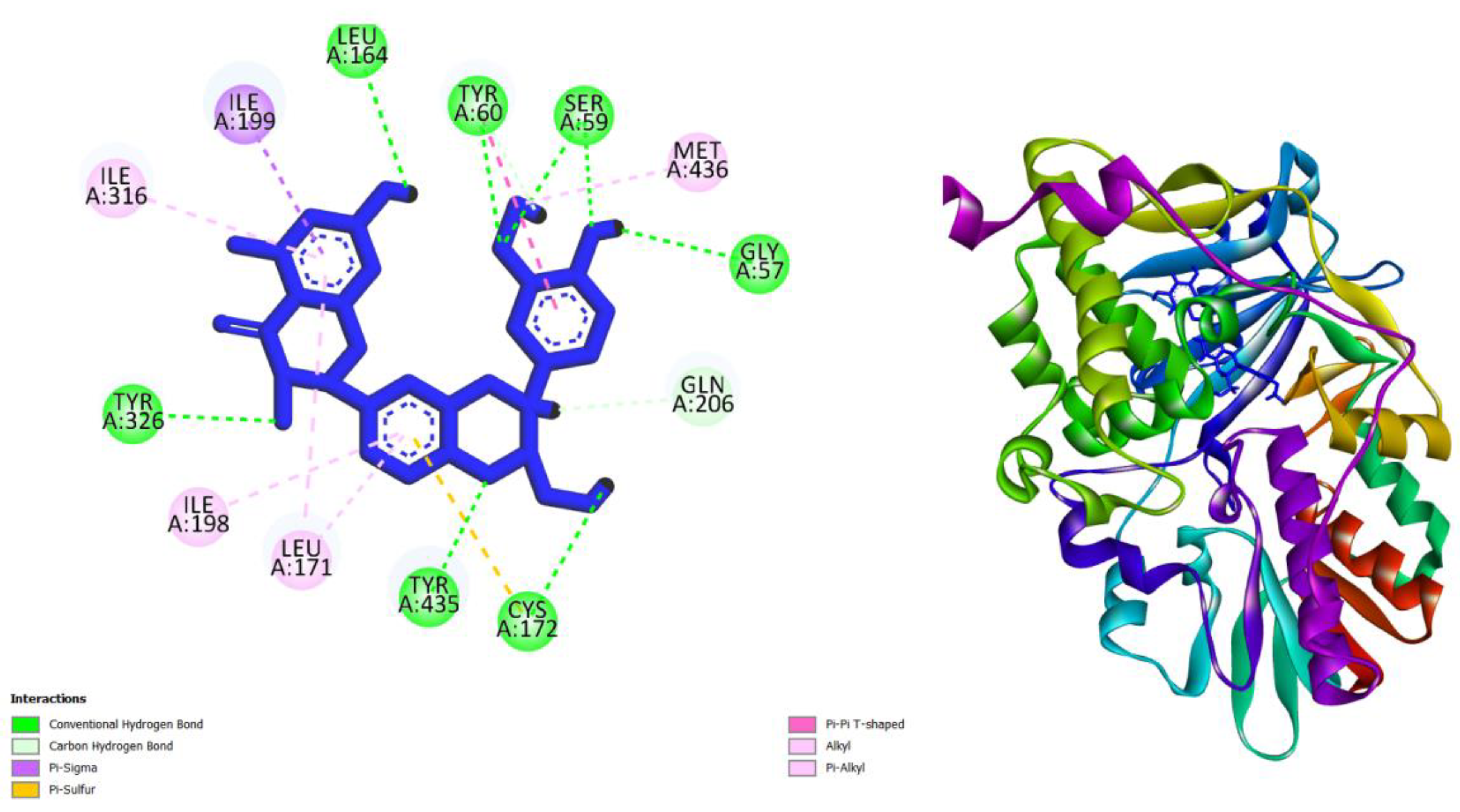
Figure 4.
displays the docking outcomes of Structure of Crystal Human human monoamine oxidase B (MAO B) in conjunction with docked Crystal ligand E92 -11.kcal mol, analyzed by Autodock Vina with pyrx program. On the left side, 2D diagrams illustrate the residue interactions between the protein and Crystal ligand E92. Meanwhile, the right side exhibits the Ligand Binding Site of the protein, highlighting the specific location of Crystal ligand E92.
Figure 4.
displays the docking outcomes of Structure of Crystal Human human monoamine oxidase B (MAO B) in conjunction with docked Crystal ligand E92 -11.kcal mol, analyzed by Autodock Vina with pyrx program. On the left side, 2D diagrams illustrate the residue interactions between the protein and Crystal ligand E92. Meanwhile, the right side exhibits the Ligand Binding Site of the protein, highlighting the specific location of Crystal ligand E92.
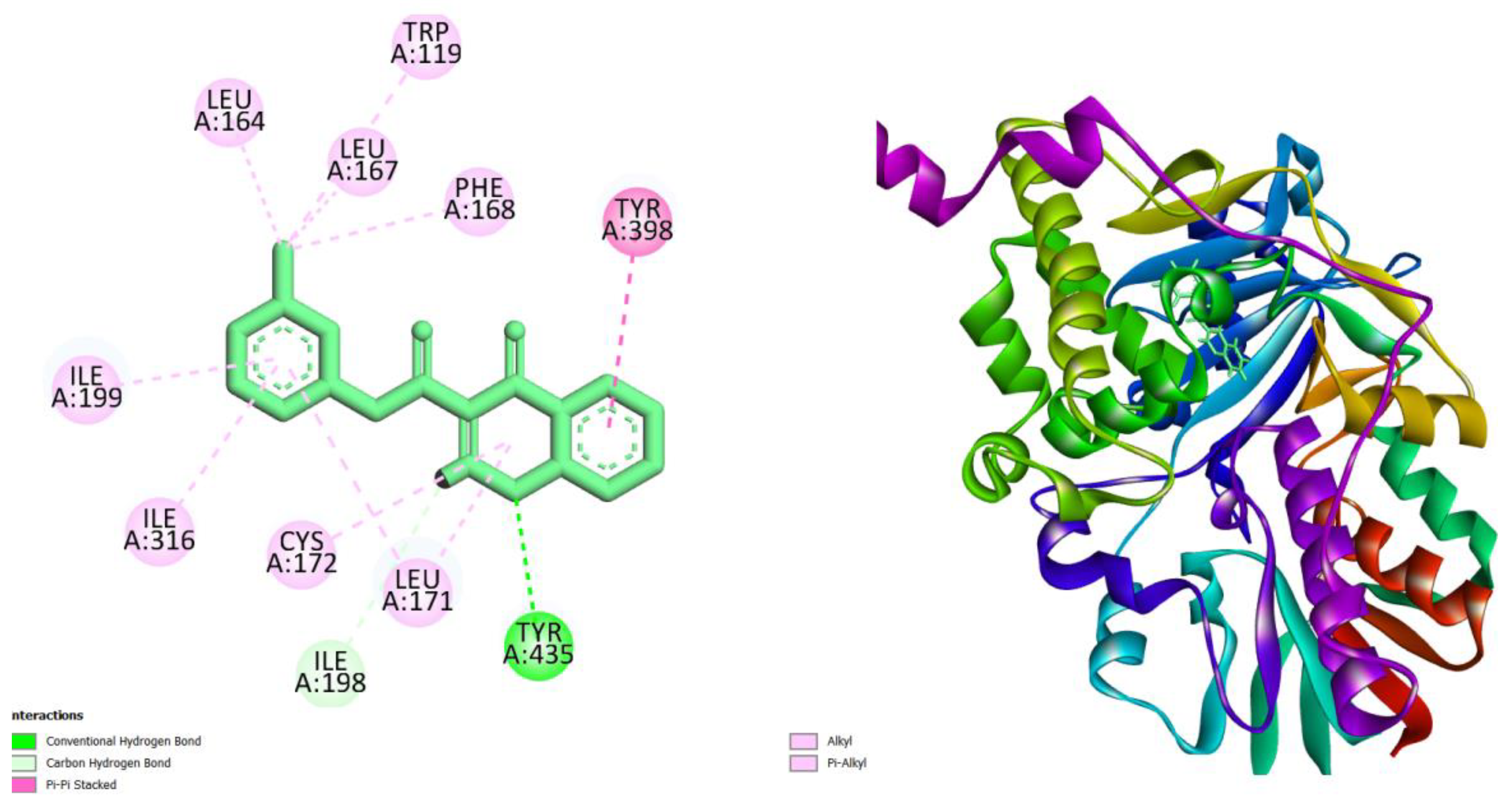
Figure 5.
displays the docking outcomes of Structure of Crystal Human human monoamine oxidase B (MAO B) in conjunction with docked Fisetin -9.5.kcal mol, analyzed by Autodock Vina with pyrx program. On the left side, 2D diagrams illustrate the residue interactions between the protein and Fisetin. Meanwhile, the right side exhibits the Ligand Binding Site of the protein, highlighting the specific location of Fisetin.
Figure 5.
displays the docking outcomes of Structure of Crystal Human human monoamine oxidase B (MAO B) in conjunction with docked Fisetin -9.5.kcal mol, analyzed by Autodock Vina with pyrx program. On the left side, 2D diagrams illustrate the residue interactions between the protein and Fisetin. Meanwhile, the right side exhibits the Ligand Binding Site of the protein, highlighting the specific location of Fisetin.
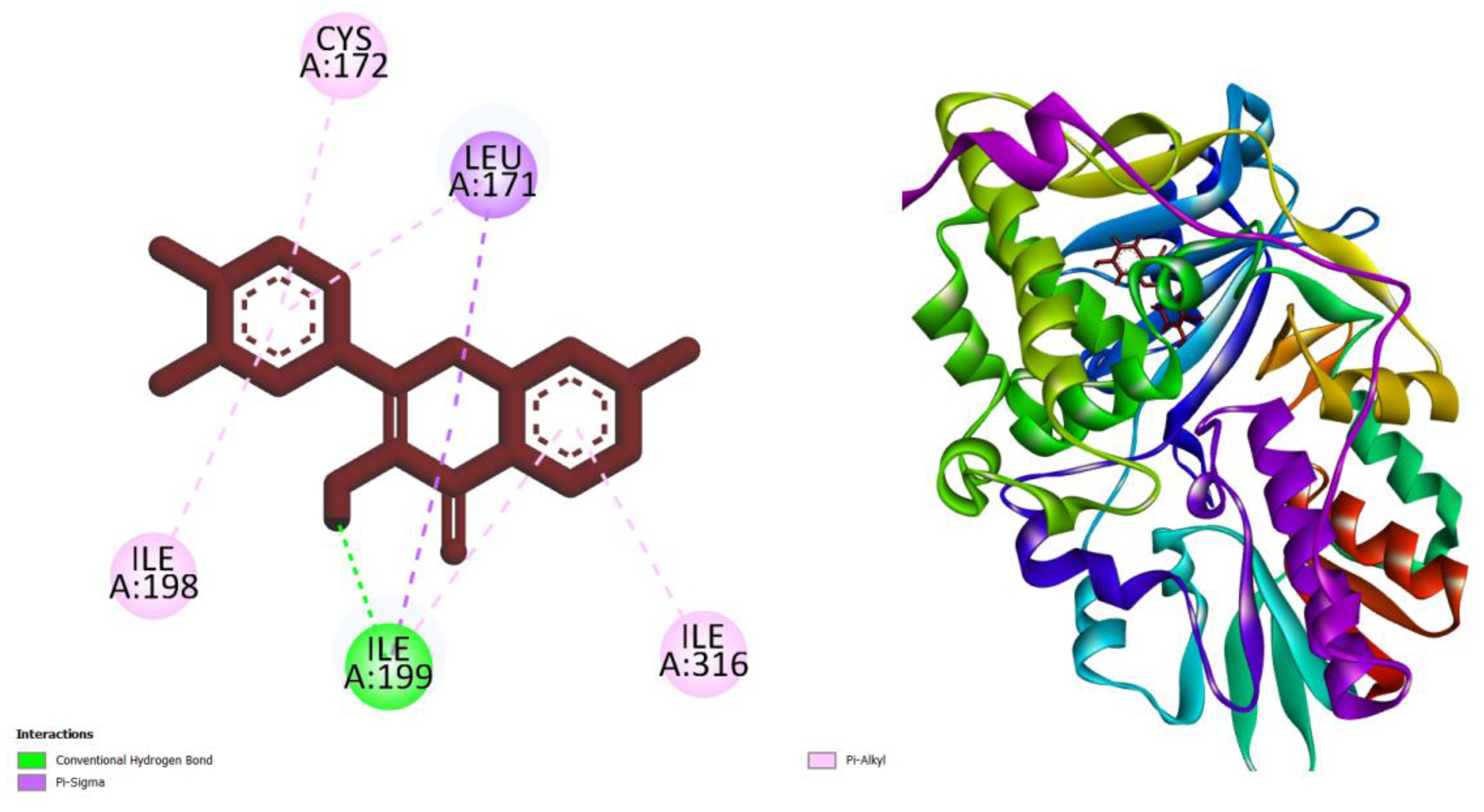
Table 1.
displays the comparison of predicted toxicity properties of investigated best natural compounds through PkCSM (Preclinical Knowledge-Based Consensus Models).
Table 1.
displays the comparison of predicted toxicity properties of investigated best natural compounds through PkCSM (Preclinical Knowledge-Based Consensus Models).
| Compounds | AMES toxicity | Max. tolerated dose (human) (log mg/kg/day) |
Oral Rat Acute Toxicity (LD50) (mol/kg) | Oral Rat Chronic Toxicity (LOAEL) (log mg/kg_bw/day) | Hepatotoxicity | Skin Sensitisation |
T. Pyriformis toxicity (log ug/L) |
Minnow toxicity (log mM) |
|||
|---|---|---|---|---|---|---|---|---|---|---|---|
| Daidzin | No | 0.488 | 2.738 | 4.717 | no | no | 0.285 | 3.902 | |||
| Luteolin | No | 0.499 | 2.455 | 2.409 | no | no | 0.326 | 3.169 | |||
| Silibinin | No | 0.65 | 2.559 | 3.494 | no | no | 0.285 | 2.543 | |||
| Fisetin | No | 0.579 | 2.465 | 1.921 | yes | no | 0.376 | 2.273 | |||
4. Conclusion
In conclusion, this study investigated the potential of natural compounds Daidzin, Luteolin, and Silibinin as inhibitors of human monoamine oxidase B (MAO-B) for Parkinson’s disease treatment. Docking simulations revealed promising binding affinities of these compounds with MAO-B, particularly with Daidzin showing the highest affinity. Additionally, toxicity predictions confirmed the low toxicity of these compounds, enhancing their potential as therapeutic candidates. Overall, Daidzin, Luteolin, and Silibinin hold promise as effective and safe treatments for Parkinson’s disease by targeting MAO-B. Further research and clinical trials are needed to validate their therapeutic efficacy and safety profiles in Parkinson’s disease management.
Conflicts of Interest
The authors declare no conflicts of interest.
References
- Mathew, B., Ravichandran, V., Raghuraman, S., Rangarajan, T. M., Abdelgawad, M. A., Ahmad, I., ... & Kim, H. (2023). Two dimensional-QSAR and molecular dynamics studies of a selected class of aldoxime-and hydroxy-functionalized chalcones as monoamine oxidase-B inhibitors. Journal of Biomolecular Structure and Dynamics, 41(19), 9256-9266. [CrossRef]
- Melfi, F., Carradori, S., Angeli, A., & D’Agostino, I. (2023). Nature as a source and inspiration for human monoamine oxidase B (Hmao-B) inhibition: A review of the recent advances in chemical modification of natural compounds. Expert Opinion on Drug Discovery, (just-accepted).
- Zhang, C., Zhang, Y., Lv, Y., Guo, J., Gao, B., Lu, Y., ... & Xie, Y. (2023). Chromone-based monoamine oxidase B inhibitor with potential iron-chelating activity for the treatment of Alzheimer’s disease. Journal of Enzyme Inhibition and Medicinal Chemistry, 38(1), 100-117. [CrossRef]
- Reis J, Manzella N, Cagide F, Mialet-Perez J, Uriarte E, Parini A, Borges F, Binda C. Tight-Binding Inhibition of Human Monoamine Oxidase B by Chromone Analogs: A Kinetic, Crystallographic, and Biological Analysis. J Med Chem. 2018 May 10;61(9):4203-4212. [CrossRef]
- Oh, J. M., Kumar, S., Sudevan, S. T., Hendawy, O. M., Abdelgawad, M. A., Musa, A., ... & Mathew, B. (2023). Halogenated class of oximes as a new class of monoamine oxidase-B inhibitors for the treatment of Parkinson’s disease: Synthesis, Biochemistry, and Molecular dynamics study. Computational Biology and Chemistry, 107899. [CrossRef]
- Chew, Z. X., Lim, C. L., Ng, K. Y., Chye, S. M., Ling, A. P., & Koh, R. Y. (2023). The Role of Monoamine Oxidase B Inhibitors in the Treatment of Parkinson’s Disease-An Update. CNS & Neurological Disorders-Drug Targets (Formerly Current Drug Targets-CNS & Neurological Disorders), 22(3), 329-352. [CrossRef]
- Chopade, P., Chopade, N., Zhao, Z., Mitragotri, S., Liao, R., & Chandran Suja, V. (2023). Alzheimer’s and Parkinson’s disease therapies in the clinic. Bioengineering & Translational Medicine, 8(1), e10367. [CrossRef]
- Funayama, M., Nishioka, K., Li, Y., & Hattori, N. (2023). Molecular genetics of Parkinson’s disease: Contributions and global trends. Journal of Human Genetics, 68(3), 125-130. [CrossRef]
- Cherian, A., Divya, K. P., & Vijayaraghavan, A. (2023). Parkinson’s disease–genetic cause. Current Opinion in Neurology, 36(4), 292-301.
- Kulkarni, A., Preeti, K., Tryphena, K. P., Srivastava, S., Singh, S. B., & Khatri, D. K. (2023). Proteostasis in Parkinson’s disease: Recent development and possible implication in diagnosis and therapeutics. Ageing Research Reviews, 84, 101816. [CrossRef]
- Wang, H., & Meng, Y. (2023). Application value of peripheral blood IgG and IgM combined with ultrasonic echo parameters of substantia nigra in the diagnosis of Parkinson’s disease. Biotechnology and Genetic Engineering Reviews, 1-9. [CrossRef]
- Ding, J., Tang, S., Mei, Z., Wang, L., Huang, Q., Hu, H., ... & Wu, J. (2023). Vina-GPU 2.0: Further Accelerating AutoDock Vina and Its Derivatives with Graphics Processing Units. Journal of Chemical Information and Modeling, 63(7), 1982-1998. [CrossRef]
- Azzam, K. A. (2023). SwissADME and pkCSM webservers predictors: An integrated online platform for accurate and comprehensive predictions for in silico ADME/T properties of artemisinin and its derivatives. Kompleksnoe Ispolzovanie Mineralnogo Syra= Complex use of mineral resources, 325(2), 14-21. [CrossRef]
Disclaimer/Publisher’s Note: The statements, opinions and data contained in all publications are solely those of the individual author(s) and contributor(s) and not of MDPI and/or the editor(s). MDPI and/or the editor(s) disclaim responsibility for any injury to people or property resulting from any ideas, methods, instructions or products referred to in the content. |
© 2024 by the author. Licensee MDPI, Basel, Switzerland. This article is an open access article distributed under the terms and conditions of the Creative Commons Attribution (CC BY) license (http://creativecommons.org/licenses/by/4.0/).
Copyright: This open access article is published under a Creative Commons CC BY 4.0 license, which permit the free download, distribution, and reuse, provided that the author and preprint are cited in any reuse.


