

Submitted:
31 January 2024
Posted:
02 February 2024
You are already at the latest version
Abstract
Transporting water from one side of a valley or gorge to the other requires construction of an aqueduct bridge or elevated aqueduct. These features are striking elements on cultural landscapes. Unlike previous research that emphasized architecture or design and relied on documentary sources and published works, this study focuses on details of construction and first-hand observation. Roman and Medieval elevated aqueducts in Spain were subjected to rigorous field examination. Marked variations were found to exist between structures of each age. No two aqueduct bridges are alike indicating the absence of standard designs. Locally available materials were used. Construction seems to have been overseen and carried out by individuals who possessed inconsistent degrees of skill. Roman treatises discussed aqueduct bridges, but not how to build them. Many palaces were clearly designed and built by highly skilled personnel during Medieval times, but more mundane public works projects such as aqueducts appear to have been carried out by less-skilled individuals. These findings have implications regarding the construction of elevated aqueducts by Spaniards in the Americas during the 16th century.
Keywords:
Elevated aqueducts
; aqueduct bridges
; arcades
; construction
; ancient Rome
; Medieval
; Spain
; cultural landscapes
1. Introduction
Aqueduct bridges (aka elevated aqueducts, arcades) are components of larger aqueduct systems that facilitate the flow of water over gorges, valleys, or low-lying lands [1,2,3]. Many of those built by ancient Romans, and still surviving whole or in part, are so large as to be well-studied “irresistible spectacles” on cultural landscapes [4,5] (p. 2). Others are small and have garnered little scholarly attention. Similarly, aqueduct bridges constructed during Medieval times remain understudied [6] (p. 1997), some limited to non-academic websites [7]. As conspicuous as some elevated aqueducts are, “we have trouble looking beyond forms that loom in front of us…. Rarely have we attended to the facture of buildings, instead beginning our inquiries with the fact of their existence” [5] (p. 3). Details regarding materials used, construction techniques, and the skills of both laborers and project overseers tend to be overlooked in favor of focusing on the architecture and aesthetics. Lacking also are comparative studies of construction. These scholarly shortcomings are typical for elevated aqueducts of all sizes regardless of culture and location. This paper, therefore, is a first step toward remedying the situation by examining construction details among Roman and Medieval elevated aqueducts in Spain, where such features are numerous. In addition to providing a better understanding of Spanish aqueduct bridges themselves, this study has implications for understanding the construction of 16th century elevated aqueducts in México [8]. Early aqueduct bridges there were constructed largely by Franciscan missionaries, without the help of architects or plans, and with little training in construction. “Certainly the Mendicant and clerical builders often had specific Spanish models in mind.” [9] (p. 108). These builders used native laborers with previous experience in aqueduct construction but without knowledge of the arch [10] (pp. 171-172). Elevated aqueduct bridges in Spain may have been their sources of inspiration, hence a reason to study their construction.
2. Materials and Methods
Existing studies of elevated aqueducts in Spain fall into one of two types. One type of study involves detailed investigations into the architecture of a single aqueduct bridge [11,12]. The other type of study involves summaries of multiple elevated aqueducts, again focusing on architecture [4,13]. The first type of studies involved fieldwork whereas the second type were conducted using secondary sources, not in a comparative sense but more like catalogs. This paper takes a different approach and involves first-hand field observations of several elevated aqueducts in Spain. It investigates 7 of 18 Roman and 5 of 14 Medieval structures focusing not on architecture and aesthetics, but on general appearances, materials used, and methods of construction. Sampling was based on the amount and condition of remains still standing. This study is comparative in nature. An unanticipated aspect of fieldwork was discovering that inferences could be drawn about the skills of each structure’s builders. Each of the elevated aqueducts discussed here was subjected to visual inspection, some on more than one occasion. As such, geographical fieldwork was of primary importance. Pictures and drawings in books and articles simply do not capture the true essence of material features on the cultural landscape [14,15]. Published and online materials were used to locate elevated aqueducts and as secondary sources of information [4,16]. The paper begins with descriptions and assessments of select Roman aqueduct bridges in Spain. Descriptions and assessments of similar features built in Spain during Medieval times are then presented. It ends with a discussion of construction materials and techniques, and their being possible models for elevated aqueducts built in early colonial México.
3. Results
3.1. Elevated Aqueducts in Roman Spain
Ancient Romans built some magnificent structures, including elevated aqueducts designed by accomplished architects. Most of those professionals left nothing in the way of documentation. A few, however, did write texts that survived and have been translated and published, such as that of water commissioner Frontinus [17]. Foremost amount these writers was Vitruvius, who lived during the first century BCE [18]. His work titled De architectura is considered the only ancient treatise on architecture [3] (p. 13). Interestingly, however, Vitruvius provided a wealth of information on all types of structures and their component parts, but when it came to building elevated aqueducts, he said what to do, but nothing about how to do it [1] (pp. 106-107,112), [3] (pp. 14-15), [5] (p. 4). It remains unknown how many builders of elevated aqueducts in Roman Spain were trained architects, engineers, or builders. The use of locally available materials, the diversity of construction techniques, and the variable quality of construction suggests a matrix of expertise and skill levels [5] (pp. 13,68).
3.1.1. Segovia
Unquestionably the most prominent, even iconic, aqueduct bridge in Spain is the one located in the heart of the city of Segovia (40°56’53”N 4°07’04”W). The piers of this two-tiered structure are relatively thick, each being less than half the span of the arches [4] (pp. 29-86). Each pier is a series of a truncated pyramids with cornices, decreasingly slightly in size from bottom to top. This arcade was built using centering, semi-circular wooden forms, and locally available late Variscan granite common throughout the Iberian Mastif [19,20] (p.489). Visible surfaces of the quarried blocks were rounded and smoothed, rendering a pillow-like appearance. The unseen surfaces are finely planed, so that each block fits tightly against adjacent blocks without mortar. Built in the 1st century CE, this impressive structure remains nearly intact, albeit after some renovations (Figure 1). As impressive as this aqueduct is, close inspection reveals that no two blocks are alike. This is evident in two adjacent spandrels, the nearly triangular section atop each pier and between adjoining arches (Figure 2). Unlike the Carthaginians, who mass produced uniformly sized and shaped components that facilitated construction and repair of their massive warships [21], Romans had yet to invent or adopt the concept and use of interchangeable parts.
3.1.2. Tarragona
Perhaps the second most celebrated Roman aqueduct bridge in Spain is the one that brought water into the city of Tarragona (Figure 3). Known as Puente del Diablo or Puente de la Ferreras, this two-tiered structure is located 3 km north of the city center (41°08’46”N 1°14’38”W) [4] (pp. 10-28), [13] (pp. 2,5,12-13). Constructed in the first century CE, this aqueduct bridge was built using centering and is comprised of Lower Jurassic and Upper Cretaceous cream-colored limestone common along the Catalonian coast that was quarried near this Mediterranean coastal city [20] (p. 489), [22] (p. 224). Two features characterize this arcade. The first of these is the shapes of the piers. Those on the upper tier have vertical sides and are parallel to each other. Piers on the lower tier are pyramidal in shape, with a series of sections decreasing in size from bottom to top. Most notably, the lowermost section is greatly exaggerated in size. The second characterizing feature of this aqueduct bridge is the use of rustication, a type of decorative masonry achieved by cutting back the edges of stones to a plane surface while leaving the central portion of the face either rough or projecting markedly. Rusticated masonry is usually dressed, or squared off neatly, on all sides of the stones except the face that will be visible when the stone is put in place. Blocks used in construction are tightly fitted without the use or mortar. The lack of knowledge pertaining to interchangeable parts is most evident in the irregular shaping of various stones (Figure 4). Cornices exist under the springers, the stones where the arches come tangent to the piers.
3.1.3. Pineda
This elevated aqueduct is very small in comparison to most Roman aqueduct bridges (Figure 5). Built in the second century CE, it is known locally as the Acueducto Can Cau [4] (pp. 190-193). It is situated 2 km north of the coastal city of Pineda de Mar (41°38’29”N 2°40’53”W). This elevated aqueduct is not very tall and has square piers, each of which is half the distance of the span of the arches [11]. The spandrels and arches are narrower than the piers longitudinally, such that a small cornice tops each pier just below the springer. The single most characteristic feature of this aqueduct bridge is its being an excellent example of opus incertum construction. That is, it was built with a core of relatively small, unshaped metamorphic rocks that were gathered locally, and mortared together, with veneer of more regularly shaped rocks from the same source. These rocks are Paleozoic in age and are common in the Catalan Coastal Range [23]. The voussoir consist of thin vertically placed rocks. The semi-circular arches that come tangent to the piers indicate that centering was used. Despite being partially destroyed, this is a well built aqueduct bridge. Furthermore, the presence of this small structure, similar to the large ones, greatly assisted cultural sustainability and resilience [6] (p. 2020).
3.1.4. Lodosa
Bisected by the highway between the towns of Mendavia and Lodosa (42°25’09”N 2°06’38”W), the Acueducto de Alcanadre crosses the northern floodplain of the Río Ebro [4] (pp. 183-189). The structure is quite low, with short piers measuring 1 m square in some places, and no piers elsewhere (Figure 6). Springers are set directly atop the foundations, at ground level, in these latter places. Construction involved the use of centering. Given its low height, the aqueduct bridge was overbuilt, involving more construction materials than were needed. Looks, however can be deceiving, especially at first glance. A close examination reveals two special traits. One, the span of each arch is five times the width or thickness of the piers. Two, construction involved opus incertum, like at Pineda, but in this case, finished with a facing of small, regularly shaped rectangular blocks mortared together and then plastered over (Figure 7). Voussoir consist of finely shaped blocks. This aqueduct bridge was built in the middle of the second century CE, and now shows signs of varying degrees of degradation. This is in no small way because the rocks used in construction are Oligocene evaporites that, by definition, are water soluble [24] (pp. 302-303).
3.1.5. Sevilla
Known as the Cañas de Carmona, this structure was quite long and carried water into town from the east (Figure 8). Remnants of this aqueduct bridge exist in two disparate locales [4] (pp. 119-138). One is 3.5 km east of the city center (37°23'12"N 5°57'29"W), and the other is 1.5 km away (37°23’18”N 5°58’58”W). The precise date of construction is unknown, but the distinguishing hallmark characteristic of this two-tiered elevated aqueduct is that it appears to be constructed of bricks held together by mortar, and plastered over (Figure 9). In reality, it is in Latin terms opus latericium, or course-laid brickwork used to face a core of opus caementicium, or concrete. Clay necessary for brick-making was doubtless obtained from mudflats along the nearby Río Guadalquivir. The uniformity of the semi-circular arches indicates that centering was used during construction. The decorative inverted teardrop shaped openings in the spandrels are one indication that an architect and skilled craftsmen were involved in its construction.
3.1.6. Ronda
Located 7 km east of the city of Ronda and transected by a highway and a railroad (36°45’32”N 5°07’27”W), the remnants of this elevated aqueduct are but a fragment of what once was a significant feature on the landscape (Figure 10). All that remains are a few piers of varying widths, and arches. The vertical piers have cornices at the springers. The span of the arches is approximately three times the width of the piers, and the semi-circularity indicates that centering was used in construction. Close-up examination revealed that construction of opus incertum. Voussoir consist of relatively thin rock slabs. Layers of two rows of brick separate sections of mortared rock fragments on the piers (Figure 11). There exists no known literature pertaining to this elevated aqueduct.
3.1.7. Mérida
Like most Roman elevated aqueducts in Spain, this Acueducto de las Milagros (38°55’26”N 6°20’53”W) is a mere shadow of what it once was [4] (pp. 96-100). But a long shadow it is. The remains of this arcade are exceptionally tall with piers that are nearly as wide as the spans of the arches, that were clearly built using centering [13] (pp. 14-17). Constructed in the first century CE, this impressive structure was actually poorly built. Buttresses were not integrated into the piers but added to their faces late as latitudinal support (Figure 12). Two smaller arches were also added later between each of the piers and below the uppermost arch that supported the channel that carried water. These arches were added for longitudinal support of the piers. The masonry techniques used in this aqueduct bridge are probably responsible for it nearly collapsing and therefore requiring additional support. It is unique in its composition (Figure 13). Each pier was constructed in sections, with a mortared rock rubble core, and exposed outer sides comprised of smooth Valle de la Serena granite blocks from nearby that were held together by mortar [23] (pp. 138-140). Each section was then topped by a layer of bricks, five high. The use of three different materials—rock rubble, bricks, and ashlar blocks—in small sections rather than one type of material throughout, suggests architectural input but a deficiency in engineering.
3.1.8. Summary
In addition to obvious differences in length, height, number of tiers, and variations in pier to span ratios, are some less conspicuous attributes including materials used in construction, and masonry techniques. This sample of aqueduct bridges indicates rather conclusively that the Romans had no standard template of construction, other than using centering. Ashlar blocks, rustification, opus incertum, opus caementicium, and bricks, all locally available materials, were used in constructions. In at least two cases—Segovia and Tarragona—masonry was used without knowledge of interchangeble parts. Most of these aqueduct bridges were well built, even overbuilt. However, one—Mérida--lacked structural integrity, and required supportive additions and renovations.
3.2. Elevated Aqueducts in Medieval Spain
Muslims invaded the Iberian Peninsula in 711 CE, reintroduced science [25], and set about constructing aqueducts and other structures for nearly 800 years [26]. They have been celebrated for their exquisite architecture [27], that resulted in beautiful buildings such as La Mezquita in Córdoba, and innovative laws that remain the basis for water management and distribution practices in Spain and much of the Americas [28,29,30]. The earliest known elevated aqueducts built during Medieval times in Spain date to the 13th century CE. Nearly 1000 years passed between the building of the last Roman and the first Medieval aqueduct bridge. During that time, most of the Roman aqueduct bridges, save a few truly monumental ones such as those in Segovia, and Tarragona fell into ruin. The technology of building elevated aqueducts, therefore, had to be reinvented. No books concerning the construction of Medieval aqueduct bridges are known to exist. Builders, for the most part, had to figure it out for themselves [6] (p. 1997).
3.2.1. Alhambra
Perhaps the pinnacle of Medieval architecture in Spain is that of the Alhambra. As beautiful as it is, it would not exist without water (Figure 14). Situated high on a hill overlooking the city of Granada, it required water to be delivered through a canal known as the Acequia del Sultan that carried water from the Darro River to the Generalife, and from there by an aqueduct bridge (37°10’30”N 3°35’07”W) across a ravine and into the center of the Alhambra [31]. Although easily visible (Figure 15), thousands of tourists each day glance at it with little understanding of its importance [32] (pp. 239-257). And, why should they? The glory of the complex itself is aesthetically overwhelming [33].
This is a very well-built, but unadorned aqueduct bridge. Piers are vertical with semi-circular arches that come tangent at the springers with no cornices. Centering was used during construction. The entire structure is made of bricks held together by mortar. The tall voussoir are perhaps its most notable attribute. The elegance of this structure is in its simplicity. Doubtless one of the Alhambra architects designed this elevated aqueduct.
3.2.2. Víznar
The city of Granada also required water, and this was fulfilled by a very long aqueduct system named the Acequia de Aynadamar [34]. It was constructed during the 13th century and carried water from a spring located high in the mountains south of the city, in the appropriately named town of Fuente Grande (Figure 16). From there (37°14'47"N 3°33'13"W), water was transported by a means of open canals downslope. In a few places, such as small barrancas or ravines, elevated aqueducts were built in order to maintain the gradient without having to lengthen the canal significantly by going around the heads of said ravines [35] (pp. 170-174). Of all the elevated aqueducts along the course of the canal, the one crossing Barranca de Víznar (37°14’22”N 3°32’42”W) is the largest. Those familiar with Spanish literature will note that this structure is only 100 meters away from the place where poet Federico García Lorca was assassinated by Nationalist forces at the beginning of the Spanish Civil War in 1936. The aqueduct bridge is not very long, but quite tall as it spans a narrow and deep ravine. Visual inspection was impaired by tall, thick, and dense vegetation, but from earlier photographs (Figure 17) seems to be little more than a wall made of unshaped mortared rocks, presumably with an opening at its base to allow stream water to flow through. It is not very elaborate or elegant, but it must have been well built, indeed over built, to be standing and transporting water for 800 years.
3.2.3. Porta Coeli
If visual inspection of the aqueduct bridge at Víznar was difficult, sections of the one at Porta Coeli (39°40’58”N 0°28’26”W) are impossible. Constructed in the 12th-14th centuries CE, much of it is sequestered within the walls of a Carthusian monastery [37]. Entrance by outsiders is strictly forbidden. Fieldwork, therefore, was limited to investigating those portions of the elevated aqueduct outside the walls. It was supplemented by videos taken by others using unmanned aerial vehicles [38]. The aqueduct brought water from a spring named Fuente de la Mina or Fuente de la Hoya. The arcade itself is large, imposing, and has clearly been renovated a few times, and it might have been built in sections, each by a separate engineers and work crews. Whomever they were that oversaw construction(s) and renovation(s) remain unknown, but the end product of their endeavors is fraught with inconsistencies (Figure 18). This elevated aqueduct has three distinct sections evident in a drone image (Figure 19). From source to terminus, the first stretch is comprised of arches that are irregular in size and shape with piers of varying widths. One pier is narrow with a cornice at the springer of an arch that is not tangent to the pier. Another pier is big and blocky. Two arches in this section are partially filled with walls that were clearly later additions, and might not had anything to do with with supporting the structure. The second section is separated from the first by a distinct seam. The three arches in this section are quite uniform, with piers that are as wide as the span of the arches. These piers are larger at the bases and smaller near the tops, in a series of four truncated pyramids. Materials used in the construction of these two sections was largely semi-shaped blocks of stone, with the voussoir and quoins being ashlar stone. The third section of the aqueduct bridge appears as a high, mortared, unshaped rock wall, however, closer inspection reveals that this wall once contained arches that were filled in later with mortared rocks (Figure 20). The reasons for filling in of arches remains unknown, it probably had nothing to do with reinforcing what seems to be a strong structure. This elevated aqueduct was completely plastered over. It continues to supply water to the monastery, but through a PVC pipe in the channel atop the structure. Appearing for the first time in Spain is the use of Gothic arches.
3.2.4. Morella
As is the case with all populated places, the hill fort city of Morella in northern Valencia province required water, and this was delivered by the means of a long aqueduct system. Known in Valencian as Aqüeducte de Santa Llúcia or Séquia Reial, this aqueduct involved sections of open canals on the surface in many places along its course. In other places it involved tunnels excavated under hills. In yet other places it involved the construction of bridges between hills [39,40]. The largest of these is only 1 km north of town (40°37’48”N 0°05’39”W). Dating to the 14th century, this elevated aqueduct clearly has a history of multiple modifications (Figure 21). The initial plan, if there was one, seems to have been the simple construction of a large wall comprised of a unshaped rock rubble core and faced with roughly shaped rectangular rocks of varying sizes. In a few places the wall has a few openings, one of which is a large Gothic arch that allows ground access to either side of the arcade (Figure 22). In other places the wall contains two tiers of rectangular window-like openings (Figure 23). Although it is difficult to capture in pictures, this wall is neither straight nor vertical, but wavy and leaning. To prevent collapse, buttresses were later added in several places. These later additions are evident by the rock in the buttresses not being imbricated into, and therefore not being an integral part of, the wall when it was constructed. A tier of arches was added to the top of the wall in one place (Figure 24). The spacing of the arches is irregular and some arches were later supported by rectangular columns of rock. A close-up view of one spandrel indicates construction by trial-and-error (Figure 24) while another was built without centering and close-up view suggests that a builder did not know how to place voussoir (Figure 25). This is a prime example of knowing about elevated aqueducts but not knowing how to build one [41].
3.2.5. Biar
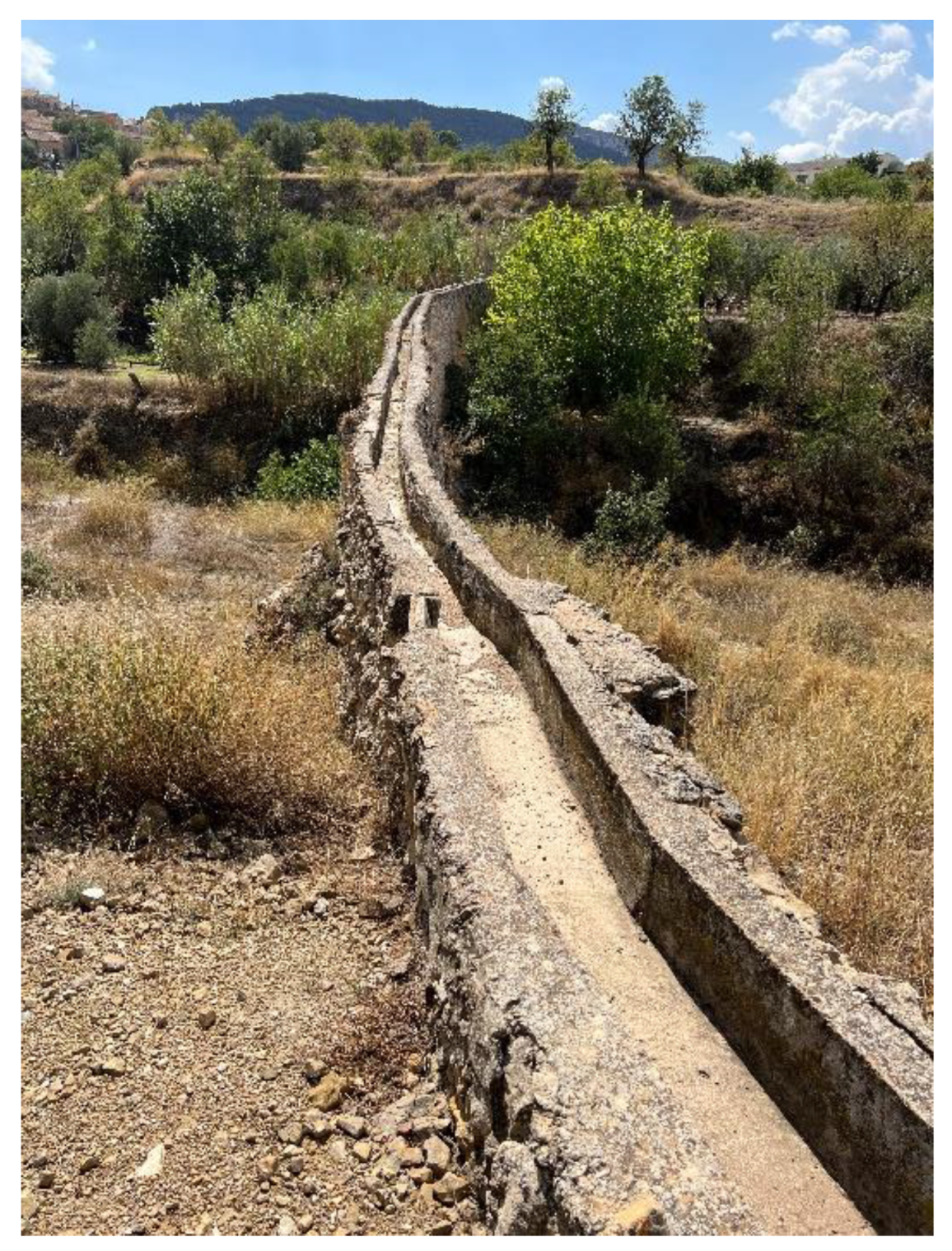
A small elevated aqueduct bridge, the Acueducto Ojival is in the province of Alicante, (38°38’08”N 0°46’00”W). It was designed by Girona architect Pere Compte and built in 1490 CE with one semicircular arch and three Gothic arches [16]. Constructed principally of unshaped rocks moratered together, this aqueduct has brick vossuori on three arches over the stream channel. Half-round and V-shaped buttresses on the upstream sides of the piers were constructed to dissipate the force of heavy stream flows (Figure 26). The rocks used in the buttresses were imbricated with those of the piers, indicating that these buttresses were integral elements of the original construction. One arch was probably added at an undetermined later date to facilitate vehicle traffic, replacing what might have been a solid wall, or a more elaborate arch like the other three. Construction of this segment is clearly different than that of other sections. The arch has semi-ashlar rock voussoir, and the irregular shape that suggests lack of centering and less-skilled builders. Although designed by a professional, this aqueduct bridge has faults that may be due to the workers who undertook renovations. From the top looking down and along, the arcade appears wavy (Figure 27). This is in part a function of elevated aqueduct being very narrow. From one side to the other is a mere 40 cm. Buttresses were clearly added at some later date to the downstream sides of two piers. This is evident by the rocks comprising the buttresses not being imbricated with those of the aqueduct bridge itself. These buttresses were probably added to support this narrow structure against the forces of unusually high stream flow.
3.2.6. Summary
Elevated aqueducts constructed in Medieval Spain are, like their earlier Roman counterparts, all different. Gothic arches appear for the first time. Two aqueduct bridges—Alhambra and Biar--were designed by architects, and constructed by skilled workers. Most are small. The two that are large—Puerta Coeli and Morella—lacked both consistency in design from one end to the other, and show signs of substantial renovations. One was poorly built and required major repairs and numerous additional supports. Although major buildings such as the Alhambra and the monastery at Puerta Coeli were designed by architects, it seems, given the less-than-perfect construction, that lesser skilled personnel were relegated to building and rebuilding water delivery systems, particularly the elevated aqueducts. Practices and techniques developed by Romans were not improved but survived into Medieval times [6] (p. 1997).
4. Discussion
Previous studies of Roman-era elevated aqueducts in Spain focused nearly exclusively on architecture and aesthetics [1,2,3,4]. They also treated the accomplishments of designers and builders favorably, celebrating both the beauty and functionality of their achievements. Understudied was the construction of aqueduct bridges, specifically investigating the materials used, techniques of assembly and composition, and by extension an attempt to understand the skills of the builders [5] (p. 3). To be sure, some high-quality elevated aqueducts were built by Romans. This study has demonstrated that more than half of these aqueduct bridges seem to have been built by local artisans, using locally available materials, and without the design of architects. Three very large aqueduct bridges were clearly designed by architects, two of which are masterpieces—Segovia and Tarragona. The architect of the third—that in Mérida—seems to have lacked engineering expertise. That arcade shows signs of multiple renovations, additions, and rebuilding. All told, this study confirms the claim made by a previous writer and stated in the Introduction, that it is difficult to discern the roles of architect, master builder, and laborers in any single construction project. One or more persons often did all three jobs [5] (p. 13).
Elevated aqueducts in Medieval Spain, in contrast, have garnered little scholarly attention. The Moors constructed some beautifully designed and executed edifices that have been celebrated in books and articles [27]. They also contributed to science [25], introduced laws pertaining to water distribution and management that are still used in parts of the world today [28,29], and built at least one nice, but simple aqueduct bridge--Alhambra. It remains uncertain who was responsible for constructing the other elevated aqueducts discussed here. It is safe to say, however, that diversity rules. No two are alike, especially regarding quality of construction. Unlike the earlier Roman structures, the smaller elevated aqueducts seem to have been built well, whereas the larger ones—especially the one near Morella—were fraught with problems.
Considering elevated aqueducts in Roman and Medieval Spain together has not been done in the past. Doing so, however, is important as a first step in addressing the construction of such features. Studies of architecture are alluring. Studies of construction are less so. Everyone loves beauty, and that is one trait that most elevated aqueducts do not possess. Sure, the big aqueduct bridges are beautiful and well known. There are far more small, unattractive ones, and these seemingly mundane features have much to say about their builders’ skills and ingenuity, or lack thereof.
Finally, it must be said that the elevated aqueducts studied here should contribute to the study of early colonial aqueduct bridges in the Americas and other parts of the Spanish empire in the 16th century [8]. Ongoing research of such features in México suffers from not recognizing what might be considered models or prototypes of elevated aqueducts constructed there [9] (p. 109), [42]. Not only is knowledge of models important, but so is construction techniques by individuals [39], such as Mendicant priests, who had no training in such matters but built elevated aqueducts nonetheless [43].
Author Contributions
This research is entirely the work of the sole author, except for a few images that are attributed in the figure captions.
Funding
This research received funding from at fellowship at The John Carter Brown Library, Brown University, Providence, USA, the Houston Endowment through the Teresa Lozano Long Institute of Latin American Studies, The University of Texas at Austin, and the Erich W. Zimmermann Regents Professorship, College of Liberal Arts, The University of Texas at Austin.
Data Availability Statement
All data related to this study are in the possession of the author. Upon his death, they will be deposited in the Nettie Lee Benson Latin American Collection, The University of Texas at Austin.
Acknowledgments
Earlier versions of the paper were delivered at the 2022 meeting of the Permanent European Commission for the Study of Rural Landscapes in Jaén and Baeza, Spain, and the 2023 annual meeting of the American Association of Geographers in Denver USA. I thank my dear friends Elisabeth Butzer and the late Karl W. Butzer for their decades of insights, inspiration, and intellectual support.
Conflicts of Interest
The author declares no conflicts of interest.
References
- Prager, F.D. Vitruvius and the Elevated Aqueducts. In History of Technology: Third Annual Volume; Hall, A.R., Smith, N., Eds.; Mansell: London, UK, 1978; pp. 105–121. [Google Scholar]
- Aicher, P.J. , Guide to the Aqueducts of Ancient Rome. Bolchazy-Carducci: Rome, Italy, 1995.
- Hodge, T.A. Roman Aqueducts and Water Supply. Duckworth: London, UK, 2002.
- Fernández Casado, C. Acueductos Romanos en España. Instituto de Ciencias de la Construcción Eduardo Torroja: Madrid, Spain, 1972.
- Taylor, R. Roman Builders: A Study in Architectural Process. Cambridge University Press: Cambridge, UK, 2003.
- De Feo, G. , Angelakis, A.N., Antoniou, G.P., El-Gohary, F., Haut, B., Passchier, C.W., Zheng, X.Y., Historical and Technical Notes on Aqueducts from Prehistoric to Medieval Times, Water 2013, 5, 1996-2025. https://turismobiar.com/acueducto-ojival/ Accessed 26 January 2024.
- Doolittle, W.E. Expanding the European Landscape: Aqueducts and the Spanish Usurpation of México. In Landscapes, indentities and Development: Europe and Beyond; Rocan, Z., Claval, P., and Agnew, J., Eds. Ashgate: Farnham, UK, 2011; pp. 151–166. [Google Scholar]
- Kubler, G. Mexican Architecture in the Sixteen Century, Yale University Press: New Haven, USA, 1948.
- Doolittle, W.E. Canal Irrigation in Prehistoric Mexico: The Sequence of Technological Change, University of Texas.
- Press: Austin, 1990.
- Prat i Puig, D.F. , L’Aqüeducte Romé de Pineda. Barcelona: Instituto d’Estudis Catalan: Barcelona, Spain, 1936.
- Almerich, L. , Historia dels Carrers de la Barcelona Vella. Volumen I. Carrer del Arcs: Barcelona, Spain, 1949.
- Fernández Ordóñez, J. , Catálogo de treinta Canales Españoles anteriores a 1900. Comisíon de Estudios Históricos de Obras Públicas y Urbanismo, Colegio de Ingenieros de Caminos, Canales, y Puertos, Colección de Ciencias, Humanidades e Ingeniería: Madrid, Spain, 1986.
- Goin, P. , Visual Literacy, Geog. Rev. 2001, 91, 363–369. [Google Scholar]
- Raitz, K.B. , Field Observation, Archives, and Explanation, Geog. Rev. 2001, 91, 121–131. [Google Scholar]
- https://es.wikipedia.org/wiki/Acueducto_Ojival Accessed 26 January 2024.
- Frontinus, S.J. , Aquaeductu urbis Romae Fontinus, Rodgers, R.H. Ed., Cambridge University Press: New York.
- USA, 2004.
- Vitruvius, The Ten Books on Architecture, trans. by Morton, M.H.. Harvard University Press: Cambridge, USA, 1914.
- Gil-Ibarguchi, J.I. (coord.).Variscan and Pre-Variscan Tectonics, In The Geology of Spain, Gibbons, W., Moreno, T. Eds. The Geological Society: London, UK, 2002, pp. 155-183.
- Lunar, R. , and T. Moreno (coords). Economic and Environmental Geology, In The Geology of Spain, Gibbons, W., Moreno, T. Eds. The Geological Society: London, UK, 2002, pp. 473-510. https://www.worldhistory.org/Carthaginian_Naval_Warfare/ Accessed 26 January 2024.
- Aurell, M. , Meléndez, G., Olóriz, F. (coords). Jurassic. In The Geology of Spain, Gibbons, W., Moreno, T. Eds. The Geological Society: London, UK, pp. 213-253, 2002.
- Castro, A.L. , Corretgé, G., de la Rosa, J., Enrique, P., Martínez, F.J., Pascual, E., Lago, M., Arranz, E., Galé, C., Fernández, C., Donaire, T., López S. Palaeozoic Magmatism. In The Geology of Spain, Gibbons, W., Moreno, T. Eds. The Geological Society: London, UK, 2002, pp. 117-153.
- Alonso-Zarza, A.M. , Armenteros, I., Braga, J.C., Muñoz, A., Pujalte, V., Ramos, E., (coords). Tertiary. In The Geology of Spain, Gibbons, W., Moreno, T. Eds., London: The Geological Society: London, UK, 2002, pp. 294-334.
- Saliba, G. , Islamic Science and the Making of the European Renaissance. Cambridge: MIT Press: Cambridge, USA, 2007.
- Glick, T.F. , Irrigation and Society in Medieval Valencia. Harvard University Press: Cambridge, USA, 1970.
- Bloom, J.M. , Architecture of the Islamic West: North Africa and the Iberian Peninsula, 700-1800. Yale University Press: New Haven, USA, 2020.
- Meyers, M.C. , Water in the Hispanic Southwest: A Social and Legal History, 1550-1850. University of Arizona Press: Tucson, USA, 1984.
- Wilkinson, J.C., Islamic Water Law with Special Reference to Oasis Settlement. J. Arid Env. 1978, 1, 87–96.
- Zarr, G. , How the Middle Eastern Irrigation Ditch Called Acequia Changed the American Southwest, AramcoWorld, 2016, September/October.
- Garcia-Pulido, L.J. , The Mastery in Hydraulic Techniques for Water Supply at the Alhambra. J Islamic Studies 2016, 27, 355–382. [Google Scholar] [CrossRef]
- López, J.B. , The Alhambra and the Generalife: Official Guide. TF Editores: Granada, Spain, 2011.
- Salmerón Escobar, P., La Alhambra: y Paisaje. Granada: La Biblioteca de la Alhambra: Granada, Spain, 1997 .
- Trillo San José, C. , A Social Analysis of Irrigation in Al-Andalus: (13th-15th Centuries), J. Med. Hist., 2005, 31, 163-183. 31,.
- Ruggles, D.F. , Gardens, Landscape, and Vision in the Palaces of Islamic Spain. Pennsylvania State University Press: State College, USA, 2000.
- https://es.wikipedia.org/wiki/Acequia_Aynadamar_(Granada) Accessed 26 January 2024.
- https://cartujadeportacoeli.org/ Accessed 26 January 2024. 26 January.
- https://www.youtube.com/watch?v=JXBDneRsYp8 Accessed 26 January 2024.
- Lampérez y Romeo, V. , Arquitectura Civil Española de los Siglos I al XVIII. Casa Editorial Saturnino Calleja: Madrid, 1933.
- Alanyà i Roig, J. Urbanisme i Vida a la Morella Medieval. Ajuntament de Morella: Morella, Spain, 2000.
- Hall, A.R. , On Knowing, and Knowing how to… In History of Technology: Third Annual Volume, Hall, A.R., Smith, N., Eds. pp. 91-103. Mansell: London, UK, 1978.
- Doolittle, W.E. , Portuguese Origins of a 16th Century Aqueduct in México. Rev. Geog. Am. Cen. 2018, 61E, 467–488. [Google Scholar] [CrossRef]
- Valdez, O. , El Padre Tembleque. Biblioteca Enciclopedica del Estado de México: México City, México, 1979.
Figure 1.
The elevated aqueduct in Segovia.
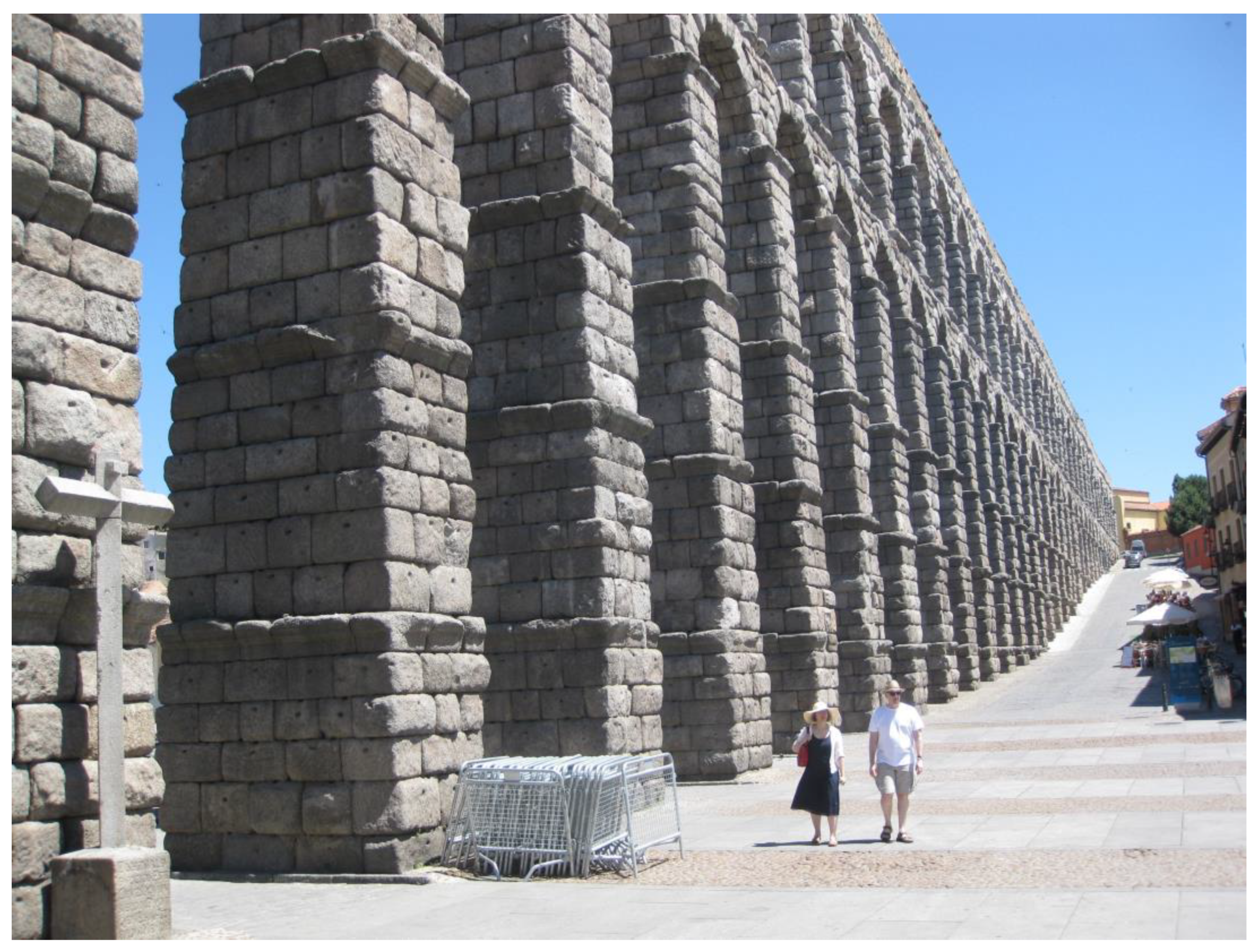
Figure 2.
A view of two adjacent spandrels on the aqueduct bridge in Segovia. Note the unique shape of each rock.
Figure 2.
A view of two adjacent spandrels on the aqueduct bridge in Segovia. Note the unique shape of each rock.
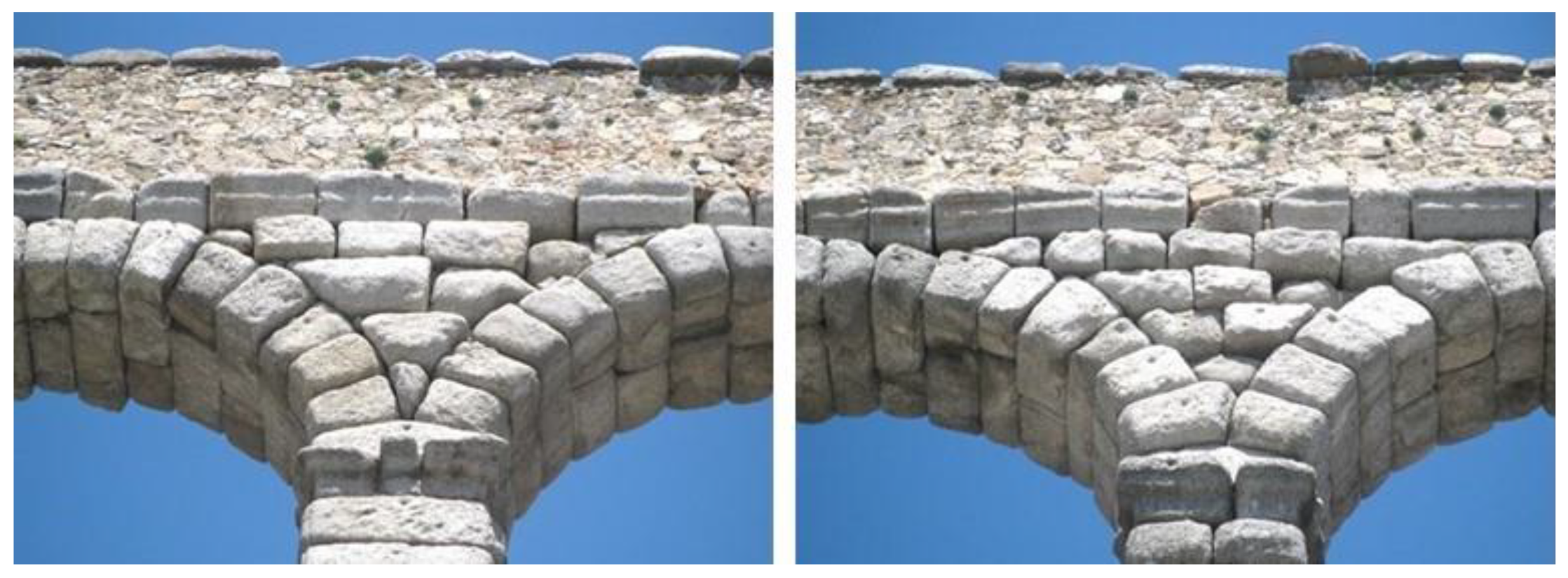
Figure 3.
The elevated aqueduct in Tarragona. Note, the truncated pyramidal shape of The piers.
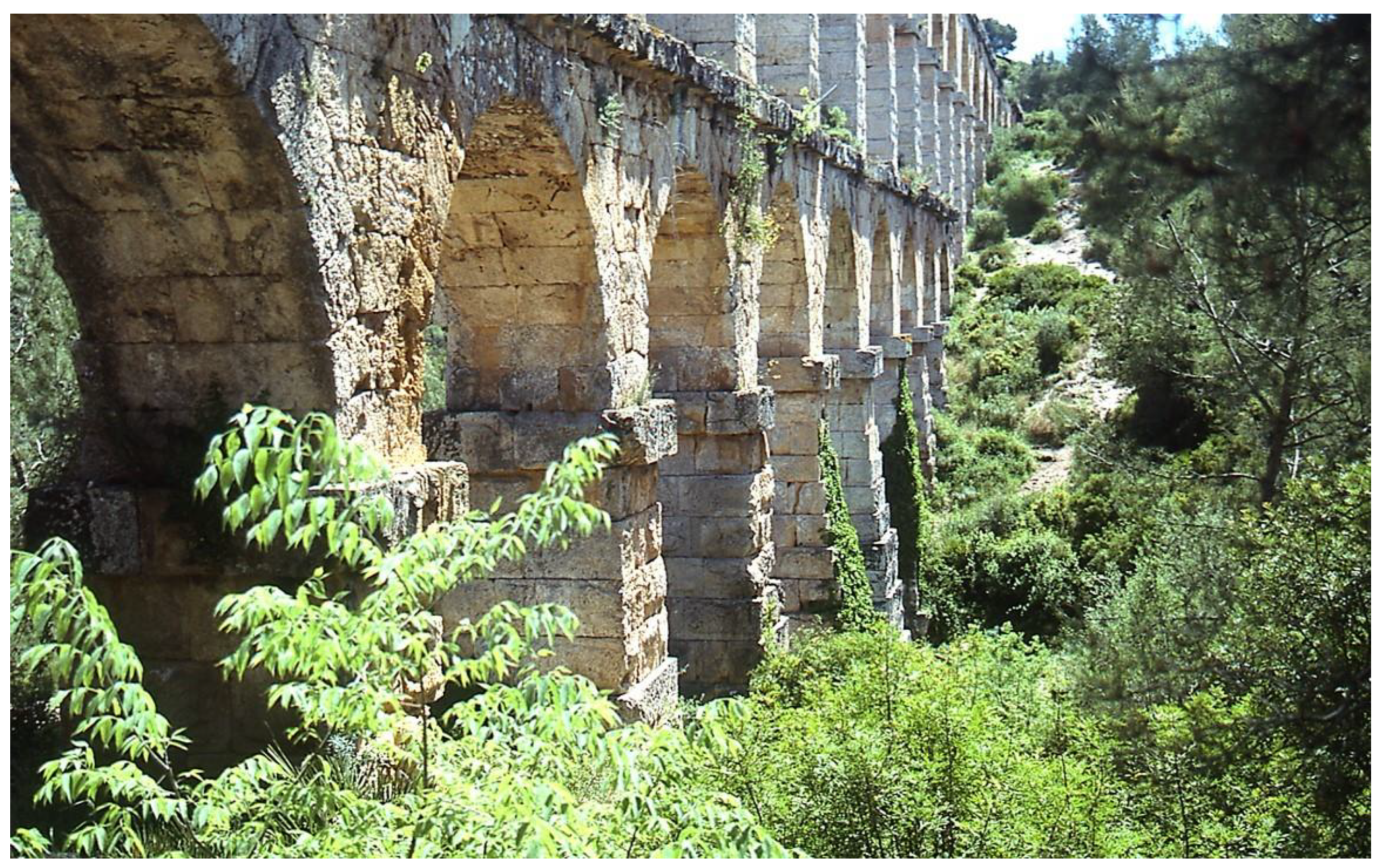
Figure 4.
A close-up view of the joints between a few unique, rusticated rocks of the aqueduct bridge in Tarragona, showing that interchangeable parts had yet to be invented or adopted by the Romans.
Figure 4.
A close-up view of the joints between a few unique, rusticated rocks of the aqueduct bridge in Tarragona, showing that interchangeable parts had yet to be invented or adopted by the Romans.
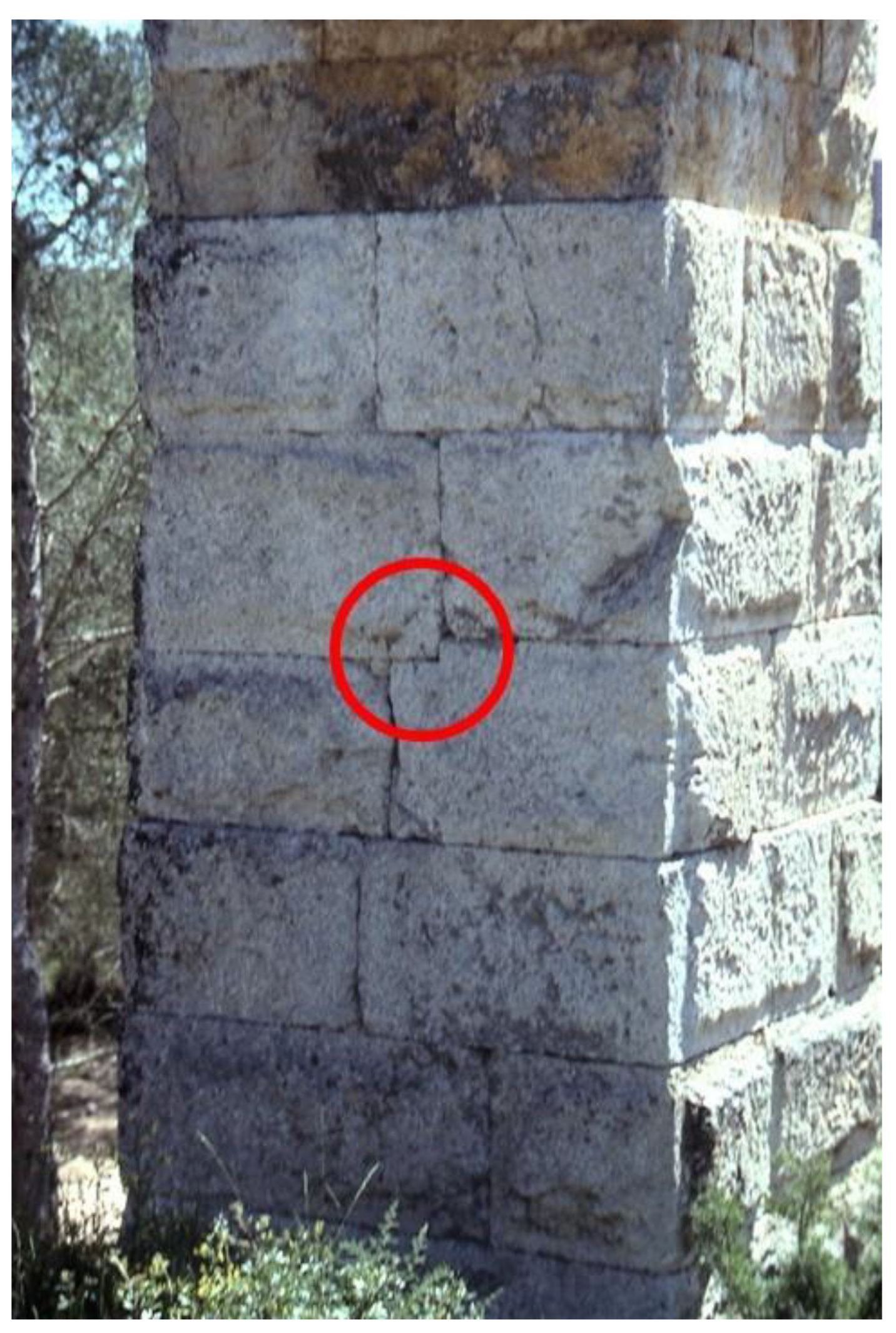
Figure 5.
The elevated aqueduct at Pineda.
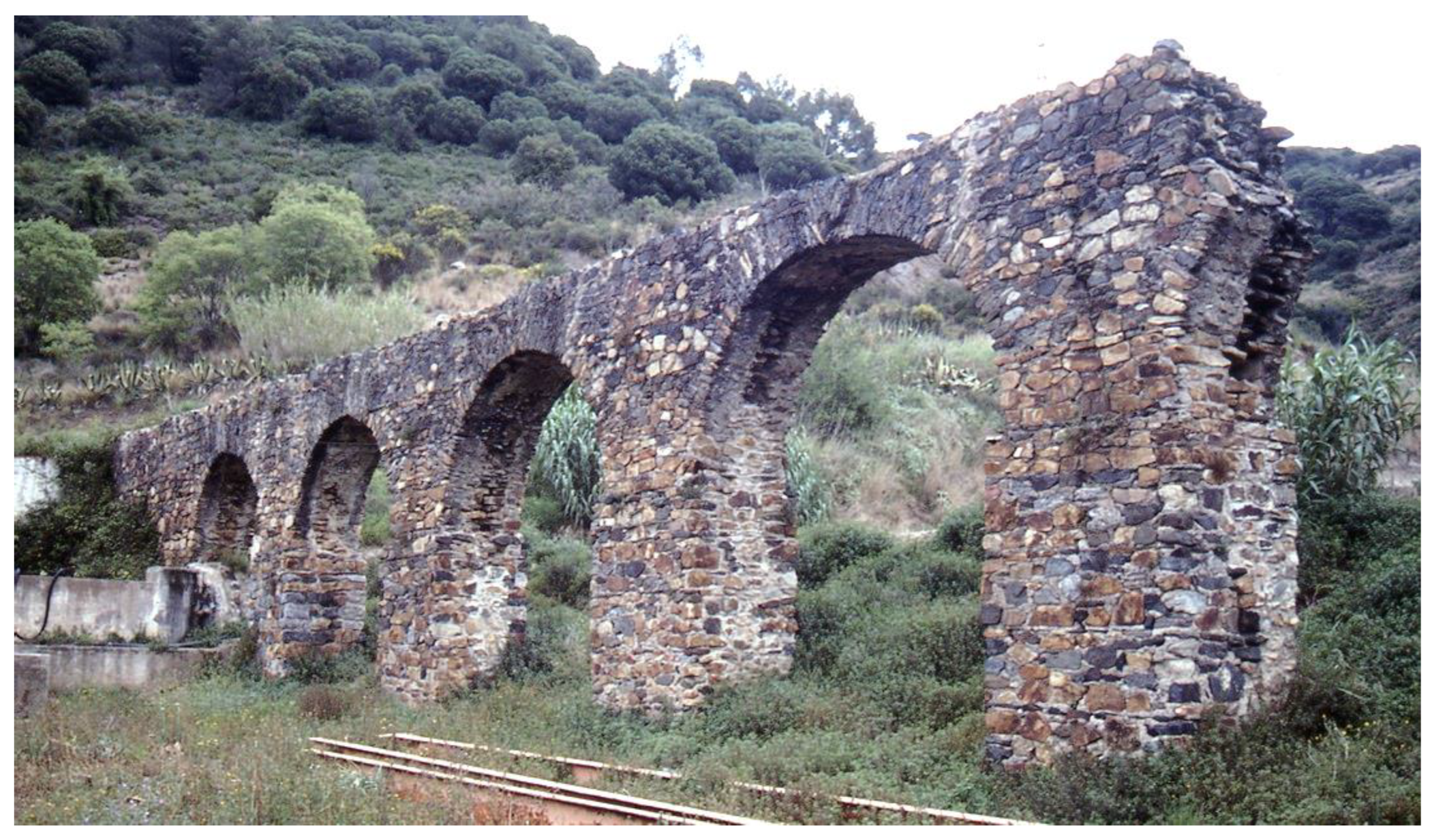
Figure 6.
The elevated aqueduct at Lodosa.
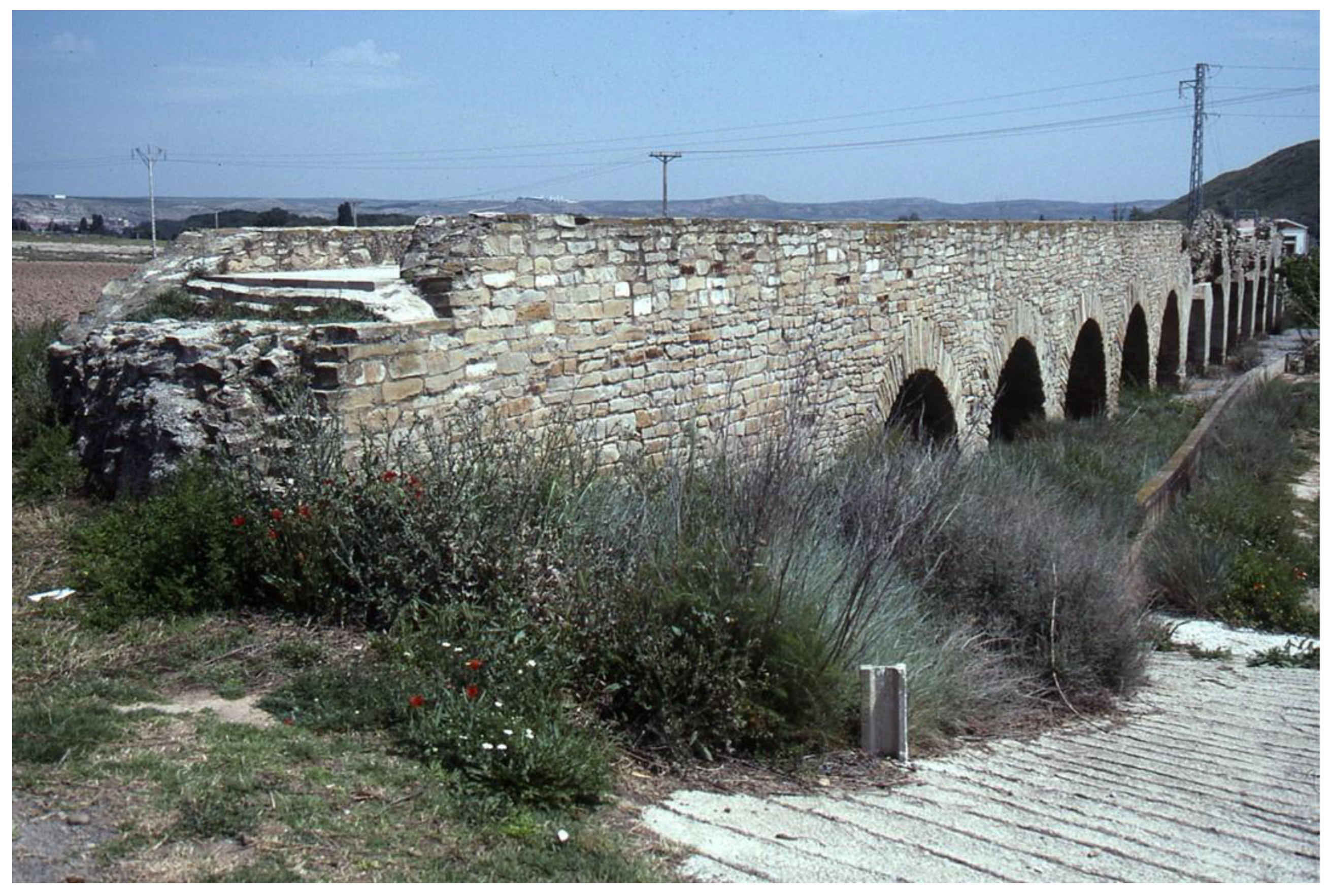
Figure 7.
A view of a highly deteriorated portion of the aqueduct at Lodosa exposing various aspects of construction.
Figure 7.
A view of a highly deteriorated portion of the aqueduct at Lodosa exposing various aspects of construction.
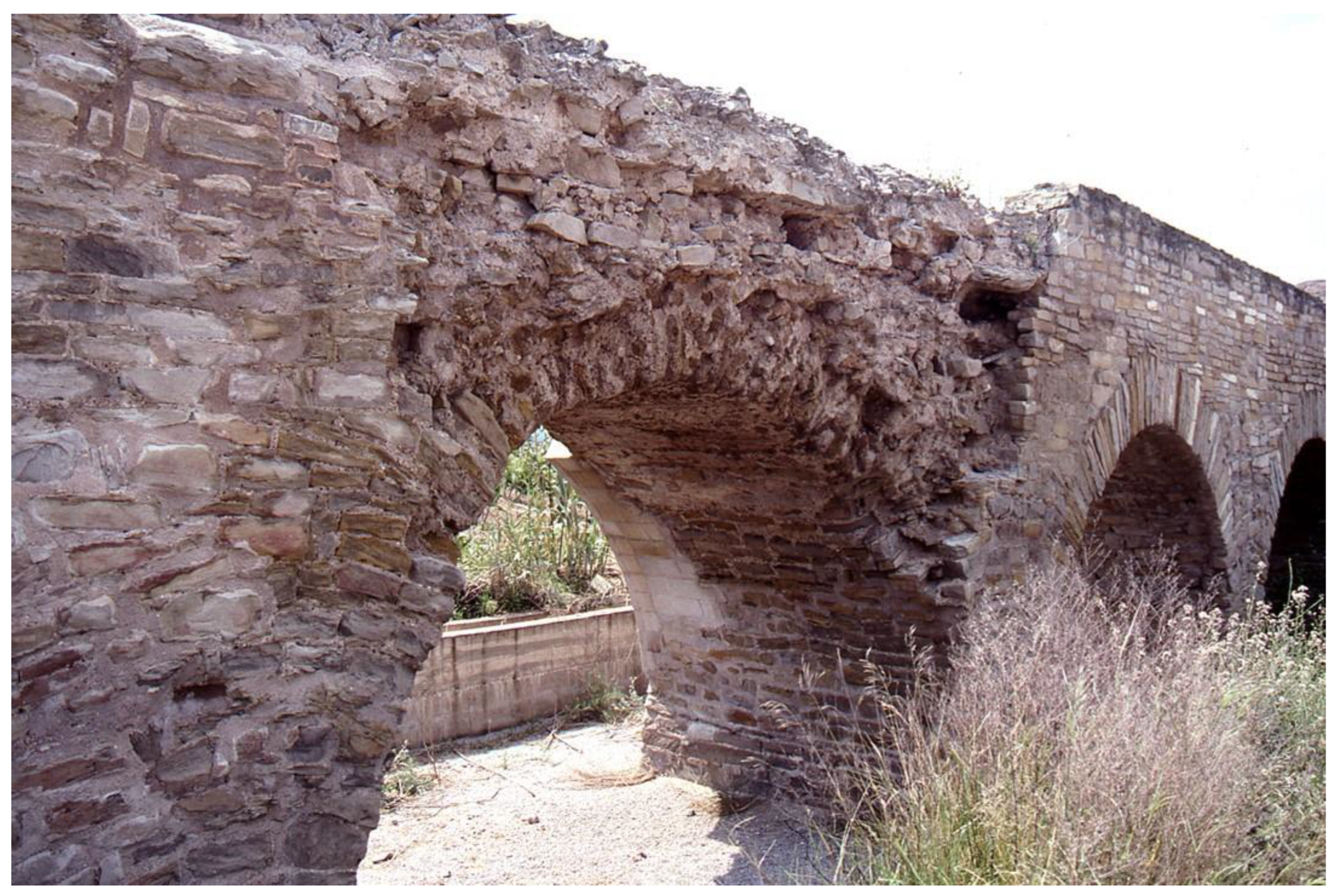
Figure 8.
The western portion of the elevated Carmona aqueduct in Sevilla.
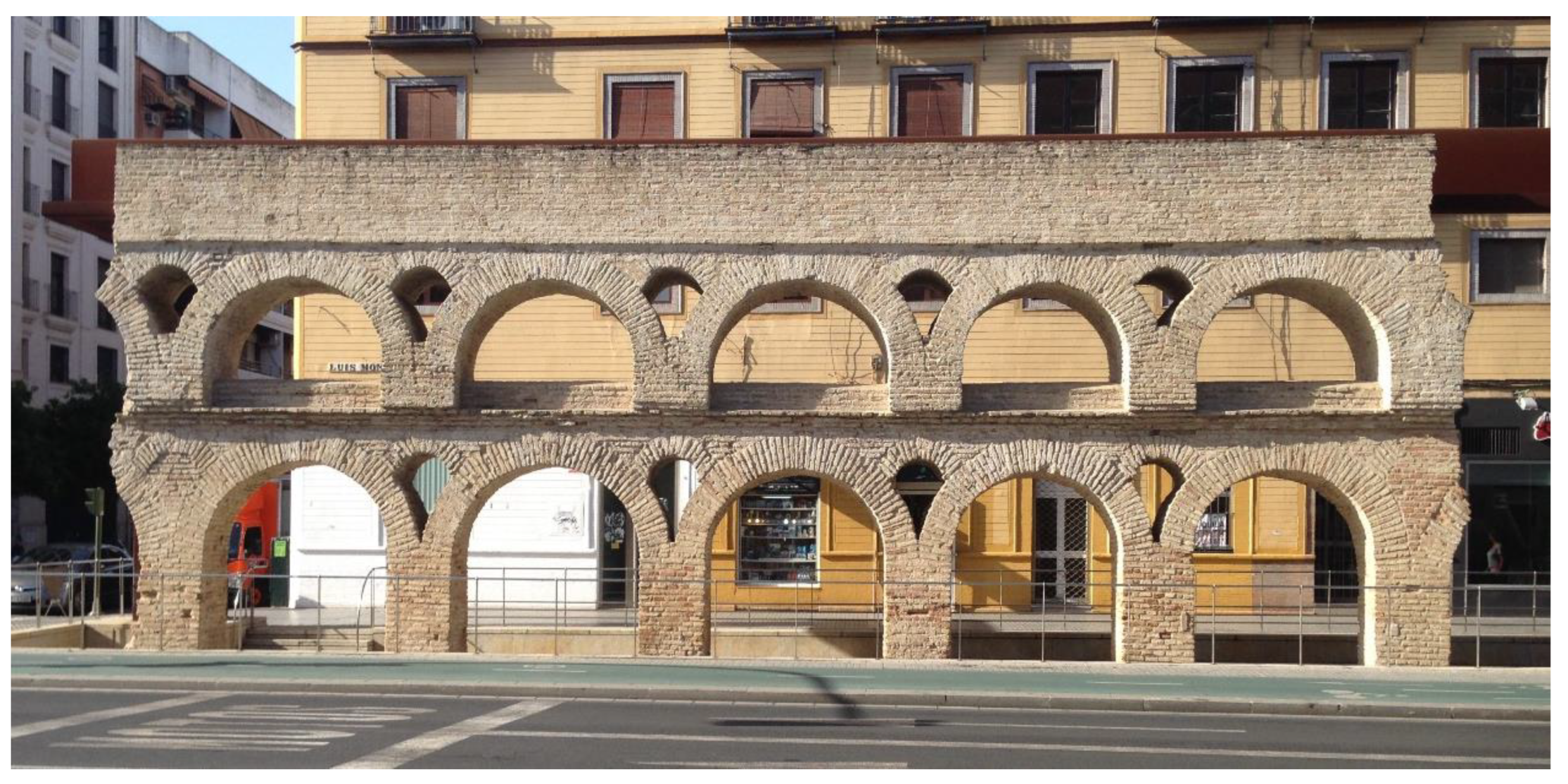
Figure 9.
A close-up view of bricks and plaster that characterize the elevated aqueduct in Sevilla.
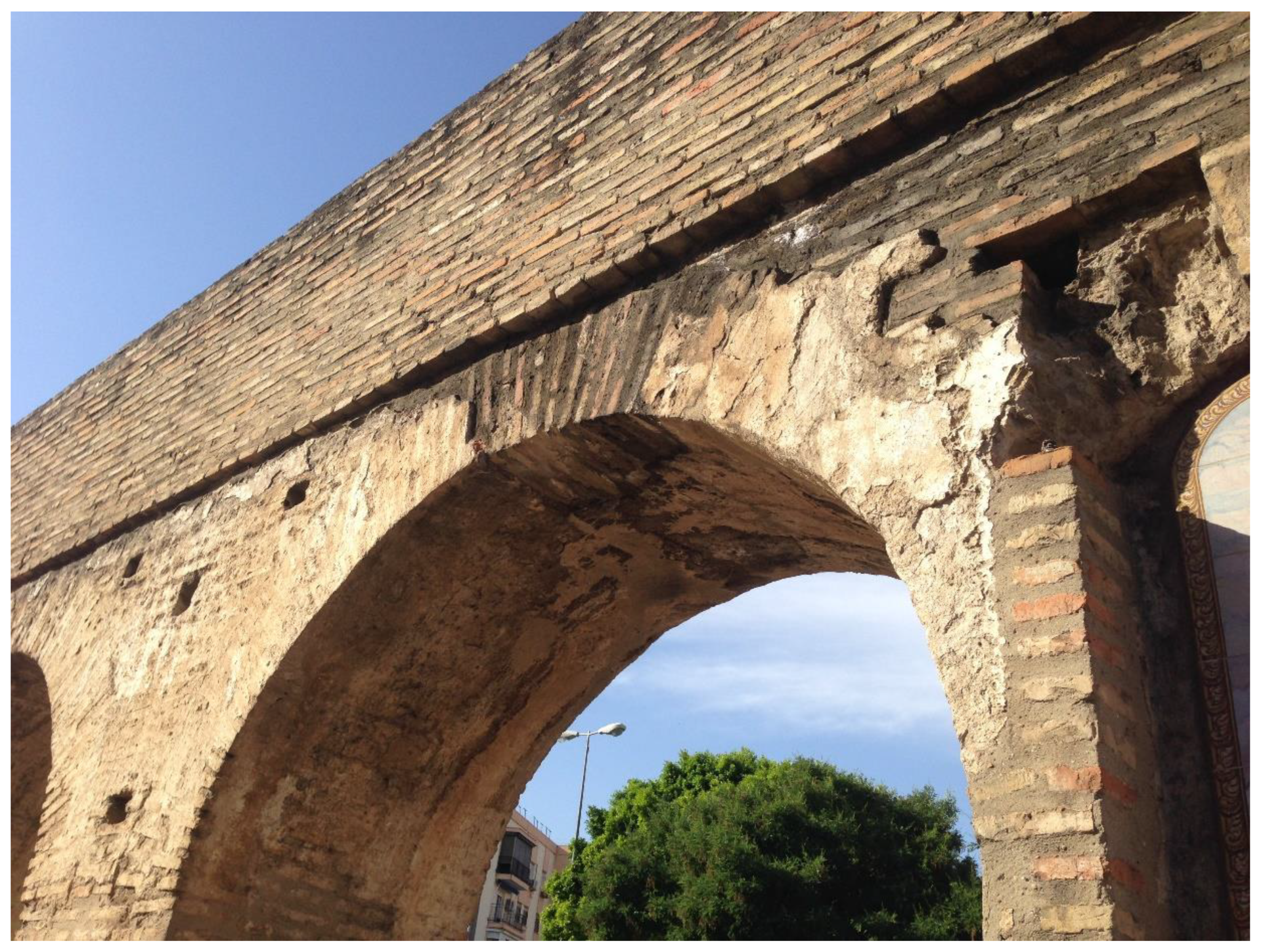
Figure 10.
The elevated aqueduct near Ronda.
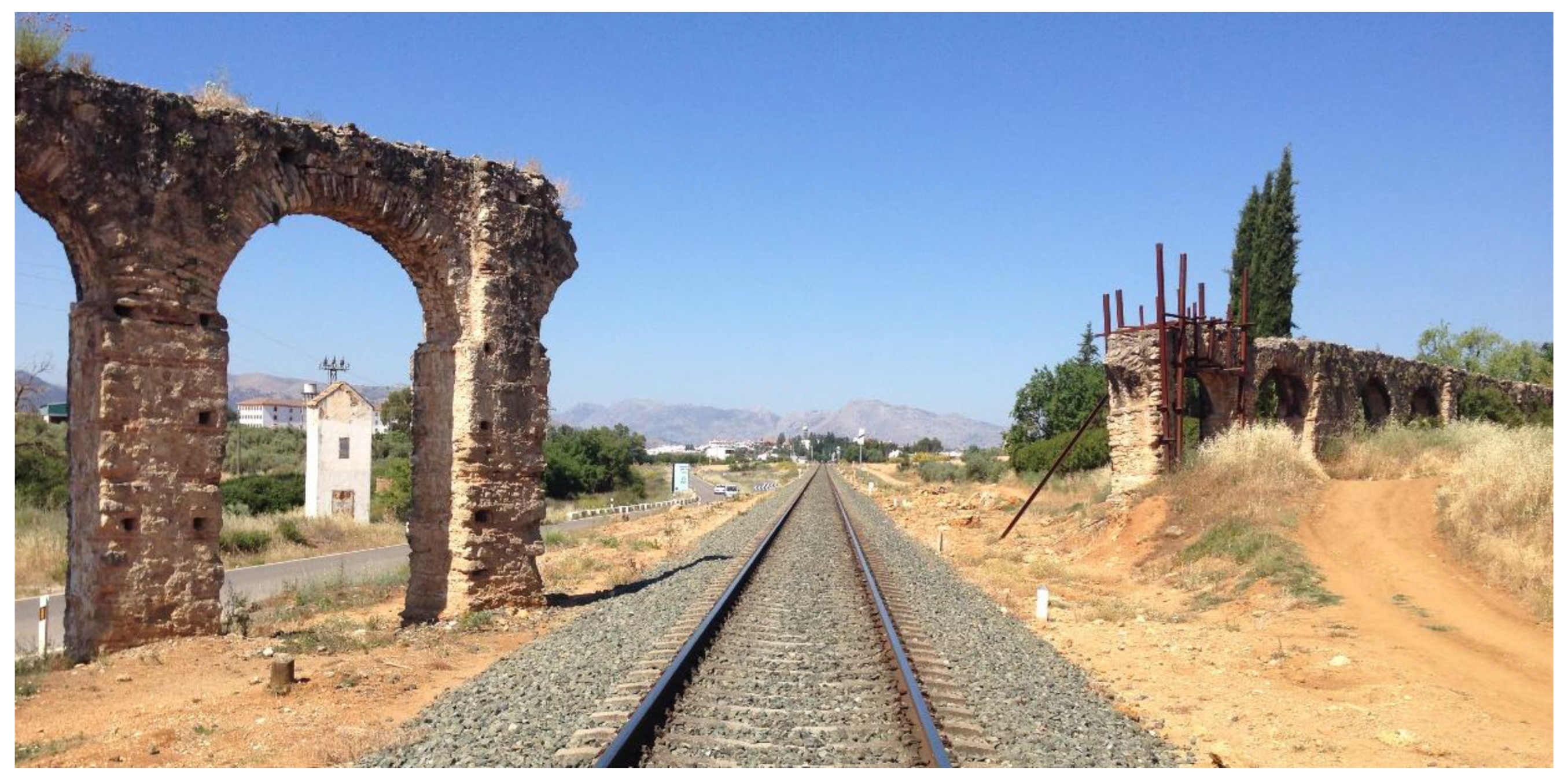
Figure 11.
A close-up view of the opus incertum construction of the aqueduct bridge near Ronda.
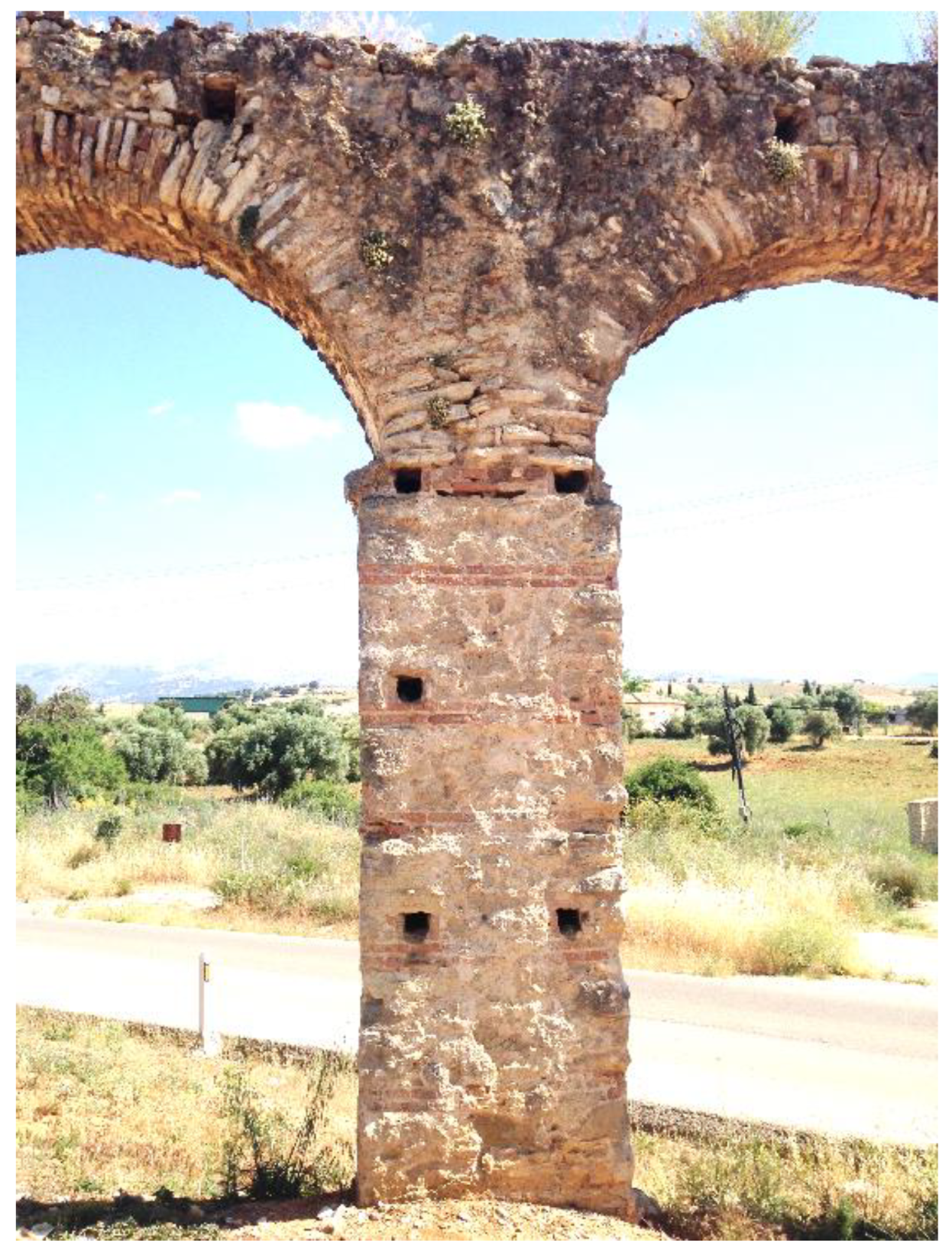
Figure 12.
The elevated aqueduct of los Milagros in Mérida, Extremadura. Note the buttress on the fifth pier from the left, and the exposed cores of the first four piers where the buttresses no longer stand.
Figure 12.
The elevated aqueduct of los Milagros in Mérida, Extremadura. Note the buttress on the fifth pier from the left, and the exposed cores of the first four piers where the buttresses no longer stand.
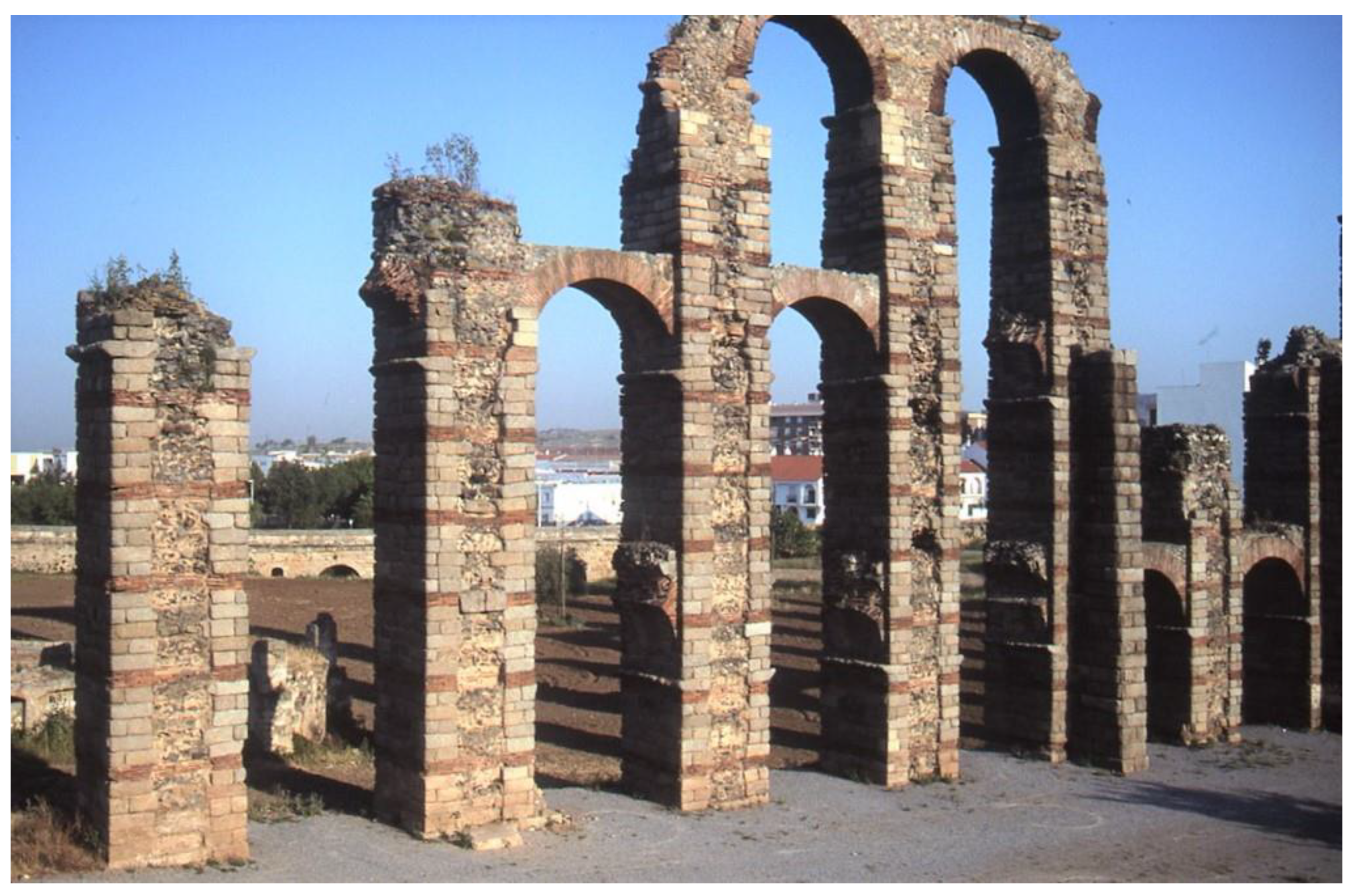
Figure 13.
A close-up view of the composite construction of the aqueduct bridge in Mérida. The buttress added after initial construction no longer exists.
Figure 13.
A close-up view of the composite construction of the aqueduct bridge in Mérida. The buttress added after initial construction no longer exists.
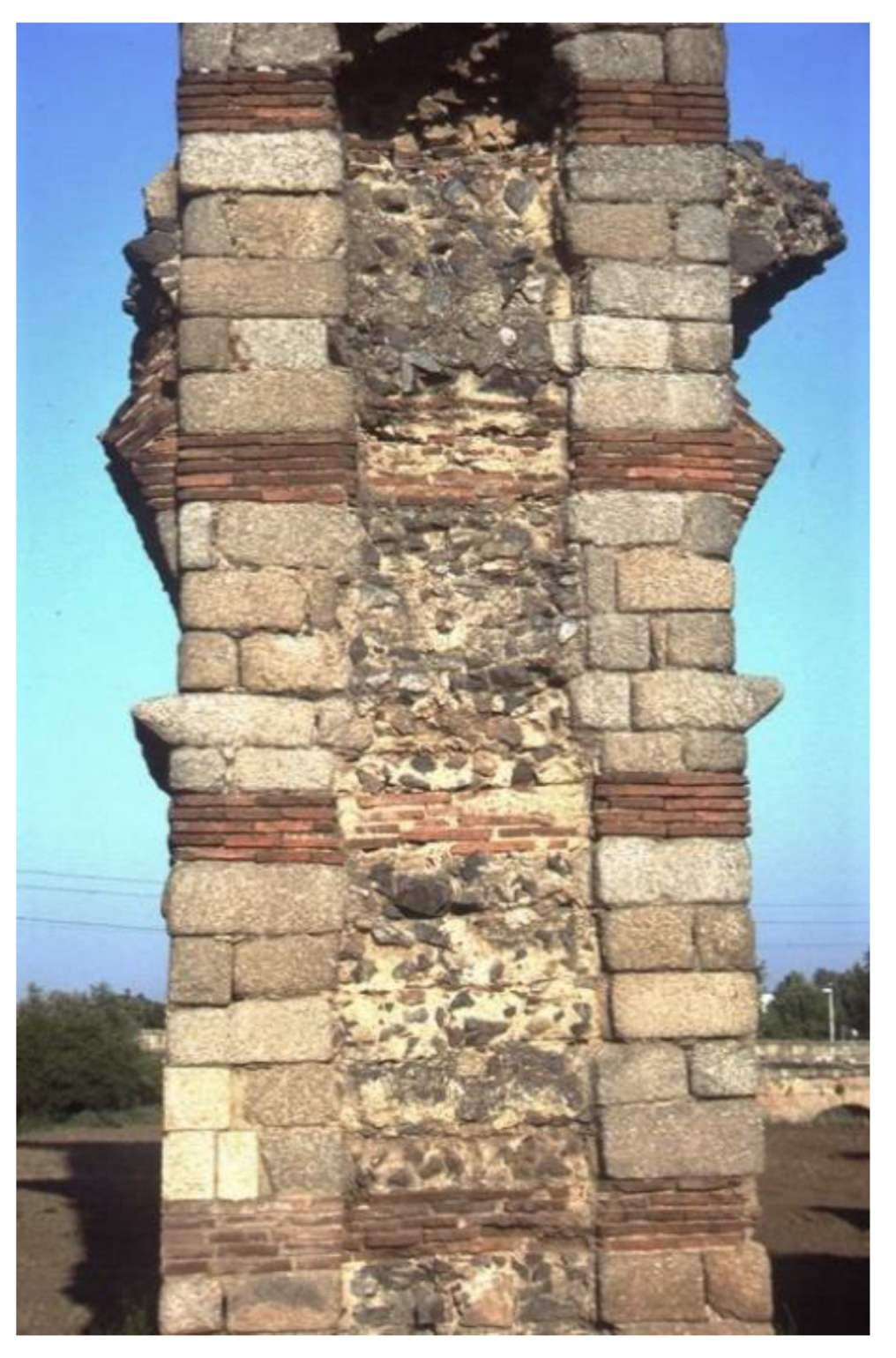
Figure 14.
Waters in the Generalife of the Alhambra in Granada, Spain.
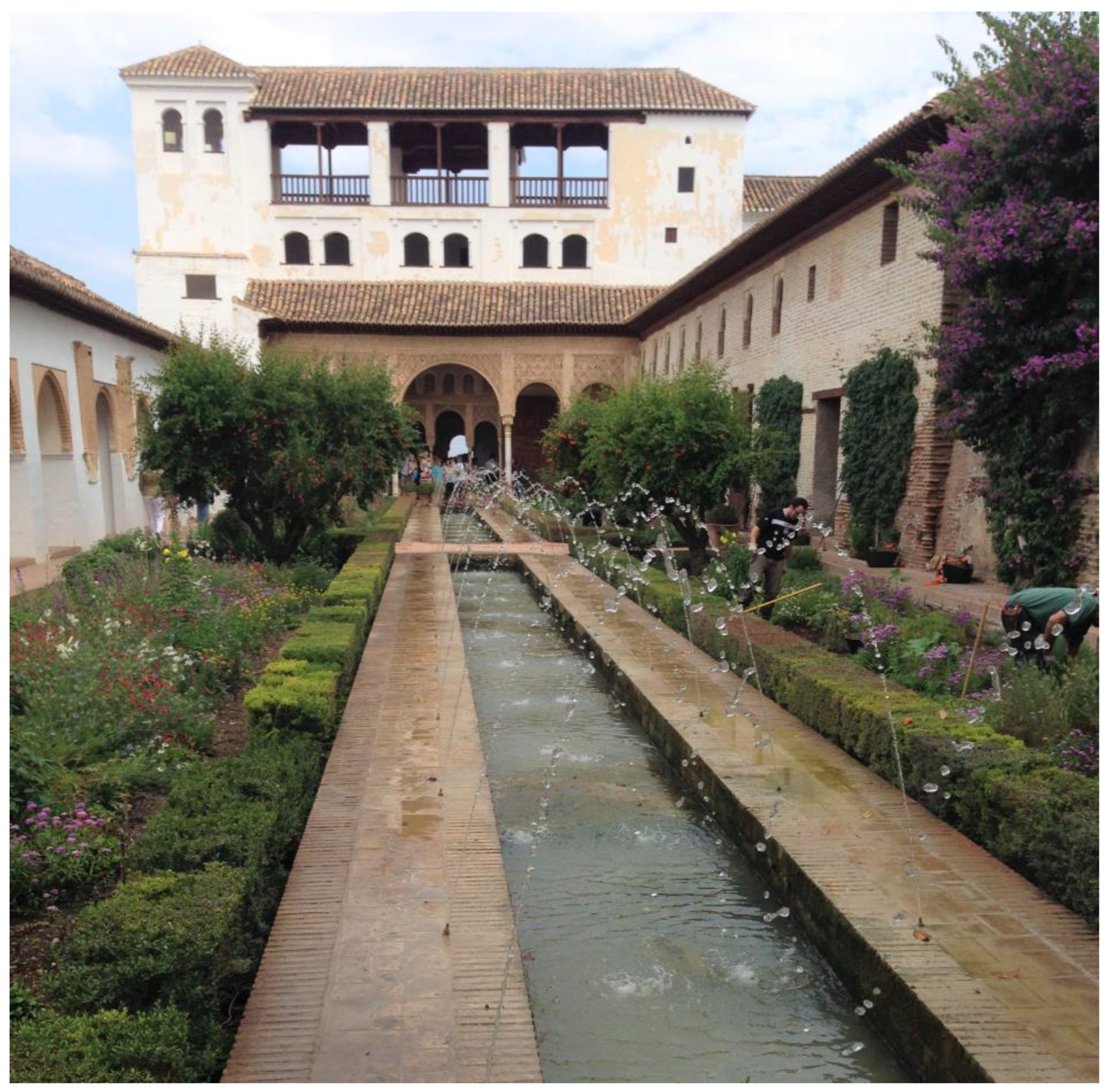
Figure 15.
The elevated aqueduct at the Alhambra.
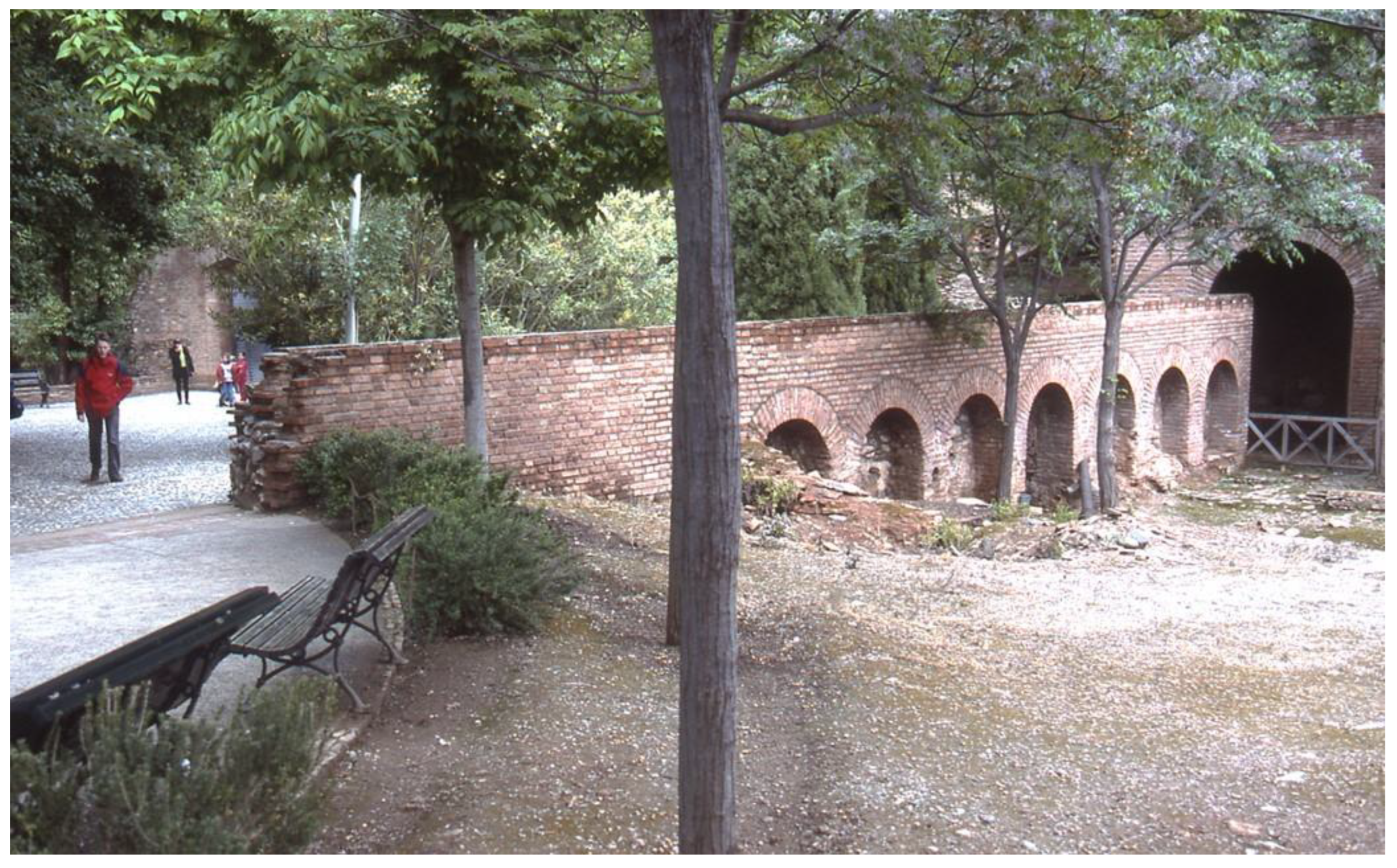
Figure 16.
The spring at Fuente Grande that supplied water to the Acequia de Aynadamar.
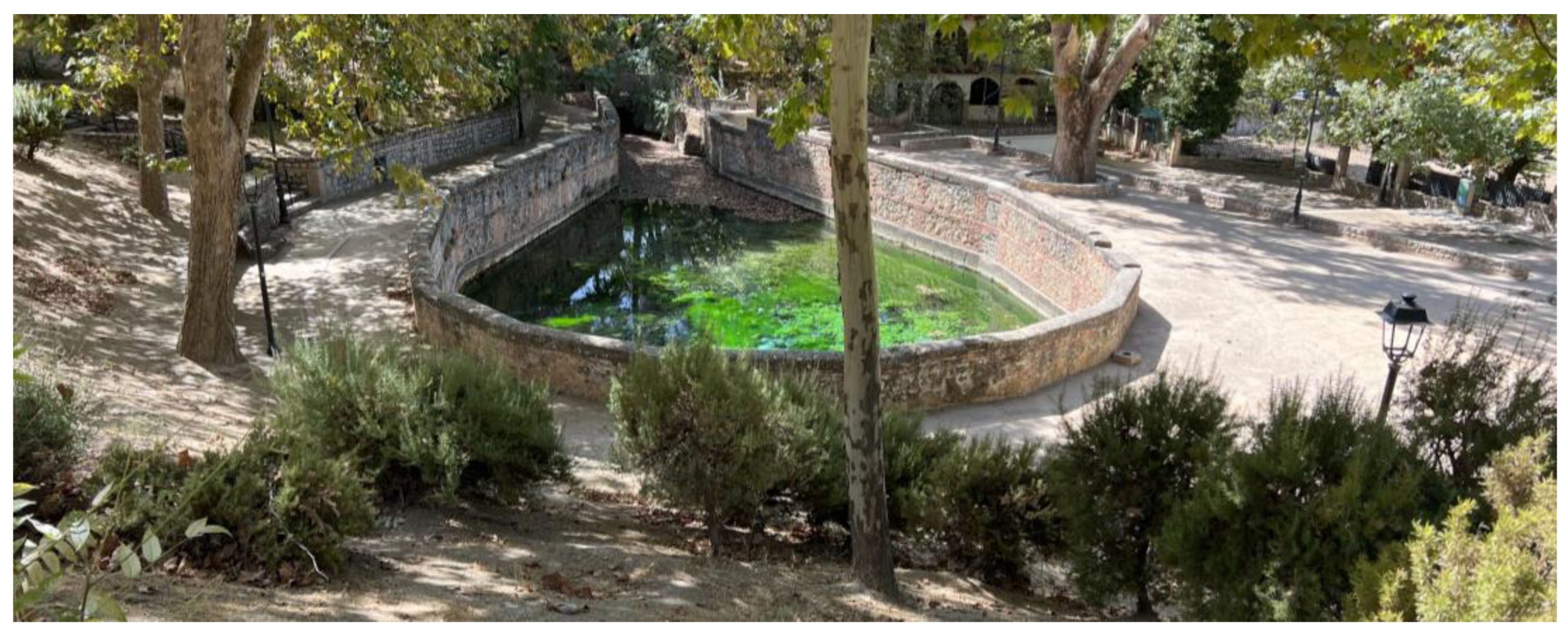
Figure 17.
A view of the aqueduct bridge at Viznar, with little vegetation and appearing much like a rock wall. Image by Javier Martin, in the public domain [36].
Figure 17.
A view of the aqueduct bridge at Viznar, with little vegetation and appearing much like a rock wall. Image by Javier Martin, in the public domain [36].
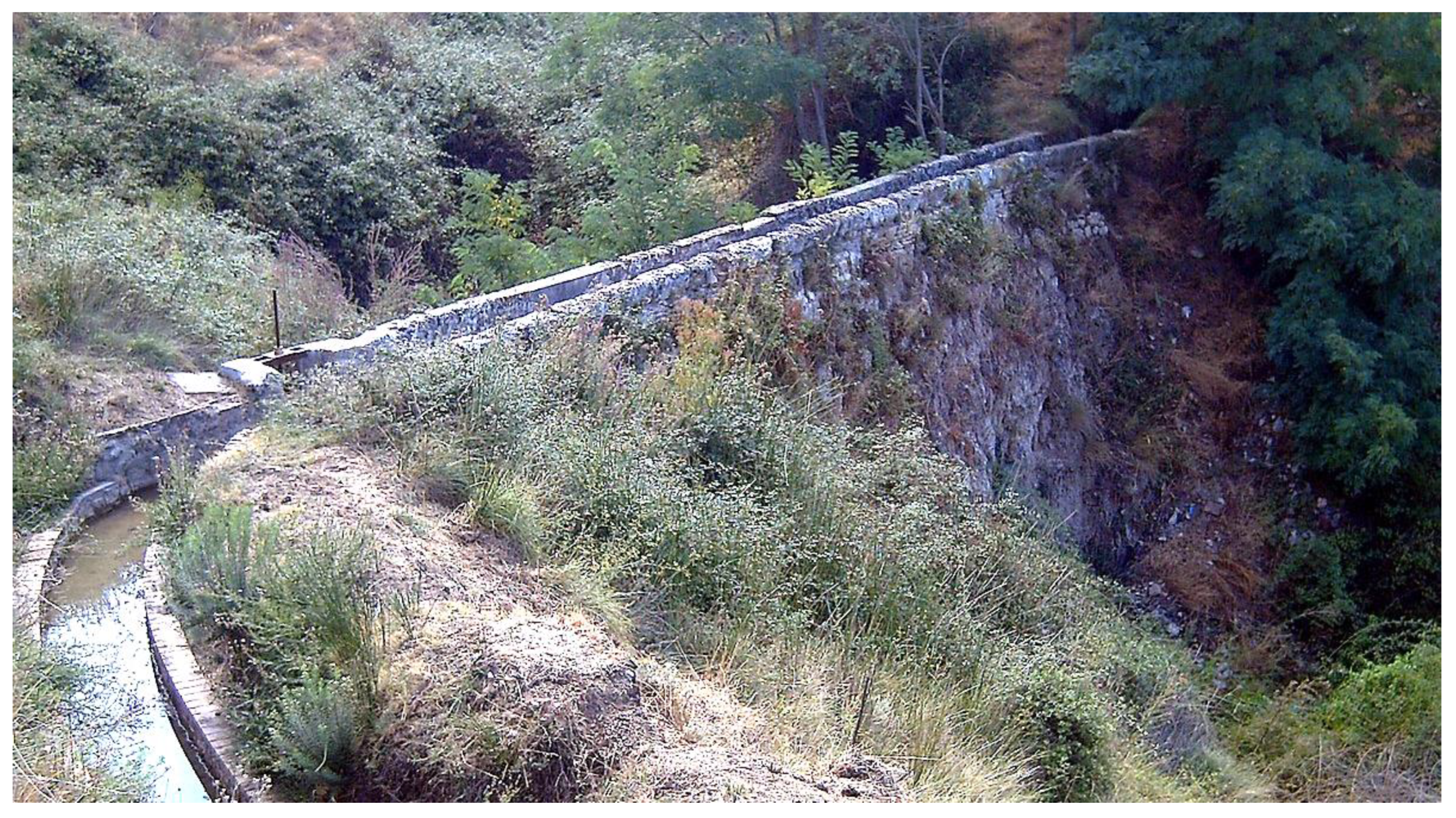
Figure 18.
The elevated aqueduct at Puerta Coeli. Note the various thicknesses of piers and the variable heights of the arches. Image by the late Karl W. Butzer, used with permission of his wife.
Figure 18.
The elevated aqueduct at Puerta Coeli. Note the various thicknesses of piers and the variable heights of the arches. Image by the late Karl W. Butzer, used with permission of his wife.
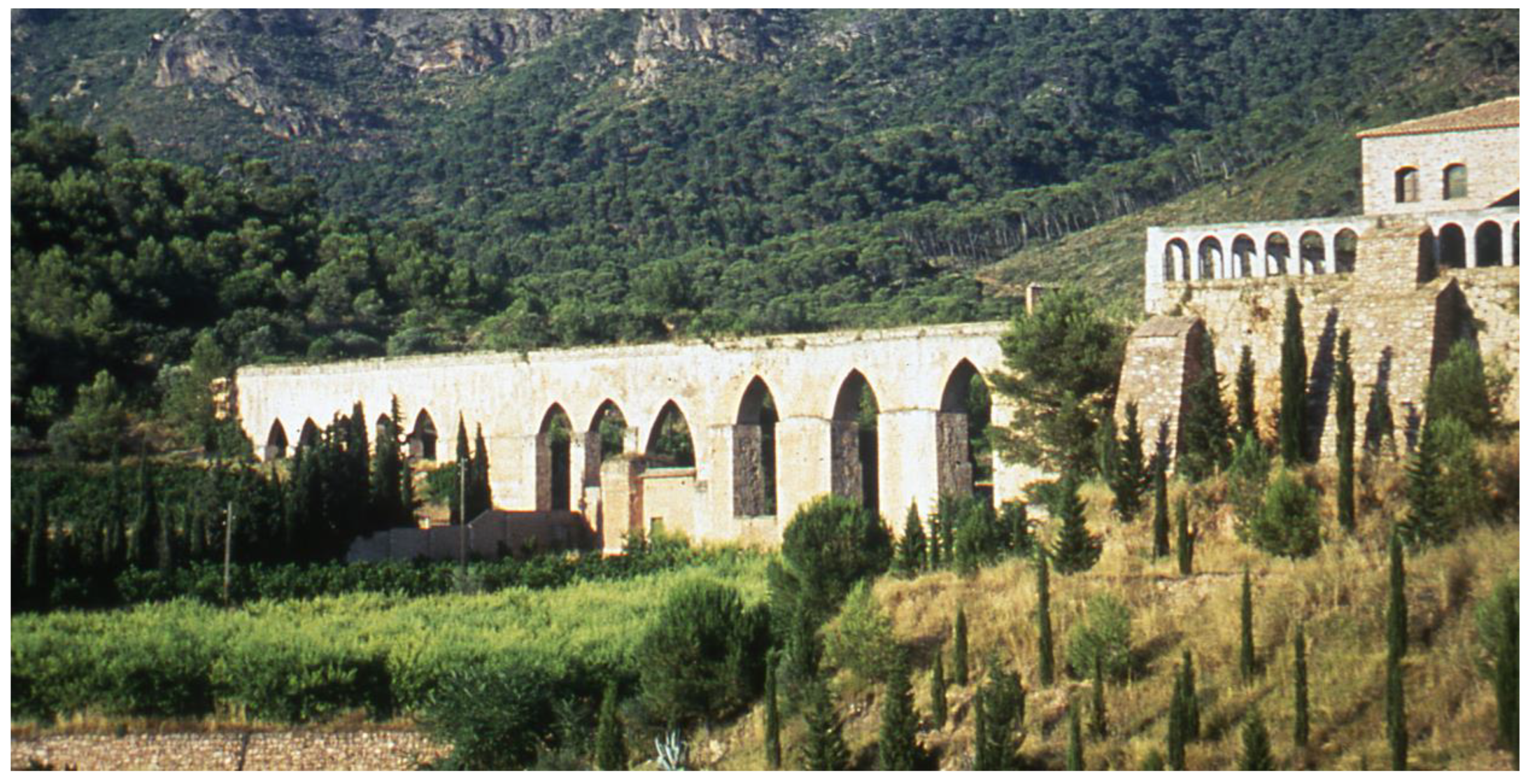
Figure 19.
A drone view of the west side of the elevated aqueduct at Porta Coeli from a YouTube video [38].
Figure 19.
A drone view of the west side of the elevated aqueduct at Porta Coeli from a YouTube video [38].
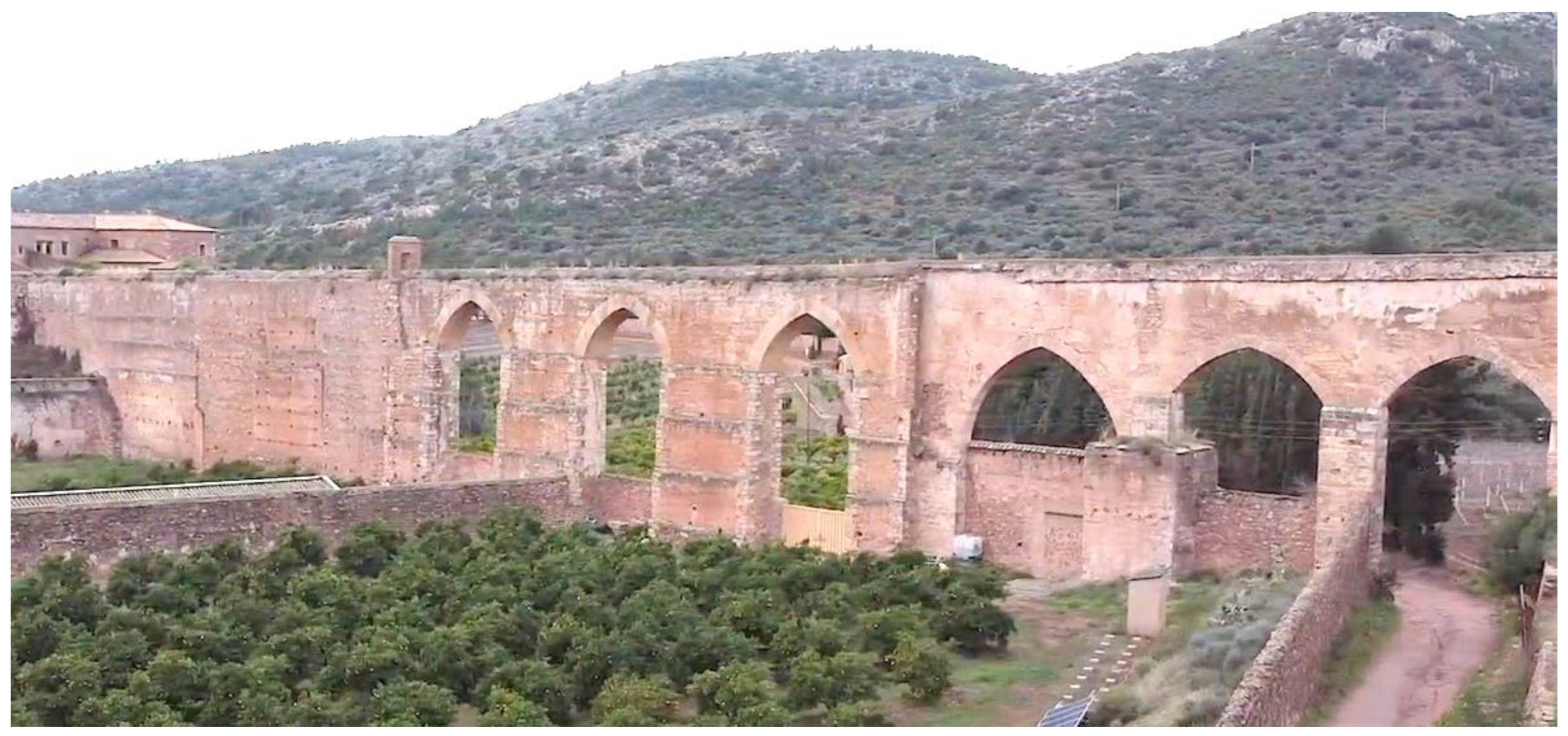
Figure 20.
A view of the section of wall where the arches have been filled in. Remants of a plaster coating are also visible. Image by the late Karl W. Butzer, used with permission of his wife.
Figure 20.
A view of the section of wall where the arches have been filled in. Remants of a plaster coating are also visible. Image by the late Karl W. Butzer, used with permission of his wife.
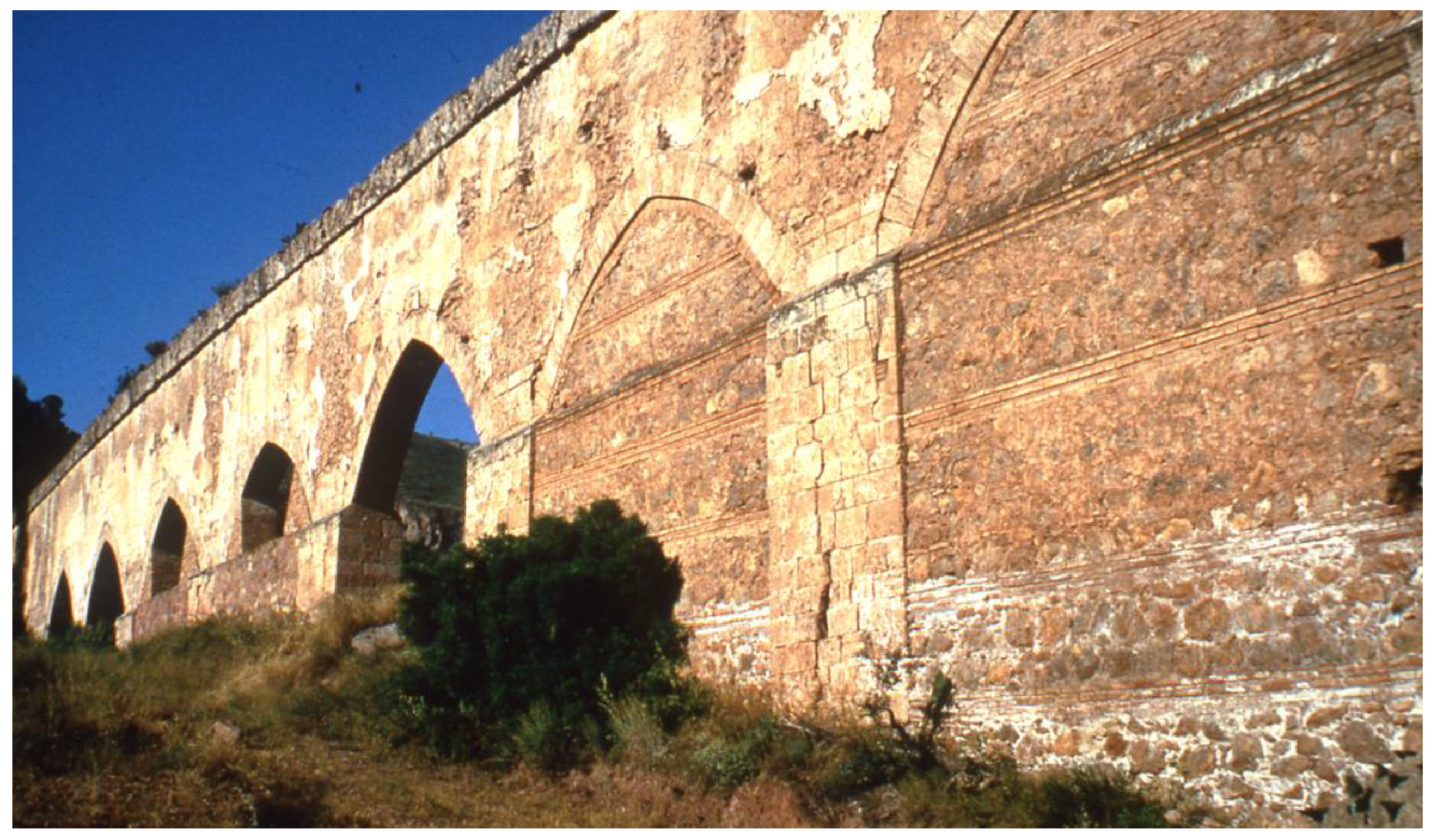
Figure 21.
The aqueduct bridge section of the Aqüeducte de Santa Llúcia, Morella, Valencia.
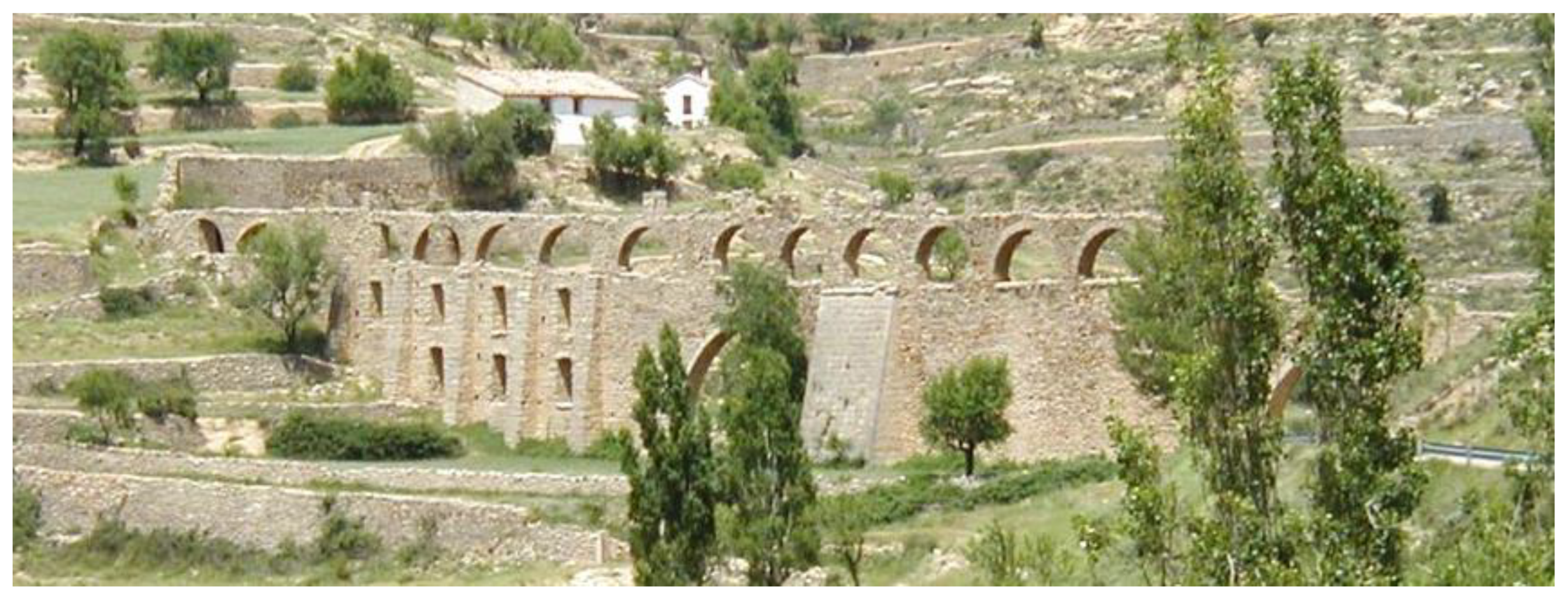
Figure 22.
A section of the elevated aqueduct at Morella that is wall-like with a large Gothic arch. Note the large section of exposed core on the right.
Figure 22.
A section of the elevated aqueduct at Morella that is wall-like with a large Gothic arch. Note the large section of exposed core on the right.
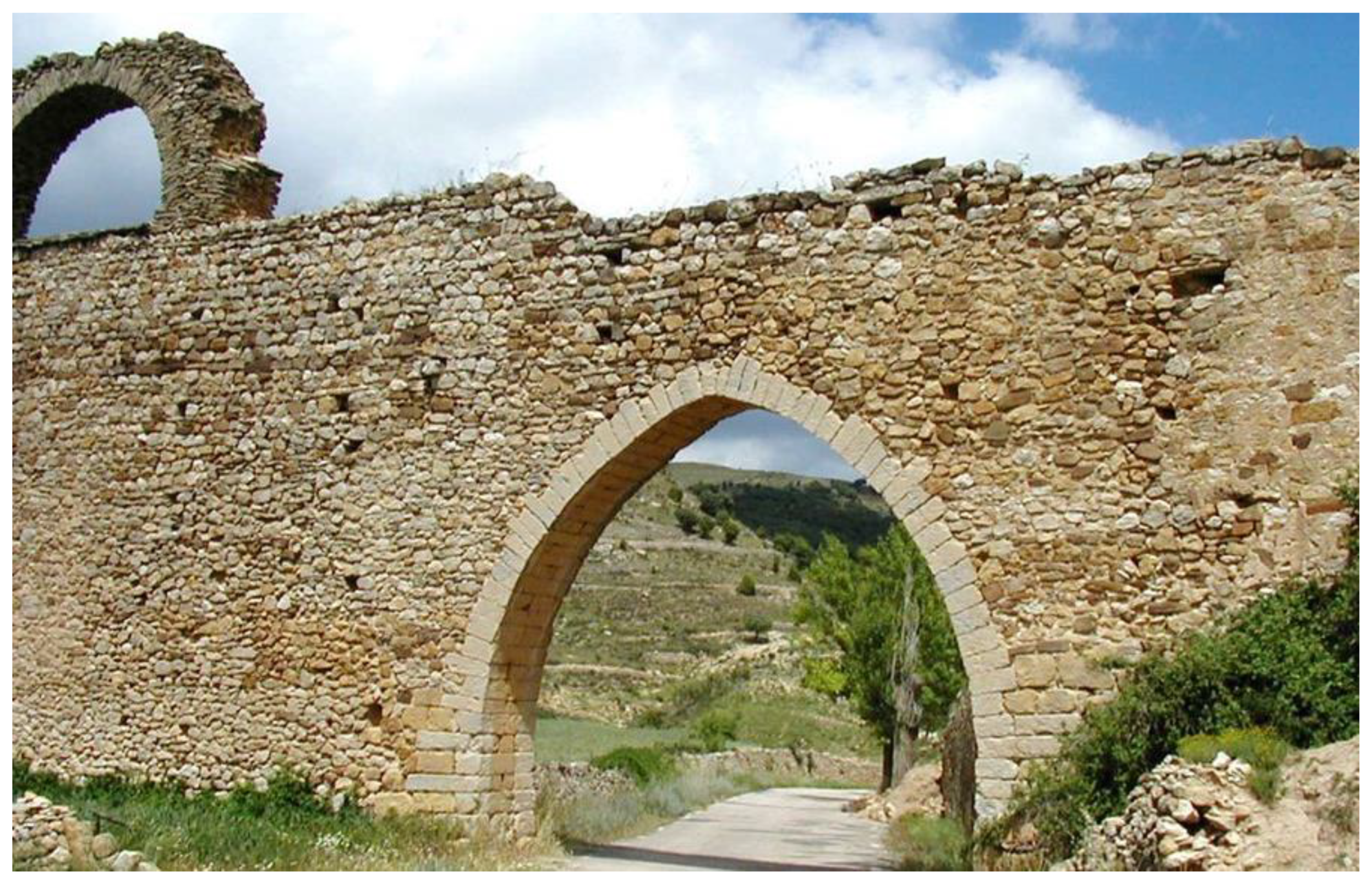
Figure 23.
A section of the aqueduct bridge at Morella. Note the buttresses that were added later, and the window-like openings. Centering was used in the arches along the top. The arch supports were added later.
Figure 23.
A section of the aqueduct bridge at Morella. Note the buttresses that were added later, and the window-like openings. Centering was used in the arches along the top. The arch supports were added later.
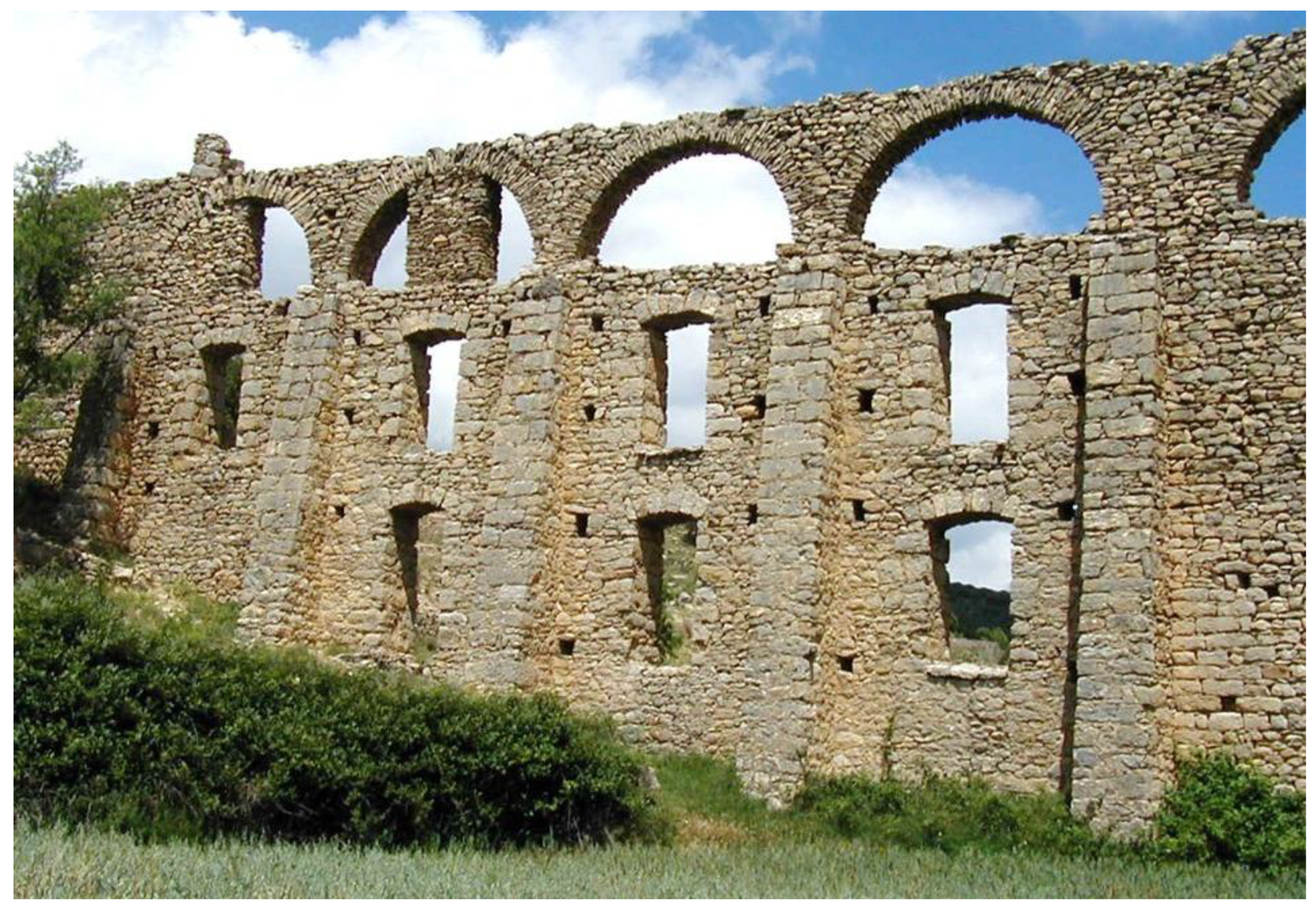
Figure 24.
A close-up view of one spandrel of the Morella aqueduct bridge showing reconstruction of two arches.
Figure 24.
A close-up view of one spandrel of the Morella aqueduct bridge showing reconstruction of two arches.
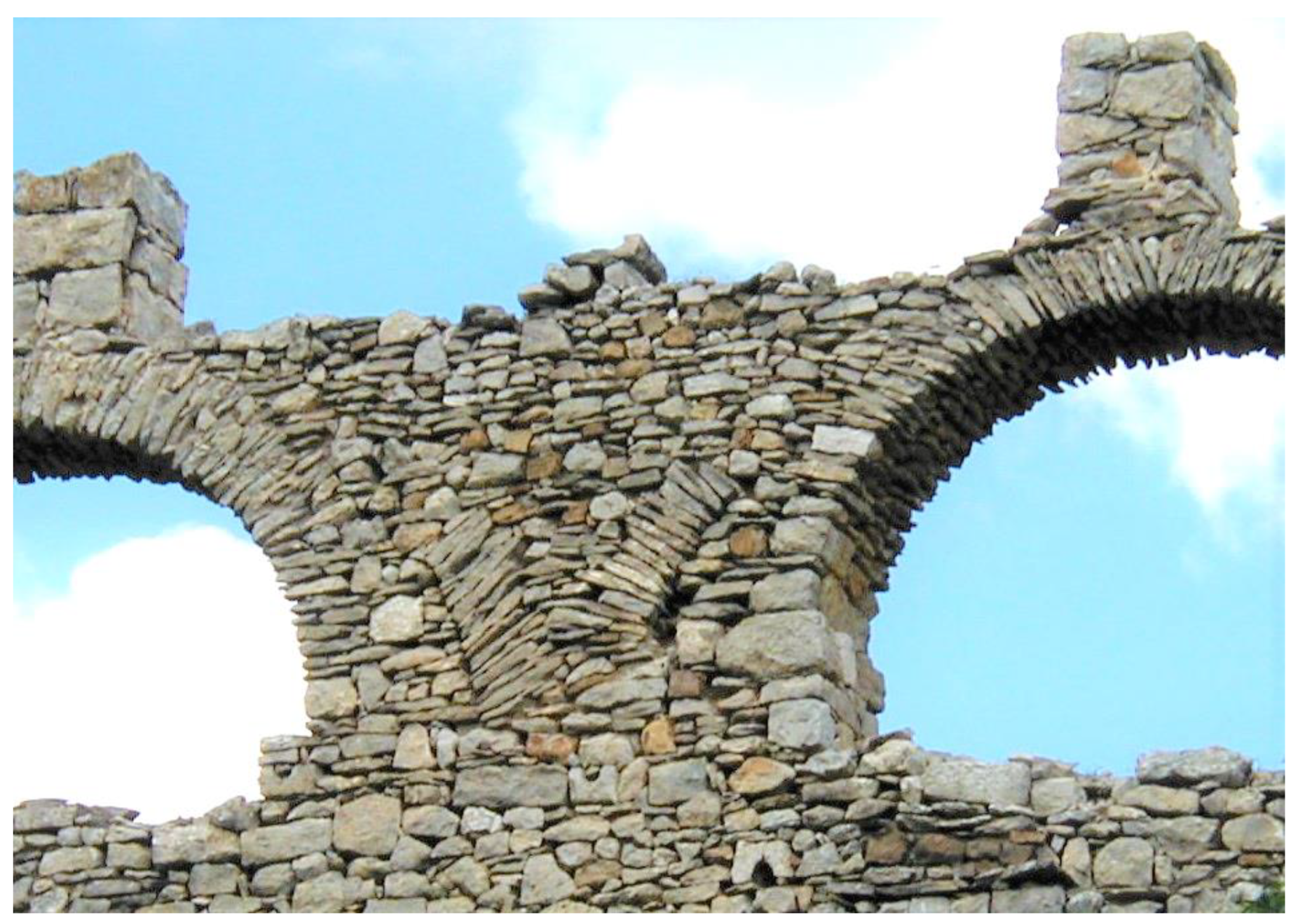
Figure 25.
A close-up view of one arch on the elevated aqueduct at Morella showing poorly placed voussoir due to not using centering during construction.
Figure 25.
A close-up view of one arch on the elevated aqueduct at Morella showing poorly placed voussoir due to not using centering during construction.
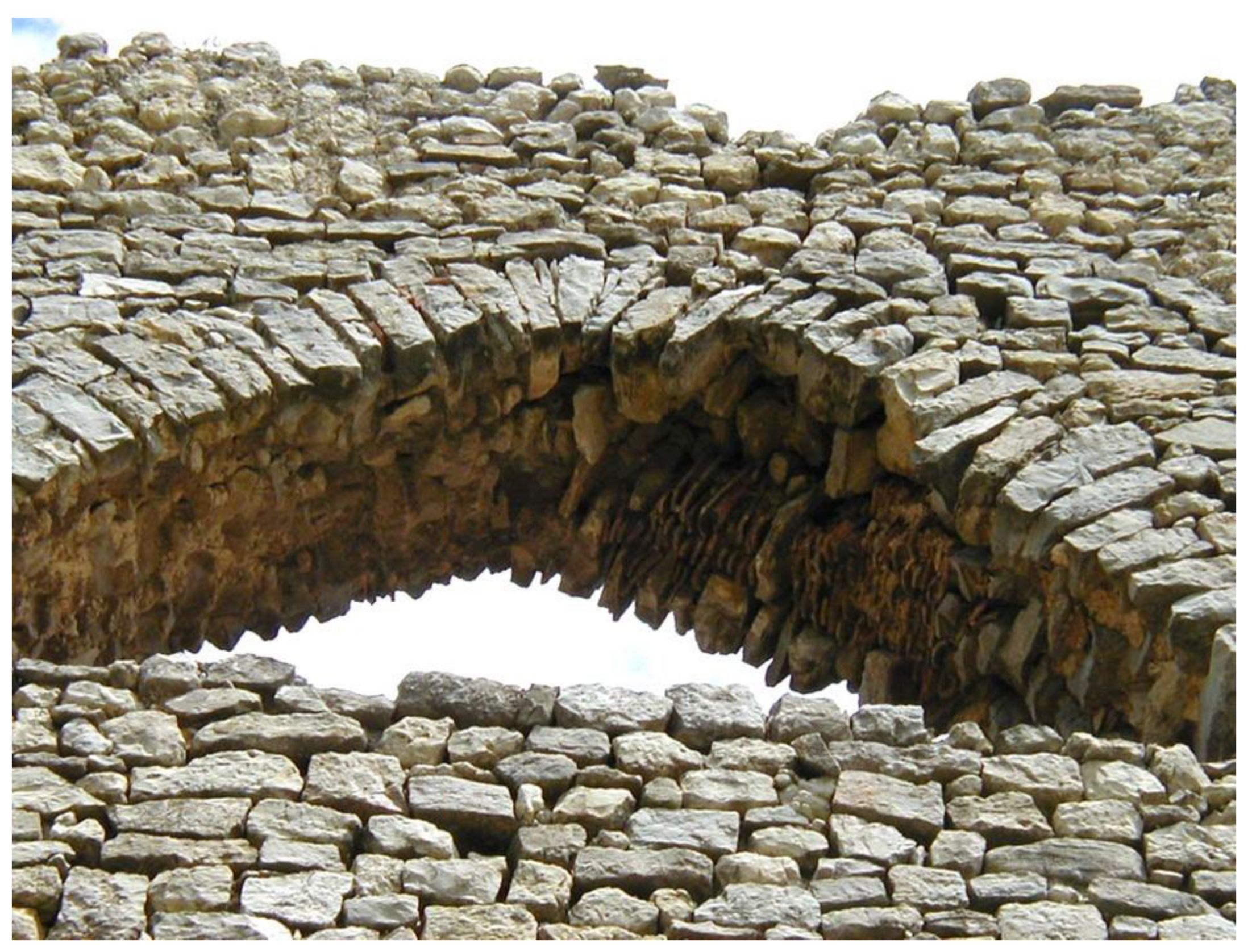
Figure 26.
The elevated aqueduct near Biar.
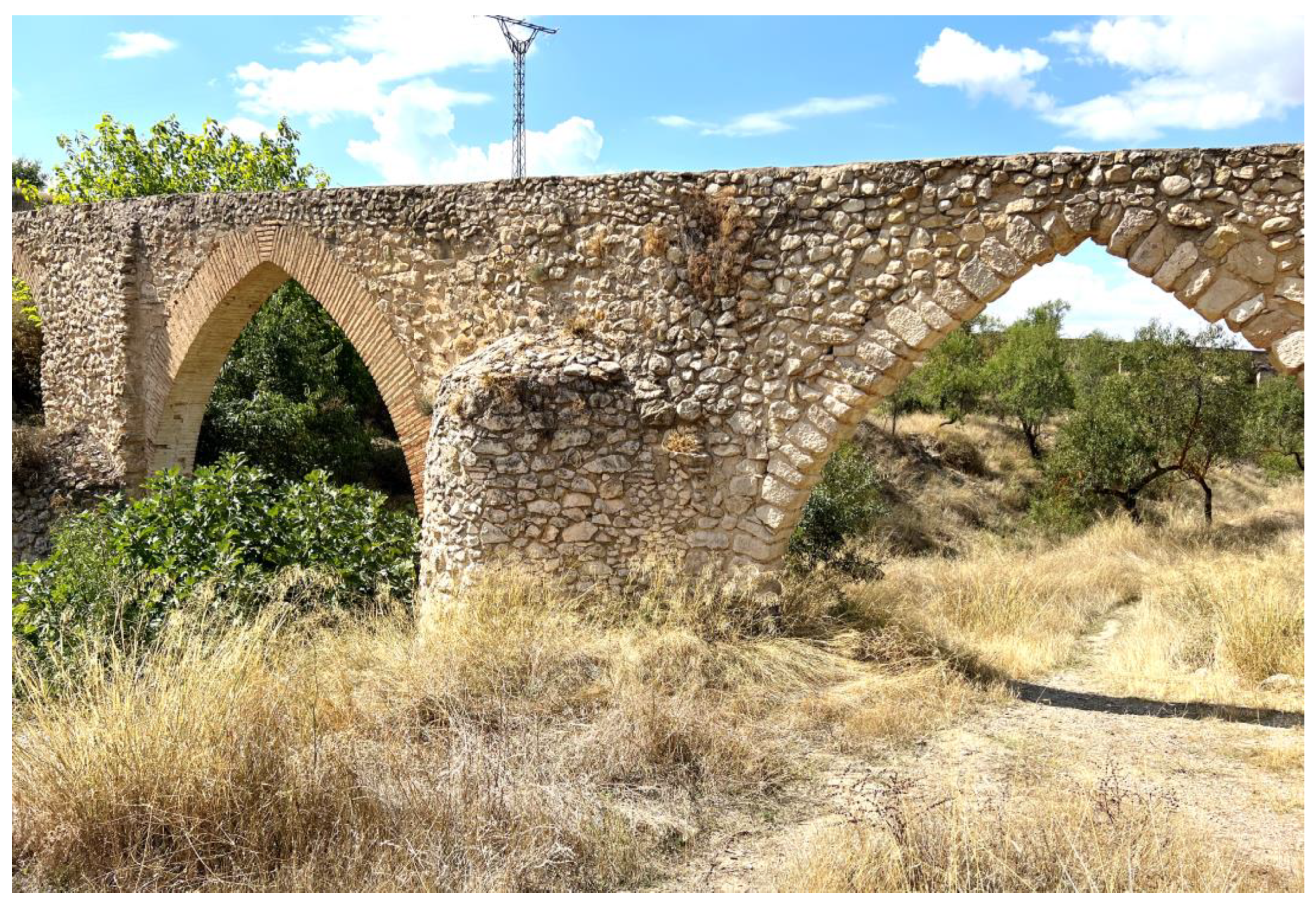
Figure 27.
A view along the top of the aqueduct bridge at Biar. Note the narrowness of the aqueduct bridge, its waviness, and buttresses.
Figure 27.
A view along the top of the aqueduct bridge at Biar. Note the narrowness of the aqueduct bridge, its waviness, and buttresses.
Disclaimer/Publisher’s Note: The statements, opinions and data contained in all publications are solely those of the individual author(s) and contributor(s) and not of MDPI and/or the editor(s). MDPI and/or the editor(s) disclaim responsibility for any injury to people or property resulting from any ideas, methods, instructions, or products referred to in the content. |
© 2024 by the authors. Licensee MDPI, Basel, Switzerland. This article is an open access article distributed under the terms and conditions of the Creative Commons Attribution (CC BY) license (http://creativecommons.org/licenses/by/4.0/).
Copyright: This open access article is published under a Creative Commons CC BY 4.0 license, which permit the free download, distribution, and reuse, provided that the author and preprint are cited in any reuse.


