

Submitted:
01 February 2024
Posted:
01 February 2024
You are already at the latest version
Abstract
Nowadays, it can be observed that all kinds of technology are gradually being incorporated to assist the human being in the performance of their frequent and daily tasks. Technological tools provide means to facilitate, improve, help and support any activity which, in itself, may be complicated, either because of the difficulty involved in carrying it out, or because the person carrying it out has limited capabilities due to the environment not being prepared for their abilities and skills. In this sense, Special Education is currently receiving special attention from researchers, especially those aimed at children. Although the proposals that have appeared recently provide perfect solutions to improve educational processes with ingenious didactic applications, there is still an interesting line of study on how to interact with these younger people in these educational processes. In this sense, haptic technologies can play a very important role, complementing all these solutions by incorporating tools that facilitate direct contact with people, especially in their initial stages, which are the most complicated. This paper aims to provide an overview of haptic technologies and how they present solutions that can be integrated into the aforementioned educational processes.
Keywords:
Childhood Special Education
; Haptic Technology
; Learning Process
; Educational Tools
; Pedagogical Rehabilitation
1. Introduction
Improving educational processes is an intrinsecally multidisciplinary effort involving pedagogy, engineering, psychology, art, medicine and electronics [1,2]. Some research projects, such as CybSPEED [3], try to address some of these aspects focusing on people (children) with special needs [4,5]. Despite the advances brought by this kind of projects, there are still limitations on the research of physical interactions in the educational processes [6,7]. People with special educational needs often require special interaction elements [8,9], due to underdeveloped sensory, behavioral or cognitive capabilities.
Specifically, haptic technologies have experienced a dramatic improvement in recent times, due to advances in computation and miniaturisation, that offer promises for new lines of study of ways to enhance the educational opportunities of people with special needs, overcoming the barriers to the direct educational experience [10,11]. The intention and degree of engagement of a person handling a haptic device can be induced from the pressure, grip, and vibration. Such contact quality evaluations do improve the understanding of the haptic interaction in some applications. For example, it is possible to assess the degree of certainty with which an object is selected.
First, this paper discusses some advances in Haptic techonologies and some related areas of technological research. Next, the paper discusses some applications that are becoming increasingly relevant, with a focus on special education. Finally, we provide a discussion and some conclusions.
2. Haptic Technologies and Related Areas of Research
Haptic technologies are concerned with the intensity, duration, location, displacement, and composition of contact sensing, including the generation of semantic representations of tactile sensory data. In related research fields, “haptic sensations” are described and treated as precursors of user-information, as in the work of Wojcik [12] where the importance of the sense of touch is studied in an application aimed at library services. Another important contribution is made by Cantoni et al. [13], where the authors offer a global vision of future learning systems, emphasising the visual component, but very generalist from the point of view of Early Childhood Special Education. More recently, works such as the one presented by Papanastasiou et al. [14] propose interesting reviews of the state of the art providing approaches and examples of new technologies, including haptics, to enhance students’ learning processes, but without special emphasis on those processes aimed at young people with Special Needs.The following are some of the disciplines that are closely related to developments in the field of haptic technology (Figure 1).
2.1. Artificial Skin
The human skin provides more information on the environment than the bare “touch” sense, including emperature, vibration, pressure (strength), and surface (area) of the objects. Specifically, sensing the temperature of the human skin allows to evaluate how active and confident a person is in performing some kind of educational task. In a recent haptic solution presented by Lu et al. in [15], a chemically induced skin heating system is used to represent increasing temperatures in a virtual reality environment. The École Polytechnique Fédérale de Lausanne (EPFL) recently presented in [16] a development based on a soft artificial skin that provides haptic feedback and can instantly adapt to the user’s movements.
We can enumerate some recent innovative proposals of artificial skin developments: (a) The solution proposed by Meta Reality Labs [17], which is exploring new configurations of haptic gloves to provide the sense of touch, including sensations related to texture, weight and stiffness; (b) An electronic skin that can restore the sense of touch through the fingertips of prosthetic hands developed by Tracey Reeves at the Johns Hopkins University [18]; (c) The light based contact detection proposed by Piacenza et al. [19], which offers an imaginative alternaive solution to the problem of integrating touch devices into robotic hands; and (d) the novel wearable device presented by Schiatti et al. [20], suitable to be used to investigate perception in interactive tasks, on individuals with and without sensory disabilities, among others.
2.2. Artificial Vision
The sense of vision does not really have a specific haptic character, however artificial vision techniques can significantly improve the development of haptic solutions by providing complementary information on certain behaviours of the user (position, gesture, approach or rejection, etc.). In this regard, the work presented by Romeo et al. [21], where the guidance of people with visual impairments is carried out with an innovative mobility assistance system, called MAPS, which provides assistance to two main functions of navigation: locomotion and wayfinding. This idea could be transferred to specific learning processes to facilitate the way in which young students with special needs interact with learning agents in the environment. This field is so advanced that it is possible to find proposals such as the one presented by Wan et al. in [22], where an innovative sensory system collects optical and pressure information from both a photodetector and a pressure sensor, then transmits the bimodal information through an ion wire and integrates them into postsynaptic currents to the brain.
2.3. Artificial Hearing
Fusion of artificial hearing, based on acoustic data processing, with the haptic data can produce relevant information on the person attention, engagement, and intention during educational processes so that assessment of educational progress can be made more objtective. An innovative boozer presented in [23] can be used, for instance, to elicit small stimuli at low frequencies (up to 150 hz) in order to create a signal activation in a very specific context, either to induce attention or to stop a hyperstimulation condition suffered by a student under stress. In a similar approach, David Eagleman presents a device called Sensory Substitution [24], which is based on a non-invasive technique to provide information about the environment to deaf people by means of a waistcoat of his own design that provides the user with this information through small vibrations on his skin.
2.4. Physical Models
Innovative haptic devices are simulating a wide variety of tactile perceptions. In the University of Chicago, Jasmine Lu’s research team is working on a new haptic development that, by delivering stimulus-generating liquids to the user’s skin, creates different sensations [15]. In fact, they have identified five chemicals that can produce the same number of sensations: tingling (sanshool), numbing (lidocaine), stinging (cinnamaldehyde), warming (capsaicin), and cooling (menthol). Even if this kind of tactile solution is not really a completely non-invasive technology, it can be considered to improve the stimulation or attention of students in special learning processes.
An interesting early approach was made by Spencer et al. in their work [25], where they highlight the important role of the sense of smell during both diagnosis and surgery in a medical setting. These perceptual sensations could be studied and introduced into innovative device designs or methodologies, in order to enhance special learning processes based on haptic integration. In other fields, such as art, recent studies present haptic technology as a step towards intensifying the perception of the environment when viewing works of art. In the work of Vi et al. [26], they present the HCI solution named “mid-air haptics” as a unique and first time case study for introducing all senses (i.e. smell, sound, touch, vision, and taste ) into the design of artistic experiences.
Air currents can be used in order to control the environment in special needs education settings, which can be critical because sensation related to air currents can be relevant for the comfort of the subjects. In this respect, an interesting study, presented by Takei et al. [27], began to investigate how to detect wind intensity using highly sensitive electronic whiskers. All of them are new research alternatives to find interesting haptic solutions, trying to reproduce Nature’s behaviour in examples far away from educational solutions, but which can offer new ways of dealing with a more complete haptic environment to enhance communication and interaction with children with special needs.
3. Haptic Applications
A quick perusal of recently developed areas of application of haptic technologies can be enlightening its potential for applications in education with special needs, having in mind that fine tuning of the interaction of students with the environment is critical for the learning process.
3.1. Medicine
Haptic solutions for medical skills training have been recently developed in many areas such as Surgery, Cardiology, Oncology, and Diagnostics. Most of them are wearable solutions improving the perception process, in different contexts, for people with some kind of disability (Figure 2). A first example is the work of Schaitti et al. [20] where they present a suitable wearable device composed of small units embedded with actuators that provoke stimuli (haptic, light, and sound) to the users and sensors to record the users’ responses. More advanced solutions can be found, such as the advanced physical suit proposed by Teslasuit [28] that gives haptic feedback and captures movement and biometrics. Other works bring together a broad collection of the most relevant technological challenges, such as suitable haptic hardware or haptic eLearning systems, analysing the resources needed to implement real solutions. The contribution of Hamza-Lup et al. [29], for instance, studies the influence of haptic feedback and the synchronisation of rendered haptics to improve user learning capability.
In terms of functional solutions in any of these areas, the appearance of proposals based on haptic devices is a continuous stream. As shown above, EPFL has been working on a soft and flexible artificial skin made of silicone that could help improve medical rehabilitation processes, which provide haptic feedback to perceive and interact with the world around the user [16]. In the same line of research, Deakin University presented a groundbreaking development, integrated into its HeroSurg robot [30], to give surgeons the sense of touch while a robot is driven via a computer to perform minimally invasive surgery. Although more invasive solutions are not the focus of the objectives set out in this work, some approximate ideas can be extracted from developments such as the one presented by Oh et al. in [31], where a remote touch system is created to reproduce tactile stimuli in the user by means of electrical signals induced in the nervous system with special magnetic synapses.
Haptics have been included in multimodal virtual reality (MVR) systems for medical training, for instance in obstetrics where haptic expert knowledge can be transferred to the student [32]. Haptic feedback is a fundamental element of neurosurgery training simulations [33,34]. Further fusion of high resolution (8 Teslas) magnetic resonance imaging data with haptics allowed high resolution bone simulation in dissection for training of otologic surgeons [35]. The value of haptic feedback has also been widely recognised in endoscopic training, specifically endoscopic neurosurgery [36] and laparoscopic surgery [37], allowing automatic evaluation of the performance of the trainee [38]. Moreover, haptic microlaryngoscopy simulation training and web module has been also positively evaluated by trainees [39]. Additionaly, some experiences show a positive effect of force feedback interfaces in neural rehabilitation processes [40].
3.2. Games and Gamification
New game interaction proposals based on inside reality laboratories, such as the Meta solution [17], have become perfect tools to interact with the user and enhance the process of sensing, which opens new frontiers to develop advanced solutions in fields such as Special Education. Tesla’s solution [28] is another clear example of how advanced haptic technology is in some areas, offering a wide range of solutions such as suits and gloves. Nowadays, in a more general framework, it is possible to find communities where new proposals and ideas are exposed in the haptic world, as is the case of Hapticast [41].
Advances in game technology are inspiring for education process design. Haptic technologies play a substantial role in the gamification of educational contents. For example, Teenage Engineering has developed a Rumble subwoofer for one of the newer synthesizers, the OP-Z [23]. This sound haptic device can be inserted into a pocket thanks to its miniaturization, offering a tool whose technology can be transferred to another type of solution focused on learning processes. Another interesting experience is the one developed by the researchers and professors who collaborate in the Tec Monterrey CyberLearning & DataSciences Laboratory, located on the Mexico City Campus, where through multimodal tactile interaction they have improved the teaching-learning processes [42].
3.3. Services
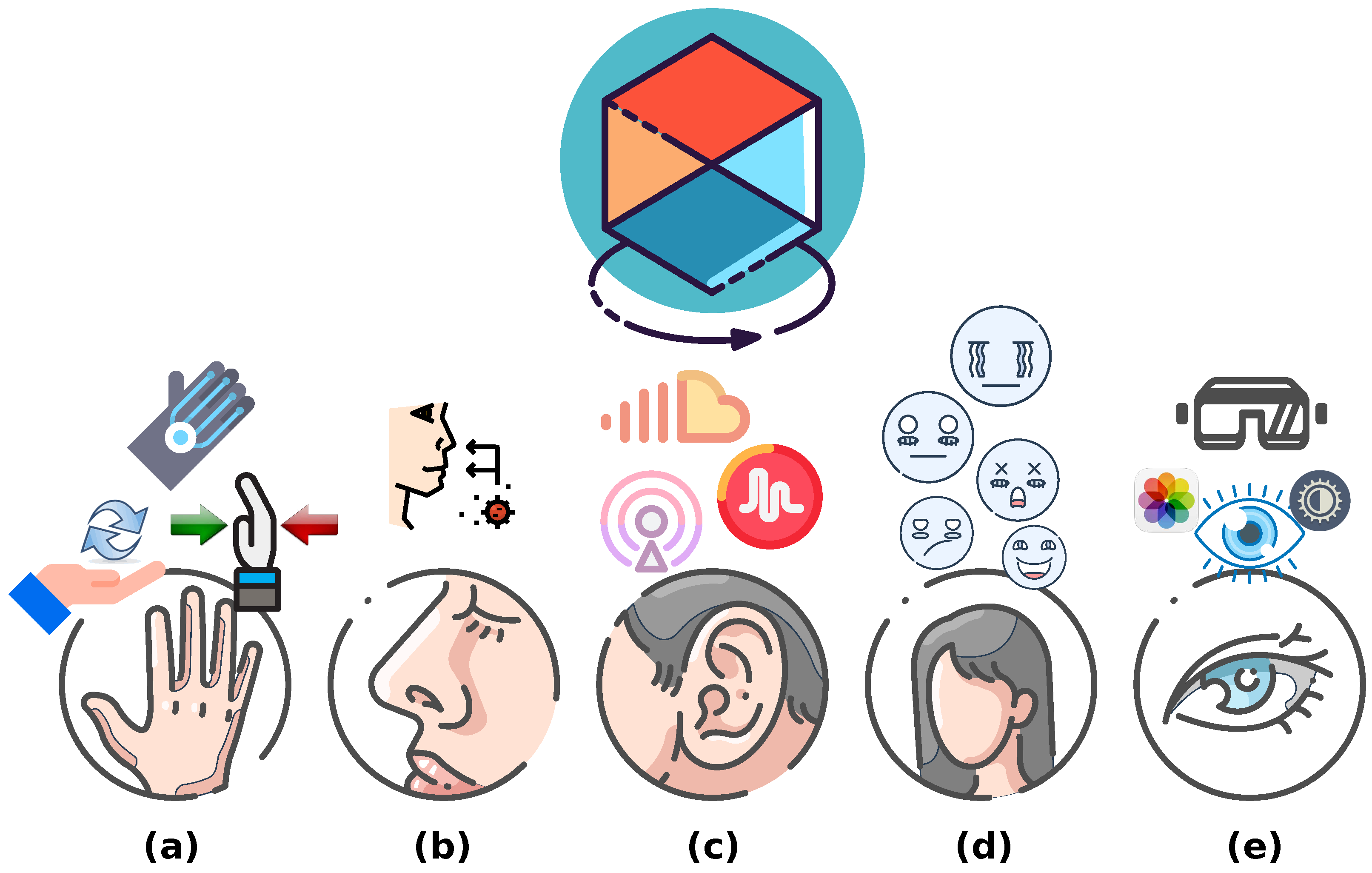
The digital environment (Figure 4) is full of tools that enhance interaction and decisions, including haptic devices. A recent work on haptics, presented by Van-Baelen et al [43], reveals how to increase the user’s awareness of an enveloping protection system. This work describes in detail how haptic feedback works and when it is activated. The user can obtain five signals: firstly, a discrete force signal when approaching the limits of use; secondly, an increased spring coefficient for control deviations at positions closer to the limits; thirdly, a shaking action for low speeds; fourthly, a movement adapted to the desired control input; and finally, automatic operation when the limit conditions are exceeded. Developing non-invasive and non-intrusive solutions will improve sensitivity to people with special needs in educational processes.
3.4. Rehabilitation
In rehabilitation, haptic devices help patients to improve their motor and sensory apparatus, either through assistance to movement realisation or in the environment perception. Solutions such as “e-dermis” [18] and “SPA-skin” [16] have very useful features in relation to some sensations such as pain, pressure, temperature, etc., which through peripheral nerves manage to produce sensations to the brain. Whether such advances can be translated into the field of special education will open a broad avenue of research.
3.5. Personal Assistance
Haptic technologies also play a big role in the development of assistive technologies for people with disabilities during their everyday tasks. There are some non-intrusive solutions that improve the lives of people with disabilities, such as “WeWalk” for the visually impaired that vibrates to inform the user of low obstacles that the bottom of a cane often misses [44], or “Sensory-Substitution” that circumvents the loss of one sense by feeding its information through another pathway [24]. Instead, there are other more invasive solutions that produce sensations by eliciting nerves, such as the work of Oh et al.[31] stimulating the nervous system via magnetic synapses, or the “e-dermis” proposal shown above [18] using transcutaneous electrical nerve stimulation.
Emotion detection and interpretation is deemed to play a big role in assistive technologies, because emotion can drive unexpected reactions and made assistive platforms to fail. Measurement of stress is by no means trivial matter and can be critical for successful interventions. These concerns translate also to the area of education with special needs, being unaddressed up to this time.
4. Haptics in Special Education
The interest in haptic instrumentation for the educational rehabilitation of children with special needs arose in the beginning of the computer era with proposal specific for the treatment of children with retarded mental development [45], following the early recognition of the role of active and passive touching in the process of building the perception of real objects [46] even for toddlers [47]. Children with developmental coordination disorder have more difficulties to appreciate the size of rods by pure haptic sensation [48]. For instance, variations of intelligence tests for visually impaired children were developed based on early haptic interfaces [49] which were soon proposed for virtual reality experiences by blind people [50]. It is becoming evident the importance of touch to the point that may overcome limitations on a priori knowledge, such a shown in an experience on children recognising familiar and unfamiliar objects [51]. This goes up to the proposal of a new kind of medical approach, so called Haptic Medicine [52], where touch can be part of curative treatments. So why not of education for children with special needs?
Motor deficits have negative impact in academic performance at various levels. A critical motor skill that can not be underestimated is writing. Haptic feedback proved to be helpful in the acquisition and improving of hand writing skills [53] for children in early grades. Concerns on the development of this kind of skills are growing in recent years due to the pervasiveness of screens so new gaming applications are proposed to engage the children [54]. The computer aided training to perform repetitive tasks required for handwriting learning has evolved to the extent that robotic systems are being proposed for routine skill improvement in children with motor difficulties [55], and for special education in general [54], due to the possibilities to tailor the training process to the specific idiosyncrasy of the child. Diverse kinds of haptic assistance ( full haptic guidance, partial haptic guidance, disturbance haptic guidance) can be applied and have found to be specifically useful for different tasks [56]. In fact, it was proven that the combination of visual and haptic interface improved the visuo-motor skills [57], and the spatial coding of objects [58]. Also, training the compliance on 3D haptic tracing tasks did improve 2D drawing abilities of children with motor difficulties [59]. As haptic perception is altered in cases of children with developmental coordination disorder [60] and children with developmental language disorder [61], the possible improvements that can be achieved by robotic assisted haptic training are of high value. Incidentally, table tennis has been found to be very helpful for such kind of children [62].
Even gestures that are equivalent to virtual subjective haptic representation of the manipulation of the objects appear to have some influence on the knowledge about the object [63]. This relation between vision, gesture and haptics has been demonstrated in the trainig for the reinterpretation of visually ambiguous images [64,65]. The image mental model seems to be influenced by the motor models constructed by gestures and/or haptic interface interaction. The relation between language and motor models of the objects has been found to evolve with age [66] providing new clues on the evolution of fragility and some guides to the use of haptic devices to assist in healthy aging research. Also, in the early ages from 16 to 18 months it has been found an evolution of the correlation between visual and haptic responses that indicate an evolution of world knowledge representation [67]. Over a greater span of ages, from 3 to 85 years, a brief assessment has found increasing accuracy in body mental representation from childhood to young ages, slight decrease from young to older adults, and significant differences among adults and old adults [68].
The interaction with the touchscreen where diverse patterns of tapping and dragging objects reveal diverse degrees of maturity in children [69] can be considered an specific kind of haptic experience that is very easy to measure for scientific purposes. Tactile stimulation (i.e. vibration of a smartphone) can be used, for instance, for covert interaction with subjects of special education reducing embarrassing public interactions [70]. Touch-vision interaction can be both ways, for children with visual impairment, the haptic training can be enhanced with their limited vision capabilities [71]. It has been found that children with visual impairment have a deficit in the motor representation of actions and objects [72], wich can be treated with haptic assistants. A repertoire of haptic based applications for middle school students with visual impairment was recently developed and introduced experimentally in the classroom [73] to assist in the study of scientific and mathematical topics. For blind children, recent studies show the value of haptic virtual reality for teaching complex abstract concepts, such as 3D shape geometry [74]. A recent review [75] shows that also children with hearing impairment can benefit their psychomotor development by the use of computer aiding systems including haptic interfaces. For deafblind children, a haptic assistant allows more independent horseback riding therapy [76].
Unfortunately, the current design of “educational” apps for tablets and mobile phones do not encourage writing skills and their corresponding visuo-motor development [77]. The pervasive presence of screens has a proven influence on the performance of mental’s imagery [78]. However, the fusion of haptic information and movement has a principal effect in the embodiment sensation in virtual reality for children [79]. On the other hand, open source haptic devices for educational purposes that can reverse these trends have been proposed in the last years [80]. The human robot interaction opens new avenues for educational interactions, simple games like joint clapping hands [81] can have a therapeutic effect on children with developmental syndromes.
The use of virtual reality techniques, specifically using haptic devices, has been considered for some time for several conditions such as Autism Spectrum Disorder (ASD), attention deficit hyperactivity disorder (ADHD), and cerebral palsy [82]. They can be applied as diagnostic assistant tools in some cases such as ADHD, and as assistants for treating the condition, however, research is still in its infancy. For example, the study of how ASD children regard agency and reward has been carried out using games in tactile platforms [83]. From a commercial point of view, a plethora of apps are in the market targeting ASD children, though most of them are of little value [84] even if they claim the use of artificial intelligence techniques. However, haptic modeling of objects have been found more acurate in a small cohort of ASD children [85] that follow similar strategies as neurotypical children. A similar result was found in haptic to visual delayed shape matching in a cohort of adult ASDs [86] contrary to expectations. Additionally, higher functioning ASD adults have found to violate a central expectation in behavioral sciences, the so called Weber’s law, in several perception tasks, including haptic weight discrimination, pointing to specific diagnostic/treatment tools in the future [87], such as improved hand-eye behavior quantitative measurement for the evaluation of interactive tasks [88]. Such robotic based systems can be deployed in experimental settings as well as in more natural environments, such as the classroom for more inclusive educational policies. In this direction, haptic devices have been useful also to help childrens with ASD to transition between ocupational therapy tasks [89], which can be shared with neurotypical development children.
5. Discussion
In this work, a large part of the innovative scientific contributions that exist in the field of haptics technology have been presented. Although it is not an exhaustive work on the state of the art of Haptics, as there are many works that have gathered this information in a more detailed way, the main objective of the work presented is to highlight the great potential of all the haptic variants to reinforce learning processes in education, particularly those aimed at children with special needs, such as children with autism spectrum disorders (ASD).
The aim of this paper is to direct the attention of the scientific community so that developments in the field of haptic technology are directed towards solutions that reinforce the aforementioned learning processes, incorporating methods and devices supported by Haptics that manage to improve the processes of communication and interaction with these children. It is known that for children with special needs (such as ASD children), due to their reduced communication skills, it is especially difficult to gain their attention and maintain a traditional education and learning standards and that conventional educational processes are not useful. For them, educational technology developments based on haptic solutions can offer new possibilities to keep these communication channels open.
The different haptic solutions presented in this work could be useful, both in terms of reinforcing the communication channels by getting the children’s attention in a more specific way, using tactile solutions that allow them to empathise more efficiently with the children, and to determine the degree of attention that is achieved with the children when imparting knowledge or in the educational phases aimed at them.
Nowadays, artificial intelligence has significantly enhanced the signal and information processing capacity of the systems to be analysed or controlled. In the case of Special Education for children with reduced capabilities, it is not so much necessary to have and analyse a large amount of information, but rather to recognise from new haptic measures how attentive the children are and whether the communication channel in the learning process is sufficiently robust to ensure that the educational process is progressing. The way of thinking about how to interact with children can change significantly if small advances in the field of haptic technologies can reinforce these educational processes.
More specifically, many proposals could be made regarding the types of haptic technologies to be incorporated into existing developments that study how to reinforce these learning processes. For example, in the European CybSPEED project [3], where it was studied how these processes are enhanced through reinforced interaction with small humanoid robots (e.g. NAO [90]), this proposal could be extended by not only basing the interaction with the children on the communication maintained through the robots, but also by analysing their level of attention through the analysis of variables such as the proximity to the robot, the way it is grasped, the child’s reaction to its contact, or whether producing some comfort event for the child could motivate it to maintain its attention.
Therefore, this work keeps open a line of research that, based on all new developments and haptic solutions, mainly those of reduced size and low cost, could be incorporated into learning processes in cases where Special Education for children with special needs (ASD) requires new and innovative proposals.
6. Conclusions
This paper aims to motivate the study of educational tools that include haptic technologies for children with special needs. Haptic technologies enhance the engagement of the user providing a more realistic experience. On the other hand, they allow to assess qualitative measures of the learning process, such as intention, certainty, engagement, and stress that are difficult to measure by other means. Haptic technologies are proposed as means to facilitate the educational process, and they can be more relevant in special needs education than in education of typically developed children.
Acknowledgments
The work in this paper has been partially supported by FEDER funds for the MICIN project PID2020-116346GB-I00. Authors have received research funds from the Basque Government as the Grupo de Inteligencia Computacional, Uni- versidad del Pais Vasco, UPV/EHU since 2007 until 2025. The current code for the grant is IT1689-22. Additionally, the authors are participating in Elkartek project KK-2022/00051.
Figure contents adapted from free icon databases: www.icon-icons.com, www.iconfinder.com, www.svgrepo.com
References
- Álvarez Ariza, J.; Baez, H. Understanding the role of single-board computers in engineering and computer science education: A systematic literature review. Computer Applications in Engineering Education 2021. [Google Scholar] [CrossRef]
- Almusawi, H.A.; Durugbo, C.M.; Bugawa, A.M. Wearable Technology in Education: A Systematic Review. IEEE Transactions on Learning Technologies 2021, 14, 540–554. [Google Scholar] [CrossRef]
- Cyber-Physical Systems for PEdagogical Rehabilitation in Special EDucation. Available online: https://www.ehu.eus/ccwintco/cybSPEED (accessed on 9 June 2023).
- Marwati, A.; Dewi, O.C.; Wiguna, T.; Aisyah, A. Visual-sensory-based quiet room: A study of visual comfort, lighting, and safe space in reducing maladaptive behaviour and emotion for autistic users. Journal of Accessibility and Design for All 2023, 13, 69–93. [Google Scholar] [CrossRef]
- Scheibel, G.; Zimmerman, K.N.; Wills, H.P. Increasing On-Task Behavior Using Technology-Based Self-Monitoring: A Meta-Analysis of I-Connect. Journal of Special Education Technology 2023, 38, 146–160. [Google Scholar] [CrossRef]
- Donmez, M. A systematic literature review for the use of eye-tracking in special education. Education and Information Technologies 2023, 28, 6515–6540. [Google Scholar] [CrossRef]
- Lewis-Dagnell, S.; Parsons, S.; Kovshoff, H. Creative methods developed to facilitate the voices of children and young people with complex needs about their education: A systematic review and conceptual analysis of voice. Educational Research Review 2023, 39, 100529. [Google Scholar] [CrossRef]
- Gallud, J.A.; Carreño, M.; Tesoriero, R.; Sandoval, A.; Lozano, M.D.; Durán, I.; Penichet, V.M.R.; Cosio, R. Technology-enhanced and game based learning for children with special needs: A systematic mapping study. Universal Access in the Information Society 2023, 22, 227–240. [Google Scholar] [CrossRef]
- Trudel, S.M.; Winter, E.L.; Fitzmaurice, B.; Norman, G.; Bray, C.R. Integration of physical health and sensory processing assessment for children with autism spectrum disorder in schools. Psychology in the Schools 2023, 60, 378–400. Available online: https://onlinelibrary.wiley.com/doi/pdf/10.1002/pits.22704. [CrossRef]
- Zhu, M.; Biswas, S.; Dinulescu, S.I.; Kastor, N.; Hawkes, E.W.; Visell, Y. Soft, Wearable Robotics and Haptics: Technologies, Trends, and Emerging Applications. Proceedings of the IEEE 2022, 110, 246–272. [Google Scholar] [CrossRef]
- Sanfilippo, F.; Blazauskas, T.; Salvietti, G.; Ramos, I.; Vert, S.; Radianti, J.; Majchrzak, T.A.; Oliveira, D. A Perspective Review on Integrating VR/AR with Haptics into STEM Education for Multi-Sensory Learning. Robotics 2022, 11. [Google Scholar] [CrossRef]
- Wójcik, M. Haptic technology - potential for library services. Library Hi Tech 2019, 37, 883–893. [Google Scholar] [CrossRef]
- Cantoni, V.; Cellario, M.; Porta, M. Perspectives and challenges in e-learning: Towards natural interaction paradigms. Journal of Visual Languages & Computing 2004, 15, 333–345, Image Understanding and Retrieval. [Google Scholar] [CrossRef]
- Papanastasiou, G.; Drigas, A.; Skianis, C.; Lytras, M.; Papanastasiou, E. Virtual and augmented reality effects on K-12, higher and tertiary education students’ twenty-first century skills. Virtual Reality 2019, 23, 425–436. [Google Scholar] [CrossRef]
- Lu, J.; Liu, Z.; Brooks, J.; Lopes, P. Chemical Haptics: Rendering Haptic Sensations via Topical Stimulants. The 34th Annual ACM Symposium on User Interface Software and Technology; Association for Computing Machinery: New York, NY, USA, 2021; UIST’21; pp. 239–257. [Google Scholar] [CrossRef]
- Artificial skin could help rehabilitation and enhance virtual reality. Available online: https://actu.epfl.ch/news/artificial-skin-could-help-rehabilitation-and-enha (accessed on 27 September 2019).
- Inside Reality Labs Research: Bringing Touch to the Virtual World. Available online: https://about.fb.com/news/2021/11/reality-labs-haptic-gloves-research (accessed on 16 November 2021).
- Electronic “Skin” Brings Sense of Touch and Pain to Prosthetic Hands. Available online: https://www.techbriefs.com/component/content/article/tb/pub/briefs/bio-medical/37624 (accessed on 1 September 2020).
- Piacenza, P.; Behrman, K.; Schifferer, B.; Kymissis, I.; Ciocarlie, M. A Sensorized Multicurved Robot Finger With Data-Driven Touch Sensing via Overlapping Light Signals. IEEE/ASME Transactions on Mechatronics 2020, 25, 2416–2427. [Google Scholar] [CrossRef]
- Schiatti, L.; Cappagli, G.; Martolini, C.; Maviglia, A.; Signorini, S.; Gori, M.; Crepaldi, M. A Novel Wearable and Wireless Device to Investigate Perception in Interactive Scenarios. Annu Int Conf IEEE Eng Med Biol Soc 2020, 1, 3252–3255. [Google Scholar] [CrossRef]
- Romeo, K.; Pissaloux, E.; Gay, S.L.; Truong, N.T.; Djoussouf, L. The MAPS: Toward a Novel Mobility Assistance System for Visually Impaired People. Sensors 2022, 22. [Google Scholar] [CrossRef] [PubMed]
- Wan, C.; Cai, P.; Guo, X.; Wang, M.; Matsuhisa, N.; Yang, L.; Lv, Z.; Luo, Y.; Loh, X.J.; Chen, X. An artificial sensory neuron with visual-haptic fusion. Nature Communications 2020, 11, 4602. [Google Scholar] [CrossRef] [PubMed]
- Teenage Engineering Rumble: A bolt-on haptic subwoofer for the OPZ. Available online: https://www.gearnews.com/teenage-engineering-rumble-a-bolt-on-haptic-subwoofer-for-the-op-z (accessed on 12 September 2019).
- Sensory Substitution. Available online: https://eagleman.com/science/sensory-substitution (accessed on 15 June 2023).
- Spencer, B. Incorporating the sense of smell into patient and haptic surgical simulators. IEEE Transactions on Information Technology in Biomedicine 2006, 10, 168–173. [Google Scholar] [CrossRef]
- Vi, C.T.; Ablart, D.; Gatti, E.; Velasco, C.; Obrist, M. Not just seeing, but also feeling art: Mid-air haptic experiences integrated in a multisensory art exhibition. International Journal of Human-Computer Studies 2017, 108, 1–14. [Google Scholar] [CrossRef]
- Takei, K.; Yu, Z.; Zheng, M.; Ota, H.; Takahashi, T.; Javey, A. Highly sensitive electronic whiskers based on patterned carbon nanotube and silver nanoparticle composite films. Proceedings of the National Academy of Sciences 2014, 111, 1703–1707. [Google Scholar] [CrossRef]
- TESLASUIT Dev Kit. Available online: https://teslasuit.io (accessed on 26 September 2022).
- Hamza-Lup, F.G.; Popovici, D.M.; Bogdan, C.M. Haptic Feedback Systems in Medical Education. Journal of Advanced Distributed LearningTechnology 2013, arXiv:cs.HC/1811.074731, 7–16. [Google Scholar]
- Deakin builds robotic surgical system with sense of touch. Available online: https://www.deakin.edu.au/about-deakin/news-and-media-releases/articles/deakin-builds-robotic- surgical-system-with-sense-of-touch (accessed on 13 October 2016).
- Oh, S.; Jung, Y.; Kim, S.; Kim, S.; Hu, X.; Lim, H.; Kim, C. Remote tactile sensing system integrated with magnetic synapse. Scientific Reports 2017, 7, 16963. [Google Scholar] [CrossRef]
- Obst, T.; Burgkart, R.; Ruckhäberle, E.; Riener, R. The delivery simulator: A new application of medical VR. Stud Health Technol Inform 2004, 98, 281–287. [Google Scholar]
- Rehder, R.; Abd-El-Barr, M.; Hooten, K.; Weinstock, P.; Madsen, J.R.; Cohen, A.R. The role of simulation in neurosurgery. Childs Nerv Syst 2016, 32, 43–54. [Google Scholar] [CrossRef] [PubMed]
- Weinstock, P.; Rehder, R.; Prabhu, S.P.; Forbes, P.W.; Roussin, C.J.; Cohen, A.R. Creation of a novel simulator for minimally invasive neurosurgery: fusion of 3D printing and special effects. J Neurosurg Pediatr 2017, 20, 1–9. [Google Scholar] [CrossRef]
- Wiet, G.J.; Schmalbrock, P.; Powell, K.; Stredney, D. Use of ultra-high-resolution data for temporal bone dissection simulation. Otolaryngol Head Neck Surg 2005, 133, 911–915. [Google Scholar] [CrossRef]
- Cohen, A.R.; Lohani, S.; Manjila, S.; Natsupakpong, S.; Brown, N.; Cavusoglu, M.C. Virtual reality simulation: Basic concepts and use in endoscopic neurosurgery training. Childs Nerv Syst 2013, 29, 1235–1244. [Google Scholar] [CrossRef]
- Saber, N.R.; Menon, V.; St-Pierre, J.C.; Looi, T.; Drake, J.M.; Cyril, X. Development of a patient-specific surgical simulator for pediatric laparoscopic procedures. Stud Health Technol Inform 2014, 196, 360–364. [Google Scholar]
- Oquendo, Y.A.; Riddle, E.W.; Hiller, D.; Blinman, T.A.; Kuchenbecker, K.J. Automatically rating trainee skill at a pediatric laparoscopic suturing task. Surg Endosc 2018, 32, 1840–1857. [Google Scholar] [CrossRef]
- Valdez, T.A.; Kudaravalli, S.; Kavanagh, K.R. Combined web and haptic simulation system: A pilot study. Int J Pediatr Otorhinolaryngol 2020, 138, 110371. [Google Scholar] [CrossRef] [PubMed]
- Cappa, P.; Clerico, A.; Nov, O.; Porfiri, M. Can force feedback and science learning enhance the effectiveness of neuro-rehabilitation? An experimental study on using a low-cost 3D joystick and a virtual visit to a zoo. PLoS One 2013, 8, e83945. [Google Scholar] [CrossRef]
- Hapticast: Podcast episodes. Available online: https://rss.com/podcasts/hapticast (accessed on 14 June 2023).
- A través del sentido del tacto, buscan mejorar aprendizaje de física. Available online: https://conecta.tec.mx/es/noticias/ciudad-de-mexico/educacion/traves-del-sentido-del-tacto-buscan- mejorar-aprendizaje-de-fisica (accessed on 13 April 2021).
- Van Baelen, D.; Ellerbroek, J.; (René) van Paassen, M.M.; Mulder, M. Design of a Haptic Feedback System for Flight Envelope Protection. Journal of Guidance, Control, and Dynamics 2020, 43, 700–714. [Google Scholar] [CrossRef]
- WeWALK Smart Cane. Available online: https://wewalk.io/en (accessed on 20 October 2021).
- Yoshida, R.K. A Guttman scalogram analysis of haptic perception for trainable mentally retarded children. Am J Ment Defic 1973, 77, 439–444. [Google Scholar] [PubMed]
- Derevensky, J.L. Relative contributions of active and passive touch to a child’s knowledge of physical objects. Percept Mot Skills 1979, 48, 1331–1346. [Google Scholar] [CrossRef] [PubMed]
- Streri, A.; Spelke, E.; Rameix, E. Modality-specific and amodal aspects of object perception in infancy: the case of active touch. Cognition 1993, 47, 251–279. [Google Scholar] [CrossRef] [PubMed]
- Wade, M.G.; Tsai, C.L.; Stoffregen, T.; Chang, C.H.; Chen, F.C. Perception of Object Length Via Manual Wielding in Children With and Without Developmental Coordination Disorder. J Mot Behav 2016, 48, 13–19. [Google Scholar] [CrossRef] [PubMed]
- Dekker, R. Visually impaired children and haptic intelligence test scores: intelligence test for visually impaired children (ITVIC). Dev Med Child Neurol 1993, 35, 478–489. [Google Scholar] [CrossRef] [PubMed]
- Max, M.L.; Gonzalez, J.R. Blind persons navigate in virtual reality (VR); hearing and feeling communicates “reality”. Stud Health Technol Inform 1997, 39, 54–59. [Google Scholar]
- Alexander, J.M.; Johnson, K.E.; Schreiber, J.B. Knowledge is not everything: Analysis of children’s performance on a haptic comparison task. J Exp Child Psychol 2002, 82, 341–366. [Google Scholar] [CrossRef]
- Mason, C.; Mason, E. Haptic medicine. Stud Health Technol Inform 2009, 149, 368–385. [Google Scholar]
- Palsbo, S.E.; Marr, D.; Streng, T.; Bay, B.K.; Norblad, A.W. Towards a modified consumer haptic device for robotic-assisted fine-motor repetitive motion training. Disabil Rehabil Assist Technol 2011, 6, 546–551. [Google Scholar] [CrossRef]
- Guneysu Ozgur, A.; Özgür, A.; Asselborn, T.; Johal, W.; Yadollahi, E.; Bruno, B.; Skweres, M.; Dillenbourg, P. Iterative Design and Evaluation of a Tangible Robot-Assisted Handwriting Activity for Special Education. Front Robot AI 2020, 7, 29. [Google Scholar] [CrossRef]
- Shire, K.A.; Hill, L.J.B.; Snapp-Childs, W.; Bingham, G.P.; Kountouriotis, G.K.; Barber, S.; Mon-Williams, M. Robot Guided ’Pen Skill’ Training in Children with Motor Difficulties. PLoS One 2016, 11, e0151354. [Google Scholar] [CrossRef]
- Park, W.; Korres, G.; Moonesinghe, T.; Eid, M. Investigating Haptic Guidance Methods for Teaching Children Handwriting Skills. IEEE Trans Haptics 2019, 12, 461–469. [Google Scholar] [CrossRef]
- Bara, F.; Gentaz, E. Haptics in teaching handwriting: The role of perceptual and visuo-motor skills. Hum Mov Sci 2011, 30, 745–759. [Google Scholar] [CrossRef] [PubMed]
- Papadopoulos, K.; Koustriava, E. The impact of vision in spatial coding. Res Dev Disabil 2011, 32, 2084–2091. [Google Scholar] [CrossRef] [PubMed]
- Snapp-Childs, W.; Shire, K.; Hill, L.; Mon-Williams, M.; Bingham, G.P. Training compliance control yields improved drawing in 5-11year old children with motor difficulties. Hum Mov Sci 2016, 48, 171–183. [Google Scholar] [CrossRef] [PubMed]
- Tseng, Y.T.; Holst-Wolf, J.M.; Tsai, C.L.; Chen, F.C.; Konczak, J. Haptic perception is altered in children with developmental coordination disorder. Neuropsychologia 2019, 127, 29–34. [Google Scholar] [CrossRef] [PubMed]
- Tseng, Y.T.; Hsu, H.J. Not only motor skill performance but also haptic function is impaired in children with developmental language disorder. Res Dev Disabil 2023, 134, 104412. [Google Scholar] [CrossRef]
- Tseng, Y.T.; Tsai, C.L.; Wu, T.H.; Chen, Y.W.; Lin, Y.H. Table Tennis, as a Method of Sensorimotor Training, Induces Haptic and Motor Gains in Children With a Probable Developmental Coordination Disorder. Motor Control 2023, 1–18. [Google Scholar] [CrossRef]
- Pouw, W.; Wassenburg, S.I.; Hostetter, A.B.; de Koning, B.B.; Paas, F. Does gesture strengthen sensorimotor knowledge of objects? The case of the size-weight illusion. Psychol Res 2020, 84, 966–980. [Google Scholar] [CrossRef]
- Kamermans, K.L.; Pouw, W.; Fassi, L.; Aslanidou, A.; Paas, F.; Hostetter, A.B. The role of gesture as simulated action in reinterpretation of mental imagery. Acta Psychol (Amst) 2019, 197, 131–142. [Google Scholar] [CrossRef] [PubMed]
- Kamermans, K.L.; Pouw, W.; Mast, F.W.; Paas, F. Reinterpretation in visual imagery is possible without visual cues: A validation of previous research. Psychol Res 2019, 83, 1237–1250. [Google Scholar] [CrossRef] [PubMed]
- Miceli, A.; Wauthia, E.; Lefebvre, L.; Vallet, G.T.; Ris, L.; Loureiro, I.S. Differences related to aging in sensorimotor knowledge: Investigation of perceptual strength and body object interaction. Arch Gerontol Geriatr 2022, 102, 104715. [Google Scholar] [CrossRef] [PubMed]
- Hendrickson, K.; Poulin-Dubois, D.; Zesiger, P.; Friend, M. Assessing a continuum of lexical-semantic knowledge in the second year of life: A multimodal approach. J Exp Child Psychol 2017, 158, 95–111. [Google Scholar] [CrossRef]
- Dunn, W.; Griffith, J.W.; Sabata, D.; Morrison, M.T.; MacDermid, J.C.; Darragh, A.; Schaaf, R.; Dudgeon, B.; Connor, L.T.; Carey, L.; Tanquary, J. Measuring change in somatosensation across the lifespan. Am J Occup Ther 2015, 69, 6903290020p1–9. [Google Scholar] [CrossRef] [PubMed]
- Russo-Johnson, C.; Troseth, G.; Duncan, C.; Mesghina, A. All Tapped Out: Touchscreen Interactivity and Young Children’s Word Learning. Front Psychol 2017, 8, 578. [Google Scholar] [CrossRef]
- Dubuque, E.M.; Collins, L.; Dubuque, M.L. Improving Performance Covertly and Remotely with Tactile Stimulation. Behav Anal Pract 2021, 14, 203–207. [Google Scholar] [CrossRef] [PubMed]
- McLinden, M. Mediating haptic exploratory strategies in children who have visual impairment and intellectual disabilities. J Intellect Disabil Res 2012, 56, 129–139. [Google Scholar] [CrossRef]
- Schott, N.; Haibach-Beach, P.; Knöpfle, I.; Neuberger, V. The effects of visual impairment on motor imagery in children and adolescents. Res Dev Disabil 2021, 109, 103835. [Google Scholar] [CrossRef]
- Murphy, K.; Darrah, M. Haptics-Based Apps for Middle School Students with Visual Impairments. IEEE Trans Haptics 2015, 8, 318–326. [Google Scholar] [CrossRef]
- Espinosa-Castaneda, R.; Medellin-Castillo, H.I. Virtual Haptic Perception as an Educational Assistive Technology: A Case Study in Inclusive Education. IEEE Trans Haptics 2021, 14, 152–160. [Google Scholar] [CrossRef]
- Peñeñory, V.M.; Manresa-Yee, C.; Riquelme, I.; Collazos, C.A.; Fardoun, H.M. Scoping Review of Systems to Train Psychomotor Skills in Hearing Impaired Children. Sensors (Basel) 2018, 18. [Google Scholar] [CrossRef]
- Ogrinc, M.; Farkhatdinov, I.; Walker, R.; Burdet, E. Horseback riding therapy for a deafblind individual enabled by a haptic interface. Assist Technol 2018, 30, 143–150. [Google Scholar] [CrossRef]
- Martens, M.; Rinnert, G.C.; Andersen, C. Child-Centered Design: Developing an Inclusive Letter Writing App. Front Psychol 2018, 9, 2277. [Google Scholar] [CrossRef]
- Suggate, S.P.; Martzog, P. Screen-time influences children’s mental imagery performance. Dev Sci 2020, 23, e12978. [Google Scholar] [CrossRef]
- Dewe, H.; Gottwald, J.M.; Bird, L.A.; Brenton, H.; Gillies, M.; Cowie, D. My Virtual Self: The Role of Movement in Children’s Sense of Embodiment. IEEE Trans Vis Comput Graph 2022, 28, 4061–4072. [Google Scholar] [CrossRef] [PubMed]
- Orta Martinez, M.; Nunez, C.M.; Liao, T.; Morimoto, T.K.; Okamura, A.M. Evolution and Analysis of Hapkit: An Open-Source Haptic Device for Educational Applications. IEEE Trans Haptics 2020, 13, 354–367. [Google Scholar] [CrossRef] [PubMed]
- Fitter, N.T.; Kuchenbecker, K.J. Teaching a Robot Bimanual Hand-Clapping Games via Wrist-Worn IMUs. Front Robot AI 2018, 5, 85. [Google Scholar] [CrossRef] [PubMed]
- Wang, M.; Reid, D. Virtual reality in pediatric neurorehabilitation: Attention deficit hyperactivity disorder, autism and cerebral palsy. Neuroepidemiology 2011, 36, 2–18. [Google Scholar] [CrossRef] [PubMed]
- Valori, I.; Carnevali, L.; Farroni, T. Agency and reward across development and in autism: A free-choice paradigm. PLoS One 2023, 18, e0284407. [Google Scholar] [CrossRef] [PubMed]
- Rehman, I.U.; Sobnath, D.; Nasralla, M.M.; Winnett, M.; Anwar, A.; Asif, W.; Sherazi, H.H.R. Features of Mobile Apps for People with Autism in a Post COVID-19 Scenario: Current Status and Recommendations for Apps Using AI. Diagnostics (Basel) 2021, 11. [Google Scholar] [CrossRef] [PubMed]
- Poole, D.; Poliakoff, E.; Gowen, E.; Couth, S.; Champion, R.A.; Warren, P.A. Similarities in Autistic and Neurotypical Visual-Haptic Perception When Making Judgements About Conflicting Sensory Stimuli. Multisens Res 2017, 30, 509–536. [Google Scholar] [CrossRef]
- Nakano, T.; Kato, N.; Kitazawa, S. Superior haptic-to-visual shape matching in autism spectrum disorders. Neuropsychologia 2012, 50, 696–703. [Google Scholar] [CrossRef]
- Hadad, B.S.; Schwartz, S. Perception in autism does not adhere to Weber’s law. Elife 2019, 8. [Google Scholar] [CrossRef]
- Casellato, C.; Gandolla, M.; Crippa, A.; Pedrocchi, A. Robotic set-up to quantify hand-eye behavior in motor execution and learning of children with autism spectrum disorder. IEEE Int Conf Rehabil Robot 2017, 2017, 953–958. [Google Scholar] [CrossRef] [PubMed]
- Beaudoin, A.J.; Pedneault, F.; Houle, M.; Bilodeau, C.; Gauvin, M.P.; Groleau, D.; Brochu, P.; Couture, M. Case study assessing the feasibility of using a wearable haptic device or humanoid robot to facilitate transitions in occupational therapy sessions for children with autism spectrum disorder. J Rehabil Assist Technol Eng 2021, 8, 20556683211049041. [Google Scholar] [CrossRef] [PubMed]
- NAO robot. Available online: https://wewalk.io/en/ (accessed on 21 June 2023).
Figure 1.
Haptic Technologies.
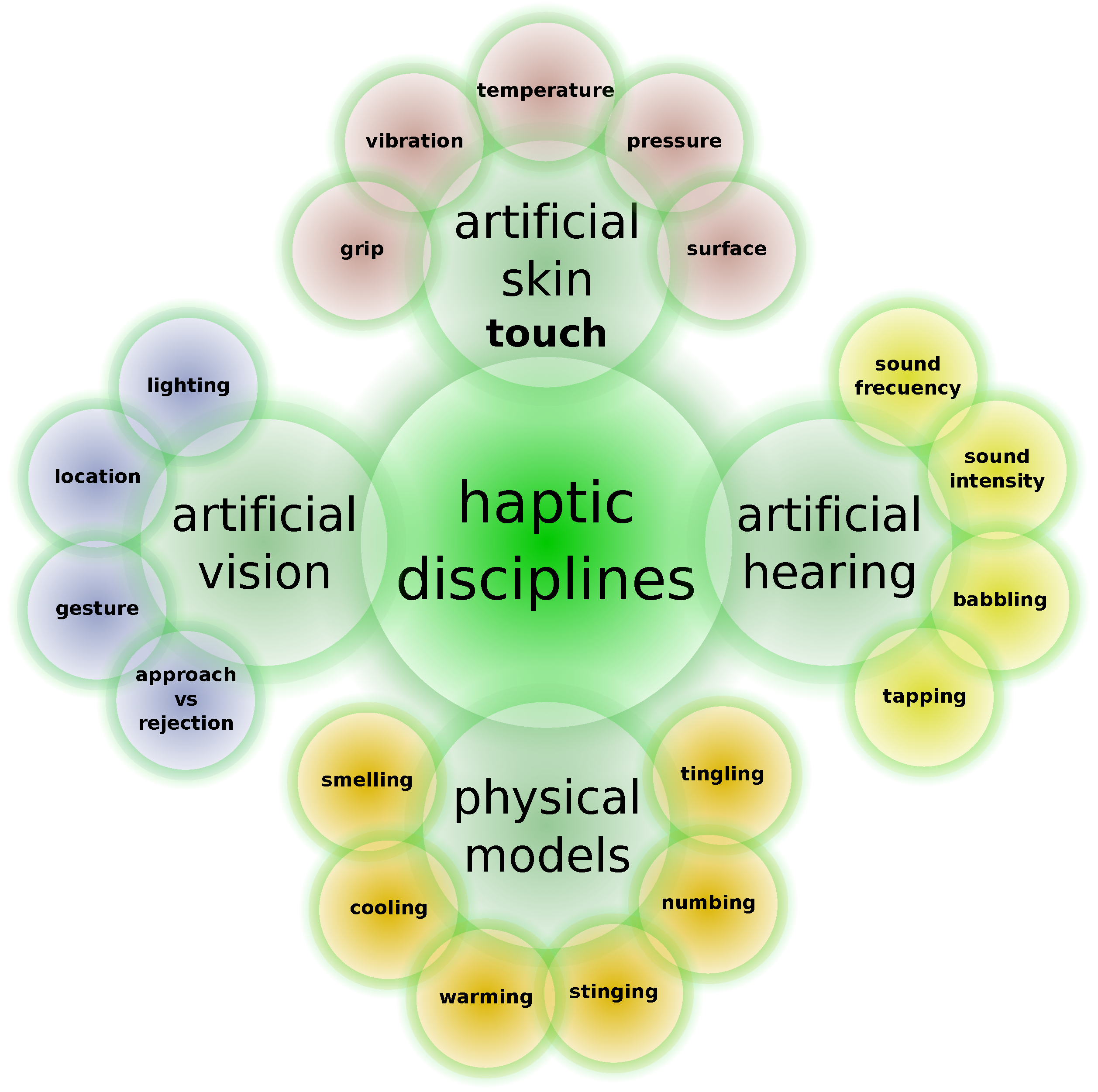
Figure 2.
Multi-sensor/-actuator based medical developments. Wearable solutions to improve the perception processes. (a) TechARM: Electrode-units to emit and record different stimuli [20]. (b) Teslasuit: Physical suit to provide haptic feedback and capture motion and biometrics [28]. (c) Medical Education enhanced by haptic devices [29].
Figure 2.
Multi-sensor/-actuator based medical developments. Wearable solutions to improve the perception processes. (a) TechARM: Electrode-units to emit and record different stimuli [20]. (b) Teslasuit: Physical suit to provide haptic feedback and capture motion and biometrics [28]. (c) Medical Education enhanced by haptic devices [29].
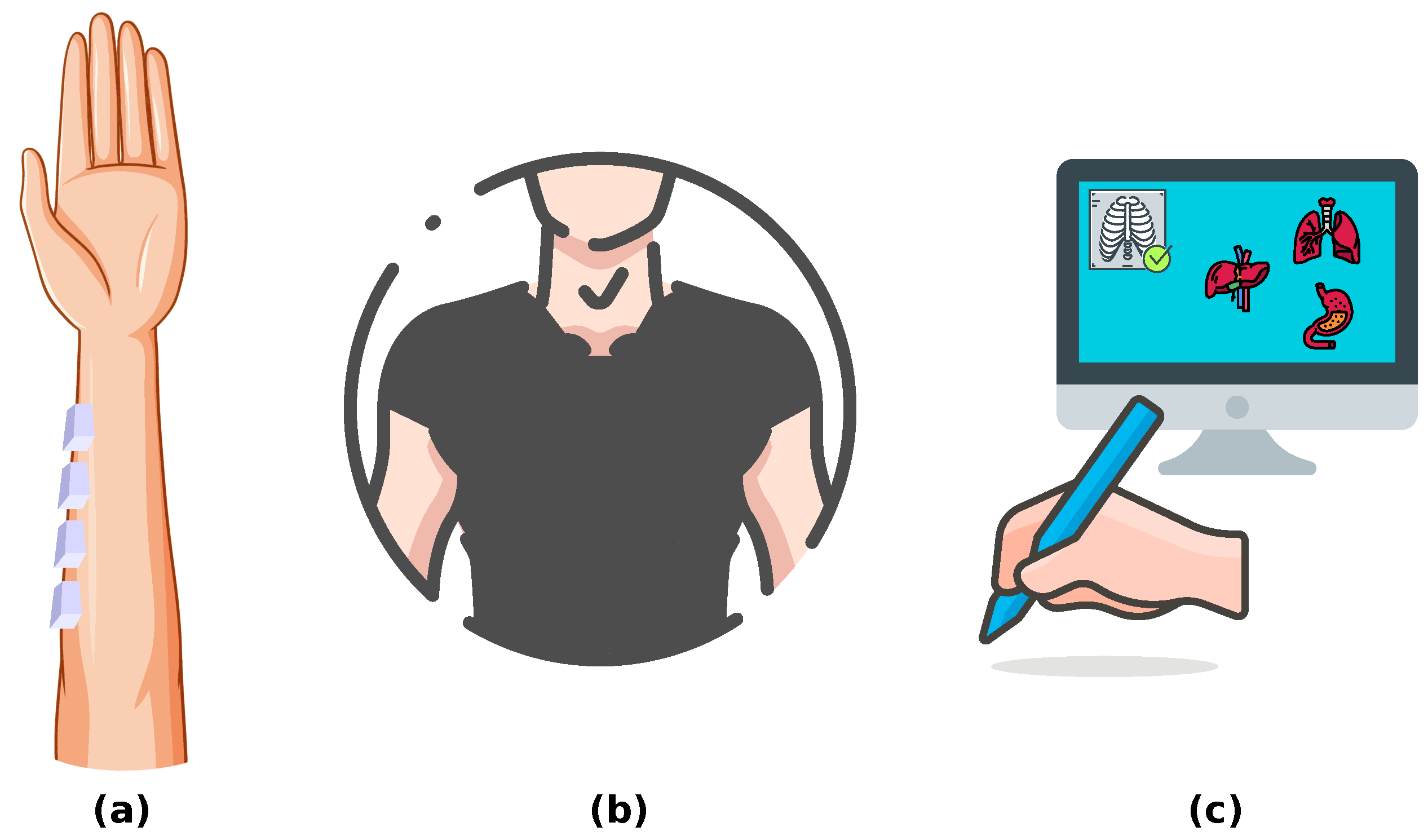
Figure 3.
Interaction with the environment. (a) Meta - Inside Reality Labs: Bringing Touch to the Virtual World [17]. (b)Teenage Engineering Rumble: a bolt-on haptic subwoofer for the OP-Z [23]. (c) Hapticast: Haptic weekly podcast filled with gaming news [41].
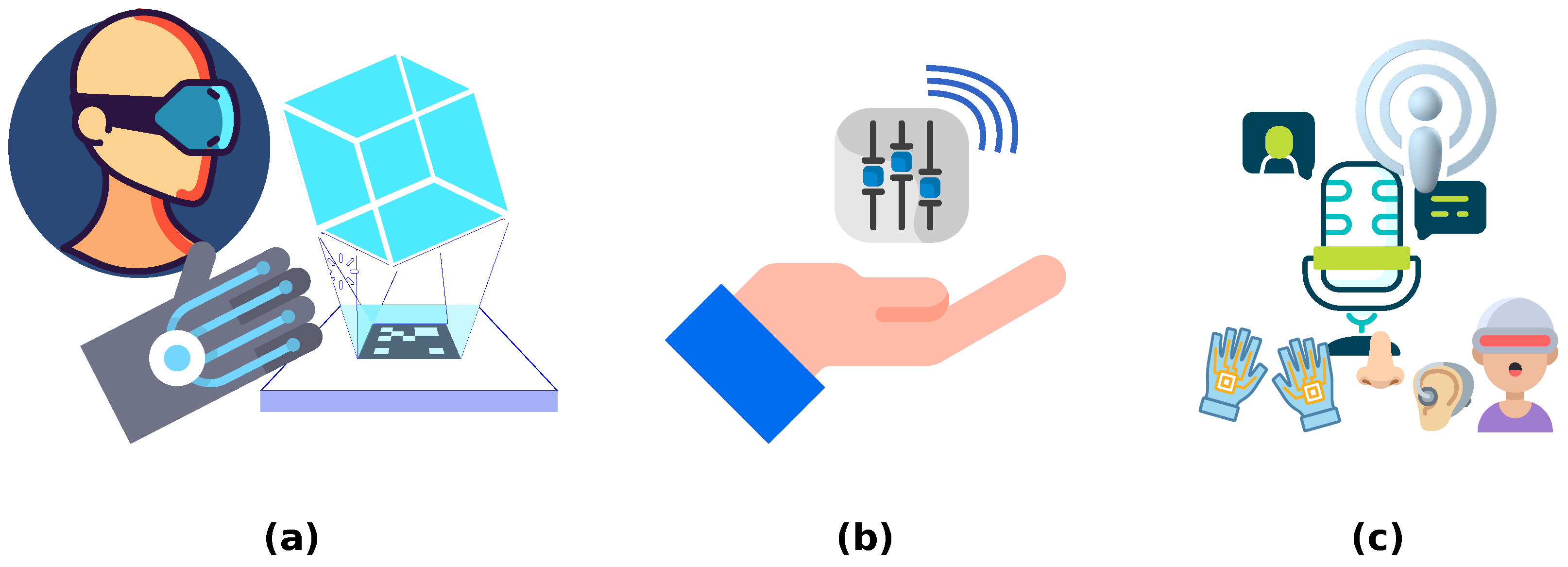
Figure 4.
Haptic feedback. Environment-user interactions: (a) Touching: Generating sensations such as pain, pressure, temperature, etc. [15,16,18]. (b) Smelling: Producing sensitivity to odors, aromas, flavors, etc. [25,26]. (c) Listening: Transmitting sounds, rhythms, tunes, etc. [20,23]. (c) Feelings: Eliciting emotions and comfort atmosphere [22]. (e) Vision: Generating accessible virtual environments [21,24,44].
Figure 4.
Haptic feedback. Environment-user interactions: (a) Touching: Generating sensations such as pain, pressure, temperature, etc. [15,16,18]. (b) Smelling: Producing sensitivity to odors, aromas, flavors, etc. [25,26]. (c) Listening: Transmitting sounds, rhythms, tunes, etc. [20,23]. (c) Feelings: Eliciting emotions and comfort atmosphere [22]. (e) Vision: Generating accessible virtual environments [21,24,44].
Disclaimer/Publisher’s Note: The statements, opinions and data contained in all publications are solely those of the individual author(s) and contributor(s) and not of MDPI and/or the editor(s). MDPI and/or the editor(s) disclaim responsibility for any injury to people or property resulting from any ideas, methods, instructions or products referred to in the content. |
© 2024 by the authors. Licensee MDPI, Basel, Switzerland. This article is an open access article distributed under the terms and conditions of the Creative Commons Attribution (CC BY) license (https://creativecommons.org/licenses/by/4.0/).
Copyright: This open access article is published under a Creative Commons CC BY 4.0 license, which permit the free download, distribution, and reuse, provided that the author and preprint are cited in any reuse.


