
Submitted:
29 January 2024
Posted:
30 January 2024
You are already at the latest version
Abstract
Chromosome elimination resulting in haploids is achieved by rapid loss of chromosomes from one parent during zygote stage, and is an important procedure to produce doubled haploid (DH) lines in plants. During crosses between an emasculated wheat (Triticum aestivum L.) and a maize (Zea mays L.) as pollen donor, the complete loss of maize chromosomes results in wheat haploid embryos. Through embryo rescue and chromosome doubling process, pure lines with stable traits can be quickly obtained. We here term it as the maize-obligated wheat doubled haploids (mowDH). Although this technology is not new, it remains a practical approach to date. In order to optimize and improve this technology, and to achieve its maximum potential in the winter wheat area of China, this paper reviews the previous and on-going research, proposes a technical scheme for production of wheat DH lines via the maize pollen induction, and presents outlooks on DH research and its application in wheat breeding.
Keywords:
wheat
; speed breeding
; maize pollen induction
; chromosome elimination
; doubled haploid (DH)
1. Introduction
In many countries, distinctness, uniformity, and stability (DUS) are prerequisites for a new plant variety to obtain protection and registration [1]. In China, there is no exception, and the approval or registration of new varieties, and variety rights protection also require distinctness, uniformity, and stability tests (DUS tests) [2,3]. Distinctness, uniformity, and stability are essential attributes for new wheat varieties. A variety’s uniformity and stability can be estimated by its proportion of homozygous DNA loci and seed purity, the higher ratio of the homozygous DNA loci, the better uniformity and stability of the variety. Varieties with a ratio of homozygous DNA loci less than 90% are poor in uniformity and stability [4]. Seed purity is an important indicator used to evaluate the quality of wheat seeds. The China National Standard (GB 4404.1-2008) [5] stipulates that the purity of wheat foundation seeds should not be less than 99.9%, and the purity of wheat variety seeds should not be less than 99.0%. Therefore, for a wheat line qualified for testing, its ratio of homozygous DNA loci needs to be over 90%, and it has to be advanced to the F5 or later generations. For wheat lines to reach the level of variety or foundation seeds, the ratio of homozygous DNA loci needs to be over 99.9%, and the generation should reach at least F11. The breeding cycle is thus very long, which certainly limits the wheat seed industry.
Haploid induction and doubled haploid (DH) technology can obtain pure lines with a genotypic homozygosity of 100%, bypassing the need for 6-10 generations of inbreeding through selfing or sib-crossing [6]. This is a significant breakthrough for developing new varieties [7]. This technology requires only one generation to obtain genetically homozygous lines, and will substantially reduce the breeding course [8].
The first naturally occurring haploid plant was discovered in jimson weed in 1922 [9]. Thereafter, using anther and microspore culture techniques, haploid plants of jimson weed and rice were obtained respectively [10,11]. DH technology gradually came into the view of breeders, and varieties of oilseed rape and barley were successively developed [12]. Along with the improved haploid induction and chromosome doubling, doubled haploid technology has been applied in many plant species [13].
DH plants rarely occur in nature but can be induced by in vitro or in vivo treatments [14]. In vitro culture include androgenesis (anther or microspore culture) and gynogenesis (bud, ovary, or unfertilized ovule culture). In vivo methods include induction of parthenogenesis by inactive pollen pollination (ionizing radiation, chemical agents, and high-temperature), and intra- or inter-specific hybridization, also known as the chromosome elimination method [15]. Effectiveness of different methods depends on plant species [13].
In wheat DH breeding, the in vitro anther or microspore culture is limited due to its genotype dependence, time consuming for regeneration, unstable ploidy, and albino seedlings [16,17]. Ionizing radiation and chemical treatments of pollen barely induces haploid and may cause aneuploidy [18]. In contrast, wheat mutants of the pollen-specific phospholipase gene TaMTL can induce wheat to produce haploid seeds [19]. Using the wheat Tamtl mutant, Tang et al. [20] have established a visual screening to identify the haploid seeds. The maize-obligated wheat doubled haploids (mowDH) involves both in vivo and in vitro operations, alien chromosome elimination, and maternal chromosome doubling. The mowDH approach is two to three times more efficient for producing green plantlets than the anther culture [21], shows little or no genotype dependence in wheat, does not require haploid identification, and thus becomes a popular method for producing DH wheat. The chromosome elimination method is well utilized in Yunnan, China, where both wheat and maize can grow in the same season, and several wheat varieties such as Yunmai 110 have been developed [22].
Winter wheat area is about 2.17×10⁷ ha and accounts for 92% of the total wheat acreage in China [23,24]. In the winter wheat region, wheat and maize are rotating crops, thus they do not flower at the same season in nature. Therefore, it is unrealistic to conduct large-scale wheat haploid induction using maize pollen in the winter wheat region. However, newly constructed plant growth facilities can be used to coordinate the flowering time of winter wheat and maize, thus allowing industrialized production of wheat DH via maize pollen grains in the winter wheat region. To improve the mowDH technology and to gain its full potential in the winter wheat region in China, in this paper, we review previous achievements, propose an updated technical scheme for future application, especially in the winter wheat region, and then present outlooks on wheat DH research and application.
2. Origin, Principle, and Advantages of mowDH
Chromosome elimination was first encountered in an interspecific hybridization in tobacco (Nicotiana tabacum × N. sylvestris), resulting in the N. tabacum haploids [25]. Similarly, Gaines and Aase [26] obtained wheat haploids after performing an intergeneric hybridization (T. compactum Host × Aegilops cylindrica L.). Barclay [27] also created wheat haploid plants when using Hordeum bulbosum as pollen donor, a method commonly termed as the bulbosum technique. The H. bulbosum is sensitive to dominant crossability inhibitor genes Kr1 and Kr2, which are located on chromosomes 5B and 5A. However, the bulbosum technique is invalid for wheat genotypes lacking dominant Kr1 and/or Kr2. Later, Laurie and Bennett [28] established an intergeneric system between wheat and maize, representing an early study of mowDH, in which the elimination of maize chromosomes was independent of wheat Kr genes [29,30]. Thus, the mowDH technology became popular, and was often used to produce haploid plants from commercial wheat varieties [31,32,33]. Now, mowDH acts as one of the most practical methods for wheat [34,35,36].
Despite the popularity of mowDH, the underlying mechanism and/or genes causing chromosome elimination are still unclear. There are different hypotheses, including asynchrony in nucleoprotein synthesis [37], asynchronous cell cycles [38], and parent-specific inactivation of centromeres [39]. In Arabidopsis, the centromeric histone H3 (CENH3) regulates the intraspecific genome elimination [40]. Similarly, CENH3 controls the chromosome elimination in the interspecific hybridization of H. vulgare × H. bulbosum [41]. Whether CENH3 accounts for the maize chromosomes elimination in wheat × maize remains to be answered. Chen et al. [42] constitutively expressed the maize CENH3 in wheat ‘Yangmai 158’, however, maize chromosomes were again eliminated in the case of ZmCENH3 overexpressing wheat × maize. Likely, low contents of ZmCENH3 in transgenic wheat may fail to suppress chromosome elimination of maize.
Kapoor et al. [43] compared the haploid plant rate after crossing polyploid wheat (4x and 6x) or hexaploid triticale with maize or Imperata cylindrica. The hexaploid wheat showed higher frequency of embryo and haploid formation than the tetraploid wheat when they were crossed with Imperata, thus the wheat D genome may be prone to trigger chromosome elimination of Imperata. Gurtay et al. [44] also tested the wheat × maize programed haploid production and conducted wheat anther culture to acquire DH plants using spontaneous doubling in androgenesis, which includes the use of ancient, local and modern types of polyploid wheat (4x and 6x). As a result, more haploid embryos were acquired in hexaploid wheat than those in tetraploid wheat, but the plant regeneration was comparable. Apparently, the D genome impacts wheat anther culture and wheat × maize hybridization. Obviously, centromeres, especially those in wheat D genome, play an important role in inducing wheat haploids by eliminating maize chromosomes. However, more studies are needed to understand how wheat D genome functions to eliminate the entire parental chromosomes.
Besides H. bulbosum and maize, other Poaceae species, such as sorghum [45], pearl millet [46], teosinte [47], Tripsacum [48], Job’s tears(Coix lacryma-jobi L.) [49], I. cylindrica [32,50], and Ae. Caudata [51], also induced haploid formation in wheat. In comparison (Table 1), sorghum’s effect highly depends on wheat genotypes, and thus sorghum is not suitable for inducing wheat haploid [52,53]. Surprisingly, according to other studies, pearl millet [53,54,55], teosinte [47,56], and Tripsacum [48,57] can induce wheat haploids with a comparable or higher rate than maize. Only a few studies were conducted with Job’s tears [49] and Ae. Caudata [51], and their applicability for wheat haploid induction needs to be further studied. Although I. cylindrica is a noxious weed [58], I. cylindrica is comparable to maize for inducing haploid embryos in common wheat [50]. But I. cylindrica outperforms maize when used in durum wheat, triticale, or their derivatives [59,60]. In practice, I. cylindrica should be handled with care due to its weedy nature. To gain the first-hand experience, we tested maize hybrid, maize inbred line, sorghum, teosinte, and Job’s tears for inducing wheat haploids. We found that pollen quantity and accessibility was critically countable for developing a large-scale and robust wheat haploid induction, for which maize outperforms all others tested (Figure 1). In addition, a variety of maize genotypes are widely planted in the world with large acreage, which make it possible to screen for ideal genotypes with higher induction rates.
3. Research Progress of the mowDH Technology
Main steps in mowDH are wheat and maize planting, wheat emasculation, maize pollen pollination, hormone treatment, embryo rescue, doubling treatment, and DH plant harvesting (Figure 2). Along the process, numerous factors control the ending wheat DH rate, which is actually attributed to pseudoseed formation frequency (PFF), embryo formation frequency (EFF), haploid regeneration frequency (HRF), haploid formation frequency (HFF), and haploid doubling frequency [59,60,64,65,66]. However, the inheritance of PFF, EFF, and HRF is independent [61,67], and they can ultimately be reflected in the embryo rate (obtained wheat haploid embryos after crossing and hormone treatment), the plantlet rate (obtained wheat haploid plantlets after haploid embryo rescue), and the doubling rate (obtained wheat DH plantlets after chromosome doubling). Over the years, the mowDH technology has been gradually upgraded, and now offers a powerful tool for wheat breeding.
3.1. Genotype Effects
The mowDH technology functions independent of wheat Kr1 and Kr2 genes, behaves superior to the bulbosum technique [68,69], and thus is reliable and widely used in wheat. Over the years, there is a non-stop passion to understand how wheat and/or maize genotypes affect the efficiency of mowDH, and complex conclusions have been drawn.
For maize, most researchers believe that the maize genotype has significant influence on mowDH [13,60,61,64,70,71,72], partially through modulating EFF and HRF. Niroula et al. [34] proposes using more responsive maize genotypes to enhance wheat DH production. Specific genotype accounts for haploid embryo induction or embryo regeneration, respectively [64]. In another case, the anther culture-responsive F1 hybrids of hexaploid wheat were tested with three sweet corns ‘Baron’, ‘Challenger’, and ‘Merit’, of which Challenger had the highest haploid embryo rate (3.5%), but not for the plantlet regeneration. Surprisingly, the use of pollen mixture of multiple sweet corn genotypes enhanced haploid plantlet regeneration [72].
For wheat itself, an early study failed to show the genotype effect on mowDH [70]. In contrast, Verma et al. [64] proved that wheat genotypes significantly influenced PFF and EFF, but not as good as those from the maize side. Today, wheat genotypes are primarily counted towards affecting mowDH [61,67,71,73]. When both winter and/or spring wheat were considered, winter wheat (winter parents and winter × winter F1s) performed better than the non-winter wheat (spring parents, spring × spring F1s, and winter × spring F1s) towards embryo formation. However, the winter × spring F1s performed the best in acquiring regenerated plantlets [67].
To study the interaction between wheat and maize, Singh et al. [71] compared winter wheat, spring wheat, and their F1s in conjunction with specific maize. There was significant interaction on embryo formation and regeneration of plantlets; the wheat × maize interaction for embryo formation and regeneration was due to non-additive gene action. In addition, the DNA heterozygosity in wheat and maize genotypes improved the haploid induction rate. Dhiman et al. [61] further demonstrated the overall contribution of the maize induction line to embryo formation and regeneration was the highest, followed by the wheat line × maize induction line interaction.
Collectively, genotypes of wheat, maize, and their interaction all play roles in mowDH. In future, more maize genotypes should be tested in conjunction with target wheat genotypes, which is designed to acquire specific maize and/or their interaction with specific wheat in conferring excellent EFF and HRF, and they will be applied to advance the mowDH technology.
3.2. Environmental Factors
Gu et al. [74] achieved a haploid embryo rate of 31.6% in mowDH when cut plants were in vitro cultured in a nutrient solution (40 g/L sucrose, 10 mg/L silver nitrate, 3 g/L calcium phosphate, and 8 ml/L sulfurous acid) under controlled conditions of 22-23 ℃ in light, 16-17 ℃ in dark and an ambient humidity of 70%. However, the haploid embryo rate was only 9.6% using plants from fields. Khan et al. [75] further conducted in vitro culture of 25 hexaploid wheat genotypes from fields used a tillering medium containing 100 mg/L 2,4-D, 40 g/L Sucrose, and 8 ml/L Sulfurous acid. They analyzed the controlled factors such as temperature during pollen collection, time of pollination, light intensity, and relative humidity towards haploid seed formation. As a result, the optimal factors are maize pollen from 21-26 ℃, pollination at 24 hours post emasculation, a light intensity of 10,000 Lux, and a relative humidity of 60-65% at 20-22 ℃. Khan et al. [76] investigated the haploid induction rate between wheat F1s and Z. mays/I. cylindrica under different conditions. The DH production rate of the F1s in greenhouse was considerably higher than those of the F1s in field. Thus, the growing condition of both wheat and maize plays a pivotal role in mowDH, and optimal environmental factors can be drawn for an improved mowDH. The environmental factors proposed by Khan et al. [75] can serve as a reference for technical improvement.
3.3. Treatment of Wheat Spikes and Timing of Pollination
Growth condition, or controlled environment, is preferred for conducting mowDH. However, due to limited space of any environmentally controlled facility, immature wheat spikes were harvested during heading and then subjected to in vitro culture [74,75,77]. Today, modern and spacious greenhouses are readily accessible, which allows to maintain enough wheat and maize plants continuously throughout the year. Therefore, it is not necessary to in vitro culture wheat immature spikes. According to Laurie [29], any accountable pollination is based on the wheat floret status, those with a feathery stigma being best. Martins-Lopes et al. [78] studied the spikelet’s position effect on wheat × maize compatibility and found more success with middle spikelets. Thus, maize pollen should be applied to middle spikelets with a feathery stigma in order to obtain more haploid embryos under the controlled conditions.
3.4. Hormone Treatment
Phytohormone treatment post the wheat × maize pollination is crucial for haploid production. The applied hormones promote ovary growth and survival rate of haploid embryos, from which haploid embryo rescue on media becomes more practical and effective [31,45,79]. To improve mowDH, a verity of hormones were tested, including 2,4-dichlorophenoxyacetic acid (2,4-D), dicamba, picloram, indole-3-acetic acid (IAA), phenylacetic acid (PAA), silver nitrate, 1-naphthaleneacetic acid (NAA), kinetin, 6-benzyladenine (BA) and zearalenone [80]. Among them, 2,4-D is widely used to control organ regeneration and callus induction. The 2,4-D also regulates early and post-embryogenic plant development involving both somatic and zygotic embryogenesis [81].
When applying a hormone in mowDH, the dosage, timing and methodology of it should be determined. At 100 ppm, 2, 4-D effectively induces haploid embryos in hexaploid wheat [70,82,83]. At 250 ppm, 2, 4-D effectively promotes haploid production in tetraploid wheat [79]. Kaushik et al. [82] tested different application methods of 2,4-D, including spray, tiller injection, dipping, and spikelet culture, of which only the spikelet culture method behaved well in recovering embryos. Despite this, we adopted the spraying method because of its simplicity and high efficiency in our hand; and we have acquired an average embryo rate of 12.9%.
3.5. Embryo Rescue
During the mowDH process, maize chromosomes are eliminated not only in embryo cells, but also in endosperm cells, which will cause seed abortion [50,75,84,85]. Therefore, wheat haploid embryos must be rescued by tissue culture to generate haploid plantlet. In practice, wheat embryo rescue is highly dependent on the plant regeneration media. Among B5, MS, and ½ MS tested, Cherkaoui et al. [86] found that B5 and ½ MS were superior to MS in obtaining young embryos for the tetraploid wheat × maize hybridizations. The supplement of putrescine and spermidine, each in 0.5 mg/L in the embryo rescue medium, SM (Standard Medium), resulted in 69.3% regeneration rate of wheat plantlets, but only 33.5% regeneration in the control group [87]. Most tests are needed with how to supply putrescine and spermidine in B5 and/or ½ MS medium.
3.6. Doubling Treatment
Wheat haploid plants obtained through the mowDH technology naturally remain undoubled [88]. Chromosome doubling is essential to acquire homozygous and stable diploid plants. Antimitotic compounds are selected to double plant chromosomes [89], for which colchicine is the mostly applied agent. Colchicine inhibits spindle function during mitosis and stops the polar segregation of sister chromatids, ending with a doubled nucleus. In the process, chromosome-doubled chimera sectors are formed, which leads to partial fertility [90] and poor grain-setting in DH plants (Figure 3). Colchicine treatment is partially lethal to plant haploids, thus only results in a low frequency of doubled haploids. It is necessary to optimize the dosage, processing time, and plant stages for an effective colchicine treatment, particularly when dealing with new plant genotypes.
Inagaki [91] trimmed roots by keeping 2-3 cm on haploid plantlets, soaked the trimmed roots in 0.1% colchicine (with 2% dimethyl sulfoxide/DMSO and fifteen Tween-20 drops per liter) at 20 ℃ for 5 hours. At the 2-3 tiller stage, the colchicine application resulted in 95.6% doubling rate. Khan et al. [92] treated haploids with 3-5 tillers in 0.1-0.2% colchicine for 3 hours and provided continuous air flow in the solution. Niu et al. [93] also supplied air during colchicine treatment at 14-16 ℃, and achieved over 90% survival and chromosome doubling among the treated wheat plantlets. Sharma et al. [94] also studied the in vitro effect of colchicine. The wheat DH production was enhanced after four hours’ treatment with 0.075% colchicine in hexaploid wheat and 0.15% colchicine in tetraploid wheat. However, in our cases, haploid plantlets at the 2-3 tiller stage were treated in 0.05% colchicine for 16 hours, resulting in over 90% survival and chromosome doubling rates.
4. Stability of Doubled Haploids
DH stability is crucial for agronomy, breeding, and research. In mowDH, maize chromosomes disappear during early embryo cell divisions [46] or later in chromosome doubling [95]. The genetic stability is then established after doubling of wheat haploid chromosomes. Using six glutenin loci of the mowDH decedents, Kammholz et al. [96] proved their stable inheritability across generations. Furthermore, Chen et al. [97] and Brazauskas [98] demonstrated the predominant genetic stability from the wheat side, and there was little or no maize DNA in the mowDH decedents.
However, colchicine also causes chromosomal aberrations, such as aneuploidy [99,100,101]. Suenaga and Nakajima [102] evaluated 110 wheat DH lines, of which 15 DH lines exhibited irregular phenotypes, such as dwarfism, poor seed setting, spike variation, and leaf stripes. Likely, they were caused by colchicine treatment. Shrestha et al. [103] studied two wheat DH populations and found many chromosomal aberrations including duplication, deletion, translocation, and aneuploidy, which were likely caused by unusual chemical exposure during haploid induction and chromosome doubling.
Apparently, the stability of DH lines is based on both haploid embryo induction and colchicine doubling. In mowDH, maize DNA barley remains in haploid embryos, thus the chromosomal aberrations in the resulted wheat DH lines are considerably caused by colchicine treatment. In our study, however, there is no significant variation in spike traits and leaf morphology (Figure 4).
5. An Optimized mowDH Procedure for Winter Wheat
Considering others and our experiences, we here propose an updated mowDH protocol for winter wheat in China (Figure 2).
- (1)
- Wheat breeding lines (≥ F3 generation) and hybrid maize varieties are maintained in environmentally controlled facilities: wheat under 20-24 ℃, day/night of 20h/4h, light intensity > 30000 lux, and humidity 60-65%; maize under 22-24 ℃, day/night of 12h/12h, light intensity > 10000 lux, and humidity 55-60%. A set of ten maize seeds are sown once a week, to continuously supply pollen grains. Winter or semi-winter wheat is vernalized under 4 ℃ for 40 days before shifting to regular growth.
- (2)
- When heading, wheat spikes are manually emasculated.
- (3)
- Mature pollen grains are collected from maize tassel around 10 am, and are applied with a brush to the emasculated wheat florets at the feathery pistil stage. The pollination time is recorded.
- (4)
- At 24 hours post pollination, 2,4-D (100 ppm) is sprayed on top of the pollinated wheat florets.
- (5)
- At 15 days post pollination, manually pollinated spikes and any immature seeds born are harvested.
- (6)
- Immature seeds are sterilized in 70% alcohol for 1 minute, and in 15% sodium hypochlorite for 20 minutes, and then rinsed with sterile water five times.
- (7)
- Within a clean hood, haploid embryos are isolated from the sterilized immature seeds using a dissection microscope, and isolated haploid embryos are then planted on ½ MS medium (½ MS + 20 g/L sucrose + 2.4 g/L plant agar, pH 5.8).
- (8)
- Immature embryos are cultured under 20-24 °C, 16h light / 8h dark, and a light intensity of 4800 Lux. Any plantlets with shoots and roots are transferred into culture bottles (150 ml) and are cultured on ½ MS medium under 20-24 °C, 16h light / 8h dark, and a light intensity of 4800 Lux.
- (9)
- At 3-leaf stage, the culture bottle is left open for 24 hours. Haploid plantlets are then transplanted into small pots with Pindstrup substrate (PH 5.5, Pindstrup Mosebrug A/S, Denmark) for cultivation.
- (10)
- Haploid plantlets with 2-3 tillers are taken out of the small pots. Extra roots are trimmed to keep only 2-3 cm on plantlets. Haploid plantlets with trimmed roots are then soaked in colchicine solution (0.05%) for 16 hours.
- (11)
- After colchicine treatment, plantlets are rinsed with running water for 30 minutes, and then transplanted into small pots with Pindstrup substrate (PH 5.5).
- (12)
- When new tillers emerge, plantlets are then vernalized at 4 ℃ for 40 days, and then transplanted into growth pots with the seedling substrate (Jinan Fengyuan Agricultural Technology Co., China). Plants are maintained until mature.
With this updated procedure, we have provided excellent service to satisfy the breeding and research need in Spring Valley Agriscience Co. In the second half of 2023, for mowDH, we achieved an average embryo rate of 12.9%, an average plantlet rate of 51.8%, and an average doubling rate of 86.0%.
6. Conclusions and Prospects
In recent years, the genome editing was used to develop novel wheat DH technologies, for example the TaMTL-based maternal haploid induction [19] and the TaCENH3α-based paternal haploid induction [104]. This indeed opens a new path to upgrade wheat DH technologies, but its application to the industrialized production of wheat DH lines still requires time for verification.
Wheat DH technologies, including anther culture, microspore culture, and mowDH have been widely applied to speed up research and breeding. The fast growth in research and facility allows a full exploration of mowDH, which in future might become a high throughput system for wheat DH lines. Nevertheless, there is still considerable room for improvement of the mowDH system. Many factors including genotype, environment, pollination and hormone treatment, embryo rescue, and doubling treatment methods can influence the production efficiency. Thus, it is necessary to improve and optimize the mowDH system around these factors. Screening the best maize induction lines (varieties) for specific types of wheat, and identifying the optimal growth environment conditions, pollination times, hormone treatments, embryo rescue, and doubling treatment plans could further improve the DH production efficiency. Moreover, the exact mechanism or gene for chromosome elimination in this technique is still unclear and needs further study. This will provide guidance for continuous improvement of the mowDH system and extend its application to other crops.
In future, with the advancement of technology and in-depth research, the mowDH system will be further developed and applied. Firstly, the continuous optimization of DH line production techniques, driven by ongoing in-depth research, will render the DH line production process more efficient and stable. Secondly, this technique in conjunction with greenhouse generation advancement technology and modern biotechnology such as marker-assisted selection, gene editing, mutation induction, transgene, genomic selection, etc., will further improve selection efficiency and accuracy, shorten breeding cycles, greatly enhance the efficiency of genetic improvement, and provide more possibilities for wheat genetics and breeding. Lastly, the improvement of equipment and facilities, and the establishment of an industry-scale production procedure for mowDH will meet the demands of scientific research on wheat genetics and breeding and wheat production. In conclusion, the mowDH system possesses tremendous potential for development and will play as a routine technique a more significant role in research on wheat genetics and breeding.
Author Contributions
Conceptualization, G.X., P.J. and F.D.; software, G.X.; validation, G.X.; formal analysis, G.X.; resources, G.X.; data curation, G.X.; writing—original draft preparation, G.X.; writing—review and editing, G.X., F.D., and P.J.; supervision, F.D. and P.J.; project administration, F.D. and P.J.; funding acquisition, F.D. and P.J. All authors have read and agreed to the published version of the manuscript.
Funding
This research was funded by National Key Research and Development Program of China (2022YFF1002300), Quancheng ‘5150’ Talent Program (NO. 07962021047), and Agriculture Applied Technology Initiative of Jinan Government (CX202113).
Data Availability Statement
Data are contained within the article.
Conflicts of Interest
The authors declare no conflict of interest.
References
- Wang, L.; Zheng, Y.; Duan, L.; Wang, M.; Wang, H.; Li, H.; Li, R.; Zhang, H. Artificial Selection Trend of Wheat Varieties Released in Huang-Huai-Hai Region in China Evaluated Using DUS Testing Characteristics. Frontiers in Plant Science 2022, 13. [Google Scholar] [CrossRef] [PubMed]
- State Council of the People’s Republic of China, Regulations on Protection of New Varieties of Plants. Beijing: China Agricultural Publishing House 1997, 4-5.
- Standing Committee of the National People’s Congress, People’s Republic of China Seed Law. Beijing: Law press 2015, 4-7.
- Wang, L.; Chang, L.; Li, H.; Ge, L.; Xin, A.; Gao, S.; Ji, W.; Sun, H.; Zhao, C. Method of Wheat Seeds Purity Testing by Molecular Markers. Journal of Triticeae Crops 2009, 29, 1–8. [Google Scholar]
- General Administration of Quality Supervision, Inspection and Quarantine of the People’s Republic of China, Standardization Administration of the People’s Republic of China. GB 4404.1-2008. Seed of food crops-Part 1: Cereals. Beijing: Standards Press of China 2008.
- Prigge, V.; Xu, X.; Li, L.; Babu, R.; Chen, S.; Atlin, G.N.; Melchinger, A.E. New Insights into the Genetics of in Vivo Induction of Maternal Haploids, the Backbone of Doubled Haploid Technology in Maize. Genetics 2012, 190, 781–793. [Google Scholar] [CrossRef] [PubMed]
- Dunwell, J.M. Haploids in flowering plants: origins and exploitation. Plant biotechnology journal 2010, 8, 377–424. [Google Scholar] [CrossRef]
- Tadesse, W.; Inagaki, M.; Tawkaz, S.; Baum, M.; Ginkel, M.V. Recent advances and application of doubled haploids in wheat breeding. African Journal of Biotechnology 2012, 11, 1. [Google Scholar] [CrossRef]
- Blakeslee, A.F.; Belling, J.; Farnham, M.E.; Bergner, A.D. A HAPLOID MUTANT IN THE JIMSON WEED, "DATURA STRAMONIUM". Science (New York, N.Y.) 1922, 55, 646–647. [Google Scholar] [CrossRef]
- Guha, S.; Maheshwari, S.C. In vitro Production of Embryos from Anthers of Datura. Nature 1964, 204, 497–497. [Google Scholar] [CrossRef]
- Niizeki, H.; Oono, K. Induction of Haploid Rice Plant from Anther Culture. Proceedings of the Japan Academy 1968, 44, 554–557. [Google Scholar] [CrossRef]
- Ho, K.M.; Jones, G.E. Mingo Barley. Canadian Journal of Plant Science 1980, 60, 279–280. [Google Scholar] [CrossRef]
- Kalinowska, K.; Chamas, S.; Unkel, K.; Demidov, D.; Lermontova, I.; Dresselhaus, T.; Kumlehn, J.; Dunemann, F.; Houben, A. State-of-the-art and novel developments of in vivo haploid technologies. Theoretical and Applied Genetics 2019. [Google Scholar] [CrossRef] [PubMed]
- Dwivedi, S.L.; Britt, A.B.; Tripathi, L.; Sharma, S.; Ortiz, R. Haploids: contraints and opportunities in plant breeding. Biotechnology Advances 2015. [Google Scholar] [CrossRef]
- Zargar, M.; Zavarykina, T.; Voronov, S.; Pronina, I.; Bayat, M. The Recent Development in Technologies for Attaining Doubled Haploid Plants In Vivo. Agriculture 2022, 12. [Google Scholar] [CrossRef]
- Liu, W.; Zheng, M.Y.; Polle, E.A.; Konzak, C.F. Highly Efficient Doubled-Haploid Production in Wheat (Triticum aestivum L.) via Induced Microspore Embryogenesis. Crop Science 2002, 42. [Google Scholar] [CrossRef]
- Tawkaz, S. Response of some wheat genotypes to anther culture technique for doubled haploid production. M. Sc Thesis. Sudan Academy of Science, Kartum, 2011.
- Ding, M.; Zhao, H.; Gu, J.; Li, H.; Liu, K.; Yang, M.; Li, S. Research and Breeding Application Progress of the Technique of Producing Double Haploid of Wheat by Wide Hybridization between Wheat and Maize. Agricultural Science & Technology 2017, 18, 2202–2208. [Google Scholar] [CrossRef]
- Liu, H.; Wang, K.; Jia, Z.; Gong, Q.; Lin, Z.; Du, L.; Pei, X.; Ye, X. Efficient induction of haploid plants in wheat by editing of TaMTL using an optimized Agrobacterium-mediated CRISPR system. Journal of Experimental Botany 2019, 71, 1337–1349. [Google Scholar] [CrossRef]
- Tang, H.; Wang, K.; Zhang, S.; Han, Z.; Chang, Y.; Qiu, Y.; Yu, M.; Du, L.; Ye, X. A fast technique for visual screening of wheat haploids generated from TaMTL-edited mutants carrying anthocyanin markers. Plant Communications 2023, 4. [Google Scholar] [CrossRef]
- Kumar Niroula, R.; Prasad Bimb, H. Overview of Wheat × Maize System of Crosses for Dihaploid Induction in Wheat. World Applied Sciences Journal 2009, 7, 1037–1045. [Google Scholar]
- Ding, M.; Yang, Z.; Cui, Y.; Li, H.; Liu, K.; Zhao, H.; Yang, M.; Gu, J.; Li, S. A high-yield and multi-resistant new wheat variety bred using diploid technology - Yunmai 110. Journal of Triticeae Crops 2022, 42, 1589. [Google Scholar]
- Zhao, G. Study on Chinese Wheat Planting Regionalization (I). Journal of Triticeae Crops 2010, 30, 886–895. [Google Scholar]
- National Bureau of Statistics of China, China Statistical Yearbook 2023. China Statistics Press 2023. https://www.stats.gov.cn/sj/ndsj/2023/indexch.htm.
- Clausen, R.E.; Mann, M.C. Inheritance in Nicotiana Tabacum: V. The Occurrence of Haploid Plants in Interspecific Progenies. Proceedings of the National Academy of Sciences 1924, 10, 121–124. [Google Scholar] [CrossRef] [PubMed]
- Gaines, E.F.; Aase, H.C. A haploid wheat plant. American Journal of Botany 1926, 13, 373–385. [Google Scholar] [CrossRef]
- BARCLAY, I.R. High frequencies of haploid production in wheat (Triticum aestivum) by chromosome elimination. Nature 1975, 256, 410–411. [Google Scholar] [CrossRef]
- Laurie, D.A.; Bennett, M.D. Wheat × maize hybridization. Canadian Journal of Genetics Cytology 1986, 28, 313–316. [Google Scholar] [CrossRef]
- Laurie, D.A. Factors Affecting Fertilization Frequency in Crosses of Triticum aestivum cv. ‘Highbury’ × Zea mays cv. ‘Seneca 60’. Plant Breeding 1989. [CrossRef]
- Laurie, D.A.; Snape, J.W. The agronomic performance of wheat doubled haploid lines derived from wheat × maize crosses. Theoretical & Applied Genetics 1990, 79, 813–816. [Google Scholar] [CrossRef]
- Laurie, D.A.; Reymondie, S. High Frequencies of Fertilization and Haploid Seedling Production in Crosses Between Commercial Hexaploid Wheat Varieties and Maize. Plant Breeding 1991, 106, 182–189. [Google Scholar] [CrossRef]
- Campbell, A.W.; Griffin, W.B.; Burritt, D.J.; Conner, A.J. Production of wheat doubled haploids via wide crosses in New Zealand wheat. New Zealand Journal of Crop and Horticultural Science 2000, 28, 185–194. [Google Scholar] [CrossRef]
- Jauhar, P.P.; Xu, S.S.; Baenziger, P.S. Haploidy in Cultivated Wheats: Induction and Utility in Basic and Applied Research. Crop Science 2009, 49, 737–755. [Google Scholar] [CrossRef]
- Niroula, R.K.; Bimb, H.P.; Thapa, D.B.; Sah, B.P.; Nayak, S. Production of haploid wheat plants from wheat (Triticum aestivum L.) × maize (Zea mays L.) cross system. Himalayan Journal of Sciences 2007, 4, 65–69. [Google Scholar] [CrossRef]
- Moradi, P.; Haghnazari, A.; Bozorgipour, R.; Sharma, B. Development of yellow rust resistant doubled haploid lines of wheat through wheat × maize crosses. International Journal of Plant Production 2009, 3, 77–88. [Google Scholar] [CrossRef]
- Li, H.; Li, S.; Abdelkhalik, S.; Shahzad, A.; Gu, J.; Yang, Z.; Ding, M.; Liu, K.; Zhao, H.; Yang, M. Development of thermo-photo sensitive genic male sterile lines in wheat using doubled haploid breeding. BMC Plant Biology 2020, 20, 246. [Google Scholar] [CrossRef] [PubMed]
- Bennett, M.D.; Finch, R.A.; Barclay, I.R. The time rate and mechanism of chromosome elimination in Hordeum hybrids. Chromosoma 1976, 54, 175–200. [Google Scholar] [CrossRef]
- Michel, B. Replication fork arrest and DNA recombination. Trends in Biochemical Sciences 2000, 25, 173–178. [Google Scholar] [CrossRef]
- Mochida, K.; Tsujimoto, H.; Sasakuma, T. Confocal analysis of chromosome behavior in wheat × maize zygotes. Genome 2004, 47, 199–205. [Google Scholar] [CrossRef] [PubMed]
- Ravi, M.; Chan, S.W.L. Haploid plants produced by centromere-mediated genome elimination. Nature 2010, 464, 615–618. [Google Scholar] [CrossRef] [PubMed]
- Sanei, M.; Pickering, R.; Kumke, K.; Nasuda, S.; Houben, A. Loss of centromeric histone H3 (CENH3) from centromeres precedes uniparental chromosome elimination in interspecific barley hybrids. Proceedings of the National Academy of Sciences 2011, 108, E498–E505. [Google Scholar] [CrossRef] [PubMed]
- Chen, W.; Zhu, Q.; Wang, H.; Xiao, J.; Xing, L.; Chen, P.; Jin, W.; Wang, X.-E. Competitive Expression of Endogenous Wheat CENH3 May Lead to Suppression of Alien ZmCENH3 in Transgenic Wheat × Maize Hybrids. Journal of Genetics and Genomics 2015, 42, 639–649. [Google Scholar] [CrossRef]
- Kapoor, C.; Chaudhary, H.; Relan, A.; Manoj, N.; Singh, K.; Sharma, P. Haploid induction efficiency of diverse Himalayan maize (Zea mays) and cogon grass (Imperata cylindrica) gene pools in hexaploid and tetraploid wheats and triticale following chromosome elimination-mediated approach of doubled haploidy breeding. Cereal Research Communications 2020, 48, 539–545. [Google Scholar] [CrossRef]
- Gurtay, G.; Kutlu, I.; Avci, S. Production of haploids in ancient, local and modern wheat by anther culture and maize pollination. Acta Biologica Cracoviensia. Series Botanica 2021, 63. [Google Scholar] [CrossRef]
- Laurie, D.; Bennett, M. Cytological evidence for fertilization in hexaploid wheat × sorghum crosses. Plant Breeding 1988, 100, 73–82. [Google Scholar] [CrossRef]
- Laurie, D.A. The frequency of fertilization in wheat × pearl millet crosses. Genome 1989, 32, 1063–1067. [Google Scholar] [CrossRef]
- USHIYAMA, T.; SHIMIZU, T.; KUWABARA, T. High frequency of haploid production of wheat through intergeneric cross with teosinte. Japanese Journal of Breeding 1991, 41, 353–357. [Google Scholar] [CrossRef]
- Riera-Lizarazu, O.; Mujeeb-Kazi, A. Polyhaploid production in the Triticeae: wheat × Tripsacum crosses. Crop science 1993, 33, 973–976. [Google Scholar] [CrossRef]
- Mochida, K.; Tsujimoto, H. Production of Wheat Doubled Haploids by Pollination With Job’s Tears (Coix lachryma-jobi L.). Journal of Heredity 2001, 92, 81–83. [Google Scholar] [CrossRef] [PubMed]
- Chaudhary, H.K.; Sethi, G.S.; Singh, S.; Pratap, A.; Sharma, S. Efficient haploid induction in wheat by using pollen of Imperata cylindrica. Plant Breeding 2005, 124, 96–98. [Google Scholar] [CrossRef]
- Kishii, M.; Singh, S. Haploid Production Technology: Fasten Wheat Breeding to Meet Future Food Security. In Accelerated Plant Breeding, Volume 1: Cereal Crops; Gosal, S.S., Wani, S.H., Eds.; Springer International Publishing: Cham, 2020; pp. 139–165. [Google Scholar]
- OHKAWA, Y.; SUENAGA, K.; OGAWA, T. Production of haploid wheat plants through pollination of sorghum pollen. Japanese Journal of Breeding 1992, 42, 891–894. [Google Scholar] [CrossRef]
- Inagaki, M.; Mujeeb-Kazi, A. Comparison of polyhaploid production frequencies in crosses of hexaploid wheat with maize, pearl millet and sorghum. Japanese Journal of Breeding 1995, 45, 157–161. [Google Scholar] [CrossRef]
- Inagaki, M.N.; Hash, C.T. Production of haploids in bread wheat, durum wheat and hexaploid triticale crossed with pearl millet. Plant Breeding 1998, 117, 485–487. [Google Scholar] [CrossRef]
- Ishii, T.; Ueda, T.; Tanaka, H.; Tsujimoto, H. Chromosome elimination by wide hybridization between Triticeae or oat plant and pearl millet: pearl millet chromosome dynamics in hybrid embryo cells. Chromosome Research 2010, 18, 821–831. [Google Scholar] [CrossRef]
- Suenaga, K.; Morshedi, A.R.; Darvey, N.L. Evaluation of teosinte lines as pollen parents for wheat haploid production. Cereal Research Communications 1998, 26, 119–125. [Google Scholar] [CrossRef]
- Li, D.W.; Qio, J.W.; Ouyang, P.; Yao, Q.X.; Dawei, L.D.; Jiwen, Q.; Ping, O.; Qingxiao, Y. High frequncies of fertilization and embryo formation in hexaploid wheat × Tripsacum dactyloides crosses. Theoretical and Applied Genetics 1996, 92, 1103–1107. [Google Scholar] [CrossRef] [PubMed]
- MacDonald, G.E. Cogongrass (Imperata cylindrica)—Biology, Ecology, and Management. Critical Reviews in Plant Sciences 2004, 23, 367–380. [Google Scholar] [CrossRef]
- Mayel, A.; Chaudhary, H.K.; Badiyal, A.; Jamwal, N.S. Comparative Pollination Efficiency of Freshly Harvested Pollen of Imperata cylindrica and Zea mays for Haploid Induction in Bread Wheat. Cereal Research Communications 2016, 44, 162–171. [Google Scholar] [CrossRef]
- Kapoor, C.; Chaudhary, H.K.; Sharma, P.; Relan, A.; Manoj, N.V.; Singh, K.; Sood, V.K. In vivo haploid induction potential of Himalayan maize (Zea mays) and cogon grass (Imperata cylindrica) gene pools in different segregational cycles of intra and inter-generic crosses of wheat. Plant Genetic Resources: Characterization and Utilization 2021, 19, 522–529. [Google Scholar] [CrossRef]
- Dhiman, R.; Rana, V.; Chaudhary, H. Himalayan maize - potential pollen source for maize mediated system of chromosome elimination approach in DH breeding of bread wheat. Cereal Research Communications 2012, 40, 246–255. [Google Scholar] [CrossRef]
- Khokhar, M.I.; Razaq, A.; Iqbal, J.; Anwar, M.J.; Iqbal, M.Z.; Sajid, u.R. Choice of maize genotype affects wheat haploid seed and success of embryo rescue. RADS Journal of Biological Research & Applied Sciences 2019, 10, 1–5. [Google Scholar] [CrossRef]
- Rather, S.A.; Chaudhary, H.K.; Kaila, V. Influence of different wheat and Imperata cylindrica genetic backgrounds on haploid induction efficiency in wheat doubled haploid breeding. Czech Journal of Genetics Plant Breeding 2014, 50, 195–200. [Google Scholar] [CrossRef]
- Verma, V.; Bains, N.S.; Mangat, G.S.; Nanda, G.S.; Gosal, S.S.; Singh, K. Maize genotypes show striking differences for induction and regeneration of haploid wheat embryos in the wheat × maize system. Crop science 1999, 39, 1722–1727. [Google Scholar] [CrossRef]
- Brazauskas, G.; Pašakinskienė, I.; Ruzgas, V. Improved approaches in wheat × maize crossing for wheat doubled haploid production. Biologija 2005, 51. [Google Scholar]
- Samuel Jeberson, M.; Kumar Chaudhary, H.; Kumar Chahota, R.; Hussain Wani, S. Doubled haploid production in advanced back cross generations and molecular cytogenetic characterization of rye chromatin in triticale wheat derived doubled haploid lines. Biocell 2021, 45, 1651–1659. [Google Scholar] [CrossRef]
- Sharma, S.; Sethi, G.S.; Chaudhary, H.K. Influence of winter and spring wheat genetic backgrounds on haploid induction parameters and trait correlations in the wheat × maize system. Euphytica 2005, 144, 199–205. [Google Scholar] [CrossRef]
- Laurie, D.A.; Bennett, M.D. The production of haploid wheat plants from wheat × maize crosses. Theoretical and Applied Genetics 1988, 76, 393–397. [Google Scholar] [CrossRef] [PubMed]
- Suenaga, K.; Tamaki, M.; Nakajima, K. Influence of wheat (Triticum aestivum) and maize (Zea mays) genotypes on haploid wheat production in crosses between wheat and maize. Nogyo Seibutsu Shigen Kenkyujo kenkyu hokoku 1991, 131–142. [Google Scholar]
- Suenaga, K.; Nakajima, K. Efficient production of haploid wheat (Triticum aestivum) through crosses between Japanese wheat and maize (Zea mays). Plant Cell Reports 1989, 8, 263–266. [Google Scholar] [CrossRef] [PubMed]
- Singh, S.; Sethi, G.S.; Chaudhary, H.K. Differential responsiveness of winter and spring wheat genotypes to maize-mediated production of haploids. Cereal Research Communications 2004, 32, 201–207. [Google Scholar] [CrossRef]
- Avcı, S.; Kutlu, İ. Comparison of orchard-grass and sweet maize for doubled haploid plant production via wide hybridization in bread wheat. Turkish Journal of Agriculture-Food Science Technology 2020, 8, 1548–1552. [Google Scholar] [CrossRef]
- Niroula, R.K.; Thapa, D.B. Response of wheat genotypes to maize mediated polyhaploid production. American-Eurasian Journal of Agronomy 2009, 2, 156–161. [Google Scholar]
- Gu, J.; Liu, K.; Li, S.; Tian, Y.; Yang, H.; Yang, M. Study on the in vitro culture of cut plants in wheat haploid embryo induction by a wheat × maize cross. Frontiers of Agriculture in China 2008, 2, 391–395. [Google Scholar] [CrossRef]
- Khan, M.A.; Ahmad, J. In vitro wheat haploid embryo production by wheat × maize cross system under different environmental conditions. Pak J Agric Sci 2011, 48, 49–53. [Google Scholar] [CrossRef]
- Khan, H.; Bhardwaj, S.C.; Gangwar, O.P.; Prasad, P.; Rathore, R. Efficiency of double haploid production in wheat through wide hybridization and embryo rescue. Indian Journal of Genetics and Plant Breeding 2017, 77, 428–430. [Google Scholar] [CrossRef]
- Hussain, M.; Niaz, M.; Iqbal, M.; Iftikhar, T.; Ahmad, J. Emasculation techniques and detached tiller culture in wheat × maize crosses. J. Agric. Res 2012, 50, 1–19. [Google Scholar]
- Martins-Lopes, P.F.; Guedes-Pinto, H.; Pinto-Carnide, O.; Snape, J. The effect of spikelet position on the success frequencies of wheat haploid production using the maize cross system. Euphytica 2001, 121, 265–271. [Google Scholar] [CrossRef]
- Mahato, A.; Chaudhary, H.K. Auxin induced haploid induction in wide crosses of durum wheat. Cereal Research Communications 2019, 47, 552–565. [Google Scholar] [CrossRef]
- Shubham; Sandal, S.S.; Walia, P.; Upadhyay, V. Application of Auxins in Haploid Embryo Induction in Hexaploidy Wheat. International Journal of Environment and Climate Change 2023, 13, 251–255. [Google Scholar] [CrossRef]
- Juzoń, K.; Warchoł, M.; Dziurka, K.; Czyczyło-Mysza, I.M.; Marcińska, I.; Skrzypek, E. The effect of 2,4-dichlorophenoxyacetic acid on the production of oat (Avena sativa L.) doubled haploid lines through wide hybridization. PeerJ 2022, 10. [Google Scholar] [CrossRef]
- Kaushik, N.; Sirohi, M.; Khanna, V.K. Influence of age of the embryo and method of hormone application on haploid embryo formation in wheat × maize crosses. In Proceedings of the Proceedings of the 4th International Crop Science Congress. Brisbane, Australia, 2004; p. 771.
- Usha, P.; Khanna, V.K. Effect of hormonal treatments on haploid formation and in vitro haploid regeneration in wheat × maize system. International Journal of Plant Sciences (Muzaffarnagar) 2017, 12, 234–239. [Google Scholar]
- Kumlehn, J.; Stein, N. Biotechnological approaches to barley improvement; Springer: 2014; Volume 69.
- Slama-Ayed, O.; Bouhaouel, I.; Ayed, S.; De Buyser, J.; Picard, E.; Amara, H.S. Efficiency of three haplomethods in durum wheat (Triticum turgidum subsp. durum Desf.): Isolated microspore culture, gynogenesis and wheat × maize crosses. Czech Journal of Genetics and Plant Breeding 2019, 55, 101–109. [Google Scholar] [CrossRef]
- Cherkaoui, S.; Lamsaouri, O.; Chlyah, A.; Chlyah, H. Durum wheat × maize crosses for haploid wheat production: influence of parental genotypes and various experimental factors. Plant Breeding 2000, 119, 31–36. [Google Scholar] [CrossRef]
- Goyal, P. Improving the efficiency of detached tiller culture and plant regeneration in wheat × maize system of doubled haploid production in wheat. PhD Dissertation, Punjab Agricultural University, Ludhiana, 2016. [Google Scholar]
- Chen, X. A Study on the Increasing Frequences of Plant Production During Embryo Culture in Crosses Between Wheat and Maize. SCIENTIA AGRICUTURA SINICA 1996. [Google Scholar]
- Hooghvorst, I.; Nogués, S. Chromosome doubling methods in doubled haploid and haploid inducer-mediated genome-editing systems in major crops. Plant Cell Reports 2021, 40, 255–270. [Google Scholar] [CrossRef] [PubMed]
- Tadesse, W.; Tawkaz, S.; Inagaki, M.; Picard, E.; Baum, M. Methods and applications of doubled haploid technology in wheat breeding. ICARDA, Aleppo, Syria. 36 pp. International Center for Agricultural Research in the Dry Areas PO Box 2013, 114, 5055. [Google Scholar]
- INAGAKI, M. Chromosome doubling of the wheat haploids obtained from crosses with Hordeum bulbosum L. Japanese Journal of Breeding 1985, 35, 193–195. [Google Scholar] [CrossRef]
- Khan, M.A.; Shaukat, S.; Ahmad, J.; Kashif, M.; Khan, A.S.; Iqbal, M.Z. Use of intergeneric cross for production of doubled haploid wheat (Triticum aestivum L.). Journal of Science, Technology and Development 2012, 31, 295–300. [Google Scholar]
- Niu, Z.; Jiang, A.; Abu Hammad, W.; Oladzadabbasabadi, A.; Xu, S.S.; Mergoum, M.; Elias, E.M. Review of doubled haploid production in durum and common wheat through wheat × maize hybridization. Plant breeding 2014, 133, 313–320. [Google Scholar] [CrossRef]
- Sharma, P.; Chaudhary, H.K.; Manoj, N.V.; Kumar, P. New protocol for colchicine induced efficient doubled haploidy in haploid regenerants of tetraploid and hexaploid wheats at in vitro level. Cereal research communications 2019, 47, 356–368. [Google Scholar] [CrossRef]
- Comeau, A.; Nadeau, P.; Plourde, A.; Simard, R.; Maës, O.; Kelly, S.; Harper, L.; Lettre, J.; Landry, B.; St-Pierre, C.A. Media for the in ovulo culture of proembryos of wheat and wheat-derived interspecific hybrids or haploids. Plant Science 1992, 81, 117–125. [Google Scholar] [CrossRef]
- Kammholz, S.J.; Grams, R.A.; Banks, P.M.; Sutherland, M.W. Segregation of glutenins in wheat × maize-derived doubled haploid wheat populations. Australian journal of agricultural research 1998, 49, 1253–1260. [Google Scholar] [CrossRef]
- Chen, C.; Zhu, L.; Sun, J. Molecular evidence on maize specific DNA fragment transferred into wheat through sexual hybridization. Science in China Series C: Life Sciences 1998, 41, 126–132. [Google Scholar] [CrossRef] [PubMed]
- Brazauskas, G.; Pasakinskiene, I.; Jahoor, A. AFLP analysis indicates no introgression of maize DNA in wheat × maize crosses. Plant Breeding 2004, 123, 117–121. [Google Scholar] [CrossRef]
- Schmid, T.E.; Xu, W.; Adler, I.D. Detection of aneuploidy by multicolor FISH in mouse sperm after in vivo treatment with acrylamide, colchicine, diazepam or thiabendazole. Mutagenesis 1999, 14, 173–179. [Google Scholar] [CrossRef] [PubMed]
- Sharma, C.B.S.R. Chemically induced aneuploidy in higher plants. Mutagenesis 1990, 5, 105–126. [Google Scholar] [CrossRef] [PubMed]
- Sandhu, S.S.; Dhesi, J.S.; Gill, B.S.; Svendsgaard, D. Evaluation of 10 chemicals for aneuploidy induction in the hexaploid wheat assay. Mutagenesis 1991, 6, 369–373. [Google Scholar] [CrossRef] [PubMed]
- Suenaga, K.; Nakajima, K. Variation in doubled haploid plants of wheat obtained through wheat (Triticum aestivum) × maize (Zea mays) crosses. Plant breeding 1993, 111, 120–124. [Google Scholar] [CrossRef]
- Shrestha, S.; Koo, D.H.; Evers, B.; Wu, S.; Walkowiak, S.; Hucl, P.; Pozniak, C.; Fritz, A.; Poland, J. Wheat doubled haploids have a marked prevalence of chromosomal aberrations. The Plant Genome 2023, 16. [Google Scholar] [CrossRef]
- Lv, J.; Yu, K.; Wei, J.; Gui, H.; Liu, C.; Liang, D.; Wang, Y.; Zhou, H.; Carlin, R.; Rich, R.; et al. Generation of paternal haploids in wheat by genome editing of the centromeric histone CENH3. Nature Biotechnology 2020, 38, 1397–1401. [Google Scholar] [CrossRef]
Figure 1.
Tassel morphology of tested plants in greenhouse. A—Sorghum; B—Maize inbred line; C—Teosinte; D—Job’s Tears; E—Maize hybrid.
Figure 1.
Tassel morphology of tested plants in greenhouse. A—Sorghum; B—Maize inbred line; C—Teosinte; D—Job’s Tears; E—Maize hybrid.
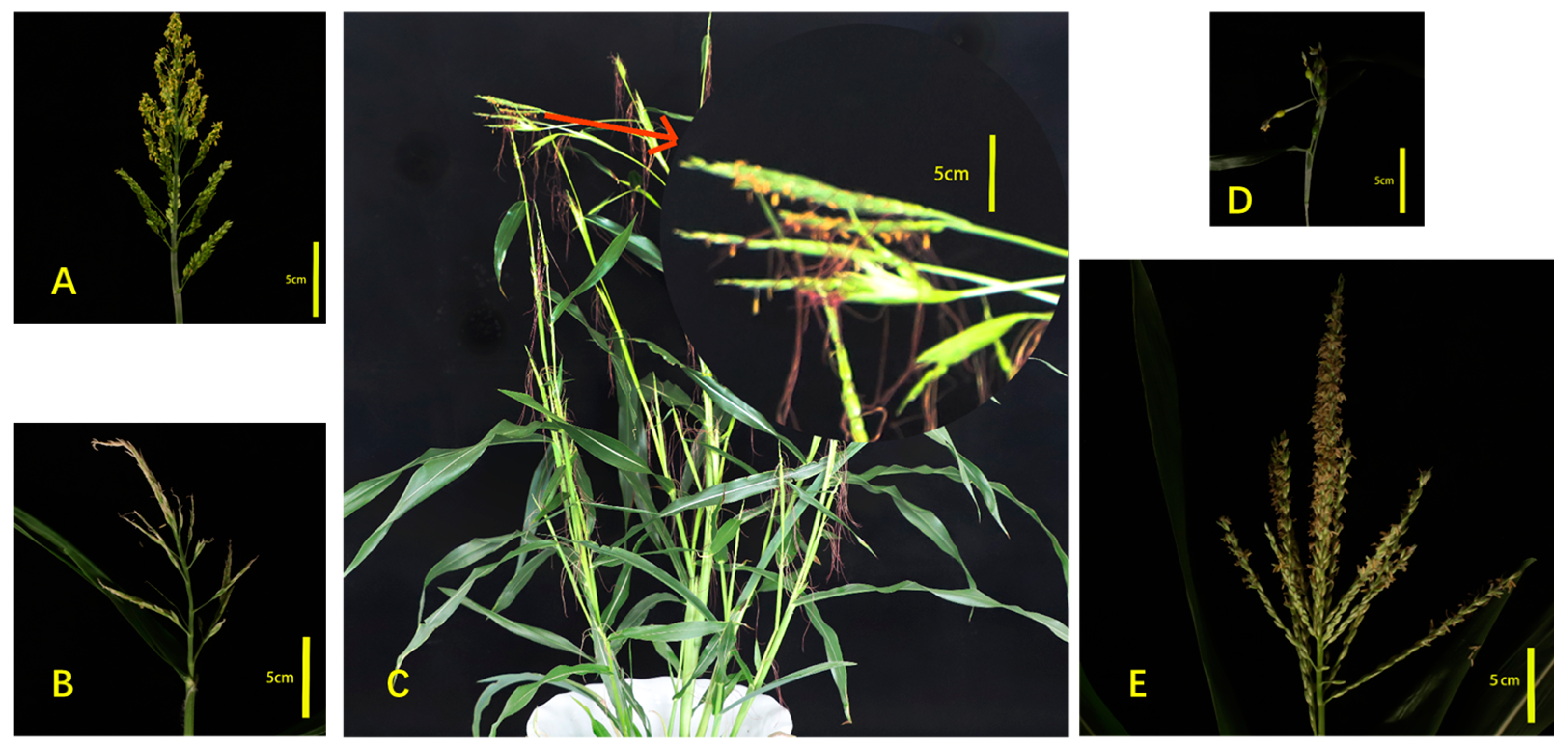
Figure 2.
Main procedures of mowDH production. A—Manual emasculation of wheat; B—Collecting maize pollen grains; C—Manual pollination (applying maize pollen on wheat pistils); D—Auxin treatment; E—Immature seeds harvested; F—Embryo isolation; G—Embryo rescue; H—Embryo regeneration; I—Haploid plantlets; J—Chromosome doubling by colchicine; K—Transplanted DH plantlets; L—DH plants.
Figure 2.
Main procedures of mowDH production. A—Manual emasculation of wheat; B—Collecting maize pollen grains; C—Manual pollination (applying maize pollen on wheat pistils); D—Auxin treatment; E—Immature seeds harvested; F—Embryo isolation; G—Embryo rescue; H—Embryo regeneration; I—Haploid plantlets; J—Chromosome doubling by colchicine; K—Transplanted DH plantlets; L—DH plants.
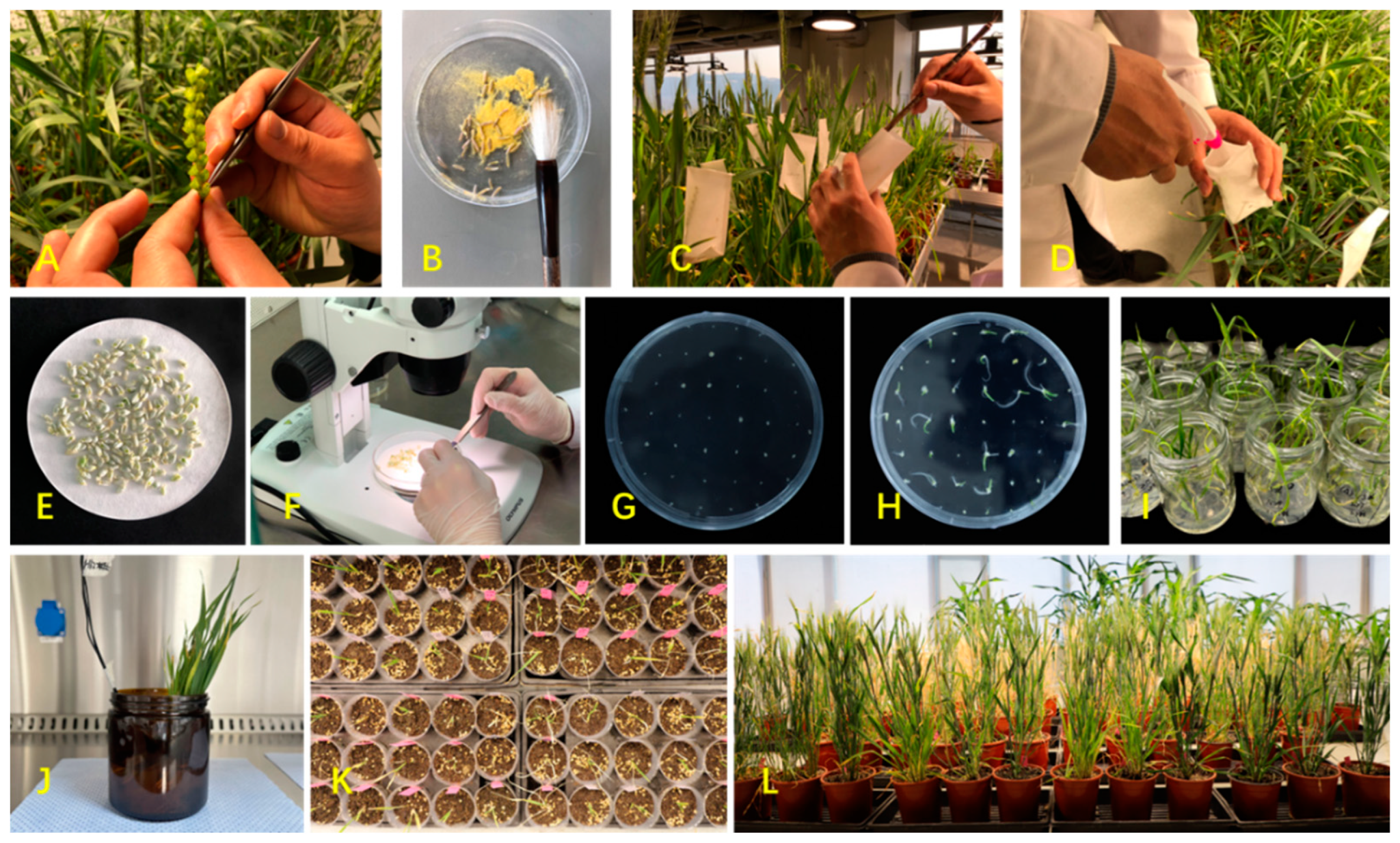
Figure 3.
Grain setting in wheat DH plants in greenhouse. Spikes with doubled chromosomes were highlighted by red arrows.
Figure 3.
Grain setting in wheat DH plants in greenhouse. Spikes with doubled chromosomes were highlighted by red arrows.
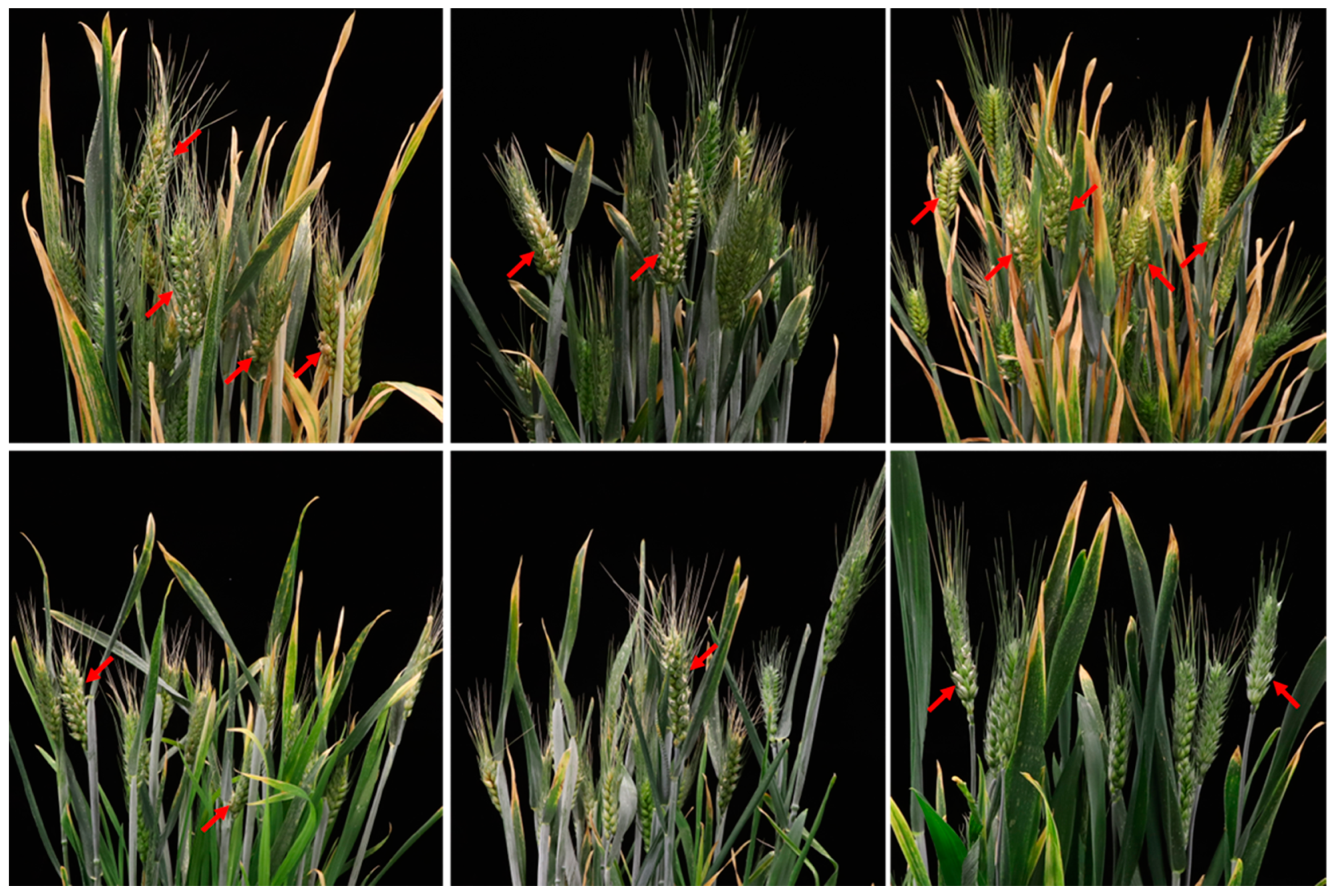
Figure 4.
Growth of individual wheat DH plants of different families.
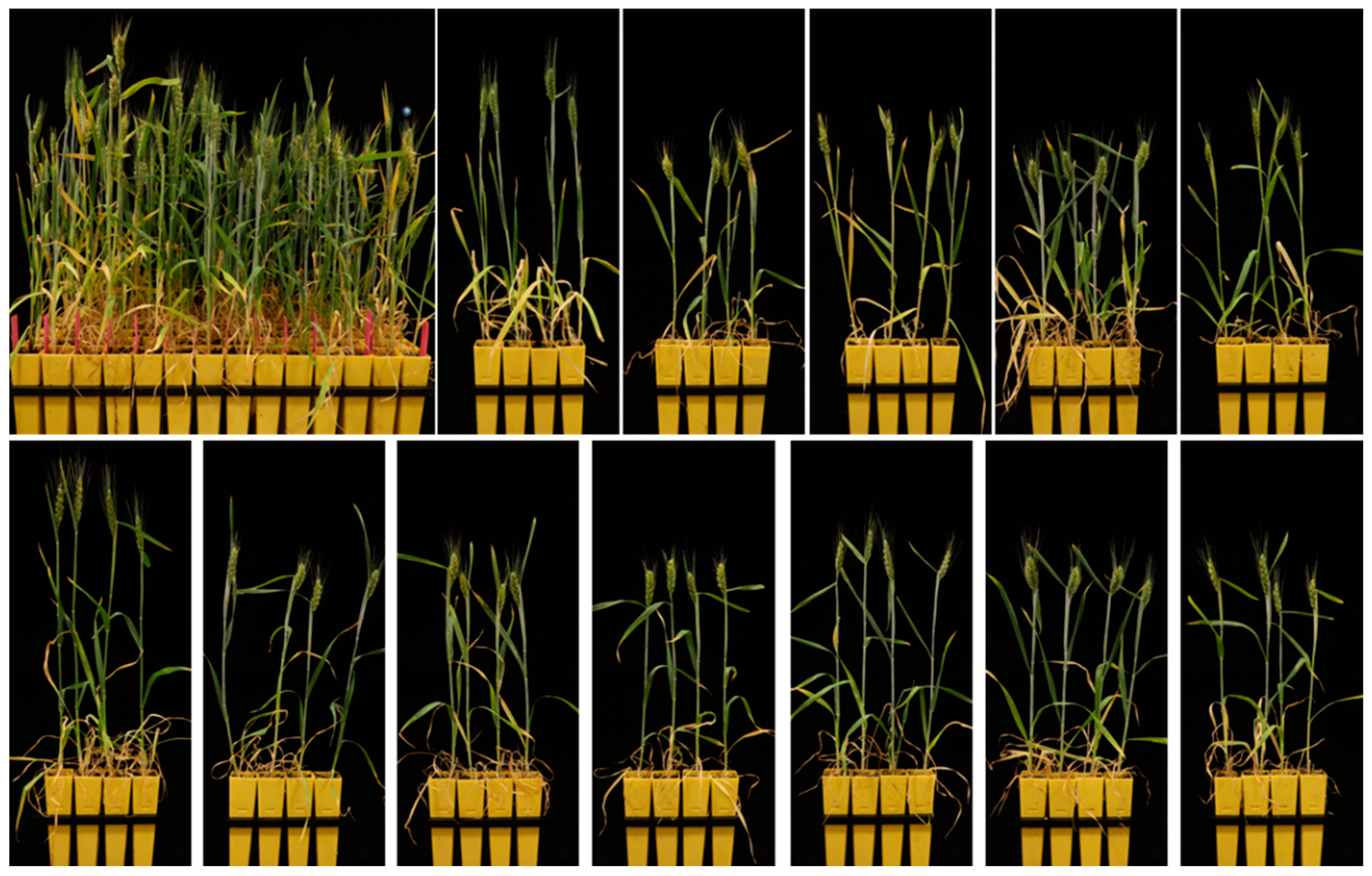

Table 1.
Utilization of different pollen sources in interspecific crosses with common wheat.
| Pollen source | First reported | Rates of haploid embryos (%) | Average rate of haploid embryos (%) | Rates of haploid plantlets (%) | Average rate of haploid plantlets (%) | Wheat genotype dependence | References |
|---|---|---|---|---|---|---|---|
| Maize | [28] | 1.6-60.7 | 17.0 | 16.3-86.6 | 58.0 | weak | [35,36,60,61,62] |
| Sorghum | [45] | 0-42.1 | 18.0 | 56.4-63.3 | 59.9 | strong | [52,53] |
| Pearl millet | [46] | 0.3-39.4 | 18.1 | 44.6-72.2 | 53.1 | weak | [53,54,55] |
| Teosinte | [47] | 12.5-57.5 | 40.5 | 34.6-90.3 | 72.2 | weak | [47,56] |
| Tripsacum | [48] | 5.0-59.0 | 22.9 | 69.3-83.3 | 78.5 | weak | [48,57] |
| Job’s tears | [49] | 10.6 | 10.6 | 26.1 | 26.1 | unknown | [49] |
| Imperata cylindrica | [50] | 0-64.7 | 27.4 | 18.1-84.9 | 48.9 | weak | [50,59,60,63] |
| Ae. caudata | [51] | No data | No data | No data | No data | unknown | [51] |
Disclaimer/Publisher’s Note: The statements, opinions and data contained in all publications are solely those of the individual author(s) and contributor(s) and not of MDPI and/or the editor(s). MDPI and/or the editor(s) disclaim responsibility for any injury to people or property resulting from any ideas, methods, instructions or products referred to in the content. |
© 2024 by the authors. Licensee MDPI, Basel, Switzerland. This article is an open access article distributed under the terms and conditions of the Creative Commons Attribution (CC BY) license (http://creativecommons.org/licenses/by/4.0/).
Copyright: This open access article is published under a Creative Commons CC BY 4.0 license, which permit the free download, distribution, and reuse, provided that the author and preprint are cited in any reuse.