

Submitted:
27 January 2024
Posted:
29 January 2024
You are already at the latest version
Abstract
This review article seeks to systematically identify appropriate ways to measure managerial skills. The systematic literature review was conducted according to the criteria in the Preferred Reporting Items for Systematic Reviews and Meta-Analyses (PRISMA) guide, and the eligibility criteria were declared through the PICOS tool (population, interventions, comparators, outcomes and study); a tool based on 6,803 records identified bibliometrically in the Web of Science database. The literature review stages determined a reduced set of articles that presented valid and reliable measurement scales covering some determinant constructs on managerial skills for employability such as fundamental, emotional, managerial, leadership, decision-making, communication and teamwork skills.
Keywords:
confirmatory factor analysis
; skills
; skills measurement
; human talent
; managerial training
; management education
; organizational psychology
1. Introduction
The objective this article was to identify appropriate ways to measure managerial skills based on a systematic review of the literature. The importance derived from the development managerial skills lies in the fact that these characteristics are the main condition required by current organizations to lead the processes for institutional improvement and achieve successful results, as they are differentiating factors for productivity in any business sector, since they have an impact on profitability and also on employability and job stability [1,2].
In this regard, the United Nations Educational, Scientific and Cultural Organization (UNESCO) points out the need to achieve the fourth Sustainable Development Goal (SDG) on Quality Education in its education target 4.4 to significantly increase the number of youth and adults who have the necessary skills, particularly technical and vocational, to access employment, decent work and entrepreneurship by 2030 [3].
Management skills are developed on competencies that are built and learned through education, where the limits and potential of individuals are expanded; therefore, detecting talents, resources and skills in intellectual capital is important for continuous improvement, job performance, sustainable development and growth in organizations [2,4,5].
So they can be classified into technical, computer (technological or digital) and cognitive (intellectual) skills, to work according to new trends at the global level [6]. The skills are also divided into hard skills, which are knowledge, and soft skills, which are attributed to personality characteristics that are more difficult to develop [7].
On the other hand, there is the proposal of seven core managerial skills focused on 1) interpersonal skills, 2) conceptual, 3) technical, 4) time management, 5) diagnosis, 6) communication and 7) decision making [8]. There is also a model with ten essential managerial skills that are classified into three main groups, firstly personal-technical skills that include 1) self-knowledge, 2) problem solving, 3) time and stress management, secondly interpersonal-social skills related to 4) conflict management, 5) motivation, 6) communication and 7) leadership; finally group skills related to 8) delegation management, 9) change management and 10) teamwork [9], these skills are complemented by other specific fundamental communication skills such as interviewing, oral and written presentations and meeting management [10].
In that vein, the Corporate Council on Education, in a program of the National Center for Education and Business of the Conference Board of Canada, has developed the Employability Skills 2000+ skills profile, which proposes a classification of core skills that lead to eleven management skills: fundamental ones include 1) communicating, 2) information handling, 3) use numbers, 4) thinking and problem solving; people management skills highlight 5) positive attitudes and behaviors, 6) responsibility, 7) adaptability, 8) learning, 9) working safely and finally, collaborative skills encompassing 10) teamwork and 11) participation in projects and tasks [11,12].
These classifications show that there is no universal consensus regarding a specific set of managerial skills, as Callohuanca and Tanta-lean, [13], state, although these skills have been widely studied as isolated dimensions or as a whole, but only for descriptive purposes, since it is assumed that they change depending on the different contexts. Additionally, according to the Organization for Economic Cooperation and Development (OECD, 2016) [14], very few countries assess skills directly, both because there is often no agreement on the definitions of many of the innumerable skills relevant to jobs, and because such measurements are costly and difficult. This makes it necessary to identify instruments that measure job skills for successful performance in management functions and that can be acquired or expanded through professional training.
Nowadays, economic, technological and social changes modify work structures, as well as the requirements for employability [15]; jobs have changed in the functions performed by workers and job stability, and this explains why the Organization for Economic Cooperation and Development (OECD) [14] insists that generic and specific competencies are increasingly important in the future employment [16,17]; demanding training and development of different skills that are compatible with the supply in the current labor market [18,19].
Companies aim to turn efforts in dynamic capabilities and organizational learning experiences into a competitive advantage [20]. For this reason, organizations invest in management development programs whose purpose is to improve the managerial skills of individual managers through education, training and systematic development of management members within the organization, enabling standardization of managerial approaches and procedures through corporate guidelines and programs [21].
In that order of ideas, workers who participate in management development programs and obtain the highest qualifications in management competencies are identified for employability, successful career transitions and inclusion in corporate succession planning, as they represent a measure for success in many organizations, since they have the potential to assume greater management responsibility for the future for the organization. [21,22].
Therefore, management development is a strategy used to promote human talent to higher level positions, leading to an increase of managerial talent level as well as employability capital for human talents, which refers to the combination of obtaining and retaining a job [23]. A key element in the management development process is the assessment of specific educational needs for the development of managers and senior executives, as well as measuring managerial skills, which will also be useful in identifying training needs and potential problems for various management styles in order to improve competitiveness [21,24].
Thus, the need arises to establish a construct explained in a valid and reliable evaluation instrument, in which indicators are identified that can measure management skills and employability attributes in order to improve the value chain in the professional training process so that human talents are better prepared for the needs of today’s labor market. However, according to a study by the Organization for Economic Co-operation and Development - OECD [14], in very few countries skills are assessed directly, because there is often no agreement regarding the definitions for many of the innumerable skills relevant to jobs, as well as because these measurements are costly and difficult [14].
2. Materials and Methods
In this review, the Preferred Reporting Items for Systematic Reviews and Meta-Analyses (PRISMA) guideline [25] and the PICOS (population, interventions, comparators, outcomes, and study) tool were used to establish eligibility criteria for articles [26,27] being also used by [28].
The initial search for articles was strengthened with the use scientometrics for a systematic review [29] that focuses on knowledge production, spatiality for knowledge production and knowledge relationships within the global network actors [30,31], which allows refining the initial selection articles based on a vector search using field labels and Boolean operators as well as incorporating the mixed sequential use with the PRISMA guideline that in the publications of [32,33,34] have been used.
Articles with the search vector TS = (management NEAR/0 skills) were identified using the Web of Science Core Collection (WoS) databases: Science Citation Index Expanded (SCIE), Social Science Citation Index (SSCI) and Emerging Sources Citation Index (ESCI), which contain journals indexed in the WoS Journal Citation Report (JCR), which are considered high quality journals whose impact is calculated annually according to the average number citations received. With respect to Scopus, the journals indexed in SCIE-WoS, SSCI-WoS and ESCI-WoS had high indexing duplicity with this index. Through the PRISMA guide, the selection of articles was specified based on eligibility criteria: the target population, the interventions in this population, the elements of comparison for these studies, the results to which these studies were oriented, as shown in Table 1.
3. Results
The bibliometric search identified a total 6,803 documents from three different databases of the Web of Science - WoS Core Collection (i.e., SCIE, SSCI and ESCI). A total 6,345 unique titles and abstracts (no duplicates) were identified; however, with the exclusion of documents that were not in English and Spanish (185) as well as documents that were not scientific articles (1,591) resulted in 4,569 re-screening records. In addition, 3,712 non-Economics and Management articles were excluded, reducing the analyzed corpus to 857 full-text articles in English or Spanish retrieved and screened. Finally, we excluded articles that did not include a confirmatory factor analysis (836), those that did not measure managerial skills (6), others without open access (5) and, using the selection criteria defined with the PICOS tool, the selection identified a total 10 studies that met the requirements for inclusion in this systematic review as shown in Figure 1.
3.1. Qualitative Review Analysis
The ten articles that met the eligibility criteria were reviewed at the full-text level to determine precisely whether their characteristics offered homogeneous criteria that made them comparable. Table 2 shows the main identification and retrieval information obtained from the WoS databases.
Table 2 shows a high concentration of articles in journals indexed in the SSCI (Social Science Citation Index) and SCIE (Science Citation Index Expanded), as well as four ESCI (Emerging Sources Citation Index) articles. Out of the 10 empirical cases, six were mainly concentrated in Asia (China, Thailand, Indonesia and Turkey), three in the Americas (United States, Chile and Mexico), plus one in Europe (Spain). In addition to the solid empirical studies, it should be noted that the data come mainly from survey applications.
Thematically, the journals in which these articles were published were associated with WoS categories, mainly concentrated in Psychology, Education, Social Sciences and Business Management. In terms of time, these articles were published between 2004 and 2022.
3.2. Quantitative Review Analysis
The set articles selected were evaluated according to the breadth of topics on the measurement managerial skills, according to the analysis method PRISMA in its quantitative stage. As a method for the analysis of the ten articles, the confirmatory factor analysis used to evaluate the validity and reliability of the instruments applied to measure managerial skills was identified.
Additionally, in this set articles that studied empirical cases where data were collected through surveys were statistically analyzed using several multivariate statistical techniques including exploratory factor analysis (EFA) and confirmatory factor analysis (CFA). These are detailed for each item and the only ones that report a complete validation and reliability for the instruments applied are those that directly use CFA.
Table 3 reports the research that refers to the measurement skills related to this research; ten articles use confirmatory factor analysis as a method to measure managerial skills, a criterion that has been maintained for the inclusion of documents in the next stage in the review.
[According to] Méndez Martínez and Rondón Sepúlveda [43] the Exploratory Factor Analysis (EFA) is a statistical technique of interdependence, whose purpose is to define new factors from the analysis of a set of variables that are highly correlated with each other or to reduce the number of these by identifying the most relevant ones; it is used in the construction of scales and questionnaires.
In an AFE, correlations can be evaluated by means of Bartlett’s test of sphericity, partial correlations can also be measured through the Kaiser Meyer Olkin index (KMO), as well as the individual sample adequacy index (MSA), both of which take values between 0 and 1. The measure can be interpreted as unacceptable values when they are less than 0.5; poor between 0.5 and 0.59; regular when they range between 0.6 and 0.79, and meritorious from 0.8 to 1.
According to [44] Confirmatory Factor Analysis (CFA) evaluates models that propose that a set unobserved variable predict the variability of a set observed variables. In addition, it evaluates the extent to which a set theoretically organized set of factors fits the data through an analysis in which the deficiencies inherent to the exploratory perspective are corrected and a confidence level must be established.
In Table 4, the evaluation metrics used in the CFA in this study are defined, based on [43] and [44].
It was necessary to perform an analysis of the indicators and their parameters: Chi-square/ratio of degrees of freedom (χ2/df), root mean square error approximation (RMSEA), adjusted goodness-of-fit index (AGFI), goodness-of-fit index (GFI), comparative fit index (CFI), normed fit index (NFI), non-normed fit index (NNFI) and root mean square root of residuals (SRMR) or (RMSR) to determine the validation and reliability parameters, which are shown in Table 5.
Table 6 presents in detail ten articles, already included in Table 3, which use various combinations of exploratory factor analysis (EFA), confirmatory factor analysis (CFA). For these analyses, the indicators reported by the researchers are presented: Chi-square/degrees of freedom ratio (χ2/df), root mean square error of approximation (RMSEA), adjusted goodness of fit index (AGFI), goodness of fit index (GFI), comparative fit index (CFI), normed fit index (NFI), non-normed fit index (NNFI) and the standardized root mean square residual (SRMR).
Table 7 shows the results for the comparison of validity and reliability indicators, product of the exploratory factor analysis (EFA) and confirmatory factor analysis (CFA), detailing the five articles that report the best indicators in this study. The analysis reflects the comparison of the following indicators: Chi-square/relation of degrees of freedom (χ2/df), root mean square error of approximation (RMSEA), adjusted goodness of fit index (AGFI), goodness of fit index (GFI), comparative fit index (CFI), normed fit index (NFI), non-normed fit index (NNFI) and standardized root mean square residual (SRMR), with respect to the parameters previously established in Table 5.
4. Discussion
La The systematic review presented in this study analyzed different appropriate ways to measure managerial skills without focusing on a specific classification for skills as did the contributions of [41] on soft or emotional skills; [12] concerning fundamental or socio-cognitive, personal and collaborative skills; [40] focused on digital content management skills; [38] on leadership skills; [42] who studied general management skills. Thus, this article provides a broader approach that allowed reviewing common aspects of the articles indicated above, e.g., general management skills, leadership, decision making, communication and teamwork, enabling future studies on a broader set employability skills in different social, geographic and organizational contexts.
Regarding the method for analysis, the data from the articles were collected through surveys or questionnaires that were statistically analyzed using several methods, including exploratory factor analysis (EFA) and confirmatory factor analysis (CFA). In this way, it was possible to compare indicators through updated validity and reliability parameters used in other studies such as that of [28].
It should also be noted that this review followed the PRISMA protocol as other previous reviews on skills [34], showing the systematization the review and advancing it to an objective-quantitative comparison of the analyzed articles. This review incorporated general managerial skills for employability and relied heavily on statistical reports provided in the reviewed literature on common variables and factors within the selected set of articles [12,38,40,41,42].
With respect to the limitations in this study, it can be mentioned that only one database - WoS - was used, which in turn guarantees a high concentration with articles in high impact indexed journals, in addition to ensuring a common comparison base and the same search vector with a high requirement that allowed the identification scales that had been subjected to strict statistical rigor reporting in due form that the stated constructs were effectively measured and, therefore, contributed to a reliable understanding for employability skills. On the other hand, not all studies included measurement instruments such as [40] and [41] in their articles.
Finally, this review has important implications for organizations, educational institutions and other researchers, since the findings identified appropriate scales for measuring managerial skills, which show guidelines on the methods for analysis and parameters of evaluation indicators, which will allow future research their use and application, as well as the generation of new instruments for measuring different types of managerial skills for employability.
5. Conclusions
In summary, this article provides an original systematic review, using the PRISMA protocol, which reviewed articles on the measurement of managerial skills for employability that presented valid and reliable scales that measured confirmatory factor constructs on the topic fundamental, emotional, managerial, leadership, communication, decision-making and teamwork skills, among others.
The results also evidence the interest in the scientific community in the study of managerial skills for employability in America, Europe and Asia, in which the objective of this research to identify appropriate ways to measure managerial skills has been achieved with the finding of a reduced set of five scales that are considered valid and reliable through a confirmatory factor analysis (CFA) and that also reported the best indicators according to the evaluation parameters.
These measurement scales can be used in public and private sector organizations, as well as in universities to identify, measure and develop managerial skills such as fundamental, emotional, managerial, leadership, decision-making, communication and teamwork skills, which contribute to generate added value for human talents and distinctive competencies for companies in different social, geographical and organizational contexts.
Author Contributions
Conceptualization, P.A-G. and A.V-M.; methodology, P.A-G. and G.S-S.; validation, A.V-M.; formal analysis, P.A-G.; writing—original draft preparation, P.A-G.; writing—review and editing, P.A-G. and A.V-M. and G.S-S.; supervision, A.V-M..; project administration, P.A-G.; funding acquisition, A.V-M. and G.S-S. All authors have read and agreed to the published version of the manuscript.
Funding
The Article Processing Charge (APC) was partially funded by Universidad Católica de la Santísima Concepción (Code: APC2024). Additionally, the publication fee (APC) was partially financed through the Publication Incentive Fund, 2023, by the Universidad Arturo Prat (Code: APC2024), and Universidad de Las Americas (Code: APC2023).
Institutional Review Board Statement
Not applicable; this study does not involve humans or animals.
Informed Consent Statement
Not applicable.
Data Availability Statement
Not applicable.
Conflicts of Interest
The authors declare no conflicts of interest.
References
- Ramírez, J. Las habilidades directivas una condición para una ejecución eficaz. Investig. Neg. 2018, 11, 23–29. [Google Scholar]
- Pereda, F.; López, T.; Gonzáles, F. Las habilidades directivas como ventaja competitiva. El caso del sector público de la provincia de Córdoba (España). Intang. Cap. 2014, 10, 528–561. [Google Scholar] [CrossRef]
- UNESCO. Education for Sustainable Development Goals (SDGs). In European Conference on Educational Research 2017. Available online: https://unesdoc.unesco.org/ark:/48223/pf0000252423.
- Cebrián, G.; Junyent, M. Competencies in Education for Sustainable Development: Exploring the Student Teachers’ Views. Sustainability 2015, 7, 2768. [Google Scholar] [CrossRef]
- Meza, A. Learning strategies. Definitions, classifications and measuring instruments. Propósitos Y Represent. 2013, 1, 193–213. [Google Scholar] [CrossRef]
- Gajdzik, B.; Wolniak, R. Influence of Industry 4.0 Projects on Business Operations: Literature and Empirical Pilot Studies Based on Case Studies in Poland. J. Open Innov. Technol. Mark. Complex. 2022, 8, 44. [Google Scholar] [CrossRef]
- Tito, M.D.; Serrano, B. Development of soft skills an alternative to the shortage of human talent. Innova Res. J. 2016, 1, 59–76. [Google Scholar] [CrossRef]
- Griffin, R.; Van Fleet, D. Habilidades Directivas. Evaluación y Desarrollo; Cengage Learning: Boston, MA, USA, 2016. [Google Scholar]
- Whetten, D.A.; Cameron, K.S. Desarrollo de Habilidades Directivas, 8th ed.; Pearson: London, UK, 2011. [Google Scholar]
- Qiu, Y.; García-Aracil, A.; Isusi-Fagoaga, R. Critical Issues and Trends in Innovation and Entrepreneurship Education in Higher Education in the Post-COVID-19 Era in China and Spain. Educ. Sci. 2023, 13, 407. [Google Scholar] [CrossRef]
- Mainga, W.; Murphy-Braynen, M.B.; Moxey, R.; Quddus, S.A. Graduate Employability of Business Students. Adm. Sci. 2022, 12, 72. [Google Scholar] [CrossRef]
- Idkhan, A.M.; Syam, H.; Sunardi; Hasim, A.H. The employability skills of engineering students’: Assessment at the university. Int. J. Instr. 2021, 14, 119–134. [Google Scholar] [CrossRef]
- Callohuanca, J.; Tantalean, L. Adaptación y validación de una escala para medir las habilidades gerenciales. An. Científicos 2020, 81, 33–57. [Google Scholar] [CrossRef]
- OCDE. Desarrollando las habilidades correctas: Evaluar y anticiparse a los cambios en las necesidades. 2016. [CrossRef]
- Guerdis, P.; López, D. Impacto social de la cuarta revolución industrial y la responsabilidad social empresarial como respuesta. I+D Rev. De Investig. 2022, 17, 1–10. [Google Scholar]
- Rego, M.A.S.; Sáez-Gambín, D.; González-Geraldo, J.L.; García-Romero, D. Transversal Competences and Employability of University Students: Converging towards Service-Learning. Educ. Sci. 2022, 12, 265. [Google Scholar] [CrossRef]
- European Commission. New Skills for New Jobs--Policy Initiatives in the Field of Education: Short Overview of the Current Situation in Europe. November 2010. November, 36. Available online: http://search.proquest.com/docview/1361846167?accountid=10755%5Cnhttp://sfx.bib-bvb.de/sfx_uben?url_ver=Z39.88-2004&rft_val_fmt=info:ofi/fmt:kev:mtx:book&genre=unknown&sid=ProQ:ERIC&atitle=&title=New+Skills+for+New+Jobs--Policy+Initiatives+in+the+Field+of.
- Andino-González, P. Habilidades del administrador de empresas desde una perspectiva del mercado laboral actual. J. Manag. Bus. Stud. 2022, 4, 1–22. [Google Scholar] [CrossRef]
- De Vos, A.; Jacobs, S.; Verbruggen, M. Career transitions and employability. J. Vocat. Behav. 2021, 126, 103475. [Google Scholar] [CrossRef]
- Garzón, M. The dynamic capacity of learning. Introd. Desarro. Gerenc. 2018, 10, 29–47. [Google Scholar] [CrossRef]
- Babiak, P.; Neumann, C.; Hare, R. Corporate Psychopathy: Talking the Walk. Behav. Sci. Law 2010, 28, 174–193. [Google Scholar] [CrossRef]
- De Vos, A.; Jacobs, S.; Verbruggen, M. Career transitions and employability. J. Vocat. Behav. 2021, 126, 103475. [Google Scholar] [CrossRef]
- Peeters, E.; Nelissen, J.; De Cuyper, N.; Forrier, A.; Verbruggen, M.; De Witte, H. Employability Capital: A Conceptual Framework Tested Through Expert Analysis. J. Career Dev. 2019, 46, 79–93. [Google Scholar] [CrossRef]
- Ingsih, K.; Suhana, S. Improving Working Readiness through Mastering Soft Skills: Empirical Evidence from University Students in Indonesia. Rev. De Métodos Cuantitativos Para La Econ. Y La Empresa 2023, 35, 268–279. [Google Scholar] [CrossRef]
- Moher, D.; Liberati, A.; Tetzlaff, J.; Altman, D.G.; Altman, D.; Antes, G.; Atkins, D.; Barbour, V.; Barrowman, N.; Berlin, J.A.; et al. Preferred reporting items for systematic reviews and meta-analyses: The PRISMA statement. PLoS Med. 2009, 6, e1000097–269. [Google Scholar] [CrossRef]
- Methley, A.M.; Campbell, S.; Chew-Graham, C.; McNally, R.; Cheraghi-Sohi, S. PICO, PICOS and SPIDER: A comparison study of specificity and sensitivity in three search tools for qualitative systematic reviews. BMC Health Serv. Res. 2014, 14, 1–10. [Google Scholar] [CrossRef] [PubMed]
- Namoun, A.; Alshanqiti, A. Predicting student performance using data mining and learning analytics techniques: A systematic literature review. Appl. Sci. 2021, 11, 237. [Google Scholar] [CrossRef]
- Vega-Muñoz, A.; Gil-Marín, M.; Contreras-Barraza, N.; Salazar-Sepúlveda, G.; Losada, A.V. How to Measure Organic Fruit Consumer Behavior: A Systematic Review. Horticulturae 2022, 8, 318. [Google Scholar] [CrossRef]
- Kullenberg, C.; Kasperowski, D. What is citizen science—A scientometric meta-analysis. PLoS ONE 2016, 11, e0147152. [Google Scholar] [CrossRef] [PubMed]
- Mikhaylov, A.; Hvaley, D. Knowledge hubs of Russia: Bibliometric mapping of research activity. J. Scientometr. Res. 2020, 9, 1–10. [Google Scholar] [CrossRef]
- Castillo-Vergara, M.; Quispe-Fuentes, I.; Poblete, J. Technological innovation in the food industry: A bibliometric analysis. Eng. Econ. 2021, 32, 197–209. [Google Scholar] [CrossRef]
- Andino-González, P. Estudio Bibliométrico sobre empleabilidad. Ad-Gnos. 2023, 12, 1–25. [Google Scholar] [CrossRef]
- Contreras-Barraza, N.; Espinosa-Cristia, J.F.; Salazar-Sepulveda, G.; Vega-Muñoz, A.; Ariza-Montes, A. A Scientometric Systematic Review of Entrepreneurial Wellbeing Knowledge Production. Front. Psychol. 2021, 12, 848. [Google Scholar] [CrossRef]
- Plant, J.L.; van Schaik, S.M.; Sliwka, D.C.; Boscardin, C.K.; O’Sullivan, P.S. Validation of a self-efficacy instrument and its relationship to performance of crisis resource management skills. Adv. Health Sci. Educ. 2011, 16, 579–590. [Google Scholar] [CrossRef]
- Liu, S.; Hallinger, P. Principal Instructional Leadership, Teacher Self-Efficacy, and Teacher Professional Learning in China: Testing a Mediated-Effects Model. Educ. Adm. Q. 2018, 54, 501–528. [Google Scholar] [CrossRef]
- García-Ros, R.; Pérez-González, F.; Hinojosa, E. Assessing time management skills as an important aspect of student learning: The construction and evaluation of a time management scale with Spanish high school students. Sch. Psychol. Int. 2004, 25, 167–183. [Google Scholar] [CrossRef]
- Boonroungrut, C.; Huang, F. Reforming theory of planned behavior to measure money management intention: A validation study among student debtors. RAUSP Manag. J. 2020, 56, 24–37. [Google Scholar] [CrossRef]
- Yuan, Y.; Chen, Q.; Sun, X.; Liu, Z.; Xue, G.; Yang, D. Development, and preliminary validation of the youth leadership potential scale. Front. Psychol. 2019, 10, 2310. [Google Scholar] [CrossRef] [PubMed]
- Faúndez, M.O.; de la Fuente-Mella, H. Skills Measurement Strategic Leadership Based on Knowledge Analytics Management through the Design of an Instrument for Business Managers of Chilean Companies. Sustainability 2022, 14, 9299. [Google Scholar] [CrossRef]
- Kocak, O. Development, and validation of a scale for assessing personal digital content management skills of higher education students. Malays. J. Libr. Inf. Sci. 2021, 26, 69–87. [Google Scholar] [CrossRef]
- Vázquez Moreno, A.; Ledesma Amaya, L.; García Cruz, R. Validación Del Cuestionario ESCQ-20 En Adolescentes Mexicanos. Univ. Y Soc. 2022, 14, 247–257. [Google Scholar]
- Boonda, P.; Preedeekul, A.; Markmee, P. Analytical study of training program factors to develop the competency of regional operating officer (ROO) in the virtual service provider office (VSPO) in Thailand. J. Health Res. 2018, 32, 47–59. [Google Scholar] [CrossRef]
- Méndez Martínez, C.; Rondón Sepúlveda, M. Introducción al análisis factorial exploratorio. Rev. Colomb. De Psiquiatr. 2012, 41, 197–207. [Google Scholar] [CrossRef] [PubMed]
- Rojas-Torres, L. Robustness of Confirmatory Factor Analysis Fit Indices to Outliers. Rev. De Matemática: Teoría Y Apl. 2020, 27, 383–404. [Google Scholar] [CrossRef]
- Schermelleh-Engel, K.; Moosbrugger, H.; Müller, H. Evaluating the fit of structural equation models: Tests of significance and descriptive goodness-of-fit measures. MPR-Online 2003, 8, 23–74. [Google Scholar]
- Kalkan, Ö.K.; Kelecioğlu, H. The effect of sample size on parametric and nonparametric factor analytical methods. Kuram Ve Uygulamada Egit. Bilim. 2016, 16, 153–171. [Google Scholar] [CrossRef]
- Qiu, Y.; García-Aracil, A.; Isusi-Fagoaga, R. Critical Issues and Trends in Innovation and Entrepreneurship Education in Higher Education in the Post-COVID-19 Era in China and Spain. Educ. Sci. 2023, 13, 407. [Google Scholar] [CrossRef]
- Ramírez, J. Las habilidades directivas una condición para una ejecución eficaz. Investig. Neg. 2018, 11, 23–29. [Google Scholar]
- Tito Maya, M.D.; Serrano Orellana, B. Desarrollo de soft skills una alternativa a la escasez de talento humano Development of soft skills an alternative to the shortage of human talent. Innova Res. J. 2016, 1, 59–76. [Google Scholar] [CrossRef]
- UNESCO. Education for Sustainable Development Goals (SDGs). In Proceedings of the European Conference on Educational Research 2017, Copenhagen, Denmark, 22–25 August 2017; Available online: https://unesdoc.unesco.org/ark:/48223/pf0000252423.
Figure 1.
Preferred Reporting Items for Systematic Reviews and Meta-Analyses (PRISMA) analysis flow.
Figure 1.
Preferred Reporting Items for Systematic Reviews and Meta-Analyses (PRISMA) analysis flow.
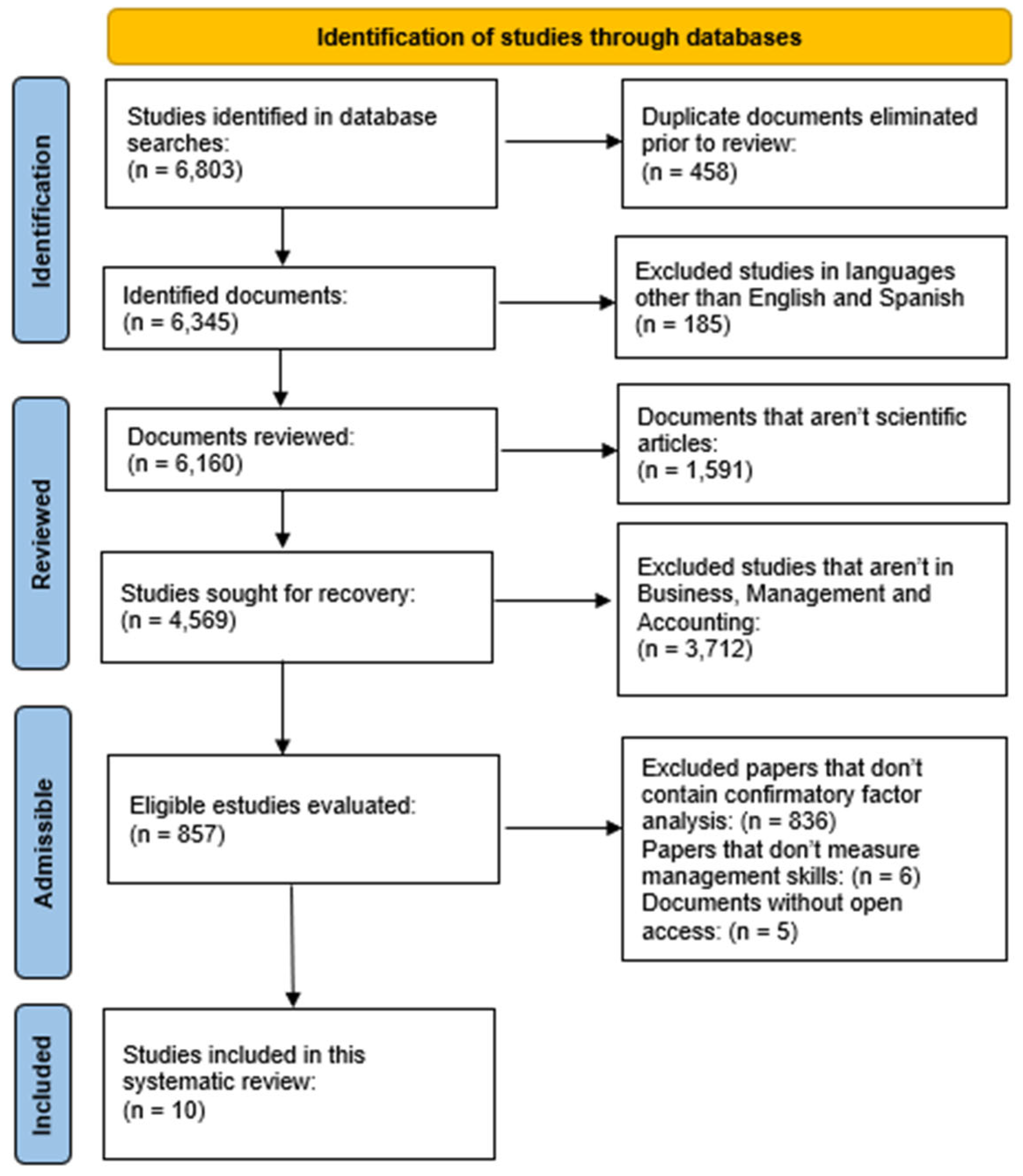

Table 1.
Eligibility criteria using PICOS (Population, Interventions, Comparators, Outcomes, and Study).
Table 1.
Eligibility criteria using PICOS (Population, Interventions, Comparators, Outcomes, and Study).
| PICOS | Descripción |
|---|---|
| Population | Students, teachers, employers, employees |
| Interventions | Survey application |
| Comparator | Methods of analysis (validity and reliability), with instruments that measure skills |
| Outcomes | Valid and reliable measurement scales to study managerial skills |
| Study designs | No a priori restrictions. Quantitative and mixed types of studies were included. |
Table 2.
Articles included in qualitative stage for review analysis.
| Authors | Article Title | Journal Title | Publication Year | WoS Categories | WoS Index* | Country | Population | Total Sample | Data from | Management Skills |
|---|---|---|---|---|---|---|---|---|---|---|
| Liu & Hallinger, [35] | Principal Instructional Leadership, Teacher Self-Efficacy, and Teacher Professional Learning in China: Testing a Mediated-Effects Model | EDUCATIONAL ADMINISTRATION QUARTERLY | 2018 | Education & Educational Research | SSCI | China | Teachers | 3,600 | Survey - PIMRS Instrument | Yes |
| Plant et al., [34] | Validation of a self-efficacy instrument and its relationship to performance of crisis resource management skills | ADVANCES IN HEALTH SCIENCES EDUCATION | 2011 | Education & Educational Research; Education, Scientific Disciplines; Health Care Sciences & Services | SCIE; SSCI | United States | University professionals | 125 | Survey - Development of instrument to measure CRM, ANTS system and GRS + Factor Analysis | Yes |
| García-Ros et al., [36] | Assessing time management skills as an important aspect of student learning - The construction and evaluation of a time management scale with Spanish high school students | SCHOOL PSYCHOLOGY INTERNATIONAL | 2004 | Psychology, Educational | SSCI | Spain | Students | 350 | Survey - Time Management Questionnaire | Yes |
| Boonroungrut & Huang, [37] | Reforming theory of planned behavior to measure money management intention: a validation study among student debtors | RAUSP MANAGEMENT JOURNAL | 2020 | Business; Management | ESCI | Thailand | Students | 919 | Survey | Yes |
| Yuan et al., [38] | Development and Preliminary Validation of the Youth Leadership Potential Scale | FRONTIERS IN PSYCHOLOGY | 2019 | Psychology, Multidisciplinary | SSCI | China | Students | 696 | Survey - Youth Leadership Potential Scale - YLPS | Yes |
| Faúndez & de la Fuente-Mella, [39] | Skills Measurement Strategic Leadership Based on Knowledge Analytics Management through the Design of an Instrument for Business Managers of Chilean Companies | SUSTAINABILITY | 2022 | Green & Sustainable Science & Technology; Environmental Sciences; Environmental Studies | SCIE; SSCI | Chile | Management level professionals | 262 | Survey | Yes |
| Kocak, [40] | Development and validation of a scale for assessing personal digital content management skills of higher education students | MALAYSIAN JOURNAL OF LIBRARY & INFORMATION SCIENCE | 2021 | Information Science & Library Science | SSCI | Turkey | University students | 600 | Survey | Yes |
| Vázquez Moreno et al., [41] | Validación Del Cuestionario ESCQ-20 En Adolescentes Mexicanos | REVISTA UNIVERSIDAD Y SOCIEDAD | 2022 | Social Sciences, Interdisciplinary | ESCI | Mexico | Students | 455 | Survey ESCQ-21 |
Yes |
| Idkhan et al., [12] | The Employability Skills of Engineering Students’: Assessment at the University | INTERNATIONAL JOURNAL OF INSTRUCTION | 2021 | Education & Educational Research | ESCI | Indonesia | Engineering undergraduates - after their internships | 528 | Survey - Employability Skills Profile 2000+ | Yes |
| Boonda et al., [42] | Analytical study of training program factors to develop the competency of regional operating officer (ROO) in the virtual service provider office (VSPO) in Thailand | JOURNAL OF HEALTH RESEARCH | 2018 | Health Care Sciences & Services | ESCI | Thailand | Executives and trainees in the health care field | 938 | Survey | Yes |
Index WoS*: SSCI – Social Science Citation Index, SCIE – Science Citation Index Ex-panded, ESCI – Emerging Sources Citation Index.
Table 3.
Articles included in the quantitative stage for the review analysis.
| Authors | Published Year | Country | Total Sample | Analysis Method* | Management Skills | Dimensions |
|---|---|---|---|---|---|---|
| Liu & Hallinger, [35] | 2018 | China | 3,600 | CFA | Leadership, Time management | Leadership, confidence, motivation, communication, time management, self-efficacy, learning. |
| Plant et al., [34] | 2011 | United States | 125 | AFE, CFA | Task management, Resource management | ANTS: decision making, technical knowledge, task management. GRS: teamwork, communication, problem solving and leadership. |
| García-Ros et al., [36] | 2004 | Spain | 350 | AFE, CFA | Time management | Short and long term planning |
| Boonroungrut & Huang, [37] | 2020 | Thailand | 919 | CFA | Money management | Money management |
| Yuan et al., [38] | 2019 | China | 696 | AFE, CFA | Leadership | Leadership attitude, communication, decision making, stress management |
| (Faúndez & de la Fuente-Mella, [39] | 2022 | Chile | 262 | CFA | Business intelligence and analysis | Professional Capability Development, Competence in learning environment, Integra skills, Strategic Vision Competence for Business Intelligence and Business Analysis business managers. |
| Kocak, [40] | 2021 | Turkey | 600 | AFE, CFA | Digital content management | Digital Content Management |
| Vázquez Moreno et al., [41] | 2022 | Mexico | 455 | AFE, CFA | Emotional | Perceiving and understanding emotions; managing and regulating emotions; expressing and naming emotions. |
| Idkhan et al., [12] | 2021 | Indonesia | 528 | CFA | Fundamental, personal and collaborative management | Communicating, information management, use of numbers, thinking and problem solving, positive attitudes and behaviors, responsibility, adaptability, learning, working safely, teamwork, participation in projects and assignments |
| Boonda et al., [42] | 2018 | Thailand | 938 | AFE, CFA | Management skills | Personnel management and internal control, management, leadership, teamwork, learning, communication. |
Analysis Method *: EFA: exploratory factor analysis, CFA: confirmatory factor analysis.
Table 4.
Confirmatory Factor Analysis (CFA) Evaluation Metrics.
| No. | Métricas de evaluación | Definición |
|---|---|---|
| 1 | Chi-square test (χ2) | It allows evaluating whether the model proposed fits the theorized distribution, comparing the observed data with the expected data according to the hypothesized model; a non-significant chi-square value indicates a good fit between the model and the data. Chi-square can be used for discrete distributions such as the binomial distribution and the Poisson distribution. |
| 2 | Root Mean Square Error of Approximation (RMSEA) | It evaluates the discrepancy between the hypothesized model and the population covariance matrix. It measures the average error per degree freedom, takes into account both the complexity of the model and the sample size, which makes it a robust and widely used fit index. |
| 3 | Adjusted goodness-of-fit index (AGFI) | It is the GFI adjusted for the degrees of freedom for the proposed model. It calculates the proportion of the variance explained by the estimated covariance of the population. |
| 4 | Goodness-of-fit index (GFI) | It indicates the proportion of the information given by the estimation with respect to the information in the sample matrix. Evaluates the goodness of fit of the model taking into account the sample size and the number of indicators. |
| 5 | Comparative Fit Index (CFI) | Indicates the proportion of improvement in the fit statistic based on non-centrality. |
| 6 | Normalized fit index (NFI) | Measures the proportional reduction in fit function when moving from the null model to the proposed model. |
| 7 | Non-Normed Fit Index (NNFI) | Also known as the Tucker Lewis index (TLI). Compares the fit by degrees of freedom of the proposed and null model, i.e. model with no relationship between the variables. |
| 8 | Root mean squared residuals mean squared index (SRMR) | Fit index that provides an average of the deviations of the elements of the matrices. |
Table 5.
Validation parameters and reliability.
| Autores | Parámetros | Muestra | χ2/df | RMSEA | AGFI | GFI | CFI | NFI | NNFI | SRMR |
|---|---|---|---|---|---|---|---|---|---|---|
| Schermelleh-Engel et al., [45] | Good fit** | ≥200 |
≥0 | ≤0.05 | ≥0,90 | ≥0,95 | ≥0,97 | ≥0,95 | ≥0,97 | |
| ≤2 | ≤1,00 | ≤1,00 | ≤1,00 | ≤1,00 | ≤1,00 | |||||
| Acceptable fit* | >2 | >0,05 | ≥0,85 | ≥0,90 | ≥0,95 | ≥0,90 | ≥0,95 | |||
| ≤3 | ≤0,08 | <0,90 | <0,95 | <0,97 | <0,95 | <0,97 | ||||
| Kalkan & Kelecioğlu, [46] | Good fit** | ≥200 |
<0.05 | |||||||
| Acceptable fit* | ≥0,05 | |||||||||
| ≤0,08 |
Table 6.
Articles with the validation and reliability reported in the quantitative stage for the review analysis.
Table 6.
Articles with the validation and reliability reported in the quantitative stage for the review analysis.
| Autores | País | Muestra | Factores | χ2/df | RMSEA | AGFI | GFI | CFI | NFI | NNFI | SRMR |
|---|---|---|---|---|---|---|---|---|---|---|---|
| Liu & Hallinger, [35] | China | 3,600 | 4 | 13.14 | 0.06* | NR | NR | 0.853 | NR | 0.847 | 0.05* |
| Plant et al., [34] | United States | 125 | 2 | 1.85** | 0.08* | NR | NR | 0.91 | NR | 0.89 | NR |
| García-Ros et al., [36] | Spain | 350 | 3 | 2.57* | 0.08* | NR | 0.86 | 0.86 | NR | 0.81 | 0.06* |
| Boonroungrut & Huang, [37] | Thailand | 919 | 1 | 2.24* | 0.06* | NR | 0.94* | 0.96* | NR | NR | NR |
| Yuan et al., [38] | China | 696 | 1 | 2.16* | 0.041** | NR | NR | 0.963* | NR | 0.937 | 0.022** |
| Faúndez & de la Fuente-Mella, [39] | Chile | 262 | 1 | 1.57** | 0.047** | NR | NR | 0.918 | 0.804 | 0.915 | NR |
| Kocak, [40] | Turkey | 600 | 1 | 2.03* | 0.06* | NR | 0.86 | 0.92 | 0.90* | NR | 0.099** |
| Vázquez Moreno et al., [41] | Mexico | 455 | 1 | 0.66** | 0.021** | NR | 0.993** | 0.998** | NR | NR | 0.044** |
| Idkhan et al., [12] | Indonesia | 528 | 3 | 0.943** | 0.006** | NR | 0.912* | 0.974** | 0.516 | 0.972** | NR |
| Boonda et al., [42] | Thailand | 938 | 1 | 1.55** | 0.029** | 0.975** | 0.991** | 0.998** | 0.995** | NR | 0.008** |
Table 7.
Validation and reliability in articles reporting the best indicators.
| Authors | Country | Total Sample | Analysis Method | Factors | Items | χ2/df | RMSEA | AGFI | GFI | CFI | NFI | NNFI | SRMR | Management Skills |
|---|---|---|---|---|---|---|---|---|---|---|---|---|---|---|
| Boonda et al., [42] | Thailand | 938 | AFE, CFA | 1 | 6 | 1.55** | 0.029** | 0.975** | 0.991** | 0.998** | 0.995** | NR+ | 0.008** | Management Skills: Personnel management and internal control, management, leadership, teamwork, learning, communication. |
| Vázquez Moreno et al., [41] | Mexico | 455 | AFE, CFA | 1 | 3 | 0.66** | 0.021** | NR | 0.993** | 0.998** | NR | NR | 0.044** | Emotional Skills: Perceiving and understanding emotions; managing and regulating emotions; expressing and naming emotions. |
| Idkhan et al., [12] | Indonesia | 528 | CFA | 3 | 11 | 0.943** | 0.006** | NR | 0.912* | 0.974** | 0.516 | 0.972** | NR | Fundamental Skills: communicating, handling information, using numbers, thinking and problem solving; People Management Skills: positive attitudes and behaviors, responsibility, adaptability, learning, working safely; and Collaborative Skills: teamwork, participation in projects and tasks. |
| Yuan et al., [38] | China | 696 | AFE, CFA | 1 | 5 | 2.16* | 0.041** | NR | NR | 0.963* | NR | 0.937 | 0.022** | Leadership, leadership attitude, communication, decision making, stress management. |
| Kocak, [40] | Turkey | 600 | AFE, CFA | 1 | 1 | 2.03* | 0.06* | NR | 0.86 | 0.92 | 0.90* | NR | 0.099** | Digital content management |
+ NR: not reported; ** Good fit; * Acceptable fit.
Disclaimer/Publisher’s Note: The statements, opinions and data contained in all publications are solely those of the individual author(s) and contributor(s) and not of MDPI and/or the editor(s). MDPI and/or the editor(s) disclaim responsibility for any injury to people or property resulting from any ideas, methods, instructions or products referred to in the content. |
© 2024 by the authors. Licensee MDPI, Basel, Switzerland. This article is an open access article distributed under the terms and conditions of the Creative Commons Attribution (CC BY) license (http://creativecommons.org/licenses/by/4.0/).
Copyright: This open access article is published under a Creative Commons CC BY 4.0 license, which permit the free download, distribution, and reuse, provided that the author and preprint are cited in any reuse.


