

Submitted:
26 January 2024
Posted:
26 January 2024
You are already at the latest version
Preprints on COVID-19 and SARS-CoV-2
Abstract
This study aimed to identify changes in visitor behavior and visitor interest in healing forests before and after the COVID-19 pandemic. The study used text mining analysis techniques to identify changes in visitation behavior over time, divided into three periods: pre-COVID-19 (January 1 to December 31, 2019), during the COVID-19 pandemic (November 1, 2020 to October 31, 2022), and post-COVID-19 (November 1, 2022 to October 31, 2023 ). After the COVID-19 outbreak, healing forest use behavior did not regress to pre-COVID-19 levels. Activity-based keywords such as "hiking," "trekking," and "walking" stood out as the main drivers of this change in behavior. Therefore, related authorities must examine the scalability of the functions, services, and programs of healing forests from a general healing space to a space for leisure and tourism. These findings will contribute to the development of future marketing strategies and programs for healing forests.
Keywords:
healing forest
; COVID-19
; text mining
; network analysis
; quadratic assignment
; procedure correlation analysis
1. Introduction
The COVID-19 pandemic and the resulting sanctions of quarantining, working from home, and social distancing have changed people’s lives, particularly rendering a significant impact on areas related to people’s health and well-being. According to a survey by the Korea Chamber of Commerce and Industry (2021), nearly 8 in 10 people (78.1%) said that since the COVID-19 pandemic, they are more likely to “care about my health and the health of my family” compared with before the pandemic. Based on credit card spending, Koreans are spending 57% of xx on jogging and climbing, followed by home training and fitness at 36% and 24%, respectively. The data demonstrate that with the prolonged duration of the COVID-19 pandemic, Koreans have become increasingly concerned about their health and well-being, which is impacting their spending and credit card usage behaviors (Samsung card, 2023).
As predicted in various fields, the emergence of viruses, such as COVID-19, is expected to occur in cycles (Kim, 2021). Indeed, since 2000, global infectious diseases, such as SARS in 2003, swine flu in 2009, MERS in 2015, and COVID-19 in 2020, have occurred on a five–six-year cycle. Infectious diseases are becoming a new factor in forest utilization as government restrictions are implemented in relation to these infectious diseases (National Institute of Forest Science, 2021). According to an analysis of changes in national tourism behavior conducted by the Korea Tourism Organization (2020), “safety” has become a top priority in overall tourism activities since the outbreak of COVID-19, with a clear preference for “safe, low-density outdoor activities” for families in nature-friendly spaces near their homes. Notably, while the overall number of hikers has decreased since the start of the COVID-19 pandemic due to reduced outdoor activities, the number of visitors to three urban national parks—Bukhansan, Gyeryongsan, and Chiaksan—has increased by about 21% (National Park Service, 2020). This shows that people are increasingly visiting mountains for their accessibility and lower risk of infection when indoor activities are limited (Chang et al., 2021).
This trend is also happening internationally. In Germany, the number of visitors to forests has more than doubled since the start of lockdown in March 2020, and the country has seen a shift toward new types of visitors, such as non-local youth and families with children (Derks et al., 2020). In the Czech Republic, the physical and mental stress caused by lockdown restrictions during the COVID-19 pandemic have been mitigated by the recreational services provided by urban forests (Bamwesigye et al., 2023).
In Korea, healing forests are particularly receiving ever larger numbers of visitors. Healing forests are forests that have been created for “forest healing,” an activity that utilizes various elements of nature, such as scent and landscape, to enhance the human body’s immunity and promote health (Lee et al., 2016). According to the Korea Forest Service, the number of visitors to healing forests exceeded 1.9 million as of 2021. Seogwipo Healing Forest has seen a 260% increase in visitors before and after COVID-19 (as of 2022), with 22,153 visitors compared with the same period last year (6,147). Visits to and demand for healing forests have been on the rise since the COVID-19 pandemic of 2021.
Behavior is not independent of time; thus, behavior over time must be analyzed as changes over time (Woo, 2020). In the aftermath of the COVID-19 pandemic, the authorities must develop strategies to attract and activate increased forest visitation in the medium to long term. Our study aimed to explore changes in healing forest visitation, identify visitor interests, and provide a basis for contributing to the development of future marketing strategies and service programs. Therefore, we identified the usage behavior and interest regarding healing forests in three periods: the pre-COVID-19, during the COVID-19 pandemic, and post-COVID-19 pandemic (Table 2). We aimed to explore mid- and long-term response measures.
2. Materials and Methods
We analyzed the usage behavior of healing forests using time series data. We used Keyword Term Frequency (TF) and Term Frequency-Inverse Document Frequency (TF-IDF) analysis, Convergence of iterated CORrelation (CONCOR) analysis, and Quadratic Assignment Procedure (QAP) correlation analysis with the matrix generated by text mining analysis technique using Textom to identify changes in usage behavior by period. The procedure of the study is shown in Figure 1.
2.1. Study Area: Healing Forests
Healing forests are recognized as “forest welfare facilities” under Article 2 of the Act on the Promotion of Forest Welfare. In contrast to other forest welfare facilities, which are centered on “education” and “experience,” healing forests focus on “healing” (Table 1).
The project to create healing forests, which began in 2007 at the initiative of the Korea Forest Service, has helped lay the foundation for forest healing. Starting with the opening of Sanyeum Healing Forest, the first healing forest in Korea, 38 are currently in operation nationwide. Each healing forest is characterized by the provision of forest healing programs using the various healing factors of forests, such as landscape, phytoncides, anions, oxygen, sound, and sunlight. International examples of similar healing forests include Forest Therapy Base in Japan, Vitaparcours in Switzerland, and Kurort in Germany.
Korean scholars have studied many dimensions of healing forests. Lee (2012) examined forest management techniques to maximize healing effects using the landscape in healing forests. Kweon and Kwon (2014) analyzed preferences for forest healing facilities in healing forests. Jeong et al. (2015) aimed to provide policy bases for appropriate area standards for healing forests in metropolitan areas. Lee and Kim (2016) investigated the impacts of the wellness value and loyalty of healing programs on participants in the Sanyeong Healing Forest programs. Lee et al. (2018) reported the difference in stress and positive and negative emotions before and after experiencing forest healing programs among workers engaged in emotional labor. Thus, research in the early 2010s had focused on preferences for forests and facilities located in healing forests, and after 2015, on programs conducted in healing forests and their effects.
2.2. Text Mining
Text mining is a technique for extracting keywords from data and then identifying relations between sets of keywords to extract valuable information (Lee et al., 2021). It is a technology that discovers information by identifying patterns, similarities, and associations of information in data, and its main feature is to explore the objective perceptions of users to provide a basis for more active service strategies and future user-customized programs (Kim, 2016).
A review of previous studies shows that text mining in the forestry field has been mainly used to analyze network structure changes and demand over time. Kim (2016) explored the perception of forest healing using social media big data. Schober et al. (2018) conducted text mining on articles listed in Scopus for sustainable forest management (SFM) to examine changes in the research agenda for SFM research over time. Park and Yeon (2020) analyzed network changes regarding forest healing issues from 2005 to 2019 using news big data. Suguru (2021) identified factors that positively influence the provision of cultural ecosystem services through the essays of recreational activity participants in a mountain village in Japan. Other studies have provided analyses of consumer intention and demand for forest products (Byun & Seok, 2019; Seok et al., 2019).
2.3. Data Collection
We used Textom to collect and clean the data and then conduct morphological and text mining analyses. The keyword we used for data collection was “healing forest,” and the collection channel was limited to blogs and Cafes(social media forums) of domestic portal sites NAVER and DAUM.
According to Internet Trend™, domestic portal sites NAVER and DAUM are ranked first and third in terms of domestic search engine share, with 57% and 4.28%, respectively, as of 2023. The blog share is 74.4% for Naver and 11.8% for Daum, ranking first and second, respectively. Thus, both are highly influential domestic portals.
Table 2 shows the periods we used for analyzing differences in usage behavior. T covers the year before the first COVID-19 case in South Korea, which occurred in January 2020. We set T1 to include the period from February 18 to April 20, 2022, when the number of domestic infections peaked amid the stronger quarantine. T2 covers the period from the lifting of the domestic outdoor mask mandate on September 26, 2022, to after the declaration of the end of the pandemic on May 11, 2023.
To clean the data, we used the MeCab-ko analysis module, which can separate vocabulary based on dictionary information. The MeCab-ko analyzer we used is based on MeCab, a Japanese open-source morphological analysis engine. It was created through machine learning using the dictionary and corpus of the 21st Century Sejong Plan to suit the Korean context. It has the advantage of outperforming other Korean morphological analyzers in that it corrects spacing errors (Park et al., 2017). In addition, in the frequency analysis stage, we conducted a refinement process to delete, consolidate, and change words to reduce errors in the original text.
2.4. TF Analysis and TF-IDF Analysis
We conducted two types of frequency analysis: TF analysis, for calculating the frequency of keywords appearing in a document and identifying words that occur with high frequency within the entire document; and TF-IDF analysis, for deriving the relative frequency of words in a particular document and identifying the importance of a particular word (Park et al., 2022). If a particular keyword occurs frequently in a document, then the keyword can be determined to play an important role in the document, but if a word with a high frequency is common in all documents, it can be given a low weight (Bank of Korea, 2019). Therefore, we compared the results of both TF and TF-IDF analyses to identify the differences.
2.5. CONCOR Analysis
CONCOR analysis is an iterative analysis technique that evaluates correlations to identify structural equivalence and find similar and related clusters in complex semantic network environments (Tao & Kim, 2022). The relations between lexemes derived from the text can reveal the importance and patterns of specific lexemes within the network. Given that it is computerized, CONCOR analysis has the advantage of compensating for the limitations of traditional content analysis methods, which are labor intensive and cannot eliminate the researcher’s subjectivity (Park & Leydesdorff, 2004).
2.6. QAP Correlation Analysis
The basic structure of social media big data collected is a matrix, which is different from the data used in general statistical analysis. At the same time, most of them are not random samples from the population and each individual observation is interdependent. As such, general inferential statistical methods cannot be directly applied to the data in the matrix, thereby requiring a separate test method to test statistical significance for social media big data (Park & Choi, 2016). Therefore, we conducted QAP correlation analysis using UCINET 6 to identify the similarity in the matrix structure of networks by time period.
QAP correlation analysis is generally divided into two steps: QAP correlation analysis and QAP regression analysis. In this study, QAP correlation analysis (Carrington et al., 2005) was performed to determine whether two matrices are correlated by transposing the matrices, comparing the similarity of the matrix lattice values to calculate the correlation coefficient, and performing a nonparametric test. The degree of correlation between the two matrices was obtained by utilizing the Pearson correlation coefficient.
3. Results
3.1. Data collection results
Using Textom with the keyword “healing forest,” we collected 2,000 data points in T, 4,165 in T1, and 2,328 in T2. The keywords derived from the collected data were 3,575 in T, 5,940 in T1, and 7,965 in T2.
3.2. TF and TF-IDF results for the keyword “healing forest”
The results of TF and TF-IDF are shown in Appendix A. In all three time periods, the results of both analyses were different, indicating that even the most frequent words had differences in terms of importance according to TF-IDF.
In all three time periods, the search keyword “healing forest” was the most frequent, followed by “forest,” “cure,” and “healing,” indicating that visitors viewed the forest as a place for healing and restoration. We also found that as keywords about COVID-19 were collected from T1, the rankings for keywords on individuals or appointments increased. This indicated a shift toward pre-booking and personalized activities owing to the implementation of social distancing policies in response to the COVID-19 pandemic. In T2, the top frequent words were similar to those in the other time periods, but tourism-related words such as "travel" and "destination" and destinations such as "Gimcheon" and "Busan" emerged as new top frequent words, indicating that visits to traditional healing forests were not limited to the concept of healing, but were embraced as part of a trip or planned in conjunction with nearby tourism resources.
According to the TF analysis, the healing forests frequently mentioned by people were Seogwipo Healing Forest, National Jangseong Healing Forest, and Seocheon Healing Forest. Seogwipo Healing Forest is located on Jeju Island, which has a mild climate that is unique in the Korean Peninsula and a variety of vegetation types, including boreal and temperate forests. National Jangseong Healing Forest boasts of the largest cypress forest in Korea. Seocheon Healing Forest is operating a special healing program in connection with a large lake called Janghang-je.
3.3. CONCOR Analysis Results
Words with higher TF-IDF weight values are more likely to determine the topic or meaning of the documents they belong to, and this measure can be used to extract the main keywords (Park & Suh, 2015). Therefore, we focused on the top 100 occurrences of words by TF-IDF weight by time period. To focus on the usage behavior of healing forests, we excluded the search words “healing forests” and “healing forest destination” from the TF-IDF top 100 occurrences. However, we included the case of Seogwipo Healing Forest, which ranked at the top of the TF and TF-IDF analyses, because it had a unique tourism potential that could not be found elsewhere owing to the unique geographical environment of Jeju Island and the unique folk culture of the former Tamra Kingdom (Shin & Moon, 2010).
The results of the CONCOR analysis are shown in Table 6. The network visualization results are shown in Figure 2, Figure 3 and Figure 4. For the results of the CONCOR analysis at time T, we created groups (topics) containing nodes (keywords) and sorted by size.

Table 3.
“Healing Forests” clustering results by period.
| Period | Group name | Topics | Included keywords |
|---|---|---|---|
| T | G1 |
Healing Forest and NRF |
Seogwipo, NRF, recreation, cure, healing, mind, body, wellness, road, forest path, walk, trail, trekking, place, forest, in the forest, wind, nature, sound, valley, air, person, child, tourist attractiveness, cafe, near, variety, management, guidance, thought, review, operation, location, utilization (34) |
| G2 | Programs and Facilities | health, program, meditation, experience, progress, infant, therapy, facility, deck, hike, possible, city, rest area, parking lot, introduction, Dulle-gil-trail, mountain, footbath, free, enjoy, weekend, family, birch, phytoncides, me, mountain forests, park, education, space, pine, sky, welfare, center (33) | |
| G3 | Visitation and usage behavior | reservation, photo, take a picture, memories, course, autumn, entrance fee, description, day, walking, weather, trip, time, car, barrier-free, rest, rain, see, visit, parking, commentary, need, eat, water, travel destination, recommendation (26) | |
| G4 | Camping | campground, camp, camping, price, tree, cypress, site (7) | |
| T1 | G1 |
Healing Forest and NRF |
tourist attractiveness, weekend, Seogwipo, person, summer, accommodation, air, car, body, parking, course, commentary, mind, wellness, possible, home, weather, visit, walking, review, near, trail, trip, entrance, forest, forest path, waterfall, eat, see, itinerary, rain, Dulle-gil-trail, barrier-free, summit, rest, wind, morning, me, cafe, reservation, recommendation, parking lot, photo, distance, location, find, hike, path, NRF, thought, walk (51) |
| G2 | Visitation and usage behavior | trekking, nature, meditation, free, introduction, space, water, sky, hiking, in the forest, deck, valley, arboretum, rest area, phytoncides, park, child, sound, scent, cypress forest, infant, mountain, autumn (23) | |
| G3 | Programs | program, COVID-19, family, target, mountain forests, welfare, recreation, culture, participation, facility, utilization, guidance, center, operation, health, cure, variety, activity, experience, progress (20) | |
| G4 | Camping | camping, campground, healing, name, site, tree (6) | |
| T2 | G1 |
Healing Forest and NRF |
NRF, mountain, activity, facility, welfare, therapy, space, in the forest, operation, mountain forests, free, family, city, application, mind, introduction, review, utilization, meditation, forest, variety, cure, center, program, coast, participation, health, me, branch, body, rest area, park, nature, scent, progress, healing, experience, child (38) |
| G2 | Tourism | trip, travel destination, near, arboretum, Seogwipo, cafe, accommodation, walk, path, parking, entrance fee, find, place, visit, walking, reservation, home, live, guidance, eat, time, recommendation, trail, location, photo, weather, possible, thought, course, car, rain, barrier-free, see, forest path, rest, distance (36) | |
| G3 | Visitation and usage behavior | birch, cypress forest, Dulle-gil-trail, deck, observatory, rental cottage, sound, sky, water, wind, flower, autumn, person, valley, phytoncides (15) |
|
| G4 | Hiking | hiking, trekking, hike, summit, climb, tree, air, town, waterfall, parking lot, campground (11) |
The CONCOR analysis results of T2 contained groups that were not observed in the other periods. The “Tourism” group contained nodes related to tourist resources near the healing forests, and the “Hiking” group contained nodes related to outdoor adventures.
3.4. QAP Correlation Analysis results
To analyze the network similarity between T, T1, and T2 using the healing forest network, we performed QAP correlation analysis using UCINET 6. QAP correlation analysis requires two systems or matrices, namely, the Observed Matrix and the Model or Expected Matrix. QAP correlation analysis can verify how similar the matrix structure of the dependent matrix is to the independent matrix (Yang & Hwang, 2005). In performing QAP correlation analysis, the nodes and matrix sizes that comprise these independent and dependent matrices must match each other (Seon et al., 2021). Therefore, we derived 100 keywords for each time period and then reconstructed the matrix with 71 keywords that co-occurred in all years. The results are shown in Table 4. The correlation values for each time period were statistically significant and can be statistically interpreted as significantly influencing or correlating with each other.
4. Discussion
We aimed to provide findings that could help promote visits to healing forests. First, the use of healing forests shifted toward individual and small group visits in response to the COVID-19 outbreak. Across T, T1, and T2, we found no significant difference in the top trending words. However, we did observe an increase in rankings for personal and appointment keywords related to COVID-19 collected from T1, during COVID-19 pandemic. This suggests that safety and hygiene are prioritized in the wake of the COVID-19 outbreak, and the type of tourism that can ensure recreation and healing-based health has changed. This is consistent with the results of previous studies that cleanliness, low congestion, and virus-free natural environments are expected to receive significant attention after the COVID-19 outbreak, and ecotourism centered on small groups and healing trips is expected to rise (Jeonbuk Green Environment Center, 2020). Therefore, visits to healing forests have been affected by the COVID-19 pandemic, shifting into individual- and small group-centered visits. This implied the necessity of preparing measures for expanding individual- and small group-centered healing programs rather than large group-centered programs.
Second, “tourism” and “hiking” became new factors in the visitation and use of healing forests. In T2, the words with the highest frequency were similar to those of other periods. However, tourism-related words such as "travel" and "destination" as well as destinations such as "Gimcheon" and "Busan" have emerged as new top frequent words. Thus, for post-COVID-19 visitors, the use of and visit to healing forests are not limited to the concept of healing but are being embraced as part of a trip or planned in conjunction with nearby tourism resources. When comparing the results of the CONCOR analysis by time period, we noted a difference in the keywords included between T and T1. However, we found no significant difference in usage behavior, with themes such as “healing forests and NRF,” “programs and facilities,” “visitation and usage behavior,” and “camping.” In T2, similar themes as in T and T1 emerged, along with distinct ones: “tourism” and “hiking.” This could show that healing forests are perceived more broadly as spaces for tourism and hiking, and not merely as spaces for healing, after the COVID-19 pandemic in Korea. This suggests that healing forests need to expand their functions as tourist destinations and organize programs that do not focus on healing.
Third, the use of healing forests after the COVID-19 pandemic is not likely to change back to that before the COVID-19 pandemic. The QAP correlation analysis showed that the correlation between T and T1 was very high, whereas the correlation between T1 and T2 was significantly lower. This is thought to be similar to the shift in usage behavior, from healing-focused activities during T, to more individual-oriented activities during T1 owing to social distancing measures, to more outdoor activities during T2 after the relaxed social distancing measures. However, although T and T2 were the same, T and T1 were also highly correlated. These results indicated a shift in the use behavior of healing forests during T2, which may not revert to the patterns of T. Therefore, the authorities must expand the function of healing forests, organize service programs, and explore ways to connect with surrounding cultural and tourism resources, focusing on the newly identified keywords of “tourism” and “hiking” as described above.
5. Conclusions
We aimed to explore the changes in the usage behavior of the healing forests before, during, and after the COVID-19 outbreak based on historical data using text mining techniques, and to identify the interests of visitors at different times. We collected big data and categorized the same into before, during, and after pandemic periods, and then created a network to analyze the association between each period.
We conclude that after the COVID-19 pandemic, usage behavior is unlikely to revert to pre-COVID-19 patterns. The main factors of change in usage behavior are “tourism” and “hiking.” Therefore, the authorities must recognize healing forests for their potential to function and develop as tourist destinations. As healing forests are located in forests, the demand and behavior of visitors change depending on the season. Forest managers should provide programs that take into account seasonality and expand activities outside the forest by linking with cultural and tourist resources near the forest.
We utilized text mining techniques to explore changes in the usage behavior of healing forests based on historical data and to identify the interests of visitors by season. Our study provides basic data that can contribute to the provision of healing forest programs and establishment of marketing strategies. Furthermore, we recognized the significance of revealing the possibility of utilizing healing forests as tourist destinations.
Nonetheless, our study had data limitations. We collected data using the keyword “healing forest.” However, given the nature of blogs and Cafes as data collection channels, we used post data that did not meet the purpose of the study, such as advertisements and recent posts. Therefore, future research should apply a collection method that can control for advertisements and posts that are not related to healing forests and thus achieve sophisticated data collection.
Appendix A
“Healing Forest” keyword data collection over time
|
Net Above |
T | T1 | T2 |
Net Above |
T | T1 | T2 | ||||||||||||
| Word | TF |
TF IDF |
Word | TF |
TF IDF |
Word | TF |
TF IDF |
Word | TF |
TF IDF |
Word | TF |
TF IDF |
Word | TF |
TF IDF |
||
| 1 | Healing Forest | 2125 | 4.33 | Healing Forest | 4060 | 57.27 | Healing Forest | 4985 | 2.14 | 51 | Sky | 40 | 140.89 | Possible | 63 | 226.36 | Meditation | 135 | 412 05 |
| 2 | Seogwipo | 712 | 880.81 | Seogwipo | 1162 | 1665.01 | Seogwipo | 1515 | 2309.24 | 52 | Palyeongsan | 38 | 149.91 | Facility | 63 | 225.22 | Possible | 134 | 397.34 |
| 3 | Forest | 660 | 531.36 | Forest | 1131 | 1158.06 | Forest | 1384 | 1415.74 | 53 | Photo | 38 | 124.58 | Yesan | 62 | 262.45 | Yesan | 131 | 497.99 |
| 4 | Cure | 606 | 485.13 | Cure | 932 | 981.97 | Cure | 1207 | 1315.18 | 54 | Location | 37 | 122.32 | Gokseong | 61 | 269.76 | Progress | 131 | 392.80 |
| 5 | Healing | 313 | 451.61 | Cypress | 535 | 1079.04 | Road | 670 | 1072.02 | 55 | Phytoncides | 36 | 125.58 | Welfare | 61 | 231.41 | Palyeongsan | 130 | 465.18 |
| 6 | Mountain Forests | 260 | 438.25 | Healing | 522 | 851.74 | Program | 612 | 1058.34 | 56 | Body | 36 | 122.15 | Utilization | 59 | 214.17 | Space | 129 | 391.42 |
| 7 | Cypress | 259 | 513.93 | Mountain Forests | 440 | 854 | Healing | 609 | 987.51 | 57 | Facility | 36 | 122.15 | Barrier-Free | 59 | 222.53 | Chukryongsan | 129 | 474.10 |
| 8 | Program | 239 | 414.97 | Forest Path | 429 | 834.15 | Forest Path | 593 | 1071.75 | 58 | Commentary | 35 | 120.94 | Infant | 57 | 224.39 | Find | 124 | 369.77 |
| 9 | Forest Path | 235 | 435.37 | National | 381 | 833.91 | Mountain Forests | 583 | 1070.71 | 59 | Start | 35 | 120.94 | Phytoncides | 57 | 204.8 | Hiking | 123 | 422.53 |
| 10 | Trip | 204 | 354.2 | Program | 364 | 730.07 | Walking | 570 | 987.09 | 60 | Name | 35 | 118.75 | Parking | 56 | 208.83 | Valley | 119 | 385.78 |
| 11 | Walking | 175 | 338.4 | Walking | 308 | 659.37 | Cypress Forest | 560 | 1200.24 | 61 | Site | 33 | 123.88 | Covid-19 | 56 | 208.83 | Family | 115 | 372.81 |
| 12 | National | 163 | 385.95 | Trip | 304 | 639.38 | Go | 533 | 906.46 | 62 | Valley | 32 | 117.46 | Thought | 56 | 200.2 | Parking | 115 | 370.31 |
| 13 | Experience | 154 | 332.97 | Reservation | 275 | 638.62 | National | 502 | 1087.08 | 63 | Hike | 31 | 113.79 | Wind | 55 | 199.65 | Free | 113 | 363.87 |
| 14 | Road | 153 | 319.09 | Center | 253 | 579.91 | Time | 502 | 913.90 | 64 | Birch | 31 | 115.05 | Cafe | 55 | 216.52 | Location | 111 | 414.62 |
| 15 | Center | 153 | 320.35 | Tree | 250 | 576.77 | Trip | 493 | 916.17 | 65 | Pocheon | 30 | 129.73 | Meditation | 54 | 207.31 | Guidance | 110 | 350.72 |
| 16 | Reservation | 149 | 330.29 | Experience | 242 | 593.6 | Experience | 474 | 921.75 | 66 | Parking | 30 | 113.95 | Weather | 53 | 199.9 | Utilization | 110 | 350.72 |
| 17 | Time | 125 | 285.55 | Time | 228 | 541.42 | Reservation | 394 | 850.27 | 67 | Wellness | 30 | 112.62 | Arboretum | 52 | 213.4 | Goheung | 110 | 402.42 |
| 18 | Tree | 118 | 278.12 | Walk | 188 | 471.25 | Walk | 374 | 794.80 | 68 | Progress | 29 | 106.45 | Introduction | 50 | 186.46 | Trekking | 110 | 385.46 |
| 19 | Walk | 113 | 259.27 | Jangseong | 188 | 546.9 | Tree | 363 | 792.94 | 69 | Gokseong | 29 | 127.73 | Weekend | 50 | 186.46 | Get | 110 | 342.91 |
| 20 | Jangseong | 110 | 303.87 | NRF | 169 | 460.55 | Course | 361 | 794.12 | 70 | Rest Area | 29 | 105.31 | Rest | 50 | 196.84 | Entrance | 107 | 343.41 |
| 21 | Course | 82 | 226.52 | Course | 168 | 450.31 | Center | 341 | 783.42 | 71 | Air | 29 | 105.31 | Sound | 50 | 193.13 | Body | 107 | 345.71 |
| 22 | Daegwallyeong | 77 | 256.73 | Seocheon | 162 | 536.21 | NRF | 321 | 802.65 | 72 | Jecheon | 29 | 123.26 | Distance | 49 | 185.89 | Review | 106 | 345.99 |
| 23 | Gimcheon | 74 | 248.87 | Daegwallyeong | 145 | 496.77 | Gimcheon | 251 | 787.54 | 73 | Free | 29 | 105.31 | Hike | 49 | 186.99 | Sky | 106 | 357.29 |
| 24 | Creation | 74 | 218.87 | Activity | 145 | 454.5 | Weather | 233 | 574.22 | 74 | Therapy | 27 | 105.13 | Deck | 48 | 186.56 | Person | 104 | 339.46 |
| 25 | Nrf | 71 | 210 | Mind | 135 | 375.31 | Mountain | 228 | 576.16 | 75 | Baekunsan | 27 | 118.92 | In Advance | 47 | 177.27 | Eat | 103 | 340.94 |
| 26 | Seocheon | 66 | 228.06 | See | 131 | 367.4 | Operation | 213 | 562.48 | 76 | Review | 26 | 97.6 | Water | 46 | 178.79 | Deck | 100 | 329.84 |
| 27 | Car | 64 | 179.97 | Park | 131 | 409.12 | Autumn | 204 | 582.40 | 77 | Day | 26 | 97.6 | Rain | 46 | 178.79 | Phytoncides | 100 | 329.84 |
| 28 | Mind | 62 | 176.48 | Car | 129 | 369.48 | Nature | 203 | 525.35 | 78 | Open | 26 | 101.24 | Forest Healing Instructor | 44 | 180.57 | Home | 97 | 314.46 |
| 29 | Recommendation | 61 | 181.63 | Nature | 122 | 349.43 | See | 200 | 511.96 | 79 | Samcheok Hwalki | 26 | 99.97 | Samcheok Hwalki | 44 | 183.32 | Barrier-Free | 95 | 328.91 |
| 30 | See | 60 | 174.03 | Recommendation | 122 | 358.3 | Mind | 195 | 527.06 | 80 | Near | 25 | 94.96 | Hiking | 44 | 187.8 | Participation | 95 | 316.72 |
| 31 | Child | 57 | 172.04 | Operation | 116 | 348.61 | come | 194 | 506.55 | 81 | Introduction | 25 | 91.76 | Eat | 43 | 167.13 | Water | 94 | 313.38 |
| 32 | Operation | 57 | 170.87 | Child | 110 | 339.84 | Car | 193 | 510.83 | 82 | Guidance | 25 | 91.76 | Commentary | 43 | 175.18 | Cafe | 93 | 317.03 |
| 33 | Health | 54 | 160.78 | Photo | 98 | 320.42 | Parking Lot | 183 | 522.45 | 83 | Weather | 25 | 91.76 | Camping | 43 | 179.15 | Live | 91 | 307.88 |
| 34 | Mountain | 53 | 159.97 | Parking Lot | 97 | 312.18 | Park | 178 | 533.39 | 84 | Utilization | 25 | 96.12 | Home | 42 | 166.43 | Hike | 91 | 316.32 |
| 35 | Yesan | 48 | 182.33 | Campground | 97 | 346.77 | Me | 177 | 490.14 | 85 | Infant | 25 | 98.62 | Scent | 42 | 172.36 | Scent | 91 | 327.04 |
| 36 | Nature | 47 | 144.89 | Entrance | 85 | 279.04 | Seocheon | 169 | 576.11 | 86 | Entrance Fee | 23 | 88.43 | Travel Destination | 41 | 167.03 | city | 89 | 345.45 |
| 37 | Campground | 47 | 170.68 | Family | 84 | 281.56 | Jangseong | 168 | 562.13 | 87 | Business | 23 | 97.76 | Dulle-Gil-Trail | 41 | 165.84 | Waterfall | 89 | 333.34 |
| 38 | Park | 47 | 158.07 | Person | 84 | 272.47 | Creation | 168 | 477.13 | 88 | Trail | 23 | 87.36 | Application | 41 | 165.84 | Therapy | 88 | 320.48 |
| 39 | Yangpyeong | 47 | 174.44 | Location | 82 | 267.04 | Busan | 163 | 555.56 | 89 | Rain | 22 | 83.56 | Pine | 39 | 160.05 | Variety | 88 | 295.53 |
| 40 | Meditation | 47 | 150.43 | Valley | 80 | 276.58 | Health | 162 | 456.56 | 90 | Footbath | 22 | 86.79 | Air | 38 | 152.64 | Town | 88 | 329.59 |
| 41 | Me | 46 | 148.39 | Health | 78 | 260.34 | in the forest | 160 | 448.64 | 91 | Roadway | 22 | 89.24 | Waterfall | 38 | 160.85 | Start | 86 | 292.06 |
| 42 | Parking Lot | 45 | 141.83 | Space | 76 | 262.75 | Daegwallyeong | 159 | 564.14 | 92 | Climb | 22 | 84.59 | Tourist Attractiveness | 38 | 154.81 | Rain | 86 | 295.43 |
| 43 | Visit | 45 | 144.03 | Sky | 73 | 259.68 | Recommendation | 158 | 457.08 | 93 | Education | 21 | 89.26 | Accommodation | 38 | 158.32 | Manisan | 85 | 369.88 |
| 44 | Chukryongsan | 44 | 158.12 | Trail | 70 | 251.51 | Child | 150 | 449.87 | 94 | Pine | 21 | 83.98 | Management | 38 | 159.56 | Welfare | 84 | 305.91 |
| 45 | Barrier-Free | 41 | 139.11 | Birch | 70 | 267.13 | Jecheon | 143 | 528.00 | 95 | Wind | 21 | 83.98 | Morning | 38 | 152.64 | Air | 83 | 295.73 |
| 46 | Deck | 41 | 141.67 | Visit | 69 | 237.46 | Photo | 142 | 415.27 | 96 | Management | 20 | 82.34 | Sea | 37 | 150.73 | Application | 82 | 287.35 |
| 47 | Family | 40 | 132.24 | Body | 67 | 231.63 | Place | 141 | 414.62 | 97 | Person | 20 | 78.9 | Explore | 37 | 152.98 | Introduction | 81 | 279.34 |
| 48 | Space | 40 | 130.08 | Rest Area | 66 | 238.35 | Visit | 140 | 416.30 | 98 | Weekend | 20 | 78.9 | Scenery | 37 | 154.15 | Distance | 81 | 283.84 |
| 49 | Changwon | 40 | 155.75 | Autumn | 66 | 235.95 | Daejeon | 140 | 503.14 | 99 | Rest | 20 | 78.9 | Trekking | 37 | 162.11 | Sound | 80 | 285.04 |
| 50 | Entrance | 40 | 131.14 | Guidance | 66 | 233.63 | Facility | 138 | 413.88 | 100 | Welfare | 20 | 82.34 | Summer | 37 | 150.73 | Arboretum | 79 | 300.32 |
References
- Andreas Schober, Nenad Šimunović, Andras Darabant & Tobias Stern. 2018. Identifying sustainable forest management research narratives: a text mining approach, Journal of Sustainable Forestry, 37:6, 537-554. [CrossRef]
- Bank of Korea. 2019. Text Mining for Economic Analysis (Report No. 2019-18). Seoul, Korea; Autuor. Retrieved from https://www.bok.or.kr/portal/main/main.do.
- Bamwesigye, D.; Fialova, J.; Kupec, P.; Yeboah, E.; Łukaszkiewicz, J.; Fortuna-Antoszkiewicz, B.; Botwina, J. Urban Forest Recreation and Its Possible Role throughout the COVID-19 Pandemic. Forests 2023, 14, 1254. [Google Scholar] [CrossRef]
- Byun, S.Y. and H.D. Seok. An Analysis of Consumer Preference and Demand for Wild Vegetables: Through a Consumer Preference Survey and Social Big Data Analysis. Journal of Korean Society of Forest Science. 2019. 108(1): 116-126. [CrossRef]
- Carrington, P.J.; Scott, J.; Wasserman, S. Models and Methods in Social Network Analysis; Cambridge University Press: Cambridge, UK, 2005; Volume 28. [Google Scholar]
- Chang, J.Y., S.H. Park. and A.R. Seol. Factors Affecting Changes in Forest Recreational Activities During the COVID-19 Pandemic. Journal of Korean Society of Forest Science. 2021. 110(4), 711-723.
- Derks, J.; Giessen, L.; Winkel, G. COVID-19-induced visitor boom reveals the importance of forests as critical infrastructure. For. Policy Econ. 2020, 118, 102253. [Google Scholar] [CrossRef] [PubMed]
- Hirahara, S. Evaluation of a Structure Providing Cultural Ecosystem Services in Forest Recreation: Quantitative Text Analysis of Essays by Participants. Forests 2021, 12, 1546. [Google Scholar] [CrossRef]
- Jang, Y.S., J.E. Lee, S.Y. Na, J.H. Lee, and J.W. Seo. An Analysis of Social Perception on Forest Using News Big Data. Journal of Korean Society of Forest Science. 2021. 110(3), 462-477. 3).
- Jeonbuk Green Environment Center. 2020. A Study on the Establishment of Future Vision for Jeonbuk-type Ecotourism Promotion (Report No. 20-14-02-15-27). Retrieved from http://www.jbgec.or.kr/bbs/board.php?bo_table=sub02_04&wr_id=193.
- Jeong, M.A., J.H. Lee, R.H. Yoo, S.J. Park, and J.J Kim. A study on the standard of healing forest size for application of forest area on wellness -focused on urban area-. Journal of Digital Convergence. 2015. 13(6), 297-305.
- Jung, K.M and W.S. Shin. The Relationship between Perceived Importance of Space and Users’ Satisfac tion. Korean Journal of Environment and Ecology, 2023. 37(4), 273-288.
- Kim, C.B. Characteristics of COVID-19 and future direction of health policy from the human security perspective. Public Health Affairs. 2021. 5(1):12-12.
- Kim, Y.H. The Analysis of Recognition and Present Condition of Forest Therapy Utilizing SNS Big Data. Soci-ety For People, Plants, And Environment. 2016. 19(3):241-248.
- Korea Chamber of Commerce and Industry. 2021. June 21. A Study on the Changes and Implications of Con-sumption Behavior in the Corona Era. Retrieved from https://www.korcham.net/nCham/Service/Economy/appl/KcciReportDetail.asp?SEQ_NO_C010=20120933952&CHAM_CD=B001.
- Korea National Park Service. 2020. August 31. Three National Parks in the City, including Bukhansan Mountain, Increase in the Number of Visitors. Retrieved from https://m.knps.or.kr/intro/viewNotice.do?pnewsId=PNEWSM016964&pnewsGrpCd=PNE02&pageIndex=1.
- Kweon, S.G and O.K. Kwon. A Study on Forest Healing Facility Preferred by Visitors of Forest Healing. Journal of Agriculture & Life Science, 2014. 48(6), 97-108.
- Lee, D.H., S.J. Lee, D.K. Lim, and J.K. Park. Analysis of Research Trends Based on Text Mining in the Journal of Korean Society of Environmental Engineering. Journal of Korean Society of Environmental Engi-neers, 2021. 43(2), 101-109.
- Lee, J.E and N.J. Kim. The Impact on the Wellness Value of a Healing Program and its Influence on Sat- satisfaction, Loyalty and Overall Life Satisfaction: Focusing on the Participants’ of ’Forest Healing’ Program. Journal of Tourism Sciences. 2016. 40(1), 167-183.
- Lee J.H., R.H. Yoo and J.W. Lee. Analysis on visitors of Healing Forest for Improvement of Forest Healing Program. he Journal of Korean institute of Forest Recreation 2016, 20, 73–80.
- Lee, J.W., P.S. Yeon, S.H. Park, and J.W. Kang. Effects of Forest Therapy Programs on the Stress and Emotional Change of Emotional Labor Workers. The Journal of Korean institute of Forest Recreation. 2018. 22(3), 15-22.
- Lee, Y.H. (A) Study on the Forest Management Methods for Therapeutic Forest. Doctoral dissertation. Kookmin University, Seoul, Korea. 2012.
- Ministry of National Institute of Forest Science. 2021 Changes and Implications of Forest Use Trends in the Corona Era (Report No. 21-1-147). Seoul, Korea; Autuor. Retrieved from https://book.nifos.go.kr.
- Ministry of Korea Forest Service. 2013. 5th Basic Forest Plan(Change). Daejeon, Korea; Autuor. Retrieved from https://www.forest.go.kr.
- Ministry of Korea Tourism Organization. 2020. Analysis of Tourism Trent in 2021 Using Big Data. Wonju, Korea; Autuor. Retrieved from https://datalab.visitkorea.or.kr/datalab/portal/main/getMainForm.do.
- Park, H.W and K.H. Choi. Doing social big data analytics: A reflection on research question, data format, and statistical test-Convergent aspects. The Society of Digital Policy & Management. 2016. 14(12):591-597.
- Park, H.W and L. Loet Leydesdorff. Understanding the KrKwic: A computer program for the analysis of Korean text. Journal of The Korean Data Analysis Society, 2004. 6(5):1377-1387.
- Park, J.S and P.S. Yeon. A Network Analysis on the Forest Healing Issues Using Big Data - Focused on Korean Web News from 2005 to 2019. The Journal of Korean institute of Forest Recreation. 2020. 24(2), 63-71.
- Park, J.W., H.N. Park., S.H. Jung, and K.Y. Lim. An Analysis of Research Trends on Personalized Learn-ing: Using TF-IDF, LDA based Text Mining. The Korean Journal of Educational Methodology Studies. 2022. 34(4): 711-739.
- Park, J.Y and C.W. Suh. Analysis of Changes in the Housing Market Using TF-IDF Weight Model. Journal of Urban Studies and Real Estate. 2015. 63(63):46-58.
- Park, S. G., W.S. Kim and D. T. Lee. The Research Trend Analysis of the Korean Journal of Physical Education using Mecab-ko Morphology Analyzer. The Korean Journal of Physical Education, 2017. 56(6), 595-605.
- Samsungcard. 2023, January 2. The importance of healthy daily life - health care, how are you doing? Retrieved from https://www.findatamall.or.kr/fsec/dataProd/generalDataProdDetail.do?cmnx=44&goods_id=c5223be8-8a68-11ed-9f58-f220ef21bb88.
- Seon, J.H., H.J. Jung, and J.Y. Lee. Changes in Street Fashion Networks Using Social Big Data -Time-Series Approach to Public Attention and Cluster Attributes-. 2021. Changes in Street Fashion Networks Using Social Big Data -Time-Series Approach to Public Attention and Cluster Attributes-. Journal of the Korean Society of Costume. 2021. 71(3):124-142.
- Seok, H.D., J.Y. Choi., S.Y. Byun. and S.H. Min. Analysis on Consumer’s Preference for Non-Timber Forest Product(Shiitake, Chest nut, Persimmon): Social Big-data Analysis. Journal of Korean Society of Forest Science. 2019. 108(1): 97-108.
- Shin, J. S and Y. M. Moon. Study on Jeju Tour Merchandise For MICE Activity. Journal of Cultural Product & Design. 2010. 27(0): 161-176.
- Tao, S.; Kim, H.S. Online customer reviews: Insights from the coffee shops industry and the moderating effect of business types. Tour. Rev. 2022, 77, 1349-1364.
- Woo, K.S. 2020. Time Series Analysis of Urban Parks Usage Patterns. Doctoral dissertation, Kyunghee Univer-sity, Seoul, Korea.
- Yang, Y.S and H.Y. Hwang. Evolutionary and Validity Analysis of Korean New Venture Promotion Policy by Utilizing Social Network Theory- In the center of Venture Financing Circular Network -. Korea Re-view of Applied Economics. 2005. 7(1):187-214.
Figure 1.
Flowchart of Research Methodology.
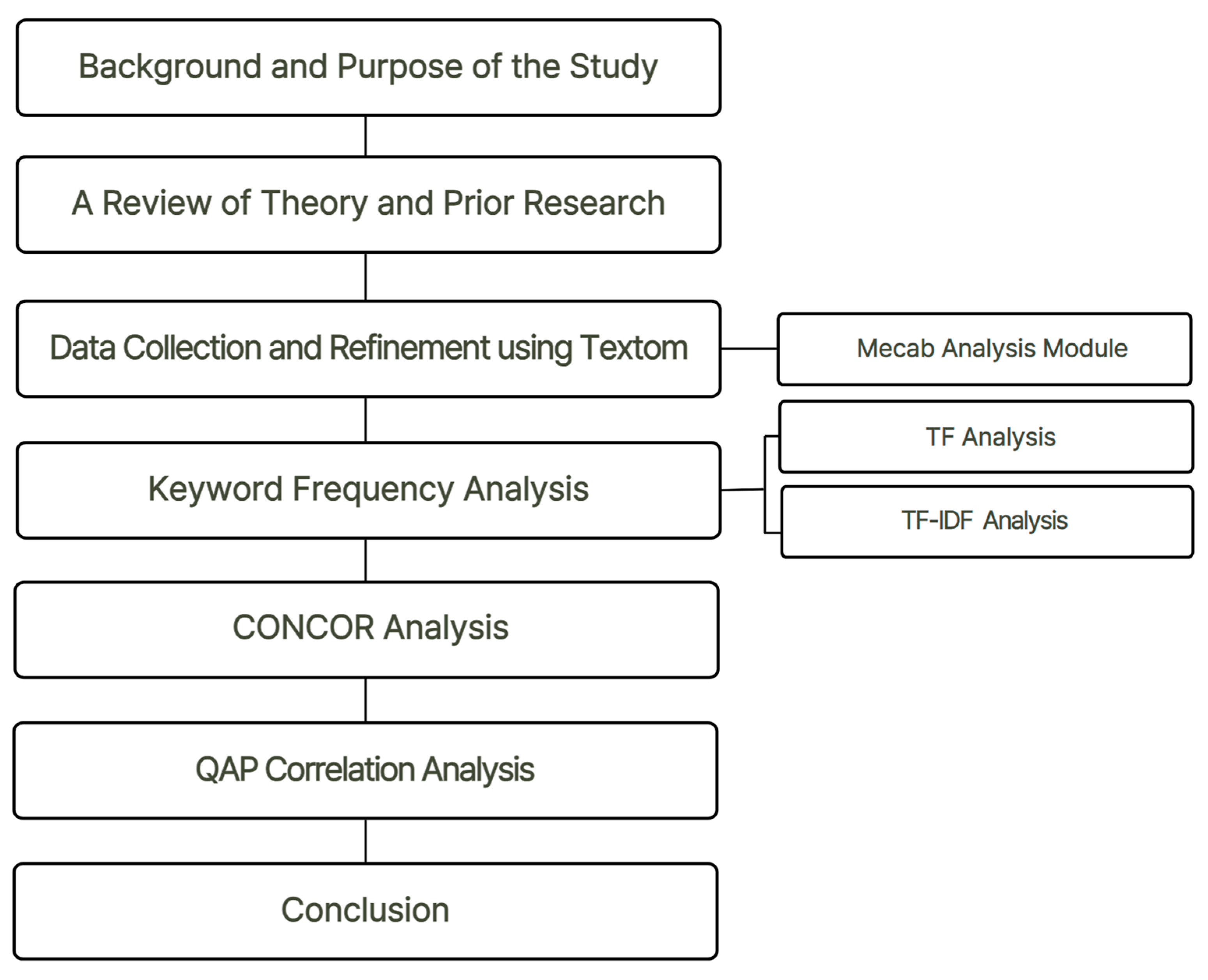
Figure 2.
Results of CONCOR analysis of healing forest networks in the pre-COVID-19 period (T, January 1 to December 31, 2019).
Figure 2.
Results of CONCOR analysis of healing forest networks in the pre-COVID-19 period (T, January 1 to December 31, 2019).
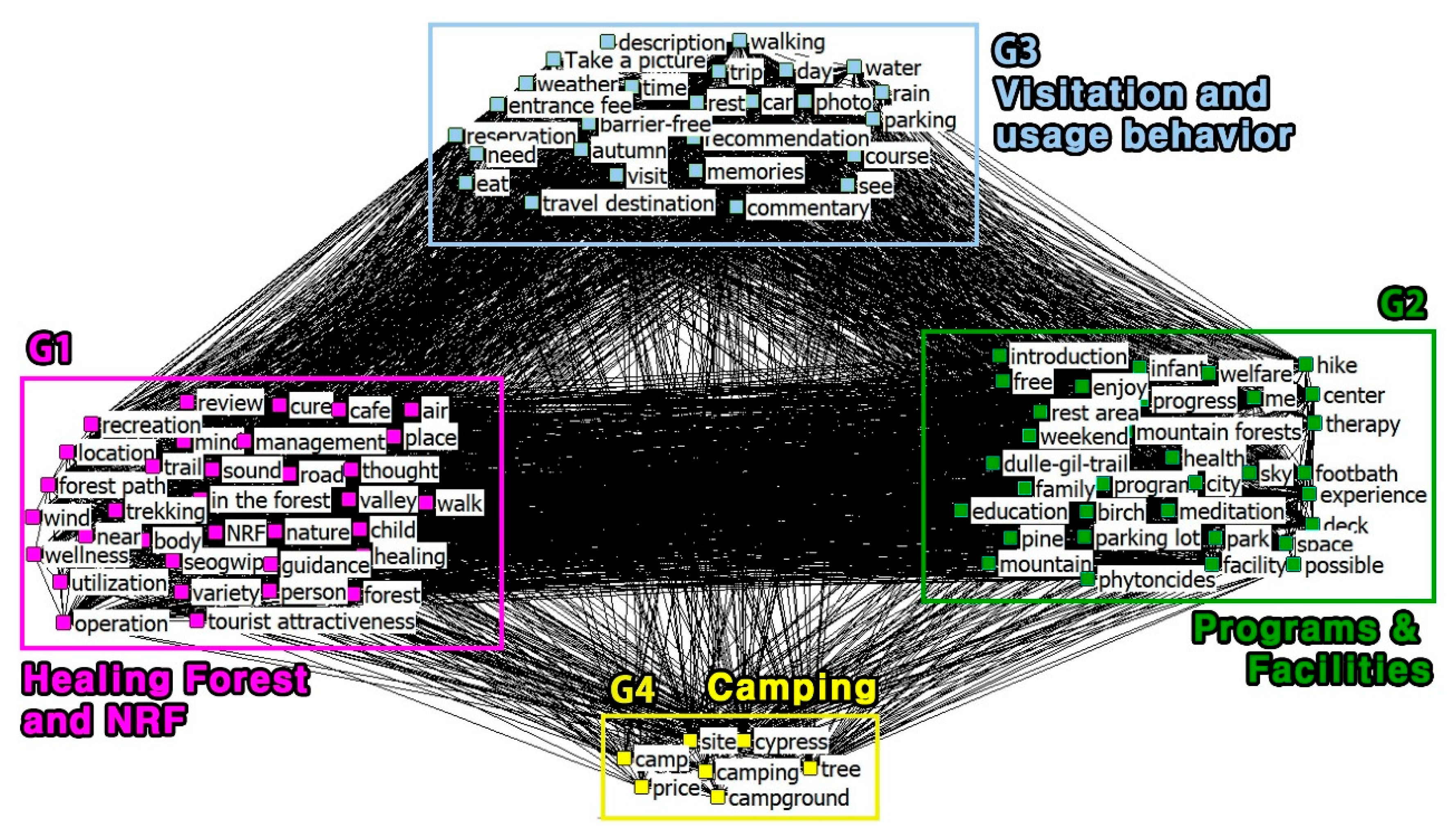
Figure 3.
Results of CONCOR analysis of healing forest networks during the COVID-19 pandemic period (T1, November 1, 2020 to October 31, 2022).
Figure 3.
Results of CONCOR analysis of healing forest networks during the COVID-19 pandemic period (T1, November 1, 2020 to October 31, 2022).
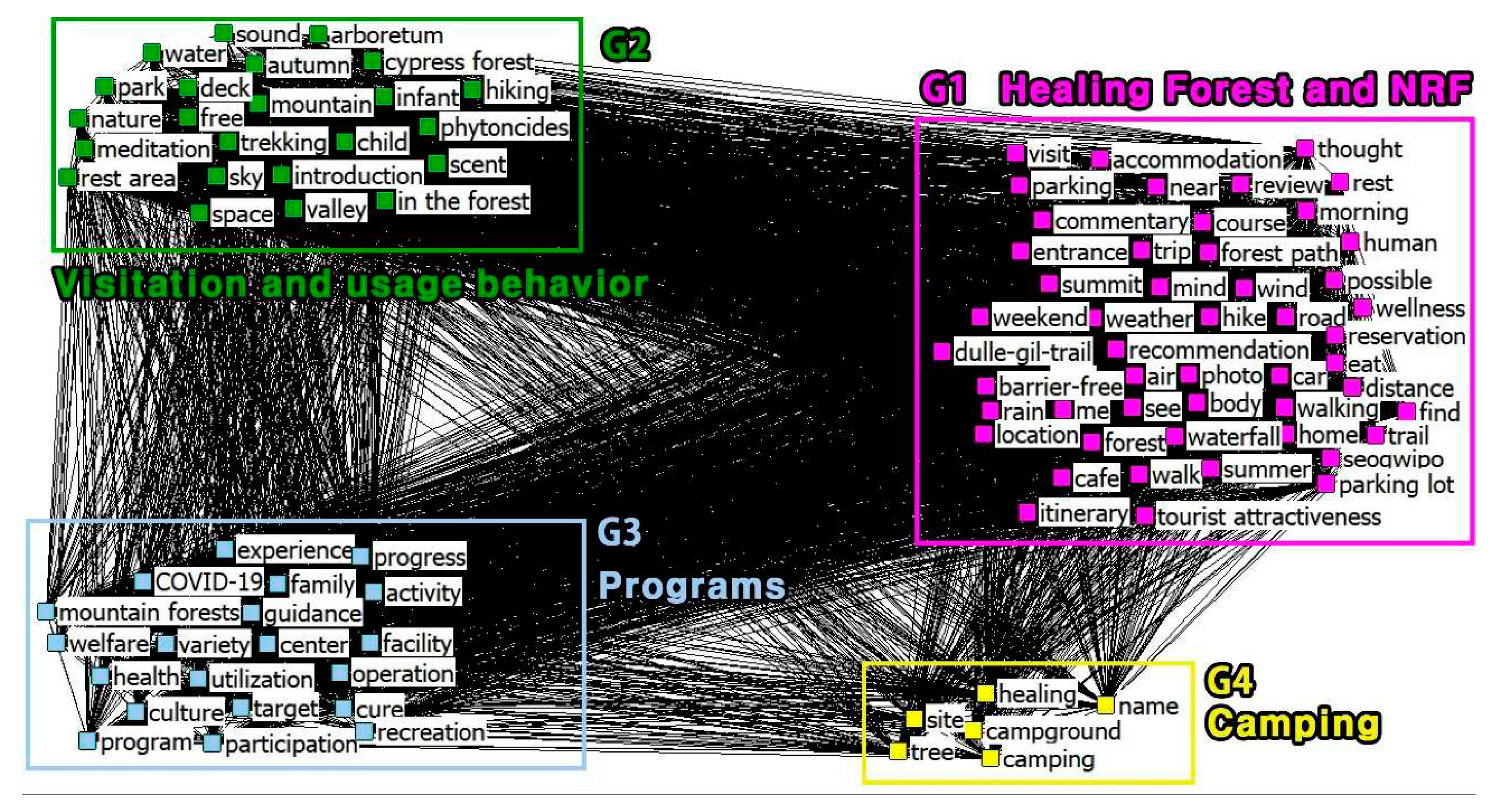
Figure 4.
Results of CONCOR analysis of healing forest networks during the post-COVID-19 period (T2, November 1, 2022 to October 31, 2023).
Figure 4.
Results of CONCOR analysis of healing forest networks during the post-COVID-19 period (T2, November 1, 2022 to October 31, 2023).
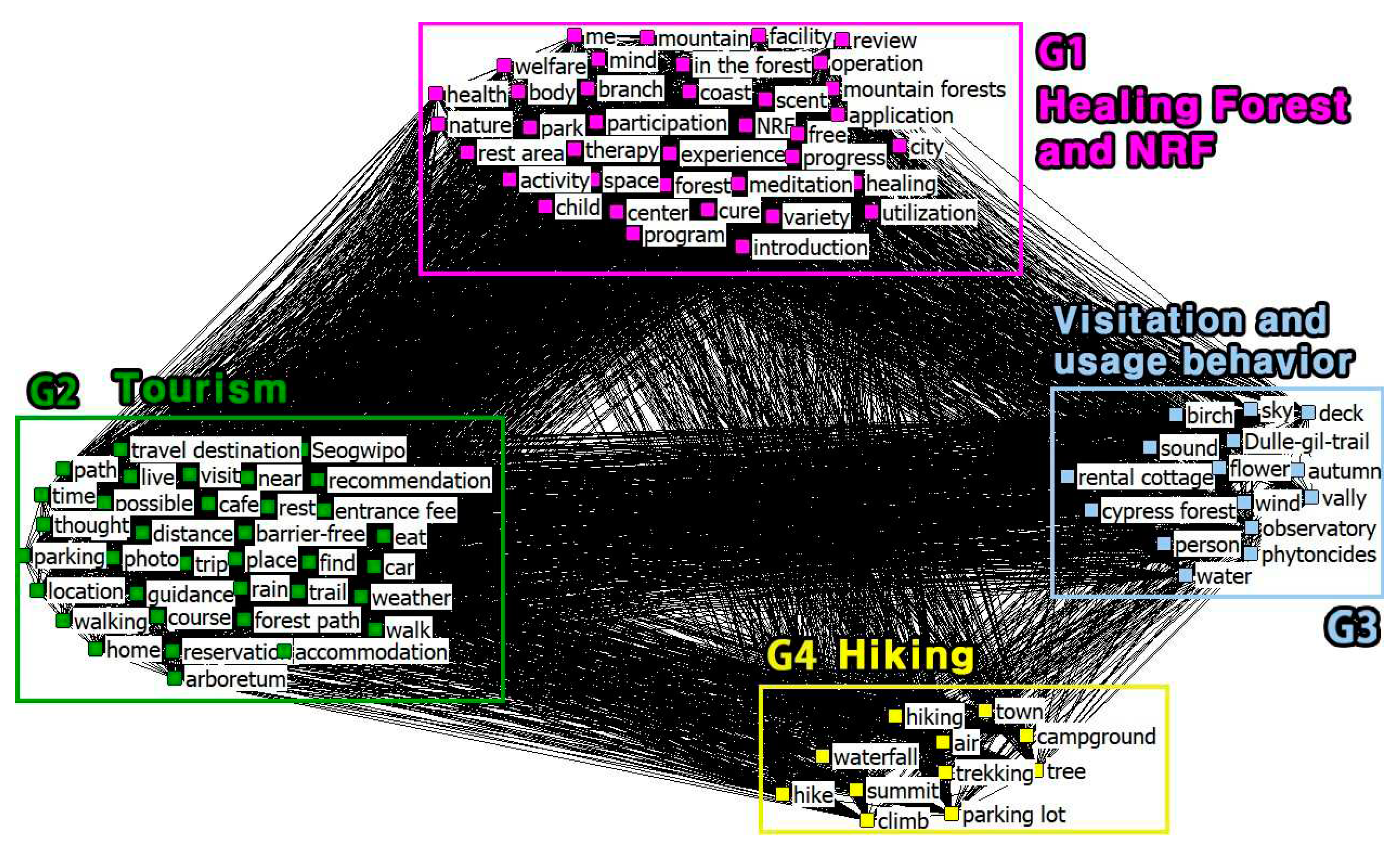
Table 1.
Forest Welfare Facilities under Article 2 of the Act on the Promotion of Forest Welfare.
| Facility Name | Definition |
|---|---|
|
Natural Recreation Forest (NRF) |
Forests created for people’s emotional development, health recreation, and forest education |
| Forest bathing | Forests created to improve people’s health by allowing them to breathe and interact with clean air, walk, and exercise in the forest |
| Healing Forest | Forests planted for healing |
| Forest Path | For activities such as mountaineering, trekking, leisure sports, exploration, or recreation and therapy Paths built in forests in accordance with Article 23 of the Forest Culture and Recreation Act |
|
Infant Forest Experience Center |
A facility that guides and educates young children to develop their emotions and holistic growth by experiencing the various functions of the forest |
|
Forest Education Center |
Facilities designated and created for the purpose of cultivating the creativity and emotions of the people, and promoting values of forests |
Table 2.
Three periods covered in our analysis.
| Name | Dates | |
|---|---|---|
| Pre-COVID-19 | January 1 to December 31, 2019 (one year) | |
| T1 | During COVID-19 | November 1, 2020 to October 31, 2022 (two years) |
| T2 | Post-COVID-19 | November 1, 2022 to October 31, 2023 (one year) |
Table 4.
QAP correlation analysis results.
|
Matrix: QAP Correlations |
Section | Collection volume (cases) | ||
| T | T1 | T2 | ||
| T | -. | 0.909 (0.000) | 0.866 (0.000) | |
| T1 | 0.909 (0.000) | -. | 0.849 (0.000) | |
| T2 | 0.866 (0.000) | 0.849 (0.000) | -. | |
p < 0.05, indicated in parentheses.
Disclaimer/Publisher’s Note: The statements, opinions and data contained in all publications are solely those of the individual author(s) and contributor(s) and not of MDPI and/or the editor(s). MDPI and/or the editor(s) disclaim responsibility for any injury to people or property resulting from any ideas, methods, instructions or products referred to in the content. |
© 2024 by the authors. Licensee MDPI, Basel, Switzerland. This article is an open access article distributed under the terms and conditions of the Creative Commons Attribution (CC BY) license (http://creativecommons.org/licenses/by/4.0/).
Copyright: This open access article is published under a Creative Commons CC BY 4.0 license, which permit the free download, distribution, and reuse, provided that the author and preprint are cited in any reuse.