

Submitted:
23 January 2024
Posted:
23 January 2024
You are already at the latest version
Abstract
Excessive body fat is a major contributor to obesity, which is related to high blood, total cholesterol and triglycerides. Lemons (Citrus limon) are renowned for their antioxidant and lipid-lowering properties. First, Sugar-free fermentation demonstrated better results lower sugar content and was identified as the preferred fermentation method. Next, the effect of two doses of sugar-free fermented lemon peel juice (SF-FLPJ) on obesity was investigated. Sprague Dawley (male rats) were randomly divided into 4 groups and fed a standard feed or high-fat diet (HFD) to induce fatness for eight weeks. The two groups of rats fed an HFD were administered SF-FLPJ at 0.45 or 0.9 g/kg body weight daily for eight weeks. The obese rats administered 0.9 g/kg (body weight/day) of SF-FLPJ exhibited significant reductions in body fat mass and percentage; they also had lower blood cholesterol and triglyceride levels than the other groups. Additionally, the rats displayed diminished liver fat accumulation. The results suggest that SF-FLPJ can be a supplement in managing body fat, contributing positively to addressing obesity within the context of health management, and reduce obesity-associated issues.
Keywords:
Lemon peel juice
; Sugar-free fermentation
; Body fat
; Total cholesterol
; health management
Introduction
Obesity is a crucial factor in numerous chronic diseases and represents a major public health problem globally[1]. According to the report of the World Health Organization (WHO) that in 2016 more than 1.9 billion adults were obese; furthermore, over 650 million of these adults were obese [2]. According to the Taiwan Statistical Yearbook of Health Promotion 2014, 7 of the top 10 causes of death were related to obesity. In addition, the obesity rate in Taiwan was reported as 47.9% in adults aged over 18 years. According to the National Health Service Standard of the Taiwan Ministry of Health, women with >30% and men with >25% body fat are considered to be obese [3]. Excess body fat causes obesity and is associated with chronic and relapsing diseases. Moreover, obesity is the leading risk factor for early death, which is estimated to affect approximately 13% of adults worldwide [4,5]. The body fat rate is calculated based on subcutaneous and visceral fat percentages. A high percentage of visceral fat is harmful to health and increases the risk of various diseases and conditions, including fatty liver, diabetes, hypertension, heart disease, and cancers.
A high-fat diet can vary the composition of intestinal flora, leading to obesity [6]. In contrast, eating healthy foods can regulate intestinal flora’s balance, preventing diseases caused by their imbalance [7]. In addition, foods such as fruits can lower triglycerides (TGs), low-density lipoprotein cholesterol (LDL-C), and high-density lipoprotein cholesterol (HDL-C), playing a crucial role in managing obesity [8].
After bananas, citrus fruits are the most common tropical fruits grown worldwide [9]. Lemons (Citrus limon) are the most widely grown citrus fruit, with a global production of 7.3 billion tons [10]. Lemons are full of natural compounds, including citric acid, polyphenols, ascorbic acid, and minerals, which possess antioxidant properties and can scavenge free radicals. Among citrus fruits, the total polyphenol content (TPC) is the highest in lemon peels, followed by grapefruit and other citrus fruit peels [11,12]. Polyphenols exert anticancer effects, modulate immune function, regulate blood lipids and blood pressure, and promote wound healing[8].
Lemons’ juice is the most used component, as it can prevent hypercholesterolemia symptoms by reducing plasma TG, and LDL-C and increasing HDL-C levels [13,14]. Lemon peel and pomace are often treated as waste and discarded. However, lemon peel contains numerous active compounds, including polyphenols, pectin, and flavonoids [15]. In addition, lemon peel polyphenols are proposed to prevent weight gain, fat accumulation, and hyperlipidemia [16]. Lemon pulp also contains diverse active ingredients, including limonin, phenolic derivatives, dietary fiber, and vitamins [17], making it a good source of nutrition.
Fermentation is an ancient technique for preserving food [18]. In recent years, increasing research has focused on fermented foods, especially traditionally fermented foods [19]. Fermented foods constitute one-third of the global diet [20] and are mainly consumed as beverage products. Fermentation enhances the nutrient profile, prolongs storage time, and prevents changes in the flavor of food [21,22]. For example, fermented lemon juice has been reported to have better overall sensory acceptability than unfermented lemon juice [23]. Furthermore, no reduction in antioxidants was noted after fermentation. Fermented sweet lemon juice has been found to have a high ascorbic acid concentration and TPC, in addition to robust antibacterial and antioxidant activities [24].
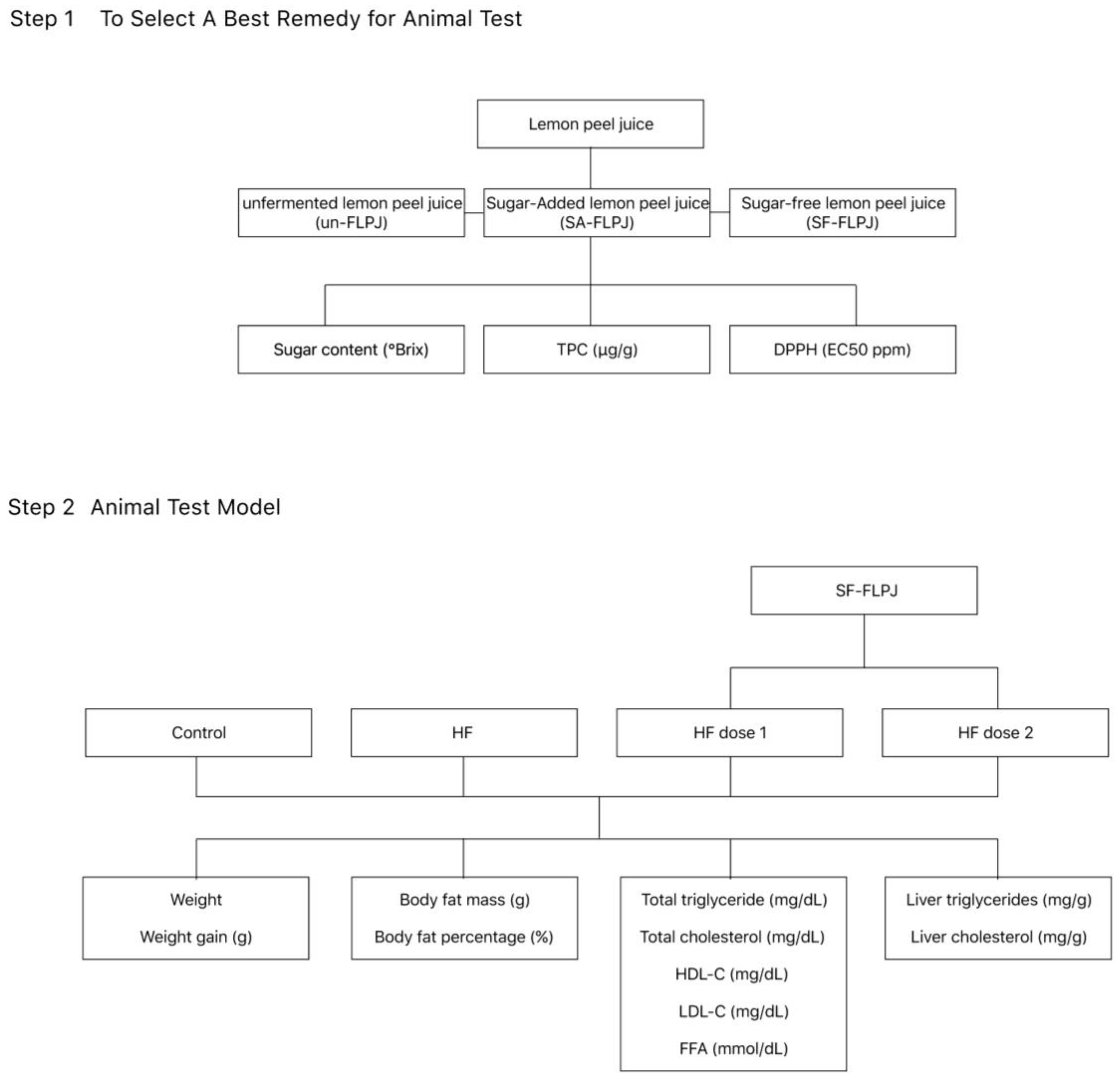
However, only a few research have studied the effects of consuming sugar-free fermented lemon juice with peel on body fat. Therefore, this study examined unfermented lemon peel juice (un-FLPJ), sugar-added fermented lemon peel juice (SA-FLPJ) and sugar-free fermented lemon peel juice (SF-FLPJ) with their TPC, sugar content, and 2,2-diphenyl-1-picrylhydrazyl (DPPH) free radical scavenging activity.
The study’s results demonstrated that the TPC of SA-FLPJ was considerably lower than that of SF-FLPJ. Moreover, SF-FLPJ presented higher free radical scavenging activity and antioxidant capability than SA-FLPJ. Furthermore, the sugar content of SA-FLPJ was about 3 times higher than that of unfermented lemon peel juice. In contrast, the SF-FLPJ’s sugar content was lower than the un-FLPJ, indicating that probiotics metabolized sugar during the fermentation process.
Sugar-free fermentation demonstrated better results lower sugar content and was identified as the preferred fermentation method [25]. This study established an animal model of hyperlipidemia by feeding rats a high-fat diet and investigating the effect of SF-FLPJ on body fat.
Figure 1.
Experimental flow chart.
Materials and methods
Preparation of unfermented lemon peel juice (un-FLPJ), sugar-added fermented lemon peel juice (SA- FLPJ) and sugar-free fermented lemon peel juice (SF-FLPJ)
In order to select a best remedy for animal test, we prepared 3 different solutions: (1) un-FLPJ, (2) SA- FLPJ, and (3) SF-FLPJ.
- (1)
- the preparation of un-FLPJ by smashing whole lemons, and then obtained lemon juice with smashed peel, seed and pulp.
- (2)
- added sugar up to 50% with un-FLPJ and then implanted cultivated yeast as SA-FLPJ;
- (3)
- the un-FLPJ was mixed with cultivated yeast as SF-FLPJ.
The yeast strains DMS32001 and DMS32002 (Kaohsiung Jianmao Biotechnology Co., Ltd., Taiwan), were selected. The yeast consistence ranged from 5 × 10⁶ to 5 × 10⁷ colony forming units CFU/mL, and culture environment is 27±1°C at a pH of 2.3±1. The SA-FLPJ and SF-FLPJ was sterilized at 121°C for 15 minutes after 21 days of fermentation and keeping at room temperature until further use.
Detection of the lemon peel juices’ total phenol content (TPC)
The method according to this reported source [26] is suitable for examining TPCs other than FLPJ. 10~20 mL of SF-FLPJ and un-FLPJ were centrifuged to remove the precipitate, and the remaining lemon peel juice was utilized as a sample. Then, dilute the test sample 60-fold, use distilled water as the base, add it to the quantitative bottle to mix, then add 5 mL Folin-Ciocalteu reagent, and let it stand for 5 minutes. Then add 7% sodium carbonate solution and let it sit for 1 hour. This experiment was performed using a BioTek Eon microplate spectrophotometer (Agilent Technologies Inc., Santa Clara, CA, USA), measuring the absorbance of the sample at a wavelength of 750 nm.
Determination of the lemon peel juices’ 2,2-diphenyl-1-picrylhydrazyl (DPPH) radical scavenging assay
The method according to this reported source [27] was applied to determine the DPPH radical scavenging assay of FLPJs. First, 10~20 mL of fermented raw un-FLPJ was centrifuged, and after removing the sediment, the remaining lemon peel juice supernatant was used as a sample. Samples were diluted 20, 40, 60, 80, or 100-fold using 95% ethanol. Subsequently, each diluted sample (150 µL) was added to 150 µL of DPPH reagent and allowed to stand for 30 minutes. Use a spectrophotometer at 517 nm to detect the concentration required for 50% antioxidant effect.
Juices’ sugar content determination
The un-FLPJ, SA-FLPJ and SF-FLPJs’ sugar content was determined using an Atago® refractometer PAL-1 (Atago Co., Ltd., Tokyo, Japan).
Experimental animal care
The Institutional Animal Care and Use Committee (IACUC) approved this study approval number MG-104172, July 10, 2015). In addition, all animal experiments were per-formed following the IACUC protocol. The 48 Sprague Dawley male rats used in this study were obtained from BioLASCO Co., Ltd. (Taipei, Taiwan). Rats were housed in individual rat cages in the animal house of MedGaea Life Science Ltd. (Medgaea Life Science Ltd., Taipei, Taiwan) with lights on at 6 a.m. and lights off at 6 p.m., a 12-hour light and dark cycle, and the temperature environment is 22±3℃. Healthy rats were selected for subsequent experiments after 1 week of adaptation. The rats were assigned randomly and equally into 4 groups according to their body weight. Food (AIN-93 diet [28]) and purified water were provided ad libitum.
Standard and high-fat diet composition
Establish a hyperlipidemia animal model: feed rats a high-fat diet (HFD). The standard feed (Research Diets, Inc., AIN-93M) contains 3.85 kcal/g, 14.2% protein, 4% fat, and 73.1% carbohydrate. The high-calorie feed [29] was HF, containing 4.6 kcal/g, 18% protein, 20% fat, 51% carbohydrate, 100% soybean oil, and 100% lard. Standard feed was fed to the control group, and HF was fed to the hyperlipidemia model rats to induce hyperlipidemia for 8 consecutive weeks.
Animal study & SF-FLPJ Dosage
The rats were assigned into four groups randomly of similar weight (n = 12 per group) according to average body weight, and the groups were as follows: control group (standard feed), HF group without SF-FLPJ (HF), HF dose with SF-FLPJ Group 1 (0.45 g/kg/day), and HF dose Group 2 with SF-FLPJ (0.9 g/kg/day).
Rats were housed in a monitored environment (one per cage, 12-h light/dark cycle, 22 ± 3°C) and provided with food and water ad libitum during acclimation and during the study period. The control group was fed standard diet every day, and the HF group was fed HFD every day for 8 weeks (i.e., a total of 8 weeks of study period).
The rat to a human-equivalent dose was converted using the maximum safe starting dose estimated by the US Food and Drug Administration (FDA) in clinical trials for healthy adult volunteers. The suggested use of SF-FLPJ for persons is approximately 25 mL once a day, along with a standard diet. Therefore, assuming that the human body weight is 60 kg, the equivalent human dose is (25 ml/day/60 kg), which is equivalent to the dose of 0.45 g/kg body weight/day in rats. A conversion factor of 6.2 will be used to calculate for differences in body surface area between rats and persons.
Data collection
Blood collection
After 8 weeks, the experimental rats were fasted for 12 hours, and blood samples were collected using carbon dioxide anesthesia. After collection, the fresh blood samples were allowed to stand for 2 hours, and then centrifuged at 1200 × g for 15 min to get the serum samples.
Tissue samples collection
Lastly, the rats were sacrificed through CO2 narcosis. The liver, kidney, and visceral fat surrounding the peritoneal cavity (the epididymis, around the kidney, and mesentery) were rapidly removed. The organs were rinsed with plain cold saline, blotted dry, and weighed.
Determination of the TGs and TC in the rats’ livers
The TG and TC levels in the rats’ livers were determined using a previously reported method [30]. Chloroform and methanol (Macron Fine Chemicals™, Avantor Inc., Radnor, PA, USA) were added at a ratio of 2:1 (v/v) to the liver tissue. The tissue was homogenized and centrifugated at 3,000 × g for 10 min. Then, it was dried with nitrogen to remove the organic solvent, and the supernatant was collected. Subsequently, the dried supernatant was dissolved in Triton X-100 solution, and the TC and TG levels were determined using a Vitron® 5.1 FS automatic serum biochemical analyzer.
Statistical Analysis Methods
All data are expressed as mean ± standard deviation (SD). Significant differences were then determined through Duncan's multiple range and one-way variance analysis test. Statistical significance was considered at p < 0.05.
Results
In Table 1 the sugar content was lower significantly in the SF-FLPJ compared with the SA-FLPJ and un-FLPJ (p < 0.05).
In addition, the SF-FLPJ had a higher TPC and DPPH free radical scavenging activity compared with the SA-FLPJ and unfermented lemon peel juice (p < 0.05; Table 2).
Rats were fed an HFD and administered different doses of SF-FLPJ for 8 weeks to investigate its effects on body fat. The functional and safety indicators of the SF-FLPJ are discussed subsequently.
Assessment of the functional indicators
Animal body weight
We measured the body weight of rats weekly during test period. The control group’s body weight was lower significantly than the HF (p < 0.05) during the test period, indicating that an HFD can successfully induce obesity in rats.
At week 8 of SF-FLPJ administration, the mean body weight of the HF dose 2 group was lower significantly than that of the HF group. The mean body weight of the HF dose 1 group did not vary significantly from the HF group’s mean body weight (Table 3).
Body fat and body fat percentage
After 8 weeks of administration of SF-FLPJ, the animals were sacrificed, the fat around the kidneys and above the mesentery near the testes was collected and weighed. The average fat weight in the control group was lower significantly compared with the HF, HF dose 1, and HF dose 2 groups. Furthermore, the average fat weight of the HF dose 1 group was higher significantly compared with the HF dose 2 group (Table 4).
The average body fat percentage of the control group was lower significantly compared with the HF, HF dose 1, and HF dose 2 groups. The average body fat percentage of the HF dose 2 group was lower significantly compared with the HF dose 1 group (Table 4).
Evaluation of the safety indicators
Blood lipids
The HF diet groups administered with SF-FLPJ doses 1 and 2 had significantly lower serum TG and TC levels compared with the HF group (Table 5). In contrast, the HDL-C and LDL-C levels did not significantly vary between the groups.
Non-esterified free fatty acid blood levels
The blood’s non-esterified free fatty acid (FFA) level is low and has a short half-life. In addition, the blood’s FFA level is affected by factors such as lipid and carbohydrate metabolism. Compared with the control group, the HF groups had increased blood FFA levels significantly (p < 0.05). The FFA level did not vary between the HF and HF dose 1 and dose 2 groups (Table 5).
Liver lipids
Changes in the liver lipid levels in the test animals are presented in Table 6. The TG and TC levels in the rats’ livers were higher significantly in the HF dose 1 and 2 groups compared with the control group. In contrast, the TC and TG levels were lower significantly in the HF dose 1 and 2 groups compared with the HF group (p < 0.05).
Discussion
Obesity is a major factor in numerous chronic diseases and represents a substantial global public health problem. According to the National Nutrition and Health Status Survey conducted in Taiwan from 2017 to 2020 [31], most people’s intake of vegetables and fruits is considerably lower than the recommended dietary intake, and the consumption of saturated fat is substantially higher than it should be these dietary choices can relate to obesity. According to data from Taiwan’s Ministry of Health and Welfare [3], the prevalence of obesity and overweight in adults in Taiwan is increasing.
Fermented lemons contain bountiful bioactive components that benefit human health [15], and can improve the nutrition and effectiveness of food [32], antioxidant activity, and promote the decomposition of plant cell walls, which helps to release or produce various antioxidants. Compounds with potential health benefits, such as reducing the probability of cardiovascular and chronic diseases [33]. Sugar, yeast or lactic acid bacteria, etc. are added to the raw materials for fermentation, thereby activating various enzymes in the raw materials and producing various functional substances, while the nutrients contained in the raw materials are converted into a form that is easier to digest and absorb [34], fermentation can increase the phenolic content and antioxidant activity of plants [33]. For example, fermented lemons have higher TPC and DPPH free radical scavenging activity than unfermented lemons [35].
Most studies have used experimental animals fed a HFD to obtain diet-induced obesity, resulting in increased visceral fat, dyslipidemia, or fatty liver [36]. In this study, an animal model of hyperlipidemia was established by feeding rats an HFD, and the effect of SF-FLPJ on body fat composition was evaluated. In this experiment, organic lemon raw materials (including peel, seeds and pulp) were used, and adds selected specific strains DMS32001 and DMS32002. The whole lemon (including peel, seeds and pulp) was processed to prepare un-FLPJ, and then fermented under different conditions to screen for the best fermentation conditions. SF-FLPJ that differs from traditional SA-FLPJ, which requires a longer fermentation time and produces a large amount of sugar; the sugar content after saccharification and fermentation can be as high as 26.7 °Brix, about three times higher than un-FLPJ. The SF-FLPJ’s sugar content was lower than the un-FLPJ; the Degree °Brix dropped from 8.7 to 6.9 after fermentation. This finding supports that the probiotics metabolized some of the un-FLPJ’s sugars during fermentation. In addition, the probiotics in the SF-FLPJ can reduce body weight and body mass index [37]. Fermenting natural foods with probiotics has been proven to improve positive effects on lipid metabolism and anti-obesity through the effect of probiotics [38].
The main risk factors for atherosclerotic cardiovascular disease (ASCVD) are dyslipidemia, including TG Elevated, LDL-C, HDL-C [39], HDL-C is considered a beneficial factor in lowering blood lipid levels [40], and the regulation of TGs, LDL-C, and HDL-C is crucial in managing obesity [8]. Fermented foods can reduce serum glucose and cholesterol levels [41]. Lemons are reported to prevent hypercholesterolemia and lower animals’ TC [42]. According to the fermentation method screening and sugar-free fermentation experimental results of this study indicated that SF-FLPJ effectively reduced TG and TC levels in the blood and liver of rats (Table 5).
Obesity is caused by many factors such as fat accumulation and elevated blood lipid levels, including LDL-C, TC and TG. LDL-C and TC are considered to be the causes of hyperlipidemia, and a high-fat diet can lead to the accumulation of white fat in the epididymis and induce hyperlipidemia [43,44]. High-fat diet-induced obesity is an important animal model because of its similarity to human obesity [45]. In this study, fat was collected from around the kidney and above the mesentery near the testes of the experimental rats to determine the body fat mass and percentage. The control group’s average body fat weight was lower significantly compared with the HF dose 1 and 2 groups. Furthermore, the average body fat weight was lower significantly in the HF dose 2 compared with the HF dose 1 group, the control group’s average body fat percentage was lower significantly compared with the HF, HF dose 1, and HF dose 2 groups. Furthermore, the average body fat percentage was significantly lower in the HF dose 2 compared with the HF dose 1 group. In the eighth week SF-FLPJ administration, the experimental rats’ hepatic TG and TC levels were significantly lower in the HF dose 1 and 2 groups compared with the HF (p < 0.05). Furthermore, the HF dose 2 group’s average body weight was substantially lower than the HF.
Polyphenols have antioxidant and anti-inflammatory properties, and flavonoids in particular have been shown to have the ability to improve insulin sensitivity and regulate lipid metabolism [46]. Studies have shown that increasing fruit intake can reduce cardiovascular disease mortality and high mortality. Blood pressure and stroke risk [44], fermented apple juice can effectively inhibit weight gain and regulate blood lipid levels [43]. The results of this study show that feeding SF-FLPJ effectively reduces body weight, fat mass, fat percentage, and liver fat.
This experiment investigated the effect of SF-FLPJ on body fat. The doses of SF-FLPJ investigated effectively reduced liver fat in the experimental animals. Considerable reductions in body weight, fat mass, fat percentage, were observed in the HF administered a higher SF-FLPJ dose. Therefore, it can be concluded that SF-FLPJ effectively regulates body fat and can positively reduce obesity. Applying SF-FLPJ as our daily drinks, may reduce obesity-associated issues, and provide a better health management.
Author Contributions
Conceptualization, Chin-Fa Tsai and Jeng-Fung Hung; investigation, writing and reviewing, Yi-Jinn Lillian Chen; writing and editing, Chang-Lu Hsu, Tzu-Chun Chen, and Pei-Chun Chen, and Tsai-Yi Cho. All authors have read and agreed to the published version of the manuscript.
Funding
This research received no specific grant from funding agencies in the public, commercial, or not-for-profit sectors.
Institutional Review Board Statement
Institutional Review Board Statement: The study was conducted in accordance with the Declaration of Helsinki, and approved by the Institutional Animal Care and Use Committee (IACUC) approved this study (IACUC approval number MG-104172, July 10, 2015). In addition, all animal experiments were performed following the IACUC protocol.
Data Availability Statement
The data sets analyzed during the current study are available from the corresponding author upon reasonable request.
Acknowledgments
The authors would like to acknowledge Jian Mao Biotech Co., Ltd., Kaohsiung City, Taiwan. In addition, we thank Susan Kuo and Jerry Chang Chien for their support in conducting the lemon peel juice fermentation.
Conflicts of Interest
The authors have no conflicts of interest to declare.
References
- Li, L., et al., Salvianolic acid B prevents body weight gain and regulates gut microbiota and LPS/TLR4 signaling pathway in high-fat diet-induced obese mice. Food & function, 2020. 11(10): p. 8743-8756. [CrossRef]
- Organization, W.H. Obesity and overweight. 2021; Available from: https://www.who.int/news-room/fact-sheets/detail/obesity-and-overweight.
- Health, T.M.o. Prevalence of overweight and obesity among Chinese people. 2023; Available from: https://www.gender.ey.gov.tw/gecdb/Stat_Statistics_DetailData.aspx?sn=%24mQvpHYEayTTt8pmhMjRvA%40%40.
- Blüher, M., Obesity: global epidemiology and pathogenesis. Nature Reviews Endocrinology, 2019. 15(5): p. 288-298.
- Valerii, M.C., et al., Effect of a Fiber D-Limonene-Enriched Food Supplement on Intestinal Microbiota and Metabolic Parameters of Mice on a High-Fat Diet. Pharmaceutics, 2021. 13(11): p. 1753. [CrossRef]
- Wang, X., et al., Alleviating effects of walnut green husk extract on disorders of lipid levels and gut bacteria flora in high fat diet-induced obesity rats. Journal of Functional Foods, 2019. 52: p. 576-586. [CrossRef]
- Wei, T., et al., Different duck products protein on rat physiology and gut microbiota. Journal of proteomics, 2019. 206: p. 103436. [CrossRef]
- Wu, C.-C., et al., The Anti-Obesity Effects of Lemon Fermented Products in 3T3-L1 Preadipocytes and in a Rat Model with High-Calorie Diet-Induced Obesity. Nutrients, 2021. 13(8): p. 2809. [CrossRef]
- Tiencheu, B., et al., Nutritional, sensory, physico-chemical, phytochemical, microbiological and shelf-life studies of natural fruit juice formulated from orange (Citrus sinensis), lemon (Citrus limon), Honey and Ginger (Zingiber officinale). Heliyon, 2021. 7(6): p. e07177. [CrossRef]
- Zhang, H., et al., Extraction and comparison of cellulose nanocrystals from lemon (Citrus limon) seeds using sulfuric acid hydrolysis and oxidation methods. Carbohydrate polymers, 2020. 238: p. 116180. [CrossRef]
- Diab, K.A., In vitro studies on phytochemical content, antioxidant, anticancer, immunomodulatory, and antigenotoxic activities of lemon, grapefruit, and mandarin citrus peels. Asian Pacific Journal of Cancer Prevention, 2016. 17(7): p. 3559-3567.
- Makni, M., et al., Citrus limon from Tunisia: Phytochemical and physicochemical properties and biological activities. BioMed research international, 2018. 2018. [CrossRef]
- Oboh, G., et al., Antioxidant, hypolipidemic, and anti-angiotensin-1-converting enzyme properties of lemon (Citrus limon) and lime (Citrus aurantifolia) juices. Comparative Clinical Pathology, 2015. 24(6): p. 1395-1406. [CrossRef]
- Trovato, A., et al., Effects of fruit juices of Citrus sinensis L. and Citrus limon L. on experimental hypercholesterolemia in the rat. Phytomedicine, 1996. 2(3): p. 221-227. [CrossRef]
- Hsieh, C.-Y., et al., Effect of lemon water vapor extract (LWAE) from lemon byproducts on the physiological activity and quality of lemon fermented products. International Journal of Food Properties, 2021. 24(1): p. 264-276. [CrossRef]
- Fukuchi, Y., et al., Lemon polyphenols suppress diet-induced obesity by up-regulation of mRNA levels of the enzymes involved in β-oxidation in mouse white adipose tissue. Journal of clinical biochemistry and nutrition, 2008. 43(3): p. 201-209. [CrossRef]
- Wang, L., et al., Physicochemical characterization of five types of citrus dietary fibers. Biocatalysis and agricultural biotechnology, 2015. 4(2): p. 250-258. [CrossRef]
- Ağagündüz, D., et al., Novel candidate microorganisms for fermentation technology: From potential benefits to safety issues. Foods, 2022. 11(19): p. 3074. [CrossRef]
- Mukherjee, A., et al., Global regulatory frameworks for fermented foods: A review. Frontiers in Nutrition, 2022. 9. [CrossRef]
- Campbell-Platt, G., Fermented foods—a world perspective. Food research international, 1994. 27(3): p. 253-257.
- C Borresen, E., et al., Fermented foods: patented approaches and formulations for nutritional supplementation and health promotion. Recent patents on food, nutrition & agriculture, 2012. 4(2): p. 134-140.
- Steinkraus, K.H., Nutritional significance of fermented foods. Food Research International, 1994. 27(3): p. 259-267. [CrossRef]
- Liu, B., et al., Changes in organic acids, phenolic compounds, and antioxidant activities of lemon juice fermented by Issatchenkia terricola. Molecules, 2021. 26(21): p. 6712.
- Hashemi, S.M.B., et al., Fermented sweet lemon juice (Citrus limetta) using Lactobacillus plantarum LS5: Chemical composition, antioxidant and antibacterial activities. Journal of Functional Foods, 2017. 38: p. 409-414.
- Chen, Y.J.L., et al., Fermented citrus lemon reduces liver injury induced by carbon tetrachloride in rats. Evidence-Based Complementary and Alternative Medicine, 2018. 2018. [CrossRef]
- Singleton, V.L., R. Orthofer, and R.M. Lamuela-Raventós, [14] Analysis of total phenols and other oxidation substrates and antioxidants by means of folin-ciocalteu reagent, in Methods in enzymology. 1999, Elsevier. p. 152-178. [CrossRef]
- Ou, B., M. Hampsch-Woodill, and R.L. Prior, Development and validation of an improved oxygen radical absorbance capacity assay using fluorescein as the fluorescent probe. Journal of agricultural and food chemistry, 2001. 49(10): p. 4619-4626. [CrossRef]
- Reeves, P.G., Components of the AIN-93 diets as improvements in the AIN-76A diet. The Journal of nutrition, 1997. 127(5): p. 838S-841S. [CrossRef]
- Kim, J., et al., Plant proteins differently affect body fat reduction in high-fat fed rats. Preventive Nutrition and Food Science, 2012. 17(3): p. 223.
- Floch, J., A simple method for the isolation and purification of total lipids from animal tissues. J. biol. Chem., 1957. 226: p. 497-509.
- 潘文涵, Survey on changes in national nutrition and health status. 2022.
- Jeon, Y.B., J.J. Lee, and H.C. Chang, Characterization of juice fermented with Lactobacillus plantarum EM and its cholesterol-lowering effects on rats fed a high-fat and high-cholesterol diet. Food Science & Nutrition, 2019. 7(11): p. 3622-3634.
- Hubert, J., et al., Effects of fermentation on the phytochemical composition and antioxidant properties of soy germ. Food Chemistry, 2008. 109(4): p. 709-721. [CrossRef]
- Zhao, Y.-S., et al., Fermentation affects the antioxidant activity of plant-based food material through the release and production of bioactive components. Antioxidants, 2021. 10(12): p. 2004. [CrossRef]
- Chanbai, C., Antioxidant activities of lactic acid bacteria fermentedlemon juice, in International Master's Degree Program in Food Science 2015, National Pingtung University of Science and Technology: Pingtung County. p. 62.
- Heydemann, A., An overview of murine high fat diet as a model for type 2 diabetes mellitus. Journal of diabetes research, 2016. 2016. [CrossRef]
- Zhang, Q., Y. Wu, and X. Fei, Effect of probiotics on body weight and body-mass index: a systematic review and meta-analysis of randomized, controlled trials. International Journal of Food Sciences and Nutrition, 2016. [CrossRef]
- Li, Z., et al., Enhanced antioxidant activity for apple juice fermented with Lactobacillus plantarum ATCC14917. Molecules, 2018. 24(1): p. 51. [CrossRef]
- Amini, M.R., et al., Orange juice intake and lipid profile: a systematic review and meta-analysis of randomised controlled trials. Journal of Nutritional Science, 2023. 12: p. e37. [CrossRef]
- Li, J., et al., High fat diet induced obesity model using four strains of mice: Kunming, C57BL/6, BALB/c and ICR. Experimental animals, 2020. 69(3): p. 326-335. [CrossRef]
- Marco, M.L., et al., Health benefits of fermented foods: microbiota and beyond. Current opinion in biotechnology, 2017. 44: p. 94-102. [CrossRef]
- Lee, H., et al., Antioxidative and cholesterol-lowering effects of lemon essential oil in hypercholesterolemia-induced rabbits. Preventive nutrition and food science, 2018. 23(1): p. 8. [CrossRef]
- Han, M., et al., Cloudy apple juice fermented by Lactobacillus prevents obesity via modulating gut microbiota and protecting intestinal tract health. Nutrients, 2021. 13(3): p. 971. [CrossRef]
- Park, S., et al., Effects of cabbage-apple juice fermented by Lactobacillus plantarum EM on lipid profile improvement and obesity amelioration in rats. Nutrients, 2020. 12(4): p. 1135. [CrossRef]
- Ha, S.-K. and C. Chae, Inducible nitric oxide distribution in the fatty liver of a mouse with high fat diet-induced obesity. Experimental Animals, 2010. 59(5): p. 595-604. [CrossRef]
- Sorrenti, V., et al., Bioactive compounds from lemon (Citrus limon) extract overcome TNF-α-induced insulin resistance in cultured adipocytes. Molecules, 2021. 26(15): p. 4411. [CrossRef]

Table 1.
Comparison of the sugar content of the control group and SF-FLPJ and SA-FLPJ.
| Group | un-FLPJ | SA-FLPJ | SF-FLPJ |
| Sugar content (°Brix) | 8.6±0.01 a | 26.96±0.09 b | 6.53±0.12 c |
Results are expressed as mean ± standard deviation. Data were analyzed using one-way ANOVA, and Duncan’s post-hoc test was used to analyze the differences between groups. Values with different superscript letters in the same row vary significantly (p < 0.05).
Table 2.
Comparison of the TPC and DPPH radical scavenging ability between the control and SF-FLPJ and SA-FLPJ.
Table 2.
Comparison of the TPC and DPPH radical scavenging ability between the control and SF-FLPJ and SA-FLPJ.
| Group | un-FLPJ | SA-FLPJ | SF-FLPJ |
| TPC (µg/g) | 422.62±0.01 a | 368.96±0.33 b | 1292.58±1.07 c |
| DPPH (EC50 ppm) | 22581.86±0.4 a | 27946.90±1.96 b | 19117.66±2.41 c |
Results are expressed as mean ± standard deviation. Data were analyzed using one-way ANOVA, and Duncan’s post-hoc test was used to analyze the differences between groups. Values with different superscript letters in the same row vary significantly (p < 0.05).
Table 3.
Weeks 8 average body weights of the Control and treatment groups.
| Group | Control | HF | HF dose 1 | HF dose 2 |
| Week number | Weight | |||
| W 0 | 349.0±11.9 a | 348.7±11.3 a | 348.7±13.7 a | 347.0±18.3 a |
| W 1 | 362.6±10.0 a | 372.3±11.5 a | 372.3±11.5 a | 379.1±8.1 a |
| W 2 | 394.3±13.0 a | 418.3±14.2 b | 418.3±14.2 b | 421.3±12.2 b |
| W 3 | 415.1±14.0 a | 450.3±16.2 c | 450.3±16.2 c | 452.8±15.8 c |
| W 4 | 430.9±15.4 a | 481.8±20.9 c | 481.8±20.9 c | 477.6±14.1 c |
| W 5 | 454.5±13.8 a | 510.4±22.1 c | 510.4±22.1 c | 502.8±18.6 c |
| W 6 | 475.8±14.4 a | 539.9±14.5 c | 537.8±22.2 c | 527.0±21.4 c |
| W 7 | 491.7±15.6 a | 565.8±23.0 c | 565.8±23.0 c | 544.8±25.5 c |
| W 8 | 507.3±18.3 a | 582.0±25.6 c | 582.0±25.6 c | 560.6±24.2 b |
| Weight gain (g) | ||||
| 158.3±15.1 a | 234.5±14.9 d | 233.3±20.2 d | 210.4±26.3 c | |
Data are mean ± SD, n = 12 rats per group. Values with different superscript letters in the same row vary significantly (p < 0.05).
Table 4.
Average body fat mass and percentage of the experimental animals in each group treated with SF-FLPJ.
Table 4.
Average body fat mass and percentage of the experimental animals in each group treated with SF-FLPJ.
| Group | Control | HF | HF dose 1 | HF dose 2 |
| Body fat mass (g) | 21.116±3.125 a | 39.230±7.073 c | 37.220±7.340 c | 30.645±6.927 b |
| Body fat percentage# (%) | 4.156±0.563 a | 6.733±1.247 c | 6.408±1.315 c | 5.472±1.211 b |
Data are mean ± SD, n = 12 rats per group. Values with different superscript letters in the same row significantly differ (p < 0.05). #Body fat percentage (%) = (body fat mass/weight) × 100.
Table 5.
Serum biochemical values of the experimental animals in each group.
| Test items | Group # | |||
| Control | HF | HF dose 1 | HF dose 2 | |
| Total triglyceride (mg/dL) | 46.7±7.0 a | 100.1±31.1 b | 61.9±18.3 a | 52.8±14.1 a |
| Total cholesterol (mg/dL) | 58.2±8.6b c | 65.7±11.8 c | 56.2±9.0 b | 55.8±10.5 b |
| HDL-C (mg/dL) | 12.03±2.33 a | 12.35±2.59 a | 11.47±2.75 a | 10.48±2.03 a |
| LDL-C (mg/dL) | 6.62±1.23 a | 7.14±1.91 a | 6.01±1.51 a | 6.38±1.04 a |
| FFA (mmol/L) | 0.40±0.05 a | 0.54±0.08 a | 0.49±0.06 a | 0.52±0.11 a |
Data are mean ± SD, n = 12 rats per group. Values with different superscript letters in the same row vary significantly (p < 0.05).
Table 6.
TC and TG levels in the experimental animals’ livers.
| Test items | Group | |||
| Control | HF | HF dose 1 | HF dose 2 | |
| Liver triglycerides (mg/g) | 23.77±8.04 a | 75.55±16.52 c | 69.43±15.82 b | 55.62±19.78 b |
| Liver cholesterol (mg/g) | 2.32±0.61 a | 6.11±1.90 c | 5.48±1.22 b | 4.92±1.17 b |
Data are mean ± SD, n = 12 rats per group. Values with different superscript letters in the same row vary significantly (p < 0.05).
Disclaimer/Publisher’s Note: The statements, opinions and data contained in all publications are solely those of the individual author(s) and contributor(s) and not of MDPI and/or the editor(s). MDPI and/or the editor(s) disclaim responsibility for any injury to people or property resulting from any ideas, methods, instructions or products referred to in the content. |
© 2024 by the authors. Licensee MDPI, Basel, Switzerland. This article is an open access article distributed under the terms and conditions of the Creative Commons Attribution (CC BY) license (http://creativecommons.org/licenses/by/4.0/).
Copyright: This open access article is published under a Creative Commons CC BY 4.0 license, which permit the free download, distribution, and reuse, provided that the author and preprint are cited in any reuse.


