

Submitted:
22 January 2024
Posted:
23 January 2024
You are already at the latest version
Abstract
Plantation-based farmer cooperatives play an important role in promoting agricultural modernization and increasing farmer income, and the management of business risks of such cooperatives not only influences the development of the cooperatives themselves, but also concerns the interests of farmers. Based on the survey data of 226 sample cooperatives from Guizhou province, this article uses factor analysis to measure business risks of plantation-based farmer cooperatives and carries out empirical tests on influence factors of business risks through structural equation model. According to the research results, the ordering of business risks of plantation-based farmer cooperative based on their significance is as follows: market risk > policy risk > natural risk > technical risk > management risk. Influence factors including policy environment, economic environment, social service environment, technical environment, resource endowment of the cooperative and manager characteristics have significant positive influence on the cooperative, with economic environment and manager characteristics generating relatively stronger influence and social service environment generating relatively weaker influence. Through this research, several policy implications on driving high-quality development of plantation-based farmer cooperative are made, including specifying supportive policies of plantation-based farmer cooperative, improving economic environment of agricultural market, upgrading agricultural infrastructure, depending reform of land transfer system, and enhancing internal management of the cooperative.
Keywords:
Plantation-based farmer cooperative
; business risk
; influence factor
; structural equation model
1. Introduction
Agriculture is the fundamental industry concerning people’s wellbeing and is the foundation of China’s national economy. Currently, Chinese agriculture is in transformation: traditional small-scale farming can no longer meets the requirement of scale management and modernization of agriculture [1], while plantation-based farmer cooperatives and other new types of agricultural businesses have become the key breakthrough points in advancing agricultural development and increasing farmers’ income [2], and they played important roles in promoting efficient use of land resources [3], linking up production and sales of agricultural produce [4], and rural governance [5,6]. In recent years, China pays great attention to the development of farmer cooperatives. Since 2008, when the No. 1 Central Document first instructed that public finance departments at all levels should increase support for farmer cooperatives, the management and development of farmer cooperatives have been a matter of concern in No. 1 Central Document for 16 years in a row. In 2023, the same document once again made important instructions on developing farmer cooperatives and increasing farmers’ income, which provides guidance for further development of farmer cooperatives. However, as the reform of rural economic structure goes further, the business environment of farmer cooperatives has become increasingly complex [7], various risks become prominent, which has great influence on the high-quality development of farmer cooperatives as well as realizing common prosperity for all farmers. Therefore, the research of business risks of farmer cooperatives has become an important topic in studying issues relating to agriculture, rural areas, and farmers.
Currently, theoretical research on farmer cooperatives mostly focuses on business performance [8,9,10,11,12] and promoting the development of farmer households [13,14,15,16,17,18], and rarely studies business risks of farmer cooperatives. Among the research of farmer cooperative’s risks, some scholars focus on risks type of cooperatives. For example, Ligon believes that the risks faced by farmer cooperatives mainly include yield risk, quality risk, basis risk and price risk [19]; Dou et al. studied farmer cooperatives in Bengbu City, Anhui Province and classified the risks faced by farmer cooperatives into three types: human capital risk, decision-making risk, and financial risk [20]. A few scholars have also conducted risk assessments on cooperatives. such as Yang used factor analysis to assess the risk of fruit and vegetable cooperatives in Shaanxi Province, The study found that fruit and vegetable cooperatives in Shaanxi Province were at higher risk, and there were significant differences in the risk level of cooperatives led by different business entities [21]; Zhang and Huang conducted a comparative analysis of the risks faced by traditional and modern cooperatives by studying 158 farmer cooperatives in Zhejiang Province. The study found that the two types of cooperatives face very different risks, with traditional cooperatives facing greater competition and human capital risks and modern cooperatives facing greater decision-making and behavioral risks [22]. Some scholars have also summarized prevention strategies for the business risks of farmer cooperatives. Sandeep proposed that the prevention of cooperative capital risks should be achieved through sound organizational structure, strict regulation and management, and optimization of the financial environment [23]; Stiglitz believes that the key to the healthy operation of cooperatives lies in ensuring sufficient working capital and meeting the funding needs of members [24]; Based on the perspective of financial risk, Tan et al. constructed a risk management mechanism involving multiple stakeholders such as the government, cooperatives, and members to mitigate the financial risks of cooperatives [25]. In addition, scholars have explored the factors affecting the business risks of farmer cooperatives from different perspectives. Jia et al. studied farmer cooperatives in Sichuan Province and found that financial security and product price stability are the main factors affecting the operation and development of cooperatives [26]; Donovan et al. analyzed the operation and performance of emerging cocoa cooperatives in Peru and found that financial capital is a key factor affecting their business risks [27]; Through studying farmer cooperatives in China, Wang et al. found that the entrepreneurial spirit of cooperative’s leader is not only a key link between farmer cooperatives and rural industrial development, but also an important factor affecting the business risks of cooperatives [28].
In conclusion, the research results of scholars on farmer cooperatives are of great significance in promoting the development of cooperative, and help enrich the theories related to agricultural industry development and agricultural production cooperation. However, there is still room for further exploration: (1) Most research on cooperatives focus on the performance and operation, and only few studied business risks of cooperatives; (2) existing literature only focus on one certain aspect when studying risk prevention strategies and influence factors affecting business risk of cooperatives. There is not enough holistic analysis from various perspectives. (3) existing research mostly carried out a general study on cooperatives, ignoring the differences among different types of cooperatives. There is even more room left in exploring risk measurement and influence factor of plantation-based cooperatives. In view of this, based on the field survey data of 226 plantation-based cooperatives in Guizhou Province, China, this article comprehensively constructs an assessment indicator system for the business risks of plantation-based farmer cooperatives, discusses the main factors affecting business risks, measures business risks through factor analysis, and analyzes the influence factors using structural equation model. Based on the research results, this article proposes methods and suggestions to promote the high-quality development of plantation-based farmer cooperatives from the perspective of influence factors, in order to provide theoretical reference for cooperatives and other emerging agricultural business entities to improve their risk prevention capabilities and enhance their performance.
2. Materials and Methods
2.1. Construction of Assessment Indicator System of Business Risks
Currently, the risk assessment standards vary from different cooperative. It is mainly because of following two reasons: one is the uncertainty of risks due to uncertainties during agricultural operation and production, and the other is the exceptionality of produce and regional differences. Therefore, this article refers to the research results of other scholars [29,30,31] and takes survey results into consideration, constructing the assessment indicator system of business risks of plantation-based farmer cooperative based on natural risks, market risks, management risks, technical risks and policy risks (Table 1).
1. Natural risk. There are a lot of uncertainties and uncontrollable factors in agricultural operation, mostly due to its natural attribute. On one hand, extreme weather events like droughts and floods are highly destructive to agricultural productions and can easily lead to crop reduction; On other hand, crops are susceptible to diseases or insect pests, which can harm the quality and yields of crops. Therefore, in this article, losses due to extreme whether events (including droughts and floods) and by diseases and insect pests are listed as natural risk indicators.
2. Market risk. The farmer cooperative targeting plantation is one of the market entities, and its input and output are closely related to the market [32]. Therefore, losses due to the mismatch between agricultural produce and market demands, and losses due to the fluctuations of produce market price are set as the specific indicators of market risk. Whether the produce meet market demands largely decided its market competitiveness, and fluctuations of produce price have a major impact on management efficiency of cooperatives, which can then affect future operations and development of cooperatives.
3. Management risk. Losses due to inexperienced managers and by lack of innovation were selected as specific indicators for management risk. On one hand, cooperatives are mostly run by migrant workers who return home to start a business, larger growers, village cadres and farmers, all of whom lack experience in operating cooperatives. This can easily cause management risk. On the other hand, innovation is the primary driving force for development, which demands cooperative managers to have strong capability to innovate and spirit of adventure. However, during the survey, it is found that some of the managers are less educated, some are vulnerable in age, some are stuck in the small farmer’s way of thinking. All these managers lack the spirit of innovation, curbing the development of cooperatives.
4. Technical risk. Losses due to the lack of agricultural technical personnel and by the mismatch between agricultural technologies and operating requirements are set as technical risk indicators. Science and technology constitute the primary productive force. The application of agricultural technology requires technological professionals, and there is increasing demand for qualified technical personnel. However, due to poor infrastructure and low payment, there is an outflow of talents in rural areas, and it is difficult to recruit talents, which cause a lack of agricultural technical talents in rural areas and the possibility of technical risk. At the same time, whether technology can meet the operating requirements of cooperatives also decide the technical risk of cooperatives [33].
5. Policy risk. Losses due to inadequate policy support and by financing difficulty are set as policy risk indicators. Policy support reflects how much attention relevant departments pay to farmer cooperatives, while financing status reflects whether the cooperative is well funded and if relevant financing policies and mechanisms are sound. According to the survey, currently China’s agricultural insurance still has problems including imperfect mechanism, limited scope of insurance coverage, and limited categories of insurance. Insurance demand of these the cooperatives cannot be met. Furthermore, financing difficulty and unsound mechanisms also make it difficult for cooperatives to expand scale of operation and bring more business risks.
2.2. Latent Variable of Influence Factor and Research Hypothesis
1. Policy environment. Policy environment can effectively promote the development of emerging business entities including cooperatives [34]. In recent years, China has been paying attention to the development of farmers' cooperatives. In Several Opinions on Improving Farmer Cooperative Regulation issued by the Ministry of Agriculture and Rural Affairs as well as Financial Regulations of Farmers’ Professional Cooperative jointly issued by the Ministry of Finance and the Ministry of Agriculture and Rural Affairs, it is stressed that farmer cooperative need to enjoy support in terms of fiscal projects, financing services and talents support polices; At provincial level, Guizhou Province also introduced targeted measures to improve the development of farmer cooperatives. Department of Agriculture and Rural affairs and other departments of Guizhou Province jointly formulated Implementing Program for Jointly Improving High-quality Development of Farmer Cooperatives, Opinions on Promoting High-quality Development of Farmer Cooperatives and other relevant documents, all of which play an important role in promoting the rapid development of local farmer cooperatives. From a practical standpoint, the development of farmer cooperatives cannot be divorced from the policy environment and laws and regulations [35]. Government support for emerging agricultural entities is beneficial to agricultural resource allocation and good for entities to develop comparative edge, thus gaining additional profits. Based on above, this article put forward the following hypothesis:
H1.
Policy environment has a positive impact on business risk avoidance of farmer cooperatives targeting plantation.
2. Economic environment. Economist Schultz believes that the economic environment has a significant impact on agricultural production [36]. changes in the economic environment will directly affect the decision-making behavior of agricultural production [37]. On one hand, produce price and its stability are important factors that affect the development of cooperatives. Produce price determines the willingness of plantation and choice of behavior of the cooperative. A stable produce price is the foundation of sustainable economy and market stability, and is also the key factor in the adjustment of the cooperative's product structure; On the other hand, whether it is easy to raise funds is also an important factor affecting the development of cooperatives. There are only a limited types of financial institutions in rural areas, the risk sharing mechanism for agricultural loan is unsound, and cooperatives are short of loan collaterals. All these have a negative impact on cooperatives’ scale of production and market management and increase the business risk. Besides, the stability of marketing channels has a significant impact on agricultural operations. The more stable the marketing channel is, the lower the business risk of cooperatives will become [38]. Based on above, this article makes the following hypothesis:
H2.
Economic environment has a positive impact on business risk avoidance of plantation-based farmer cooperatives.
3. Social service environment. Socialized service is the basic path to improve agricultural efficiency [39]. The development of farmer cooperatives targeting plantation needs the support of agricultural socialized service that has wide coverage and is high in efficiency. Effective socialized service can provide support for cooperatives in its operation and production, improve cooperatives capacity to develop and make cooperatives the foundation for connecting modern agriculture and agricultural economic organization. Form the standpoint of institutional economics, outsourcing in agricultural production is a practice throughout which agricultural entities share land management right with socialized service providers by buying the latter’s services, Such practice will definitely improve agricultural production efficiency and increase economic benefits for agricultural entities [40]. Mechanized production can improve production efficiency and reduce production cost in agriculture, but the purchase and maintenance of agricultural machinery will cost a fortune. Therefore, agricultural equipment leasing is a good way to reduce cost and increase benefits for the business entities. Logistics is important for the storage and transportation of agricultural products from production to consumption. Therefore, socialized service environment will have major impact on agricultural operation and production. Based on above, this article makes the following hypothesis:
H3.
Social service has a positive impact on business risk avoidance of plantation-based farmer cooperatives.
4. Technical environment. Agricultural technology is the primary driving force of agricultural development. Advanced productive forces can increase agricultural output, improve production efficiency, and increase managers’ incomes by reducing cost of production. Advanced agricultural technology is also the main drive for promoting farmer cooperatives targeting plantation. The application of agricultural technology and employment of technical talents have major impact on production and operation of farmer cooperatives targeting plantation. Besides, different geographical conditions and different crops have different requirement for the technology. Therefore, whether the technology meets the requirements of cooperatives operation also has impact on the business risk. Based on above, this article makes the following hypothesis:
H4.
Technical environment has a positive impact on business risk avoidance of plantation-based farmer cooperatives.
5. Self-resource endowment. In market economy, external environment will affect the business risk and internal condition is also a key factor for the successful operation of businesses [41]. Internal conditions of farmer cooperatives targeting plantation that can affect business risks mainly include: cooperative’s scale of operation, operating years, and the level of industrial organization. According to existing research, scholars generally believe that the scale of land management has major impact on the development of agricultural businesses. The larger the scale of operation, the higher the risk level [42]. The longer the operating years, the better the operating efficiency and the lower the level of business risk [43]. Improve the level of industrial organization of cooperatives can not only realize market transaction of costs, but also spread risks to other organization members, thus reducing the business risk of the entity itself [44]. Based on above, the following hypothesis is made:
H5.
Self-resource endowment has a positive impact on business risk avoidance of plantation-based farmer cooperatives.
6. Manager characteristics. As the core members of cooperatives, managers' business capability and managerial expertise are the key to the development of cooperatives. Usually, managers with higher level of education and knowledge tend to be more far-sighted. They are prone to run cooperatives through modern management methods and agricultural technology, and tend to make operation decisions and solve problems in an economic way of thinking [45]. Furthermore, the age of managers have major impact on management philosophy and operation decisions. Younger managers tend to make risk-taking and innovative decisions, while elder managers are less advantaged in learning and making risk choice, which have impact on operation [46]. And last, cooperatives operation is similar to that of enterprise, so leadership abilities of entrepreneurs including firm enterprise belief, pioneering and innovative spirit, strong competitiveness and tolerance are also essential to successful operation of cooperatives. Therefore, whether managers have entrepreneur spirit has impact on operation of cooperatives. Based on above, the following hypothesis is made:
H6.
Manager characteristics has a positive impact on business risk avoidance of plantation-based farmer cooperatives.
To sum up, this article constructs the structural model of influence factors of plantation-based farmer cooperative’s business risk (Figure 1). Policy environment, economic environment, social service environment, technical environment and self-resource endowment and manager characteristics are exogenous latent variables, and business risk is endogenous latent variable.
2.3. Variable Selection for Influence Factor
Based on the characteristics of production and operation of farmer cooperative targeting plantation, this article combined existing research [47,48,49] and made measurement item design for influence factor of cooperative business risk, which covers 6 latent variables including policy environment, economic environment, social service environment, technical environment, self-resource endowment, manager characteristics and 18 observational variables. The questionnaire takes Likert five-level scale. Specific meaning of variables and descriptive statistics are shown in table 2.
2.4. Research Methods
2.4.1. Factor Analysis Method
Factor analysis is method that puts several related variables into the same category and then assigns new specific meaning to each category that can be taken as a new factor. Various complex variables can be represented by fewer numbers of new factors, while information of previous variables will not be distorted, and the dimension of research has also been reduced. In this way, researchers can study the relationship between original variables in a less complicated way [50]. In this article, factor analysis can explore the correlation coefficient matrix between various risks of cooperatives and divide variable matrix into different groups based on correlation. Variables in same group will have high correlation and those in different groups will have low correlation. This method can combine qualitative analysis and quantitative analysis and assign weight in a more scientific and reasonable way. In carrying out factor analysis, we need to first carry out testing of validity and reliability of observed value of business risk of farmer cooperative targeting plantation to see if they are suitable for factor analysis. Then, principal component analysis (PCA) will be used to select the first five characteristic values (value greater than 1) as common factor. Through calculation, cumulative variance contribution rate will be obtained. Then by using the maximum variance orthogonal rotation method, weight value of each factor will be acquired, based on which the weighting of each factor will be realized. Finally, the composite scores will be obtained. Evaluation of business risk of plantation-based farmer cooperative will be carried out based on this.
2.4.2. Structural Equation Model
Structural equation model is a method to establish, estimate and test causality model [51]. It mainly uses factor analysis and path analysis to estimate model fit, and then carries out model averaging to verify original hypothesis. Structural equation model includes structural model and measurement model. Structural model describes hypothetical relations among latent variables and then analyze and demonstrate possible relations; measurement model first makes assumptions about measurement indicators and latent variables, then analyzes and demonstrate relations between the two based on the assumption. Model equations are as follows:
Formula (1) is structural equation. η is coefficient matrix of endogenous latent variable, Γ is exogenous latent variable matrix, ζ is influence of η, and ζ is coefficient matrix of exogenous latent variable.
Formula (2) and (3) are measurement equation of endogenous latent variable and exogenous latent variable respectively. They represent relation between endogenous latent variable η and endogenous manifest variable Y as well as relation between exogenous latent variable ζ and exogenous manifest variable X. Y and X are measured variable matrix of η and ζ respectively; η is endogenous latent variable matrix, and ζ is exogenous latent variable matrix.
2.5. Data Sources
In order to enhance the significance of the research, the research team adopted a field research method. In June 2021 and October 2022, 97 villages from 9 counties (districts) in Guizhou Province, including Kaiyang, Bozhou, Meitan, Suiyang, Qixingguan, Dafang, Huishui, Luodian, and Fuquan, were selected for field research on plantation-based farmer cooperatives, so as to further confirm their production and operation. The research area is shown in Figure 2. The surveyed cooperatives are from different terrains in eastern, southern, western and northern Guizhou Province and are of different levels of economic development, which can better reflect the average level of plantation-based farmer cooperatives in Guizhou Province. A total of 238 questionnaires were distributed during the survey, and after excluding 12 invalid samples, 226 were actually valid, with a questionnaire effectiveness rate of 95.0%. The main content of the questionnaire includes basic information about the cooperative, information about managers, the revenues of the cooperative, received policy benefits, funding, business scale, disaster occurrences, agricultural technology application, labor factors, the infrastructure of the village, and the provision of social services, etc.
3. Results and Analysis
3.1. Measurement Analysis on Business Risk of Plantation-Based Farmer Cooperative
3.1.1. Validity and Reliability Testing
Cronbach's α is a common reliability test indicator. When Cronbach's α value is greater than 0.6, sample data is considered reliable [52]. KMO test and Bartlett’s test of sphericity are commonly used validity test indicators, and they determine whether the data conforms to factor analysis. When the KMO value is greater than 0.6 and the significance statistical value of Bartlett sphericity test results is less than 0.05 (P value<0.05), the correlation between sample data is strong and suitable for factor analysis [53]. Through SPSS 22.0 software testing and analysis, it is found that the Cronbach's α value of sample data of this article is 0.809, which indicates strong stability among various evaluation indicators and high data reliability; The KMO value is 0.746, and the significance statistical value of Bartlett sphericity test results is 0.000<0.05, indicating good data validity and suitable for further factor analysis.
3.1.2. Factor analysis
According to the analysis results of SPSS 22.0 software, the first five feature values are extracted as indicator representatives. After dividing the characteristics values of each factor by the sum of the factor characteristics values, the result will be multiplied by the maximum cumulative variance contribution rate in the matrix to obtain the variance contribution rate of that factor. Then, the cumulative variance contribution rate is added to test the explanatory ability of the common factor. This article uses the maximum variance orthogonal rotation method to transform the factor load matrix, and obtains the load coefficients of each indicator as shown in Table 3. Through the variance contribution rates and cumulative variance contribution rates of the five common factors, it can be seen that the overall explanatory power of the selected indicators on the business risk of plantation-based farmer cooperatives is 83.7%, indicating that the indicator settings are reasonable, and these common factors can largely cover the information in various specific indicators. From Table 3, it can be seen that the correlation degree of the first five common factors to the business risk of cooperatives is: market risk (33.376%) > policy risk (16.162%) > natural risk (14.029%) > technical risk (10.421%) > management risk (9.744%).
Score the extracted 5 common factors and use variance contribution rate of each factor obtained through varimax rotation as the weight. After obtaining the weights, the corresponding scores for each factor are weighted to obtain a comprehensive score. The calculation formula is:
By ranking the comprehensive scores of business risks of 226 cooperatives in Guizhou Province and referring to Deng's method [54], this article divides the comprehensive score values into five different evaluation levels, namely below -0.5, -0.5 to -0.2, -0.2 to 0.2, 0.2 to 0.5, and above. A comprehensive score greater than 0.5 indicates extremely high level of business risk for the cooperative, a score between 0.2 and 0.5 indicates a high level of business risk for the cooperative, a comprehensive score between -0.2 and 0.2 indicates a moderate level of business risk for the cooperative, a comprehensive score between -0.5 and -0.2 indicates a low level of business risk, and a comprehensive score below -0.5 indicates an extremely low level of business risk. The distribution of scores for business risk evaluation factors of the selected sample cooperatives is shown in Table 4:
The highest score of 226 samples in this article is 1.22, while the lowest score is -1.41. The number of samples with scores greater than 0.2 is 106, accounting for 46.9% of the total sample, indicating that most sample cooperatives are at high risk levels, and the overall level of business risk is high. Based on distribution, there are 43 plantation-based farmer cooperatives with extremely high business risks, accounting for 19.0% of the total sample; There are 63 plantation-based farmer cooperatives with high business risks, accounting for 27.9% of the total sample; There are 39 plantation-based farmer cooperatives with moderate business risk, accounting for 17.3% of the total sample. There are 48 plantation-based farmer cooperatives with low business risk and 33 plantation-based farmer cooperatives with extremely low business risk, accounting for 21.2% and 14.6% of the total sample respectively. Overall, the business risk of plantation-based farmer cooperatives are at a relatively high level.
3.2. Analysis on the Influence Factors of the Business Risk of Plantation-based Farmer Cooperatives
3.2.1. Reliability and Validity Testing
Before conducting empirical analysis, reliability and validity tests were conducted on the selected variable data. The test results are shown in Table 5. Cronbach's α values of all indicators for reliability test are all greater than the threshold (0.6), Bartlett's sphericity test Sig. values for validity test are all 0.000, and the KMO value is all greater than the threshold (0.6), all of which indicate that the model data has good reliability and validity, and the data quality has passed the test.
3.2.2. Model Fit Test
A structural equation model was constructed using AMOS24.0 software to analyze the factors influencing the business risk of plantation-based farmer cooperatives. After multiple fitting analyses and factor corrections, the final fit index was above the standard value (Table 6) according to existing standards [55,56]. It can be seen that the theoretical model has a good fit with actual data.
3.2.3. Analysis of Model Test Results
The main function of structural equation models is to reveal the structural relationships among latent variables and relationship between latent variables and observed variables through path coefficients and load coefficients of the theoretical model constructed. The final revised model and calculation results are shown in Figure 3 and Table 7.
According to Figure 3 and Table 7, the six latent variables of policy environment, economic environment, social service environment, technical environment, self-resource endowment, and manager characteristics have all passed the significance test, and their standardized path coefficients are 0.219, 0.522, 0.114, 0.323, 0.331, and 0.533, respectively, verifying the hypothesis H1-H6. From the perspective of influential effect, the influencing values of each influence factor on business risk are shown in Figure 4. Among them, the economic environment and manager characteristics have strong influential effect, the technical environment and self-resource endowment have moderate influential effect, and the policy environment and social service environment have relatively weak influential effects on the business risk of plantation-based farmer cooperatives.
According to the fit results of the modified model, the latent variable of "Policy environment" has significant positive impact on the business risk of plantation-based farmer cooperatives. The standardized path load is 0.219, and hypothesis H1 can be verified. Firstly, government subsidies can not only provide direct financial support to cooperatives, but also attract investment from industrial and commercial capital [57], thus promoting the development of cooperatives and reducing business risk. Secondly, the more support from the government and more practical implementation of resource factors, financial credit, fiscal and tax systems, the more direct and indirect benefits cooperatives can receive. Presuming other market conditions are the same, cooperatives that enjoy their policy advantages will have a significant comparative advantage and competitiveness in market competition, thereby reducing their business risk. Thirdly, moderate scale operation is an important way to improve agricultural efficiency and increase income, and it is also the main form of operation for plantation-based farmer cooperatives. Land transfer is the key to promoting moderate scale operation [58]. Therefore, a proactive land transfer policy will promote the development of plantation-based farmer cooperatives. The more convenient the land transfer is, the lower the cost of factors paid by the cooperatives, and the easier it is to form moderate scale operation. In this way, the resistance to the development of cooperatives will become smaller and the business risk will reduce.
The “Economic environment” has significant positive impact on business risks of plantation-based farmer cooperatives. The standardized path load is 0.522 and hypothesis H2 is verified. Firstly, plantation-based farmer cooperative is the supplier in the produce market, and the produce price has a significant impact on cooperatives’ planting willingness and behavior choices. From the perspective of producers, the higher the product price, the stronger the enthusiasm of producers. When other conditions are the same and the production costs are equal, producers are more willing to produce agricultural products with higher prices to obtain greater profits; At the same time, reasonable and stable prices are the foundation for ensuring sustainable economy and market stability, and are also the key to the sound development of plantation-based farmer cooperatives. The instability of produce prices due to disrupted market and economic uncertainty will to some extent exacerbate the business risk of plantation-based farmer cooperatives. Secondly, in terms of financial supply, diverse financing channels, convenient credit processes, and diverse guarantee methods can promote the improvement of the cooperative's financing environment. The better the financing environment is, the less financial pressure the cooperatives will have, thereby reducing business risks. Thirdly, a stable and sustainable supply and marketing channel can reduce the transaction costs of produce and means of production; At the same time, a stable supply and marketing channel usually guarantees the stability of product prices through formal or informal contracts, reducing the uncertainty of product sales and thus reducing transaction risks. Therefore, the more favorable the economic environment, the lower the business risk of plantation-based farmer cooperatives.
The “Social service environment” has significant positive impact on the business risk of plantation-based farmer cooperatives. The standardized path load is 0.114 and hypothesis H3 is verified. Firstly, the more outsourcing in agricultural production processes, the more advanced the business philosophy of managers. Such managers are inclined to innovate business models, and therefore enjoy lower management risk; On the other hand, by outsourcing agricultural production, professional technologies required in corresponding process will be provided by outsourcing service provider, which evades losses due to lack of professional techniques of cooperative itself, thus reducing technical risks. Secondly, the higher the frequency of agricultural machinery leasing, the higher the level of mechanization and the degree of large-scale operation of the cooperative. In this way, cooperatives will have better economies of scale, more economic benefits, become more table in operation, and thus reduce business risk. In addition, the more complete the logistics system of agricultural products is, the more modern the facilities in storage, transportation, preservation, packaging, and other links are, which reduces the losses in these processes and improves efficiency. Value of commodities of produce will be increased, market realization will be improved, and cooperatives will enjoy more benefits and a more sound development with lower business risks.
The “Technical environment” has significant positive impact on business risks of plantation-based farmer cooperatives. The standardized path load is 0.323 and hypothesis H4 is verified. Firstly, the deep promotion and application of modern agricultural technology have lifted farmers from the passive situation of relying on natural conditions solely in agriculture. By dispatching technical talents and fostering new agricultural group leaders, agricultural science and technology are introduced into agricultural production. Modern agricultural science and technology are used in a standardized and reasonable manner, thereby reducing the technical risk in cooperative operation. Secondly, the adaptability of agricultural technology to the operational needs of cooperatives determines the degree to which cooperatives adopt this technology. The higher the adaptability, the more active the cooperatives are in using this technology, Conversely, cooperatives may consider abandoning the use of this technology (use of technology has certain cost as well). Finally, agricultural technical talents are the main force in promoting the transformation and application of agricultural scientific and technological achievements. The technical guidance and application they provide improved the technical efficiency of cooperative production. From this perspective, the more abundant the resources of agricultural technical talents are, the higher the production efficiency of plant-based farmer cooperatives will become, thus generating a more table technical environment and reducing business risk.
The “Self-resource endowment” has significant positive impact on business risks of plantation-based farmer cooperatives. The standardized path load is 0.331 and hypothesis H5 is verified. Firstly, large-scale operation can improve land use efficiency and increase income. The large scale of land operation indicates that the cooperative has strong profitability, sound development, and strong ability to respond to business risks. Secondly, the longer the operation period of a cooperative is, the more stable its development is. It represents the cooperative has more experience in responding to and prevent various risks is more capable to bear risk. Finally, industrial organization can provide continuous supplementation of industrial components such as means of production and labor, enabling cooperatives to achieve high spillover effects in terms of economic benefits; At the same time, industrial organization can improve the efficiency of agricultural product circulation and reduce circulation costs, promote communication and cooperation between cooperatives and other business entities, and establish a stable and win-win supply and marketing relationship between cooperatives and other business entities. In this way, stable supply sources of agricultural materials required for cooperative production and stable marketing channels for produce sales will be ensured, thus reducing the business risk of plantation-based farmer cooperatives.
The “Manager characteristics” has significant positive impact on the business risk of plantation-based farmer cooperatives. The standardized path load is 0.533 and hypothesis H6. Firstly, young managers have a strong ability to learn and accept new things, and are more willing to apply advanced science and technology to agricultural production, which reduces the possibility of technological risks; At the same time, young managers are more skilled in accessing online information and can obtain market information more accurately and timely. They can get hold of market demand, consumer preferences, and other information more fully, thereby reducing the possibility of market risk. Secondly, the higher the education level of the manager, the more comprehensive their understanding of relevant policies and market information, the more accurate their judgment of the development prospects of the agricultural product market, and the more scientific and reasonable their decision-making may be, reducing the possibility of management risks. Finally, entrepreneurs with firm development beliefs, pioneering and innovative spirit, strong management capability and pressure resistance abilities are more in line with the actual needs of the healthy development of cooperatives, thereby reducing the business risk of cooperatives.
4. Conclusions and Implication
This article uses survey data from 226 planting farmer cooperatives in Guizhou Province to measure the business risk of planting farmer cooperatives through factor analysis, and uses structural equation models to explore their influence factors. The results indicate that firstly, the business risk of plantation-based farmer cooperatives are at a relatively high level, with market risk being the biggest threat, policy risks and natural risks coming second and technical and management risks last. Secondly, the business risk of plantation-based farmer cooperatives is influenced by factors such as agricultural policies, economic environment, socialized services, agricultural technology, cooperative resource endowment, and manager characteristics. Among them, the economic environment has the most significant impact and is the main external factor affecting the business risk of plantation-based farmer cooperatives. Manager characteristics is the internal core factor that affect the business risk of cooperatives. The impact of technical environment and cooperative resource endowment is at a moderate level, while the impact of socialized service environment on cooperative business risks is relatively small.
Based on conclusions above, this article comes up with following policy implications. First, introducing detailed supportive policies for plantation-based farmer cooperatives. In terms of policy support, policy makers need to consider difficulties faced by cooperatives in operation and development, understand the common and special problems faced by different types of cooperatives, specify the target of assistance policies, and improve the policy implementation mechanism. For example, efforts can be made to further improve the agricultural insurance mechanism to cover the entire process of agricultural production; insurance model can be innovated in terms of insurance coverage, types and standards; cooperatives can be encouraged to enhance capability of preventing risks by purchasing agricultural insurance. Second, improving agricultural market environment. On one hand, efforts can be made to enhance preferential policies for enterprises engaged in processing agricultural products and encourage win-win cooperation between such enterprises and farmer cooperatives; On the other hand, relevant departments and institutions should actively create a good rural financial environment, provide flexible financing and loan services by simplifying agricultural loan procedures and reasonably reducing loan interests. Third, further strengthening the construction of agricultural infrastructure. The improved infrastructure not only provides convenience for agricultural production and operation, enhances the production and operation capacity of agricultural business entities, but also conforms to the agricultural insurance requirements, improves the insurance environment of cooperatives, and reduces their insurance resistance. Fourth, deepening the reform of the rural land transfer system. Efforts need to be made to further improve the rural land transfer service system, actively promote the establishment of land property rights trading platforms, innovate land transfer mechanisms, and promote the marketization of land transfer; At the same time, it is necessary to regulate land transfer behavior, protect the legitimate rights and interests of both parties involved in the transaction, and reduce the uncertainty risks in land transfer transactions. Fifth, promoting the upgrading of cooperative management level. It is important to enhance internal management of cooperatives, strengthen the training of managers in terms of agricultural technology and management knowledge, so as to enhance their theoretical and practical abilities in cooperative management.
Author Contributions
Conceptualization, G.L. and X.S.; methodology, G.L.; software, G.L.; validation, G.L and Z.Z.(Zhuo Zhang); formal analysis, G.L. and Z.Z.(Zhuo Zhang); investigation, G.L.,P.W.,and Z.Z.(Zhijie Zhang); resources, G.L., P.W. and Z.Z.(Zhijie Zhang); data curation, G.L.; writing-original draft preparation, G.L.; writing-review and editing, G.L.; visualization, Z.Z.(Zhuo Zhang); supervision, X.S.; project administration, X.S.; funding acquisition, X.S., G.L., P.W., and Z.Z.(Zhijie Zhang). All authors have read and agreed to the published version of the manuscript.
Funding
This research was funded by the National Social Science Foundation of China, grant number 18BJY150.
Institutional Review Board Statement
Not applicable.
Informed Consent Statement
Before data collection, all eligible respondents were informed about the aims of the study, voluntary participation, the right to withdraw at any time without giving a reason, and were assured of the confidentiality of the information to be collected.
Data Availability Statement
Data is unavailable due to privacy or ethical restrictions.
Acknowledgments
The authors are grateful to the editor and the anonymous reviewers for their insightful comments and suggestions.
Conflicts of Interest
The authors declare no conflict of interest.
References
- Liu, C.; Deng, M.; Ma, G.W. Research on Risk Identification and Prevention Countermeasures of Family Farm Management. Journal of Soochow University(Philosophy & Social Science Edition). 2019, 40, 102-110.
- Sun, Y.Y.; Research on the Long-term Mechanism of Agricultural Enterprises' Joint Development with Agriculture – Multi-case Analysis Based on the Perspective of Value Network. Rural Economy. 2023, 04, 105-113.
- Qing, T.; Jiang, Y.F.; Zhu, R. Innovation and Value Promotion of Agriculture Land Transfer Mode -- Taking the “Liangshan Cooperative” in Quzhou, Zhejiang Province as an Example. World Agriculture. 2023, 05, 116-124. [CrossRef]
- Li, J.P.; Wang, J.P.; Zhou, Z.Y.; Li, J.J. Study on Producing and Marketing Docking Modes and Mechanism of Agriculture Commodity. Issues in Agricultural Economy. 2013, 34, 31-35+110.
- Shen, M.; Shen, J. Evaluating the Cooperative and Family Farm Programs in China: A Rural Governance Perspective. Land Use Policy. 2018, 79, 240-250. [CrossRef]
- Liu, T.S.; Chen, L. Do Farmers’ Cooperatives Promote Participation in Rural Public Affairs? World Agriculture. 2023, 12, 75-87.
- Zhang, M.; Yang, L.L. Performance Evaluation of Risk Management Tools for Cooperative. Insurance Studies. 2022, 03, 58-69.
- Gonzalez, R. A. Going Back to Go Forwards? From Multi-stakeholder Cooperatives to Open Cooperatives in Food and Farming. Journal of Rural Studies. 2017, 53, 278–290. [Google Scholar] [CrossRef]
- Ajates, R. An Integrated Conceptual Framework for the Study of Agricultural Cooperatives: from Repolitisation to Cooperative Sustainability. Journal of Rural Studies. 2020, 78, 467–479. [Google Scholar] [CrossRef]
- Hakelius, K.; Nilsson, J. The Logic Behind the Internal Governance of Sweden’s Largest Agricultural Cooperatives. Sustainability. 2020, 12(21), 9073. [Google Scholar] [CrossRef]
- Zhang, X.; Guo, W.H. Credible Commitments:The Practical Mechanism of the Development and Governance of Cooperation. Journal of Northwestern Ethnic Studies. 2020, 04, 96–106. [Google Scholar]
- Wang, J.Y.; Zeng, L.J. Cooperative Types, Governance Mechanisms and Operating Performance. Chinese Rural Economy. 2020, 02, 30–45. [Google Scholar]
- Ma, W.; Zheng, H.; Yuan, P. Impacts of Cooperative Membership on Banana Yield and Risk Exposure: Insights from China. Journal of Agricultural Economics. 2022, 73, 564–579. [Google Scholar] [CrossRef]
- Wairegi, L.W.I.; Bennett, M.; Nziguheba, G.; Mawanda, A.; Rios, C.; Ampaire, E.; Jassogne, L.; Pali, P.; Mukasa, D.; Asten, P.J.A. Sustainably Improving Kenya's Coffee Production Needs More Participation of Younger Farmers with Diversified Income. Journal of Rural Studies. 2018, 63, 190–199. [Google Scholar] [CrossRef]
- Liu, H.; Liu, Y.Y.; Fu, X.H. Can the Standardized Production Services of Cooperatives Improve the Income of Farmers? Rural Economy. 2021, 12, 55–62. [Google Scholar]
- Zou, Y.; Wang, Q.B.; Ji, R.M. Effects of Joining Farmer Cooperatives on Family Income and Agriculture Fix Production Assets in China:A Study Based on CHIP Survey Data. Collected Essays on Finance and Economics. 2021, 11, 13–24. [Google Scholar]
- Zhang, X.H.; Jin, S.H.; Zhou, L. Impact of Specialized Cooperatives on Farmers’ Income Growth from the Perspective of Internal Governance Mechanisms. Journal of Agro-Forestry Economics and Management. 2020, 19, 431-438. 19.
- Zhang, Q.L.; Liu, P.; Hu, L.; Wang, H.M. Research on Business Model Transformation of Full Service Carrier Based on Value Chain Theory. Economy and Management. 2017, 31, 39-42+67.
- Ligon, E. Risk Management in the Cooperative Contract. American Journal of Agricultural Economics. 2009, 91, 1211–1217. [Google Scholar] [CrossRef]
- Dou, Y.R.; Li, S.L. On the Training Professional Farmers Cooperatives’ Consciousness of Risk -- Taking Bengdu City as an Example. Journal of Shanxi Agricultural University (Social Science Edition). 2015, 14, 32-37.
- Yang, X.M.; Liang, H.Q.; Wang, Z.B. Risk Assessment and Difference of Farmers Specialized Cooperative. Journal of Northwest A&F University (Social Science Edition). 2017, 17, 29-37.
- Zhang, Y.; Huang, H.Z. Identifying Risks Inherent in Farmer Cooperatives in China. China Agricultural Economic Review. 2014, 06, 335–354. [Google Scholar] [CrossRef]
- Sandeep, B.; Ben, P. The Emergence and Persistence of the Anglo-Saxon and German Financial Systems. The Review of Financial Studies. 2004, 17, 129–163. [Google Scholar]
- Stiglitz, J. E. Credit Markets and the Control of Capital. Journal of Money, Credit and Banking. 1985, 17, 133-152. [CrossRef]
- Tang, X.F.; Li, Y. Financial Risk Analysis and Prevention Measures for Farmer Professional Cooperatives. Journal of Agrotechnical Economics. 2011, 10, 115–120. [Google Scholar]
- Jia, X.W.; Feng, L. Business Risks of Rural Cooperative’ Economic Organization Based on Principal Component Analysis. Journal of Anhui Agricultural Sciences. 2010, 38, 11006-11009+11012.
- Donovan, J.; Blare, T.; Poole, N. Stuck in a Rut: Emerging Cocoa Cooperatives in Peru and the Factors that Influence their Performance. International Journal of Agricultural Sustainability. 2017, 15, 169–184. [Google Scholar] [CrossRef]
- Wang, S.B.; Wang, B.S. The Entrepreneurship of Leaders of Farmers’ Cooperatives: Theoretical Models and Case Test. China Rural Survey. 2021, 05, 92–109. [Google Scholar]
- Liu, C.; Deng, M.; Su, H.Q.; Cai, Y.; Zhang, X.M. The Evaluation of the Business Risk of Family Farms and the Influence Factors. Research of Agricultural Modernization. 2018, 39, 770–779. [Google Scholar]
- Visser, O.; Sippel, S.R.; Thiemann, L. Imprecision Farming? Examining the (in) Accuracy and Risks of Digital Agriculture. Journal of Rural Studies. 2021, 86, 623–632. [Google Scholar] [CrossRef]
- Zhang, M.; Xing, L.; Yan, H. Farmers Cooperative’s Risks Mechanisms under Agriculture industry China from the Perspective of Asset Specificity. Journal of Agro-Forestry Economics and Management. 2022, 21, 1-9.
- Zhu, H.Y.; Meng, Z.H.; Liu, X.Z. Research on the Influence of Fruit Production Input on Output in Shangdong Province under the Background of Supply-side Reform---Based on a Survey of 502 Fruit Farmers. Chinese Journal of Agricultural Resources and Regional Planning. 2022, 43, 243–251. [Google Scholar]
- Zhang, Z.X.; Liu, L.; Huang, H.R. Research on Technology Progress, Large-scale Management and Production Efficiency in China’s Main Sugarcane Producing Areas. Chinese Journal of Agricultural Resources and Regional Planning. 2021, 42, 251–259. [Google Scholar]
- Kong, X.Z.; Zhou, Z. The Development of New Agriculture Management Entities Must Break Through the Institutional Obstacles. Hebei Academic Journal. 2020, 40, 110–117. [Google Scholar]
- Wang, L.X. The Causes and Countermeasures of Financing Difficulties for New Agricultural Business Entities. Economic Review Journal. 2016, 07, 70–73. [Google Scholar]
- Theodore W. Schultz. Transforming Traditional Agriculture. 2rd ed.; Commercial Press: Beijing, China. 2006, 33-34.
- Xu, J.B.; Wang, Y.; Li, C.X. Is New Agriculture Management Entity Capable of Promoting the Development of Smallholder Farmers: Form the Perspective of Technical Efficiency Comparison. Journal of China Agricultural University. 2020, 25, 200–214. [Google Scholar] [CrossRef]
- Huang, Y.N.; Li, X.; Zhang, G.S. The Impact of Technology Perception and Government Support on E-commerce Sales Behavior of Farmer Cooperatives: Evidence from Liaoning Province, China. Sage Open. 2021, 11, 1–10. [Google Scholar] [CrossRef]
- Yang, Y.; Li, Z.; Han, X.S. Analysis on the Threshold Effect of Agriculture Socialized Service on the “Grain Orientation” of Agriculture Land. Journal of Management. 2022, 35, 44–54. [Google Scholar]
- Zhang, Z.J.; Yi, Z.Y. Research on the Impact of Agricultural Productive Service Outsourcing on Rice Productivity -- An Empirical Analysis Based on 358 farmers. Issues in Agricultural Economy. 2015, 36, 69–76. [Google Scholar]
- Huang, Y. Does Digital Transformation Reduce Business risk? Contemporary Finance. 2023, 01, 13–21. [Google Scholar]
- Lu, W.C.; Xi, A.Q. Risk Response of Farmers' Agricultural Production: A Case Study of Zhejiang Province Based on MOTAD model. Chinese Rural Economy. 2005, 12, 68–75. [Google Scholar]
- Emmanuelle, R.; Tao, K. Business Models for Sustainable Technology: Strategic Re-framing and Business Model Schema Change in Internal Corporate Venturing. Organization & Environment. 2023, 36, 282-314. [CrossRef]
- Guo, C.L. Analysis on the Causes of Industrial Organization of Agricultural Product Price Fluctuation. Price:Theory & Practice. 2010, 11, 25-26.
- Adhikari, S.; Khanal, A.R. Economic Sustainability and Multiple Risk Management Strategies: Examining Interlinked Decisions of Small American Farms. Sustainability. 2021, 13, 1741. [Google Scholar] [CrossRef]
- Adhikari, S.; Khanal, A.R. Business risk, Financial risk and Savings: Does Perceived Higher Business Risk Induce Savings Among Small Agricultural Operations in the USA? Agricultural Finance Review. 2023, 83, 107–123. [Google Scholar] [CrossRef]
- Fang, M.H. The Influence Factors and Countermeasure Research in the Development of the Family Farm in Heilongjiang Province. Dissertation for the Master Degree, Northeast Agricultural University, Harbin, China, 2016, 06.
- Liang, G.H. Analysis and Prevention of Business Risk of Agricultural Production Cooperatives in Guizhou Province. Dissertation for the Master Degree, Guizhou University, Guiyang, China, 2022, 06. Guizhou University, Guiyang, China, 2022.
- Guo, X.Y.; Yao, J.N.; Li, T. Configuration Analysis of Efficiency Measurement and Influencing Factors of Farmers' Professional Cooperatives -- Based on the Survey Data of 120 Grain Planting Cooperatives in Three Provinces of Northeast China. Rural Economy. 2023, 01, 137–144. [Google Scholar]
- Ou, G.L.; Wu,G.; Zhu, X.B. Research on Financial Risk Early Warning of Real Estate Enterprises Based on Factor Analysis. Social Scientist. 2018, 09, 56-63. [CrossRef]
- Chen, K.M. Characteristics and Application of Structural Equation Model. Statistics & Decision. 2006, 10, 22-25.
- Dong, G.L.; Su, H.; Zheng, X.Q.; Liu, R.R.; Xue, J.T. SEM Analysis on the Indicator System for Evaluating the Land Use Intensity in the Industry Development Zones Excluding the Hi-Tech ones. China Land Science. 2012, 26, 35–40. [Google Scholar]
- Duan, L.F.; Zhou, Y. The Influence Path of Farmers’ Willingness to Withdraw from Land Contracting Rights from the Perspective of Common Prosperity -- Comparison of Different age Groups. The World of Survey and Research. 2023, 03, 30–40. [Google Scholar]
- Deng, M. Research on the Prevention of the Business Risk of Family Farms in Heilongjiang Province. Dissertation for the Master Degree, Northeast Agricultural University, Harbin, China, 2019, 06.
- Mu, Y.H.; Wang, S.C.; Chi, F.M. Analysis of Factors Influencing Rural E-commerce Based on Structural Equation Modeling: A Case Study of 15 Rural E-commerce Demonstration Counties in Heilongjiang Province. Journal of Agrotechnical Economics. 2016, 08, 106–118. [Google Scholar]
- Hussain, A.; Li, M.; Kanwel, S.; Asif, M.; Jameel, A.; Hwang, J. Impact of Tourism Satisfaction and Service Quality on Destination Loyalty: A Structural Equation Modeling Approach concerning China Resort Hotels. Sustainability. 2023, 15, 7713. [Google Scholar] [CrossRef]
- Guo, J.Y.; Xu, L.; Huang, Q. Government Subsidies, Production Capacity and the Duration of Cooperative Agricultural Super Docking”. Journal of Agrotechnical Economics. 2019, 03, 87–95. [Google Scholar]
- Xu, X.B.; Li, C.; Guo, J.B.; Zhang, L.X. Land Transfer-in Scale, Land Operation Scale and Carbon Emissions from Crop Planting Throughout the Life Cycle: Evidence from China Rural Development Survey. Chinese Rural Economy. 2022, 11, 40–58. [Google Scholar]
Figure 1.
Structural model of influence factors of plantation-based farmer cooperatives business risk.
Figure 1.
Structural model of influence factors of plantation-based farmer cooperatives business risk.
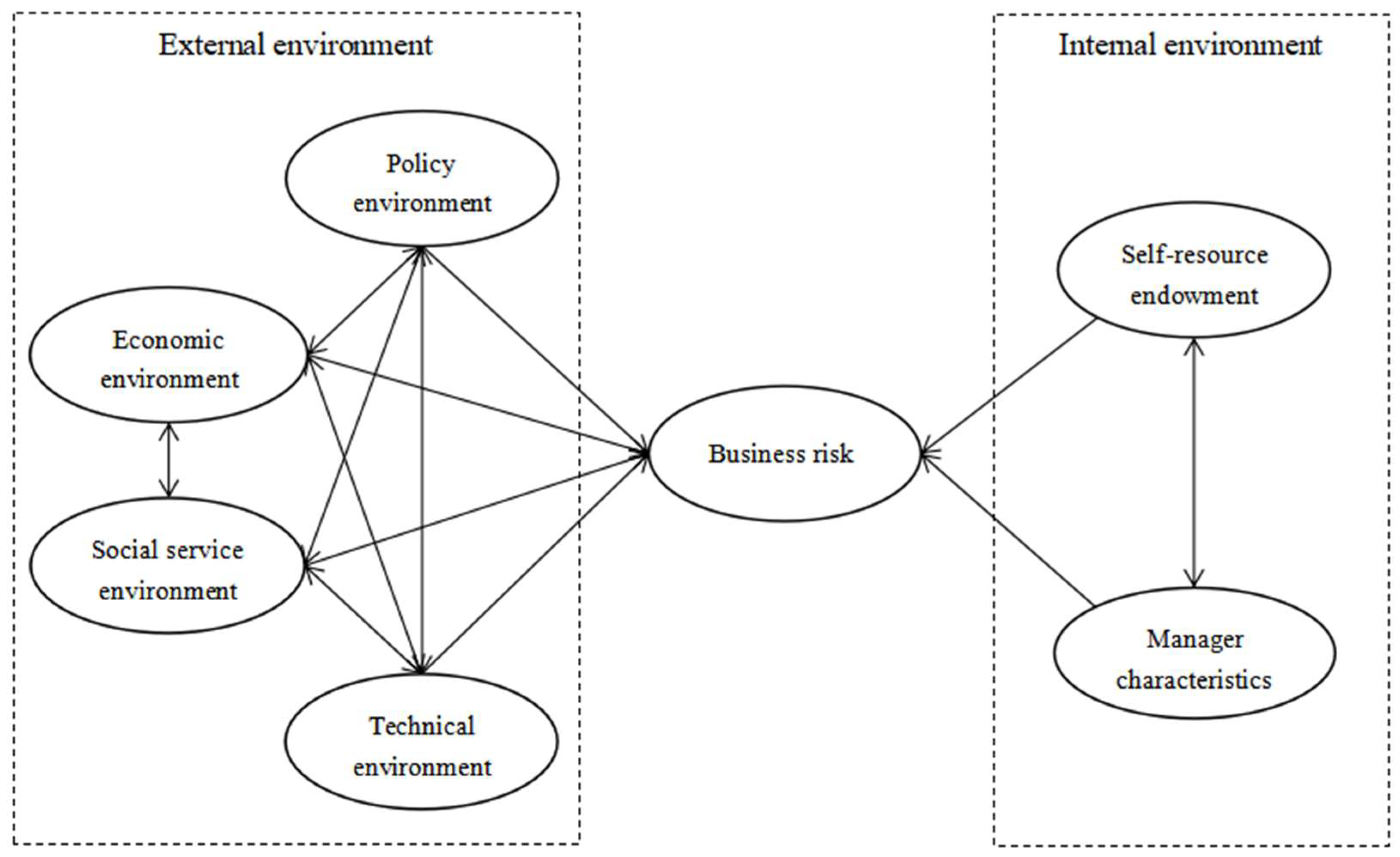
Figure 2.
Study area map.
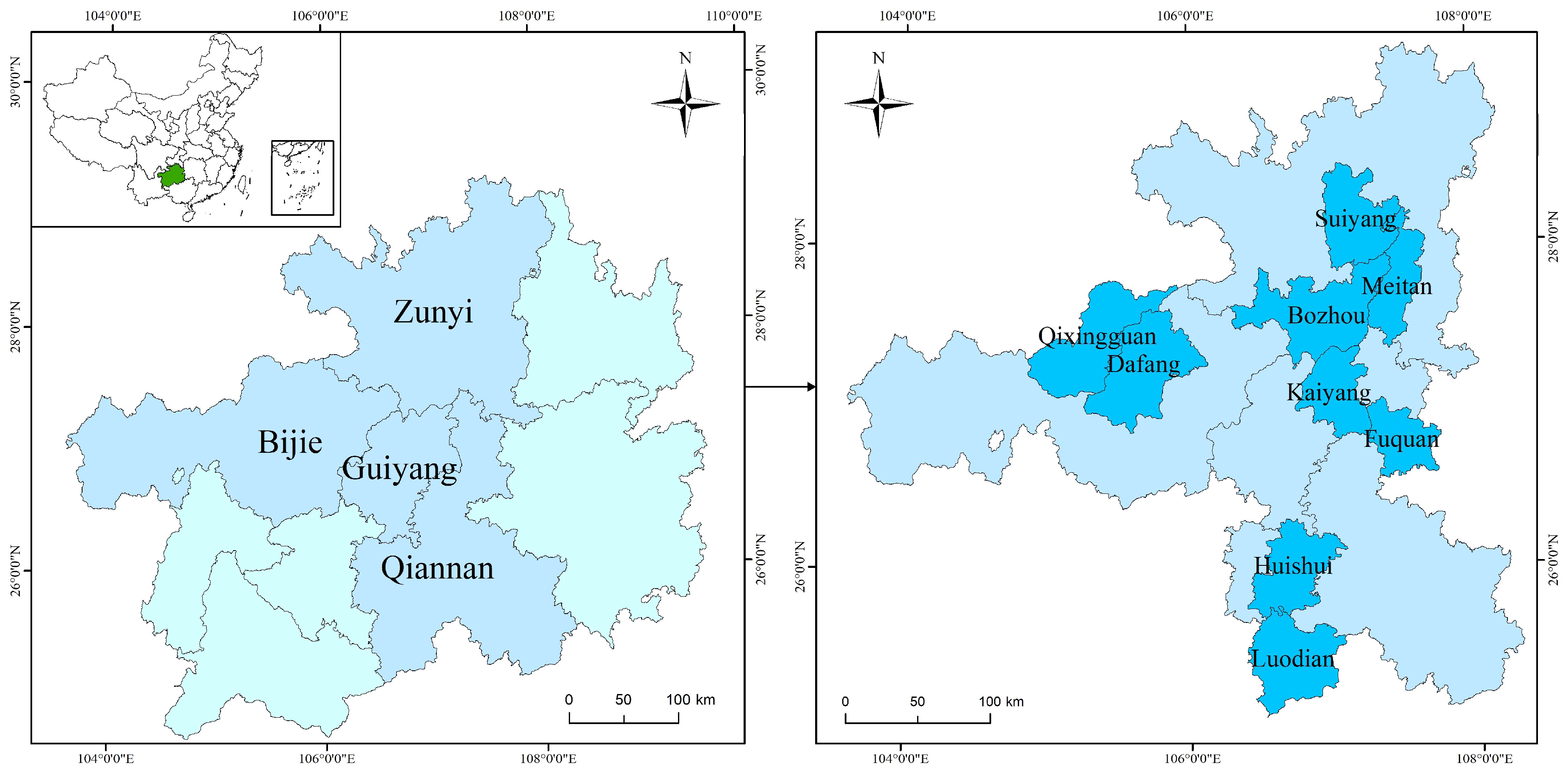
Figure 3.
Structural equation model path and standardized path coefficient diagram.
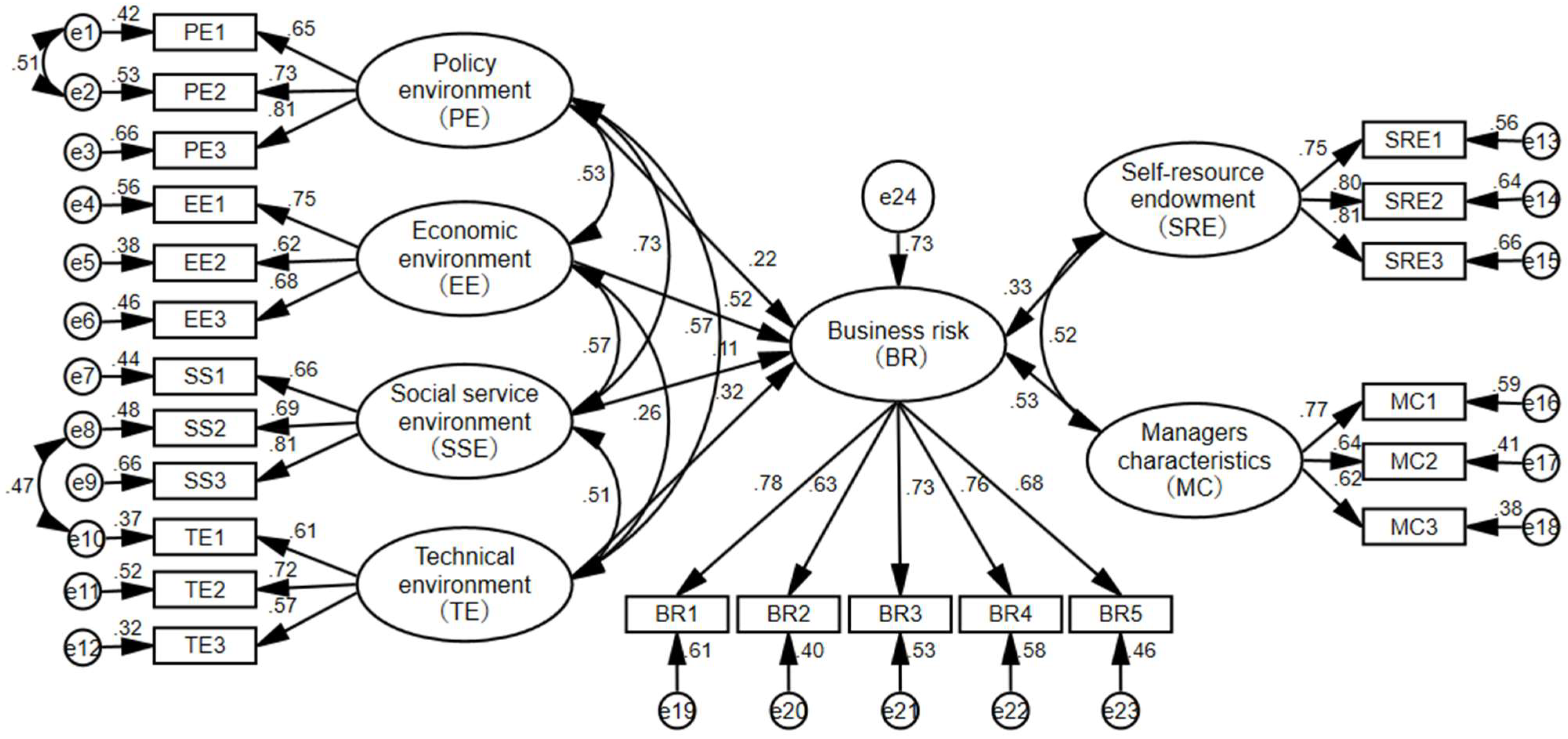
Figure 4.
Value of Influence of Each Factor on Business Risk.
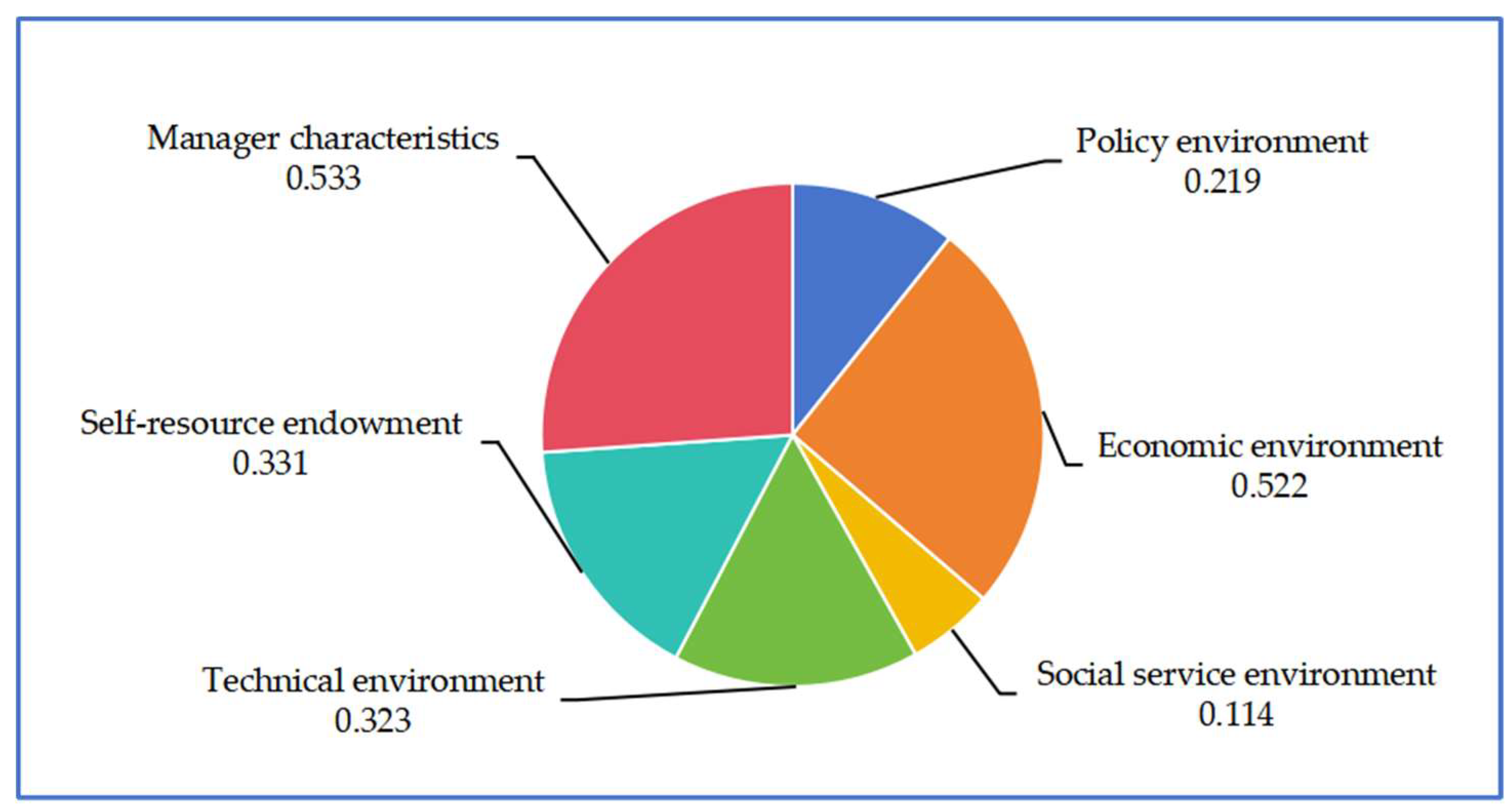

Table 1.
Assessment indicator system of business risk of plantation-based farmer cooperative and data characteristics.
Table 1.
Assessment indicator system of business risk of plantation-based farmer cooperative and data characteristics.
| First Class Index | Second Class Index | Symbol | Min | Max | Mean | S.D. |
|---|---|---|---|---|---|---|
| Natural risk | Losses due to extreme weather conditions including droughts and floods | a1 | 1 | 5 | 3.798 | 0.954 |
| Losses due to plant diseases and insect pests | a2 | 1 | 5 | 3.593 | 0.883 | |
| Market risk | Losses due to low matching degree between produce and market requirements | b1 | 1 | 5 | 3.163 | 0.912 |
| Losses due to changes in produce prices | b2 | 1 | 5 | 3.146 | 1.036 | |
| Management risk | Losses due to inexperience managers | c1 | 1 | 5 | 3.476 | 0.995 |
| Losses due to lack of innovation of managers | c2 | 1 | 5 | 3.102 | 0.827 | |
| Technical risk | Losses due to lack of agricultural technological personnel | d1 | 1 | 5 | 3.116 | 0.871 |
| Losses due to unmatched technologies and operational requirements | d2 | 1 | 5 | 3.354 | 0.927 | |
| Policy risk | Losses due to inadequate policy support | e1 | 1 | 5 | 3.661 | 0.913 |
| Losses due to financing difficulty | e2 | 1 | 5 | 3.815 | 0.898 |
Table 2.
Indicator system and scale of business risk of plantation-based farmer cooperative.
| Latent variable | Observational variable | Serial No. | Variable declaration | Mean | S.D. |
|---|---|---|---|---|---|
| Policy environment | Subsidies acquired by cooperatives | PE1 | 0-50,000RMB=1,50,000-100,000RMB=2, 100,000-150,000RMB=3, 150,000-200,000RMB=4, 200,000RMB and above=5 | 2.881 | 0.889 |
| Implementation of relevant policies | PE2 | Very poor=1, Poor=2, Normal=3, Good=4, Very good=5 | 3.233 | 0.896 | |
| Land transfer | PE3 | Hard=1, Difficult=2, Normal=3, Easy=4, Very easy=5 | 3.184 | 0.922 | |
| Economic environment | Price stability of agricultural products | EE1 | Very bad=1, Bad=2, Norman=3, Good=4, Very good=5 | 2.901 | 1.045 |
| Fund raising | EE2 | Hard=1, Difficult=2, Normal=3, Easy=4, Very easy=5 | 3.022 | 0.841 | |
| Stability of marketing channel | EE3 | Highly unstable=1, Unstable=2, Normal=3, Stable=4, Highly stable=5 | 3.669 | 0.903 | |
| Social service environment | Outsourcing of agricultural production | SSE1 | Hardly ever=1, Few=2, Normal=3, Frequent=4, Very frequent=5 | 2.912 | 0.857 |
| Machinery leasing | SSE2 | Hardly ever=1, Few=2, Normal=3, Frequent=4, Very frequent=5 | 2.907 | 0.915 | |
| Logistics of produce | SSE3 | Very poor=1, Poor=2, Normal=3, Sound=4, Very sound=5 | 3.652 | 0.941 | |
| Technical environment | Modern agricultural technology | TE1 | Very poor=1, Poor=2, Average=3, Good=4, Very good=5 | 2.851 | 0.801 |
| Matching between technology and cooperative operation | TE2 | Highly unmatched=1, Unmatched=2, Normal=3, Matched=4, Highly matched=5 | 3.13 | 0.916 | |
| Agricultural technological talent resource | TE3 | Very scarce=1, Scarce=2, Average=3, Abundant=4, Very abundant=5 | 2.952 | 0.849 | |
| Self-resource endowment | Scale of land management | CE1 | Below 16.47 acres=1, 16.47-49.42 acres=2, 49.42-82.37 acres=3, 82.37-115.32 acres=4, 115.32 acres and above=5 | 3.685 | 0.969 |
| Operating years of cooperative | CE2 | Less than 1 year=1, 1-3 years=2, 3-5 years=3, 5-7 years=4, above 7 years=5 | 3.603 | 0.992 | |
| Level of industrial organization | CE3 | Very low=1, Low=2, average=3, High=4, Very high=5 | 3.232 | 1.027 | |
| Manager characteristics | Age | MC1 | 60 years old and above=1, 50-59 years old=2, 40-49 years old=3, 30-39 years old=4, below 30 years old=5 | 2.671 | 1.215 |
| Level of education | MC2 | Primary school level and below=1, Junior high school level=2, Senior high school and vocational high school level=3, Junior college level=4, Undergraduate and above=5 | 2.839 | 0.83 | |
| Entrepreneur spirit | MC3 | Very inadequate=1, Inadequate=2, Average=3, Adequate=4, Very adequate =5 | 3.756 | 0.981 |
Table 3.
Factor analysis results of business risk evaluation system.
| Evaluation indicator | Variable | Market risk | Policy risk | Natural risk | Technical risk | Management risk |
|---|---|---|---|---|---|---|
| Market risk | b1 | 0.921 | 0.178 | 0.143 | 0.061 | 0.133 |
| b2 | 0.902 | 0.099 | 0.051 | 0.139 | 0.141 | |
| Policy risk | e1 | 0.183 | 0.917 | 0.134 | 0.086 | 0.183 |
| e2 | 0.145 | 0.904 | 0.185 | 0.15 | 0.044 | |
| Natural risk | a1 | 0.103 | 0.158 | 0.911 | 0.08 | 0.137 |
| a2 | 0.112 | 0.183 | 0.906 | 0.061 | 0.152 | |
| Technical risk | d1 | 0.162 | 0.156 | 0.082 | 0.873 | 0.191 |
| d2 | 0.093 | 0.069 | 0.067 | 0.906 | 0.014 | |
| Management risk | c1 | 0.079 | 0.09 | 0.154 | 0.069 | 0.852 |
| c2 | 0.154 | 0.089 | 0.133 | 0.072 | 0.819 | |
| Cumulative variance contribution rate (%) | - | 33.376 | 49.538 | 63.567 | 73.988 | 83.732 |
Table 4.
The distribution of scores for business risk evaluation factors.
| Evaluation scale | Comprehensive score | Number | Percentage (%) |
|---|---|---|---|
| Extremely high risk | Above 0.5 | 43 | 19.0 |
| High risk | 0.2 to 0.5 | 63 | 27.9 |
| Moderate risk | -0.2 to 0.2 | 39 | 17.3 |
| Low risk | -0.5 to -0.2 | 48 | 21.2 |
| Extremely low risk | Below -0.5 | 33 | 14.6 |
Table 5.
Testing of Reliability and Validity.
| Latent variable | Cronbach's α | KMO measure | Bartlett's sphericity test | ||
|---|---|---|---|---|---|
| x2 | df | sig | |||
| Total scale | 0.765 | 0.780 | 721.860 | 45 | 0.000 |
| Policy environment | 0.723 | 0.698 | 1435.233 | 9 | 0.000 |
| Economic Environment | 0.686 | 0.621 | 2034.227 | 6 | 0.000 |
| Social service environment | 0.629 | 0.652 | 575.663 | 6 | 0.000 |
| Technical environment | 0.817 | 0.669 | 3653.219 | 3 | 0.000 |
| Self-resource endowment | 0.809 | 0.712 | 1576.355 | 6 | 0.000 |
| Manager characteristics | 0.763 | 0.715 | 1236.436 | 7 | 0.000 |
| Business risk | 0.756 | 0.715 | 986.217 | 3 | 0.000 |
Table 6.
Model fit test.
| Fit index | reference value | Model value | Judgment result | |
|---|---|---|---|---|
| Absolute fit indices | x2/df | <3.00 | 2.652 | Pass |
| RMSEA | <0.08 | 0.042 | Pass | |
| RMR | <0.08 | 0.039 | Pass | |
| GF | >0.90 | 0.925 | Pass | |
| AGF | >0.90 | 0.992 | Pass | |
| Relative fit indices | RFI | >0.90 | 0.967 | Pass |
| IFI | >0.90 | 0.984 | Pass | |
| NF | >0.90 | 0.978 | Pass | |
| CF | >0.90 | 0.995 | Pass | |
| TL | >0.90 | 0.989 | Pass |
Table 7.
Test results of path relationship of modified model.
| Path | Parameter Estimate | ||||||
|---|---|---|---|---|---|---|---|
| Estimate | S.E. | C.R. | P Value | ||||
| NSEC | SEC | ||||||
| Business risk(BR) | ← | Policy environment (PE) | 0.313 | 0.219 | 0.055 | 6.418 | *** |
| Business risk (BR) | ← | Economic environment (EE) | 0.401 | 0.522 | 0.046 | 10.187 | *** |
| Business risk (BR) | ← | Social service environment (SSE) | 0.357 | 0.114 | 0.049 | 5.143 | *** |
| Business risk (BR) | ← | Technical environment (TE) | 0.617 | 0.323 | 0.078 | 8.475 | *** |
| Business risk (BR) | ← | Self-resource endowment (SRE) | 0.376 | 0.331 | 0.062 | 6.953 | *** |
| Business risk (BR) | ← | Manager characteristics (MC) | 0.504 | 0.533 | 0.053 | 7.352 | *** |
| PE1 | ← | PE | 1 | 0.651 | |||
| PE2 | ← | PE | 0.853 | 0.618 | 0.061 | 15.431 | *** |
| PE3 | ← | PE | 1.133 | 0.682 | 0.065 | 17.012 | *** |
| EE1 | ← | EE | 1 | 0.750 | |||
| EE2 | ← | EE | 0.796 | 0.623 | 0.047 | 10.326 | *** |
| EE3 | ← | EE | 0.861 | 0.677 | 0.063 | 11.865 | *** |
| SSE1 | ← | SSE | 1 | 0.664 | |||
| SSE2 | ← | SSE | 1.143 | 0.693 | 0.095 | 7.983 | *** |
| SSE3 | ← | SSE | 1.326 | 0.808 | 0.089 | 8.461 | *** |
| TE1 | ← | TE | 1 | 0.614 | |||
| TE2 | ← | TE | 1.192 | 0.720 | 0.065 | 13.436 | *** |
| TE3 | ← | TE | 0.963 | 0.573 | 0.051 | 15.763 | *** |
| SRE1 | ← | SRE | 1 | 0.749 | |||
| SRE2 | ← | SRE | 1.141 | 0.802 | 0.068 | 11.571 | *** |
| SRE3 | ← | SRE | 1.356 | 0.811 | 0.066 | 14.316 | *** |
| MC1 | ← | MC | 1 | 0.773 | |||
| MC2 | ← | MC | 0.823 | 0.637 | 0.052 | 10.763 | *** |
| MC3 | ← | MC | 0.745 | 0.622 | 0.061 | 8.357 | *** |
Notes: NSEC is the non-standardized path coefficient; SEC is the standardized path coefficient; P*** indicates significant at the 1% level.
Disclaimer/Publisher’s Note: The statements, opinions and data contained in all publications are solely those of the individual author(s) and contributor(s) and not of MDPI and/or the editor(s). MDPI and/or the editor(s) disclaim responsibility for any injury to people or property resulting from any ideas, methods, instructions or products referred to in the content. |
© 2024 by the authors. Licensee MDPI, Basel, Switzerland. This article is an open access article distributed under the terms and conditions of the Creative Commons Attribution (CC BY) license (http://creativecommons.org/licenses/by/4.0/).
Copyright: This open access article is published under a Creative Commons CC BY 4.0 license, which permit the free download, distribution, and reuse, provided that the author and preprint are cited in any reuse.


