
Submitted:
16 January 2024
Posted:
18 January 2024
You are already at the latest version
Abstract
We give a bilocal field theory description of a composite scalar with an extended binding potential,
that reduces to the Nambu–Jona–Lasinio (NJL) model in the pointlike limit. This provides a
description of the internal dynamics of the bound state and features a static internal wave-function,
ϕ(⃗r), in the center-of-mass frame that satisfies a Schr¨odinger-Klein-Gordon equation with eigenvalues
m2. We analyze the “coloron” model (single perturbative massive gluon exchange) which yields a
UV completion of the NJL model. This has a BCS-like enhancement of its interaction, ∝ Nc the
number of colors, and is classically critical with gcritical remarkably close to the NJL quantum
critical coupling. Negative eigenvalues for m2 lead to spontaneous symmetry breaking, and the
Yukawa coupling of the bound state to constituent fermions is emergent.
Keywords:
bilocal field theory
; Composite Scalar Bosons
1. Introduction
Many years ago Yukawa proposed a multilocal field theory for the description of relativistic bound states [1]. For a composite scalar field, consisting of a pair of constituents, he introduced a complex bilocal field, . This is factorized, where where , and describes the center-of-mass motion like any conventional point-like field. Then, describes the internal structure of the bound state. The formalism preserves Lorentz covariance, though we typically “gauge fix” to the center-of mass frame and Lorentz covariance is not then manifest. Here we must confront ths issue of “relative time.”
Each of the constituent particles in a relativistic bound state carries its own local clock, e.g., and . These are in principle independent, so the question arises, “how can a description of a multi-particle bound state be given in a quantum theory with a single time variable, ?” To this, Yukawa introduced an imaginary “relative time” , but this didn’t seem to be effective and is an element of his construction we will abandon.
A bilocal field theory formalism can be constructed in an action by considering general properties of free field bilocal actions. However, we can “derive” the bilocal theory from a local constituent field theory, by matching the conserved currents of the composite theory with those of the constituent theory. This leads to the removal of relative time then becomes associated with canonical normalization of the constituent fields and . In the center-of-mass frame the internal wave-function reduces to a static field, , where . The approach yields a fairly simple solution to the problem of relative time, matching the conclusions one gets from the elegant Dirac Hamiltonian constraint theory [2,3]. The resulting then appears as a straightforward result.
After first considering a bosonic construction, we apply this to a theory of chiral fermions with an extended interaction mediated by a perturbative massive gluon, i.e., the “coloron model” [5,6,7,8]. This provides a UV completion for the Nambu–Jona-Lasinio (NJL) model [4], which is recovered in the point-like limit, . This leads to an effective (mass)2 Yukawa potential with coupling g. We form bound states with mass, , determined as the eigenvalue of a static Schrödinger-Klein-Gordon (SKG) equation for the internal wave-function .
A key result of this analysis leads to a departure from the usual NJL model: the coloron model has a nontrivial classical critical behavior, , leading to a bound state with a negative . The classical interaction is analogous to the Fröhlich Hamiltonian interaction in a superconductor and has a BCS-like enhancement of the coupling by a factor of (number of colors) [9]. Remarkably we find the classical is numerically close to the NJL critical coupling constant which arises in fermion loops.
The scalar bound state develops an effective Yukawa coupling to its constituent fermions, distinct from g, that is emergent in the theory. In the point-like limit this matches the NJL coupling when near criticality. However, in general this depends in detail upon the internal wave-function and potential. In the point-like limit this is determined by and we recover the NJL model. However, if we are far from the point-like limit in an extended wave-function might suppress the emergent Yukawa coupling, even though the coloron coupling g is large.
The description of a relativistic bound state in the rest frame is similar to the eigenvalue problem of the nonrelativistic Schrödinger equation and some intuition carries over. However, the eigenvalue of the static Schrödinger-Klein-Gordon (SKG) equation, is , rather than energy. Hence, a bound state with positive is a resonance that can decay to its constituents and has a Lorentz line-shape in , and thus has a large distance radiative component to its solution that represents incoming and outgoing open scattering states.
If the eigenvalue for is negative, or tachyonic, then contrary to the non-relativistic case the bound state represents a chiral vacuum instability. This then requires consideration of a quartic interaction of the composite field, , which is expected to be generated by the loops in the underlying theory. We treat this phenomenologically in the present paper. In the broken symmetry phase the composite field acquires a vacuum expectation value (VEV), . In the perturbative quartic coupling limit (), in the broken phase remains localized and the Nambu-Goldstone modes and Brout-Englert-Higgs (BEH) boson retain the common localized solution for their internal wave-functions.
2. Constructing a Bilocal Composite Theory
2.1. Brief Review of the NJL Model
The Nambu–Jona-Lasinio model (NJL) [4] is the simplest field theory of a composite scalar boson, consisting of a pair of chiral fermions. A bound state emerges from an assumed point-like 4-fermion interaction and is described by local effective field, . The effective field arises as an auxiliary field from the factorization of the 4-fermion interaction. In the usual formulation of the NJL model, chiral fermions induce loop effects in a leading large limit which, through the renormalization group, lead to the interesting dynamical phenomena at low energies. We give a lightning review of this presently.
We assume chiral fermions, each with “colors” labeled by . A non-confining, point-like chirally invariant interaction then takes the form:
This can be readily generalized to a chiral symmetry. We then factorize eq.(1) by introducing the local auxiliary field and write for the interaction:
We view eq.(2) as the action defined at the high scale . We then, following [10], integrate out the fermions to obtain the effective action for the composite field at a lower scale .
The calculation in the large- limit and full renormalization group is discussed in detail in [11,12]. The leading fermion loop yields the result:
where,
Here is the UV loop momentum cut-off, and we include the induced kinetic and quartic interaction terms. The one-loop result can be improved by using the full renormalization group [11,12]. Hence the NJL model is driven by fermion loops, which are intrinsically quantum effects.
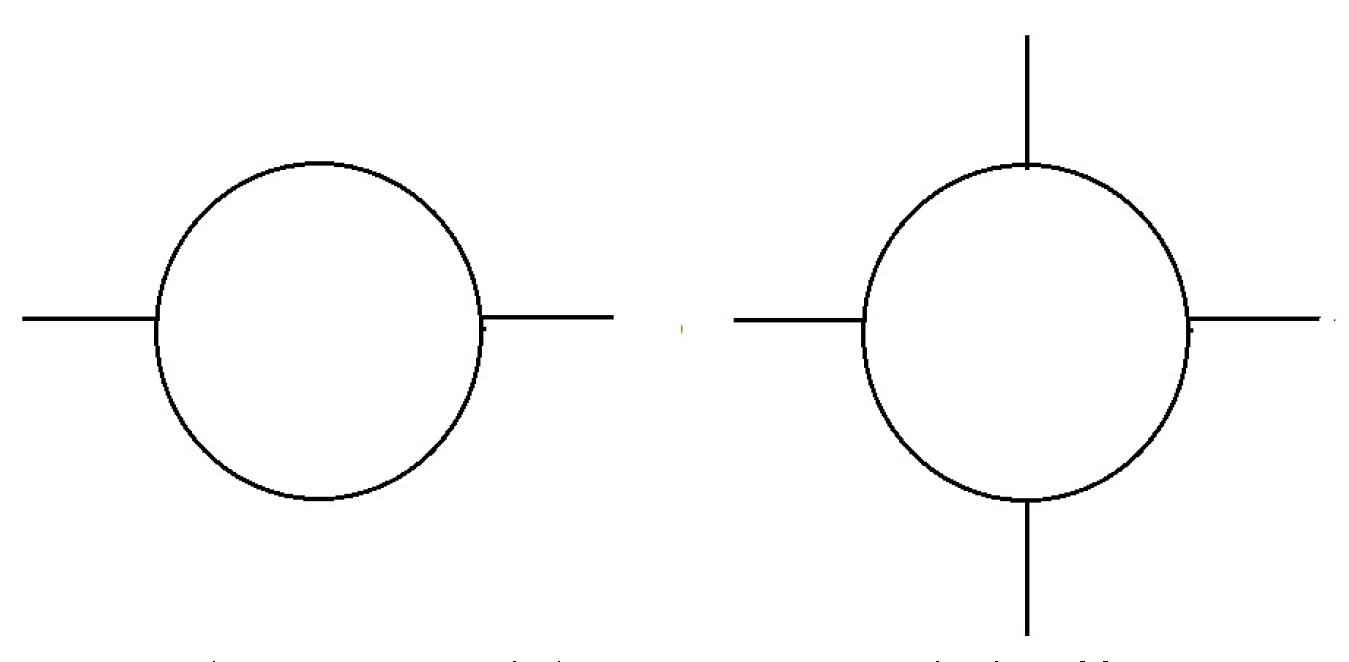
Note the behavior of the composite scalar boson mass, , of eq.(4) in the UV. The term arises from the negative quadratic divergence in the loop involving the pair of Figure 1, with UV cut-off . Therefore, the NJL model has a critical value of its coupling defined by the cancellation of the large terms for ,
Note that is the running RG mass, and comes from the lower limit of the loop integrals and breaks scale invariance and can in principle be small. For super-critical coupling, we see that and there will be a vacuum instability. The effective action, with a term, is then the usual sombrero potential, The chiral symmetry is spontaneously broken, the chiral fermions acquire mass, and the theory generates Nambu-Goldstone bosons. Fine tuning of is possible if we want a theory with a hierarchy, .
2.2. Construction of Bilocal Compositeness in a Local Scalar Field Theory
Presently we obtain a theory of bound states by bilocal fields in a Lorentz invariant model, consisting of a point-like complex scalar field and an interaction mediated by a point-like real field (in section 3 we extend this to a chiral fermions interacting by a massive gauge field, analogous to a heavy gluon, aka “coloron”; in Appendix A we give a summary of notation and formulas). Our present treatment will be semi-classical.
Consider local scalar fields (complex) and (real) and action:
where we abbreviate, and . Here g is dimensionless and we refer all mass scales to the single scale M. We will discuss the quartic term separately below, and presently set it aside, .
If we integrate out A we obtain an effective, attractive, bilocal potential interaction term at leading order in ,
where the two-point function is given by the Feynman propagator,
The equation of motion of is therefore,
(note we have transposed and under the integral). In the action eq.(7), the kinetic term is still local while the interaction is bilocal, and the theory is still classical in that this only involved a tree diagram that is .
We now define a bilocal field of mass dimension ,
The free particle states described by the bilocal field trivially satisfy an equation of motion and a symmetry,
and this is generated by a bilocal action,
where we will specify the normalization, Z and scale M subsequently (we discuss the general properties of the bilocal fields and actions in Appendices B.2 and B.3). With the bilocal field the interaction of eq.(7) becomes,
We can therefore postulate a bilocalized action as a free particle part plus the interaction,
In the limit the field and the action faithfully represents two particle kinematics, and we have the equation of motion,
We see that a conserved Noether current is generated by ,
where . This must match the conserved current in the constituent theory,
This is a required constraint for the bound state sector of the theory. Note that the square of the conatraint is the 4-normalization of
This implies that the presence of a correlation in the two particle sector, acts as a constraint on the single particle action in that sector. We can now see how the underlying action of eq.(7) leads to the action by inserting the constraint of eq.(19) onto the kinetic term of eq.(7) and rearranging to obtain,
and S remains dimensionless. With the bilocal field of eq.(10) the bilocalized action eq.(65) becomes eq.(14).
Following Yukawa, we go to barycentric coordinates ,
where , where is the radius and is the relative time.1 Hence we write,
Let and we can then rewrite the kinetic term, , using the derivative ,
Note the Jacobian ,
Likewise, the potential term is,
We will treat the latter term in eq.(24), as a constraint, with its contribution to the equation of motion,
We can redefine this term in the action as a Lagrange multiplier while preserving Lorentz invariance,
which also enforces the constraint on a path integral in analogy to gauge fixing. In the following we assume the constraint is present in the total action though not written explicitly. We therefore have the bilocal action with the constraint understood:
Following Yukawa, we factorize ,2
is the internal wave-function which we define to be dimensionless, , while is an ordinary local field with mass dimension . determines the center-of-mass motion of the composite state. The full action for the factorized field takes the form,
The matching of the current generated by (or to have a canonical normalization of ) we see that the normalization of the world-scalar 4-integral is,
where replaces in eq.(19).
We can then represent S in terms of two “nested” actions. For the field ,
and is an action for the internal wave-function,
Eq.(33) then implies,
has free plane wave solutions with .
In the center of mass frame of the bound state we can choose to have 4-momentum where we then have,
must then satisfy the Lagrange multiplier constraint
and therefore becomes a static function of .
While we have specified Z in eq.(32), we still have the option of normalizing the internal wave-function . This can be conveniently normalized in the center of mass frame as,
Note that in eq.(38) we have implicitly defined the static internal wave-function to be dimensionless, .
We see that the relative time now emerges in the 4-integral over of eq.(32) together with eq.(38),
where . Then from eq.(39) we have,
With static the internal action of eq.(34) becomes,
where . Note is spacelike, and the arguments of the constrained are now 3-vectors, however still depends upon the 4-vector .
There remains the integral over relative time in the action. For the potential, we have by residues,
and the potential term in the action becomes the static Yukawa potential,
Note has dimension , as it must for . We thus see, as previously mentioned, that the combination occurs in the theory, and the relative time has disappeared into normalization constraints, eqs.(32, 38).
The extremalization of leads to the Schrödinger-Klein-Gordon (SKG) equation in the center-of-mass frame,
where, for spherical symmetry in a ground state,
We see that the induced mass2 of the bound state, , is the eigenvalue of the SKG equation. We can compare this to a non-relativistic Schrödinger equation (NRSE),
In the next section we will obtain a similar results for a bound state of chiral fermions and use the known results for the Yukawa potential in the NRSE to obtain the critical coupling. The negative eigenvalue of E in the NRSE, which signals binding, presently implies a vacuum instability.
Integrating by parts we then have from eq.(45),
Note consistency, using eq.(48), and the normalization of the dimensionless field of eq.(38).
More generally, by promoting to a time dependent field while maintaining a static we have the full joint action:
In summary, we have constructed, by “bilocalization” of a local field theory, a bilocal field description for the dynamics of binding a pair of particles. The dynamics implies that, in barycentric coordinates, , where the internal wave-function, , is a static function of and satisfies an SKG equation with eigenvalue , which determines the squared-mass of a bound state. This illustrates the removal of relative time in an action formalism, which is usually framed in the context of Dirac Hamiltonian constraints [2].
2.3. Simplified Normalization
The normalization system we have thus far used is awkward. We can facilitate this by defining a new integral over the internal wave function 3-space :
We then have the key elements of the theory in this notation:
Our general notation is summarized in Appendix A.
3. The Coloron Model
3.1. Boundstate and -Enhanced Coupling
The point-like NJL model can be viewed as the limit of a physical theory with a bilocal interaction. An example that motivates the origin of the NJL interaction is an analogue of QCD, with a massive and perturbatively coupled gluon. We call this a “coloron model,” and it has been extensively deployed to describe chiral constituent and heavy-light quark models [6,18], the possibility of the BEH boson composed of top quarks, and as a generic model for experimental search strategies [5,7,8].
Consider a nonconfining gauge theory, broken to global , where the coloron gauge fields, acquire mass M and have a fixed coupling constant g. We assume chiral fermions, each with “colors” labeled by with the local Dirac action,
where the covariant derivative is,
and are the adjoint representation generators of . We assume the colorons have a common mass M.
The single coloron exchange interaction then takes a bilocal current-current form:
where are generators of . The coloron propagator in a Feynman gauge yields:
A Fierz rearrangement of the interaction to leading order in leads to an attractive potential [5]:
where is defined in eq.(8). Note that if we suppress the term in the denominator of eq.(56)
and we immediately recover the point-like NJL model interaction.
Consider spin-0 fermion pairs of a given color . We will have free fermionic scattering states, coexisting in the action with bound states
The normal ordering signifies that we have subtracted the bound state from the product. These will be eigenstates of the equation of motion and will be orthogonal wave-functions.
We see that is an complex matrix that transforms as a product of representations, , and therefore decomposes into a singlet plus an adjoint representation of . We write it as a matrix by introducing the adjoint matrices, , where . The unit matrix is diag, and , hence we have,
The is present because and form complex representations since they also represent the chiral symmetry.
For the bilocal fields, we have a bosonic kinetic term with the constraint,
Note the numerical factor differs from the scalar case by treating symmetrically as in eq.(A15). For the singlet representations this takes the form,
We assume the constraint in the barycentric frame, and integrate out relative time with .
(where ). Factorizing ,
and the kinetic term action becomes identical to the bosonc case,
with
If we include the free fermion scattering states the full bound state interaction of eq.(57) becomes,
where,
The leading term of eq.(69) is just a free 4-fermion scattering state interaction and has the structure of an NJL interaction in the limit of eq.(58). This identifies as the NJL coupling constant. This is best treated separately by the local interaction of eq.(57). We therefore omit this term in the discussion of the bound states.
The second term in eq.(69) determines the Yukawa interaction between the bound state and the free fermion scattering states. We will treat this below.
Note that the third term is the binding interaction and it involves only the singlet, . It can then be written from eq.(42) as,
We see that adjoint representation are decoupled from the interaction and remain as two body massless scattering states. Hence they do not form bound states by the interaction.
We also see that the singlet singlet field has an enhanced interaction by a factor of . This is analogous to a BCS superconductor, where the color pairs are analogues of N Cooper pairs and the weak 4-fermion Fröhlich Hamiltonian interaction is enhanced by a factor of [9]. The color enhancement also occurs in the NJL model, but at loop level. Here we see that the color enhancement is occurring in the semi-classical (no loop) coloron theory by this coherent mechanism.
Hence, the removal of relative time is then the identical procedure as in the previous model (and absorbs away Z and T as in eqs.(32,39,40)), and leads to the same action, in the compact notation of eqs.(52) with the interaction enhanced by .
The extremalization of then leads to the SKG equation,
3.2. Classical Criticality of the Coloron Model
The coloron model furnishes a direct UV completion of the NJL model. However, in the coloron model we do not need to invoke large- quantum loops to have a critical theory. Rather, it leads to an SKG potential of the Yukawa form which has a classical critical coupling, . For the theory is subcritical and produces resonant bound states that decay into chiral fermions. For the theory produces a tachyonic bound state which implies a chiral instability and must develop a VEV. This requires stabilization by, e.g., quartic interactions and a sombrero potential. All of this is treated bosonically in our present formalism.
The criticality of the Yukawa potential in the nonrelativistic Schrödinger equation is discussed in the literature in the context of “screening.” The nonrelativistic Schrödinger equation is:
and criticality (eigenvalue ) occurs for where a numerical analysis yields [14],
For us the spherical SKG equation is now
Comparing, gives us a critical value of the coupling constant, when , and , then:
We can compare the NJL critical value of eq.(4),
Hence, the NJL quantum criticality is a comparable effect, with a remarkably similar numerical value for the critical coupling.
Note that we can rewrite eq.(73) with dimensionless coordinates, ,
and then only appears as an overall scale factor. Hence we see that critical coupling is determined by eq.(76), and the scale M cancels out at criticality. The mass scale M is dictated in the exponential of the particular Yukawa potential, together with canonical normalization of . In general, we can start with the dimensionless coordinate form of the SKG equation and infer the scale M by matching to the potential. In this way, solutions may exist where the scale in the potential is driven by the renormalization group. This will be investigated elsewhere.
However, it is important to realize that the NJL model involves the Yukawa coupling, while the present criticality involves the coloron coupling constant. The NJL coupling is emergent in the coloron model, and we need to compute it.
3.3. Yukawa Interaction
The second term in eq.(67) is the induced Yukawa interaction , and can be written with the factorized field as:
This is the effective Yukawa interaction between the bound state and the free fermion scattering states.
We can’t simply integrate out the relative time here. However, we can first connect this to the point-like limit by suppressing the term in the denominator of with in:
where , hence with ,
This gives a value of the Yukawa coupling,
The wave-function at the origin, in the NJL limit is somewhat undefined. However, if we consider a spherical cavity of radius R where , with a confined, dimensionless, , then is obtained,
Plugging this into the expression for in eq.(80) gives,
where is the critical coupling of the NJL model, as seen in eq.(4).
Hence, if the coloron coupling constant, , is critical, as in eqs.(74,75). then we have seen in that , and the induced Yukawa coupling from eq.(82) is then . The coloron model is then consistent with the NJL model in the point-like limit where the NJL model coupling is the Yukawa coupling, as seen in eq.(2).
However, the induced Yukawa coupling in the bound state, , may be significantly different than the coloron coupling g in realistic extended models. The result we just obtained applies when we assume the strict point-like limit of , while in reality, as the potential becomes more extended, the may become smaller, even if the coloron coupling g may be supercritical. We anticipate this could have implications for a composite Higgs model, which will be investigated elsewhere (together with loop effects including the extended wave-function). There may also be additional new effects that occur at loop level in extended potentials, such as the infall of zero modes, as suggested in [15].
In the next section we see that will develop a VEV . Note that with plane wave free fermions,
Can we enhance f? The induced fermion mass in a coloron model is:
GeV2, M= coloron mass, .
3.4. Spontaneous Symmetry Breaking
For subcritical coupling there are resonance solutions with positive that have large distance tails of external incoming and outgoing radiation, representing a steady state of resonant production and decay. The portion of the wave-function localized within the potential can be viewed as the resonant bound state for normalization purposes, while the large distance tail is non-normalizable radiation.
With super-critical coupling, , the bilocal field has a negative squared mass eigenvalue (tachyonic), with a well-defined localized wave-function. In the region external to the potential (forbidden zone) the field is exponentially damped. At exact criticality with there is a (quasi-radiative) tail that switches to exponential damping for . The supercritical solutions are localized and normalizable over the entire space , but with they lead to exponential runaway in time of the field , and must be stabilized, typically with a interaction.
We then treat the supercritical case as resulting in spontaneous symmetry breaking. In the point-like limit, , the theory has the “sombrero potential”,
The point-like field develops a VEV, . In this way the bound state theory will drive the usual chiral symmetry breaking from the underlying dynamics of a potential induced by new physics.
A quartic potential gnerally exists in a local field theory, eq.(6), and would be induced by free loops in the coloron model. We can introduce a bilocalized quartic interaction as a model by presently introducing another world scalar factor with coefficient ,
and to absorb relative time.
The simplest sombrero potential can therefore be modeled as,
In the case of a perturbatively small we expect the eigensolution of to be essentially unaffected,
The effective quartic coupling is then further renormalized by the internal wave-function,
In this case we see that develops a VEV in the usual way:
This is consequence of remaining localized in its potential
The external scattering state fermions, , will then acquire mass through the emergent Yukawa interaction described in the previous section, However, an issue we have yet to resolve is whether the induced fermion masses back-react the VEV solution itself? We segregated the free fermions from the bound state wave-function, , by shifting, so we are presently arguing that forms a VEV as described above, and the scattering state fermions independently acquire mass as spectators, but this may require a more detailed analysis.
However, for general and possibly large (as in a nonlinear sigma model), the situation is potentially more complicated. The VEV is determined by joint integro-differential equations for constant
If we can can solve the second local equation then the global one follows, but we see that cannot become constant in a potential which has r dependence! While perturbative solutions maintain locality in , it is unclear what solutions exist to the latter equation for non-perturbative . If acquires a constant component then we may have something analogous to the Bose-Einstein condensate (BEC) phase of a superconductor.
4. Summary and Conclusions
In the present paper we have given a formulation of bilocal field theory, , as a variation on Yukawa’s original multilocal field theory of composite particles [1]. In particular we focus upon two particle bound states consisting of bosons or chiral fermions. There are many foreseeable extension of the present work. and scattering states
Here we construct bilocal field theories from an underlying local interacting field theory, by introduction of “world-scalars.” We then go to barycentric coordinates, and the bilocal field is “factorized,”
Here describes center-of-mass motion like any pointlike scalar field, while is the internal wave-function of the bound state.
This procedure enables the removal of the relative time, , in the bilocalized theory, essentially by canonical renormalization. The bilocal kinetic term contains a constraint that leads to a static internal field, , in the center of mass frame. Hence, we obtain a static Schrödinger-Klein-Gordon (SKG) equation for the internal wave-function. The eigenvalue of this equation is the of the bound state.
The SKG equation likewise contains a static potential that comes from the Feynman propagator of the exchanged particle in the parent theory. Typically we have a Yukawa potential, , though the formalism can in principle accommodate any desired phenomenological potential. Here g is the exchanged particle coupling constant, such as the coloron coupling (massive perturbative gluon) for fermions. This is not the scalar-fermion Yukawa coupling, , which is subsequently emergent.
We find that the Yukawa potential is classically critical with coupling . If the coupling is sub-critical, , then positive, and the bound state is therefore a resonance. It will decay to its constituents if kinematically allowed. is then a localized “lump,” with a radiative tail representing the two body decay and production by external free particles.
If the coupling is supercritical, , then , is tachyonic and will acquire a VEV. We require an interaction, such as , to stabilize the vacuum and we therefore have spontaneous symmetry breaking. is expected to be localized in its potential and acquires the VEV. If becomes delocalized; both and acquire VEVs, which is analogue of a Bose-Einstein condensate e.g., in a slightly heated superconductor, however we have not produced solutions to the SKG equation that demonstrates this behavior.
We consider a bound state of chiral fermions in the coloron model, where a coloron is a massive gluon with coupling g, such as in “topcolor” models [5] and chiral constituent quark models [6]. Fierz rearrangement of the non-local, color-current-current, interaction yields a leading large– interaction in . For the color singlet the coupling is enhanced by , in analogy to a BCS superconductor [9].
As our main result, we find that the coloron model can be classically critical. The critical coupling, , extracted from [14], is astonishingly close to the critical value of the Yukawa coupling in the NJL model. While in the NJL model the critical behavior is coming from fermion loops, in the bilocal model this is a semiclassical result, and the essential factor of comes from the coherent BCS-like enhancement of the 4-fermion scattering amplitudes. It is therefore unclear what happens when we include the fermion loops in addition to the classical behavior in the large limit. Is criticality further enhanced by the additional loop contribution? Is there an additional enhancement of the underlying coupling due to the factor in the emergent Yukawa interaction? These are interesting issues we will address elsewhere.
The induced Yukawa coupling of the bound state to fermions, , is extended and emergent in the composite models. We derive the coupling and find in the point-like limit. For in a tiny spherical cavity we obtain . Hence the critical value of implies the critical value of in point-like limit NJL model, which is consistent.
However, the could in principle be reduced in an extended potential, as the wave-function spreads out, even if is critical. This is an intriguing possibility: the BEH-Yukawa coupling of the top quark is , which is perturbative and is insufficient to drive the formation of a composite, negative , Brout-Englert-Higgs (BEH) boson at low energies in e.g., a top condensation model. However the present result suggests that perhaps is small suppressing , even though the underlying coloron coupling, , is super-critical and leads to the composite BEH mechanism. In this picture the BEH boson may be a large object, a “balloon,” of size (see [15]).
While we have an eye to a composite BEH boson for the standard model, as in top condensation theories, [11,12,16], our present analysis is more general, but does not yet include many details, e.g. gauge interactions and gravity. We think the emphasis on a bosonic field description, the treatment of the coloron model and its classical criticality, its linkage the NJL model as UV completion, and our treatment of relative time renormalization, comprises a novel perspective.
Acknowledgments
I thank W. Bardeen and Bogdan Dobrescu for critical comments, and the Fermi Research Alliance, LLC under Contract No. DE-AC02-07CH11359 with the U.S. Department of Energy, Office of Science, Office of High Energy Physics.
Appendix A. Summary of Notation
Two body kinematics:
though commonly referred to as the “invariant mass” of a pair, is not a scale breaking mass in that it involves fields with a traceless stress tensor.
Barycentric coordinates:
Two body scattering states
Integration Measures
Appendix B. Bilocal Field Theory
Here we give a general discussion of our “revisited” bilocal field theory for a pair of particles, as inspired by Yukawa [1]. We begin with the “bilocalization” and subsequently construct the generic actions for bilocal fields containing free particles.
Appendix B.1. Free Fields
Let us examine the bilocalization procedure in Section for free particle states. Consider a pair of local scalar fields (complex):
with independent free particle equations of motion
We want to describe a pair of particles by a bilocal field of mass dimesion 1:
We therefore have the two equations of motion for ,
Appendix B.2. Bilocalization of Scattering States
We can obtain the action for as follows. We multiply the kinetic and mass terms of eq.(A5) by world-scalars:
hence,
At this stage we can still vary with respect to either of , and the equations are modified. In terms of the bilocal field we have,
We go to barycentric coordinates and note the derivatives:
The factor of M is superfluous at this point and in what follows we can set (we’ll restore it below). Hence:
which yields the action,
If we vary we obtain one equation of motion:
We see that this is consistent with eq.(A8)
However, eq.(A9) is missing. We see using,
eq.(A15) takes the form
As before, this can be viewed as a constraint, and we can treat it as a Lagrange multiplier as in eq.(28) to supply the second equation.
We factorize in barycentric coordinates as,
The action eq.(A15) becomes
We then define
The Schrödinger-Klein-Gordon equation has eigenvalue ,
Then the equation becomes
The constraint then takes the form
In the barycentric (rest) frame we can choose to have 4-momentum . The constraint becomes , Therefore becomes a static function of . The Schrödinger-Klein-Gordon equation is then a static equation,
We define the static internal wave-function to be dimensionless, , and we normalize the dimensionless static wave-function (restoring M),
We then have,
where an integral over relative time has appeared leading to an overall factor in the action for . The action becomes two nested parts,
with eq.(A27).
Appendix B.3. Kinematics of Scattering States
We can more directly construct the bilocal fields, without appealing to world scalars, by considering simple free particle kinematics. For free particles of 4-momenta we see that describes a scattering state
where,
For massive particles, , satisfies
The constraint is the second equation,
and forces and forces to have in the center of mass frame, hence and .
Appendix B.3.1. Constant Positive
In the center of mass frame, , ,
Therefore, if we were to try to interpret as a “bound state” we see that is has continuum of invariant “masses” . This is evidently an “unparticle” [17]. This implies it is not localized and is a scattering state of asymptotic free particles each of mass .
With the constraint of eq.(A33) we can choose and . We factorize and the factor field then satisfies the static SKG equation with eigenvalue ,
the solutions of the factorized field are static, box normalized, plane waves, with eigenvalues
then satisfies the KG equation with and ,
and the solution becomes,
This is just the spectrum of the two body states of -massive particles in the barycentric frame.
Appendix B.3.2. Constant Negative
If we suppose then the solutions for for small are runaway exponentials, . The eigenvalues are
This analogous to a “Dirac sea” of negative mass eigenvalues extending from to , where the lowest mass state has and eigenvalue .
This would therefore be a tachyonic instability of unparticles, and we then require higher field theoretic interactions, such as , to stabilize the vacuum. This represents a spontaneous breaking of the chiral symmetry and the constituent fermions will dynamically acquire masses and the instability is halted.
However, a constant negative does not give a Higgs-like spontaneous symmetry breaking mechanism. If the potential is,
(where we have constant rather than a localized potential) then indeed the field develops a constant VEV:
Then indeed becomes a massive BEH mode, but with the continuous spectrum . To have an acceptable BEH mechanism, with a well–defined BEH boson, we therefore require a localized potential in where and is a localized eigenmode.
Appendix B.4. Removal of Relative Time and Generic Potential
A point-like interaction in the underlying theory may produce an effective action with a potential term that is a function of ,
and we assume the constraint:
We factorize ,
In the center of mass frame we impose the constraint, . We can then integrate over relative time,
where
and has dimensions of . We now define the normalizations,
The purpose of these normalizations is to have a canonically normalized field in the center of mass frame, even in the limit . It also defines the conserved current to have unit charge (one boundstate pair) to match the underlying theory’s conserved current.
Hence we obtain the actions:
with eq.(A48).
An attractive (repulsive) potential is (). The main point is that the field must have canonical normalization of its kinetic term, which dictated the introduction of Z. The kinetic term of is seen to be extensive in T, and this is absorbed by normalizing Z, as . The potential is determined by the integral over relative time of the interaction and is not extensive in T.
From the factorization with normalized , as in eq.(38), the eigenvalue is computed in the rest frame,
From this we obtain a normalized effective action for in any frame,
The mass of the bound state is determined by the eigenvalue of the static Schrödinger-Klein-Gordan (SKG) equation in the center-of-mass frame:
References
- H. Yukawa, Phys. Rev. 77, 219-226 (1950); ibid, Phys. Rev. 80, 1047-1052 (1950); Phys. Rev. 91, 415 (1953); Yukawa introduced an imaginary relative time; we abandon this in favor of relative time constraints [2].
- P.A.M. Dirac, Can. J. Math. 2, 129 (1950); P.A.M. Dirac,“ Lectures on Quantum Mechanics” (Yeshiva University, New York, 1964).
- For application of [2] to removal of relative time see also: K. Kamimura, Prog. Phys. 58 (1977) 1947; D. Dominici, J. Gomis and G. Longhi, Nuovo Cimento B48 (1978)257; ibid, 1, Nuovo Cimento B48(1978)152-166; A. Kihlberg, R. Marnelius and N. Mukunda, Phys. Rev. D 23, 2201 (1981); H. W. Crater and P. Van Alstine, Annals Phys. 148, 57-94 (1983); H. Crater, B. Liu and P. Van Alstine, [arXiv:hep-ph/0306291 [hep-ph]]; For a tutorial of Dirac’s constraint theory see: https://en.wikipedia.org/wiki/Two_body_Dirac_equations, and https://en.wikipedia.org/wiki/Dirac_bracket and references therein. The barycentric frame is ghost-free for gauge and scalar interactions.
- Y. Nambu and G. Jona-Lasinio, Phys. Rev.122, 345-358 (1961), and Phys. Rev. 124, 246-254 (1961),.
- C. T. Hill, Phys. Lett. B 266, 419-424 (1991); ibid, Phys. Lett. B 345, 483-489 (1995).
- J. Bijnens, C. Bruno and E. de Rafael, Nucl. Phys. B 390, 501-541 (1993).
- E. H. Simmons, Phys. Rev. D 55, 1678-1683 (1997); R. Sekhar Chivukula, P. Ittisamai and E. H. Simmons, Phys. Rev. D 91, no.5, 055021 (2015); Y. Bai and B. A. Dobrescu, JHEP 04, 114 (2018).
- For a review see: C. T. Hill and E. H. Simmons, Phys. Rept. 381, 235-402 (2003) [erratum: Phys. Rept. 390, 553-554 (2004)].
- L. N. Cooper, Phys. Rev. 104, 1189-1190 (1956); J. Bardeen, L. N. Cooper and J. R. Schrieffer, Phys. Rev. 108, 1175-1204 (1957).
- K. G. Wilson, Phys. Rev. D 3, 1818 (1971).
- W. A. Bardeen, C. T. Hill and M. Lindner, Phys. Rev. D 41 (1990) 1647.
- W. A. Bardeen and C. T. Hill, Adv. Ser. Direct. High Energy Phys. 10, 649 (1992); C. T. Hill, Mod. Phys. Lett. A, 5, 2675-2682 (1990).
- W. A. Bardeen and C. T. Hill, Phys. Rev. D 49, 409-425 (1994); W. A. Bardeen, E. J. Eichten and C. T. Hill, Phys. Rev. D 68, 054024 (2003).
- J. P. Edwards, et al. , “The Yukawa potential: ground state energy and critical screening,”Progress of Theoretical and Experimental Physics, Volume 2017, Issue 8, August (2017), 083A01, https://doi.org/10.1093/ptep/ptx107. M. Napsuciale and S. Rodriguez, Phys. Lett. B 816, 136218 (2021) doi:10.1016/j.physletb.2021.136218 [arXiv:2012.12969 [hep-ph]].
- C. T. Hill, “Naturally Self-Tuned Low Mass Composite Scalars,” [arXiv:2201.04478 [hep-ph]].
- V. A. Miransky, M. Tanabashi and K. Yamawaki, Mod. Phys. Lett. A 4, 1043 (1989); ibid, Phys. Lett. B 221, 177-183 (1989).
- H. Georgi, Phys. Rev. Lett. 98, 221601 (2007).
- W. A. Bardeen and C. T. Hill, Phys. Rev. D 49, 409-425 (1994); W. A. Bardeen, E. J. Eichten and C. T. Hill, Phys. Rev. D 68, 054024 (2003).
- J. D. Bjorken and S. D. Drell, “Relativistic quantum fields,” McGraw-Hill College; 1st edition (January 1, 1965).
- R. Floreanini and R. Jackiw, Phys. Rev. D 37, 2206 (1988); T. L. Curtright “Schrodinger’s cataplex,” [arXiv:quant-ph/0011101 [quant-ph]]; T. L. Curtright and G. I. Ghandour, [arXiv:hep-th/9503080 [hep-th]].
- J. M. Cornwall, R. Jackiw and E. Tomboulis, Phys. Rev. D 10, 2428-2445 (1974).
- E. Schrödinger, Naturwiss. 14, 664-666 (1926). [CrossRef]
- L.D. Landau and E.M. Lifshitz, “Quantum Mechanics,” 2nd edition, pgs. 113 - 116 (Pergamon Press, London, 1958, 2nd ed. 1965).
- Y. Nambu, Phys. Rev. D 7, 2405-2412 (1973). [CrossRef]
- I thank Bill Bardeen for critical comments on this and other issues.
- K. G. Wilson and W. Zimmermann, Commun. Math. Phys. 24, 87-106 (1972). [CrossRef]
- This will be developed elsewhere.
- B. Bellazzini, C. Csaki, J. Hubisz, J. Serra and J. Terning, JHEP 11, 003 (2012); G. Isidori, A. V. Manohar and M. Trott, Phys. Lett. B 728, 131-135 (2014); A. Banerjee, S. Dasgupta and T. S. Ray, Phys. Rev. D 104, no.9, 095021 (2021); P. Bittar and G. Burdman, [arXiv:2204.07094 [hep-ph]].
- S. R. Coleman and E. J. Weinberg, Phys. Rev. D 7, 1888-1910 (1973).
- C. T. Hill, Phys. Rev. D 89, no.7, 073003 (2014).
- C. G. Callan, Jr., S. R. Coleman and R. Jackiw, Annals Phys. 59, 42-73 (1970).
- P. G. Ferreira, C. T. Hill and G. G. Ross, Phys. Rev. D 95, no.4, 043507 (2017); ibid. Phys. Rev. D 98, no.11, 116012 (2018); C. T. Hill, “Inertial Symmetry Breaking,” [arXiv:1803.06994 [hep-th]].
- Mie, Gustav, "Zur kinetischen Theorie der einatomigen Körper". Annalen der Physik (in German). 316 (8): 657–697 (1903). For recent work and refs. therein see: I Okun, et.al.. Int’l Journal of Recant Advances in Physics, (IJRAP) , Vol. 2, No, 2, (2013).
- B. Pendleton and G. G. Ross, Phys. Lett. 98B, 291 (1981). C. T. Hill, Phys. Rev. D 24, 691 (1981).
- C. T. Hill, P. A. N. Machado, A. E. Thomsen and J. Turner, Phys. Rev. D 100, no. 1, 015015 (2019). ibid.,, Phys. Rev. D 100, no. 1, 015051 (2019).
- C. T. Hill, “The Next Higgs Boson(s) and a Higgs-Yukawa Universality,” arXiv:1911.10223 [hep-ph].
- C. T. Hill, [arXiv:2002.11547 [hep-ph]].
- R. J. Crewther, Universe 6, no.7, 96 (2020) [arXiv:2003.11259 [hep-ph]]. [arXiv:2003.11259 [hep-ph]]. [CrossRef]
- J. D. Bjorken and S. D. Drell, “Relativistic Quantum Mechanics,” McGraw-Hill Book Company, (1965).
| 1 | Yukawa preferred to write things in terms of which has the advantage of a unit Jacobian, with . We find that the radius, r, is more convenient in loop calculations and derivatives are symmetrical, vs. , but requires the Jacobian. See Appendix A for a summary of notation. |
| 2 | These factorized solutions form a complete set of basis functions. |
Disclaimer/Publisher’s Note: The statements, opinions and data contained in all publications are solely those of the individual author(s) and contributor(s) and not of MDPI and/or the editor(s). MDPI and/or the editor(s) disclaim responsibility for any injury to people or property resulting from any ideas, methods, instructions or products referred to in the content. |
© 2024 by the author. Licensee MDPI, Basel, Switzerland. This article is an open access article distributed under the terms and conditions of the Creative Commons Attribution (CC BY) license (http://creativecommons.org/licenses/by/4.0/).
Copyright: This open access article is published under a Creative Commons CC BY 4.0 license, which permit the free download, distribution, and reuse, provided that the author and preprint are cited in any reuse.