
Submitted:
28 December 2023
Posted:
15 January 2024
You are already at the latest version
Abstract
Power grid fault diagnosis technology has been widely used at home and abroad. With the access of distributed power sources and diversified loads, the distribution network has changed from a passive network to an active network, and the current has changed from "one-way" to "two-way". The structure of distribution network, equipment environment and operating conditions are becoming more and more complex, and the fault diagnosis and localization of active distribution network is becoming more and more difficult. With the rapid development of artificial intelligence, power grid fault diagnosis based on intelligence is unprecedented. This paper introduces the research status of distributed photovoltaic grid-connected fault diagnosis technology, and expounds the history of fault diagnosis technology, which mainly includes expert system, artificial neural network, Bayesian network, fuzzy set theory, rough set theory, Petri net analytical model and multi-source information fusion, etc. The applicability and characteristics of these diagnoses are described, and the existing defects and the overall direction of improvement are briefly described Finally, the key technical problems and future directions in the field of power system fault diagnosis are pointed out by combining theory with practice, so as to promote the further development of this field.
Keywords:
power grid
; distributed photovoltaic
; fault diagnosis
; development trend
1. Introduction
With the global energy crisis becoming more and more obvious and environmental pollution becoming more and more serious, people are more and more concerned about the natural environment on which they depend for their survival. The effective development and utilization of distributed generation technology based on renewable energy can simultaneously alleviate the survival pressure caused by energy shortage and the trend of environmental degradation [1]. At the same time, making full use of the rapid development of distributed generation (DG) for off-grid power generation can also reduce line losses and lower the cost of electricity. However, the increasing penetration of distributed generation in the distribution network makes the grid operation mode richer, the system more flexible, and the reliability is also improved while increasing the complexity of the system structure, which has a multifaceted impact on the distribution network. As a direct carrier of electric energy transmission, the grid will inevitably fail due to its long-term exposure to the natural environment. In order to quickly monitor and solve the faults to ensure the safe and reliable operation of the power system, a set of intelligent fault diagnosis system is needed, which can enable the operators to quickly and accurately determine the fault area and lock the faulty components, so as to timely and effectively restore the normal operation of the system in the fault area, and enhance the continuity and reliability of the power supply [2].
Grid fault diagnosis usually refers to the system-level fault diagnosis carried out by the dispatch center, which processes and analyzes the fault signals issued by the protection devices and the action information of the circuit breakers, and deduces the possible fault locations and fault types based on the logic of the grid protection and the experience of the supervisors, so as to provide a basis for the relevant personnel [3]. Since the 1970s for the system level grid fault diagnosis research, especially after the increasing penetration of distributed power in the distribution network, the distributed photovoltaic grid fault diagnosis related research has become the focus of attention of experts and scholars at home and abroad, and the development of artificial intelligence technology and computer technology makes the intelligent fault diagnosis method become the hotspot and the focus of the research in this field.
2. Basic Structure of Distributed Photovoltaic Grid Connection
Figure 1 shows the typical structure of a PV grid-connected power generation system, which consists of a DC-DC converter and a DC-AC inverter with two levels of converters. The control functions of the PV grid-connected power generation system include maximum power point tracking control, grid current control and DC bus voltage control to realize maximum power tracking and grid-connected power control [4].
The front stage DC-DC converter uses a Boost circuit in order to provide the required DC voltage level to the back stage inverter with the control objective of MPPT or power limiting [5]. The back stage grid-connected inverter uses a two-level voltage source converter whose control objective is to stabilize the DC bus voltage and grid-connected reactive power control, on the one hand, to maintain the DC voltage level of the voltage source converter in order to achieve the power-following balance between the front and back stages, and on the other hand, it can provide or absorb a certain amount of reactive power to or from the grid. In this control mode, the front stage and the back stage are independent of each other in control.
3. Research Status of Distributed Photovoltaic Grid-Connected Fault Diagnosis
The purpose of fault diagnostic classification is to quickly and accurately identify faults to ensure the stability and reliability of the power grid, encountering non-fault disturbances, can do to avoid the false action of protection; in the face of different types of faults, can effectively identify the type of fault [6]. Fault diagnostic classification methods can be divided into time domain fault diagnostic methods, frequency domain fault diagnostic methods, and deep learning diagnostic methods.
3.1. Time Domain Fault Diagnosis Methods
The time-domain fault classification method mainly determines whether a short-circuit fault occurs in the line by colland bus line current signals. On the one hand, referring to the traditional methods in AC distribution networks, fault classification can be realized by monitoring the change of current and voltage amplitude or rate of change [7].
Monadi et al. [8] monitor the current value of each DC line and determine that a short-circuit fault occurs on the line when the current value exceeds the threshold set in advance. Although the direct measurement method is simple to compute, there is a problem of selecting the threshold value and it is easy to misclassify the faulted line in a multiport DC distribution network. Meghwani et al. [9] monitored the rate of change of current on DC lines and determined that a short-circuit fault occurs on the line when the rate of change of current exceeds the pre-set threshold value. Although using the rate of change for fault classification can better distinguish the faulted line compared to using the current value directly, it is susceptible to sampling noise signal interference and the threshold value is more difficult to select.
3.2. Frequency Domain Fault Diagnosis Methods
3.2.1. Short-Time Fourier Transform
Short-time Fourier transform and wavelet transform are two special forms of Fourier transform. The Fourier transform only reflects the characteristics of the signal in the frequency domain and cannot analyze the signal in the time domain [10]. In order to link the time and frequency domains, Gabor proposed the short-time Fourier transform (STFT) in 1946, which is in essence a Fourier transform with a window. The process of STFT is: multiply a time-limited window function h(t) before the signal is Fourier transformed, and assume that the non-smooth signal is smooth in the analyzing window. Short time interval in the analysis window is assumed to be smooth, through the window function h(t) in the time axis of the movement of the signal to analyze the signal segment by segment to obtain a set of local "spectrum" of the signal.
Yeap et al. [11] proposed a method of fault classification using short-time Fourier transform to determine whether a short-circuit fault occurs or not by analyzing the individual frequency components of the current signal collected in a fixed-length time window. Ranjbar et al. [12] proposed a microgrid protection method based on voltage disturbance data mining. In order to distinguish fault and non-fault events, short-time Fourier transform (STFT) was performed on one cycle of voltage waveform to extract and construct effective interference features. These features are then used in the decision tree to make distinctions.
3.2.2. Wavelet Transforms
Wavelet transform (WT) inherits and develops the idea of localization of the short-time Fourier transform, and at the same time overcomes the shortcomings of the window size does not change with frequency, which can provide a "time-frequency" window that changes with the frequency, and it is an ideal tool for time-frequency analysis and processing of signals [13]. Its main feature is that the transformation can fully highlight the characteristics of certain aspects of the problem, can be localized to the analysis of time (space) frequency, through the expansion and translation operations on the signal (function) gradually multi-scale refinement, and ultimately achieve the high frequency time subdivision, low frequency frequency subdivision, can be automatically adapted to the requirements of the time-frequency signal analysis, so that it can be focused to the signal in any detail, to solve the difficult problem of the Fourier transform. Fourier transform can solve the difficult problem of Fourier transform.
Moreno et al. [14] applied discrete wavelet transform (DWT) on the basis of Daubechies wavelet and proposed a technique to detect and identify the fault direction of medium voltage distribution network with distributed generation by using the information in the high-frequency components generated by faults and finally simulated it in matlab environment and used ATP/EMTP software to Simulation of the distribution network under different fault conditions has been carried out. Dwivedi et al. [15] proposed a radial distribution system fault identification and localization technique based on wavelet multiresolution method using substation current measurements available in the distribution network, and finally validated the effectiveness of the proposed method on 7 node and 19 node three phase test system.
3.3. Deep Learning Diagnostic Methods
Grid fault diagnosis analyzes the abnormal information of electrical and switching quantities through the dispatching centers at all levels to discover faulty components and find the cause of the fault. Table 1 analyzes the advantages and disadvantages of several intelligent diagnosis methods that are widely used at home and abroad at this stage.
3.3.1. Expert Systems
Expert system is the first intelligent technology applied in the field of power grid fault diagnosis. It integrates the protection, the mapping relationship between circuit breakers and equipment, and the expert experience and knowledge, and uses rules to represent it. When the power grid fails, the fault components are diagnosed by logically matching the input alarm information with the rule-based expert knowledge base. The reasoning process and diagnostic conclusion are explained accordingly [16]. The schematic diagram of the expert decision system is shown in Figure 2. In the early 1970s, expert system was introduced into the field of power grid fault diagnosis. After decades of development and innovation, expert system is still the most widely used and effective intelligent fault diagnosis system in power grid fault diagnosis today.
The expert system has a better diagnosis effect for the fault of deterministic information, based on different knowledge and reasoning strategies for fault diagnosis can be divided into 3 categories.
- Generative rule based system. Sekine et al. [17] represent the action logic of protectors and circuit breakers as well as the operator's experience through rules to form a knowledge base, and use data driven to do forward reasoning and finally get the diagnosis results.
- Model-based system. Jiang et al. [18] developed a fault diagnosis expert system based on model-based diagnosis, and divided the power grid into several independent subsystems according to the distribution of measurement points, thus reducing the computational complexity of diagnostic reasoning. By obtaining the preliminary candidate diagnosis through offline reasoning and confirming the diagnostic output through online reasoning, the diagnostic reasoning time was shortened. Reshmila et al. [19] used finite state automata to model the fault reasoning of expert systems. Combined with the characteristics of finite state automata and production reasoning, they built a simple reasoning model to improve the reasoning ability of real-time diagnosis of complex faults..
- A system based on forward and reverse reasoning. Liu et al. [20] and others combine forward and reverse reasoning methods, the forward reasoning process is the same as b. Reverse reasoning can effectively narrow the scope of the fault, and the use of hybrid reasoning can improve the adaptability of diagnosis and self-learning ability.
Expert systems are used in grid fault diagnosis in a mature manner. It has a very strong reasoning and diagnostic ability in the face of deterministic information about the faults, and at the same time has a very perfect explanation of the fault results. However, with the continuous expansion of the grid scale, its topology has become more and more complex, and the rule base of the expert system is difficult to be updated and maintained in time; in the face of false alarms, omission of alarms, and repeated alarms, it is very difficult for the expert system to make accurate diagnosis under such circumstances. It is difficult for the expert system to make accurate diagnosis in this situation; since the single knowledge expert system can only diagnose the faults corresponding to its knowledge of the diagnostic system, it is unable to diagnose the multiple complex faults, and does not have the characteristics of independent diagnosis.
Along with the continuous emergence of other intelligent diagnostic methods, many experts and scholars have combined the expert system with other intelligent technologies to optimize and improve the expert system to a certain extent, and achieved good results. However, in the practical application of engineering, the intelligent diagnosis method based on expert system still cannot meet the demand of fault diagnosis of power grid system with more and more complex topology and gradually expanding scope. How to establish an expert system with autonomous learning ability and self-updating and self-maintaining is the focus of future research.
3.3.2. Artificial Neural Network
Artificial neural network is a technology that imitates the human brain's nervous system for data processing, and is listed as a branch of artificial intelligence technology together with expert system. Neural networks implement sample training through historical data, can synthesize existing data, and can handle problems that are difficult to solve with existing mathematical models or rules.
Figure 3.
Artificial neural network model diagram.
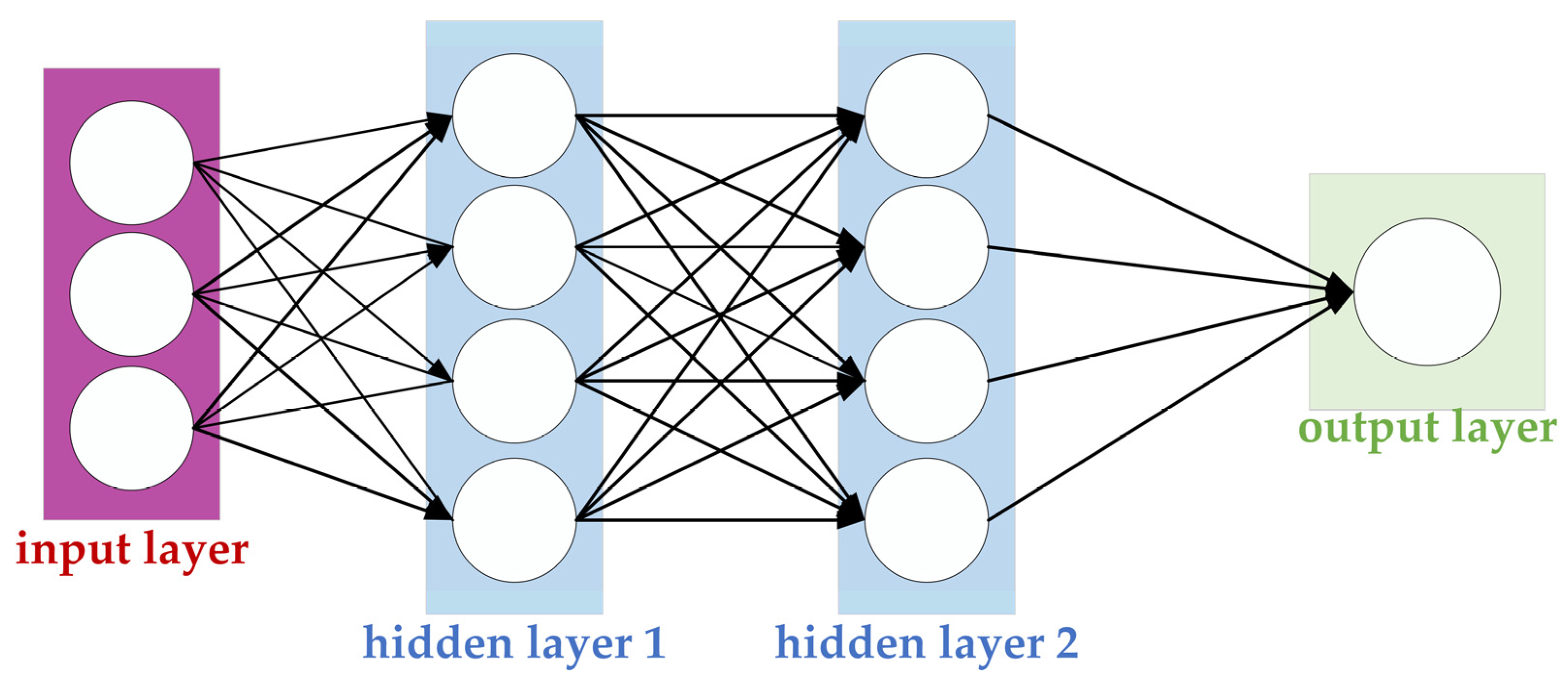
Wu et al. [21] proposed a new fault diagnosis method based on the fault diagnosis method of expert system, took BPNN model as the benchmark learning model, and adopted genetic algorithm and least square method as the optimization algorithm. In this model, the knowledge function replaces the traditional cost function, which is modified for each individual and the prediction results, and the improved method greatly improves the accuracy of diagnosis. Peter et al. [22] used artificial neural networks for fault detection, classification and fault localization in hybrid microgrids with islanded operation. MATLAB software was used to generate fault voltage and current datasets from the experimental model and the trained artificial neural network model was tested for 11 types of faults and no-fault scenarios using mean square error (MSE), regression plots, and receiver operating characteristics ( ROC) to evaluate the performance of the neural network model.
The neural network fault diagnosis model is mainly based on radial basis function and BP (back propagation) algorithm which has the following advantages.
- Information is stored independently and has good fault tolerance [23].
- Knowledge is contained in the connection weights, self-organization as well as self-learning ability and also some generalization ability.
- Relatively independent computation between neurons, high parallelism.
- Good memory and high robustness.
The main problems in applying neural networks are; the need for a large number of typical samples for training and long training time, and for new systems, re-training [24]; the ability to give only numerical results between 0 and 1, and lack of the ability to interpret the results; the inability to provide information to help the operator to diagnose the components of the malfunction; and the difficulty of modeling for the complex power transmission network.
In recent years, due to the advantages of neural networks such as powerful self-learning ability, good robustness and high fault tolerance, the theoretical research in the areas of grid partition diagnosis and component-oriented diagnosis has made great progress, but its practical application process is still progressing slowly. The problems to be faced at this stage are as follows:
- How to solve the problem of obtaining high-quality and complete samples for the training of neural networks in engineering practice;
- How to improve the ability of neural networks to interpret the diagnostic results;
- How to design the neural network diagnostic module so that it is more suitable for the grid fault diagnosis system. These are the problems we need to focus on.
3.3.3. Bayesian Network
Bayesian network is a model to represent and infer uncertain knowledge by combining graph theory and probabilistic theory, with a strict probabilistic theoretical foundation, in which the network flow graph is used to express the knowledge, and the probabilistic theory shows the influence between different knowledge. Bayesian network can describe the faults intuitively and clearly, and can better realize the diagnostic decision in the case of uncertainty and incompleteness of alarm information. With the application of Bayesian network in power grid fault diagnosis, its advantages are gradually highlighted, but Bayesian network needs to obtain effective prior probability to ensure the accuracy of the results in practical applications, so Bayesian network has better results for single fault diagnosis, and complex faults due to some difficulties in obtaining prior probability, Bayesian network is less applied to complex network fault diagnosis [25].
Yang et al. [26] proposed a transmission network fault diagnosis method that combines a simplified Bayesian network with a fault decision table. Using the information from the SCADA system, a fault region identification method was proposed.In the fault region, a simplified Bayesian network was built to correlate the components with the circuit breakers, and finally, by comparing the localized fault decision table, the components, circuit breakers, and protection devices were Fault states are diagnosed. Li et al. [27] established a component-oriented Bayesian model for power system fault diagnosis, which identifies faults by comparing the protection action and circuit breaker action to see if they conform to the normal fault handling pattern. The new Bayesian network structure reflects the operation of circuit breakers and protections in a more direct way, which retains the fault tolerance of the traditional Bayesian model and enhances the versatility of the model.
In the actual power grid fault diagnosis, the fault diagnosis system based on Bayesian network still has the following problems to be improved:
- How to model a power grid with complex topology and large scale while ensuring that the modeling difficulty is not too great and the correlation information between devices is not missing;
- How to obtain the prior probability more easily in practical engineering, which is of great significance to ensure the accuracy of fault diagnosis;
- How to combine other intelligent diagnosis methods with Bayesian network diagnosis model to enhance the robustness of Bayesian network.
3.3.4. Petri Net
Petri Net was proposed by German professor Carl Adam Petri in the 1960s. In 1992, Indian scholars Jenkensel and Khincha applied Petri net to the field of power grid faults. Petri net uses graphics for intuitive representation, which can clearly represent the internal functional relations of the system. In the field of power grid fault diagnosis, Petri net, as a weighted directed network, can not only deduce the interconnection relationship between protection, circuit breaker and various components through mathematical calculation, but also visually explain the topology structure of power grid in the form of graphics. The power grid fault diagnosis technology based on Petri net has a fast diagnosis speed, and the results of fault diagnosis can be visually expressed through graphics. However, when the topology of the power network is complex and the operation bit dimension is high, it is difficult for the Petri net model to get the diagnosis results quickly and accurately. At the same time, when the power grid structure changes, due to the poor generalization ability of Petri net, it is difficult to cope with the changed power grid structure, and then it is difficult to make timely response and accurate diagnosis of power grid faults. In the absence of critical fault information, the fault tolerance rate of Petri net model will be greatly reduced. With the continuous progress of intelligent diagnosis technology, many improved Petri net models have been proposed by domestic and foreign scholars in recent years. By improving the shortcomings of the original Petri net, it is expected to obtain better diagnostic results.
Tong et al. [28] introduced the fuzzy set theory into the Petri net fault diagnosis model, and realized the structural simplification of the detected fault model by establishing hierarchical fuzzy Petri nets for the bus and other branch lines respectively. At the same time, according to the time-sequence constrained cross-check method, it can still rely on the time-sequence analysis to find the fault components in the case of multiple faults or missing key information. Binh et al [29] creatively proposed neural Petri network (NPN) and fuzzy neural Petri network (FNPN) by introducing neural networks and fuzzy techniques into Petri nets through continuous improvement of Petri nets. Compared with the traditional Petri net diagnostic method, the new method can use fewer parameters to diagnose, reduce the overall computational complexity, and greatly improve the diagnostic speed. Xie et al. [30] assigned different colors to different devices such as components, protection and circuit breakers, and expressed the relationship between devices through colors, thus simplifying the complexity of the fault model, reducing the dimension of the operation, and making the modeling easier. Xie et al. [31] established various protection subnets and diagnostic subnets by various components in the power grid, and carried out hierarchical modeling of the fault model, which enabled Petri net to adapt to changes in the topology of the power grid and improved the generalization and versatility of Petri net.
Compared with the traditional Petri net, the improved Petri net solves the existing defects of the traditional Petri net, and can be applied to the engineering practice better. The diagnostic accuracy of Petri Net is improved by introducing the information of electricity volume and timing. However, there are still the following shortcomings.
- How to prevent the phenomenon of "information explosion" caused by the growing topology of the power grid system;
- How to maintain the accuracy of diagnosis under the condition of missing critical fault information or protection and false positive information of circuit breaker;
- How to simplify the modeling process and model the fault system more accurately and efficiently? How to apply the research results to practice better is the key direction to explore.
4. Challenges and Future Trends
4.1. Challenges
With the continuous expansion of the power grid scale and the continuous development of computer technology, mathematical intelligent algorithms, communication and network technology, etc., new methods will continuously emerge in the field of power grid fault diagnosis [32], but the following major problems still exist in the power grid fault diagnosis technology:
- Low accuracy in dealing with uncertain and incomplete information, until now there is still no clear solution given for this problem;
- The application of intelligent methods of fault diagnosis has its own limitations and defects, and most of the fault diagnosis is still based on only one diagnostic method in practical application;
- Changes in the operation mode and structure of power grids have a very great influence on the results of power grid diagnosis;
- Research on the practicalization of grid fault diagnosis is still lacking, most of them stay in the theory and model stage [33], and are not sufficiently integrated with the actual practice, especially the shaped practical system, which has not been developed much so far.
4.2. Future Trends
In order to allow further development of grid fault diagnosis techniques, future work should focus on the following four areas:
- (1)
- Research on fault diagnosis methods when information is missing. Some of the current fault diagnosis methods are carried out in the case of error-free information, without considering the case of errors in the process of information transmission, however, protection refusal and false activation are inevitable, and it is difficult to ensure that the information is completely correct because the information channel is susceptible to interference by communication equipment. In fact, if all the protection or circuit breaker status information is uploaded to the dispatch center, it will face the problem of cost and wiring, and the dispatch centers in many developing countries do not have a perfect relay protection information system. As a result, many hypothetical fault information does not have an incorrect diagnostic method, in which case the correct diagnosis cannot be made, and further hypothetical premises need to be provided, which is not very realistic. As of now, there is still no perfect solution to the problem of power system fault diagnosis in the case of incomplete relay protection information, which is one of the main problems to be solved in the field of power system fault diagnosis.
- (2)
- Research on fault diagnosis methods that integrate various different intelligent technologies [34]. As can be seen from the previous diagnostic methods, the use of a single diagnostic method is only able to solve some specific problems, the diagnostic performance needs to be improved, and it is not possible to effectively solve all the difficult problems faced by the grid fault diagnosis, and even some of the diagnostic methods introduce new problems. Therefore, the integration of multiple intelligent diagnostic methods has a bright development prospect. Therefore, always pay attention to the development in the field of intelligent science, and introduce these cutting-edge science and technology into grid fault diagnosis when appropriate, such as random set theory, data mining, rough set theory and imprecise probability, etc., which will surely broaden the way for the diagnosis field in the future. Based on the present research results, taking the essence and removing the dregs, using a variety of intelligent technologies for integration is a research direction that deserves attention.
- (3)
- Practical research on power system fault diagnosis. Although fault diagnosis has a long history of research, but also significant results, but still can not fully meet the needs of the theory to the actual transition is not ideal. Now the need to further promote the scientific research institutions and related power companies to join forces, so that better carry out the practical research of power grid fault diagnosis. Combined with the actual situation of the power system, the collection and sorting of fault information is an important task, including the construction of database, the preprocessing of fault information and the elimination of redundant data. In the practical application to find out the problem, to take intelligent methods of diagnosis and analysis, to provide auxiliary analysis and decision-making means for electric power staff.
5. Conclusions
Grid fault diagnosis technology is an important technology to quickly diagnose the cause of faults in the grid system after a fault occurs, and assist dispatchers and maintenance personnel to restore power supply as soon as possible. Accompanied by the continuous expansion of the grid construction scale, distributed power supply access to the distribution network makes the grid topology more complex, grid faults present diverse, a single diagnostic method is difficult to meet the demand for fault diagnosis in the actual project. Grid fault diagnosis technology after decades of rapid development, a variety of intelligent methods combined with the grid fault diagnosis method has become the mainstream trend, the field of research has also achieved fruitful results. This paper summarizes the multiple intelligent methods involved in distributed photovoltaic grid-connected fault diagnosis at this stage, and at the same time finds the practical problems faced by grid fault diagnosis, and points out the shortcomings of various methods, clarifies the main problems and development trends in the field of fault diagnosis, and provides certain theoretical references for the study of grid fault diagnosis technology. This is of guiding significance to the construction of power system fault diagnosis intelligent auxiliary decision-making system, which is of great theoretical and practical significance to ensure the safe operation of the power system and reduce the occurrence of accidents and economic losses.
Author Contributions
Conceptualization, W.Q. and Y.Z.; methodology, Y.Z.; investigation, Y.Z; resources, W.Q.; writing—original draft preparation, Y.Z.; writing—review and editing, W.Q.; supervision, W.Q.; project administration, Y.Z.; All authors have read and agreed to the published version of the manuscript.
Funding
This research was funded by Fund project of Beijing Education Commission: Key technology research on intelligent operation and maintenance of Big data for power distribution, grant number 110052972027/067.
Institutional Review Board Statement
Not applicable.
Data Availability Statement
Not available.
Conflicts of Interest
The authors declare no conflict of interest.
References
- Wu, Z.; Zou, Y.; Zheng, F.; Liang, N. Research on Optimal Scheduling Strategy of Microgrid Considering Electric Vehicle Access. Symmetry 2023, 15, 1993. [CrossRef]
- Jia, K.; Yang, B.; Bi, T.; Zheng, L. An Improved Sparse-Measurement Based Fault Location Technology for Distribution Networks. IEEE Trans. Ind. Inform. 2020, 17, 1712-1720. [CrossRef]
- Azeroual, M.; Boujoudar, Y.; Bhagat, K.; El Iysaouy; et al. Fault location and detection techniques in power distribution systems with distributed generation: Kenitra City (Morocco) as a case study. Electr. Power Syst. Res. 2022, 209, 108026. [CrossRef]
- Vavilapalli, S.; Padmanaban, S.; Subramaniam, U.; Mihet-Popa, L. Power Balancing Control for Grid Energy Storage System in Photovoltaic Applications—Real Time Digital Simulation Implementation. Energies 2017, 10, 928. [CrossRef]
- Ullah, K.; Ishaq, M.; Tchier, F.; Ahmad, H.; Ahmad, Z. Fuzzy-based maximum power point tracking (MPPT) control system for photovoltaic power generation system. Results Eng. 2023, 20, 101466. [CrossRef]
- Bindi, M.; Piccirilli, M.C.; Luchetta, A.; Grasso, F. A Comprehensive Review of Fault Diagnosis and Prognosis Techniques in High Voltage and Medium Voltage Electrical Power Lines. Energies 2023, 16, 7317. [CrossRef]
- Nian, H; Kong, L. Review on Fault Protection Technologies of DC Microgrid. High Voltage Engineering, 2020, 46, 2241-2254. [CrossRef]
- Monadi, M.; Koch-Ciobotaru, C.; Luna, A.; Candela, J.I.; Rodriguez, P. A protection strategy for fault detection and location for multi-terminal MVDC distribution systems with renewable energy systems. In 2014 international conference on renewable energy research and application (ICRERA), Milwaukee, WI, USA, 19-22 October 2014; pp. 496-501.
- Meghwani, A.; Srivastava, S. C.; Chakrabarti, S. A new protection scheme for DC microgrid using line current derivative. In 2015 IEEE Power & Energy Society General Meeting, Denver, CO, USA, 26-30 July 2015; pp. 1-5.
- Liao, X.; Yu, S.; Zhang, L.; Feng, X.; Wang, X. A novel fault diagnosis method for power grid based on graph Fourier transform. Front. Energy Res. 2023, 10, 1020687. [CrossRef]
- Yeap, Y.M.; Geddada, N.; Satpathi, K.; Ukil, A. Time- and frequency-domain fault detection in a VSC-interfaced experimental DC test system. IEEE Trans. Ind. Inform. 2018, 14, 4353-4364. [CrossRef]
- Ranjbar,S.; Farsa, A.R.; Jamali, S. Voltage-based protection of microgrids using decision tree algorithms. Int. Trans. Electr. Energy Syst. 2020, 30, e12274. [CrossRef]
- You, J.; Zhang, D.; Gong, Q.; Zhu, J.; Tang, H.; Deng, W.; Kang, T. Fault phase selection method of distribution network based on wavelet singular entropy and DBN. In 2022 China International Conference on Electricity Distribution (CICED), Changsha, China, 7-8 September 2022; pp. 1742-1747.
- Moreno, J.G.; Perez, F.E.; Orduna, E.A. Protection functions for distribution networks with distributed generation applying wavelet transform. In 2012 Sixth IEEE/PES Transmission and Distribution: Latin America Conference and Exposition (T&D-LA), Montevideo, Uruguay, 3-5 September 2012; pp. 1-5.
- Dwivedi, U.D.; Singh, S.N.; Srivastava, S.C. A wavelet based approach for classification and location of faults in distribution systems. In 2008 Annual IEEE India Conference, Kanpur, India, 11-13 December 2008; pp. 488-493.
- Deng, G; Zhao, D; Zhang, X. Research of informations identification on the fault diagnosis system for regional power grid. Power System Protection and Control, 2009, 37, 50-54. [CrossRef]
- Sekine, Y.; Akimoto, Y.; Kunugi, M.; Fukui, C.; Fukui, S. Fault diagnosis of power systems. Proc. IEEE 1992, 80, 673-683. [CrossRef]
- Jiang, X.; Wang, D.; Ning, Y.; Zhang, C. Query Method for Optimal Diagnosis of Power System Faults. High Voltage Engineering, 2017, 43, 1311-1316. [CrossRef]
- Reshmila, S.; Devanathan, R. Diagnosis of power system failures using observer based discrete event system. In 2016 IEEE First International Conference on Control, Measurement and Instrumentation (CMI), Kolkata, India, 8-10 January 2016; pp. 131-135.
- Liu, Q.; Xia, D. Expert System Of Power System Fault Diagnosis Based On Forward And Backward Reasoning. Power System Technology, 1999, 23, 66-68. [CrossRef]
- Wu, Q.; Zhang, H. A Novel Expertise-Guided Machine Learning Model for Internal Fault State Diagnosis of Power Transformers. Sustainability 2019, 11, 1562. [CrossRef]
- Peter, N.; Gupta, P.; Goel, N. Fault Detection and Identification of Fault location in Hybrid Microgrid using Artificial Neural Network, In 2023 10th International Conference on Signal Processing and Integrated Networks (SPIN), Noida, India, 23-24 March 2023; pp. 686-691.
- Thukaram, D.; Khincha, H.P.; Vijaynarasimha, H.P. Artificial neural network and support vector machine approach for locating faults in radial distribution systems. IEEE Trans. Power Deliv. 2005. 20, 710-721. [CrossRef]
- Hamza, Z. A Review of Bayesian Networks Applications for Electrical Systems. Recent. Adv. Electr. Electron. Eng. 2022, 15, 93-103. [CrossRef]
- Liu, Z.; Hu, Y.; Zhang, X. Research review on intelligent fault diagnosis technology of power grid. Journal of Nanjing Normal University(Natural Science Edition), 2019, 42, 138-144. [CrossRef]
- Yang, Q.; Yang, X.; Zhu, X.; Xiang, B.; Tian, F.; Yi, J. A Fault Diagnosis Method of Transmission Network Based on Bayesian Network and Fault Decision Table, In 2020 5th Asia Conference on Power and Electrical Engineering (ACPEE), Chengdu, China, 4-7 June 2020; pp. 42-46.
- Li, G.; Wu, H.; Wang, F. Bayesian network approach based on fault isolation for power system fault diagnosis, In 2014 International Conference on Power System Technology, Chengdu, China, 20-22 October 2014; pp. 601-606.
- Tong, X.; Xie, H.; Sun, M. Power system fault diagnosis model based on layered fuzzy petri net considering temporal constraint checking. Automation of Electric Power Systems, 2013, 37 63-68. [CrossRef]
- Binh, P.T.T.; Tuyen, N.D. Fault diagnosis of power system using neural petri net and fuzzy neural petri net. In 2006 IEEE Power India Conference, New Delhi, India, 10-12 April 2006; pp. 5.
- Xie, M.; Wu, Y.; Huang, Z.; Liu, M. Identification of fault area in power system based on colored self-modifying Petri nets. Power System Protection and Control, 2016, 44, 56-64. [CrossRef]
- Xie, H.; Tong, X. A method of synthetical fault diagnosis for power system based on fuzzy hierarchical Petri net. Power System Technology, 2012, 36, 246-252. [CrossRef]
- Ibitoye, O.T.; Onibonoje, M.O; Dada, J.O. Machine Learning Based Techniques for Fault Detection in Power Distribution Grid: A Review, In 2022 3rd International Conference on Electrical Engineering and Informatics (ICon EEI), Pekanbaru, Indonesia, 19-20 October 2022; pp. 104-107.
- Cao, L; Sun, R; Chang, Z; Gai, D. Summary and Development Trend of Diagnostic Methods for Power Grid Faults. Control and Instruments in Chemical Industry, 2020, 47, 465-470. [CrossRef]
- Nsaif, Y.M.; Lipu, M.H.; Ayob, A.; Yusof, Y.; Hussain, A. Fault Detection and Protection Schemes for Distributed Generation Integrated to Distribution Network: Challenges and Suggestions. IEEE Access, 2021, 9, 142693-142717. [CrossRef]
Figure 1.
Block diagram of PV grid-connected main circuit and its control system.
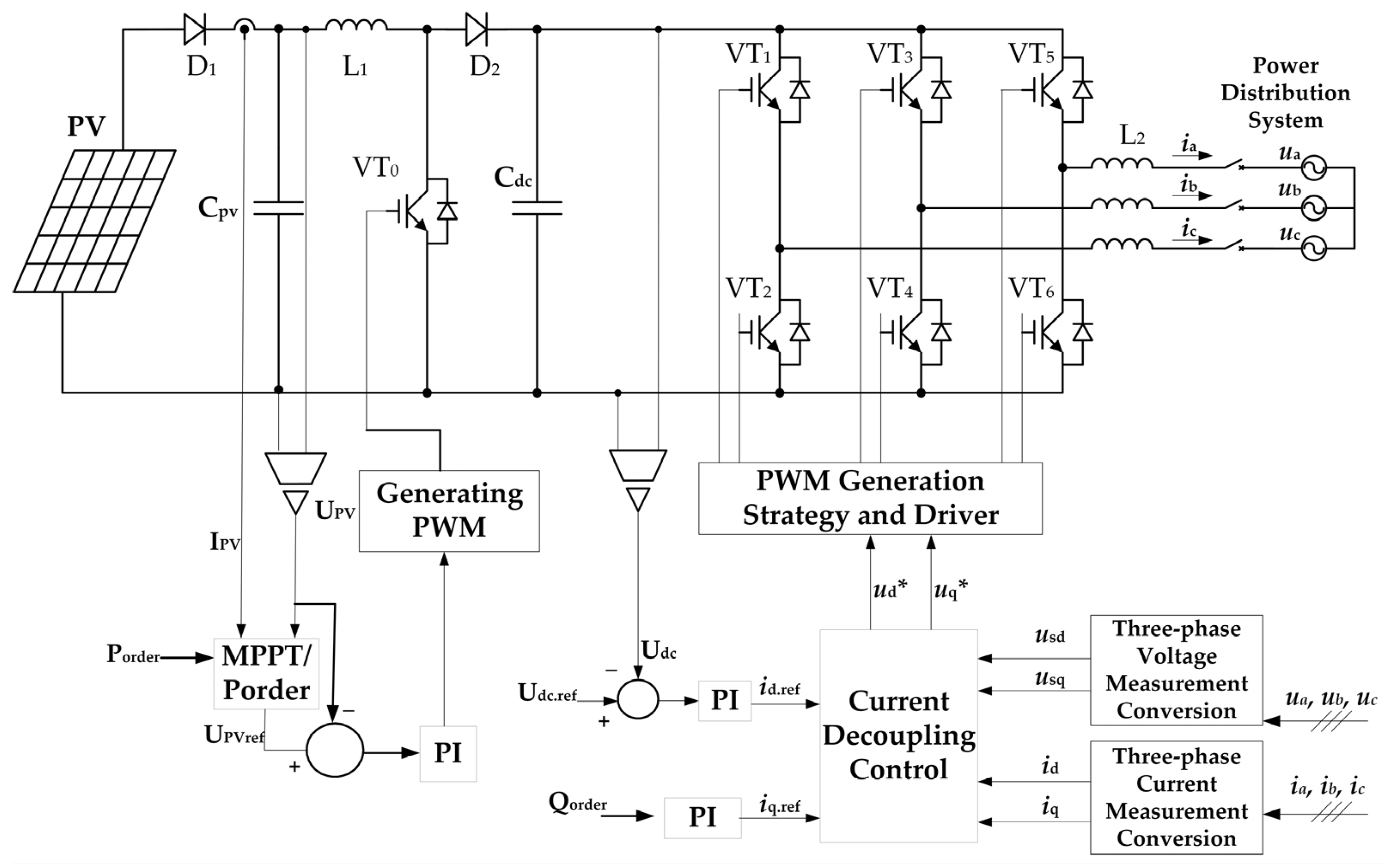
Figure 2.
Schematic diagram of expert decision system.
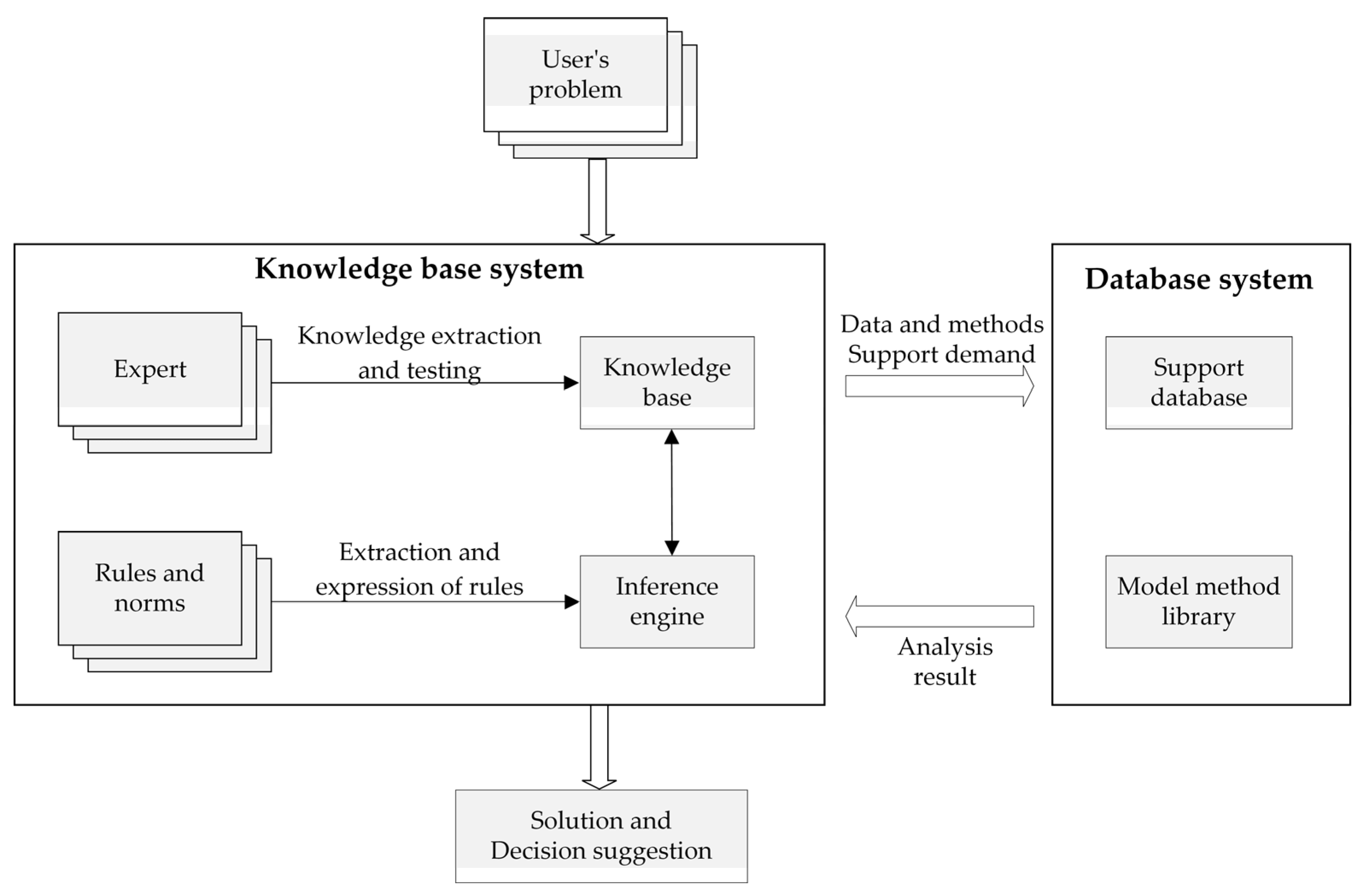

Table 1.
Comparison of advantages and disadvantages of intelligent diagnostic methods.
| Techniques | Pros | Cons |
|---|---|---|
| Expert Systems |
|
|
| Artificial Neural Network |
|
|
| Bayesian Network |
|
|
| Petri Net |
|
|
Disclaimer/Publisher’s Note: The statements, opinions and data contained in all publications are solely those of the individual author(s) and contributor(s) and not of MDPI and/or the editor(s). MDPI and/or the editor(s) disclaim responsibility for any injury to people or property resulting from any ideas, methods, instructions or products referred to in the content. |
© 2024 by the authors. Licensee MDPI, Basel, Switzerland. This article is an open access article distributed under the terms and conditions of the Creative Commons Attribution (CC BY) license (http://creativecommons.org/licenses/by/4.0/).
Copyright: This open access article is published under a Creative Commons CC BY 4.0 license, which permit the free download, distribution, and reuse, provided that the author and preprint are cited in any reuse.