
Submitted:
21 February 2025
Posted:
24 February 2025
You are already at the latest version
Abstract
If we assume that: (a) The four fundamental forces of nature are independent waves without rest mass, and their speeds are constant in a vacuum, just like light. (b) Light or electromagnetic waves and gravity are comparable in structure. The weak and strong interials are similar in structure. (c) Light and the weak interaction have the same speed cL with spin number +1 or -1. (d) Gravity and the strong interaction have the same speed cG and the same single spin number. (e) The primary particles, namely electrons (or positrons), electron neutrinos, and dark neutrinos in this paper, are made of the above four waves. We can find and describe some fundamental characteristics of the primary particles (e.g., their sizes, energies, and interactions) and introduce new attractive results from them (e.g., the source of the Pauli exclusion principle, the solution of the Einstein-Podolsky-Rosen paradox, and cG slightly faster than cL).
Keywords:
1. Introduction
- a.
- Light or electromagnetic waves, the weak interaction, gravity, and the strong interaction are independent waves without rest mass. However, their structures are different.
- b.
- Light and gravity can be described by the wave Equation with the field strength Ê and speed c.
- c. The weak and strong interactions can be described by the 4-dimensional Laplace Equation with field strength Ê' and speed c'.
- d. According to the electroweak theory, light and the weak interaction have the same speed cL with spin number +1 or –1.
- e. Gravity and the strong interaction have the same speed cG without spin, and cG is constant in a vacuum.
- f. The primary particles, which are electrons, electron neutrinos, and dark neutrinos in this paper, are made of the four waves mentioned above.
- Light and the weak interaction couple together (hereafter referred to as the E-W couple) when they have the same spin number and the second-order partial derivatives of their fields with respect to time are equal. Gravity and the strong interaction also couple together (hereafter referred to as the G-S couple) when the second-order partial derivatives of their fields with respect to time are equal. So we have
- b. The original spins of the light and the weak interaction convert the polarity of the electric and weak charges when an E-W couple is formed.
- c. It makes a primary particle when two coupled waves attract each other and shrink to a tiny sphere. One E-W couple and one G-S couple produce an electron or a positron whose charge property depends on the original spin of the E-W couple. Dark neutrinos are composed of two G-S couples. Two E-W couples with different original spin compress themselves into an electron neutrino. But they cannot attract each other if they have the same original spin.
2. The Fields and Binding Energies
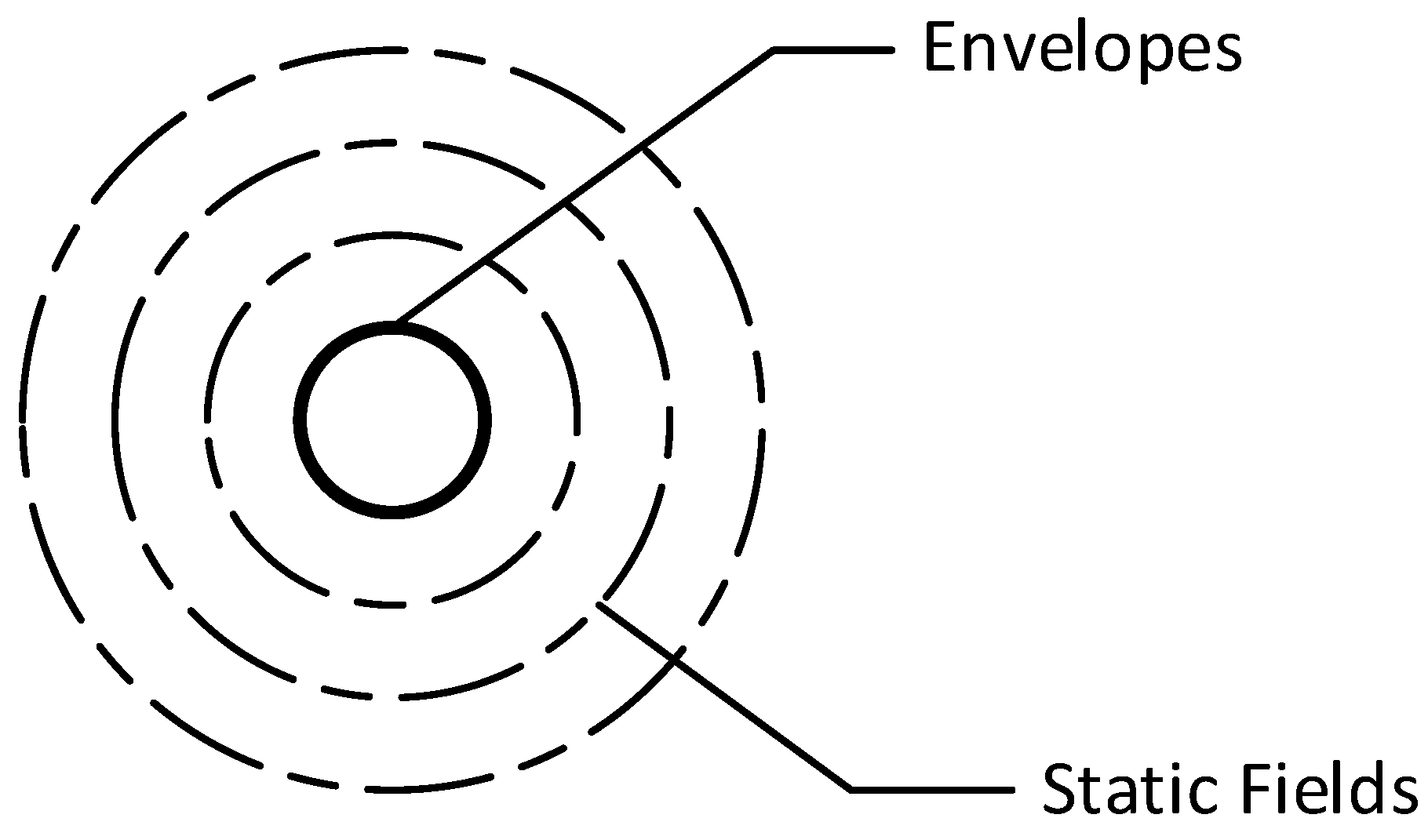
- The whole binding energy of the coupled waves concentrates on the envelopes.
- The macroscopic items of combined field strengths of the two coupled waves are equal on the envelopes. Outside the envelopes, the coupled waves become two independent static fields. But there are no fields inside the envelopes.
- The size of the envelope, that is the size of a primary particle, depends on the critical radius of the weak or strong interaction.
- The two envelopes have the same inherent frequency νin, although this is not mathematically required.
- The degree of the associated Legendre polynomials j is the same on the two envelopes.
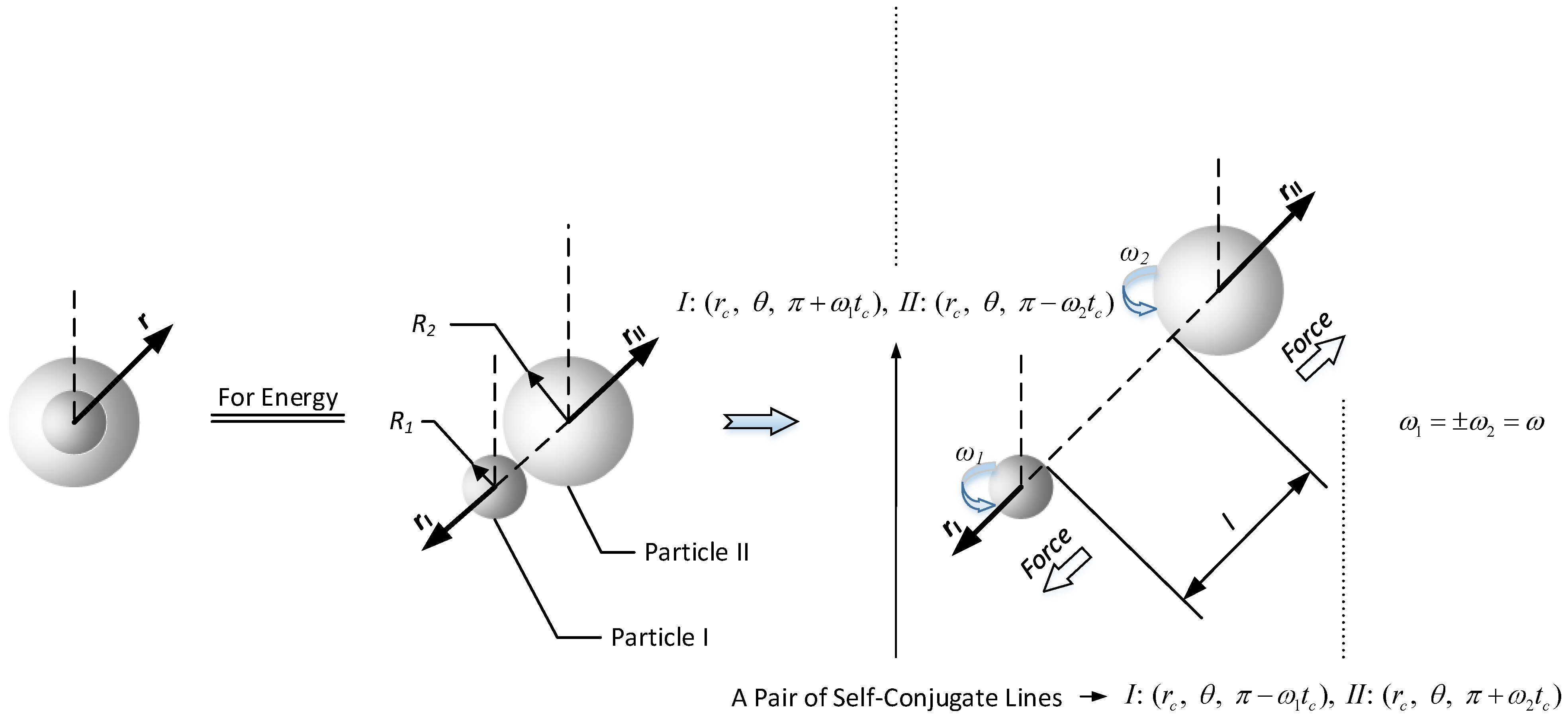
- The behaviors of the two envelopes obey the Self-Conjugate Mechanism, which requires that one occupies the surface of and the other must take up , or they are conjugate to each other.
2.1. An Electron Neutrino
- Its radius re_ν is equal to the critical radius of the weak interaction Rcw.
- The charges in Equations (9) and (11) are equal and minimal for an electron neutrino, i.e., , if and are the mathematical electric charge and the mathematical weak charge of an electron neutrino.
2.1. Dark Neutrinos
2.3. An Electron or A Positron
3. The Interactions Between Two Primary Particles
3.1. Two Particles of the Same Type
3.2. Two Particles of the Different Type
4. The Structure Values of Primary Particles
4. Conclusions and Discussion
- Two self-conjugate primary particles have potential energy or force when they rotate in opposite directions. However, they have zero potential energy or rest when they spin in the same direction. This is one of the foundations of the Pauli exclusion principle.
- Dark Is have the asymptotic freedom characteristic, but following the principle of energy minimization, there should be only Dark IIs in most cases.
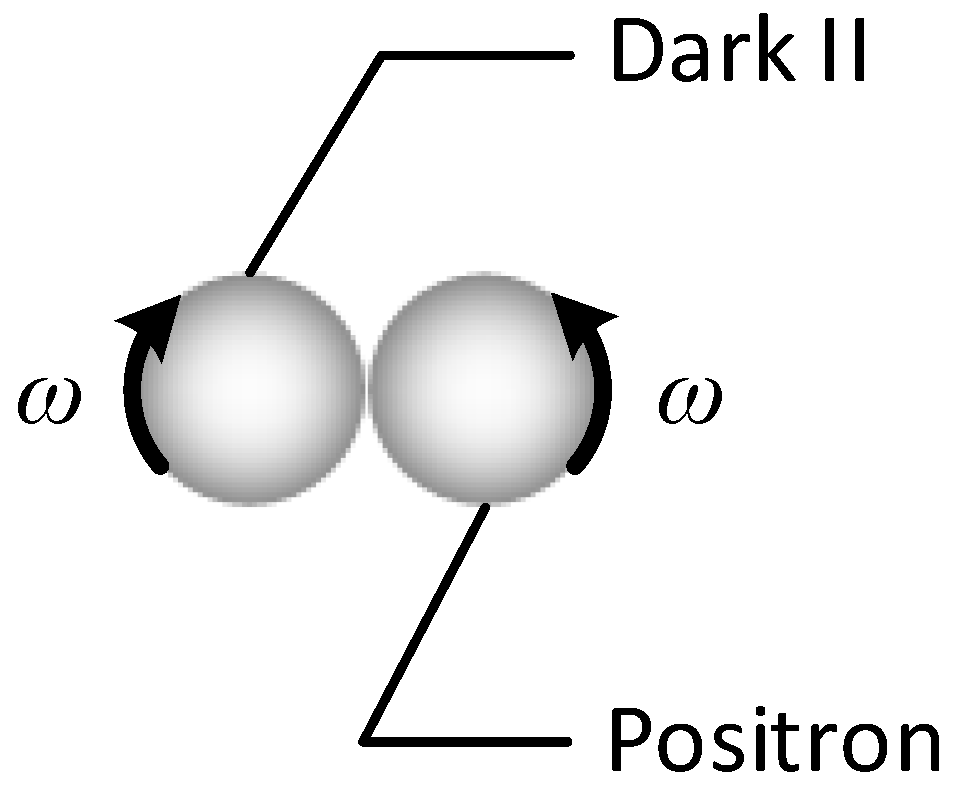
- The force between two electrons (or two positrons) or between an electron and a positron has two values, one large and one small, if the two electrons have potential energy or force. Not only an electron and a positron but also two electrons (or two positrons) can join together in the form of small force (or form E-P II).
- It is also random that two electron neutrinos or an electron neutrino and an electron (or a positron) attract or repel each other. Because of this, electron neutrinos are a weak destabilizer in the nucleus, and even though the binding energy of electron neutrinos is the smallest of the primary particles, no evidence of electron neutrino destruction has yet been found.
- Primary particles behave like perfect tiny spheres in terms of energies and interactions, but they also look like uneven minuscule spheres in external fields. Which is the reality of a primary particle? Observation or mathematics? The answer should be that "the Moon is always there, doesn't matter we see it or not", however, the Moon is changed when we see it.
References
- Russell Herman (2024). Introduction to Partial Differential Equations . LibreTexts. Section 6.5 Laplace’s Equation and Spherical Symmetry (https://math.libretexts.org/Bookshelves/Differential_Equations /Introduction_to_Partial_Differential_Equations _(Herman)).
- Weak interaction. https://en.wikipedia.org/wiki/Weak_interaction.
- weak interaction. https://www.britannica.com/science/weak-force.
- Strong interaction. https://en.wikipedia.org/wiki/Strong_interaction.
- strong force. https://www.britannica.com/science/strong-force.
- Associated Legendre polynomials. https://en.wikipedia.org/wiki/Associated_Legendre_polynomials.
- Fundamental constants of physics. https://physics.nist.gov/cuu/Constants/index.html.

| Particle Name | Binding Energy* (MeV) | Elementary Charge (e) | Spin | Radius* (fm) | Determinants of Radius |
| Electron/ Positron |
0.511 (Known quantity) | ±1 | Critical radius of the weak interaction Rcw | ||
| Electron Neutrino | N.A. | 0 | |||
| Dark I | 1st critical radius of the strong interaction RcS1 | ||||
| Dark II | 469 | 2nd critical radius of the strong interaction RcS2 |
Disclaimer/Publisher’s Note: The statements, opinions and data contained in all publications are solely those of the individual author(s) and contributor(s) and not of MDPI and/or the editor(s). MDPI and/or the editor(s) disclaim responsibility for any injury to people or property resulting from any ideas, methods, instructions or products referred to in the content. |
© 2025 by the authors. Licensee MDPI, Basel, Switzerland. This article is an open access article distributed under the terms and conditions of the Creative Commons Attribution (CC BY) license (http://creativecommons.org/licenses/by/4.0/).


