

Submitted:
08 January 2024
Posted:
09 January 2024
You are already at the latest version
Abstract
Tea infusions are the most consumed beverages in the world after water, their pleasant yet peculiar flavor profile drives consumer choice and acceptance and becomes a fundamental benchmark for industry. Any qualification method capable of objectifying the product's sensory features effectively supports industrial quality control laboratories guaranteeing high sample throughputs even without the human panel intervention. The current study presents an integrated analytical strategy acting as an Artificial Intelligence decision tool for black tea infusion aroma and taste blueprinting. Key markers validated by sensomics are accurately quantified in a wide dynamic range of concentrations. Thirteen key aromas are quantitatively assessed by standard addition with in-solution solid-phase microextraction sampling followed by GC-MS. On the other hand, nineteen key taste and quality markers are quantified by external standard calibration and LV-UV/DAD. The large dynamic range of concentration for sensory markers is reflected in the selection of seven high-quality teas from different geographical areas (Ceylon, Darjeeling Testa Valley and Castleton, Assam, Yunnan, Azores, and Kenya). The strategy acts as an AI smelling and taste machine predicting teas sensory features without the human panel intervention.
Keywords:
flavor blueprint
; black tea infusions
; sensomics-based-expert-system
; industrial quality control
; Artificial Intelligence sensing
; accurate flavor screening
1. Introduction
Tea plant has a great economic importance and, after water, tea infusions are the most consumed beverages in the world; they are prepared by hot water extraction of dried leaves from Camellia sinensis L. [1,2,3]. According to their manufacturing, teas can commercially be classified into three main categories: non-fermented (white and green teas), partially fermented (oolong and paochong teas), and fully fermented (black tea) [4,5]. Green and black teas are widespread in the world, while the other kinds of tea (white, yellow, and oolong) are mainly consumed in producing countries [6].
Tea is characterized by important physiological and potential health benefits [7,8,9,10] due to the presence of many bioactive chemical constituents. The chemical composition of the dried tea plant (green or black) includes primary metabolites such as proteins, free amino acids, carbohydrates, vitamins, minerals, and specialized metabolites, i.e. polyphenols, purine alkaloids (methyl xanthines and, above all, caffeine), chlorophyll, and other volatile and non-volatile compounds [1].
The peculiar combination of non-volatile solids extractable from tea leaves and the complex volatile fraction evokes tea’s characteristic flavor, which is fundamental in influencing its market value and consumer choices. It is well-known that the quality of food is not only guaranteed by its safety and health properties but a significant role is played by its hedonic profile, especially flavor, and appearance [11,12,13,14,15,16,17,18,19,20].
Tea flavor has represented an intriguing research topic since the 1930s [5] and still today this area of investigation is active. The increase in the industrial production of ready-to-drink beverages requires an in-depth knowledge of the quality of raw materials (traceability, and flavor features) to obtain products with excellent yet benchmarked flavor.
The literature reports several studies focused on compounds responsible for the characteristic flavor of teas differing for geographical provenience/botanical variety. In 2006, Schuh and Schieberle [21] applied the molecular sensory science approach, nowadays referred to as sensomics, to identify and quantify key aroma compounds in the infusion prepared from Darjeeling (India) black teas. The approach includes solvent-assisted flavor evaporation (SAFE) followed by gas chromatography-olfactometry (GC-O) with aroma extract dilution analysis (AEDA) to identify potent odorants and their odor qualities. By stable isotope dilution assay (SIDA) accurate quantitative determination of odorants highlights those exceeding the odor threshold (OT) in the sample thereby indicating how to reconstruct an aroma recombinate that evokes the unique and distinctive aroma identity (aroma blueprint) of the product [22]. The authors identified a total of 42 impacting odorants both in the leaves and in the resulting infusions with some quantitative differences. Among 16 character impact odorants, terpenes alcohols (geraniol and linalool), Strecker aldehydes (2-methyl propanal, 2- and 3-methyl butanal), carotenoids derivates (β-damascenone), significantly increased their concentration after the infusion process.
A similar analytical procedure was adopted by Scharbert and co-workers [23] to identify the key molecules generating the taste perception after tea infusion consumption. Their studies on Darjeeling tea revealed as the main contributors to the astringent taste perceived upon black tea consumption a series of compounds belonging to the flavonoids class, i.e. flavan-3-ol glycosides. Borse et al. [24] investigated the characteristic distribution of volatiles and non-volatiles in black teas originating from different regions of India (Darjeeling, Assam, Nilgiris, etc.). In that study, tea chemical fingerprints were identified by associating physicochemical assays, spectrophotometric and liquid chromatography (LC) analyses for the determination of flavonoids and caffeine, while simultaneous distillation-extraction (SDE) followed by GC coupled to mass spectrometry (MS) were used to map the volatile fraction. In particular, 25 volatile flavor compounds were demonstrated to be diagnostic in discriminating Indian tea samples from the others.
In 2008, Wang and co-workers [25] profiled 56 teas with different degrees of fermentation (green, oolong, and black teas) using LC and head-space solid phase micro-extraction (HS-SPME) followed by gas chromatography-mass spectrometry (GC-MS). They found that neither the total nor individual catechins content was different in green and oolong teas among the investigated samples while the post-harvest process (fermentation) was responsible for major differences in volatiles distribution. Within the volatiles, five components [(E)-2-hexenal, benzaldehyde, 6-methyl-5-hepten-2-one, methyl salicylate, and indole) were able to discriminate unfermented and fermented teas, while (E)-2-hexenal and methyl salicylate together supplied an index to differentiate semi- and fully-fermented teas. Special teas (e.g., Chinese green tea Jingshan cha and Longjing) were recently investigated for aroma blueprinting by sensomic principles [26,27] posing the basis of a new concept/methodology termed sensomic-based-expert-system (SEBES) [28].
The methodological approach SEBES is capable of “characterize key food odorants with one single analytical platform and without using the human olfactory system, that is, by artificial intelligence smelling” [28]. The SEBES is capable of identifying the set of key food odorants (KFO) in a product and by combining OTs with quantitative data, the OAVs are automatically estimated and aroma features are predicted with great accuracy. This way the food odor code is “defined without using the human olfactory system” [28]. This application of Artificial Intelligence (AI) to food sensory properties is intriguing yet attractive for the industry quality control (QC) where primary materials and finished products have to be benchmarked and compared to references.
In this study, the SEBES concept is developed, validated, and applied for aroma and taste (i.e., flavor) blueprinting of a selection of black tea infusions. To support the high throughput required by quality controls (QC), flavor and quality markers are quantitatively profiled by fully automated GC-MS and LC with ultra-violet diode-array (UV/DAD) avoiding time-consuming sample preparation. The strategy, if connoted by a suitable dynamic range and accuracy could support product quality assessment with a focus on flavor features avoiding human panel.
In particular, for the aroma blueprinting in-solution (IS) SPME-GC-MS is implemented with Standard Addition (SA) quantification while for taste blueprinting LC-UV/DAD is with external standard (ES) calibration of key-aromas and marker compounds [29]. The suitability of the AI tea flavor blueprinting is tested on a selection of commercial teas from all over the world.
2. Results and Discussion
The number of chemicals effectively contributing to the flavor of food (key aroma, key taste, and trigeminally active compounds) is relatively small, and complex analytical procedures are required to detect, identify, and quantify flavor-active components often occurring at very low concentrations (µg/L or below) in the final product. Concerning aroma-active compounds, the adoption of a suitable sampling technique is fundamental to obtaining a meaningful picture of components evoking the sensory identity and quality profile of the product [30]. In this respect, the so-called high concentration capacity sampling techniques (HCC) [3,31,32,33,34] are the elective route to achieve suitable selectivity, sensitivity, and quantification accuracy to provide high-throughput informative analysis in full automation. In a previous study, several HCC approaches were tested for their capability to efficiently and accurately delineate the aroma blueprint of black teas from Ceylon [3]. Of the tested techniques, HS-SPME-GC-MS resulted as the most suitable for in-solution sampling of key-aroma compounds providing the possibility of accurate quantification of analytes by standard addition (SA) and calibration [35].
About taste active and trigeminally active compounds, teas are characterized by a complex pattern of specialized metabolites belonging to flavonoids and methyl xanthines classes which are responsible for taste and trigeminal sensations. In particular, caffeine is responsible for bitterness while glycosidic derivates of flavonols (quercetin, myricetin, and kaempferol) are the most taste-active analytes imparting a mouth-drying and velvety-like astringency. In addition, an important role in defining tea quality (dried plant and related infusion) is also played by flavan-3-ols which exert a minor but not negligible contribution on overall tea astringency perception. Depending on their concentration, flavan-3-ols (catechins) and dimeric derivates (theaflavins) evoke a puckering astringency and rough oral sensation [36].
The following sections present and critically discuss the experimental results on the quali-quantitative profiling of the most potent flavor components of selected teas after standardized infusion according to the EMA/HMPC/283630/2012 Committee on Herbal Medicinal Products (HMPC) protocol. Teas were all fermented (i.e., black teas) and were from Ceylon (Flowery Orange Pekoe – FOP), from India (Assam, Darjeeling Testa Valley, Darjeeling Castleton), Portugal (Azores), China (Yunnan), and Kenya.
2.1. Tea infusion volatiles profiling by IS-SPME-GC-MS
As a first step, GC-MS analyses acquired in full-scan mode enabled a comprehensive mapping of the volatile fraction of tea infusions. Volatiles were reliably identified by their EI-MS fragmentation patterns, compared to those present in commercial libraries (Wiley [37] and NIST 2014 [38]). Acceptability criteria for putative identification were direct match factor (DMF) > 900; linear ITs tolerance ±5 units. When available pure reference compound confirmation was done. Table 1 reports the list of 44 volatile marker compounds together with their retention times, experimental ITS, odor descriptors, and presence in analyzed samples. Although the number of detected and reliably identified volatiles was lower if compared to the GC×GC methodology [2,3] adopted in previous investigations, the proposed strategy by IS-SPME-GC-MS allowed for efficiently mapping the most relevant markers carrying information about tea aroma profile, plant origin, and manufacturing practices.
Results on the volatiles profiling showed a different distribution of analytes within the selected samples, Ceylon and Darjeeling Testa Valley (India) were characterized by a more complex volatile fraction, showing a matching of 42 detected analytes over 44 targets. The same outcome cannot be observed with the other teas from Darjeeling (Castleton) where only 26 volatiles were detected, demonstrating how different tea gardens, located in the same country, lead to distinctive products. On the other hand, tea samples from Azores (Portugal) and Yunnan (China) showed a less complex fraction of volatiles, also in terms of key aroma compounds distribution; indeed, within all identified analytes, only 15 compounds were mapped in Azores tea and 23 in Yunnan tea.
Qualitative profiling results show that some volatiles are ubiquitous in all tea infusions, although quantitative differences deserve some comments. Of those detected in all samples, Strecker aldehydes (2-methyl butanal and 3-methyl butanal) and volatile terpenes (linalool and its related 3,6-oxides, and geraniol) are the most relevant in the aroma definition. Phenyl propanoid derivates, a group of characteristic components in tea, followed a slightly different behavior; phenylacetaldehyde and benzaldehyde were detected in all samples, while benzyl alcohol and 2-phenyl alcohol were present only in some products (both for Ceylon and Darjeeling T.V, benzyl alcohol in Assam tea, the others in tea from Kenya). Within the entire set of volatiles, an important role is played by saturated and unsaturated aldehydes which originate from the oxidation of fatty acids and contribute to defining the aroma of tea infusions. In this case, it is interesting to point out that some short-chain linear aldehydes (hexanal, heptanal) are present in all infusions while unsaturated C7-C10 aldehydes have characteristic patterns in Ceylon, Assam, Darjeeling T.V. and Kenya samples.
The next step focused on key aroma quantitation by Standard Addition (SA), a well-established internal calibration approach suitable when the so-called matrix effect cannot be neglected and likely has an impact on method accuracy. Indeed, in the case of tea infusions, the release/behavior of volatiles is strictly influenced by their interaction with non-volatile components (e.g., polyphenols, alkaloids, organic acids, pigments). The next section introduces the SA procedure and quantitation results.
2.2. Key-aroma markers quantitation by Standard Addition (SA) and IS-SPME-GC-MS
The standard addition procedure, widely used as a quantitation approach, consists of a series of experiments in which the original sample and a suitable number (at least four concentration levels) of aliquots of the sample spiked with increasing and known amounts of reference compounds, are submitted to the analytical process.
When using the single addition method, the analyte concentration in the sample can be estimated from Equation (1):
where: W0 is the amount of analyte in the matrix, Wa the amount of analyte added to the sample, A0 the instrumental response obtained from analysis of the original sample, and A(0+a) the instrumental response of the analyte obtained from analysis of the spiked sample.
A preferable and more accurate procedure, which was applied in this study, includes multiple standard additions. With multiple SA a linear regression analysis evaluates the terms Wa and A(0+a) therefore the amount of analyte in the matrix (W0) is given by the ratio between the intercept and the slope, Eq. (2):
Standard addition is a quantitation approach that can be carried out in different ways: (a) by spiking the target analyte(s), in a gaseous state, into the sample headspace (gas phase addition - GPA); (b) by spiking the analyte(s) dissolved in a suitable solvent, directly onto the sample (sample phase addition - SPA) or (c) by spiking the stable-isotope-labeled analyte(s) dissolved in a suitable solvent (stable isotope dilution analysis - SIDA) onto the sample. The present study adopted the SPA protocol, as being suitable for its ease of implementation and automation, and its cost-effectiveness compared to isotopically-labeled standards.
The analytical protocol, rationalized in the Experimental section, consisted of (a) three replicate infusions prepared from each tea sample; and (b) three standard addition levels for each infusion (plus the analysis of the original sample). Acetone was selected as a solvent for spiking solutions because it guaranteed full solubilization of all target analytes, being miscible with water. For each calibration step two analytical replicates were acquired.
Thirteen key odorants were accurately quantified: 3-methyl butanal, 2-methyl butanal, hexanal, (Z)-4-heptenal, phenyl acetaldehyde, linalool, (E,Z)-2,6-Nonadienal, (E)-2-nonenal, (E,E)-2,4-nonedienal, geraniol, (E,E)-2,4-decadienal, β-damascenone and β-ionone. They are listed in Supplementary Table 1 (ST1) together with chromatographic information on retention times (tR min), Target/Qualifier Ions m/z, calibration functions and determination coefficients (R2), precision and accuracy results. For the method’s performance parameters evaluation see the experimental section, section 3.9.
Table 2 lists quantitation results, obtained by SA calibration technique and IS-SPME-GC-MS (SIM) for key aromas in tea infusions. The results referred to Ceylon teas are reported as the mean value obtained from four commercial batches from the same harvest year. Data are expressed as µg/L in the infusion.
Experimental results are consistent with those obtained by Schuh and Schieberle [21] which adopted a more complex procedure for isolation and accurate quantification of potent odorants, i.e., SIDA and Solvent Assisted Flavour Evaporation (SAFE) followedby GC-ofactometry (GC-O) and aroma extract dilution assay AEDA).
An unsupervised multivariate approach (i.e. Principal Component Analysis – PCA) provides prompt information on samples’ natural clustering based on compositional similarities. Figure 1a shows the scores plot on the first and the second principal components (F1-F2 plane) obtained by analyzing the distribution of targeted odorants in all sample replicates. The first principal component (F1) explains 57.70% of the total variance (74.85%), contributing most to the discrimination of samples, while the second principal component (F2) has a minor informative influence (17.15%). Three main groupings (ellipses with dotted line) arbitrarily delineated by the authors can be observed in the scores plot of Figure 1a: from left to right with increasing F1 scores values the Darjeeling Castelton, Azores and Yunnan, followed by Assam, Ceylon and Kenya, and finally Darjeeling Testa Valley (TV) with higher scores values along F1. The distribution of variables as a function of the first two principal components is reported in the loadings plot of Figure 2b. Analytes providing the most information on the F1 axis, and likely more abundant in related infusions, directly correlate with Ceylon, Assam, Kenya, and Darjeeling TV teas.
Interestingly Darjeeling teas, although produced in the same region of India, showed distinctive yet different aroma-active compound patterns, with Darjeeling TV characterized by higher amounts of these analytes. On the other hand, teas from Ceylon, Assam, and Kenya were clustered together suggesting similar aroma features.
Experimental results indicate that the most potent odorants characterizing these kinds of tea are present in a wide range of concentration, to be specific 0-4 µg/L for (Z)-4-heptenal, (E,Z)-2,6-nonadienal, (E)-2-nonenal, (E,E)-2,4-nonadienal, (E,E)-2,4-decadienal, β-damascenone and β-ionone, while in the range 0-100 µg/L for hexanal, linalool, geraniol, phenyl acetaldehyde, 2 and 3-methyl butanal.
Darjeeling TV has a peculiar profile described by the flowery terpenes linalool (54.48 µg/L) and geraniol (24.83 µg/L), the green-grassy note from hexanal (63.49 µg/L) and fatty nuances likely modulated by unsaturated aldehydes (E)-2-nonenal and (E,E)-2,4-nonadienal. The commercial selection of Ceylon infusions are described by higher amounts of (Z)-4-heptenal (0.98 µg/L) and (E,Z)-2,6-nonadienal (0.56 µg/L). Other key volatiles such as phenylacetaldehyde, β-damascenone, and β-ionone play a role in defining the peculiar profile of Ceylon, Assam, Kenya, and Darjeeling TV.
Teas from Kenya and Assam are connoted by higher amounts of Strecker aldehydes 3-methyl butanal (49.12 µg/L for Assam and 84.89 µg/L for Kenya) and 2-methyl butanal (63.12 µg/L for Assam and 89.97 µg/L). Moreover, within the cluster of Ceylon, Assam and Kenya other major differences occur for β-ionone, more abundant in Ceylon (2.16 µg/L) and Kenya (1.92 µg/L).
In general, Azores, Yunnan, and Darjeeling Castleton showed a weaker profile of aroma-active analytes; in particular, many key odorants (unsaturated aldehydes and the nor-isoprenoids β-damascenone and β-ionone) were not detected and quantified in the related infusions. However, tea from the Azores showed a fairly high amount of Strecker aldehydes (3-methyl butanal, 2-methyl butanal 46.69 µg/L) which likely imparts malty notes.
Nevertheless, the great variability in the quantitative distribution of key-odorants does not necessarily lead to a meaningful characterisation of the selected samples for their sensory quality. Odorants, besides their intrinsic potency that is related to the binding with odor receptors (ORs), should be effectively released by the food matrix to reach the olfactory epithelium and trigger retronasal olfaction (i.e., aroma perception). The ratio between analyte’s concentration in the sample (i.e., tea infusion) and its odor threshold (OT, i.e., the lowest concentration of a compound that is just enough for the recognition of its odour [36]) in water provides a more realistic perspective of the overall aroma quality and odorants balancing. For this reason, the contribution of the analytes in the prediction of samples sensory profile is evaluated by applying the SEBES concept.
2.3. Aroma Blueprinting by AI smelling based on sensomics
As reported by Schieberle and co-workers in their studies on Darjeeling black tea (infusions and dried leaves) [21,36], a group of 24 odorants with high flavour dilution (FD) factors was recognized to play a prominent role in defining the characteristic aroma of the final infusion. Within these 24 chemicals, 16 were identified as having a high odor activity value (OAV), i.e., the ratio between the odorant concentration in the food vs. its odor threshold. It is commonly assumed that the higher the OAV value the higher its contribution to the overall sensory perception.
Among the most-odor-active compounds revealed by sensomics (16), i.e. those with OAV values ≥ 1 (value recognized to be significant in contributing to the flavor of food [41]), the current method reliably monitors 13 of them with a fully automatized procedure that avoids laborious sample-preparation steps. By IS-SPME-GC-MS it is realized an effective aroma blueprinting to support, or even replace, sensory panel evaluation in the perspective of quality benchmarking and quality controls.
About aroma features, the Strecker aldehydes formed during the fermentation process [1] (2-methyl butanal and 3-methyl butanal) concur to an intense malty perception while phenylacetaldehyde evokes a pleasant honey-like note. Responsible for floral notes are geraniol (rose-like) and β-ionone (violet-like), for fruity linalool and β-damascenone. An important contribution to the black tea aroma identity is provided also green and grassy notes of hexanal, (E)-2-nonenal, and (E,E)-2,4-nonadienal. Fatty perception is modulated by C9 unsaturated aldehydes while fishy notes are from [(Z)-4- heptenal] and fatty/fried by [(E,E)-2,4-decadienal]. All these aldehydes are formed from the enzyme-catalized oxidation of fatty acids during plant growth and manufacturing processes [40].
The aroma blueprint of the infusions is visualized as spider diagrams based on OAV values in a logarithmic scale (Figure 2). By this visualization for each compound the concentration is associated with the relative OT in water and the odor descriptor. The spider diagrams show that most tea samples have a specific aroma profile characterized by a well-balance of markers; in general teas from Ceylon, Assam, and Kenya likely have a similar aroma profile, especially for some notes such as fruity (β-damascenone), malty (Strecker aldehydes), honey-like (phenyl acetaldehyde), cucumber-like ((E,Z)-2,6-nonadienal). On the other hand, Assam infusion is characterized by a lower content of terpene derivates (geraniol and linalool) than the other teas, likely resulting in weaker citrus and rose-like notes. The aroma profile confirms the great diversity of samples from Darjeeling.
A very important outcome deriving from the calculation of OAVs consists in the explanation of the role played by each specific analyte in the definition of the aroma profile. Although present at very low concentrations (range 0-4 µg/L), some analytes such as β-damascenone, β-ionone, (Z)-4-heptenal, and (E,Z)-2,6-nonadienal are extremely potent being characterized by very low OTs (e.g. 0.004 µg/L for β-damascenone); as an example, β-damascenone generates the maximum OAV value of 94.8 in Darjeeling Testa Valley tea, where OAV values were higher also for other key-volatiles (i.e., linalool, 3-methyl butanal, and 2-methyl butanal). On the contrary, despite their high concentration in the beverage, hexanal and phenylacetaldehyde likely play a minor role in the definition of tea aroma as being less active as odorants (higher OTs, 10 and 6.3 µg/L respectively).
2.4. Taste active compounds and quality markers accurate quantitative profiling by LC-UV/DAD
Tea infusions were then profiled by LC-UV/DAD to quantitatively map non-volatiles responsible for taste and trigeminal perception and for quality features [8,29]. The analytical method was optimized and verified for the accurate quantification of 19 informative chemicals in a single analytical run. Analytes are listed in Table 3 together with taste threshold (TT) and average amounts (mg/L) from three replicate infusions for each sample. Analytical method figures of merit, including precision and accuracy are discussed in the Experimental section and detailed in Supplementary Table 1 (ST1) .
Principal Component Analysis was applied on the data matrix (quantitative results) of non-volatiles to evaluate the presence of natural clusters within selected samples. Figure 3a shows the scores plot on the first and the second principal components (F1-F2 plane); to note the variance explained by the first two components is quite high and similar to that resulted from key-aroma patterns shown in Figure 1a (58.55% F1, 20.10% F2, for a total variance of 78.65%). Moreover, sample clusters based on taste and quality markers distribution are similar to those shown in Figure 1a generated by volatiles patterns. Darjeeling Testa Valley is characterized by a fingerprint that drives its independent clustering; it is described by a peculiar pattern of flavan-3-ols (Figure 3b) such as epigallocatechingallate (EGCG), epigallocatechin (EGC), catechin (C) and epicatechingallate (ECG). Experimental results on Darjeeling black tea are consistent with those obtained by Scharbert and co-workers in 2004 [23]. Ceylon, Assam, and Kenya teas sub-classification is mostly driven by theaflavins and flavonol-3-o-glycosides. On the other hand, tea samples from Azores, Yunnan, and Darjeeling Castleton inversely correlate with these variables (weaker profiles).
The quantitative distribution of monitored will have an impact on their taste and trigeminal perception. Flavan-3-ols, originally present in tea leaves, can undergo substantial changes during post-harvest treatments (oxidative phenomena during fermentation) leading to the formation of high molecular weight dimeric (theaflavins) and oligomeric (thearubigins) derivates. For this reason, in fermented black tea, quantitative differences in flavan-3-ols and theaflavins can be ascribed to both the geographical origin and the technological processing. Conversely, the levels of flavonols and caffeine remain unchanged during tea manufacturing and thus, their variations are mostly influenced by the origin [3,40].
The high amount of flavan-3-ols but the low content of theaflavins in Darjeeling Testa Valley infusion suggests lower oxidation during post-harvest treatment which preserves the original amount of these analytes. On the other hand, teas from Ceylon, Assam, and Kenya due to the higher levels of dimeric analytes are likely more fermented. In addition, theaflavins are responsible for the characteristic dark orange-red color of black tea infusions, a piece of evidence that was confirmed by a visual inspection of the infusions. Indeed, teas from Darjeeling had a light yellow color due to the low concentration of these markers, in contrast with Ceylon tea. Tea from the Azores confirms to be characterized by a poor non-volatile fraction, for all compounds, suggesting a low astringency capacity.
Caffeine is present in similar concentrations in all samples (230-260 mg/L), with the only exception of Azores tea (143 mg/L); this outcome is probably related to the standardization of the infusion process (incomplete extraction), which does not allow its exhaustive extraction from the matrix.
2.5. Taste Blueprinting by AI tasting based on sensomics
In general, it can be assumed that the infusions with higher concentrations of flavan-3-ols and flavonol-3-o-glycosides (Ceylon and Darjeeling Testa Valley) are described by a more intense astringent sensation; however, to objectify the real contribution on the overall taste perception of the seven flavan-3-ols and the seven flavonol-3-o-glycosides, beyond the other markers, concentration data were associated with taste thresholds (Table 3).
Figure 4 visualizes as spider diagrams the dose over threshold (DoT, ratio of the concentration of each compound vs. its taste threshold) values, i.e., the taste blueprint profile of tea infusions. Key tastants are associated with their taste descriptors, e.g. bitter, p. (puckering) astringency, m.d/v (mouth drying/velvety) astringency.
Within the entire class of monitored polyphenols, flavonol-3-ol glycosides are the most relevant for the definition of the taste blueprint, evoking a strong mouth-drying and velvety-like sensation [23,42]. In particular, quercetin-3-o-rutinoside, known as rutin, is the most representative marker, followed by kaempferol-3-o-rutinoside and the other derivates of quercetin (glucoside and galactoside). Rutin likely has a strong influence on the taste profile (upper part of the spider diagrams) since it is characterized by DoT values of three orders of magnitude higher than those of flavan-3-ols (very low taste thresholds, e.g. from 0.0009 mg/L for rutin to 0.30 mg/L for glucosidic compounds of quercetin and kaempferol). In addition, an important although not primary role for taste perception is also played by flavan-3-ols, especially those esterified with gallic acid; epigallocatechingallate (EGCG) is the most abundant catechin present in black teas (85.35 mg/L in Ceylon infusion, 177.23 mg/L in Darjeeling Testa Valley tea) [14,21]. The bitterness of the beverage is mainly related to the high content of caffeine which however shows a low DoT value, being characterized by high TT.
As a final consideration, the higher the concentration of flavonoidic markers is, the more intense the astringency sensation after tea consumption is; this outcome can be expected for tea samples from Ceylon, Darjeeling T.V., Assam and Kenya.
3. Materials and Methods
3.1. Reference compounds and solvents
Pure reference compounds for odorants and key aromas identity confirmation and quantitation [(E)-2-nonenal, (E,E)-2,4-nonadienal, (E,E)-2,4-decadienal, 3-methyl butanal, 2-methyl butanal, hexanal, phenyl acetaldehyde, (Z)-4-heptenal, linalool, (E,Z)-2,6-nonadienal, β-damascenone, β-ionone, geraniol, phenyl acetaldehyde) and n-alkanes (n-C7 to n-C25) for (ITs) determination were from Merck (Milan, Italy).
Pure reference compounds for quantitative determination of key tastants and quality markers [(-)-epigallocatechin, (+)-catechin, (-)-epigallocatechingallate, (-)-epicatechin, (-)-gallocatechingallate, (-)-epicatechingallate, (-)-catechingallate, theaflavin, theaflavin-3-gallate, theaflavin-3’-gallate, and theaflavin-3,3’-digallate] were supplied by Merck.
Tea extract from black tea (≥ 80% theaflavins and theaflavin gallates-basis) used as a reference for the theaflavins external standard calibration, was purchased from Fluka Analytical. Reference standard compounds of myricetin-3-O-glucoside, myricetin-3-O-galactoside, quercetin-3-O-rutinoside (rutin), quercetin-3-O-galactoside, quercetin-3-O-glucoside, kaempferol-3-O-rutinoside, kaempferol-3-O-glucoside, and caffeine were supplied by Extrasynthese (Lyon, France).
Internal standardization (ISTD) for volatile compounds was with 1,4-dibromobenzene from Merck.
Solvents were all LC grade, from Merck: acetone (purity 99.5%), acetonitrile ACN (purity 99.9%), and methanol (purity 99.9%). Water used to prepare stock solutions, tea infusions, and LC mobile phases was obtained by a Milli-Q RG system (Millipore, Molsheim, France) in agreement with the ISO 9002 Quality Systems Standards.
3.2. Reference solutions and calibration mixtures
Standard stock solutions at 10 mg/mL, containing pure aroma reference compounds and ISTD, were prepared in acetone and stored in sealed vials at -18°C for a two weeks maximum. Standard spiking mixtures, adopted for quantification (Standard Addition SA procedure), were prepared by diluting standard stock solutions of each compound to different final concentrations in the range 5-500 ng/µL (5, 10, 25, 50, 100, 250, 500 ng/µL). The ISTF 1,4-dibromobenzene was added to all calibration solutions at 120 ng/µL.
For taste compounds, standard stock solutions were prepared in a water/ACN (9:1 v/v) mixture or methanol at the concentration of 1 mg/mL. Standard stock solutions were sealed and stored at -18°C for two weeks. Standard calibration solutions at 100, 50, 25, 10, 5, 2.5, and 1 ng/µL were prepared by diluting suitable amounts of standard stock solutions in the same solvent (water for catechins and theaflavins, methanol for flavonols) and stored at -18 °C until analyzed.
3.3. Tea infusions: samples and preparation
Four different lots of fermented dried tea leaves of homogeneous particle size from Ceylon (Flowery Orange Pekoe - FOP) were kindly supplied by Soremartec Italia Srl (Alba-Cuneo, Italy). Tea samples from India (Assam, Darjeeling Testa Valley, Darjeeling Castleton) were all graded as Golden Flowery Orange Pekoe – GFOP, from those from Portugal (Azores), China (Yunnan), and Kenya OP grading was not available. Excluding the Ceylon teas, all the others were bought in a specialized tea shop in Turin (Italy).
Infusions were prepared by following the EMA/HMPC/283630/2012 Committee on Herbal Medicinal Products (HMPC) protocol: 3.0 g of dried leaves were suspended in 300 mL of ultrapure boiling water for 90 seconds and then filtered. Infusions were left to reach ambient temperature in closed glass flasks and directly analyzed by IS-SPME followed by GC-MS for aroma blueprinting. For taste and quality markers quantitative profiling, infusions were filtered through 0.45 mm, 25 mm nylon membrane syringe filters (Agilent, Little Falls, DE, USA) and then analyzed by LC-UV/DAD.
3.4. Automated in-solution solid-phase microextraction: devices and sampling conditions
SPME sampling devices and fibers were from Merck Supelco (Bellefonte, PA, USA). A Divinylbenzene/Carboxen/Polydimethylsiloxane (DVB/CAR/PDMS) df 50/30 μm, 2 cm long fiber was chosen, and conditioned before use as recommended by the manufacturer.
Sampling conditions were set as follows: 20 mL of tea infusions were submitted to in-solution (IS) sampling for the quantitative profiling of key aroma compounds. In particular, for SA quantitation, 20 mL of tea infusion was sealed in a 20 mL headspace vial and spiked with suitable volumes of standard spiking solutions for each calibration level. Sampling was performed by exposing the SPME device to the tea infusion for 40 minutes at 50°C.
3.5. Automated IS-SPME-GC-MS instrumental set-up and analysis conditions
Automated SPME for IS sampling was performed using a MPS-2 multipurpose sampler (Gerstel, Mülheim a/d Ruhr, Germany) online integrated with an Agilent 7890 GC unit coupled to an Agilent 5977C MS spectrometer equipped with a High-Efficiency Source (HES) (Agilent, Little Falls, DE, USA) operating in EI mode at 70 eV. The transfer line was set to 280°C. A HES Tune was used and the scan range was set to m/z 35-350 (full scan acquisition) with a scanning rate of 1,000 amu/s, to obtain a suitable number of data points for each chromatographic peak to ensure reliable identification. Analyses were also acquired in Single Ion Monitoring (SIM) mode for the accurate quantification of selected (key-aroma) markers. A SE52 capillary column (95% polydimethylsiloxane, 5% phenyl – 30m × 0.25 mm dc × 0.25 µm df) from Mega (Legnano, Milan, Italy) was used.
For Linear Retention Indexes (ITs) determination, the n-alkanes liquid sample solution (100 mg/L) was injected using the MPS-2 multipurpose sampler (Gerstel) under the following conditions: injection mode: split, split ratio 1:50, injector temperature 250°C, injection volume 1 μL.
The analytes sampled by IS-SPME were thermally desorbed from the fiber for 5 min, directly into the GC injector, under the following conditions: injection mode: split, split ratio 1:20, injector temperature 250°C. The carrier gas was helium, at a constant flow rate of 1.0 mL/min. The temperature program was 40°C (1 min) to 170°C at 3°C/min and to 260°C at 10°C/min (5 min).
3.6. LC-UV/DAD instrumental set-up and analysis conditions
LC-UV/DAD analyses were carried out on a Spectra System (SCM1000, P4000, AS3000) provided with a Spectra System UV6000LP Diode Array Detector (Thermo Fisher Scientific, Waltham, MA, USA). LC column was a Supelco Ascentis® Express RP-C18 (150 mm × 4.6 mm; spherical particles with fused core® technology, 90 Å, 2.7µm) from Merck; a pre-column (5 mm × 4.6 mm; spherical particles with fused core® technology, 90 Å, 2.7µm) was installed to preserve the analytical column for pollution.
Operative conditions were as follows: injection volume 8 µL; detection wavelengths, 280 nm for flavan-3-ols and caffeine, 350 nm for flavonol-3-O-glycosides, 380 nm for theaflavins; mobile phases, (A) H2O + 0.1% formic acid, (B) ACN + 0.1% formic acid; flow rate, 1.10 mL/min; mobile phase program, from 95% H2O (4.7 min) to 85% H2O (15.8 min), to 75% H2O (9.2 min), hold for 12 min, then to 65% H2O, and then to 100% ACN, hold for 3 min. Before re-injection, the LC system was stabilized for at least 5 min.
3.7. Data acquisition and data processing
GC-MS data were acquired by MassHunter WorkStation (Agilent Technologies) while LC analyses data acquisition and data handling were performed with ChromQuest 2.51 software (Thermo Fisher Scientific). Post-processing was by XLSTAT 2014 by Addinsoft (New York, USA).
3.8. Method validation parameters
Method validation was designed according to Eurachem Guidelines [43] and performance quality evaluation was based on reference parameters of Commission Implementing Regulation (EU) 2021/808 of 22 March 2021 for quantitative methods in food applications [44]. Infusions prepared from Ceylon tea (named Quality Controls QCs) were analyzed by IS-SPME-GC-MS and LC-UV/DAD and quantitative results collected over a period of six weeks were used for repeatability (intra-week) and intermediate precision (inter-week) assessment. Results on precision based on chromatographic responses (normalized over the internal standard for GC-MS and absolute areas for LC-UV/DAD) are reported in Supplementary Table 1 (ST1) expressed as percent coefficient of variation (CV%) together with chromatographic information on retention times (tR min), Target/Qualifier Ions m/z (GC-MS), detection wavelengths nm (LC-UV/DAD), calibration functions and determination coefficients (R2), and accuracy results from spiked QC infusions at two levels expressed as percent recovery % Rec. Accuracy was tested at +10 and +25 µg/L for aroma compounds and +10 and +25 mg/L for tastants and quality markers.
3.9. Method validation results: precision and accuracy
For aroma compounds results on quantified analytes referred to a fairly good precision with inter-week CV% never exceeding 25% [results reported in Supplementary Table 1 (ST1)]; this outcome was consistent with validation parameters included in the Commission Implementing Regulation (EU) 2021/808 in the case of analytes present at ppb levels (µg/L). Within aroma compounds, those with the best performances over the six weeks validation period were: hexanal (10.09%), (E,Z)-2,6-nonadienal (12.21%), phenylacetaldehyde (13.54%), and geraniol (14.25%). The most volatile odorants, i.e. Strecker aldehydes 3-methyl butanal and 2-methyl butanal reported CV% values close to the acceptability threshold with 24.56 and 22.13 % respectively.
In the case of taste active compounds results concerning precision were all within the acceptable range established by Commission Implementing Regulation (EU) 2021/808; CV% were always below 18%. The higher value was obtained for flavan-3-ols with an inter-week CV% of 14.55% while a very good intermediate precision was for theaflavins (5.16%), caffeine (6.0%), and flavonols derivates (10.60%).
Accuracy was determined by spiking suitable amounts of analytes within the working range. Percent Rec (% Rec) never exceeded the range ±20% with better performances, as expected, for non-volatile compounds (average Rec% 103).
4. Conclusions
The integrated analytical strategy proposed in this study enabled the successful definition of the aroma and taste blueprint of black tea infusions. Acting as a SEBES system, the approach supports the prediction of flavor features of teas without the need for human panel assessment. Moreover, thanks to the full automation and absence of laborious sample preparation, both methodologies can efficiently support a sustainable yet green analytical control with high throughput of samples as that requied in industrial laboratories.
The selected black teas showed a large dynamic range of variation of key-analytes concentrations, the integrated methodology is therefore suitable not only for standard infusion characterization but also to support industrial development of alternative extraction processes facilitating product benchmarking against a quality reference.
Experimental results demonstrate the tight relationship between the distribution of potent odorants (volatiles) and taste and quality markers (non-volatiles), a phenomenon taking place already during tea manufacturing; in fact, tea fermentation is characterized by the atmospheric oxidation of tea flavan-3-ols catalyzed by an endogenous catechol oxidase. In turn, these compounds are strongly oxidizing agents which can react with other chemicals (amino acids, carotenoids, unsaturated fatty acids, etc.) leading to the formation of the typical black tea aroma and its particular flavor profile [45,46].
Although limited in its representativeness, the sample set covered different geographical origins; results showed a quite good clustering of samples according to origin. This outcome suggests an additional feature related to origin qualification and discrimination, a characteristic that has relevance to tea price and value.
Supplementary Materials
The following supporting information can be downloaded at the website of this paper posted on Preprints.org, Supplementary Table 1 ST1: Analytes subjected to validation for Ai flavor blueprinting of tea. Analytes are listed together with chromatographic information on retention times (tR min), Target/Qualifier Ions m/z (GC-MS), detection wavelengths nm (LC-UV/DAD), calibration functions and determination coefficients (R2), precision (repeatability and intermediate precision) CV%, and accuracy results from spiked QC infusions at two levels expressed as percent recovery % Rec. Accuracy was tested at +10 and +25 µg/L for aroma compounds and +10 and +25 mg/L for tastants and quality markers.
Author Contributions
Conceptualization, C.B. and C.C.; methodology, C.C. and F.M.; validation, F.M., A.C and C.C.; formal analysis, F.M.; resources, C.B. and C.C.; data curation, F.M., A.C., A.F., and F.T.; writing—original draft preparation, F.M., C.C., and A.C.; writing—review and editing,C.C., A.C., A.F., and F.T.; visualization, F.M., A.C. and E.L.; supervision, C.C, E.L., and C.B.; funding acquisition, C.B. and C.C. All authors have read and agreed to the published version of the manuscript.
Data Availability Statement
Data will be made available on request.
Acknowledgments
This research was supported by Soremartec Italia srl (Alba, CN Italy) with the project entitled “Advanced analytical approaches for sensomic investigations of high quality food matrices of vegetable origin”.
Conflicts of Interest
The authors declare no conflict of interest.
References
- Zhang, L.; Cao, Q.Q.; Granato, D.; Xu, Y.Q.; Ho, C.T. Association between chemistry and taste of tea: A review. Trends Food Sci. Technol. 2020, 101, 139–149. [Google Scholar] [CrossRef]
- Morimoto, J.; Rosso, M.C.; Kfoury, N.; Bicchi, C.; Cordero, C.; Robbat, A.; Cialiè Rosso, M.; Kfoury, N.; Bicchi, C.; Cordero, C.; et al. Untargeted/targeted 2D gas chromatography/mass spectrometry detection of the total volatile tea metabolome. Molecules 2019, 24, 3757. [Google Scholar] [CrossRef]
- Magagna, F.; Cordero, C.; Cagliero, C.; Liberto, E.; Rubiolo, P.; Sgorbini, B.; Bicchi, C. Black tea volatiles fingerprinting by comprehensive two-dimensional gas chromatography – Mass spectrometry combined with high concentration capacity sample preparation techniques: Toward a fully automated sensomic assessment. Food Chem. 2017, 225, 276–287. [Google Scholar] [CrossRef]
- Alcázar, A.; Ballesteros, O.; Jurado, J.M.; Pablos, F.; Martín, M.J.; Vilches, J.L.; Navalón, A. Differentiation of green, white, black, Oolong, and Pu-erh teas according to their free amino acids content. J. Agric. Food Chem. 2007, 55, 5960–5965. [Google Scholar] [CrossRef] [PubMed]
- Zhao, Y.; Chen, P.; Lin, L.; Harnly, J.M.; Yu, L. (Lucy); Li, Z. Tentative identification, quantitation, and principal component analysis of green pu-erh, green, and white teas using UPLC/DAD/MS. Food Chem. 2011, 126, 1269–1277. [Google Scholar] [CrossRef] [PubMed]
- Yang, Z.; Baldermann, S.; Watanabe, N. Recent studies of the volatile compounds in tea. Food Res. Int. 2013, 53, 585–599. [Google Scholar] [CrossRef]
- Atoui, A.K.; Mansouri, A.; Boskou, G.; Kefalas, P. Tea and herbal infusions: Their antioxidant activity and phenolic profile. Food Chem. 2005. [Google Scholar] [CrossRef]
- Del Rio, D.; Calani, L.; Scazzina, F.; Jechiu, L.; Cordero, C.; Brighenti, F. Bioavailability of catechins from ready-to-drink tea. Nutrition 2010, 26, 528–533. [Google Scholar] [CrossRef] [PubMed]
- Del Rio, D.; Calani, L.; Cordero, C.; Salvatore, S.; Pellegrini, N.; Brighenti, F. Bioavailability and catabolism of green tea flavan-3-ols in humans. Nutrition 2010, 26, 1110–1116. [Google Scholar] [CrossRef]
- Wheeler, D.S.; Wheeler, W.J. The Medicinal Chemistry of Tea. Drug Dev. Res. 2004. [CrossRef]
- Prescott, J. Multisensory processes in flavour perception and their influence on food choice. Curr. Opin. Food Sci. 2015, 3, 47–52. [Google Scholar] [CrossRef]
- Bondarovich, H.A.; Giammarino, A.S.; Renner, J.A.; Shephard, F.W.; Shingler, A.J.; Gianturco, M.A. VOLATILES IN TEA Some Aspects of the Chemistry of Tea. A Contribution to the Knowledge of the Volatile Constituents. J. Agric. Food Chem. 1967, 15, 36–47. [Google Scholar] [CrossRef]
- Kawakami, M.; Ganguly, S.N.; Baneijee, J.; Kobayashi, A. Aroma Composition of Oolong Tea and Black Tea by Brewed Extraction Method and Characterizing Compounds of Darjeeling Tea Aroma. J. Agric. Food Chem. 1995, 43, 200–207. [Google Scholar] [CrossRef]
- Kumazawa, K.; Masuda, H. Change in the flavor of black tea drink during heat processing. J. Agric. Food Chem. 2001, 49, 3304–3309. [Google Scholar] [CrossRef]
- Lv, H.P.; Zhong, Q.S.; Lin, Z.; Wang, L.; Tan, J.F.; Guo, L. Aroma characterisation of Pu-erh tea using headspace-solid phase microextraction combined with GC/MS and GC-olfactometry. Food Chem. 2012. [Google Scholar] [CrossRef]
- Hu, S.; He, C.; Li, Y.; Yu, Z.; Chen, Y.; Wang, Y.; Ni, D. The formation of aroma quality of dark tea during pile-fermentation based on multi-omics. LWT 2021. [Google Scholar] [CrossRef]
- Togari, N.; Kobayashi, A.; Aishima, T. Pattern recognition applied to gas chromatographic profiles of volatile components in three tea categories. Food Res. Int. 1995. [Google Scholar] [CrossRef]
- Wang, C.; Lv, S.; Wu, Y.; Gao, X.; Li, J.; Zhang, W.; Meng, Q. Oolong tea made from tea plants from different locations in Yunnan and Fujian, China showed similar aroma but different taste characteristics. Springerplus 2016. [Google Scholar] [CrossRef]
- Zhang, L.; Zeng, Z.; Zhao, C.; Kong, H.; Lu, X.; Xu, G. A comparative study of volatile components in green, oolong and black teas by using comprehensive two-dimensional gas chromatography-time-of-flight mass spectrometry and multivariate data analysis. J. Chromatogr. A 2013, 1313, 245–252. [Google Scholar] [CrossRef]
- Vitzthum, O.G.; Werkhoff, P.; Hubert, P. New Volatile Constituents of Black Tea Aroma. J. Agric. Food Chem. 1975. [Google Scholar] [CrossRef]
- Schuh, C.; Schieberle, P. Characterization of the key aroma compounds in the beverage prepared from Darjeeling black tea: Quantitative differences between tea leaves and infusion. J. Agric. Food Chem. 2006, 54, 916–924. [Google Scholar] [CrossRef]
- Cordero, C.; Kiefl, J.; Reichenbach, S.E.; Bicchi, C. Characterization of odorant patterns by comprehensive two-dimensional gas chromatography: A challenge in omic studies. TrAC Trends Anal. Chem. 2019, 113, 364–378. [Google Scholar] [CrossRef]
- Scharbert, S.; Hofmann, T. Molecular Definition of Black Tea Taste by Means of Quantitative Studies, Taste Reconstitution, and Omission Experiments. J. Agric. Food Chem. 2005, 53, 5377–5384. [Google Scholar] [CrossRef]
- Borse, B.; Jagan Mohan Rao, J.; Nagalakshmi, S.; Krishnamurthy, N. Fingerprint of black teas from India: identification of the regio-specific characteristics. Food Chem. 2002, 79, 419–424. [Google Scholar] [CrossRef]
- Wang, L.F.; Lee, J.Y.; Chung, J.O.; Baik, J.H.; So, S.; Park, S.K. Discrimination of teas with different degrees of fermentation by SPME-GC analysis of the characteristic volatile flavour compounds. Food Chem. 2008. [Google Scholar] [CrossRef] [PubMed]
- Flaig, M.; Qi, S.C.; Wei, G.; Yang, X.; Schieberle, P. Characterisation of the key aroma compounds in a Longjing green tea infusion (Camellia sinensis) by the sensomics approach and their quantitative changes during processing of the tea leaves. Eur. Food Res. Technol. 2020, 246, 2411–2425. [Google Scholar] [CrossRef]
- Flaig, M.; Qi, S.; Wei, G.; Yang, X.; Schieberle, P. Characterization of the Key Odorants in a High-Grade Chinese Green Tea Beverage (Camellia sinensis; Jingshan cha) by Means of the Sensomics Approach and Elucidation of Odorant Changes in Tea Leaves Caused by the Tea Manufacturing Process. J. Agric. Food Chem. 2020. [Google Scholar] [CrossRef] [PubMed]
- Nicolotti, L.; Mall, V.; Schieberle, P. Characterization of Key Aroma Compounds in a Commercial Rum and an Australian Red Wine by Means of a New Sensomics-Based Expert System (SEBES) - An Approach to Use Artificial Intelligence in Determining Food Odor Codes. J. Agric. Food Chem. 2019, 67, 4011–4022. [Google Scholar] [CrossRef] [PubMed]
- Cordero, C.; Canale, F.; Rio, D. Del; Bicchi, C. Identification, quantitation, and method validation for flavan-3-ols in fermented ready-to-drink teas from the Italian market using HPLC-UV/DAD and LC-MS/MS. J. Sep. Sci. 2009, 32, 3643–3651. [Google Scholar] [CrossRef] [PubMed]
- Dunkel, A.; Steinhaus, M.; Kotthoff, M.; Nowak, B.; Krautwurst, D.; Schieberle, P.; Hofmann, T. Nature’s chemical signatures in human olfaction: A foodborne perspective for future biotechnology. Angew. Chem. - Int. Ed. 2014, 53, 7124–7143. [Google Scholar] [CrossRef] [PubMed]
- Ruosi, M.R.; Cordero, C.; Cagliero, C.; Rubiolo, P.; Bicchi, C.; Sgorbini, B.; Liberto, E. A Further Tool To Monitor the Coffee Roasting Process: Aroma Composition and Chemical Indices. J. Agric. Food Chem. 2012, 60, 11283–11291. [Google Scholar] [CrossRef]
- Nicolotti, L.; Cordero, C.; Cagliero, C.; Liberto, E.; Sgorbini, B.; Rubiolo, P.; Bicchi, C. Quantitative fingerprinting by headspace-Two-dimensional comprehensive gas chromatography-mass spectrometry of solid matrices: Some challenging aspects of the exhaustive assessment of food volatiles. Anal. Chim. Acta 2013, 798, 115–125. [Google Scholar] [CrossRef] [PubMed]
- Cordero, C.; Cagliero, C.; Liberto, E.; Nicolotti, L.; Rubiolo, P.; Sgorbini, B.; Bicchi, C. High concentration capacity sample preparation techniques to improve the informative potential of two-dimensional comprehensive gas chromatography–mass spectrometry: Application to sensomics. J. Chromatogr. A 2013, 1318, 1–11. [Google Scholar] [CrossRef] [PubMed]
- Stilo, F.; Cordero, C.; Sgorbini, B.; Bicchi, C.; Liberto, E. Highly Informative Fingerprinting of Extra-Virgin Olive Oil Volatiles: The Role of High Concentration-Capacity Sampling in Combination with Comprehensive Two-Dimensional Gas Chromatography. Separations 2019, 6, 34. [Google Scholar] [CrossRef]
- Sgorbini, B.; Cagliero, C.; Liberto, E.; Rubiolo, P.; Bicchi, C.; Cordero, C. Strategies for Accurate Quantitation of Volatiles from Foods and Plant-Origin Materials: A Challenging Task. J. Agric. Food Chem. 2019, 67, 1619–1630. [Google Scholar] [CrossRef] [PubMed]
- Schieberle, P.; Hofmann, T. Mapping the combinatorial code of food flavors by means of molecular sensory science approach. In Food Flavors: Chemical, Sensory and Technological Properties; 2011; pp. 413–438 ISBN 9781439814925.
- McLafferty, F.W. Wiley Registry of Mass Spectral Data, 12th Edition 2020.
- NIST/EPA/NIH Mass Spectral Library with Search Program Data Version: NIST v17.
- Sanderson, G.W.; Selvendran, R.R. The organic acids in tea plants. A study of the non-volatile organic acids separated on silica gel. J. Sci. Food Agric. 1965, 16, 251–258. [Google Scholar] [CrossRef]
- Sai, V.; Chaturvedula, P.; Prakash, I. The aroma, taste, color and bioactive constituents of tea. J. Med. Plants Res. 2011, 5, 2110–2124. [Google Scholar] [CrossRef]
- Preininger, M.; Grosch, W. Evaluation of Key Odorants of the Neutral Volatiles of Emmentaler Cheese by the Calculation of Odour Activity Values. Leb. Und-Technol. 1994, 27, 237–244. [Google Scholar] [CrossRef]
- Hofmann, T. Identification of the Astringent Taste Compounds in Black Tea Infusions by Combining Instrumental Analysis and Human Bioresponse Identification of the Astringent Taste Compounds in Black Tea Infusions by Combining Instrumental Analysis and Human. J. Agric. Food Chem. 2016, 52, 3498–3508. [Google Scholar] [CrossRef]
- Eurachem Eurachem Guide: The Fitness for Purpose of Analytical Methods – A Laboratory Guide to Method Validation and Related Topics.; 2014; ISBN 0-94948926-12-0.
- Commission, E. Commission Implementing Regulation (EU) 2021/808 of 22 March 2021 on the performance of analytical methods for residues of pharmacologically active substances used in food-producing animals and on the interpretation of results as well as on the methods to. Off. J. Eur. Union 2021, 180, 84–109. [Google Scholar]
- Kinlin, T.E.; Muralidhara, R.; Pittet, A.O.; Sanderson, A.; Walradt, J.P. Volatile Components of Roasted Filberts. J. Agric. Food Chem. 1972, 20, 1021–1028. [Google Scholar] [CrossRef]
- Stilo, F.; Tredici, G.; Bicchi, C.; Robbat, A.; Morimoto, J.; Cordero, C. Climate and Processing Effects on Tea (Camellia sinensis L. Kuntze) Metabolome: Accurate Profiling and Fingerprinting by Comprehensive Two-Dimensional Gas Chromatography/Time-of-Flight Mass Spectrometry. Molecules 2020, 25, 2447. [Google Scholar] [CrossRef] [PubMed]
Figure 1.
PCA results. (1a) scores plot on the first and the second principal components (F1-F2 plane) based on key- aroma compounds quantitative data determined in infusions prepared from tea leaves (Table 2). For Ceylon teas an average profile obtained from four lots was considered; (2b) loadings plot with the distribution of quantified analytes.
Figure 1.
PCA results. (1a) scores plot on the first and the second principal components (F1-F2 plane) based on key- aroma compounds quantitative data determined in infusions prepared from tea leaves (Table 2). For Ceylon teas an average profile obtained from four lots was considered; (2b) loadings plot with the distribution of quantified analytes.
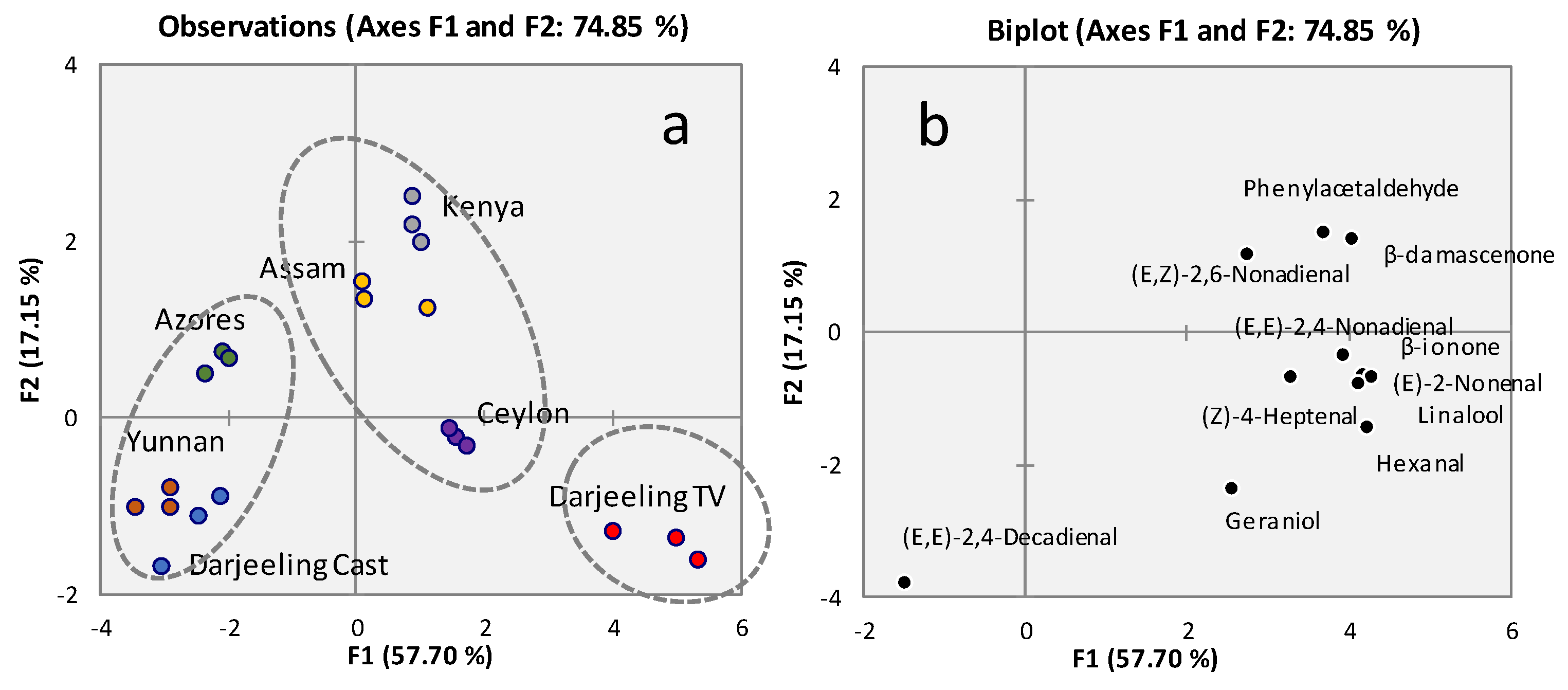
Figure 2.
Spider diagrams with Odour Activity Values (OAVs) illustrating the contribution of each key-aroma compound to the aroma perception of selected teas. OAV data are reported in logarithmic scale. Ceylon tea aroma profile is reported as average value calculated on four different lots.
Figure 2.
Spider diagrams with Odour Activity Values (OAVs) illustrating the contribution of each key-aroma compound to the aroma perception of selected teas. OAV data are reported in logarithmic scale. Ceylon tea aroma profile is reported as average value calculated on four different lots.
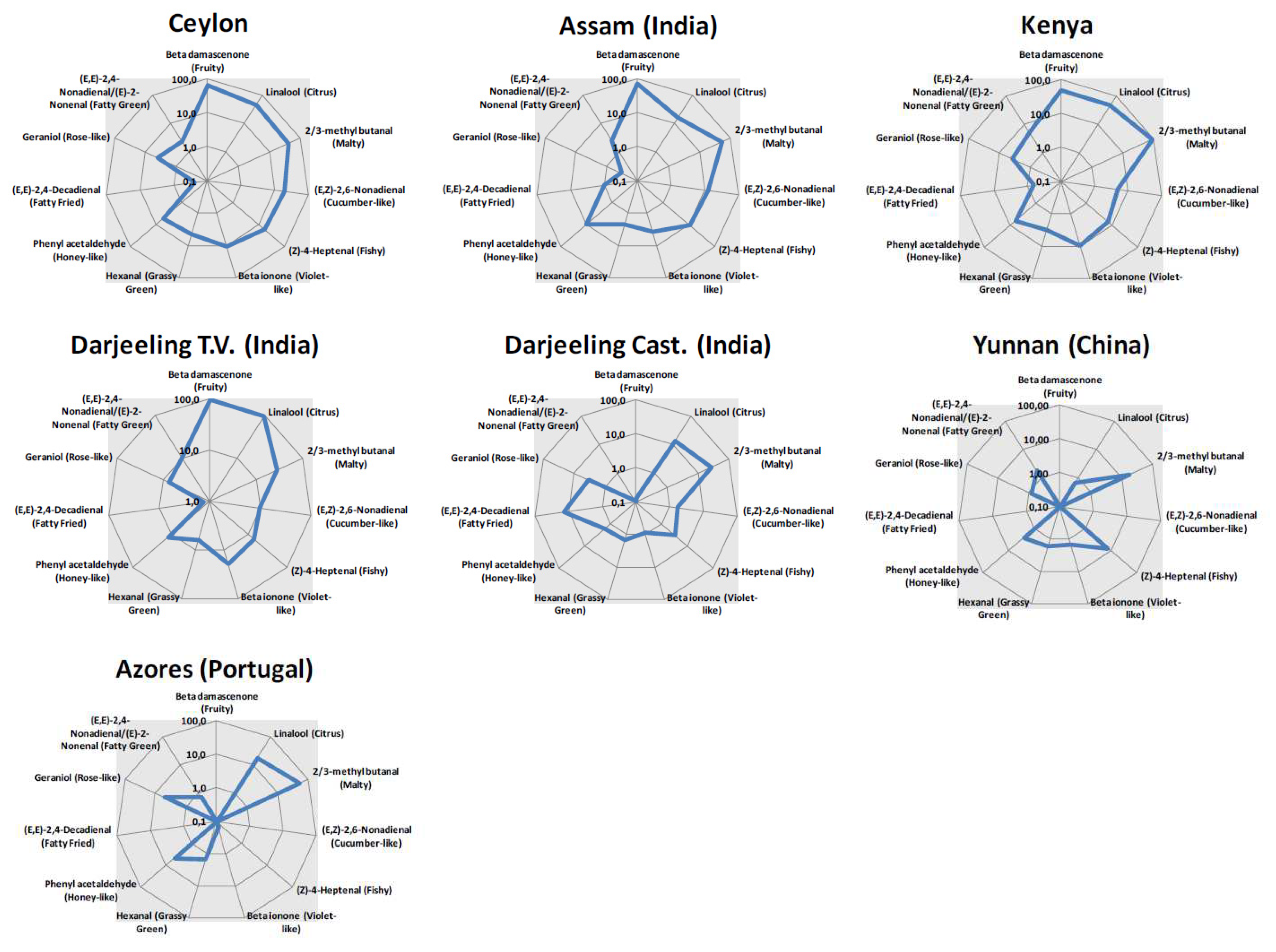
Figure 3.
PCA results. (3a) scores plot on the first and the second principal components (F1-F2 plane) based on key-taste and quality compounds quantitative data determined in infusions prepared from tea leaves (Table 3). For Ceylon teas an average profile obtained from four lots was considered; (3b) loadings plot with the distribution of quantified analytes and centroids (yellow circles) for analyzed teas.
Figure 3.
PCA results. (3a) scores plot on the first and the second principal components (F1-F2 plane) based on key-taste and quality compounds quantitative data determined in infusions prepared from tea leaves (Table 3). For Ceylon teas an average profile obtained from four lots was considered; (3b) loadings plot with the distribution of quantified analytes and centroids (yellow circles) for analyzed teas.
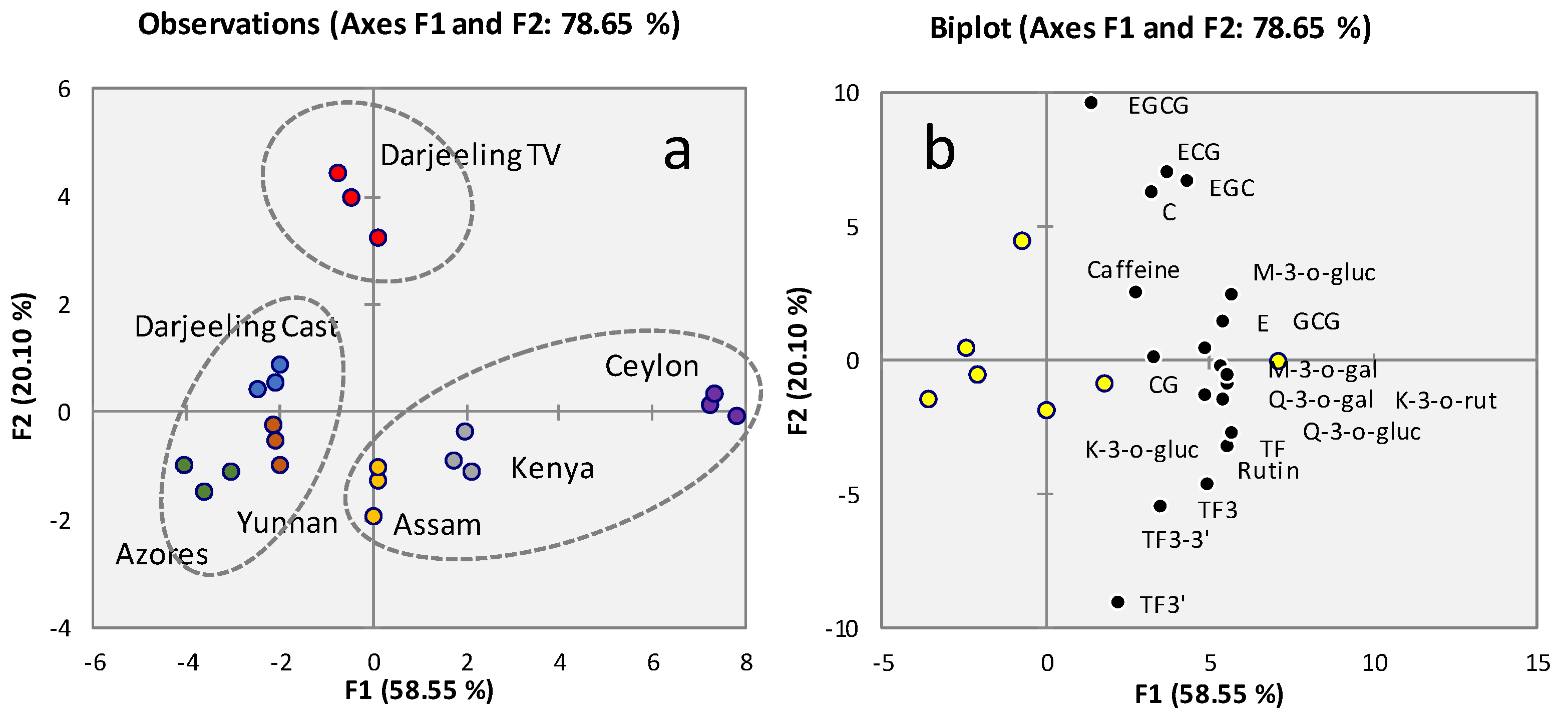
Figure 4.
Spider diagrams with Dose over Threshold values (DoTs) illustrate the contribution of each key taste and quality marker to the sensory perception of selected teas. DoTs values are reported in logarithmic scale. Ceylon tea taste profile is reported as average values deriving from four different lots.
Figure 4.
Spider diagrams with Dose over Threshold values (DoTs) illustrate the contribution of each key taste and quality marker to the sensory perception of selected teas. DoTs values are reported in logarithmic scale. Ceylon tea taste profile is reported as average values deriving from four different lots.
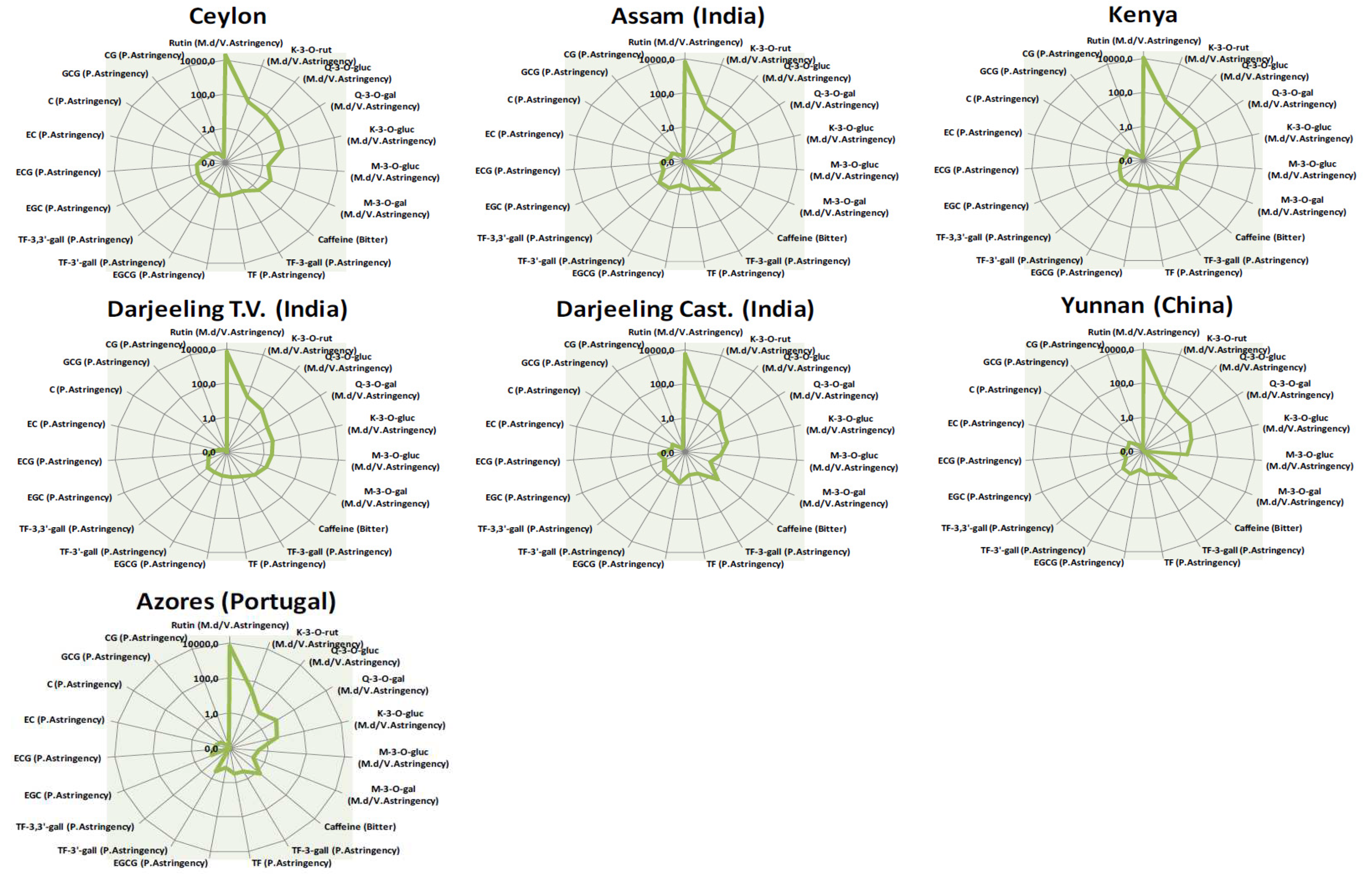

Table 1.
List of the targeted volatiles detected in selected tea infusions by IS-SPME-GC-MS together with retention times (tR min), experimental IT, and odor descriptors as reported in reference literature [12,26,27,39,40]. Detected (d) and non-detected (nd) analytes are also reported for each tea sample; moreover, Ceylon tea is rendered as an average profile obtained from different quality grades. Analytes with an asterisk (*) are the key odorants confirmed by sensomics and subjected to accurate quantification in this study.
Table 1.
List of the targeted volatiles detected in selected tea infusions by IS-SPME-GC-MS together with retention times (tR min), experimental IT, and odor descriptors as reported in reference literature [12,26,27,39,40]. Detected (d) and non-detected (nd) analytes are also reported for each tea sample; moreover, Ceylon tea is rendered as an average profile obtained from different quality grades. Analytes with an asterisk (*) are the key odorants confirmed by sensomics and subjected to accurate quantification in this study.
| # | Compound name | tR min | ITS | Odor | Ceylon | Assam | Azores | Darjeeling Castelton |
Darjeeling Testa Valley |
Kenya | Yunnan |
|---|---|---|---|---|---|---|---|---|---|---|---|
| 1 | 3-Methyl butanal* | 2.61 | 541 | Malty | d | d | d | d | d | d | d |
| 2 | 2-Methyl butanal* | 2.70 | 566 | Malty | d | d | d | d | d | d | d |
| 3 | (E)-2-Pentenal | 4.10 | 725 | Green, apple | d | d | nd | nd | d | d | nd |
| 4 | (Z)-2-Penten-1-ol | 4.85 | 788 | - | d | d | nd | nd | d | nd | nd |
| 5 | Hexanal* | 5.19 | 816 | Grassy-green | d | d | d | d | d | d | d |
| 6 | (E)-2-Hexenal | 6.82 | 856 | Bitter, almond | d | d | d | d | d | d | d |
| 7 | 1-Hexanol | 7.65 | 873 | Fruity | nd | nd | nd | nd | d | d | d |
| 8 | 2-Heptanone | 8.40 | 890 | Sweet, fruity | d | d | d | nd | d | nd | nd |
| 9 | (Z)-4-Heptenal* | 8.48 | 896 | Fishy | d | d | nd | d | d | d | d |
| 10 | Heptanal | 8.79 | 899 | Oil, fatty | d | d | d | d | d | d | d |
| 11 | (E)-2-Heptenal | 11.10 | 953 | Fatty, almond-like | d | d | nd | nd | nd | d | nd |
| 12 | Benzaldehyde | 11.10 | 954 | Almond, burnt sugar | d | d | d | d | d | d | d |
| 13 | 6-Methyl-5-hepten-2-one | 12.42 | 984 | Pungent, green | d | d | nd | nd | d | d | nd |
| 14 | (E,Z)-2,4-Heptadienal | 12.79 | 993 | Fatty, rancid | d | d | nd | d | d | d | nd |
| 15 | (E,E)-2,4-Heptadienal | 13.43 | 1008 | Fatty, rancid | d | d | nd | d | d | d | d |
| 16 | Limonene | 14.17 | 1026 | Citrus | d | nd | nd | d | d | d | d |
| 17 | 2,2,6-Trimethyl cyclohexanone | 14.51 | 1030 | - | d | nd | nd | nd | nd | nd | nd |
| 18 | Benzyl alcohol | 14.73 | 1035 | Sweet, fruity | d | d | nd | nd | d | nd | nd |
| 19 | Phenyl acetaldehyde* | 14.90 | 1039 | Honey-like | d | d | d | d | d | d | d |
| 20 | (E)-2-Octenal | 15.67 | 1055 | Green, nut, fat | d | d | nd | nd | d | d | nd |
| 21 | Trans-linalool-3,6-oxide | 16.98 | 1071 | Sweet, floral, citrus | d | d | d | d | d | d | d |
| 22 | Cis-linalool-3,6-oxide | 17.13 | 1087 | d | d | d | d | d | d | d | |
| 23 | Linalool* | 17.67 | 1101 | Citrus | d | d | d | d | d | d | d |
| 24 | Nonanal | 18.03 | 1103 | Fatty, waxy | d | nd | nd | nd | d | nd | d |
| 25 | 2-Phenyl alcohol | 18.30 | 1111 | Honey-like | d | nd | nd | nd | d | d | nd |
| 26 | (E,Z)-2,6-Nonadienal* | 20.12 | 1151 | Cucumber-like | d | d | nd | d | d | d | nd |
| 27 | (E)-2-Nonenal* | 20.43 | 1157 | Fatty, green | d | d | nd | nd | d | d | d |
| 28 | Cis-linalool-3,7-oxide | 20.93 | 1168 | Sweet, floral, citrus | d | d | nd | nd | d | d | nd |
| 29 | Trans-linalool-3,7-oxide | 21.18 | 1173 | d | d | nd | nd | d | d | nd | |
| 30 | Methyl salicylate | 21.95 | 1192 | - | d | d | d | d | d | d | d |
| 31 | Safranal | 22.25 | 1196 | Saffron | d | nd | nd | nd | d | d | nd |
| 32 | Decanal | 22.45 | 1200 | Penetrating, waxy | d | nd | nd | nd | d | d | nd |
| 33 | (E,E)-2,4-Nonadienal* | 22.93 | 1215 | Fatty, green | d | d | d | nd | d | d | d |
| 34 | Geraniol* | 24.79 | 1254 | Rose-like | d | d | d | d | d | d | d |
| 35 | Geranial | 25.55 | 1267 | Citrus | d | nd | nd | d | d | d | nd |
| 36 | Trans anethole | 26.35 | 1280 | Sweet | nd | d | nd | d | d | nd | nd |
| 37 | (E,Z)-2,4-Decadienal | 26.54 | 1291 | Deep-fried | d | d | nd | d | d | d | nd |
| 38 | (E,E)-2,4-Decadienal* | 29.64 | 1319 | Fatty, fried | d | d | nd | d | d | d | nd |
| 39 | β-Damascenone | 30.48 | 1381 | Fruity | d | d | nd | nd | d | d | nd |
| 40 | (Z)-Jasmone | 31.01 | 1400 | Floral, sweet, fruity | d | nd | nd | d | d | nd | nd |
| 41 | α-Ionone | 32.24 | 1424 | Violet-like | d | d | nd | d | d | d | d |
| 42 | Geranyl acetone | 33.31 | 1450 | Magnolia, green | d | d | nd | d | d | d | d |
| 43 | β-Ionone* | 34.62 | 1483 | Violet-like | d | d | nd | d | d | d | d |
| 44 | Caffeine | 43.77 | 1841 | - | d | d | d | d | d | d | d |
Table 2.
SA quantitative results on key aroma compounds of tea infusions, data are expressed in µg/L.
Table 2.
SA quantitative results on key aroma compounds of tea infusions, data are expressed in µg/L.
| Compound name | Odor Threshold (µg/L) | Ceylon | Assam | Azores | Darjeeling Castelton |
Darjeeling Testa Valley |
Kenya | Yunnan |
|---|---|---|---|---|---|---|---|---|
| 3-Methyl butanal | 1.2 | 37.00 | 49.12 | 52.32 | 25.22 | 27.45 | 84.89 | 17.02 |
| 2-Methyl butanal | 4.4 | 45.44 | 63.12 | 46.69 | 29.50 | 21.22 | 89.97 | 18.29 |
| Hexanal | 10 | 45.25 | 23.04 | 14.84 | 15.30 | 63.49 | 31.75 | 16.88 |
| (Z)-4-Heptenal | 0.06 | 0.98 | 0.68 | 0.00 | 0.20 | 0.82 | 0.41 | 0.47 |
| Phenyl acetaldehyde | 6.3 | 32.73 | 62.73 | 29.76 | 10.77 | 77.52 | 38.76 | 16.11 |
| Linalool | 0.6 | 25.75 | 9.72 | 10.19 | 7.86 | 54.48 | 27.24 | 0.41 |
| (E,Z)-2,6-Nonadienal | 0.03 | 0.56 | 0.39 | 0.00 | 0.50 | 0.28 | 0.14 | 0.00 |
| (E)-2-Nonenal | 0.4 | 0.40 | 0.24 | 0.00 | 0.02 | 1.21 | 0.60 | 0.15 |
| (E,E)-2,4-Nonadienal | 0.2 | 0.29 | 0.39 | 0.14 | 0.00 | 1.46 | 0.73 | 0.29 |
| Geraniol | 3.2 | 13.20 | 1.07 | 16.38 | 11.31 | 24.83 | 12.41 | 2.78 |
| (E,E)-2,4-Decadienal | 0.16 | 0.51 | 0.15 | 0.00 | 2.29 | 0.21 | 0.11 | 0.00 |
| Beta damascenone | 0.004 | 0.26 | 0.29 | 0.00 | 0.00 | 0.38 | 0.19 | 0.00 |
| Beta ionone | 0.2 | 2.16 | 0.78 | 0.00 | 0.18 | 3.84 | 1.92 | 0.29 |
Table 3.
quantitative results on key-taste compounds (T) and quality markers (Q) of selected infusions. Amounts are expressed in mg/L and obtained by external calibration tecnique with LC-UV/DAD analysis. Results are provided as mean of three infusions and two analytical replicates. Taste threshold (TT) is expressed in µg/L.
Table 3.
quantitative results on key-taste compounds (T) and quality markers (Q) of selected infusions. Amounts are expressed in mg/L and obtained by external calibration tecnique with LC-UV/DAD analysis. Results are provided as mean of three infusions and two analytical replicates. Taste threshold (TT) is expressed in µg/L.
| Compound name | TT (µg/L) | Ceylon | Assam | Azores | Darjeeling Castelton |
Darjeeling Testa Valley |
Kenya | Yunnan |
|---|---|---|---|---|---|---|---|---|
| EpigallocatechinQ (EGC) | 159 | 72.38 | 29.24 | 16.09 | 25.27 | 71.08 | 38.62 | 16.61 |
| CatechinQ (C) | 119 | 10.87 | 8.05 | 4.42 | 7.22 | 13.03 | 11.54 | 9.76 |
| EpicatechinQ (EC) | 270 | 41.97 | 19.07 | 12.99 | 14.16 | 25.80 | 24.90 | 19.84 |
| EpigallocatechingallateT,Q (EGCG) | 87.0 | 85.35 | 24.09 | 11.88 | 63.52 | 177.23 | 27.18 | 11.23 |
| GallocatechingallateQ (GCG) | 179 | 8.64 | 5.49 | 2.84 | 3.16 | 4.73 | 3.54 | 5.44 |
| EpicatechingallateQ (ECG) | 115 | 41.40 | 21.90 | 7.92 | 29.68 | 39.79 | 20.31 | 18.80 |
| CatechingallateQ (CG) | 239 | 5.37 | 5.18 | 3.07 | 5.03 | 3.93 | 3.59 | 2.76 |
| TheaflavinQ (TF) | 9.00 | 7.55 | 4.39 | 2.92 | 2.25 | 2.16 | 4.50 | 2.33 |
| Theaflavin-3-gallateQ (TF3) | 10.7 | 8.81 | 7.77 | 3.70 | 3.17 | 2.89 | 5.90 | 3.65 |
| Theaflavin-3′-gallateQ (TF3′) | 10.7 | 5.28 | 6.64 | 3.76 | 3.47 | >LOQ | 4.92 | 3.67 |
| Theaflavin-3,3′-gallateQ (TF3-3′) | 11.3 | 6.38 | 7.96 | >LOQ | 3.40 | >LOQ | 4.77 | 3.59 |
| Myricetin-3-o-galactosideT (M-3-o-gal) | 1.3 | 2.39 | >LOQ | 0.28 | 0.42 | 0.32 | 1.51 | >LOQ |
| Myricetin-3-o-glucosideT (M-3-o-gluc) | 1.0 | 4.10 | 0.24 | 0.37 | 0.85 | 1.02 | 1.33 | >LOQ |
| Quercetin-3-o-rutinosideT (Rutin) | 0.0009 | 19.58 | 6.68 | 6.39 | 5.16 | 6.34 | 9.55 | 7.63 |
| Quercetin-3-o-galactosideT (Q-3-o-gal) | 0.20 | 4.31 | 2.62 | 1.60 | 1.90 | 2.39 | 4.01 | 1.82 |
| Quercetin-3-o-glucosideT (Q-3-o-gluc) | 0.30 | 9.42 | 3.93 | 1.01 | 0.77 | 1.12 | 5.53 | 2.68 |
| Kaempferol-3-o-rutinosideT (K-3-o-rut) | 0.15 | 8.31 | 3.11 | 4.56 | 1.98 | 3.83 | 6.89 | 3.91 |
| Kaempferol-3-o-glucosideT (K-3-o-gluc) | 0.30 | 4.19 | 1.32 | 1.07 | 0.62 | 1.24 | 3.50 | 1.43 |
| CaffeineT | 97.1 | 250.50 | 290.30 | 143.70 | 241.52 | 265.88 | 263.36 | 228.03 |
Disclaimer/Publisher’s Note: The statements, opinions and data contained in all publications are solely those of the individual author(s) and contributor(s) and not of MDPI and/or the editor(s). MDPI and/or the editor(s) disclaim responsibility for any injury to people or property resulting from any ideas, methods, instructions or products referred to in the content. |
© 2024 by the authors. Licensee MDPI, Basel, Switzerland. This article is an open access article distributed under the terms and conditions of the Creative Commons Attribution (CC BY) license (http://creativecommons.org/licenses/by/4.0/).
Copyright: This open access article is published under a Creative Commons CC BY 4.0 license, which permit the free download, distribution, and reuse, provided that the author and preprint are cited in any reuse.