

Submitted:
03 January 2024
Posted:
04 January 2024
You are already at the latest version
Abstract
In 2023, the technological landscape witnessed an unprecedented surge of transformative innovations, including Web 3.0 and machine learning, poised to revolutionize various aspects of our daily lives. At the forefront of this revolution stands artificial intelligence (AI), which has evolved from a concept once confined to science fiction into an indispensable force reshaping industries on a global scale. Notably, recent years have seen remarkable strides in AI functionalities, particularly in machine learning, computer vision, and natural language processing. These advancements have empowered AI to generate diverse interactions and media autonomously. This study ultimately provides invaluable insights into the dynamic intersection of AI and Advertising, con-tributing to a deeper comprehension of this evolving field. This study conducts a comprehensive review of Artificial Intelligence within the advertising domain, employing network analysis. By meticulously examining the evolution of AI through co-occurrences of terms, keywords, and co-authorship analysis, we aim to unveil the relationship of AI & Advertising through the lens of Generative models to identify pivotal trends, core concepts, and seminal studies that have profoundly influenced the industry.
The analysis charts the trajectory leading to the emergence of Generative Artificial Intelligence (GenAI), a transformative development poised to revolutionize advertising practices and consumer engagement. In tandem with these objectives, the results highlight vital trends, emphasizing the growing prominence machine learning tools and techniques such as deep learning techniques and advanced natural language processing methods like word2vec, GANs, and more in shaping the future of advertising practices.
Keywords:
generative AI advertising
; artificial intelligence advertising
; machine learning advertising
; bibliometrics
; full counting
; co-occurrence network analysis
; co-author network analysis
1. Introduction
Artificial Intelligence (AI) has emerged as a disruptive force, driven by rapid technological advancements that harness sophisticated computing capabilities, intricate algorithms, and vast datasets. This enables machines to replicate human cognitive and emotional functions, autonomously performing tasks like problem-solving and reasoning [11]. The progression of AI has been a transformative force across various industries, including finance, healthcare, manufacturing, marketing and more [17]. In the lens of advertising, its progression was accelerated by dynamic shifts in advertising strategies, fundamentally transforming how brands interact with their target audiences. Today, advertisers leverage AI to craft personalized experiences, target specific demographics, and make quicker decisions [26]. The integration of AI into advertising represents a paradigmatic shift in contemporary marketing strategies.
The Emergence of Generative Models
One aspect of AI that became prominent in Industry 4.0 are Generative Models. One example is Generative Artificial Intelligence, commonly known as “Generative AI”. It was introduced decades ago, but it is only in recent years that it has evolved rapidly. Much of the current discourse revolves around large language models and image-generation models, where these Gen AI tools allow users to create articulate-sounding texts and compelling images using an English-language prompt which helps users generate content. This, however, is just one facet of the broader scope of Gen AI [19]. Today, it holds the potential to revolutionize how brands connect with their audiences, ushering in new advertising avenues.
Generative AI utilizes extensive datasets comprising images, text, or other forms of data to generate fresh iterations of text, visuals, or predicted data at the user’s request [14]. The field of computer science propelling Gen AI is experiencing rapid evolution, witnessing monthly breakthroughs [52] In 2023, reputable sources including CNBC [58], Forbes [34], LinkedIn [53], and Google Blogs [14] have attested to the monumental impact of Generative AI on the advertising industry. This transformative artificial intelligence might have a significant impact on the advertising world. It was said that artificial intelligence advertising spending across the globe in 2022 was estimated at $370 billion, together with predictions of $1.3 trillion in the next decade [25]. This burgeoning technology has revolutionized advertising endeavors, from the precision of targeted ads to the potential for dynamic content creation and even the nuanced analysis of images and videos for marketing purposes.
Despite the undeniable influence of AI, foundational research on the emergence and trajectory of it especially in the aspect of Generative Models intertwined in advertising must be more conspicuously sparse. This study aims to bridge this gap by providing a comprehensive review of the evolution of AI in advertising, culminating in the latest innovation of Generative Models. Through this research, we seek to offer valuable insights into the trajectory of this transformative technology within the advertising domain, thereby empowering businesses, and marketers to navigate this dynamic landscape with informed strategies and tactics.
2. Research Questions
- RQ1 (Topic Analysis): What are the prominent themes and subtopics within the field of Artificial Intelligence in Advertising based on keyword co-occurrence patterns?
- RQ2 (Emerging Trends): Can we identify any emerging trends or topics within Artificial Intelligence in Advertising over the past few years through co-occurrence analysis?
- RQ3 (Geographical Trends): Are there regional or country-specific trends in research on Artificial Intelligence in Advertising?
- RQ4 (Technological Trends and Application Domains): Are there specific techniques or approaches within Generative AI that are particularly prominent in the context of advertising applications?
- RQ5 (Trajectory of Generative AI in Advertising): What is the developmental trajectory of Generative AI within the field of advertising?
Our exploration will encompass key themes and topics, notably machine learning, social media platforms, and language processing within the realm of AI in Advertising. Additionally, we will uncover emerging trends that are prominent in the architecture of Generative Models such as image and text recognition, along with investigating novel models.
As we embark on this investigation, we recognize the global nature of AI research and its application in advertising. To provide a comprehensive understanding, we will scrutinize the contribution of different countries through co-authorship publications. By doing so, we seek to discern the leading nations that actively contribute to the expansion of knowledge and the practical application of AI within the advertising domain.
This study, therefore, endeavors to present a cohesive and insightful analysis, seamlessly navigating through the architecture of Generative Models, thematic explorations, and a nuanced examination of international contributions in the ever-evolving landscape where AI and Advertising intersect.
3. Literature Review
3.1. AI Applications in Advertising
AI has transformed the advertising industry through various means. It harnessed the ability of data-driven decision-making and processing [4] and more. One notable technique is Machine Learning, which is the technique behind enhanced targeting accuracy as it can predict the most relevant advertisements for audiences rooted in pre-existing or contextual user data [8] For example, the media streaming service Netflix employs a machine learning algorithm to curate customized content recommendations from viewers’ past viewing habits and preferences [22]. Natural Language Processing (NLP) is a technique that empowers computers to comprehend and process human language. It analyzes and comprehends human language [28]. Within advertising, NLP is used in applications for sentiment analysis; these provide brands invaluable insights concerning perception and enhanced customer feedback. For example, KLM (airline programmed a chatbot to deal with customer queries [60]. Image Recognition expands the capabilities of artificial intelligence to data visualization; it enables the identification of scenes and objects in images. It can support Out-of-Home (OOH) advertising agencies in acquiring maximum reach for their businesses by optimizing the panel’s geospatial positioning following the detected traffic in the pedestrian area and optimizing the advertising content flashed on panels and the response of people when they view it [10]. Predictive Analysis, another advertising technique, provides better recommendations to users, which allows them to maximize the value of the services and products presented to them, which results in a high-value proposition and customer satisfaction [18]. Unilever uses this technique through their app, “Flower,” which uses AI to generate a human-like profile that can interact with users on social media platforms [59]. Following this, Recommender Systems, a cornerstone of AI-powered advertising known by many today, analyzes audience behavior to offer customized suggestions to enhance user experience and drive engagement. This is most prominent in E-commerce as it greatly benefits from applying informatics through this technique [38]. The culmination of Deep Learning further elevates the capabilities of artificial intelligence, specifically in image and speech recognition tasks. This technique is utilized across many social network platforms. Today, deep learning covers almost all techniques, from image classification to object detection, which can inform targeted advertising strategies [41].
The Content Generation that generative models facilitate enables advertisers to craft compelling ad copies, blog posts, and social media content. For example, ChatGPT can generate content production through the help of deep learning to create more diverse forms of content that are provided in real time [32]. All these techniques collectively represent the arsenal of artificial intelligence tools that advertisers of all walks leverage to engage with audiences more efficiently, impactful, and personalized.
3.2. Opportunities of Innovation in Advertising: Generative Artificial Intelligence
Generative Artificial Intelligence (Generative AI) stands as a pivotal advancement in machine learning, with contributions from various techniques such as General Adversarial Networks (GANs) [21], variational autoencoders (VAEs) [31], and diffusion models [48]. The idea behind Generative Diffusion Models (GDMs) stands out as it takes inspiration from thermodynamic diffusion processes, forging distinctive connections with score-based models [49], and stochastic differential equations [44]. As a subset within the category of diffusion models, GDMs demonstrate a unique method of data generation and highlight an outstanding capability to model intricate data distributions [6].
On another note, VAEs contribute significantly to the landscape of generative AI. Utilizing an encoder-decoder architecture, VAEs comprehend the underlying distribution of the input data and create new samples [46]. This technique has paved the way for generative AI in various fields, including art, entertainment, design, and scientific research, positioning VAEs as a cornerstone in artificial intelligence.
The versatility and potency of GDMs are evident in their widespread adoption and applications across various domains, particularly in AI-generated Content (AIGC) realms. An illustrative example is Stable Diffusion [51]. It’s an image generation application based on diffusion models, with an impressive user base exceeding 10 million daily, highlighting the practicality and widespread popularity of GDMs. In Computer Vision (CV), GDMs like Denoising Diffusion Probabilistic Models (DDPM) and Denoising Diffusion Implicit Models (DDIM) contribute to generating high-quality images from noise. Moreover, GDMs have been employed in tasks related to text generation, improving the control and coherence of the generated textual content [15]. In the realm of audio, GDMs have been utilized for the generation of symbolic music and the conversion of text to speech [24,36]. Outside conventional fields, GDMs have demonstrated notable progress in generating graphs, creating molecular and material structures, and synthesizing tabular data for electrocardiogram signal synthesis [15].
The unique advantages of GDMs over other Gen AI methods contribute to their widespread adoption. Notably, GDMs exhibit high-quality data generation ability, flexibility, and simplicity of implementation. These characteristics amplify the versatility of GDMs, positioning them as a significant player in the landscape of generative AI. Including GDMs and acknowledging VAEs in the discussion enriches the narrative, providing advertisers with a comprehensive suite of tools for tailored and compelling content creation strategies. This diversity redefines the landscape of audience interaction and brand communication, marking a transformative chapter in the evolving field of Generative AI.
3.3. Recent Intersections of Artificial Intelligence & Advertising
Artificial Intelligence (AI) has ushered in a new era of innovation within the advertising landscape, offering various applications and tools that redefine personalization, content creation, and campaign optimization. The transformative technology is exemplified by creations like OpenAI’s GPT-3 which is introduced by U.S. Research Institute (Kim et al. 2020), showcasing the potential of Generative AI in dynamically tailoring content to suit individual preferences, thereby augmenting user engagement, ad creative development, and driving conversion rates [25].Another noteworthy example is DALL-E, a creation by OpenAI, and Midjourney by Mid Journey Inc., both generative models capable of creating novel images from textual descriptions. These developments underscore the remarkable intersection and power of artificial intelligence and generative models in generating new and unique content, enhancing personalization, and revolutionizing advertising practices by leveraging neural networks and other machine learning methods [20]. The intersection is apparent but further study is needed to understand the prominent relationship of the two entities with the Generative Model sitting at the center of it.
4. Methodology
4.1. Data Collection & Pre-Processing
Topic Modeling: Orange Data Mining
In the process of conducting a systematic keyword search and filtering relevant data for our research, we employed Orange Data Mining. This powerful software suite is widely recognized for its proficiency in data analysis and machine learning. One of its key features is facilitating data exploration through visual programming and Python scripting [12]. Given the technical nature of terminologies associated with artificial intelligence, utilizing such tools becomes essential for ensuring precision in the analysis.
One notable step in our approach involved the utilization of sentiment analysis during the pre-processing phase using the Vader method. Sentiment analysis helps gauge the emotional tone or sentiment expressed in the text data. In the context of our research topic, understanding sentiment is relevant because advertisements often aim to evoke specific emotions or responses from the audience in relation to AI. By incorporating sentiment analysis, we can gain insights into how discussions and content related to generative AI in advertising are perceived. It provides a nuanced understanding of the sentiments associated with the topic, ranging from positive to negative, which can be crucial in shaping effective keyword selection.
Moreover, sentiment analysis aids in identifying key themes, sentiments, or opinions within the dataset. This information can be valuable in refining the selection of keywords and ensuring that the generated keywords are not only relevant but also reflective of the sentiments prevalent in discussions about generative ai in advertising. In essence, sentiment analysis enhances the depth and context of the keyword selection process, contributing to a more comprehensive and nuanced analysis of the data.
The dataset, sourced from Wikipedia using a query word list focused on ‘Generative Artificial Intelligence in Advertising’ in English, was subjected to this multi-faceted approach, including sentiment analysis, to extract meaningful insights and generate relevant keywords for the research. Results can be seen in Figure 1.
Following the data shown in Figure 1, data collection commenced. The focus was on papers published in the Web of Science, a reputable platform for scholarly publications, citation data, and bibliometric information accessed through Clarivate. This platform is widely recognized for its comprehensive coverage of academic literature. Yeungnam University’s Institutional access was utilized to gather specific data related to the search topic. To refine the search, precise search strings were employed.
During the initial attempt at data collection, approximately 11,169 datasets were gathered using the search string ‘Generative AI Advertising’, along with related keywords drawn from pertinent journals and Orange Data Mining word cloud. This sample was presented as part of a class session on Big Data Analysis at Yeungnam University on October 6, 2023, in front of an audience of 20 students. (Park, personal communication, 2023). However, it became evident that specific keywords, such as ‘General Adversarial Networks’ and ‘GANs,’ led to results beyond the scope of advertising. Park advised using keywords that are more common to the audience because these models might also be used in different industries and are too specific. Hence, keywords and journals from other industries were present. This necessitated a re-evaluation of the keywords to align them more closely with the intended research focus.
With that, a refined search string was generated using “Generative AI Advertising” (Title) or Generative AI Advertising (Abstract) or Synthetic Media Advertising (Title) or Synthetic Media Advertising (Abstract) or Machine Learning Advertising (Title) or Machine Learning Advertising (Abstract) or Artificial Intelligence Advertising (Title) or Artificial Intelligence Advertising (Abstract) or Generative Artificial Intelligence Advertising (Title) or Generative Artificial Intelligence Advertising (Abstract) or Artificial Intelligence Digital Advertising (Abstract) or Artificial Intelligence Digital Advertising (Title) or Programmatic Advertising (Title) or Programmatic Advertising (Abstract) or AI Creative Advertising (Title) or AI Creative Advertising (Abstract) or AI Online Advertising (Title) or AI Online Advertising (Abstract) or AI Social Media Advertising (Title) or AI Social Media Advertising (Abstract) or Artificial Intelligence Social Media Advertising (Title) or Artificial Intelligence Social Media Advertising (Abstract) or AI Generated Ads (Title) or AI Generated Ads (Abstract) or Generative AI Mobile Advertising (Title) or Generative AI Mobile Advertising (Abstract) or Generative AI Advertisements (Title) or Generative AI Advertisements (Abstract) or Machine Learning Social Media (Title) or Machine Learning Social Media (Abstract) or AI Deep Learning Advertising (Title) or AI Deep Learning Advertising (Abstract) or Machine Learning Mobile Advertising (Title) or Machine Learning Mobile Advertising (Abstract) or Machine Learning Advertisements (Title) or Machine Learning Advertisements (Abstract) or AI Powered Advertising (Title) or AI Powered Advertising (Abstract) or Automated Content Advertising (Title) or Automated Content Advertising (Abstract) or Artificial Intelligence Ads (Title) or Artificial Intelligence Ads (Abstract) or Generative AI Social Media (Title) or Generative AI Social Media (Abstract) or Creative AI (Title) or Creative AI (Abstract) or Machine Learning Ads (Title) or Machine Learning Ads (Abstract) or Synthetic Ads (Title) or Synthetic Ads (Abstract) or Synthetic Advertising (Title) or Synthetic Advertising (Abstract) or AI Targeted Advertising (Abstract) or AI Targeted Advertising (Title) or AI Content Creation (Title) or AI Content Creation (Abstract) or AI in Digital Advertising (Title) or AI in Digital Advertising (Abstract) or Smart Advertising with AI (Title) or Smart Advertising with AI (Abstract) or Personalized Ads with AI (Title) or Personalized Ads with AI (Abstract) or Ad Creatives with Machine Learning (Title) or Ad Creatives with Machine Learning (Abstract) or Artificial Intelligence Video Advertising (Abstract) or Neural Network Advertising (Title) or Neural Network Advertising (Abstract) or AI Advertising Tools (Title) or AI Advertising Tools (Abstract) or Generative AI Fake News (Title) or Generative AI Fake News (Abstract) and 2024 or 2023 or 2022 or 2021 or 2020 or 2019 or 2018 or 2017 or 2016 or 2015 or 2014 or 2013 or 2012 or 2011 or 2010 or 2009 or 2008 or 2007 or 2006 or 2005 or 2004 or 2003 or 2002 or 2001 or 2000 or 1999 or 1998 or 1997 or 1996 or 1995 or 1994 or 1993 or 1992 or 1991 or 1990 (Publication Years) and English (Languages)
The refined search string encompassed specific terms related to Generative AI Advertising, resulting in a revised dataset of 6,591 documents for analysis. To ensure comprehensive coverage, the search also considered various publication years, ranging from 1990 to 2024, and included documents in the English language. Additionally, filters (criteria used to exclude or include specific types of documents) and parameters (specific conditions set for the search) were applied to enhance the accuracy of the results. The focus on titles and abstracts ensured a concentrated source of relevant keywords, vital for data analysis. This approach minimized noise from unrelated documents while providing high-level insights. The data extraction process was executed in batches, considering Web of Science’s limitation to 1,000 documents per batch. Full records were extracted in TXT file format to facilitate thorough analysis, ensuring comprehensive coverage of pertinent categories.
4.2. Network Analysis
Drawing upon the powerful lens of network analysis, this research delves deeper into the intricate landscape of advertising research. This approach transcends isolated elements and illuminates the complex patterns of relationships [29] that shape the field. By deciphering the structural underpinnings within these networks, we gain a comprehensive understanding [29] of the intellectual terrain and the influential players driving its evolution [23].
The widespread adoption of network analysis as a methodological approach extends across diverse domains, finding relevance in the field of advertising. Newman underscores the significance of understanding the interplay between network topology and dynamics, offering valuable insights applicable to the examination of advertising networks [39]. Expanding on this perspective, Van Loon delves into the concept of networks, emphasizing their ability to organize non-linear complexity and challenge conventional boundaries, a crucial aspect in investigating advertising relationships [56]. In a parallel vein, Brass highlights the importance of exploring cross-level network phenomena, advocating for a multilevel perspective as indispensable in deciphering the dynamics within advertising networks [5]. Collectively, these studies underscore the intrinsic value of employing network analysis to unveil intricate relationships and identify key influencers within the advertising research domain.
At a more abstract level, the network comprises various structures of assigned variables, represented by nodes, and the relationships, formerly known as edges. This method allows researchers to delve into the relationships between key elements, such as concepts, authors, or publications.
Once the network structure is estimated, a graphical representation emerges, unveiling the intricate web of relationships between nodes. This visual map transforms into a powerful tool for researchers, opening doors to a deeper understanding of the network’s properties. Measures like centrality, revealing key influencers and power dynamics, shed light on the most prominent actors shaping the advertising research landscape [2]. Degree centrality, for instance, quantifies the number of connections a node possesses, offering a quantitative indicator of its influence within the network. Furthermore, clustering techniques pinpoint cohesive groups or communities of nodes, each sharing thematic threads or closely intertwined research interests [2]. Hierarchical clustering progressively groups nodes based on their similarities, building a multi-layered map of thematic clusters within the wider network.
By utilizing the analytical power of network analysis, researchers gain profound insights into the intellectual landscape of advertising. This method not only unveils the structural intricacies of relationships but also identifies pivotal players and patterns that significantly contribute to the field. Ultimately, network analysis facilitates informed and strategic advancements or learnings within the dynamic and evolving discipline of advertising research.
4.2.1. Vos Viewer
Navigating the complexities of large-scale qualitative data poses a formidable challenge for researchers. As data volume swells, capturing diverse perspectives and accurately representing reality becomes infinitely more intricate. While thematic coding software eases the exploration of expansive datasets, ensuring confirmability, the extent to which researcher bias influences analysis and scalability, upholding the core tenets of constructivism amidst data growth, remain persistent hurdles. Separating researcher interpretations from participant-driven insights within vast data landscapes further amplifies these difficulties [9].
Recognizing these limitations, digital tools emerge as crucial allies in deciphering large-scale qualitative data. This research, therefore, embraces a methodology powered by VOS Viewer, a versatile instrument developed by Nees Jan van Eck and Ludo Waltman [54]. VOS Viewer transcends its role as a mere software. It becomes a central pillar for our investigation, enabling comprehensive bibliometric and network analyses, including bibliographic coupling, co-occurrence examination, and co-authorship exploration. Through this potent alliance with VOS Viewer, we aim to navigate the intricacies of large-scale qualitative data and unveil the nuanced and multifaceted realities embedded within.
Before delving into the results, it is imperative to grasp the analytical capabilities of VOS Viewer. This versatile tool enables a range of analyses, including bibliographic, co-occurrences, and co-authorship analyses, among others, and jargon present. However, this research will focus on term occurrences, keyword occurrences, and co-authorships analysis.
Word (Keywords & Terms) co-occurrences offers a deeper dive into the research domain. By analyzing the frequency and patterns of specific keywords appearing together within the dataset, we gain valuable insights into prevalent themes and trends. This technique, also known as word co-occurrence, examines the joint appearance of two words within a defined text window and reveals the semantic relationship between them. The co-occurrence data thus provides quantitative indicators for exploring various areas, including text mining, information retrieval, topic analysis, and knowledge discovery. Its applications extend beyond these core areas, finding further utility in natural language processing, artificial intelligence, and even bioinformatics [64]. Furthermore, the explanation of co-authorship illuminates collaborative relationships among the authors, which can be done using full or binary counting methods to unveil nuanced insights into the extent and nature of scholarly collaborations.
To facilitate a smooth discussion of results, it is imperative to comprehend the terms and elements utilized in VOS Viewer. Initially, it is pivotal to explore the available visualizations on VOS Viewer, encompassing three visualization maps: network, overlay, and density visualizations. Network visualization involves visualizing the relationships or connections between entities, known as nodes, within a network. This is instrumental in gaining insights into the dynamic structure of complex networks. Overlay Visualization complements network visualization by generating an avenue to display additional information atop the existing network representation. This may include attributes, labels, or any crucial information associated with the nodes or ties. Lastly, density visualization quantifies the compactness of connections within the network, indicating the extent to which the nodes are closely linked. These representations outline connectivity patterns.
During the data analysis phase, a dual approach incorporating both binary and full counting methods was intentionally adopted. The binary method simplifies network analysis by categorizing connections as either present (1) or absent (0), providing a straightforward representation of network relationships. In contrast, the full counting method, when applied to co-occurrence network analysis, accounts for the frequency of connections, assigning numerical values to represent the strength of association between terms. For co-author network analysis, the full counting method considers the number of collaborations between authors, reflecting the quantitative aspects of their relationship strength.
The decision to utilize both methods aimed to offer a nuanced exploration of the dataset. While the binary method provides a binary perspective on connection presence, the full counting method captures the quantitative aspects of relationship strength, allowing for a more comprehensive understanding of network dynamics in both co-occurrence and co-authorship contexts.
Additionally, a thesaurus was consistently employed across all analyses to enhance the accuracy of text analysis by incorporating synonyms and related terms. This systematic use of the thesaurus ensured a robust examination of the dataset, enriching the depth and precision of the derived insights.
In the network context, nodes represent individual entities, while ties, also known as edges, denote the connections between nodes, illustrating relationships and interactions. Clusters are groups of nodes tightly interconnected within the network, demonstrating stronger ties among the nodes within the same cluster than in other clusters. Further details about these methodologies, including the scoring used in co-author network analysis, can be found in the manuals of Van Eck and Waltman.
4.2.2. NodeXL
In addition to VOS Viewer, NodeXL played a pivotal role in this study’s methodology, particularly in network visualization and analysis. As a familiar and accessible option within the framework of a spreadsheet, NodeXL offers a comprehensive suite for collecting, storing, analyzing, visualizing, and publishing network datasets [50]. Developed by Marc Smith and his colleagues, NodeXL seamlessly complements VOS Viewer’s strengths by providing advanced capabilities in network visualization and analysis. Notably, NodeXL facilitated the calculation of centralities, including degree, betweenness, and closeness, allowing us to uncover the significance and influence of specific nodes within the network. These centralities proved instrumental in identifying key entities and understanding their roles in the network structure. This comprehensive approach, leveraging both VOS Viewer and NodeXL, enabled a robust exploration of bibliometric and network analyses, ultimately revealing a nuanced understanding of the interconnected landscape within generative artificial intelligence in advertising.
5. Results & Analyzation
5.1. Co-Occurence of Keywords Analysis
5.1.1. Binary Counting Method
In the pursuit of unraveling the intricate themes and emerging trends within the domain of Artificial Intelligence in Advertising, a crucial step involved conducting a co-occurrence of terms analysis. This methodological approach aligns directly with the research questions posed in the study: RQ1 focuses on discerning the prominent themes and subtopics, while RQ2 seeks to identify emerging trends over recent years. The data, sourced from the Web of Science, underwent meticulous preprocessing before being uploaded to VOSViewer. Specifically, the focus was directed solely to the Title and Abstract fields, excluding structured abstract labels and copyright statements. The counting method employed was binary, with the incorporation of a thesaurus file to enhance the precision of term recognition. Setting a minimum occurrence threshold of 10 ensured the inclusion of substantive terms in the analysis. Out of a staggering 112,307 terms, 1,609 met the threshold, and a strategic selection of 965 terms, representing 60% of the most relevant, was made to refine the analysis further. Exclusions were made for terms unrelated to advertising, ensuring the final set of terms accurately captured the nuances of the advertising landscape. This carefully curated dataset was then subjected to VOS Viewer analysis, providing a robust foundation for the subsequent exploration of themes and trends in Artificial Intelligence in Advertising.
Figure 2.
Visualization of Co-occurrences of Terms (Binary).
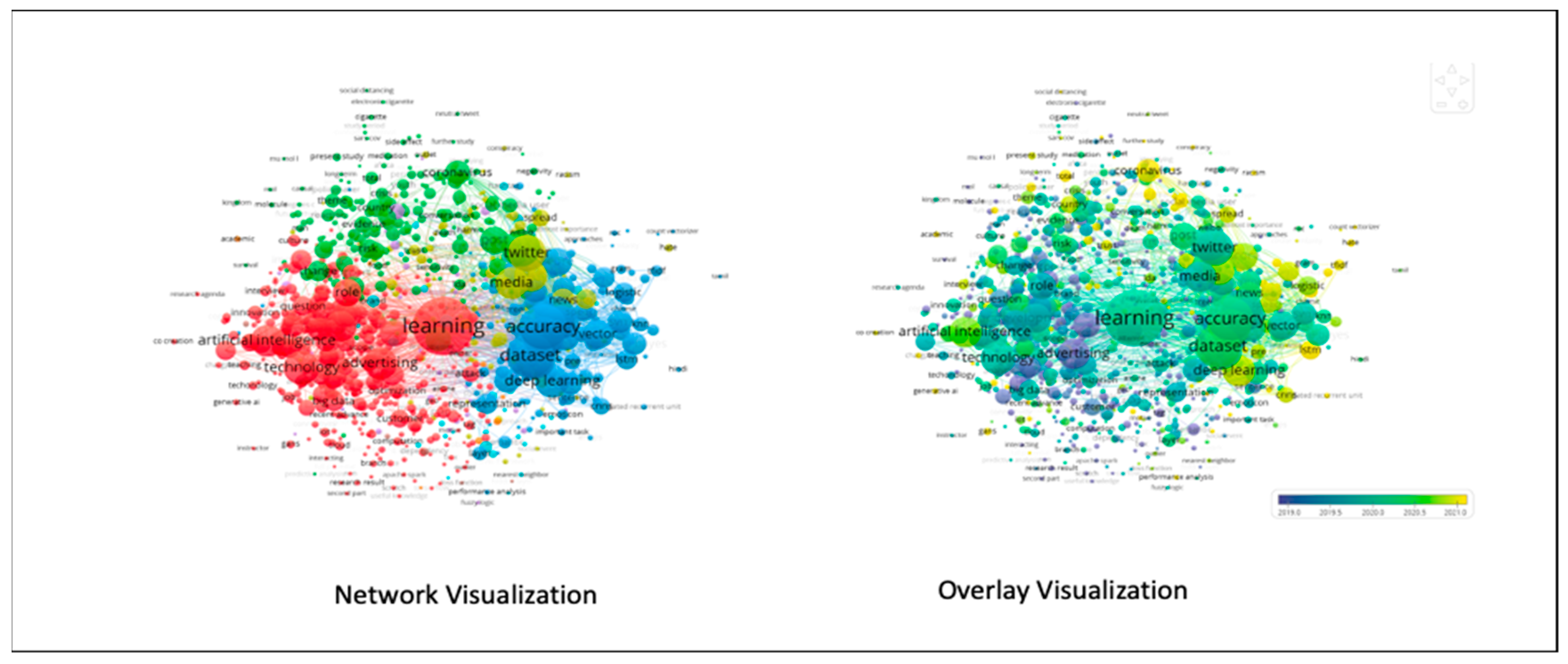

Table 1.
Co-occurrences of Terms Analysis (Binary) - Clustering.
| Cluster | Cluster Name | Description |
|---|---|---|
| 1 (Red) | Holistic Examination of the Interdisciplinary Landscape in AI Research | This cluster provides a panoramic view of the interdisciplinary landscape in artificial intelligence research, showcasing the breadth and depth of topics covered. Encompassing areas such as ethics, blockchain, advertising, human life, and the potential of generative AI, it underscores the multifaceted nature of AI’s impact on various domains. |
| 2 (Green) | Multifaceted Analysis of the Societal Impact of Social Media Data | This cluster encapsulates a comprehensive exploration of the societal impact of social media data in the context of various significant factors. |
| 3 (Blue) | Advanced Techniques in Natural Language Processing (NLP) and Machine Learning | This cluster focuses on the cutting-edgetechniques and methodologies employed in natural language processing (NLP) and machine learning for analyzing textual content, particularly in the context of social media. |
| 4 (Yellow) | AI-Powered Analysis of Online Content and Social Dynamics | This cluster centers on the application of artificial intelligence in analyzing and understanding the dynamics of online content and social interactions. |
| 5 (Purple) | Technological Advancements and Ethical Considerations | This cluster delves into the intersection of technological advancements and ethical considerations within the field of artificial intelligence. |
| 6 (Sky Blue) | Predictive Modeling and Algorithm Evaluation | This cluster revolves around predictive modeling and algorithmic evaluation in the realm of artificial intelligence. |
| 7 (Orange) | Knowledge Representation and Analysis Methods | This cluster revolves around the exploration of knowledge graphs and academic perspectives within the context of artificial intelligence. |
| 8 (Brown) | Neural Network Architecture and Learning | This cluster encompasses discussions related to neural network architecture, learning processes, and associated challenges. |
In this comprehensive co-occurrence of terms analysis, we examined the intricate web of relationships. This analysis, encompassing 904 nodes, provides a nuanced perspective on the co-occurrence patterns within and across these clusters. The 126,902 links, with a cumulative link strength of 474,412, signify the strength and frequency of associations between terms. We employed the association strength method to underscore the significance of terms co-occurring within the same context. This academic exploration sheds light on the complex interplay and interdependencies among various domains, offering valuable insights into the interdisciplinary landscape shaped by AI research and the evolving dynamics influenced by digital platforms.
Our exploration led us to identify eight distinct clusters, each representing an aspect of this multifaceted landscape: “Holistic Examination of the Interdisciplinary Landscape in AI Research,” “Multifaceted Analysis of the Societal Impact of Social Media Data,” “Advanced Techniques in Natural Language Processing (NLP) and Machine Learning,” “AI-Powered Analysis of Online Content and Social Dynamics,” “Technological Advancements and Ethical Considerations,” “Predictive Modeling and Algorithm Evaluation,” “Knowledge Representation and Analysis Methods,” and “Neural Network Architecture and Learning.”. These clusters provide a panoramic view of the diverse facets and interconnections within the AI research landscape and underscore the intricate relationship between AI and the societal dynamics influenced by digital platforms’ data. In this regard, AI is evolving in the aspect of machine learning. The most significant cluster, Holistic Examination of the Interdisciplinary Landscape in AI Research, shows the intricate details of AI being heavily developed throughout the years and how it is spread through areas of our lives. This is then followed by clusters that show how AI is evolving in a multifaceted approach. Its evolution includes generative models, advanced techniques in NLP, predictive modeling, deep learning, neural network architectures, and more. While these concepts are present in other industries, their application in advertising is more present today.
In the exploration of the interdisciplinary landscape in AI research, the co-occurrence analysis illuminates crucial insights shown in Table 2. “Learning” emerges as the term with the highest degree of centrality, reflecting its integral role in the field of Artificial Intelligence in Advertising. This suggests a prevailing emphasis on the development and application of learning methodologies within advertising-focused AI research. The prominence of “learning” in this visualization is unsurprising, as it inherently ties into the core concept of artificial intelligence as discussed in the literature review. It encompasses a multifaceted phenomenon, encompassing the acquisition of new knowledge, development of motor and cognitive skills through practice and guidance, organization of information, constructive representation, and the discovery of new data and theories through experiments and observations. Since the advent of the computer age, significant efforts have been dedicated to integrating learning into machines. This endeavor gave rise to the complex realm of artificial intelligence, coevolving with the field of machine learning [35]. The interconnectedness of terms like “accuracy,” “dataset,” and “text” signifies their pivotal roles, potentially pointing towards the core components shaping the discourse in this domain. These findings directly contribute to answering RQ1 by uncovering the prevalent themes and subtopics that define the landscape of Artificial Intelligence in Advertising.
The betweenness centrality metric sheds light on the critical terms that act as bridges or connectors within the network. In this analysis, “learning,” “dataset,” and “accuracy” emerge as pivotal concepts, indicating their intermediary roles in connecting various themes and subtopics within the field of Artificial Intelligence in Advertising. This suggests that these terms play a crucial role in facilitating communication and knowledge flow across different dimensions of AI research in advertising.
Closeness centrality, on the other hand, emphasizes the proximity of a term to other terms in the network. “Accuracy,” “dataset,” and “text” exhibit high closeness centrality, indicating their close associations with other key terms. This suggests that these terms are not only central within their immediate thematic clusters but also maintain close connections with other important concepts, potentially serving as core components that contribute to a cohesive knowledge structure.
The strength of ties, represented by link strength, signifies the intensity of connections between terms. “Learning” and “accuracy” exhibit strong ties, underlining their frequent co-occurrence and interconnectedness. This emphasizes the robust relationships between these terms, suggesting a strong thematic coherence within the AI in the advertising domain.
Finally, the occurrences metric highlights the frequency of each term within the dataset. “Learning,” “accuracy,” and “dataset” stand out with the highest occurrences, indicating their prevalence in the literature and emphasizing their foundational roles in AI research for advertising applications.
Delving deeper, the analysis also provides a lens into potential emerging trends and topics within this field (RQ2). The prominence of specific terms and their interconnections can signal evolving areas of focus and innovation. For instance, if terms related to emerging technologies or novel approaches exhibit increased centrality, it could signify the emergence of new trends in AI applications for advertising. This adds a temporal dimension to the study, helping to discern shifts and developments over the past few years.
Centering on the core topic of this paper, we directed my attention towards the node representing “artificial intelligence” and “advertising,” aiming to gain insights into its immediate connections. The visualization in Figure 3 vividly illustrates the robust associations between artificial intelligence, advertising, and key concepts like “learning,” “neural networks,” and “data.” These connections underpin the intricate interplay between these vital elements within generative artificial intelligence in advertising.
In Table 3, the recent terms in AI research shed light on an evolving landscape, mirroring the community’s focus on cutting-edge technologies and methodologies. Positioned at the forefront, “ChatGPT” signifies the current interest in advancing conversational AI, likely with a focus on enhancing dialogue generation capabilities. This aligns with the broader trend observed in the prominence of “bidirectional,” indicating a continued exploration of models like BERT that comprehend context in both directions, contributing to more nuanced natural language understanding. The term “generative AI” underscores a collective pursuit of AI systems capable of creative content generation, reflecting an interest in pushing the boundaries of AI applications.
Moreover, the inclusion of “explainability” underscores the growing concern for interpreting AI model decisions, addressing ethical dimensions in AI research. “Knowledge graph” and “count vectorizer” signify a sustained commitment to refining the representation and organization of information, showcasing a continuous effort to enhance the foundational aspects of natural language processing. Lastly, “technological advancement” serves as a comprehensive term, capturing the overarching theme of progress and innovation in the AI field. This highlights the community’s awareness of and active engagement with the dynamic nature of AI technologies, providing a comprehensive snapshot of the current trends and priorities in AI research.
5.1.2. Full Counting Method
In this section, we conducted an in-depth co-occurrence analysis using the full counting method, leveraging the dataset sourced from Web of Science that was also utilized for binary counting. Employing the powerful VOS Viewer tool, we refined our analysis parameters to enhance precision. Focusing on the Title and Abstract fields, we deliberately excluded structured abstract labels and disregarded copyright statements. Employing a minimum occurrence threshold of 10, we meticulously filtered an extensive dataset of 112,562 terms down to 2,477, ensuring that our subsequent analysis centered on terms with substantive frequency.
To further refine our exploration, we incorporated thesaurus filtering, augmenting the relevance of the identified terms. The subsequent step involved selecting the top 60% of the most relevant terms, concentrating on the most significant aspects of the dataset. Employing VOS Viewer, we visualized co-occurrence patterns among the refined terms, excluding those not directly aligned with the research focus. The excluded terms spanned diverse topics, including specific diseases and broader subjects like climate change. This curation resulted in a refined dataset of 1,486 terms for co-occurrence analysis. Figure 4 provides a visual representation of the interconnected thematic landscape within the field of Artificial Intelligence in Advertising, illuminating the intricate relationships among the identified terms. Notably, the analysis revealed 1373 nodes, distributed across 10 clusters, forming 150,955 links with a total link strength of 772,553. These metrics underscore the complexity and interconnectedness of the identified themes, offering valuable insights into the interdisciplinary landscape of Artificial Intelligence in Advertising.
Figure 4.
Co-occurrence Analysis of Terms (Full Counting) Visualization.
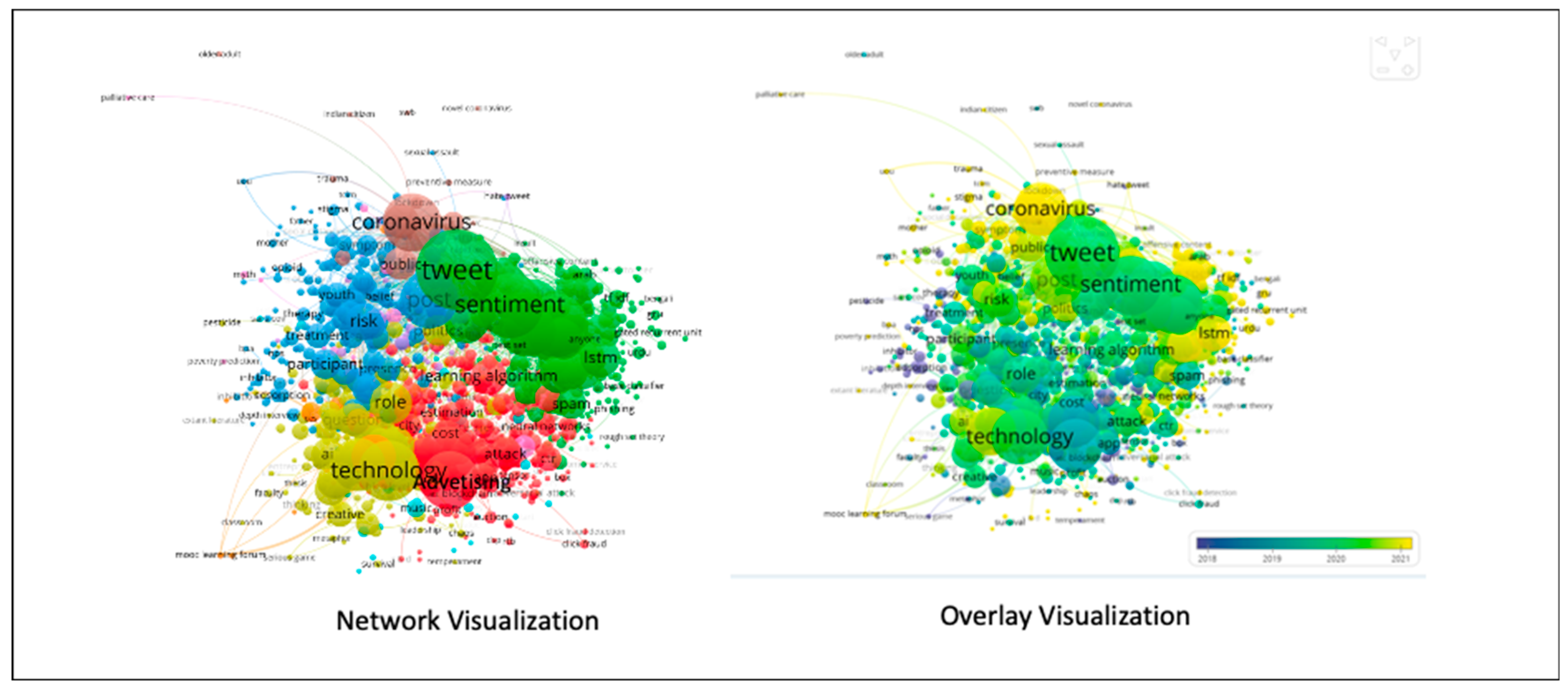
Table 4.
Co-occurrences of Terms Analysis (Full Counting) - Clustering.
| Cluster | Cluster Name | Description |
|---|---|---|
| 1 (Red) | AI-Enhanced Advertising Ecosystem | The cluster, with its diverse set of terms, provides insights into the multifaceted intersection of AI and advertising, serving as a valuable resource for researchers and practitioners seeking a holistic understanding of the AI-driven advertising ecosystem. |
| 2 (Green) | Enhanced Sentiment and Misinformation Classification in social media | This cluster aims to contribute significantly to the discourse surrounding sentiment dynamics and misinformation detection in social media contexts relevant to advertising and AI applications. |
| 3 (Blue) | Comprehensive Exploration of Mental Health and Societal Dynamics | This cluster provides a rich exploration of mental health dynamics within the context of societal influences and online discourse, contributing valuable insights for AI applications in advertising addressing mental health-related issues. |
| 4 (Yellow) | Surveillance and Methodological Insights in Health Communication | This cluster offers a comprehensive examination of the evolving landscape of health communication, providing methodological insights and technological approaches relevant to AI applications in advertising within the health domain. |
| 5 (Purple) | Deception Detection and Computational Modeling in NLP | This cluster provides a nuanced view of the intricate techniques and methodologies employed in NLP for deception detection and computational modeling. |
| 6 (Sky Blue) | Music Consumption and Neuroscientific Insights | This cluster signifies a comprehensive examination of the intricate relationships between music, consumer identity, and neuroscientific aspects, offering valuable insights for advertisers in the music industry. |
| 7 (Orange) | Knowledge and Social Impact in Tourism | This cluster reflects a multidimensional examination of AI’s contributions to knowledge, societal influences, and their implications for the tourism industry in the realm of advertising. |
| 8 (Brown) | AI’s Response to the Global Pandemic | The cluster implies a nuanced examination of how AI technologies can assist in managing and mitigating the consequences of a pandemic on a global scale, reflecting the interdisciplinary nature of AI applications in advertising during extraordinary circumstances. |
| 9 (Pink) | Financial Impact and Social Awareness | This cohesive grouping implies an exploration of how AI can be a valuable tool for financial predictions and simultaneously contribute to socially impactful advertising initiatives, reflecting the diverse applications of AI technologies in advertising. |
| 10 (Coral) | Appearance | This cluster likely encapsulates discussions related to the visual elements, aesthetics, and overall presentation of content in advertising campaigns. |
In conducting our co-occurrence analysis, we employed clustering technique to distill a vast array of terms into cohesive clusters, allowing for a more nuanced exploration of the interdisciplinary landscape within AI research, particularly in the context of advertising. Clustering, as a methodological approach, enables the identification of cohesive groups of terms, shedding light on the underlying themes, relationships, and emergent patterns within the extensive dataset. By categorizing related terms into clusters, we can unravel the intricate connections between various concepts, facilitating a comprehensive understanding of the multifaceted dimensions that characterize the evolving field of AI in advertising. This systematic approach not only aids in discerning prevalent trends but also contributes to the interpretation of the complex interplay between technological advancements, ethical considerations, and user-centric approaches in the realm of AI-enhanced advertising.
The largest and most relevant cluster in our co-occurrence analysis, aptly titled “AI-Enhanced Advertising Ecosystem,” encapsulates the dynamic fusion of artificial intelligence (AI) technologies with the intricate landscape of advertising practices. This expansive cluster not only incorporates cutting-edge AI methodologies such as “learning algorithm” and “convolutional neural network,” indicating the integration of machine learning and deep learning techniques, but also delves into crucial ethical considerations with terms like “attack,” “blockchain,” and “protection.” The multifaceted nature of this cluster extends to user-centric elements, evident in terms such as “customer,” “satisfaction,” and “recommender system,” emphasizing the role of AI in tailoring advertising content to individual preferences. Moreover, the cluster reflects the evolution of advertising strategies with terms like “computational advertising,” “search advertising,” and “contextual advertising,” highlighting the role of AI in targeted and personalized advertising. Beyond traditional boundaries, terms like “IoT,” “smart city,” and “autonomous vehicle” underscore the pervasive influence of AI applications in shaping not only advertising ecosystems but also broader aspects of technology and society.
In relation to our research questions, this dominant cluster provides valuable insights into the prominent themes and emerging trends within the field of AI in advertising (RQ1 and RQ2). The prevalence of terms related to technological advancements, ethical considerations, and user-centric approaches aligns with the overarching trajectory of Generative AI within the advertising domain (RQ4 and RQ5). The cluster’s sheer size and relevance underscore its significance, serving as a focal point for understanding the intricate dynamics of AI-driven advertising and providing a foundation for future research endeavors in this rapidly evolving field.
Figure 5.
Nodes Tied to Advertising & Artificial Intelligence Visualization (Full Counting).
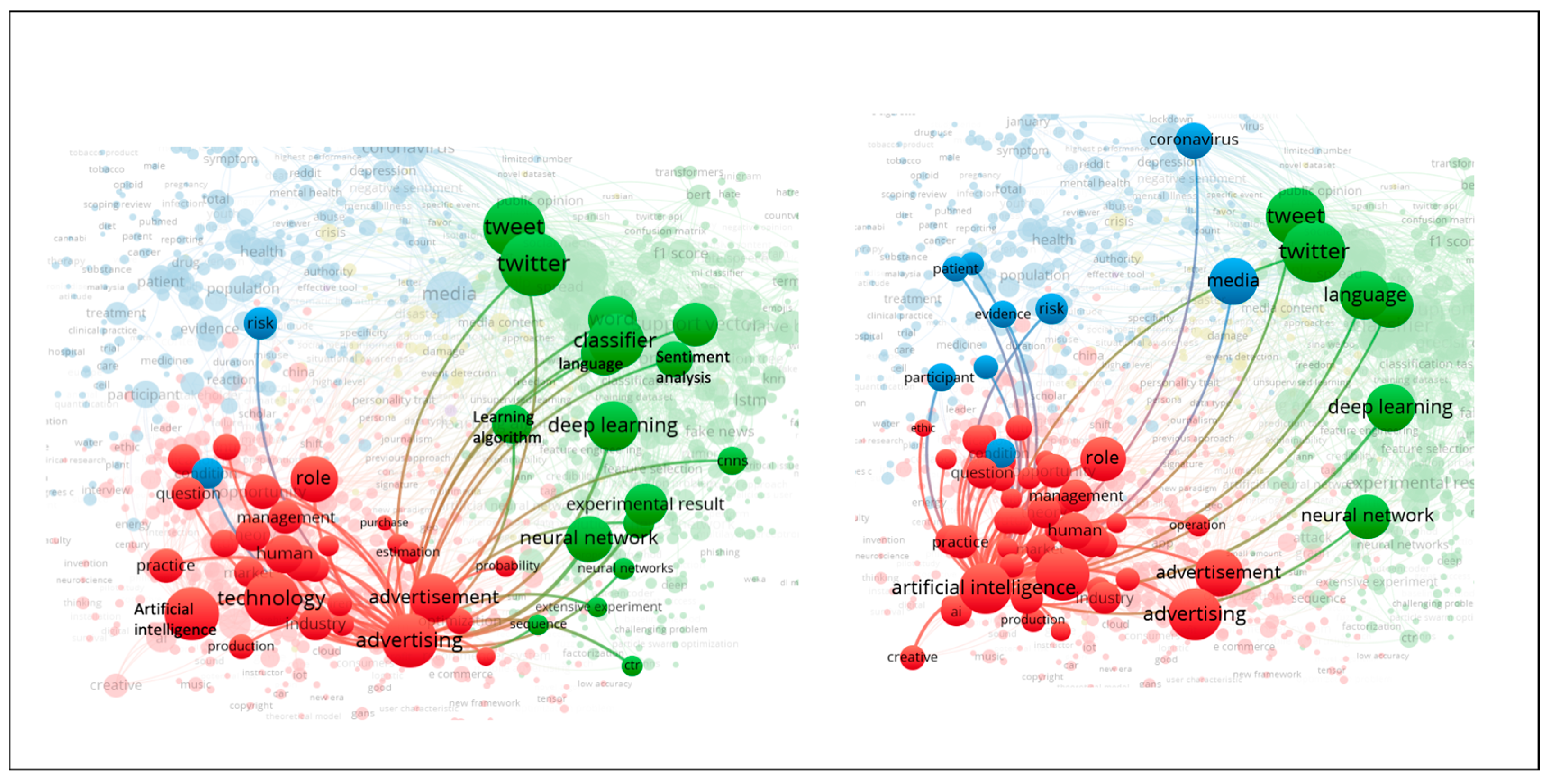
The connections stemming from the advertising and artificial intelligence clusters exhibit a discernible focus on critical elements pivotal to the field. Deep learning, an advanced machine learning technique, emerges as a prominent node, underscoring its critical role in integrating AI within advertising. This suggests a concerted effort to harness the potential of deep learning algorithms in crafting innovative advertising strategies. Neural networks, a foundational concept in artificial intelligence, are also strongly linked, indicating their relevance in the context of advertising. Language, another recurrent theme, highlights the significance of natural language processing for tasks like sentiment analysis or content generation. Twitter features prominently, implying a specific interest in leveraging this platform for advertising endeavors, which aligns with Twitter’s real-time nature and widespread reach. As a node, media points to the diverse forms of media content being explored, indicating a multi-modal approach to advertising strategies. Including terms like “pieces of evidence” suggests a rigorous approach to experimentation and validation, emphasizing the empirical foundation of the research. These connections elucidate a comprehensive approach to integrating artificial intelligence into advertising, encompassing advanced algorithms, linguistic analysis, and strategic utilization of social media platforms. This signifies a nuanced and forward-looking approach to applying Generative AI in the advertising domain.
In Table 5, Results from running the data in VOS Viewer and NodeXL are shown. The degree of centrality, as evidenced by the prominence of terms such as “technology,” “tweet,” and “knowledge,” reveals the pivotal role of technological advancements and social media discourse in the interdisciplinary landscape of AI research. The high degree centrality of “technology” underscores the fundamental importance of cutting-edge tools and methodologies within the field, indicative of a strong emphasis on innovation and progress. Simultaneously, the prevalence of terms like “tweet” and “sentiment” suggests a significant focus on social media dynamics, highlighting the integral role of user-generated content and sentiment analysis in the context of AI applications.
Examining betweenness centrality, “technology” and “tweet” again emerge as central nodes, showcasing their critical bridging role in connecting various thematic clusters. This aligns with the overarching theme of the intersection between technology and social discourse, emphasizing the influential position of these terms in mediating interactions within the broader AI research landscape. Furthermore, the inclusion of terms like “advertising” and “advertisement” in the betweenness centrality metrics points towards the interconnectedness of AI with the advertising domain, substantiating the relevance of our study in understanding the symbiotic relationship between these realms.
Closeness centrality reinforces the significance of “technology” and “tweet,” emphasizing their proximity to other terms within the network. This proximity signifies their integral position, serving as central hubs that facilitate efficient information flow and connectivity. The presence of “sentiment” and “word” in the closeness centrality metrics indicates the interconnected nature of language, sentiment analysis, and word usage, suggesting a rich interplay of linguistic elements within the AI landscape.
Analyzing tie strength, the prominence of “tweet” and “coronavirus” underscores the intersection between AI, social media, and real-world events. The strength of ties in these areas suggests a heightened focus on leveraging AI for analyzing sentiments, opinions, and information dissemination, particularly in the context of significant global events such as the COVID-19 pandemic. The substantial tie strength associated with “sentiment analysis” and “technology” further emphasizes the synergy between linguistic analysis and technological advancements, portraying a landscape where AI is harnessed for understanding and interpreting user sentiments in various applications.
The total link strength, which represents the cumulative strength of connections between terms, aligns with the prominence of “tweet,” “sentiment,” and “technology.” This cumulative strength underscores the collective influence and interdependence of these terms, highlighting their integral role in shaping the discourse and directions within the AI research landscape.
In terms of occurrences, the frequency of “tweet” and “sentiment” indicates a sustained scholarly interest in understanding and utilizing social media content for AI applications. The high occurrences of these terms suggest a continuous exploration of the role of user-generated content and sentiment analysis in the development and implementation of AI models. The consistent presence of “advertising” and “artificial intelligence” in occurrences aligns with the overarching theme of this study, emphasizing the persistent relevance of AI in advertising and the ongoing exploration of its multifaceted applications.
The centrality and tie strength metrics collectively reveal a landscape where technology, social media, sentiment analysis, and advertising coalesce, emphasizing the interconnected and influential role of these elements within the broader AI research domain. The high occurrences of relevant terms further highlight the sustained scholarly interest and ongoing exploration of these themes in the academic discourse. These findings significantly contribute to our understanding of the interdisciplinary nature of AI research, particularly in the context of advertising applications.
Table 6.
Co-occurrences of Terms Analysis (Full Counting) – Publication Years.
| Publication Years | |
|---|---|
| Terms | Years |
| tcim | 2022 |
| neurosurgery awareness month | 2022 |
| palliative care | 2021 |
| indirect appeal | 2021 |
| self competence | 2021 |
| cpss | 2021 |
| mgc | 2021 |
| ipv | 2021 |
| common theme | 2021 |
| bpa | 2021 |
The co-occurrence analysis of terms, each accompanied by its respective publication year, offers valuable insights into the thematic landscape of scholarly works. Notably, the term “tcim” also known as Traditional, Complementary and Integrative Medicines (TCIM) surfaces in the most recent publications of 2022, indicating its contemporaneity within academic dialogues. While the acronym remains undefined in this context, its recurrence suggests an emerging or focal concept in recent research endeavors.
The term “neurosurgery awareness month” appearing twice in 2022 may signify an increased scholarly attention to initiatives dedicated to raising awareness about neurosurgery, possibly implicating evolving perspectives in healthcare communication or public health campaigns. Delving into the acronym-laden entries, “CPSS,” “MGC,” and “IPV,” identified within the publications of 2021, warrant further scrutiny to elucidate their specific domain relevance and contributions to the scholarly discourse.
Furthermore, the appearance of terms such as “indirect appeal” and “self-competence” in 2021 implies an enduring interest in psychological and persuasive dimensions within communication studies, particularly relevant in the context of advertising discourse. The acronym “BPA” in 2021 may pertain to Bisphenol A, a compound associated with plastics, potentially indicating a confluence of environmental and health-related considerations within the broader scope of the research.
This meticulous examination of co-occurring terms and their respective publication years lays the groundwork for a nuanced exploration of contemporary academic inquiries, offering a glimpse into evolving thematic trends and potential intersections within the dynamic landscape of scholarly research.
5.2. Co-Occurrences of Keywords Analysis
In conducting the comprehensive co-occurrences of keywords, VOS viewer and NodeXL were employed, each playing a distinct role in unraveling the intricate network of keywords. For VOS viewer, the co-occurrence type of analysis was selected, utilizing all keywords as the unit of analysis. The full counting method was chosen to gauge the strength and frequency of connections between keywords, providing a detailed perspective on their relationships. This method was preferred due to its ability to capture nuanced associations, assigning numerical values to signify the degree of connection. The application of a thesaurus file enriched the analysis by incorporating synonyms and related terms, ensuring a more accurate representation of keyword relationships. To focus on relevant terms, a minimum occurrence threshold of 5 was set, resulting in 984 terms selected for further analysis. To refine the dataset and eliminate irrelevant terms, especially those related to the health industry, exclusion criteria were applied to words such as diseases, medications, and health-related terms. The refined dataset was then subjected to network analysis, and the results were exported in Pajek format for subsequent centrality analysis in NodeXL. This meticulous approach, combining VOS viewer’s network analysis and NodeXL’s centrality computation, ensures a comprehensive exploration of the keyword landscape in the context of artificial intelligence and advertising.
Figure 6.
Keyword Co-occurrence Analysis Network Visualizations.
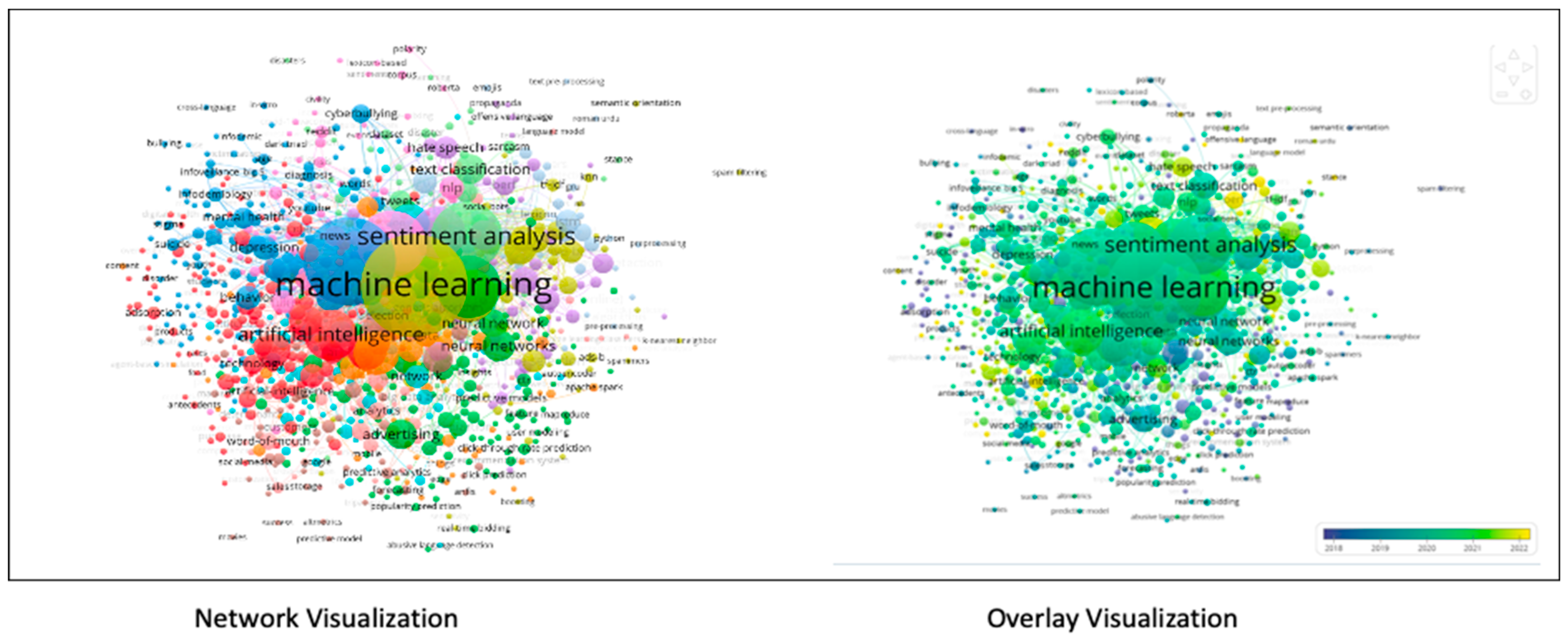
Table 7.
Co-occurrence of Keywords - Clustering
| Cluster | Cluster Name | Description |
|---|---|---|
| 1 (Red) | AI Impact and Ethical Considerations in Advertising | This cluster provides a comprehensive overview of the broad spectrum of issues related to the impact, ethics, and varied applications of AI in advertising, offering insights into the evolving landscape and the ethical considerations associated with the integration of advanced technologies in the field. |
| 2 (Green) | Deep Learning in Advertising and Information Retrieval | This cluster provides a comprehensive view of the intersection between deep learning, advertising, and information retrieval, showcasing the diverse applications and challenges within this domain. |
| 3 (Blue) | Social Media Impact on Mental Health and Public Health Surveillance | The broad scope of this cluster contributes to a nuanced understanding of the complex interplay between social media, mental health, and public health dynamics. |
| 4 (Yellow) | Machine Learning Applications in Cybersecurity and Advertisement | This cluster provides insights into the multifaceted applications of machine learning techniques in enhancing cybersecurity measures and optimizing advertising strategies. |
| 5 (Purple) | Deception Detection and Computational Modeling in NLP | This cluster provides a nuanced view of the intricate techniques and methodologies employed in NLP for deception detection and computational modeling. |
| 6 (Sky Blue) | Crisis Management and Data-Driven Decision-Making | This cluster provides insights into the multifaceted aspects of crisis management, emphasizing the role of data-driven decision-making and advanced technologies in addressing challenges. |
| 7 (Orange) | Emerging Technologies and Big Data Integration | This cluster provides insights into the evolving landscape of emerging technologies, big data utilization, and their multifaceted integration across various domains. |
| 8 (Brown) | Predictive Analytics and Personalization Strategies | This cluster provides insights into the evolving landscape of predictive analytics, its diverse applications, and the integration of human-AI collaboration for personalized experiences. |
| 9 (Pink) | Social Media Analysis and Communication Dynamics | This cluster is centered around the analysis of social media, particularly Twitter, and the dynamics of online communication. Additionally, the cluster delves into computational methods, linguistic analysis, and visual analytics to unravel patterns in online content. |
| 10 (Coral) | Business Intelligence and Consumer Insights | This cluster revolves around business intelligence, consumer insights, and the analysis of user-generated content. |
| 11 (Mint) | Text Analysis in Sentiment Classification | The cluster includes techniques like gradient boosting, naive Bayes classification, and embeddings, emphasizing the employment of various machine learning approaches for effective text analysis in the domain of disaster management and sentiment classification. |
| 12 (Pastel Blue) | Advanced Natural Language Processing and Text Analysis | This cluster focuses on various aspects of natural language processing (NLP) and machine learning techniques applied to text and language analysis. |
In this network analysis, 920 nodes representing distinct keywords were systematically examined, revealing insightful patterns through the identification of 12 distinct clusters. The clusters, including “AI Impact and Ethical Considerations in Advertising,” “Deep Learning in Advertising and Information Retrieval,” “Social Media Impact on Mental Health and Public Health Surveillance,” and others, encapsulate thematic concentrations within the vast landscape of AI and advertising research. The network comprises 27,214 links, with a total link strength of 55,601, providing a nuanced understanding of the relationships and associations among these keywords. Clustering serves as a valuable tool to unveil inherent structures, highlighting cohesive groups of related terms. This approach facilitates a more organized exploration of diverse research themes, aiding in the identification of trends and the categorization of topics. Concurrently, co-occurrence analysis of keywords is a strategic method to unravel hidden connections and recurrent themes across academic literature. By examining which terms frequently appear together, this analysis offers insights into prevalent topics, emerging trends, and the interplay between various concepts within the realm of AI and advertising. The combination of clustering and co-occurrence analysis enhances the comprehension of the multidimensional facets of research in this dynamic field, providing a foundation for a more targeted and insightful investigation.
Table 8.
Co-occurrences of Keywords Network Analysis Data
| Centrality | Link Strength | Documents | |||||||
|---|---|---|---|---|---|---|---|---|---|
| Keywords | Degree | Keywords | Betweenness | Keywords | Closeness | Keywords | Tie Strength | Keywords | Occurrences |
| machine learning | 806 | machine learning | 60748.198 | machine learning | 0.891 | machine learning | 6805 | machine learning | 1644 |
| social media | 740 | social media | 43256.645 | social media | 0.837 | social media | 5714 | social media | 1213 |
| 595 | 21682.789 | 0.739 | 3445 | sentiment analysis | 718 | ||||
| deep learning | 527 | deep learning | 19698.834 | deep learning | 0.701 | sentiment analysis | 3144 | 686 | |
| sentiment analysis | 515 | classification | 16078.697 | sentiment analysis | 0.695 | deep learning | 2509 | deep learning | 593 |
| classification | 505 | sentiment analysis | 15862.208 | classification | 0.689 | classification | 2094 | classification | 444 |
| big data | 462 | artificial intelligence | 13931.537 | big data | 0.668 | natural language processing | 1899 | natural language processing | 425 |
| artificial intelligence | 459 | big data | 11645.331 | artificial intelligence | 0.666 | big data | 1543 | artificial intelligence | 397 |
| natural language processing | 425 | model | 10273.965 | natural language processing | 0.65 | artificial intelligence | 1412 | big data | 298 |
| model | 406 | natural language processing | 10023.799 | model | 0.641 | covid-19 | 1140 | covid-19 | 224 |
The examination of keyword co-occurrences in artificial intelligence for advertising research provides valuable insights into the central themes and connections within the field. Notably, machine learning emerges as a pivotal keyword, dominating in terms of degree centrality, betweenness, closeness, and total link strength. This underscores the foundational role of machine learning in shaping research conversations and collaborative networks. Social media and Twitter follow closely, exhibiting comparable centrality metrics, indicating their substantial influence and interconnectedness within the research landscape. The co-occurrence count reinforces the prominence of machine learning, with a substantial 1,644 instances, followed by social media (1,213) and sentiment analysis (718). These findings signify the integral role of these keywords in the discourse surrounding artificial intelligence in advertising, reflecting a strong emphasis on the intersection of machine learning, social media, and sentiment analysis in contemporary research endeavors.
The dominance of machine learning in keyword co-occurrence analysis stems not just from its impressive abilities and versatility, but also from its foundational position as the cornerstone of artificial intelligence itself. As ML is considered a vital category within AI, its research methods – constantly refined with data and experience – form the very backbone of optimized computer programs powering advanced AI applications (Zhu et al.,2022). This inherent connection to the core of AI naturally positions machine learning as the preeminent driving force behind sophisticated techniques like keyword co-occurrence analysis. Machine learning techniques, ranging from neural networks to deep learning algorithms, play a pivotal role in developing and enhancing advertising strategies. Researchers and practitioners alike recognize the transformative impact of machine learning in personalizing content, optimizing ad targeting, and improving overall advertising effectiveness. Social media and Twitter, closely following in centrality metrics and co-occurrence counts, signify the increasing reliance on these platforms as crucial channels for advertising content dissemination and audience engagement. The dynamic and real-time nature of social media platforms aligns seamlessly with the evolving landscape of advertising, driving researchers to explore the integration of artificial intelligence, particularly machine learning, to harness its capabilities in these influential domains. Furthermore, the significant co-occurrence of sentiment analysis highlights the growing interest in understanding and leveraging user sentiments to tailor advertising content, emphasizing the industry’s shift toward more personalized and emotionally resonant marketing strategies.
Table 9.
Co-occurrence of Keywords Publication Year Analysis.
| Keyword | Publication Year |
|---|---|
| generative ai | 2022 |
| social media platforms | 2022 |
| digital media | 2022 |
| accessibility | 2022 |
| perspective | 2022 |
| social media use | 2022 |
| inclusion | 2022 |
| ai ethics | 2022 |
| data classification | 2022 |
| theme | 2022 |
The recent surge in research focusing on keywords such as “generative AI,” “social media platforms,” “digital media,” “accessibility,” “perspective,” “social media use,” “inclusion,” “AI ethics,” “data classification,” and “theme” reflects the evolving landscape and emerging priorities within the field of artificial intelligence in advertising. “Generative AI” signifies a growing interest in advanced AI models capable of creating diverse and dynamic content for advertising purposes, showcasing the industry’s continuous quest for innovative and impactful strategies. The prominence of “social media platforms” and “digital media” underscores the increasing emphasis on leveraging these platforms for advertising campaigns, aligning with contemporary trends in consumer behavior and media consumption. The inclusion of “accessibility” and “inclusion” suggests a heightened awareness and commitment to creating advertising content that is accessible to a diverse audience, acknowledging the importance of inclusivity in contemporary marketing practices. The appearance of “AI ethics” highlights the growing ethical considerations associated with the use of artificial intelligence in advertising, emphasizing the need for responsible and transparent AI practices. Additionally, “data classification” reflects the ongoing efforts to manage and categorize data effectively in the context of advertising analytics, ensuring the quality and relevance of insights derived from AI-powered systems. Lastly, the keyword “theme” suggests a focus on the overarching themes and narratives that drive advertising strategies, indicating a holistic approach to content creation and campaign development.
5.3. Co-Authorship in Countries
In co-authorship analysis, an extensive examination of collaborative networks among countries was conducted, shedding light on global research collaborations in the field of artificial intelligence in advertising. The unit of analysis was countries, and both full and fractional counting methods were applied to discern the intricate relationships between nations. Notably, a meticulous approach was taken to filter out documents co-authored by many countries, setting a maximum limit of 25 countries per document. This decision aimed to emphasize meaningful collaborations and avoid dilution of the analysis. The application of a thesaurus file enriched the analysis by incorporating variations in country names, ensuring a comprehensive assessment of collaborative networks. To ensure the inclusion of robust collaborative efforts, a minimum threshold of 5 documents per country was set. Like earlier analyses, Vos Viewer and NodeXL were used to comprehensively analyze the network and centrality.
5.3.1. Full Counting Method
For the Full Counting method, out of the 105 countries initially available, 62 met this threshold, forming the basis for subsequent analysis. The resulting dataset consisted of 62 items, representing 62 countries engaged in collaborative research efforts. These countries were then grouped into 9 clusters, reflecting distinct patterns of research collaboration. The analysis revealed a total of 416 links, symbolizing collaborative ties, with a total link strength of 1426, providing quantitative insights into the strength of these collaborative networks.
Figure 7.
Co-Authorship Visualizations - Full Counting Method.
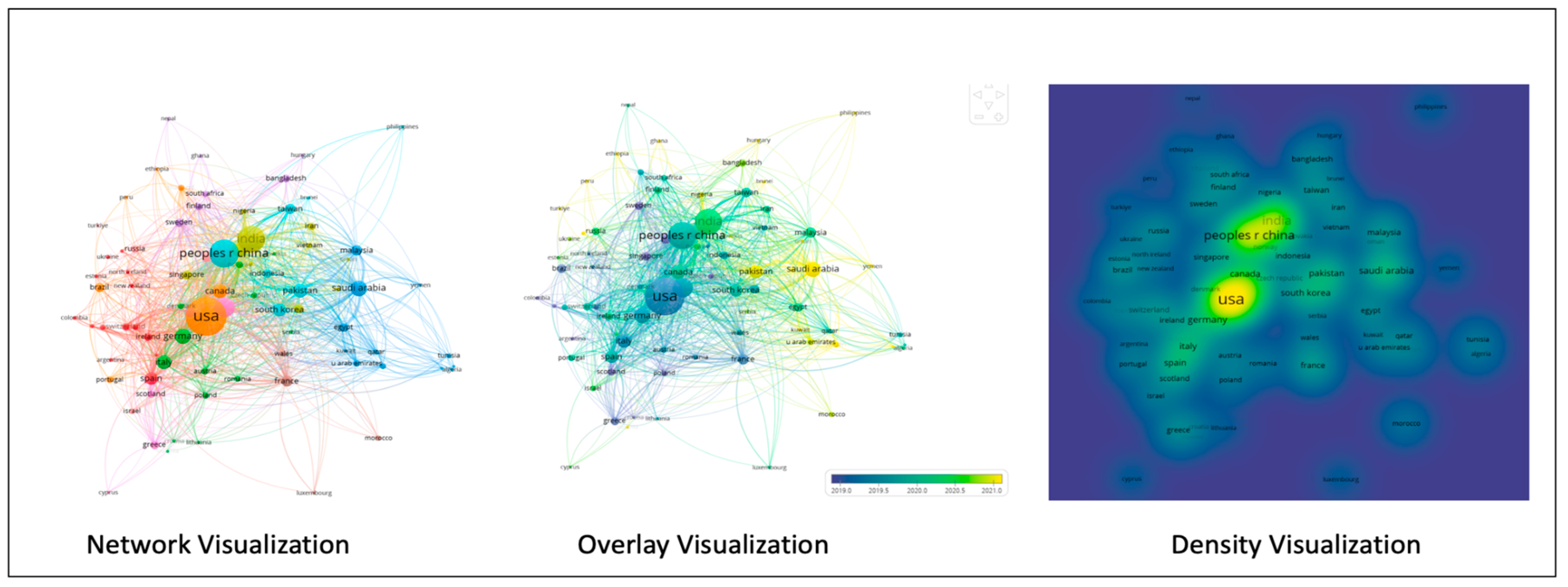
In Table 10, we can see the results from the data analysis done from NodeXL for the centrality, and the data from of strength ties and publications provided by VOSViewer. A comprehensive analysis of co-authorship sheds light on the global landscape of research collaboration. The United States emerges as a central hub, not only leading in the number of documents available, with a substantial 1,808 publications, but also dominating the centrality metrics. The USA tops the charts in degree, betweenness, and total link strength, highlighting its pivotal role in collaborative networks within this field. Notably, the USA showcases strong collaborations with researchers from diverse continents, including Vietnam, Iraq, and Germany, showcasing the extent of its global reach and influence. England, another significant contributor, exhibits notable betweenness and closeness centrality, indicating its strategic position in facilitating communication and information flow among researchers. India, while ranking slightly lower in terms of document availability, establishes a solid presence with commendable centrality metrics, emphasizing its active engagement in collaborative efforts. Additionally, China stands out for its considerable strength tie, signifying the robustness of connections in its research collaborations. This analysis underscores the dynamic and global nature of research in artificial intelligence in advertising, with key players like the USA, England, India, and China influencing collaborative networks and contributing substantially to the scholarly discourse in this evolving field.
In the Overlay Visualization, node colors correspond to the average appearing year (AAY), as indicated by the color gradient in the lower right corner. It is intriguing that countries with smaller nodes, such as Sweden, Japan, Singapore, Scotland, Poland, and Greece, initiated co-authored documents. However, as the years progressed, the USA took center stage regarding centrality and influence. The evolution of AI in advertising is evident, particularly with China’s notable entry into the field in 2020. Saudi Arabia and Pakistan also emerged as newer players in this domain.
5.3.2. Fractional Counting Method
For the Fractional Method, out of the 115 countries initially available, 72 met this threshold, forming the basis for subsequent analysis. The resulting dataset consisted of 72 items, representing 72 countries engaged in collaborative research efforts. These countries were then grouped into 12 clusters, reflecting distinct patterns of research collaboration. The analysis revealed a total of 590 links, symbolizing collaborative ties, with a total link strength of 1315.50, providing quantitative insights into the strength of these collaborative networks.
Figure 8.
Co-Authorship of Countries Visualization - Fractional Counting Method.
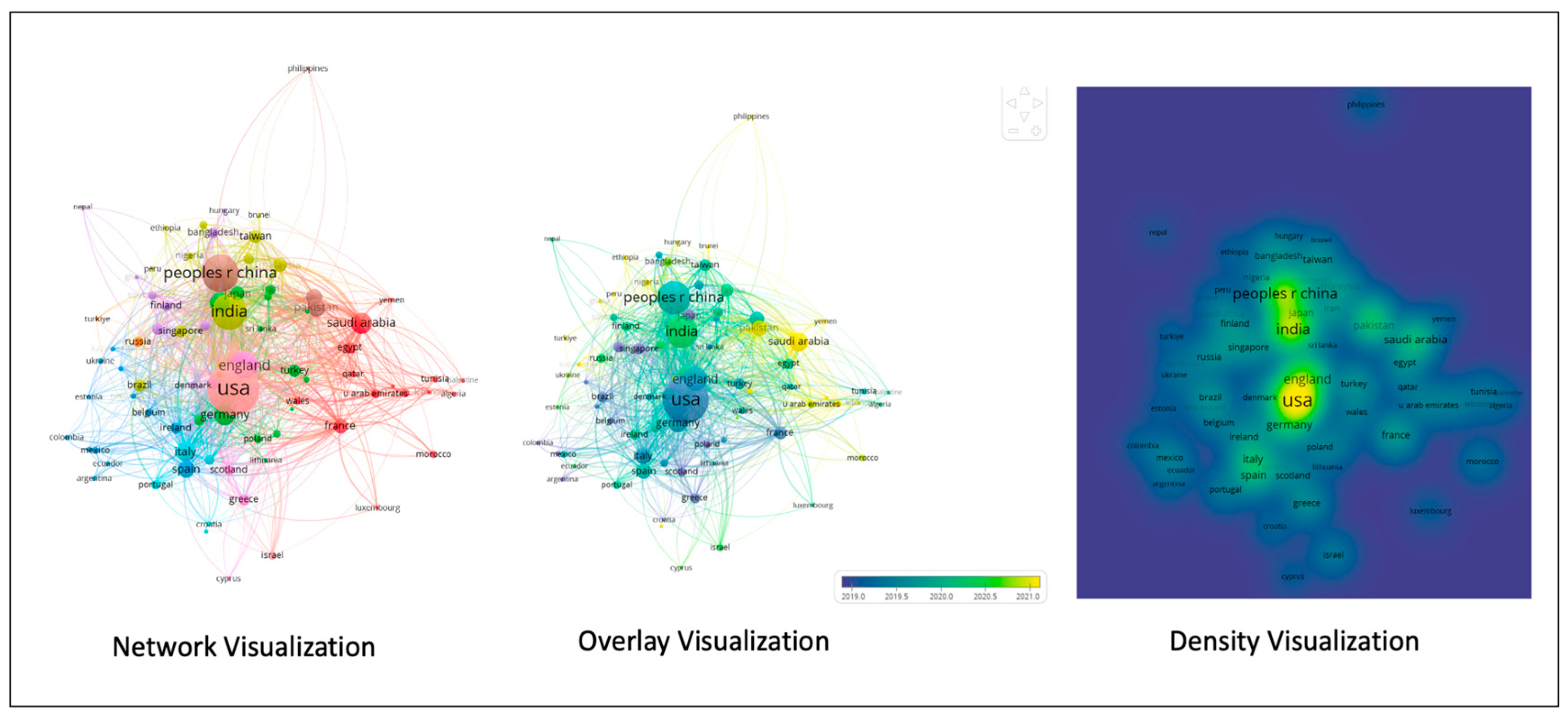
Table 11.
Co-Authorship of Countries Analysis Fractional Method Network Analysis Data.
| Centrality | Link Strength | Documents | |||||||||
|---|---|---|---|---|---|---|---|---|---|---|---|
| Countries | Degree | Countries | Betweenness | Countries | Closeness | Countries | Tie Strength | Countries | Publications | ||
| usa | 58 | usa | 383.8 | usa | 0.835 | usa | 511 | usa | 1808 | ||
| england | 57 | england | 332.621 | england | 0.835 | china | 294 | china | 925 | ||
| india | 53 | india | 277.31 | india | 0.789 | england | 260 | india | 834 | ||
| france | 43 | france | 162.213 | france | 0.717 | india | 157 | england | 479 | ||
| china | 42 | china | 108.698 | china | 0.71 | germany | 125 | germany | 272 | ||
| germany | 40 | germany | 77.019 | germany | 0.689 | france | 83 | south korea | 186 | ||
| netherlands | 33 | netherlands | 72.584 | netherlands | 0.651 | netherlands | 77 | france | 148 | ||
| egypt | 29 | croatia | 71.427 | egypt | 0.623 | south korea | 68 | netherlands | 114 | ||
| ireland | 27 | egypt | 58.887 | belgium | 0.612 | singapore | 60 | taiwan | 112 | ||
| sweden | 26 | belgium | 50.789 | ireland | 0.612 | switzerland | 49 | turkey | 103 | ||
The application of fractional counting in co-authorship analysis with a unit of analysis focusing on countries provides valuable insights into the global collaborative landscape in artificial intelligence for advertising. Examining the degree of centrality, betweenness centrality, and closeness centrality, the United States emerges as a prominent leader, indicating its extensive engagement and influence in collaborative research networks. This is consistent with the USA’s robust performance in total link strength, solidifying its position in forging strong connections with other nations. China, while trailing in the degree of centrality, demonstrates substantial strength ties, emphasizing the quality and robustness of its collaborations. England exhibits notable centrality metrics, positioning itself strategically in facilitating communication and information flow. Analyzing the publication metrics, the USA maintains a dominant presence, contributing the highest number of documents, followed by China and India. This nuanced analysis underscores the multifaceted nature of global collaboration in artificial intelligence for advertising, with each country playing a unique and significant role in shaping the research landscape.
China’s notable entry into the field in 2020, as observed in the overlay visualization, underscores the global expansion of research efforts in this domain. This indicates a growing international interest and engagement in the intersection of generative AI and advertising. The density visualizations further emphasize the critical role of the USA and China as crucial collaborators, indicating a dense network of connections and reinforcing their influence in shaping the landscape of generative AI in advertising. These findings collectively affirm the importance of international collaboration and knowledge exchange in advancing the application of generative AI techniques in advertising practices.
The comparative analysis between full counting and fractional counting methods in co-authorship analysis with a country unit of analysis offers nuanced insights into the collaborative dynamics within artificial intelligence for advertising research. In terms of degree centrality, both methods consistently position the United States, England, and India at the forefront, emphasizing their substantial engagement in collaborative networks. Similarly, for betweenness centrality and closeness centrality, the order remains consistent across the two counting methods. However, the fractional counting method introduces a subtle shift, highlighting China’s strength tie as a notable feature, which is less pronounced in the full counting approach. This underscores the significance of considering not only the quantity but also the quality of collaborative ties. Notably, the USA maintains its dominant position in total link strength in both methods, showcasing the robustness of its research collaborations. The fractional counting method adds granularity to the analysis, revealing unique strengths and contributions of each country.
The leadership of certain countries in the field of artificial intelligence, particularly in generative AI applied to advertising, can be attributed to a combination of various factors. One primary determinant is the level of investment and commitment each country has made to advance research and development in artificial intelligence. The United States, for instance, has been at the forefront of AI innovation, boasting significant financial investments from both public and private sectors. This financial backing has fueled extensive research initiatives and the development of cutting-edge technologies.
Moreover, the concentration of top-tier academic institutions and research organizations in these leading countries contributes to their prominence in AI research. These institutions serve as hubs for talented researchers and scientists, fostering an environment conducive to groundbreaking discoveries and advancements in AI.
Additionally, the availability of skilled researchers and professionals in these countries plays a crucial role. The United States, the United Kingdom, India, and China, among others, have a large pool of experts in AI and related fields. This talent pool enables these nations to undertake sophisticated research projects and drive innovation in generative AI applied to advertising.
Furthermore, collaboration and knowledge exchange among researchers and institutions on a global scale contribute to the leadership of these countries. Networks and partnerships between academia, industry, and government entities facilitate the flow of ideas, resources, and expertise, fostering a collaborative environment that accelerates progress in AI research.
In the context of generative AI, where technologies like GANs and advanced natural language processing methods are applied to advertising, these leading countries likely leverage their research ecosystems, investments, and skilled workforce to stay at the forefront of innovation, ultimately influencing the trajectory of research in this dynamic and evolving field.
6. Summary of Results
In summary, this study, conducted with the use of WoS data and employing methodologies such as co-occurrences analysis and co-authorship analysis, seeks to unveil key aspects of research in the dynamic intersection of artificial intelligence and advertising. In this research, we aimed to investigate the evolving relationship of advertising and AI through the lens of generative models as we explore five critical dimensions, encompassing research topics, emerging trends, geographical patterns, technological trends, and applications. Through rigorous analysis, the study sheds light on the trajectory of Generative AI in Advertising, tracing its development from foundational AI concepts to advanced machine learning techniques. We unfolded that the trajectory of AI Advertising is heavily anchored but not limited to machine learning, especially in the aspect of deep learning, predictive modelling, natural language processing (NLP) and techniques related to content recognition and creation. The methodologies employed provide a comprehensive understanding of the landscape, addressing overarching questions and contributing valuable insights to the evolving field of artificial intelligence in advertising.
RQ1 (Topic Analysis): The exploration of prominent themes and subtopics in the context of Artificial Intelligence in Advertising, conducted through keyword co-occurrence analysis and pattern identification, reveals a diverse array of concepts and themes. The identified clusters emphasize that AI techniques serve as the foundational framework for understanding the intricate relationship between AI and Advertising. Notably, machine learning assumes a central role, encompassing a spectrum of techniques and methods applicable to advertising, including predictive modeling, surveillance, error detection, content creation, natural language processing, deep learning, and more. Core terms and keywords such as “learning,” “neural networks,” and “data” underscore the fundamental aspects that constitute the backbone of artificial intelligence applications in advertising. Furthermore, significant subtopics like sentiment analysis, media platforms (e.g., Twitter), online advertising, and predictive analysis emerge, highlighting the multifaceted impact of AI on diverse advertising practices.
RQ2 (Emerging Trends): Through co-occurrence of terms & keywords analysis, emerging trends, and topics in Artificial Intelligence in Advertising over recent years are discernible. Notably, there is a surge in interest and research focus on deep learning techniques, as evidenced by the appearance of terms like “BERT,” “CNNs,” “LSTM,” “word2vec,” and “real-time systems.” These advancements in deep learning signify a pivotal trend within the field, suggesting a progressive shift towards more sophisticated AI approaches, including advanced language modeling techniques like word2vec. Generative Models applied in advertising remains as the emerging trend that’s being explored and applied by the industry today through different models, techniques, and tools.
RQ3 (Geographical Trends): The co-authorship analysis indicates significant contributions from various countries, with the USA taking a central role, hosting many co-authored documents (1808). China follows closely with 925 documents, showcasing its growing influence in the field. Other prominent contributors include India (834), England (479), Australia, Germany, Canada, Pakistan, Spain, and South Korea. This underscores a collaborative strength among these countries in advancing research on Artificial Intelligence in Advertising.
RQ4 (Technological Trends and Application Domains): Within Generative AI applied to advertising, there is a notable focus on deep learning techniques, including GANs, CNNs, LSTM, BERT, and word2vec, indicating their significance in content generation and analysis. The application domains span various areas in advertising, including content creation, sentiment analysis, and personalized marketing strategies. This suggests a broad utilization of Generative AI techniques across different facets of advertising, with specific attention to advanced natural language processing techniques like word2vec.
RQ5 (Trajectory of Generative AI in Advertising): The developmental trajectory of Generative AI within the field of advertising, as discerned from the comprehensive review, showcases a progression from foundational AI concepts toward advanced deep learning techniques. This aligns with the evolution of Generative AI, which increasingly influences content creation and engagement in advertising. The integration of advanced technologies, such as GANs, deep learning, BERT, and word2vec, indicates a forward-looking approach toward applying Generative AI in advertising practices.
7. Conclusion & Future Works
The study has shed light on the significant themes and subtopics within Artificial Intelligence in Advertising. These encompass fundamental aspects like “learning,” “neural networks,” and “data,” underscoring the core of AI applications. Additionally, emerging trends indicate a surge in deep learning techniques, signifying a pivotal shift towards more sophisticated approaches. Geographically, the USA, China, India, England, and other countries mentioned above have made substantial contributions, highlighting a global collaborative strength in advancing research on AI in advertising.
Regarding technological trends and application domains, Generative AI, mainly through deep learning techniques like GANs, CNNs, LSTM, BERT, and word2vec, is pivotal in content generation and analysis across various facets of advertising. This is because these can learn complex patterns and relationships when data is provided making them ideal for creating creative and realistic outputs. The developmental trajectory of Generative AI in advertising showcases a progression from foundational AI concepts toward advanced deep learning techniques, indicating a forward-looking approach in advertising practices.
As AI and advertising intertwine through the transformative power of generative models, future research must dissect the intricacies of this phenomenon. Deciphering how consumers emotionally respond to AI-generated messaging, how their trust fluctuates with varying degrees of realism, and how these dynamics evolve alongside technological advancements are the keys to unlocking the true potential of this potent partnership. Just as businesses require new skills to navigate the ever-shifting digital landscape, so must we equip ourselves with the tools to decode the complex interplay between AI, advertising, and generative models within the human psyche [33].
However, we must remain mindful of the potential pitfalls associated with centralized data models, as highlighted by the recent Facebook data breach and concerns about “cultural imperialism” in the hands of dominant platforms like GAFA [42]. This underscores the urgency of exploring the potential of decentralized technologies within the AI advertising landscape. Decoupling data ownership and control from centralized entities could offer a promising path toward mitigating privacy risks, fostering a more equitable power distribution, and ensuring culturally sensitive advertising practices in the AI era.
On another note, controlled experiments and surveys can play a crucial role in this endeavor. Researchers can uncover nuanced patterns that inform more effective and emotionally resonant strategies by meticulously measuring emotional responses, purchasing intent, and user satisfaction in response to AI-driven advertising [16]. As Zarifis and Fu highlight in their study on mobile app purchases, trust in AI-powered initiatives remains complex and multifaceted [62]. Future research exploring trust across various digital outlets, particularly in regions with prominent AI adoption and emerging markets, holds immense potential to inform ethical and effective advertising practices in the AI era [16].
A deep dive into the evolution of machine learning techniques and tools within advertising is crucial. Especially, its trajectory and how it can work with individuals and organizations for various opportunities. This aligns with Wheeler’s emphasis on trans literacy, the ability to navigate and utilize diverse platforms for content creation, collection, sharing, and interaction [61].
Author Contributions
For research articles with several authors, a short paragraph specifying their individual contributions must be provided. The following statements should be used “Conceptualization, P.H.W. and C.L.; methodology, M.U, Y.P.Z., H.W.P.; software, C.L.; validation, M.O., C.L. and Y.P.Z.; formal analysis, C.L.; investigation, C.L., H.W.P.; resources, C.L.; data curation, C.L.; writing—original draft preparation, C.L.; writing—review and editing, C.L., M.O., H.W.P., and Y.P.Z.; visualization, C.L.; supervision, H.W.P.; project administration, H.W.P. All authors have read and agreed to the published version of the manuscript.
Funding
This research received no external funding.
Data Availability Statement
All the data generated and used for analyzation during this study are included in this published article and its supplementary information files which can be seen in this drive (https://drive.google.com/drive/folders/1Yvxor4rCNsi7FXXVfCjH5mHSVEPVmEva?usp=sharing).
Conflicts of Interest
The authors declare no conflict of interest.
References
- Artik, K., Arque, E. C., Martinez, S. G., Perez, J. L. M., & Zhang, S. (2017). Systematic overview of industry-academic collaborations in the field of artificial intelligence. Meta-Research, 96.
- Barnett, G. A., Ruiz, J. B., & Park, H. W. (2015). Globalization or decentralization of hyperlinked content among websites: An examination of website co-citations. Presented at the 48th Hawaii International Conference on System Sciences, Kauai, HI.
- Boddu, R. S. K., Santoki, A. A., Khurana, S., Koli, P. V., Rai, R., & Agrawal, A. (2022). An analysis to understand the role of machine learning, robotics and artificial intelligence in digital marketing. Materials Today: Proceedings, 56, 2288–2292. [CrossRef]
- Baltezarevic, R. (2023). THE ROLE OF ARTIFICIAL INTELLIGENCE IN DIGITAL MARKETING. ResearchGate. https://www.researchgate.net/publication/369490089_THE_ROLE_OF_ARTIFICIAL_INTELLIGENCE_IN_DIGITAL_MARKETING.
- Brass, D.J., Galaskiewicz, J., Greve, H.R., & Tsai, W. (2004). Taking Stock of Networks and Organizations: A Multilevel Perspective. Academy of Management Journal, 47, 795-817. [CrossRef]
- Cao, H., Tan, C., Gao, Z., Chen, G., Heng, P.-A., & Li, S. Z. (2022). A survey on generative diffusion model. arXiv preprint arXiv:2209.02646. arXiv:2209.02646.
- Çepni, S., Toprak, A. G., Yatkınoğlu, A., Mercan, Ö. B., & Ozan, Ş. (2023). Performance Evaluation of a Pretrained BERT Model for Automatic Text Classification. Journal of Artificial Intelligence and Data Science, 3(1), 27-35. 1.
- Choi, J., & Lim, K. (2020). Identifying machine learning techniques for classification of target advertising. ICT Express, 6(3), 175–180. [CrossRef]
- Chung, C. J., Biddix, J. P., & Park, H. W. (2020). Using digital technology to address confirmability and scalability in thematic analysis of Participant-Provided data. The Qualitative Report. [CrossRef]
- Costache, A., Popescu, D., Mocanu, S., & Ichim, L. (2020). Target audience response analysis in out-of-home advertising using computer vision. In 2020 12th International Conference on Electronics, Computers and Artificial Intelligence (ECAI) (pp. 1-6). Bucharest, Romania. [CrossRef]
- De Bruyn, A., Viswanathan, V., Beh, Y. S., Brock, J. K.-U., & von Wangenheim, F. (2020). Artificial intelligence and marketing: Pitfalls and opportunities. Journal of Interactive Marketing, 51(1), 91–105. [CrossRef]
- Demšar, J., Curk, T., Erjavec, A., Gorup, Č., Hočevar, T., Milutinovič, M., Možina, M., Polajnar, M., Toplak, M., Starič, A., Štajdohar, M., Umek, L., Žagar, L., Žbontar, J., Žitnik, M., & Zupan, B. (2013). Orange: data mining toolbox in python. Journal of Machine Learning Research, 14(1), 2349–2353. http://eprints.fri.uni-lj.si/2267/1/2013%2DDemsar%2DOrange%2DJMLR.pdf.
- Dodgson, M., & Gann, D. (2017). Artificial intelligence will transform universities. Here’s how. World Economic Forum. https://www.weforum.org/agenda/2017/08/artificial-intelligence-will-transform-universities-here-s-how/.
- Dischler, J. (2023, May 23). Introducing a new era of AI-powered ads with Google. Google. https://blog.google/products/ads-commerce/ai-powered-ads-google-marketing-live/. 23 May.
- Du, H., Zhang, R., Liu, Y., Wang, J., Lin, Y., Li, Z., Niyato, D., Kang, J., Xiong, Z., Cui, S., Ai, B., Zhou, H., Kim, D. I. (2023). Beyond Deep Reinforcement Learning: A Tutorial on Generative Diffusion Models in Network Optimization. IEEE Transactions on Networking.
- Dura, J. (2022). Determinants of Financial Literacy and Digital Literacy on Financial Performance in Driving Post-Pandemic Economic Recovery. Journal of Contemporary Eastern Asia, 21(2), 47-69. [CrossRef]
- Dwivedi, Y. K., Hughes, L., Ismagilova, E., Aarts, G., Coombs, C., Crick, T., Duan, Y., Dwivedi, R., Janssen, M., & More Authors (2019). Artificial Intelligence (AI): Multidisciplinary perspectives on emerging challenges, opportunities, and agenda for research, practice and policy. International Journal of Information Management, 57, [101994]. [CrossRef]
- Enache, M. (2020). AI for Advertising. Annals of Dunarea De Jos University. Fascicle I: Economics and Applied Informatics, 26(1), 28–32. [CrossRef]
- Euchner, J. (2023). Generative AI. Research-technology Management, 66(3), 71–74. [CrossRef]
- Fezari, M., & Ali-Al-Dahoud, A. A. D. (n.d.). Augmanting Reality: The Power of Generative AI.
- Goodfellow, I. J., Pouget-Abadie, J., Mirza, M., Xu, B., Warde-Farley, D., Ozair, S., Courville, A., & Bengio, Y. (2014). Generative adversarial networks. arXiv (Cornell University). [CrossRef]
- Gorgoglione, M., Panniello, U., & Tuzhilin, A. (2019). Recommendation strategies in personalization applications. Information & Management, 56(6), 103143. [CrossRef]
- Hevey, D. (2018). Network analysis: a brief overview and tutorial. Health Psychology and Behavioral Medicine, 6(1), 301–328. [CrossRef]
- Huang, R., Zhao, Z., Liu, H., Liu, J., Cui, C., & Ren, Y. (2022). Prodiff: Progressive fast diffusion model for high-quality text-to-speech. Proceedings of the ACM International Conference on Multimedia, 2595–2605.
- Huh, J., Nelson, M. R., & Russell, C. A. (2023). ChatGPT, AI Advertising, and Advertising Research and Education. Journal of Advertising, 52(4), 477–482. 4. [CrossRef]
- IBM Watson Advertising Thought Leadership. (2021, April 6). How AI is changing advertising. Retrieved from https://www.ibm.com/watson-advertising/thought-leadership/how-ai-is-changing-advertising.
- Javaid, M., Haleem, A., Singh, R. P., & Suman, R. (2021). Substantial capabilities of robotics in enhancing industry 4.0 implementation. Cognitive Robotics, 1, 58–75. [CrossRef]
- Kang, Y., Cai, Z., Tan, C., Huang, Q., & Liu, H. (2020). Natural language processing (NLP) in management research: A literature review. Journal of Management Analytics, 7(2), 139–172. [CrossRef]
- Kim, H., Park, H. W., & Thelwall, M. (2006). Comparing Academic Hyperlink Structures with Journal Publishing in Korea. Science Communication, 27(4), 540–564. 4. [CrossRef]
- Kim, S. Y., & Kim, B. Y. (2020). Big Data Analysis of AI News and Robot Journalism Trends. International Journal of Advanced Research in Engineering and Technology, 11(10), 1395-1402. http://www.iaeme.com/IJARET/issues.asp?JType=IJARET&VType=11&IType=10.
- Kingma, D. P., & Welling, M. (2019). An introduction to variational autoencoders. Foundations and Trends in Machine Learning, 12(4), 307–392. [CrossRef]
- Lv, Z. (2023). Generative artificial intelligence in the metaverse era. Cognitive Robotics, 3, 208–217. [CrossRef]
- Mabula, J. B., & Ping, H. D. (2018). Use of technology and SME managers’ financial literacy in developing economies. ACM International Conference Proceeding Series, 9(6), 145–152. [CrossRef]
- Marr, B. (2023, September 8). The Amazing Ways Coca-Cola Uses Generative AI In Art And Advertising. Forbes. https://www.forbes.com/sites/bernardmarr/2023/09/08/the-amazing-ways-coca-cola-uses-generative-ai-in-art-and-advertising/?sh=1db364092874.
- Michalski, R. S., Carbonell, J. G., & Mitchell, T. M. (2013). Machine Learning: an artificial intelligence approach. In Springer eBooks.
- Mittal, G., Engel, J., Hawthorne, C., & Simon, I. (2021). Symbolic music generation with diffusion models. Proceedings of the International Society for Music Information Retrieval Conference.
- Murthy, D. (2013). Twitter: social communication in the Twitter age. Choice Reviews Online, 50(10), 50–5424. [CrossRef]
- Necula, S., & Păvăloaia, V. (2023). AI-Driven Recommendations: A Systematic review of the state of the art in E-Commerce. Applied Sciences, 13(9), 5531. [CrossRef]
- Newman, M.E. (2006). The structure and dynamics of networks. Princeton studies in complexity.
- Ongsulee, P. (2017). Artificial intelligence, machine learning and deep learning. IEEE. [CrossRef]
- Park, C. W., & Seo, D. R. (2018). Sentiment analysis of Twitter corpus related to artificial intelligence assistants. 2018 5th International Conference on Industrial Engineering and Applications (ICIEA). [CrossRef]
- Park, H. W., & Ozel, B. (2019). The Rise of Blockchain Technology: Overcoming Theoretical Poverty and Its Implications for Developing Countries. Journal of Contemporary Eastern Asia, 18(2), 1-8. [CrossRef]
- Park, J., Naumov, M., Basu, P., Deng, S., Kalaiah, A., Khudia, D. S., Law, J., Malani, P., Malevich, A., Nadathur, S., Pino, J., Schätz, M., Sidorov, A., Sivakumar, V., Tulloch, A., Wang, X., Wu, Y., Yuen, H., Diril, U.,... Smelyanskiy, M. (2018). Deep learning inference in Facebook data centers: characterization, performance optimizations and hardware implications. arXiv (Cornell University). http://export.arxiv.org/pdf/1811. 0988.
- Peng, S. (2019). Stochastic differential equations. Springer.
- Puaschunder, J. M. (2019). Artificial Diplomacy: A guide for public officials to conduct artificial intelligence. Social Science Research Network. [CrossRef]
- Ramdurai, B., & Adhithya, P. (n.d.). The Impact, Advancements and Applications of Generative AI.
- Shah, N., Bhagat, N., Chauhan, H., & Shah, M. (2020). Research trends on the usage of machine learning and artificial intelligence in advertising. Augmented Human Research, 5(1). [CrossRef]
- Sohl-Dickstein, J., Weiss, E., Maheswaranathan, N., & Ganguli, S. (2015). Deep unsupervised learning using nonequilibrium thermodynamics. In Proceedings of the International Conference on Machine Learning (pp. 2256-2265).
- Song, Y., Sohl-Dickstein, J., Kingma, D. P., Kumar, A., Ermon, S., & Poole, B. (2021). Score-based generative modeling through stochastic differential equations. Proceedings of the International Conference on Learning Representations.
- Smith, M.A. (2013). NodeXL: Simple network analysis for social media. IEEE. [CrossRef]
- Stability AI. (n.d.). Stability AI. Retrieved from https://stability.ai/, Nov 16, 2023.
- Stokel-Walker, C., & Van Noorden, R. (2023). What ChatGPT and generative AI mean for science. Nature, 614(7947), 214–216. [CrossRef]
- Technavio. (n.d.). Artificial Intelligence (AI) market: Insights on US, Canada, China, Germany, and UK - Forecasts and trends. www.linkedin.com. https://www.linkedin.com/pulse/artificial-intelligence-ai-market-insights-us-canada-china-germany.
- Van Eck, N. J., & Waltman, L. (2011). VOSviewer manual. Manual for VOSviewer version, 1(0).
- Van Eck, N. J., & Waltman, L. (2017). Citation-based clustering of publications using CitNetExplorer and VOSviewer. Scientometrics, 111(2), 1053–1070. [CrossRef]
- Van Loon, J. (2006). Network. Theory, Culture & Society, 23(2–3), 307–314. [CrossRef]
- Van Raan, A.F.J. (2005). For your citations only? Hot topics in Bibliometric analysis. Measurement: Interdisciplinary Research & Perspective, 3(1), 50–62. [CrossRef]
- Vanian, J. (2023, July 12). How the generative A.I. boom could forever change online advertising. CNBC. https://www.cnbc.com/2023/07/08/how-the-generative-ai-boom-could-forever-change-online-advertising.html.
- Vellasamy, T.S. (2021). 15 Companies using Data Analytics in Marketing. www.linkedin.com. https://www.linkedin.com/pulse/15-companies-using-data-analytics-marketing-sivabalan-vellasamy-.
- West, A., Clifford, J., & Atkinson, D. (2018). “Alexa, build me a brand” An Investigation into the Impact of Artificial Intelligence on Branding. The Business Management Review.
- Wheeler, S. (2012). Digital literacies for engagement in emerging online cultures. eLC Research Paper Series, 5, 14-25.
- Zarifis, A., & Fu, S. (2023). Re-Evaluating Trust and Privacy Concerns When Purchasing a Mobile App: Re-Calibrating for the Increasing Role of Artificial Intelligence. Digital, 3, 286–299. [CrossRef]
- Zhao, H., Lyu, F., & Luo, Y. (2022). Research on the effect of online marketing based on multimodel fusion and artificial intelligence in the context of big data. Security and Communication Networks, 2022, 1–9. [CrossRef]
- Zhao, Y., Yin, J., Zhang, J., & Wu, L. (2023). Identifying the driving factors of word co-occurrence: a perspective of semantic relations. Scientometrics, 128(12), 6471–6494. [CrossRef]
- Zhu, Y. P., & Park, H. W. (2022). Use of Triangulation in Comparing the Blockchain Knowledge Structure between China and South Korea: Scientometric Network, Topic Modeling, and Prediction Technique. Sustainability, 14(4), 2326. [CrossRef]
Figure 1.
Word Cloud via Orange Data Mining.
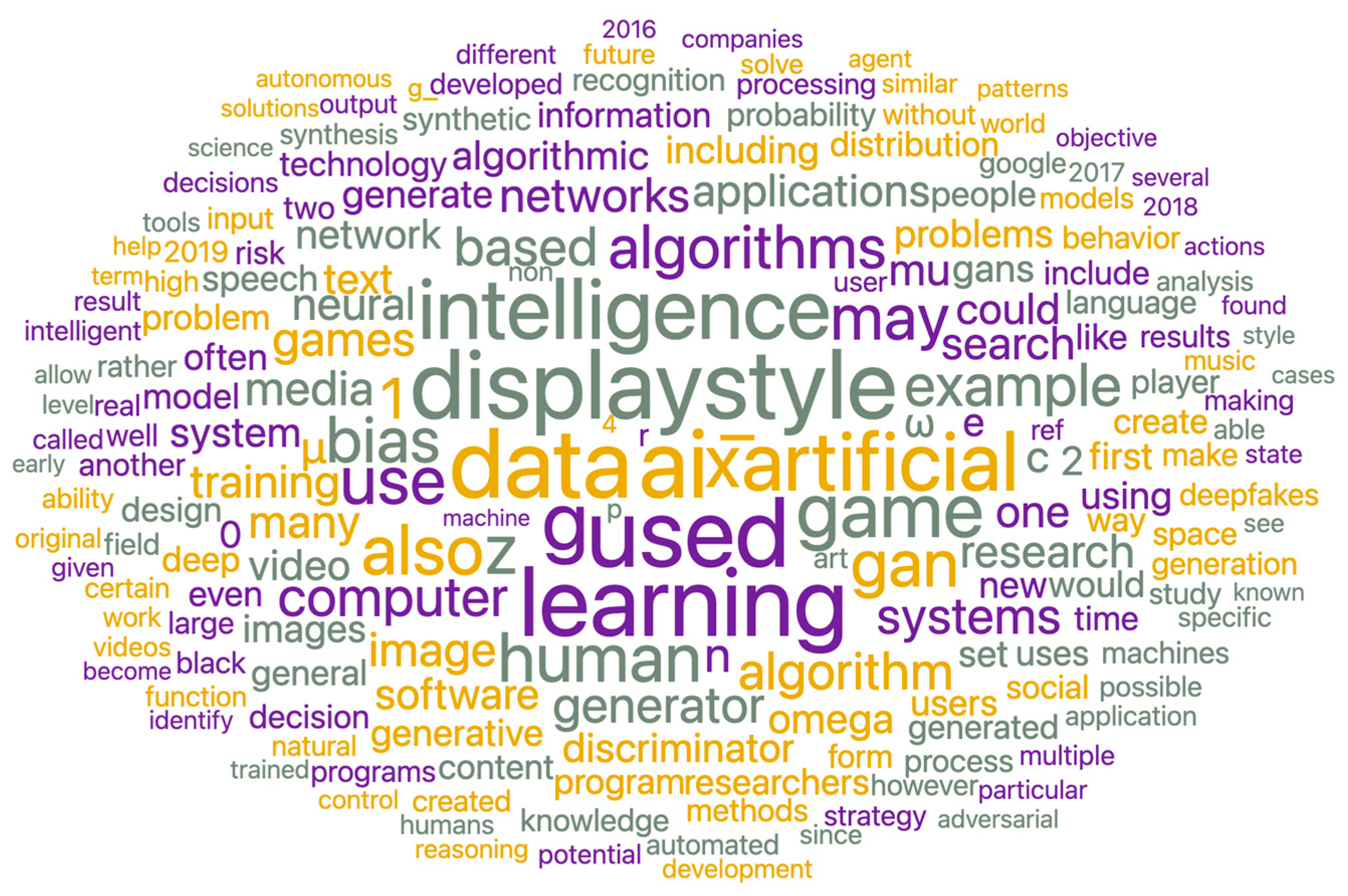
Figure 3.
Artificial Intelligence in Advertising Node Visualization (Binary).
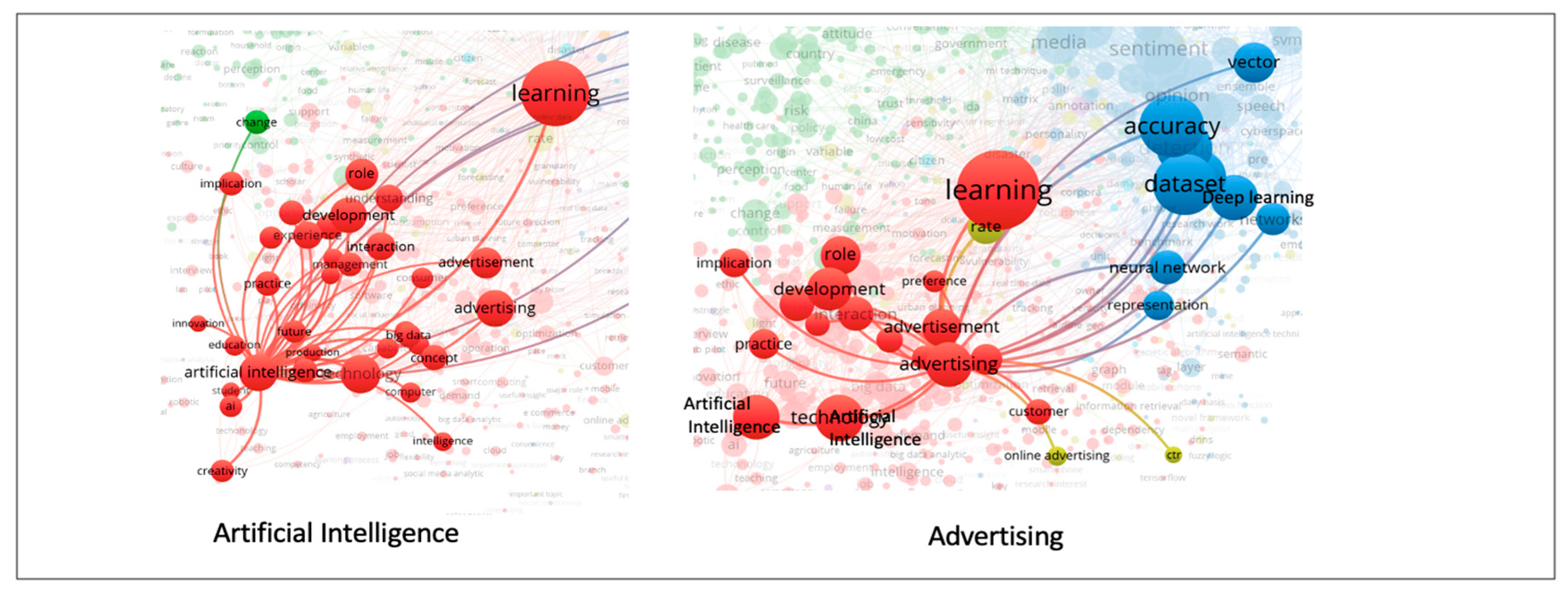
Table 2.
Co-occurrences of Terms (Binary) - Network Analysis Data.
| Co-occurrences of Terms Analysis | |||||||||
|---|---|---|---|---|---|---|---|---|---|
| Centrality | Link Strength | Occurrences | |||||||
| Terms | Degree | Terms | Betweenness | Terms | Closeness | Terms | Tie Strength | Terms | Occurrences |
| learning | 900 | learning | 3891.907 | accuracy | 0.997 | learning | 30037 | learning | 2554 |
| accuracy | 887 | dataset | 3692.864 | dataset | 0.983 | accuracy | 19563 | accuracy | 1550 |
| dataset | 886 | accuracy | 3678.043 | text | 0.982 | dataset | 18453 | dataset | 1515 |
| text | 868 | text | 3407.614 | 0.963 | sentiment | 14420 | detection | 1149 | |
| 861 | detection | 3338.448 | tweet | 0.956 | detection | 13900 | sentiment | 1104 | |
| tweet | 856 | 3294.642 | sentiment | 0.951 | text | 13842 | text | 1092 | |
| sentiment | 856 | tweet | 3238.677 | technology | 0.951 | 13241 | 1017 | ||
| technology | 854 | technology | 3230.757 | detection | 0.949 | tweet | 13070 | tweet | 1002 |
| detection | 853 | development | 3226.166 | development | 0.948 | classifier | 10790 | technology | 856 |
| development | 845 | sentiment | 3213.324 | classifier | 0.94 | technology | 10587 | classifier | 832 |
Table 3.
Co-occurrences of Terms Analysis (Binary) - Publication Years.
| Terms | Years |
|---|---|
| chatgpt | 2022 |
| longitudinal | 2022 |
| bidirectional | 2021 |
| generative ai | 2021 |
| preferred reporting item | 2021 |
| bert | 2021 |
| explainability | 2021 |
| knowledge graph | 2021 |
| count vectorizer | 2021 |
| technological advancement | 2021 |
Table 5.
Co-occurrences of Terms Analysis (Full Counting) Network Analysis Data.
| Centrality | Link Strength | Occurrences | |||||||
|---|---|---|---|---|---|---|---|---|---|
| Terms | Degree | Terms | Betweenness | Terms | Closeness | Terms | Tie Strength | Terms | Occurrences |
| technology | 1162 | technology | 16790.033 | technology | 0.867 | tweet | 46375 | tweet | 2576 |
| tweet | 1156 | tweet | 15333.087 | tweet | 0.864 | coronavirus | 30215 | sentiment | 1651 |
| knowledge | 1104 | role | 14404.801 | knowledge | 0.837 | sentiment | 28546 | sentiment analysis | 1555 |
| post | 1095 | knowledge | 14330.311 | post | 0.832 | sentiment analysis | 24835 | technology | 1470 |
| language | 1094 | post | 13968.271 | language | 0.832 | technology | 23854 | coronavirus | 1334 |
| role | 1090 | advertising | 12845.353 | role | 0.83 | post | 21931 | advertising | 1327 |
| media | 1090 | language | 12668.547 | media | 0.83 | language | 18436 | post | 1286 |
| sentiment | 1075 | media | 12404.62 | sentiment | 0.822 | word | 17670 | language | 1227 |
| sentiment analysis | 1050 | advertisement | 12146.639 | word | 0.81 | artificial intelligence | 16440 | advertisement | 1212 |
| word | 1050 | sentiment | 11854.481 | sentiment analysis | 0.81 | advertising | 16191 | artificialintelligence | 1123 |
Table 10.
Co-Authorship of Countries Analysis Network Analysis Data.
| Centrality | Link Strength | Publications | |||||||
|---|---|---|---|---|---|---|---|---|---|
| Countries | Degree | Countries | Betweenness | Countries | Closeness | Countries | Tie Strength | Countries | Publications |
| usa | 49 | usa | 339.723 | england | 0.836 | usa | 536 | usa | 1808 |
| england | 49 | england | 299.647 | usa | 0.824 | england | 346 | england | 479 |
| india | 45 | india | 227.772 | india | 0.782 | china | 298 | china | 925 |
| china | 35 | china | 99.025 | china | 0.701 | india | 194 | india | 834 |
| germany | 33 | germany | 76.234 | germany | 0.678 | germany | 182 | germany | 272 |
| malaysia | 27 | malaysia | 68.891 | malaysia | 0.635 | malaysia | 71 | malaysia | 127 |
| egypt | 26 | croatia | 61.575 | egypt | 0.629 | switzerland | 69 | switzerland | 69 |
| belgium | 22 | egypt | 53.821 | belgium | 0.598 | scotland | 63 | scotland | 68 |
| ireland | 21 | belgium | 47.508 | ireland | 0.598 | sweden | 63 | sweden | 87 |
| sweden | 20 | qatar | 34.664 | qatar | 0.592 | austria | 58 | austria | 56 |
Disclaimer/Publisher’s Note: The statements, opinions and data contained in all publications are solely those of the individual author(s) and contributor(s) and not of MDPI and/or the editor(s). MDPI and/or the editor(s) disclaim responsibility for any injury to people or property resulting from any ideas, methods, instructions or products referred to in the content. |
© 2024 by the authors. Licensee MDPI, Basel, Switzerland. This article is an open access article distributed under the terms and conditions of the Creative Commons Attribution (CC BY) license (http://creativecommons.org/licenses/by/4.0/).
Copyright: This open access article is published under a Creative Commons CC BY 4.0 license, which permit the free download, distribution, and reuse, provided that the author and preprint are cited in any reuse.


