

Submitted:
03 January 2024
Posted:
04 January 2024
You are already at the latest version
Abstract
Floating wind is becoming an essential part in terms of renewable energy. Therefore, highlighting the perspectives in developing the floating wind platforms is very important. In this paper, we focus on floating wind concepts and projects around the world. This will give a taste to the reader about what is going on in terms of the projects around the world. The main aim of this work is to further explain the collected data regarding the floating wind concepts and projects, and further classify them in terms of cost, power capacity, wind speed, water depth, and distance to shore.
Keywords:
renewable energy
; floating platforms
; wind
; marine environment
; sustainable development
1. Introduction
Floating wind is currently a big candidate for renewable energy in many countries around the world. Governments and companies are investing a lot of money in developing floating wind projects. The purpose of this paper is to present all the floating wind projects in the world, as well as their implemented floating wind types, and their corresponding concepts, which is very significant to understand the floating wind situation around the world.
Renewable energy has become essential in response to the increasing world population, and their corresponding demand for energy, and to stop the reliance on fuels, to eliminate pollution, and climate change [15].
Renewable energy is also a way to prevent the countries with Oil and Gas resources from having economic and political dominance over the countries which are without [16].
Unlike Oil and Gas energy, renewable energy is carbon-free and endless, which will make it the perfect solution for both climate change, and population growth [16].
While onshore wind energy is the current cheapest source of renewable energy, it has weaker, and more turbulent wind speeds as compared to its offshore counterpart, which is anticipated to dominate in the years to come, especially in high water-depth areas, which will necessitate the implementation of floating wind [15].
From this perspective, the European Union will need 450 GW of offshore wind by 2050, to achieve its complete decarbonization, as compared with its current offshore wind capacity of 25 GW [13].
The European Union must develop 150 GW of floating wind to be carbon neutral by 2050, which is likely to happen due to the available financial resources, as well as the high effort of the corresponding specialized floating wind companies [6].
Europe currently has 318 MW of floating wind from 34 floating wind concepts. The rest of the world has 32 MW of floating wind, coming from 16 concepts. The floating wind cumulative capacity is currently led by the European Union, and further investments in floating wind will facilitate the industrialization process and will reduce the capital expenditures (CAPEX) of future floating wind projects [6].
As of 2030, France plans to have 750 MW of floating wind, the UK plans to have 1 GW, Norway plans to have 1.5 GW (or 3 GW [9]), and Portugal plans to have 275 MW [3], as compared to their current floating wind capacities of 114 MW in France, 80 MW in the UK, 95 MW in Norway, and 30 MW in Portugal. Furthermore, the US has 12 MW, and Japan has a 20 MW floating wind power capacity [6].
Floating wind will be implemented in the areas where the typical bottom-fixed offshore wind projects are not attractive due to their corresponding negative assembly impact on the marine environment, as well as their corresponding limited water-depth capacities. Their floating counterparts have exceeding water-depth capacities, as well as less environmental impact, due to their early assembly in the ports. Further, the floating wind is on its way toward its industrialization, which will make its cost competitive with its bottom-fixed offshore counterpart [6].
Both bottom-fixed offshore wind, as well as the existing Oil and gas infrastructure, will contribute to making Europe the world’s floating wind leader. Europe is currently planning to have the lead in the following floating wind supply chain areas, which will also help with bringing a corresponding tremendous job creation. Electrical cabling, mooring, as well as installation. The outcome of this will especially become significant when the floating wind global market will be 18 thousand GW in the future [6].
The floating wind LCOE cost will be 250 euros/MWh when the floating wind capacity reaches 0.5 GW. Furthermore, it will drop to 50 euros, when the floating wind capacity reaches 4 GW in 2030 [4].
Romania has a current installed onshore wind capacity of 3 GW. However, it lacks a corresponding electrical infrastructure in the Sea areas, which is currently the obstacle to its corresponding floating wind implementation [13]. Efforts are still being made towards the success of the floating wind implementation in Romania [14]. The solution for the lack of a corresponding offshore electrical infrastructure in Romania is to implement the Power-to-X technology, which is used to convert the produced floating wind electrical power mainly into hydrogen and compressed air and eliminate the need for a tremendous electrical infrastructure.
Figure 1 shows the most popular bottom-fixed and floating wind turbine concepts.
2. Materials and Methods
This section mainly presents the floating wind projects and concepts from all around the world. The data presented in this section is mainly based on the ABS Group report [22]. The data presented here presents the global floating wind situation in 2020.
2.1. Worldwide floating wind concepts
Table 1 shows the four most common types of floating wind turbines, Spar-buoy, Semi-submersible, Barge, TLP (See Figure 2), as well as the multi-turbine type (See Figure 7). The table also shows further information of relevance to the most common corresponding concepts of these wind turbine types, as well as their other related aspects.
It is seen from the table that there are more concepts of Semi-submersible in comparison with each of the other concepts. Then comes the Spar-buoy, and TLP. Then Barge, and Multi-turbine. Most of these concepts are made of steel, while few of them are made of concrete.
2.1.1. Worldwide Spar-buoy floating-wind concepts
One of the most popular floating wind Spar-buoy concepts is Hywind [27], which is designed by Equinor and comes with either steel or concrete material. Advanced Spar [29], and Sea Twirl [30] are known enough as well, and are developed by JMU, and Sea Twirl, respectively, and are both made of steel. Stiesdal Tetra Spar [31], and Fukushima Forward [33,34] are also worth mentioning. They are made of steel, and they are developed by Stiesdal, and JMU, respectively. Toda Hybrid Spar [28] is also a Spar floating wind concept, which was developed by Toda, and it is made of steel and concrete (hybrid).
2.1.2. Worldwide Semi-submersible floating-wind concepts
One of the most popular floating wind Semi-submersible designs is Wind Float [32], which is designed by PRINCIPLE-POWER and is made of steel. VOLTURNUS [35], OO-Star [38], and Tri-Floater [43] are also well-known floating wind Semi-submersible concepts, and they are developed by the University of Maine, Iberdrola, and Gusto MSC, respectively. The first two floating wind Semi-submersible concepts are made of concrete, while the third one is made of steel. Cobra Semi-Spar, and SCD NEZZY [41] are also floating wind Semi-submersible concepts, which are made of concrete, and they are developed by Cobra, and SCD Technology, respectively. Hexa-Float [39], EOLINK, Nautilus [42], Tri-Floater, and Truss Float [22], are also Semi-submersible floating wind concepts, which are made of steel, and they are developed by Saipem, EOLINK, Nautilus floating solutions, Gusto MSC, and DOLFINES, respectively. Sea Reed [36] is also a Semi-submersible floating wind concept, which is made of either steel, concrete, or hybrid, and it is developed by Naval Energies.
2.1.3. Worldwide Barge floating wind concepts
One of the most popular Barge floating wind concepts is the IDEOL Damping Pool Barge, which is designed by IDEOL and is made of either steel or concrete. SAITEC SATH (Swinging Around Twin Hull) is a Barge floating wind concept, which is also worth mentioning and was developed by SAITEC, and it is made of concrete.
2.1.4. Worldwide TLP floating wind concepts
One of the most popular floating-wind TLP platforms is TLPWIND [49], which is designed by Iberdrola and is made of steel. SBM [22], Pivot Buoy [47], and Pela star are also TLP floating wind concepts, which are made of steel, and they are designed by SBM Offshore, X1 Wind, and GLOSTEN, respectively. GICON [48] is also a TLP floating wind concept, which is made of concrete, and designed by GICON.
2.1.5. Worldwide multi-turbine floating wind concepts
One of the most popular multi-turbine floating wind platforms is the HEXICON Multi-turbine Semi-submersible [51], which is designed by HEXICON and is made of steel. W2Power [52], and Floating Power Plant Multi-turbine floating wind platforms [53], are also worth mentioning. They are made of steel, and they are developed by Ener Ocean, and Floating Power Plant, respectively.
2.2. Worldwide installed floating-wind projects
Table 2 presents all the installed floating wind projects in the world.
Worldwide largest contributing countries to the installed floating-wind projects
It is shown in Table 2 that the largest contributing countries to the installed floating wind projects are the UK, Portugal, and Japan. The table shows that the UK has a total installed power capacity of 79.5 MW, coming from two floating wind projects. The first one is Kincardine [64], which was developed by Principle Power, and it has a power capacity of 5x9.5 MW. This project also contains an additional 2 MW floating wind turbine, which was first implemented in the WF1 floating wind project. The second floating wind project in the UK is Hywind Scotland [63], which was developed by Equinor, and it has a power capacity of 5x6 MW. The first project in the UK implements a Vestas wind turbine brand. While the other one implements a Siemens wind turbine brand.
It is seen from the table that Portugal has a total installed floating wind power capacity of 27.2 MW, which comes from two projects. The first floating wind project is WindFloat Atlantic (WFA) [61,67], with a total power capacity of 3x8.4 MW. The other one is WF1 [60], which has a total power capacity of 2 MW. Both these Portuguese floating wind projects are developed by Principle Power, and they implement wind turbines with a Vestas brand.
Japan has a total installed power capacity of 21 MW, coming from 7 projects. Mainly from Fukushima FORWARD Phases I and II [56], which make a total of 14 MW power capacity, and they are developed by Fukushima Offshore Wind Consortium. Then come Hibiki [57], and Kabashima, as well as Sakiyama Japanese floating wind projects. The first floating wind project is developed by Ideol, while the other two are designed by Toda. The Hibiki project has a 2 MW power capacity, as well as a downwind Hitachi wind turbine. Sakiyama floating wind project also implements a 2 MW Hitachi downwind wind turbine.
Further installed floating wind projects in Europe, are the following. The Norwegian Hywind Demo, which was developed by Equinor, has a total power capacity of 3.2 MW, and it implements a Siemens wind turbine brand.
The Spanish BlueSATH [46], and W2Power 1:6 scale floating wind projects, are developed by Saitec, and EnerOcean, respectively. The first Spanish floating wind project has a 30 kW power capacity. While the other one has a 2x100 kW power capacity. It is accompanied by two separate wind turbines, which are supported on a single Multi-turbine floating wind support structure.
The Danish Poseidon 37 Demonstrator floating wind project, has a power capacity of 33 kW, and it is developed by Floating Power Plant.
The French Floatgen floating wind project, which was developed by Ideol, has a total power capacity of 2 MW, and it implements a Vestas wind turbine brand.
The Swedish SeaTwirl S1 floating wind project [62], which was developed by SeaTwirl, has a power capacity of 30 kW. This project implements a vertical-axis wind turbine, i.e., the blades rotate around the tower, and not around the typical horizontal-axis wind turbine’s hub. Meaning that their rotation axis faces the sky.
It is concluded from Table 2, that Europe is currently the largest contributor to worldwide installed floating wind projects.
2.3. Worldwide planned floating-wind projects
Table 3 contains all the European, North American, and Asian floating wind projects in the world.
Worldwide largest contributing countries to the planned floating wind projects (Table 3)
- The US has planned a floating wind power capacity of 2.45 GW, from 9 floating wind projects, in the period 2023-2027.
- Korea has planned a floating wind power capacity of 1.6 GW, from 7 floating wind projects, in the period 2020-2024.
- France has planned a floating wind power capacity of 113.5 MW, from 5 projects, in the period 2021-2022.
- Ireland has planned a floating wind power capacity of 106 MW, from 2 projects, in 2022.
- The UK has planned a floating wind power capacity of 105 MW, from 2 projects, in 2021.
- Spain has planned a floating wind power capacity of 103.2 MW, from 6 projects, in the period 2020-2021.
- Norway has planned a floating wind power capacity of 102.6 MW, from 5 projects, in the period 2020-2023.
- Japan has planned a floating wind power capacity of 28 MW, from 3 floating wind projects, in the period 2020-2023.
2.4. Further details on the worldwide installed and planned floating wind projects in the world (based on Table 2 and Table 3)
Table 4 presents further details on some of the installed and planned floating wind projects in the world. These projects were first mentioned in their corresponding tables (Table 2 and Table 3). Their corresponding mentioned data will be discussed and classified in Section 3. In this subsection, we only present the table. Note that Table 4 contains 14/16 of the installed floating wind projects, which were mentioned in Table 2. As well as 12/25 of the planned floating wind projects, which were mentioned in Table 3.
3. Results
The following subsections present the findings from Table 1, Table 2, Table 3 and Table 4 regarding all the floating wind concepts and projects in the world.
3.1. Findings of Table 1 (Worldwide floating wind turbine concepts – Part 1)
The total number of the presented floating wind turbine concepts is twenty-eight. Thirteen Semi-submersibles, five Spar-buoys, five TLPs, three multi-turbines, and two Barges.
3.2. Findings of Table 1 (Worldwide floating wind-turbine concepts – Part 2)
The total number of the presented floating wind turbine concepts is twenty-eight. Eighteen of which are made of steel, six are made of concrete, and four are made of steel and/or concrete.
3.3. Findings of Table 1 (Worldwide floating wind-turbine concepts – Part 3)
The total number of the presented floating wind turbine concepts is twenty-eight. Thirteen Semi-submersibles, eight of which are made of steel, four are made of concrete, and one is made of steel or concrete. Five Spar-buoys, three of which are made of steel, and two are made of steel and/or concrete. Five TLPs, four of which are made of steel, and one is made of concrete. Three multi-turbines, which are made of steel. Two Barges, one of which is made of concrete, and one is made of steel or concrete.
3.4. Findings of Table 2 (Worldwide installed floating wind-turbine projects)
The total installed floating wind capacity in Europe is 123.5 MW, coming from 12 projects, from eight contributing countries. The UK, Portugal, Norway, France, Spain, Denmark, Sweden, and Germany.
The total installed floating wind capacity in the US is 30.2 MW, coming from two projects.
The total installed floating wind capacity in Asia is 21 MW, coming from 4 projects in Japan.
3.5. Findings of Table 3 (Worldwide planned floating wind-turbine projects)
The total planned floating wind power capacity in France is 108.5 MW, coming from 4 projects (Golfe du Lion – EFGL, GROIX & Belle-Ile, Provence Grand Large – PGL, and EOLMED).
The total planned floating wind power capacity in Ireland is 106 MW, coming from 2 projects (Emerald and AFLOWT).
The total planned floating wind power capacity in the UK is 105 MW, coming from 2 projects (Atlantis IDEOL and TLP Wind).
The total planned floating wind power capacity in Spain is 103 MW, coming from 5 projects (Parque EOLICO Gofio, Balea, FLOCAN 5, Demo SATH, and Pivot Buoy 1:3 Scale).
The total planned floating wind power capacity in Norway is 102.6 MW, coming from 4 projects (Hywind Tampen, Flagship Demo, Tetra Spar Demo, and Sea Twirl S2).
The total planned floating wind power capacity in the US is 2.42 GW, coming from 8 projects (Castle Wind, Progression South, AWH Oahu Northwest, AWH Oahu South, Red Wood Coast, CADEMO, New England Aqua Ventus I, and Mayflower Wind).
The total planned floating wind power capacity in Korea is 1.606 GW, coming from 7 projects (Gray Whale, KF Wind, DONGHAE Twin Wind, KNOC (DONGHAE 1), White Heron, Ulsan Prototype, and Ulsan 750 kW Floating Demonstrator).
The total planned floating wind power capacity in Japan is 28 MW, coming from 2 projects (Goto City and NEZZY Demonstrator).
3.6. Findings of Table 4 (Further details on the worldwide installed and planned floating wind projects – Part 1)
The most distinguishable floating wind projects’ cost in France is 962.7 million dollars, coming from one installed project (FLOATGEN), and four planned projects (GROIX & Belle-Ile, EOLMED, Provence Grand Large, and Golfe du Lion).
The most distinguishable floating wind projects’ cost in the UK is 655 million dollars, coming from two installed projects (Kincardine and Hywind Scotland).
The most distinguishable floating wind projects’ cost in Norway is 316.5 million dollars, coming from one installed project (Hywind Demo – ZEFYROS), and two planned projects (Hywind Tampen and Tetra Spar Demo).
The most distinguishable floating wind projects’ cost in Portugal is 159 million dollars, coming from two installed projects (Wind Float Atlantic and Wind Float 1).
The most distinguishable floating wind projects’ cost in Spain is 19.5 million dollars, coming from one installed project (Blue SATH), and one planned project (Demo SATH).
The most distinguishable floating wind projects’ cost in the US is 112 million dollars, coming from one installed project (VOLTURNUS 1:8), and one planned project (New England Aqua Ventus I).
The most distinguishable floating wind project cost in Japan is 157 million dollars, coming from one installed project (Fukushima Forward Phases I & II).
3.7. Findings of Table 4 (Further details on the worldwide installed and planned floating wind projects – Part 2)
The most distinguishable floating wind power capacity in France is 110.5 MW, coming from one installed project (FLOATGEN), and four planned projects (Golfe du Lion – EFGL, GROIX & Belle-Ile, Provence Grand Large – PGL, and EOLMED).
The most distinguishable floating wind power capacity in Norway is 93.9 MW, coming from one installed project (Hywind Demo – ZEFYROS), and two planned projects (Hywind Tampen and Tetra Spar Demo).
The most distinguishable floating wind power capacity in the UK is 79.5 MW, coming from two installed projects (Kincardine and Hywind Scotland).
The most distinguishable floating wind power capacity in Portugal is 27.2 MW, coming from one installed project (Wind Float 1 – WF1), and one planned project (Wind Float Atlantic)
The most distinguishable floating wind power capacity in Spain is 2.302 MW, coming from two installed projects (W2Power 1:6 Scale and Blue SATH), and one planned project (Demo SATH).
The most distinguishable floating wind power capacity in Sweden is 30 kW, coming from one installed project (Sea Twirl S1).
The most distinguishable floating wind power capacity in the US is 1.2102 GW, coming from one installed project (VOLTURNUS), and four planned projects (Castle Wind, Red Wood Coast, CADEMO, and New England Aqua Ventus I).
The most distinguishable floating wind power capacity in Korea is 200 MW, coming from one planned project (DONGHAE Twin Wind).
The most distinguishable floating wind power capacity in Japan is 20 MW, coming from three installed projects (Fukushima Forward Phases I & 2, Hibiki, and Sakiyama).
3.8. Findings of Table 4 (Further details on the worldwide installed and planned floating wind projects – Part 3)
The most distinguishable wind speed in Norway is 40 m/s, coming from one installed floating wind project (Hywind Demo – ZEFYROS).
The most distinguishable wind speed in Sweden is 35 m/s, coming from one installed floating wind project (Sea Twirl S1).
The most distinguishable wind speed in Portugal is 31 m/s, coming from one installed floating wind project (Wind Float 1).
The most distinguishable wind speed in France is 24.2 m/s, coming from one installed floating wind project (FLOATGEN).
The most distinguishable wind speed in Spain is 12 m/s, coming from one planned floating wind project (Demo SATH).
The most distinguishable wind speed in the UK is 10 m/s, coming from one installed floating wind project (Hywind Scotland).
The most distinguishable floating wind speed in the US is 8.5-40 m/s, coming from one installed floating wind project (VOLTURNUS 1:8), and four planned projects (CADEMO, Castle Wind, Red Wood Coast, and New England Aqua Ventis I).
The most distinguishable wind speed in Japan is 45-48 m/s, coming from two installed floating wind projects (Sakiyama and Fukushima Forward Phases I & II).
3.9. Findings of Table 4 (Further details on the worldwide installed and planned floating wind projects – Part 4)
The most distinguishable water depth in Norway is 220-300 m, coming from one installed floating wind project (Hywind Demo – ZEFYROS), and two planned projects (Tetra Spar Demo and Hywind Tampen).
The most distinguishable water depth in the UK is 90-120 m, coming from two installed floating wind projects (Kincardine and Hywind Scotland).
The most distinguishable water depth in France is 33-100 m, coming from one installed floating wind project (FLOATGEN), and four planned projects (EOLMED, GROIX & Belle-Ile, Golfe du Lion – EFGL, and Provence Grand Large - PGL).
The most distinguishable water depth in Portugal is 100 m, coming from one installed floating wind project (Wind Float Atlantic – WFA).
The most distinguishable water depth in Spain is 85 m, coming from one installed floating wind project (Demo SATH).
The most distinguishable water depth in Portugal is 49 m, coming from one installed floating wind project (Wind Float 1 – WF1).
The most distinguishable water depth in Sweden is 35 m, coming from one installed floating wind project (Sea Twirl S1).
The most distinguishable water depth in the US is 27.4 m – 1 km, coming from one installed floating wind project (VOLTURNUS 1:8), and three planned projects (CADEMO, New England Aqua Ventus I, and Red Wood Coast).
The most distinguishable water depth in Japan is 55-125 m, coming from three installed floating wind projects (Hibiki, Sakiyama, and Fukushima Forward Phases I & II).
3.10. Findings of Table 4 (Further details on the worldwide installed and planned floating wind projects Part 5)
The most distinguishable distance to shore in Norway is 10-140 km, coming from one installed floating wind project (Hywind Demo – ZEFYROS), and two planned projects (Tetra Spar Demo and Hywind Tampen).
The most distinguishable distance to shore in the UK is 15-25 km, coming from two installed floating wind projects (Kincardine and Hywind Scotland).
The most distinguishable distance to shore in France is 15-22 km, coming from one installed floating wind project (FLOATGEN), and four planned projects (EOLMED, Golfe du Lion – EFGL, Provence Grand Large – PGL, and GROIX & Belle-Ile).
The most distinguishable distance to shore in Portugal is 5-20 km, coming from two installed floating wind projects (Wind Float 1 – WF1 and Wind Float Atlantic).
The most distinguishable distance to shore in Spain is 800 m – 3.2 km, coming from one installed floating wind project (Blue SATH), and one planned project (Demo SATH).
The most distinguishable distance to shore in the US is 330 m – 48 km, coming from one installed floating wind project (VOLTURNUS 1:8), and four planned projects (New England Aqua Ventus I, CADEMO, Red Wood Coast, and Castle Wind).
The most distinguishable distance to shore in Korea is 62 km, coming from one planned floating wind project (DONGHAE Twin Wind).
The most distinguishable distance to shore in Japan is 5-15 km, coming from three installed floating wind projects (Sakiyama, Hibiki, and Fukushima Forward Phases I & II).
4. Discussion
In this section, we will no further discuss the obtained findings in Section 3, because these were sufficiently touched upon. This section will include external references of relevance to the worldwide floating wind situation, with a special focus on Europe, and some other related aspects. Figure 9 shows the floating wind Power-to-X technology, which is used to transform the produced floating wind electrical energy mainly into hydrogen and compressed air to eliminate the need for tremendous corresponding electrical infrastructures. Next, we will consider the floating wind feasibility in Romania.
There was established a European floating wind research project, which specializes in European floating wind development, has a total cost of 50 million euros, but with an expected revenue of 5000 million euros [2]. Europe is also working towards both keeping its position as the world’s floating wind leader, as well as towards being the biggest floating wind manufacturer. It will first focus on the European pre-commercialized floating wind projects and their corresponding incentives and grants. It will second focus on the European-patent floating wind concepts and collect them in a corresponding portfolio, which will be pushed rapidly toward serial production. It will third focus on the European large-scale floating wind projects and make corresponding large governmental investments. It will fourth focus on developing the European coastal infrastructure and making it suitable for the implementation of large-scale floating wind projects. It will also focus on financing the private sector and making European inter-governmental floating wind collaborations [6].
A typical 2 MW Spar floating wind support structure weighs 140 tons, and has a draft of 100 m, a water depth of 700 m, a tower height of 70 m, and a total height of 100 m. A typical floating wind project takes seven years for its demonstration, and an additional eight years for its construction (i.e., Hywind Scotland) [8].
Floating wind projects have an overall cost that comes from the implemented floating support structure (24%), the implemented wind turbine (33%), Operation and Maintenance (23%), grid connection (15%), and decommissioning (5%) [5].
Spar-buoy is the simplest floating wind support structure, and it has convenient stability. Semi-submersible is less stable due to its comparably larger water-plane area, and it has a relatively difficult manufacturing. TLP is the most stable floating wind support structure, but it has both the most difficult installation and an inconvenient mooring system price. The typical cost for a generic floating wind turbine is 8 million euros/MW [1].
Spar-buoy has both ballast and drag-embedded catenary-mooring, as well as anchor stability systems. Semi-submersible and Barge have both buoyancy and mooring stability systems. TLP has both mooring lines and suction pile anchors [5].
Romania is a feasible candidate for floating wind implementation [10,11]. However, it lacks electrical infrastructures in the Sea areas, which will necessitate the implementation of floating wind Power-to-X technology, which will do the job of transforming the produced electrical power mainly into hydrogen or compressed air and transport it accordingly through ships or other means of transportation. This technology is also a candidate for replacing the European gas import from other countries, by converting renewable energy’s produced electricity into other chemicals such as methanol and synthetic natural gas [45]. Also see [7,12,17,18,19,20,21,44,50,54,55,59,66,68,76,83].
5. Conclusions
The presented data throughout the paper shows that the current installed floating wind power capacity is 123.5 MW in Europe, 30.2 MW in the US, and 21 in Asia, making an overall floating wind installed power capacity of 174.7 MW (between 2013-2020). The total planned floating wind power capacity is 525.1 MW in Europe, 2.42 GW in the US, and 1.634 GW in Asia, making an overall floating wind planned power capacity of 4.5791 GW (for 2020-2027). The total number of the floating wind concepts is twenty-eight. Thirteen Semi-submersibles, five Spar-buoys, five TLPs, three multi-turbines, and two Barges. Three-thirds of these are made of steel, and a third are made of steel and/or concrete.
The most outstanding installed and planned floating wind projects make a total cost of 2.113 billion dollars in Europe, 112 million dollars in the US, and 157 million dollars in Asia. Their corresponding power capacity is 313.43 MW in Europe, 1.21 GW in the US, and 220 MW in Korea. Their corresponding wind speed range is 10-40 m/s in Europe, 8.5-40 m/s in the US, and 45-48 m/s in Asia. Their corresponding water depth is 33-300 m in Europe, 27.4 m – 1 km in the US, and 55-125 m in Asia. Their corresponding distance to shore range is 800 m – 140 km in Europe, 330 m – 48 km in the US, and 5-62 km in Asia.
Note that this data is based on 2020 [22], due to the limited reliable overall resources on the floating wind situation in 2023.
Author Contributions
Conceptualization, M.M. and E.R.; methodology, M.M. and E.R.; software, M.M.; resources, M.M. and E.R.; data curation, M.M.; writing—original draft preparation, M.M.; writing—review and editing, M.M. and E.R.; supervision, E.R.; project administration, E.R.; funding acquisition, E.R. All authors have read and agreed to the published version of the manuscript.
Funding
This research received no external funding.
Data Availability Statement
Not applicable.
Acknowledgments
This is an improved version of the work presented in the 11th edition of the Scientific Conference organized by the Doctoral Schools of “Dunarea de Jos” University of Galati (SCDS-UDJG), on the 8th and 9th of June 2023, in Galati, Romania.
Conflicts of Interest
The authors declare no conflict of interest.
References
- Lathigara, A., Zhao, F. 2022. Floating Offshore Wind – a Global Opportunity. Global Wind Energy Council.
- Tande, J. O., Wagenaar, J. W., Latour, M. I., Aubrun, S., Wingerde, A. V., Eecen, P., Andersson, M., Barth, S., McKeever, P., Cutululis, N. A. 2022. Proposal for European lighthouse project: Floating wind energy. EU SETWind project.
- Wind Europe. 2021. Scaling up Floating Offshore Wind Towards Competitiveness.
- Wind Europe. 2017. FLOATING OFFSHORE WIND ENERGY - A POLICY BLUEPRINT FOR EUROPE.
- Butterfield, S., Musial, W., Jonkman, J., Sclavounos, P. 2007. Engineering Challenges for Floating Offshore Wind Turbines. NREL/CP-500-38776.
- ETIP Wind. 2020. FLOATING OFFSHORE WIND DELIVERING CLIMATE NEUTRALITY.
- Kurniawati, I., Beatriz, B., Varghese, R., Kostadinović, D., Sokol, I., Hemida, H., Alevras, P., Baniotopoulos, C. 2023. Conceptual Design of a Floating Modular Energy Island for Energy Independency: A Case Study in Crete. Energies 16, no. 16: 5921. [CrossRef]
- Nielsen, F. G. 2017. Hywind – From idea to the world’s first wind farm based upon floaters. University of Bergen.
- ABB and ZERO. 2018. Floating offshore wind - Norway’s next offshore boom?
- Yildirir, V., Rusu, E., Onea, F. 2022. Wind Variation near the Black Sea Coastal Areas Reflected by the ERA5 Dataset. Inventions 7, no. 3: 57. [CrossRef]
- Yildirir, V., Rusu, E., Onea, F. 2022. Wind Energy Assessments in the Northern Romanian Coastal Environment Based on 20 Years of Data Coming from Different Sources. Sustainability 14, no. 7: 4249. [CrossRef]
- Girleanu, A., Onea, F., Rusu, E. 2021. The efficiency and coastal protection provided by a floating wind farm operating in the Romanian nearshore. Energy Reports 7, no.: 13-18. [CrossRef]
- Girleanu, A., Onea, F., Rusu, E. 2021. Assessment of the Wind Energy Potential along the Romanian Coastal Zone. Inventions 6, no. 2: 41. [CrossRef]
- Onea, F., Rusu, E., Rusu, L. 2021. Assessment of the Offshore Wind Energy Potential in the Romanian Exclusive Economic Zone. Journal of Marine Science and Engineering 9, no. 5: 531. [CrossRef]
- Ruiz, A., Onea, F., Rusu, E. 2020. Study Concerning the Expected Dynamics of the Wind Energy Resources in the Iberian Nearshore. Energies 13, no. 18: 4832. [CrossRef]
- Onea, F., Ruiz, A., Rusu, E. 2020. An Evaluation of the Wind Energy Resources along the Spanish Continental Nearshore. Energies 13, no. 15: 3986. [CrossRef]
- Raileanu, A. B., Onea, F., Rusu, E. 2020. Implementation of Offshore Wind Turbines to Reduce Air Pollution in Coastal Areas—Case Study Constanta Harbor in the Black Sea. Journal of Marine Science and Engineering 8, no. 8: 550.
- Onea, F., Rusu, E. 2019. An Assessment of Wind Energy Potential in the Caspian Sea. Energies 12, no. 13: 2525. [CrossRef]
- Onea, F., Rusu, E. 2016. Efficiency assessments for some state-of-the-art wind turbines in the coastal environments of the Black and the Caspian seas. Energy Exploration & Exploitation 34, no. 2: 217-234. [CrossRef]
- Raileanu, A., Onea, F., Rusu, E. 2015. Assessment of the wind energy potential in the coastal environment of two enclosed seas. OCEANS’15 MTS/IEEE GENOVA. [CrossRef]
- Onea, F., Raileanu, A., Rusu, E. 2015. Evaluation of the Wind Energy Potential in the Coastal Environment of Two Enclosed Seas. Advances in Meteorology 2015, no.: 1-14. [CrossRef]
- ABSG Consulting Inc. 2021. Floating Offshore Wind Turbine Development Assessment. BOEM, stage of publication (accepted).
- Jakobsen, E. G., Ironside, N. 2021. OCEANS UNLOCKED - A FLOATING WIND FUTURE. Available online: https://www.cowi.com/insights/oceans-unlocked-a-floating-wind-future (accessed on 8 June 2022).
- Equinor. N.d. Hywind Tampen. Available online: https://www.equinor.com/energy/hywind-tampen (accessed on 9 June 2022).
- Equinor. N.d. Hywind Scotland. Available online: https://www.equinor.com/energy/hywind-scotland (accessed on 9 June 2022).
- Baltscheffsky, H. 2021. JOIN THE FUTURE. Available online: https://www.utilityeda.com/wp-content/uploads/Wed_Session-8-a_Hexicon-AB_Henrik-Baltscheffsky_Offshore-Wind-Power.pdf (accessed on 9 June 2022).
- Kubiat, U., Lemon, M. 2020. Drivers for and Barriers to the Take-up of Floating Offshore Wind Technology: A Comparison of Scotland and South Africa. Energies 13, no. 21: 5618. [CrossRef]
- Yang, R. Y., Chuang, T. C., Zhao, C., Johanning, L. 2022. Dynamic Response of an Offshore Floating Wind Turbine at Accidental Limit States—Mooring Failure Event. Applied Sciences 12, no. 3: 1525. [CrossRef]
- Kosasih, K. M. A., Suzuki, H., Niizato, H., Okubo, S. 2020. Demonstration Experiment and Numerical Simulation Analysis of Full-Scale Barge-Type Floating Offshore Wind Turbine. Journal of Marine Science and Engineering 8, no. 11: 880. [CrossRef]
- Möllerström, E. 2019. Wind Turbines from the Swedish Wind Energy Program and the Subsequent Commercialization Attempts—A Historical Review. Energies 12, no. 4: 690. [CrossRef]
- Borg, M., Jensen, M. W., Urquhart, S., Andersen, M. T., Thomsen, J. B., Stiesdal, H. 2020. Technical Definition of the Tetra Spar Demonstrator Floating Wind Turbine Foundation. Energies 13, no. 18: 4911. [CrossRef]
- Gao, S., Zhang, L., Shi, W., Wang, B., Li, X. 2021. Dynamic Responses for Wind Float Floating Offshore Wind Turbine at Intermediate Water Depth Based on Local Conditions in China. Journal of Marine Science and Engineering 9, no. 10: 1093. [CrossRef]
- Ishihara, T., Liu, Y. 2020. Dynamic Response Analysis of a Semi-Submersible Floating Wind Turbine in Combined Wave and Current Conditions Using Advanced Hydrodynamic Models. Energies 13, no. 21: 5820. [CrossRef]
- Chen, J., Kim, M. H. 2022. Review of Recent Offshore Wind Turbine Research and Optimization Methodologies in Their Design. Journal of Marine Science and Engineering 10, no. 1: 28. [CrossRef]
- Liu, S., Chuang, Z., Wang, K., Li, X., Chang, X., Hou, L. 2022. Structural Parametric Optimization of the VOLTURNUS-S Semi-Submersible Foundation for a 15 MW Floating Offshore Wind Turbine. Journal of Marine Science and Engineering 10, no. 9: 1181. [CrossRef]
- Qu, X., Yao, Y. 2022. Numerical and Experimental Study of Hydrodynamic Response for a Novel Buoyancy-Distributed Floating Foundation Based on the Potential Theory. Journal of Marine Science and Engineering 10, no. 2: 292. [CrossRef]
- Mathern, A., Von der Haar, C., Marx, S. 2021. Concrete Support Structures for Offshore Wind Turbines: Current Status, Challenges, and Future Trends. Energies 14, no. 7: 1995. [CrossRef]
- Ahn, H., Ha, Y. J., Cho, S. G., Lim, C. H., Kim, K. W. 2022. A Numerical Study on the Performance Evaluation of a Semi-Type Floating Offshore Wind Turbine System According to the Direction of the Incoming Waves. Energies 15, no. 15: 5485. [CrossRef]
- Ghigo, A., Cottura, L., Caradonna, R., Bracco, G., Mattiazzo, G. 2020. Platform Optimization and Cost Analysis in a Floating Offshore Wind Farm. Journal of Marine Science and Engineering 8, no. 11: 835. [CrossRef]
- Bensalah, A., Barakat, G., Amara, Y. 2022. Electrical Generators for Large Wind Turbine: Trends and Challenges. Energies 15, no. 18: 6700. [CrossRef]
- Desmond, C. J., Hinrichs, J. C., Murphy, J. 2019. Uncertainty in the Physical Testing of Floating Wind Energy Platforms’ Accuracy versus Precision. Energies 12, no. 3: 435. [CrossRef]
- Petracca, E., Faraggiana, E., Ghigo, A., Sirigu, M., Bracco, G., Mattiazzo, G. 2022. Design and Techno-Economic Analysis of a Novel Hybrid Offshore Wind and Wave Energy System. Energies 15, no. 8: 2739. [CrossRef]
- Pham, T. D., Shin, H. 2020. The Effect of the Second-Order Wave Loads on Drift Motion of a Semi-Submersible Floating Offshore Wind Turbine. Journal of Marine Science and Engineering 8, no. 11: 859. [CrossRef]
- Fernández-Guillamón, A., Kaushik, D., Cutululis, N. A., Molina-García, A. 2019. Offshore Wind Power Integration into Future Power Systems: Overview and Trends. Journal of Marine Science and Engineering 7, no. 11: 399. [CrossRef]
- Rickert, Christopher., Parambil, A. M. T., Leimeister, M. 2022. Conceptual Study and Development of an Autonomously Operating, Sailing Renewable Energy Conversion System. Energies 15, no. 12: 4434. [CrossRef]
- Baita-Saavedra, E., Cordal-Iglesias, D., Filgueira-Vizoso, A., Morató, À., Lamas-Galdo, I., Álvarez-Feal, C., Carral, L., Castro-Santos, L. 2020. An Economic Analysis of An Innovative Floating Offshore Wind Platform Built with Concrete: The SATH® Platform. Applied Sciences 10, no. 11: 3678. [CrossRef]
- González, J., Payán, M., Santos, J., Gonzalez, A. 2021. Optimal Micro-Siting of Weathervaning Floating Wind Turbines. Energies 14, no. 4: 886. [CrossRef]
- Walia, D., Schünemann, P., Hartmann, H., Adam, F., Großmann, J. 2021. Numerical and Physical Modeling of a Tension-Leg Platform for Offshore Wind Turbines. Energies 14, no. 12: 3554. [CrossRef]
- Zhou, Y., Ren, Y., Shi, W., Li, X. 2022. Investigation on a Large-Scale Braceless-TLP Floating Offshore Wind Turbine at Intermediate Water Depth. Journal of Marine Science and Engineering 10, no. 2: 302. [CrossRef]
- Agarwal, R. 2022. Economic Analysis of Renewable Power-to-Gas in Norway. Sustainability, 14, 16882. [CrossRef]
- Lamei, A., Hayatdavoodi, M. 2020. On motion analysis and elastic response of floating offshore wind turbines. Journal of Ocean Engineering and Marine Energy 6. [CrossRef]
- Renzi, E., Michele, S., Zheng, S., Jin, S., Greaves, D. 2021. Niche Applications and Flexible Devices for Wave Energy Conversion: A Review. Energies 14, no. 20: 6537. [CrossRef]
- Solomin, E., Sirotkin, E., Cuce, E., Selvanathan, S. P., Kumarasamy, S. 2021. Hybrid Floating Solar Plant Designs: A Review. Energies 14, no. 10: 2751. [CrossRef]
- Skobiej, B., Niemi, A. 2022. Validation of copula-based weather generator for maintenance model of offshore wind farm. WMU J Marit Affairs 21, 73–87. [CrossRef]
- Xu, X., Xing, Y., Gaidai, O., Wang, K., Sandipkumar Patel, K., Dou, P., Zhang, Z. 2022. A novel multi-dimensional reliability approach for floating wind turbines under power production conditions. Front. Mar. Sci. Sec. Ocean Solutions Volume 9. [CrossRef]
- Dong, Y., Chen, Y., Liu, H., Zhou, S., Ni, Y., Cai, C., Zhou, T., Li, Q. 2022. Review of Study on the Coupled Dynamic Performance of Floating Offshore Wind Turbines. Energies 15, no. 11: 3970. [CrossRef]
- Edwards, E. C., Holcombe, A., Brown, S., Ransley, E., Hann, M., Greaves, D. 2023. Evolution of floating offshore wind platforms: A review of at-sea devices. Renewable and Sustainable Energy Reviews. Volume 183. 113416. ISSN 1364-0321. [CrossRef]
- Haces-Fernandez, F., Li, H., Ramirez, D. 2018. Assessment of the Potential of Energy Extracted from Waves and Wind to Supply Offshore Oil Platforms Operating in the Gulf of Mexico. Energies 11, no. 5: 1084. [CrossRef]
- Connolly, P., Crawford, C. 2023. Comparison of optimal power production and operation of unmoored floating offshore wind turbines and energy ships. Wind Energy Science. [CrossRef]
- Pham, T. D., Dinh, M. C., Kim, H. M., Nguyen, T. T. 2021. Simplified Floating Wind Turbine for Real-Time Simulation of Large-Scale Floating Offshore Wind Farms. Energies 14, no. 15: 4571. [CrossRef]
- Ramos, V., Giannini, G., Cabral, T., López, M., Santos, P., Taveira-Pinto, F. 2022. Assessing the Effectiveness of a Novel WEC Concept as a Co-Located Solution for Offshore Wind Farms. Journal of Marine Science and Engineering 10, no. 2: 267. [CrossRef]
- Arredondo-Galeana, A., Brennan, F. 2021. Floating Offshore Vertical Axis Wind Turbines: Opportunities, Challenges and Way Forward. Energies 14, no. 23: 8000. [CrossRef]
- Ulazia, A., Nafarrate, A., Ibarra-Berastegi, G., Sáenz, J., Carreno-Madinabeitia, S. 2019. The Consequences of Air Density Variations Over Northeastern Scotland for Offshore Wind Energy Potential. Energies 12, no. 13: 2635. [CrossRef]
- Kyle, R., Früh, W. G. 2022. The transitional states of a floating wind turbine during high levels of surge. Renewable Energy. Volume 200. Pages 1469-1489. ISSN 0960-1481. [CrossRef]
- Díaz, H., Serna, J., Nieto, J., Guedes Soares, C. 2022. Market Needs, Opportunities, and Barriers for the Floating Wind Industry. Journal of Marine Science and Engineering 10, no. 7: 934. [CrossRef]
- Venture. 2021. Power to X - TRANSFORMING RENEWABLE ELECTRICITY INTO GREEN PRODUCTS AND SERVICES. Concept paper.
- Andersen, M. T. 2016. Floating Foundations for Offshore Wind Turbines. Ph.D. Dissertation. Faculty of Engineering and Science, Aalborg University.
- North Sea Wind Power Hub. 2021. Integration of offshore wind. Discussion Paper #1.
- Codiga, D. A. 2018. PROGRESSION HAWAII OFFSHORE WIND. SCHLACK ITO.
- CADEMO Corporation. 2021. CADEMO Research and Demonstration Goals.
- Cabigan, M. K. 2022. Offshore Wind Development in an Integrated Energy Market in the North Sea: Defining regional energy policies in an integrated market and offshore wind infrastructure. Master thesis (NTNU).
- Beiter, P., Musial, W., Duffy, P., Cooperman, A., Shields, M., Heimiller, D., Optis, M. 2020. The Cost of Floating Offshore Wind Energy in California Between 2019 and 2032. National Renewable Energy Laboratory. NREL/TP-5000-77384.
- INPEX CORPORATION. 2022. Goto Floating Wind Farm LLC Consortium Begins Offshore Wind Turbine Assembly (Towards Realization of Floating Offshore Wind Power Generator). Press Release.
- Belvasi, N., Conan, B., Schliffke, B., Perret, L., Desmond, C., Murphy, J., Aubrun, S. 2022. Far-Wake Meandering of a Wind Turbine Model with Imposed Motions: An Experimental S-PIV Analysis. Energies 15, no. 20: 7757. [CrossRef]
- Tan, L., Ikoma, T., Aida, Y., Masuda, K. 2021. Mean Wave Drift Forces on a Barge-Type Floating Wind Turbine Platform with Moonpools. Journal of Marine Science and Engineering 9, no. 7: 709. [CrossRef]
- Fernández-Guillamón, A., Das, K., Cutululis, N. A., Molina-García, Á. 2019. Offshore Wind Power Integration into Future Power Systems: Overview and Trends. J. Mar. Sci. Eng. 7, 399. [CrossRef]
- Shin, H. 2020. Introduction to the 1.2 GW Floating Offshore Wind Farm Project in the East Sea, Ulsan, Korea. University of Ulsan, KOREA.
- Lee, J., Xydis, G. 2023. Floating offshore wind project development in South Korea without government subsidies. Springer. [CrossRef]
- Ha, K., Kim, J. B., Yu, Y., Seo, H. 2021. Structural Modeling and Failure Assessment of Spar-Type Substructure for 5 MW Floating Offshore Wind Turbine under Extreme Conditions in the East Sea. Energies. 14., 6571. [CrossRef]
- TECHNIP ENERGIES. 2022. Technip Energies, Subsea 7, and SAMKANG M&T to Perform FEED for Gray Whale 3 Floating Offshore Wind Project in South Korea.
- Strivens, S., Northridge, E., Evans, H., Harvey, M., Camp, T., Terry, N. 2021. Floating Wind Joint Industry Project (Phase III summary report). CARBON TRUST.
- Tamarit, F., García, E., Quiles, E., Correcher, A. 2023. Model and Simulation of a Floating Hybrid Wind and Current Turbines Integrated Generator System, Part I: Kinematics and Dynamics. Journal of Marine Science and Engineering 11, no. 1: 126. [CrossRef]
- Ibrahim, O. S., Singlitico, A., Proskovics, R., McDonagh, S., Desmond, C., Murphy, J. D. 2022. Dedicated large-scale floating offshore wind to hydrogen: Assessing design variables in proposed typologies. Renewable and Sustainable Energy Reviews. Volume 160. 112310. ISSN 1364-0321. [CrossRef]
- Ringvej Dahl, I., Tveitan, B. W., Cowan, E. C. 2022. The Case for Policy in Developing Offshore Wind: Lessons from Norway. Energies 15, no. 4: 1569. [CrossRef]
- Flagship. 2020. Floating offshore wind optimization for commercialization. Brochure.
- Aquatera. 2016. Dounreay-Tri Floating Wind Demonstration Project (Environmental Statement).
- Ideol. N, A. IDEOL Winning Solutions for Offshore Wind. Brochure.
- Brocklehurst, B., Bradshaw, K. 2022. AFLOWT Environmental Impact Assessment Scoping Report. SEAI.
- Emerald floating wind. 2021. Emerald Project: Foreshore License Application for Site Investigation Work – Risk Assessment for Annex IV Species.
- GICON. N.d. GICON SOF (A modular and cost competitive TLP Solution). Brochure.
- BOURBON. 2022. Bourbon Subsea Services awarded by EOLMED an EPCI contract for one of the first floating wind pilot farm in the French Mediterranean Sea. Press release.
- IGEOTEST. 2013. PROVENCE GRAND LARGE & MISTRAL FLOATING OFFSHORE WIND PROJECT. Brochure.
- COPERNICUS. 2018. MET-OCEAN STUDIES AND KEY ENVIRONMENTAL PARAMETERS FOR FLOATING OFFSHORE WIND TECHNOLOGY. Brochure.
- EOLFI. 2016. GROIX & Belle-Ile floating wind turbines, Signature of a new phase at NAVEXPO. Press release.
- Nair, R. J. Towing of Floating Wind Turbine Systems. Master's thesis. UIT University.
- Voltà, L. 2021. Self-Alignment on Single Point Moored Downwind Floater – The PivotBuoy® Concept. EERA Deep Wind.
- Margheritini, L., Rialland, A., Sperstad, I. B. 2015. THE CAPITALISATION POTENTIAL FOR PORTS DURING THE DEVELOPMENT OF MARINE RENEWABLE ENERGY. Beppo.
- RWE Offshore Wind GmbH. 2023. Demo SATH has achieved a key project milestone with the offshore installation. Press release.
- EOLFI. N, A. EOLFI, A member of the Shell Group. Brochure.
- IRENA. 2019. Innovation landscape for a renewable-powered future: Solutions to integrate variable renewables. International Renewable Energy Agency. ISBN 978-92-9260-111-9.
Figure 1.
Most popular bottom-fixed and floating wind support structures in the world. From left to right: Monopile, Jacket, Semi-submersible, and Spar-buoy. Figure processed by the authors, according to the information presented in [23].
Figure 1.
Most popular bottom-fixed and floating wind support structures in the world. From left to right: Monopile, Jacket, Semi-submersible, and Spar-buoy. Figure processed by the authors, according to the information presented in [23].
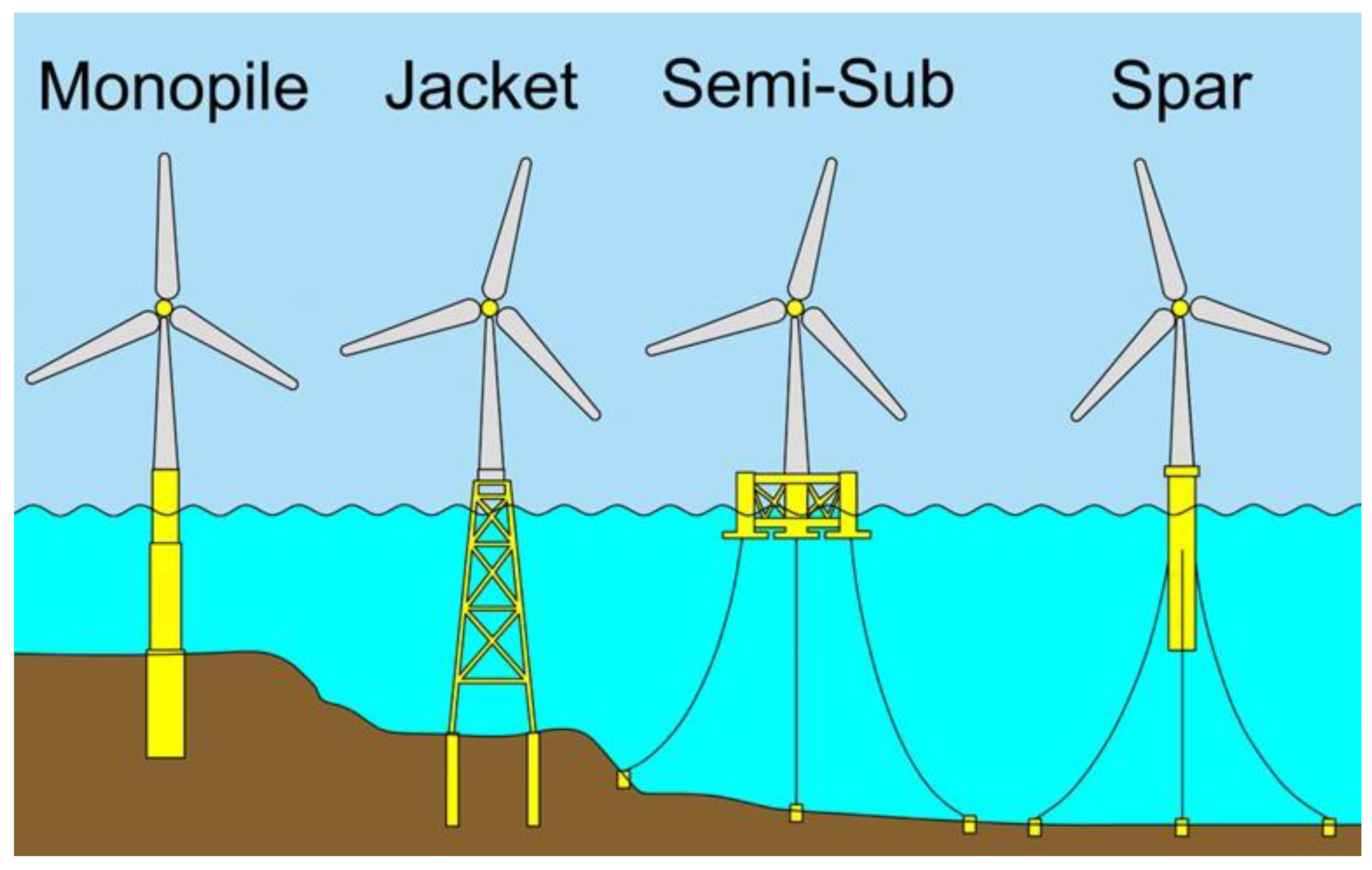
Figure 2.
Most popular floating wind support structures in the world. From left to right: Barge, Semi-submersible, Spar-buoy, and TLP. Figure processed by the authors, according to the information presented in [23].
Figure 2.
Most popular floating wind support structures in the world. From left to right: Barge, Semi-submersible, Spar-buoy, and TLP. Figure processed by the authors, according to the information presented in [23].
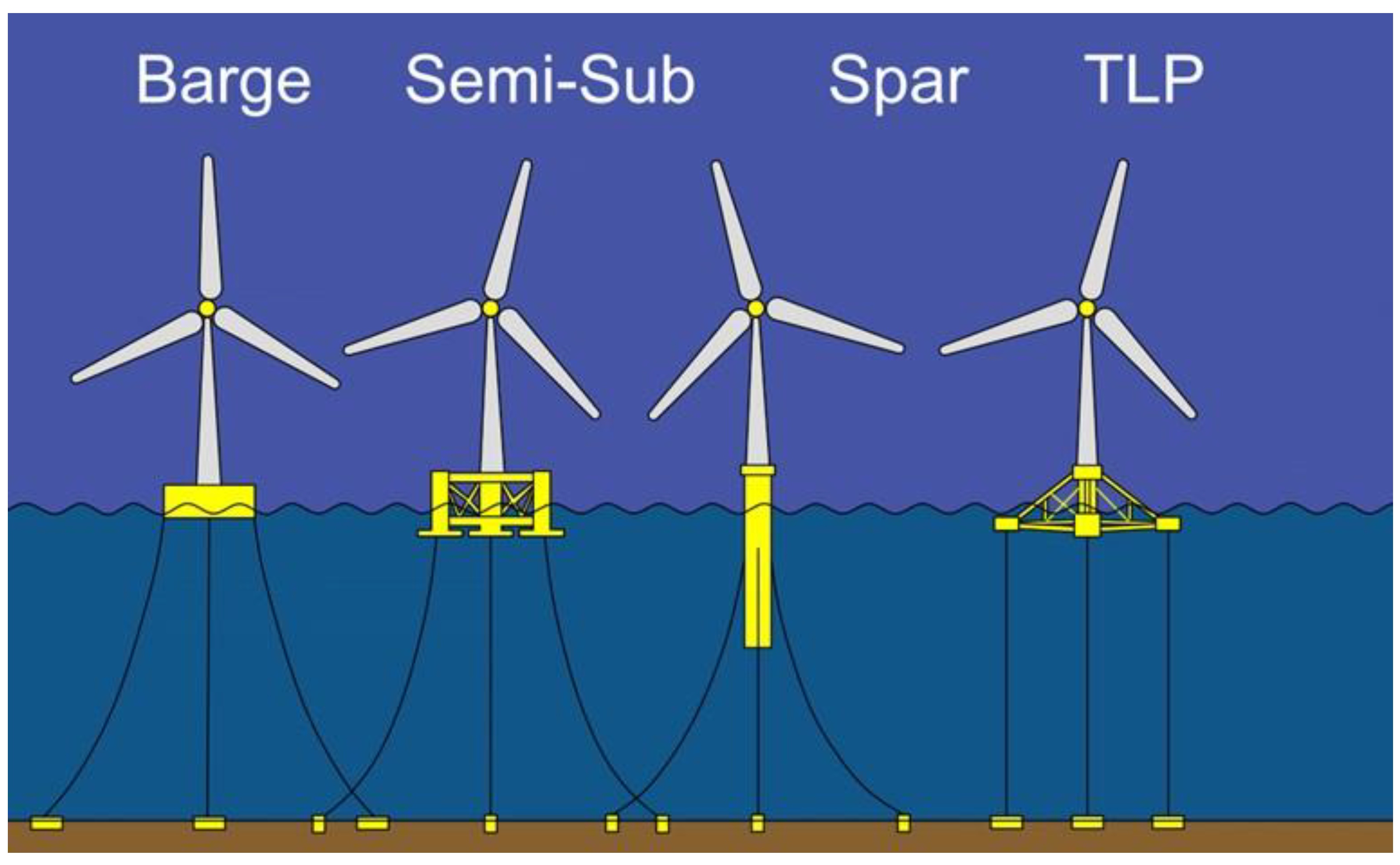
Figure 3.
The largest installed floating wind turbine in the world (Hywind Tampen). Figure processed by the authors, according to the information presented in [24].
Figure 3.
The largest installed floating wind turbine in the world (Hywind Tampen). Figure processed by the authors, according to the information presented in [24].
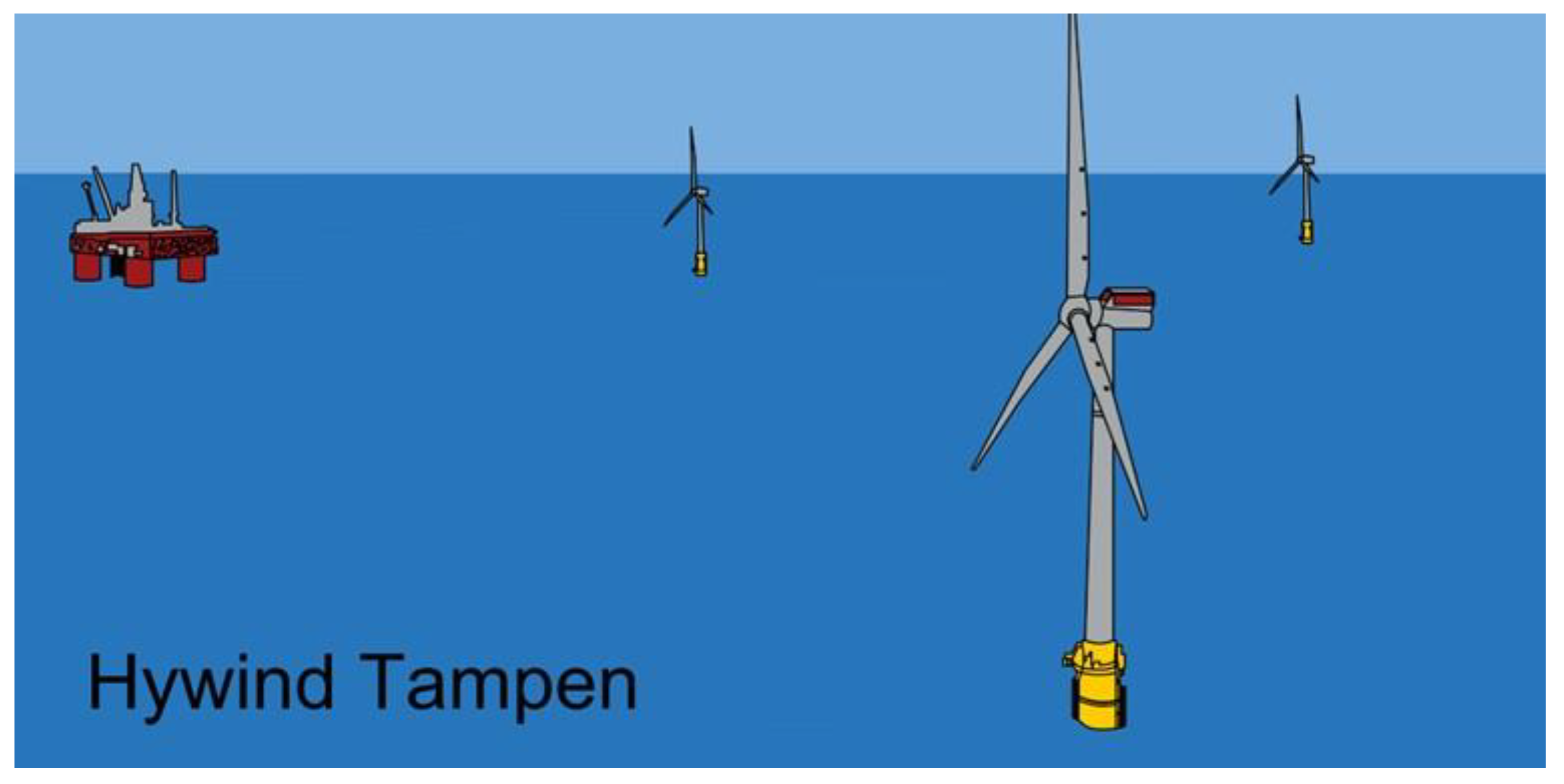
Figure 4.
The largest installed floating wind project in the world (Hywind Tampen). Figure processed by the authors, according to the information presented in [24].
Figure 4.
The largest installed floating wind project in the world (Hywind Tampen). Figure processed by the authors, according to the information presented in [24].
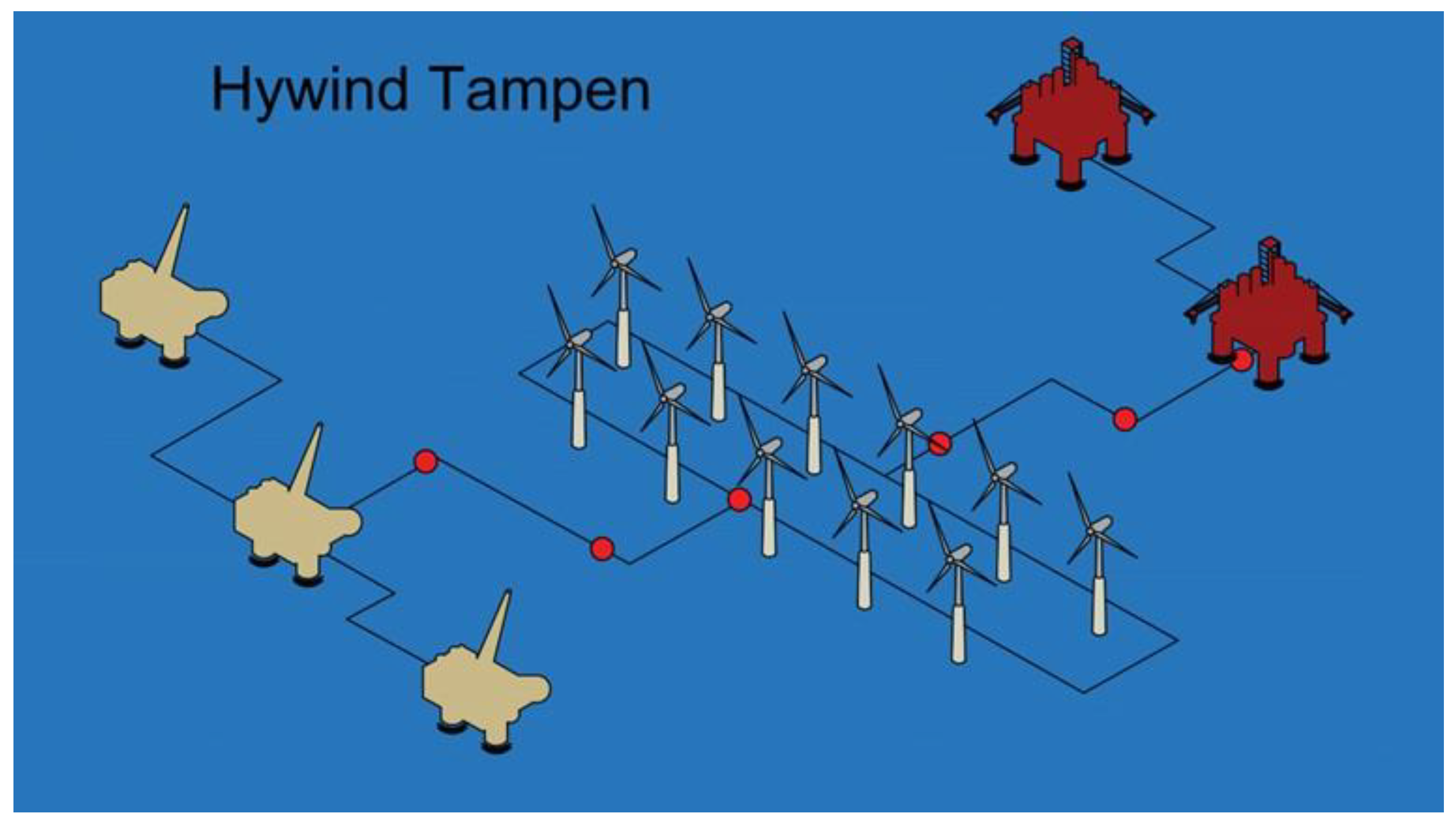
Figure 5.
The first installed floating wind project in the world (Hywind Scotland). Figure processed by the authors, according to the information presented in [25].
Figure 5.
The first installed floating wind project in the world (Hywind Scotland). Figure processed by the authors, according to the information presented in [25].
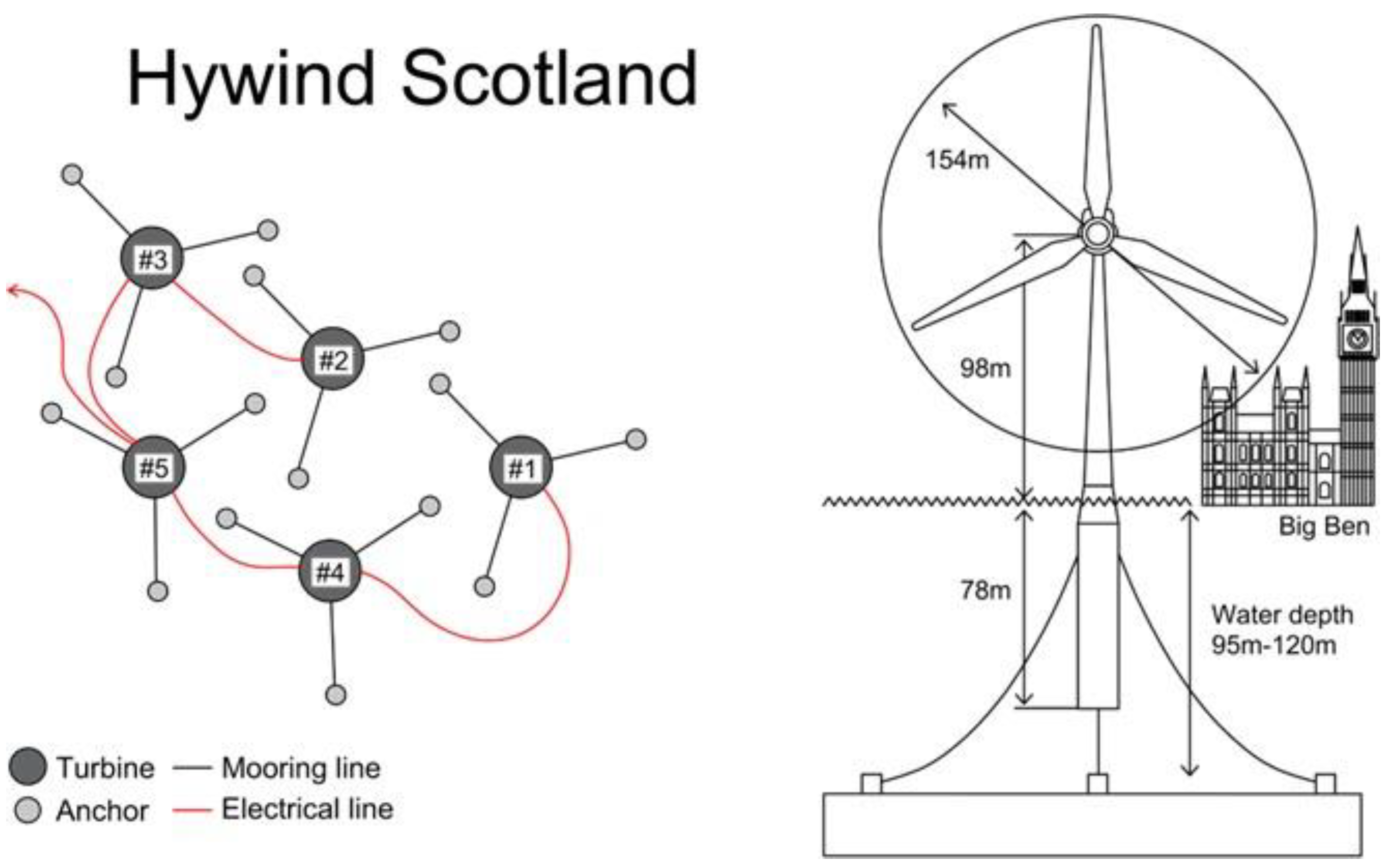
Figure 6.
The most popular multi-turbine floating wind turbine support structure in the world (HEXICON). Figure processed by the authors, according to the information presented in [26].
Figure 6.
The most popular multi-turbine floating wind turbine support structure in the world (HEXICON). Figure processed by the authors, according to the information presented in [26].
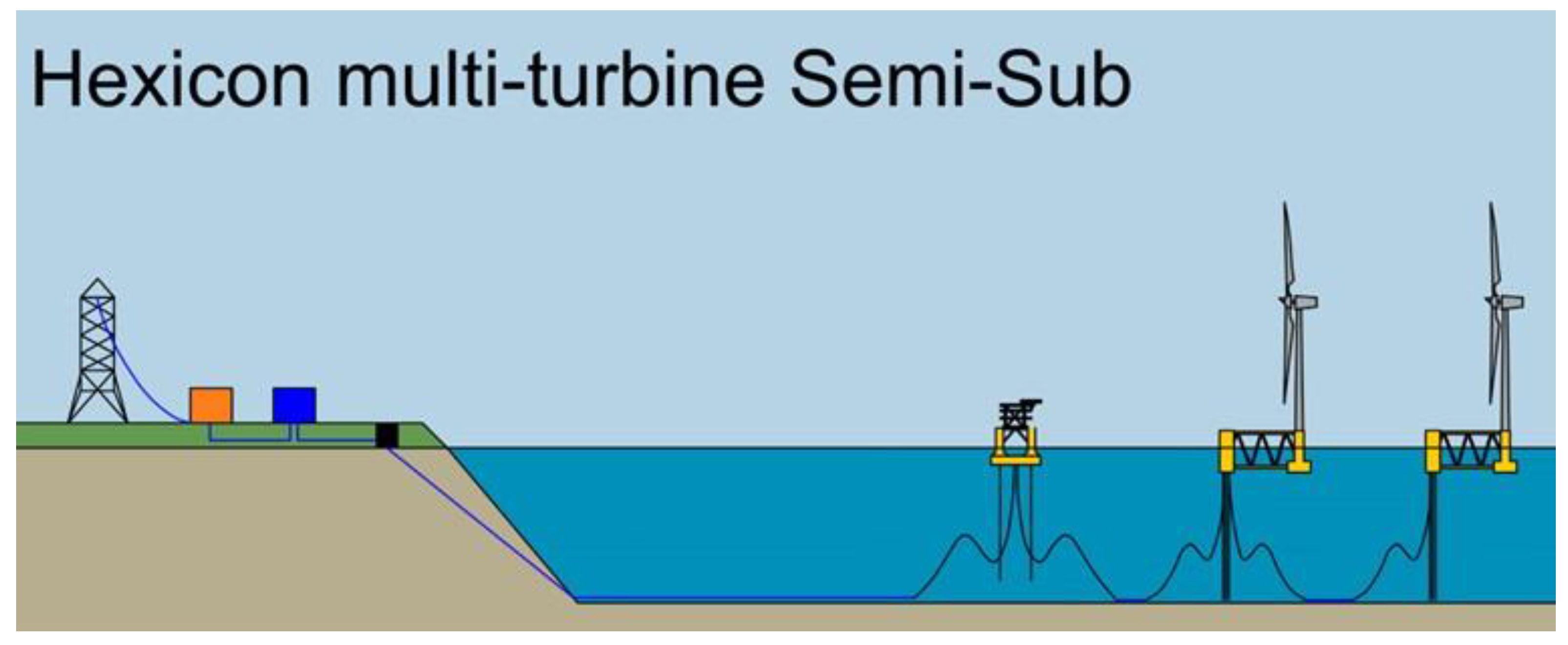
Figure 7.
The most popular multi-turbine floating wind support structure in the world (HEXICON). Figure processed by the authors, according to the information presented in [26].
Figure 7.
The most popular multi-turbine floating wind support structure in the world (HEXICON). Figure processed by the authors, according to the information presented in [26].
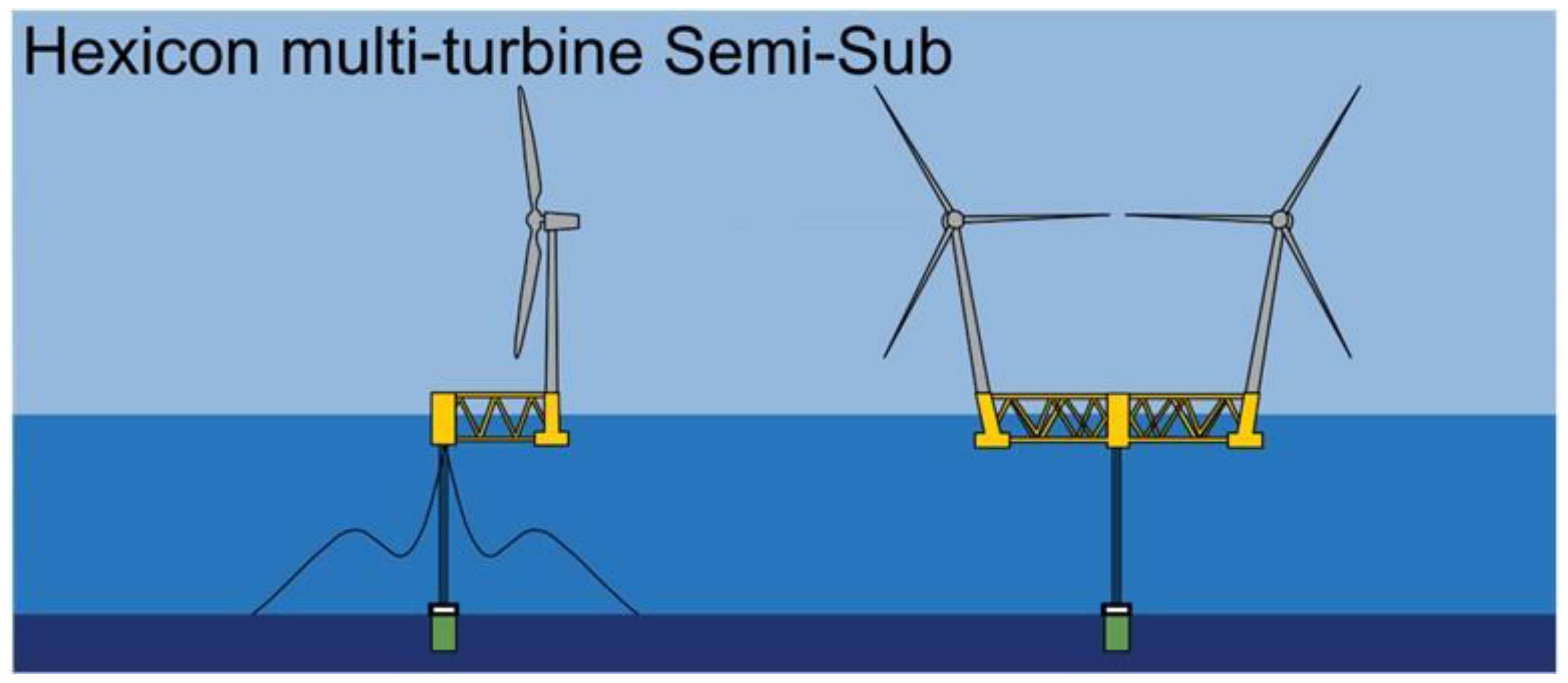
Figure 8.
The most popular multi-turbine floating wind support structure in the world (HEXICON). Figure processed by the authors, according to the information presented in [26].
Figure 8.
The most popular multi-turbine floating wind support structure in the world (HEXICON). Figure processed by the authors, according to the information presented in [26].
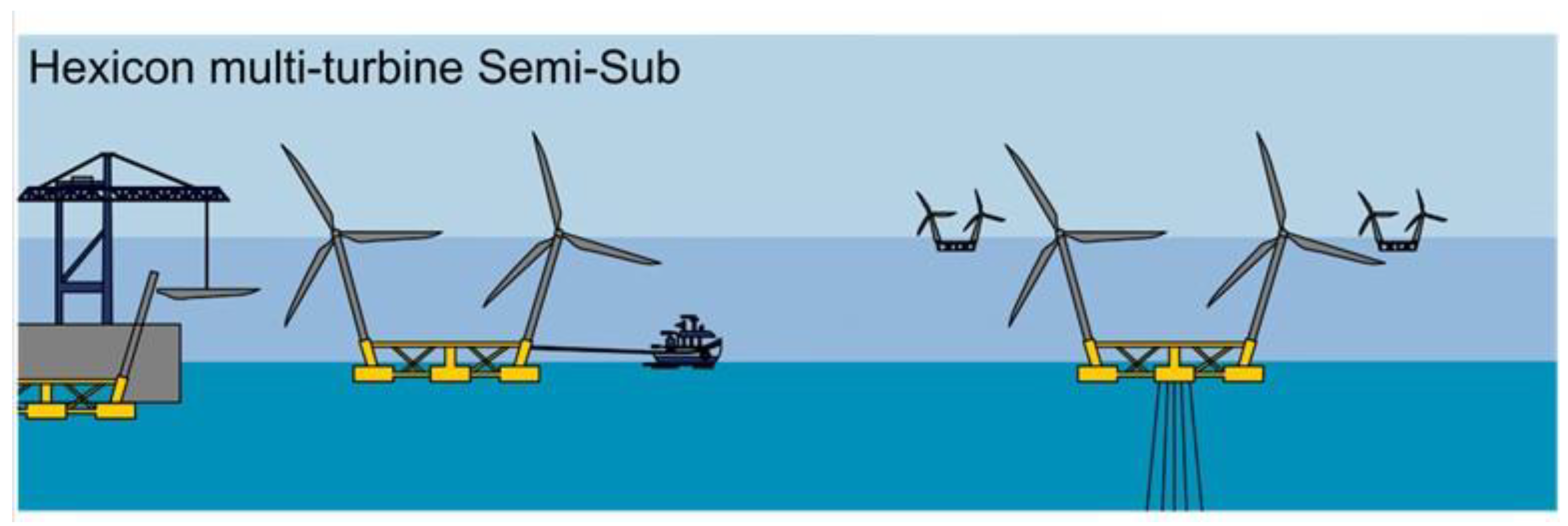
Figure 9.
The floating wind Power-to-X technology which transforms the produced floating wind electrical power mainly into hydrogen and compressed air. Figure processed by the authors, according to the information presented in [100].
Figure 9.
The floating wind Power-to-X technology which transforms the produced floating wind electrical power mainly into hydrogen and compressed air. Figure processed by the authors, according to the information presented in [100].
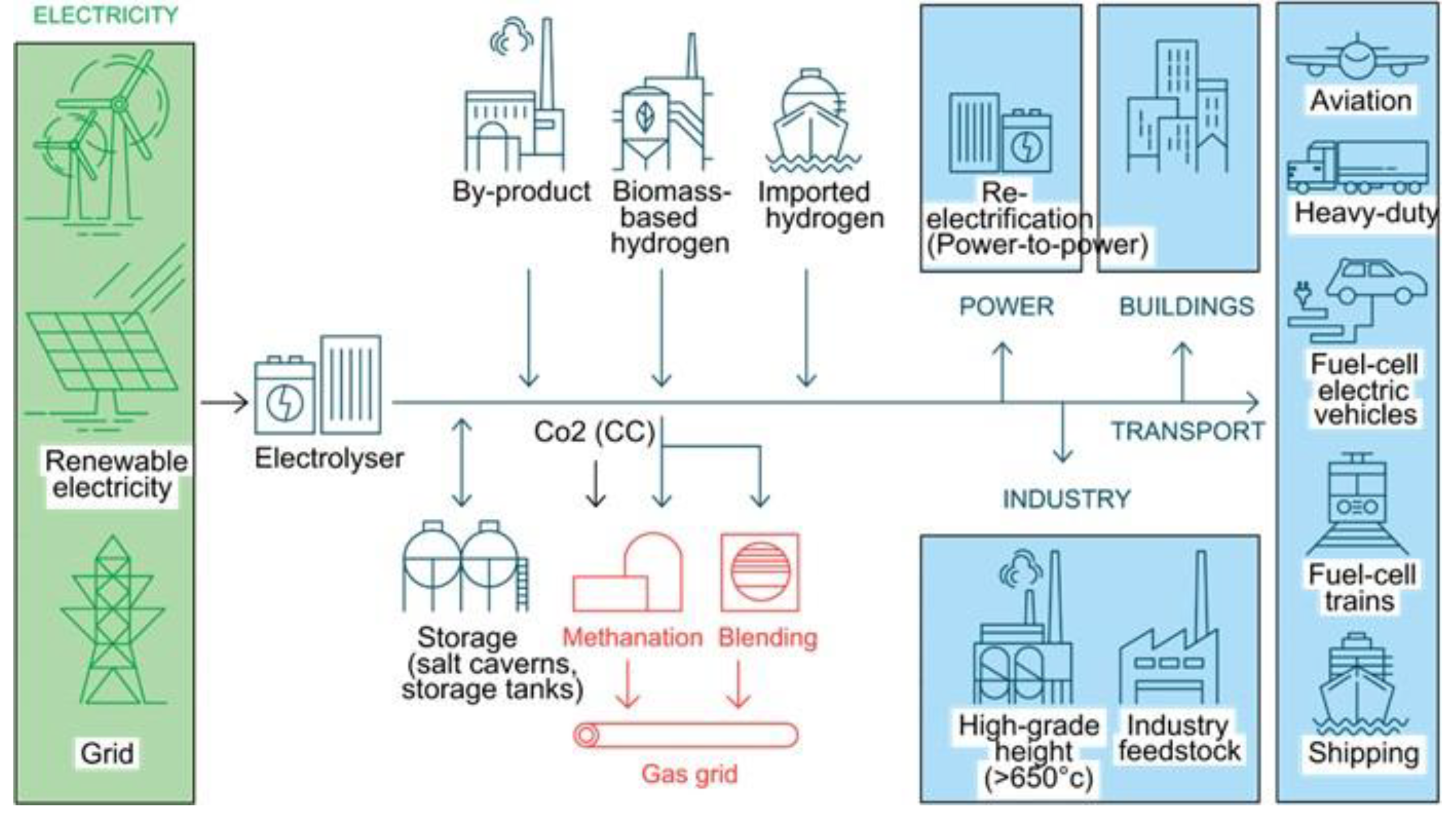

Table 1.
All the floating wind concepts in the world. Table data processed by the authors, based on the information presented in [22].
Table 1.
All the floating wind concepts in the world. Table data processed by the authors, based on the information presented in [22].
| Type | Concept | Designer | Hull Material |
|---|---|---|---|
| Spar-buoy | Hywind Toda Hybrid Spar |
Equinor Toda |
Steel or concrete Steel and concrete hybrid |
| Fukushima FORWARD Advanced Spar |
JMU | Steel | |
| SeaTwirl | SeaTwirl | Steel | |
| Stiesdal TetraSpar | Stiesdal | Steel | |
| Semi-submersible | WindFloat Fukushima FORWARD compact semi-submersible |
Principle Power MES |
Steel Steel |
| Fukushima FORWARD V-shape semi-Submersible |
MHI | Steel | |
| VolturnUS | University of Maine | Concrete | |
| Sea Reed | Naval Energies | Steel, concrete, or hybrid | |
| Cobra semi-spar | Cobra | Concrete | |
| OO-Star | Iberdrola | Concrete | |
| Hexafloat | Saipem | Steel | |
| Eolink | Eolink | Steel | |
| SCD nezzy | SCD Technology | Concrete | |
| Nautilus | NAUTILUS Floating Solutions | Steel | |
| Tri-Floater | GustoMSC | Steel | |
| TrussFloat | DOLFINES | Steel | |
| Barge | Ideol Damping Pool Barge Saitec SATH (Swinging Around Twin Hull) |
Ideol Saitec |
Concrete or steel Concrete |
| Tension leg platform | SBM TLP PivotBuoy TLP |
SBM Offshore X1 Wind |
Steel Steel |
| Gicon TLP | Gicon | Concrete | |
| Pelastar TLP | Glosten | Steel | |
| TLPWind TLP | Iberdrola | Steel | |
| Multi-turbine platform | Hexicon multi-turbine semi-submersible W2Power Floating Power Plant |
Hexicon EnerOcean Floating Power Plant |
Steel Steel Steel |
Table 2.
All the installed floating wind projects in the world. Table data processed by the authors, based on the information presented in [22].
Table 2.
All the installed floating wind projects in the world. Table data processed by the authors, based on the information presented in [22].
| Continent | Country, Location | Year, Turbine - Power | Project Name, Designer |
|---|---|---|---|
| North America | U.S., Maine | 2013, Renewegy 20 kW | VolturnUS 1:8, University of Maine |
| Asia | Japan, Goto Japan, Fukue |
2013, Hitachi 2 MW downwind 2015, Hitachi 2 MW downwind |
Kabashima, Toda Sakiyama, Toda |
| Japan, Fukushima | 2013, 66kV - 25MVA Floating Substation |
Fukushima FORWARD Phase 1, Fukushima Offshore Wind Consortium |
|
| Japan, Fukushima | 2013, Hitachi 2 MW downwind |
Fukushima FORWARD Phase 1, Fukushima Offshore Wind Consortium |
|
| Japan, Fukushima | 2015, MHI 7 MW | Fukushima FORWARD Phase 2, Fukushima Offshore Wind Consortium |
|
| Japan, Fukushima | 2016, Hitachi 5 MW downwind |
Fukushima FORWARD Phase 2, Fukushima Offshore Wind Consortium |
|
| Japan, Kitakyushu | 2019, Aerodyn SCD 3 MW – 2 bladed |
Hibiki, Ideol | |
| Europe | Denmark, Lolland Norway, Karmøy |
2008, 33 kW 2009, Siemens 2.3 MW |
Poseidon 37 Demonstrator [58], Floating Power Plant Hywind Demo, Equinor |
| Portugal, Aguçadoura | 2011, Vestas 2 MW | WindFloat 1 (WF1), Principle Power | |
| Portugal, Viana do Castelo | 2020, MHI Vestas 3×8.4 MW | WindFloat Atlantic (WFA), PrinciplePower | |
| Sweden, Lysekil | 2015, 30 kW Vertical Axis Wind Turbine |
SeaTwirl S1, SeaTwirl | |
| UK, Peterhead | 2017, Siemens 5×6 MW | Hywind Scotland, Equinor | |
| UK, Dounreay |
2017, N/A 2×5 MW | Hexicon Dounreay Trì project [86], Hexicon |
|
| UK, Kincardineshire | 2020, MHI Vestas 2 MW (former WF1) & MHI Vestas 5×9.5MW |
Kincardine, Principle Power | |
| Spain, Gran Canaria Spain, Santander France, Le Croisic Germany, Baltic Sea |
2019, 2×100 kW twin-rotor 2020, Aeolos 30 kW 2018, Vestas 2 MW 2017, Siemens 2.3 MW |
W2Power 1:6 Scale, EnerOcean BlueSATH, Saitec Floatgen, Ideol Gicon SOF [90], GICON |
|
Table 3.
All the planned floating wind projects in the world. Table data processed by the authors, based on the information presented in [22].
Table 3.
All the planned floating wind projects in the world. Table data processed by the authors, based on the information presented in [22].
| Continent | Country - Location, Floating Substructure Design -Type | Year, Turbine - Power | Project Name, Designer | ||
|---|---|---|---|---|---|
| Europe | Norway - Karmøy, Stiesdal TetraSpar - Spar Norway - Haugaland, SeaTwirl Spar |
2020, Siemens Gamesa 3.6 MW 2021, 1 MW Vertical Axis Wind Turbine |
TetraSpar Demo [82], Stiesdal SeaTwirl S2 [37], SeaTwirl |
||
| Norway - Snorre & Gullfaks offshore fields, Hywind Spar | 2022, Siemens Gamesa 11×8 MW |
Hywind Tampen, Equinor [84] |
|||
| Norway - Karmøy, OO-Star semi-submersible | 2022, 10 MW | Flagship Demo, Iberdrola [85] |
|||
| Offshore Norway | 2023, N/A | NOAKA, N/A | |||
| Offshore UK, Ideol damping pool - barge | 2021, 100 MW | Atlantis Ideol [87], Ideol | |||
| Offshore UK, TLPWind TLP | N/A, 5 MW | TLPWind UK, Iberdrola | |||
| Ireland - Offshore Irish west coast, Hexafloat -semi-submersible |
2022, 6 MW | AFLOWT [88], Saipem | |||
| Ireland - Offshore Kinsale, WindFloat semi-submersible | N/A, 100 MW | Emerald [89], Principle Power |
|||
| France - Gruissan, Ideol Damping Pool, barge | 2021, Senvion 4×6.2 MW | EolMed [91], Ideol | |||
| France - Offshore Napoleon Beach, SBM TLP | 2021, Siemens Gamesa 3×8.4 MW |
Provence Grand Large (PGL) [92], SBM Offshore | |||
| France - Offshore Leucate-Le Barcarès, WindFloat semi-submersible |
2022, MHI Vestas 3×10 MW | Golfe du Lion (EFGL) [93], Principle Power | |||
| France - Offshore Brittany, Sea Reed semi-submersible | 2022, MHI Vestas 3×9.5 MW | Groix & Belle-Ile [94], Naval Energies | |||
| France - Offshore Le Croisic, Eolink semi-submersible | N/A, 5 MW | Eolink Demonstrator [95], Eolink | |||
| Spain - Offshore Canary Island, PivotBuoy TLP | 2020, Vestas 200kW | PivotBuoy 1:3 Scale [96], X1 Wind | |||
| Spain - Offshore Canary Islands, Cobra semi-spar | 2020, 5×5 MW | FLOCAN5 [97], Cobra | |||
| Spain - Offshore Basque, Saitec SATH | 2021, 2 MW | DemoSATH [98], Saitec | |||
| Spain - Offshore Gran Canaria, N/A |
N/A, 4×12.5 MW | Parque Eólico Gofio, Greenalia | |||
| Spain - Basque, N/A | N/A, 26 MW | Balea, N/A | |||
| Spain - Offshore Gran Canaria, N/A |
N/A | WunderHexicon, Hexicon | |||
| North America | U.S. - Monhegan Island, VolturnUS semi-submersible | 2023, 12 MW | New England Aqua Ventus I [22], University of Maine | ||
| U.S. - California, WindFloat semi-submersible | 2024, 100 – 150 MW | Red Wood Coast [65], Principle Power |
|||
| U.S. - Hawaii, WindFloat semi-submersible | 2025, 400 MW | Progression South [69], Principle Power | |||
| U.S. - California, SBM TLP/ Saitec SATH | 2025, 4×12 MW | CADEMO, SBM Offshore/ SAITEC [70] |
|||
| U.S. - California, N/A | 2026, 1 GW | Castle Wind, N/A | |||
| U.S. - Hawaii, WindFloat semi-submersible | 2027, 400 MW | AWH Oahu Northwest, Principle Power | |||
| U.S. - Hawaii, WindFloat semi-submersible | 2027, 400 MW | AWH Oahu South [71], Principle Power | |||
| U.S. - California, N/A | N/A | Diablo Canyon [72], N/A | |||
| U.S. - Massachusetts, N/A | N/A, 10+ MW | Mayflower Wind, Atkins | |||
| Asia | Japan - Goto, Toda Hybrid spar Offshore Japan, Ideol Damping Pool, barge |
2021, 22 MW 2023, N/A |
Goto City [73], Toda Acacia [74,75], Ideol |
||
| Offshore Japan, SCD NEZZY Semi-Submersible | N/A, Aerodyn SCD 6 MW – 2-bladed |
Nezzy Demonstrator [40], SCD Technology | |||
| Korea - Ulsan, Hexicon multi-turbine semi- submersible |
2022, 200 MW | Donghae TwinWind, Hexicon |
|||
| Korea - Ulsan, Semi- submersible |
2020, 750 kW | Ulsan 750kW Floating Demonstrator, University of Ulsan |
|||
| Korea - Ulsan, N/A | 2020, 5 MW | Ulsan Prototype [78,79], N/A | |||
| Korea - Ulsan, N/A | 2023, 500 MW | Gray Whale [80], N/A | |||
| Korea - Ulsan, Hywind Spar | 2024, 200 MW | KNOC (Donghae 1) [77,81], Equinor | |||
| Korea - Ulsan, WindFloat semi-submersible | N/A, 500 MW | KFWind, Principle Power | |||
| Korea - Ulsan, N/A | N/A, 200 MW | White Heron, N/A | |||
Table 4.
Further details on the worldwide installed and planned floating wind projects in the period 2009-2026. Table data processed by the authors, based on the information presented in [22].
Table 4.
Further details on the worldwide installed and planned floating wind projects in the period 2009-2026. Table data processed by the authors, based on the information presented in [22].
| Year | Project, Location, Distance To Shore |
Turbine & Power, Floating Substructure Design & Type, Designer |
Water Depth, Site Condition, Estimated Cost |
|
|---|---|---|---|---|
| 2009 | HYWIND DEMO (ZEFYROS), Offshore Karmøy Norway, 10 km |
Siemens 2.3 MW, Hywind Spar, Equinor |
220 m, wind speed 40 m/s & max wave height 19 m, US $71 million |
|
| 2011 | WINDFLOAT 1 (WF1), Offshore Aguçadoura Portugal, 5 km |
Vestas 2 MW, WindFloat semi-submersible, Principle Power |
49 m, wind speed 31 m/s & max wave height 17 m, US $25 million |
|
| 2013 | VOLTURNUS 1:8, Offshore Castine Maine US, 330 m |
Renewegy 20 kW, VolturnUS, semi-submersible, University of Maine |
27.4 m, 50-year wind speed 14.1 m/s & 50-year significant wave height 1.3 m, US $12 million |
|
| SAKIYAMA, Offshore Sakiyama Fukue Island Japan, 5 km |
Hitachi 2 MW downwind, Haenkaze -Toda Hybrid spar, Toda |
100 m, 50-year wind speed 45.8 m/s & 50-year significant wave height 12.1 m, N/A |
||
| FUKUSHIMA FORWARD PROJECT phase I, Offshore Fukushima Japan, 23 km |
66kV - 25 MVA Floating Substation, Fukushima Kizuna - Advanced Spar, Japan Marine United Corporation (JMU) |
120 m, 50-year wind speed 48.3 m/s & 50-year significant wave height 11.71 m, US $157 million for all the phases of the project |
||
| FUKUSHIMA FORWARD PROJECT phase I, Offshore Fukushima Japan, 23 km |
Hitachi 2 MW downwind, Fukushima Mira - compact semi-submersible, Mitsui Engineering & Shipbuilding Co., Ltd. (MES) |
122-123 m, 50-year wind speed 48.3 m/s & 50-year significant wave height 11.71 m, US $157 million for all the phases of the project |
||
| 2015 | FUKUSHIMA FORWARD PROJECT, phase II, Offshore Fukushima Japan, 23 km |
MHI 7 MW, Fukushima Shimpuu - V-shape Semi-Submersible, Mitsubishi Heavy Industries, Ltd. (MHI) |
125 m, 50-year wind speed 48.3 m/s & 50-year significant wave height 11.71 m, US $157 million for all the phases of the project |
|
| SEATWIRL S1, Offshore Lysekil Sweden, N/A |
30 kW Vertical Axis Wind Turbine, SeaTwirl Spar, SeaTwirl |
35 m, wind speed 35 m/s, N/A |
||
| 2016 | FUKUSHIMA FORWARD PROJECT, phase II, Offshore Fukushima Japan, 23 km |
Hitachi 5 MW downwind, Fukushima Hamakaze - Advanced Spar, Japan Marine United Corporation (JMU) |
110-120 m, 50-year wind peed 48.3 m/s & 50-year significant wave height 11.71 m, US $157 million for all the phases of the project |
|
| 2017 | HYWIND SCOTLAND, Offshore Peterhead Scotland UK, 25 km |
Siemens 5×6 MW, Hywind Spar, Equinor |
95-120 m, average wind speed 10 m/s & average wave height 1.8 m, US $210 million |
|
| 2018 | FLOATGEN, Offshore Le Croisic France, 20 km |
Vestas 2 MW, Ideol Damping Pool-barge, Ideol |
33 m, wind speed 24.2 m/s & significant wave height 5.5 m, US $22.5 million |
|
| 2019 | HIBIKI, Offshore Kitakyushu Japan, 15 km |
Aerodyn SCD 3 MW - 2 bladed, Ideol Damping Pool - barge, Ideol |
55 m, typhoon-prone area, N/A |
|
| W2POWER 1:6 SCALE, Offshore Gran Canaria Spain, N/A |
2×100 kW twin-rotor, EnerOcean W2Power semi-submersible, EnerOcean |
N/A |
||
| 2020 | WINDFLOAT ATLANTIC (WFA), Offshore Viana do Castelo Portugal, 20 km |
MHI Vestas 3×8.4 MW, WindFloat semi-submersible, Principle Power |
85-100 m, N/A, US $134 million |
|
| KINCARDINE, Offshore Kincardineshire Scotland UK, 15 km |
MHI Vestas 2 MW (former WF1) - MHI Vestas 5×9.5 MW, WindFloat semi-submersible, Principle Power |
60-80 m, UK North Sea off the coast of Scotland, US $445 million |
||
| BLUESATH, Offshore Santander Spain, 800 m |
Aeolos 30 kW, Saitec SATH 1:6, Saitec |
N/A, Abra del Sardinero, US $2.2 million |
||
| TETRASPAR DEMO, Offshore Karmøy Norway, 10 km |
Siemens Gamesa 3.6 MW, Stiesdal TetraSpar - Spar, Stiesdal |
220 m, Near Zefyros (former Hywind Demo), US $20.5 million |
||
| 2021 | DEMOSATH, Offshore Basque Spain, 3.2 km |
2 MW, Saitec SATH, Saitec | 85 m, wind speed 12 m/s & significant wave height 2.8 m, $17.3 million |
|
| EOLMED, Offshore Gruissan Mediterranean Sea France, 15 km |
Senvion 4×6.2 MW, Ideol Damping Pool - barge, Ideol |
55 m, Mediterranean Sea, US $236.2 million |
||
| PROVENCE GRAND LARGE (PGL), Offshore Napoleon beach Mediterranean Sea France, 17 km |
Siemens Gamesa 3×8.4 MW, SBM TLP, SBM Offshore |
100 m, Mediterranean Sea, US $225 million |
||
| 2022 | HYWIND TAMPEN, Snorre & Gullfaks offshore fields Offshore Norway, 140 km |
Siemens Gamesa 11×8 MW, Hywind Spar, Equinor |
260-300 m, mean significant wave height 2.8 m, US $545 million |
|
| GOLFE DU LION (EFGL), Offshore Leucate-Le Barcarès Mediterranean Sea France, 16 km |
MHI Vestas 3×10 MW, WindFloat semi-submersible, Principle Power |
65-80 m, Mediterranean Sea, US $225 million |
||
| GROIX & BELLE-ILE, Offshore Brittany France, 22 km |
MHI Vestas 3×9.5 MW, Sea Reed semi-submersible, Naval Energies |
60 m, Atlantic Ocean off the coast of France, US $254 million |
||
| DONGHAE TWINWIND, Offshore Ulsan Korea, 62 km |
200 MW, Hexicon multi-turbine semi-submersible, Hexicon |
N/A | ||
| 2023 | NEW ENGLAND AQUA VENTUS I, Offshore Monhegan Island in the Gulf of Maine US, 4.8 km |
12 MW, VolturnUS - semi-submersible, University of Maine |
100 m, 50-year wind speed 40 m/s & 50-year significant wave height 10.2 m, US $100 million |
|
| 2024 | REDWOOD COAST, Offshore Humboldt County California US, 40 km |
100 – 150 MW, WindFloat semi-submersible, Principle Power |
600 m - 1 km, average annual wind speed 9-10 m/s, N/A |
|
| 2025 | CADEMO, Offshore Vandenberg California US, 4.8 km |
4×12 MW, SBM TLP/ Saitec SATH, SBM Offshore/Saitec |
85-96 m, average wind speed 8.5 m/s, N/A |
|
| 2026 | CASTLE WIND, Offshore Morro Bay California US, 48 km |
1 GW, N/A, N/A | 813 m-1.1 km, average wind speed 8.5 m/s, N/A |
|
Disclaimer/Publisher’s Note: The statements, opinions and data contained in all publications are solely those of the individual author(s) and contributor(s) and not of MDPI and/or the editor(s). MDPI and/or the editor(s) disclaim responsibility for any injury to people or property resulting from any ideas, methods, instructions, or products referred to in the content. |
© 2024 by the authors. Licensee MDPI, Basel, Switzerland. This article is an open access article distributed under the terms and conditions of the Creative Commons Attribution (CC BY) license (http://creativecommons.org/licenses/by/4.0/).
Copyright: This open access article is published under a Creative Commons CC BY 4.0 license, which permit the free download, distribution, and reuse, provided that the author and preprint are cited in any reuse.


