

Submitted:
03 January 2024
Posted:
04 January 2024
You are already at the latest version
Abstract
Keywords: gender equality policy; initial teacher education; teacher educators’ perceptions; gender perspective; university teaching; sustainable development; SDG5; SDG4.
Keywords:
gender equality policy
; initial teacher education
; teacher educators’ perceptions
; genderperspective
; university teaching
; sustainable development
; SDG5
; SDG4
1. Introduction
Gender mainstreaming (GM) is a policy strategy that has been used to improve social justice and equality in education. The concept was introduced at the 1985 Nairobi World Conference on Women and established as a global approach to promote gender equality (GE) through the Beijing Platform for Action [1] which set the guidelines for its implementation. The term emerged in the European Union in 1991 and soon was embraced by the Member States gaining acceptance thanks to various UN conferences. The UN Economic and Social Council (ECOSOC) [2] institutionalized and defined it as (p. 2):
The process of assessing the implications … of any planned action, including legislation, policies or programs, in all areas and at all levels. It is a strategy for making women’s as well as men’s [and other vulnerable groups] concerns and experiences an integral dimension of the design, implementation, monitoring and evaluation of policies and programs in all political, economic and societal spheres so that [they] benefit equally and inequality is not perpetuated.
The GM concept was transferred by UN Women to non-European contexts without considering its epistemological and political implications, reason why it has not been exempt from criticism, tensions, as well as terminological misunderstandings [3,4,5,6]. It was born with the attempt to transform institutions, cultural norms and practices that limited women’s rights and was articulated as a process of transformation of power relations [7]. Therefore, it pertains not only to women but also to the evaluation of policies based on how they affect both men and women in a way that benefits them both [8].
In addition to the Beijing Platform for Action and the ECOSOC Agreed Conclusions 1997/2, the implementation of the GM strategy has been guided by other international mandates, such as the Quadrennial Comprehensive Policy Review 2020, which emphasized that achieving GE and empowering women and girls will make a crucial contribution to progress across all the goals and targets of the 2030 Agenda [9]. This indicates that the transformative potential of GM has been reaffirmed in the 2030 Agenda for Sustainable Development [10], with an explicit acknowledgement that sustainable development cannot be accomplished in any area without equality, women’s rights and empowerment. In the 2030 Agenda, this commitment to protect human rights and promote equality seeks to be developed through SDG4 (the education goal), which includes developing knowledge and skills on gender equality (Target 4.7) and improving educational institutions to make them more gender-sensitive and responsive (Target 4.8). Thus, education for sustainable development (ESD) has a leading role in training in and for gender equality and teacher educators and universities have a duty to assume that role by teaching and doing research using a gender approach [11].
Given the crucial role of ESD as an engine of development, higher education institutions have been driven to reorient their mission and values to sustainability commitments. But a number of obstacles to comprehending its principles, approaches, and methodologies, along with the need to build institutional capacity to facilitate GM implementation and overcome resistance, have slowed down its advancement [12]. The laxity in GM implementation, along with the continuous and renewed impetus provided by the 2030 Agenda has gardually led universities to increase their efforts to enforce institutional commitment, develop guidelines and tools, and promote training and capacity-building, but the question, To what extent existing practice actually supports a gender-responsive approach to teaching and learning?, remains unanswered. As we approach the 25th anniversary of the adoption of the ECOSOC Conclusions on GM’s adoption, it seems fitting to reflect on and provide evidence of the developmental status of GM implementation in university teaching, commitment that higher education institutions have acquired to make educators and curricula responsive to gender equality [13].
1.1. Literature Review
In the context of higher education, GM refers to the process of including a gender perspective (GP) into teaching, research and management of faculties and departments using GE plans as instruments for its implementation [14]. In the area of teaching, it translates into a way of teaching that considers sex and gender as key analytical and explanatory variables, which implies that educators must pay attention to the similarities and differences in the experiences, interests, expectations, attitudes and behaviors of women, men, as well any disadvantaged group. Additionally, it implies addressing the causes and effects of inequality, a task for which teachers are insufficiently prepared. Therefore, it has been acknowledged that teacher education (TE) is crucial for advancing sustainable gender equality, and that teachers play a key part in raising gender awareness and facilitating the development of the knowledge, skills, attitudes and abilities considered necessary to teach future generations [15].
Despite the recognition of gender training for teachers as key for development, research on teacher education for SDG5 is very limited. Teacher education for sustainable gender equality is an emergent area of policy, practice, and research that focuses on the integration of ESD4.7 for gender equality concepts and objectives into teacher education. According to Fischer [16], after the Decade of ESD and the Global Action Programs, research on TE for SD began to grow substantially resulting in a considerable number of journals, conferences, and networks that contributed to enhancing its conceptual and practical development. However, in practice, there is an increasing need to consolidate this scarce body of research. In regards to TE for gender equality, an analysis at institutional level of current training programs shows that teacher training institutions are not adequately preparing future teachers for gender-sensitive practice. Studies like the ones conducted in Spain by García-Ramos et al. [17], Larrondo and Rivero [18], Merma et al. [19], Miralles-Cardona et al. [20], Reverter-Bañón [21], Valdivieso [22], or that of Rodríguez-Jaume and Gil-González [23] at the universities of Xarxa Vives, among others, demonstrate the absence of a gender dimension in the university curriculum. This state of affairs seems similar in all branches of knowledge and disciplines (see for example Atchison [24], Ortega-Sánchez & Pagès-Blanch [25], Prendes-Espinosa et al. [26], Rebollo-Catalán & Buzón-García [27], Serra et al. [28]) and across countries (Bothwell [29], Brunilla & Kallioniemi [30], Gründberg [31], Gudbjornsdottir et al. [32], Kitta & Cardona-Moltó [33], Kreitz-Sandberg & Lahelma [34], Weiner [35], or Zippel et al. [36]), indicating that TE for sustainable gender equality appears to not have materialized in the university curricula.
Larger-scale initiatives to promote gender equality in institutions have been put into place in Europe (such as gender equality plans and impact assessments of GM); however, structural, cultural and institutional barriers and ineffectiveness keep these initiatives from developing to their full potential [37]. To address these challenges and facilitate the implementation of a gender approach in teaching, research and innovation, the European Community has recently funded several projects through the Seventh Framework Program and Horizon 2020, encouraging the creation of consortia amongst institutions to exchange experiences. Much work remains to be done, even if this effort has aided in the creation of a training academy for institutional change (Gender Equality Academy) and the development of a network of Communities of Practice (CoP) to address gender inequalities in these fields (e.g. ACT-on-Gender).
The studies mentioned above suggest that, although GE policy and the mandate of GM have been widely researched, little attention has been paid to educational practices and outcomes, suggesting that there is no systemic approach to teaching gender equality at university level. For instance, it is enough to consider the findings of Valdivieso’s research in the field of teacher education. Valdivieso et al. [22] examined whether subjects with gender content were present in the degrees of Early Childhood and Elementary Education at 44 Spanish universities. They found that only 11 universities included courses on gender issues and that they were usually electives. In five other universities they identified subjects that, although they did not include the term ‘gender’ in the title, the gender approach had a place in the teaching guides. Other studies conducted across Spain by González-Pérez [38], Ortega-Sánchez and Pagès-Blanch [26], Reverter-Bañón [21] o Vizcarra et al. [39] reached similar conclusions, indicating that teacher education for GE is overlooked at education degrees.
At the University of Alicante (UA), institution where the present study was carried out, a study of Axis 2 (University Teaching) of the IV Equal Opportunities Plan between Women and Men [40] leads to similar conclusions, indicating that the gender approach in teaching is practically non-existent at curricular level. Moreover, according to the Report of the III Equal Opportunities Plan between Women and Men [41], which examined the teaching guides for every subjects across 45 degrees in the 5 branches of knowledge (Arts and Humanities with 9 degrees, Sciences with 6 degrees, Health Sciences with 3 degrees, Social and Judicial Sciences with 17 degrees, and Engineering and Architecture with 10 degrees), it appears that: (a) in terms of the inclusion of gender-specific subjects in study plans, only three degrees (French Studies, Management and Public Administration and Sociology) include a compulsory subject whose title explicitly refers to gender issues and only four degrees (Criminology, History, Early Childhood Education, Primary Education) have an elective subject. This means that only seven of the 45 degrees offered throught the UA (15.55%), or seven of the 2,513 subjects analyzed (0.27%) have gender-specific subjects in their study plans; (b) with regard to the incorporation of a gender approach in the objectives and contents of the teaching guides, only 24 out of 45 degrees (53.33%) have at least one teaching guide with content with a gender perspective, 15 degrees (33.33%) include three or more teaching guides with a focus on gender, and the remaining five degrees (11.11%) include five or more teaching guides for subjects with a gender perspective. The degree with the most gender-responsive teaching guides is Sociology, with eight teaching guides. The status of GM in university teaching at the universities of the Xarxa Vives is quite similar to that described in the UA, with very few exceptions [23].
The developmental aspects of GM do not seem better than the ones described above, particularly when the interest focuses not so much on assessing the presence-absence of gender content and objectives in degrees and teaching guides, but rather on outcomes, specifically, on the competency development of teachers/educators and students, in which case the absence of research is alarming. The literature review carried out by Edwards et al. [42] regarding SDG4.7 for gender equality contributed to confirm the lack of meaningful engagement with the incorporation of gender equality training at all levels (curricula, teacher education, and student assessment) having identified in their review only two studies (that of Grayson and Martin [43] conducted in primary grades in the United States and that of Acar-Erdol and Gözütok [44] carried out in Turkey at the university level) that demonstrate that when a GE curriculum is mainstreamed into teaching the benefits not only for teacher educators but for students are secured. The study by Edwards et al. also focused on the recognition that to achieve the SDGs attention should be paid not only to teaching but also to learning, which means that assessment and monitoring at various levels should be a prerequisite on how SDGs can be achieved and that transformational experiences for students are key to put them in connection with the wider world.
Among the professionals in the field of gender studies, there is a belief that current initial teacher education programs must be improved by adopting a more conceptually grounded and sustainable gender approach for which existing barriers should be removed. This means that mainstreaming gender into teaching must be preceded by an evaluation where each institution identifies their challenges and problems in regards to this issue. Within the framework of their institutional plans, universities must seriously establish a plan that defines their needs, goals and developmental activities. The model developed by the Swedish Association of Local and Regional Authorities [45] illustrates the general processes to be observed when planning a consensual and responsible institutional plan of GM implementation. According to SALAR [45, p. 12, 18], universities should ask themselves:
- How are gender policies related to the European Community, national, or regional regulations? Are these regulations included in the mission of the university itself and in its educational project?
- How does the institution ensure that the content of its GE plan is incorporated into its governing documents?
- Are the principles of GE and social justice included in degrees? How to ensure that the degree competencies are achieved and that the acquired skills are transferred to practice?
- Do teacher educators incorporate a gender perspective into teaching content and activities? Does this incorporation vary by discipline, area of knowledge or occupational field?
The issue is not so much the success or failure of incorporating a gender-sensitive approach into teaching, but rather the establishment of a viable implementation process that includes appropriate indicators to monitor and evaluate the undertaken actions. According to Sandler [46], it is these actions and activities that will help make visible the state of the art. So that, if the work carried out does not exceed the policy level, few significant changes in practice can be expected.
1.2. Aims
Based on the given background, this study aimed to explore teacher educators’ perceptions of GM implementation on teaching and the factors that may affect their involvement in teaching using a gender-responsive approach. Specifically, we pursued to learn about: (1) the impact of the GE policy on teacher education degrees and study programs at the University of Alicante, Alicante, Spain, institution that is situated in a neutral position, with an average of 59.7 out of 100, in the World University Ranking on Gender Equality [47]; (2) the factors influencing teacher educators’ involvement in teaching using a gender approach; and (3) teacher educators’ perspective of challenges and needs to improve the GM implementation process. Gained knowledge may provide valuable information for understanding the barriers influencing teacher educators’ involvement in using a gender-responsive approach and, ultimately, may facilitate curricular reforms deemed necessary to achieve visible results on gender equality policy implementation.
2. Materials and Methods
The methodology in this study was predominantly of qualitative nature given that the goal was to gain understanding on how teacher educators view and experience GM implementation at their institution. Individual interviews, survey and document analysis were the main sources of data.
2.1. Design
A descriptive case study with teacher educators selected from the College of Education at UA in Spain was developed [48]. A case study can be defined as an intensive study about a person, a group of people, or a unit, which is aimed to generalize over several units. As Cousin [49] stated, the case study method is not aimed to analyze cases but it is a good way to define cases and to explore a setting in order to understand it.
2.2. Participants
The sample consisted of nine (N = 9) teacher educators representing the three teacher education programs at the participating institution (Early Childhood, Elementary, and Secondary Education). They were purposefully selected from the instructor pool teaching in these programs and following the criteria of balance proportion by sex, degree taught, and tenure status. Of approximately 40 teacher educators in each degree (120 in the three programs), 12 (10%) with teaching assignments in those degree programs were contacted. We received nine responses (N = 9) from the initial 12. Their age ranged between 34 to 67 years (M = 49.22, SD = 11.09) and their teaching experience between 8 to 28 years (M = 14.22, SD = 6.36). Fifty percent of the participants were associate professors, 35% lecturers, and 15% professors and rated their gender knowledge at 6.89 (SD = 2.20) on a scale of 10. More detailed demographic information about the sample is displayed in Table 1.
2.3. Data Collection and Procedure
Data collection included individual interviews with each participant, document analysis (programs and syllabus examination), and participants’ assessment of the current conditions of GM implementation at their institution via questionnaire. Interviewees were contacted by email. Those who accepted to participate were carefully informed about the study and agreement was obtained through a signed consent form. Confidentiality was also guaranteed assuring that no names would be shown in completed files, transcribed interviews, or other type of document. The study was deemed exempt from review by the Ethical Board of the institution.
2.3.1. Interviews
Due to the restrictions imposed by the COVID-19 pandemic, most of the semi-structured interviews were conducted by phone or videoconference in order to reach out to those who preferred this form of communication. Interviews were on average 40-45 minutes in length. All interviews were conducted during the second semester of the 2019-2020 academic year on the day and time agreed with the interviewees. During the interviews, the researcher asked open-ended questions (see Interview Guide in Appendix A) and followed up with probing questions when appropriate [50]. All of the interviews were conducted in Spanish. The interview guide was divided into four main themes: (1) impact of GM implementation in study plans and course content, (2) factors affecting teacher educators’ involvement in GM in teaching, and (3) self-identified challenges and needs to effectively improve this process. The guide was pilot-tested with two experts belonging to the UA Institute for Gender Studies Research. The question that opened the main part of the interview was ‘Do you consider that gender and GE training are important for initial teacher preparation?’ In the following questions, interviewees were asked about their perceptions on how the College of Education had been managing GM implementation and what factors were affecting their decision to teach using a gender-responsive approach.
2.3.2. Document Analysis
Using qualitative content analysis, nine syllabi (teaching guides) taken from the courses taught by the participants were analyzed (two from Early Childhood, three from Elementary, and four from Secondary Education degrees). Focus was placed on how the terms ‘gender’, ‘gender equity’, ‘gender equality’, ‘equal opportunities’, ‘gender inequities’ appeared in the general and/or specific degree’s competencies and course description in the teaching guides. The nine (N = 9) syllabi were retrieved from the participating institution’s website (www.ua.es). Fifty-six (55%) of the syllabi analyzed were from undergraduate courses and 45% from graduate courses. The syllabi represented the areas of didactics (45%), diagnosis and research methods (33%), and theory and philosophy of education (22%). Data was then examined and analyzed for key words or phrases that suggested gender-related concepts, or equity principles or philosophies. Memos or document summaries were then created.
2.3.3. Questionnaire
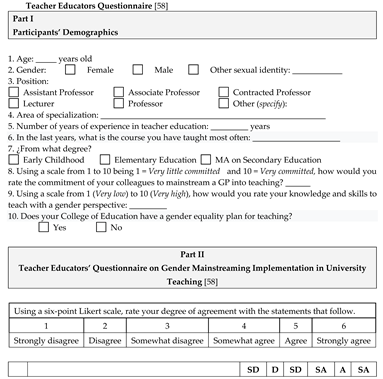
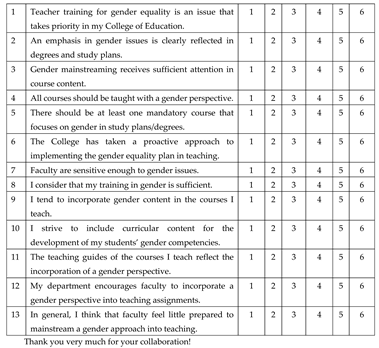
A brief questionnaire (Appendix B) was used to assess teacher educators’ perceptions of the current conditions of GM implementation in teaching at the College of Education. The questionnaire included 23 questions (10 related to demographic information and 13 which gathered their perceptions of their personal (7 items) and institutional (6 items) commitment to GM. Responses to the questionnaire were based on a Likert scale of six anchors (1 = Strongly Disagree; 6 = Strongly Agree). The minimum score of the Personal Commitment subscale was 7 and the maximum was 42. A score of 14 was considered a ‘weak commitment’, while a score around 35 indicated ‘good commitment.’ Similarly, a score of 12 on the Institutional Commitment subscale was considered low, while a value of around 30 was considered high. The content validity of the questionnaire was assessed using Lawshe’s [51] formula. The questionnaire was submitted for four experts to review its content and evaluate item relevance. As a result, a Content Validity Index of .97 was obtained, which is considered a very good coefficient [52]. Cronbach’s alpha was also calculated yielding a coefficient of .87. These indices, although tentative due to small sample size, showed preliminary evidence that the questionnaire ‘Teacher Educators Perceptions on Gender Mainstreaming Implementation in Teaching’ was initially psychometrically sound in terms of item characteristics, scale reliability, and content validity.
2.4. Data Analysis
For Part I of the study (interviews), a qualitative content analysis was conducted from the participants’ responses. The analysis was consensus-based and followed the procedures commonly associated with phenomenological research [53]. It was carried out by three researchers familiar with the topic, who began the process with independent analysis. Codes, categories, themes, and passages were continuously compared with each other and carefully examined through data immersion and scrutiny to find consistencies, inconsistencies, patterns, and connections. For Part II of the study, a two-stage qualitative content analysis of the teaching guides was used. Stage 1 consisted of reading through all the syllabus to get an overview of the competencies to be developed, expressed goals, and content. Stage 2 involved identifying the correspondence between competencies, goals, and content. For Part III (questionnaire data), descriptive statistics (mean, standard deviations, frequencies and percentages) were calculated. Credibility was achieved by using methodological triangulation through both qualitative (interviews and document analysis) and quantitative (questionnaire) methods.
3. Results
Findings are summarized by objectives and main themes/subthemes as they emerged from the qualitative and quantitative analyses.
3.1. Impact of the Gender Mainstreaming Policy on Education Degrees
The prevailing idea among participants in regards to the impact of the GM strategy on university teaching was that GM has had very little impact on instruction. The review made on undergraduate and graduate TE degrees and study programs showed that there was no required course in these programs making reference to gender equity. There was only one elective course, “Education for Gender Equality,” which, given its voluntary nature, did not guarantee that all students would take it, so there was no certainty that all student teachers would acquire a certain level of gender competency. One of the interviewed participants described the phenomenon as follows:
Degrees in the College of Education do not include a specific commitment to developing gender equity competence, hence, study plans have not been designed with this purpose in mind. It can be said that they are gender blind. (SE1)
Other interviewees emphasized the separation between theory and practice regarding GM implementation, stating that the regulations on GE policy have brought new initiatives, but in practice there have been few changes made in study programs:
There is a specific regulation that makes explicit the incorporation of gender equality in the initial training of future teachers, but at the classroom level, very few changes have been made. (EL3)
I have not seen significant changes. The impact has been occasional and not systemic. (EC6)
It seemed as if GM were being taken as a voluntary and occasional intervention, meaning that, since there was no required coursework, GE regulations had not been reflected in degrees and, consequently, the teaching staff did not feel committed. Rather, gender issues remained not embedded in the philosophy of study programs.
There have been hardly any changes in study plans ... [Gender] has not been treated transversally in the different subjects. (SE8)
As far as I know, a course that addresses this issue has been incorporated in the curricula, but it is optional, when I understand that it should be mandatory. (SE9)
Additionally, the teaching guides did not reflect the inclusion of gender in course-content (Table 2). A close examination revealed that gender was absent from the curriculum and that only one of the nine teaching guides examined, Cod. 11998, showed some congruence between the syllabi competencies to be developed and the course goals and contents. In the rest of the subjects (teaching guides with cod. 12192, 17516, 12031 and 12078), no reference to gender was made in any of the indicators (competencies, course description, goals, course-content). Lastly, teaching guides from subjects Cod. 17310, 17313, 12023, and 17511, did make reference to the principle of GE, but its development was not reflected in course description nor in the rest of the curricular components of the guide.
When informants were asked if they thought that the College of Education was doing what was deemed necessary to make possible the inclusion of a GP in university teaching, there was unanimity that the institution was not doing things well. The interviewees stated that:
I think not. The UA Equality Plan does not offer specific guidelines nor require colleges to plan instruction incorporating a gender perspective in teaching, hence, with a few exceptions, courses do not include gender as a part of its contents. (SE1)
I believe that the College of Education has taken significant steps in this regard and it is observed, for example, in the number of Ph.D. candidates that are specializing in gender equity issues or in the number of master’s thesis that address the topic of gender. (EL2)
I think some efforts are being made, but isolated. There are groups of educators who work on these issues, but a unified, comprehensive teaching plan is needed for the entire College. (EC3)
3.2. Factors Influencing Educators’ Involvement in Mainstreaming Gender in Teaching
Participants’ responses were organized around four types of factors that emerged from the interviews (institutional, departmental, professional, and personal factors). Table 3 provides a selection of the most representative quotes. At an institutional level, the interviewees highlighted the absence of leadership from the College and a well-established GE plan with concrete and mandatory guidelines and action steps. They also felt that their departments were even less committed than the College with the inclusion of GP in teaching. At a professional level, the interviewees indicated that educators were not sufficiently academically incentivized and that there was a lack of preparation, sensitivity and awareness in regards to the issue. Other factors affecting teacher educators’ involvement in teaching with a GP identified by the interviewees were lack of faculty interest, motivation, or knowledge, in addition to lack of previous experience.
All these comments were highly congruent with the participants’ perceptions of personal and institutional commitment to GM assessed through the questionnaire. As reflected in Table 4, respondents valued the College commitment to GM around the midpoint of the scale (3.70), which indicated a neutral commitment neither for nor against GM. The item with the lowest rating was Item 3 (M = 2.89) ‘GP receives sufficient attention in the subjects that make up the study plans’, while the one with the highest rating was Item 13 (M = 5.11) ‘Faculty feel little prepared to incorporate a gender approach in teaching’, statement that was supported by 78% of the respondents. On the other hand, personal commitment was rated better than the commitment they assigned to the College (M = 4.30), being characterized as acceptable. To summarize, the data obtained from the questionnaire, is congruent with data obtained from the interviews, contributing to confirm that, for the participants, there is not enough institutional commitment nor sufficient planning, organization and preparation to effectively implement a gender-responsive approach to teaching.
3.3. Self-Identified Challenges and Needs to Effectively Improve Teaching with a Gender Perspective
When teacher educators were asked about challenges, problems, and needs to improve GM implementation, their answers reflected the need for a structured plan agreed upon with the teaching staff and coordinated by a board with department representatives. Two of the interviewees highlighted:
It is urgent to design an action plan in collaboration with the teaching staff that includes clear and concrete guidelines to: (1) put emphasis on the gender perspective in study plans and (2) commit that at least all core subjects include a gender component ... (EC3)
A board with representatives from different departments should be created for curriculum adaptation that should include competencies to be developed and block-contents clearly referring to gender and gender equity issues. (EL2)
A recurring theme was the need to create working groups (professional learning communities) and teaching staff coordination at the departmental level, as well as to decisively commit to coordinating the implementation of a gender approach in all the subjects under their responsibility. One of the interviewees expressed:
In addition to transferring guidelines from the College, departments should sensitize and encourage their faculty to incorporate a GP in their classes. This can be done, for example, through the creation of a ‘GE commission’ that guides teaching staff, analyzes and evaluates the incorporation of the GP into the teaching guides and offers strategies to put them into practice. (EL4)
Another identified challenge was to provide professional development to both teaching and administrative staff:
Teacher educators at the College must be aware that future teachers must be prepared to face situations of inequality in their classrooms, so having worked on these aspects in their initial training will help them in their professional practice. (SE7)
Increasing awareness on the issue of GE is necessary as well as having a good understanding of its importance and the need to carry out actions that promote gender equity. (SE9)
And given the diverse nature of the areas of the knowledge, some interviewees even ventured to say that:
Preparing a dossier of examples by area of knowledge and model lessons in which various methods and strategies to mainstream a gender perspective into subjects could be helpful in a practical way. (EC6)
Above all a change of mentality and attitude was emphasized:
I believe that in the end, it is the teacher themselves who is responsible for including [a GP] in their assignments, so the most important thing is that there is an attitude of commitment to transformation and change. (SE9)
Lastly, when asked about the strategies they used in their classes to mainstream gender, interviewees became more insecure. Their comments revealed variations in intention and involvement. The following quotes exemplify this:
I spent my first year laying the groundwork, learning, and studying. In the second year, I began to apply a GE perspective in my classes, and in this third year, I feel more confident and with more capacity to teach wich a gender sensitive lens in my courses ... At a personal level, it has been a journey with challenges to overcome. Today the subject, the students, and myself have evolved. We have been transformed forever. (LE2)
Depending on the nature of the subjects I teach, I mainstream gender equality in a specific way, but it is a difficult task to carry out without the necessary training. (EC3)
I include dynamics to explore the social inequalities in power relations attached to gender but not in a regular basis. (EC6)
4. Discussion
The purpose of this work was to explore teacher educators’ perceptions of GM implementation in university teaching at UA in Spain. The findings seem important because they add the voices of teacher educators to the incipient existing research on GM. Preliminary studies in the field have analyzed the impact of GE policies on degrees, study plans and subjects through document analysis (e.g. [22,25,39]), as well as students’ perceptions of this process (e.g. [20,33]), but rarely have addressed these issues from the perspective of teacher educators.
Our findings contribute to advance knowledge in three fundamental aspects of the developmental process of GM implementation at the participating institution by providing: (a) insights about the impact of the GM mandate on teacher education degrees; (b) information on the factors currently affecting educators’ involvement in incorporating a GP into teaching; and (c) feedback to identify challenges and needs to effectively improve GM operationalization. The findings are consistent across informants from all three education degrees as they (1) supported the view that until now the GM strategy has had very little impact on their instruction as evidenced by the fact that there is no compulsory subject in education degrees that consider gender issues a priority to be included in teaching guides and assignments; (2) the need to have an operational GE plan with clear guidelines for implementation, development and evaluation; and (3) highlighted gender training as a necessary condition for an effective and successful GM implementation, including the creation of GE working groups within the departments as a mean of sharing knowledge creation. These insights were contrasted with the findings from content analysis of degrees and syllabi, which reflected that only one of the nine teaching guides explicitly named gender equity and none of them drew connections between gender inequities and larger societal and contextual factors.
Although the testimonies of the interviewees paint a rather negative picture of the GE policy implementation in teaching at the participating institution, there are some indicators from this picture that could be used to support progress. Despite shortcomings, it should be noted that almost all informants agreed and felt responsible to some degree with the mandate of gender mainstreaming and insistently asked for a well-organized training plan for GE (agreed upon with the college’s teaching staff and departments). They also were asking for coordination and the creation of working groups and networks to help maintain commitment to gender equality. They were also requesting teaching with a GP to be enforced, encouraged and its value recognized. Breaking these barriers, together with the commitment of the College, departments, and teaching staff is a crucial for developing gender-sensitive degrees. This will help move from policies to action so that change can be materialized into practice. For this to happen, the following processes should be prioritized:
- 1)
- Reflection processes of the meaning of the GM and its contextualization from a social justice framework. Without due reflection, contextualization, internalization and application of the principles and values of gender equity, educators/students will not be able to experience the necessary transformation [3,54-55].
- 2)
- Gender training. Teacher educators are not currently prepared to incorporate a GP into their teaching assignments. This preparation should be a prerequisite to become involved in GM implementation, as the follow-up of workshops and seminars on gender is not enough to transform the uncritical attitude to initiate a curricular transformation [56-58].
- 3)
- 4)
- Making equality plans more operational with regard to teaching. In guiding this process, the recommendations of the Swedish Secretariat for Gender Research [59] are essential.
Carrying out these actions and processes would undoubtedly improve the developmental aspects of GM implementation in teaching and would help cross the barrier between theory and practice, contributing to increase the congruence between values and personal and institutional commitment to GM. The idea of congruence (or shared values) highlights the importance of understanding how teacher educators’ beliefs about gender align with those of their institutions. Understanding these beliefs and perceptions can provide critical insight into why teacher educators and institutions are or are not motivated to sustain the necessary ideological and curricular transformation [60].
4.1. Limitations
This study has some limitations to be considered. The combination of data from different response formats (interviews, questionnaire, document analysis) could be considered as a limitation. In this sense, close attention was paid to possible differences in the quantity, quality, and magnitude of different responses which were fairly small. Furthermore, the selection of informants and the interactions during the interview process could have had an impact on the quality of the data. This procedure gives a volunteer selected group of teacher educators a voice but might run the risk that other groups of educators never get their voices heard and they risk remaining silent. Clearly, it is not the intention to generalize the findings of this study from a small sample but rather to contribute to the study of GM implementation in teaching by bringing insights from the perspectives of a small group of teacher educators. Directions for further research could be exploring how to implement a whole institution approach to GM following the guidelines of the Swedish Secretariat for Gender Research [59] and also exploring how other institutions have managed to create structures and cultures that promote gender equality and GM implementation. It would be interesting to investigate what the unknown territory might entail and, in that case, how these institutions are challenging the developmental aspects of gender mainstreaming. In addition, it would also be usuful to compare the vision of student teachers, educators and management teams. Triangulating the three visions while combining quantitative and qualitative techniques would provide a more comprehensive and in-depth knowledge about what may be hindering the incorporation of a gender perspective in initial teacher education.
4.2. Conclusion
This study showed that education degrees at the participating institution were not meeting the standards and demands on gender training of future gender-sensitive professionals. Gender mainstreaming in university teaching is scarce, not well articulated and lacks well-prepared teacher educators. Current initiatives in GM in Spain depend on the will of educators and even on students’ interest in subjects concerning gender [14]. Thus, it is important to raise awareness and seek institutional compromise and responsibility in implementing a gender approach to university teaching aligned to international and national goals. The necessity of complying with the demands for a quality, equitable and inclusive education [10] brings a unique opportunity to infuse principles, strategies and gender equity issues into degrees, study plans and subjects.
Author Contributions
Conceptualization, C.M-C. and M-C. C-M.; methodology, C.M-C and E.C.; software, X.X.; validation, E.C. and S.S.; formal analysis, C.M-C., E.C. and M-C. C-M.; investigation, C.M-C.; resources, R.T. and B.A.; data curation, R.T. and B.A; writing—original draft preparation, C.M-C.; writing—review and editing, M-C. C-M. and S.S.; visualization, E. C..; supervision, E. C.; project administration, M-C. C-M.; funding acquisition, C.M-C. All authors have read and agreed to the published version of the manuscript.”
Funding
This research was funded by the ALICANTE INSTITUTE OF CULTURE JUAN GIL-ALBERT, grant number 27/10/2020-5, and by the “SPANISH STATE RESEARCH AGENCY, THE EUROPEAN UNION AND THE UNIVERSITY OF ALICANTE, grant number FJC2020-046278-I.
Institutional Review Board Statement
Ethical review and approval were waived for this study because it was deemed exempt from review by the Ethical Board of the University of Alicante.
Informed Consent Statement
Informed consent was obtained from all subjects involved in the study.
Data Availability Statement
Data from this study are available on request from the corresponding authors due to restrictions of privacy.
Conflicts of Interest
The authors declare no conflict of interest.
Appendix A
Interview guide [58]
- 1)
- Do you consider that gender equity is an important issue in teacher training?
- 2)
- >2) What impact do you think gender equality policy has had on university teaching in the field of teacher preparation? Do you think that the design of study plans and the development of course syllabi have changed in any way since the publication of PL 3/2007? In which one/ones?
- 3)
- Do you think that the College of Education is doing what is necessary to make possible the inclusion of gender issues in university teaching?
- 4)
- What factors do you think affect the teaching staff's decision to incorporate a gender perspective in the courses they teach?
- 5)
- Considering that the inclusion of a gender perspective in university teaching is a legal requirement endorsed in international agreements and national/community regulations, how do you think its incorporation into teaching could be made effective?
- 6)
- If you are a teacher educator already initiated in mainstreaming a gender perspective in teaching, indicate how you do it? (e.g. What strategies do you use?
Appendix B
References
- United Nations. Beijing Platform for Action. 1995. http://www.5wwc.org/conference_background/Beijing_Platform.html.
- United Nations Economic and Social Council. (1997). United Nations Economic and Social Council Resolution 1997/2: Agreed conclusions, 18 July 1997. https://www.un.org/womenwatch/osagi/pdf/ECOSOCAC1997.2.pdf.
- Eveline, J.; Bacchi, C. What are we mainstreaming when we mainstream gender? International Feminist Journal of Politics 2005, 7, 496–512. [Google Scholar] [CrossRef]
- Guzura, T. An overview of issues and concepts in gender mainstreaming. Afro Asian Journal of Social Sciences 2017, 8, 1-21. http://dl.icdst.org/pdfs/files3/9162d2c0b71e1d60bb0bea620a26008f.pdf.
- Moser, A. (2007). Gender and indicators: Overview report. Sussex: Bridge Development-Gender, Institute of Development Studies.
- Walby, S. Gender mainstreaming: Productive tensions in theory and practice. Social Politics: International Studies in Gender, State & Society 2005, 12, 321–343. [Google Scholar] [CrossRef]
- Khalil, Z. Decoding gender mainstreaming: Gender policy frameworks in an era of global governance. Yale Journal of International Affairs 2017, 12, 49–62. [Google Scholar]
- Shang, B. (2022). Tackling gender inequality: Definitions, trends, and policy designs. https://www.imf.org/en/Publications/WP/Issues/2022/12/02/Tackling-Gender-Inequality-Definitions-Trends-and-Policy-Designs-525751.
- UN General Assembly (2020). Quadrennial comprehensive policy review of operational activities for development of the United Nations system. https://digitallibrary.un.org/record/3896788?ln=en#record-files-collapse-header.
- United Nations. (2015). Transforming our world: The 2030 Agenda for Sustainable Development. https://sdgs.un.org/2030agenda.
- Bourn, D., Hunt, F., & Bamber, P. (2017). A review of education for sustainable development and global citizenship education in teacher education. https://discovery.ucl.ac.uk/id/eprint/10030831/1/bournhuntbamber.pdf.
- UN Women. (2022). Handbook on gender mainstreaming for gender equality results. https://www.unwomen.org/en/digital-library/publications/2022/02/handbook-on-gender-mainstreaming-for-gender-equality-results.
- UNESCO. (2016). Education 2030: Incheon Declaration and Framework for Action for the implementation of Sustainable Development Goal 4: Ensure inclusive and equitable quality education and promote lifelong learning. UNESCO. https://unesdoc.unesco.org/ark:/48223/pf0000245656.
- Cardona-Moltó, M. C., & Miralles-Cardona, C. (2022). Education for gender equality in teacher preparation: Gender mainstreaming policy and practice in Spanish higher education. In J. Bolvin and H. Pacheco-Guffrey (Eds.) Education as the Driving Force of Equality for the Marginalized (pp. 65-89). IGI Global. [CrossRef]
- Gough, A. (2016). Teacher education for sustainable development: Past, present, and future. In Leal Filho, W. & Pace, P. (Eds.), Teaching Education for Sustainable Development at University Level (pp. 109-122). Springer.
- Fischer, D.; King, J.; Rieckmann, M.; Barth, M.; Büssing, A.; Hemmer, I.; Lindau-Bank, D. Teacher education for sustainable development: A review of an emerging research field. Journal of Teacher Education 2022, 73, 509–524. [Google Scholar] [CrossRef]
- García-Ramos, F.J.; Zurian-Hernández, F.A.; Núñez-Gómez, P. Los estudios de género en los grados de comunicación. Comunicar: Revista Científica Iberoamericana de Comunicación y Educación 2020, 63, 21–30. [Google Scholar] [CrossRef]
- Larrondo, A.; Rivero, D. A case study on the incorporation of gender-awareness into the university journalism curriculum in Spain. Gender & Education 2019, 31, 1–14. [Google Scholar] [CrossRef]
- Merma-Molina, G.; Gavilán-Martín, D.; Hernández-Amorós, M.J. La integración del Objetivo de Desarrollo Sostenible 5 en la docencia de las universidades españolas: revisión sistemática. Santiago 2021, 154, 49–75. [Google Scholar]
- Miralles-Cardona, C.; Cardona-Moltó, M.C.; Chiner, E. La perspectiva de género en la formación inicial docente: estudio descriptivo de las percepciones del alumnado. Educación XX1 2020, 23, 231–257. [Google Scholar] [CrossRef]
- Reverter-Bañón, S. (Ed.). (2022). Experiencias docentes de la introducción de la perspectiva de género. Publicacions de la Universitat Jaume I. https://repositori.uji.es/ xmlui/bitstream/handle/10234/197357/9788418951398.pdf?sequence=1&isAllowed=y.
- Valdivieso, S. (Coord.), Ayuste, A., Rodríguez-Menéndez, M.C., & Vila-Merino, E. (2016). Educación y género en la formación docente en un enfoque de equidad y democracia. In I. Carrillo i Flores (Coord.), Democracia y educación en la formación docente (pp. 117-140). Universidad de Vic-Universidad Central de Cataluña.
- Rodríguez-Jaume, M.J., & Gil-González, D. (2021). La perspectiva de gènere en docència a les universitats de la Xarxa Vives: Situació actual i reptes futurs. Xarxa Vives d’Universitats. https://www.vives.org/book/la-perspectiva-de-genere-endocencia-a-les-universitats-de-la-xarxa-vives-situacio-actual-i-reptes-de-futur/.
- Atchison, A. The practical process of gender mainstreaming in the political science curriculum. Politics & Gender 2013, 9, 228–235. [Google Scholar] [CrossRef]
- Ortega-Sánchez, D.; Pagès-Blanch, J. Género y formación del profesorado: un análisis de las guías docentes del área de didácticas de las ciencias sociales. Contextos Educativos 2018, 21, 53–66. [Google Scholar] [CrossRef]
- Prendes-Espinosa, M.P.; García-Tudela, P.A.; Solano-Fernández, I.M. Igualdad de género y TIC en contextos educativos formales: Una revisión sistemática. Comunicar 2020, 28, 9–20. [Google Scholar] [CrossRef]
- Rebollo-Catalán, A., & Buzón-García, O. (2021). La perspectiva de género en los planes de estudios universitarios en educación. In A. Rebollo-Catalán y A. Arias (Eds.), Hacia una docencia sensible al género en la educación superior (pp. 51-78). Dykinson.
- Serra, P.; Soler, S.; Prat, M.; Vizcarra, M.T.; Garay, B.; Flintoff, A. The (in)visibility of gender knowledge in the Physical Activity and Sport Science degree in Spain. Sport. Sport. Education and Society 2018, 23, 324–338. [Google Scholar] [CrossRef]
- Bothwell, E. (2022). Gender equality: How global universities are performing. Part I. UNESCO & Times Higher Education. https://www.timeshighereducation.com/digital-editions/gender-equality-how-global-universities-are-performingpart-1.
- Brunilla, K.; Kallioniemi, A. Equality work in teacher education in Finland. Policy Futures in Education, 2018; 16, 539–552. [Google Scholar]
- Grünberg, L. (2011). From gender studies to gender in studies: Case studies on gender-inclusive curriculum in higher education. UNESCO-CEPES.
- Gudbjornsdottir, G.S., Thordardottir, T., & Larusdottir, S.H. (2017, October). Gender equality issues in teacher education and in schools: A plea for a change in practice. Paper presented at the conference on Gender Training in Education, Lisbon, Portugal.
- Kitta, I.; Cardona-Moltó, M.C. Students’ perceptions of gender mainstreaming implementation in university teaching in Greece. The Journal of Gender Studies 2022, 31, 457–477. [Google Scholar] [CrossRef]
- Kreitz-Sandberg, S.; Lahelma, E. Global demands-local practices: Working towards including gender equality in teacher education in Finland and Sweden. Nordic Journal of Comparative & International Education 2021, 5, 5068. [Google Scholar] [CrossRef]
- Weiner, G. A critical review of gender and teacher education in Europe. Pedagogy, Culture, and Society 2000, 8, 233–247. [Google Scholar] [CrossRef]
- Zippel, K.; Ferree, M.M.; Zimmermann, K. Gender equality in German universities: Vernacularising the battle for the best brains. Gender and Education 2016, 28, 867–885. [Google Scholar] [CrossRef]
- Kalpazidou Schmidt, E.; Cacace, M. Setting up a dynamic framework to activate gender equality structural transformation in research organizations. Science and Public Policy 2019, 46, 321. [Google Scholar] [CrossRef]
- González-Pérez, T. Políticas educativas igualitarias en España: la igualdad de género en los estudios de magisterio. Archivos Analíticos de Políticas Educativas 2017, 26, 1–17. [Google Scholar] [CrossRef]
- Vizcarra, M.T.; Nuño, T.; Lasarte, G.; Aristizabal, P.; Álvarez, A. La perspectiva de género en los títulos de grado en la Escuela Universitaria de Magisterio de Victoria-Gasteiz. Revista de Docencia Universitaria 2015, 13, 297–318. [Google Scholar] [CrossRef]
- University of Alicante. (2022). IV Plan de Igualdad de Oportunidades entre Mujeres y Hombres de la UA (2022-2025). https://web.ua.es/es/unidad-igualdad/3-planes-de-igualdad/ivpiua-cas.pdf.
- University of Alicante. (2020). III Plan de Igualdad de Oportunidades entre Mujeres y Hombres de la UA (2018-2020). https://web.ua.es/es/unidad-igualdad/0-documentos/planes-de-igualdad/plan-igualdad-ua-3.pdf.
- Edwards, D.B., Jr.; Sustarsic, M.; Chiba, M.; McCormick, M.; Goo, M.; Perriton, S. Achieving and monitoring education for sustainable development and global citizenship: A systematic review of the literature. Sustainability 2020, 12, 1383. [Google Scholar] [CrossRef]
- Grayson, D.A., & Martin, M.D. (1984). Gender expectations and student achievement: A teacher training program addressing gender disparity in the classroom. Paper presented at the American Educational Research Association: New Orleans, LA, USA.
- Acard-Erdol, T.; Gözütok, F.D. Development of gender equality curriculum and its reflective assessment. Turkish Journal of Education 2018, 7, 117–135. [Google Scholar] [CrossRef]
- Swedish Association of Local Authorities and Regions (2010). Model house to gender mainstreaming implementation. http://webbutik.skl.se/sv/artiklar/program-for-hallbar-jamstalldhet-resultatrapport-2008-2010.html.
- Sandler, J. (1997). UNIFEM’s experiences in mainstreaming for gender equality. United Nations Development Fund for Women (UNIFEM).
- World University Rankings. (2023). Impact rankings 2020: Gender equality. Elsevier-Vertigo Ventura. https://www.timeshighereducation.com/rankings/impact/2023/gender-equality#!/length/25/name/University%20of%20Alicante/sort_by/name/sort_order/desc.
- Merriam, S. B. (1998). Qualitative research and case study applications in education. Jossey-Bass.
- Cousin, G. Case study research. Journal of Geography in Higher Education 2005, 29, 421–427. [Google Scholar] [CrossRef]
- Kvale, S. Ten standard objections to qualitative research interviews. Journal of Phenomenological Psychology 1994, 25, 147–173. [Google Scholar] [CrossRef]
- Lawshe, C.H. A quantitative approach to content validity. Personnel Psychology 1975, 28, 563–575. [Google Scholar] [CrossRef]
- Nunnally, J., & Bernstein, I. H. (1994). Psychometric theory (3rd ed.). McGraw-Hill.
- Creswell, J. W. (2013). Qualitative inquiry and research design: Choosing among five approaches (3rd ed.). SAGE.
- Daly, M. Gender mainstreaming in theory and practice. Social Politics: International Studies in Gender, State and Society 2005, 12, 433–450. [Google Scholar] [CrossRef]
- Williams, M. Mainstreaming gender perspectives into all policies and programs in the United Nations system. Spotlight 2004, 3, 1–12. [Google Scholar]
- Aguilar-Ródenas, C. Género y formación crítica del profesorado: una tarea urgente y pendiente. Revista Interuniversitaria de Formación del Profesorado.
- Brandt, J.; Bürgener, L.; Barth, M.; Redman, A. Becoming a competent teacher in education for sustainable development: Learning outcomes and processes in teacher education. International Journal of Sustainability in Higher Education 2019, 20, 630–653. [Google Scholar] [CrossRef]
- Miralles-Cardona, C. (2020). Student teachers’ perceptions, competencies, and attitudes towards gender equality: An exploratory study. [Doctoral dissertation]. University of Alicante, Alicante, Spain.
- Swedish Secretariat for Gender Research. (2016). Guidelines for gender mainstreaming academia. Author. https://eige.europa.eu/sites/default/files/sscr_guidelines-for-gender-mainstreaming-academia.pdf.
- Cardona-Moltó, M.C.; Miralles-Cardona, C.; Chiner, E. Sustainable gender equality practice in education (Special issue). Sustainability 2023, 15. [Google Scholar]

Table 1.
Information about sampled teacher educators.
| Participants | Age | Gender | Degree | Subject | Position | Prior GM experience |
|---|---|---|---|---|---|---|
| 1 | 67 | F | SE | RM | PR | No |
| 2 | 51 | M | EL | ET | AP | Yes |
| 3 | 48 | F | EC | ET | LE | Yes |
| 4 | 42 | M | EL | DI | LE | No |
| 5 | 36 | M | SE | DI | AP | No |
| 6 | 57 | M | EC | DI | AP | No |
| 7 | 42 | F | SE | RM | LE | No |
| 8 | 61 | F | SE | RM | AP | No |
| 9 | 34 | F | SE | DI | LE | Yes |
Note. EC = Early Childhood, EL = Elementary, SE = Secondary; RM = Research Methods; ET = Education Theory; DI = Didactics; PR = Professor, AP = Associate Professor, LE = Lecturer.
Table 2.
Summary of content analysis from degrees and teaching guides.
| Code | Degree | Competencies | Course descrip | Objetives |
Course content | Other |
|---|---|---|---|---|---|---|
| 12192* | 3 |
O | O | O | O | O |
| 11998* |
3 | GC7: Design and develop learning spaces, with special attention to equity, equal rights and opportunities between men and women, civic education and respect for human rights that facilitate living in society, decision-making and building a sustainable future. | O | Recognize situations of inequality in relation to gender and promote educational actions that promote equality between men and women within the school organization. | Family changes and new gender roles. The democratization of family relationships. GE and coeducation. Prevention of gender-based violence. |
Gender and curriculum: contributions of gender to the study and practice of the currículum. |
| 17310* | 1 | GC1: Ethical commitment. Show attitudes consistent with ethical and deontological concepts, while respecting and promoting democratic values, gender equality, non-discrimination of people with disabilities, equity and respect for human rights. | O | O | O | O |
| 17313* |
1 |
GC1: Ethical commitment. Show attitudes consistent with ethical and deontological conceptions, while respecting and promoting democratic values, gender equality, non-discrimination, equity and respect human rights. EC3: Design and regulate learning environments that address GE, and respect for human rights. |
O | O | O | O |
| 12023* | 3 | GC7: Design and develop learning spaces, with special attention to equity, equal rights and opportunities between men and women, civic education and respect for human rights that facilitate living in society, decision-making and building a sustainable future. | O | O | O | O |
| 17511** |
2 |
Promote actions to develop equal opportunities and compensate for inequalities of origin that affect students when entering the center. | O | O | O | O |
Table 2.
Summary of content analysis from degrees and teaching guides (Continued).
| Code | Degree | Competencies | Course descrip | Objetives | Course content | Other |
|---|---|---|---|---|---|---|
| 17516** | 2 |
O | O | O | O | O |
| 12031* | 3 |
O | O | O | O | O |
| 12078* | 3 |
O | O | O | O | O |
O = No reference to GE issues; 1= Early Childhood, 2 = Elementary, 3 = Secondary; * = Required, ** = Basic.
Table 3.
Factors that may affect educators’ intention to teach with a gender perspective.
| Factors | Quotes |
|---|---|
| Institutional | I believe that the College does not have a plan that includes specific guidelines and requirements to help design gender-sensitive teaching guides. If there was, educators will follow it and implement it. (SE1) Faculty must lead this project in order to create a climate conducive to GM implementation. (EC6) There should be be a greater commitment from the teaching staff. There is a lack of general guidelines that allow educators to incorporate the gender perspective in their classes. (EC3) For me, it’s necessary to design lesson plans and proposals that support teacher educators in the task of incorporating a GP into their daily practice. Having a person who is in charge of coordinating all actions is essential. (SE7) Providing specific resources ... and disseminating successful initiatives would help getting educators involved. (SE9) |
| Departmental | My department is even less sensitized than the College. Gender and gender equity issues are not given the importance they really have. The neutrality to the subject is evident. (SE1) There should be a gender equality specialist in each department. (EL2) Departments should control educators’ involvement in teaching with a gender perspective. (EC3) In most cases, departments do not do what is necessary. They limit themselves to transferring information they receive from the university or the College. They do not provide indications on how gender issues should be mainstreamed. Clearly, there is a lack of involvement. (SE7) Recognition of faculty work on this issue is necessary. (SE5) |
| Professional | Faculty are not sufficiently incentivized. (SE1) Professional motivation is always a key element. There is a lack of motivation on this topic. (EL2) Inadequate preparation for the topic is a real barrier to developing the project at university level. (EC6) Lack of awareness ... Studies at the College are highly feminized, which can lead educators to think that a gender perspective is not necessary. The low presence of men in classes makes the debate difficult. (SE7) In my case, working with other colleagues in this field (educator circles) has made me notice aspects that I did not notice before, which has increased my commitment to working on this topic. (SE9) |
| Personal | Gender is not perceived as an important issue in teacher preparation. (SE1) From my view, there is a positive will to implement GM, but it would need clear guidelines, support and collaborative work to implement the plan. (SE8) The belief that a gender perspective can be incorporated into any subject should be enforced. It is necessary to develop gender competence to carry out this commitment. (SE7) I believe that everyone’s personal experience is key to change their attitude and disposition towards this topic. (SE9) |
Table 4.
Teacher educators’ perceptions of commitment to GM implementation.
| Agree | |||||
|---|---|---|---|---|---|
| Min-Max | M | SD |
f |
% | |
| Perceptions about Personal Commitment | |||||
| 1. Training for gender equality is a priority issue in my College. | 2-6 | 4.67 | 1.41 | 4 | 44 |
| 4. All courses should be taught with a gender perspective. | 4-6 | 5.44 | 0.88 | 7 | 78 |
| 5. There should be at least one required course on gender issues in the curricula. | 3-6 | 5.00 | 1.50 | 6 | 67 |
| 8. I consider that my training in gender is sufficient. | 1-5 | 3.22 | 1.56 | 3 | 33 |
| 9. I tend to incorporate gender content in the courses I teach. | 1-6 | 3.89 | 1.69 | 3 | 33 |
| 10. I strive to include curricular objectives and content for the development of my students’ gender competencies. | 1-6 | 4.22 | 1.56 | 4 | 44 |
| 11. The teaching guides of the courses I teach reflect the incorporation of a gender perspective. | 1-6 | 3.67 | 1.58 | 3 | 33 |
| Total factor | 2.86-5.86 | 4.30 | 1.15 | ||
| Perceptions about Institutional Commitment | |||||
| 2. An emphasis on gender issues is clearly reflected in degrees/study plans. | 2-6 | 3.22 | 0.97 | 0 | 0 |
| 3. GM receives sufficient attention in the subjects that make up the study plans. | 2-6 | 2.89 | 1.05 | 1 | 11 |
| 6. The College has taken a proactive approach to incorporating the GE plan in teaching. | 2-6 | 4.00 | 1.22 | 3 | 33 |
| 7. Faculty are sensitive enough to gender issues. | 2-6 | 3.33 | 1.22 | 2 | 22 |
| 12. My department encourages faculty to incorporate a GP into teaching assignments. | 2-6 | 3.67 | 1.32 | 2 | 22 |
| 13. In general, faculty feel little prepared to mainstream a gender approach into teaching. | 2-6 | 5.11 | 1.05 | 7 | 78 |
| Total factor | 2.67-4.50 | 3.70 | 0.65 | ||
Range 1-6 (Min. 1, Max. 6, mid point 3.50).
Disclaimer/Publisher’s Note: The statements, opinions and data contained in all publications are solely those of the individual author(s) and contributor(s) and not of MDPI and/or the editor(s). MDPI and/or the editor(s) disclaim responsibility for any injury to people or property resulting from any ideas, methods, instructions or products referred to in the content. |
© 2024 by the authors. Licensee MDPI, Basel, Switzerland. This article is an open access article distributed under the terms and conditions of the Creative Commons Attribution (CC BY) license (http://creativecommons.org/licenses/by/4.0/).
Copyright: This open access article is published under a Creative Commons CC BY 4.0 license, which permit the free download, distribution, and reuse, provided that the author and preprint are cited in any reuse.


