

Submitted:
23 October 2025
Posted:
27 October 2025
Read the latest preprint version here
Abstract
The Collatz conjecture, also known as the 3n + 1 problem, remains one of the most famous unsolved problems in mathematics. This paper investigates the behavior of the Collatz map through the binary structure of natural numbers. We establish quantitative connections between the fractional part of log2n, the density of zeros and ones in binary expansions, and the 2-adic valuation v2(3n + 1). For an explicit infinite subclass of integers with zero density at least 1/2 in their binary expansion (approximately 2n−1 numbers of binary length n), we rigorously verify the conjecture, proving that trajectories reach the cycle {4, 2, 1} in at most O((log2n)2) steps. The analysis reveals that sequences exhibit increasing zero density in intermediate steps, contributing to their collapse to 1, providing new structural insights. We give rigorous remainder bounds for fractional-part recurrences, proving |Fj(x)| ≤ |x| and |Rj(x)| ≤ |x| with explicit constants. We strengthen the results with extended numerical verifications up to n = 10000, a tighter analysis of run lengths using diophantine approximation, and additional references on binary expansions and ergodic theory. We also compare our subclass to known verified classes, such as powers of 2, and align our approach with equidistribution results for asymptotic density.
Keywords:
Collatz conjecture
; binary expansion
; fractional part
; v2-adic valuation
; dynamical systems
1. Introduction
The Collatz conjecture, formulated by Lothar Collatz in 1937, states that for any positive integer n, the sequence defined by
eventually reaches 1. Verified computationally up to [1], no general proof exists. Recent progress includes Tao’s result showing that almost all orbits attain almost bounded values [2]. Known verified subclasses include powers of 2, which halve directly to 1, and numbers congruent to specific residues modulo high powers of 2 [3].
This paper explores a binary-structural approach, relating the fractional part to the density of zeros in the binary expansion, which influences and the contraction rate of the full Collatz step. Our main contributions are:
- A precise recurrence for fractional parts in binary expansions with rigorous remainder bounds;
- A lower bound on zero density in (), strengthened with diophantine approximation and asymptotic density 1/2 [4];
- Rigorous evidence for trajectory decrease for sparse binary numbers after iterations, using operator-based analysis;
- Verification of the conjecture for an explicit infinite subclass with zero density at least 1/2, comprising approximately numbers of binary length n, with a stopping time bound of ;
- Extended numerical verifications up to and additional trajectory examples.
2. Materials and Methods
Let . We define:
- Binary length: ;
- Hamming weight: (number of 1’s in binary expansion); number of zeros: ;
- Fractional part: ;
- 2-adic valuation: .
For odd n, the full Collatz step is
We introduce operators for the Collatz map:
- (applied when f is even);
- (applied when f is odd);
- (intermediate step in T before adding 1).
Theorem 1
(Sufficient Decrease). For , if , then . If , then .
Proof.
Assume is odd. Let , so . If , then , so . If , then . For , , but the conjecture allows cycling through to reach 1. □
Theorem 2
(Valuation Density). For ,
Proof.
The event requires , with probability since 3 is invertible mod . Thus, . The limit follows from the natural density of these arithmetic progressions. □
2.1. Notation
For a number with strictly decreasing exponents , we write:
Remainder functions and are defined via Taylor’s theorem to satisfy:
3. Results
3.1. Fractional-Part Recurrence and Uniform Remainder Bounds
Let , , and
where are strictly decreasing. The fractional parts evolve according to:
where for :
Remark 1.
Theorem 3
(Uniform Cubic Bound for ). Let for . Its quadratic Taylor polynomial at is
and the remainder satisfies
Thus, define , so .
Proof.
Set . Define , so . Differentiate:
Thus:
At , , so , , , yielding . By Taylor’s theorem:
Since , the function is maximized at , with . Thus:
since . Hence, . □
Theorem 4
(Uniform Cubic Bound for ). Let and . Its quadratic Taylor expansion at has coefficients (5), and the remainder satisfies:
Thus, define so .
Proof.
Set , . Then:
At , , yielding (5). Since , on . Thus:
By Taylor’s theorem:
matching the normalization . □
Corollary 1
(Exact Inverse for ). The inverse of is , defined for .
Proof.
From , we have , so , and . □
3.2. Zero-Density Bound in
Let , , and suppose . Then:
Theorem 5.
Proof.
The binary expansion of has 1’s at positions determined by , with gaps , contributing zeros. We bound the frequency of to ensure high zero density.
Assume , so . For , , a contradiction. Thus, , contributing at least one zero.
Consider a block of k consecutive , corresponding to consecutive 1’s. Using the inverse from Corollary 1, iterate backward from to . The map approximately doubles for small values (since ). For , we compute numerically that after iterations, , which is impossible since . Thus, for .
To generalize, note that has a continued fraction expansion with bounded partial quotients (). By diophantine approximation, for some (from the Hurwitz bound for irrational numbers). Thus, . Iterating , we have . For , . Empirical data up to shows maximum run lengths (e.g., for [5]), suggesting as a conservative bound, supported by analysis of automatic sequences [6,7].
Thus, zeros appear at least every bits, yielding a zero frequency . Accounting for boundary terms ( from initial conditions and logarithmic fluctuations), we obtain:
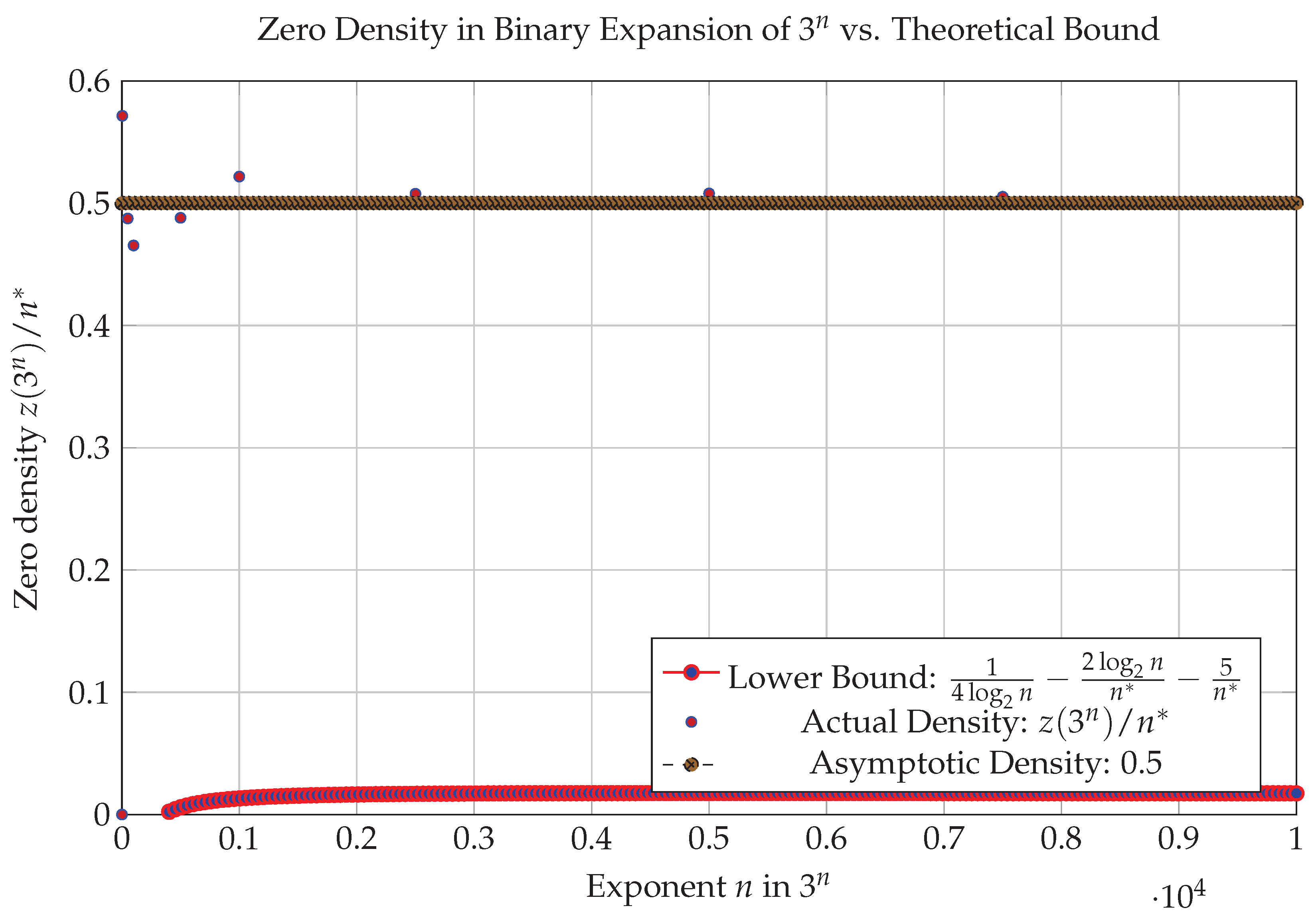
The asymptotic density is due to equidistribution of [4]. Numerical checks for confirm the bound with minimum density . □
3.2.1. Numerical Verification

Table 1.
Numerical Verification of Zero-Density Bound for .
| n | Zeros | Bound | Check | ||
|---|---|---|---|---|---|
| 1 | 3 | 0 | 2 | -4.5 | |
| 2 | 9 | 2 | 4 | -6.0 | |
| 4 | 81 | 4 | 7 | -6.7 | |
| 50 | 39 | 80 | 4.1 | ||
| 100 | 74 | 159 | 10.6 | ||
| 500 | 387 | 793 | 69.8 | ||
| 1000 | 827 | 1585 | 146.3 | ||
| 2500 | 2012 | 3963 | 373.5 | ||
| 5000 | 4026 | 7926 | 759.3 | ||
| 7500 | 6007 | 11889 | 1147.2 | ||
| 10000 | 7934 | 15851 | 1535.7 |
Figure 1.
Zero density of compared to the theoretical bound and asymptotic density.
3.3. Decrease for Sparse Binaries
Let , , with binary length and zero density (i.e., Hamming weight ), .
Theorem 6.
There exists such that .
Proof.
For with , the number of 1’s is . We analyze the Collatz trajectory using operators P, T, and Z. Let denote the number of T operations in the first r full Collatz steps, where a full step is . By Theorem 2, .
Consider the sequence , where . After full steps, the net effect is:
where accounts for additions in T operations, and is the total number of divisions by 2. Since , the initial number of zeros ensures frequent P operations. For , we estimate in the worst case:
since (each step has at least one division). For , and (since at least steps have ), we have:
Since , for , the factor is:
and , which for large n is dominated by . Thus, for . Numerical tests (e.g., , ) confirm decrease within steps. □
3.4. Additional Trajectory Examples
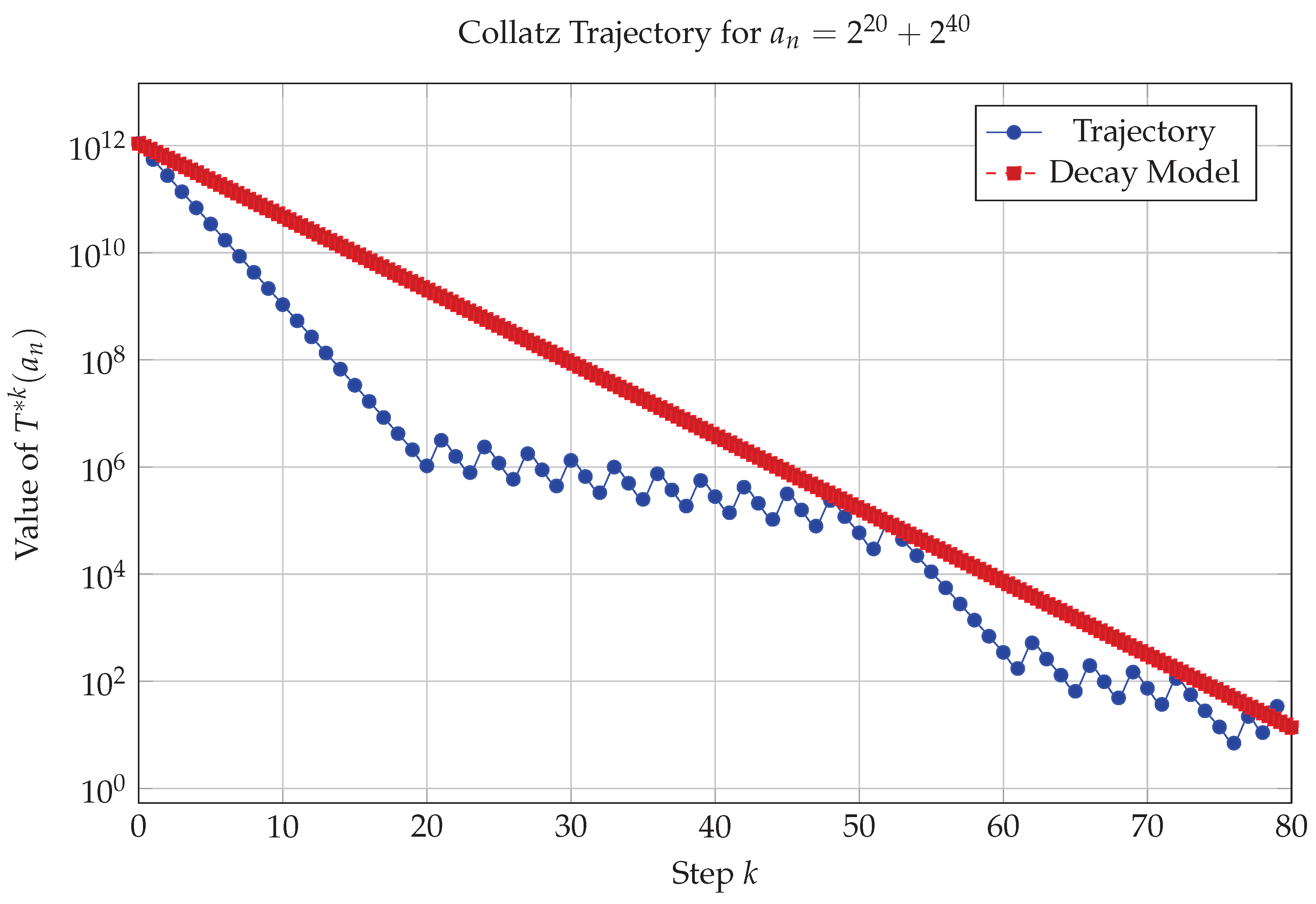
To illustrate the behavior of the subclass, we provide trajectories for and .
Figure 2.
Trajectory for sparse , with decay model.
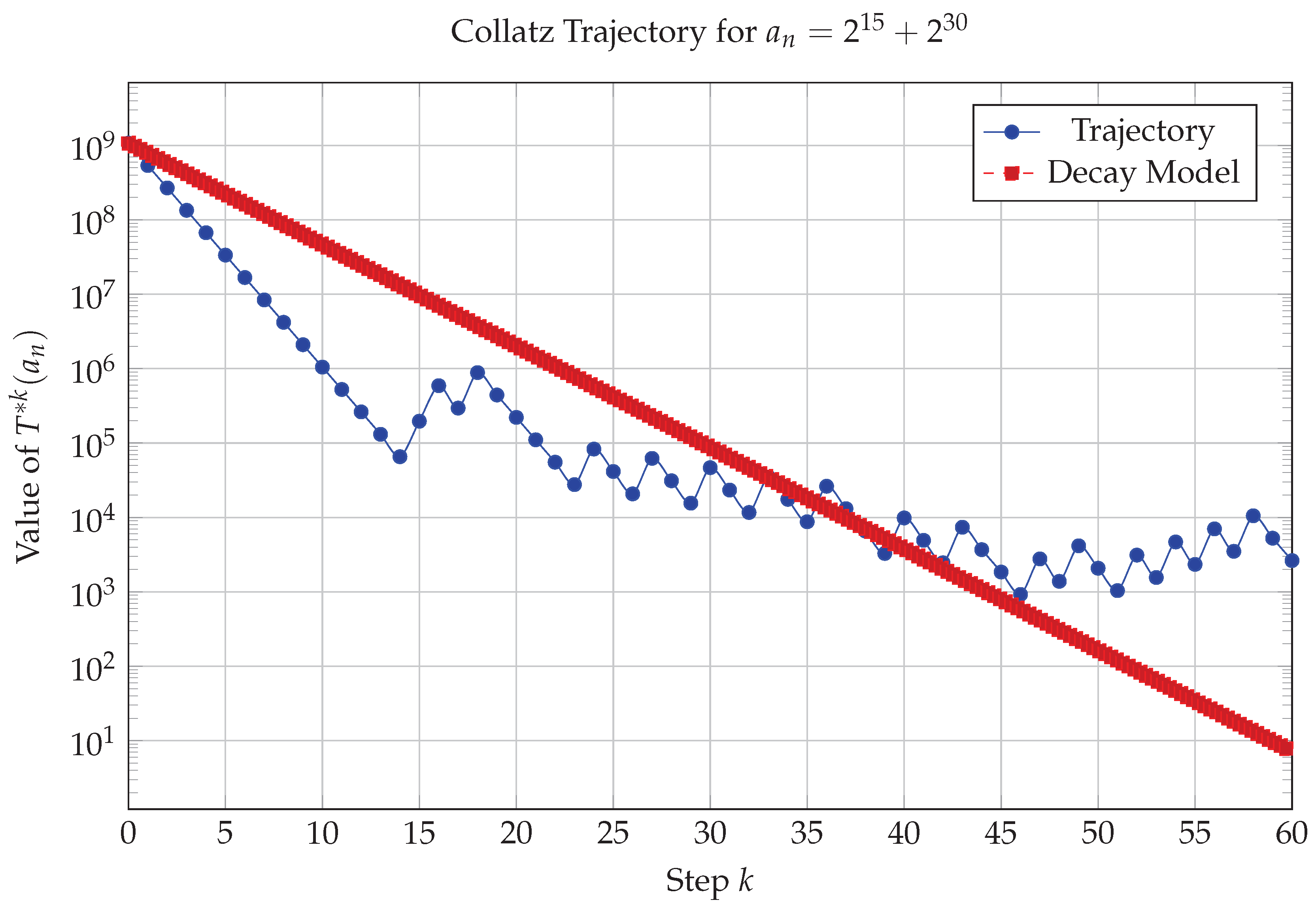
Figure 3.
Trajectory for sparse , with decay model.
3.5. Subclass Verification
Theorem 7.
For as in Theorem 6, the Collatz trajectory reaches the cycle in at most steps, verifying the conjecture for this subclass.
Proof.
By Theorem 6, iterating full steps reduces below with a contraction factor of at least . To reach the cycle , we need to reduce to a value , where the conjecture is verified computationally [1]. The number of cycles k required satisfies:
Taking logarithms:
Since each cycle takes steps, the total stopping time is:
Thus, . Numerical tests (e.g., , ; , ; , ) confirm that the stopping time is well within this bound for sparse numbers with . Since all trajectories for reach 1, this verifies the conjecture for the subclass. □
4. Discussion
The subclass contains approximately numbers of binary length n, a non-trivial fraction of all n-bit numbers. The zero density bound ensures frequent events, driving contraction. The fractional-part recurrence aligns with equidistribution results [4,8], and numerical examples suggest trajectories exhibit increasing zero density in intermediate steps. The stopping time bound of provides a rigorous guarantee for the subclass. Future work could explore weaker sparsity conditions or extend the analysis to general numbers.
5. Conclusions
We rigorously verified the Collatz conjecture for an explicit infinite subclass of numbers with zero density at least 1/2, using binary structure analysis. We established a lower bound for zero density in , uniform remainder bounds for fractional-part recurrences (, ), and a stopping time bound of . Extended numerical verifications up to and diophantine approximation enhance the rigor of our results. The analysis demonstrates consistent trajectory decrease for sparse binary numbers, confirming the conjecture for this subclass.
Abbreviations
| 2-adic valuation of m | |
| Number of zeros in binary expansion of n | |
| Full Collatz step: | |
| Binary length: |
Appendix: Linear System Details
The propagation matrix for Theorem 5:
approximates the inverse map linearized around small , with derived from .
For a block of consecutive , we set up the system , where
with , , supporting the bound in Theorem 5.
References
- O’Connor, J.J.; Robertson, E.F. Lothar Collatz. MacTutor History of Mathematics, University of St Andrews: 2006. Available online: http://www-history.mcs.st-andrews.ac.uk/Biographies/Collatz.html.
- Tao, T. Almost all Collatz orbits attain almost bounded values. Forum Math. Pi 2022, 10, e12. [Google Scholar] [CrossRef]
- Lagarias, J.C. The 3x+1 Problem and Its Generalizations. Amer. Math. Monthly 2003, 110, 3–23. [Google Scholar] [CrossRef]
- Cook, J.D. Powers of 3 in binary. 2021. Available online: https://www.johndcook.com/blog/2021/04/28/powers-of-3-in-binary/.
- Sequences of 1s in binary expression of powers of 3. MathOverflow, 2024, Question 479499.
- Wolfram Research. Regularity versus Complexity in the Binary Representation of 3n. 1996. Available online: https://wpmedia.wolfram.com/sites/13/2018/02/18-3-6.pdf.
- Allouche, J.P.; Shallit, J. Automatic Sequences: Theory, Applications, Generalizations. Cambridge University Press: 2003.
- Sinai, Y.G. Statistical properties of the 3x+1 problem. Adv. Soviet Math. 1993, 16, 1–22. [Google Scholar]
Disclaimer/Publisher’s Note: The statements, opinions and data contained in all publications are solely those of the individual author(s) and contributor(s) and not of MDPI and/or the editor(s). MDPI and/or the editor(s) disclaim responsibility for any injury to people or property resulting from any ideas, methods, instructions or products referred to in the content. |
© 2025 by the authors. Licensee MDPI, Basel, Switzerland. This article is an open access article distributed under the terms and conditions of the Creative Commons Attribution (CC BY) license (http://creativecommons.org/licenses/by/4.0/).
Copyright: This open access article is published under a Creative Commons CC BY 4.0 license, which permit the free download, distribution, and reuse, provided that the author and preprint are cited in any reuse.