

Submitted:
28 December 2023
Posted:
28 December 2023
You are already at the latest version
Abstract
Kojic acid (KA) has emerged as a prominent tyrosinase inhibitor with considerable potential in cosmetic applications; however, its susceptibility to instability during storage poses a challenge to its widespread use. This review explores the advancements in addressing this limitation through the development of various KA derivatives, focusing on the modification of the C-7 hydroxyl group. Strategies such as esterification, hydroxy-phenyl ether formation, glycosylation, and incorporation into amino acid or tripeptide derivatives have been employed to enhance stability and efficacy. Among these derivatives, Kojic Acid Dipalmitate (KDP), a palmitic ester derivative of KA, stands out for its notable improvements in stability, permeability, and low toxicity. Recent developments indicate a growing utilization of KDP in cosmetic formulations, with over 132 available products on the market, encompassing various formulations. Additionally, three patents and seven advanced system deliveries of KDP further underscore its significance. Despite its increasing prevalence, the literature on KDP remains limited. This comprehensive review aims to bridge this gap by providing insights into the synthesis process, physicochemical properties, pharmaceutical preparation, diverse applications of KDP in cosmetic products, and recent nanotechnology formulations of KDP. This review paper seeks to explore the recent developments in the use of KDP in cosmetics. The goal is to enhance stability, permeability, and reduce the toxicity of KA, with the intention of promoting future research in this promising sector.
Keywords:
kojic acid dipalmitate
; cosmeceuticals
1. Introduction
Tyrosinase (monophenol, L-dopa: oxygen oxidoreductase, EC 1.14.18.1) known as the starting point for the formation of mammalian skin color [1]. It is an enzyme that catalyzes several steps in the production of the pigment melanin in living cells, including bacteria, fungi, plants, animals, and humans [1,2]. It is located in melanocytes in the epidermis, especially in the viable epidermis [3,4]. Tyrosinase is the enzyme that controls the pace of melanin synthesis [6], which is the process responsible for producing the pigment that determines skin color [7].
Melanin synthesis, or melanogenesis, is a complex process that involves various protein groups, including tyrosinase, tyrosinase-related protein 1 (Tyrp1 or TRP1), and tyrosinase-related protein 2 (Tyrp2, DCT, or TRP2) [6,7,8]. Melanogenesis occurs in an auto-regulated manner. The activity of tyrosinase begins with the presence of the substrate tyrosine and the enzyme co-factor, dihydroxyphenylalanine (DOPA). Tyrosinase uses its binuclear copper center to hydroxylate tyrosine into 3,4-dihydroxyphenylalanine (DOPA) [9,10]. Then, tyrosinase catalyzes the oxidation of DOPA to DOPAquinone [13]. This reaction proceeds with multi-polymerization to form pigments that are blackish-gray in color, namely eumelanin, and red-yellowish in color, namely pheomelanin, with the influence of the conjugation reaction [14].
This melanogenesis process occurs in the melanosome [15], where the size, density, and shape of the melanosome among populations have the same characteristics [11,16]. The determinant of skin color for a population is the total amount, ratio, and distribution of eumelanin and pheomelanin, which differ among populations around the world, such as Europe, Africa, and Asia [17]. In some countries, particularly in Southeast Asia, a high amount of eumelanin is undesirable because fair and clean skin has become the standard of beauty for women in these countries [11,12]. This is evident from a study by Peltzer (2016) of 19,624 students from 26 low-, middle-, and developing-income countries, showing that Southeast Asia has a higher percentage of skin-lightening product users than Africa, at 36.0% [18]. Indonesia, with a majority of Fitzpatrick skin phototypes IV and V, which tend to be dark or brown [18], has a skin-lightening product usage rate of up to 36% [19]. Abnormal skin pigmentation in the form of hypo- or hyperpigmentation can cause significant anxiety and decrease self-esteem in affected individuals [18,19]. Various methods are employed to regulate pigmentation in the fields of dermatology and cosmetics. One of these methods involves the utilization of synthetic compounds, such as hydroquinone and kojic acid (KA) [22,23,24].
Hydroquinone is a gold standard compound for treating hyperpigmentation [20,21,22]. However, its use in cosmetic formulations is prohibited due to the side effects such as irritation, allergic reactions, post-inflammatory hyperpigmentation, and temporary hypopigmentation that it can cause [14,15,16,17,18]. Hydroquinone (C6H6O2) reduces the level of pigmentation by non-selectively degrading epidermal melanocytes and keratinocytes, making it cytotoxic to cells [28,29]. Therefore, the use of skin-lightening agents in cosmetic formulations has shifted towards more effective alternative compounds with low toxic and irritation effects, such as kojic acid [20,30].
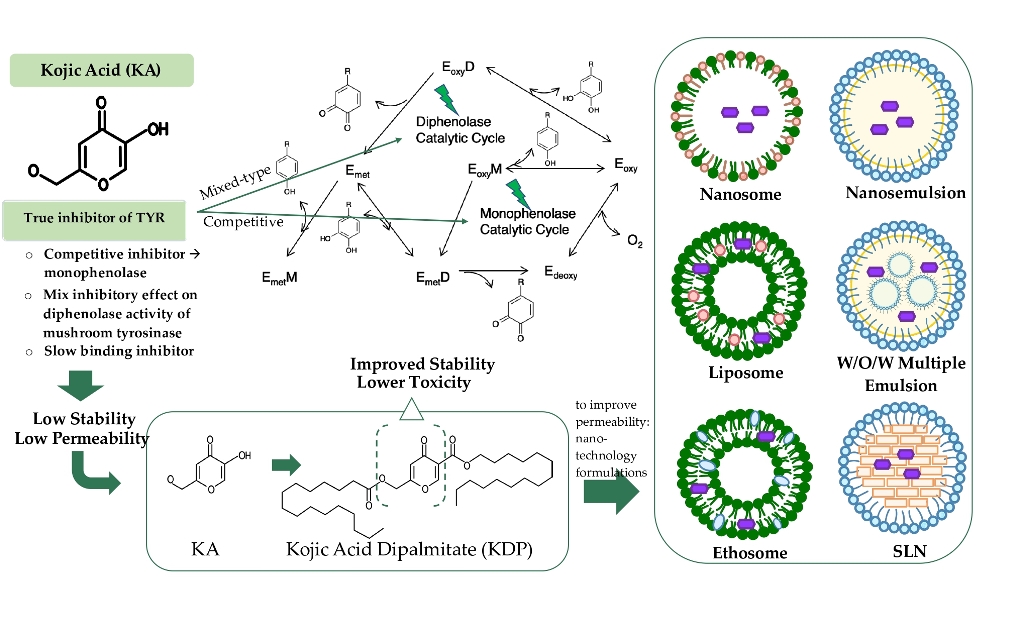
Kojic acid is one of several tyrosinase inhibitors that have been extensively studied for this purpose [24,25,26,27]. It is a natural compound with both skin-lightening and antibacterial properties and is widely used for cosmetic purposes and as a food additive to prevent browning caused by enzymes [20,21,22]. While KA has a competitive inhibitory effect on the monophenolase activity and a mixed inhibitory effect on the diphenolase activity of mushroom tyrosinase, its use in cosmetics is limited by its instability during storage due to its labile oxidative properties, which can be accelerated by light and heat [34]. To address these limitations, various KA derivatives have been developed by modifying the C-7 hydroxyl group, such as through esterification [42], hydroxyphenyl ether formation [43], glycosylation [44], or incorporation into amino acid or tripeptide derivatives [45], with the aim of improving their stability and efficacy in cosmetic and cosmeceutical applications.
According to reports, kojic acid-tripeptide amide derivatives have shown superior storage stability in comparison to kojic acid [46]. Additionally, as stated in Rho et al. (2010) [47], kojyl thioether derivatives strongly inhibit tyrosinase activity. Moreover, Lee et al (2006) [44] report that kojic acid derivatives with two pyrone rings possess eight times higher tyrosinase inhibitory potency than kojic acid itself. Maltol (3-hydroxy-4H-pyran-4-one) and its derivatives share a similar scaffold with kojic acid and have similar biological effects. Ester derivatives of allomaltol (5-hydroxy-2-methyl-4H-pyran-4-one) have been described to have inhibitory to tyrosinase and antioxidant effects by Wempe et al. in Michael (2012) [48]. Kojic acid has also been reported to exhibit antioxidant activity [49]. According to Ahn el al. (2011), a kojic acid derivative containing a trolox moiety exhibits potent tyrosinase inhibitory and radical scavenging activity [50]. Lajis et al., 2012 suggest that KA esters derived from the esterification of kojic acid and palm oil-based fatty acids, namely kojic acid monooleate, kojic acid monolaurate, and kojic acid monopalmitate, was exhibit similar inhibitory effects to kojic acid; however, kojic acid monopalmitate gave slightly stronger inhibition to melanin formation compared to other inhibitors [40]. Moreover, Balaguer et al. (2008) reported that kojic acid dipalmitate (KDP) poses superior stability, oil solubility, and skin absorption compared to kojic acid, attributed to its resistance to changes in pH, heat, and light compared to kojic acid [34].
Kojic Acid Dipalmitate (KDP), a palmitic ester derivative of KA, has gained widespread usage in cosmetic formulations in recent times due to its improvement in stability and permeability, as well as its low toxicity [19,21,31]. It is synthesized in skin cells through an in-situ esterification process, which results in the release of kojic acid [52]. This unique characteristic sets it apart from other derivatives of kojic acid [53]. The aforementioned condition has resulted in the widespread usage of KDP, which is a commonly utilized component in numerous skincare items, including creams and serums, by well-known cosmetic brands. These products usually contain concentrations of up to 3% KDP and are marketed as skin-whitening and lightening agents [54]. Despite its widespread use, the available literature on KDP remains limited. This review aims to discuss various aspects of KDP, including its synthesis process, physicochemical properties, pharmaceutical preparation, and application in cosmetic products. Although KDP is becoming more common, there is still a scarcity of literature on the subject. This thorough review seeks to fill this need by offering insights into the synthesis process, physicochemical features, pharmaceutical preparation, and many uses of KDP in cosmetic goods. This review study aims to examine the latest advancements in the use of KDP in the field of cosmetics. The objective is to improve the stability, permeability, and toxicity of KA in order to facilitate further investigation in this promising field.
2. Sythesis of Kojic Acid Dipalmitate
The hydrophilicity of KA has limited its use in cosmetics, oily foods, and pharmaceutical products. Furthermore, concerns exist regarding its potential toxicity [54] and irritancy [50,51,52]. To enhance the chemical and biological attributes of KA, researchers have developed derivatives with improved properties. Several efforts, including the enzymatic esterification of KA and fatty acids to form KA esters, have been undertaken [57] to increase their hydrophobicity and expand their potential uses, such as in the cosmetic industry. Some KA esters, like KA dipalmitate, have been brought to market for cosmetic and skin health applications [58].
Figure 1.
The basic molecular structure of (a) kojic acid and (b) kojic acid dipalmitate.
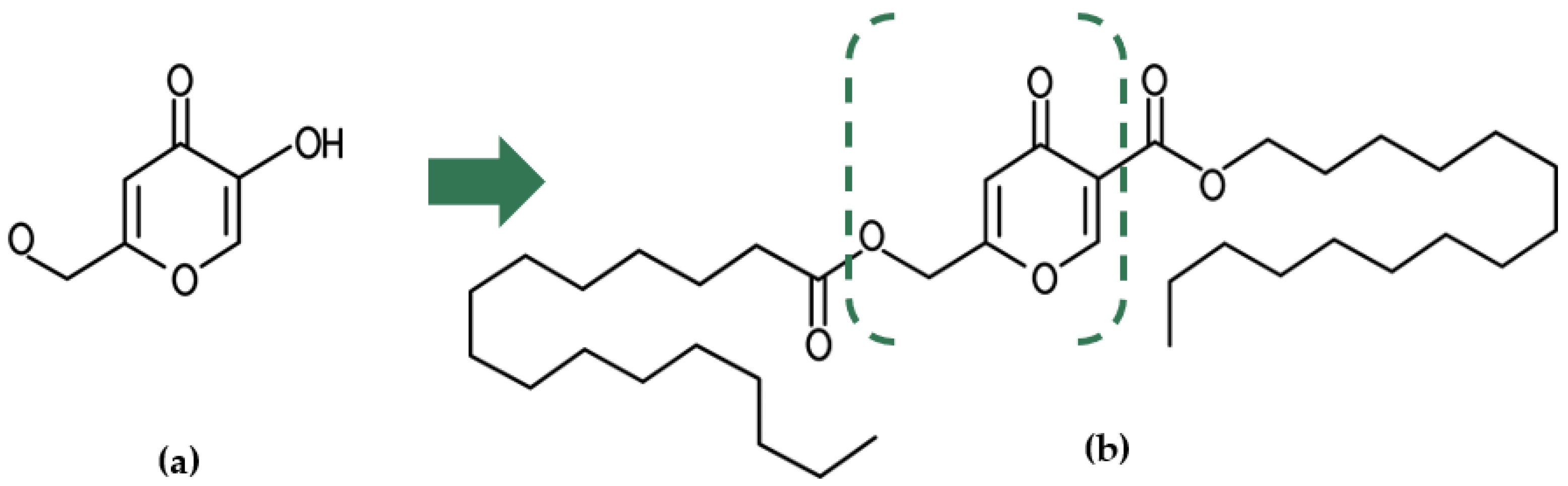
Kojic acid dipalmitate can be synthesized by esterifying kojic acid with palmitic acid. Figure 1 depicts the basic molecular structure of KA and KDP. Kojic acid possesses two functional groups: a hydroxyl group (OH) at C-5 and a carboxylic group (COOH) at C-7 [59]. The esterification process involves removing the OH group and attaching the fatty acid (R) to create KA monoesters like 5-O-KA monoesters and 7-O-KA monoesters. Fatty acids have been synthesized chemically and enzymatically to link with KA at positions C-5 and C-7 [60]. Chemical esterification of KA oleate was facilitated by N,N′-dicyclohexylcarbodiimide (DCC)/4-dimethylaminopyridine (DMAP) in dichloromethane, resulting in yields of up to 80% within 24 to 48 hours. However, this method necessitates the use of environmentally harmful and dangerous chemicals, requiring additional safety precautions. Other chemical esterification procedures involve numerous steps and chemicals, leading to a higher production cost for KDP [40].
Enzymatic processes for esterification of KA involve the preparation and catalysis of lipases and proteases in organic or solvent-free systems, resulting in the utilization of fewer chemicals and being more cost-effective and environmentally friendly. When used in their immobilized form, most of the enzymes can be repeatedly reused, resulting in consistent specific enzyme activity and yield during the synthesis of KA esters. The yield of enzymatically synthesized KA esters is influenced by several factors, including the type of catalytic enzyme, reaction temperature, organic solvents, KA to fatty acid ratio, metal ions, water content, and pH [40,61,62].
Various enzymes have been screened for enzymatic synthesis of KA esters, and most of them were derived from fungi and bacteria. However, the highest yields were obtained when lipase enzymes from Candida antarctica, Pseudomonas cepacia, and Rhizomucor miehei were utilized. Based on research conducted by Liu and Shaw (1998) [61], Kobayashi et al. (2001) [63], Khamaruddin et al. (2008) [64], and Ashari et al. (2009) [57], the synthesis of C-5-KA monoester using these enzymes resulted in a yield of 40-60%. The optimal temperature for KA ester synthesis is closely linked to the optimum temperature of the immobilized enzyme employed in the esterification process. For instance, lipase from Pseudomonas cepacia exhibits its optimal activity at a temperature of 50°C [61,62]. In this context, immobilized enzymes are utilized due to their thermostability and higher catalytic activity when compared to free enzymes [65]. Furthermore, the choice of an organic solvent played a significant role in influencing the esterification process. A high ratio of KA to fatty acids esterification resulting in KA esters was attained by using specific solvents, namely acetonitrile, acetone, and chloroform, which possessed logP values of -0.33, -0.21, and 2.00, respectively [66]. To enhance the hydrophobic nature of the reaction mixture and thereby improve the efficiency of the esterification process, a co-solvent mixture was also employed [66]. Moreover, KA to fatty acid ratio, metal ions, water content, and pH also influence the esterification process. Lajis et al. (2013) [62] have extensively discussed the influence of these parameters on esterification. Readers are encouraged to refer directly to the literature for more details.
3. Physical and Chemical Propreties of Kojic Acid Dipalmitate
The molecular formula of kojic acid dipalmitate (2-Palmitoyloxymethyl-5-palmitoyloxy-pyrone) is C38H66O6 with a molecular weight of 618.9 g/mol [67]. Kojic dipalmitic acid exhibits characteristics of a white powder [52], a melting point of 94°C, and solubility in oil, alcohol, mineral oil, and esters. Unlike kojic acid, kojic acid dipalmitate is more stable to light, heat [68], and oxidation and does not chelate metal ions [69]. This makes it more color-stable with a reduced likelihood of turning yellow or brown, which makes it a more popular choice for manufacturers of skin-lightening whitening creams [69]. Kojic acid dipalmitate is also considered stable over a wide range of pHs [70].
The chemical structure of kojic acid dipalmitate consists of two molecules of palmitic acid, which are saturated fatty acid, attached to the two hydroxyl groups of kojic acid. This structure gives kojic acid dipalmitate its lipophilic (fat-loving) properties, making it more soluble in oils and fats than kojic acid itself [52,71]. These derivatives have been found to improve both the stability and solubility of kojic acid in oily cosmetic products [72].
Based on acomparative stability study conducted by Tazesh et al. (2019) between KA and KDP under oxidative stress, it was observed that KDP underwent more rapid degradation in similar liquid oxidative stress conditions compared to KA [52]. This degradation could possibly be linked to the opening of the pyrone ring, followed by subsequent decomposition into smaller aliphatic chains. Based on the study, it was concluded that the notion of enhancing the stability of KA by obstructing its hydroxyl groups through the attachment of two palmitic acid molecules was a misconception, as the hydroxyl groups are not the reactive moiety of the molecule. However, Tazesh et al. (2019) still recommend choosing KDP over KA in cosmetic formulations. Yet, to prevent oxidation, formulators can include antioxidants to achieve improved stability results [52].
4. Mechanism of Action of Kojic Acid Dipalmitate
Kojic Acid Dipalmitate (KDP) demonstrates greater effectiveness compared to KA [35]. Esterases within skin cells hydrolyze KDP, leading to the in-situ release of kojic acid, as illustrated in Figure 2 [34]. Consequently, the mechanism of action for KDP is akin to that of KA. The depigmentation properties of kojic acid, elucidated from cellular to molecular levels, have been extensively explored by Saeedi et al. (2019) [35].
Kojic acid, extensively studied as an inhibitor of tyrosinase, is recognized for its competitive inhibition of monophenolase activity and its mixed inhibitory effect on the diphenolase activity of mushroom tyrosinase [73]. Due to the action mechanism described, kojic acid is categorized as a "true inhibitor," wherein it can bind to the enzyme and inhibit tyrosinase activity. Tyrosinase is a copper-containing monooxygenase enzyme that catalyzes two reactions: o-hydroxylation of monophenols to catechols, also known as monophenolase or cresolase activity, and oxidation of catechols by O2 to o-quinones, known as diphenolase or catecholase activity. Typically, true inhibitors are classified into four types: competitive inhibitors, uncompetitive inhibitors, mixed-type (competitive/uncompetitive) inhibitors, and non-competitive inhibitors (Figure 3). Competitive inhibitors are compounds that can bind to free enzymes, thereby preventing substrates from binding to the enzyme. The observed competitive inhibitory effect of kojic acid is attributed to its ability to chelate copper at the enzyme's active site. In contrast to competitive inhibitors, uncompetitive inhibitors can bind only to the enzyme-substrate complex. A mixed-type inhibitor, which is both competitive and uncompetitive, can bind to both the free enzyme and the enzyme-substrate complex. Most mixed-type inhibitors bind to a free enzyme and an enzyme-substrate complex with the same equilibrium constant. In addition to the inhibitory mechanism, the strength of inhibition is a primary criterion for an inhibitor [73].
Casella et al. [74] studied how KA affects the oxidation of 3,5-dtbc (3,5-di-tert-butyl catechol) by dicopper model complexes. They suggested that KA acts as a connecting bridge between the metal centers in the dicopper(II) catalysts, indicating that KA may bind to the dicopper Ty center. This idea gained support from two other reports that characterized tetrachloro-o-catecholate-bridged dicopper(II) complexes [75]. Subsequent reports by Plenge et al. [76] and Ackermann et al. (2002) [77] put forward the concept of bridging and unsymmetric binding of catechol substrates in a Z2:Z1 fashion, with one of the two oxygen atoms participating in a weak interaction with either of the neighboring copper(II) ions. Studies involving electron spin echo envelope modulation (ESEEM) [78] and X-ray absorption spectroscopy (XAS) [79] of a met Ty-KA adduct from bacterial Streptomyces antibioticus Ty provided further support for this binding mechanism. However, when the X-ray structure of the adduct of KA with the met form of Bacillus megaterium Ty was examined, it revealed that the KA molecule was situated at a distance of 7 Å from the dicopper center. This finding contrasted with the conclusions of Bochot et al. (2013) [80], who reported that the distances between copper and oxygen atoms of KA varied around 2.15 Å for CuB…O2, 2.04 Å for CuA…O2, and 2.17 Å for CuA…O3 [80].
Moreover, kojic acid has been reported as a slow-binding inhibitor of tyrosinase's diphenolase activity. Other potent slow-binding inhibitors of tyrosinase include tropolone and the substrate analog L-mimosine. Interestingly, all these slow-binding inhibitors of tyrosinase share a common feature: they contain an α-hydroxyketone group. Kojic acid, tropolone, and L-mimosine are frequently used as positive controls in the literature to compare the inhibitory potency of newly discovered inhibitors [73].
5. Cosmetic Application of Kojic Acid Dipalmitate
5.1. Cosmetic Products Containing KDP
In skincare products, kojic acid dipalmitate was used at concentrations ranging from 0.01% to 25%. Typically, it was employed at concentrations between 0.2% and 8.0%, with the most frequent usage occurring at concentrations of 0.4% to 4.0% [81]. Kojic acid dipalmitate exhibited the ability to inhibit the activity of the tyrosinase enzyme, thereby decelerating melanin synthesis by impeding the conversion of DOPAchrome into DHICA [40].
A study conducted by Chandrashekar et al. in 2018 demonstrated that a 2% kojic acid dipalmitate formulation in a combination cream was effective and safe as a therapy for melasma. Kojic acid dipalmitate did not induce skin irritation and contributed to skin brightening, as evidenced by a reduction in hyperpigmentation observed in 51-57% of the subjects. Kojic acid at concentrations of 1-2% did not exhibit hepatocarcinogenic effects, was non-genotoxic, did not irritate the mucosal layer, and did not lead to sensitization [36,82].
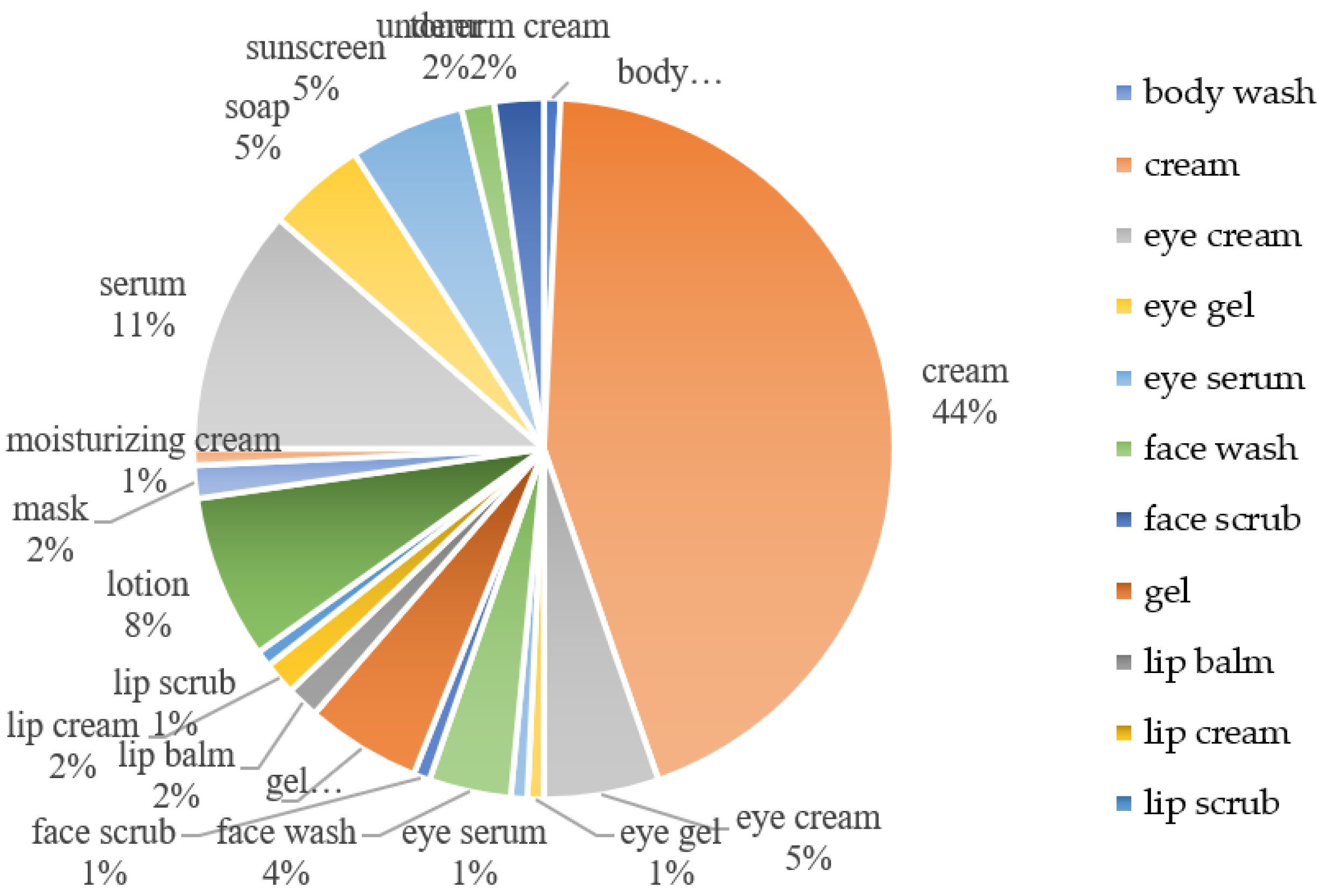
As of the time when this literature review was conducted, it is known that there are over 132 cosmetics available on the market containing Kojic Acid Dipalmitate (KDP) in various formulations. This data was obtained from a list of products containing kojic acid dipalmitate accessed on the website [83]. These formulations include face or body creams, lotions, gels, face masks, serums, toners, eye-brightening products, lip products, face or body washes, and soap bars, as well as underarm creams designed to reduce pigmentation. All of these have been summarized in Figure 3.
The concentrations of KDP in these products typically range from 0.4% to 4.0%. KDP is most commonly formulated in creams designed for brightening both facial and body areas. In contrast, formulations containing KDP as face scrub and lip scrub are relatively rare. Additionally, KDP is incorporated into cosmetics intended for the whitening of the under-eye area and the lightening of the underarms. In addition to containing KDP, these whitening products may be provided as standalone treatments or in combination with other depigmenting agents such as arbutin, niacinamide, retinol, tranexamic acid (an antifibrinolytic agent widely favored in cosmetics for addressing melasma or hyperpigmentation), or in combination with exfoliant agents like glycolic acid and lactic acid. These products may also include antioxidants such as ascorbic acid and tocopherol acetate, as well as pine bark extracts [83].
Figure 3.
Cosmetics available in the market containing Kojic Acid Dipalmitate (KDP) in various formulations.
Figure 3.
Cosmetics available in the market containing Kojic Acid Dipalmitate (KDP) in various formulations.
3.3. Patent Products of KDP
The patents related to kojic acid dipalmitate remain relatively limited. One such patent related to KDP is the US patent held by Whittemore et al. (1998), which claims a skin-whitening cosmetic composition containing kojic dipalmitate. The invention specifically pertains to an anhydrous skin-whitening cosmetic composition incorporating kojic dipalmitate [84].
The Shanghai Institute of Technology holds a patent for Solid Lipid Nanoparticles (SLN) containing kojic acid dipalmitate, valid until 2014. A disclosed innovation pertains to a nanometer-sized solid lipid carrier encapsulating kojic acid dipalmitate. This delivery system was designed to enhance the permeation of kojic acid dipalmitate into the skin, increase utilization efficiency, and improve the whitening effect components.
Components of the formulation shown in the patent include kojic acid dipalmitate, phospholipid, solid lipid, liquid lipid, a solid emulsifying agent, a polyalcohol additive, and a preservative, with the remaining content being deionized water. The method for preparing the nanometer solid lipid carrier involves melting an oil phase and ingredients that dissolved in it at 75-95°C, heating a water phase containing deionized water and the polyalcohol additive, and combining the two phases. High-pressure homogenization is then performed, followed by stirring and cooling to produce the nanometer-sized solid lipid carrier [85].
As for the patent regarding the analytical approach of Kojic Dipalmitate (KDP) using the High-Performance Liquid Chromatography (HPLC) method, it is held by Shanghai Jahwa United Co. Ltd. [86]. The three patented formulations and characterizations containing kojic acid dipalmitate are presented in Table 1.
6. Nanotechnology Formulations of Kojic Acid Dipalmitate
Nanotechnology refers to the manufacturing and use of materials at the nanoscale [87]–[89], where they exhibit distinct physicochemical characteristics compared to their larger particles [90]. These novel materials demonstrate an increased surface area as a result of certain internal rearrangements, leading to distinct interactions with biological systems [91]. The integration of nanotechnology into cosmetic formulations is regarded as the most current and developing technology currently accessible [88]. Cosmetic producers use nanoscale compounds to enhance UV protection [92]–[95], facilitate deeper skin penetration [96]–[100], prolong the effects [101,102], intensify color [103,104], improve finish quality [104], stability [101,105], and provide lower toxicity [98,106]. Kojic acid dipalmitate has been widely utilized in the cosmetics industry. It has been formulated using nanotechnology, primarily to enhance its physical and chemical properties.
Kojic acid dipalmitate incorporates two palmitate groups onto the hydroxyl group at C-7 [42], resulting in a molecular weight of KDP exceeding 500 Da, thereby impeding its permeability. As previously explained in the preceding section, the molecular weight of KDP is 618.9 g/mol [67]. According to the literature, a majority of chemical compounds with a molecular weight greater than 500 Da are unable to permeate the skin through passive diffusion processes [107]. To address this limitation, KDP has been formulated into various preparations such as nanosomes, nanocreams, multiple emulsions, liposomes, solid lipid nanoparticles (SLN), ethosomal suspensions, and nanoemulsions. These formulations aim to enhance skin permeability, stability, and reduce toxicity, thereby improving efficacy and conferring skin benefits. Figure 4 displays schematic representations of the architectures of KDP integrated into several types of nanomaterials.

Table 2.
Anhance cosmeceuticals formulation of KDP.
| Published in | Preparation of KDP | The research objective | Diameter of particle/droplet | Zeta Potentials | Loading capacity | Results | Refference |
| 2000 | Nanosome | Development of KDP nanosome in mono-vesicle and increase stability | 57-75,7 nm | -24mV | NA | Turbidity was very good transparency compared nanosome with liposome. It formed the monovesicle in the opposite direction to form the multi-lamelar vesicle of the liposome. The stability of nanosomes was very good for 6 months | [108] |
| 2010 | Nanocream | Increased release and permeability through skin in vitro | < 350 nm | NA | NA | nano-creams had shown to produce a higher drug release and permeability through Franz diffusion cells, although there was no significant variation than that in normal cream at P value < 0.05. Nano-creams penetrate faster and the cumulative amount of KDP is higher than in normal creams | [58] |
| 2015 | W/O/W Multiple Emulsions | Increase safety and activity of KDP in vitro$$$$ | 0,056μm-12.487μm$$$$ | NA | N/A | Incorporation of KDP into MEs improved the safety and antioxidant activity of KDP in vitro | [71] |
| 2020 | Liposome | Increasing stability and loading capacity | 80-100 nm;$$$$PDI ≤ 0.2 | -0.5 to -0.6 mV | 0.61% to 28.12 % | Ethosomal gel had a good stability at lower temperature (8, 25°C).$$$$KDP loading capacity increased from 0.61 to 28.12% | [109] |
| 2020 | Solid Lipid Nanoparticle (SLN) | Increase release profile and permeability through skin ex vivo | 70 nm | NA | 47% | The KDP loaded in the SLN presented a slower release profile of KDP in comparison with the formulations loaded with KDP. The KDP loaded into SLN had the highest concentration in the stratum corneum. | [53] |
| 2022 | Ethosomal suspension | Increases stability and skin benefits | 148 nm | −23.4 mV | 90.0008% | Ethosomal gel gave a significant decrease in skin melanin, erythema, and sebum levels while improving in skin hydration level and elasticity during non-invasive in vivo studies. The formulation had good stability at a lower temperature (8, 25°C). | [106] |
| 2023 | Nanoemulsion | Increase permeation, antioxidant and depigmentation efficiency, and lower cytotoxicity | < 130 nm | -10mV | > 95% | The nanoemulsion containing 1 mg/mL KDP exhibited antioxidant and depigmenting activities and allowed the active compound to reach the epidermis without permeating to deeper layers of the skin, showing potential for use in cosmetic formulations for melasma treatment. Such nanoemulsion was safe for fibroblast-like cells (3T3-L1) at concentrations up to 1%. | [110] |
6.1. Nanoemulsion
Zilles et al. (2023) are one of the researchers who have formulated the incorporation of KDP in nanoemulsions [110]. The study suggests that nanoemulsions serve as effective carriers, enhancing both the stability [111] and activity [58] of KDP on the skin. Beyond their carrier capabilities, nanoemulsions are recognized as a preferable option for drug delivery systems related to skin permeation. This preference arises from their diminished particle sizes and lipophilic characteristics [112], resulting in an increased affinity with the stratum corneum. Consequently, this facilitates deeper penetration and permeation of active substances into the skin, leading to heightened efficacy [113]. Additionally, nanoemulsions possess lipophilic cores, making them excellent carriers for hydrophobic actives in aqueous media [113].
6.2. Nanocream
Kojic acid dipalmitate (KDP) was also formulated in nanocream [111]. Nanocream is aformulation of nanoemulsion in the form of semisolid cream [114,115]. Nano-emulsions are composed of an isotropically clear dispersion of two liquids that are immiscible with each other with droplet size varied between 100 and 200 nm [116,117], in another literature, 600 nm [114]. These liquids include a disperse phase consisting of oils and a continuous phase consisting of water. The presence of dispersed phase droplets that are smaller than 200 nanometers results in the nanoemulsion exhibiting a clear and transparent appearance [118]. The stability of this dispersion is maintained by an interfacial film of surfactant molecules, which possess stable thermodynamic properties [107,119].
Al-Edresi and Baie (2009) conducted a study aimed at formulating a nanoemulsion in cream form containing Kojic Acid Dipalmitate (KDP) as a whitening active ingredient and evaluating its stability [111]. The primary components of the nano-cream formulation included Emulium Kappa® (EK), which consists of candelilla/jojoba/rice bran polyglyceryl-3-esters, glyceryl stearate, stearoyl alcohol, and sodium stearoyl lactylate, serving as the emulsifier. Propylene glycol was used as a cosurfactant in a 9:1 ratio. The oil Phase comprised virgin coconut oil (VCO) and squalene oil, maintaining a consistent surfactant-to-oil ratio of 1.4:1.2. The formulation of the nanoemulsion was successfully achieved using the Emulsion Inversion Point method.
To mitigate Ostwald ripening, the main instability mechanism of emulsion systems [112], insoluble oil (squalene)-was added to the system. The Ostwald ripening rate decreased significantly from 14.94 to 0.97 nm/day as the squalene concentration increased from 2 to 20%, representing a nearly 15-fold reduction in growth rate. This finding aligns with the study done by Cruz-Barrios (2014), which demonstrates that the inclusion of squalene in the formula mitigates the impact of ripening [120]. The zeta potential of the formulation indicated an increase in charge from −65.1 to −101.8 mV with the rising squalene ratio. This led to enhanced repulsion forces between the droplets, contributing to the improved stability of the nanoemulsion [121]. The negative droplet charge resulted from the adsorption of hydroxyl ions on the non-polar VCO droplet through hydrogen bonding [122]. The primary droplet diameter, ranging from 171.3 to 240.2 nm, remained unaffected by the squalene ratio. It is important to note that while this research focused on enhancing the stability of the nanocream in terms of the zeta potential of the system, it did not assess the permeation of active ingredients into the skin [111]. In the subsequent development, Kojic acid dipalmitate (KDP) was further developed into an encapsulated form using phospholipids, namely liposomes [109].
6.3. Liposome
Al-Edresi et al. (2020) conducted a study to enhance the loading capacity of kojic acid dipalmitate (KDP) into liposomes using the active loading method [109]. In this research, KDP was formulated in liposomes as encapsulating agents to overcome obstacles to cellular uptake [123]–[125] and target specific sites in vivo [126,127] thereby improving the delivery efficacy of compounds. Liposomal formulations were also proposed as a means of enhancing the therapeutic efficacy of poorly bioavailable drugs [128,129].
Initially, liposomes were prepared using the thin lipid film hydration method without active ingredients. To actively load KDP into the liposomes, a KDP solution was mixed with liposome suspension in a shaking water bath at 60 ºC [130]. As the temperature of the liposomes increased to the phase transition temperature, holes opened in the lipid bilayer, allowing KDP to permeate from the intraliposomal to the interliposomal medium due to concentration gradients. This gradient served as a driving force for the permeation of KDP, leading to an equilibration of concentration on both sides of the liposome bilayer [131]. Active loading resulted in significantly higher loading capacity (%LC) compared to passive loading of KDP [126,131]. The concentration gradient technique forced KDP to be incorporated into the core of the liposomes, achieving an LC% of 28.12% [109].
Passive loading of KDP into liposomes, on the other hand, depended mainly on hydrophobic interaction and association with the 1,2-distearoyl-sn-glycero-3-phosphocholine (DSPC) bilayer structure as a phospholipid [131]. Liposomes were able to incorporate KDP, but in low percentages for passive loading methods, with a loading capacity of 0.61%, as the lipid bilayer constituted only small fractions of the liposomes.
Using the active loading method not only resulted in an increase in the amount of KDP incorporated into the liposomes but also maintained stable liposomes with particle sizes in the range of 80-100 nm, PDI ≤ 0.2, and zeta potential of -0.5 to -0.6 mV [109]. No significant changes in particle size over time were observed, indicating stable liposomes. However, it's important to note that this study did not conduct penetration testing into the skin or evaluate the content of formulations during storage stability testing.
6.4. Solid Lipid Nanoparticles
Solid lipid nanoparticles (SLNs), formerly referred to as lipospheres, are a kind of pharmaceutical nanocarrier that show potential for controlled drug delivery [132,133]. SLNs are generally composed of biodegradable and safe lipidic components [134]. SLNs possess the notable ability to transport a wide range of therapeutic substances, such as tiny medication molecules, big biomacromolecules (such as polysaccharides), genetic material (such as DNA or siRNA), and vaccination antigens [135]. Small drug molecules have the ability to load both hydrophilic and lipophilic medicines, including KDP.
Kojic Acid Dipalmitate (KDP) have been formulated in SLN by Mohammadi et al., (2020) [53]. SLN-loaded KDP formulation consisted of melted GMS 100 mg and KDP 10 mg in 2% PVA ( ) using evaporated solvent ethanol/aceton 2.5:1.5, all of which had a KDP entrapment efficiency of about 47%, meaning the KDP concentration in the formulation was 10 mg/25 ml (0,04%) and being loaded in the SLN of about 47% of 0.04% (0.02% KDP in SLN). SLN-loaded KDP was successfully formulated with the mean size of 70±5 nm. In this formulation, stability test results are not explained, so conclusions about the stability of the formula cannot be drawn. However, in vitro drug release and ex vivo permeation of Kojic Acid Dipalmitate (KDP) from Solid Lipid Nanoparticle (SLN)-based preparations were clearly described in the research paper.
The release profile of KDP from SLN preparations follows a first-order kinetic model. In comparison to KDP powder and KDP cream, formulations loaded with KDP in SLN, hydrogel, SLN-based cream, and SLN-based hydrogel exhibit a slower release rate. Among these, the KDP hydrogel demonstrates the slowest release profile, followed by the SLN-based hydrogel of KDP. These findings suggest that the lipophilic nature of KDP, the occlusive effect of the cream, the matrix structure of SLN, and the hydrogen bonds facilitated by polyvinyl alcohol (PVA) play crucial roles in determining the release rate of KDP and its diffusion into the receiving phase [53].
One of the factors accelerating the release rate from KDP powder and KDP cream is the lipophilic nature of KDP, which enable penetration into the skin through both intracellular and paracellular pathways. The second factor is the entrapment efficiency of KDP in the SLNs (47%). In contrast, KDP powder, KDP cream, and KDP hydrogel have higher concentrations, leading to a greater diffusion rate through the skin based on Fick’s second law. The lipid matrix structure of SLNs retains lipophilic drugs for an extended period, allowing a slower release. The hydrogen bonds formed through the interaction of the hydrophilic structure of hydrogels, PVA in the SLNs, and even KDP itself contribute to a slower release rate from hydrogel formulations [53].
6.5. Ethosome
Kojic Dipalmitate (KDP) can also be formulated in nanosized ethosome gel. Various ethosomal suspensions loaded with KDP were prepared using soy phosphatidylcholine, ethanol, propylene glycol, and water through a cold method. These formulations underwent assessment for size, zeta potential, polydispersity index, entrapment efficiency, FTIR spectroscopy, and scanning electron microscopy (SEM). Subsequently, the stability of the optimized gel was examined, and in vivo studies were conducted to evaluate the skin benefits.
The optimized formulation has zeta potential, size, and entrapment efficiency of −23.4 mV, 148 nm, and 90.0008%, respectively. SEM results showed the vesicles were spherical in shape. Ethosomal gel had good stability at lower temperatures (8, 25°C). In addition, ethosomal gel causes a significant decrease in skin melanin, erythema, and sebum levels while it causes improvement in skin hydration level and elasticity during non-invasive in vivo studies [106].
The overall findings indicated that the prepared KDP-loaded ethosomal formulation was stable and provided deep penetration of KDP into the skin. It offers a promising therapeutic approach for use in skin hyperpigmentation as it has skin-whitening and moisturizing effects [106].
6.6. Nanosome
In the year 2000, In-young et al. introduced a novel encapsulation vesicle system that combines elements of both niosomes and liposomes, termed as nanosomes. Generally, when a surfactant is dissolved in water, it tends to form micelles [88,136]. A liposome is a molecule with two lipophilic parts attached, such as a phospholipid [137]. Furthermore, when phospholipids and surfactants are mixed and dispersed in water, a monolayer is formed in a lamellar structure, as opposed to micelles. These monolayer vesicles are denoted as nanosomes. In comparison to liposomes, these vesicles exhibit a much finer size, contributing to enhanced stability of the active ingredient [108].
In this study kojic acid dipalmitate was encapsulated inside the mono-layer vesicle and consisted of phospholipids and surfactants. The phospholipid used was hydrogenated liposomes (HL), and surfactants included in the formula were diethanolamine cetylphosphate (DEA-CP) and diglyceryl diodeate (DGDO). Kojic acid dipalmitate encapsulated in the vesicle could be up to 1% located in the core of the vesicles. With the application of the microfluidization (MF) method, the nanosomes was successfully developed until a nanosized suspension of the monovesicles system was obtained. It was confirmed through SEM that the particle size of the nanosomes was 57-75.7 nm, and the average particle size was 66nm, indicating very fine particle size was formed. The stability of nanosomes developed in this research was also good, because of they passed through MF three times as confirmed by the zeta potential value at 23.8 mV [108].
6.7. Multiple Emulsion
Kojic Dipalmitate (KDP) has also been formulated into multiple emulsions (MEs) with the aim of increasing their bioavailability and protecting the drugs against biological degradation and oxidation processes [72]. This formulation can extend the drug release, potentially reducing the required dosages and application time. The ME system formulated was in the form of a water-in-oil (W/O/W) system, developed through a two-step process. The initial W/O emulsion was first created using 20% span 80 as a surfactant, 45% liquid petrolatum, and 35% water. The primary emulsion was then dispersed into an aqueous solution of Tween 20 to generate a W/O/W ME composed of 80% of the primary emulsion, 10% of the solution in 40% Tween 20, and 10% water [72].
The droplet size of multiple emulsions (MEs) is notably larger in comparison to other nanodelivery systems, measuring approximately 1 µm with a zeta potential of −13 mV. In addition to the formulation, the authors conducted in vitro biological assays using the Erythrocyte-induced hemolysis in vitro method to evaluate the potential irritation of a novel topical preparation. Free Kojic Dipalmitate (KDP) led to the lysis of 4.09% ± 0.13% of erythrocyte membranes. KDP-unloaded MEs induced lysis of 1.57% ± 0.47% of erythrocyte membranes. The incorporation of KDP in ME resulted in 2.98% ± 1.12% lysis, demonstrating decreased erythrocyte lysis compared to free KDP. Therefore, all systems exhibited tolerable erythrocyte hemolysis [72].
The formulations, whether with or without the addition of KDP, underwent assessment for in vitro antioxidant activity over a 28-day period using the DPPH assay. Throughout the 28 days, there was a decline in the antioxidant power of all experimental groups, with the most significant decrease observed for free KDP. The differences between the samples were statistically significant (p < 0.05), and the observed lesser destabilization of the samples is likely attributed to the increased stabilization of the KDP-loaded ME formulation [72].
5. Conclusions
This article explores the development and use of Kojic Acid Dipalmitate (KDP) in skincare products, with a specific emphasis on its ability to hinder the production of melanin and its potential for treating disorders like melasma. KDP concentrations in skincare products often vary between 0.01% and 25% [81]. In 2018, Chandrashekar et al. conducted research that demonstrated that a combination cream including a 2% KDP formulation was both efficacious and safe for treating melasma [36,82].
The article explores the restricted number of patents associated with KDP, specifically focusing on one patent by Whittemore et al. (1998) for a cosmetic composition that lightens the skin and contains KDP [84]. Furthermore, the Shanghai Institute of Technology has a patent for Solid Lipid Nanoparticles (SLN) that include KDP, with the purpose of augmenting skin permeability and enhancing whitening effects [85,86]
The fundamental focus of this discussion is the use of nanotechnology in the formulation of KDP. Various preparations, including nanoemulsions, nanocreams, liposomes, and ethosomal suspensions, are explored in detail. The purpose of these formulations is to overcome the molecular weight restrictions of KDP and improve the capacity of the substance to pass through the skin, as well as its stability and effectiveness, while also minimizing any potential harmful effects.
The article highlights the importance of nanoemulsions in drug delivery systems for skin permeation, providing evidence from studies that demonstrates their efficacy in improving both the stability and activity of KDP on the skin. Nanoemulsions are favored because of their smaller particle sizes and lipophilic properties, which enable enhanced penetration and absorption of active ingredients into the skin.
In addition, the essay provides a comprehensive analysis of formulations such as nanocreams and liposomes, specifically examining their stability, particle sizes, and loading capacities. The focus is on the creation of ethosomal suspensions loaded with KDP, which show potential for effectively treating skin hyperpigmentation.
Ultimately, the study highlights the transformative influence of nanotechnology on the development of Kojic Acid Dipalmitate, augmenting its physical and chemical characteristics. The use of KDP in several nanoscale formulations has significant promise for enhancing effectiveness and skin advantages in cosmetic uses.
References
- G. Casanola-Martin et al., “Tyrosinase Enzyme: 1. An Overview on a Pharmacological Target,” Curr. Top. Med. Chem., vol. 14, no. 12, pp. 1494–1501, 2014. [CrossRef]
- Y. Qu et al., “Catalysis-based specific detection and inhibition of tyrosinase and their application,” J. Pharm. Anal., vol. 10, no. 5, pp. 414–425, 2020. [CrossRef]
- P. Matos, A. Paranhos, M. T. Batista, and A. Figueirinha, “Synergistic Effect of DIBOA and Verbascoside from Acanthus mollis Leaf on Tyrosinase Inhibition,” Int. J. Mol. Sci., vol. 23, no. 21, 2022. [CrossRef]
- T. Pillaiyar, M. Manickam, and V. Namasivayam, “Skin whitening agents: Medicinal chemistry perspective of tyrosinase inhibitors,” J. Enzyme Inhib. Med. Chem., vol. 32, no. 1, pp. 403–425, 2017. [CrossRef]
- X. Lai, H. J. Wichers, M. Soler-Lopez, and B. W. Dijkstra, “Structure and Function of Human Tyrosinase and Tyrosinase-Related Proteins,” Chem. - A Eur. J., vol. 24, no. 1, pp. 47–55, 2018. [CrossRef]
- C. V. Ortiz-Ruiz, J. Berna, J. Tudela, R. Varon, and F. Garcia-Canovas, “Action of ellagic acid on the melanin biosynthesis pathway,” J. Dermatol. Sci., vol. 82, no. 2, pp. 115–122, 2016. [CrossRef]
- M. A. Dettori et al., “Synthesis and studies of the inhibitory effect of hydroxylated phenylpropanoids and biphenols derivatives on tyrosinase and laccase enzymes,” Molecules, vol. 25, no. 11, pp. 1–21, 2020. [CrossRef]
- S. Kumari, S. T. G. Thng, N. K. Verma, and H. K. Gautam, “Melanogenesis inhibitors,” Acta Derm. Venereol., vol. 98, no. 10, pp. 924–931, 2018. [CrossRef]
- J. M. Gillbro and M. J. Olsson, “The melanogenesis and mechanisms of skin-lightening agents - Existing and new approaches,” Int. J. Cosmet. Sci., vol. 33, no. 3, pp. 210–221, 2011. [CrossRef]
- S. Zolghadri et al., “A comprehensive review on tyrosinase inhibitors,” J. Enzyme Inhib. Med. Chem., vol. 34, no. 1, pp. 279–309, 2019. [CrossRef]
- N. Wang and D. N. Hebert, “Tyrosinase maturation through the mammalian secretory pathway: Bringing color to life,” Pigment Cell Res., vol. 19, no. 1, pp. 3–18, 2006. [CrossRef]
- B. Deri et al., “The unravelling of the complex pattern of tyrosinase inhibition,” Sci. Rep., vol. 6, no. June, pp. 1–10, 2016. [CrossRef]
- M. Mine, H. Mizuguchi, and T. Takayanagi, “Kinetic analyses of two-steps oxidation from L-tyrosine to L-dopaquinone with tyrosinase by capillary electrophoresis/dynamic frontal analysis,” Anal. Biochem., vol. 655, no. April, p. 114856, 2022. [CrossRef]
- Y. C. Boo, “Human skin lightening efficacy of resveratrol and its analogs: From in vitro studies to cosmetic applications,” Antioxidants, vol. 8, no. 9, 2019. [CrossRef]
- S. A. N. D’Mello, G. J. Finlay, B. C. Baguley, and M. E. Askarian-Amiri, “Signaling pathways in melanogenesis,” Int. J. Mol. Sci., vol. 17, no. 7, pp. 1–18, 2016. [CrossRef]
- A. Slominski, D. J. Tobin, S. Shibahara, and J. Wortsman, “Melanin pigmentation in mammalian skin and its hormonal regulation,” Physiol. Rev., vol. 84, no. 4, pp. 1155–1228, 2004. [CrossRef]
- J. P. Ebanks, R. R. Wickett, and R. E. Boissy, “Mechanisms regulating skin pigmentation: The rise and fall of complexion coloration,” Int. J. Mol. Sci., vol. 10, no. 9, pp. 4066–4087, 2009. [CrossRef]
- K. Peltzer, S. Pengpid, and C. James, “The globalization of whitening: Prevalence of skin lighteners (or bleachers) use and its social correlates among university students in 26 countries,” Int. J. Dermatol., vol. 55, no. 2, pp. 165–172, 2016. [CrossRef]
- R. Qamar et al., “Novel 1,3-oxazine-tetrazole hybrids as mushroom tyrosinase inhibitors and free radical scavengers: Synthesis, kinetic mechanism, and molecular docking studies,” Chem. Biol. Drug Des., vol. 93, no. 2, pp. 123–131, 2019. [CrossRef]
- S. Eimpunth, R. Wanitphadeedecha, and W. Manuskiatti, “A focused review on acne-induced and aesthetic procedure-related postinflammatory hyperpigmentation in Asians,” J. Eur. Acad. Dermatology Venereol., vol. 27, no. SUPPL. 1, pp. 7–18, 2013. [CrossRef]
- T. J. Lieu and A. G. Pandya, “Melasma Quality of Life Measures,” Dermatol. Clin., vol. 30, no. 2, pp. 269–280, 2012. [CrossRef]
- T. Z. da S. Marques et al., “Development And Characterization Of A Nanoemulsion Containing Propranolol For Topical Delivery,” Int. J. Nanomedicine, vol. 13, pp. 2827–2837, 2018. [CrossRef]
- Z. D. Draelos, G. Deliencourt-Godefroy, and L. Lopes, “An effective hydroquinone alternative for topical skin lightening,” J. Cosmet. Dermatol., vol. 19, no. 12, pp. 3258–3261, 2020. [CrossRef]
- J. O. Owolabi, O. S. Fabiyi, L. A. Adelakin, and M. C. Ekwerike, “Effects of skin lightening cream agents - hydroquinone and kojic acid, on the skin of adult female experimental rats,” Clin. Cosmet. Investig. Dermatol., vol. 13, pp. 283–289, 2020. [CrossRef]
- M. Chandra, J. Levitt, and C. A. Pensabene, “Hydroquinone therapy for post-inflammatory hyperpigmentation secondary to acne: Not just prescribable by dermatologists,” Acta Derm. Venereol., vol. 92, no. 3, pp. 232–235, 2012. [CrossRef]
- A. M. Rossi and M. I. Perez, “Treatment of Hyperpigmentation,” Facial Plast. Surg. Clin. North Am., vol. 19, no. 2, pp. 313–324, 2011. [CrossRef]
- M. Picardo and M. Carrera, “New and Experimental Treatments of Cloasma and Other Hypermelanoses,” Dermatol. Clin., vol. 25, no. 3, pp. 353–362, 2007. [CrossRef]
- N. Smit, J. Vicanova, and S. Pavel, “The hunt for natural skin whitening agents,” Int. J. Mol. Sci., vol. 10, no. 12, pp. 5326–5349, 2009. [CrossRef]
- A. Singhal, D. Kumar, and M. Bansal, “SKIN WHITENING- A BRIEF REVIEW,” vol. Pharmatuto, no. February 2013, 2013.
- P. Arora, V. Garg, S. Sonthalia, N. Gokhale, and R. Sarkar, “Melasma update,” Indian Dermatol. Online J., vol. 5, no. 4, p. 426, 2014. [CrossRef]
- P. Hariyono, J. R. Karamoy, and M. Hariono, “Exploration of Indonesian Plants as Skin Lightening against Tyrosinase: A Virtual Screening,” Indones. J. Pharm. Sci. Technol., vol. 1, no. Suppl. 1, No. 2 (2019), pp. 25–32, 2019.
- K. Jurica, I. B. Karačonji, V. Benković, and N. Kopjar, “In vitro assessment of the cytotoxic, DNA damaging, and cytogenetic effects of hydroquinone in human peripheral blood lymphocytes,” Arh. Hig. Rada Toksikol., vol. 68, no. 4, pp. 322–335, 2017. [CrossRef]
- N. F. Chang et al., “Study of hydroquinone mediated cytotoxicity and hypopigmentation effects from UVB-irradiated arbutin and deoxyarbutin,” Int. J. Mol. Sci., vol. 18, no. 5, 2017. [CrossRef]
- A. Balaguer, A. Salvador, and A. Chisvert, “A rapid and reliable size-exclusion chromatographic method for determination of kojic dipalmitate in skin-whitening cosmetic products,” Talanta, vol. 75, no. 2, pp. 407–411, 2008. [CrossRef]
- M. Saeedi, M. Eslamifar, and K. Khezri, “Kojic acid applications in cosmetic and pharmaceutical preparations,” Biomed. Pharmacother., vol. 110, no. December 2018, pp. 582–593, 2019. [CrossRef]
- C. L. Burnett et al., “Final Report of The Safety Assessment of Kojic Acid As Used in Cosmetics,” Int. J. Toxicol., vol. 29, no. 6, 2010. [CrossRef]
- F. Bashir, K. Sultana, M. Khalid, H. Rabia, and H. Khan, “Kojic Acid : A Comprehensive Review Abstract : Keywords : The Applications of Kojic Acid Kojic acid,” Ajahas, vol. 06, no. 01, pp. 13–17, 2021.
- A. D. Sharma, I. Kaur, and M. Farmaha, “Preparation and Characterization of O / W Nanoemulsion with Eucalyptus Essential Oil and Study of In vitro Antibacterial Activity,” Nanomed Res J, vol. 5, no. 4, pp. 347–354, 2020. [CrossRef]
- A. Asadzadeh, H. Sirous, M. Pourfarzam, P. Yaghmaei, and A. Fassihi, “In vitro and in silico studies of the inhibitory effects of some novel kojic acid derivatives on tyrosinase enzyme,” Iran. J. Basic Med. Sci., vol. 19, no. 2, pp. 132–144, 2016.
- A. F. B. Lajis, M. Hamid, and A. B. Ariff, “Depigmenting effect of kojic acid esters in hyperpigmented B16F1 melanoma cells,” J. Biomed. Biotechnol., vol. 2012, 2012. [CrossRef]
- M. Schurink, W. J. H. van Berkel, H. J. Wichers, and C. G. Boeriu, “Novel peptides with tyrosinase inhibitory activity,” Peptides, vol. 28, no. 3, pp. 485–495, 2007. [CrossRef]
- Y. Kobayashi, H. Kayahara, K. Tadasa, T. Nakamura, and H. Tanaka, “Synthesis of Amino Acid Derivatives of Kojic Acid and their Tyrosinase Inhibitory Activity,” Biosci. Biotechnol. Biochem., vol. 59, no. 9, pp. 1745–1746, 1995. [CrossRef]
- J. Kadokawa, T. Nishikura, R. Muraoka, H. Tagaya, and N. Fukuoka, “Synthesis of kojic acid derivatives containing phenolic hydroxy groups,” Synth. Commun., vol. 33, no. 7, pp. 1081–1086, 2003. [CrossRef]
- Y. S. Lee, J. H. Park, M. H. Kim, S. H. Seo, and H. J. Kim, “Synthesis of tyrosinase inhibitory kojic acid derivative,” Arch. Pharm. (Weinheim)., vol. 339, no. 3, pp. 111–114, 2006. [CrossRef]
- K. M. Lewis, N. Robkin, K. Gaska, and L. C. Njoki, “Investigating Motivations for Women’s Skin Bleaching in Tanzania,” Psychol. Women Q., vol. 35, no. 1, pp. 29–37, 2010. [CrossRef]
- J. M. Noh, S. Y. Kwak, H. S. Seo, J. H. Seo, B. G. Kim, and Y. S. Lee, “Kojic acid-amino acid conjugates as tyrosinase inhibitors,” Bioorganic Med. Chem. Lett., vol. 19, no. 19, pp. 5586–5589, 2009. [CrossRef]
- H. S. Rho, S. M. Ahn, D. S. Yoo, M. K. Kim, D. H. Cho, and J. Y. Cho, “Kojyl thioether derivatives having both tyrosinase inhibitory and anti-inflammatory properties,” Bioorganic Med. Chem. Lett., vol. 20, no. 22, pp. 6569–6571, 2010. [CrossRef]
- I. Michael and F. Wempe, “( 12 ) United States Patent ( 10 ) Patent No .:,” vol. 2, no. 12, 2012.
- H. A. M. Ammar, S. M. Ezzat, and A. M. Houseny, “Improved production of kojic acid by mutagenesis of Aspergillus flavus HAk1 and Aspergillus oryzae HAk2 and their potential antioxidant activity,” 3 Biotech, vol. 7, no. 5, pp. 1–13, 2017. [CrossRef]
- S. M. Ahn et al., “Inhibitory activity of novel kojic acid derivative containing trolox moiety on melanogenesis,” Bioorganic Med. Chem. Lett., vol. 21, no. 24, pp. 7466–7469, 2011. [CrossRef]
- R. Sarkar, P. Arora, and Kv. Garg, “Cosmeceuticals for hyperpigmentation: What is available?,” J. Cutan. Aesthet. Surg., vol. 6, no. 1, p. 4, 2013. [CrossRef]
- S. Tazesh, E. Tamizi, M. S. Shadbad, N. Mostaghimi, and F. Monajjemzadeh, “Comparative Stability of Two Anti-hyperpigmentation Agents: Kojic Acid as a Natural Metabolite and Its Di-Palmitate Ester, Under Oxidative Stress; Application to Pharmaceutical Formulation Design,” Adv. Pharm. Bull., vol. 12, no. 2, pp. 329–335, 2022. [CrossRef]
- F. Mohammadi, R. Giti, M. N. Meibodi, A. M. Ranjbar, A. R. Bazooband, and V. Ramezani, “Preparation and evaluation of kojic acid dipalmitate solid lipid nanoparticles,” J. Drug Deliv. Sci. Technol., vol. 61, p. 102183, 2021. [CrossRef]
- C. Zilles, F. L. dos Santos, I. C. Kulkamp-Guerreiro, and R. V. Contri, “Biological activities and safety data of kojic acid and its derivatives: A review,” Exp. Dermatol., vol. 31, no. 10, pp. 1500–1521, 2022. [CrossRef]
- M. Nakagawa, K. Kawai, and K. Kawai, “Contact allergy to kojic acid in skin care products,” Contact Dermatitis, vol. 32, no. 1. pp. 9–13, 1995. [CrossRef]
- E. Serra-Baldrich, M. J. Tribó, and J. G. Camarasa, “Allergic contact dermatitis from kojic acid,” Contact Dermatitis, vol. 39, no. 2, pp. 86–87, 1998. [CrossRef]
- S. E. Ashari, R. Mohamad, A. Ariff, M. Basri, and A. B. Salleh, “Optimization of enzymatic synthesis of palm-based kojic acid ester using response surface methodology,” J. Oleo Sci., vol. 58, no. 10, pp. 503–510, 2009. [CrossRef]
- S. Al-Edresi and S. Baie, “In-vitro and in-vivo evaluation of a photo-protective kojic dipalmitate loaded into nano-creams,” Asian J. Pharm. Sci., vol. 5, no. 6, pp. 251–265, 2010.
- M. DellaGreca et al., “The issue of misidentification of kojic acid with flufuran in aspergillus flavus,” Molecules, vol. 24, no. 9, pp. 1–11, 2019. [CrossRef]
- K. Karkeszov, “Regioselective Enzymatic Synthesis of Kojic Acid Monoesters of acid without acid possibly present incorrect product structures . ample , for lipase from Chromobacterium viscosum [ 2,” pp. 1–12, 2021.
- K. J. Liu and J. F. Shaw, “Lipase-catalyzed synthesis of kojic acid esters in organic solvents,” JAOCS, J. Am. Oil Chem. Soc., vol. 75, no. 11, pp. 1507–1511, 1998. [CrossRef]
- A. F. B. Lajis et al., “Enzymatic synthesis of kojic acid esters and their potential industrial applications,” Chem. Pap., vol. 67, no. 6, pp. 573–585, 2013. [CrossRef]
- T. Kobayashi, S. Adachi, K. Nakanishi, and R. Matsuno, “Semi-continuous production of lauroyl kojic acid through lipase-catalyzed condensation in acetonitrile,” Biochem. Eng. J., vol. 9, no. 2, pp. 85–89, 2001. [CrossRef]
- N. H. Khamaruddin et al., “Enzymatic synthesis and characterization of palm-based kojic acid ester,” J. Oil Palm Res., vol. 20, no. JUNE, pp. 461–469, 2008.
- S. Kumar, R. P. Qla, S. Pahujani, R. Kaushal, S. S. Kanwar, and R. Gupta, “Thermostability and esterification of a polyethylene-immobilized lipase from Bacillus coagulons BTS-3,” J. Appl. Polym. Sci., vol. 102, no. 4, pp. 3986–3993, 2006. [CrossRef]
- M. H. Zong, H. Wu, and Z. yang Tan, “Substantially enhancing enzymatic regioselective acylation of 1-β-d-arabinofuranosylcytosine with vinyl caprylate by using a co-solvent mixture of hexane and pyridine,” Chem. Eng. J., vol. 144, no. 1, pp. 75–78, 2008. [CrossRef]
- National Center for Biotechnology Information, “Kojic dipalmitate,” “PubChem Compound Summary for CID 71587292, Kojic dipalmitate,” 2021. https://pubchem.ncbi.nlm.nih.gov/compound/Kojic-dipalmitate (accessed Nov. 28, 2023).
- C. S. Chen, K. J. Liu, Y. H. Lou, and C. J. Shieh, “Optimisation of kojic acid monolaurate synthesis with lipase PS from Pseudomonas cepacia,” J. Sci. Food Agric., vol. 82, no. 6, pp. 601–605, 2002. [CrossRef]
- S. Madhogaria and I. Ahmed, “Leucoderma After Use Of A Skin-Lightening Cream Containing kojic dipalmitate, Liquorice root extract and Mitracarpus scaber Extract,” Clin. Exp. Dermatol., vol. 35, no. 4, pp. 103–105, 2010. [CrossRef]
- M. Bährle-Rapp, “Kojic Dipalmitate,” in Springer Lexikon Kosmetik und Körperpflege, 2007, pp. 300–300.
- M. L. Gonçalez, D. G. Marcussi, G. M. F. Calixto, M. A. Corrêa, and M. Chorilli, “Structural characterization and in vitro antioxidant activity of kojic dipalmitate loaded W/O/W multiple emulsions intended for skin disorders,” Biomed Res. Int., vol. 2015, 2015. [CrossRef]
- M. Rosfarizan, M. S. Mohamed, N. Suhaili, M. M. Salleh, and A. B. Ariff, “Kojic acid: Applications and development of fermentation process for production,” Biotechnol. Mol. Biol. Rev., vol. 5, no. 2, pp. 24–37, 2010.
- “Chang, 2009.pdf.” .
- G. Battaini, E. Monzani, L. Casella, L. Santagostini, and R. Pagliarin, “Inhibition of the catecholase activity of biomimetic dinuclear copper complexes by kojic acid,” J. Biol. Inorg. Chem., vol. 5, no. 2, pp. 262–268, 2000. [CrossRef]
- K. D. Karlin, Y. Gultneh, T. Nicholson, and J. Zubieta, “Catecholate Coordination to Copper: Structural Characterization of a Tetrachloro-o-catecholate-Bridged Dicopper(II) Complex as a Model for Intermediates in Copper-Catalyzed Oxidation of Catechols,” Inorg. Chem., vol. 24, no. 23, pp. 3725–3727, 1985. [CrossRef]
- T. Plenge, R. Dillinger, L. Santagostini, L. Casella, and F. Tuczek, “Catecholate Adducts of Binuclear Copper Complexes Modelling the Type 3 Copper Active Site - Spectroscopic Characterization and Relevance to the Tyrosinase Reaction,” Zeitschrift fur Anorg. und Allg. Chemie, vol. 629, no. 12–13, pp. 2258–2265, 2003. [CrossRef]
- J. Ackermann, F. Meyer, E. Kaifer, and H. Pritzkow, “Tuning the activity of catechol oxidase model complexes by geometric changes of the dicopper core,” Chem. - A Eur. J., vol. 8, no. 1, pp. 247–258, 2002. [CrossRef]
- L. Bubacco, E. Vijgenboom, C. Gobin, A. W. J. W. Tepper, J. Salgado, and G. W. Canters, “Kinetic and paramagnetic NMR investigations of the inhibition of Streptomyces antibioticus tyrosinase,” J. Mol. Catal. - B Enzym., vol. 8, no. 1–3, pp. 27–35, 2000. [CrossRef]
- L. Bubacco, R. Spinazze, S. della Longa, and M. Benfatto, “X-ray absorption analysis of the active site of Streptomyces antibioticus Tyrosinase upon binding of transition state analogue inhibitors,” Arch. Biochem. Biophys., vol. 465, no. 2, pp. 320–327, 2007. [CrossRef]
- C. Bochot et al., “Probing kojic acid binding to tyrosinase enzyme: Insights from a model complex and QM/MM calculations,” Chem. Commun., vol. 50, no. 3, pp. 308–310, 2014. [CrossRef]
- J. Whittemore and R. Neis, “Kojic Dipalmitate Skin Whitening Cosmetic Composition,” United States Pat., no. 19, pp. 1–6, 1998.
- Y. Chusiri et al., “Non-Genotoxic Mode Of Action And Possible Threshold For Hepatocarcinogenicity Of Kojic Acid In F344 Rats,” Food Chem. Toxicol., vol. 49, no. 2, pp. 471–476, 2011. [CrossRef]
- Incidecoder, “Decode ingredients lists like a pro,” 2023. https://incidecoder.com/ (accessed Nov. 28, 2023).
- K. Amouzegar, G. St. Amant, and S. Harrison, “United States Patent ( 19 ) 11 Patent Number : BATTERY-49,” 2000.
- 张婉萍朱海洋刘晓慧, “Nanometer solid lipid carrier covering kojic acid dipalmitate and preparing method.”.
- 蔡惠民周莉, “Method for quantitatively analyzing kojic dipalmitate.”.
- Y. Khan et al., “Nanoparticles , and Their Applications in Various Fields of Nanotechnology : A Review,” Catalysts, vol. 12, no. 11, p. 1386, 2022.
- Z. A. A. Aziz et al., “Role of Nanotechnology for Design and Development of Cosmeceutical: Application in Makeup and Skin Care,” Front. Chem., vol. 7, no. November, pp. 1–15, 2019. [CrossRef]
- K. B. Sutradhar and M. L. Amin, “Nanotechnology in Cancer Drug Delivery and Selective Targeting,” ISRN Nanotechnol., vol. 2014, pp. 1–12, 2014. [CrossRef]
- E. B. Souto et al., “Nanomaterials for skin delivery of cosmeceuticals and pharmaceuticals,” Appl. Sci., vol. 10, no. 5, 2020. [CrossRef]
- G. Oberdörster, E. Oberdörster, and J. Oberdörster, “Nanotoxicology: An emerging discipline evolving from studies of ultrafine particles,” Environ. Health Perspect., vol. 113, no. 7, pp. 823–839, 2005. [CrossRef]
- S. R. Yearla and K. Padmasree, “Preparation and characterisation of lignin nanoparticles: evaluation of their potential as antioxidants and UV protectants,” J. Exp. Nanosci., vol. 11, no. 4, pp. 289–302, 2016. [CrossRef]
- D. L. Slomberg, R. Catalano, V. Bartolomei, and J. Labille, “Release and fate of nanoparticulate TiO2 UV filters from sunscreen: Effects of particle coating and formulation type,” Environ. Pollut., vol. 271, 2021. [CrossRef]
- J. Liu and W. X. Wang, “The protective roles of TiO2 nanoparticles against UV-B toxicity in Daphnia magna,” Sci. Total Environ., vol. 593–594, pp. 47–53, 2017. [CrossRef]
- M. Bartoszewska, E. Adamska, A. Kowalska, and B. Grobelna, “Novelty Cosmetic Filters Based on Nanomaterials Composed of Titanium Dioxide Nanoparticles,” Molecules, vol. 28, no. 2, 2023. [CrossRef]
- N. Dragicevic and H. I. Maibach, “Percutaneous penetration enhancers chemical methods in penetration enhancement: Nanocarriers,” Percutaneous Penetration Enhanc. Chem. Methods Penetration Enhanc. Nanocarriers, pp. 1–384, 2016. [CrossRef]
- A. Radmard, M. Saeedi, K. Morteza-Semnani, S. M. H. Hashemi, and A. Nokhodchi, “An eco-friendly and green formulation in lipid nanotechnology for delivery of a hydrophilic agent to the skin in the treatment and management of hyperpigmentation complaints: Arbutin niosome (Arbusome),” Colloids Surfaces B Biointerfaces, vol. 201, no. January, 2021. [CrossRef]
- M. L. Gonçalez, M. A. Corrêa, and M. Chorilli, “Skin delivery of kojic acid-loaded nanotechnology-based drug delivery systems for the treatment of skin aging,” Biomed Res. Int., vol. 2013, 2013. [CrossRef]
- S. Hoeller, A. Sperger, and C. Valenta, “Lecithin based nanoemulsions: A comparative study of the influence of non-ionic surfactants and the cationic phytosphingosine on physicochemical behaviour and skin permeation,” Int. J. Pharm., vol. 370, no. 1–2, pp. 181–186, 2009. [CrossRef]
- S. N. A. Syed Azhar, S. E. Ashari, S. Ahmad, and N. Salim, “In vitro kinetic release study, antimicrobial activity and in vivo toxicity profile of a kojic acid ester-based nanoemulsion for topical application,” RSC Adv., vol. 10, no. 71, pp. 43894–43903, 2020. [CrossRef]
- S. Kaul, N. Gulati, D. Verma, S. Mukherjee, and U. Nagaich, “Role of Nanotechnology in Cosmeceuticals: A Review of Recent Advances,” J. Pharm., vol. 2018, pp. 1–19, 2018. [CrossRef]
- D. E. Effiong et al., “Nanotechnology in Cosmetics: Basics, Current Trends and Safety Concerns—A Review,” Adv. Nanoparticles, vol. 9, no. 1, pp. 1–22, 2019. [CrossRef]
- A. Lohani, A. Verma, H. Joshi, N. Yadav, and N. Karki, “Nanotechnology-Based Cosmeceuticals,” vol. 2014, 2018.
- S. K. Dubey, A. Dey, G. Singhvi, M. M. Pandey, V. Singh, and P. Kesharwani, “Emerging trends of nanotechnology in advanced cosmetics,” Colloids Surfaces B Biointerfaces, vol. 214, no. March, p. 112440, 2022. [CrossRef]
- A. C. Santos et al., “Nanotechnology for the development of new cosmetic formulations,” Expert Opin. Drug Deliv., vol. 16, no. 4, pp. 313–330, 2019. [CrossRef]
- N. Tanveer, H. M. S. Khan, and N. Akhtar, “Whitening effect of kojic acid dipalmitate loaded nanosized ethosomal gel for the treatment of hyperpigmentation: In vitro and in vivo characterization,” J. Cosmet. Dermatol., vol. 21, no. 12, pp. 6850–6862, 2022. [CrossRef]
- K. Aulton, M., & Taylor, Aulton’s Pharmaceutics: The Design and Manufacture of Medicines (6th ed). 2022.
- I.-Y. Kim, G.-H. Je, and J.-D. Lee, “The Manufacturing Mechanism of Nano-some of Capsulation of Kojic Acid and Kojic Dipalmitate with Hydrogenated Lecithin and Co-emulsifiers,” J. Korean Oil Chem. Soc, vol. 17, no. 4, pp. 248–256, 2000.
- S. S. Aledresi, A. J. Alshaibani, and A. N. Abood, “Enhancing the loading capacity of kojic acid dipalmitate in liposomes,” Lat. Am. J. Pharm., vol. 39, no. 7, pp. 1333–1339, 2020.
- J. C. Zilles, L. P. Duarte, T. C. Ruaro, A. R. Zimmer, I. C. Kulkamp-Guerreiro, and R. V. Contri, “Nanoemulsion Containing Kojic Dipalmitate and Rosehip Oil: A Promising Formulation to Treat Melasma,” Pharmaceutics, vol. 15, no. 2, pp. 1–16, 2023. [CrossRef]
- S. Al-Edresi and S. Baie, “Formulation and stability of whitening VCO-in-water nano-cream,” Int. J. Pharm., vol. 373, no. 1–2, pp. 174–178, 2009. [CrossRef]
- Y. Singh et al., “Nanoemulsion: Concepts, development and applications in drug delivery,” J. Control. Release, vol. 252, pp. 28–49, 2017. [CrossRef]
- R. Sarkar, V. Garg, S. Bansal, S. Sethi, and C. Gupta, “Comparative evaluation of efficacy and tolerability of glycolic acid, salicylic Mandelic acid, and Phytic acid combination peels in Melasma,” Dermatologic Surg., vol. 42, no. 3, pp. 384–391, 2016. [CrossRef]
- N. A. Zainol, T. S. Ming, and Y. Darwis, “Development and characterization of cinnamon leaf oil nanocream for topical application,” Indian J. Pharm. Sci., vol. 77, no. 4, pp. 422–433, 2015. [CrossRef]
- K. Charoenkul and D. Phromyothin, “Development and characterization of nano-cream preparation containing natural extract using nanoemulsion techniques,” Mater. Today Proc., vol. 4, no. 5, pp. 6105–6110, 2017. [CrossRef]
- N. H. Arbain, N. Salim, H. R. F. Masoumi, T. W. Wong, M. Basri, and M. B. Abdul Rahman, “In vitro evaluation of the inhalable quercetin loaded nanoemulsion for pulmonary delivery,” Drug Deliv. Transl. Res., vol. 9, no. 2, pp. 497–507, 2019. [CrossRef]
- J. Suyal, “Nanoemulsion: A Novel Approach in Various Pharmaceutical Applications,” J. Pharm. Sci. Biosci., vol. 7, no. 1, pp. 153–157, 2017.
- A. Qadir, M. D. Faiyazuddin, M. D. Talib Hussain, T. M. Alshammari, and F. Shakeel, “Critical steps and energetics involved in a successful development of a stable nanoemulsion,” J. Mol. Liq., vol. 214, pp. 7–18, 2016. [CrossRef]
- M. F. Abdulkarim et al., “Stability studies of nano-cream containing piroxicam.,” Int. J. Drug Deliv., vol. 2, no. 4, pp. 333–339, 2010. [CrossRef]
- G. Urbina-villalba and E. Cruz-Barrios, “Influence of Creaming and Ripening on the Aggregation Rate of Non-Ionic Dodecane-in-Water Nanoemulsions,” Rev. del CEIF, vol. 3, no. 4, pp. 22–29, 2014.
- S. Bajpai et al., “Recent Advances in Nanoparticle-Based Cancer Treatment: A Review,” ACS Appl. Nano Mater., vol. 4, no. 7, pp. 6441–6470, 2021. [CrossRef]
- I. T. Hsieh, J. S. Chang, and T. H. Chou, “The impact of the surfactant type on physicochemical properties, encapsulation, and in vitro biocompatibility of coconut oil nanoemulsions,” J. Taiwan Inst. Chem. Eng., vol. 137, p. 104217, 2022. [CrossRef]
- J. O. Eloy, M. Claro de Souza, R. Petrilli, J. P. A. Barcellos, R. J. Lee, and J. M. Marchetti, “Liposomes as carriers of hydrophilic small molecule drugs: Strategies to enhance encapsulation and delivery,” Colloids Surfaces B Biointerfaces, vol. 123, pp. 345–363, 2014, . [CrossRef]
- A. U. Andar, R. R. Hood, W. N. Vreeland, D. L. Devoe, and P. W. Swaan, “Microfluidic preparation of liposomes to determine particle size influence on cellular uptake mechanisms,” Pharm. Res., vol. 31, no. 2, pp. 401–413, 2014, . [CrossRef]
- S. G. Antimisiaris et al., “Overcoming barriers by local drug delivery with liposomes,” Adv. Drug Deliv. Rev., vol. 174, pp. 53–86, 2021, . [CrossRef]
- T. Garg and A. K. Goyal, “Liposomes: Targeted and Controlled Delivery System,” Drug Deliv. Lett., 4, 62-71, vol. 4, pp. 62–71, 2014.
- E. Nogueira, A. C. Gomes, A. Preto, and A. Cavaco-Paulo, “Design of liposomal formulations for cell targeting,” Colloids Surfaces B Biointerfaces, vol. 136, pp. 514–526, 2015, . [CrossRef]
- N. Mignet, J. Seguin, and G. G. Chabot, “Bioavailability of polyphenol liposomes: A challenge ahead,” Pharmaceutics, vol. 5, no. 3, pp. 457–471, 2013, . [CrossRef]
- M. C. Teixeira, C. Carbone, and E. B. Souto, “Beyond liposomes: Recent advances on lipid based nanostructures for poorly soluble/poorly permeable drug delivery,” Prog. Lipid Res., vol. 68, pp. 1–11, 2017, . [CrossRef]
- C. Has and P. Sunthar, “A comprehensive review on recent preparation techniques of liposomes,” J. Liposome Res., vol. 30, no. 4, pp. 336–365, 2020, . [CrossRef]
- 131. S. Pande, “Liposomes for drug delivery: review of vesicular composition, factors affecting drug release and drug loading in liposomes,” Artif. Cells, Nanomedicine Biotechnol., vol. 51, no. 1, pp. 428–440, 2023, . [CrossRef]
- N. Mendoza-Muñoz, Z. Urbán-Morlán, G. Leyva-Gómez, M. De La Luz Zambrano-Zaragoza, E. Piñón-Segundo, and D. Quintanar-Guerrero, “Solid lipid nanoparticles: An approach to improve oral drug delivery,” J. Pharm. Pharm. Sci., vol. 24, pp. 509–532, 2021, . [CrossRef]
- V. Mishra et al., “Solid lipid nanoparticles: Emerging colloidal nano drug delivery systems,” Pharmaceutics, vol. 10, no. 4, pp. 1–21, 2018, . [CrossRef]
- M. Qushawy and A. Nasr, “Solid lipid nanoparticles (SLNs) as nano drug delivery carriers: Preparation, characterization and application,” Int. J. Appl. Pharm., vol. 12, no. 1, pp. 1–9, 2020, . [CrossRef]
- R. Paliwal, S. R. Paliwal, R. Kenwat, B. Das Kurmi, and M. K. Sahu, “Solid lipid nanoparticles: a review on recent perspectives and patents,” Expert Opin. Ther. Pat., vol. 30, no. 3, pp. 179–194, 2020, . [CrossRef]
- S. Kotta, H. M. Aldawsari, S. M. Badr-Eldin, A. B. Nair, and K. YT, “Progress in Polymeric Micelles for Drug Delivery Applications,” Pharmaceutics, vol. 14, no. 8, pp. 1–32, 2022, . [CrossRef]
- S. Shaker, A. Gardouh, and M. Ghorab, “Factors affecting liposomes particle size prepared by ethanol injection method,” Res. Pharm. Sci., vol. 12, no. 5, pp. 346–352, 2017, . [CrossRef]
Figure 2.
In-situ liberation of KA. The enzymatic activity of esterases in the skin leads to the in-situ liberation of kojic acid from KDP. This process takes place within the viable epidermis.
Figure 2.
In-situ liberation of KA. The enzymatic activity of esterases in the skin leads to the in-situ liberation of kojic acid from KDP. This process takes place within the viable epidermis.
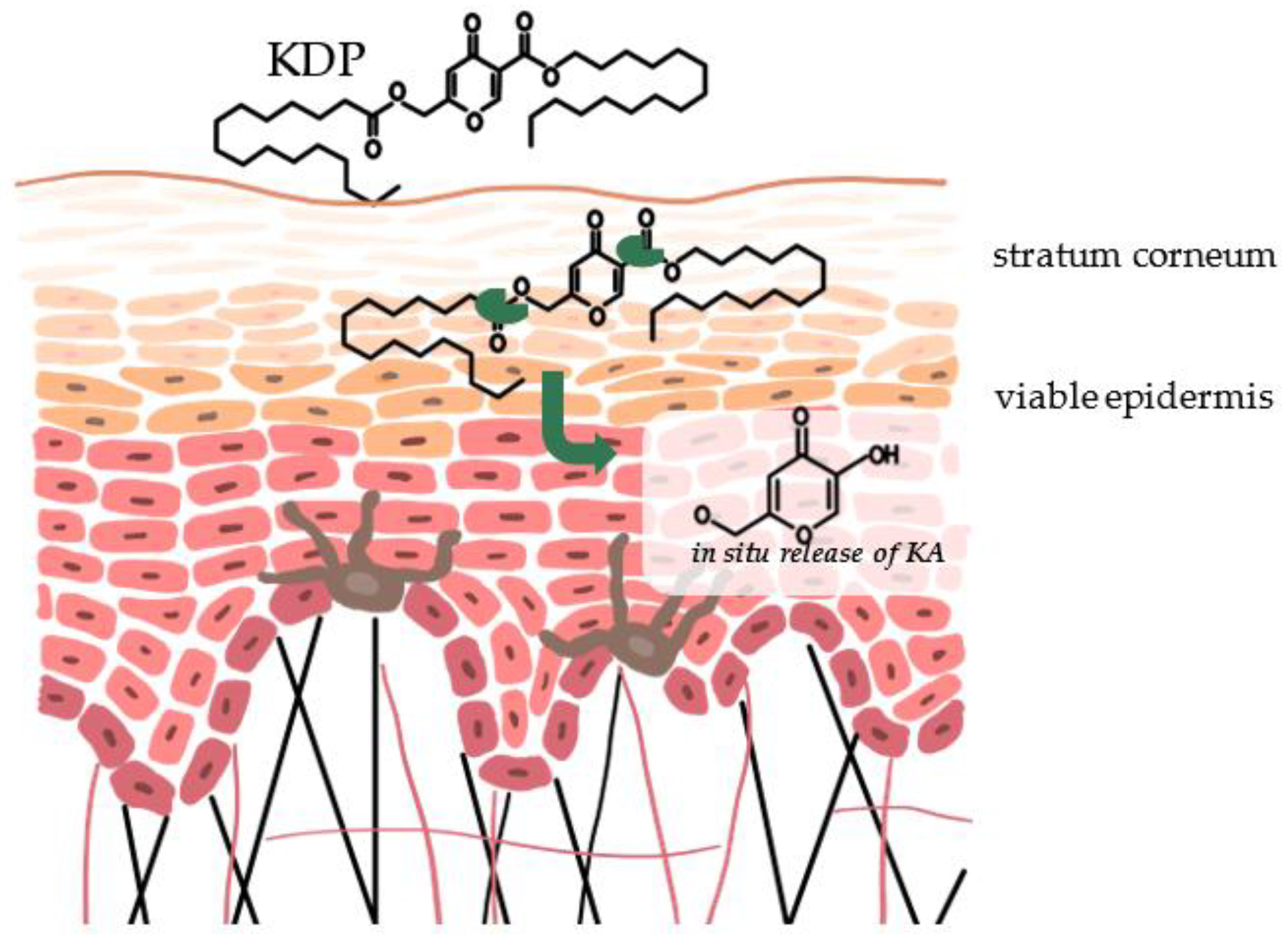
Figure 3.
True inhibitors mechanisms of action: (a) normal binding; (b) competitive inhibition; (c) noncompetitive inhibition.
Figure 3.
True inhibitors mechanisms of action: (a) normal binding; (b) competitive inhibition; (c) noncompetitive inhibition.
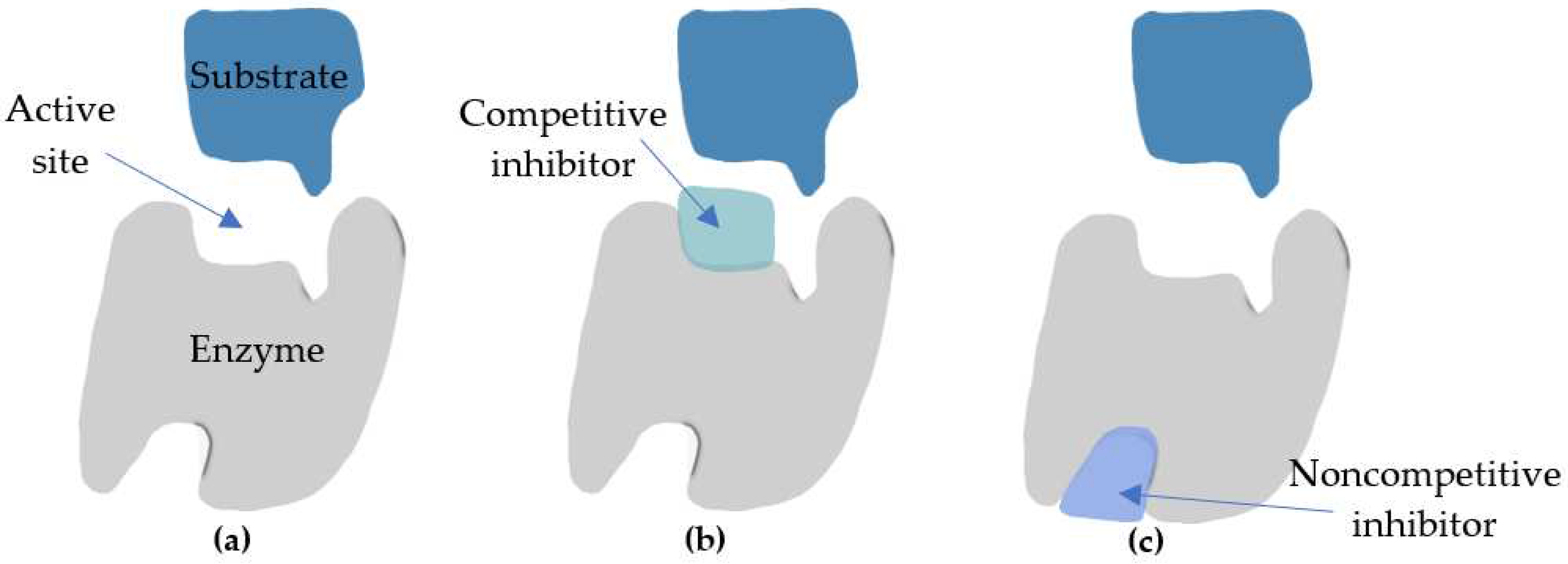
Figure 4.
Schematic illustration of several configurations in which KDP nanomaterials were formulated.
Figure 4.
Schematic illustration of several configurations in which KDP nanomaterials were formulated.
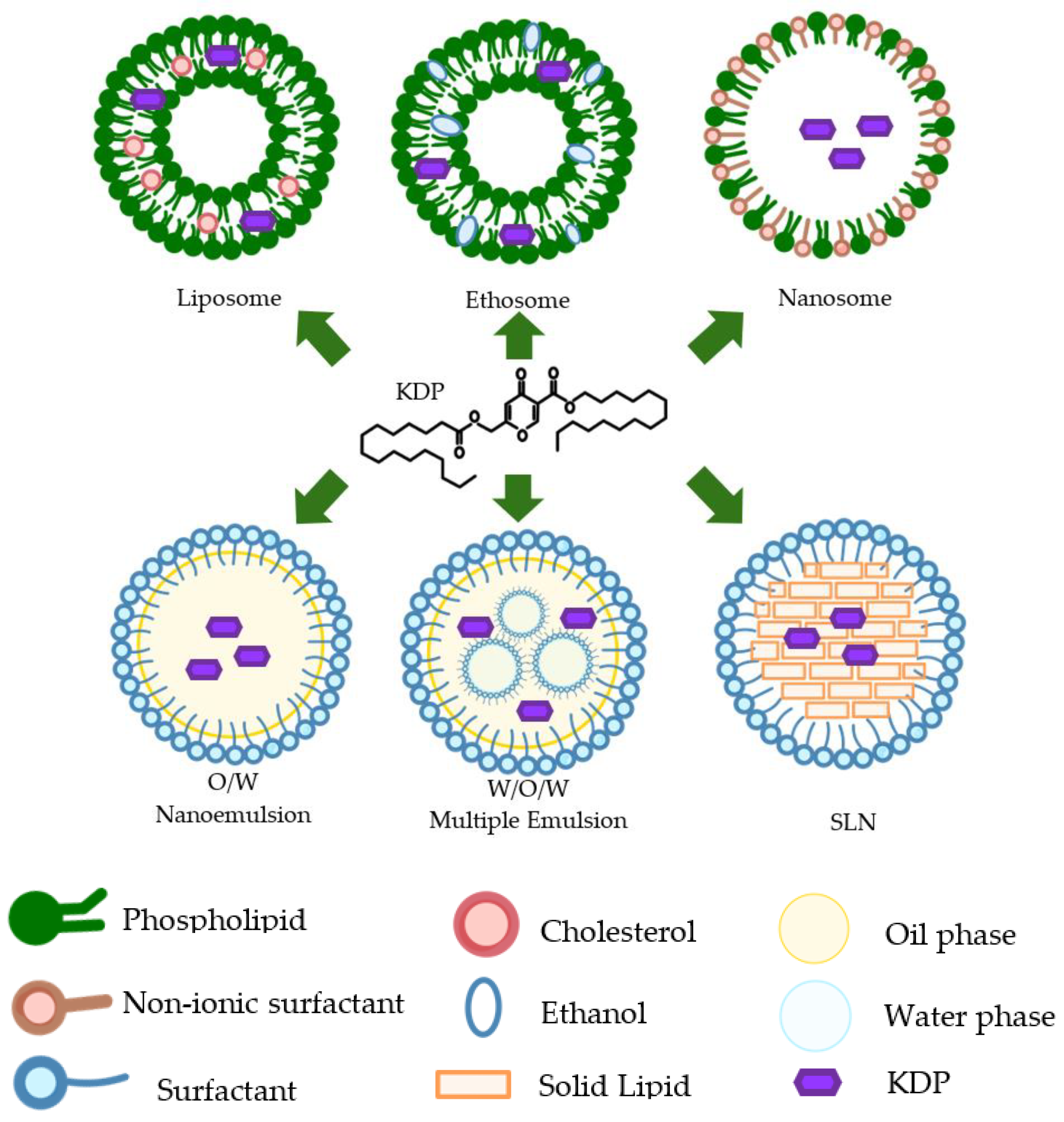
Table 1.
Patents of kojic acid dipalmitate.
| Pantent’s holder | Field of Invention | Year | No. of patent | Refference |
|---|---|---|---|---|
| Jerry Whittemore Robert Neis | The present invention relates to a skin-whitening cosmetic compositions and in particular to such a composition that is anhydrous and incorporates kojic dipalmitate. | 1998-2018 | US5824327A | [84] |
| Shanghai Institute of Technology | A kind of nano-solid lipid carrier and preparation method of coated kojic acid acid dipalmitate | 2014-2034 | CN104116643A | [85] |
| Shanghai Jahwa United Co Ltd | The present invention relates to a kind of high-performance liquid chromatography (HPLC) analytical approach, be specifically related to method with the HPLC quantitatively analyzing kojic dipalmitate. | 2002-2022 | CN1188700C | [86] |
Disclaimer/Publisher’s Note: The statements, opinions and data contained in all publications are solely those of the individual author(s) and contributor(s) and not of MDPI and/or the editor(s). MDPI and/or the editor(s) disclaim responsibility for any injury to people or property resulting from any ideas, methods, instructions or products referred to in the content. |
© 2023 by the authors. Licensee MDPI, Basel, Switzerland. This article is an open access article distributed under the terms and conditions of the Creative Commons Attribution (CC BY) license (http://creativecommons.org/licenses/by/4.0/).
Copyright: This open access article is published under a Creative Commons CC BY 4.0 license, which permit the free download, distribution, and reuse, provided that the author and preprint are cited in any reuse.