

Submitted:
27 December 2023
Posted:
28 December 2023
You are already at the latest version
Abstract
The split of the brain into two hemispheres is pivotal to human existence, enabling incompatible versions of the world, with quite different priorities and values, to exist concomitantly. Neuroimaging techniques are usually the adopted methods to assess hemispherical bias. However, can differences in thinking orientation, behavioural style, and personality emerging from laterality be observed without the use of neuroimaging techniques? This paper investigates whether a personality test based on the Five-factor model (FFM) is also able to identify hemispherical bias. It does so by testing five hypotheses on personality differences related to handedness. The aim is to contribute to the instantiation of the FFM in neuroscience by testing its validity against the neuroscientific literature on brain laterality. The findings pointed to no statistically significant differences due to handedness in three out of five personality traits (namely, Neuroticism, Conscientiousness and Extraversion). As to the other two traits – Openness and Agreeableness – the hypotheses were only partially confirmed by the data, as the relevant difference found was not between left-handed and right-handed groups, but between ambidextrous and the others.
Keywords:
Big five
; five-factor model
; handedness
; laterality
; personality traits
Introduction
The composition of the brain divided into two hemispheres is crucial to human existence, as it enables dissenting versions of the world to concomitantly exist (McGilchrist, 2019). The asymmetric location of functional elements in the brain has been studied in both animals (Corballis, 2017) and humans (Güntürkün et al., 2020). Such studies have led to the recognition of five lateralized functions in the human brain, as follows: Handedness, language skills, spatial skills, facial recognition and emotion recognition (Tzourio-Mazoyer, 2020). Nevertheless, we now understand that every sort of brain function (e.g., reason, emotion, language and imagery) is a consequence of inter-hemispheric interaction (McGilchrist, 2019).
Traditionally, researchers attributed the qualitative difference in data processing observed between the right and left cerebral hemispheres to hemisphericity usually gauged through a 10-step gradient between right and left extremes (Morton, 2020). The approach dovetails nicely with the growing body of research indicating that the degree of handedness might be of more psychological relevance than the direction itself (Grimshaw & Wilson, 2013; Papadatou-Pastou, 2020). Neuroimaging techniques, most prominently magnetic resonance imaging (MRI), are usually the adopted methods to confirm hemispherical bias. However, can differences in thinking orientation, behavioural style, and personality emerging from laterality be observed without the use of neuroimaging techniques?
In this paper, I investigate whether a personality test based on the Five-factor model (FFM) is also able to identify hemispherical bias. I will do so by testing five hypotheses on personality differences related to handedness. These are well-founded in both the scientific literature and popular stereotypes. This is relevant because the FFM has been criticized for not linking its findings on personality psychology to underlying physiological mechanisms or neurochemical brain processes (Boyle, 2008). Moreover, it has also been suggested that the five traits underpinning the model are too broad to generate highly accurate predictions (e.g., Block, 1995). Thereby, testing its accuracy against the neuroscientific literature on brain laterality seems to be a judicious manner to respond to the aforesaid criticism. The five hypotheses are:
- Hypothesis 1: Left-handers are more creative (trait Openness) (Anstee et al., 2022; Newland, 1981)
- Hypothesis 2: Left-handers have a big advantage at competitive sports for being more competitive (trait Agreeableness reversed) (Coren, 1994; Hadžić, 2023)
- Hypothesis 3: Left-handers are more fearful (trait Neuroticism) (Ocklenburg, 2023; Orme, 1970)
- Hypothesis 4: Left-handers are more likely to become leaders (trait Conscientiousness)
- (Huffstetler, 2017)
- Hypothesis 5: Left-handers are introverted (trait Extraversion reversed) (Arsenova, 2021; Lester, 1987)
I use handedness as a proxy for innate neurological differences between individuals because of its negative correlation with hemispherical bias (Morton, 2020). The aim is to use a neutral source of data to identify differences manifested in personality traits. If results converge, this paper will contribute to the instantiation of the FFM in neuroscience.
The Five-Factor Model
The five-factor model (FFM) – also known as the ‘Big Five’ – is an empirical-based taxonomy of personality that converges a myriad of human behaviour dispositions into five descriptive traits, namely neuroticism (or emotional stability), extraversion, openness (or intellect/imagination), agreeableness, and conscientiousness (Digman, 1997; McCrae, 1992; McCrae and John, 1992). Put simply, the model is an empirical generalization about the covariation of personality traits.
The Big Five have been found originally in peer rating scales (Tupes & Christal, 1961/1992). Later, they have also been observed in self-reports on trait descriptive adjectives (Saucier, 1997), in questionnaires (Costa & McCrae, 1988) and personality disorder symptom clusters (Clark & Livesley, 2002). Indeed, the general notion of “personality”, insofar as what psychologists mean by it, has been summarized by the FFM, which has been of great utility to the field in promoting integration and systematization of diverse conceptions and measures (Johnson, Briggs & Hogan, 2008).
The FFM has gathered over the years a vast body of work filled with cross-cultural studies on the most varied aspects of human personality. The literature includes research done on diverse populations (McCrae, Terracciano, et al., 2005), usually followed across decades of the lifespan (Terracciano, Costa, & McCrae, 2006), employing various methodology (Funder, Kolar, & Blackman, 1995), and even featured case studies (Costa & McCrae, 1998; McCrae, 1993–1994). As suggested by Costa & McCrae (1993, p. 302), the FFM “is the Christmas tree on which findings of stability, heritability, consensual validation, cross-cultural invariance, and predictive utility are hung like ornaments”. Thus, it is safe to say that the FFM has promoted steady development in the realm of personality psychology, as it has enabled the accumulation of replicable findings of the origins, development, and functioning of personality traits (McCrae, 2002). In Figure 1 below, I present a compilation of the hierarchical personality structure predicated on the combination of multiple sources of research on personality psychology. Following up, Table 1 introduces basic conceptual definitions for each of the meta-traits, the Big Five and their facets.
As it is possible to surmise, the hierarchy depicted in Figure 1 is an oversimplification as it streamlines the hierarchical structure by omitting cross-loadings. If the diagram was to be taken for its face value, traits underneath the meta-trait Stability could not be related to traits beneath meta-trait Plasticity. However, human personality is not as clear-cut as its graphic representation might make us believe, especially at levels below the Big Five (Costa & McCrae, 1992; DeYoung, 2010; Hofstee et al., 1992). For instance, while Politeness has a negative correlation with Assertiveness, Compassion is positively related to Enthusiasm (DeYoung et al., 2013; Rengifo & Laham, 2022). Thus, biological models of personality are only accurate insofar as they take these cross-connections into account.
In any event, a growing body of work focused on instantiating the empirical findings accruing from the five-factor model on personality neuroscience has developed in recent years (Brooks et al., 2020; DeYoung, 2010, 2015; Latzman et al., 2019; Van Egeren, 2009; Widiger & Crego, 2019). In this literature, a common thread seems to be the understanding that there is a multitude of biological parameters instantiating any given personality trait, which causes covariance among several personality traits encompassed by the FFM (DeYoung, 2010; Peterson & Flanders, 2002; Van Egeren, 2009). In other words, there are causal biological mechanisms underlying personality traits that have not been as well explored as the descriptive mechanisms comprising the meaning given to personality traits by the FFM. When we think of one of the Big 5 personality traits, for example, there is a set of well-established patterns of behaviour described in the literature, but the same cannot be said about causal processes underlying the trait. This is a gap in the literature to be filled and this paper is an attempt of contribution.
Materials and Methods
Data Collection
The study investigates the correlation between handedness and personality traits in a publicly available dataset (https://openpsychometrics.org/tests/IPIP-BFFM/) comprising responses to the International Personality Item Pool Big Five measure (IPIP; Goldberg et al., 2006). The questionnaire comprised 50 rated statements related to the FFM. The five traits (i.e., Extraversion, Agreeableness, Conscientiousness, Neuroticism (Emotional Stability), and Openness (Intellect/Imagination) were each measured by ten items. Participants responded using a 5-point Likert scale ranging from 1 = very inaccurate to 5 = very accurate. Also, self-reported data on gender, age, race, handedness, native language and country were collected. Participants were asked for their consent on the use of their data for educational or research applications. In light of the purpose of my study, only participants who informed on handedness (n= 19612) were included.
The sample comprised right-handers (n=17417) – approximately 88,80% of the total –, left-handers (n=1724) – approximately 8,79% of the total –, and ambidextrous (n=471) – approximately 2,40% of the total. This ratio reflects the general understanding presented by the handedness literature that describes a majority of right-handers (approximately 90%) and a minority of left-handers (approximately 10%) (e.g., Peters, 1979; Skolyes, 2000; Guadalupe, Willems & Zwiers, 2014). By and large, studies do not consider ambidextrous as a separate category. Table 2 below presents more information on participants’ age, gender and language.
Data Analysis
The results of the IPIP scales were analysed and scored as follows:
There were 10 items on the test for each of the 5 personality traits. These items were either "+keyed" and "-keyed". For “+keyed” items, the response "Very Inaccurate" was assigned a value of 1, "Moderately Inaccurate" a value of 2, "Neither Inaccurate nor Accurate" a 3, "Moderately Accurate" a 4, and "Very Accurate" a value of 5. Conversely, For “-keyed” items, the response "Very Inaccurate" is assigned a value of 5, "Moderately Inaccurate" a value of 4, "Neither Inaccurate nor Accurate" a 3, "Moderately Accurate" a 2, and "Very Accurate" a value of 1. Once the numbers were assigned for all of the items in the scale, a simple sum of all the values was performed to obtain a total scale score. In the appendix, one can find a list with all the factor markers as well as the characteristics of the preliminary IPIP scales measuring the domains. Below, Table 3 presents more information on the reliability of the test.
Results
Claims of left-handers being introverted, more creative, more fearful, more competitive or innate leaders are not necessarily substantiated by concrete evidence, which does not impede the stereotypes to exist. A cursory examination of the Internet as a proxy of popular belief reveals some ‘‘myths about left-handers’’ sites (e.g., https://www.deccanchronicle.com/lifestyle/culture-and-society/240719/five-personality-traits-of-left-handed-people.html; https://www.rd.com/list/left-handed-people-myths/; www.hubpages.com/hub/Left-handers-the-myths-and-the-facts). In such cases, the important point is not the accuracy of the stereotypes, but their existence.
The scientific community has also dedicated a fair share of its attention to investigating the potential personality differences between right and left-handers. To name a few, Grimshaw and Wilson (2013) looked into facts, beliefs and stereotypes about left-handed personality; Reshetnikova and others (2022) investigated the relationship between success in motor imagery of the right and left hands and users' personality traits; Fritsche and Lindell (2019) talk about the costs and benefits of being left-handed; Sartarelli (2016) examined the bearing of handedness on earning, ability and personality; and McCann (2019) studied political preferences and their predictability based on handedness.
The five hypotheses tested by this study were:
- Hypothesis 1: Left-handers are more creative (trait Openness) (Anstee et al., 2022; Newland, 1981)
- Hypothesis 2: Left-handers have a big advantage at competitive sports for being more competitive (trait Agreeableness reversed) (Coren, 1994; Hadžić, 2023)
- Hypothesis 3: Left-handers are more fearful (trait Neuroticism) (Ocklenburg, 2023; Orme, 1970)
- Hypothesis 4: Left-handers are more likely to become leaders (trait Conscientiousness)
- (Huffstetler, 2017)
- Hypothesis 5: Left-handers are introverted (trait Extraversion reversed) (Arsenova, 2021; Lester, 1987)
A one-way ANOVA tested whether there was a statistically significant difference between groups as to hypotheses 1 to 5. An alpha of .01 was adopted to reflect the fact that all analyses were repeated for each of the five personality factors. There was no sex, age, ethnicity, or nationality differences in either beliefs or stereotypes about handedness, and so all reported results are collapsed across these categories. Below, the summary data (mean and standard deviation) of the Big-Five traits concerning handedness.
Hypothesis 1
An one-way ANOVA test demonstrated statistically significant difference between groups (F(2,19612) = 48.375, p < .001, ηp2 = .005). A Tukey post hoc test revealed that Right-handed people’s score in trait Openness was statistically significantly lower (38.97 ± 6.261 points) compared to Left-handed (39.49 ± 6.250 points, p = .003), but it was the ambidextrous group who scored highest (41.72 ± 5.628 points, p < .001). In other words, ambidextrous is the most creative group and some .5% of the variance in Openness between people can be attributable to handedness.
Hypothesis 2
An one-way ANOVA test demonstrated statistically significant difference between groups (F(2,19612) = 14.389, p < .001, ηp2 = .001). A Tukey post hoc test revealed that ambidextrous people’s score in trait Agreeableness was statistically significantly lower (36.75 ± 8.596 points) compared to Left-handed (38.31 ± 7.470 points, p < .001) and Right-handed (38.51 ± 7.065 points, p < .001) groups. Furthermore, the test revealed no significant difference between the groups of Right-handed and Left-handed people’s score in trait Agreeableness (38.51 ± 7.065 points, 38.31 ± 7.470 points, p = .486). In other words, ambidextrous is the least agreeable group. Some .1% of the variance in Agreeableness between people is attributable to handedness.
Hypothesis 3
An one-way ANOVA test demonstrated no statistically significant difference between groups (F(2,19612) = 2.480, p = .084, ηp2 < .001) in trait Neuroticism. In other words, the claim that left-handed individuals are more fearful is not supported by the findings of this study.
Hypothesis 4
An one-way ANOVA test demonstrated no statistically significant difference between groups (F(2,19612) = 2.681, p = .069, ηp2 < .001) in trait Conscientiousness. In other words, the claim that left-handed individuals are more likely to become leaders is not supported by the findings of this study.
Hypothesis 5
An one-way ANOVA test demonstrated no statistically significant difference between groups (F(2,19612) = 1.468, p = .230, ηp2 < .001) in trait Extraversion. In other words, the claim that left-handed individuals are introverted is not supported by the findings of this study.
In the end, this study produced evidence that there are statistically significant differences in personality as to traits Openness and Agreeableness, which partially substantiates hypothesis 1 and hypothesis 2. The hypotheses are not fully empirically confirmed, however, because the relevant difference is not between left-handed and right-handed groups, but between ambidextrous and the others. Furthermore, although the results are not negligible, the effect size of the influence of handedness on Openness and Agreeableness is of less than one per cent in both cases (hypothesis 1: .005, hypothesis 2: < .001). In sum, the evidence produced by this study points to no statistically significant differences due to handedness in three out of five personality traits (namely, Neuroticism, Conscientiousness and Extraversion). As to the other two traits – Openness and Agreeableness – the difference in not negligible, but of limited effect size.
Discussion
Why Are the Ambidextrous People (Marginally) More Creative?
Preliminarily, it is relevant to highlight the importance of an adequate taxonomy in handedness research. Many studies have already reported the idiosyncrasies of ambidexterity in cases of episodic memory (Propper, Christman, & Phaneuf, 2005), intelligence (Nicholls et al., 2010), and updating of belief (Christman et al., 2008). In this sense, this study adds to the body of research that differentiates ambidextrous instead of combining them with left-handers into a group of non-right-handers (or ambidextrous and right-handers into a group of non-left-handers). There is a growing body of research indicating that the degree of handedness might be of more psychological relevance than the direction itself (Grimshaw & Wilson, 2013; Papadatou-Pastou, 2020) and this study is in line with such understanding, as hand preference (or lack thereof more precisely) accounted for variance in both Agreeableness and Openness of ambidextrous people – not the left-handers (Newland, 1981; Coren, 1994). In other words, those with a lower degree of handedness (i.e., with no strong hand preference) are the ones with differed personality traits, which poses the question: Why?
Personality traits can be construed as accounts of relatively stable psychobiological patterns with causal effects on life outcomes, e.g., health, relationships, occupation. Life outcomes can in turn have an influence on traits, either directly or through their impact on the environment that contributes to forming the personality. Figure 2 below depicts the cyclical causal effect interplay between environmental forces, personality traits and life outcomes.
Research has suggested that the interplay between personality traits and life outcomes can potentially shape the epigenome1 of an individual (McEwen & Bulloch, 2019). In fact, recent studies have linked handedness to epigenetics marks in the spinal cord; not the brain (Ocklenburg et al., 2017). To fathom that personality traits can influence the epigenome and ultimately affect left or right-hand preference could be a way to explain the underlying causal processes of the findings of this study concerning traits Agreeableness and Openness in ambidextrous people. However, this is not the route adopted in this article.
The literature still attributes handedness vastly to the developmental process that differentiates the right and left hemispheres of the brain (Avezmurodovich, 2021), being a key notion when it comes to hemispheric collaboration in emotion processing. The degree to which individuals use one hand for performing a series of tasks will determine whether they are consistent-handers (i.e., usually prefer to use one specific hand) or ambidextrous (i.e., use different hands depending on the task being performed). The literature suggests that consistent-handers present greater independence of the hemispheres, whereas ambidextrous demonstrate greater collaboration between hemispheres (Kraus, 2023; Shobe, 2014). Thus, it is possible to assume that ambidextrous will have an advantage over consistent-handers in activities that require a cross-hemispheric strategy (Lyle and Martin, 2010; Propper et al., 2005), for example, creative thinking and emotion regulation (an aspect of social intelligence).
Why Are Ambidextrous (Marginally) More Creative and More Competitive?
There is much research done on what factors might influence the competitiveness level of individuals. There is evidence, for example, that the gender differences in competitiveness are partially due to socialization (Lackner, 2021; Gneezy et al., 2009). There is evidence also that nature plays an important role in shaping economic preferences, as Israel et al. (2009) have found links between specific genes and behaviour in the dictator game, and Buser (2012) found a proclivity for women to be more competitive depending on their menstrual cycle and potential intake of hormonal contraceptives.2 In any event, the use of handedness as a proxy for innate neurological differences between individuals’ personality traits seems to be a judicious strategy as it enables the circumvention of the aforementioned discussion, i.e. whether competitiveness is honed by nature or nurture. To address the correlation between competitiveness and handedness, however, it is necessary first to tackle the notion of gullibility.
It has been suggested that gullibility is a combination of high levels of agreeableness and low social intelligence (Carter & Weber, 2010; Teunisse et al., 2020). Agreeableness, as addressed earlier in this paper, is a personality trait predicated on conformity and avoidance of conflict. However, it is not self-evident that highly agreeable people are necessarily gullible as they may have the necessary social intelligence to detect someone else’s skewed intentions (see: Carter & Weber, 2010). Therefore, it is not agreeableness alone that engenders lack of competitiveness, but its combination with low social intelligence. In this vein, it is not the low scores in trait Agreeableness that make ambidextrous more competitive, instead it is the combination of lower Agreeableness and higher inter-hemispheric interaction.
Research on hemispheric asymmetries for processing emotions has been able to reveal cerebral asymmetries for perceiving and labelling external stimuli. Although little information has been provided on the depth of processing each hemisphere does or how they collaborate for emotional processing, it has been demonstrated that the right hemisphere processes all emotional expression and that the left hemisphere is able to identify positive emotions only (Hecht & Shin, 2015). This is a conclusion drawn upon studies done on the processing abilities of patients with corpus callosal abnormality or with unilateral brain damage, which provides researchers with the opportunity for a glimpse into the separate competencies of each hemisphere and emphasises the need for interhemispheric interaction for the normal processing of emotional experience (Shobe, 2014). The findings from studies done on these populations suggest that while the right hemisphere is the centre of emotional experience, adjusted to comprehension and identification of emotional stimuli, the left hemisphere relies on the information transferred by the right hemisphere to make abstract, propositional extractions (Baynes & Gazzaniga, 2000; Shobe, 2014). This is relevant because it is the interplay between both hemispheres in the brain that engenders what is known as social intelligence.
Social intelligence is the ability to make accurate social inferences based upon interpretation of social information. It develops from interactions with people and learning from previous experiences in social settings. In nonprofessional’s terms, it is commonly referred to as "street smart" (see Goleman, 2007). As demonstrated above, social intelligence strongly relies on the levels of inter-hemispheric interaction taking place in the brain (Razumnikova & Volf, 2021). In fact, as noted by Paul, et al. (2003), agenesis of the corpus callosum (ACC) – meaning, the complete or partial absence of the corpus callosum, the band of white matter bridging the two hemispheres in the brain – leads to deficiency in paralinguistic processing (e.g., difficulty understanding nonliteral meaning or affective content). Ultimately, despite normal general intelligence, individuals with ACC are prone to be deficient in social intelligence since this deficit might result in the misunderstanding of social communications, which rely heavily on linguistic nuances and nonliteral statements (Badaruddin et al., 2007). In other words, ambidextrous’ higher levels of inter-hemispheric interaction, in comparison with individuals with strong hand preferences, potentially render them more socially intelligent. Higher social intelligence combined with lower levels of Agreeableness (as my analysis of the data suggests) engenders a group of people with less accommodating behaviour, which manifests itself through a higher degree of competitiveness.
Finally, although not statistically significant, the data also show that ambidextrous scored the highest in Neuroticism, which combined with their low score in Agreeableness, indicates perhaps low levels of serotonin. As explained by Allen and DeYoung (2017, p. 325) “serotonergic neurons project from the raphe nuclei in the brainstem to innervate most cortical and subcortical brain structures, making serotonin well poised to influence the broad range of personality traits implicated in Stability”. Stability is a metatrait that encompasses both traits Conscientiousness, Neuroticism and Agreeableness. In this vein, each of these traits represents a different kind of stability in the human personality: reversed Neuroticism instantiates emotional stability, Conscientiousness reflects motivational stability, and Agreeableness engenders social stability, i.e. promoting social harmony (DeYoung, 2013). Furthermore, studies link serotonin function to prosocial conduct, e.g., altruism, cooperation and caregiving, whereas serotonin depletion shifts neural computations toward antisocial conduct (Siegel & Crockett, 2013), which can be manifested through a more competitive behaviour. However, it is known that serotonin levels can fluctuate and this is not something FFM tests control for. In this sense, the correlation between handedness, serotonin levels and Agreeableness represents an avenue to be explored by future research, notwithstanding the speculative nature of the conjecture that ambidextrous who participated in this study might have had lower serotonin levels.
The evidence produced by this article predicated on the FFM is not only aligned but also validated by the vast number of studies on handedness with a neuropsychological and neuroanatomical slant. This is relevant because of the ongoing criticism of the FFM and its alleged lack of underlying physiological or neurochemical grounding (Boyle, 2008; May et al., 2022). Moreover, the emphasis on handedness as proxy for innate differences has proven to be a commensurate methodological strategy insofar as it is a stable feature not amenable to direct manipulation (Kovel & Francks, 2019).
Conclusion
This article presents the findings of a study on five different stereotypes (one for each of the Big Five personality traits) about left-handers. The data produced evidence that there are statistically significant differences in personality as to traits Openness and Agreeableness. These hypotheses are, however, only partially substantiated because the significant differences are not between left-handed and right-handed groups, but between ambidextrous and the others. In addition, the effect size of the influence of handedness on Openness and Agreeableness is of less than one per cent in both cases (hypothesis 1: .005, hypothesis 2: < .001), which is rather limited. Nevertheless, such findings contribute to the instantiation of the Five-factor model (FFM) in neuroscience.
As to the limitations of the study, the literature suggests causal differences between genders concerning handedness. Therefore, research on handedness should control results for sex. This study did not do so because it was testing five hypotheses that did not account for sex, age, ethnicity, or nationality differences. Moreover, the best practice seems to be to consider ambidextrous as an autonomous category in the taxonomy of handedness, which the hypotheses did not do either.
In conclusion, this article serves two purposes:
First, it dismantles the legacy claim that left-handers are more creative (hypothesis 1), more competitive (hypothesis 2), more fearful (hypothesis 3), more likely to become leaders (hypothesis 4) and more introverted (hypothesis 5). The data do not support hypotheses 3 to 5 and, regarding hypotheses 1 and 2, the findings demonstrate ambidextrous to be more creative (trait openness) and competitive (trait agreeableness reversed).
Second, it refutes the critique that the FFM is not linked to underlying physiological mechanisms or to neurochemical brain processes and that its five traits are too broad to generate highly accurate predictions (Boyle, 2008; May et al., 2022). The findings produced by the FFM in this study were accurate about the higher prevalence of creativity and competitiveness among ambidextrous instead of left-handers, which was supported by the vast number of studies carried out on handedness with a neuropsychological (Shobe et al., 2009) and neuroanatomical (Riccelli et al., 2017) slant. In other words, the understanding that most aspects of human personality are encoded in language and can be assessed through lexically based tests (Costa & McCrae, 1992; Saucier & Goldberg, 2001) remains valid and, in fact, dovetails nicely with evidence produced by neuroscientific studies of the human behaviour. The large, cross-cultural, sample of this study is perhaps just another proof of the accuracy of the FFM and its grounding also in biological aspects of the human personality.
Acknowledgments
The author is thankful to the Open-Source Psychometrics Project that generously made available the data on the big five personality traits using the IPIP Big-Five Factor Markers.
References
- Anstee, L., Müllensiefen, D., & Harrison, P. (2022). Handedness and musical abilities in secondary school students.
- Asenova, I. (2021). Comparison of Interests and Special Abilities of Left-and Right-handers. Филoсoфия, 30(2), 192-204. [CrossRef]
- Avezmurodovich, Q. R. (2021). Psychological aspects of left-handedness: Concept, causes, and peculiarities. Academicia: an international multidisciplinary research journal, 11(1), 623-631. [CrossRef]
- Badaruddin, D. H., Andrews, G. L., Bölte, S., Schilmoeller, K. J., Schilmoeller, G., Paul, L. K., & Brown, W. S. (2007). Social and behavioral problems of children with agenesis of the corpus callosum. Child psychiatry and human development, 38(4), 287-302. [CrossRef]
- Baynes, K. , & Gazzaniga, M. S. (2000). Callosal disconnection.
- Block, J. (1995). A contrarian view of the five-factor approach to personality description. Psychological Bulletin, 117, 187–215. [CrossRef]
- Boyle, G. J. (2008). Critique of the five-factor model of personality. In G. J. Boyle, G. Matthews, & D. H. Saklofske (Eds.), The SAGE handbook of personality theory and assessment, Vol. 1. Personality theories and models (p. 295–312). Sage Publications, Inc.
- Brackenridge, C. J. (1981). Secular variation in handedness over ninety years. Neuropsychologia, 19(3), 459-462. [CrossRef]
- Brandler, W. M. , Morris, A. P., Evans, D. M., Scerri, T. S., Kemp, J. P., Timpson, N. J.,... & Monaco, A. P. (2013). Common variants in left/right asymmetry genes and pathways are associated with relative hand skill. PLoS Genet, 9(9), e1003751. [CrossRef]
- Brooks, D., Hulst, H. E., de Bruin, L., Glas, G., Geurts, J. J., & Douw, L. (2020). The multilayer network approach in the study of personality neuroscience. Brain sciences, 10(12), 915. 12. [CrossRef]
- Buser, T. (2012). The impact of the menstrual cycle and hormonal contraceptives on competitiveness. Journal of Economic Behavior & Organization, 83(1), 1-10. [CrossRef]
- Carter, N. L. , & Mark Weber, J. (2010). Not Pollyannas: Higher generalized trust predicts lie detection ability. Social Psychological and Personality Science, 1(3), 274-279. [CrossRef]
- Cherbuin, N. , & Brinkman, C. (2006). Hemispheric interactions are different in left-handed individuals. Neuropsychology, 20(6), 700. [CrossRef]
- Christman, S. D. (1995). Independence versus integration of right and left hemisphere processing: Effects of handedness.
- Christman, S. D. , Henning, B. R., Geers, A. L., Propper, R. E., & Niebauer, C. L. (2008). Mixed-handed persons are more easily persuaded and are more gullible: Interhemispheric interaction and belief updating. Laterality, 13(5), 403-426. [CrossRef]
- Clark, L. A. , & Livesley, W. J. (2002). Two approaches to identifying dimensions of personality disorder: Convergence on the five-factor model. In P. T. Costa & T. A. Widiger (Eds.), Personality disorders and the five-factor model of personality (2nd ed., pp. 161–176). Washington, DC: American Psychological Association.
- Clarke, J. M. , & Zaidel, E. (1994). Anatomical-behavioral relationships: corpus callosum morphometry and hemispheric specialization. Behavioural brain research, 64(1-2), 185-202. [CrossRef]
- Corballis, M. C. (2017). The evolution of lateralized brain circuits. Frontiers in Psychology, 18, 1021. [CrossRef]
- Coren, S. (1994). Personality differences between left- and right-handers: an overlooked minority group? Journal of Research in Personality, 28, 214–229.
- Costa, P. T., Jr. , & McCrae, R. R. (1992). NEO PI-R professional manual. Odessa, FL: Psychological Assessment Resources.
- Costa, P. T., Jr., & McCrae, R. R. (1993). Bullish on personality psychology. The Psychologist, 6, 302–303. 6.
- Costa, P. T., Jr. , & McCrae, R. R. (1998). Six approaches to the explication of facet-level traits: Examples from Conscientiousness. European Journal of Personality, 12, 117–134. [CrossRef]
- Cowell, P. E., Kertesz, A., & Denenberg, V. H. (1993). Multiple dimensions of handedness and the human corpus callosurn. Neurology, 43(11), 2353-2353. 11. [CrossRef]
- Deacon, T. W. (1997). The symbolic species: The co-evolution of language and the brain. New York: W.W. Norton.
- DeYoung, C. G. (2006). Higher-order factors of the Big Five in a multi-informant sample. Journal of Personality and Social Psychology, 91, 1138–1151. [CrossRef]
- DeYoung, C. G. (2010). Personality neuroscience and the biology of traits. Social and Personality Psychology Compass, 4, 1165–1180. [CrossRef]
- DeYoung, C. G. (2013). The neuromodulator of exploration: A unifying theory of the role of dopamine in personality. Frontiers in human neuroscience, 7, 762. [CrossRef]
- DeYoung, C. G. (2015). Cybernetic big five theory. Journal of research in personality, 56, 33-58. [CrossRef]
- DeYoung, C. G. , Peterson, J. B., & Higgins, D. M. (2002). Higher-order factors of the Big Five predict conformity: Are there neuroses of health? Personality and Individual Differences, 33, 533–552. [CrossRef]
- DeYoung, C. G., Weisberg, Y. J., Quilty, L. C., & Peterson, J. B. (2013). Unifying the aspects of the Big Five, the interpersonal circumplex, and trait affiliation. Journal of Personality, 81, 465–475. [CrossRef]
- Digman, J. M. (1997). Higher-order factors of the Big Five. Journal of Personality and Social Psychology, 73(6), 1246–1256. [CrossRef]
- Fink, G. R. , Halligan, P. W., Marshall, J. C., Frith, C. D., Frackowiak, R. S., & Dolan, R. J. (1996). Where in the brain does visual attention select the forest and the trees. Nature, 336, 766–767. [CrossRef]
- Finke, R. A. , Ward, T. B., & Smith, S. M. (1992). Creative cognition: Theory, research, and applications.
- Fleeson, W. (2001). Toward a structure- and process-integrated view of personality: Traits as density distributions of states. Journal of Personality and Social Psychology, 80, 1011–1027. [CrossRef]
- Floegel, M. , & Kell, C.A. (2017). Functional hemispheric asymmetries during the planning and manual control of virtual avatar movements. PLoS One, 12, 787–790. [CrossRef]
- Fritsche, S. A. , & Lindell, A. K. (2019). On the other hand: The costs and benefits of left-handedness. Acta Neuropsychologica, 17, 69-86. [CrossRef]
- Funder, D. C. , Kolar, D. C., & Blackman, M. C. (1995). Agreement among judges of personality: Interpersonal relations, similarity, and acquaintanceship. Journal of Personality and Social Psychology, 69, 656–672. [CrossRef]
- Furnham, A. (1983). Personality and handedness. Personality and Individual Differences.
- Gneezy, U. , Leonard, K. L., & List, J. A. (2009). Gender differences in competition: Evidence from a matrilineal and a patriarchal society. Econometrica, 77(5), 1637-1664. [CrossRef]
- Goldberg, L. R. , Johnson, J. A., Eber, H. W., Hogan, R., Ashton, M. C., Cloninger, C. R., & Gough, H. G. (2006). The international personality item pool and the future of public-domain personality measures. Journal of Research in personality, 40(1), 84-96. [CrossRef]
- Goleman, D. (2007). Social intelligence. Random house.
- Gray, J. A. (1995). A model of the limbic system and basal ganglia: Application to anxiety and schizophrenia. In M. S. Gazzaniga (Ed.), The cognitive neurosciences (pp. 1165–1176). Cambridge, MA: MIT Press.
- Gray, J. A. (2004). Consciousness: Creeping up on the hard problem. New York: Oxford University Press.
- Grimshaw, G. M. , & Wilson, M. S. (2013). A sinister plot? Facts, beliefs, and stereotypes about the left-handed personality. Laterality: Asymmetries of Body, Brain and Cognition, 18(2), 135–151. [CrossRef]
- Guadalupe, T. , Willems, R. M., Zwiers, M. P., Arias Vasquez, A., Hoogman, M., Hagoort, P.,... & Francks, C. (2014). Differences in cerebral cortical anatomy of left-and right-handers. Frontiers in psychology, 5, 261. [CrossRef]
- Güntürkün, O. , Ströckens, F., & Ocklenburg, S. (2020). Brain lateralization: a comparative perspective. Physiological reviews. [CrossRef]
- Hadžić, A. (2023). Do Left-handers and Left-footers Have a Competitive Advantage in Sports?
- Harris, L. J. (2003). What to do about your child's handedness? Advice from five eighteenth-century authors, and some questions for today. Laterality: Asymmetries of Body, Brain and Cognition, 8(2), 099-120. [CrossRef]
- Hecht, M. L. , & Shin, Y. (2015). Culture and social and emotional competencies.
- Hofstee, W. K., de Raad, B., & Goldberg, L. R. (1992). Integration of the Big Five and circumplex approaches to trait structure. Journal of Personality and Social Psychology, 63, 146–163. [CrossRef]
- Huffstetler, R. L. (2017). The Left-Handed Leader: Educational Experiences and Leadership Practices.
- Ince, E., & Christman, S. D. (2002). Semantic representations of word meanings by the cerebral hemispheres. Brain and Language, 80(3), 393-420. 3. [CrossRef]
- Israel, S., Lerer, E., Shalev, I., Uzefovsky, F., Riebold, M., Laiba, E., ... & Ebstein, R. P. (2009). The oxytocin receptor (OXTR) contributes to prosocial fund allocations in the dictator game and the social value orientations task. PloS one, 4(5), e5535. 5. [CrossRef]
- Johnson, J. A. , Briggs, S. R., & Hogan, R. (2008). Handbook of personality psychology. Elsevier.
- Kim, J. (2009). Mental causation. In B. McLaughlin, A. Beckermann, & S. Walter (Eds.), The Oxford handbook of philosophy of mind (pp. 29–52). New York: Oxford University Press.
- Kovel CGF, Francks C. (2019). The molecular genetics of hand preference revisited. Sci Rep. 9(1):5986. [CrossRef]
- Kraus, E. (2023). Mixed Handedness. In Beyond Left and Right Handedness: A Practice-based Approach to Assessing and Analysing Handedness Dimensions and Types (pp. 81-100). Cham: Springer International Publishing.
- Lackner, M. (2021). Gender differences in competitiveness. IZA World of Labor.
- Latzman, R. D. , Krueger, R. F., DeYoung, C. G., & Michelini, G. (2021). Connecting quantitatively derived personality–psychopathology models and neuroscience. Personality Neuroscience, 4, e4. [CrossRef]
- Lester, D. (1987). The relationship between handedness and personality traits (extraversion and neuroticism). Personality and Individual Differences, 8, 437. [CrossRef]
- Lyle, K. B. , & Martin, J. M. (2010). Bilateral saccades increase intrahemispheric processing but not interhemispheric interaction: Implications for saccade-induced retrieval enhancement. Brain and Cognition, 73(2), 128-134. [CrossRef]
- Mandal, M. K. , & Dutta, T. (2001). Left handedness: Facts and figures across cultures. Psychology and developing societies, 13(2), 173-191. [CrossRef]
- May, J. , Workman, C. I., Haas, J., & Han, H. (2022). The neuroscience of moral judgment: empirical and philosophical developments.
- McAdams, D. P. , & Pals, J. L. (2006). A new Big Five: Fundamental principles for an integrative science of personality. American Psychologist, 61, 204–217. [CrossRef]
- McCann, S. J. (2019). Handedness predicts Conservative-Republican preference and eliminates relations of Big Five personality to political orientation using the 48 contiguous American states as analytical units. Laterality: Asymmetries of Body, Brain and Cognition, 24(3), 289-319. [CrossRef]
- McCrae, R. R. (1992). The five-factor model: Issues and applications [Special issue]. Journal of Personality, 60(2).
- McCrae, R. R. (1993–1994). Openness to Experience as a basic dimension of personality. Imagination, Cognition, and Personality, 13, 39–55. [CrossRef]
- McCrae, R. R. (2002). The maturation of personality psychology: Adult personality development and psychological well-being. Journal of Research in Personality, 36, 307–317. [CrossRef]
- McCrae, R. R. , & John, O. P. (1992). An introduction to the five-factor model and its applications. Journal of Personality, 60, 175–215. [CrossRef]
- McCrae, R. R. , Terracciano, A., & 78 Members of the Personality Profiles of Cultures Project. (2005). Universal features of personality traits from the observer’s perspective: Data from 50 cultures. Journal of Personality and Social Psychology, 88, 547–561. [CrossRef]
- McEwen, B. S., & Bulloch, K. (2019). Epigenetic impact of the social and physical environment on brain and body. Metabolism, 100, 153941. [CrossRef]
- McManus, I. C. , Moore, J., Freegard, M., & Rawles, R. (2010). Science in the Making: Right Hand, Left Hand. III: Estimating historical rates of left-handedness. Laterality, 15(1-2), 186-208. [CrossRef]
- Morton B., E. (2020). Brain executive laterality and hemisity. Personality neuroscience, 3, e10. [CrossRef]
- Morton, B. E. , & Rafto, S. E. (2010). Behavioral laterality advance: Neuroanatomical evidence for the existence of hemisity. Personality and Individual Differences, 49, 34–42. [CrossRef]
- Morton, B. E. , & Rafto, S.E. (2017). Executive laterality: Evidence from hemisometry, hemisity and MRI. Universal Journal of Psychology, 5, 244–252. http://doi/10:13189/ujp.2017.050602.
- Newland, G. A. (1981). Differences between left-and right-handers on a measure of creativity. Perceptual and Motor Skills, 53(3), 787-792. [CrossRef]
- Nicholls, M. E. , Chapman, H. L., Loetscher, T., & Grimshaw, G. M. (2010). The relationship between hand preference, hand performance, and general cognitive ability. Journal of the International Neuropsychological Society: JINS, 16(4), 585. [CrossRef]
- Niebauer, C. L. , Aselage, J., & Schutte, C. (2002). Hemispheric interaction and consciousness: Degree of handedness predicts the intensity of a sensory illusion. Laterality: Asymmetries of Body, Brain and Cognition, 7(1), 85-96. [CrossRef]
- Niebauer, C. , & Garvey, K. (2004). Gödel, Escher, and degree of handedness: Differences in interhemispheric interaction predict differences in understanding self-reference. Laterality: Asymmetries of Body, Brain and Cognition, 9(1), 19-34. [CrossRef]
- Ocklenburg, S., Schmitz, J., Moinfar, Z., Moser, D., Klose, R., Lor, S., ... & Epplen, J. T. (2017). Epigenetic regulation of lateralized fetal spinal gene expression underlies hemispheric asymmetries. Elife, 6, e22784. [CrossRef]
- Ocklenburg, S. , Borawski, J., Mundorf, A., Riedel, K., & Lischke, A. (2023). Handedness and anxiety: a review. Laterality, 28(4-6), 336-356. [CrossRef]
- Orme, J. E. (1970). Left-handedness, ability and emotional instability. The British journal of social and clinical psychology, 9(1), 87. [CrossRef]
- Papadatou-Pastou, M. , Ntolka, E., Schmitz, J., Martin, M., Munafò, M. R., Ocklenburg, S., & Paracchini, S. (2020). Human handedness: A meta-analysis. Psychological bulletin, 146(6), 481. [CrossRef]
- Paul, L. K. , Van Lancker-Sidtis, D., Schieffer, B., Dietrich, R., & Brown, W. S. (2003). Communicative deficits in agenesis of the corpus callosum: nonliteral language and affective prosody. Brain and language, 85(2), 313-324. [CrossRef]
- Peter, J. P. (1979). Reliability: A review of psychometric basics and recent marketing practices. Journal of marketing research, 16(1), 6-17. [CrossRef]
- Peterson, J. B. , & Flanders, J. (2002). Complexity management theory: Motivation for ideological rigidity and social conflict. Cortex, 38, 429–458. [CrossRef]
- Propper, R. E. , Christman, S. D., & Phaneuf, K. A. (2005). A mixed-handed advantage in episodic memory: A possible role of interhemispheric interaction. Memory & Cognition, 33(4), 751-757. [CrossRef]
- Razumnikova, O. M. , & Volf, N. V. (2022). Individual Characteristics of Brain Activity and Thinking Strategies. In Russian Cognitive Neuroscience (pp. 178-214). Brill.
- Rengifo, M. , & Laham, S. M. (2022). Big Five personality predictors of moral disengagement: A comprehensive aspect-level approach. Personality and Individual Differences, 184, 111176. [CrossRef]
- Reshetnikova, V. V. , et al. "Relationship between Success in Motor Imagery of the Right and Left Hands and Users’ Personality Traits." Neuroscience and Behavioral Physiology 52.6 (2022): 910-916. [CrossRef]
- Riccelli, R. , Toschi, N., Nigro, S., Terracciano, A., & Passamonti, L. (2017). Surface-based morphometry reveals the neuroanatomical basis of the five-factor model of personality. Social cognitive and affective neuroscience, 12(4), 671-684. [CrossRef]
- Runco, M. A. (2006). Creativity Is Always Personal and Only Sometimes Social.
- Sartarelli, M. (2016). Handedness, earnings, ability and personality. Evidence from the lab. PloS one, 11(10), e0164412. [CrossRef]
- Saucier, G. (1997). Effects of variable selection on the factor structure of person descriptors. Journal of Personality and Social Psychology, 73, 1296–1312. [CrossRef]
- Saucier, G. , & Goldberg, L. R. (2001). Lexical studies of indigenous personality factors: Premises, products, and prospects. Journal of personality, 69(6), 847-879. [CrossRef]
- Shobe, E. R. (2014). Independent and collaborative contributions of the cerebral hemispheres to emotional processing. Frontiers in human neuroscience, 8, 230. [CrossRef]
- Shobe, E. R., Ross, N. M., & Fleck, J. I. (2009). Influence of handedness and bilateral eye movements on creativity. Brain and Cognition, 71(3), 204-214. 3. [CrossRef]
- Siegel, J. Z., & Crockett, M. J. (2013). How serotonin shapes moral judgment and behavior. Annals of the New York Academy of Sciences, 1299(1), 42. 1. [CrossRef]
- Simonton, D. K. (2013). What is a creative idea? Little-c versus Big-C creativity. In Handbook of research on creativity. Edward Elgar Publishing.
- Skoyles, J. R. (2000). Gesture, language origins, and right handedness. Psycoloquy, 11(24).
- Sperry, R. (1982). Some effects of disconnecting the cerebral hemispheres. Science, 217, 1223–1226. 10.1126/science.7112125. [CrossRef]
- Terracciano, A., Costa, P. T., Jr., & McCrae, R. R. (2006). Personality plasticity after age 30. Personality and Social Psychology Bulletin, 32, 999–1009. [CrossRef]
- Teunisse, A. K. , Case, T. I., Fitness, J., & Sweller, N. (2020). I should have known better: Development of a self-report measure of gullibility. Personality and Social Psychology Bulletin, 46(3), 408-423. [CrossRef]
- Tupes, E. C. , & Christal, R. E. (1992). Recurrent personality factors based on trait ratings. Journal of Personality, 60, 225–251. (Original work published 1961). [CrossRef]
- Tzourio-Mazoyer, N. , Zago, L., Cochet, H., & Crivello, F. (2020). Development of handedness, anatomical and functional brain lateralization. In Handbook of clinical neurology (Vol. 173, pp. 99-105). Elsevier.
- Van Egeren, L. F. (2009). A cybernetic model of global personality traits. Personality and Social Psychology Review, 13, 92–108. [CrossRef]
- Widiger, T. A. (Ed.) . (2017). The Oxford handbook of the five factor model. Oxford University Press.
- Widiger, T. A. , & Crego, C. (2019). The Five Factor Model of personality structure: an update. World Psychiatry, 18(3), 271. [CrossRef]
- Witelson, S. F. , & Goldsmith, C. H. (1991). The relationship of hand preference to anatomy of the corpus callosum in men. Brain research, 545(1-2), 175-182. [CrossRef]
Figure 1.
Hierarchical personality structure, from Meta-traits (Allen & DeYoung, 2016) to Big Five traits to Facets (DeYoung, Quilty, and Peterson 2007) to NEO subfacets (Costa & McCrae, 1992, 1998).
Figure 1.
Hierarchical personality structure, from Meta-traits (Allen & DeYoung, 2016) to Big Five traits to Facets (DeYoung, Quilty, and Peterson 2007) to NEO subfacets (Costa & McCrae, 1992, 1998).
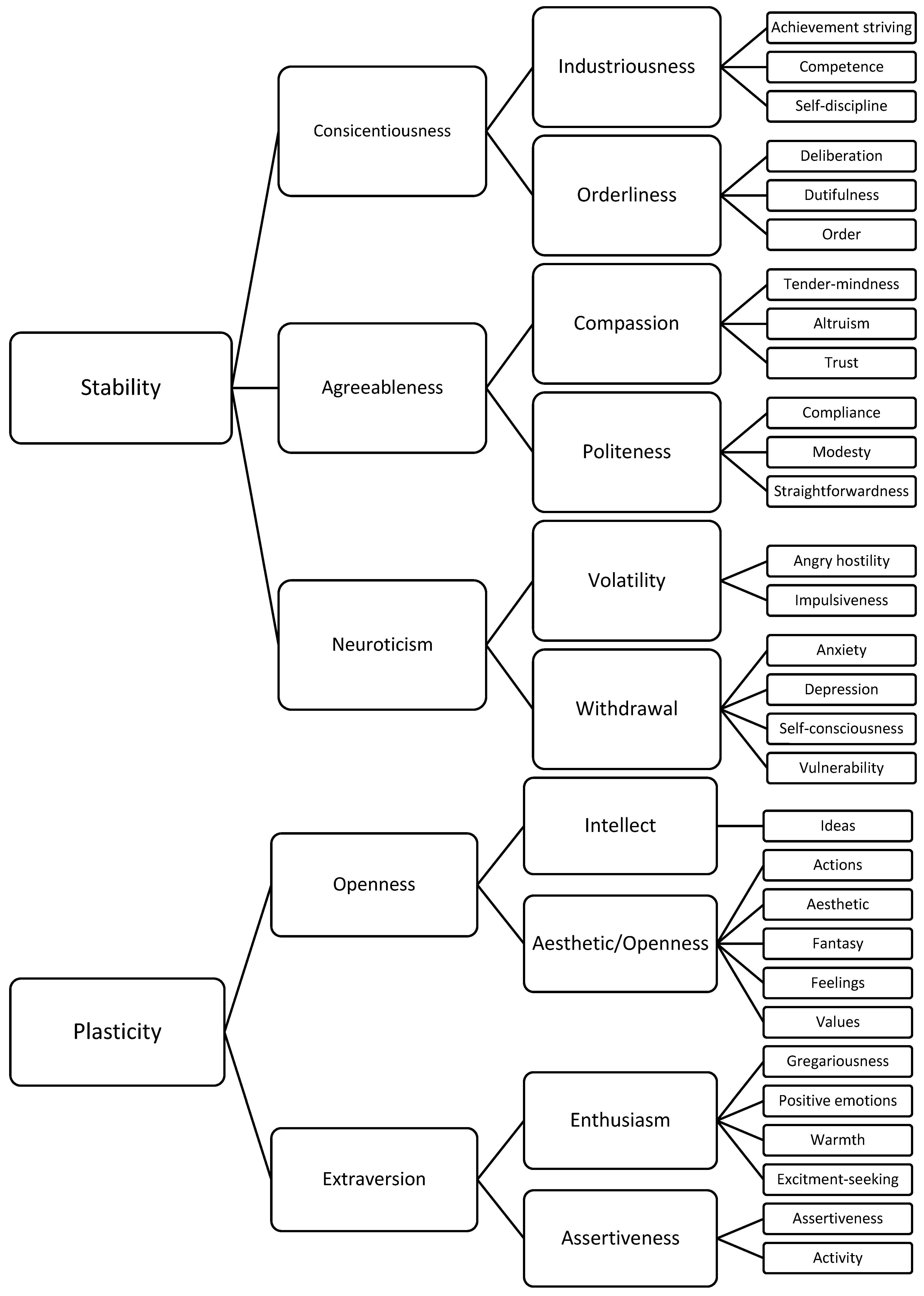
Figure 2.
Biological and environmental mechanisms affect personality traits. These go ahead to influence life outcomes and are in turn influenced back by them. The same dualistic relation can be observed between environmental forces and life outcomes. Adapted from DeYoung 2014.
Figure 2.
Biological and environmental mechanisms affect personality traits. These go ahead to influence life outcomes and are in turn influenced back by them. The same dualistic relation can be observed between environmental forces and life outcomes. Adapted from DeYoung 2014.
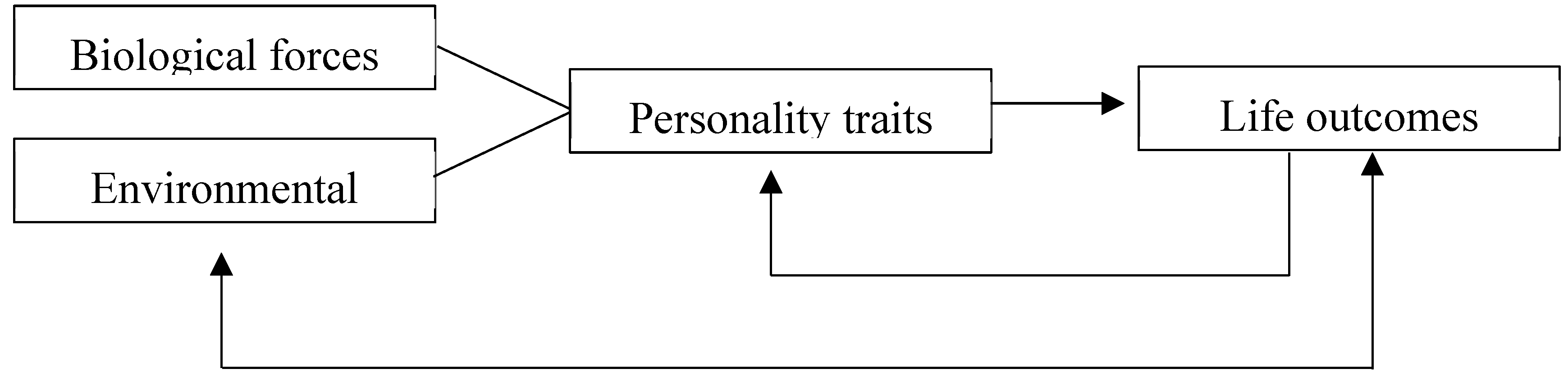

Table 1.
Inspired by DeYoung, 2015a and McCrae and Costa, 2008.
| Verbal label | Conceptual definition | |
|---|---|---|
| Meta-traits | Stability | Maintenance of objectives, interpretations, and strategies from disruption by impulses |
| Plasticity | Creation of new objectives, interpretations, and strategies | |
| Big Five | Extraversion | Describes an energetic demeanour toward life, which engenders features such as sociability, assertiveness and positive emotionality |
| Neuroticism | On one extreme entails emotional stability. On the other, implies negative emotionality | |
| Openness | Implies the breadth, originality, and complexity of person’s mental abilities and experiential life | |
| Conscientiousness | The impulse to be driven and industriousness | |
| Agreeableness | Proclivity to concurrence with others usually manifested through altruism, trust, and modesty | |
| Facets | Assertiveness | Drive towards a goal |
| Enthusiasm | Gratification of attainment of actual or imagined goal | |
| Volatility | Proactive behaviour to avoid or eradicate threats | |
| Withdrawal | Represented through anxiety and/or depression | |
| Intellect | Development of logical patterns in abstract and semantic information | |
| Openness to experience | Spatial and temporal correlational patterns in sensory and perceptual information | |
| Industriousness | Represented through dutifulness and delayed gratification | |
| Orderliness | Obedience to rules to avoid chaos | |
| Compassion | Represented through empathy, i.e. emotional attachment to and concern for others | |
| Politeness | Suppression of aggressive behaviour and avoidance of or norm-violating conduct |
Table 2.
Overview of the participants’ age, gender and language.
| Handedness | Mean age (standard deviation) | Gender | Native English speaker |
|---|---|---|---|
| Right-handers | 26,22 (11,43) | 10673 female (±61,27%) 6649 male (±38,17%) 18 missed (±0,10%) 77 other (±0,44%) |
10727 yes (±61,58%) 6632 no (±38,07%) 58 missed (±0,33%) |
| Left-handers | 26,66 (12,25) | 987 female (±57,25%) 730 male (±42,34%) 7 other (±0,40%) |
1241 yes (±71,98%) 475 no (±27,55%) 8 missed (±0,46%) |
| Ambidextrous | 25 (12,64) | 276 female (±58,59%) 177 male (±37,57%) 2 missed (±0,42%) 16 other (±3,39%) |
346 yes (±73,46%) 123 no (±26,11%) 2 missed (±0,42%) |
Table 3.
Reliability of the performed test.
| Trait | Number of items + - |
Mean item intercorrelation | Coefficient Alpha | Correlation with markers |
|---|---|---|---|---|
| Extraversion | 5 + 5 | .40 | .87 | .73[.84] |
| Agreeableness | 6 + 4 | .31 | .82 | .54[.66] |
| Conscientiousness | 6 + 4 | .29 | .79 | .71[.90] |
| Neuroticism | 2 + 8 | .38 | .86 | .72[.84] |
| Openness | 7 + 3 | .34 | .84 | .67[.80] |
| Total/Mean | 26 + 24 | .34 | .84 | .67[.81] |
Table 4.
Summary data (mean and standard deviation) of the Big-Five traits concerning handedness.
| Category | Openness | Conscientiousness | Extraversion | Agreeableness | Neuroticism | |||||
|---|---|---|---|---|---|---|---|---|---|---|
| Mean | SD | Mean | SD | Mean | SD | Mean | SD | Mean | SD | |
| Right-handed | 38,97 | 6,261 | 33,46 | 7,304 | 30,15 | 9,181 | 38,51 | 7,065 | 29,02 | 8,582 |
| Left-handed | 39,49 | 6,250 | 33,33 | 7,434 | 29,91 | 9,606 | 38,31 | 7,470 | 28,88 | 8,785 |
| Ambidextrous | 41,72 | 5,628 | 34,20 | 7,053 | 29,55 | 9,278 | 36,75 | 8,596 | 29,86 | 9,233 |
| 1 | The epigenome is formed by chemical compounds that tell the genome what to do, for example, turning genes on or off, controlling the production of proteins in particular cells. A genome is said to be “marked” when epigenomic compounds attach to DNA and modify its function. Although the marks do not change the DNA sequence, they change the way cells use the DNA’s instructions. These marks can be passed on from cell to cell as cells divide as well as passed down from one generation to the next (National Human Genome Research Institute, 2020) |
| 2 | In this paper, there was no control of the results for sex because the hypothesis that left-handers are more competitive did not establish a distinction between males and females. |
Disclaimer/Publisher’s Note: The statements, opinions and data contained in all publications are solely those of the individual author(s) and contributor(s) and not of MDPI and/or the editor(s). MDPI and/or the editor(s) disclaim responsibility for any injury to people or property resulting from any ideas, methods, instructions or products referred to in the content. |
© 2023 by the authors. Licensee MDPI, Basel, Switzerland. This article is an open access article distributed under the terms and conditions of the Creative Commons Attribution (CC BY) license (http://creativecommons.org/licenses/by/4.0/).
Copyright: This open access article is published under a Creative Commons CC BY 4.0 license, which permit the free download, distribution, and reuse, provided that the author and preprint are cited in any reuse.