

Submitted:
26 December 2023
Posted:
27 December 2023
You are already at the latest version
Abstract
Social media has become more popular in the last few years. It has been used in public health development and healthcare settings to promote healthier lifestyles. Given its important role in today's culture, it is necessary to understand its current trends and future directions in public health. This review aims to describe and summarize how public health professionals have been using social media to improve population outcomes. Additionally, it discusses potential future directions on how social media can be used to improve population health. The findings showed how social media has been used as a tool for research, designing and implementing health campaigns, messaging, and health promotion. In addition, social media integration with Artificial Intelligence (AI) and Generative Pre-Trained transformers (GPT) can have a big impact and offer an innovative approach to tackle the problems and difficulties in health informatics. These innovations might improve patient participation, individualized assistance, and care experiences. The research showed how likely social media will keep growing and evolving and, if used effectively, have the potential to help close public health gaps across different cultures and improve population health.
Keywords:
social media
; public health
; health informatics.
; virtual reality
; Artificial Intelligence
; Generative Pretrained transformers
; metaverse.
1. Introduction
Social media is defined as “forms of electronic communication (such as websites for social networking and microblogging) through which users create online communities to share information, ideas, personal messages, and other content (such as videos)” [1]. Since its start, social media (Facebook, Twitter, LinkedIn, etc.) has been used to share important information relevant to the public’s interest, encourage consumerism, and exchange ideas and opinions throughout many communities [2]. Given the people’s high use of social media, public health, and healthcare professionals must use this easy and accessible strategy to improve population health. A study published in 2018 reported that the proportion of US adults who used at least one social media platform rose from 5% in 2005 to 61% in 2008. By 2020, there were roughly 1.2 billion monthly active users of Facebook and Instagram [3,4].
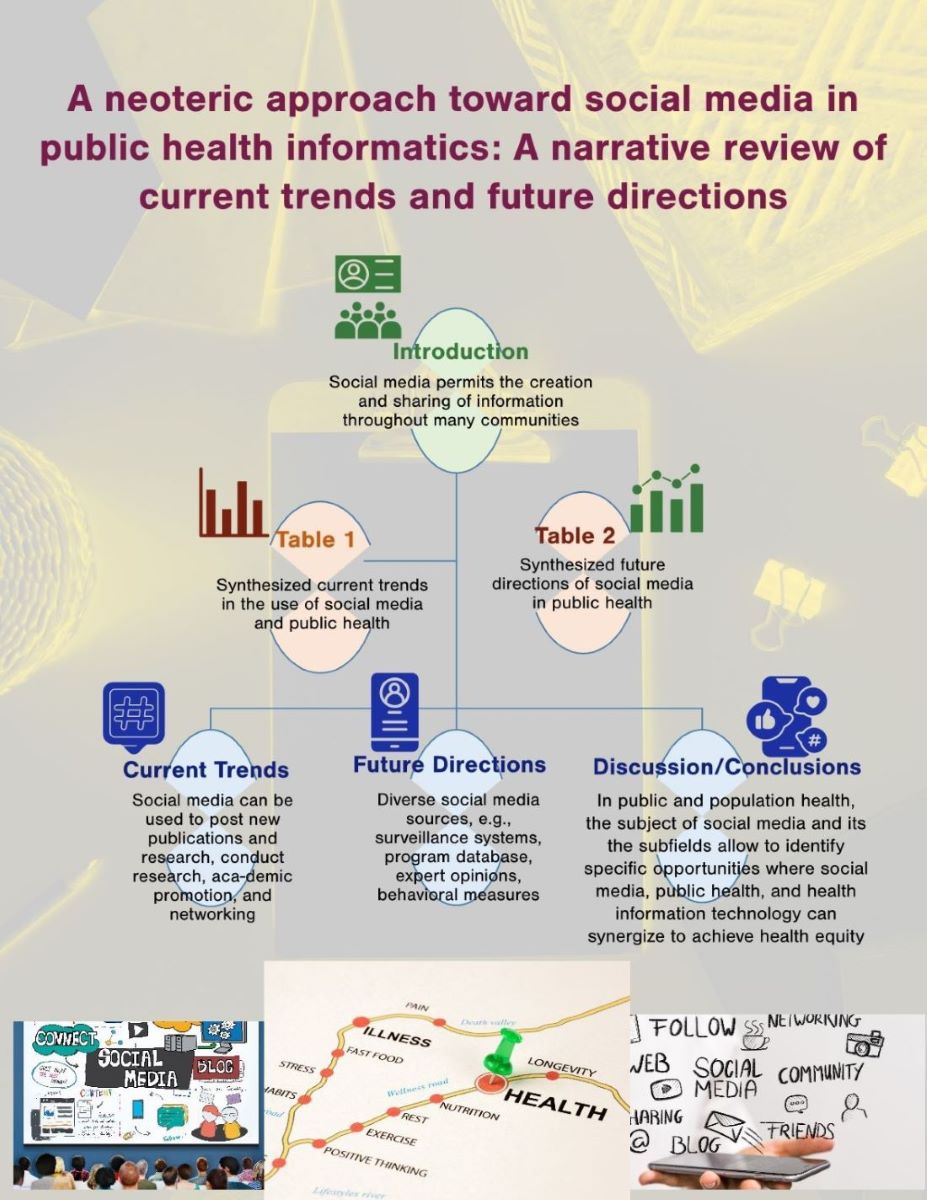
Besides, for more than ten years, social media has been widely used in public health development, helping patients and healthcare providers to encourage healthier lifestyles, and coping mechanisms [5,6]. Social media has often been used in public health for different purposes, including subject recruitment, communication with research subjects, social and behavior observation, data collection, and dissemination of research findings [6]. As a result, studies on alcohol consumption, diabetes, cancer, HIV, and obesity are promoted on social media [6]. Nowadays, Facebook shares health-sponsored messages with around 2.4 million users [2]. In addition, the COVID-19 pandemic boosted the Twitter platform to share public health information [7]. While the use of social media keeps increasing around the world, its use in public health is not well understood by health professionals. In addition, there is a need to do a lot of work on evaluating the best way to use it as a platform to promote health interventions (Figure 1). Therefore, this narrative review intends to describe and summarize the current uses of social media in public health. Furthermore, it will examine the potential future directions on how social media can benefit population health. Social media is widely used worldwide, and public health professionals should figure out the best ways to use it as a platform to promote health interventions [2].
2. Methods
The purpose of this narrative review is to provide a concise and generative overview of current and future social media technologies in public health informatics, with a specific emphasis on the aspects of trends and modalities in use. We synthesize our narrative review from the current and targeted literature looking forward to five years with an inception of 2018. A focused literature search was undertaken in academic databases, including, PubMed, Scopus, and IEEE Xplore, while articles were also hand-searched within Google Scholar. We applied a combination of keywords and phrases for the search, including “social media technologies”, “public health informatics”, “health informatics”, “social media trends”, “innovations in social media”, “social media in healthcare”, “metaverse in health”, “digital health”, “digital health literacy”, “emerging social media technologies”, “social media trends in public health informatics”, and similar terms. Inclusion criteria were employed for the combinations of keywords and phrases and all types of studies and articles published in the English language. As this narrative review has generated and synthesized the knowledge from a broad literature search, so a systematic literature search and screening criteria with the primary objectives and predefined protocol for systematic review or meta-analysis were excluded.
3. Current Trends
3.1. The growing use of social media in public health
Social media, if used correctly, is a promising tool to improve population health because they are low-cost, reaches a large volume of people, and could influence their behavior to improve their lifestyles [8]. In recent years social media has played an important job in health as a health communication tool, especially during the COVID-19 pandemic [9,10]. According to Sharma 2023, some of the uses of social media in public health are related to using social media in health research, using social media in public health campaigns, and messaging, in addition to health promotion interventions and the use of social media in disease surveillance [11]. For example, previous research has found that around 80% of patients with cancer use social media to contact peers and to increase their bond with family members [12]. Also, State Health Departments in the US have used Facebook as a tool to communicate information related to healthy living, communicable diseases, vaccines and immunizations, tobacco use, and infant and child health [10].
Social media networks can be used to empower patients to learn more about their health conditions, increase the reach of health professionals’ counseling, and promote equity in different healthcare settings [8]. Furthermore, evidence has shown that social media interventions can be efficient and effective in low-income communities, rural areas, and minority groups [13]. We cannot deny that the use of social media is a growing trend that will continue evolving in the future years. Table 1 shows some current trends in the use of social media and public health.
3.2. Social media, its role in public health research, and in training public health professionals
Social media can be used to post new publications and research, conduct research, academic promotion, and networking [19]. Despite the skepticism, evidence has shown that the promotion of research articles on social media increases their reach by having more views, downloads, and citations [19,20]. Social media has started to influence how researchers present and disseminate their research [19], like the use of visuals and graphs and the adoption of visual abstracts to enhance the appeal and dissemination of health research [11,20]. Findings from a scoping review identified Twitter, Facebook, and Instagram as the most popular platforms used for health research [21]. The most popular research studies published on social media are related to communicable diseases (33.00%), followed by chronic diseases (20%), lifestyles (16%), and mental health, especially depression (8%) [21]. In addition, the more studied subgroups were adolescents and women [21,22].
Public health and healthcare fields have been using social media to teach students, and this trend will likely become more popular over time [11]. Alzain et al. 2021, evaluated the role of social media in training healthcare professionals in Eastern Saudi Arabia. The results showed that more than 50% of participants participated in training sessions conducted via social media [23]. Crilly and Kayyali 2020 evaluated pharmacy students’ attitudes about social media as a teaching and learning tool. The results showed that more than 90% of students agreed that social media was more effective when learning about public health compared to a class oral presentation [24]. Additionally, a systematic review described how social media was used to overcome some learning challenges presented during the COVID-19 pandemic [25]. Another study described how social media was used to train nephrology interns [26]. Social media will keep expanding and changing as a tool for teaching and training, and it will help close the gaps across cultural contexts [11].
3.3. Social media, crowdsourcing, and artificial intelligence in public health
Crowdsourcing has been used in different settings. For example, in elaborating educational tools, developing navigation apps like Waze, and testing health promotion materials [28]. However, the adoption of social media to recollect data for crowdsourcing is a growing field that has not been very popular among public health programs [27]. Wang and colleagues (2020) conducted a systematic review to summarize the crowdsourcing in public health settings. The results showed that crowdsourcing has been used to evaluate surgical skills, promote HIV tests, and artificial intelligence related to the annotation of medical data [15]. In addition, in 2019, an online platform called “Crowdbreaks” was created to automatize the data collection from Twitter by filtering and crowdsourcing algorithms to help assess trends in health behavior like vaccination or potential disease outbreaks [29]. A previous study used Facebook and Twitter to engage people in designing and creating slogans and artwork to raise awareness and educational messages about cardiac arrest. Unfortunately, the reach and effectiveness of this effort to improve population health are uncertain [30].
Artificial intelligence (AI) is an evolving tool that has been utilized in medicine and healthcare in the past years [31]. AI uses several methods like computer vision, natural language processing, and machine learning for pattern recognition, prediction, and data analysis. For these reasons, researchers have suggested that AI has the potential to improve public health [31]. A study conducted in the United Kingdom in 2021 explored how AI enables social media analysis on Facebook and Twitter for contact-tracing apps use [32]. In addition, a systematic review conducted by Golinelli et al. 2020 summarized how the use of AI algorithms applied to social media gained popularity during the COVID-19 pandemic [33]. All these efforts show that crowdsourcing and pairing AI with social media is a growing study field that can be used to improve public health and healthcare fields.
3.4. Other social media uses in public health
One emerging social media use is disease surveillance [34]. Active surveillance can be used to improve the quality of the information collected and help develop disease-specific interventions [11]. Some less commonly explored uses of social media for public health are the use of these platforms to address social inequities across the world. However, movements like “Black Lives Matter” and “Me Too” have gained importance through social media [11]. Social media is not going anywhere. On the contrary, it is here to stay, and health professionals have the potential to use them ethically to improve population health.
4. Future Directions
4.1. Future paradigms and applications
Social media and informatics in public health have created a new paradigm for public health practitioners and the audience. Information systems and communication platforms have an inevitable, pivotal role in alleviating risks and closing knowledge gaps in vulnerable populations [35]. Public health informatics use with an integration of social media has several applications in the field of health. Applications have arisen, such as promoting advancements in health research and practice, mobilizing social efforts, and enabling offline health services and events [36].
There is an ongoing examination of different techniques that may offer cost-effective alternatives for assisting individuals in enhancing and controlling their health habits, accounting for the design, implementation, and evaluation of behavioral interventions. The National Cancer Institute (NCI) has emphasized the incorporation of such connected health technologies for cancer care and research [37]. The utilization of the internet, social media platforms, and mobile communications can be harnessed as a means to provide and facilitate the availability and accessibility of health information. Social media’s role in public health can innovatively facilitate or interrupt the processes of collecting, storing, utilizing, and spreading information in the field of healthcare informatics. The operationalization of public health informatics in the social media domains encompasses the fundamental systems and architecture, including data and transmission standards, transfer protocols, and data management protocols (Table 1). The adoption of this interdisciplinary practice depends on the pervasiveness of the public health professionals seems futuristic and innovative.

Table 2.
Future directions of social media in public health.
| Types | Future Directions | Innovation |
|---|---|---|
| User services | Health-related service quality, precision health | Enhanced User Experience (UX) of Social Media [37] |
| Disease Surveillance | Infomediology data, Web 2.0 technologies |
Web-based (real time) data for disease forecasting, outbreaks, and epidemics. Top-level domain (TLD) “.health”—for screening and filtering of diseases and health information providers [39] |
| Public health research | Public health needs assessment for community engagement, data leveraging for social determinants of health (SDoH) | Real word experience (RWE), predictive modeling from social media sites, Social Media Health Information Exchange, Health Literacy Exchange [41] |
| Population Health | Social and behavioral health integration |
Systematic social media campaigns, Bioartificial Human Behaviors [43] |
| Artificial intelligence in public health |
User tags and sentence predictions for social media posts |
Personal health libraries with comparable profile [48] |
| Metaverse | Social media with metaverse will assist in curating experiences that are more immersive, engaging, and realistic. | AR, VR, and MR, together known as XR in mental health, mixed reality headsets, virtual hologram [49,50] |
4.2. Social media and healthcare research
The mixed-method approach can be used to evaluate and assess efficiency and effectiveness. Social media users can assess the suitability of a specific health information system component for a technological task [38]. The questionnaire can be easily distributed, and the analysis is established according to standard protocols and procedures. The utilization of mixed-method research can become a well-established practice in the evaluation and assessment of social media healthcare research and web-based real-time data from social media infomedic experience via top-level domain (TLD) [39].
4.3. Social media and public health surveillance
The utilization of social media for the infomediology data for surveillance generates an information stream for disease surveillance, i.e., “infoveillance”. Public health practitioners can avail the dissemination of information on behavior change as a crucial intervention during an outbreak. Additionally, monitoring the effectiveness of information dissemination during a pandemic is another possible application [40]. Concurrent of use of social media trends with the utilization of Artificial Intelligence (AI) holds immense capacity to revolutionize healthcare on a global scale. However, with the ongoing progress of AI technology, it is crucial to prioritize the integration of low- and middle-income countries [41]. Responsible global utilization of AI involves implementing a process that is safe, fair, transparent, dependable, and advantageous while maintaining a high level of responsibility and accountability. To fully capitalize on the potential of AI, it is crucial to closely monitor and address the safety, ethical, equity, and reliability aspects of deploying AI. This will enable researchers, scientists, and policymakers to fully harness the immense resilience, creativity, and dedication of AI for a long-lasting positive impact.
4.4. Social media and health literacy
When it comes to healthcare, medical education, and research—social media uses Web 2.0 technologies. It is pertinent to understand that it facilitates cooperation and allows for the distribution of research. There are ongoing concerns over the accuracy and prevalence of disinformation on these platforms, despite its use by healthcare professionals to enhance public health literacy. In 2023, platforms like Facebook (Meta Platforms, Inc., Menlo Park, California, United States), YouTube (Google LLC, Mountain View, California, United States), Instagram (Meta Platforms, Inc.), TikTok (ByteDance Ltd., Beijing, China), and Twitter (X Corp., Carson City, Nevada, United States) are increasingly fundamental to healthcare research because they provide contact with patients, training for healthcare providers, data management, and the exchange of information [42].
4.5. Social media and health promotion
Many evaluation approaches that have been designed for health promotion programs may use social media platforms to monitor outcomes and analyze progress [43]. Despite the fact that social media campaigns may significantly alter health behavior and coordinate health promotion initiatives, but evaluation of such health promotion campaigns and behavioral interventions remains complex owing to the influence of individual social media on health promotion initiatives either less significant or serves as a supplementary aspect with other elements [44]. Another factor related to health promotion is the increasing trend to seek information for perceived benefits on social media or health-information-seeking behaviors (Figure 2). The field of health information is very diverse and the quantity of information accessible on social media is infinite [45]. An individual must get the most optimal knowledge with minimal time and privacy by thoroughly examining all the accessible data and information on social media.
4.6 Social media, AI, GPT, and Metaverse models for public health informatics.
Artificial Intelligence (AI) and Generative Pre-Trained Transformers (GPT) integrated social media can exert a significant impact and provide a novel approach to addressing the issues and challenges in health informatics. A wide range of healthcare and public health sectors are adopting AI and GPT integration, i.e., bioinformatics; 2) medical diagnosis; 3) medical imaging; 4) medical informatics; 5) medical education; 6) public health; and 7) medical robotics [46]. A novice wave could be the healthcare information via social media that can be personalized using AI-ML-GPT to improve patient engagement and education. This may help patients make decisions and enhance treatment. Google and Amazon are creating AI systems that “learn” and empathize with patients [47,48]. These innovations might improve patient participation, individualized assistance, and care experiences. Another novel informatics technology in the infantile stage is the “metaverse” which can gyrate social media together with public health information. While the metaverse may be commonly associated with games and entertainment, its underlying technologies have practical applications in the field of healthcare. Metaverse induces an experience of social media which can be incorporated into current health technologies for therapy in the context of connected communities, clinical contexts, and measurement-based care through the active involvement of people [49]. These experiences include extended reality (augmented reality, virtual reality, and mixed reality, abbreviated as AR, VR, and MR, respectively, and together known as XR) [50]. Innovations in healthcare service, delivery, and digital therapies can be made possible by technological advancements in metaverse virtual world experiences.
5. Discussion
5.1. Social media and public health resources
Current social media current trends and future directions serve as an interface for the intelligent human control of public health informatics infrastructure. To foster healthy social media integration in public health venues, it is crucial to prioritize public health resources towards enhancing healthcare systems and optimizing healthcare organizations.
5.2. Social media and digital health
An innovative obliteration of social media and the digital divide needs robust, scientific, and technological advancements to stimulate digital health information services.
5.3. Digital twin for public health
Social media has created a space for interaction and entertainment on the one hand, but the adoption of a digital twin in public health practice and healthcare research has engaged individuals in an insightful, data-driven virtual world on the other end.
5.4. Digital twin for public health research
It is seen that digital twins are virtual representations of the actual world and have been used in academia and industry to enhance individualized processes and optimize real-world experience. Nevertheless, the notion of social media in the digital twins has only lately been amplified in public health and healthcare [51]. Social media via digital twin technologies are the evolutionary implications in precision medicine, clinical trials, and public health when used appropriately.
5.5. Human usability of social media tools
Human factors have a great impact on the design and utilization of health information technology. Increased adoption rates of technology determine the operability and usability by certain groups of people involved in its use and then use it at a comfortable pace and routine [52]. Social media tools and techniques are governed by the fundamental usability of human factors connected to the systems interface for the subjective and objective continuity of higher levels of individual safety.
5.6. Social media on large-scale health treatments
Social media is being integrated with large-scale health treatments aimed at addressing non-communicable illnesses and is increasingly using AI-enabled technologies such as the metaverse [53]. The prevalence of non-communicable illnesses, such as diabetes, heart disease, strokes, chronic respiratory disease, malignancies, and mental illness, is significantly influenced by the “built environment,” which encompasses the artificial surroundings that individuals constantly interact with.
5.7. Digital health ecosystems
In digital health ecosystems, metaverse can provide several modalities through social media for the public health systems and public health informatics, e.g., machine learning (ML), natural language processing (NLP), robotic assistance, virtual agents (chatbots), visionary and speech analytics, deep learning, and many more.
5.8. Limitations
This narrative review does not follow the predefined protocols for a systematic review or meta-analysis, but it reproduces a thematic qualitative comparison of social media current trends and future directions implicated in public health informatics. Another limitation pertains to the highly dynamic field of social media since social media facilitates the examination of novel occurrences and the formulation of inquiries in the field of public health and public health informatics research, and also summons evidence-based perspectives and practices. Further investigation is required to fully investigate the methodological capabilities of social media in public health research. Lastly, the incorporation of preset criteria for literature search may have induced selection bias, and the rapidly changing dynamics of this field could have led to the inadequate preference given to a certain type of social media while omitting the potential advancements of other types.
6. Conclusions
The review has explained the pivotal position of social media integration processes for the current and future trends and needs. The highly dynamic field of social media needs to be a structured process of measures taken to ensure the robustness and strength of public health informatics. Social media systems and projects require large investments, time, and technology demands. Social media user analysis requires evidence-based theoretical and practical values for the stakeholders, consumers, and people to utilize social media in the real world. Continuous monitoring, assessments, and evaluations yield impactful investments in social media-integrated health technology projects. Social media can impart public health awareness to communities, raise benchmarks in public health research, and increase healthcare quality.
Author Contributions
Conceptualization, M.S. and A.A. methodology, A.A.; software, A.A.; validation, A.A., A.G., and M.S., formal analysis, A.A.; investigation, A.A., A.G.; resources, M.S., A.A.; data curation, A.A., A.G.; writing—original draft preparation, A.A., A.G.; writing—review and editing, A.A., A.G., M.S.; visualization, A.A., A.G.; supervision, M.S; project administration, A.A., funding acquisition, NA. All authors have read and agreed to the published version of the manuscript.
Funding
This research received no external funding.
Data Availability Statement
No new data were created or analyzed in this study. Data sharing is not applicable to this article.
Acknowledgments
The authors wish to thank the leadership of their respective schools and the university for their support.
Conflicts of Interest
The authors declare no conflict of interest.
References
- Merriam-Webster: Since 1828. Available online: https://www.merriam-webster.com/dictionary/social%20media (accessed on 13 November 2023).
- Tseng, T.S.; Gonzalez, G. Social media and types with their current applications in public health and healthcare. In Effective Use of Social Media in Public Health; Batra, K., Sharma, M., Eds.; Academic Press: London, England, 2023; pp. 3–22. [Google Scholar] [CrossRef]
- Pew Research Center. Social Media Fact Sheet. Available online: https://www.pewresearch.org/internet/factsheet/social-media/ (accessed on 13 November 2023).
- Pew Research Center Internet and Technology. Social Media Fact Sheet. Available online: http://www.pewinternet.org/fact-sheet/social-media/ (accessed on 13 November 2023).
- Giustini, D.; Ali, S.M.; Fraser, M.; Kamel Boulos, M.N. Effective uses of social media in public health and medicine: A systematic review of systematic reviews. Online J. Public Health Inform. 2018, 10, e215. [Google Scholar] [CrossRef] [PubMed]
- Zhang, Y.; Cao, B.; Wang, Y.; Peng, T.Q.; Wang, X. When public health research meets social media: Knowledge mapping from 2000 to 2018. J Med Internet Res. 2020, 22, e17582. [Google Scholar] [CrossRef]
- Fuentes, A.; Peterson, J.V. Social media and public perception as core aspect of public health: The cautionary case of @realdonaldtrump and COVID-19. PloS One 2021, 16, e0251179. [Google Scholar] [CrossRef]
- Mendoza-Herrera, K.; Valero-Morales, I.; Ocampo-Granados, M.E.; Reyes-Morales, H.; Arce-Amaré, F.; Barquera, S. An overview of social media use in the field of public health nutrition: Benefits, scope, limitations, and a Latin American experience. Prev Chronic Dis. 2020, 17, E76. [Google Scholar] [CrossRef] [PubMed]
- Chen, J.; Wang, Y. Social media use for health purposes: Systematic review. J Med Internet Res. 2021, 23, e17917. [Google Scholar] [CrossRef] [PubMed]
- Jha, A.; Lin, L.; Savoia, E. The use of social media by state health departments in the US: Analyzing health communication through facebook. J Community Health 2016, 41, 174–179. [Google Scholar] [CrossRef]
- Sharma, M. Innovative uses of social media in public health and future applications. In Effective Use of Social Media in Public Health; Batra, K., Sharma, M., Eds.; Academic Press: London, England, 2023; pp. 3–22. [Google Scholar] [CrossRef]
- Braun, L.A.; Zomorodbakhsch, B.; Keinki, C.; Huebner, J. Information needs, communication and usage of social media by cancer patients and their relatives. J Cancer Res Clin Oncol. 2019, 145, 1865–1875. [Google Scholar] [CrossRef]
- Welch, V.; Petkovic, J.; Pardo Pardo, J.; Rader, T.; Tugwell, P. Interactive social media interventions to promote health equity: An overview of reviews. Health Promot Chronic Dis Prev Can. 2016, 36, 63–75. [Google Scholar] [CrossRef]
- Kanchan, S.; Gaidhane, A. Social media role and its impact on public health: a narrative review. Cureus 2023, 15, e33737. [Google Scholar] [CrossRef]
- Wang, C.; Han, L.; Stein, G.; Day, S.; Bien-Gund, C.; Mathews, A.; Ong, J.J.; Zhao, P.Z.; Wei, S.F.; Walker, J.; et al. Crowdsourcing in health and medical research: A systematic review. Infect Dis Poverty 2020, 9, 8. [Google Scholar] [CrossRef]
- Centers for Disease Control and Prevention (CDC). Artificial Intelligence and Machine Learning: Applying Advanced Tools for Public Health. Available online: https://www.cdc.gov/surveillance/data-modernization/technologies/ai-ml.html (accessed on 08 December 2023).
- Aiello, A.E.; Renson, A.; Zivich, P. Social media and internet-based disease surveillance for public health. Annu Rev Public Health 2020, 41, 101–118. [Google Scholar] [CrossRef] [PubMed]
- Charalambous, A. Social media and Health Policy. Asia Pac J Oncol Nurs. 2019, 6, 24–27. [Google Scholar] [CrossRef] [PubMed]
- Dol, J.; Tutelman, P.R.; Chambers, C.T.; Barwick, M.; Drake, E.K.; Parker, J.A.; Parker, R.; Benchimol, E.I.; George, R.B.; Witteman, H.O. Health researchers’ use of social media: Scoping review. J Med Internet Res. 2019, 21, e13687. [Google Scholar] [CrossRef]
- Breland, J.Y.; Quintiliani, L.M.; Schneider, K.L.; May, C.N.; Pagoto, S. Social media as a tool to increase the impact of public health research. Am J Public Health. 2017, 107, 1890–1891. [Google Scholar] [CrossRef] [PubMed]
- Bour, C.; Ahne, A.; Schmitz, S.; Perchoux, C.; Dessenne, C.; Fagherazzi, G. The use of social media for health research purposes: Scoping review. J Med Internet Res. 2021, 23, e25736. [Google Scholar] [CrossRef] [PubMed]
- Huo, J.; Desai, R.; Hong, Y.R.; Turner, K.; Mainous, A.G.; Bian, J. Use of social media in health communication: findings from the Health Information National Trends Survey 2013, 2014, and 2017. Cancer Control 2019, 26, 1073274819841442. [Google Scholar] [CrossRef] [PubMed]
- Brabham, D.C.; Ribisl, K.M.; Kirchner, T.R.; Bernhardt, J.M. Crowdsourcing applications for public health. Am J Prev Med. 2014, 46, 179–187. [Google Scholar] [CrossRef]
- Conrad, E.J.; Becker, M.; Powell, B.; Hall, K.C. Improving health promotion through the integration of technology, crowdsourcing, and social media. Health Promot Pract. 2020, 21, 228–237. [Google Scholar] [CrossRef]
- Mueller, M.M.; Salathe, M. Crowdbreaks: Tracking health trends using public social media data and crowdsourcing. Front. Public Health 2019, 7, 81. [Google Scholar]
- Rumsfeld, J.S.; Brooks, S.C.; Aufderheide, T.P.; Leary, M.; Bradley, S.M.; Nkonde-Price, C.; Schwamm, L.H.; Jessup, M.; Ferrer, J.M.E.; Merchant, R.M. Use of mobile devices, social media, and crowdsourcing as digital strategies to improve emergency cardiovascular care: A scientific statement from the American Heart Association. Circulation 2016, 134, e87–e108. [Google Scholar] [CrossRef]
- Olawade, D.B.; Wada, O.J.; David-Olawade, A.C.; Kunonga, E.; Abaire, O.; Ling, J. Using artificial intelligence to improve public health: A narrative review. Front. Public Health 2023, 11. [Google Scholar] [CrossRef]
- Cresswell, K.; Tahir, A.; Sheikh, Z.; Hussain, Z.; Hernández, A.D.; Harrison, E.; Williams, R.; Sheikh, A.; Hussain, A. Understanding public perceptions of COVID-19 contact tracing apps: Artificial intelligence-enabled social media analysis. J Med Internet Res. 2021, 23, e26618. [Google Scholar] [CrossRef] [PubMed]
- Golinelli, D.; Boetto, E.; Carullo, G.; Nuzzolese, A.G.; Landini, M.P.; Fantini, M.P. Adoption of digital technologies in health care during the COVID-19 pandemic: Systematic review of early scientific literature. J Med Internet Res. 2020, 22, e22280. [Google Scholar] [CrossRef] [PubMed]
- Alzain, Z.; Alfayez, A.; Alsalman, D.; Alanezi, F.; Hariri, B.; Al-Rayes, S.; Alhodaib, H.; Alanzi, T. The role of social media in the training and continuing education of healthcare professionals in Eastern Saudi Arabia. Inf. Med Unlocked 2021, 24, 100587. [Google Scholar] [CrossRef]
- Crilly, P.; Kayyali, R. The use of social media as a tool to educate United Kingdom undergraduate pharmacy students about public health. Curr Pharm Teach Learn 2020, 12, 181–188. [Google Scholar] [CrossRef] [PubMed]
- Dedeilia, A.; Sotiropoulos, M.G.; Hanrahan, J.G.; Janga, D.; Dedeilias, P.; Sideris, M. Medical and surgical education challenges and innovations in the COVID-19 era: A systematic review. In Vivo 2020, 34, 1603–1611. [Google Scholar] [CrossRef]
- Ramakrishnan, M.; Sparks, M.A.; Farouk, S.S. Training the public physician: The nephrology social media collective internship. Semin Nephrol. 2020, 40, 320–327. [Google Scholar] [CrossRef]
- Velasco, E.; Agheneza, T.; Denecke, K.; Kirchner, G.; Eckmanns, T. Social media and internet-based data in global systems for public health surveillance: A systematic review. Milbank Q. 2014, 92, 7e33. [Google Scholar] [CrossRef] [PubMed]
- Zhong, Y.; Liu, W.; Lee, T.Y.; Zhao, H.; Ji, J. Risk perception, knowledge, information sources and emotional states among COVID-19 patients in Wuhan, China. Nurs. Outlook 2021, 69, 13–21. [Google Scholar] [CrossRef]
- Chen, J.; Wang, Y. Social media use for health purposes: Systematic review. J Med Internet Res. 2021, 23, e17917. [Google Scholar] [CrossRef]
- National Cancer Institute; Division of Cancer Treatment and Diagnosis. At the Crossroads of Social Media and Clinical Trials: A Workshop on the Future of Clinician, Patient and Community Engagement. Workshop; June 7-8, 2018; Bethesda, MD. Available online: https://dctd.cancer.gov/NewsEvents/20180706_Social_Media_and_Clinical_Trials.htm (accessed on 12 December 2023).
- Yu, P. A multi-method approach to evaluate health information systems. In Studies in Health Technology and Informatics, IOS Press: Amsterdam, Netherlands, 2010, 160(Pt 2), pp. 1231–1235. [CrossRef]
- Eysenbach, G. Infodemiology and infoveillance: Framework for an emerging set of public health informatics methods to analyze search, communication and publication behavior on the internet. J Med Internet Res. 2009, 11, e11. [Google Scholar] [CrossRef]
- Zielinski, C. Infodemics and infodemiology: A short history, a long future. Rev Panam Salud Publica. 2021, 45, e40. [Google Scholar] [CrossRef]
- Bill and Melinda Gates Foundation. Global Grand Challenges. Grand Challenges India: Catalyzing Equitable Artificial Intelligence (AI) Use to Improve Global Health. Available online: https://gcgh.grandchallenges.org/challenge/grand-challenges-india-catalyzing-equitable-artificial-intelligence-ai-use-improve-global (accessed on 11 December 2023).
- Jeyaraman, M.; Ramasubramanian, S.; Kumar, S.; Jeyaraman, N.; Selvaraj, P.; Nallakumarasamy, A.; Bondili, S.K.; Yadav, S. Multifaceted role of social media in healthcare: Opportunities, challenges, and the need for quality control. Cureus 2023, 15, e39111. [Google Scholar] [CrossRef]
- Hu, N. Sentiment analysis of texts on public health emergencies based on social media data mining. Comput Math Methods Med. 2022, 3964473. [Google Scholar] [CrossRef]
- Ghahramani, A.; De Courten, M.; Prokofieva, M. The potential of social media in health promotion beyond creating awareness: An integrative review. BMC Public Health 2022, 22, 2402. [Google Scholar] [CrossRef]
- Wijayanti, R.P.; Handayani, P.W.; Azzahro, F. Intention to seek health information on social media in Indonesia. Procedia Comput Sci. 2022, 197, 118–125. [Google Scholar] [CrossRef]
- Qiu, J.; Li, L.; Sun, J.; Peng, J.; Shi, P.; Zhang, R.; Dong, Y.; Lam, K.; Lo, F.P.-W.; Xiao, B.; et al. Large ai models in health informatics: Applications, challenges, and the future. IEEE J Biomed Health Inform. 2023, 27, 6074–6087. [Google Scholar] [CrossRef] [PubMed]
- Frick, E. 2023 Nov 2. Q&A: How AI and Machine Learning can Enhance Social Media as a Public Health Tool. Medical Xpress. Available online: https://medicalxpress.com/news/2023-11-qa-ai-machine-social-media.html (accessed on 11 December 2023).
- Adishesha, A.S.; Jakielaszek, L.; Azhar, F.; Zhang, P.; Honavar, V.; Ma, F.; Belani, C.; Mitra, P.; Huang, S.X. Forecasting user interests through topic tag predictions in online health communities. IEEE J Biomed Health Inform. 2023, 27, 3645–3656. [Google Scholar] [CrossRef] [PubMed]
- Benrimoh, D.; Chheda, F.D.; Margolese, H.C. The best predictor of the future-the metaverse, mental health, and lessons learned from current technologies. JMIR Ment. Health 2022, 9, e40410. [Google Scholar] [CrossRef] [PubMed]
- Qiu, C.S.; Majeed, A.; Khan, S.; Watson, M. Transforming health through the metaverse. J. R. Soc. Med. 2022, 115, 484–486. [Google Scholar] [CrossRef] [PubMed]
- Venkatesh, K.P.; Raza, M.M.; Kvedar, J.C. Health digital twins as tools for precision medicine: Considerations for computation, implementation, and regulation. npj Digit. Med. 2022, 5, 150. [Google Scholar] [CrossRef] [PubMed]
- Kortum, P. Has human factors and usability lost its mojo? J. Usability Stud. 2017, 12, 50–55. Available online: https://uxpajournal.org/wp-content/uploads/sites/7/pdf/JUS_Kortum_Feb2017.pdf (accessed on 12 December 2023).
- Corpuz, J.C.G. Metaverse phenomenon and its impact on public health. J. Public Health 2023, 45, e838–e839. Available online: https://doi-org.ezproxy.library.unlv.edu/10.1093/pubmed/fdad119. [CrossRef] [PubMed]
Figure 1.
Social media in public health informatics.
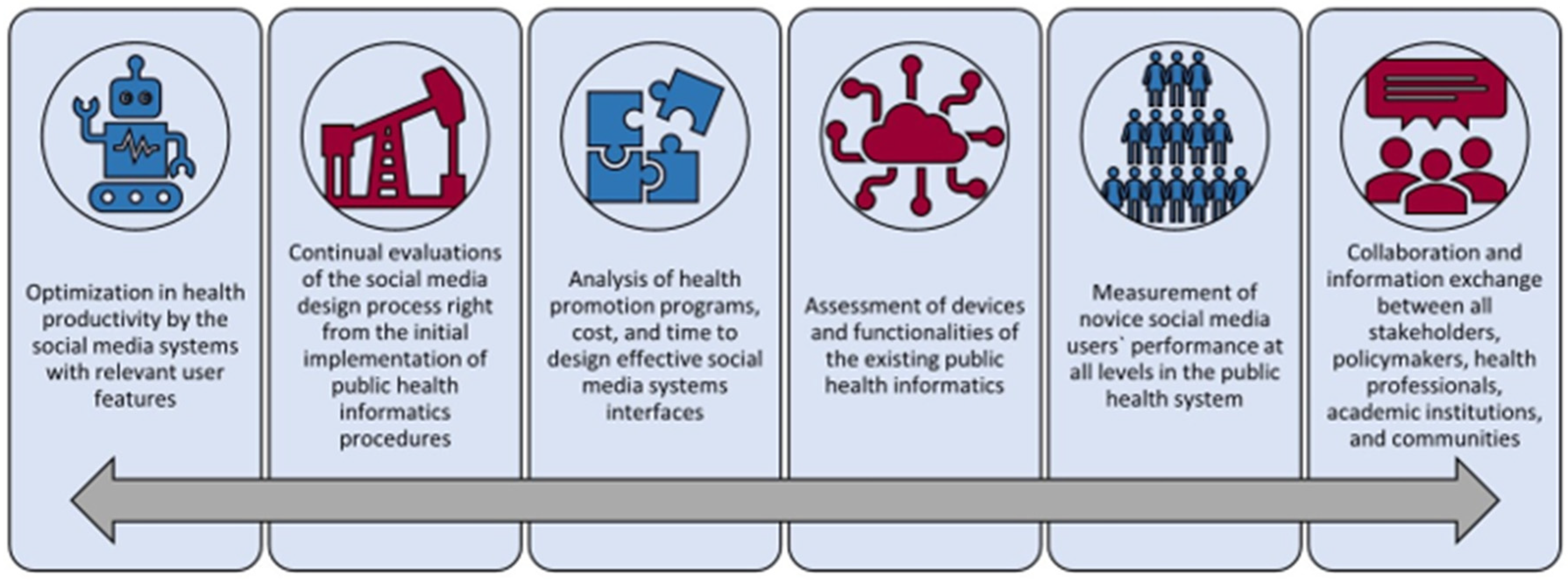
Figure 2.
Social media in health promotion behavior.
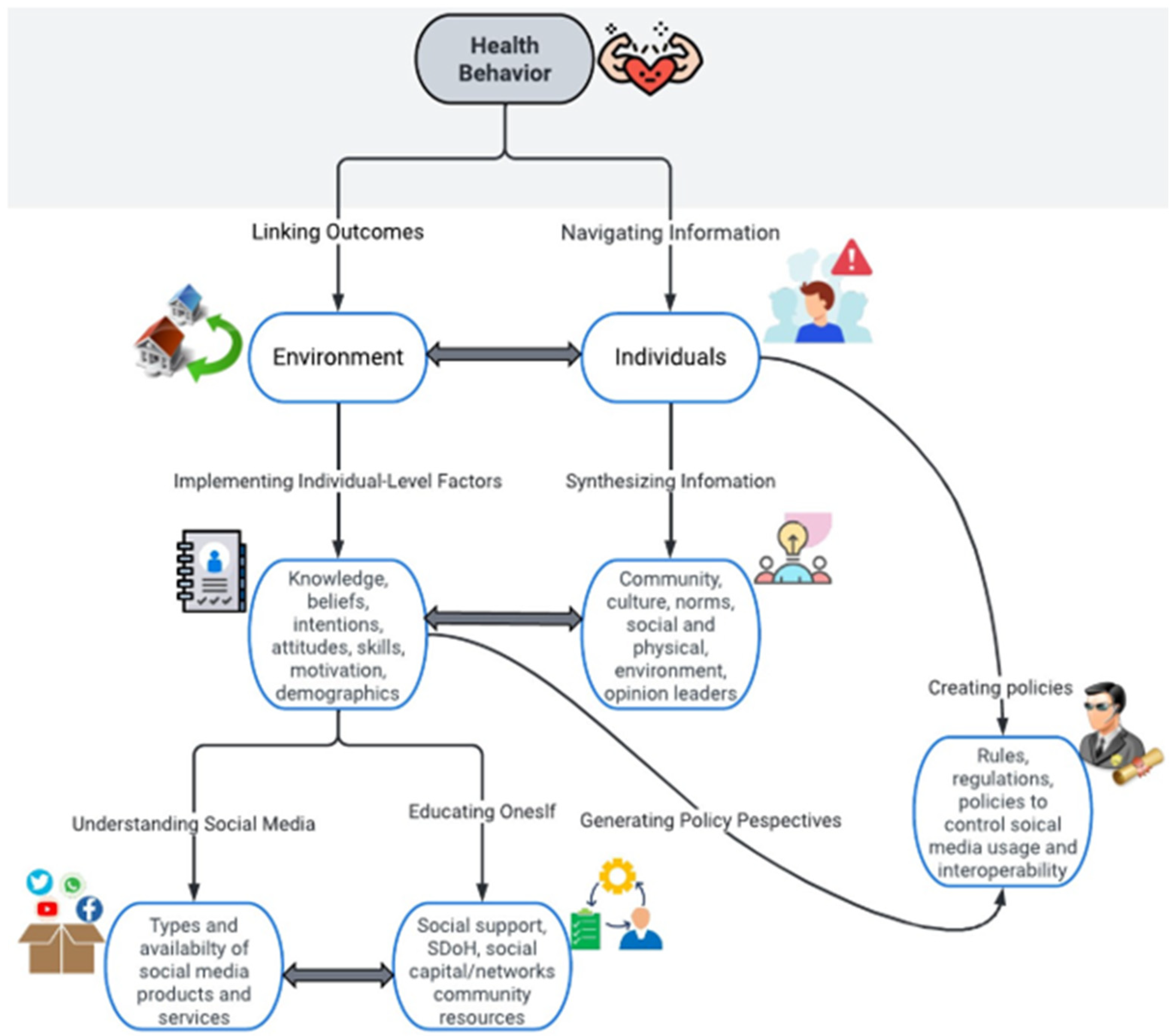
Table 1.
Current trends in the use of social media and public health.
| Types | Current trends | Innovation |
|---|---|---|
| Social Media | Health messaging, health literacy, and health education [14]. |
Twitter, YouTube, TikTok, Facebook, Snapchat, Reddit, Instagram, WhatsApp, and blogs. |
| Public health research | Networking with colleagues and knowledge users, distributing public health research, broadening readership, and exponentially increasing reach [11]. | LinkedIn, using social media to share research about chronic diseases, vaccination, and behavioral health. |
| Crowdsourcing | Surgical skills, developing systems for out-of-hospital cardiopulmonary resuscitation, developing sexual health messages, and annotating medical data to train machine learning algorithms [15]. | Engaging youth in developing HIV services, designing a patient-centered mammography report, and enhancing cancer research. |
| Artificial intelligence in public health | Health education projects, literature searches, machine learning technologies, diagnostics, and surveillance [16]. | LIT maps, collaborative research, open-source clinical trials, and automatically detecting tuberculosis from chest X-rays. |
| Surveillance | Statistics, data monitoring, epidemiological information, and open AI chatbots [17]. | COVID-19 dashboards, and electronic health records. |
| Monitoring | Giving surveys, using QR codes, Apps, and gadgets [11]. | Apps to monitor blood sugar, step count, and sleep patterns. |
| Policy | Shaping public opinion and influencing policymakers, patient safety, public health safety, and HIPAA law [18]. | Public health informatics, protected health information. |
Disclaimer/Publisher’s Note: The statements, opinions and data contained in all publications are solely those of the individual author(s) and contributor(s) and not of MDPI and/or the editor(s). MDPI and/or the editor(s) disclaim responsibility for any injury to people or property resulting from any ideas, methods, instructions or products referred to in the content. |
© 2023 by the authors. Licensee MDPI, Basel, Switzerland. This article is an open access article distributed under the terms and conditions of the Creative Commons Attribution (CC BY) license (http://creativecommons.org/licenses/by/4.0/).
Copyright: This open access article is published under a Creative Commons CC BY 4.0 license, which permit the free download, distribution, and reuse, provided that the author and preprint are cited in any reuse.


