

Submitted:
22 December 2023
Posted:
26 December 2023
You are already at the latest version
Abstract
Schinus terebinthifolius Raddi is a plant native to Brazil. The objective of this work was to analyze the chemical composition, antioxidant and antibacterial potential of essential oils (EOs) from the leaves, fruits and twigs of S. terebinthifolius aiming for their application in food safety. EOs were obtained by hydrodistillation and the chemical composition was determined by gas chromatog-raphy coupled to mass spectrometry. Phenolic compounds were quantified and antioxidant ac-tivity was evaluated using three different methods. The antibacterial activity was determined by the broth microdilution method against foodborne bacteria. In the chemical analysis, 22 com-pounds were identified in the leaves, 13 compounds in the fruits and 37 compounds in the twigs, revealing the presence of the main compounds germacrene D, caryophyllene, α-pinene, β-pinene and γ-gurjunene. EOs showed better antioxidant potential using the β-carotene/linoleic acid method with 40.74, 61.52 and 63.65% oxidation inhibition for leaves, fruits and twigs, respectively. The EO from the leaves showed greater antibacterial potential against Escherichia coli and Staphy-lococcus aureus with a minimum inhibitory concentration (MIC) of 0.62 mg mL-1, values lower than the MIC of sodium nitrite (5.00 mg mL-1), antimicrobial standard synthetic. The activities of pink pepper EOs suggest their potential as a biopreservative in foods.
Keywords:
Anacardiaceae
; pink pepper
; β-pinene
; caryophyllene
; antimicrobial
; food safety
1. Introduction
The food industry needs to explore new strategies due to the problems caused by microbial contamination of food, ranging from spoilage to food outbreaks. Furthermore, there is interest in reducing the use of synthetic chemical additives used in food preservation as they can lead, depending on the concentration, to harmful effects on human health such as allergies and carcinogenicity [1], aiming to reduce replacement with efficient and safe natural substances [2,3].
According to the World Health Organization (WHO), foodborne illnesses (DTAs) are a major global public health concern. There are more than 200 types of DTAs and it is estimated that every year, one in 10 people fall ill as a result of these diseases. Furthermore, DTAs can be fatal, especially in children under 5 years of age, causing 420,000 deaths per year [4]. Among the main microorganisms that cause DTA, the species of bacteria Pseudomonas aeruginosa, Salmonella Typhi, Bacillus cereus, Escherichia coli and Staphylococcus aureus are reported [5,6,7].
In addition to microbial deterioration of food, chemical changes due to oxidation of lipid components of food involve the reaction of unsaturated fatty acids with oxygen, leading to the formation of reactive species such as free radicals, peroxides, hydroperoxides and various compounds, which cause changes in the characteristics sensorial and nutritional value, in addition to the emergence of potentially toxic substances [8]. Furthermore, reactive oxygen species can attack biological macromolecules in vivo in the human or animal organism, which will cause damage to proteins, lipids and DNA, promoting cellular aging and diseases [9]. Studies have reported that these reactions are linked to diseases such as cancer, atherosclerosis, diabetes, arthritis, AIDS, cardiovascular diseases and diseases of aging [10].
The main synthetic antioxidants used in the food industry are butylated hydroxyanisole (BHA), butylated hydroxytoluene (BHT) and tert-butyl hydroquinone (TBHQ) [11], but when in inadequate concentrations they can cause effects toxic effects on the body such as carcinogenicity, cytotoxicity, induction of oxidative stress and endocrine disruption effects [12].
Schinus terebinthifolius Raddi is a plant popularly known as red pepper, Brazilian pepper and pink pepper [13] belonging to the Anacardiaceae family, native to Brazil and widely found in the northwest region of Paraná [14,15,16]. The medicinal and popular uses of this plant have been reported in ethnopharmacological studies as anti-inflammatory, healing and in the treatment of respiratory diseases [17,18,19,20]. It is sold and used in dehydrated form, being well accepted in cooking as a gourmet spice [21,22]. The essential oil extracted from pink pepper fruits has antioxidant, antimicrobial and insecticidal properties [23,24]. These properties may be related to the presence of biologically active compounds in the composition such as germacrene-D, sabinene and pinene [24,25].
Considering the interest in the potential of essential oils, studies with pink pepper were carried out to evaluate chemical composition [26,27], antibacterial activity [23,28] and antioxidant [29], however, they did not evaluate essential oils from different parts (leaves, fruits and twigs) of the same studied plant, in order to understand the distributions of the compounds and their activities. Therefore, the objective of this work was to identify the chemical composition, antioxidant and antibacterial potential of the essential oil from the leaves, fruits and twigs of Schinus terebinthifolius.
2. Results
2.1. Yield and Chemical Composition of Essential Oil
The yield of essential oils from pink pepper leaves and twigs was 0.63 ± 0.01% (m/m) and 0.12 ± 0.02% (m/m), respectively, while the fruits demonstrated greater yield of 7.60 ± 0.03% (m/m) (p < 0.05).
The results of the chemical identification of the essential oil from the fruits of S. terebinthifolius are shown in Table 1. 22 compounds were identified in the leaves, 13 compounds in the fruits and 37 compounds in the twigs. Of the 37 compounds identified in the branches, 19 were exclusive to this part of the plant. The fruits and leaves presented 2 and 4 compounds, respectively. The predominant class in the leaves and branches were hydrocarbon sesquiterpenes (69.52% and 64.96%, respectively). In the fruits, hydrocarbon monoterpenes predominated (63.27%). The major compounds were β-Pinene, the majority in the fruits (43.34%), while Germacrene D was the majority in the twigs (20.41%), and in the leaves, caryophyllene (15.97%) and γ-Gurjunene (16.85%).
The results of the chromatographic analyzes were subjected to multivariate analysis using the Principal Component Analysis (PCA) technique. According to Figure 1, two classes stood out as the main ones, the hydrocarbon sesquiterpenes in the leaves and twigs, and the monoterpenes in the fruits, corroborating the data shown in Table 1.
2.2. Antioxidant Activity
The results of antioxidant activity using the DPPH, FRAP and total phenol content methods are presented in Table 2. The essential oil from the leaves showed the highest antioxidant activity by the DPPH method (IC50 5,368 ± 0,132 mg mL−1).
Regarding the FRAP method, there was no significant difference (p < 0.05) between the essential oil extracted from the leaves (0,434 ± 0,005 μM/mL), fruits (0,438 ± 0,002 μM mL−1) and twigs (0,437 ± 0,004 μM mL−1). When compared to the positive control trolox (9.175 ± 0.01 μM mL−1), they showed reduced antioxidant activity.
The total phenol content in the essential oil varied in relation to the different parts of the plant, being higher in the fruits (24.79 ± 0.37 µg EAG mg−1).

Table 2.
Antioxidant activity by the free radical scavenging method 2,2 diphenyl-1-picrylhydrazyl (DPPH), by the iron reducing power (FRAP) and determination of the phenol content (FT) of the essential oils of the leaves, fruits and twigs of Schinus terebinthifolius.
Table 2.
Antioxidant activity by the free radical scavenging method 2,2 diphenyl-1-picrylhydrazyl (DPPH), by the iron reducing power (FRAP) and determination of the phenol content (FT) of the essential oils of the leaves, fruits and twigs of Schinus terebinthifolius.
| Samples | DPPH | FRAP | Total Phenolics |
|---|---|---|---|
| IC50 (mg mL−1) | (µM ferrous sulphate mg−1) | (µg AGE mg−1) | |
| Leaves | 5.368 ± 0.132b | 0.434 ± 0.005b | 23.66 ± 1.60b |
| Fruits | 14.760 ± 0.108d | 0.438 ± 0.002b | 24.79 ± 0.37a |
| Twigs | 12.690 ± 0.483c | 0.437 ± 0.004b | 19.17 ± 0.72c |
| Quercetin | 0.01 ± 0.01a | - | - |
| Trolox | - | 9.175 ± 0.01a | - |
Values are the mean ± standard deviation of the experiment performed in triplicate. The statistical analysis used was analysis of variance (ANOVA), and the differences between the means determined by the Tukey test (p ≤ 0.05). Values in the same column with different letters are significantly different (p ≤ 0.05). IC50: oil concentration necessary to inhibit 50% of the DPPH radical (2,2 diphenyl-1-picrylhydrazyl); FRAP: ferrous-reducing antioxidant power; AGE: gallic acid equivalents.
The results of inhibition (%) of the oxidation of S. terebinthifolius EO by the β-carotene/linoleic acid co-oxidation system are shown in Table 3. The increase in concentration contributed to an increase in the antioxidant activity of the essential oil of fruits (61.52%) and leaves (63.65%) in the concentration of 1,0 mg mL−1. Compared to the Trolox standard (76.32%), the antioxidant activity of these samples represents 19% and 17% lower activity, respectively.
2.3. Antibacterial Activity
The results of the antibacterial activity for the minimum inhibitory concentration (MIC) and minimum bactericidal concentration (MBC) of the essential oil from the fruits, leaves and twigs of Schinus terebinthifolius and the positive control sodium nitrite are shown in Table 4. The MIC values for the essential oil ranged from 5.00 to 10.00 mg mL−1 for the fruits; 0.62 to 2.50 mg mL−1 for the leaves and 2.50 to 20.00 mg mL−1 for the twigs of S. terebinthifolius. For the positive control sodium nitrite, the result was 5.00 mg mL−1 for all species evaluated. For the fruit’s essential oil, the lowest MIC value was against P. aeruginosa (5.00 mg mL−1), being equal (p>0.05) to the MIC obtained for the sodium nitrite control. For the essential oil from the leaves, the lowest MIC values were against E. coli (0.62 mg mL−1) and B. cereus (0.62 mg mL−1), this value being eight times lower than the MIC of positive control sodium nitrite. For the essential oil from the twigs, the lowest MIC value was for S. aureus (2.50 mg mL−1), 2 times lower than the sodium nitrite control.
The results of the antibacterial activity for the minimum bactericidal concentration (MBC) of the essential oil from the fruits, leaves and twigs of S. terebinthifolius and the positive control sodium nitrite are shown in Table 4. The average MBC values ranged from 10.00 to >20.00 mg mL−1 for fruits, 2.50 to >20.00 mg mL−1 for leaves and from 10.00 to >20.00 mg mL−1 for the essential oil from the twigs. For the control, sodium nitrite and MBC were >20.00 mg mL−1 for all species. For the essential oil of the fruits, the lowest MBC values were against B. cereus and P. aeruginosa with an average value of 10.00 mg mL−1, showing greater bactericidal potential than the sodium nitrite control. In relation to the essential oil of the leaves, the lowest MBC was against P. aeruginosa (2.50 mg mL−1), demonstrating greater potential than the sodium nitrite control. For the essential oil from the twigs, the lowest value was for S. aureus (10.00 mg mL−1), also demonstrating greater potential than the sodium nitrite control.
Table 4.
Minimum inhibitory concentration (MIC) and minimum bactericidal concentration (MBC) of essential oil from the fruits, leaves and twigs of Schinus terebinthifolius and sodium nitrite control.
Table 4.
Minimum inhibitory concentration (MIC) and minimum bactericidal concentration (MBC) of essential oil from the fruits, leaves and twigs of Schinus terebinthifolius and sodium nitrite control.
| Bacteria | Leaves | Fruits | Twigs | Sodium Nitrite |
|---|---|---|---|---|
| (mg mL−1) | (mg mL−1) | (mg mL−1) | (mg mL−1) | |
| MIC | MIC | MIC | MIC | |
| MBC | MBC | MBC | MBC | |
| Staphylococcus aureus | 1.25 ± 0.00b | 10.00 ± 0.01d | 2.50 ± 0.00c | 5.00 ± 0.00c |
| 5.00 ± 0.01b | 20.00 ± 0.01d | 10.00 ± 0.00c | >20.00 ±0.00d | |
| Escherichia coli | 0.62 ± 0.00b | 10.00 ± 0.00d | 20.00 ±0.002e | 5.00 ± 0.00c |
| 20.00 ± 0.00b | >20.00 ± 0.00b | >20.00 ±0.00b | >20.00 ± 0.00b | |
| Bacillus cereus | 0.62 ± 0.00b | 10.00 ± 0.00d | 10.00 ± 0.00d | 5.00 ± 0.00c |
| 10.00 ± 0.01b | 10.00 ± 0.00b | 20.00 ± 0.00c | >20.00 ± 0.00c | |
| Salmonella Typhi | 2.50 ± 0.00b | 10.00 ± 0.01d | >20.00 ± 0.02e | 5.00 ± 0.00c |
| 20.00 ±.0.00b | >20.00 ± 0.00b | >20.00 ± 0.00b | >20.00 ± 0.01b | |
| Pseudomonas aeruginosa | 2.50 ± 0.00b | 5.00 ± 0.00c | 20.00 ±0.00d | 5.00 ± 0.00c |
| 2.50 ± 0.00b | 10.00 ± 0.00c | 20.00 ±0.00d | >20.00 ± 0.00d |
Values are the mean ± standard deviation of the experiment performed in triplicate. The statistical analysis used was analysis of variance (ANOVA), and the differences between the means were determined by the Tukey test. Values in the same row with different letters are significantly different (p ≤ 0.05).
3. Discussion
The yield of EOs may vary depending on plant characteristics, collected parts and genetic conditions [30]. In the present study, the yields of EOs extracted from different structures of S. terebinthifolius varied among themselves and these results are in line with those obtained by Bortolucci et al. [24] who found yields of 7.25 ± 0.61 % (m/m) and 0.57 ± 0.10 % (m/m) in the fruits and leaves of S. terebinthifolius, respectively. No reports were found in the literature on the yield of essential oil from S. terebinthifolius twigs. According to the European Pharmacopoeia, the minimum extraction yield of EOs for development and application in products is 2 mL kg−1 [31]. The yield of EO from the fruits in the present study was 75.0 mL kg−1, from the leaves 6.3 mL kg−1 and from the branches 1.2 mL kg−1, indicating that the essential oil from the fruits and leaves are found within the recommendations stipulated by the European Pharmacopoeia [32], allowing them to be recommended for application in products.
The chemical composition of the essential oil can be directly affected by factors such as the geographic origin of the crop, cultivation method, harvest time, phenological stage, climate, season, part of the plant, whether the plant was dehydrated or fresh, among others [30]. Mohamed et al. [25] in research carried out in Egypt, identified the main compounds in the essential oil from the twigs of S. terebinthifolius as terpinen-4-ol (18.25%), cis-β -terpineol (15.60%), γ-terpinene (12.46%), sabinene (9.83%), α-terpinene (8.56%) and 4-thujanol (6.71%).
Bortolucci et al. [24] also investigated the chemical composition of the essential oil from the leaves and fresh fruits of S. terebinthifolius and reported sesquiterpene hydrocarbons as the majority class, the main ones being bicyclogermacrene (27.57%), β-phellandrene (7.30%), germacrene D (7.16%) for leaves and β-pinene (30.32%), Germacrene D (14.23%), bicyclogermacrene (5.97%) and α-pinene (3.58%) for the fruits. Bendaoud et al. [33] in a culture established in southern Tunisia, obtained the main compounds from the fruits of S. terebinthifolius α-phellandrene (34.38%), γ-cadinene (18.04%), β-phellandrene (10.61%), p-chymene (7.34%), α-pinene (6.49%) and β-pinene (3.09%).
Due to the variety of substances present in the EO of S. terebinthifolius leaves, the application of a single methodology does not present accurate results on antioxidant activity. In addition, some criteria must be taken into account, such as: type of sample, extraction technique, chemical components present, as well as methodological parameters such as time, temperature, oxidation time, and mechanism of action [34]. Therefore, in this work, different methodologies (DPPH, FRAP and β-carotene/linoleic acid co-oxidation) were applied to evaluate the antioxidant activity of S. terebinthifolius essential oils.
The DPPH method is more suitable for extracts or polar substances extracted from aromatic plants, which generally have greater antioxidant activity than essential oils. This fact can be attributed to the presence of phenolic compounds present in polar extracts. The non-polar nature of essential oils may explain the low efficiency in stabilizing the hydrophilic DPPH radical [35], which may also justify the low antioxidant activity present in the study. Dannenberg et al. [36] reported an average IC50 value of 0.5 ± 0.0008 mg mL−1 for essential oil from the green fruit and 0.02 ± 0.0012 mg mL−1 for the essential oil from the ripe fruit of S. terebinthifolius, demonstrating in this study greater antioxidant potential for ripe fruits. When comparing the antioxidant activity of the essential oil from the leaves, fruits and twigs of S. terebinthifolius in the present study with the activity of the synthetic additive BHT (IC50 of 19.8 ± 0.5 mg mL−1) reported by Sokmen et al. [37], it can be considered that essential oils presented superior activities. BHT is a synthetic antioxidant compound that can have toxicological effects such as cancer and liver damage [38], and the search for new substances with a view to its industrial replacement is of interest. The FRAP assay is a quick and easy method to perform. Its reaction is reproducible and related to the molar concentrations of the antioxidant in it [39]. However, in the present study, essential oils showed reduced activities compared to the control.
The β-carotene/linoleic acid methodology is more effective for evaluating lipophilic antioxidant activity, such as essential oils [40]. According to Hassimotto, Genovese and Lajolo [41], the antioxidant capacity using this method can be classified as high when it results in greater than 70% inhibition, intermediate between 40 and 70% and low when it is less than 40%. Therefore, the essential oil from the leaves and fruits in the present study can be classified as having intermediate activity.
The antioxidant potential found may be related to the chemical compounds identified in the essential oils of the fruits, leaves and twigs of S. terebinthifolius. However, it can hardly be attributed to its components in isolation, as its chemical composition presents molecules with different functional groups. The synergistic interaction of all components of the essential oil can also justify the antioxidant activity presented [42].
Regarding antibacterial activity, Dannenberg et al. [36] reported the essential oil activity of green and ripe fruits of S. terebinthifolius Raddi, which showed MIC of 6.79 mg mL−1 and 1.74 mg mL−1 against S. aureus (ATCC 6538), respectively; and MIC of 0.85 mL−1 for B. cereus (ATCC 11778) for both, showing that the oil from the ripe fruit has greater action against bacteria. In a study also carried out by Dannenberg et al. [26], determined the chemical composition of the essential oil from the ripe fruits of S. terebinthifolius and evaluated the antibacterial activity against S. aureus (ATCC 6538) and Listeria monocytogenes (ATCC 7644), which they identified as the major compounds β-myrcene (41%), β-cuvebene (12%) and limonene (9%) and reported MIC values of 0.68 and 1.32 mg mL−1 for S. aureus and L. monocytogenes, respectively. When compared with the literature, the results of the present study showed higher MIC values, suggesting that these seasonal variations in the composition of essential oils and their allelopathic activity may be related to the origin, season, and cultivation conditions of the plant, and whether the fruit is it green or ripe.
Gram-positive bacteria generally present greater susceptibility to essential oils than Gram-negative bacteria due to the complexity of the constitution of the cell wall, such as the presence of lipopolysaccharides, which makes it difficult for the essential oil to penetrate the cell [43]. In the present study, essential oils from different parts of S. terebinthifolius showed activity for both Gram-positive and Gram-negative bacteria. The activity of essential oils also cannot be confirmed based on a single mode of action, due to the various compounds present in the plant material [44]. The action can be attributed to the degradation of the cell wall, ability to penetrate the bacterial cell membrane and inhibit its functional properties, coagulation and inhibition of cytoplasmic enzymes and depletion of the proton motive force [44,45].
The essential oils extracted from leaves, fruits and twigs of S. terebinthifolius showed the presence of different chemical components, which explains the different effects in inhibiting bacterial growth. The antibacterial activity can also be attributed to the possible synergistic effect between the components of essential oils. When evaluated separately by Souza et al. [46], the positive enantiomer of α-pinene showed antibacterial activity against strains of S. aureus (ATCC 25923) and E. coli (ATCC 25922), suggesting that (+) α-pinene in the future may be a compound used in as antimicrobial [46].
The β-caryophyllene isomer, one of the majority present in this study, is one of the main components of essential oils extracted from spices and food plants [47,48]. This plant compound has been approved by the Food and Drug Administration (FDA) and European Food Safety Authority (EFSA) and is used as a flavor enhancer in foods [49].
It is important to highlight that the essential oil from different parts of the plant had greater antibacterial potential than the preservative sodium nitrite. Sodium and potassium nitrite are widely used as food additives with the purpose of preserving, intensifying or modifying the sensory properties of foods [50]. The ingestion of nitrites can cause hemolymphatic problems, since the nitrite toxicity mechanism acts on the oxygen transport process, acting on hemoglobin and producing methemoglobin, which prevents the transport of oxygen from the alveoli to the tissues, which may lead the individual to death [51,52]. Nitrite also reacts in the human body with amines and can form nitrosamines, potentially carcinogenic [53,54]. Therefore, the search for natural substances with preservative potential is a promising way to minimize the toxic effects caused by food additives, showing that the use of essential oils is promising in the food industry. The results obtained in this work prove the potential of S. terebinthifolius essential oil as a source of active compounds regarding antioxidant and antimicrobial properties, to be possibly used as an alternative to traditional antimicrobials, and opens the field for new research, as well as new tests for application as a biopreservative in foods.
4. Materials and Methods
4.1. Plant Material
The leaves, ripe fruits and twigs of S. terebinthifolius were collected in Umuarama-Brazil, at the geographic coordinates 23° 66′ 0.27” S, 53° 301′45” W in February 2020. An exsicata was deposited in the Herbarium of the Horto Medicinal da Universidade Paranaense, under number 364. This species was registered in the National Genetic Heritage and Associated Traditional Knowledge Management System (SisGen), under registration number ABF50ED.
4.2. Extraction of Essential Oil from the Leaves, Fruits and Twigs of Schinus terebinthifolius
250 g of fresh plant material were used for 2.5 L of distilled water. The different parts of the plant (leaves, fruits and twigs) were separately crushed in an industrial blender and subjected to the hydrodistillation process in a modified Clevenger apparatus for 2 h [55]. After this period, the essential oil was removed from the extractor with the aid of a Pasteur pipette and filtered with anhydrous sodium sulfate (Na2SO4). They were then placed in amber bottles, weighed and kept refrigerated at 4 °C. The essential oil yield was obtained according to Equation 1:
Performance (%) = Essential oil mass (g)/Plant mass (g) × 100
4.3. Analysis of the Chemical Composition of Essential Oil
Chemical identification was carried out on a gas chromatograph (Agilent 7890 B) coupled to a mass spectrometer (Agilent 5977A), equipped with an Agilent HP-5MS UI fused silica capillary column (30 m x 0.250 mm x 0.25 μm). The analysis conditions were: injector temperature 260 °C, injection volume of 2 µL and injection ratio in split mode 1:30, initial column temperature of 60 °C remaining for 2 min, with a heating ramp of 2 °C/min up to 180 °C remaining for 4 min, a ramp of 10 °C/min to 260 °C for 10 min and finally a ramp of 40 °C/min to 300 °C for 1 min. The transfer line was maintained at 260 °C and the ionization source and quadrupole, 230 °C and 150 °C, respectively. He gas was used as carrier gas with a flow rate of 1 mL/min. The detection system was EM in Scan mode, in the mass/charge ratio range (m/z) of 40–550, with a Solvent Delay of 3 min. The oil samples were diluted in a ratio of 1:10 with dichloromethane. The compounds present in the essential oil were identified by comparing their mass spectra with the mass spectra of the NIST 11.0 library and based on the comparison of their retention indices (RI) obtained using a series homologous to the n-alkane standard (C7–C40) [56].
4.4. Analysis of the Main Components of Essential Oils
A multivariate exploratory analysis was carried out, determining the principal component analysis (PCA), which allowed the joint assessment of the chemical class of all compounds present in the essential oils of leaves, fruits and twigs. The result of the analysis was presented in graphic form (Biplot), helping to characterize the groups of variables analyzed [57]. For each sample of essential oil obtained from leaves, fruits and branches, an exploratory analysis of chemical classes was carried out as well as the relative area (%). These data were transformed into orthogonal latent variables called main components, which are linear combinations of the original variables created with the eigenvalues of the data’s covariance matrix [58]. Kaiser’s criterion was used to choose the main components, with an eigenvalue preserving relevant information when it is greater than unity [59,60]. This analysis was carried out referring to the chemical classes of the compounds using the Statistica 7 program [61].
4.5. Antioxidant Activity
4.5.1. Determination of Total Phenol Content (FT)
The determination of the total phenol content present in the essential oils of the leaves, fruits and twigs of S. terebinthifolius was carried out using spectroscopy in the visible region using the Folin-Ciocalteu method according to Swain and Hills [62] with modifications [63]. The samples were diluted in methanol at a concentration of 1.0 mg mL−1. The reagent solution was composed of 155 μL of the Folin-Ciocalteu solution, 125 μL of sodium carbonate solution followed by 20 μL of the diluted sample (1 mg mL−1) in each well of the microplate. The mixture was left to rest in the absence of light for 60 min and the reading was performed on the SpectraMax Plus384 Microplate Reader at 760 nm, in triplicate. The calibration curve was obtained using seven dilutions of gallic acid (0-100 µg mL−1). The calibration curve equation obtained by linear regression occurred according to Equation 2:
where: A represents the measured absorbance, C the concentration of gallic acid equivalents, and R2 represents the coefficient of determination for the multiple regression. Results were expressed as µg gallic acid equivalent (GAE) mg−1 of sample.
A = 0.0196 C – 0.031 (R2 = 0.9997)
4.5.2. Free Radical Scavenging Method 2,2 Diphenyl-1-picrylhydrazyl (DPPH)
To determine the free radical scavenging capacity of DPPH, the methodology described by Rufino et al. [64]. An aliquot of 10 µL of samples of essential oils from the leaves, fruits and twigs of S. terebinthifolius at concentrations of 1.00; 0.75; 0.50 and 0.25 mg mL−1 were added to 290 µL of methanolic DPPH solution (60 µM). For the negative control, 10 µL of methanol was used in DPPH solution (60 µM). The mixture was kept in the dark at room temperature for 30 min. The reduction in absorbance was measured at 515 nm on a SpectraMax Plus384 Microplate Reader. The total antioxidant capacity of the extracts was calculated using a standard quercetin solution (60 µM) as a 100% reference. From the correlation between absorbance versus concentration of the antioxidant sample, the concentration necessary to reduce 50% of free radicals was determined (IC50).
4.5.3. β-Carotene/Linoleic Acid Co-Oxidation System
The antioxidant capacity of essential oils from the leaves, fruits and twigs of S. terebinthifolius were evaluated according to Rufino et al. [65]. The reaction is monitored by spectrophotometry, measuring the loss of β-carotene color. In a beaker, 20 μL of linoleic acid, 265 μL of Tween 40, 25 μL of the β-carotene solution (20 mg mL−1) and 0.5 mL of chloroform were added. The solvent was removed using a dryer and then the mixture was dissolved in 20 mL of hydrogen peroxide. The antioxidant activity of the samples was determined by mixing 280 μL of emulsion with 20 μL of samples at different concentrations (1.00; 0.75; 0.50 and 0.25 mg mL−1). Samples were kept for 120 min and readings were measured at an absorbance of 470 nm. A trolox solution was used as a control. The results were expressed as a percentage of oxidation inhibition, following Equation 3 and the reduction in absorbance of the antioxidant system was considered as 100% oxidation. From the absorbance value following Equation 4, the percentage of oxidation correlated with the absorbance of the sample was calculated, decreasing with the absorbance of the system and the percentage of oxidation of each sample was subtracted from 100 (Equation 5) to obtain the percentage of oxidation inhibition (%).
Absorbance reduction = Absinitial – Absfinal
% Oxidation = [(Reduction Abs) sample x 100]/(Reduction Abs) system
% Protection = 100 – (%Oxidation)
4.5.4. Ferrous Reduction Method (FRAP)
The methodology used was described by Benzie [66], modified by Rufino et al. [67]. For the FRAP (Ferric Reducing Antioxidant Power) method, 25 mL of acetate buffer (0.3 M) and 2.5 mL of an aqueous solution of 2,4,6-Tris (2-pyridyl)-s-triazine (TPTZ - 10 mM) and 2.5 mL of an aqueous solution of ferric chloride (20 mM). For the antioxidant activity reaction, a microplate with 96 wells was used where 10 μL of essential oils from the leaves, fruits and twigs of S. terebinthifolius were added at concentrations of 1.00; 0.75; 0.50 and 0.25 mg mL−1 and 290 μL of FRAP reagent. The plate was placed in the Spectra Max Plus384 equipment, homogenized vigorously by the equipment and maintained at 37 °C for 30 min. The change in absorbance was read at 595 nm. The percentage of antioxidant activity was calculated relative to a standard curve of ferrous sulfate (1000 μM). Antioxidant activity was expressed as μM ferrous sulfate/mg of sample.
4.6. Antibacterial Activity
4.6.1. Microorganisms and Inoculum Preparation
The antibacterial activity of the essential oil was tested against five bacterial strains: Bacillus cereus (ATCC 14579), Escherichia coli (ATCC 43893), Salmonella enterica subsp. enterica Typhi (ATCC 19214), Staphylococcus aureus (ATCC 25923) and Pseudomonas aeruginosa (ATCC 27853). Bacterial cell mass dilution from 24 h culture was prepared for the assays. The final bacterial cell concentration was adjusted in a spectrophotometer at 625 nm using 0.85% (m/v) sterile saline and adjusted to the 0.5 McFarland Scale (1.5 × 10⁸ CFU mL−1). Then, the suspension was diluted to 1:10 in Muller Hinton Broth culture medium, obtaining 1.5 × 10⁷ CFU mL−1 as inoculum, which was used to determine the minimum inhibitory concentration (MIC).
4.6.2. Antibacterial Activity by Broth Microdilution Method
The MIC of the essential oils was determined by serial microdilution in 96-well microplates according to the broth microdilution method [68], as modified for natural products. The tested concentrations of essential oils ranged from 20.00 to 0.039 mg mL−1, which were dissolved in distilled water and 2% Tween 80, and were subsequently evaluated in a total volume of 100 μL of the solution (culture medium and samples). Positive sodium nitrite control (50 to 1.25 mg mL−1) dissolved in sterile distilled water was used to assess antibacterial activity. After serial dilution, 50 µL of the inoculum 1.5 × 10⁵ CFU mL−1 prepared in saline solution, as described in the previous item, was added to each well (1.5 x 10⁵ CFU mL−1) and subjected to incubation for 35 °C for 24 h. Reading was performed with the addition of 20 μL of 1.0% 2,3,5-triphenyltetrazolium chloride (Reatec®) developer in each well followed by incubation of microplates at 37 °C for 20 min. MIC was defined as the lowest concentration that resulted in visual growth inhibition, according to the developer. Minimum bactericidal concentration (MBC) was determined by subculturing 10 µL from each well on Muller Hinton agar plates and incubating at 35 °C for 24 h.
4.7. Statistical Analysis
All analyses were performed in triplicate. Results were expressed as arithmetical mean and standard deviation. Data were submitted to one-way analysis of variance (ANOVA) followed by Tukey’s test at a 5% level. Statistical analyses were carried out using SISVAR.
5. Conclusions
The EO yield of fruits was higher than that of branches and leaves. The main compounds were germacrene-D in leaves, fruits and twigs, caryophyllene in leaves and twigs; α-pinene in leaves and fruits; β-pinene in fruits; and γ-gurjunene in the leaves. EO showed potential antioxidant activity using the β-carotene method, but reduced activity for the DPPH and FRAP methods and low total phenol content. The antibacterial activity was evident for EO from the leaves, which presented an MIC eight times lower than sodium nitrite. In this way, this research opens the field for new research, aiming at the development of products for future applications in food as an alternative for conservation.
Author Contributions
Author Contributions: “Conceptualization, S.P.R; methodology, K.C.O, L.M.S.S.F, S.S.M, J.E.G, Z.C.G, F.A.B, M.G.I.F, J.S.V, D.D.G, R.F.A.C, S.P.R; validation, K.C.O, S.P.R, L.N.B, D.D.G; formal analysis, K.C.O, L.M.S.S.F, S.S.M, J.E.G, Z.C.G, M.G.I.F, J.S.V, D.D.G, F.A.B, R.F.A.C, S.P.R; investigation, K.C.O, L.M.S.S.F, S.S.M, M.G.I.F, Z.C.G, J.E.G; data curation, K.C.O, S.P.R; writ-ing—original draft preparation, K.C.O, D.D.G, L.N.B, S.P.R, M.G.I.F; writing—review and editing, K.C.O, S.P.R, L.N.B, M.G.I.F, Z.C.G; visualization, S.P.R; su-pervision, S.P.R; project administration, S.P.R. All authors have read and agreed to the published version of the manuscript”.
Funding
To the National Council for Scientific and Technological Development (CNPq) for the Research Productivity grants - PQ.
Institutional Review Board Statement
Not applicable.
Informed Consent Statement
Not applicable.
Data Availability Statement
Data are contained within the article.
Acknowledgments
To UNIPAR - Universidade Paranaense, Fundação Araucária and Coordination for the Improvement of Higher Education Personnel – Brazil (CAPES) - finance code 001 for the incentive and funding for research.
Conflicts of Interest
The authors declare no conflict of interest.
References
- Augustyniak, A.; Bartosz, G.; Čipak, A.; Duburs, G.; Horáková, L.; Łuczaj, W.; Žarković, N. Natural and synthetic antioxidants: An updated overview. Free Radic. Res. 2010, 44, 1216–1262. [CrossRef]
- Burt, S. Essential oils: their antibacterial properties and potential applications in foods a review. Int. J. Food Microbiol. 2004, 94, 223- 253. [CrossRef]
- Zantar, S.; Yedri, F.; Mrabet, R.; Laglaoui, A.; Bakkali, M.; Zerrouk, M. H. Effect of Thymus vulgaris and Origanum compactum essential oils on the shelf life of fresh goat cheese. J. Essent. Oil Res. 2014, 26, 76 - 84. [CrossRef]
- World Health Organization. Available online: https://www.who.int/news-room/facts-in-pictures/detail/food-safety (accessed on 02 December 2023).
- Almeida Filho, E. S.; Nader Filho, A. Occurrence of Staphylococcus aureus in cheese made in Brazil. Rev. Saúde Pública 2000, 34, 578-580. [CrossRef]
- Bulhões, C. C. C.; Rossi Júnior, O. D. Occurrence of the genus Aeromonas in minas frescal cheese. Arq. Bras. Med. Vet. Zootec. 2002 54, 320-324. [CrossRef]
- Komatsu, R. S.; Rodrigues, M. A. M.; Loreno, W. B. N.; Santos, K. A. Ocorrência de Staphylococcus coagulase positiva em queijos Minas frescal produzidos em Uberlândia-MG. Biosci. J. 2010, 26, 316-321.
- Lourenço, S. C.; Moldão-Martins, M.; Alves, V. D. Antioxidants of natural plant origins: from sources to food industry applications. Molecules 2019, 24, 4132. [CrossRef]
- Apak, R.; Gorinstein, S.; Böhm, V.; Schaich, K. M.; Özyürek, M.; Güçlü, K. Methods of measurement and evaluation of natural antioxidant capacity/activity (IUPAC Technical Report). Pure Appl. Chem. 2013, 85, 957–998. [CrossRef]
- Phaniendra, A.; Jestadi, D. B.; Periyasamy, L. Free radicals: properties, sources, targets, and their implication in various diseases. Indian J. Clin. Biochem. 2015, 30, 11-26. [CrossRef]
- Andrade, M. A.; Cardoso, M. G.; Batista, L. R.; Mallet, A. C. T.; Machado, S. M. F. Essential oils of Cinnamomum zeylanicum, Cymbopogon nardus and Zingiber officinale: composition, antioxidant and antibacterial activities. Rev. Ciênc. Agron. 2012, 43, 399-408. [CrossRef]
- Xu, X.; Liu, A.; Hu, S.; Ares, I.; Martínez-Larrañaga, M.R.; Wang, X.; Martínez, M.; Anadón, A.; Martínez, M. A. Synthetic phenolic antioxidants: Metabolism, hazards, and mechanism of action. Food Chem. 2021, 353, 129488. [CrossRef]
- Lenzi, M.; Orth, A. I. Fenologia reprodutiva, morfologia e biologia floral de Schinus terebinthifolius Raddi (Anacardiaceae), em restinga da ilha de Santa Catarina, Brasil. Biotemas 2004, 17, 67-89.
- Cesário, L. F.; Gaglianone, M. C. Pollinators of Schinus terebinthifolius Raddi (Anacardiaceae) in vegetational formations of restinga in northern Rio de Janeiro state. Biosci. J. 2013, 29, 458- 467.
- Oliveira, L. F. M.; Oliveira Junior, L. F. G.; Santos, M. C.; Narain, N.; Leite Neto, M. T. S. Distillation time and volatile profile of the essential oil of Brazilian pepper (Schinus terebinthifolius) in Sergipe, Brazil. Rev. Bras. Plantas Med. 2014, 16, 243-249. [CrossRef]
- Ferreira-Filho, P. J.; Pinã-Rodrigues, F. C. M.; Silva, J. M. S.; Guerreiro, J. C.; Ghiotto, T. C.; Piotrowski, I.; Dias, L. P.; Wilcken, C. F.; Zanuncio, J. The exotic wasp Megastigmus transvaalensis (Hymenoptera: Torymidae): first record and damage on the Brazilian peppertree, Schinus terebinthifolius drupes, in São Paulo, Brazil. An. Acad. Bras. Cienc. 2015, 87, 2091-2095. [CrossRef]
- Carvalho, M. G.; Melo, A. G. N.; Aragão, C. F. S.; Raffin, F. N.; Moura, T. F. A. L. Schinus terebinthifolius Raddi: chemical composition, biological properties and toxicity. Rev. Bras. Plantas Med. 2013, 15, 158-169. [CrossRef]
- Brasil. Ministério da Saúde. Agência Nacional de Vigilância Sanitária. Monografia da espécie Schinus terebinthifolius Raddi (Aroeira-da-praia). Anvisa: Brasília, 2014.
- Estevão, L. R. M.; Simões, R. S.; Cassini-Vieira, P.; Canesso, M. C. C.; Barcelos, L. D. S.; Rachid, M. A.; Câmara, C. A. G. D.; Evêncio-Neto, J. Schinus terebinthifolius raddi (aroeira) leaves oil attenuates inflammatory responses in cutaneous wound healing in mice. Acta Cir. Bras. 2017, 32, 726-735. [CrossRef]
- Rosas, E.C.; Correa, L. B.; M.; Henriques, M. G. Antiinflammatory properties of Schinus terebinthifolius and its use in arthritic condition, In Book Bioactive Food as Dietary Interventions for Arthritis and Related Inflammatory Diseases, 2nd ed.; Editor(s): Ronald Ross Watson, R. R.; Victor R. Preedy, V. R., Eds.; Academic Press: London, United Kingdom, 2019; pp. 489-505. [CrossRef]
- Food and Agriculture Organization of the United Nations World Health Organization. Discussion paper on the grouping of spices and culinary herbs. Codex committee on spices and culinary herbs. FAO/WHO, 2015.
- Ruas, E. A.; Ruas, C. F.; Medri, P. S.; Medi, C.; Medri, M. E.; Bianchini, E.; Pimenta, J. A.; Rodrigues, L. A.; Ruas, P. M. Anatomy and genetic diversity of two populations of Schinus terebinthifolius (Anacardiaceae) from the Tibagi River basin in Paraná, Brazil. Genet. Mol. Res. 2011, 10, 526-536. [CrossRef]
- Dannenberg, G. S.; Funck, G. D.; Silva, W. P.; Fiorentini, A. M. Essential oil from pink pepper (Schinus terebinthifolius Raddi): chemical composition, antibacterial activity and mechanism of action. Food Control 2019, 95, 115–120. [CrossRef]
- Bortolucci, W. C.; Oliveira, H. L. M.; Silva, E. S.; Campo, C. F. A. A.; Gonçalves, J. E.; Piau Junior, R.; Colauto, N. B.; Linde, G. A.; Gazim, Z. C. Schinus terebinthifolius essential oil and fractions in the control of Aedes aegypti. Biosci. J. 2019, 35, 391-404. [CrossRef]
- Mohamed, A. A.; Behiry, S. I.; Ali, H. M.; El-Hefny, M.; Salem, M. Z. M.; Ashmawy, N. A. Phytochemicals from branches of the oily liquid extract of P. halepensis and essential oil of S. terebinthifolius and their potential antifungal activity. Processes 2020, 8, 330. [CrossRef]
- Nedorostova, L.; Kloucek, P.; Kokoska, L.; Stolcova, M.; Pulkrabek, J. Antimicrobial properties of selected essential oils in vapour phase against foodborne bacteria. Food Control 2009, 20, 157-160. [CrossRef]
- Bhavaniramya, S.; Vishnupriya, S.; Al-Aboody, M. S.; Vijayakumar, R.; Baskaran, D. Role of essential oils in food safety: Antimicrobial and antioxidant applications. Grain Oil Sci. Technol. 2019, 2, 49-55. [CrossRef]
- Ennigrou, A.; Casabianca, H.; Vulliet, E.; Hanchi, B.; Hosni, K. Assessing the fatty acid, essential oil composition, their radical scavenging and antibacterial activities of Schinus terebinthifolius Raddi leaves and twigs. J. Food Sci. Technol. 2018, 55, 1582-1590. [CrossRef]
- Belhoussaine, O.; El Kourchi, C.; Harhar, H.; Bouyahya, A.; El Yadini, A.; Fozia, F.; Alotaibi, A.; Ullah, R.; Tabyaoui, M. Chemical composition, antioxidant, insecticidal activity, and comparative analysis of essential oils of leaves and fruits of Schinus molle and Schinus terebinthifolius. Evid. Based Complement. Alternat. Med. 2022, 30, 4288890. [CrossRef]
- Baser, K. H. C.; Buchbauer, G. Handbook of essential oils: science, technology and applications, 1st ed.; CRC Press: Boca Raton/London/New York, USA, 2010; 991 p.
- Nemeth, E.; Bernath J. Biological activities of yarrow species (Achillea spp.). Curr. Pharm. Des. 2008, 14, 3151-3167. [CrossRef]
- European Pharmacopoeia. Council of Europe, Strasbourg, 2013, ed. VIII, pp. 1-43.
- Bendaoud, H.; Romdhane, M.; Souchard, J. P.; Cazaux, S.; Bouajila, J. Chemical composition and anticancer and antioxidant activities of Schinus molle L. and Schinus terebinthifolius Raddi berries essential oils. J. Food Sci. 2010, 75, C466-C472. [CrossRef]
- Becker, E. M.; Nissen, L. R.; Skibsted, L. H. Antioxidant evaluation protocols: food quality or health effects. Eur. Food Res. Technol. 2004, 219, 561-571. [CrossRef]
- Sahin, F.; Gulluce, M.; Daferera, D.; Sokmen, A.; Sokmen, M.; Polissiou, M.; Agar, G.; Ozer, H. Biological activities of the essential oils and methanol extract of Origanum vulgare ssp. vulgare in the Eastern Anatolia region of Turkey. Food Control 2004, 15, 549-557. [CrossRef]
- Dannenberg, G. D.; Funck, G. D., Mattei, F. J.; Silva, W. P., Fiorentini, Â. M. Antimicrobial and antioxidant activity of essential oil from pink pepper tree (Schinus terebinthifolius Raddi) in vitro and in cheese experimentally contaminated with Listeria monocytogenes. Innov. Food Sci. Emerg. Technol. 2016, 36, 120-127. [CrossRef]
- Sokmen, A.; Abdel-Baki, A. A. S.; Al-Malki, E. S.; Al-Quraishy, S.; Abdel-Hallem, H. B. Constituents of essential oil of Origanum minutiflorum and its in vitro antioxidant, scolicidal and anticancer activities. J. King Saud. Univ. Sci. 2020, 32, 2377-2382. [CrossRef]
- Neha, K.; Haider, M. R.; Pathak, A.; Yar, M. S. Medicinal prospects of antioxidants: A review. Eur. J. Med. Chem. 2019, 178, 687-704. [CrossRef]
- Yunfeng, Z.; Lin, L.; Lan, S.; Zhou Lidong, Z.; Yang, X. In comparison with vitamin C and butylated hydroxytoluene, the antioxidant capacity of aqueous extracts from buds and flowers of Lonicera japonica Thunb. J. Tradit. Chin. Med. 2018, 38, 373-379. [CrossRef]
- Kulisic, T.; Radanic, A.; Katalinic, V.; Milos, M. Use of different methods for testing antioxidative activity of oregano essential oil. Food Chem. 2004, 85, 633-640. [CrossRef]
- Hassimotto, N. M. A.; Genovese, M. I.; Lajolo, F. M. Antioxidant activity of dietary fruits, vegetables, and commercial frozen fruit pulps. J. Agric. Food Chem. 2005, 53, 2928-2935. [CrossRef]
- Yunes, R. A; Cechinel Filho, V. Química de Produtos Naturais, Novos fármacos e a Moderna Farmacognosia, 2nd ed.; Univale: Itajaí, Brasil, 2009; pp. 219-256.
- Nazzaro, F.; Fratianni, F.; De Martino, L.; Coppola, R.; De Feo, V. Effect of essential oils on pathogenic bacteria. Pharmaceuticals 2013, 6, 1451-1474. [CrossRef]
- Bajpai, V. K.; Baek, K. H.; Kang, S. C. Control of Salmonella in foods by using essential oils: a review. Food Res. Int. 2012, 45, 722-734. [CrossRef]
- Falleh, H.; Jemaa, M. B.; Saada, M.; Ksouri, R. Essential oils: a promising eco-friendly food preservative. Food Chem. 2020, 330, 1-40. [CrossRef]
- Sousa, E. L. F.; Arias, T. C.; Ferreira, S. B.; Ferreira, P. B.; Lima, Z. N.; Ferreira, S. B. Antibacterial activity and Time-kill kinetics of positive enantiomer of α-pinene against strains of Staphylococcus aureus and Escherichia coli. Curr. Top. Med. Chem. 2018, 18, 917-924. [CrossRef]
- Tundis, R.; Iacopetta, D.; Sinicropi, M. S.; Bonesi, M.; Leporini, M.; Passalacqua, N. G.; Ceramella, J.; Menichini, F.; Loizzo, M. R. Assessment of antioxidant, antitumor and pro-apoptotic effects of Salvia fruticosa Mill. subsp. thomasii (Lacaita) Brullo, Guglielmo, Pavone & Terrasi (Lamiaceae). Food Chem. Toxicol. 2017, 106, 155–164. [CrossRef]
- Ceramella, J.; Loizzo, M. R.; Iacopetta, D.; Bonesi, M.; Sicari, V.; Pellicano, T. M.; Saturnino, C.; Malzert-Freon, A.; Tundis, R.; Sinicropi, M. S. Anchusa azurea Mill. (Boraginaceae) aerial parts methanol extract interfering with cytoskeleton organization induces programmed cancer cells death. Food Funct. J. 2019, 10, 4280–4290. [CrossRef]
- Machado, K. D. C.; Islam, M. T.; Ali, E. S.; Rouf, R.; Uddin, S. J.; Dev, S.; Shilpi, J. A.; Shill, M. C.; Reza, H. M.; Das, A. K. A systematic review on the neuroprotective perspectives of beta-caryophyllene. Phytother. Res. 2018, 32, 2376–2388. [CrossRef]
- Novais, C.; Molina, A. K.; Abreu, R. M. V.; Santo-Buelga, C.; Ferreira, I. C. F. R.; Pereira, C.; Barros, L. Natural food colorants and preservatives: a review, a demand, and a challenge. J. Agric. Food. Chem. 2022, 70, 2789-2805. [CrossRef]
- Gundimeda U.; Naidu, A. N.; Krishnaswamy, K. Dietary intake of nitrate in India. J. Food Compos. Anal. 1993, 6, 242–249. [CrossRef]
- Ezeagu, I. E. Nitrate and nitrite contents in ogi and the changes occurring during storage. Food Chem. 1996, 56, 77-79. [CrossRef]
- Zhang, D. S. T.; Lin, X. Accumulation of nitrate in vegetables and its possible implications to human health. Agr. Sci. China, 2007, 6, 1246-1255. [CrossRef]
- Chan, T. Y. K. Vegetable-borne nitrate and nitrite and the risk of methaemoglobinaemia. Toxicol. Lett. 2011, 200, 107-108, 2011. [CrossRef]
- Santos, M. R. A.; Lima, R. A.; Silva, A. G.; Lima, D. K. S.; Sallet, L. A. P.; Teixeira, C. A. D.; Facundo, V. A. Chemical composition and insecticidal activity of the essential oil of Schinus terebinthifolius Raddi (Anacardiaceae) on coffee berry borer (Hypothenemus hampei) Ferrari. Rev. Bras. Plantas Med. 2013, 15, 757-762. [CrossRef]
- Adams, R. P. Identification of essential oils components by gas chromatography/quadrupole mass spectrometry, 5th ed.; Texensis Publishing: Gruver, United States of America 2017; 698p.
- Moita Neto, J. M.; Moita, G. C. An introduction analysis exploratory multivariate date. Quim. Nova 1998, 21, 467-469. [CrossRef]
- Hair, J. F.; Anderson, R. E.; Tatham, R. L.; Black W, Hair J. Análise multivariada de dados, 1st ed.; Bookman: Porto Alegre, Brasil, 2005; 688 p.
- Ferré, L. Selection of components in principal component analysis: a comparison of methods. Comput. Stat. Data Anal. 1995, 19, 669-682. [CrossRef]
- Camacho, J.; Picó, J.; Ferrer, A. Data understanding with PCA: structural and variance information plots. Chemometr. Intell. Lab. Syst. 2010, 100, 48-56. [CrossRef]
- Statsoft Inc. Statistica for Windows (Computer Program Manual). Available online: http://www.statsoft.com/ (accessed on 20 July 2018).
- Swain, T.; Hillis, W.E. The Phenolic Constituents of Prunus domestica. I.—The Quantitative Analysis of Phenolic Constituents. J. Sci. Food Agric. 1959, 10, 63-68. [CrossRef]
- Sousa De Sá, P.G., Guimarães, A.L., Oliveira, A.P., Filho, J.A.S., Fontana, A.P., Damasceno, P.K.F., Branco, C.R.C., Branco, A., Almeida, J.R.G.S. Total phenols, total flavonoids and antioxidant activity of Selaginella convoluta (Arn.) Spring (Selaginellaceae). Rev. Ciênc. Farm. Básica Apl. 2012, 33, 561-566.
- Rufino, M. S. M.; Alves, R. E., Brito, E. S.; Morais, S. M.; Sampaio, C. G.; Jiménez, J. P.; Calixto, F. D. S. Metodologia científica: determinação da atividade antioxidante total em frutas pela captura do radical livre DPPH. Embrapa 2007, 127, p. 1–4.
- Rufino, M. S. M.; Alves, R. E.; Brito, E. S.; Mancini Filho, J.; Moreira, A. V. B. Metodologia Científica: determinação da atividade antioxidante total em frutas no sistema β-caroteno/ácido linoleico. Embrapa 2006a, 126, 1-4.
- Benzie, I. F.; Strain, J. J. The ferric reducing ability of plasma (FRAP) as a measure of “antioxidant power”: the FRAP assay. Anal. Biochem. 1996, 239, 70-76. [CrossRef]
- Rufino, M. S. M.; Alves, R. E.; Brito, E. S.; Morais, S. M.; Sampaio, C. G.; Jiménez, J. P.; Calixto, F. D. S. Metodologia científica: determinação da atividade antioxidante total em frutas pelo método de redução do ferro (FRAP). Embrapa 2006b, 125, 1-4.
- Clinical Laboratory Standards Institute. Methods for dilution antimicrobial susceptibility test for bacteria that grow aerobically. Approved standard M7-A10. CLSI 2015, 7th.
Figure 1.
Biplot with representation of the projection of classes of compounds of essential oils from the leaves, fruits and twigs of Schinus terebinthifolius obtained by gas chromatography coupled to mass spectrometry (GC/MS).
Figure 1.
Biplot with representation of the projection of classes of compounds of essential oils from the leaves, fruits and twigs of Schinus terebinthifolius obtained by gas chromatography coupled to mass spectrometry (GC/MS).
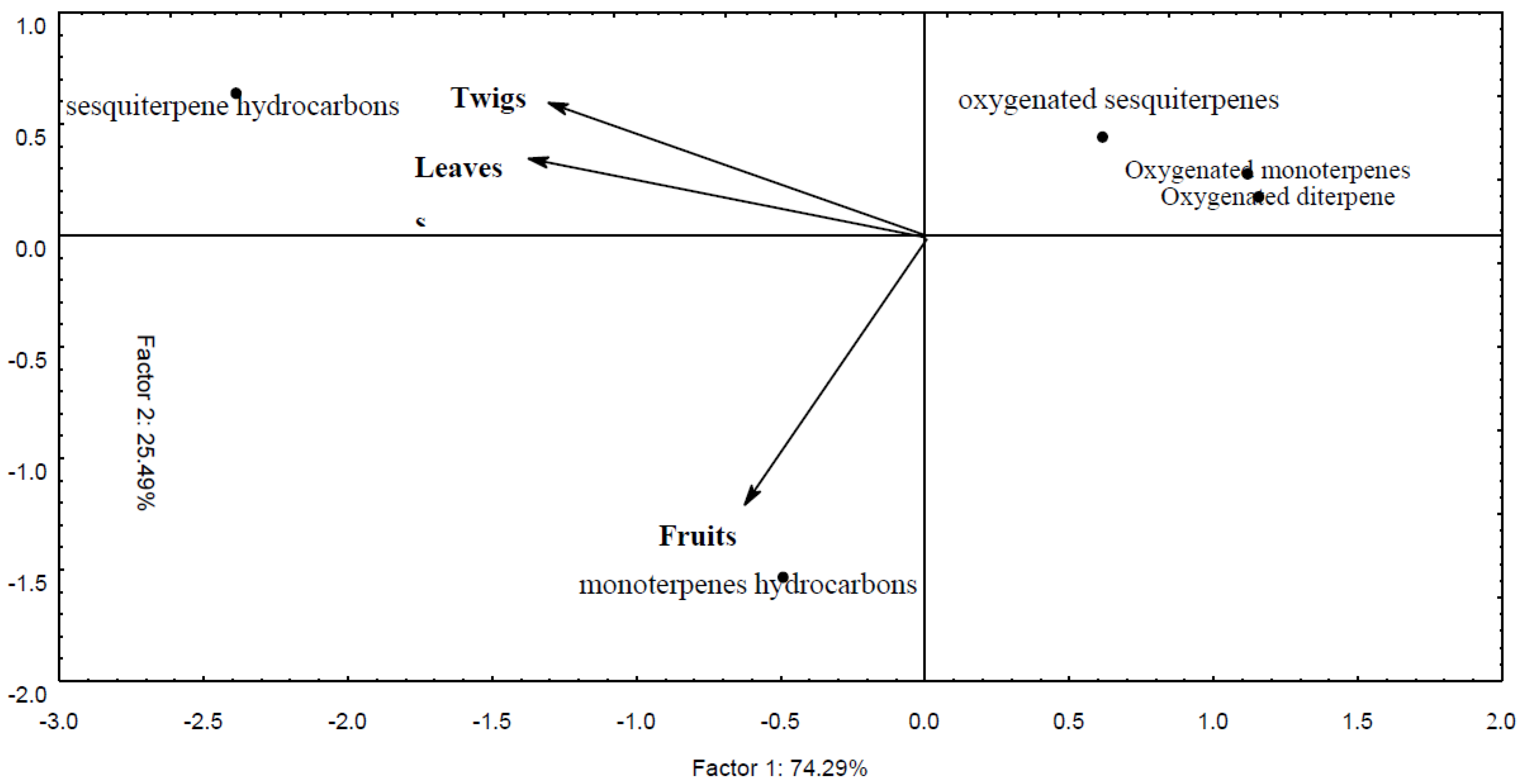
Table 1.
Chemical identification by gas chromatography coupled to mass spectrometry (GC-MS) of essential oils extracted from the leaves, fruits and twigs of Schinus terebinthifolius.
Table 1.
Chemical identification by gas chromatography coupled to mass spectrometry (GC-MS) of essential oils extracted from the leaves, fruits and twigs of Schinus terebinthifolius.
| Peak | RT1 | Compound | RI2 | RI | RA %3 | ||
|---|---|---|---|---|---|---|---|
| Leaves | Fruits | Twigs | |||||
| 1 | 5.833 | α- pinene | 934 | 932 | 11.6 | 17.16 | 2.99 |
| 2 | 7.13 | β-pinene | 976 | 974 | 5.68 | 43.34 | 5.60 |
| 3 | 7.13 | α- phellandrene | 1003 | 1002 | 0.61 | 0.85 | 0.44 |
| 4 | 8.523 | 3-carene | 1009 | 1008 | 0.79 | - | 0.54 |
| 5 | 8.803 | α-terpinene | 1014 | 1014 | - | - | 0.17 |
| 6 | 9.144 | p-cymene | 1019 | 1020 | - | - | 0.43 |
| 7 | 9.32 | D-limonene | 1018 | 1024 | - | 1.92 | 1.50 |
| 8 | 9.321 | β- phellandrene | 1023 | 1025 | 0.43 | - | 0.66 |
| 9 | 9.324 | eucalyptol | 1025 | 1026 | 1.49 | - | - |
| 10 | 10.274 | β-cis-ocimene | 1039 | 1032 | - | - | 0.26 |
| 11 | 10.717 | γ-terpinene | 1048 | 1054 | - | - | 0.40 |
| 12 | 17.051 | terpinen-4- ol | 1178 | 1174 | - | - | 1.18 |
| 13 | 17.882 | α- terpineol | 1185 | 1186 | - | - | 0.42 |
| 14 | 26.657 | δ-eIemene | 1330 | 1335 | 0.71 | - | - |
| 15 | 27.442 | α- cubebene | 1343 | 1345 | - | - | 1.31 |
| 16 | 28.963 | α-copaene | 1373 | 1374 | 5.25 | - | 5.73 |
| 17 | 29.88 | β-cubebene | 1383 | 1387 | 1.55 | - | 1.94 |
| 18 | 30.03 | β-elemene | 1390 | 1389 | 4.57 | - | 1.44 |
| 19 | 31.549 | α- gurjunene | 1409 | 1409 | 2.15 | 2.12 | 0.82 |
| 20 | 31.549 | caryophyllene | 1418 | 1417 | 15.97 | 3.12 | 11.73 |
| 21 | 32.621 | (-) -aristolene | 1427 | 1428 | - | - | 0.40 |
| 22 | 33.155 | α-himachalene | 1446 | 1449 | - | - | 1.42 |
| 23 | 33.493 | α-humulene | 1452 | 1452 | 1.91 | - | 1.99 |
| 24 | 34.913 | E-β-farnesene | 1454 | 1454 | - | - | 1.31 |
| 25 | 34.212 | aromadendrene-allo | 1459 | 1458 | 2.25 | - | 1.49 |
| 26 | 34.928 | γ-gurjunene | 1475 | 1475 | 16.85 | 3.15 | - |
| 27 | 35.241 | γ-muurolene | 1476 | 1478 | - | - | 1.27 |
| 28 | 35.45 | germacrene D | 1481 | 1484 | 12.04 | 15.78 | 20.41 |
| 29 | 36.435 | valencene | 1495 | 1496 | - | - | 6.38 |
| 30 | 36.569 | α-selinene | 1497 | 1498 | 1.33 | - | - |
| 31 | 37.148 | α-muurolene | 1499 | 1500 | - | - | 0.63 |
| 32 | 37.262 | δ-amorphene | 1509 | 1511 | 4.94 | 3.21 | 0.77 |
| 33 | 37.811 | δ-cadinene | 1503 | 1522 | - | - | 5.59 |
| 34 | 38.212 | cadina-1,4-diene | 1510 | 1524 | - | - | 0.33 |
| 35 | 39.29 | elemol | 1530 | 1548 | - | 2.7 | - |
| 36 | 40.628 | spathulenol | 1573 | 1577 | 3.75 | 1.21 | 5.47 |
| 37 | 40.92 | caryophyllene oxide | 1578 | 1582 | 1.99 | 0.77 | 4.83 |
| 38 | 41.041 | globulol | 1589 | 1590 | 1.11 | - | - |
| 39 | 42.167 | viridiflorol | 1590 | 1592 | - | - | 0.61 |
| 40 | 43.577 | epicubenol | 1603 | 1617 | - | - | 0.66 |
| 41 | 44.316 | t-cadinol | 1618 | 1625 | 1.02 | - | 2.17 |
| 42 | 44.632 | torreyol | 1624 | 1632 | - | - | 0.39 |
| 43 | 45.046 | t-muurulol | 1638 | 1640 | - | - | 1.08 |
| 44 | 69.658 | mandenol | 2151 | 2159 | - | 2.02 | - |
| Total Identified | 97.99 | 97.35 | 94.76 | ||||
| monoterpenes hydrocarbons | 19.11 | 63.27 | 12.99 | ||||
| monoterpenes oxygenated | 1.49 | 0 | 1.6 | ||||
| sesquiterpenes hydrocarbons | 69.52 | 30.08 | 64.96 | ||||
| Sesquiterpenes oxygenated | 7.87 | 1.98 | 15.21 | ||||
| Diterpene oxygenated | 0 | 2.02 | 0 | ||||
| Unidentified | 0.99 | 2.17 | 5.27 | ||||
1RT = Retention time (min); 2RI = retention index; 3RA = Relative area (%) = Percentage of the area that the compound occupies in the chromatogram; (-) compound absent; (ni) unidentified compound.
Table 3.
Percentage of inhibition (%) of oxidation by the β-carotene/linoleic acid co-oxidation system of essential oils from the twigs, leaves and fruits of Schinus terebinthifolius.
Table 3.
Percentage of inhibition (%) of oxidation by the β-carotene/linoleic acid co-oxidation system of essential oils from the twigs, leaves and fruits of Schinus terebinthifolius.
| Samples | Concentrations (mg mL−1) | |||
|---|---|---|---|---|
| 1 | 0.75 | 0.5 | 0.25 | |
| Leave | 63.65±1.38dC | 55.23±2.25cB | 50.63±2.75bB | 44.93±2.85aA |
| Fruits | 61.52±1.13dB | 54.60±1.27cA | 49.69±2.45aA | 54.09±2.94bC |
| Twigs | 40.75±2.10aA | 58.76±0.71dC | 51.62±2.53cC | 47.95±1.24bB |
Values are the mean ± standard deviation of the experiment performed in triplicate. Values in the same column with different capital letters are significantly different (p ≤ 0.05). Values in the same row with different lowercase letters are significantly different (p ≤ 0.05) Positive control: Trolox (0.2 mg mL−1) inhibition of oxidation of: 76.32%.
Disclaimer/Publisher’s Note: The statements, opinions and data contained in all publications are solely those of the individual author(s) and contributor(s) and not of MDPI and/or the editor(s). MDPI and/or the editor(s) disclaim responsibility for any injury to people or property resulting from any ideas, methods, instructions or products referred to in the content. |
© 2023 by the authors. Licensee MDPI, Basel, Switzerland. This article is an open access article distributed under the terms and conditions of the Creative Commons Attribution (CC BY) license (http://creativecommons.org/licenses/by/4.0/).
Copyright: This open access article is published under a Creative Commons CC BY 4.0 license, which permit the free download, distribution, and reuse, provided that the author and preprint are cited in any reuse.


