

Submitted:
21 December 2023
Posted:
21 December 2023
You are already at the latest version
Abstract
Knowledge about the genesis and evolution of black soils in the Eastern Mediterranean is vital for sustainable land management. In this study, the black soils that currently occur in the Eastern Mediterranean were analyzed in different bioclimatic zones and were found to genetically be long to three soil types: 1-Calcareous black soils (Rendzina, Para-Rendzina) (Rendzic or Somerirendzic Leptosols -Typic Rendolls or Lithic Rendolls), 2-Hydromorphic black soils (Calcic Chernozems -Haploxerolls). 3- Black soils on Basalt (Somerirendzic Leptosols) (Haploxerolls). The impact of the relief was obvious on both the thickness of the solum and the mollic horizon. Rendzina occurs on the toe and feet slope, Para-Rendzina on the shoulders, and Chernozems on a flat plain. The color of the epipedon in Rendzina reflects the origin of the prevailing parent material from which they are derived: Proper Rendzina found on limestone, chalk, sandstone, conglomerate, and claystone; Reddish Rendzina on Dolomite and hard limestone, and Grayish Rendzina on Serpentine. It was also found that the Hydromorphic black soils only occur on calcic marl and lacustrine deposits in the depressions arising from the Dead Sea faults under saturation or bad drainage conditions. This soil has a thick, dark mollic horizon and high organic matter content.
Keywords:
semi-arid
; black soils
; Rendzina
; Chernozems
; eastern Mediterranean
1. Introduction
The term ‘Black Soil’ refers to soft soil, with a deep humus layer and rich organic matter content on the top layer [1,2]. Its dark color is due to the abundant accumulation of soil organic carbon (SOC) [3]. The International Black Soil Network (INBS) defines black soil as soil containing (1) surface horizons with color of ≥ 3 wet, a value of ≥ 3 wet and ≥ 5 dry); (2) high organic carbon content as follows: ≥ 1.2% for cold and temperate regions and ≥ 0.6% for tropical regions and (3) thickness of very dark to black surfaces of at least 25 cm [4,5]. The WRB Classification System [6] classified black soil as Chernozems, Kastanozems, and Phaeozems, or soil with qualifies of Rendzic and Somerirendzic whereas Soil Survey Staff [7] classified black soil as being mostly Mollisols, excluding Vertisols and dark Andesols [8]. Black soils are mostly found in cold and temperate northern latitudes, such as Russian Federation, Kazakhstan; northeast China, Mongolia, Ukraine, the United States, and Canada, as well as in southern latitudes such as Argentina, Colombia and Mexico [6,9]. Black soils are relatively fertile and have a high production potential for agriculture [10], host the largest terrestrial carbon pool [11], and thus play a crucial role in the global carbon balance by regulating dynamic biochemical processes and the exchange of greenhouse gases with the atmosphere [12]. Therefore, their occurrences are crucial in climate change, food security, and land degradation. The best sustainable land management should be applied to prevent carbon loss from this soil.
In the Mediterranean region, the prevailing climatic conditions are not favorable for the deposition and accumulation of organic matter, which is the major soil-forming process of black soil [13]. In which soils are characterized by low amounts of OM often comprising less than 1 % [14-17]. Also because the region is highly vulnerable to land degradation due to the continuous erosion of soils, including the humus-bearing surface layer, caused by heavy rains after long, dry, and hot summers. Although Mediterranean landscapes typically have high elevations and slopes, the soils are fragile and soft and can be easily washed away by rain [18]. Nevertheless, black soils can be found in the Mediterranean region on a very small scale. This unique presence of these soils has led to ongoing debates regarding their origin and genesis [19]. Reifenberg [20] suggested at an early stage that the accumulation of organic matter was not essential for soil formation in the Mediterranean and attributed the immaturity of these soils to the high erodibility of the disintegration products of soft limestone. In contrast, [21] postulated that the texture of soft and hard limestone is crucial in the development of both Rendzina and Terra rossa. Geze [22] highlighted the occurrence of Rendzina soils in Lebanon, which was earlier referred to by Miklaszewski [23] as white Rendzina. These soils contain a significantly higher content of CaCO3 and availability of P than any other soil [24] because they are derived from soft Miocene and Senonian limestone and can be found in the foothills of the Lebanon and Anti-Lebanon Mountains [19]. Çepel [25] argues that the genetic soil types in the karstic areas southwest of Turkey, where the Lebanon cedar occurs, are Rendzina. According to Darwish and Zurayk [26], Rendzina can be found in the coastal area, southern plateau, mountain range, and the central Bekaa Valley in Lebanon. In Syria, these soils were referred to in studies presented by Muir [27], Nahal [28,29], Van lier [30], Zain al Ab-deen, [31], Chalabi [32], as well as by Ilaiwi [33]. First mentioned of black soils in Jordan by Moormann [34], he remarked that the (A) horizon is very weak and almost absent of humus in the upper horizon (values seldom exceed 1 or 2 %) in the best soils of Jordan. The survey of the Ministry of Agriculture MoA [35,36] found that the black soils of Typic Calcixerolls, Lithic Haploxerolls, Vertic Haploxerolls, and Typic Haploxerolls could be found in minor occurrences, mainly in the higher hilly areas of Jordan such as in Um Qeis, East Nueimeh, Ajlun and Salt Subiehi. Khresat [37] pointed out that Mollisols have developed from Quaternary deposits in northern Jordan under xeric moisture and thermic temperature regimes in the 450 mm precipitation zone. Lucke et al. [38-40] found very weakly developed Rendzic Regosols on limestone regolith in the Abila ruins in northern Jordan.
Despite increasing attention to the importance of black soils as carbon sequestration pools especially in marginal and fragile environments such as the eastern Mediterranean, information regarding the properties of black soils and their use is currently limited. Hence, this study aims to shed light on the specifications and factors of deformation of these soils based on soil survey data from 15 soil profiles. Understanding the properties and genesis are essential requirements to preserve them for sustainable use.
2. Materials and Methods
Fifteen soil profiles with thick dark mineral surface horizons from the coastal and inland regions of the eastern Mediterranean were studied, Figure 1.
The soils were studied in four bioclimatic areas according to the pluviothermic quotient of Emberger [41], namely: 1-The upper humid stage cold, 2-lower sub-humid stage fresh 3- lower sub-humid stage temperate and 4-upper semiarid. These areas receive an annual precipitation ranging from ~500 to more than 1000 mm. The precipitation amount increases on the slopes facing south and southwest. The climax vegetation is Pinus brutia forest; the degraded areas were covered with Maquis consisting mainly of Quercus species in wet areas.
From these soil profiles, three representative profiles: Jableh (littoral plain), Al-Ghab (rift valley), and Barshin (littoral high hilly mountainous area) were selected to take soil samples for analysis.
Soil description and sampling were based on procedures of the Soil Survey Division Staff [42]. The morphological study and soil profile description were based on the Field Book for Describing and Sampling Soil [43] as well as the Keys to Soil Taxonomy [7].
All soil samples were air-dried at 95 °C for 24 h. After the removal of all stones and vegetation, they were ground, sieved, and homogenized. Organic carbon (Corg.) was determined by the Walkley-Black method [44], modified by Nelson and Sommers [45]. The particle-size analysis was performed using the hydrometer method [46]. Soil reaction (pH) was measured in a suspension of H2O (1:1), (0.01M) CaCl2 (1:2) and (1M) KCl (1:2) [47]. Exchangeable cations (Ca++, Mg++, K+, Na+) were estimated using the method (BaCl2-TEA, pH=8.2) [48]. Calcium carbonates were determined by Scheibler [49]. Total Nitrogen was determined following the procedures of Kjeldahl [50] and McRae [51]. Electrical Conductivity (EC) was measured in the suspension of H2O (1:2) [47]. Available phosphorus was estimated according to Olsen et al. [52] and total potassium according to Jackson [53].
3. Results
The soil profiles showed that black soil occurs in some areas of the littoral plain, littoral high hilly areas, and rift depression valleys. The existence of these soils was in several bioclimatic stages, on different parent materials, and in different rain zones, Table 1.
3.1 Soil Morphology
The soil morphology of the representative profiles is listed in Table 2. The color of the topsoil ranged from black to dark brown (10YR 2/1-10YR 3/2). Distinct color differences between the horizons were only apparent in the soil profile of the Rendzina; this was related to high carbonate content in the subsurface horizon and the origin of the parent materials. A thin layer of slightly decomposed forest litter was found on top of the Rendzina (Oi) horizon. The soils were all relatively deep, except for the soil on steep slopes of intervening undulating hills and mountainous areas. Here the gully erosion posed a severe problem on deforested plots.
3.2. Soil Physical Properties
The particle size analysis showed that the texture varies from clay to sandy clay loam to loam, Table 3. From the clay content change as a function of depth, it did not become clear that illuviation was discernible.
3.3. Soil Chemical Properties
Some soil chemical properties are presented in Table 4. The soil reaction (pH) in general ranged from slightly to moderately alkaline. These values were related to the carbonate content and base saturation. Only the soil derived from basalt was slightly to moderately acid. This was attributed to igneous non-carbonate parent materials as well as the intensive precipitation.
Apart from the Barshin soil, which seems to be carbonate-free, but only with some nodules of secondary carbonates, the calcium carbonate content was fairly high and constant in all of the soil profiles and constituted a prominent chemical feature. Moreover, the values exhibited no consistent trend, increasing to more than 77% in marl diatomaceous lacustrine deposits. Cation exchange capacities were relatively high which can be attributed to the content of organic matter.
Their trends to decrease or increase as a function of depth are not clear. The base saturation was generally high in all soil profiles; however, a few examples reached 100% base saturation. Only the soil of the Barshin soil profile exhibited a low base saturation due to low carbonate content and low soil reaction.
4. Discussion
Our study found that the black soils occur in the Eastern Mediterranean on very small-scale areas, and can be categorized into three types depending on evolution and genesis: 1-Calcareous black soils (Rendzina) on littoral plains and hilly areas, 2- Hydro-morphic black soils in depressions, and 3- Black soil on basalt. These soils can occur in a humid and sub-humid Mediterranean climate.
Calcareous black soils
These soils can develop on limestone, sandstone, chalk, dolostones, and similar calcareous materials. The darker color of the surface horizon due to the accumulation of organic matter in (O- A) or (A) horizons. In contrast to Reifenberg [20], who postulated that these types of soils were deficient in humus, this investigation found that the soils have a high content of organic carbon. The high contents of calcium carbonate content kept soils almost completely base saturated, retarding weathering and subsequent release and redistribution of sesquioxides and silica [54]. Consequently, this soil has a weakly developed, immature profile. The more common soils are Typic Rendolls (Rendzina) that have developed from Brown Calcisols or directly from calcareous regolith by humification. The microrelief and parent materials play an important role in the development of this kind of soil. On shoulders and slopes the mollic horizon is shallow (perhaps eroded), resulting in the formation of Para-Rendzina (Somerirendzic Leptosols- Lithic Rendolls). In this case, the soil is relatively immature, not deep, and has a unique diagnostic mollic epipedon. Sometimes litter layer can be found over mollic horizon, which varies in depth from 5 to 30 cm. The general soil horizon sequence was (O-A-C or A-C), sometimes including a transitional horizon (AC), but no proper illuvial horizon could be found. The soil shows a strong reaction with dilute hydrochloric acid, indicating the high calcium carbonate content, Figure 2.
Hydromorphic black soils
These soils are the most important in terms of extent and agricultural use. Hydromorphic black soils occur in areas with annual precipitation ranges of 500 to 1000 mm. The hydrologic conditions play a key role in the evolution and development of this kind of soil. Except for the soils found in rainy mountainous regions that developed on basalt (Barshin soil) and are relatively well drained, the prominent feature of hydromorphic black soil is that it forms in bad drainage conditions. The poor drainage is attributed to a heavy clayey texture and very slow runoff; (as is the case in the soil of the Akkar plain between Syria and Lebanon) or the location in a closed or semi-closed depression valley (Al-Ghab, Hola, El Amuq soils). This depression chronology is linked to the extension of the Dead Sea faults along the eastern coast of the Mediterranean that took place in the Tertiary and led to the emergence of many depressions (Jordan Valley, Hola Galilea, Houla Plain, El Beqaa Valley, Al-Ghab rift valley, El Amuq rift valley). Valley fills of these areas can tell a complicated story of erosion, sedimentation, and pedogenesis during periods of stability [55].
Water stagnation and poor drainage affected the accumulation of organic matter on the topsoil to the extent that these soils were considered wetlands before reclamation and drainage. The black soil of these areas developed on marl, freshwater organic, woody materials and conglomerates of lacustrine deposits (Al-Ghab, El Amuq) as well as on marl, freshwater organic material of lacustrine deposits and basalt (Houla Homs, Hola Galilea). Until recently, before undergoing reclamation and artificial drainage to dispose of excess water, ponding at least occasionally from January to February. Yet, the remains of hydrophilic vegetation such as Elms, Willow, Bulrush, Tama-risk, and acrocarpous mosses are still visible today [56], Figure 3.
The black soil in the Al-Ghab valley is a good example of this soil. It is located in a broken-down strip of a north-to-south fault of the Coastal Mountain Range, which is occupied by the wetland of the Al-Ghab depression. The poor drainage of the Al-Ghab is due to a lava flow, which almost completely bars the outlet of the Orontes River. At one point, only one shallow passage has been worn through this impediment. In 1956, the basalt threshold in the far north was broken to dry the area. The landscapes are highly similar since both areas are characterized by a lack of prominent topographic features, which makes soil distribution patterns difficult to grasp in a general survey [33]. The evolution of these soils seems largely connected with waterlogging conditions, which might retard or affect the decomposition of organic matter. Since the dark colors seem to persist for some time after artificial drainage of an area, it seems possible that more stable forms of humus were accumulated and are responsible for black soils. The absence of a clay migration in these soils is a result of continuous soil cultivating and extensive agriculture rotation, [57]
Mollisols with a strongly distinctive mollic epipedon cover the entire area and the isoline 200 m.a.s.l. is considered a sharp delineation between this soil and others. Three great groups represent the Mollisols in this area: Paleoxerolls, Calcixerolls, and Haploxerolls, with the latter being the predominant one due to the prevailing xeric soil moisture regime. However, data from the field and the morphological soil profiles studied show that the soil receives more moisture (ground moisture) than the prevailing moisture system suggests. The thickness of the mollic epipedon, the occurrence of carbonate within 1.5 m of the soil as well as the groundwater level (although artificial drainage is applied) are the main reasons for the soil complexity. These features facilitate the soil classification at the lower categories. However, Aquic, Cumulic, Pachic, Calcic pachic, and Typic Haploxerolls are assumed to be largely represented, Figure 4.
In Calcixerolls, the saturation of the subsoil, high groundwater level and high evaporation rates combined lead to the upward movement of carbonates, which, in turn, result in the formation of calcic horizons. This is contrary to the typical process of calcic horizon formation in Mediterranean soils, which normally includes the leaching and translocation of carbonate from the topsoil to the subsoil. Typic and Cumulic subgroups are found within the Calcixerolls. In contradiction to Ilaiwi’s suggestions [33], no petrocalcic horizon was detected in any of the soil profiles, probably due to the waterlogging conditions. Further research should investigate the potential roles of vegetation types in the genesis of such humus-rich soils.
Black soil on basalt
Most of these black soils have been weathered from basic olivine basalts of the Pliocene age [58]. Van Lier [30] referred to these soils as Kastanozem or dark brown soils resulting from the dissolution of basalt. The occurrence of markedly different soils in this area can be explained satisfactorily by differences in their topographic position and the progressive changes in topography.
These soils are shallow and have small and very dark grayish-brown epipedons.
The epipedon is rich in fine roots and highly contains organic material over an intensive weathered parent materials (C) horizon. The texture is loam or clay loam with crumb to fine blocky structure and high amounts of gravel of various parent rocks through the profile. Soil colors are approximately similar, and originate from humus accumulation and dark basaltic parent material. However, the dark color in the surface horizons is mainly due to the high humus content rather than the fact that these horizons originated from basalt parent material. The appearance of some red and purple soil colors is not only related to high precipitation, as is common in the Mediterranean region but also reflects high quantities of ferric materials [59].
These soils are considered devoid of primary carbon, and this is due to the igneous parent material. However, this does not prevent the formation of nodules of secondary carbonates of sedimentation origin in Endopedons. The heavy rainfall rate (800 mm) can wash secondary carbonates from the surface horizons through cracked soil to lower horizons, but it is unable to completely remove them from the entire soil profile, Figure 5.
5. Conclusions
This study found that black soils occur occasionally in the Eastern Mediterranean at small scale in different climatic zones ranging from xeric to aridic, and that they can be categorized into two types: Calcareous black soil, and Hydromorphic black soil.
The Hydromorphic black soil seems to be the most important because of its extent/distribution and intensive agricultural use. Its formation is spatially associated with the Dead Sea faults. Therefore, it is reasonable that this soil is the oldest and that the Rendzina is the most recent one. Rendzina occurs on limestone, sandstone, chalk, dolostones, and similar calcareous materials, with a dark surface horizon and high carbonate content, keeping it completely base saturated. The soil has a weakly developed, immature profile and the Rendzina is predominant in occurrence (Typic Rendolls). However, the existence of these kinds of soils under arid and semi-arid conditions raises questions on the geneses and forming processes as well as the conditions associated particularly with paleosols and paleoclimate, which require further research.
Author Contributions
Conceptualization, H.H.H. and B.L.; Methodology, H.H.H. and R.B.; Formal Analysis, H.H.H. and B.L.; Investigation, H.H.H., W.S. and B.L.; Data Curation, B.L.; Writing-Original Draft Preparation, W.S.; Writing-Review & Editing, H.H.H., R.B. and B.L.; Visualization, H.H.H. All authors have read and agreed to the published version ofthe manuscript.
Funding
This research received no external funding.
Acknowledgments
Many thanks go to the Soil Laboratory of the General Commission for Scientific Agriculture Research (GCSAR), Syria.
Conflicts of Interest
The authors declare no conflict of interest.
References
- Han, X.; Li, N. Research Progress of Black Soil in Northeast China. Scientia Geographica Sinica 2018, 38, 1032–1041. [Google Scholar] [CrossRef]
- Song, C.; Lu, W.; Du, H. Degradation of Black Soil Quality and Strategies of Prevention Control in Northeast Plain, China. 2022. Available online: https://www.scitepress.org/Papers/2021/110203/110203.pdf.
- Andreeva, D.B.; Leiber, K.; Glaser, B.; Hambach, U.; Erbajeva, M.; Chimitdorgieva, G.D.; Zech, W. Genesis and properties of black soils in Buryatia, southeastern Siberia, Russia. Quaternary International 2011, 243, 313–326. [Google Scholar] [CrossRef]
- FAO. DEFINITION | What is a black soil? 2019. Retrieved 08 June 2023 from. Available online: https://www.fao.org/global-soilpartnership/intergovernmental-technical-panelsoils/gsoc17-implementation/internationalnetworkblacksoils/more-on-black-soils/definition-what-is-a-black-soil/en/.
- FAO Global status of black soils. Rome. 2022. [CrossRef]
- IUSSWorking Group, W.R.B. World Reference Base for Soil Resources. In International soil classification system for naming soils and creating legends for soil maps, 4th ed.; International Union of Soil Sciences (IUSS): Vienna, Austria, 2022. [Google Scholar]
- Soil Survey Staff Keys to Soil Taxonomy, 13th ed.; U.S. Department of Agriculture, Natural Resources Conservation Service: Washington, DC, USA, 2022.
- Sorokin, A.; Owens, P.; Láng, V.; Jiang, Z.-D.; Michéli, E.; Krasilnikov, P. “Black soils” in the Russian Soil Classification system, the US Soil Taxonomy and the WRB: Quantitative correlation and implications for pedodiversity assessment. CATENA 2021, 196, 104824. [Google Scholar] [CrossRef]
- Liu, X.; Burras, C.L.; Kravchenko, Y.S.; Duran, A.; Huffman, T.; Morras, H.; Studdert, G.; Zhang, X.; Cruse, R.M.; Yuan, X. Overview of Mollisols in the world: Distribution, land use and management. Canadian Journal of Soil Science 2012, 92, 383–402. [Google Scholar] [CrossRef]
- Smreczak, B.; Jadczyszyn, J.; Kabała, C. Przydatnoœć rolnicza rędzin w Polsce. Soil Science Annual 2018, 69, 142–151. [Google Scholar] [CrossRef]
- FAO. ITPS Status of the world’s soil resources (SWSR)–main report; Food and agriculture organization of the United Nations and intergovernmental technical panel on soils: Rome, Italy, 2015. [Google Scholar]
- Lal, R. Soil carbon management and climate change. Carbon Mgmt 2013, 4, 439–462. [Google Scholar] [CrossRef]
- Hag Husein, H.; Lucke, B.; Bäumler, R.; Sahwan, W. Contribution to Soil Fertility Assessment for Arid and Semi-Arid Lands. Soil Syst. 2021, 5, 42. [Google Scholar] [CrossRef]
- Achiba, W.B.; Gabteni, N.; Lakhdar, A.; Laing, G.D.; Verloo, M.; Jedidi, N.; Gallali, T. Effects of 5-year application of municipal solid waste compost on the distribution and mobility of heavy metals in a Tunisian calcareous soil. Agr. Ecosyst. Environ. 2009, 130, 156–163. [Google Scholar] [CrossRef]
- Parras-Alcántara, L.; Lozano-García, B.; Keesstra, S.; Cerdà, A.; Brevik, E.C. Long-term effects of soil management on ecosystem services and soil loss estimation in olive grove top soils. Sci. Total Environ 2016, 571, 498–506. [Google Scholar] [CrossRef]
- Muñoz-Rojas, M.; Jordán, A.; Zavala, L.M.; De la Rosa, D.; Abd-Elmabod, S.K.; Anaya-Romero, M. Organic carbon stocks in Mediterranean soil types under different land uses (Southern Spain). Solid Earth 2012, 3, 375–386. [Google Scholar] [CrossRef]
- Hag Husein, H.; Mousa, M.; Sahwan, W.; Bäumler, R.; Lucke, B. Spatial Distribution of Soil Organic Matter and Soil Organic Carbon Stocks in Semi-Arid Area of Northeastern Syria. Natural Resources 2019, 10, 415–432. [Google Scholar] [CrossRef]
- Ahmet, C. Soil organic carbon losses by water erosion in a Mediterranean watershed. Soil Research 2016, 55, 363–375. [Google Scholar] [CrossRef]
- Tarzi, J.G.; Paeth, R.C. Genesis of a Mediterranean red and a white rendzina soil from Lebanon. Soil science 1975, 120, 272–277. [Google Scholar] [CrossRef]
- Reifenberg, A. The Soils of Palestine, 2nd ed.; Thomas Murbery and Co.: London, UK, 1947. [Google Scholar]
- Durand, R.; Dutil, P. Experimental alteration of calcareous and dolomitic rocks-Importance of rock structure and its mineralogical nature. comptes rendus hebdomadaires des seances de l academie des sciences serie D 1971, 272, 2423. [Google Scholar]
- Geze, B. Carte de reconnaissance de sols du Liban. MinistCre de 1’Agriculture. In Direction de 1’Enseignement et de la Vulgarisation; Beyrouth: Rkpublique, Libanaise, 1956. [Google Scholar]
- Miklaszewski, S. Mémoire relatif à la Pologne, Mémoires sur la nomenclature et la classification des sols, Helsinki. 245-255, 1924.
- Sayegh, A.H.; Salib, A.J. Some physical and chemical properties of soils in the Beqa'a plain, Lebanon. Journal of Soil Science 1969, 20, 167–175. [Google Scholar] [CrossRef]
- Çepel, N. Sedir yetisme muhiti tanitinimin pratik esaslari ve orman yetisme muhiti haritaciligi; Kurtulus: Matbaasi, Istanbul, 1966. [Google Scholar]
- Darwish, T.M.; Zurayk, R.A. Distribution and nature of Red Mediterranean soils in Lebanon along an altitudinal sequence. Catena 1997, 28, 191–202. [Google Scholar] [CrossRef]
- Muir, A. Notes on the Soil of Syria. J. of Soil Sci 1951, 2, 163–187. [Google Scholar] [CrossRef]
- Nahal, I. Contribution à l'étude de la végétation dans le Baer-Bassit et le Djebel Alaouite de Syrie. Webbia 1962, 16, 477–641. [Google Scholar] [CrossRef]
- Nahal, I. The Mediterranean climate from a biological viewpoint. In: di Castri, Goodall W. and Specht, R. L. (eds): Mediterranean-type shrublands. Ecosystem of the World Vol. 11, Chapter 3. Elsevier Scientific Publishing Company. Amsterdam-Oxford-London: 63-86. 1981.
- Van Lier, W.J. Classification and rational utilization of soils. Report to the Govern. Syria; FAO: Rome, Italy, 1965; p. 141. [Google Scholar]
- Zain al Abdeen, A.N. Principles of soil science, University of Aleppo. 250-270, 1978.
- Chalabi, M.N. Analyse phytosociologique, phytoécologique, dendrométrique et dendroclimatologique des forêts de Quercus cerris subsp. pseudocerris et contribution à l’ étude taxinomique du genre Quercus L. en Syrie, Thèse de Doctrat ès -sciences, Université d' Aix- Marseille, France. III 342p. + annexes de 171 p. Ecologia Mediterranea T.VIII, (Fascicule 1/2). Marseille: 137-141. 1980.
- Ilaiwi, M. Contribution to the knowledge of the soils of Syria. Ph. D. Thesis, State Univ. Of Ghent, Belgium; p 259, 1983.
- Moormann, F. The soils of East Jordan: Report to the government of Jordan (Expanded Technical Assistance Program No. 1132). FAO, Rome, 1959.
- Ministry of Agriculture, Jordan (MoA). The Soils of Jordan: Level 1 (Reconnaissance Survey), Report of the National Soil Map and Land Use Project, Vol. 1, Ministry of Agriculture, Amman, Jordan, 1993.
- Ministry of Agriculture, Jordan (MoA). The soils of Jordan: Level 2 (Semi Detailed Studies), Report of the National Soil Map and Land Use Project, Vol. 3, Ministry of Agriculture, Amman, Jordan, 1995.
- Khresat, S.E.A. Nature and properties of mollisols in a semiarid region in northern Jordan. Communications in soil science and plant analysis 1999, 30, 2429–2436. [Google Scholar] [CrossRef]
- Lucke, B.; Schmidt, M.; al-Saad, Z.; Bens, O.; Hüttl, R.F. The Abandonment of the Decapolis Region in Northern Jordan – Forced by Environmental Change? Quaternary International 2005, 135, 65–81. [Google Scholar] [CrossRef]
- Lucke, B. Demise of the Decapolis. Past and Present Desertification in the Context of Soil Development, Land Use, and Climate. Omni Scriptum, Saarbrücken. First published online in 2007, dissertation at BTU Cottbus, 2008.
- Lucke, B.; Kemnitz, H.; Bäumler, R. Evidence for isovolumetric replacement in Terrae Rossae of Jordan. Boletin de la Sociedad Geologica Mexicana 2012, 64, 21–35. [Google Scholar] [CrossRef]
- Emberger, L. Une classification biogeographique des climates. Recueil trav. Lab. Bot. Geol. Zool. Fac. Sci. Montpellier. 1955, 7, 3–43. [Google Scholar]
- Soil Survey Division Staff Soil Survey Manual. U. S. Dept. Of Agric.Handb.18.U. S. Covt. print Off. Washington, D. C; p 510, 1993.
- U.S.D.A-NRCS Field Book for Describing and Sampling Soils. v 1.1. USDA. Lincoln, Nebraska. p 182, 1998.
- Walkley, A.; Black, A. An examination of the Degtjareff method for determining soil organic matter and a proposed modification of the chromic acid titration method. Soil Sci. 1934, 37, 29–38. [Google Scholar] [CrossRef]
- Nelson, D.W.; Sammers, L.E. Total carbon and organic matter. In A. L. Page, R. H. Miller, and D. R. Keeney (eds) Methods of soil analysis, Part 2. Chemical and microbiological properties. Agronomy Monograph no. 9 (2end edition), S. Segor Dd; ASA-SSSA, Madison, USA. 539-579, 1982.
- Soil Survey Staff Soil taxonomy: a basic system of soil classification for making an interpreting soil survey. U. S. Department of Agriculture. Habdb. 436. U.S. Govt. Print. Washington, D. C; p 503, 1975.
- Soil Conservation Service. Soil Survey laboratory methods. Soil Survey. Invest. Report No 42; U. S. Dept. Agric; Washington, D. C; p 400, 1992.
- Mehlich, A. Use of Triethanolamine Acetate-Barium Hydroxide Buffer for the Determination of Some Base Exchange Properties and Lime Requirement of Soil 1. Soil Science Society of America Journal 1939, 3, 162–166. [Google Scholar] [CrossRef]
- Turski, R.; Domżał, H.; Borowiec, J.; Flis-Bujak, M.; Misztal, M. Gleboznawstwo. Ćwiczenia dla studentów wydziałów rolniczych. Wyd. Nauk. PWN, Warszawa, 1-278, 1986.
- Kjeldahl, J. Neue Methodezur Bestimmung des Sticksoffs in organischen Körpern. Z. Anal. Chem 1883, 22, 36–382. [Google Scholar] [CrossRef]
- McRae, S.G. Practical pedology studying soils in the field. Ellis Horwood Limited: Chichester, UK, 1988; p. 253. ISBN 0-85312-918-5. [Google Scholar]
- Olsen, S.R.; Cole, F; Watanabe, S.; Dean, L.A. Estimation of available Phosphorus in soil by extraction with sodium bicarbonate. U. S. Department of Agriculture Circular 939, Washington, D C. p 18, 1954.
- Jackson, M.L. Instrument in soils and waters. J. Agric. Food Chem. 1956, 4, 602–605. [Google Scholar] [CrossRef]
- Arnold, R.W. Multiple Working Hypothesis in Soil Genesis 1. Soil Science Society of America Journal 1965, 29, 717–724. [Google Scholar] [CrossRef]
- Lucke, B.; Hag Husein, H.; Sahwan, W.; Bäumler, R. A preliminary survey of soils and sediments in the Dead Cities region, northwestern Syria. In: Riis, T. ed., The “Dead Cities” of Northern Syria and Their Demise, Verlag Ludwig, Kiel, 33-59, 2015.
- Erdağ, A; Kirmaci, M.; Tizini, I.; Kashlan, A.; Addine, B.C. Contributions to the moss flora of the Al-Ghab plain (north-west Syria). Turkish Journal of Botany 2013, 37, 369–374. [Google Scholar] [CrossRef]
- Hag Husein, H.; Kalkha, M.; Al Jrdi, A.; Bäumler, R. Urban Soil Pollution with Heavy Metals in Hama Floodplain, Syria. Natural Resources 2019, 10, 187–201. [Google Scholar] [CrossRef]
- Technoexport. The geological map of Syria. Scale 1:1,000,000. Explanatory notes. Ministry of Industry, Syria, 111p, 1966.
- Hag Husein, H.; Nammora, T.; Zaghtiti, I.; Al-Khateeb, A.; Zenyah, E. Soil Catena Properties of Daher Al-Jabal IN south Syria. International Journal of Environment 2017, l6, 87–107. Available online: http://www.nepjol.info/index.php/IJE/article/view/16870/13714. [CrossRef]
Figure 1.
Map of the location of 15 black soil studied profiles from four bioclimatic stages of the Eastern Mediterranean.
Figure 1.
Map of the location of 15 black soil studied profiles from four bioclimatic stages of the Eastern Mediterranean.
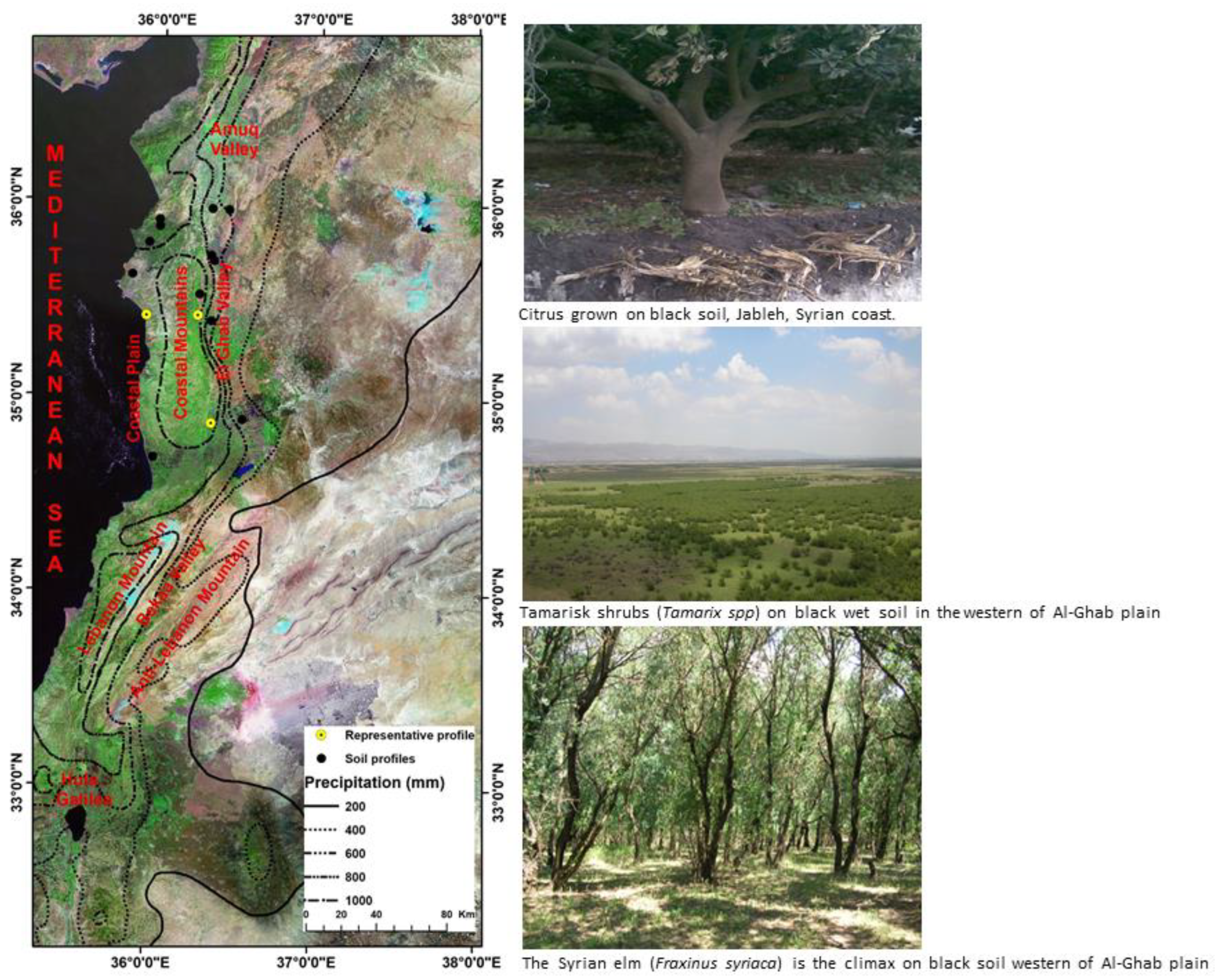
Figure 2.
Calcareous black soils: A. on chalk, B: on serpentine, C: on sandstone, D: calcareous materials.
Figure 2.
Calcareous black soils: A. on chalk, B: on serpentine, C: on sandstone, D: calcareous materials.
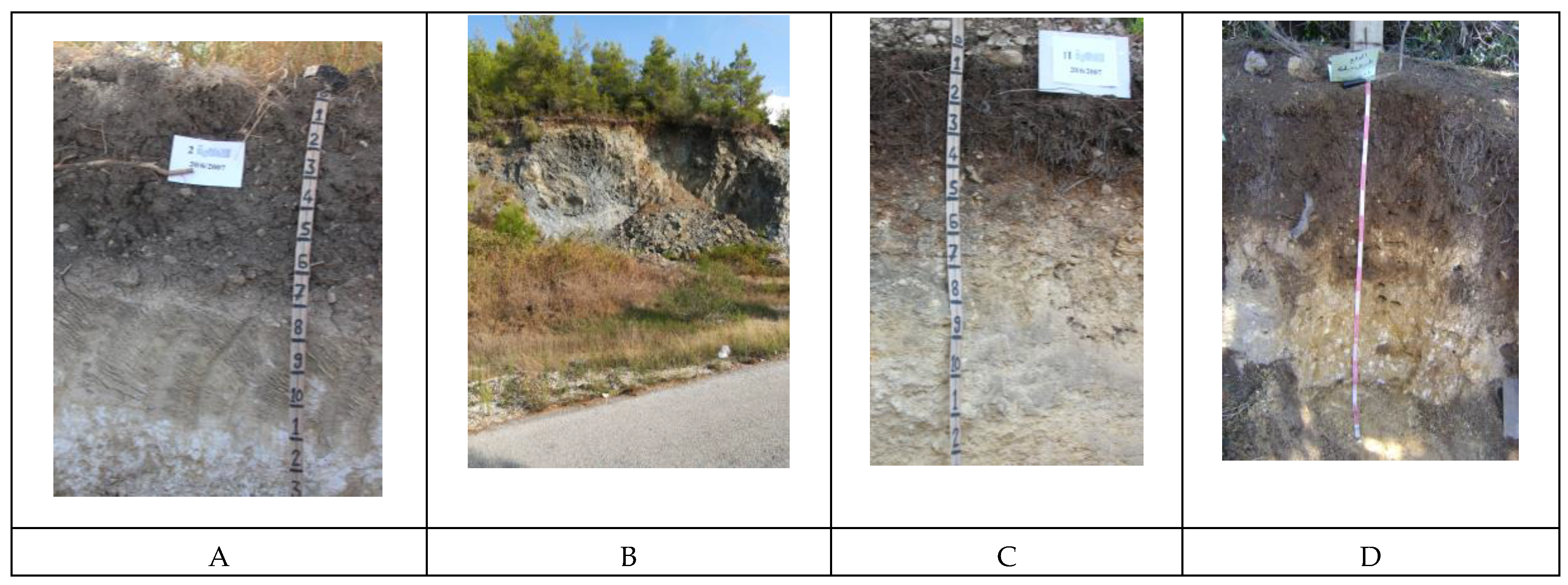
Figure 3.
A. The landscape and B. Natural vegetation of the Al-Ghab rift plain.
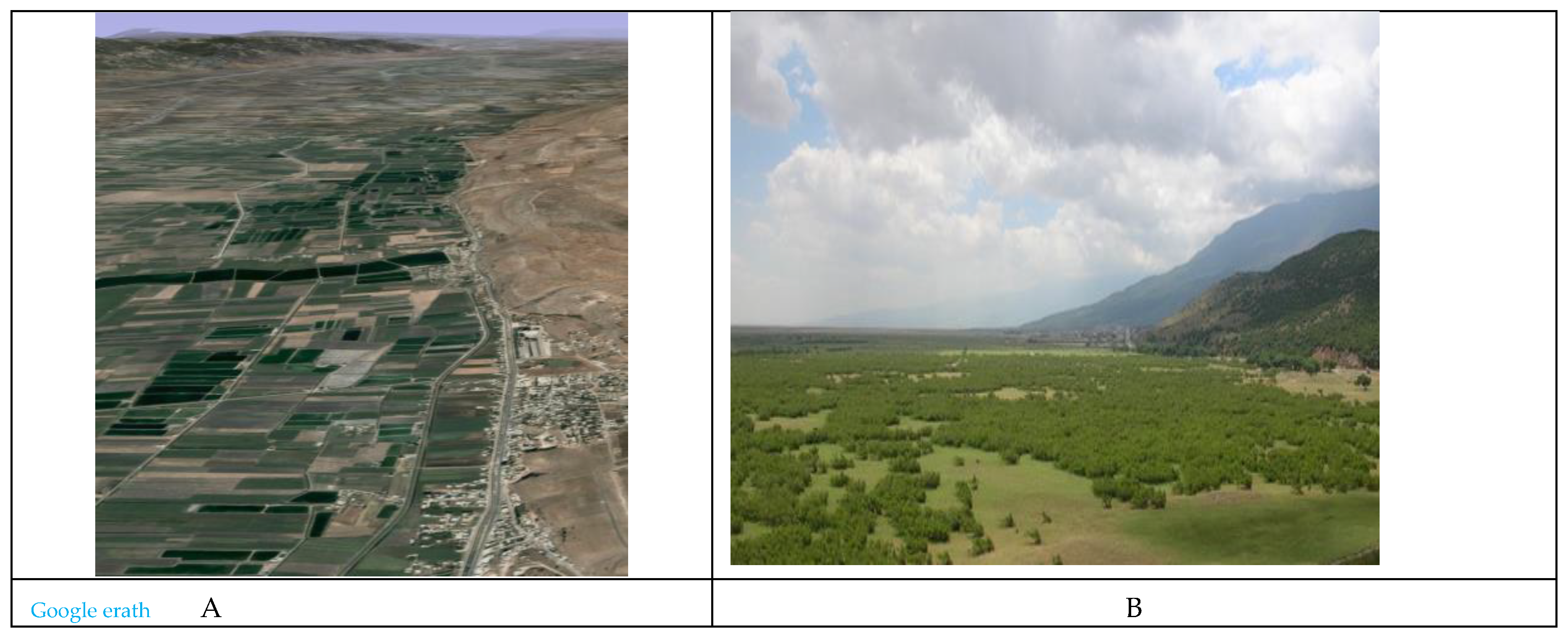
Figure 4.
Hydromorphic black soils of the Al-Ghab rift plain.
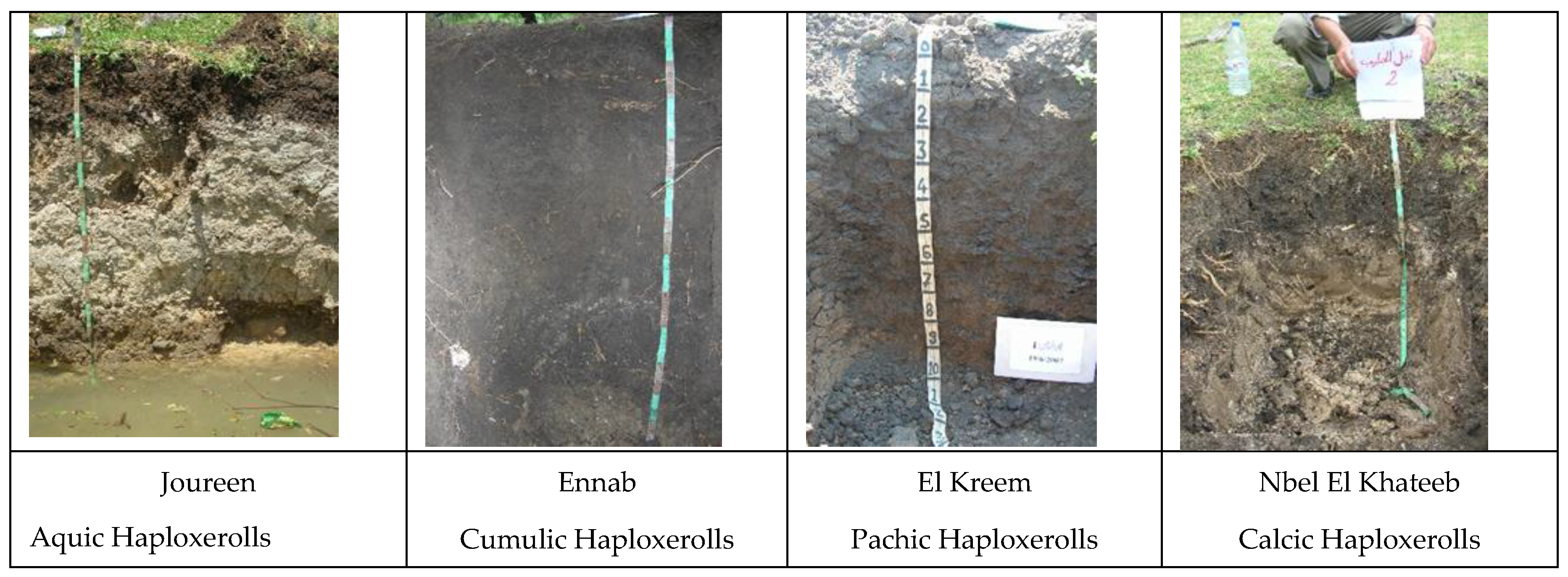
Figure 5.
Black soils have developed on weathered olivine basalt.
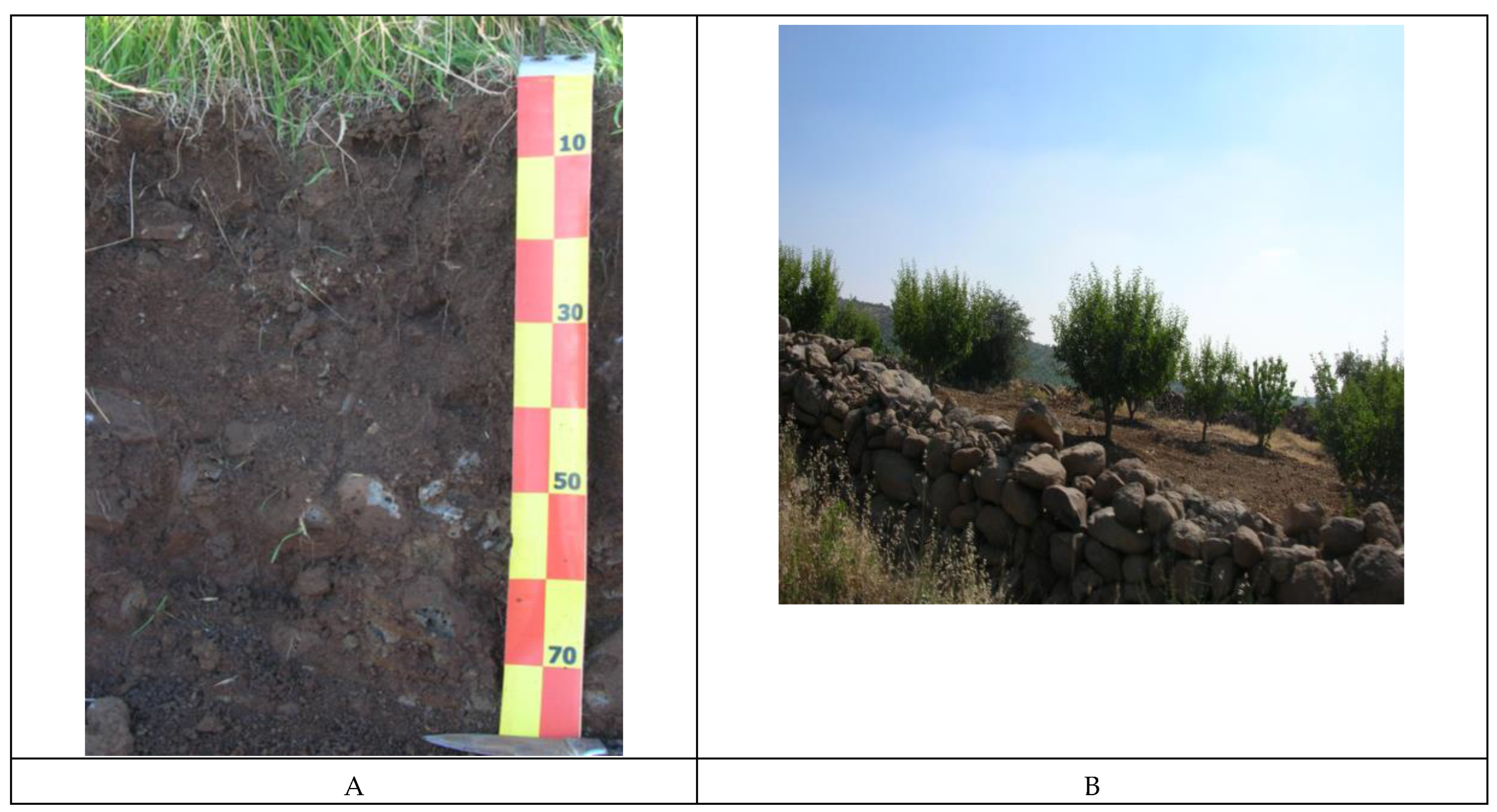

Table 1.
General description of soil profiles features.
| Profile Cod |
Coordinates & Elevation |
Rainfall mm |
Bio-climate zone | Physiography & Topographic position |
Drainage class | Vegetation | Parent material | Classification | |
|---|---|---|---|---|---|---|---|---|---|
| ST | WRB | ||||||||
| Jableh |
35°25'10.67" N 35°55'23.37" E 28 m. a. s. l |
863 | Sub-humid hot | littoral undulating plain, very gently slope towards east | moderately well drained, very slow surface run off | pine trees | calcareous sandstone and conglomerates | Typic Rendolls | Rendzic Leptosols |
| Al Qanjra | 35°37'43.7" N 35°49'40.13" E 10 m. a. s. l |
797 | Sub-humid hot | littoral flat plain, very gently slope towards east | moderately well drained, very slow surface run off | cultivated olive trees | Pliocene marls and limestone | Typic Calcixerolls | Somerirendzic Leptosols |
| Kassab-Zanzaf | 35°47'44.77" N 35°55'46.52" E 240 m. a. s. l |
1248 | humid temperate | littoral high hilly areas foot slopes | well drained, rapid surface run-off, moderately slow permeability | pome trees | undifferentiated complex of igneous rock predominated by serpentine of Mesozoic era | Typic Rendolls | Rendzic Leptosols |
| Kasab Nibh Almur |
35°52'41.93"N 35°59'35.60"E 380 m. a. s. l |
1248 | humid temperate | littoral high hilly areas middle slopes of mountainous area | well drained, rapid surface run-off, slow permeability | pome trees and stone fruit trees | undifferentiated complex of igneous rock predominated by serpentine of Mesozoic era | Entic Ultic Hapoloxerolls | Rendzic Leptosols |
| Kassab | 35°54'47.54"N 35°59'24.10"E 800 m. a. s. l |
1248 | humid temperate | littoral high hilly areas middle slopes of high hills | well drained, rapid surface run-off, moderately rapid permeability | pome trees | undifferentiated complex of igneous rock predominated by serpentine of Mesozoic era | Entic Ultic Hapoloxerolls | Rendzic Leptosols |
| Der Autman | 35°58'22.8" N 36°19'16.2" E 325 m. a. s. l |
679 | sub-humid temperate | Inland mountainous area –backslope of undulating hills |
well drained | cultivated olive and stone fruit trees | limestone | Calcic Pachic Hapoloxerolls | Leptic Kastanozem |
| Drkosh-Al-daher | 35°58'04.8" N 36°25'37.9" E 530 m. a. s. l |
679 | sub-humid temperate | littoral high hilly areas mountainous area | well drained | shrubs and cultivated olive tress | dolostones and hard limestone | Entic Hapoloxerolls | Rendzic Humic Leptosol |
| Akkar-Zahed | 34°41'38.66"N 35°59'12.36"E 1 m. a. s. l |
1150 | sub-humid hot | littoral plain -flat plain | poorly drained, very slow surface runoff, slow permeability | irrigated vegetable and greenhouses | quaternary and recent colluvium and alluvium derived mainly from neogene basalt | Vertic Haploxerolls |
Vertic Chernozems |
| Barshin | 34°52'20.60"N 36°20'37.41"E 930 m. a. s. l |
994 | humid temperate | littoral high hilly - backslopes of high hills |
moderately well drained, rapid run-off, slow permeability | pome trees | Pliocene basalt | Typic Haploxerolls |
Somerirendzic Leptosols |
| Houla | 34°53'42.88"N 36°32'11.59"E 375 m. a. s. l |
480 | semi-arid temperate | Historical oasis -level flood plain | somewhat poorly drained | field crops and irrigated vegetables | alluvial deposits of quaternary to more recent era, derived mainly from neogene basalt | Aquic Haploxerolls | Vertic Kastanozems |
| Al-Ghab-Joureen | 35°31'58.92"N 36°15'7.67"E 183 m. a. s. l |
871 | sub-humid temperate | rift valley-level to depressional valley fills | moderately well drained, very slow surface run-off, slow permeability | elms trees | quaternary or more recent marl diatomaceous lacustrine deposits | Aquic Haploxerolls | Leptic Chernozems |
| Al-Ghab-Ennab | 35°25'25.40" N 36°14'41.89" E 182 m. a. s. l |
871 | sub-humid temperate | rift valley-level to depressional valley fills | moderately well drained, very slow surface run-off, slow permeability | elms trees | quaternary or more recent marl diatomaceous lacustrine deposits | Aquic Haploxerolls | Vermic Chernozems |
| Al-Ghab-Al Kareem | 35°23'48.30" N 36°19'49.73" E 178 m. a. s. l |
695 | sub-humid temperate | rift valley-level to depressional valley fills | moderately well drained, very slow surface run-off, slow permeability | irrigated agriculture | quaternary or more recent marl diatomaceous lacustrine deposits | Patchic Haploxerolls | Haplic Chernozems |
| Al-Ghab-Qarqor | 35°43'58.76"N 36°19'13.47"E 170 m. a. s. l |
679 | sub-humid temperate | rift valley-level to depressional valley fills | moderately well drained, very slow surface run-off, slow permeability | irrigated agriculture | quaternary or more recent marl diatomaceous lacustrine deposits | Patchic Haploxerolls | Haplic Chernozems |
| Al-Ghab-Mshik | 35°42'20" N 36°20'26.7" E 175 m. a. s. l |
693 | sub-humid temperate | rift valley-level to depressional valley fills | moderately well drained, very slow surface run-off, slow permeability | irrigated agriculture | quaternary or more recent marl diatomaceous lacustrine deposits | Patchic Haploxerolls | Haplic Chernozems |
Table 2.
Soil morphology of representative soil profiles.
|
Hor-izon |
Depth (cm) |
Color | Structure | Consistence | Pores | Roots | Boundary | Special features | |
| dry | wet | ||||||||
| Jableh | |||||||||
| Oi | 5-0 | very dark gray 10YR 3/1 | black 10YR 2/1 | midrate medium fine granular | slightly plastic | - | abundant very fine to medium | abrupt smooth | slightly decomposed plant materialfrequent rounded stone constituting approximately 10% |
| A | 0-35 | - | very dark grayish brown 10 YR 3/2 | weak fine granular | sticky and plastic | few very fine and fine discontinuous irregular simple open | few fine and very fine | clear wavy | roots mostly inside peds |
| A2 | 35-50 | dark red 2.5Y3/6 | - | fine granular | sticky and plastic | Few fine vertical in ped simple closed | few fine | very abrupt smooth | Few small soft carbonate stones |
| C | 50+ | - | very pale brown10YR8/2 and pink 7.5YR8/3 | - | - | - | - | - | Conglomerates calcareous sandstone |
| Al-Ghab | |||||||||
| A | 0-26 | dark brown 10 YR 3/3 | black 10 YR 2/1 | midrate medium granular | soft (dry) slightly firm (moist) sticky and plastic | many fine horizontal in ped simple open | plenty fine | abrupt smooth | roots between peds |
| A2 | 26-55 | - | very dark brown 10 YR 3/2 | fine granular | firm (moist) sticky and plastic | few fine vertical in ped simple closed | Plenty fine | gradual wavy boundary | Roots between peds |
| AC | 55+ | - | grayish brown 10 YR 4/1 | massive | firm (moist) sticky and plastic | few fine vertical in ped simple closed | few fine inside peds | - | few small soft carbonate accumulations on ped faces |
| Barshin | |||||||||
| Ap | 0-18 | dark brawn 10 YR 3/3 | very dark grayish brawn10YR 3/2 | moderate medium subangular blocky breaking to moderate firm granular | very hard (dry) firm (moist) sticky and plastic | fine and medium dis-continuous vertical open | few fine | clear smooth | De-rocking surface |
| A2 | 18-40 | dark brawn 10 YR 3/3 | very dark grayish brawn10YR 3/2 | moderate medium subangular blocky | very hard (dry) firm (moist) | few fine dis-continuous vertical open | few fine and medium | clear smooth | few subrounded gravel 10% |
| C | 40-75 | - | Very dark grayish brawn 10 YR 3/2 | weak medium subangular blocky | very hard (dry) firm (moist) | Few fine dis-continuous open | few medium and coarse | broken | Soil and partially weathered parent material |
| R | 75+ | Neogene Basalt | |||||||
Table 3.
Particle size distribution, clay/sand, and clay/silt ratios of soil profiles.
| Soil | Horizon | Depth (cm) | Particle size distribution (%) Ø mm | Clay/Sand | Clay/Silt | Texture | ||
| Sand | Silt | Clay | ||||||
| Jableh | Oi | 0-5 | 54 | 16 | 30 | 0.55 | 1.87 | sandy clay loam |
| A | 5-35 | 60 | 14 | 26 | 0.43 | 1.85 | clay loam | |
| A2 | 35-50 | 46 | 22 | 32 | 0.69 | 1.45 | Sandy clay loam | |
| C | 50+ | 40 | 40 | 20 | 0.5 | 0.5 | sandy clay loam | |
| Al-Ghab | A | 0-26 | 46 | 26 | 28 | 0.6 | 1.07 | sandy clay loam |
| A2 | 26-55 | 48 | 34 | 18 | 0.37 | 0.69 | loam | |
| AC | 55+ | 46 | 24 | 30 | 0.65 | 1.25 | sandy clay loam | |
| Barshin | Ap | 0-25 | 12 | 42 | 46 | 3.83 | 1.09 | clay |
| A2 | 25-55 | 12 | 39 | 49 | 4.08 | 1.25 | clay | |
| AC | 55-115 | 12 | 39 | 49 | 4.08 | 1.25 | clay | |
| R | 115+ | - | - | - | - | - | - | |
Table 4.
Some soil chemical properties.
| Horizon |
Depth (cm) |
pH | Carbonates as CaCO3% | EC mS.m_1 | C org. % | Extractable bases meq.100g-1 |
Ext. P2O5 mg.kg-1 | Tot. N % | CEC meq.100g-1 |
BS | |||||
|---|---|---|---|---|---|---|---|---|---|---|---|---|---|---|---|
| CaCl2 1:1 |
H2O 1:1 |
<2mm | <0.002mm | Ca++ | Mg++ | K+ | Na+ | ||||||||
| Jableh | |||||||||||||||
| Oi | 0-5 | 7.42 | 7.54 | 2.2 | ND | 0.5 | 4.42 | ND | ND | 0.4 | 0.3 | 31.3 | 0.38 | 52.5 | 100 |
| A | 5-35 | 7.64 | 7.8 | 16.4 | ND | 0.4 | 2.41 | ND | ND | 0.1 | 0.3 | 20.5 | 0.19 | 62.5 | 100 |
| A2 | 35-50 | 8.1 | 8.2 | 29.5 | ND | 0.4 | 0.9 | ND | ND | 0.2 | 0.4 | 29.0 | 0.08 | 67.9 | 100 |
| C | 50+ | 7.42 | 7.54 | 44.0 | ND | 0.5 | 0.1 | ND | ND | 0.2 | 0.3 | 19.0 | - | 70.2 | 100 |
| Al-Ghab | |||||||||||||||
| A | 0-26 | 7.23 | 41.0 | 17.0 | 1.6 | 4.2 | 28.0 | 8.0 | 0.2 | 0.9 | 11.8 | 2* | 42 | 88.2 | |
| A2 | 26-55 | 7.86 | 69.5 | 27.0 | 2.1 | 3.1 | 15.0 | 1.1 | 0.1 | 1.1 | 8.2 | 4* | 24 | 88.3 | |
| AC | 55+ | 7.64 | 77.0 | 26.0 | 2.5 | 2.2 | 11.0 | 0.6 | 0.1 | 0.6 | 3.3 | 2* | 22 | 75.7 | |
| Barshin | |||||||||||||||
| Ap | 0-18 | 5.6 | 5.8 | 2.0 | 3.2 | 0.3 | 1.8 | 18.7 | 8.5 | 2.02 | 0.24 | 4.1 | 1.5* | 32.8 | 67.9 |
| A2 | 18-40 | 5.5 | 5.6 | tr | 4.3 | 0.4 | 1.1 | 19.9 | 8.9 | 1.14 | 0.24 | 3.9 | 1.2* | 32.6 | 72.4 |
| C | 40-75 | 5.8 | 6.1 | 1.0 | 9.8 | 0.8 | 0.6 | 21.6 | 9.3 | 0.56 | 0.22 | 3.5 | 0.9* | 33.1 | 88.3 |
| R | 75+ | - | - | - | - | - | - | - | - | - | - | - | - | - | - |
*Min- N mg.kg-1.
Disclaimer/Publisher’s Note: The statements, opinions and data contained in all publications are solely those of the individual author(s) and contributor(s) and not of MDPI and/or the editor(s). MDPI and/or the editor(s) disclaim responsibility for any injury to people or property resulting from any ideas, methods, instructions or products referred to in the content. |
© 2023 by the authors. Licensee MDPI, Basel, Switzerland. This article is an open access article distributed under the terms and conditions of the Creative Commons Attribution (CC BY) license (http://creativecommons.org/licenses/by/4.0/).
Copyright: This open access article is published under a Creative Commons CC BY 4.0 license, which permit the free download, distribution, and reuse, provided that the author and preprint are cited in any reuse.


