

Submitted:
17 December 2023
Posted:
21 December 2023
You are already at the latest version
Abstract
This paper presents how social media platforms and their components could be integrated into the KMS for the purpose of managing and sustaining Somali Indigenous knowledge (IK). The discovery of knowledge and its utilization is now fuelled by the advancement of technology, which connects users to external sources through using different platforms. The rapidly increasing use of SM and mobile technologies create opportunities to form knowledge networks that can facilitate the process of creating, preserving, and sharing knowledge and skills that are unique to communities in the Somali context. Somali society being an oral society with rich IK and other cultural practices lacked a framework in place to organize the existing knowledge in various methods. The paper refers to existing methodology E-learning and KM functions. This method first identifies functional similarities between SM, E-Learning, and KM systems and their interactions if they are properly integrated. The proposed framework consists of two functional parts; KM and SM. The KM part involves knowledge capturing, validation, formatting, storing, and distribution. SM part of the framework involves knowledge presentation, sharing, and application. Since the Somalis are said to be an oral society, this framework helps to capture and disseminate IK residing in knowledge holders.
Keywords:
Knowledge Management
; social media
; Tacit knowledge
; Indigenous Knowledge
1. Introduction
This chapter explores the integration of social media (SM) systems and knowledge management (KM) technology to improve, capture, organize and deliver large amounts of indigenous knowledge (IK). In recent dates, the development of new technologies has enabled users to retrieve a huge amount of information using advanced tools. Due to the advancement of social media (SM), blogs, wiki, Facebook, Instagram, Twitter, Youtube, and others are being used extensively in our daily life. These technologies are being used by academia and business institutions to create and disseminate knowledge to learners and employees (Fullwood, Rowley, & Delbridge, 2013). Still the process and methods for retrieving information have limitations and are not valuable to some extent. Many similarities exist between SM, E-learning, and KM platforms and previous generations of information and communication technologies (González-Valiente, Costas, Noyons, Steinerová, & Šušol, 2021). Knowledge management (KM) is a field that is designated to create, store, transfer, disseminate and utilize knowledge for different purposes (Ahmed, Khan, & Ahmed, 2014).Managing knowledge in general and indigenous knowledge in particular has become an important and valuable input in the management of sustainable development programmes (Lwoga, Ngulube, & Stilwell, 2011).
1.2. Problem Statement
Somali society being an oral community in which transmission of knowledge, wisdoms and other cultural practices relay on traditional mechanisms including; storytelling, Agora discussions and informal gatherings. The advancement of technology disrupted the traditional knowledge management practices that Somalis had been using to pass knowledge and wisdom to the present generations and the future generations to come. Therefore, there is a pressing need to devise a hybrid KMS that compromises SM and KM functions that could be used to sustain and revive the indigenous Somali knowledge. Other challenges facing oral cultures are the disappearance of traditional knowledge and skills due to memory loss or the death of elders and the deliberate or inadvertent destruction of IK.
2. Functions of social media and Knowledge Management Systems
SM encompasses a set of platforms that enable “people to network, share information, and collaborate” (Hemsley & Mason, 2013). SM is a new paradigm that spreads fast in society, organizations, and academia and is used for different purposes. SM is employed in the institutions to support a new communication model by substituting one-way communication into multi-way communication. According to the literature reviews, there have been various perspectives of integrating SM and KM; E-learning with KM functions, KMS with SM functions are the most common architecture. The following diagram represents the architecture of KMS based on SM (Quoc, 2013).
Figure 1.
Architecture of KMS based on SNS (Quoc, 2013).
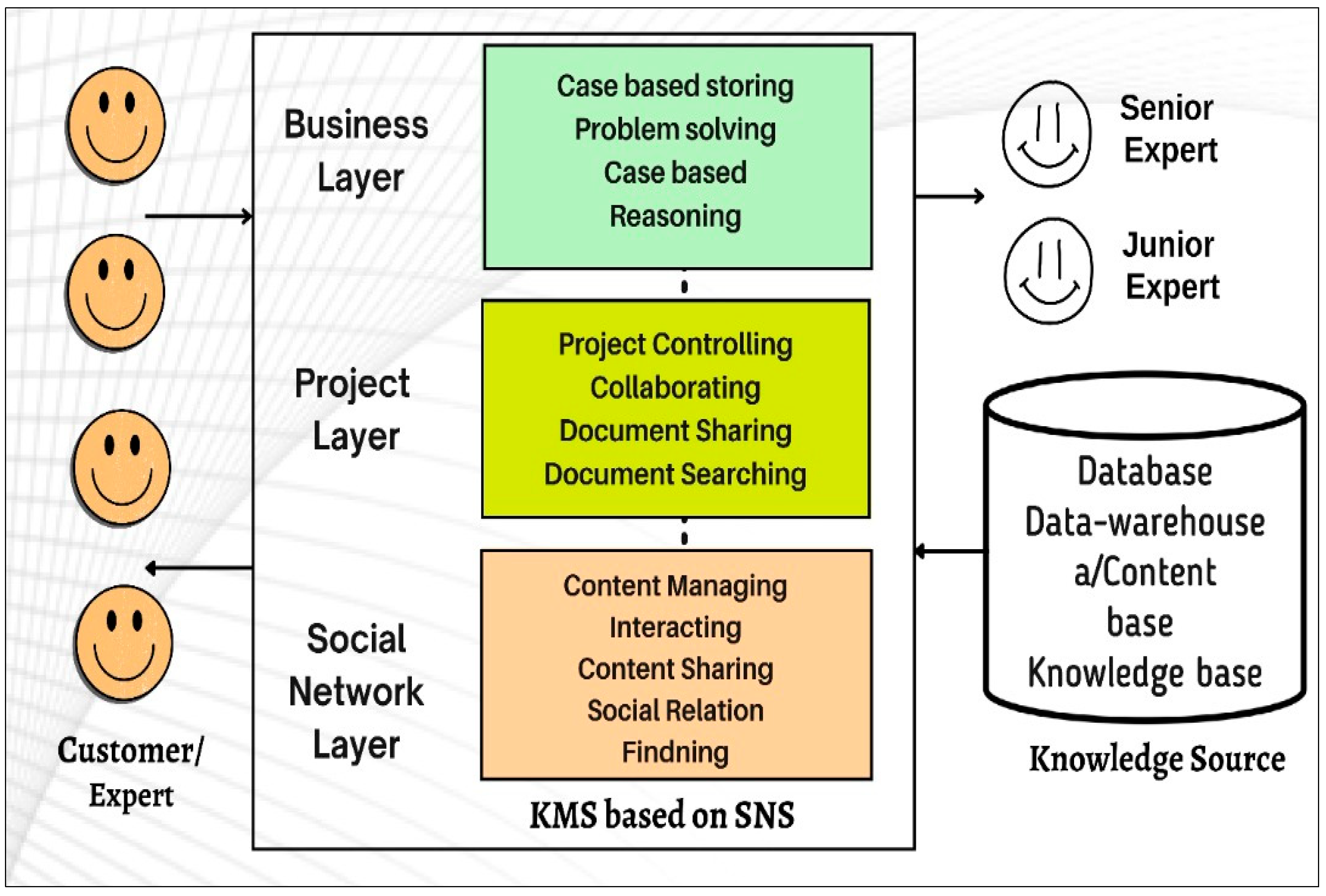
Through the demo KMS based on SNS, one of the most significant advantages of KMS based on SNS is to improve knowledge flow (relational capital) and ease its retention and dissemination.
Similarly, KM, LMS, and E-learning are compatible platforms; this is another approach to enhance teaching and learning activities if they are properly integrated.
Figure 2.
Hybrid Model of KM and E-learning (Madar, 2014).
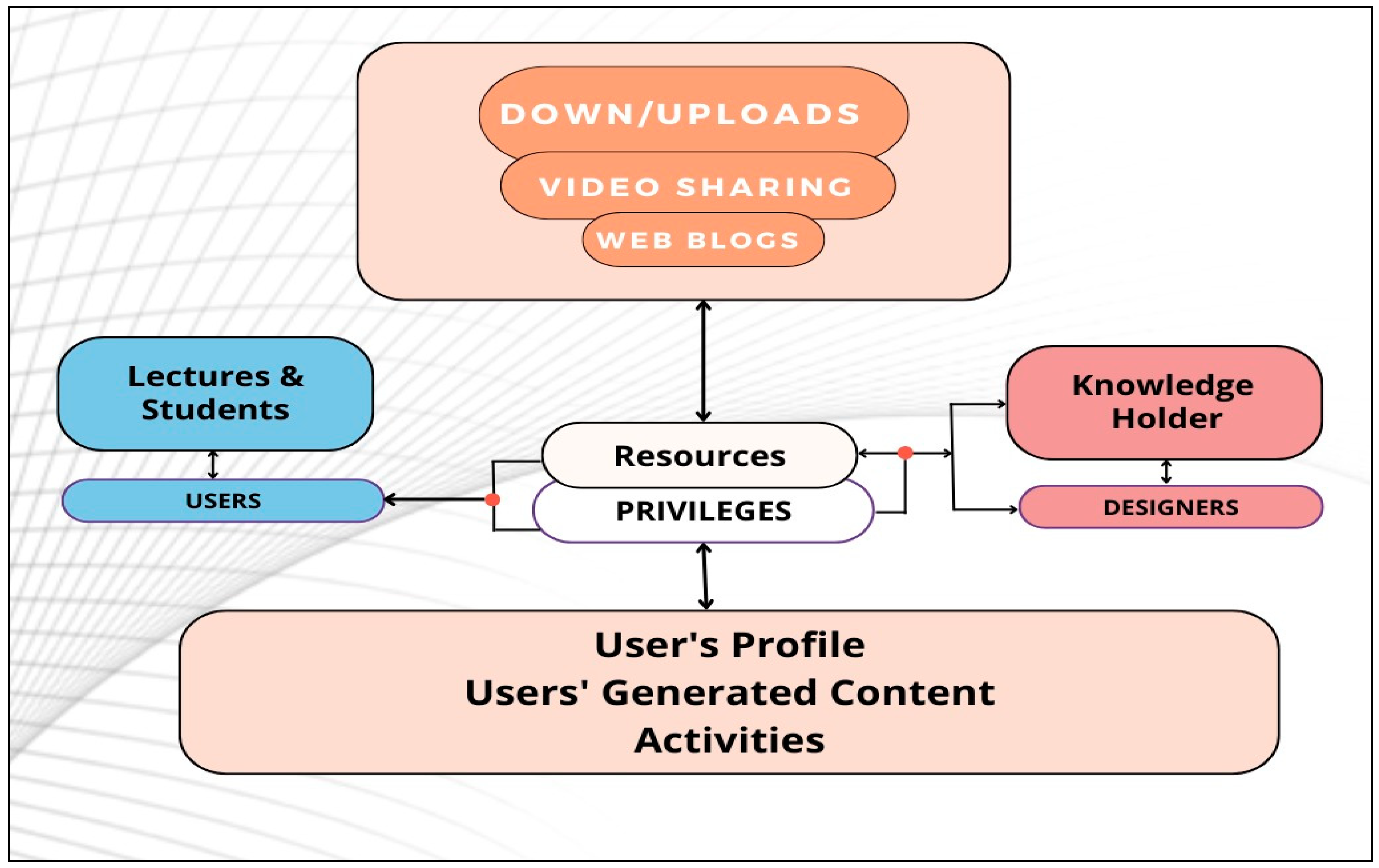
The above figure shows the combination of KM and E-learning functional features to form a hybrid KM framework. This hybrid model supports both knowledge holders, learners, and instructional leaders (Madar, 2014).
SM such as wikis; blogs, Facebook, academia, research gates, and others allow collaborative working. Their integration into KM enriches the teaching and learning process if they are properly planned, configured, and integrated. Furthermore, they offer an effortless method for people to communicate, collaborate and consequently support the creation and dissemination of knowledge(J. Hemsley & R. Mason, 2012). Similarly, SM could also be used as an effective and accessible way of transmitting and sustaining the Somali IK across the loops of the SM. Aforementioned, storytelling is one of the mechanisms that adults transfer wisdom, and traditions to the younger generations, and using SM would allow future generation access to the Somali IK.
Knowledge creation and transfer processes have a strong social underpinning as they are dependent on interpersonal networks (Crevoisier & Jeannerat, 2009). Research on individualinteractions has exposed how actors and community-level attributes facilitate knowledge creation and mobilization (Allard & Ferris, 2015). Knowledge is a collective activity embedded in social interactions within both economic and social contexts (Antonelli, 2006). In recent years, there are many organizations that put into practice SM such as blogs, wiki, internal networks, and so on as communication tools to facilitate knowledge sharing between the knowledge holders and users across the society (Panahi, Watson, & Partridge, 2013).
Several studies have indicated a positive impact on the application of SM to knowledge sharing. As such, SM can be handy and would make easy knowledge sharing activities within and across knowledge holders, users, and contributors (Zaffar & Ghazawneh, 2012).
Likewise, SM would be useful tool for Somali knowledge holders and users use it to present and share IK in more accessible ways. KM and SM if they are properly integrated would enhance and improve management of the ingenious knowledge, which may be difficult to capture and disseminate across different channels. Linking SM to KM would again increase access to IK and accelerate its dissemination activities through various SM channels (Antonelli, 2006). Building strong IK community of practice (CoP) through incorporating SM functions into KM functions KMS would play a crucial role in sustaining the IK.
On contemporary social networking sites, participation rates are “astounding”, since “huge information and data are freely revealed by the user. Similarly, the number and type of knowledge sharing on Web 2.0 platforms including profiling, blogging, posting, tagging, and reviews is incremental and continues to increase (Paroutis & Al Saleh, 2009).
People are liberally contributing to online knowledge communities of all kinds, even when the benefits go directly to different purposes, let it business or education matters(Allen, 2008). This same applies to knowledge holders if they are given to a platform that connects them to knowledge users and contributors, and then both tacit and explicit knowledge holders can freely contribute to knowledge communities.
3. The Proposed Integrated Framework of KM and SM
The proposed framework consists of two functional parts; KM and SM. The KM part involves in knowledge capturing, creation, validation, profiling, formatting, storing, and distribution. SM part of the framework involves in knowledge presentation, sharing, and application. Knowledge presentation refers to the ways knowledge is displayed to the organizational members. While other existing KM models illustrate three concentric circles interacting directly to one another; creation and sensing, organizing and capture, sharing, and dissemination. The proposed framework shows a process in which KM and SM are integrated to make KM richer and more accessible. This framework was designed to sustain the IK by establishing interaction among the holders, contributors, and users of IK. This framework has a central repository that stores knowledge. Knowledge profiling and validation are other functional features that verify the authentic sources of different knowledge domains. The validation mechanisms have a role to prevent knowledge manipulation and information distortion, which may infringe intellectual property rights.
Figure 3.
Madar’s Indigenous Knowledge Management Framework.
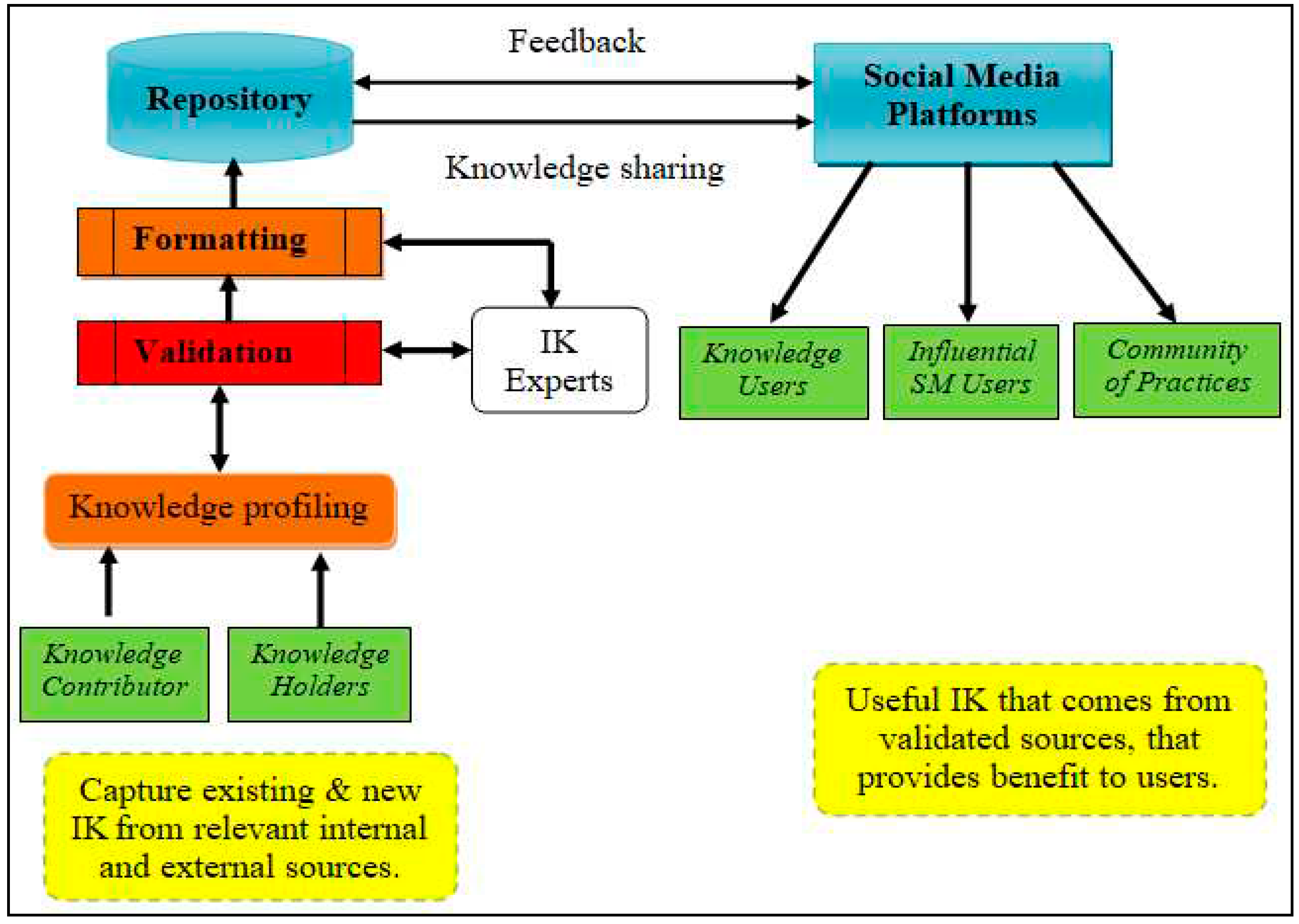
The major challenges to the management and preservation of IK are issues relating to collection development, intellectual property rights, access and the preservation media. In this regard, this framework is designed to support different forms of knowledge, and disseminate them through different channels of the SM. Most importantly, the proposed framework captures tacit IK from external sources, and converts it into explicit IK. In this framework, the components and functions of the SM and KM system are integrated into two different levels by considering their similarities. This framework illustrates that the function of SM is to ease sharing and utilization. In contrast, KM's role is to capture and transfer both explicit and implicit knowledge. Knowledge profiling and validation is also core functions designated to ensure quality information provided to different levels of users.
Additionally, this framework has IK experts, whose function is to validate and verify content and quality of knowledge domains. Knowledge validation is a painstaking process of continually monitoring, testing, and refining the knowledge base to suit the existing or potential realities. Experts in the validation process review, test, and validate their knowledge base to keep up with the latest knowledge in the discipline and discard the outdated knowledge. The KM design perspective is an alternative that relates to holders, users, contributors of knowledge and sharing it with SMs users.
In this framework, holders are reflective tacit and explicit knowledge holders in this case are said to be IK holders, who struggle to share their knowledge with knowledge users. The SM perspective is a supportive function that complements with functions of the KM; it relates to knowledge users, CoP, and influential SM users for dissemination purposes. This perspective has two essential aspects. According to the perspective, this chapter incorporates each element into a new conceptual framework that integrates the significant component of KM and SM frameworks.
Similarly, this framework supports reluctant knowledge contributors who like to share knowledge with their groups through using collaborative SM features including Google community and similar technologies. These technologies would help reluctant knowledge contributors establish their own knowledge networks. Open knowledge contributors could use both layers of the proposed framework in different capacities; they can join to specific CoP, or they could be contributors, and users.
4. Conclusion
This chapter explores effective and efficient approaches to integrating KMS into SM, and how they support knowledge transfer and creation. Basic functions of KM and SM components are discussed and their common features are investigated. The proposed integrated framework has two layers that are interconnected, and interactive, which allows KM layer and SM layer to establish collaborations within the knowledge ecosystem.
The use of social networking tools will help more holders, users, and contributors of IK to connect and form huge knowledge networks.
This framework will also improve the process of knowledge discovery and knowledge sharing across virtual communities and indigenous knowledge holders. Transfer between tacit and explicit knowledge in both directions would enrich the existing IK through profiling and validating potential knowledge sources.
Through analysing the main functions of KM and SM, this chapter proposed a hybrid KMS framework that contains the two functions to conserve the IK. This pattern is adaptable to learning society, which can create a flexible environment for the development of IK.
This chapter addresses the above gaps and contributes to this literature by offering an IK perspective of how these processes vary across space and whether they follow or challenge established geographies of knowledge.
Using this integrated framework would help Somalis to preserve and sustain IK, and overcome difficulties in practicing their traditions.
Future research should focus on other factors or see the impact of virtual communities on IK, especially those related to conflict management and peace building.
Acknowledgments
The author would like to thank Dr. Ahmed Moussa and Dr. Ismail Bile for their comments on a previous version of the chapter. Similar thanks go to Mr. Muse Dirie and Mohamed Sulub for fruitful early discussions on this topic, the participants, and the 14th SSIA congress organizers of Jigjiga University.
References
- Ahmed, A., Khan, A. R., & Ahmed, S. (2014). Collaboration of knowledge network and e-learning system with social sites for teaching-learning. Chapter presented at the 2014 Fourth International Conference on Advances in Computing and Communications. [CrossRef]
- Allard, D., & Ferris, S. (2015). Antiviolence and marginalized communities: Knowledge creation, community mobilization, and social justice through a participatory archiving approach. Library Trends, 64(2), 360-383. [CrossRef]
- Allen, J. P. (2008). How Web 2.0 communities solve the knowledge sharing problem. Chapter presented at the 2008 IEEE International Symposium on Technology and Society. [CrossRef]
- Antonelli, C. (2006). The business governance of localized knowledge: an information economics approach for the economics of knowledge. Industry and Innovation, 13(3), 227-261. [CrossRef]
- Crevoisier, O., & Jeannerat, H. (2009). Territorial knowledge dynamics: from the proximity paradigm to multi-location milieus. European planning studies, 17(8), 1223-1241. [CrossRef]
- Fullwood, R., Rowley, J., & Delbridge, R. (2013). Knowledge sharing amongst academics in UK universities. Journal of knowledge management. [CrossRef]
- González-Valiente, C. L., Costas, R., Noyons, E., Steinerová, J., & Šušol, J. (2021). Terminological (di) Similarities between Information Management and Knowledge Management: a Term Co-Occurrence Analysis. Mobile Networks and Applications, 26(1), 336-346. [CrossRef]
- Hemsley, J., & Mason, R. (2012). The nature of knowledge in the social media age: Implications for knowledge management models. En 2012 45th Hawaii International Conference on System Sciences. IEEE, 2012. In. [CrossRef]
- Hemsley, J., & Mason, R. M. (2012). The nature of knowledge in the social media age: Implications for knowledge management models. Chapter presented at the 2012 45th Hawaii International Conference on System Sciences. [CrossRef]
- Hemsley, J., & Mason, R. M. (2013). Knowledge and knowledge management in the social media age. Journal of Organizational Computing and Electronic Commerce, 23(1-2), 138-167. [CrossRef]
- Jiang, K., & Gao, Z. (2010). Research on the application model of Personal Knowledge Management based on Social Software. Chapter presented at the 2010 2nd IEEE International Conference on Information Management and Engineering. [CrossRef]
- Lwoga, E. T., Ngulube, P., & Stilwell, C. (2011). Challenges of managing indigenous knowledge with other knowledge systems for agricultural growth in sub-Saharan Africa. [CrossRef]
- Madar, M. J. (2014). Hybrid Model Of E-Learning With Knowledge Management.
- Owiny, S. A., Mehta, K., & Maretzki, A. N. (2014). The use of social media technologies to create, preserve, and disseminate indigenous knowledge and skills to communities in East Africa. International Journal of Communication, 8, 14.
- Panahi, S., Watson, J., & Partridge, H. (2013). Towards tacit knowledge sharing over social web tools. Journal of knowledge management. [CrossRef]
- Paroutis, S., & Al Saleh, A. (2009). Determinants of knowledge sharing using Web 2.0 technologies. Journal of knowledge management. [CrossRef]
- Quoc, T. P. (2013). Apply KM and SNS for Improving Labor Productivity of Vietnamese SMS.
- Schoenherr, T., Griffith, D. A., & Chandra, A. (2014). Knowledge management in supply chains: The role of explicit and tacit knowledge. Journal of Business Logistics, 35(2), 121-135. [CrossRef]
- Tranos, E. (2020). Social network sites and knowledge transfer: An urban perspective. Journal of Planning Literature, 35(4), 408-422. [CrossRef]
- Warren, D. M. (1991). Using Indigenous Knowledge. Agricultural Develop-ment World Bank Discussion Chapters(127).
- Zaffar, F. O., & Ghazawneh, A. (2012). Knowledge Sharing and Collaboration through Social Media-the Case of IBM. Chapter presented at the MCIS (Short Chapters).
Disclaimer/Publisher’s Note: The statements, opinions and data contained in all publications are solely those of the individual author(s) and contributor(s) and not of MDPI and/or the editor(s). MDPI and/or the editor(s) disclaim responsibility for any injury to people or property resulting from any ideas, methods, instructions or products referred to in the content. |
© 2023 by the authors. Licensee MDPI, Basel, Switzerland. This article is an open access article distributed under the terms and conditions of the Creative Commons Attribution (CC BY) license (http://creativecommons.org/licenses/by/4.0/).
Copyright: This open access article is published under a Creative Commons CC BY 4.0 license, which permit the free download, distribution, and reuse, provided that the author and preprint are cited in any reuse.


