
Submitted:
11 December 2023
Posted:
20 December 2023
You are already at the latest version
Abstract
Climate change is unpredictable and can change rapidly or over time; anthropogenic stressors work synergistically to strengthen their impact on vulnerable ecosystems and the fisheries sector. This study documented the past occurrence of extreme climate change impacts, such as supertyphoon Pablo (ST: Bopha), which severely affected Baganga, Davao Oriental, about ten years ago. A mixed-methods data collection was used, combining semi-structured interviews with small-scale fishers (N=120) in four fishing villages and focus group discussions (N=4, participated by about 4 focus groups) on assessing the impacts and their adaptation after climatic events occurred. Our findings indicate that the four selected fishing villages were exposed to common factors of climate change events that destroyed many lives and their livelihood. Including a decrease in catch per trip and the fishing operations disruption (98%). However, due to the impact of the supertyphoon, small-scale fishers in Baganga developed psychological distress (emotional 44% and physical 24%) due to the extreme event or disaster and economic losses (32%). In order to survive, their adaptation strategies relied on government and non-government-provided provisions and projects, e.g., planting trees, constructing a sea wall with wave breakers, cash for work, and tourism as an alternative livelihood. Despite this, our study revealed that the community had limited knowledge on the impacts of climate change, lack clear management goals especially for fishers, and the widespread use of illegal fishing gears. The local government must strongly implement rules, policies, and adaptation measures that will contribute to better and more resilient communities. This can help them to withstand future shocks and provide sustainable fisheries resources that will benefit all the fishers. The study will be useful to policymakers, disaster management group and organization that will help assist affected communities highly affected by climatic events.
Keywords:
adaptive strategies
; climate risk management
; livelihoods
; small-scale fisheries
; supertyphoons
1. Introduction
Small-scale fishers have historically made significant contributions to the growth of global fisheries in terms of employment, economic, social, individual levels, cultural identity, and, most importantly, food security for millions of people worldwide (Bene et al., 2007; Finegold, 2009; Schuhbauer & Sumaila, 2016; Gough et al., 2020). Small-scale fishers produce half of the world’s food supply, which is crucial for life and welfare (Bene, 2005). However, small-scale fishing accounts for 22 million fishermen worldwide, with 95% of fishermen in developing nations fall into this category (FAO, 2004). About 90% of fishers (Kelleher et al., 2012; Schuhbauer & Sumaila, 2016) rely on work in catch fisheries. According to Perez et al. (2012), it employs 1.4 million people in the Philippines.
Around 90 million Filipinos consume fish annually at a rate of approximately 38 kg/per capita/year (Perez et al., 2012). Fish protein makes up to 45% of the animal protein eater daily by fisher and it is frequently the least expensive and prevents hunger in many other developing countries (Finegold, 2009; Cochrane et al., 2009; World bank, 2012; Gough et al., 2020; Macusi et al., 2020;). Similarly, to Bell et al. (2009). Seafood fish products are the most widely traded food item, accounting for one-third of all fisheries goods, particularly in developing nations (Finegold, 2009). The Philippines fisheries, includes the production of fin fish, crustaceans and mollusks, generates that 4.40 million tons of fish annually, placing it eighth among the top-producing nations, according to BFAR (2020).
However, the effects of climate change are widespread on ecosystems, communities, and economies, placing stress on infrastructure, means of subsistence, and food supply, particularly in the fisheries and aquaculture industries (Cochrane et al., 2009). Climate change is defined as a significant change in the environment, such as an abrupt increase in global atmospheric temperature, prolonged periods of rainfall, snow, and wind directions (Fakana, 2020; Salim et al., 2014; IPCC, 2014; Jacinto et al., 2015), and a drop in biomass (Hasni et al., 2023). These phenomena have multidimensional effects on the environment, social, economic, human, biodiversity, agriculture, and food security (Salim et al., 2014; Jacinto et al., 2015; Cai et al., 2015). Including the irregular occurrence of El Niño and La Niña, which resulted in global disruptions of weather patterns. It was estimated that 75% of the occurrence of these events every year (Cai et al., 2015) affected the distribution, abundance, and metabolic patterns of fish species due to a decrease in temperature (Domingues et al., 2000; Padilla, 2002).
Other factors that exacerbated climate change impact include growth of population and human activities which occurred in the 20th century (e.g., air, water, land pollution, greenhouse gas production, deforestation, emissions of carbon dioxide, and desertification) (Macusi et al., 2011; Nwankwoala, 2015; Holden & Marshall, 2018; Fakana, 2020). Due to this effect, fish production is affected (BFAR, 2021). Other climate change impact also extends to other valuable species such as glass eel production which has been declining globally due to anthropogenic activities, pollution, habitat loss, overexploitation, and global oceanic changes (Tattao et al., 2022). Similar findings in Davao Gulfs indicated that climate change impact heavily influenced invasive species that damaged ecosystem and reduced fish harvest due weather pattern change, fishers experienced hotter temperatures, and climatic shifts (Macusi et al., 2021). Other causes of depletion include overfishing of marine species, coral bleaching, and conversion of mangrove forests to aquaculture projects (Muallil et al., 2013). These issues are exacerbated by the use of illegal fishing gears and competition between commercial and small-scale fishers, which are also affected the volume of fish caught (Macusi et al., 2020; Gough et al., 2020; Warren & Steenbergen, 2021). Furthermore, people have turned to exploiting marine resources in order to survive, which has a negative impact on the ecosystem (Benn et al., 2014; Swinburn et al., 2019). These actions might lead to a decline in fishing activities, a loss of income, and lost opportunities for fishers (Perez et al., 2012; Macusi et al., 2021)
According to Daw et al. (2009), poorer and less empowered individuals are more vulnerable to climatic change impacts, wherein the fisheries sectors suffer the most from overexploitation and climatic change impact. Effective adaptation measures are there needed to mitigate the impacts of climate change including natural disasters. This require governance and anticipatory actions of individuals or public institutions and must be based on livelihood and well-being. Additionally, to achieve resilience and reduce small-scale fishers’ vulnerability, adjustments in fisheries management will demand significant changes (Andrew et al., 2007). Other evidence suggests that in order to mitigate the effects of climate change, a variety of adaptive strategies must be developed and planned to improve the capacity of individuals, groups, and organizations, diversify the livelihood, and maintain the well-being of small-scale fishers (Smit et al. (2000), Agrawal & Perrin (2007), and Daw et al. (2009). This study was conducted to assess the impact of climate change, especially extreme events. There are currently no studies in the Philippines documenting the impact of the extreme events that occured in 2012 (e.g., Super Typhoon Pablo that destroyed Baganga). In doing so, we seek to contribute to understanding the impact of extreme climatic events on the affected fishing communities in Baganga, Davao Oriental. This study was based on their experience and perception of the impacts of extreme events that affected them and their responses or adaptation.
2. Methodology
2.1. Description of the Study Area
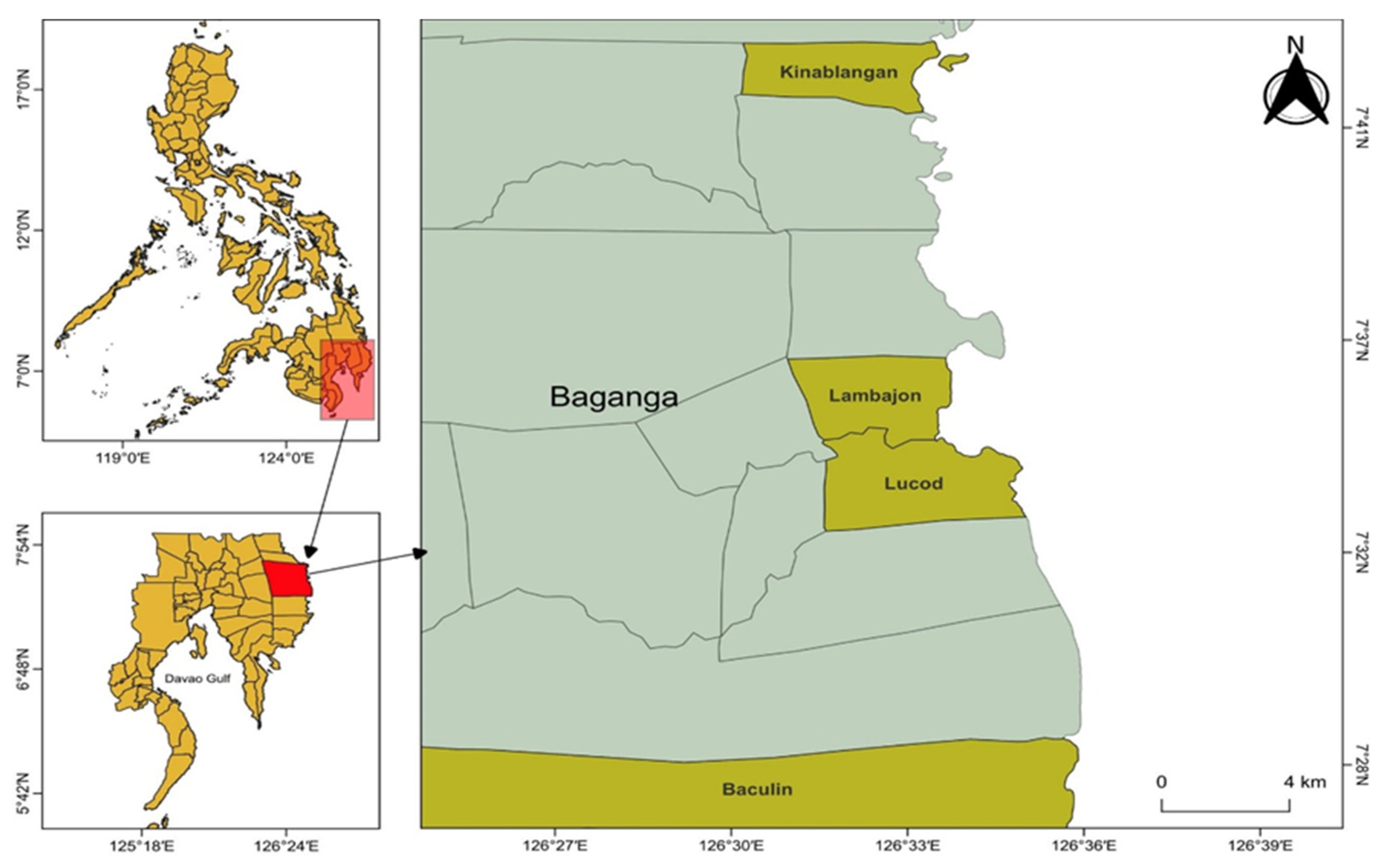
Baganga is a first-class municipality in Davao Oriental, with a total population of 58,714 people. According to the Philippines Statistic Authority 2020 (PSA), the four-study areas had a population of 6,080 in Kinablangan, 3,922 in Baculin, 7,635 in Lambajon, and 5,087 in Lucod. These four barangays have the highest number of small-scale fishers. Furthermore, Baganga is well-known for producing seafood byproducts such as tuna, banana fiber, and copra, which are the province’s main source of income. Preview to the Typhoon events, Baganga was also a local exporter of plywood products. Today it mainly relies on fishing, farming, and tourism.
Figure 1.
Location of the map showing the four barangays’ in Baganga, Davao Oriental.
2.2. Pilot testing and conduct of semi-structured interview
Pilot testing was conducted to evaluate the answers of respondents to the questions and check the reliability of the questionnaire to be used. To do that, the researchers chose ten small-scale fishers as respondents. The purpose was to eliminate questions that were unnecessary to ask the respondents and to determine whether questions were answerable by the respondents. The semi-structured interview was conducted on a one-on-one setting, and the questions contained both closed and open-ended questions, followed by how and why questions where necessary (Newcomer et al., 2015). During the first round of data collection (December 2022) semi-structured interview was used, which contained sociodemographic profile of the respondents, climate change impacts, and their adaptation during and after the extreme events, how they coped with the situations, and how extreme events affected their livelihoods. The researchers enlisted the guide in selecting the study site with the assistance of the Municipal Agriculture Office (MAO).
Four barangays were selected which were Kinablangan, Baculin, Lambajon, and Lucod, with the highest number of small-scale fishers found in Baganga. In each barangay, 30 small-scale fishers (N = 120) were selected to participate during the interview. Initially, researchers discussed the purpose of the study and provided the participant with consent and informed before the interview. All information provided were kept confidential and only used for generating reports.
2.3. Focus Group Discussions
The focus group discussion is a qualitative approach to study social and adaptive aspects of climat change impacts (Nyumba et al., 2017). We used FGD during the meeting (December 2022), to validate all important data from the fishers. The researchers invited 10-15 fishers in the four barangays with a total participant of N=135. Through this meeting, the researchers collected data regarding anthropogenic stressors in the area (e.g., garbage, compressors, climate change), their social and economic status and ecological impact of climate change, and their adaptation. One researcher assists in documenting and recording the study regarding the fishers’ ideas and response, another did the photo documentation.
2.4. Target Respondents
In the four barangays, thirty respondents were selected among the small-scale fishers (n=30) based on the list from the Municipality Agriculture Office (MAO). Our criteria for the interview of the fishers include a fishing exposure of more than ten years because typhoon Pablo occurred more than ten years ago. All precautionary health measures were observed during the focus groups. Before the interview, the researcher asked if they spent ten years or more as fishers. Most of the four barangays lack community organizations due lack of initiative and cooperate and potable measure. Moreover, there is lack of engagement with BFAR (Bureau of Fisheries and Aquatic Resources).

Table 1.
The respondents from four barangays in Baganga, Davao Oriental.
| Barangay | Semi-structured | Focus group discussion |
|---|---|---|
| Small-scale fishers | Small-scale fishers | |
| Kinablangan | 30 | 45 |
| Baculin | 30 | 15 |
| Lambajon | 30 | 11 |
| Lucod | 30 | 64 |
| TOTAL (N) | 120 | 135 |
2.5. Data Analysis
Field questionnaires, notes, and phone recordings were taken during semi-structured interviews and focus groups in the four barangays in Baganga, Davao Oriental. Later, the researchers transcribed all data gathered during the fieldwork and translated it into English. The responses were organized and tabulated, preliminary graphs were also done based on the data, economic situation, and discussions. Some opinions from the respondents were converted into quotes and cited directly in the paper. All quantitative parts of the data set were given in percentages and averages.
3. Results
- Sociodemographic Profile
The four barangays of Kinablangan, Baculin, Lambajon, and Lucod in the municipality of Baganga had the highest numbers of small-scale fishers. Although most locals depend primarily on fishing for their livelihood, they differ in other ways. In terms of age, number of households, typical catch, hours spent fishing, amount of fuel used each trip, number of trips made per week, the amount of money earned per trip, and alternative sources of income. The average age of all fishers was 46 years old. The oldest fishers were from Barangay Lucod, 52 years old, followed by those in Baculin, 47 years old, Kinablangan, 46 years old, and Lambajon, 40 years old. Moreover, regarding years in fishing, the majority of the fishers have an experience of more than 20 years in fishing operation, except for Lucod. Respondents from Lucod were younger than those from the other barangays because they were mostly in their 20s and 30s. In comparison, Kinablangan had 25 years, followed by Baculin at 26 years, and Lambajon at 29 years of fishing experience. The overall average household number was four (see Table 2).
In addition, the average fish catch was 12 kg, but the highest catch recorded in the area was 21 kg for Lucod, followed by 16 kg for Kinablangan, 6 kg for Baculin, and 5 kg for Lambajon. The common catch species include frigate mackerel tuna (Auxis thazard), yellow fin tuna (Thunnus albacares) bullet tuna (Auxis rochei), skipjack22 tuna (Katsuwonus pelamis) and bigeye scad (Selar crumenophthalmus) and groupers. These catch species were very common in the area and commands a commercial price in the market and provide premium catch quality. The longer time that fishers stay offshore fishing, they perceive that this practice can increase their catches. Because of this, some fishers opt to stay longer in the fishing ground (>24 hrs.). Once they stayed longer, they also consumed more fuel, e.g., 16 L for Kinablangan, followed by 5 L in Baculin, 8 L in Lucod, and 3 L in Lambajon. In addition, the majority of the small-scale fishers focus on catching fish, and they travel four or five times in a week, even if the weather is bad e.g., torrential rains and windy. In terms of weekly income revenue, Lucod posted the highest weekly revenue (Php 2,014), Kinablangan (Php 900), Baculin (Php 689), and Lambajon (Php 760). Despite this, fishers’ income will still be lower because the revenue will be deducted with fuel expenses and other operations expenses. Thus, they bring lesser money home (see Table 2). Furthermore, the four barangays had a low percentage of access to credit, with an average of 58%, and some of them mentioned that they do not have a choice but to avail of opportunities that lenders provide to sustain their family’s needs and continue their fishing operations.
- 2.
- The small-scale fishers’ sociodemographic profile
Table 3 shows the differences in fish catch during normal days and during the presence of extreme events. The fish catch of small-scale fishers depends on their abilities to endure the challenges in the fishing grounds and the weather. The four barangays have different averages of fish catch, which in Kinablangan had a normal catch of 46 kg, followed by Lucod at 20 kg, Baculin at 9 kg, and Lambajon at 8 kg. Large pelagic fishes, yellowfin tuna (Thunnus albacares), bullet tuna (Auxis rochie), skipjack tuna (Katsuwonus pelamis), and frigate tuna (Auxis thazard) were some of the most commonly targeted fish by small-scale fishers.
Regarding motorized and non-motorized boats, three sites, e.g., Kinablangan (n=25), Baculin (n=28), and Lucod (n=28) have fishers that own or rent their boats. Meanwhile, in the barangay of Lambajon, fishers have lesser number of motorized boats, and the majority of them used manual paddle boats (n=21). Fishers who use manual boats can save more money since there is less needed. However, they cannot fish further offshore and they usually end up with fewer catches, affecting their daily income. Moreover, after the impact of the extreme events in December 2012, fishers reported that the fish they were catching also started to decrease. For example, in the case of Kinablangan, from previous normal catch of 46 kg down to 12 kg, followed by Lucod 20 kg down to 12 kg, Baculin 9 kg down to 3 kg, and Lambajon 8 kg down to 3 kg. Some of the reasons mentioned to have caused this decrease include destruction of fish habitat, intrusion to municipal waters of commercial fishers vs. small scale fishers causing conflicts destructive and illegal fishing, as well as lack of viable marine protected areas (MPAs) in the area. The conflicts arising from the commercial fishers and the municipal fishers has already affected the latter’s fishing operations, some even filed complaints to their local management but was ignored.
- 3.
- Extreme impacts of climate change and fisher’s adaptation
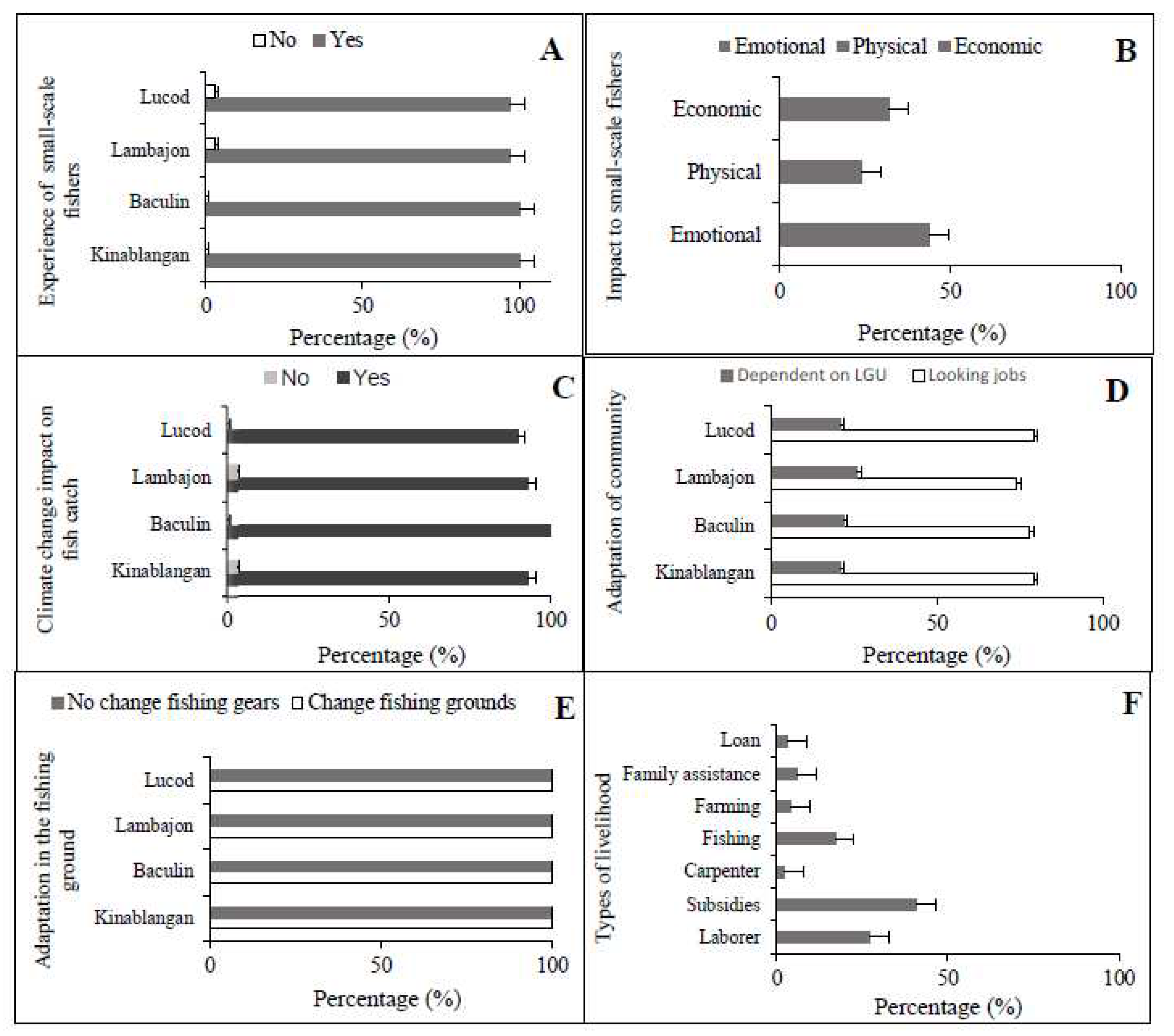
Naturally occurring phenomena such as storms and typhoons are not new in the fishing grounds, and small-scale fishers say that they are used to it and had become part of their lives. This especially occurs during the “ber months” (September to December). However according to the fishers’ perception, their experience during super typhoon Pablo (2012) was different and they consider it one of the most tragic part in their lives, just as they described it. About 98% of the fisher respondents in the four barangays concluded that they experienced extreme events (typhoons and supertyphoons) while only 2% experienced less impact on their livelihood and mental health since they temporarily migrated to another place to secure their families (Figure 3A). The surveyed respondents in this study concluded that they recovered after almost a year to sustain their income, including building their own houses. But even though the impact was 10 years ago, the trauma and phobia of strong wind and heavy rains put them into remembrance of what happened in December 2012. The four barangays responded that 44% among small-scale fishers experienced these emotions (fear) towards extreme events and 24% of them experienced physical damages (destroyed house) (Figure 3B).
Regarding the supertyphoons’ economic impact, the fishers from the four barangays run their own little businesses that were managed by their wives, such as a sidewalk public market or a tiny sari-sari store, to have a daily income. Nevertheless, the impact of the extreme event destroyed their source of income, about 32% of these stalls vanished (Figure 3B). The event caused them distress and anxiety.
In addition, as shown in Figure 3C, the changes in the small-scale fishers’ catch were associated with the supertyphoon Pablo resulting in decrease of fish supply in the market. Fishers have mentioned that when this extreme event occurred, it significantly reduced their fish catch. Small-scale fishers in Baculin (100%) declared that climatic events were factors that held their fishing operation and limited their daily income. At the same time, fishers from Lambajon and Kinablangan say 93% experienced decrease in their fish catch, followed by Lucod at 90%. However, small-scale fishers continued their fishing operation to alleviate their hunger. These fishers do not go beyond 3 km away from their home. They usually catch fish near the shore to stay safe even if there was a calamity. Moreover, during and after the supertyphoon Pablo, the community received subsidies from various local and international donors, but because of the big impact, the assistance was not enough in the long term. The affected community were underserved.
So, the small-scale fishers found new sources of income to survive, and this was shown in the result as 79% of the respondents from Kinablangan and Lucod agreed that many of them also traveled to look for jobs, followed by 78% of respondents from Baculin and 74% of Lambajon (Figure 3D). Many of these small-scale fishers were also dependent on government subsidy. Also shown below are the different types of livelihood and sources of income of small-scale fishers after the extreme events (Figure 3F). Moreover, our respondents revealed that they received subsidies from international, local, and non-government organizations (41%). The government provided them work and food subsidies per family so that they can gradually cover their expenses (this was the time just after the typhoon), such as cash for work that lasted for several months. They were paid weekly to assist government employees in charge of the clean-up after Typhoon Pablo left. Moreover, laborers (27%) received money from the government for working on cleaning streets, roads, and construction projects to build or rebuild new homes for those whose homes were partially or totally damaged. Pabahay project included works for carpenters (2%) while other families continued to catch fish (17%) near shore and farm crops (4%) as substitutes for canned goods and noodles, and others received assistance from relatives (6%) and availed loans 3% (Figure 3F).
In terms of adaptation in the fishing ground, the fishers nowadays have chosen to fish and stay longer in their fishing grounds, practiced changing their fishing grounds from time to time, or went fishing beyond their usual distances compared to 10 years ago when they usually fish near the shore. For example, the four barangays (e.g., Kinabalangan, Baculin, Lambajon, and Lucod) (100%) traveled further because of fish depletion near the shore. However, there was no change in fishing gear, there might be changes in fishing areas but not in fishing gears. Whereas the respondents used the old type of gear and techniques such as hook-and-line, spear, multiple hook and line “palangre,” and fishing nets (Figure 3E).
Figure 3.
Extreme climate change impact of super typhoon to fisher in barangay; Experience of fishers (A), Emotion, physical and economic of climate change on small-scale fishers (B), impact to fish catches (C), adaptation of community (D), adaptation in the fishing ground (E), and types of livelihood (F).
Figure 3.
Extreme climate change impact of super typhoon to fisher in barangay; Experience of fishers (A), Emotion, physical and economic of climate change on small-scale fishers (B), impact to fish catches (C), adaptation of community (D), adaptation in the fishing ground (E), and types of livelihood (F).
- 4.
- Community recollection of the disaster
During the focus group discussions and semi-structured interviews, the four barangay respondents were asked about their experiences and how they coped and managed the difficult situations after the extreme event, Typhoon Pablo “Bopha.” Typhoon Pablo was one of the strongest typhoons in the Philippines that sadly landed in Baganga on December 4, 2012. The majority of respondents were local or “lumad” tribe of “Mandaya” who had lived and stayed for more than 50 years in the municipality. The main crops being planted and sources for their food and income were crops e.g., banana, coconut, and cassava, coconut copras, plywood and abaka fiber. Before the tragedy, the government warned each barangay to evacuate the area due to impending floods and possible landslides because the area will be the main landfall area of the supertyphoon. However, some older residents concluded that their grandparents were born, raised, and reached 70 years old but they did not even experience heavy and strong winds; so half of the community concluded that they will not be affected by the supertyphoon and did not listen to the government warning. The other reasons mentioned for this is that if they leave their houses, perhaps, thieves will steal all their appliances, livestock, and food supply, as well as ransack their grocery stores. Due to these rationalizations, the entire community suffered from loss of properties, damaged homes, loss of love ones, and hunger and injuries.
The following response were recorded during the semi-structured interviews and focus groups which show strong emotions towards the impact of supertyphoon Pablo:
“If only we listened to the government, hopefully we had prepared ourselves.” (XI-fisher from Kinablangan)
“If the government only explained it properly, we could have prepared ourselves and evacuated.” (II fisher from Baculin)
“It was very painful to lose our love ones, livelihood, sari-sari store and boat.” (VI-fishers Baculin)
“We were away from home for three days and did not bring anything even extra clothes to change on because we were not prepared for what happened.” (II-fisher from Lucod)
“All of our newly harvested rice got wet, and our house was damaged by the typhoon, and I could not understand the pain in my heart.” (XI-fishers from Lambajon)
“I thought like I’m going crazy trying to find food for my family. My children were still very young, and they all experienced the tragedy of this typhoon.”(X- fisher from Lambajon)
“If not because of the response from the government, maybe I would have to beg for food just to feed my family.” (VII-fisher from Lucod)
“To be honest, what we ate after typhoon Pablo was taken from our neighboring sari-sari store because the store was destroyed and abandoned. I did not have a choice but to take the remaining goods to feed my family and survive.” (XXX-fisher from Kinablangan)
“The government assistance took a long time to arrive due to damaged brigdes, and we were very hungry so we decided to collect the fallen coconuts and ate them to survive.” (I- fisher from Lambajon)
“Our sari-sari store was our main source of livelihood and helped meet our daily needs. But everything we have been working for so hard all these years suddenly disappeared in one blip of the typhoon. We need to restart again to from scratch.” (III-fisher from Kinablangan)
I saw our neighbor injured, the children were hurt and sick because of the impact of Typhoon Pablo it was very heart breaking. I was also afraid for my family, if they developed illnesses because I do not know where to find a medicine and I do not have any money.” (XXI-fisher from Lucod)
“I was always thinking about how to survive from day to day, and whether our boat still existed, where shall we go from here?” (XV-fisher from Baculin)
“In order for us to have a temporary shelter, I gathered destroyed pieces of wood and galvanised steel roof materials to build a small house.” (V-fisher from Kinablangan)
4. Discussion
4.1. Social factors and fisher’s catch
Sociodemographic of fishers contribute to a proper understanding and knowledge of the small-scale fishers, including their household size, age distribution, level of education, income, and year on the fishing grounds (Lara et al., 2016). The small-scale fisher’s family composition showed that some married sons or daughters lived under their parents. The granddaughters and sons were raised by their grandparents, which is the reason they work so hard to sustain the whole family despite being senior citizens (Goodman & Silverstein, 2002). In Nigeria, 60.9% of the population, composed of 6 to 8 family members, were 24.5% for food security resulting in a negative impact to insufficient house food supply (Olayemi, 2012). In the Philippines, the average household size of families is 4.1 (PSA, 2020), and the larger family size is prone to early marriage, less individualization, and less investment of resources (Bartl et al., 2020; Kanazawa, 2012). The higher number of children could harm academic achievement because of insufficient income, unstable finances, and less attention given to studying instead of the top priority for food sustenance (Nanama & Frongillo, 2012). Moreover, the study of Palis (2020) indicate that farmers work so hard to pursue their children in education to avoid following in their footsteps as farmers. The higher the educational achievement this vibrants contributes to economy, society, and well-being of humans and positively impacts other fishers’ family (Rabearisoa & Zorzi, 2014). Education is the human capital that describes your status, and the less education leads to fewer opportunities and livelihoods (Rabearisoa & Zorzi, 2014). In Madagascar, 70% of fishers have five years below educational level, and it was shown that the fishing communities had a low level of education. As a result, less education is linked to difficulties in finding employment (Agarwal et al., 2009).
Other issue that was faced by fishers were lesser catch associated with financial losses due to extreme events and insufficient income to support their other needs (Islam et al., 2020). Including lack of access to credits and having low take home income (Macusi et al., 2022). This driver small-scale fishers to avail of informal lenders or financiers to maintain their fishing operation (Macusi et al., 2021). Moreover, the situation also forces the fishers to adopt new strategies to sustain their daily living (Islam et al., 2014). In Bangladesh, where flooding is frequent and cyclones, and other calamities affect their communities, they adopt strategies for both sea fishing and family livelihood such as tailoring, labor work, fish drying, and fish transportation (Islam et al., 2014; Islam et al., 2020). Similarly, in Surigao, the small-scale fishers who look for temporary jobs try to earn money, through construction jobs or work by weeding the frontage of their neighbors, and their housewives do the laundry to further support their family (Macusi et al., 2022). They follow this set-up even after extreme events because subsidies are not sustained after a few months although the affected communities are still suffering from its impact (Béné et al., 2007). The lack of jobs can lead to low contribution to the economy and safety of the community (Béné et al., 2007). The needs of the communities for more opportunities regarding livelihoods, training, seminars, and preparedness for extreme events have been noted and the Local Government Units (LGU) and Department of Social Welfare Development (DSWD) must provide attention to lower-income Filipinos and enroll them in their 4Ps program. A more sustainable future for the families includes subsidized housing and grants for the economic integration of the fishers, including marketing and value-adding of their catch.
4.2. Extreme impacts of climate change events
Extreme climate change impacts wrought by supertyphoons are highly destructive and does not only threaten community infrastructure, and economy, but also limits access to resources (Phuong et al., 2023). This is especially true for small-scale fishers who rely on various fisheries resources (Turner et al., 2020; Macusi et al., 2021). During the Typhoon Pablo, the municipality of Baganga suffered from its impact losing as much as 30% to 50% of its agricultural crops, that was estimated to be at U$ 645 million, which cut off the market supply chain (OCHA, 2012). However, the overall cost considering the affected region, was U$ 770.2 million (Munta, 2013). Aside from that the impact of climate change is not only confined to physical aspects but also affects the personal capabilities of a person such as the resulting depression, socio-ethical paralysis, loss of well-being, loss time for education and developing a social defense in response to climatic change (Acosta et al., 2016; Pihkala, 2018). The experience of the impact of extreme events can affect people both physically and psychologically and make them unstable (Bergquist et al., 2019). In addition, typhoons, earthquakes, and floods could cause mental health, post-traumatic stress disorder (PSTD), depression, anxiety disorders, and even lead to suicidal tendencies (Stimpson, 2005). Tropical storm cyclones and other storm-related effects impacts the community’s public health, including psychosocial, injury, infections, diseases, displacement, loss of jobs and livelihoods, and lead to economic crisis (Shultz et al., 2005). Similarly, in the U.K., when a severe storm hits the area, it has a direct emotional effect and a higher perceived personal and risk perception of the affected community regarding flooding (Demski et al., 2017). In New Bataan Compostela valley, the response had a similar emotional impact 75% of Cabinuangan expressed the feeling of fear against the landslide and floods after the strike, and this may connect with the insufficient support after the village was destroyed (Acosta et al., 2016; Eugenio et al., 2016). Furthermore, the small-scale fishers in Baganga suffered from psychological distress. For several months during recovery from destruction, regular wind and rain triggerred their anxiety and they developed illnesses because of stress, griefs and mourning their loved ones and opportunities and resources that were gone.
Also, earlier, the impact on agriculture, and aquatic resrouces was not given much attention due to less funding and therefore the lack of assessment, thus, there were no insurance programs to compensate the farmers and aquaculture owners after the typhoon (Prabhakar et al., 2013). The same situation occurred in Compostela valley and New Bataan which also suffered from huge landslide of rocks, timbers, and logs, and buried business areas, farms, and inland livelihoods (Manunta, 2013; Eugenio et al., 2016). Ironically, all the affected fishers in the community were the last to gain economic subsidies (Thrope, 2004; Islam, 2011).
Another issue is the yearly occurrence of typhoons from September to March which affects fishing operations and leading to decreased fish supply in the community due to the disruption of fishing activities. According to Bagata (2020), September to October is a wet season followed by the northeast monsoon, locally known as “Amihan,” which brings light environmental changes. However, from May to June, they also experience the southeast monsoon or rainy season “Habagat.” This disturbance affected their regular fishing activities resulting to lesser fish catch (Macusi et al., 2021). This is a contributing factor to resource lower fish product in the area in addition to fisher conflicts and overfishing (Béné & Friend, 2011; Islam, 2011; Macusi et al., 2022).
4.3. Policy changes required for climate change adaptations
The absence of proper management during and after climatic events in the fisheries sectors can be a bridge to less opportunity for coastal communities. Baganga is facing uncontrollable anthropogenic stressors, active compressor fishing, using poison plants to catch fish (Derris elliptica), locally called “tubli”, illegal fishing gear, and conflicts between commercial and municipal fishers. The municipality has a weak implementation of policy and management towards climate change that cause scarcity for food security, disruption of livelihood, and increased number of illegal activities towards upland and marine resources. According to Alam et al. (2018), a lack of information and less knowledge about the climate change impact will affect communities’ resilience capacity.
In spite of these, there are various way to respond to climate change impacts which is the trait to be resilient that can lead to a decrease in adverse impacts to the community (Shaffril et al., 2019). On top of that, the local and provincial government must prioritize development and adaptation planning to mitigate the effects of climate change impacts and alleviate the socioeconomic conditions of communities (Mimura et al., 2014), and government institutions must learn that adaptation practice have an effective outcome (Noble et al., 2014). Through generating activities, it will enable the fishers to learn alternative skills to develop and diversify their livelihoods, such as early education on climate change and proper dissemination of information, strengthening the public awareness programs, social relationships, participatory action on coastal clean-up, tree planting, proper garbage disposal, meetings (Shaffril et al., 2019; Alam et al., 2023), farming, and livestock’s (Kumar et al., 2020). Furthermore, other sectors like public and private fisheries needs to conduct agendas to introduce climate change information (Fahmi et al., 2013; Shaffril et al., 2016; Shaffril et al., 2017), and provide new economic opportunities to reduce dependence in fisheries resources (Bennett et al., 2014). Strengthening and engaging with local organizations can empower and prepare the community for any disaster impacts (Turner et al., 2020). These actions significantly contribute to becoming more capable and adaptive when extreme events will happen (Turner et al., 2020). In addition, improving management, (Phuong et al., 2023), and increasing education, employment, sustainable access to food and safety services in the community will lead to resilient households (Alam et al., 2018) and significantly reduce climatic factors (Kumar et al., 2020).
5. Conclusions
Baganga is well-known for its beautiful scenery, such as landscape and seascape, as well as fresh seafood (e.g., tuna, fish, crabs, and lobsters). However, small-scale fishers’ limited participation resulted from inconsistent leadership, a lack of a reliable financing source, and inadequate services, including training, workshops, and meetings. Furthermore, because there was no agenda, the community had less information about the effects of climate change, less public awareness, and fewer options for alternative livelihoods. As a result, most respondents depended on non-governmental organizations and government subsidies during extreme events. The municipality needs more economic privilege, fisheries and disaster management, environmental protection, adequate community organizing, seminars, and training. Providing more attention to this lacking helps the community be resilient and implement management measures in the fisheries sector for fishers which reduce their vulnerability in extreme events. The study’s results will be helpful to policymakers by providing management measures useful for those affected by extreme climatic events.
References
- Adger, W. N., Hughes, T. P., Folke, C., Carpenter, S. R., & Rockstrom, J. (2005). Social-ecological resilience to coastal disasters. Science, 309(5737), 1036-1039. [CrossRef]
- ADPC (2003) ‘The role of local institutions in reducing vulnerability to recurrent natural disaster and in sustainable livelihoods development in highrisk areas’, Organization, Klong Luang [online] ftp://ftp.fao.org/docrep/nonfao/ad695e/ad695e00.pdf (accessed February 26 2014).
- Agrawal, A., & Perrin, N. (2009). Climate adaptation, local institutions and rural livelihoods. Adapting to climate change: thresholds, values, governance, 350-367. [CrossRef]
- Agarwal, S., Rahman, S., & Errington, A. (2009). Measuring the determinants of relative economic performance of rural areas. Journal of Rural Studies, 25(3), 309-321. [CrossRef]
- Alam, G. M., Alam, K., Mushtaq, S., & Leal Filho, W. (2018). How do climate change and associated hazards impact on the resilience of riparian rural communities in Bangladesh? Policy implications for livelihood development. Environmental science & policy, 84, 7-18. [CrossRef]
- Bartl, H., Keller, H., Zohar, N., & Wahle, N. (2020). Many children, many risks? Listening to the voices of families with many children from the Ultra-Orthodox (Haredi) community in Israel. Context-informed perspectives of child risk and protection in Israel, 105-129. [CrossRef]
- Barange, M.; Perry, R.I. 2009. Physical and ecological impacts of climate change relevant to marine and inland capture fisheries and aquaculture. In K. Cochrane, C. De Young, D. Soto and T. Bahri (eds). Climate change implications for fisheries and aquaculture: overview of current scientific knowledge. FAO Fisheries and Aquaculture Technical Paper. No. 530. Rome, FAO. pp. 7–106.
- Bersaldo, M. J., Lacuna, M. L., & Macusi, E. (2022). Status of mangrove clam (Anodontia philippiana Reeve, 1850) in Bagana, Davao Oriental, Philippines. Animal Biology & Animal Husbandry, (2).
- Béné, C., Macfadyen, G., & Allison, E. H. (2007). Increasing the contribution of small-scale fisheries to poverty alleviation and food security (No. 481). Food & Agriculture Org.
- Béné, C., & Friend, R. M. (2011). Poverty in small-scale fisheries: old issue, new analysis. Progress in Development Studies, 11(2), 119-144. [CrossRef]
- Béné, C., 2005. Small-scale Fisheries: Assessing Their Contribution to Rural Livelihoods in Developing Countries, FAO Fisheries Circular No. 1008. FAO, Rome.
- Béné, C., Macfadyen, G., Allison, E., 2007. Increasing the Contribution of Small-scale Fisheries to Poverty Alleviation and Food Security. FAO Fisheries Technical Paper 481. FAO, Rome.
- Benn, S., Edwards, M., & Williams, T. (2014). Organizational change for corporate sustainability. Routledge. [CrossRef]
- Bennett, N. J., Dearden, P., Murray, G., & Kadfak, A. (2014). The capacity to adapt? Communities in a changing climate, environment, and economy on the northern Andaman coast of Thailand. Ecology and Society, 19(2). [CrossRef]
- Birkan, R., & Öndes, F. (2020). Socioeconomic characteristics of small-scale fisheries in the Aegean Sea, Turkey (eastern Mediterranean). Acta Ichthyologica et Piscatoria, 50(3), 257-268. [CrossRef]
- Brander, K. (2013). Climate and current anthropogenic impacts on fisheries. Climatic Change, 119(1), 9-21. [CrossRef]
- Cai, W., Wang, G., Santoso, A., McPhaden, M. J., Wu, L., Jin, F. F., ... & Guilyardi, E. (2015). Increased frequency of extreme La Niña events under greenhouse warming. Nature Climate Change, 5(2), 132-137. [CrossRef]
- Chandra, A., McNamara, K. E., Dargusch, P., Caspe, A. M., & Dalabajan, D. (2017). Gendered vulnerabilities of smallholder farmers to climate change in conflict-prone areas: A case study from Mindanao, Philippines. Journal of Rural Studies, 50, 45-59. [CrossRef]
- Chumchuen, W., Chumchuen, S. V., Kajonrit, K., & Krueajun, K. (2022). COVID-19 and Thai marine capture fishery in the Gulf of Thailand: A case of small-scale fishery versus industrial fishery. Marine Policy, 144, 105240. [CrossRef]
- Comerio, M. C. (2004). Public policy for reducing earthquake risks: a U.S. perspective. Building Research & Information, 32(5), 403-413. [CrossRef]
- Cochrane, K., De Young, C., Soto, D., & Bahri, T. (2009). Climate change implications for fisheries and aquaculture. FAO Fisheries and aquaculture technical paper, 530, 212.
- Daw, T.; Adger, W.N.; Brown, K.; Badjeck, M.-C. 2009. Climate change and capture fisheries: potential impacts, adaptation and mitigation. In K. Cochrane, C. De Young, D. Soto and T. Bahri (eds). Climate change implications for fisheries and aquaculture: overview of current scientific knowledge. FAO Fisheries and Aquaculture Technical Paper. No. 530. Rome, FAO. pp.107-150.
- Eagly, Alice H., and Linda L. Carli. “Women and men as leaders.” The nature of leadership (2004): 279-301.
- Evans, S. G., Guthrie, R. H., Roberts, N. J., & Bishop, N. F. (2007). The disastrous February 17 2006 rockslide-debris avalanche on Leyte Island, Philippines: a catastrophic landslide in tropical mountain terrain. Natural Hazards and Earth System Sciences, 7(1), 89-101. [CrossRef]
- Fahmi, Z., Hamzah, A., Muhammad, M., Yassin, S. M., Samah, B. A., D’Silva, J. L., & Shaffril, H. A. M. (2013). Involvement in agro-tourism activities among communities in Desa Wawasan Nelayan villages on the East Coast of Malaysia. Asian Social Science, 9(2), 203.
- Fakana, S. T. (2020). Causes of Climate Change. Glob J Sci Front Res: H Environ Earth Sci, 20(2), 7-12.
- Finegold, C. (2009). The importance of fisheries and aquaculture to development. The Royal Swedish Academy of Agriculture and Forestry.
- Food and Agriculture Organization of the United Nations (FAO), 2004. The State of World Fisheries and Aquaculture. FAO, Rome.
- Godınez-Domınguez, E., Rojo-Vázquez, J., Galván-Piña, V., & Aguilar-Palomino, B. (2000). Changes in the structure of a coastal fish assemblage exploited by a small-scale gillnet fishery during an El Niño–La Niña event. Estuarine, Coastal and Shelf Science, 51(6), 773-787. [CrossRef]
- Gough, C. L., Dewar, K. M., Godley, B. J., Zafindranosy, E., & Broderick, A. C. (2020). Evidence of overfishing in small-scale fisheries in Madagascar. Frontiers in Marine Science, 7, 317. [CrossRef]
- Gülkan, P. (2005). An analysis of risk mitigation considerations in regional reconstruction in Turkey: the missing link (pp. 193-208). Springer Netherlands. [CrossRef]
- Jacinto, M. R., Al Jayson, G. S., Von Yip, G., & Santos, M. D. (2015). Development and application of the fisheries vulnerability assessment tool (Fish Vool) to tuna and sardine sectors in the Philippines. Fisheries research, 161, 174-181. [CrossRef]
- Hanna, B. (2001). Negotiating motherhood: the struggles of teenage mothers. Journal of advanced nursing, 34(4), 456-464. [CrossRef]
- Hanich, Q., Wabnitz, C. C., Ota, Y., Amos, M., Donato-Hunt, C., & Hunt, A. (2018). Small-scale fisheries under climate change in the Pacific Islands region. Marine Policy, 88, 279-284. [CrossRef]
- Hasni, S., El Arraf, S., Khaili, A., Idrissi, M.M., Barakat, A. (2023). Climate Scenarios and their Influence on the European Sardine (Sardina pilchardus, Walbaum 1792) Fishery Along the Moroccan Coast of the South Alboran Sea. Egyptian Journal of Aquatic Biology and Fisheries, 27(1), 559-577. [CrossRef]
- Huppert, H. E., & Sparks, R. S. J. (2006). Extreme natural hazards: population growth, globalization and environmental change. Philosophical Transactions of the Royal Society A: Mathematical, Physical and Engineering Sciences, 364(1845), 1875-1888. [CrossRef]
- Holden, W. N., & Marshall, S. J. (2018). Climate change and typhoons in the Philippines: Extreme weather events in the anthropocene. In Integrating disaster science and management (pp. 407-421). Elsevier.
- Huchim-Lara, R. O., Salas, S., Fraga, J., Mendez, N., & Chin, W. (2016). Fishermen’s perceptions and attitudes toward risk diving and management issues in small-scale fisheries. American Journal of Human Ecology, 5(1), 1-10.
- IPCC, 2014: Climate Change 2014: Synthesis Report. Contribution of Working Groups I, II and III to the Fifth Assessment Report of the Intergovernmental Panel on Climate Change [Core Writing Team, R.K. Pachauri and L.A. Meyer (eds.)]. IPCC, Geneva, Switzerland, 151 pp.
- Islam, M. M. (2011). Living on the margin: the poverty-vulnerability nexus in the small-scale fisheries of Bangladesh. Poverty mosaics: Realities and prospects in small-scale fisheries, 71-95. [CrossRef]
- Kanazawa, S. (2012). Intelligence, birth order, and family size. Personality and Social Psychology Bulletin, 38(9), 1157-1164. [CrossRef]
- Kelleher, K., Westlund, L., Hoshino, E., Mills, D., Willmann, R., de Graaf, G., & Brummett, R. (2012). Hidden harvest: The global contribution of capture fisheries. Worldbank; WorldFish.
- Kumar, S., Mishra, A. K., Pramanik, S., Mamidanna, S., & Whitbread, A. (2020). Climate risk, vulnerability and resilience: Supporting livelihood of smallholders in semiarid India. Land Use Policy, 97, 104729. [CrossRef]
- Lasco, R.D. and Pulhin, F.B. (2009) ‘Carbon budgets of forest ecosystems in the Philippines’, Journal of Environmental Science and Management, Vol. 12, No. 1, pp.1–13 [online] http://ntfp.org/coderedd/wpcontent/uploads/2009/12/Lasco_and_Pulhin_2009_Carbon_budget s_JESAM.pdf (accessed July 25 2013).
- Lasco, R. D., Visco, R. G., & Pulhin, J. M. (2001). Secondary forests in the Philippines: formation and transformation in the 20th century. Journal of Tropical Forest Science, 652-670.
- Lauria, Valentina, Isha Das, Sugata Hazra, Ignacio Cazcarro, Iñaki Arto, Susan Kay, Patrick Ofori-Danson et al. “Importance of fisheries for food security across three climate change vulnerable deltas.” Science of the Total Environment 640 (2018): 1566-1577. [CrossRef]
- Macusi, E. D., Camaso, K. L., Barboza, A., & Macusi, E. S. (2021). Perceived vulnerability and climate change impacts on small-scale fisheries in Davao gulf, Philippines. Frontiers in Marine Science, 8, 597385.
- Macusi, E. D., Deepananda, A. K., Conte, A. R., Katikiro, R. E., Fadli, N., & Jimenez, L. A. (2011). Human induced degradation of coastal resources in Asia Pacific and implications on management and food security.
- Macusi, E. D., Sabino, L. L., & Macusi, E. S. (2022). Closed Season Policy Is Only Partly Practiced in Surigao del Sur, Philippines. World, 3(4), 1067-1079. [CrossRef]
- McPherson, M., Counahan, M., & Hall, J. L. (2015). Responding to typhoon Haiyan in the Philippines. Western Pacific surveillance and response journal: WPSAR, 6(Suppl 1), 1. [CrossRef]
- Manuta, J. (2013). Building back better, safer and resilient post-Pablo economy and communities in Eastern Mindanao. Davao: Ateneo de Davao University.
- Mimura, N., Yasuhara, K., Kawagoe, S., Yokoki, H., & Kazama, S. (2011). Damage from the Great East Japan Earthquake and Tsunami-a quick report. Mitigation and adaptation strategies for global change, 16, 803-818. [CrossRef]
- Mimura, N., R.S. Pulwarty, D.M. Duc, I. Elshinnawy, M.H. Redsteer, H.Q. Huang, J.N. Nkem, and R.A. Sanchez Rodriguez, 2014: Adaptation planning and implementation. In: Climate Change 2014: Impacts,Adaptation, and Vulnerability. Part A: Global and Sectoral Aspects. Contribution of Working Group II to the Fifth Assessment Report of the Intergovernmental Panel on Climate Change [Field, C.B., V.R. Barros, D.J. Dokken, K.J. Mach, M.D. Mastrandrea, T.E. Bilir, M. Chatterjee, K.L. Ebi, Y.O. Estrada, R.C. Genova, B. Girma, E.S. Kissel, A.N. Levy, S. MacCracken, P.R. Mastrandrea, and L.L.White (eds.)]. Cambridge University Press, Cambridge, United Kingdom and New York, NY, USA, pp. 869-898.
- Muallil, R. N., Cleland, D., & Aliño, P. M. (2013). Socioeconomic factors associated with fishing pressure in small-scale fisheries along the West Philippine Sea biogeographic region. Ocean & coastal management, 82, 27-33. [CrossRef]
- Mohamed Shaffril, H. A., Hamzah, A., D’Silva, J. L., Abu Samah, B., & Abu Samah, A. (2016). Individual adaptive capacity of small-scale fishermen living in vulnerable areas towards the climate change in Malaysia. Climate and Development, 9(4), 313-324. [CrossRef]
- Nanama, S., & Frongillo, E. A. (2012). Altered social cohesion and adverse psychological experiences with chronic food insecurity in the non-market economy and complex households of Burkina Faso. Social science & medicine, 74(3), 444-451. [CrossRef]
- Newcomer, K. E., Hatry, H. P., & Wholey, J. S. (2015). Conducting semi-structured interviews. Handbook of practical program evaluation, 492, 492. [CrossRef]
- NDRRMC (National Disaster Risk Reduction and Management Council).2012. Situation report on the effects of typhoon Pablo (NDRRMC), December 13, 2012. National Risk Reduction and management council. https://www.officialgazette.gov.ph/2012/12/13/situation-report-on-the-effects-of-typhoon-pablo-ndrrmcdecember-13-2012-as-of-10-a-m/.
- Noble, I.R., S. Huq, Y.A. Anokhin, J. Carmin, D. Goudou, F.P. Lansigan, B. Osman-Elasha, and A. Villamizar, 2014: Adaptation needs and options. In: Climate Change 2014: Impacts, Adaptation, and Vulnerability. Part A: Global and Sectoral Aspects. Contribution of Working Group II to the Fifth Assessment Report of the Intergovernmental Panel on Climate Change [Field, C.B., V.R. Barros, D.J. Dokken, K.J. Mach, M.D. Mastrandrea, T.E. Bilir, M. Chatterjee, K.L. Ebi, Y.O. Estrada, R.C. Genova, B. Girma, E.S. Kissel, A.N. Levy, S. MacCracken, P.R. Mastrandrea, and L.L.White (eds.)]. Cambridge University Press, Cambridge, United Kingdom and New York, NY, USA, pp. 833-868.
- Nyumba, O. T., Wilson, K., Derrick, C. J., & Mukherjee, N. (2018). The use of focus group discussion methodology: Insights from two decades of application in conservation. Methods in Ecology and evolution, 9(1), 20-32. [CrossRef]
- OCHA. 2012f. Philippines: Typhoon Bopha. Situation Report No. 11. 27 December.
- Orense, Rolandop, and Samuele Sapuay. “Preliminary report on the February 17 2006 Leyte, Philippines landslide.” Soils and foundations 46, no. 5 (2006): 685-693. [CrossRef]
- Palis, F. G. (2020). Aging Filipino rice farmers and their aspirations for their children. Philippine Journal of Science, 149(2), 351-361. [CrossRef]
- Perez, M. L., Pido, M. D., Garces, L. R., & Salayo, N. D. (2012). Towards sustainable development of small-scale fisheries in the Philippines: Experience and lessons learned from eight regional sites.
- Philippine Statistics Authority, 2020. Census of Population and Housing.
- Philippine Statistic Authority (PSA), (2020). Household Population, Number of households, and average household size of the Philippine (2020 Census of Population and Housing).
- Phuong, T. T., Tan, N. Q., Dinh, N. C., Van Chuong, H., Ha, H. D., & Hung, H. T. (2023). Livelihood vulnerability to climate change: Indexes and insights from two ethnic minority communities in Central Vietnam. Environmental Challenges, 10, 100666. [CrossRef]
- Shaffril, H. A. M., Samah, A. A., & D’Silva, J. L. (2017). Adapting towards climate change impacts: Strategies for small-scale fishermen in Malaysia. Marine Policy, 81, 196-201. [CrossRef]
- Shaffril, H. A. M., Samah, A. A., Samsuddin, S. F., & Ali, Z. (2019). Mirror-mirror on the wall, what climate change adaptation strategies are practiced by the Asian’s fishermen of all?. Journal of Cleaner Production, 232, 104-117. [CrossRef]
- Shultz, J. M., Russell, J., and Espinel, Z. (2005). Epidemiology of tropical cyclones: the dynamics of disasters, disease, and development. Epidemiol. Rev. 27, 21–35. [CrossRef]
- Shyam, S. S., Kripa, V., Zacharia, P. U., Mohan, A., & Ambrose, T. V. (2014). Vulnerability assessment of coastal fisher households in Kerala: A climate change perspective. Indian Journal of Fisheries, 61(4), 99-104.
- Smit, B., Burton, I., Klein, R. J., & Wandel, J. (2000). An anatomy of adaptation to climate change and variability (pp. 223-251). Springer Netherlands. [CrossRef]
- Stimpson, J. P. (2005). Flood and Psychological Well-Being: Direct, Mediating, and Moderating Effects. International Journal of Mass Emergencies & Disasters, 23(1), 27–48. [CrossRef]
- Tattao, J. T., Angeles, I. P., & Ame, E. C. (2023). Climate Change Vulnerability Assessment of the Eel Fishery in Aparri, Cagayan, Philippines. [CrossRef]
- Thorpe, A. 2004: Growth and equity: Grounds for inserting the sector is PRSPs and NDPs. In Mainstreaming fisheries into national development and poverty reduction strategies: Current situation and opportunities. FAO Fisheries Circular No. 997, FAO, Rome.
- Turner, R., McConney, P., & Monnereau, I. (2020). Climate change adaptation and extreme weather in the small-scale fisheries of Dominica. Coastal Management, 48(5), 436-455. [CrossRef]
- The 2014 World Risk Report. Bonn, United Nations University. Institute for Environment and Human Security (UNU-EHS), 2014 (http://i.unu.edu/media/ehs.unu.edu/news/4070/11895.pdf, accessed March 27, 2023).
- The State of Food Insecurity in the World, (2004). Monitoring progress towards the World Food Summit and Millennium Development Goals. Food and Agriculture Organization (FAO) of the United Nations Viale delle Terme di Caracalla, 00100 Rome, Italy.
- Warren, C., & Steenbergen, D. J. (2021). Fisheries decline, local livelihoods and conflicted governance: An Indonesian case. Ocean & Coastal Management, 202, 105498. [CrossRef]
- Wendt, U. J. (2013). Typhoon Bopha and People Displacements in the Philippines. The State of Environmental Migration, 33-46.
- World Health Organization. (2021). The State of Food Security and Nutrition in the World 2021: Transforming food systems for food security, improved nutrition and affordable healthy diets for all (Vol. 2021). Food & Agriculture Org.
- Zapata Padilla, L. A. (2002). Effects of El Niño and La Niña on the fisheries of the Colombian Pacific. Investigaciones marinas, 30(1), 205-206. [CrossRef]
Table 2.
The characteristics of small-scale fishers in Baganga, Davao Orientral.
| Characteristics | Kinablangan | Baculin | Lambajon | Lucod | Average |
|---|---|---|---|---|---|
| Age (yr) | 46 | 47 | 40 | 52 | 46 |
| Year in fishing (yr) | 25 | 26 | 29 | 17 | 24 |
| Household size | 4 | 4 | 4 | 5 | 4 |
| Normal catch (kg/trip) | 16 | 6 | 5 | 21 | 12 |
| Hours fishing (hrs) | 24 | 7 | 5 | 7 | 11 |
| Fuel per trip (L/trip) | 16 | 5 | 3 | 8 | 8 |
| Fishing (trip/week | 4 | 5 | 5 | 5 | 5 |
| Revenue per trip (Php) | 900 | 689 | 760 | 2014 | 1090 |
| Access to Credit (%) | 67 | 57 | 73 | 33 | 58 |
Table 3.
Small-scale fishers fish catch during normal day and extreme events.
| Barangay | Normal catch (kg) | Extreme events (kg) |
|---|---|---|
| Kinablangan | 46 | 12 |
| Baculin | 9 | 3 |
| Lambajon | 8 | 3 |
| Lucod | 20 | 12 |
| Average | 20 | 7 |
Disclaimer/Publisher’s Note: The statements, opinions and data contained in all publications are solely those of the individual author(s) and contributor(s) and not of MDPI and/or the editor(s). MDPI and/or the editor(s) disclaim responsibility for any injury to people or property resulting from any ideas, methods, instructions or products referred to in the content. |
© 2023 by the authors. Licensee MDPI, Basel, Switzerland. This article is an open access article distributed under the terms and conditions of the Creative Commons Attribution (CC BY) license (http://creativecommons.org/licenses/by/4.0/).
Copyright: This open access article is published under a Creative Commons CC BY 4.0 license, which permit the free download, distribution, and reuse, provided that the author and preprint are cited in any reuse.


