

Submitted:
20 December 2023
Posted:
20 December 2023
You are already at the latest version
Abstract
Atrial Fibrillation (AF) is known as one of the dominant cardiac disease that is associated with severe consequences such as risk of strokes. This cardiac arrhythmia can be efficiently diagnosed using EEG signals. However, AF episodes in EEG records are not always permanent for all subjects. In addition, lengthy subject preparation and ECG recording sessions makes this practice time consuming and not attractive for efficient diagnosis. One attractive solution for this problem will be the use of wearable Internet of Medical Things IoMT devices for EEG recording and AF detection. From another side the use machine learning for efficient diagnosis could provide high accurate diagnosis. However, the deployment of these wireless wearable devices faces the problems of limited processing capabilities and of energy scarcity. In this context, the design of energy efficient accurate on-sensor AF detection scheme using machine learning algorithms still requires a focused research effort. This paper proposes a wearable solution for ECG-based processing scheme for embedded AF detection. The proposed method achieved 100% sensitivity and 94.5% of specificity and accuracy of around 97.4 % for wide range of subjects while showing low energy-consumption. The obtained results show the efficiency of using Logistic Regression algorithm for accurate AF detection and attest about practical feasibility of the proposed approach in wearable IoMT devices.
Keywords:
Atrial Fibrillation
; IoMT
; ECG signal
; Embedded machine learning classification
; Energy efficiency
1. Introduction
Atrial Fibrillation (AF) disease represents a major concern in cardiac arrhythmia in clinical practice since it affects around 2% of the community [1]. This diseased, charactarised by asynchronized and irregular atria and ventricules contraction, attracts the focus of reserachers for early stage detection to avoid severe evolution and to reduce reduce of cardiovascular symptoms, morbidity and mortality. In depth most of AF episodes are asymptotics which does not play in favor of early stage diagnosis and awerness.
In ECG-based diagnosis, AF episodes often represented by the main features; RR irregularity and the absence of the P-wave, are not permanently detectable in the electrocardiogram. They might be manifested randomly in time making impredicatable the onset and the recurrence of the arithmya in the record. This adds a strong difficulty to the diagnosis [2,3].
The use of Artificial intelligence (AI) techniques is currently considred as the best approach for pattern recognition and classification. Indepth, the use of big relevant dataset and adequate classification model might contribute to build an accurate classification tool. Machine learning and deep learning models were, indeed, used for pattern detection and classification, in particular it was efficiently used for biosignal analysis and disease diagnosis [4,5,6,7]. The use of these detection methods for the diagnosis of AF detection based on ECG signals has been recently proposed in literature showing their adequacy and supremacy on classical feature- based engineering as detection methods [5,7].
From another side the use of IoT-based wearable device in e-health systems is gaining more importance and being advocated for large scale use [3,8]. In particular for AF detection, the use of wearable sensor tiny machine learning classifier is a very attractive method for accurate pe-diagnosis method that helps to avoid the burden of in-clinic lengthy recording sessions. Their deployement increases the probability of capturing non permanent episodes through multiple diagnosis sessions in the recorded ECG waveform.
Some solutions were reported in the literature for AF detection using wearable systems. M Lown et al. in [9] proposed an algorithm based on the use of Lorenz plots of 60 consecutive RR mesures of intervals. These images were compressed using JPEG2000 and then introduced to an SVM classifier. The performance analysis was performed using MIT-BIH Atrial Fibrillation dataset. It has shown interesting accuracy of about 99.2 % of sensitivy and 99.7% of specificity. This solution was proposed for low-cost wearable device. Eventhough the measured sensitivity is very attractive, the use of images compressed with a high complexity algorithm for compression in addition to the SVM classifier significantly increase the processing resource requirements. We think that the energy consumption related to the use of this solution will not be optimized for long life time of the wearable devices. In addition the demand in terms of processing bandwidth and memory reduces its adequacy for IoT based werable sensor implementation.
In [10], the authros proposed a hardware architecture for the implementation of Deep Neural Network (DNN) classifier for the detection of AF in low-frequency band of the ECG signal. The circuit was synthetized for VLSI implementation using the CMOS technology 180 nm. It was intebded to be used as a wearable device for AF detection ensuring a low-power consumption of 11.08 µW with a frequency of 25 kHz. The accuracy of AF detection was around 92% for class-oriented AF detection and around 81 % for subject oriented classification. We think that CMOS implementation is very suitable for low-power consumption which is an attractive characteristic for werable device. But the classification accuracy obtained is relatively low compared to other methods presented in literature. In Addition CMOS design is very costly compared to software implementation and less-adequate to evolution and scalability of the design.
Lee et al. in [11] proposed a compressed deep learning model for wearable systems to detect AF episodes. They used Resnets and MobileNets with model compression based on TensorFlow lite. The authors reported in this paper that the accuracy of detection and other performances metrics such sensitivity, Specificity and F1 score are highly scored with both of Resnets and MobileNets but they demonstrated that the MobileNets model is more adequate for memory occupancy of Embedded devices. The paper has shown that the current consumed to process MobileNet model is about 7.4 mA and that the inference time is about 0.2 sec. So if we consider that the embedded device is powerd by 6v battery and that it processes segment of 10 sec ECG records than the expected energy consumption will be around 440 mJ. This energy consumption is highier than the energy consumption presented with other approaches such as the model based on time-domain ECG processing for AF detection in wearable device [12] where we have measured an energy consumption of around 100 mJ for the same segment length. Eventhough the presented solution is attractive interms of accuracy and design methodlogy, it is still higly demanding in energy consumption and does not play in favor of extended life time of the wearable device for multiple diagnosis sessions. The detection accuracy of 97% was reported with the use of less complexity ML algorithms that are more adequate to low-memory occupancy and low-power consumption.
The solution that we have proposed for Embedded atrial fibrillation detection [12] was based on extraction RR-feature in the time domain andand detection the absence of P-wave to calssify processed ECG segment. Decision of AF detection is made upon a block of processed consecutive segments allowing to reach a sensitivity of 99 % and specificity of 96 % while ensuring a low-energy consumption. We think that the main issue in this proposed solution is its high sensitivity to noise since the signal is processed in the time domain. The QRS detection and measurments of RR intervals and P-wave detection can be significantly affected by motion artifacts and other sources of noise. Furthermore we think also that classification over groups of ECG segments might reduces accuracy since some AF episodes might go undetected. From another side, it was reported in the literature that the mean features of for efficient AF detection can be detected in the frequency domain or in the time frequency domain. That’s why we believe that an extension of the proposed scheme to process the ECG signal in time-frequency domain with the extraction of relevant features might provide more scalability and resistance to noises. The use of ML algorithm will significantly reduce the sensitivity of this solution to noise and will reduce the dependency of the of the results to the dataset.
Saadatnejad et al. in [13] presented a wearable solution for arrithmya classification using ECG signals. They used wavelet transform of the the ECG followed by LSTM Recurrent Neural Network architecture for classification. They have used MIT-BIH ECG arrhythmia database for training and for testing, showing that for 7 classes of arrithmya, the accuracy was above 95% for most of the signals. The algorithm was proposed for embedded implementation and it was prototyped for 3 types platforms. They have used in depth Moto 360 which is an adroid wearable device based on CPU ARM Cortex A7. They have measured an execution time of 31 ms. When implemented on NanoPi Neo Plus2 using CPU ARM Cortex A53 the execution time was 39 ms. Using Raspberry Pi Zero the measured time was around 58 ms. The classification approach was performed for ECG data window of 300 ms. Eventhough the classification was not oriented for the detection of AF episodes, this approach demonstrated the feasibility of analyzing ECG signal for arrithmya disagnosis in wearable device. In this study the authors did not proved the energy efficiency of the proposed approach.
Based on the previous discussion we can state the the design of low-complexity scheme based on AI techniques for ECG processing and AF detection is well feasbale using wearable system. However a carefull attention should be yet for the selection of low-complexity tasks while ensuring efficient accuracy for AF detection.
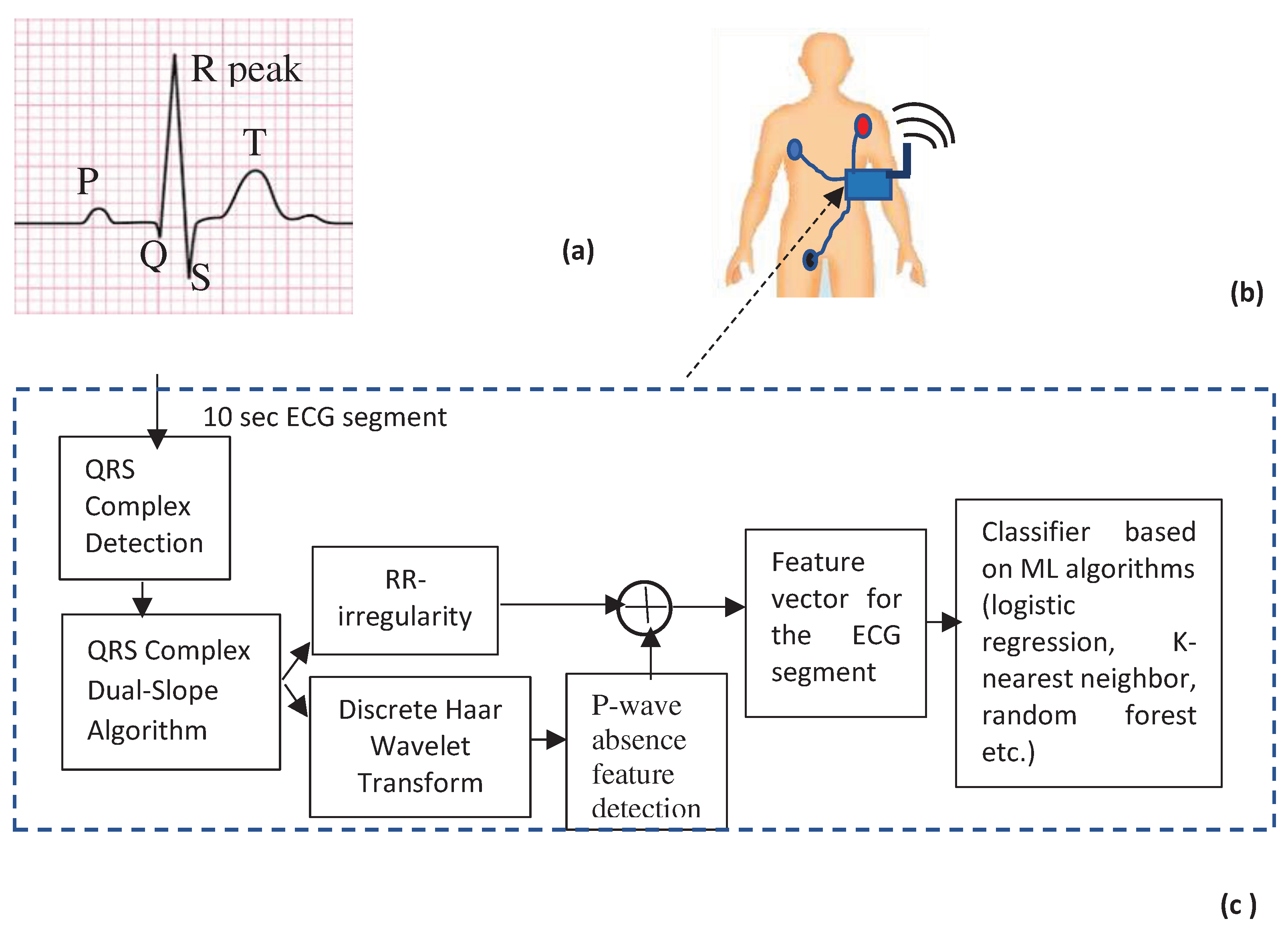
We propose in this paper, a new study addressing the design of a low-complexity scheme for AF detection based on machine learning algorithms using wearable wireless sensor. The main novelty is to assess the capability of some machine learning algorithms for wearable AF detection and their adequacy for embedded system implementation. The new proposed scheme will be using per segment of 10 sec for the detection of QRS complex using dual-slope algorithm[12] followed by Discrete Wavlet Transform for the extraction of usful features ( RR intervals and P-wave absence ) that will be used to train and to classify input signals. We assess in this paper the execution time and the energy consumption related to processing of the proposed scheme to check its adequacy for embedded AF detection.
The main research question to which this paper is trying to provide an answer is ; is it possible to deploy ML algorithms for low-energy wearable solution for AF detection using IoMT devices?
The remain part of the paper is organized as follow. We first present the general approach and the methodlogy for the design of the proposed AF detection scheme. Next, we present the experimentation and the obtained results. These result will be discussed and analyzed in the discussion section. We present in the last section the conclusion of this research and the feature works.
3. Methodolgy
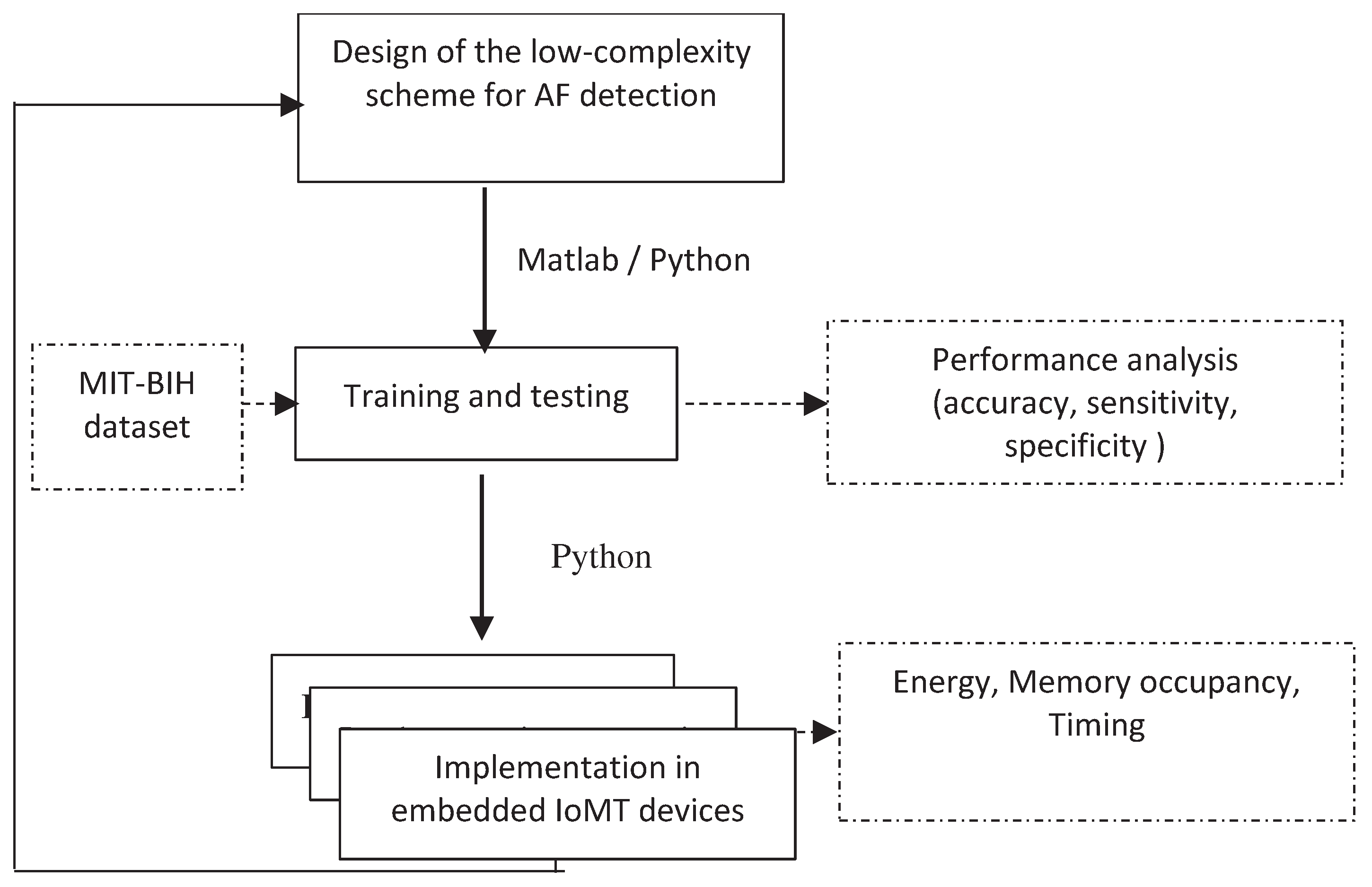
The adopted methodology to design the proposed low-complexity scheme for wearable AF detection is summarized in Figure 1. The different tasks of the scheme are implemented using python and matlab languages. The proposed scheme based on machine learning algorithm for classification is trained and tested using MIT-BIH dataset. It is assessed in terms of accuracy of AF detection at the application level. The retained solution showing the highest accuracy is then implemented using python language to be simulated on different wearable IoMT solutions such as (Waspmote and Zolertia Z1 platforms). These implementations on IoMT devices are used to evaluate the energy consumption, the memory occupancy and the execution time.
- 1.
- General approach
Figure 1.
Adopted methodology for the design of the embedded AF detection scheme.
- 2.
- Structure of the proposed scheme
Relevant features for AF detection in ECG signals were discussuded in [12]. We have shown that the combination of RR interval’s measurments combined with the absence of P-wave detection in an ECG segment can be efficiently used for high accuracy [14,15]. The difficulty that was faced in [12] is that the definition of model for p-wave reference in the time domain doesn’t provide and a stable biomarker for the detection of this wave in the test ECG segement. In depth the p-wave has a low amplitude and can be easily missed in detection because of noise. Furthermore, p-wave shapes in ECG signals are subject dependent which does not play in favor of automated detection. Therefore, in the new scheme the detection of the p-wave will be performed in the time-frequency domain using Discrete wavelet transform Figure 2.
- QRS complex detection
The proposed scheme that is illustrated in Figure 2 uses Dual-Slope (DS) algorithm for the detection of QRS complex in the ECG segment. The detection accuracy of the R-peaks was evaluated in [12] using different AF ECG segements from MIT BIH arrhythmia dataset. We have demonstrated that the DS algorithm was capable to perform as good as the Pan Tompkins algorithm (PT) [14] while showing lower processing complexity. The detection accuracy of the DS algorithm for R peacks is around 97%. The PT algorithm is processed in the frequency domain after the fourrier transform of the ECG signal. To evalauate the processing complexity of these two algorithms, we implemented them in Waspmote sensors to compare the Flash memory requirement and the execution time. Table 1 shows these results. As illustrated in this table the DS algorithm is requiring around 50% less than the flash memory required by TP and around 57% of less execution time. This attests about the adequacy of DS algorithm for low-ressources execution wearable devices.
The adoption of the DS algorithm in this scheme was encouraged by its capability to provide efficient solution to mesure RR intervals that is used for simple statsical measure to capture the RR- irregularity interval. This measurement defines the estimate standard deviation of the series of RR intervals in the ECG segment. It represents the first used feature as input for the classifier of the signal.
Figure 2.
General structure of the proposed scheme for embedded machine learning based AF detection. (a) ECG wave form; (b) deplyement of the scheme as wearable IoMT. (c) proposed scheme.
Figure 2.
General structure of the proposed scheme for embedded machine learning based AF detection. (a) ECG wave form; (b) deplyement of the scheme as wearable IoMT. (c) proposed scheme.
- Haar Discrete Wavelet Transformation (HDWT)
The use of 1-D DWT to transform the input non-stationary ECG signal is suitable to extract relevant feature in the tim-frequency domain. In our approach, we used Haar for its low computational requirements. Each level of the Haar DWT is implemented as a cascade of low-pass filter and high pass filter. The output of the low-pass filter that represents the approximation coefficient is then decomposed again to generate the next level. We adopted a decomposition at the 2nd level that provides good a good reduction of noises.
The Haar DWT is charactirised by a reduced number of computational operations. For a a length N samples, it needs additions and multiplications to process the first level of the decomposition. For the second level, it needs additions and multiplications. Since we are using the second level of decomposition, Haar wavlet requires additions and multiplications. This number of arithmetic operation is much less than other proposed implementation for IoT devices [17].
- P-wave absence detection
The P-wave detection is always expected in the second half of the RR intervals. In depth, we estimated the pR distance ( ) from QT dataset [17] to prove that the useful interval for p wave searching is the second half (Table 2). We used 21766 pR pairs in this analysis that has shown the rsults illustrated in Figure 3.
Based on Figure 3 we can attest that around 98% of the studied P waves have a distance in the interval [0.12, 0.22]. Only 2% have outside of this interval. This results attests about the search interval of the p-wave should be in the second half of the interval RRs of the acquired ECG segment. The processing of short window length of the EEG segment is expected to reduce the processing load and therefore it reduces the energy consumption in the wearable IoMT device.
In a segment of 10-sec the number of absent P waves in the N serach interval is denoted by . These parameters were used to define the second used feature in this study defined by (2) that represent the fraction of the absent p wave in the ECG segment.
In our proposed method the P wave is detected using the discrete wavelet transform applied to the the second half of the RR interval in the segment. This transform is used to provide an approximate morphology of the second half of the RR intervals.
To determine the number of absent p waves we developed a model that is used to calculate the feature expressed in (2). This model was developed based on the signals mentioned in Table3 usingmQT dataset [18].

Table 3.
NSR signals used to create the p wave template.
| Sel16265 | Sel16272 | Sel16273 |
| Sel16420 | Sel16773 | Sel16939 |
| sel117 | sel123 | Sel213 |
| Sel16786 | Sel17152 | Sel17453 |
The model is obtained by normalization of the approximation coefficients at the second level of the Haar DWT transform. The template of the built P wave is presented in Figure 4.
The model of the P wave denoted by ( is then used to detect its presence in each second half of the RR interval and to extract the fraction of p wave absent in the ECG segment. However the main difficulty to do that is that extracted P waves don’t have the same length as the built model. In depth the length of the P waves varies according to the duration of the RR intervals. To solve this issue we have used Dynamic Time Warping (DTW) method that allowas to estimate the distance between two time series of differents lengths and not aligned [19]. This method is applied as follow. For two series X and Y ; and . The DWT constructs m x n matric () where each cell represents the alignment between and . the main objective of DWT is to find out the optimal alignment between the sequences with the minimum distance. The distance in each cell is calculated recursively by (4).
The implementation of DWT results on a quadratic space complexity that represents a high complexity and is not adequate for wearable devices. Therefore we used a linear space- complexity implementation of the DTW (Figure 5). In this approach, we keep only the current and the previous columns as the distance maticx is evaluated. This method to evaluate the minimum distance does not keep track of the warping pat, but for our purpose of getting similariy between the detected p wave and the P wave model (
Then with the estimated value of the minimum distance, we compare it with the pre-determined threshold value to decide if we have a valid P wave or it is absent. For the evaluation of this threshold we have used a set of AF signal as well as NSR signals from MIT Atrial Fibrillation Dataset and also from MIT BIH Normal sinus Rhythm dataset as illustrated in Table 4.
The frequency of distribution of distances DTW for P waves is illustrated in Figure 6. We can see from this figure that for AF signals, the distances DTW is for 92% higher than 3.2 (Figure 6.a). For NSR the value of the DTW distance is for 86 % less than 3.2. So we think that this feature gives a clear clustering and can be well used train the classifier for efficient discrimination between AF episodes and non AF signals which help the classifier to correctly assess the acquired signal.
- 3.
- AF detection using machine learning classifiers
In biomedical engineering, using machine learning (ML) for classification and disease’s diagnosis has shown interesting performances [20,21,22]. In this paper we study the perfrmances of three ML classifiers; Support Vector Machine (SVM), Logistic Regression, and Decision Tree algorithms for AF detection. We will also assess the adequacy of these algorithm for embedded implementation in werable devices.
4. Result and Discussion
4.2. AF detection and accuracy
To evaluate the accuracy of AF detectin based on the proposed features. We have used a set of signal from Normal Sinus Rhythm (NSR) and Atrial Fibrillation (AF) rhythm for both of training and testing of the algorithms. The classification was performed for 2 classes (AF signals and non AF signals ). Table 5 shows the differents number of segments and the references of the studied signals in the dataset.
In this study the eSTD feature expressed in (1) was extracted in the time domain. The feature expressed in equation (2) was extracted as previously explained using Haar Wavelet. These features are used by the classifier to make decision.
We used in this study the following inducators for the performances evaluation
- The number of false positives (FP) is the number of non-AF segments that were missclassified as AF segments.
- The number of false negatives (FN) is the number of AF segments that were missclassified as non-AF segments.
- The number of true negatives (TN) is the number of non-AF segments that were correctly classified as non-AF segments.
- The number of true positives (TP) is the number of AF segments that were correctly classified as AF segments.
Based on these inducators we measured the following metrics.
- The sensitivity estimates the ability of the scheme to classify correctly subjects with AF disease.
- The specificity, defines the percentage of non-AF segments that were correctly classified
- The accuracy the prediction ability oof the scheme
- The positive Predictive Value, It provides the probability of how likely is that the subject has AF
- F1-score (F1): It combines both sensitivity and PPV in a single metric.
Table 6. sums out the results of classification of the proposed scheme for the set of studied ECG signals using different ML classifiers. This tabe shows that the proposed schem was capable to perform with a high accuracy of classification. All the studied ML algorithms achieved higher than 94% of accuracy. The best accuracy was achieved with Logistic Regression (97.4). This algorithm was also capable to provide the best F1 score (95.2%) and 100% of sensitivity.
The results shown in this table attest about the high performances of AF detection using classical ML algrithms. In addition, the abtained performances are better than most of the proposed solutions for werable devices [1,23,24,25,26,27,28].
Table 6.
Performanc of the proposed scheme with different classifiers.
| Classifier | Sen % | Spec % | Acc % | F1 % | |
| Our proposed scheme | SVM | 96.7 | 94.4 | 94.8 | 92.3 |
| Logistic Regression | 100 | 94.5 | 97.4 | 95.2 | |
| Decision tree | 98.2 | 95.4 | 95.2 | 94 | |
| Marsili et al. [25] | Threshold based classifer using only RR interval | 96, 13 |
97.9 |
97.6 |
--- |
| Huerta et al. [1]
FFT, Pantompkins |
SVM | -- | -- | 71.2 | 78 |
| Logistic regression | -- | -- | 70.8 | 70 | |
| Ahsanuzzaman et al. [26] | Neural Network | -- | -- | 97.5 | -- |
| Kim et al. [27] | K-NN | 91.1 | -- | 83.7 | -- |
| Decision Tree | 88.2 | -- | 83.7 | -- | |
| Ma et al [28] | SVM | 89.2 | 96.8 | 93.8 | -- |
In depth, we compared the obtained results with the classification performances of other approaches that have used the same dataset MIT BIH AF dataset. We can see from the table 6 that for the use of logistic regression, our scheme gives an accuracy of 97.4 % that is 26% higher than the solution presented in [1]. With the use of decision tree algorithm the accuracy was enhanced with around 12% compared to the result presented in [27]. Despite the complexity of the scheme proposed in [26] by the use of neural network deep learning architecture, it scored the same accuracy as our proposed solution.
For the embedded implementation, the classification based on Logistic regression will be adopted for its high accuracy level and its low processing requirements.
We believe that the good performance achieved in the proposed scheme are coming from the fact that we are combining the RR irregularity and the p-wave absence features. The use of these combined features increases the cpapbility of this scheme to detect AF episodes while keeping low processing complexity.
4.2. IoT-based device implementation
We have selected Logistic Regression(LR) classifier to be implement in the proposed processing scheme. This selection was motivated by the best classification performance achieved by this classifier in the detection of AF episodes. The scheme based on LR classifier was studied to evaluate its adequacy for low-computational ressource execution in Internet of Medical Thing (IoMT) plateforms. In depth, we analyzed the processing requirments of this scheme when implemented on Waspmote sensors and Zolertia Z1 platforms that are compliant with the standard IEEE 802.15.4 for low-power communication. These devices are wireless wearable devices that can be deployed for AF detection. They can be configured to notify a remote server once AF is detected as an alerting message to trigger on in-clinic follow-up procedure for further investigation.
We note that the training of the scheme is processed offline and therefore, it will not be considred in the evaluation of the processing characteristics.
The proposed scheme was implemented using paython. The required flash memory is 87.2 KB. We have used simulators ( Contiki-NG with cooja and Avrora software tools ) [29,30,31] to estimate the processing time and energy consumption for the CPU of Waspmote and for Zolertia Z1 platforms. The main processing charcteristics of these devices are illustrated in Table 7.
This table shows that both of the studied plateforms are shown low energy execution of the proposed scheme as well as as short processing time. This result attests about the adequacy of these limited ressources devices to be used for the execution of the proposed scheme based on machine learning plateform.
Compared to some existing solutions reported in literature, we can say that the solution proposed in [13] was implemented in more powerful computing devices. In depth, we think that the short execution time shown, by smartwatch Moto 360, of LST-Neural Network based classifier is explained the strong processing capability of this device.
5. Conclusions
In this paper we proposed a new low-complexity scheme for AF detection that is intended to be implemented in wearable devices. The proposed schme uses RR variability feature extracted in the time domain and the absence of the p-wave feature extracted in time-frequency domain with haar wavelet transform of the signal. We discussed the suitability of using machine learning classifier for these devices and we have shown that we can use logistic regression algorithm that achieves 97.4 % of accuracy while consuming low-energy when implemented in IoMT devices (422 mJ for waspmote ). We have shown that the embedded execution needs 45.2 ms in waspmote. These results are outsanding the proposed approach in the literature and attest about the possibility of deploying IoMT devices for AF monitoring.
As future work, we think that the implementation of this proposed scheme in an embedded system based on FPGA circuit will strongly contribute to reduce the energy consumption and the execution time. We also believe that, in this type of IoT devices we can efficiently implement Deep Learning Based classifier that will provide higher classification results.
Author Contributions
All the authors participated in the developpement of the proposed work, in the results discussion and in writing the paper.
Acknowledgments
The authors extend their appreciation to the Deputyship for Research & Innovation,”Ministry of Education” in Saudi Arabia for funding this research work through the project no.(IFKSUOR3-506-1).
Conflicts of Interest
No conflicts of interest to be declared.
References
- Liaqat, S.; Dashtipour, K.; Zahid, A.; Assaleh, K.; Arshad, K.; Ramzan, N. Detection of Atrial Fibrillation Using a Machine Learning Approach. Information 2020, 11, 549. [CrossRef]
- Wegner, F.K.; Plagwitz, L.; Doldi, F.; Ellermann, C.; Willy, K.; Wolfes, J.; Sandmann, S.; Varghese, J.; Eckardt, L. Machine learning in the detection and management of atrial fibrillation. Clin. Res. Cardiol. 2022, 111, 1010–1017. [CrossRef]
- Rienstra, M.; Lubitz, S.A.; Mahida, S.; Magnani, J.W.; Fontes, J.D.; Sinner, M.F.; Ellinor, P.; Van Gelder, I.C.; Benjamin, E.J. Response to Letter Regarding Article, “Symptoms and Functional Status of Patients With Atrial Fibrillation: State of the Art and Future Research Opportunities”. Circulation 2012, 126, 2933-2943. [CrossRef]
- Alhassan, S.; Soudani, A.; Almusallam, M. Energy-Efficient EEG-Based Scheme for Autism Spectrum Disorder Detection Using Wearable Sensors. Sensors 2023, 23, 2228. [CrossRef]
- Alsaleem, M.N.; Islam, S.; Al-Ahmadi, S.; Soudani, A. Multiscale Encoding of Electrocardiogram Signals with a Residual Network for the Detection of Atrial Fibrillation. Bioengineering 2022, 9, 480. [CrossRef]
- Almarshad, M.A.; Al-Ahmadi, S.; Islam, S.; BaHammam, A.S.; Soudani, A. Adoption of Transformer Neural Network to Improve the Diagnostic Performance of Oximetry for Obstructive Sleep Apnea. Sensors 2023, 23, 7924. [CrossRef]
- Jahan, M.S.; Mansourvar, M.; Puthusserypady, S.; Wiil, U.K.; Peimankar, A. Short-term atrial fibrillation detection using electrocardiograms: A comparison of machine learning approaches. Int. J. Med Informatics 2022, 163, 104790. [CrossRef]
- Mäkynen, M.; Ng, G.A.; Li, X.; Schlindwein, F.S. Wearable Devices Combined with Artificial Intelligence—A Future Technology for Atrial Fibrillation Detection? Sensors 2022, 22, 8588. [CrossRef]
- Lown, M.; Brown, M.; Brown, C.; Yue, A.M.; Shah, B.N.; Corbett, S.J.; Lewith, G.; Stuart, B.; Moore, M.; Little, P. Machine learning detection of Atrial Fibrillation using wearable technology. PLOS ONE 2020, 15, e0227401. [CrossRef]
- Parmar, R.; Janveja, M.; Pidanic, J.; Trivedi, G. Design of DNN-Based Low-Power VLSI Architecture to Classify Atrial Fibrillation for Wearable Devices. IEEE Trans. Very Large Scale Integr. (vlsi) Syst. 2023, 31, 320–330. [CrossRef]
- Lee, K.-S.; Park, H.-J.; Kim, J.E.; Kim, H.J.; Chon, S.; Kim, S.; Jang, J.; Kim, J.-K.; Jang, S.; Gil, Y.; et al. Compressed Deep Learning to Classify Arrhythmia in an Embedded Wearable Device. Sensors 2022, 22, 1776. [CrossRef]
- Almusallam, M.; Soudani, A. Embedded Solution for Atrial Fibrillation Detection Using Smart Wireless Body Sensors. IEEE Sensors J. 2019, 19, 5740–5750. [CrossRef]
- Saadatnejad, S.; Oveisi, M.; Hashemi, M. LSTM-Based ECG Classification for Continuous Monitoring on Personal Wearable Devices. arXiv 2018, arXiv:1812.04818. [CrossRef]
- J. Pan and J. T. Willis, “A Real-Time QRS Detection Algorithm,” IEEE Trans. Biomed. Eng., vol. BME-32, no. 3, pp. 230–236, 1985.
- Faust, O.; Ciaccio, E.J.; Acharya, U.R. A Review of Atrial Fibrillation Detection Methods as a Service. Int. J. Environ. Res. Public Heal. 2020, 17, 3093. [CrossRef]
- Jeon, E.; Oh, K.; Kwon, S.; Son, H.; Yun, Y.; Jung, E.-S.; Kim, M.S. A Lightweight Deep Learning Model for Fast Electrocardiographic Beats Classification With a Wearable Cardiac Monitor: Development and Validation Study. Psychopharmacol. 2020, 8, e17037. [CrossRef]
- Rincón, F.; Grassi, P.R.; Khaled, N.; Atienza, D.; Sciuto, D. Automated real-time atrial fibrillation detection on a wearable wireless sensor platform. 2012 34th Annual International Conference of the IEEE Engineering in Medicine and Biology Society (EMBC). LOCATION OF CONFERENCE, COUNTRYDATE OF CONFERENCE; pp. 2472–2475.
- Laguna, P.; Mark, R.G.; Goldberg, A.; Moody, G.B. A database for evaluation of algorithms for measurement of QT and other waveform intervals in the ECG. In Proceedings of the Computers in Cardiology 1997, Lund, Sweden, 7–10 September 2002; pp. 673–676.
- Li, H.; Wang, C. Similarity Measure Based on Incremental Warping Window for Time Series Data Mining. IEEE Access 2018, 7, 3909–3917. [CrossRef]
- Mazlan, A.U.; Sahabudin, N.A.; Remli, M.A.; Ismail, N.S.N.; Mohamad, M.S.; Nies, H.W.; Warif, N.B.A. A Review on Recent Progress in Machine Learning and Deep Learning Methods for Cancer Classification on Gene Expression Data. Processes 2021, 9, 1466. [CrossRef]
- Bashar, S.K.; Han, D.; Zieneddin, F.; Ding, E.; Fitzgibbons, T.P.; Walkey, A.J.; McManus, D.D.; Javidi, B.; Chon, K.H. Novel Density Poincaré Plot Based Machine Learning Method to Detect Atrial Fibrillation From Premature Atrial/Ventricular Contractions. IEEE Trans. Biomed. Eng. 2021, 68, 448–460. [CrossRef]
- Z. Li, H. Derksen, J. Gryak, H. Ghanbari, P. Gunaratne and K. Najarian, "A Novel Atrial Fibrillation Prediction Algorithm Applicable to Recordings from Portable Devices," 2018 40th Annual International Conference of the IEEE Engineering in Medicine and Biology Society (EMBC), Honolulu, HI, USA, 2018, pp. 4034-4037.
- Z. Li, H. Derksen, J. Gryak, H. Ghanbari, P. Gunaratne and K. Najarian, "A Novel Atrial Fibrillation Prediction Algorithm Applicable to Recordings from Portable Devices," 2018 40th Annual International Conference of the IEEE Engineering in Medicine and Biology Society (EMBC), Honolulu, HI, USA, 2018, pp. 4034-4037.
- Narin, A.; Isler, Y.; Ozer, M.; Perc, M. Early prediction of paroxysmal atrial fibrillation based on short-term heart rate variability. Phys. A: Stat. Mech. its Appl. 2018, 509, 56–65. [CrossRef]
- Marsili, I.A.; Mase, M.; Pisetta, V.; Ricciardi, E.; Andrighetti, A.O.; Ravelli, F.; Nollo, G. Optimized algorithms for atrial fibrillation detection by wearable tele-holter devices. 2016 IEEE International Smart Cities Conference (ISC2). LOCATION OF CONFERENCE, ItalyDATE OF CONFERENCE; pp. 1–4.
- Ahsanuzzaman, S.; Ahmed, T.; Rahman, A. Low Cost, Portable ECG Monitoring and Alarming System Based on Deep Learning. In Proceedings of the 2020 IEEE Region 10 Symposium (TENSYMP), Dhaka, Bangladesh, 5–7 June 2020; pp. 316–319. [CrossRef]
- Ma, C.; Wei, S.; Chen, T.; Zhong, J.; Liu, Z.; Liu, C. Integration of Results From Convolutional Neural Network in a Support Vector Machine for the Detection of Atrial Fibrillation. IEEE Trans. Instrum. Meas. 2020, 70, 1–10. [CrossRef]
- K, S.R.S.; Martis, R.J. Machine Learning Based Decision Support System for Atrial Fibrillation Detection using Electrocardiogram. 2020 IEEE International Conference on Distributed Computing, VLSI, Electrical Circuits and Robotics (DISCOVER). LOCATION OF CONFERENCE, IndiaDATE OF CONFERENCE; pp. 263–266.
- Kurniawan, A. “Practical Contiki-NG”; Apress: Berkeley, CA, USA, 2018; ISBN 978-1-4842-3407-5.
- Titzer, B.L.; Lee, D.K.; Palsberg, J. Avrora: Scalable sensor network simulation with precise timing. In Proceedings of the IPSN 2005, Fourth International Symposium on Information Processing in Sensor Networks, Boise, ID, USA, 15 April 2005; pp. 477–482.
- N. R. Hendrawan and I. G. N. W. Arsa, "Zolertia Z1 energy usage simulation with Cooja simulator," 2017 1st International Conference on Informatics and Computational Sciences (ICICoS), Semarang, Indonesia, 2017, pp. 147-152.
Figure 3.
The distribution of the PR distance.
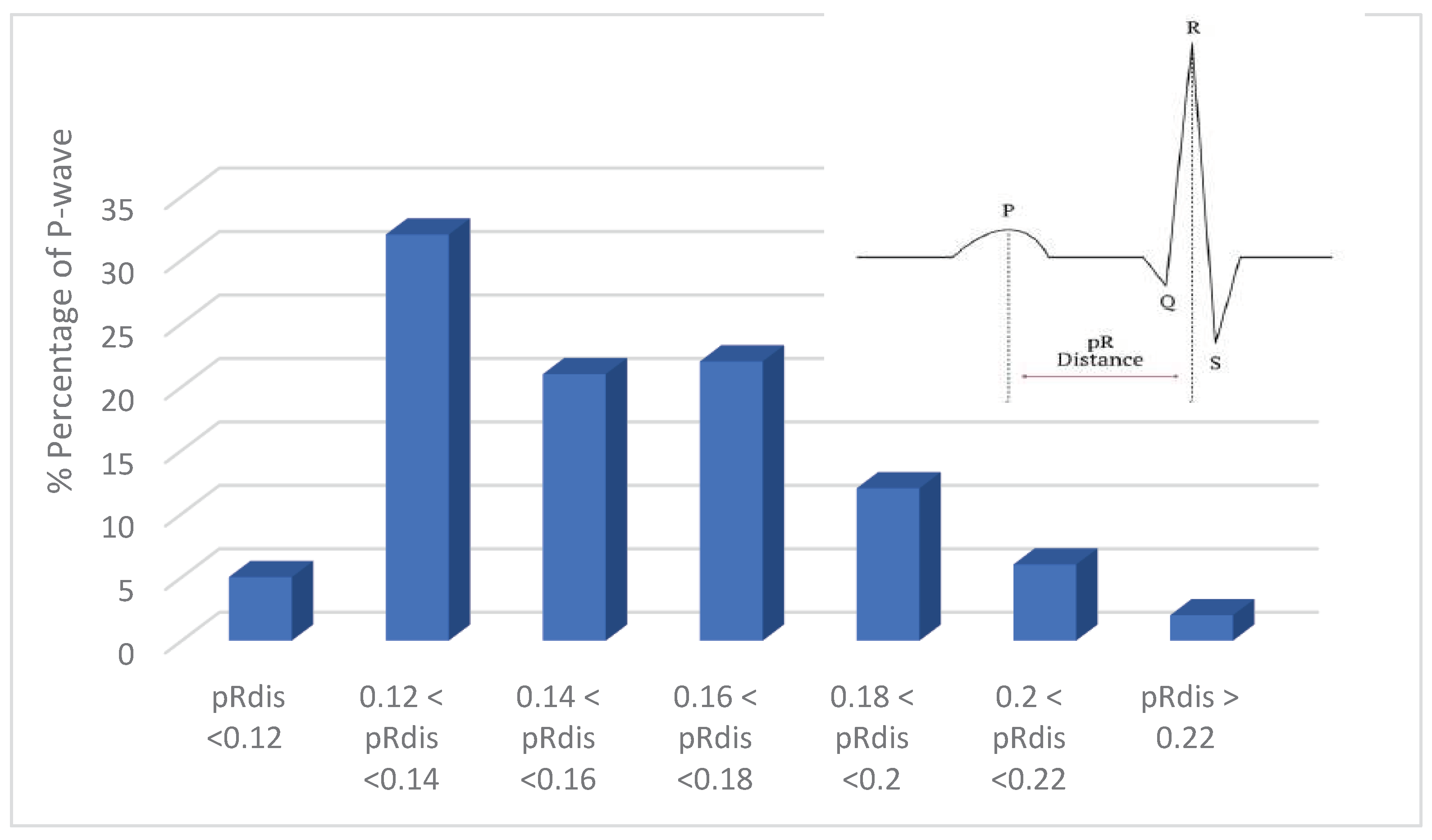
Figure 4.
The template of the P-wave built using the approximation coefficients of the Haar DWT transform at the level 2.
Figure 4.
The template of the P-wave built using the approximation coefficients of the Haar DWT transform at the level 2.
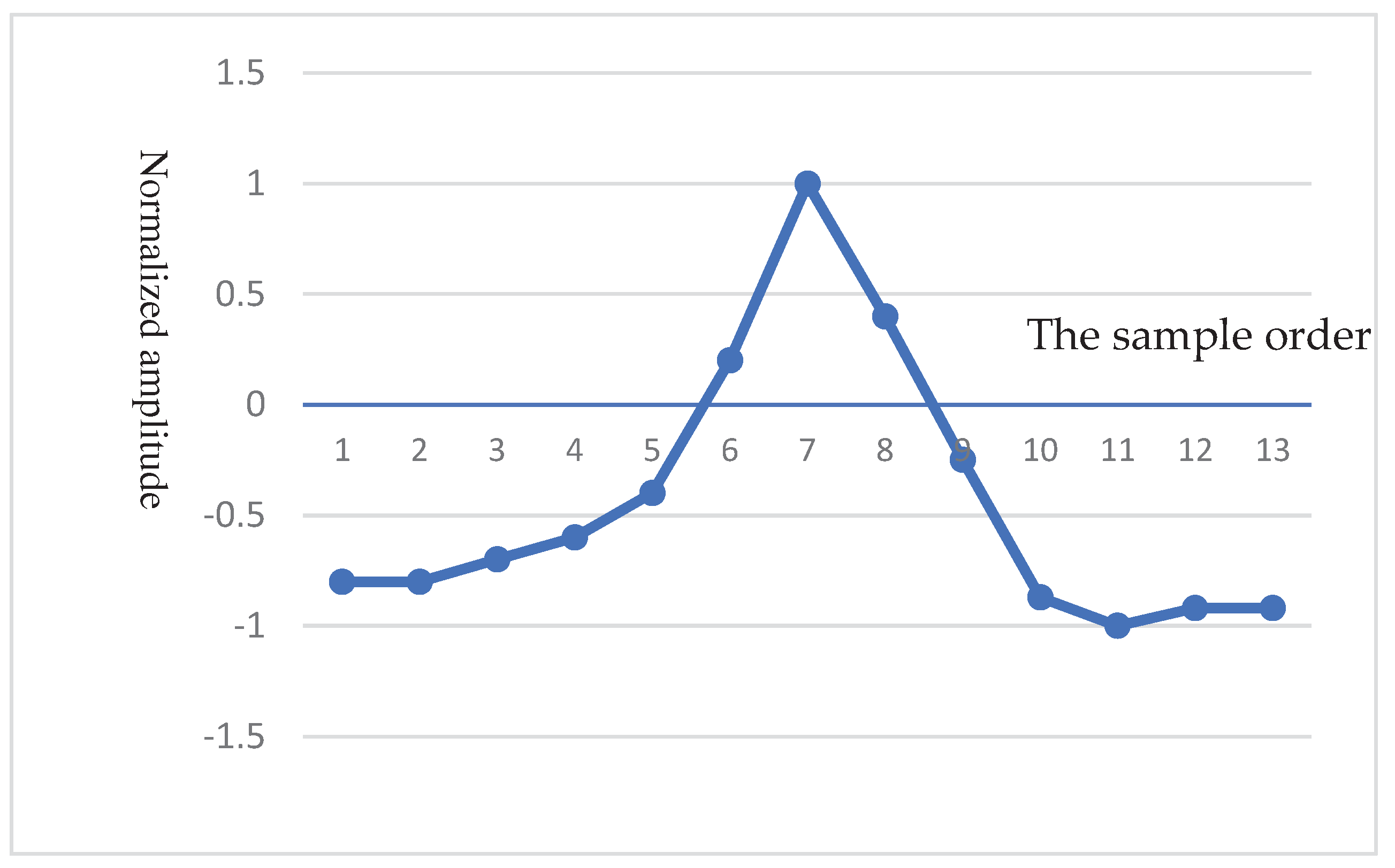
Figure 5.
Pseudo-code of min distance estimation using the approach of the linear space- complexity of DTW
Figure 5.
Pseudo-code of min distance estimation using the approach of the linear space- complexity of DTW
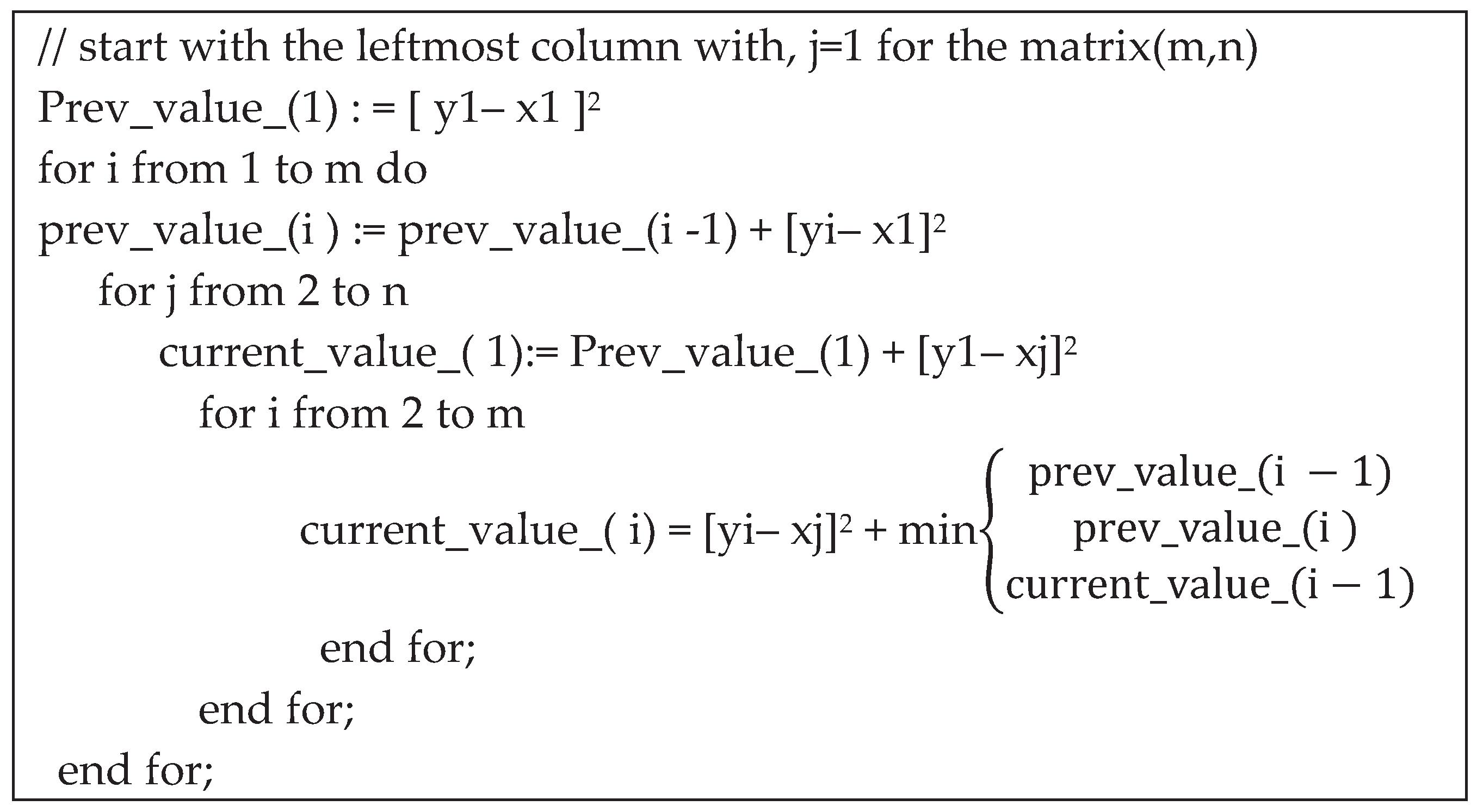
Figure 6.
The distribution of the DTW distances.
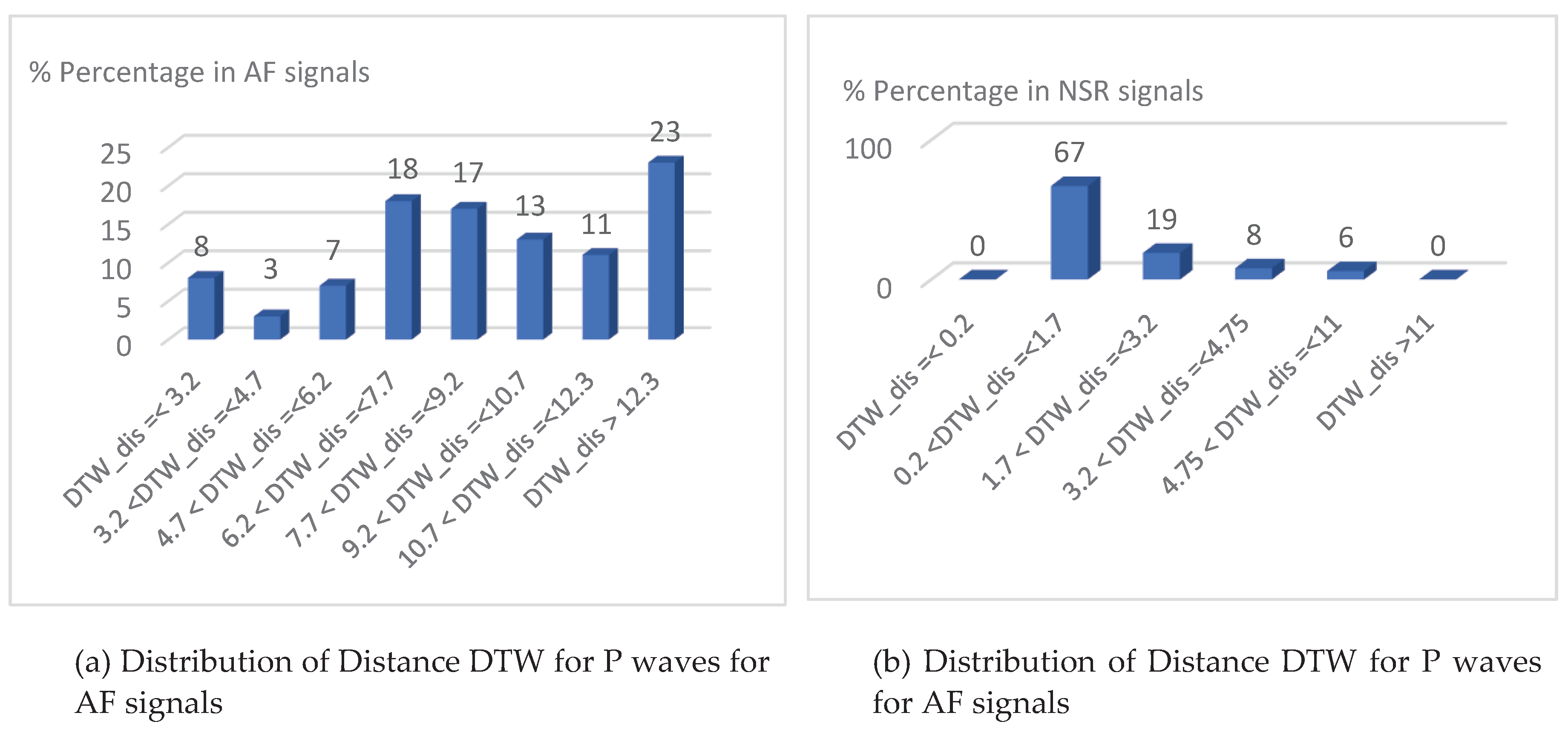
Table 1.
Flash memory size requirement and execution time for the two algorithms DS and PT in Waspmote.
Table 1.
Flash memory size requirement and execution time for the two algorithms DS and PT in Waspmote.
| Dual-Slope (DS) | Pan Tompkins algorithm (PT) | |
| Flash Memory KBytes | 7,4 | 15.6 |
| Estimated execution time (ms) | 17,2 | 30.7 |
Table 2.
Signals used to determine the distance .
| sel100 | sel102 | sel103 |
| sel104 | sel114 | sel116 |
| sel117 | sel123 | Sel213 |
| Sel223 | Sel230 | Sel231 |
| Sel232 | Sel233 |
Table 4.
Signals used to determine the threshld for the distance DTW fr a valid P wave.
| Number evaluate distances | ||
| AF signals | 04048, 05121, 08215, 04043, 04746, 06453 | 690 |
| NSR signals | 19830,16483, 16795 | 830 |
Table 5.
Signals used for training and performances evaluation.
| Signals | 04048, 04015, 07910, 04126, 04908, 18177,
18184, 19090, 19093, 19140 |
580 AF segments |
| 472 NSR segments | ||
| Number of segments 10 sec | 1052 |
Table 7.
Processing in IoMT devices of the proposed scheme. (a) The processing features of the devices, (b) the execution performance metrics.
Table 7.
Processing in IoMT devices of the proposed scheme. (a) The processing features of the devices, (b) the execution performance metrics.
| IoMT plateform | Zolertia Z1 | Waspmote | |
| (a) | CPU | MSP430 | ATmega1281 |
| Processing frequency (MHz) | 8 | 14.7 | |
| Flash | 98 KB | 128 KB | |
| Battery | 2AA (3.3 V) ( or USB 5V) | ||
| (b) | Energy Consumption related to the processing of the scheme | 405.2 mJ | 422.2 mJ |
| Notification to a remote base station | 0.16 mJ | ||
| Execution time | 80 ms | 45.5 ms | |
Disclaimer/Publisher’s Note: The statements, opinions and data contained in all publications are solely those of the individual author(s) and contributor(s) and not of MDPI and/or the editor(s). MDPI and/or the editor(s) disclaim responsibility for any injury to people or property resulting from any ideas, methods, instructions or products referred to in the content. |
© 2023 by the authors. Licensee MDPI, Basel, Switzerland. This article is an open access article distributed under the terms and conditions of the Creative Commons Attribution (CC BY) license (http://creativecommons.org/licenses/by/4.0/).
Copyright: This open access article is published under a Creative Commons CC BY 4.0 license, which permit the free download, distribution, and reuse, provided that the author and preprint are cited in any reuse.


