

Submitted:
18 December 2023
Posted:
18 December 2023
You are already at the latest version
Abstract
Background: Tilmicosin, a macrolide antibiotic, has the potential to treat bacterial respiratory infections in donkeys. However, the pharmacokinetics of tilmicosin in donkeys have not been reported. Objectives: The aim of this study was to investigate the pharmacokinetics of tilmicosin in donkey plasma, urine and feces after a single intragastric administration to determine the suitability of tilmicosin for donkeys. Animals: A total of 4 healthy fattening male donkeys were selected with body weights of 148, 140, 145, and 135 kg, with an average body weight of 142.00 ± 4.95 kg. Methods: The donkeys were administered intragastrically a single dose of 10 mg·kg-1 BW tilmicosin. Blood, urine and fecal samples were collected. The concentrations of tilmicosin in plasma, urine, and feces were determined using high-performance liquid chromatography-tandem masss pectrometry. Results: After a single intragastric administration of 10 mg·kg-1 body weight, tilmicosin in donkey plasma reached a maximum concentration of 11.23 ± 5.97 mg·L-1 at 0.81 ± 0.11 h, with a mean residence time of 8.05 ± 2.44 h, a Cl/F of 0.48±0.22 L·kg-1·h-1, and a Vd/F of 9.28 ± 4.10 L·kg-1. The percentage of tilmicosin excreted through the urine of donkeys is (2.47±0.43)%, and the percentage excreted through the feces is (66.43±8.65)%. Conclusions: A single intragastric administration of 10 mg·kg-1 BW of tilmicosin to donkeys was rapidly absorbed and was able to achieve plasma concentrations of against pathogenic bacteria.
Keywords:
tilmicosin
; pharmacokinetics
; intragastric administration
; excretion
; donkey
1. Introduction
Tilmicosin is a macrolide antibiotic developed in the 1980s as a broad-spectrum antimicrobial in veterinary clinical practice [1,2]. It can irreversibly bind to the 50S subunit of bacterial ribosomes and selectively inhibit protein synthesis by blocking transpeptidation and mRNA displacement [3]. In North America, tilmicosin products, such as Micotil® and Pulmotil®, have been licensed for the treatment of respiratory diseases in cattle, sheep and pigs. In Europe, tilmicosin has been shown to be used to treat Mycoplasma gallisepticum infections in chickens [4]. Tilmicosin is semi-synthesized from a hydrolysis product of tylosin, which inhibits gram-positive bacteria, certain gram-negative bacteria, mycoplasma, spirochetes, etc., and possesses stronger antimicrobial activity than tylosin [5]. It is often recommended for treating respiratory diseases and pneumonia in swine, cattle, and sheep [6,7,8]. Tilmicosin has high lipophilicity and good tissue penetration and is absorbed quickly after administration [9]. Moreover, the large apparent volume of distribution and the high concentration in lung tissue allow rapid and complete passage from the bloodstream to the breast and accumulation in milk [10,11]. Tilmicosin administered intravenously causes negative cardiac effects, so it’s commonly administered orally or subcutaneously [12]. Whereas subcutaneous injections can lead to severe reactions at the injection site, oral administration is the most convenient and safest [13]. However, the absorption of enteral administration is incomplete due to the poor water solubility of tilmicosin, which causes it to be excreted in urine and feces and may lead to antibiotic contamination [14]. Therefore, in addition to plasma, our study also focused on urine and feces.
Donkeys (Equus asinus) have high economic value and are used as toiling draft animals in underdeveloped areas while they are used as companion animals in developed areas paradoxically [15]. Importantly, donkeys are farmed on a large scale in China and elsewhere for the production of donkey-hide gelatin (Colla Corii Asini) and other industrial products [16]. Donkey-hide gelatin is considered to have great medicinal value and is sought after by many Chinese people. Although donkey meat is rarely consumed in Europe and America, it is a famous delicacy in China or other countries. However, most donkeys are not as well cared for as horses, and they are constantly exposed to complex environments, which are highly susceptible to respiratory disease [17]. Tilmicosin has been evaluated for in vitro activity against bacterial pathogens in horses [18]. Therefore, tilmicosin is a very promising drug for the treatment of respiratory disorders in donkeys. The pharmacokinetics of tilmicosin have been studied in horse [13], swine [19], cattle [20], sheep [8], chicken [21,22], and rabbit [23], and data in donkeys are still vacant. Therefore, the present study was carried out around the pharmacokinetics of tilmicosin in plasma, urine, and feces of donkeys in order to determine the suitability of tilmicosin for donkeys.
2. Materials and methods
2.1. Chemicals and reagents
The concentration of tilmicosin standard in methanol is over 99.0% which was purchased from the Research and Monitoring Institute of Environmental Protection (Ministry of Agriculture, China). And tilmicosin used in this study was donated by Zhongmu Nanjing Animal Pharmaceutical Co., Ltd (Nanjing, China). Water used to quantify tilmicosin was purified by Arium® Pro ultra pure water system (Millipore Corp., Bedford, MA, USA), which complies with grade-II water specified in ISO 3696: 1987. The 5810R high-speed refrigerated centrifuge (Eppendorf GmbH., Germany) was conducted to centrifuge samples.
Phosphate buffer salt (pH=8.0) was prepared by dissolving 13.8 g of disodium hydrogen phosphate in 950 mL of secondary water and adjusting the volume to 1 L with 0.1 mol·L-1 NaOH. 0.1% formic acid was prepared by adding 1 mL of formic acid to 1000 mL of secondary water. The isopropanol, acetonitrile, methanol, formic acid, and ammonium acetate are chromatographically pure. The ammonia and trichloroacetic acid are both analytical grades. Oasis HLB column contains 150 mg anhydrous magnesium sulfate, 50 mg PSA (ethylenediamine-n-propyl silane, particle size 40 µm), 50 mg C18 (particle size of 40 µm), and 0.22 µm microporous filter membrane. Two milliliters of the supernatant were injected into an HLB column (Alta Technology Co., Ltd., Tianjin, China).
2.2. Animals and Management
Animal experiments were conducted in accordance with protocols approved by the Institutional Animal Care and Use Committee of China Agricultural University (grand No. Aw80803202-1-2). In the present study, a total of 4 fattening male donkeys (large breed) were selected with body weights of 148, 140, 145, and 135 kg, with an average body weight of 142.00 ± 4.95 kg. The donkeys were obtained from Shandong Dong’e Black Donkey Animal Husbandry Co., Ltd., China. Physical and biochemical examinations were performed to ensure that all the donkeys were healthy. All animals were acclimatized for at least 7 days before the formal trial. Before 1.0 h of the trial proceeded, each donkey was guided into a metabolic cage (2.0 m × 0.8 m × 1.8 m), and each donkey was fed with 2 kg of fattening concentrate feed and had free access to drink water and ingest grain straw every day during the trial period of 7 days. Samples from plasma, urine, and feces were collected before the donkeys were administrated with tilmicosin solution that was used as control samples.
2.3. Experimental design
We studied the pharmacokinetics profiles of tilmicosin in donkeys with reference to a previously reported dose of 10 mg·kg-1 body weight administered intragastrically to animals [24,25]. To cope with the problem of low palatability, intragastric administration was chosen instead of oral administration in this study. After administering a single dose of 10 mg·kg-1 BW tilmicosin by a disinfected nasogastric tube to the donkeys, we collected approximately 5 mL of blood samples from each donkey through the anterior vena cava and placed them in anticoagulation tubes. The blood samples were centrifuged at 3000 rpm for 20 min at 4℃ to obtain plasma and were stored at -20℃. Urine and fecal samples were collected and weighed every 6 h. Blood sample time collection points were set at 0.00, 0.08, 0.25, 0.42, 0.58, 0.75, 1.00, 1.50, 2.00, 2.50, 3.00, 4.00, 6.00, 8.00, 10.00, 12.00, 24.00, 48.00, and 72.00 h after administration. The basic information of the donkeys during the experiment is shown in Table 1.
2.4. Determination of tilmicosin
For the determination of tilmicosin, we refered to previous reports [26]. The concentrations of tilmicosin in plasma, urine, and feces were determined using high-performance liquid chromatography-tandem masss pectrometry (HPLC-MS/MS). In brief, 1 mL of blood, 1 mL of urine, or 1 g of fecal samples were measured into a 50 mL centrifuge tube, and 50 μL of its mixed standard working solution at a concentration of 1.0 μg·mL-1 was added to the tube, followed by the addition of 20 mL of phosphate-buffered salts (pH = 8.0). Then vortex mixed for 1 min, sonicated for 10 min, centrifuged at 8000 rpm for 5 min and transferred the supernatant to each other in a 50 mL centrifuge tube. After completing these steps, the extraction was repeated once and then the extraction solutions were combined. Then 20 mL of dichloromethane was added for the second extraction, the organic layer was removed, and the prepared organic layer solution was blown to near dryness in a nitrogen blower. Finally, 2.0 mL of methanol-water (v:v = 3:7) solution was accurately added to fix the volume, passed through a microporous filtration membrane, and vortexed and mixed as a sample solution. The final sample was provided for HPLC-MS/MS determination. The mobile phase was 5% acetonitrile (phase A) and 95% formic acid in water (phase B). The flow rate was kept at 1.0 mL·min-1.
2.5. HPLC method validation
The method was validated for linearity, sensitivity, and recovery in plasma, urine, and feces. The calibration curve was established with tilmicosin concentrations (50, 100, 200, 500, 1000, 2000, and 2500 μg·L-1 or μg·kg-1 tilmicosin in plasma, urine, and feces blank matrix). Sensitivity was calculated from the limits of detection (LOD) and the limits of quantification (LOQ). The signal-to-noise ratio (S/N) was ≥ 3 for LOD and ≥ 10 for LOQ. Recoveries were calculated by the ratio of the peak areas of different concentrations of tilmicosin obtained from spiked samples of plasma, urine, and feces to the peak area of the corresponding tilmicosin standard working solution.
2.6. Data analysis
The data analysis was performed by the non-compartmental analysis using a combined linear trapezoidal rule approach using Certara Phoenix WinNonlin (Ver 8.1; Pharsight Corp., Raleigh, NC, USA). Pharmacokinetic parameters were performed with reference to those described in previous studies [27,28]. The λz is a first-order rate constant associated with the terminal (log-linear) segment of the curve. It was estimated by the linear regression of the terminal data points. The terminal elimination half-life (T1/2λz) was calculated by T1/2λz = 0.693/λz. In the plasma model, peak plasma concentrations (Cmax) of the drug and times to reach peak concentration (Tmax) for the study were determined from the individual plasma concentration-time curves, and areas under the plasma concentration-time curves for AUC0-∞ studies were calculated by the method of trapezoids. The mean residence time (MRT), plasma clearance (Cl/F), and volume of distribution (Vd/F) were also calculated. In the urinary excretion model, curves of urinary tilmicosin excretion rate, cumulative recovered amount vs. the midpoint of the time period in which the samples were collected and listed, and the area under rate curve (AURC0-∞) were calculated, referring to previous reports [29]. Data were reported as the ± s.
3. Results
3.1. Validation parameters
The peak areas of tilmicosin in plasma, urine and feces were linearly correlated with the concentration of 50, 100, 200, 500, 1000, 2000, and 2500 μg·L-1 or μg·kg-1, and the R2 of the regression equations were obtained to be 0.9995, 0.9975, and 0.9964, respectively. See Figure 1 for more information of calibration curve. The results showed that the peak area of tilmicosin was completely positively correlated with the concentration, and the concentration of tilmicosin obtained by this equation was accurate. The LODs of tilmicosin in donkey blood, urine and feces were 1.2 μg·kg-1, and the LOQs were 3.9 μg·kg-1, indicating that the sensitivity of the method meets the requirements for the determination of tilmicosin in plasma, urine and feces. The recoveries of the three concentrations of tilmicosin in plasma, urine and feces were determined and showed mean values of 86.21%, 88.49% and 80.58%, respectively (Table 2).
3.2. Pharmacokinetic parameters of plasma tilmicosin
As is shown in Table 3, after intragastric administration of tilmicosin via donkey, the blood concentration peaked at 0.81 ± 0.11 h with a Cmax of 11.23 ± 5.97 mg·L-1. The tilmicosin was slowly eliminated from the plasma, with a terminal half-life of 14.49 ± 7.04 h and an AUC0-∞ of 24.69 ± 9.43 mg·L-1·h. The Cl/F was 0.48 ± 0.22 L·kg-1·h-1, the MRT was 8.05 ± 2.44 h, and the Vd/F was 9.28 ± 4.10 L·kg-1. These results indicate that tilmicosin is rapidly absorbed and distributed in donkeys, has a long maintenance time and is slowly eliminated.
Tilmicosin was first detected in plasma at 0.08 h after administration and rapidly increased to a maximum concentration of 11.23 ± 5.97 mg·L-1 over time (Figure 2). After 24 h, tilmicosin was barely detectable in plasma.
3.3. Pharmacokinetic parameters of tilmicosin in urine
Urine data were analyzed using an elimination kinetic model (Table 4). After administration of tilmicosin to donkeys, the maximum excretion rate of 2.53 ± 0.57 mg·h-1 was reached at 13.75 ± 7.46 h. The terminal half-life of tilmicosin in urine was 12.52 ± 3.29 h. The AURC0-∞ was 38.95 ± 8.71 mg. The recovered amount of tilmicosin in urine was 35.05 ± 6.73 mg. The percentage of tilmicosin excreted in urine was (2.47 ± 0.43)%. These results indicate that the elimination of temicoxacin in donkeys is relatively slow, similar to the results in plasma, and a low percentage of tilmicosin is excreted through the urine.
Tilmicosin was detected in the urine at 6 h and was at the highest level (Figure 3A). Subsequently, the concentration of tilmicosin in the urine slowly decreased until it was already almost undetectable in the urine at 72 h, which corresponds to the plasma results.
It can be seen in the rate and amount curves that the elimination rate peaks around 12 h (Figure 3B-C). The rate then decreases rapidly until it nearly goes to zero after 72 h. There was a corresponding trend in terms of the amount of recovery, with the incremental increase in cumulative recovery amount slowing down from about 12 h and approaching the horizontal trend after 72 h.
3.3. Pharmacokinetic parameters of tilmicosin in feces
The data for feces were modeled using the elimination kinetics as for urine and the results are shown in Table 5. In feces, the recovered amount was 939.88 ± 98.46 mg. The percentage of tilmicosin excreted in feces was (66.43 ± 8.65)%.
Tilmicosin in feces was first detected at 6 h and then increased to reach maximum levels around 36 h (Figure 4A). Then the level of tilmicosin in the feces declined to 144 h when tilmicosin was no longer detectable. The recovered amount of tilmicosin in feces increased rapidly at first and then tended to be flat (Figure 4B).
4. Discussion
Tilmicosin is a macrolide that is widely used in animal husbandry and veterinary medicine. Acute cardiotoxicity has been reported in animals following intravenous administration of 10 mg·kg-1 tilmicosin [6]. Therefore, subcutaneous and enteral administration are the common clinical modes of administration for tilmicosin. Subcutaneous administration of tilmicosin in horses has been reported to cause severe reactions at the injection site [13,18]. Although the system availability of enteral administration is influenced by the gastrointestinal environment, this method is more convenient and safe than subcutaneous injection and is commonly used in clinical practice. To cope with the problem of low palatability, intragastric administration was chosen instead of oral administration in this study.
In the present study, plasma Tmax after intragastric administration of tilmicosin was 0.81±0.11 h and the Cmax was 11.23 ± 5.97 mg·L-1, indicating that tilmicosin is rapidly absorbed in donkeys. The terminal half-life was 14.49 ± 7.04 h, the AUC0-∞ was 24.69 ± 9.43 mg·L-1·h and the MRT was 8.05 ± 2.44 h, which suggests that tilmicosin is eliminated slowly and has a long residual time in donkeys. Also for Equus genus, the plasma Tmax for equine injected subcutaneously with tilmicosin was 6.00 ± 9.20 h, the AUC was 6747 ± 1296 h·ng·mL-1 and the MRT was 19.30 ± 5.00 h [13]. In foals, the Tmax of tilmicosin in serum after intramuscular injection was reported to be 5.50 ± 3.43 h, the AUC0-∞ was 5.76 ± 1.87 μg·h·mL-1 and the MRT was 34.50 ± 18.0 h [18]. A serum MRT of 1.9 d and an AUC of 230 ppb·d were reported for elk following subcutaneous administration of tilmicosin [30]. All of these reports differ from the results of the present trial, possibly due to differences in the mode of administration. Enteral administration is more influenced by the gastrointestinal tract, resulting in lower utilization, lower peak concentrations and shorter residence times. There are pharmacokinetic studies in other animals with enteral administration of tilmicosin. In swine, the pharmacokinetics of orally administered tilmicosin were influenced by the dose administered, with a Tmax of 3.12 ± 0.50 h, an AUC of 14.01 ± 2.25 μg·h·mL-1 and an MRT of 17.81 ± 1.16 h for 20 mg·kg-1 administered compared to a Tmax of 3.48 ± 0.77 h, an AUC of 29.41 ± 3.37 μg·h·mL-1 and an MRT of 16.79 ± 1.18 h for 40 mg·kg-1 administered [19]. In chickens, oral administration of liquid tilmicosin resulted in a Tmax of 3.99 ± 0.84 h, an AUC of 21.82 ± 3.14 μg·h·mL-1 and an MRT of 71.20 ± 12.87 h [31]. The above studies, in turn, present different results because they are different from the animals studied in the present study. However, the above studies including the present study have come to the same conclusion that tilmicosin is rapidly absorbed by the animal body and slowly excreted. The Cl/F of tilmicosin in donkey in the present study was 0.48 ± 0.22 L·kg-1·h-1. In pigs, the Cl/F of tilmicosin was 1.67 ± 0.28 L·kg-1·h-1 after a single oral administration of 50 mg·kg-1 BW [32]. This suggests a lower clearance of tilmicosin in donkeys compared to pigs, which may also be related to the different doses administered. Tilmicosin has a large Vd/F in donkeys (9.28 ± 4.10 L·kg-1), indicating large tissue distribution. The results for the large Vd/F are consistent with previous reports in chicken (1.02 ± 0.09 L·kg-1), and pigs (48.36 ± 9.38 L·kg-1) [20,31,32]. This suggests that tilmicosin is widely distributed in donkeys, thus making it easier to exert its antibacterial effects.
Pharmacokinetics and pharmacodynamics are inextricably linked. In addition to pharmacokinetic parameters, parameters such as minimum inhibitory concentration (MIC) are just as important for clinical applications. A study of tilmicosin in foals reported the bacteriostatic activity of tilmicosin on equine bacterial pathogens. Both the MIC50 and MIC90 of 56 Rhodococcus equi isolates were 32 μg·mL-1. Tilmicosin is active against most streptococci, Staphylococcus spp., Actinobacillus spp., and Pasteurella spp., but not against Enterococcus spp., Pseudomonas spp., and Enterobacteraceae [18]. The MIC90 of tilmicosin against Actinobacillus pleuropneumoniae was 8 μg·mL-1 [33]. The MICs of tilmicosin against Pasteurella multocida type D ranged from 4 to 16 mg·L-1 [34]. Despite the paucity of studies on MICs of bacterial pathogens of donkey respiratory diseases, the maximum tilmicosin plasma concentration (11.23±5.97 mg·L-1) in combination with the results of the present study could demonstrate its effectiveness in respiratory diseases, but dealing with Rhodococcus equi doesn't seem to be a good option.
The restrictive nature of enteral administration with low absorption results in the majority of administered tilmicosin being excreted in excreta [14]. Livestock manure pollution has been an important factor plaguing human life. Improper handling of antibiotics in livestock urine or manure could enter human life with the water cycle, leading to serious consequences such as antibiotic contamination [35,36]. Administration of tilmicosin and tiamulin to pigs has been reported to result in twice as much tilmicosin being excreted through feces as tiamulin, and it takes longer to break down tilmicosin that enters agricultural fields through feces [37]. The present study showed that a small portion of tilmicosin (1.90%-3.09%) is excreted in the urine and that the rate changes are similar to those in plasma. Similar trends have been reported in studies of lactating ewes [38]. Tilmicosin has a large tissue distribution but low plasma levels and accumulates mainly in the lungs and kidneys due to the high blood flow in these two areas [13]. As such, urinary excretion is similar to plasma. Tilmicosin is poorly water-soluble, so it is poorly absorbed by enteral administration [14]. Oral administration of tilmicosin at 4 mg·kg-1 failed to produce detectable plasma or tissue concentrations in the equine study [30]. This evidence also indirectly illustrates the fact that intragastric administration has a low absorption rate, corroborating the results of the low percentage of urinary recovery in this study. However, higher recovered percentages (55.12%-78.53%) were observed in feces, suggesting that tilmicosin is more likely to be excreted in feces. Excretion of tilmicosin in the feces includes elimination through metabolism in the liver and bile, as well as unabsorbed. Although not as accurate, this could be used as a reference indicator of tilmicosin absorption. Similarly, tylosin, a synthetic precursor of tilmicosin, is excreted primarily in the feces. In swine, up to 67% of oral tylosin is excreted primarily in the feces. In cattle, 40% of oral tylosin is excreted from the large intestine [39]. Although the relevant evidence was less in studies of tilmicosin, similar results were observed in studies of dirithromycin, also a macrolide antibiotic. Following oral administration of radiolabeled dirithromycin, 1.2%-2.9% of the radioactivity appeared in the urine and 81%-97% in the feces, suggesting that intragastrically administered dirithromycin is excreted predominantly through the feces or liver rather than the kidney [40]. Of concern for donkeys farming is that more effective measures should be taken to deal with tilmicosin in feces.
The use of tilmicosin in donkeys is not regulated. Although donkeys are not slaughtered for human consumption in Europe and the USA, it is common in other countries, especially China. Maximum residue levels and duration of residues of tilmicosin in donkeys have not been established in countries where donkey meat is consumed. If donkey meat is consumed by humans, a longer withdrawal period is required. There is not sufficient information from this study at this time to determine the withdrawal period and residual time in the tissues, which requires further study.
5. Conclusions
The following conclusions were drawn from this study, in the case of a single intragastric administration of tilmicosin, it is rapidly absorbed, widely distributed and slowly excreted by donkeys. And compared to being excreted through urine, the proportion of excretion in feces was much larger.
Author Contributions
Conceptualization, Qiugang Ma; Funding acquisition, Qiugang Ma; Investigation, Bowen Yang, Shijie Liu, Yanxin Guo, Honglei Qu, Yulong Feng, Yantao Wang and Boying Dong; Methodology, Bowen Yang, Shijie Liu and Yanxin Guo; Project administration, Qiugang Ma; Resources, Honglei Qu, Yulong Feng, Yantao Wang, Boying Dong, Yanjie Dong and Shancang Zhao; Software, Bowen Yang, Shijie Liu and Yanxin Guo; Supervision, Yanjie Dong, Shancang Zhao, Shimeng Huang, Lihong Zhao, Jianyun Zhang, Cheng Ji and Qiugang Ma; Validation, Bowen Yang, Shijie Liu, Yanxin Guo, Honglei Qu, Yulong Feng, Yantao Wang and Boying Dong; Visualization, Bowen Yang, Shijie Liu and Yanxin Guo; Writing – original draft, Bowen Yang, Shijie Liu and Yanxin Guo; Writing – review & editing, Bowen Yang, Shimeng Huang, Lihong Zhao, Jianyun Zhang, Cheng Ji and Qiugang Ma.
Funding
This work was supported by the Taishan Leading Industry Talents-Agricultural Science of Shandong
Province (grant number LJNY202022).
Institutional Review Board Statement
Animal experiments were conducted in accordance with protocols approved by the Institutional Animal Care and Use Committee of China Agricultural University (grand No. Aw80803202-1-2).
Informed Consent Statement
Written informed consent has been obtained from the owners of the patient(s) to publish this paper. No animals or people are identifiable within this publication; therefore, additional informed consent for publication was not required.
Data Availability Statement
The data not presented in the manuscript are available for consultation after a reasonable request to the corresponding author.
Conflicts of Interest
The authors declare no conflict of interest.
References
- Villarino, N.; Martín-Jiménez, T. Pharmacokinetics of macrolides in foals. Journal of veterinary pharmacology and therapeutics 2013, 36, 1–13. [Google Scholar] [CrossRef] [PubMed]
- Martínez-Cortés, I.; Acevedo-Domínguez, N.A.; Olguin-Alor, R.; Cortés-Hernández, A.; Álvarez-Jiménez, V.; Campillo-Navarro, M.; Sumano-López, H.S.; Gutiérrez-Olvera, L.; Martínez-Gómez, D.; Maravillas-Montero, J.L.; et al. Tilmicosin modulates the innate immune response and preserves casein production in bovine mammary alveolar cells during staphylococcus aureus infection. Journal of animal science 2019, 97, 644–656. [Google Scholar] [CrossRef] [PubMed]
- Vázquez-Laslop, N.; Mankin, A.S. How macrolide antibiotics work. Trends in biochemical sciences 2018, 43, 668–684. [Google Scholar] [CrossRef] [PubMed]
- Charleston, B.; Gate, J.J.; Aitken, I.A.; Reeve-Johnson, L. Assessment of the efficacy of tilmicosin as a treatment for mycoplasma gallisepticum infections in chickens. Avian pathology : Journal of the W.V.P.A 1998, 27, 190–195. [Google Scholar] [CrossRef] [PubMed]
- Ose, E.E. In vitro antibacterial properties of el-870, a new semi-synthetic macrolide antibiotic. The Journal of antibiotics 1987, 40, 190–194. [Google Scholar] [CrossRef] [PubMed]
- Ziv, G.; Shem-Tov, M.; Glickman, A.; Winkler, M.; Saran, A. Tilmicosin antibacterial activity and pharmacokinetics in cows. Journal of veterinary pharmacology and therapeutics 1995, 18, 340–345. [Google Scholar] [CrossRef] [PubMed]
- Inamoto, T.; Kikuchi, K.; Iijima, H.; Kawashima, Y.; Nakai, Y.; Ogimoto, K. Antibacterial activity of tilmicosin against pasteurella multocida and actinobacillus pleuropneumoniae isolated from pneumonic lesions in swine. The Journal of veterinary medical science 1994, 56, 917–921. [Google Scholar] [CrossRef]
- Modric, S.; Webb, A.I.; Derendorf, H. Pharmacokinetics and pharmacodynamics of tilmicosin in sheep and cattle. Journal of veterinary pharmacology and therapeutics 1998, 21, 444–452. [Google Scholar] [CrossRef] [PubMed]
- Giguère, S. Macrolides, azalides, and ketolides. In Antimicrobial therapy in veterinary medicine, 4th ed.; 2013; pp. 211–231. [Google Scholar]
- Avci, T.; Elmas, M. Milk and blood pharmacokinetics of tylosin and tilmicosin following parenteral administrations to cows. The Scientific World Journal 2014, 2014, 869096. [Google Scholar] [CrossRef]
- Scorneaux, B.; Shryock, T.R. Intracellular accumulation, subcellular distribution, and efflux of tilmicosin in bovine mammary, blood, and lung cells. Journal of dairy science 1999, 82, 1202–1212. [Google Scholar] [CrossRef]
- Jordan, W.H.; Byrd, R.A.; Cochrane, R.L.; Hanasono, G.K.; Hoyt, J.A.; Main, B.W.; Meyerhoff, R.D.; Sarazan, R.D. A review of the toxicology of the antibiotic micotil 300. Veterinary and human toxicology 1993, 35, 151–158. [Google Scholar] [PubMed]
- Clark, C.; Dowling, P.M.; Ross, S.; Woodbury, M.; Boison, J.O. Pharmacokinetics of tilmicosin in equine tissues and plasma. Journal of veterinary pharmacology and therapeutics 2008, 31, 66–70. [Google Scholar] [CrossRef] [PubMed]
- Chen, X.; Wang, T.; Lu, M.; Zhu, L.; Wang, Y.; Zhou, W. Preparation and evaluation of tilmicosin-loaded hydrogenated castor oil nanoparticle suspensions of different particle sizes. International journal of nanomedicine 2014, 9, 2655–2664. [Google Scholar] [PubMed]
- Davis, E. Donkey and mule welfare. The Veterinary clinics of North America. Equine practice 2019, 35, 481–491. [Google Scholar] [CrossRef]
- Du, J.; Liu, S.; Liang, Q.; Lin, J.; Jiang, L.; Chen, F.; Wei, Z. Analysis of heparan sulfate/heparin from colla corii asini by liquid chromatography-electrospray ion trap mass spectrometry. Glycoconjugate journal 2019, 36, 211–218. [Google Scholar] [CrossRef] [PubMed]
- Rickards, K.J.; Thiemann, A.K. Respiratory disorders of the donkey. The Veterinary clinics of North America. Equine practice 2019, 35, 561–573. [Google Scholar] [CrossRef] [PubMed]
- Womble, A.; Giguère, S.; Murthy, Y.V.; Cox, C.; Obare, E. Pulmonary disposition of tilmicosin in foals and in vitro activity against rhodococcus equi and other common equine bacterial pathogens. Journal of veterinary pharmacology and therapeutics 2006, 29, 561–568. [Google Scholar] [CrossRef]
- Shen, J.; Li, C.; Jiang, H.; Zhang, S.; Guo, P.; Ding, S.; Li, X. Pharmacokinetics of tilmicosin after oral administration in swine. American journal of veterinary research 2005, 66, 1071–1074. [Google Scholar] [CrossRef]
- Lombardi, K.R.; Portillo, T.; Hassfurther, R.; Hunter, R.P. Pharmacokinetics of tilmicosin in beef cattle following intravenous and subcutaneous administration. Journal of veterinary pharmacology and therapeutics 2011, 34, 583–587. [Google Scholar] [CrossRef]
- Zhang, N.; Yan, X.; Liu, J.; Zhou, S.; Zhou, M.; Song, S.; Yao, Z.; Jia, Y.; Yuan, S. Pharmacokinetics of tilmicosin in chicken joints based on a novel microdialysis sampling method. Journal of veterinary pharmacology and therapeutics 2023, 46, 257–263. [Google Scholar] [CrossRef]
- Yan, X.; Liu, J.; Jia, Y.; Yao, Z.; Zhou, M.; Song, S.; Yuan, S.; Zhang, D.; Zhang, N. The pharmacokinetics of tilmicosin in plasma and joint dialysate in an experimentally mycoplasma synoviae infection model. Poultry science 2023, 102, 102572. [Google Scholar] [CrossRef] [PubMed]
- Gallina, G.; Lucatello, L.; Drigo, I.; Cocchi, M.; Scandurra, S.; Agnoletti, F.; Montesissa, C. Kinetics and intrapulmonary disposition of tilmicosin after single and repeated oral bolus administrations to rabbits. Veterinary research communications 2010, 34 (Suppl 1), S69-72. [Google Scholar] [CrossRef]
- Zhang, N.; Liu, Z.; Wei, Y.; Zhang, C.; Mao, C.; Cai, Q.; Shen, X.; Ding, H. Comparison of the pharmacokinetics of tilmicosin in plasma and lung tissue in healthy chickens and chickens experimentally infected with mycoplasma gallisepticum. Journal of veterinary pharmacology and therapeutics 2020, 43, 347–354. [Google Scholar] [CrossRef] [PubMed]
- Luo, W.; Qin, H.; Chen, D.; Wu, M.; Meng, K.; Zhang, A.; Pan, Y.; Qu, W.; Xie, S. The dose regimen formulation of tilmicosin against lawsonia intracellularis in pigs by pharmacokinetic-pharmacodynamic (pk-pd) model. Microbial pathogenesis 2020, 147, 104389. [Google Scholar] [CrossRef]
- Chen, Y.; Ji, X.; Zhang, S.; Wang, W.; Zhang, H.; Ding, H. Pharmacokinetic/pharmacodynamic integration of tilmicosin against pasteurella multocida in a piglet tissue cage model. Frontiers in veterinary science 2023, 10, 1260990. [Google Scholar] [CrossRef] [PubMed]
- Jung, Y.; Song, J.S.; Ahn, S. Pharmacokinetics and tissue distribution of (13)c-labeled succinic acid in mice. Nutrients 2022, 14, 4757. [Google Scholar] [CrossRef] [PubMed]
- Gupta, S.V.; Fanget, M.C.; MacLauchlin, C.; Clausen, V.A.; Li, J.; Cloutier, D.; Shen, L.; Robbie, G.J.; Mogalian, E. Clinical and preclinical single-dose pharmacokinetics of vir-2218, an rnai therapeutic targeting hbv infection. Drugs in R&D 2021, 21, 455–465. [Google Scholar] [CrossRef]
- Li, Z.; Su, M.; Cheng, W.; Xia, J.; Liu, S.; Liu, R.; Sun, S.; Feng, L.; Zhu, X.; Zhang, X.; et al. Pharmacokinetics, urinary excretion, and pharmaco-metabolomic study of tebipenem pivoxil granules after single escalating oral dose in healthy chinese volunteers. Frontiers in pharmacology 2021, 12, 696165. [Google Scholar] [CrossRef]
- Clark, C.; Woodbury, M.; Dowling, P.; Ross, S.; Boison, J.O. A preliminary investigation of the disposition of tilmicosin residues in elk tissues and serum. Journal of veterinary pharmacology and therapeutics 2004, 27, 385–387. [Google Scholar] [CrossRef]
- Abu-Basha, E.A.; Idkaidek, N.M.; Al-Shunnaq, A.F. Pharmacokinetics of tilmicosin (provitil powder and pulmotil liquid ac) oral formulations in chickens. Veterinary research communications 2007, 31, 477–485. [Google Scholar] [CrossRef]
- Zhang, N.; Ba, J.; Wang, S.; Xu, Z.; Wu, F.; Li, Z.; Deng, H.; Yang, H. Pharmacokinetics and bioavailability of solid dispersion formulation of tilmicosin in pigs. Journal of veterinary pharmacology and therapeutics 2021, 44, 359–366. [Google Scholar] [CrossRef] [PubMed]
- Xiong, J.; Zhu, Q.; Zhao, Y.; Yang, S.; Cao, J.; Qiu, Y. Tilmicosin enteric granules and premix to pigs: Antimicrobial susceptibility testing and comparative pharmacokinetics. Journal of veterinary pharmacology and therapeutics 2019, 42, 336–345. [Google Scholar] [CrossRef] [PubMed]
- Lim, J.; Yun, H. Postantibiotic effects and postantibiotic sub-mic effects of erythromycin, roxithromycin, tilmicosin, and tylosin on pasteurella multocida. International journal of antimicrobial agents 2001, 17, 471–476. [Google Scholar] [CrossRef] [PubMed]
- Robles-Jimenez, L.E.; Aranda-Aguirre, E.; Castelan-Ortega, O.A.; Shettino-Bermudez, B.S.; Ortiz-Salinas, R.; Miranda, M.; Li, X.; Angeles-Hernandez, J.C.; Vargas-Bello-Pérez, E.; Gonzalez-Ronquillo, M. Worldwide traceability of antibiotic residues from livestock in wastewater and soil: A systematic review. Animals : An open access journal from MDPI 2021, 12, 60. [Google Scholar] [CrossRef] [PubMed]
- van den Bogaard, A.E.; Stobberingh, E.E. Antibiotic usage in animals: Impact on bacterial resistance and public health. Drugs 1999, 58, 589–607. [Google Scholar] [CrossRef] [PubMed]
- Perruchon, C.; Katsivelou, E.; Karas, P.A.; Vassilakis, S.; Lithourgidis, A.A.; Kotsopoulos, T.A.; Sotiraki, S.; Vasileiadis, S.; Karpouzas, D.G. Following the route of veterinary antibiotics tiamulin and tilmicosin from livestock farms to agricultural soils. Journal of hazardous materials 2022, 429, 128293. [Google Scholar] [CrossRef] [PubMed]
- Atef, M.; Abo el-Sooud, K.; Nahed, E.; Tawfik, M. Elimination of tilmicosin in lactating ewes. DTW. Deutsche tierarztliche Wochenschrift 1999, 106, 291–294. [Google Scholar]
- Feinman, S.E.; Matheson, J.C. Draft environmental impact statement: Subtherapeutic antibacterial agents in animal feeds. Food and drug administration department of health education and welfare report.; Washington DC, 1978; p 72.
- Sides, G.D.; Cerimele, B.J.; Black, H.R.; Busch, U.; DeSante, K.A. Pharmacokinetics of dirithromycin. The Journal of antimicrobial chemotherapy 1993, 31 (Suppl C), 65–75. [Google Scholar] [CrossRef]
Figure 1.
The calibration curves for spiked samples (50, 100, 200, 500, 1000, 2000, and 2500 μg·L-1 or or μg·kg-1) of tilmicosin in plasma (A), urine (B), and feces (C).
Figure 1.
The calibration curves for spiked samples (50, 100, 200, 500, 1000, 2000, and 2500 μg·L-1 or or μg·kg-1) of tilmicosin in plasma (A), urine (B), and feces (C).
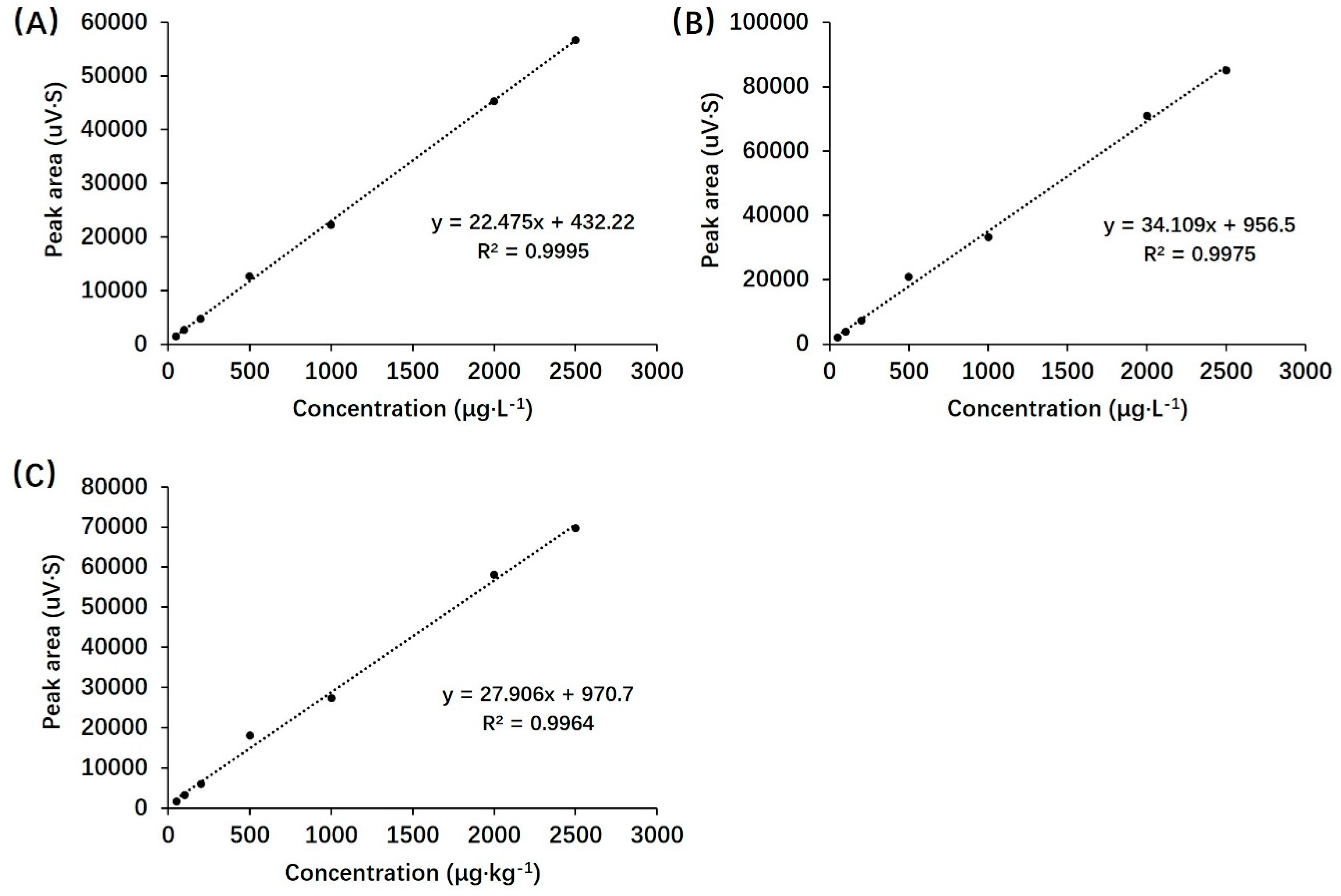
Figure 2.
Plots of mean plasma tilmicosin concentrations vs. time in donkeys after a single intragastric administration of 10 mg·kg-1 BW, n=4.
Figure 2.
Plots of mean plasma tilmicosin concentrations vs. time in donkeys after a single intragastric administration of 10 mg·kg-1 BW, n=4.
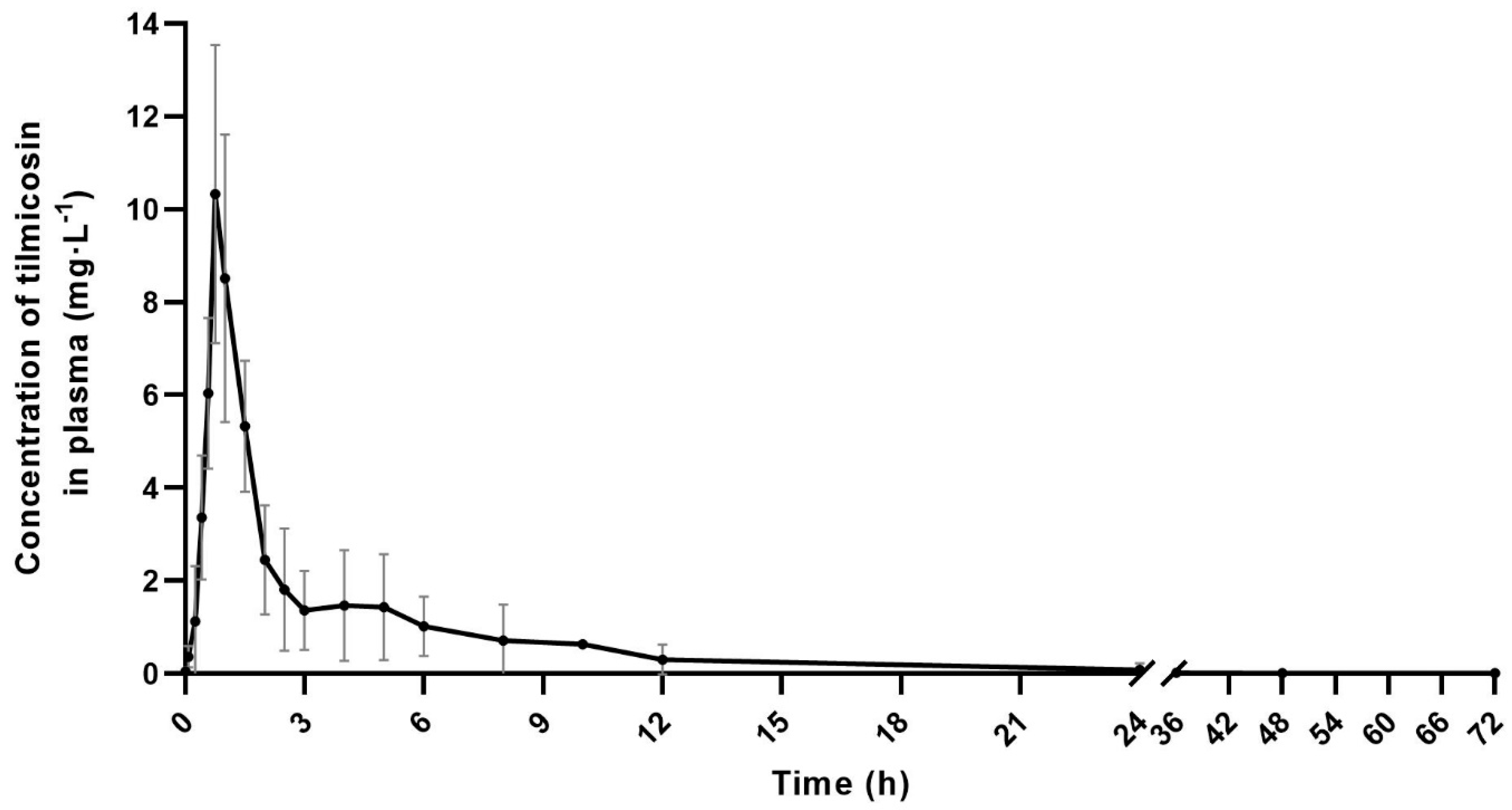
Figure 3.
The excretion of tilmicosin in urine of donkeys after a single intragastric administration of 10 mg·kg-1 BW, n=4. (A) Plots of mean urine tilmicosin concentrations vs. time in donkeys. (B) Plots of recovered rate of tilmicosin in urine vs. midpoint in donkeys. (C) Plots of recovered amount of tilmicosin in urine vs. midpoint in donkeys.
Figure 3.
The excretion of tilmicosin in urine of donkeys after a single intragastric administration of 10 mg·kg-1 BW, n=4. (A) Plots of mean urine tilmicosin concentrations vs. time in donkeys. (B) Plots of recovered rate of tilmicosin in urine vs. midpoint in donkeys. (C) Plots of recovered amount of tilmicosin in urine vs. midpoint in donkeys.
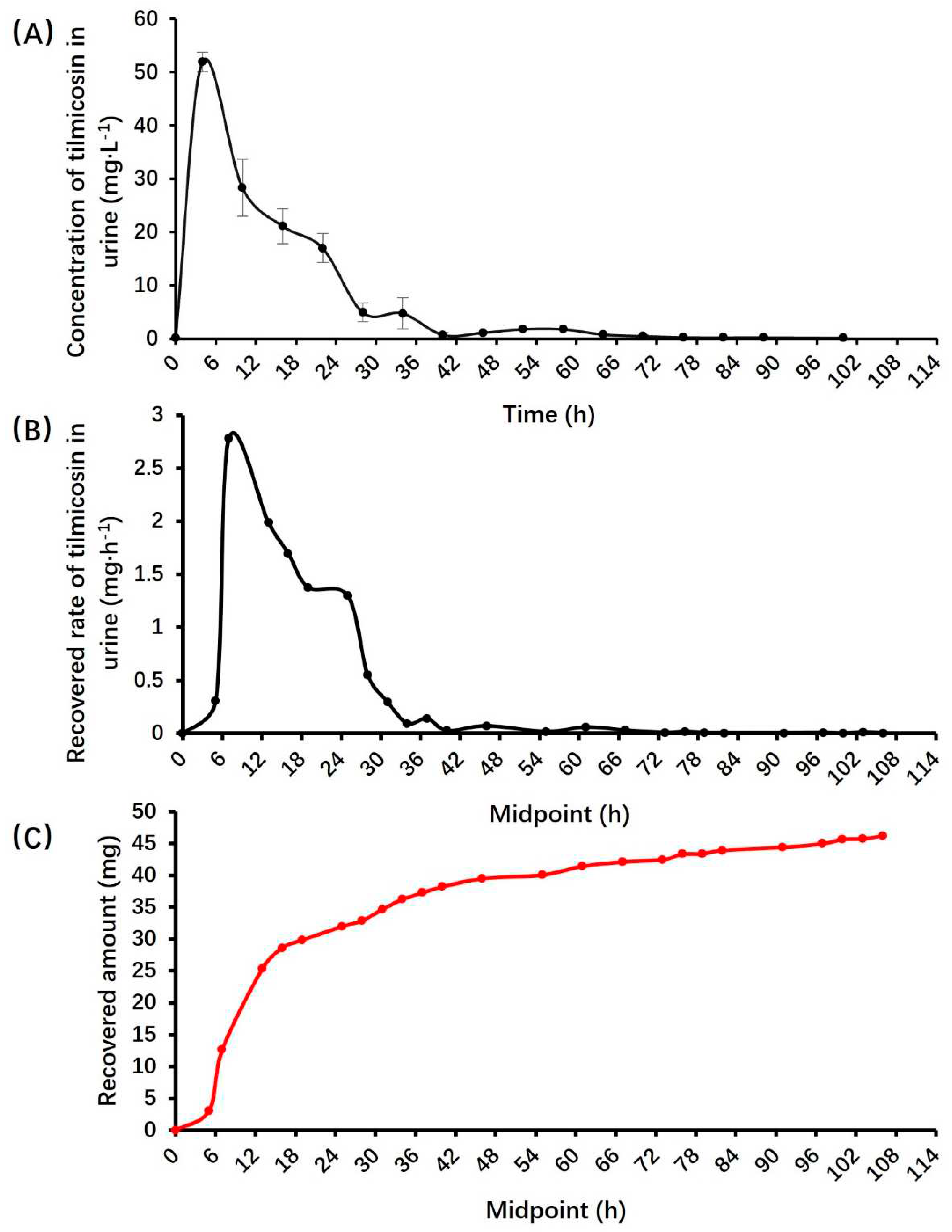
Figure 4.
The excretion of tilmicosin in feces of donkeys after a single intragastric administration of 10 mg·kg-1 BW, n=4. (A) Plots of mean feces tilmicosin concentrations vs. time in donkeys. (B) Plots of recovered amount of tilmicosin in feces vs. midpoint in donkeys.
Figure 4.
The excretion of tilmicosin in feces of donkeys after a single intragastric administration of 10 mg·kg-1 BW, n=4. (A) Plots of mean feces tilmicosin concentrations vs. time in donkeys. (B) Plots of recovered amount of tilmicosin in feces vs. midpoint in donkeys.
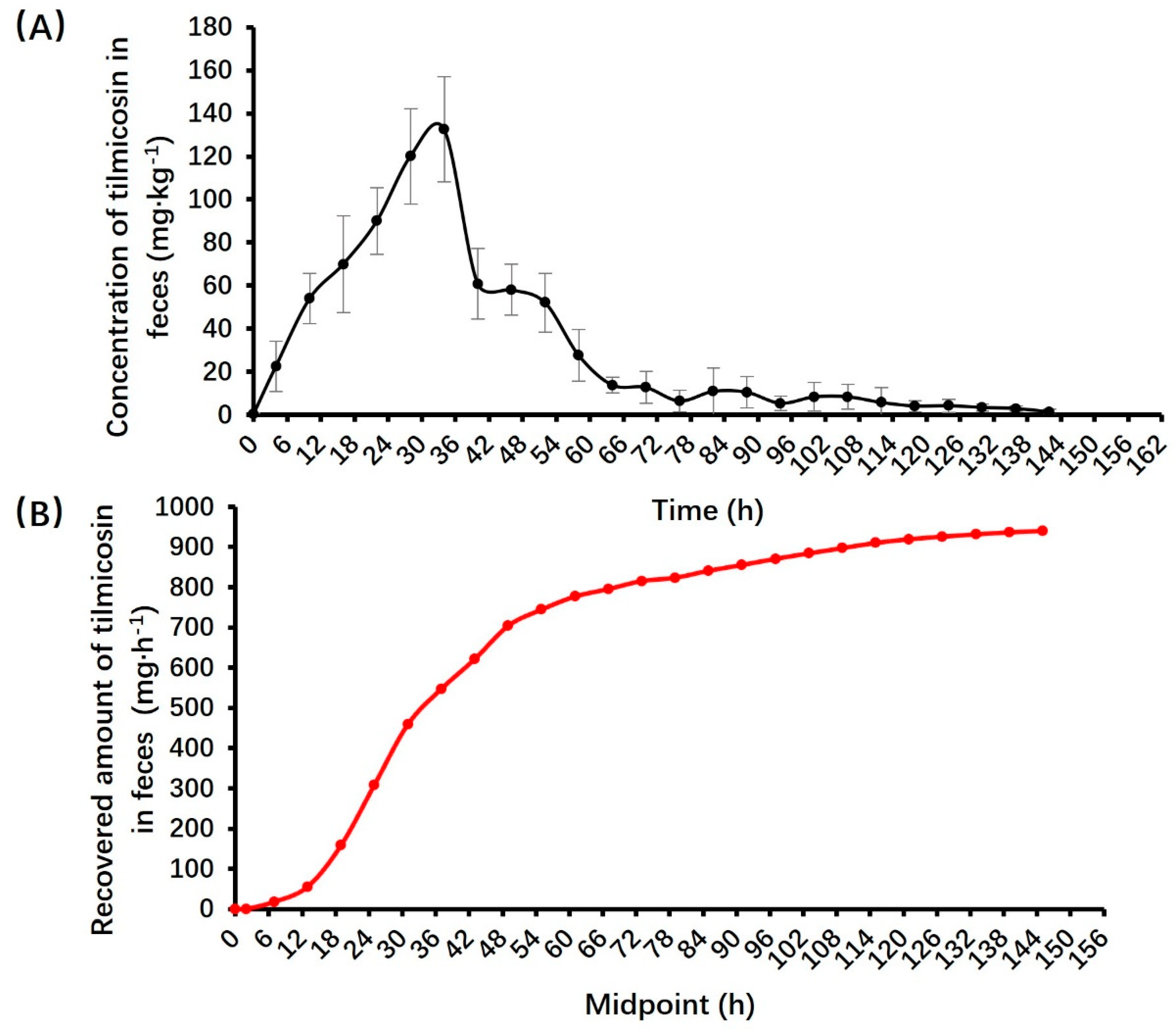

Table 1.
Basic information about experimental animals.
| Items | Donkey name | ± s | |||
| Jacob | Joshua | Matthew | William | ||
| Body weight (kg) | 148.00 | 140.00 | 145.00 | 135.00 | 142.00±4.95 |
| Single administered dose (mg · kg-1) | 10.00 | 10.00 | 10.00 | 10.00 | - |
| Administered dose (mg) | 1480.00 | 1400.00 | 1450.00 | 1350.00 | 1420.00±49.50 |
| Concentrated feed intake (kg · d-1) | 2.00 | 2.00 | 2.00 | 2.00 | - |
| Coarse fodder intake (kg · d-1) | 2.06 | 2.39 | 1.76 | 2.24 | 2.11±0.23 |
| Total feces volume (kg) | 41.65 | 43.55 | 31.45 | 34.80 | 37.86±4.93 |
| Water intake (L · d-1) | 8.21 | 6.03 | 6.79 | 8.21 | 7.31±0.94 |
| Total urine volume (L) | 6.37 | 4.87 | 6.68 | 4.53 | 5.61±0.93 |
Table 2.
The recovery of tilmicosin for plasma, urine, and feces.
| Spike level (μg·L-1)/(μg·kg-1) |
Average Recovery(%) | ||
| Plasma | Urine | Feces | |
| 50 | 87.53±2.04 | 87.93±2.78 | 82.60±3.71 |
| 500 | 84.73±2.37 | 91.33±3.35 | 79.00±1.02 |
| 5000 | 86.38±4.64 | 86.22±3.29 | 80.13±3.07 |
Table 3.
Pharmacokinetic parameters of tilmicosin in plasma after single intragastric administration in donkeys.
Table 3.
Pharmacokinetic parameters of tilmicosin in plasma after single intragastric administration in donkeys.
| Items | Donkey name | ± s | |||
| Jacob | Joshua | Matthew | William | ||
| λz (1·h-1) | 0.07 | 0.05 | 0.08 | 0.03 | 0.06±0.02 |
| T1/2λz (h) | 10.40 | 12.76 | 8.41 | 26.39 | 14.49±7.04 |
| Tmax (h) | 1.00 | 0.75 | 0.75 | 0.75 | 0.81±0.11 |
| Cmax (mg·L-1) | 5.69 | 5.10 | 18.82 | 15.34 | 11.23±5.97 |
| AUC0-∞ (mg·L-1·h) | 20.09 | 12.05 | 29.64 | 36.96 | 24.69±9.43 |
| MRT (h) | 11.71 | 8.83 | 5.84 | 5.82 | 8.05±2.44 |
| Cl/F (L·kg-1·h-1) | 0.50 | 0.83 | 0.34 | 0.27 | 0.48±0.22 |
| Vd/F (L·kg-1) | 7.47 | 15.27 | 40.96 | 10.30 | 9.28±4.10 |
λz, the first order rate constant associated with the terminal portion of the curve; T1/2λz, terminal half-life; AUC0-∞, area under curve; Tmax, time of maximum observed concentration; Cmax, maximum observed concentration; MRT, mean residence time; Cl/F, plasma clearance; Vd/F, volume of distribution.
Table 4.
Pharmacokinetic parameters of tilmicosin in urine after single intragastric administration in donkeys.
Table 4.
Pharmacokinetic parameters of tilmicosin in urine after single intragastric administration in donkeys.
| Items | Donkey name | ± s | |||
| Jacob | Joshua | Matthew | William | ||
| λz (1/h) | 0.08 | 0.06 | 0.06 | 0.04 | 0.06±0.01 |
| T1/2λz (h) | 8.99 | 11.08 | 12.18 | 17.82 | 12.52±3.29 |
| Time of maximum rate (h) | 7.00 | 7.00 | 16.00 | 25.00 | 13.75±7.46 |
| Maximum excretion rate (mg · h-1) | 3.22 | 2.34 | 1.70 | 2.86 | 2.53±0.57 |
| AURC0-∞ (mg) | 47.75 | 40.92 | 24.50 | 42.63 | 38.95±8.71 |
| Recovered amount (mg) | 45.57 | 35.78 | 27.62 | 31.24 | 35.05±6.73 |
| Recovered percent (%) | 3.09 | 2.56 | 1.90 | 2.31 | 2.47±0.43 |
λz, the first order rate constant associated with the terminal portion of the curve; T1/2λz, terminal half-life; AURC0-∞, area under rate curve.
Table 5.
Pharmacokinetic parameters of tilmicosin in feces after single intragastric administration in donkeys.
Table 5.
Pharmacokinetic parameters of tilmicosin in feces after single intragastric administration in donkeys.
| Items | Donkey name | ± s | |||
| Jacob | Joshua | Matthew | William | ||
| Recovered amount (mg) | 815.77 | 875.09 | 1008.52 | 1060.14 | 939.88±98.46 |
| Recovered percent (%) | 55.12 | 62.51 | 69.55 | 78.53 | 66.43±8.65 |
Disclaimer/Publisher’s Note: The statements, opinions and data contained in all publications are solely those of the individual author(s) and contributor(s) and not of MDPI and/or the editor(s). MDPI and/or the editor(s) disclaim responsibility for any injury to people or property resulting from any ideas, methods, instructions or products referred to in the content. |
© 2023 by the authors. Licensee MDPI, Basel, Switzerland. This article is an open access article distributed under the terms and conditions of the Creative Commons Attribution (CC BY) license (http://creativecommons.org/licenses/by/4.0/).
Copyright: This open access article is published under a Creative Commons CC BY 4.0 license, which permit the free download, distribution, and reuse, provided that the author and preprint are cited in any reuse.