

Submitted:
12 March 2025
Posted:
13 March 2025
You are already at the latest version
Abstract
Background/Objectives: Marbofloxacin, a second-generation fluoroquinolone, is used to control economically significant poultry diseases caused by pathogenic bacteria such as Staphylococcus aureus and Escherichia coli. Although synergistic antimicrobial activity between fluoroquinolones and N-acetyl-L-cysteine (NAC) has been observed in vitro, data on their pharmacokinetic interactions in vivo remain limited. This study aimed to evaluate the effect of NAC on the oral pharmacokinetics of marbofloxacin in broiler chickens and its antibacterial activity against E. coli ATCC 25922 and S. aureus ATCC 25923, assessing the potential benefits of their combined administration. Methods: Marbofloxacin pharmacokinetics was evaluated in broilers (5 mg/kg dose) after single intravenous (n=12) or single oral (n=12) administration into the crop; co-administration with NAC (400 mg/kg via feed): first day poultry (n=12) received single oral dose of marbofloxacin via the crop and next days the fluoroquinoilone drug was administered via drinking water. Plasma levels were determined by LC-MS/MS analysis and minimum inhibitory concentrations were assessed using the microbroth dilution method. Results: NAC significantly reduced bioavailability of marbofloxacin after a single oral administration into the crop and decreased the elimination rate constant following multiple administration of both drugs. At a concentration of 20 μg/mL, NAC led to a 3.8-fold reduction in the MIC of marbofloxacin against E. coli ATCC 25922 and a two-fold decrease at concentrations between 1 μg/mL and 6 μg/mL, while no change was observed for S. aureus ATCC 25923. Conclusions: Oral co-administration of NAC and marbofloxacin reduced fluoroquinolone bioavailability by two-fold while enhancing antibacterial activity against E. coli ATCC 25922.
Keywords:
chickens
; marbofloxacin
; N-acetyl-L-cysteine
; drug-drug interactions
1. Introduction
Marbofloxacin is a second-generation fluoroquinolone with a broad antibacterial activity against many Gram-negative aerobic and some Gram-positive bacteria, registered for use in veterinary medicine [1]. It exhibits concentration-dependent bactericidal activity with a significant post-antibiotic effect by inhibiting bacterial DNA topoisomerases II and IV [1,2]. High oral bioavailability, a large volume of distribution, and a long half-life, combined with short withdrawal periods, are among the pharmacokinetic characteristics of oral marbofloxacin that make it an effective therapeutic drug against susceptible bacterial infections in bird species such as chickens [2,3,4,5], turkeys [6], Japanese quails, common pheasants [7], and geese [8,9]. It has been considered as a critically important veterinary antimicrobial agent by the World Organisation for Animal Health in the treatment of respiratory, and enteric diseases in poultry, ruminants, equine, rabbits, and swine [10]. Moreover, marbofloxacin is generally considered safe for use in exotic birds, as no or only mild, reversible adverse effects have been reported [11].
Despite its broad antibacterial activity, recent studies have reported an increased risk of resistance development to fluoroquinolones, including marbofloxacin, due to their widespread use in pathogens such as Staphylococcus aureus (S. aureus) and Escherichia coli (E. coli), which cause economic losses in poultry husbandry [12,13,14]. As a result, efforts to promote the rational use of antibiotics have been made, and these are reflected in EU legislation. According to this, marbofloxacin, as a fluoroquinolone, is classified as a Category B antibacterial drug, and its use is limited to cases where no alternative, clinically applicable, and effective Category C or D antibiotics are available [15]. Its use must be based on antimicrobial susceptibility testing when possible [15].
It has been acknowledged that, apart from reducing the use of antibacterial drugs, the emergence and spread of resistance to antibiotics require finding alternative strategies to mitigate the negative impact on animals and the environment [16]. One such approach is the combined administration of non-antibiotic compounds to overcome bacterial resistance [17,18,19]. N-acetyl-L-cysteine (NAC) has been shown to exhibit antioxidant properties in poultry [20,21,22,23] and holds potential for use in combination with antibiotic treatments to reduce the risk of developing bacterial resistance [24,25,26]. Furthermore, NAC has been reported as a potential modulator of antibiotic activity [27,28,29,30]. Although the in vitro potentiation of antibacterial activity by co-administering NAC with certain antibacterial drugs, including fluoroquinolones, has been documented, it remains unclear whether these effects occur in vivo. Furthermore, no data are available on potential pharmacokinetic interactions, which may differ from in vitro findings.
Considering the increased responsibility associated with the administration of fluoroquinolones and the lack of information on possible interactions between marbofloxacin and N-acetyl-L-cysteine, this study was designed to evaluate the effect of their co-administration on the oral pharmacokinetics and antibacterial activity of marbofloxacin in broiler chickens, as well as to assess the potential benefits of their combined.
2. Results
The simultaneous administration of NAC and marbofloxacin for five consecutive days did not result in any clinical manifestations of undesirable effects.
2.1. Pharmacokinetic Analysis of Marbofloxacin with or Without NAC
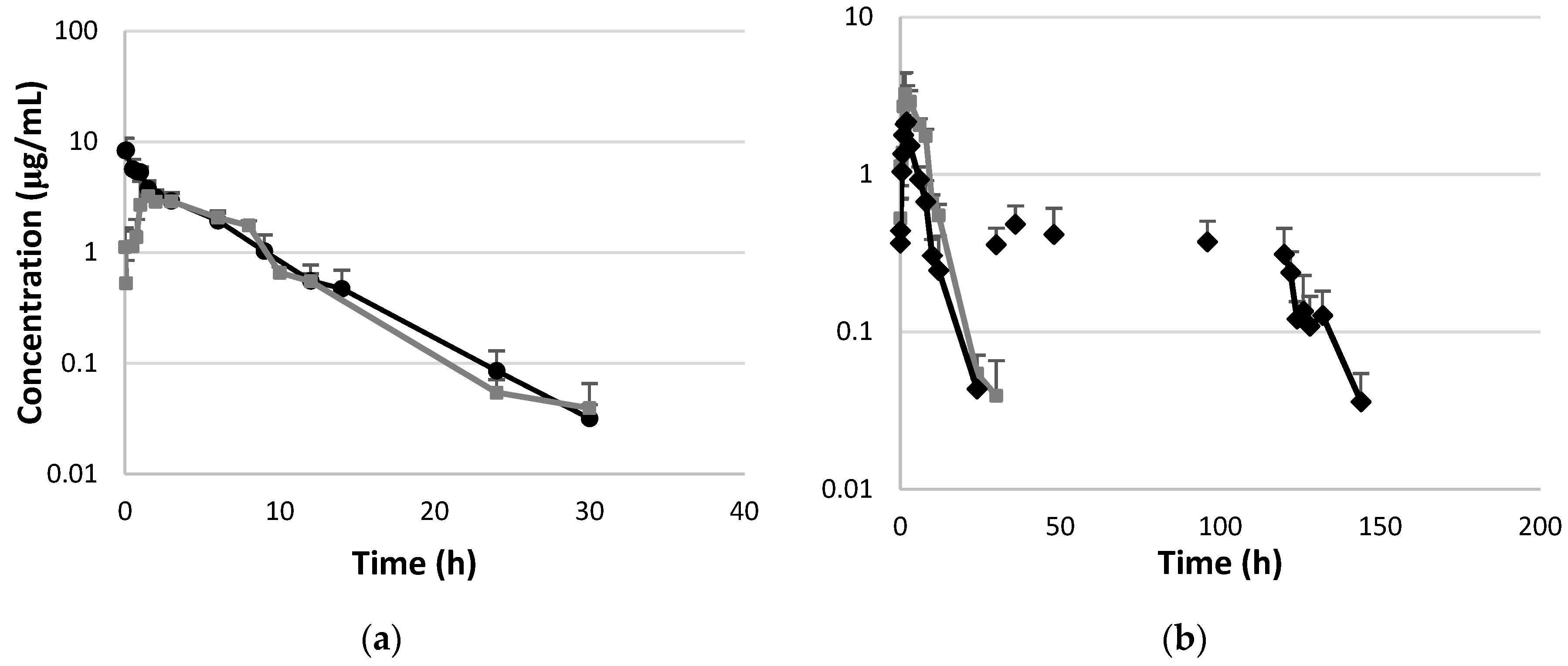
Plasma concentrations of marbofloxacin are presented in Figure 1 (a and b), while the pharmacokinetic parameters are summarized in Table 1. Statistically significant lower value of AUC₀–∞ and an higher value of MRT was observed after single oral administration of marbofloxacin compared to intravenous treatment. Additionally, the results showed a significant increase in the elimination rate constant (p < 0.05) and a significant decrease in AUC₀–∞ following the first oral dose of marbofloxacin administered into the crop via a plastic tube and after pre-treatment with NAC. The values of Cmax, AUC0–∞, F, and MAT for the fluoroquinolone drug were significantly decreased under the influence of NAC administration. Additionally, a significantly lower elimination rate constant and a prolonged elimination half-life were observed after five days of fluoroquinolone administration via drinking water in combination with N-acetyl-L-cysteine, compared to all other treatments. Median value of the fluctuation of marbofloxacin concentrations after multiple administration of the drug did not exceeded 12.2% (2.87-48.44). The value of accumulation index was 1.22 (1.01-1.73).
Low values of plasma protein binding of marbofloxacin were found for the medium concentrations: 7.99±1.01 and 3.28±1.1 for 1 and 2.5 µg/mL, respectively. Higher values were observed for low and high fluoroquinolone levels: 24.65±0.4 % and 10.39±3.01 % for 0.1 and 5 µg/mL, respectively.
2.2. Antimicrobial Activity of Marbofloxacin with or Without NAC
An important aspect of drug-drug interactions involving antibacterial compounds is the need to evaluate not only potential changes in pharmacokinetics but also possible variations in antibacterial efficacy. Table 2 presents data for MIC values of marbofloxacin against Gram-negative Escherichia coli ATCC 25922 and Gram-positive Staphylococcus aureus ATCC 25923 strains, used alone, or in combination with different concentrations of NAC. N-acetyl-L-cysteine reduced the MIC value of marbofloxacin by 3.8-fold when administered at 20 μg/mL. Concentrations between 6 μg/mL and 1 μg/mL resulted in a two-fold decrease in the MIC of the fluoroquinolone. However, the MIC value against Staphylococcus aureus ATCC 25923 remained unchanged after bacterial incubation with the marbofloxacin-NAC combination. MBC value for Escherichia coli ATCC 25922 was equal to the value of MIC and for Staphylococcus aureus ATCC 25923 MBC value was two-fold higher than MIC (Table 2).
3. Discussion
The present study aimed to evaluate the effect of NAC on the pharmacokinetics and antibacterial activity of marbofloxacin after multiple oral administration in broiler chickens and the potential benefits and drawbacks of the combination. No deviations from normal behavior, signs of pain or distress were observed in chickens subjected to either single or combined oral administration of marbofloxacin and NAC. No adverse effects have been reported in previous studies on broiler chickens following the administration of marbofloxacin or N-acetyl-L-cysteine alone. [11,31,32].
A non-compartmental analysis was used to characterize the pharmacokinetics of marbofloxacin following both single intravenous and single oral administrations, alone. Previous studies in chickens have reported relatively higher Vz values, ranging from 1.3 to 2.5 L/kg [2,5,33], compared to our observed range of 0.662–1.118 L/kg. The ClB values in our study (0.116–0.204 L/h/kg) were comparable to those reported in similar investigations, such as 0.19 ± 0.02 L/h/kg [33]. Taken together, the Vz and ClB data resulted in a t₁/₂el of 3.48–4.35 h, which is slightly lower than the previously reported range of 4.89–5.55 h [2,5,33]. Similar tendency was observed for MRT values: 3.25–6.12 h in our study and range from 6.09 to 7.78 h reported in comparable experiments in chickens [2,5,33]. The slight differences can be explained by the different methods of analysis, HPLC versus LC-MS/MS, breed and age of poultry.
The pharmacokinetic parameters determined in this study following single oral administration of marbofloxacin into the crop were consistent with values reported in the available literature. The published values of bioavailability from 60.22 % to 88.0% were similar to our findings [2,3,34]. The observed high bioavailability of marbofloxacin is attributed to the inherent lipophilicity of fluoroquinolones, which facilitates their absorption. Reported mean Cmax and Tmax values ranged from 2.11 to 2.19 µg/mL and 0.83 to 1.68 h, respectively [2,32,34]. However, our study showed greater variability in these parameters, with Cmax values ranging from 1.95 to 5.01 µg/mL and Tmax from 1 to 6 h. The data showing a low percentage of plasma protein binding, ranging from 3% to 24%, suggest that marbofloxacin concentrations and AUC values are unlikely to be significantly affected by a decrease in the free drug concentration. The reported mean t₁/₂el values (4.13–4.89 h) were in close agreement with our observations [32,34,35]. Similarly, the MRT values found in previous studies (ranging from 5.37 to 7.48 h) were comparable to our findings [5,34,35]. In summary, the pharmacokinetic parameters obtained in our experiment are consistent with previously published data on marbofloxacin and align with the typical characteristics of fluoroquinolones.
NAC significantly affected the oral pharmacokinetics of marbofloxacin in broiler chickens. In the group of chickens that received the first dose of marbofloxacin directly into the crop after pre-treatment with NAC, the drug reached a significantly lower values of Cmax compared to the group treated with a single dose of marbofloxacin alone (p < 0.05). The changes in the Cmax can be explained by the affected rate of absorption of marbofloxacin in combination with NAC [36]. The lower MAT values suggest a faster absorption rate in the presence of NAC compared to the single marbofloxacin administration. The decreased Cmax value corresponded to a two-fold reduction in the AUC₀–∞, leading to a statistically significant decrease in bioavailability. This indicates lower systemic exposure to the fluoroquinolone when co-administered with NAC in broiler chickens. Fluoroquinolone molecules are characterized by the presence of both acidic and basic groups, which can exist in different protonated forms. These forms vary in solubility depending on the environmental conditions [37]. As a weak organic acid with a pKa of 3.24, NAC can influence the pH in the intestinal lumen, potentially altering ability of marbofloxacin to cross the intestinal barrier and reducing its absorption [38]. A decrease in Cmax and AUC of marbofloxacin in broiler chickens has been reported after pre-treatment with lactic acid which has a pKa of 3.8 [39]. The changes in the pharmacokinetics of marbofloxacin observed after single oral administration were also seen after multiple treatments with the fluoroquinolone in combination with NAC. The data for steady-state plasma levels (Cavg) lower than the Cmax values reveals decreased exposure to the fluoroquinolone drug. Significantly longer elimination half-life after multiple administration of marbofloxacin can be explained by the administration of the antibacterial drug via drinking water and free access and consumption of the medicated water. The small fluctuations in drug concentrations during the dosage interval and low accumulation index indicate a relatively stable exposure over time without significant variations and risk of excessive drug accumulation.
Optimizing dosing regimens for antibacterial drugs co-administered with other medications requires consideration not only of pharmacokinetic drug-drug interactions but also of the impact of combination on antibacterial activity. Literature data support the enhanced antibacterial activity of fluoroquinolones, such as enrofloxacin, as well as other antibacterial agents, including beta-lactam antibiotics, apramycin, gentamicin, and tigecycline, when combined with NAC [24,25,26]. These changes in the efficacy of the combination between NAC and antibiotics highlight the importance of properly selecting combinations of antibacterial drugs and NAC to achieve a synergistic effect. Combination therapy of NAC and fluoroquinolones is one approach used to improve efficacy and reduce the risk of resistance development [25]. In the present study, co-administration of marbofloxacin and NAC resulted in a reduction in the minimum inhibitory concentration (MIC) of marbofloxacin against E. coli ATCC 25922, providing effect at lower antibiotic concentrations. Our data show that the MIC of marbofloxacin against E. coli ATCC 25922 decreases in the presence of NAC at concentrations of 1–6 μg/mL. According to our previous study on NAC pharmacokinetics in healthy broiler chickens, slightly higher plasma levels were observed 24 hours after its oral administration at a dose of 400 mg/kg BW via feed, with a Cmax of 5.74 μg/mL (range: 3.44–9.32 μg/mL) [40]. The observed reduction in the MIC of marbofloxacin against Gram-negative E. coli ATCC 25922 from 0.0156 to 0.008 μg/mL, along with an average plasma concentration of 0.41 μg/mL, indicates that NAC-pre-treated broiler chickens maintain plasma marbofloxacin levels 50-fold above the MIC throughout the dosing interval. Higher reduction of MIC was achieved when the fluprpquinolone drug was combined with NAC at a concentration of 20 μg/mL. Similar values of Cmax of 34.18 μg/mL (range: 19.14–57.19 μg/mL) can be reached after direct application of NAC into the crop [40]. However, the low oral bioavailability and rapid elimination of NAC limits the maintenance of these plasma levels [26,28,41,42]. However, a study by Petkova [30], reported no change in MIC values of doxycycline when combined with NAC, but an increase in the minimum biofilm inhibitory concentration (MBIC) for E. coli ATCC 25922. This combination also resulted in increased MIC values against S. aureus ATCC 25923, S. aureus O74, while showing no change in MBIC against the tested Gram-positive strains and Pseudomonas aeruginosa ATCC 27853 [30].
The data from our study suggest possible oral application of marbofloxacin in combination with NAC for treatment of gastro-intestinal E. coli infections in poultry. The limitations include the lack of pharmacokinetic data on the NAC combination in sick animals with a Gram-negative bacterial infection model. Future studies are needed to ensure that therapeutic drug concentrations are achieved and maintained under infection conditions, determine the optimal dosing regimen, and confirm the safety of the combination. Additionally, in vitro testing of the marbofloxacin-NAC combination on other strains, including field isolates, could provide further insight into its efficacy. A disadvantage of this combination is the low oral bioavailability of NAC, which limits its use in treating systemic E. coli infections. Based on pharmacokinetic interaction data, it can be concluded that decreased bioavailability may compromise the systemic efficacy of marbofloxacin, particularly against less susceptible pathogenic bacteria.
4. Materials and Methods
Drugs and Reagents
Marbofloxacin (Marfloxin 100 mg/ml injectable solution, KRKA, Novo mesto, Slovenia) was diluted with sterile pyrogen-free water to 2% for intravenous (i.v.) administration. The same sterile formulation was diluted to 1% and it was used for oral administration. N-acetyl-L-cysteine (TLC grade ≥ 99%, Sigma-Aldrich, St. Louis, MO, USA) was applied orally to poultry, mixed with the feed. LC-MS/MS analysis of marbofloxacin plasma concentrations was performed by using enrofloxacin hydrochloride as an internal standard and marbofloxacin (≥98%, Sigma-Aldrich, St. Louis, MO). Mobile phases were prepared with acetonitrile (LC/MS grade, Honeywell, Fluka™, Germany), formic acid for mass spectrometry (LC/MS purity ~98%, Honeywell Fluka™, Seelze, Germany) and water for chromatography (LC-MS grade, LiChrosolv®, Merck KGaA, Darmstadt, Germany).
The microbiological assays Staphylococcus aureus American Type Culture Collection (ATCC) 25923 and Escherichia coli ATCC 25922 were obtained from the Bulgarian National Collection for Microorganisms and Cell Cultures (NBIMCC, Sofia, Bulgaria). Microbiological tests were performed by using cation-adjusted Mueller Hinton broth (MHB, HiMedia Laboratories GmbH, Einhausen, Germany).
Animals and Experimental Design
The study was conducted after receiving ethical approval from the Bulgarian Food Safety Agency (License No. 339/December 13, 2022). All animal studies were performed according to the requirements of Bulgarian legislation (Ordinance 20/01.11.2012).
Thirty-six, day-old Ross hybrid broiler chickens (Cornish ♀ x Plymouth Rock ♂) of both sexes were purchased from a commercial hatchery (Zhuliv EOOD, Stara Zagora, Bulgaria) and housed at the Biobase of the Faculty of Veterinary Medicine, Trakia University. The birds were raised under standard management conditions in accordance with the species’ requirements, ensuring they remained healthy and free from stress and disease. They were fed an antibiotic-free grower and finisher ration according to the requirements of the age, with water provided ad libitum. At four weeks of age, the broiler chickens (n=36) were randomly divided into three experimental groups, each consisting of twelve birds.
The chickens (n=12, 1.48 ± 0.11 kg body weight, BW) from Group I were treated intravenously (i.v.) with 2% solution of marbofloxacin. The poultry received a single dose of 5 mg/kg BW via the left v. subcutanea ulnaris. Blood samples were collected from the right wing vein of the birds (n=6 chickens at every sampling time) in heparinized tubes at 0.083, 0.25, 0.5, 0.75,1,1.5,2, 3, 6, 9, 12, 14, 24,30, 36 and 48 h after administration of marbofloxacin.
The second group (n = 12; 2.0 ± 0.17 kg BW) was treated orally via intraingluvial gavage using a soft probe. The broilers received a single dose (5 mg/kg BW) of a 1% marbofloxacin solution. To eliminate the possibility of food-drug interaction, the birds were deprived of feed 12 hours prior to treatment. Blood samples were collected from either the right or left wing vein at the following time points (n = 6 chickens per sampling time): 0.083, 0.25, 0.5, 0.75, 1, 1.5, 2, 3, 6, 8, 10, 12, 24, 30, 36, and 48 hours after drug administration.
The first dose of marbofloxacin (5 mg/kg BW) was administered to the chickens in Group III (n = 12, 1.80 ± 0.16 kg BW) via a soft probe into the crop after two days of NAC pretreatment at a dose of 400 mg/kg BW, mixed with the feed (Scheme 1). Over the next four days, the broilers in Group III received marbofloxacin at a dose of 5 mg/kg BW/day through drinking water, while NAC was administered orally at a dose of 400 mg/kg BW via the feed. NAC administration continued for two days after the final dose of marbofloxacin. Broiler chickens were fasted for 12 hours prior to the first oral administration of marbofloxacin. The doses were calculated based on the average bird weight and water consumption measured the previous day. The sampling times were as follows: 0.083, 0.25, 0.5, 0.75, 1, 1.5, 2, 3, 6, 8, 10, 12, 24, 30, 36, 48, 96, 120, 122, 124, 126, 128, 132, 144, 150, 156, and 168 hours after the start of marbofloxacin treatment.
Blood samples were collected from six chickens in each experimental group at each designated time point. Approximately 0.8 mL of blood was drawn from each chicken per collection time point, centrifuged at 1500 × g for 10 minutes, and the plasma was collected and stored at –80°C until analysis.
Determination of Marbofloxacin Concentrations by LC-MS/MS Analysis
Marbofloxacin was extracted from 300 μL plasma. The samples were transferred into 2 mL Eppendorf tubes. Then, 10 μL of enrofloxacin hydrochloride (internal standard) at a concentration of 6 μg/mL was added, resulting in a final concentration of 100 ng/mL. To deproteinize the plasma, 290 μL of 0.1% formic acid in acetonitrile was added, and the mixture was vortexed for 1 minute. The mixture was then shaken at 200 g/min for 20 minutes (Lauda™ Varioshake VS 8 BE shaker with BS1363 UK-Plug, Marlton. USA). Following this, it was centrifuged at 14 370 × g for 15 minutes at 4 °C. The supernatant was filtered through 0.22 μm syringe filters (Agilent Captiva Econo Filter, PTFE membrane, Santa Clara, CA, United States) and transferred into LC-MS/MS vials for analysis.
The chromatographic separation of the compounds was made with a Zorbax Eclipce Plus (2.1 mm i.d. × 50 mm, 1.8 µm, Agilent Technologies, United States) connected to a precolumn Zorbax SB-C18 (2.1x5mm, 1.8 µm, Agilent Technologies, United States). The liquid chromatography module consisted of a 1260 Infinity II quaternary pump and a 1260 Infinity II Vial Sampler. The temperature of the column was maintained at 40°С. It was set at 8°C in the autosampler. The mobile phases A consisted of 0.1% formic acid in water, while mobile phase B consisted of 0.1% formic acid in methanol. The following gradient mode was applied: 0–1 min (98% A, 2% B), 1–7 min (from 98% A, 2% B to 60% A, 40% B), 7–11 min (from 60% A, 40% B to 0% A, 100% B), 11–13 min (0% A, 100% B), 13-13.1 min (from 0% A, 100% B to 98% A, 2% B), 13.1-17 min (98% A, 2% B), 17-20 min (98% A, 2% B), 20-24 min (Post run): (98% A, 2% B). The flow rate was 0.2 mL/min. The injection volume was 5 μL.
The quantification of marbofloxacin was done with a triple-quadrupole mass spectrometer Agilent 6460c, Agilent Jet Stream (AJS) technology (Santa Clara, CA, United States). The analysis was performed by applying ESI positive ion mode was used (Agilent Jet Stream ESI+). The following conditions were set: drying gas temperature (N2) 300°C; flow of the drying gas (N2) 7 L/min; nebulizer gas (N2) 50 psi; sheath gas temperature (N2) 350°C; sheath flow 10 L/min; capillary voltage 3000 V; nozzle voltage 500 V; dwell time 200 ms. The qualifying ion for marbofloxacin was 363.2 m/z and quantitative ions were 320.1 m/z and 72.1 m/z. For enrofloxacin ware 360 m/z, 342.1 m/z and 316.2 m/z, respectively [43]. Data analysis and quantification of marbofloxacin was performed using MassHunter software (Agilent Technologies, Santa Clara, CA, USA). The retention time of marbofloxacin was 9.7 min.
Quantification of marbofloxacin in plasma samples was performed by reference to a calibration curve, which showed acceptable linearity over a range of eight different concentrations of standards: 5, 10, 50, 100, 250, 500, 750, and 1000 ng/mL, as indicated by a mean correlation coefficient (R²) value of 0.9978. The limit of detection (LOD) for the drug was 0.004 μg/mL. The limits of quantification (LOQ) were 0.013 μg/mL. Accuracy ranged from 91.27% to 109.96%. Intra- and inter-day precision values were below 8.29% and 14.35%, respectively.
Protein Binding
Standard solutions of marbofloxacin in chicken plasma with low (0.1 µg/mL), medium (1 µg/mL and 2.5 µg/mL), and high (5.0 µg/mL) concentrations were used for determination of protein binding of the fluoroquinolone drug. Ultrafree—MC Centrifugal Filters with a hydrophilic PTFE membrane and 0.45 μm pore size (Merck KGaA, Darmstadt, Germany) were used according to the manufacturer’s instructions. Plasma samples (800 μL) with added marbofloxacin concentrations were incubated for 1 h at 37 °C. After that, they were centrifuged first at 1000× g for 10 min, then at 2000× g for 20 min. Filtrate (5 μL) of each concentration was analyzed with the described LC-MS/MS method. The tests were performed in triplicate. The percentage of protein binding was determined by application of the following equation:
where CTP is the total plasma concentration, and CFP is the unbound concentration in the filtrate [44].
% protein binding = (CTP − CFP/CTP) × 100,
Pharmacokinetic Analysis
Pharmacokinetic analysis was performed using Phoenix 8.3 software (Pharsight Certara, St. Louis, MO, USA). Non-compartmental analysis was applied for computation of pharmacokinetic parameters on the basis of the determined marbofloxacin concentrations in plasma for every chicken, n=12 per group. The following parameters were calculated: λ, elimination rate constant; t1/2el, terminal half-life; Tmax, time at maximum plasma concentration; Cmax, maximum plasma concentration; Cavg, average plasma concentration; AUC(0-inf), area under the curve from zero to infinity; Cl, total body clearance; Vss, volume of distribution at steady state; Vz, area volume of distribution; MRT, mean residence time; MAT, mean absorption time; F, bioavailability and AUC0-τ, partial area from dosing time to dosing time plus dosing interval. Linear-up log-down method was used for AUC calculation after single oral administration of marbofloxacin, alone or in combination with NAC. The value of R2 was >0.943 and the extrapolation of AUC was lower than 20%.
The bioavailability (F) was calculated according to the following equation:
where AUCp.o. and AUCi.v. are area under the curve after oral or intravenous administration, recpectively.
F % = (AUCp.o./AUCi.v.)×100,
Determination of MIC and MBC Values
The bacterial strains were stored at −80 °C prior to use. The strains were grown on tryptic soy agar (TSA; Sigma-Aldrich, St. Louis, USA, Product of India) supplemented with 5% defibrinated sheep blood. Colonies from overnight growth were directly suspended in Mueller-Hinton broth (MHB; HiMedia, Mumbai, India) until a turbidity comparable to the McFarland turbidity standard of 0.5 (Densilameter II, Erba Lachema, Brno, CZ). Broth was used at a ratio of 1:100 to obtain dilute the cultures to 106 CFU/ml.
Broth microdilution assay was applied to determine the minimum inhibitory concentration (MIC) of marbofloxacin for E. coli ATCC 25922 and S. aureus ATCC 25923. Serial (two-fold) dilutions of marbofloxacin were prepared in Muller-Hinton broth with an initial concentration of 256 μg/ml and then 100 μL (in the trial without NAC) aliquots of the dilutions added to the wells to 96-well flat bottom plates (Costar, Corning Incorporated, Kennebunk, ME, USA). Then aliquots in volumes of 100 μL of E. coli ATCC 25922/S. aureus ATCC 25923 suspension prepared in Mueller-Hinton broth with approximate cell density of 1×10⁶ CFU/mL were added to each well. The plates were incubated at 37 °C for 20 h and after that optical density (OD) was measured at a wavelength of 620 nm (Synergy LX Multi-Mode Microplate Reader, BioTek, Winooski, VT, USA). The MIC was defined as the lowest drug concentration resulting in an OD value close to blank. The independent experiments were performed in triplicate.
The determination of the MIC value for each bacterial strain was performed in 96-well plates by adding 50 μL of marbofloxacin at an initial concentration of 256 μg/mL to 50 μL of bacterial suspension. Serial 2-fold dilutions of marbofloxacin were prepared. Then, 50 μL of NAC was added to each plate containing the serial dilutions of marbofloxacin, resulting in final NAC concentrations of 1, 2, 4, 6 and 20 μg/mL. The plates were incubated at 35°C for 20 hours. The NAC concentrations used in this study were chosen based on a previous study, which demonstrated that a NAC concentration of 34.18 (19.14–57.19) μg/mL was achievable in chicken plasma after a single oral administration at a dose of 400 mg/kg BW (Roydeva et al., 2024). Absorbance was measured at 620 nm using a plate reader (Synergy LX Multi-Mode Microplate Reader, BioTek, Winooski, VT, USA).
Aliquots (10 μl) from wells at or above the MIC were subcultured on TSA plates to determine MBC values. The Petri dish were incubated at 35°C for 20 hours. The minimum bactericidal concentration MBC was defined as the lowest concentration of marbofloxacin at which >99.9% of the inoculated organisms were killed. Each experiment was performed in triplicate.
Statistical Analysis
Statistical evaluation of the data from the non-compartmental pharmacokinetic analysis are presented as geometric mean and range of minimum and maximum. Normal distribution of the data was confirmed with Shapiro–Wilk test. ANOVA test, followed by Bonferroni post-hoc test, was applied for statistical analysis of the data. Comparison of Tmax values was performed using the Mann-Whitney test due to the absence of a normal distribution. A P-value < 0.05 was considered to be significant (Statistica 10.0, Tibco, Palo Alto, CA).
5. Conclusions
The results of this study demonstrate that oral administration of marbofloxacin at a dose of 5 mg/kg BW and NAC at 400 mg/kg BW in the feed led to a two-fold decrease in the bioavailability of the fluoroquinolone and a reduction in the MIC for Escherichia coli ATCC 25922. Based on these findings, the combination of marbofloxacin and NAC could have beneficial effect in treating localized gastrointestinal infections caused by susceptible Gram-negative microorganisms. However, further studies in sick animals are necessary to confirm the efficacy and safety of this combination.
Author Contributions
Conceptualization, A.M.; methodology, A.M. and N.R.; software, A.M.; validation, A.R.; formal analysis, A.R.; data curation, A.M., A.R. and N.R.; writing—original draft preparation, A.R. and A.M.; writing—review and editing, A.M.; visualization, A.M.; supervision, A.M.; project administration, A.M.; funding acquisition, A.R. All authors have read and agreed to the published version of the manuscript.
Funding
The publication of the manuscript was funded by the Bulgarian Ministry of Education and Science (MES) in the framework of the Bulgarian National Recovery and Resilience Plan, component “Innovative Bulgaria”, Project № BG-RRP-2.004-0006-C02, “Development of research and innovation at Trakia University in service of health and sustainable well-being”
Institutional Review Board Statement
The study was conducted in accordance with the requirements of Bulgarian legislation (Ordinance 20/01.11.2012). The animal study protocol was approved by ethical commission at the Bulgarian Food Safety Agency (License No. 339/December 13, 2022).
Informed Consent Statement
Not applicable.
Data Availability Statement
The individual marbofloxacin concentrations are available from the authors upon request. All the other data are included in the article.
Conflicts of Interest
The authors declare no conflicts of interest.
Abbreviations
The following abbreviations are used in this manuscript:
| NAC | N-acetyl-L-cysteine |
| E. coli | Escherichia coli |
| S. aureus | Staphylococcus aureus |
References
- Martinez M., McDermott P., Walker R. Pharmacology of the fluoroquinolones: a perspective for the use in domestic animals. Vet J. 2006, 172, 10-28. [CrossRef]
- Singh, R.D., Vaghela, S.H., Tukra, S., Patel, A.R., Patel, H.B., Sarvaiya, V.N., Mody, S. K. (). Dosage derivation of marbofloxacin in broiler chickens based on pharmacokinetic-pharmacodynamic integration. Indian J. Vet. Sci. & Biotechnol., 2023, 19, 7-11. [CrossRef]
- Atef M., Atta A. H., Darwish A. S., Mohamed H. Pharmacokinetics aspects and tissue residues of marbofloxacin in healthy and Mycoplasma gallisepticum-infected chickens. Wulfenia, 2017, 24, 80-107.
- Urzúa Pizarro N.F., Errecalde C.A., Prieto G.F., Lüders C.F., Tonini M.P., Picco E.J. Pharmacokinetic behavior of marbofloxacin in plasma from chickens at different seasons. Mac Vet Rev, 2017, 40, 143-147. [CrossRef]
- Vaghela S.H., Singh R.D., Tukra S., Patel A.R., Patel H.B., Sarvaiya V.N., Mody S.K. Disposition kinetic behaviour of marbofloxacin in broiler chickens. Pharm Innov J, 2022, 11, 2223-2226.
- Haritova A.M., Rusenova N.V., Parvanov P.R., Lashev L.D., Fink-Gremmels J. Integration of pharmacokinetic and pharmacodynamic indices of marbofloxacin in turkeys. Antimicrob Agents Chemother, 2006, 50, 3779-3785. [CrossRef]
- Lashev L.D., Dimitrova D.J., Milanova A., Moutafchieva R.G. Pharmacokinetics of enrofloxacin and marbofloxacin in Japanese quails and common pheasants. Br Poult Sci, 2015, 56, 255-261. [CrossRef]
- Abo-EL-Sooud K., Swielim G.A., EL-Gammal S.M., Ramsis M.N. Comparative Pharmacokinetics and bioavailability of marbofloxacin in geese (Anser Anser domesticus) after two sites of intramuscular administrations. J vet Pharmacol Therap, 2020, 43, 313-318. [CrossRef]
- Sartini I., Łebkowska-Wieruszewska B., Lisowski A., Poapolathep A., Owen H., Giorgi M. Concentrations in plasma and selected tissues of marbofloxacin after oral and intravenous administration in Bilgorajska geese (Anser anser domesticus). N Zeal Vet J, 2020, 68, 31-37. [CrossRef]
- OIE (World Organisation for Animal Health), 2019. OIE list of antimicrobial agents of veterinary importance. https://www.oie.int/fileadmin/Home/eng/Our_scientific_ex pertise/docs/pdf/AMR/A_OIE_List_antimicrobials_July2019.pdf. Last assessed March 5, 2025.
- Soh H.Y., Tan P.X.Y., Ng T.T.M., Chng H.T., Xie S. A critical review of the pharmacokinetics, pharmacodynamics, and safety data of antibiotics in avian species. Antibiotics, 2022, 11, 741. [CrossRef]
- Roth N., Käsbohrer A., Mayrhofer S., Zitz U., Hofacre C., Domig K.J. The application of antibiotics in broiler production and the resulting antibiotic resistance in Escherichia coli: A global overview. Poult Sci, 2019, 98, 1791–1804. [CrossRef]
- Prandi I., Bellato A., Nebbia P., Stella M.C., Ala U., von Degerfeld M.M., Quaranta G., Robino P. Antibiotic resistant Escherichia coli in wild birds hospitalised in a wildlife rescue centre. Comp Immunol Microbiol Infect Dis, 2023, 93, 101945. [CrossRef]
- Shaheen R., El-Abasy M., El-Sharkawy H., Ismail M.M. Prevalence, molecular characterization, and antimicrobial resistance among Escherichia coli, Salmonella spp., and Staphylococcus aureus strains isolated from Egyptian broiler chicken flocks with omphalitis. Open Vet J, 2024, 14, 284–291. [CrossRef]
- European Medicines Agency, 2020. Committee for Medicinal Products for Veterinary use (CVMP). EMA/CVMP/CHMP/682198/2017. Categorisation of Antibiotics in the European Union. chrome-extension://efaidnbmnnnibpcajpcglclefindmkaj/https://www.ema.europa.eu/en/documents/report/categorisation-antibiotics-european-union-answer-request-european-commission-updating-scientific-advice-impact-public-health-and-animal-health-use-antibiotics-animals_en.pdf. Last assessed March 6, 2025.
- de Mesquita Souza Saraiva M., Lim K., do Monte D.F.M., Givisiez P.E.N., Alves L.B.R., de Freitas Neto O.C., Gebreyes W.A. (). Antimicrobial resistance in the globalized food chain: A One Health perspective applied to the poultry industry. Braz J Microbiol, 2022, 53, 465-486. DOI: 10.1007/s42770-021-00635-8.
- Worthington R.J., Melander C. Combination approaches to combat multidrug-resistant bacteria. Trends in biotechnology. 2013, 31, 177-184. [CrossRef]
- Pinto R.M., Soares F.A., Reis S., Nunes C., Van Dijck P. Innovative strategies toward the disassembly of the EPS matrix in bacterial biofilms. Front Microbiol, 2020, 11, 952. [CrossRef]
- Shariati A., Kashi M., Chegini Z., Hosseini S.M. Antibiotics-free compounds for managing carbapenem-resistant bacteria; a narrative review. Front Pharmacol. 2024, 17, 15:1467086. [CrossRef]
- Yi D., Hou Y., Tan L., Liao M., Xie J., Wang L., Ding B., Yang Y., Gong J. N-acetylcysteine improves the growth performance and intestinal function in the heat-stressed broilers. Anim Feed Sci Tech, 2016, 220, 83-92. [CrossRef]
- Mishra B., Jha R. Oxidative stress in the poultry gut: Potential challenges and interventions. Front Vet Sci, 2019, 6, 60. https:// doi. org/ 10. 3389/ fvets. 2019. 00060.
- Allam A., Abdeen A., Devkota H.P., Ibrahim S.S., Youssef G., Soliman A., Abdel-Daim M.M., Alzahrani K.J., Shoghy K., Ibrahim S.F., Aboubakr M. (). N-acetylcysteine alleviated the deltamethrin-induced oxidative cascade and apoptosis in liver and kidney tissues. Int J Environ Res Public Health, 2022, 19, 638. [CrossRef]
- Wang L., Xu Y., Zhao X., Zhu X., He X., Sun A., Zhuang G. Antagonistic effects of N-acetylcysteine on lead-induced apoptosis and oxidative stress in chicken embryo fibroblast cells. Heliyon, 2023, e21847. [CrossRef]
- Blasi F., Page C., Rossolini G.M., Pallecchi L., Matera M.G., Rogliani P., Cazzola M. The effect of N-acetylcysteine on biofilms: Implications for the treatment of respiratory tract infections. Respir Med, 2016, 117, 190-197. [CrossRef]
- Rodríguez-Rosado A.I., Valencia E.Y., Rodríguez-Rojas A., Costas C., Galhardo R.S., Rodríguez-Beltrán J., Blázquez J. N-acetylcysteine blocks SOS induction and mutagenesis produced by fluoroquinolones in Escherichia coli. J Antimicrob Chemother, 2019, 74, 2188-2196. [CrossRef]
- Hamed S., Emara M., Tohidifar P., Rao C.V. N-Acetyl cysteine exhibits antimicrobial and anti-virulence activity against Salmonella enterica. PLoS One, 2025, 20, e0313508. [CrossRef]
- Goswami M., Jawali N. N-acetylcysteine-mediated modulation of bacterial antibiotic susceptibility. Antimicrob Agents Chemother, 2010, 54, 3529–3530. [CrossRef]
- Landini G., Di Maggio T., Sergio F., Docquier J.D., Rossolini G.M. Pallecchi L. Effect of high N-acetylcysteine concentrations on antibiotic activity against a large collection of respiratory pathogens. Antimicrob Agents Chemother, 2016, 60, 7513-7517. [CrossRef]
- De Angelis M., Mascellino M.T., Miele M.C., Al Ismail D., Colone M., Stringaro A., Vullo V., Venditti M., Mastroianni C. M., Oliva A. High Activity of N-Acetylcysteine in Combination with Beta-Lactams against Carbapenem-Resistant Klebsiella pneumoniae and Acinetobacter baumannii. Antibiotics, 2022, 11, 225. [CrossRef]
- Petkova T., Rusenova N., Danova S., Milanova A. Effect of N-Acetyl-L-cysteine on Activity of Doxycycline against Biofilm-Forming Bacterial Strains. Antibiotics. 2023, 12, 1187. [CrossRef]
- Valdivia A.G., Martinez A., Damian F.J., Quezada T., Ortiz R., Martinez C., Llamas J., Rodríguez M.L., Yamamoto L., Jaramillo F., Loarca-Piña M.G., Reyes, J.L. Efficacy of N-acetylcysteine to reduce the effects of aflatoxin B1 intoxication in broiler chickens. Poult Sci, 2001, 80(6), 727-734. [CrossRef]
- Patel A.R., Patel H.B., Sarvaiya V.N., Singh R.D., Patel H.A., Vaghela S.H., Tukra S., Mody S.K. Pharmacokinetic profile of marbofloxacin following oral administration in broiler chickens. Pharm Innov, 2022, 11, 22-25.
- Patel H.B., Patel U.D., Modi C.M., Bhadarka, D.H. Pharmacokinetics of Marbofloxacin Following Single and Repeated Dose Intravenous Administration in Broiler Chickens. Int J Curr Microbiol App Sci, 2018, 7, 2344-2351. [CrossRef]
- Patel H.B., Patel U.D., Modi C.M., Ahmed S., Solanki, S. L. Pharmacokinetic profiles of marbofloxacin following single and repeated oral administration in broiler chickens. Annals of Phytomedicine, 2018, 7, 174-179. DOI: 10.21276/ap.2018.7.2.26.
- Yang F., Yang Y.R., Wang L., Huang X.H., Qiao G., Zeng Z.L. Estimating marbofloxacin withdrawal time in broiler chickens using a population physiologically based pharmacokinetics model. J Vet Pharmacol Ther, 2014, 37, 579-588. [CrossRef]
- Toutain P.L., Bousquet-mélou A. Plasma terminal half-life. J Vet Pharmacol Ther, 2004, 27, 427-439. [CrossRef]
- Kłosińska-Szmurło E., Pluciński F.A., Grudzień M., Betlejewska-Kielak K., Biernacka J., Mazurek A. (). Experimental and theoretical studies on the molecular properties of ciprofloxacin, norfloxacin, pefloxacin, sparfloxacin, and gatifloxacin in determining bioavailability. J Biol Phys, 2014, 40, 335-345. [CrossRef]
- Li X., Kim J., Wu J., Ahamed A. I., Wang Y., Martins-Green M. N-Acetyl-cysteine and Mechanisms Involved in Resolution of Chronic Wound Biofilm. J Diabetes Res, 2020, 9589507. [CrossRef]
- Patel A., Patel H.B., Sarvaiya V.N., Singh, R.D., Patel H.A., Vaghela S., Tukra S., Mody S. K. Pharmacokinetics of marbofloxacin following oral administration in lactic acid pretreated broiler chickens. Asian J Dairy Food Res, 2023, DR-2046, 1-6. DOI: 10.18805/ajdfr.DR-2046.
- Roydeva A., Beleva G., Gadzhakov D., Milanova A. Pharmacokinetics of N-acetyl-l-cysteine in chickens. J Vet Pharmacol Ther, 2024, 47, 403-415. [CrossRef]
- Aslam S., Trautner B.W., Ramanathan V., Darouiche R.O. (). Combination of tigecycline and N-acetylcysteine reduces biofilm-embedded bacteria on vascular catheters. Antimicrob Agents Chemother, 2007, 51, 1556-1558. [CrossRef]
- Attili A., Cerquetella M., Pampurini F., Laus F., Spaterna A., Cuteri V. Association between enrofloxacin and N-acetylcysteine in recurrent bronchopneumopathies in dogs caused by biofilm producer bacteria. J Anim Vet Adv, 2012, 11, 462-469. [CrossRef]
- Sun J.-L., Liu C., Song Y. Screening 36 veterinary drugs in animal origin food by LC/MS/MS combined with modified QuEChERS method. 2012, chrome-extension://efaidnbmnnnibpcajpcglclefindmkaj/https://www.agilent.com/cs/library/applications/5991-0013EN.pdf. Last accessed March 06, 2025.
- Barre J., Chamouard J.M., Houin, G., Tillement J.P. Equilibrium dialysis, ultrafiltration, and ultracentrifugation compared for determining the plasma-protein-binding characteristics of valproic acid. Clin Chem, 1985, 31, 60–64.
Figure 1.
Semi-logarithmic plot of plasma concentrations of marbofloxacin versus time in broiler chickens (n=6 samples per time point, n=12 animals/group). (a): Plasma concentrations after single intravenous administration of marbofloxacin (●) and after single oral administration into the crop (■) at a dose rate of 5 mg/kg b.w. (b): Plasma concentrations after repeated oral administration of marbofloxacin at a dose rate of 5 mg/kg b.w. (♦) and after pretreatment with N-acetyl-L-cysteine via feed at the doses of 400 mg/kg b.w. N-acetyl-L-cysteine administration started two days before first oral dose of marbofloxacin (administered into the crop). The next doses of marbofloxacin were administered via drinking water.
Figure 1.
Semi-logarithmic plot of plasma concentrations of marbofloxacin versus time in broiler chickens (n=6 samples per time point, n=12 animals/group). (a): Plasma concentrations after single intravenous administration of marbofloxacin (●) and after single oral administration into the crop (■) at a dose rate of 5 mg/kg b.w. (b): Plasma concentrations after repeated oral administration of marbofloxacin at a dose rate of 5 mg/kg b.w. (♦) and after pretreatment with N-acetyl-L-cysteine via feed at the doses of 400 mg/kg b.w. N-acetyl-L-cysteine administration started two days before first oral dose of marbofloxacin (administered into the crop). The next doses of marbofloxacin were administered via drinking water.
Scheme 1.
Schedule of the treatment of Group III.


Table 1.
Pharmacokinetic parameters (noncompartmental analysis) of marbofloxacin in chickens after single i.v. (5 mg/kg bw, n=12), single oral administration into the crop (5 mg/kg bw, n=12), single oral administration (5 mg/kg bw, n=12) into the crop in combination with N-acetylcystein (400 mg/kg BW via feed) and multiple oral administration of marbofloxacin (5 mg/kg, for five consecutive days) in combination with NAC administered orally via feed (dose rate of 400 mg/kg BW). The data are presented as geometric mean (min-max).
Table 1.
Pharmacokinetic parameters (noncompartmental analysis) of marbofloxacin in chickens after single i.v. (5 mg/kg bw, n=12), single oral administration into the crop (5 mg/kg bw, n=12), single oral administration (5 mg/kg bw, n=12) into the crop in combination with N-acetylcystein (400 mg/kg BW via feed) and multiple oral administration of marbofloxacin (5 mg/kg, for five consecutive days) in combination with NAC administered orally via feed (dose rate of 400 mg/kg BW). The data are presented as geometric mean (min-max).
| Parameters (unit) |
Marbofloxacin | Marbofloxacin + N-acetylcystein | |||
| i.v. | p.o. into the crop | p.o. into the crop | p.o. multiple administration | ||
| λ (1/h) | 0.174 (0.159-0.199) | 0.17 (0.114-0.252) | 0.213 (0.111-0.316)* | 0.084 (0.046-0.179)*,▲,■ | |
| t1/2el (h) | 3.98 (3.48-4.35) | 3.99 (2.75-6.10) | 3.13 (2.20-6.22) | 8.26 (3.87-15.02)*,▲,■ | |
| Tmax (h) | - | 1.99 (1.0-6.0) | 1.97 (1.0-8.0) | - | |
| Cmax (μg/mL) | - | 3.10 (1.95-5.01) | 2.0 (1.03-2.82)▲ | - | |
| Cavg (μg/mL) | - | - | - | 0.41 (0.26-0.81) | |
| AUC0-∞ (μg×h/mL) | 33.02 (24.54-42.96) | 23.99 (19.47-31.02)* | 12.22 (8.35-15.62)*,▲ | - | |
| AUC0-τ (μg×h/mL) | - | - | - | 9.09 (6.0-17.95) | |
| AUCextrap (%) | 0.67 (0.23-2.19) | 0.59 (0.16-2.26) | 3.85 (0.65-18.68) | - | |
| CL(mL/h/kg) | 151.45 (116.4-203.76) | - | - | - | |
| Vss (L/kg) | 0.753 (0.624-0.955) | - | - | - | |
| Vz (L/kg) | 0.872 (0.662-1.118) | - | - | - | |
| MRT (h) | 4.98 (3.25-6.12) | 6.67 (5.50-7.83)* | 5.49 (3.91-9.33) | - | |
| MAT (h) | - | 1.53 (0.68-3.07) | 0.44 (0.05-3.44)▲ | - | |
| F (%) | - | 72.66 (50.84-106.47) | 37.0 (19.45-63.65)▲ | ||
λ, elimination rate constant; t1/2el, terminal half-life, presented as harmonic mean; Tmax, time at maximum plasma concentration; Cmax, maximum plasma concentration; Cavg, average plasma concentration; AUC(0-inf), area under the curve from zero to infinity; Cl, total body clearance; Vss, volume of distribution at steady state; Vz, area volume of distribution; MRT, mean residence time; MAT, mean absorption time; F, bioavailability; AUC0-τ, partial area from dosing time to dosing time plus dosing interval. ▲ - statistically significant differences between the parameters after single oral administration of marbofloxacin and the parameters of single or multiple marbofloxacin administration in combination with N-acetyl-L-cysteine (p < 0.05); ■ - statistically significant differences between the parameters after single oral administration of marbofloxacin in combination with N-acetyl-L-cysteine and the parameters after multiple oral administration of marbofloxacin in combination with N-acetyl-L-cysteine for 5 consecutive days; * - statistically significant differences in comparison to i.v. administration.
Table 2.
MIC and MBC values of marbofloxacin against Escherichia coli ATCC 25922 and Staphylococcus aureus ATCC 25923 and MIC values of marbofloxacin in combination of different concentrations of N-acetyl-L-cysteine (NAC).
Table 2.
MIC and MBC values of marbofloxacin against Escherichia coli ATCC 25922 and Staphylococcus aureus ATCC 25923 and MIC values of marbofloxacin in combination of different concentrations of N-acetyl-L-cysteine (NAC).
| Bacterial strain |
Marbofloxacin (μg/mL) |
MIC of marbofloxacin + N-acetyl-L-cysteine (μg/mL) |
||||||
| MIC | MBC | NAC 20 μg/ml |
NAC 6 μg/ml |
NAC 4 μg/ml |
NAC 2 μg/ml |
NAC 1 μg/ml |
||
| E. coli ATCC 25922 | 0.0156 | 0.0156 | 0.0039 | 0.008 | 0.008 | 0.008 | 0.008 | |
| S. aureus ATCC 25923 | 0.25 | 0.5 | 0.25 | 0.25 | 0.25 | 0.25 | 0.25 | |
Disclaimer/Publisher’s Note: The statements, opinions and data contained in all publications are solely those of the individual author(s) and contributor(s) and not of MDPI and/or the editor(s). MDPI and/or the editor(s) disclaim responsibility for any injury to people or property resulting from any ideas, methods, instructions or products referred to in the content. |
© 2025 by the authors. Licensee MDPI, Basel, Switzerland. This article is an open access article distributed under the terms and conditions of the Creative Commons Attribution (CC BY) license (http://creativecommons.org/licenses/by/4.0/).
Copyright: This open access article is published under a Creative Commons CC BY 4.0 license, which permit the free download, distribution, and reuse, provided that the author and preprint are cited in any reuse.


