

Submitted:
16 December 2023
Posted:
18 December 2023
You are already at the latest version
Abstract
The relationship between culture and the individual is a central focus of social scientific research. This paper examines motivations that mediate between shared culture norms and individual actions. Inspired by the works of Leon Festinger and Melford Spiro, we posit that social network conformation (the perceived adherence of one’s social network with norms) and internalization of cultural norms (incorporation of cultural models with the self-schema) will differentially shape behavior (cultural consonance) depending on the domain and individual characteristics. For the domain of gender roles among Brazilian men, religious affiliation results in different configurations of the individual and culture. Our findings suggest that due to changing and competing cultural models, religious men are compelled to reflexively “think” about what masculinity means to them, rather than subconsciously conform to social (hegemonic) expectations. This study demonstrates the importance of considering the impetus of culturally informed behaviors, and in doing so, provides a methodological means for measuring and interpreting such motivations, an important factor in the relationship between culture and the individual.
Keywords:
cultural models
; cultural consonance
; reflexivity
; Brazil
; gender roles
1. Introduction
The relationship between culture and the individual has been a central focus of social scientific research for over a century. Social structures and culture inform, guide, and constrain the thoughts and actions of individuals. Individuals, however, are also independent agents, employing actions that are not wholly determined by structural and cultural constraints. The tension between culture and agency, and the relationship of the individual and society, has been the central focus of many theoretical endeavors, including those of Durkheim, Bourdieu, and Giddens. Potential mediators that shape how culture and the individual interact have also been examined, with the anthropologist Melford Spiro proposing a process of “internalization,” psychologist Leon Festinger advancing “social comparison”, and sociologist Margaret Archer offering the notion of “reflexivity” to bridge the culture-individual divide. There has been, however, little methodological advancement in this area of inquiry. The methods and theories of cultural consensus analysis (Romney et al. 1986) and cultural consonance (Dressler 2017), provide approaches for linking individual behaviors with shared sociocultural processes, enabling the evaluation of possible mediators of the culture-individual relationship.
Research using these cognitive anthropological approaches demonstrates that humans’ actions are embedded in shared understandings. Social and cultural structures compel conformity via constructions of normalcy and deviancy; individuals who are more consonant with societal and cultural expectations possess greater social and cultural capital, are better positioned within the social hierarchy, and demonstrate better health outcomes (Dressler 2012). These findings, replicated by a number of studies, nevertheless subtly privilege a structural vantage point in the relationship between the individual and culture (e.g., D’Andrade 1995; Dengah 2014; c.f., Dressler et al. 2019, 2023). As a result, research may inadvertently overstate the notion that cultural norms, or models, are “self-motivating,” and individuals are compelled, somewhat automatically, to enact them (D’Andrade 1992a).
The means and motives by which individuals are enabled and choose to enact culturally prescribed behaviors (or not) are no less important for understanding the individual- culture/structure relationship. Outside of contexts of doxa (or unexamined and self-evident cultural constructions), cultural models exist within pluralistic settings, with competing and overlapping ideals of orthodoxy and heterodoxy available for implementation. Human agents, by choice or by force, are motivated, coerced, and/or compelled to follow certain models over others within specific contexts. Such pressures to enact cultural models were articulated by Roy D’Andrade (1992a), and later developed by cognitive anthropologists such as Spiro, Quinn, Strauss, and others (see Spiro 1997; Strauss and Quinn 1997; D’Andrade and Strauss 1992). They argue that cultural norms are motivated into practice through a combination of external social forces and internalized ideals. Until recently however, the field lacked a compelling methodology to fully examine how individuals variously react to, and are influenced by, cultural norms.
Utilizing cognitive anthropological methodologies, this paper evaluates the motivations by which gender norms are enacted in Brazil among religiously inclined men. In 1995, Elizabeth Brusco published her influential ethnography, The Reformation of Machismo, which asks, “What happens to Columbian men who convert to Evangelical Christianity?” Among other things, Brusco argues that male gender roles are reoriented away from the male-prestige complex of machismo, and toward household and domestic (i.e., traditional female) goals. Like many anthropological works, Brusco relies on qualitative data gathered through careful participant-observation and interviews to make her argument. We take Brusco’s findings as a starting point for our own research but contend that mixed-method and structured approaches (e.g., cultural consensus and cultural consonance) provide a valid empirical evaluation of qualitative and interpretive findings (see Dengah et al. 2019; Weller et al. 2023). That is, we seek to not only replicate, via quantitative methods, Brusco’s findings in Brazil among a wider sample of religious men, but also examine the relationship of individuals and culture via the motivations that compel religious Brazilian men to enact alternative forms of masculinity. Specifically, we ask:
RQ1: Are religious men expected to enact gender roles more closely aligned with feminine models?
- H1a: The Religious Male Model will be more closely aligned with terms associated with the Brazilian Female Model, as compared to the secular Brazilian Male Model.
- H1b: The Religious Male Model will eschew terms associated with negative aspects of machismo and endorse items associated with domestic and familial duties.
RQ2: What motivates men to enact these religious gendered behaviors?
- H2a: Men who are active in their religious communities will have greater consonance.
- H2b: Men who internalize the model as personally meaningful will have greater consonance.
We organize our paper into the following sections: First, we briefly examine the dominant social constructions of gender in Brazil. The norms associated with the gender complexes of machismo and marianismo (idealized masculinity and femininity) provide the backdrop for analyzing the articulation between structure and individual action. Next, we provide background on the cognitive anthropological theory associated with cultural consonance and offer a means of evaluating culture-individual mediators via internalized (à la Spiro) and external/social (via Festinger) motivations. We then present results from a mixed-methods study of Brazilian gender roles. Results are then discussed with respect to theories of culture and the individual.
1.1. Gender in Brazil
Gender is a useful domain for the evaluation of the interplay between culture and the individual, particularly in Brazil. Cross culturally, gender is an essential form of identity display (West and Zimmerman 1987). Social norms of gender, as such, become a primary marker of identify and motivator of behavior. Brazilian anthropologist Roberto Da Matta (1997) argues that Brazilian society, both ideologically and spatially, is bifurcated along such gender lines. The male orientation is denoted by the ruas (streets), praças (plazas), and cidade (city), as well as the actions that take place there (e.g., professional work, drinking). In contrast, female space is epitomized by the casa (house) and designates it as a site of reproduction and nurturing, and as a place protected from the outside world. The gendered organization of Brazil is often framed by the machismo and marianismo archetypes. While these gender models may be stereotypical, they are salient cultural constructs that shape the thoughts, perceptions, expressions, and actions of Brazilians (Baldwin and DeSouza 2001).
Machismo is a traditional form of hyper-masculinity that emphasizes male domination (Anders 1993; Hardin 2002. This gender role situates manliness in contract to, and even opposition with, femininity. Men are expected to be strong and assertive, versus the submissiveness expected of women (DeSouza et al. 2004, Connell and Messerschmidt 2005). This expectation of dominance and authority extends to all the social and familial roles a man may occupy. For instance, men are expected to be the primary supporter and decision maker in the household, defending the safety and honor of the family (i.e., caballerismo or chivalry) (Arciniega et al. 2008). Similarly, men are expected to show dominance with non-familiar actors, and limit emotional expression in order to avoid showing weakness. In these public spaces, such as the ruas (streets), barzinhos (bars), and jogos de futebol (especially neighborhood soccer games), men often gather with one another in these masculine third-places (a community space separate from home and work), where they are socialized within these gender norms.
Within these all-male gatherings, one’s masculinity (and honor) is very much on trial in the eyes of one’s peers. In talk, men verbally joust with one another and use innuendos embedded in Portuguese to symbolically “feminize” and “penetrate” the other thereby gaining status by dominating (i.e., feminizing) others. When not verbally sparring, it is common for talk to turn towards sexual exploits, including stories of putarias (brothels) which are common in Brazil. Indeed, given this need to aggressively demonstrate manliness, it is perhaps unsurprising that violence, substance abuse, and the pursuit of sexual conquests are endemic. For example, Ribeirão Preto, the site of this study, has a male alcohol dependence rate of 43.5% (Freitas and Moraes 2011). And Brazil has been labeled one of the most dangerous places for women, with a high femicide rate (4.8 for every 100,000 people) and an estimated domestic violence event occurring every two minutes (Carless 2015; Wilson Center 2019). Such exaggerated displays of masculinity cross racial and class boundaries in Brazil. Indeed, former Brazilian President Jair Bolsonaro, who was equally celebrated and derided by his voters for his machismo behavior, is famous for downplaying the COVID-19 virus, telling the public to stop being “sissies” (Farzan and Berger 2020); describing a rival female politician as “not worth raping; she is very ugly” (Meredith 2018); making fun of the penis size of an Asian tourist (UOL 2019), and promoting foreign sex tourism with Brazilian women in an effort to discourage “gay tourism” (Phillips and Kaiser 2019).
Marianismo is the counterpart to machismo, and refers to the cultural norms of femininity. Ther term “marianismo” refers to the Virgin Mary, who is the paragon of the ideal woman—virtuous, pure, self-sacrificing, and maternal (Brusco 1993; Gill 1990). In contrast to machismo, where the focus in on a man’s authority over others, the emphasis of marianismo is a woman’s service (and submissiveness) to others. Marianismo values, above all else, a woman’s self-sacrifice for the needs and well-being of her children and family. This focus on the family is both in opposition, but also an accommodation to, the machismo expectations placed on men. Because machismo positions masculine spaces outside the house (and can encourages anti-familial behaviors), women often have to take on the role of guardians, nurturers, and providers of the family and household (contrary to caballerismo). The reality of gender-roles for many women in Brazil means a contradictory existence. Women are expected to be virginal and pure but also mothers, they are expected to nurture the household but absentee husbands require their employment outside the house. So, while marianismo does subordinate women in a patriarchal regime, it can also provide empowerment as the spiritual, moral, and (often) financial, core of the household and community (Brusco 1993).
Dengah, Falcão, and Henderson (2022) employed cultural consensus analysis and cultural consonance to examine if there were shared cultural models of gender that corresponded to the distinction between machismo and marianismo, and to identify the strongest correlates of cultural consonance with each cultural model. They found that indeed there were consensus models identifying a machista male role and a marianista female role. For women, cultural consonance with the female role was most strongly associated with internalization of that role, while for men cultural consonance with the male role was most strongly associated with the degree to which men perceived their immediate social network as consonant with that role (see below).
Even though machismo and marianismo may be dominant cultural models of gender, they are just two ways of performing gender out of many. Across Brazil there are other ways to display and enact masculinity and femininity, in addition to non-binary and transgender identities as well (e.g., travesty). One such alternative model of masculinity is that of the “religious man.”
Religions can provide alternative gender roles to that of dominant society. Faith-based communities, particularly those found in Western and secularized countries, are productive areas for the development of alternative and competing cultural norms. Religions frequently exist within a somewhat precarious position with wider society—they need to provide an alternative style of life to set themselves apart from secular society while offering lifestyle improvements to potential converts; however, too much separation creates barriers for conversion and participation, limiting the faiths’ growth and longevity (Mauss 1994). As a primary indicator of identity, gender ideals are often a point of distinction for faiths, including in Brazil. While Brazil is nominally Catholic, it is also a rich religiously pluralistic society, and counts both Abrahamic, indigenous, and African-derived faiths as major religions. The particularities by which any of these faiths endorse a specific gender role will differ, but a common framing is of religious masculinity in contrast to secular machismo. Ethnographies show that traits such as marital fidelity, sobriety (not necessarily abstention), hardworking, caring father/spouse, and household provider are male traits endorsed by Brazilian faiths across the spectrum (Dengah 2013, 2017; Hayes 2017; Mayblin 2010). Indeed, rather than promoting a specific or unique type of religious-gender performance, much of the core description of “good religious men” involve a rejection of some of the more detrimental aspects of the machismo model. Brusco (1993), in her study of Columbian Evangelical masculinity, argues that the Evangelical faith distinguishes itself from dominant society by explicitly rejecting key aspects of the male prestige complex that is associated with familial strife, domestic violence, and other social ills. While perhaps not as explicit within sermons and doctrine, other Brazilian faiths make similar critiques of machismo and in doing so, orient models of “the good man” in distinct opposition. The degree to which religious traditions endorse similar styles of masculinity is an empirical question that will be taken up below. For the purposes of this study we will use cognitive anthropological approaches to examine if there is a shared religious model of masculinity and evaluate how it compares with both secular masculinity models (i.e., machismo), and female gender roles (i.e., marianismo); and determine what motivates religious men to follow a faith-based masculinity norm over secular machismo.
1.2. Cultural Models and Motivations
A cognitive theory of culture is based on Goodenough’s (1957) definition of culture as that which one must know to function adequately in a given society. Knowledge is structured within domains that are organized spheres of discourse or, more prosaically, topics that arise in mundane discussion. Knowledge within a domain is encoded in models, consisting of the elements (terms and phrases) that make up the domain, along with the semantic, functional and causal associations understood to link and contrast among those elements. Cultural models enable us to (more-or-less) accurately interpret our environment, especially the actions of others, and to direct our own actions. Cultural models range from the commonplace (e.g., eating in a restaurant) to the sublime (e.g., religious devotion). The shared knowledge informs and directs our actions (e.g., reading a menu, or reading from scripture), and coordinates social interaction.
Roy D’Andrade (1992a) posited that a vertical integration of cultural models is associated with their motivational potential. For example, gender identity—being a man or a woman—could be thought of as a more abstract model that in turn entails models involving specific social settings and practices, such as “going to the bar” or “wearing fashionable clothing” (see Quinn 1992, also Bennardo and de Munk (2014) for a discussion of molar models). Yet, models, in of themselves, “do not automatically impart motivational force” (Strauss 1992b: 13). Rather, these models are motivating because they are culturally important in social situations and in individual’s psyches. Put differently, models are motivating due to the pressures of “socializing agents” for conformity; the psychological drive of models incorporated into the “self-schema”; the predictive or goal-seeking value they confer; and the degree to which a model is seen as “natural and right” (e.g., doxa, molar models) (D’Andrade 1992b: 227).
Of these four conditions, which need not be mutually exclusive, some domains may be more motivated by external social pressures or via internalized self-schemas (see D’Andrade and Claudia Strauss 1992). Certain domains, due to the nature of the model, the social-cultural conditions within which it arises, and/or individual variation, will be motivated by external social pressures that reward conformity and punish deviance. Other domain-actions arise from the internalized pressures from the psyche when models are incorporated within one’s world-view, and become part of the “self-schema of the individual” (D’Andrade 1992b, 227; see also Spiro 1987, 1997).
Unfortunately, despite the apparent utility of these motivational theories, these ideas have not been widely incorporated into research on cultural models. Recent developments in theory and method have, however, provided researchers with the toolkit to examine adherence to cultural models and factors underlying that more precisely These include cultural consensus analysis and the concept and measurement of cultural consonance. Cultural consensus analysis is used to analyze the degree of sharing of knowledge in a particular cultural domain; if there is no sharing, there is no cultural model (Romney et al. 1986). Based on the degree of sharing, cultural consensus analysis also provides a “cultural best estimate” of how a reasonably knowledgeable individual in that specific society would answer the set of questions, thus providing a prototype of shared norms. Cultural consonance is the degree to which individuals, in their own behaviors, approximate the prototypes for behavior encoded in cultural models. By matching reported behaviors to the prototypical answers regarding shared norms, a scale of cultural consonance can be derived, which in turn can serve as the dependent variable to determine what factors motivate cultural consonance.
Next, we to a more detailed discussion of what those motivators of cultural consonance might be.
1.3. Social Comparison Theory
Leon Festinger’s (1954) theory of social comparison examines how individuals employ social norms to assess and shape their own identity and behaviors. By evaluating one’s self in relation to others, individuals gain both cultural knowledge and self-knowledge. These comparisons are ubiquitous in daily interactions and often occur outside of conscious awareness (Buunk and Gibbons 2007). This proclivity for evaluation allows us to determine our place within social hierarchies, formulate appropriate goals and behaviors, and reflect on one’s opinions and values in relation to known social actors. Festinger proposed that social comparisons are more prevalent during novel and/or stressful situations, where appropriate actions may be unclear. In these situations, comparisons reduce the stress and anxiety that occurs in unpredictable contexts by enabling individuals to gain information about appropriate actions through observation of their peers. Indeed, this is likely why social comparison is so prevalent during adolescence, as the many novel social interactions have potential costs to be avoided, and self-knowledge is at a minimum (see Irons and Gilbert 2005, Gibbons et al. 2002).
Festinger identifies two cognitive processes that can occur during social comparison. Individuals may assimilate by bringing their own behaviors and opinions in line with that of the social group, minimizing any perceived differences. This can occur in a variety of contexts, but particularly when the individual feels that they are deviant with the overwhelming consensus of the group. For example, the Asch conformity line experiments demonstrate that individuals will override their own sense of reality in order to conform to the shared opinions of the group (see Bond and Smith 1996). The other process involves contrasting comparisons, where individuals emphasize the differences between themselves and other social actors. This is more prominent in situations where individuals are comparing themselves with those considered inferior (e.g., lower SES than themselves) or with out-group individuals (e.g., a religious person comparing themselves to a non-religious individual).
A key aspect of this theory is that the evaluations are subjective. They are based on what the individual perceives to be the shared values and actions of the comparative social group, and their own related positionality. That is, it matters less what the actual, objective opinions of each individual in the group is; rather, what the individual perceives them to be. Methodologically, this means that every individual in a person’s social network need not be evaluated for their adherence (or consonance) with a particular social norm. Instead, the subjective appraisal of what someone understands their peer group’s norms to be is more insightful for social comparison.
1.4. Internalization
Melford Spiro’s (1997) theory of internalization seeks to explain how cultural knowledge is learned, and how it shapes behaviors. In essence, culture knowledge is transmitted, via socialization and enculturation, from something external to the individual, to something that is within the cognitive and motivational structures of the person. Spiro identified four distinct stages in the process of internalization. First, an individual is exposed to a cultural norm. Following this, the particular piece of cultural knowledge is transmitted to the individual in that it is learned, but not acted upon. In the third stage the cultural norm is incorporated, or internalized into one’s cognitive and behavioral repertoire. Finally, in the fourth stage of internalization, the cultural norm becomes an identifying aspect of one’s self-concept, and is an organizing and motivating force.
Spiro’s internalization theory, however, has been critiqued for its metaphor of “depth” and for not applying to all types of knowledge (Lizardo 2021). And indeed, Spiro’s model does appear to privilege knowledge learned through socialization as compared to that attained through unsupervised enculturation processes (such as embodied knowledge which may skip stages 1-2). These critiques notwithstanding, the typology does offer a useful spectrum for evaluating how some types of knowledge can become more integrated within one’s cognition. One’s concept of gender can be a master organizing force, such as in societies like Brazil with a clear gendered bifurcation of space, or when it is integrated with religion, as in the case below.
At this point we turn to an empirical example of the degree to which individuals adhere to novel cultural norms regarding male gender roles in Brazil, to examine how social comparison processes and internalization are motivating forces in that adherence.
2. Methods
Data were collected in 2018 and 2019 in Ribeirão Preto, Brazil, a city of approximately 700,000 people in the state of São Paulo. The city was founded on coffee cultivation and agriculture is still a foundation of the economy, although in recent decades it has grown as a regional financial, educational, and health-care center.
Data collection proceeded in two stages. The first stage was devoted to eliciting the terms and phrases that Brazilians use to talk about the cultural domain of gender roles. Convenience sampling was used, recruiting respondents from public locations such as shopping malls, parks, and the city center. Within this sampling strategy we also used a quota sampling frame. Approximately equal numbers of men (n = 24) and women (n = 23) were recruited and the average age (36.7 ± 13.8 years old) and income (3.4 ± 2.1 minimum salaries or about R$1000/month) approximated that of the city as a whole, although the sample has somewhat higher educational status (with 70% having at least a high school education and 28% completing education beyond high school). Semi-structured interviews were conducted in which respondents were asked to describe gender roles endorsed in Brazilian society, and in their faith-based communities. Interviews were conducted until data saturation was achieved (i.e., respondents were no longer generating new terms to describe Brazilian gender roles).
Grounded theory text-analysis (using the software Dedoose) was conducted to identify salient terms describing male and female gender roles (Quinn 2005; see also Dengah et al. 2020). Initial coding was done by the first author. The third author, (a native Brazilian) then verified codes. As seen in other work (e.g., Da Matta 1997), these respondents clearly contrasted the differences between male and female gender roles.
For the second stage of the research a separate sample of 60 women and 42 men was recruited, with an emphasis placed again on approximating age and income composition of the community (34 ± 11.4 years old; 3.9 ± 3.8 minimum salaries). 75 individuals identified as belonging to a religion, 30 of whom were men (see Figure 1). Among the male sample, thirteen individuals identify as being part of the Protestant or Evangélico faiths, eight are Catholic, five practice Espiritismo, two informants self-identify as Buddhist, and two practice Afro-Brazilian faiths. Evangelicals are over-sampled to examine Brusco’s hypothesis that evangelical men consciously position themselves in contrast to, and reject, key aspects of secular Brazilian masculinity (i.e., machismo). In the sample of 30 religious men, the average age is 36.6 (± 12.6, range 21-67 years old), who earn 4.7 minimum salaries (± 4.4) with 83% of our sample having some college or vocational education. Respondents were again recruited from public locations and identified as cis gender.
Cultural Consensus Analysis: Cultural consensus analysis (CCA) is an analytic model for testing the degree of sharing of knowledge among a set of respondents. Although not a factor analysis per se, CCA uses factor analytic methods to determine: (a) the overall degree of sharing of knowledge; (b) the degree to which individual respondents agree with the aggregate; and (c) a consensus set of responses to the questions that represents the culturally best estimate of how a reasonably knowledgeable member of that society would answer the questions (Romney et al. 1986).
In this study, the terms and phrases describing normative gender roles elicited from the semi-structured interviews described above were formulated as questions regarding the importance of each trait to men or women. Terms of course applied to either men or women, and both genders responded to all questions, providing both comprehensive and gender-specific data to test for cultural consensus. Subjects responded “true” or “false” regarding the importance of a specific trait to specific genders. Also, respondents were prompted to think in terms of a trait’s importance as viewed in general in Brazilian society, to emphasize the collective representation of gender roles.
Cultural Consonance: Cultural consonance is the degree to which individuals approximate behavior defined as normative in the cultural consensus analysis. To measure cultural consonance, each respondent was asked if they engaged, or not, in the behavior described by each item. For each individual, the items that were defined as important (i.e., “true”) for gender role behavior in the consensus answers derived from CCA were summed. This score thus represents the degree to which individuals report actually doing what the cultural consensus analysis identifies as culturally appropriate in terms of role behavior, or the degree to which each individual matches behavior regarded as culturally important. (Note that some items were regarded as inappropriate for males or females; these were reverse coded and included in each scale appropriately.)
Social Network Conformation: This scale measures the degree to which each individual sees their immediate social network as culturally consonant with each item assessing role behavior. Specifically, for each item, respondents were asked: “Does the majority of your family and friends think this characteristic is important to being a woman (or a man)?” Items were summed to measure the degree to which an individual perceives their social network as conforming to the consensus model.
Internalization of Cultural Norms: To measure the degree to which individuals have personally adopted specific cultural gender norms, each respondent was asked if each trait was important in defining appropriate gender roles. When summed across each trait, this measure assesses the internalization of the consensus cultural models.
The secular male (machismo) variables have a potential range of 0 - 22; the female (marianismo) model has a range of 0-28. The religious male variables have a possible range of 0-27. Variables were standardized for statistical analysis.
Covariates: Covariates included age (in years), socioeconomic status (SES), religious affiliation, and religious activity. SES was assessed as the first principal component of total household income, head of household income, and respondent education (the first principal component accounted for 69% if the variation). Respondents self-identified as having a religious affiliation or not. Individuals who were religious then disclosed the specific faith-based tradition they identify with. Members of Protestant-faiths (e.g., Pentecostals, Evangelicals, Baptists) were oversampled due to other research aims, and thus controlled for in this present study. Religious activity was measured by self-reported average frequency of attendance per week; informants were grouped by those who attend religious activities less than once a week, once a week, and more than once a week.
3. Results
The cultural consensus analysis is based on a mix-gender sample of 75 self-described religious respondents as both men and women jointly participate in the construction of gender norms. However, correlations and least squares regression focus solely on religious men N=30), whose descriptive statistics are presented in Table 1.
Consensus was found for the religious male model with an eigenvalue ratio of 6.5, average competency of 0.64, and a single negative score (-0.07). Importantly, there were no differences of religious affiliation, supporting the notion that religions similarly distinguish religious masculinity apart from secular machismo, at least for the terms used in this model.
Figure 1.
Comparison of Gender Models.
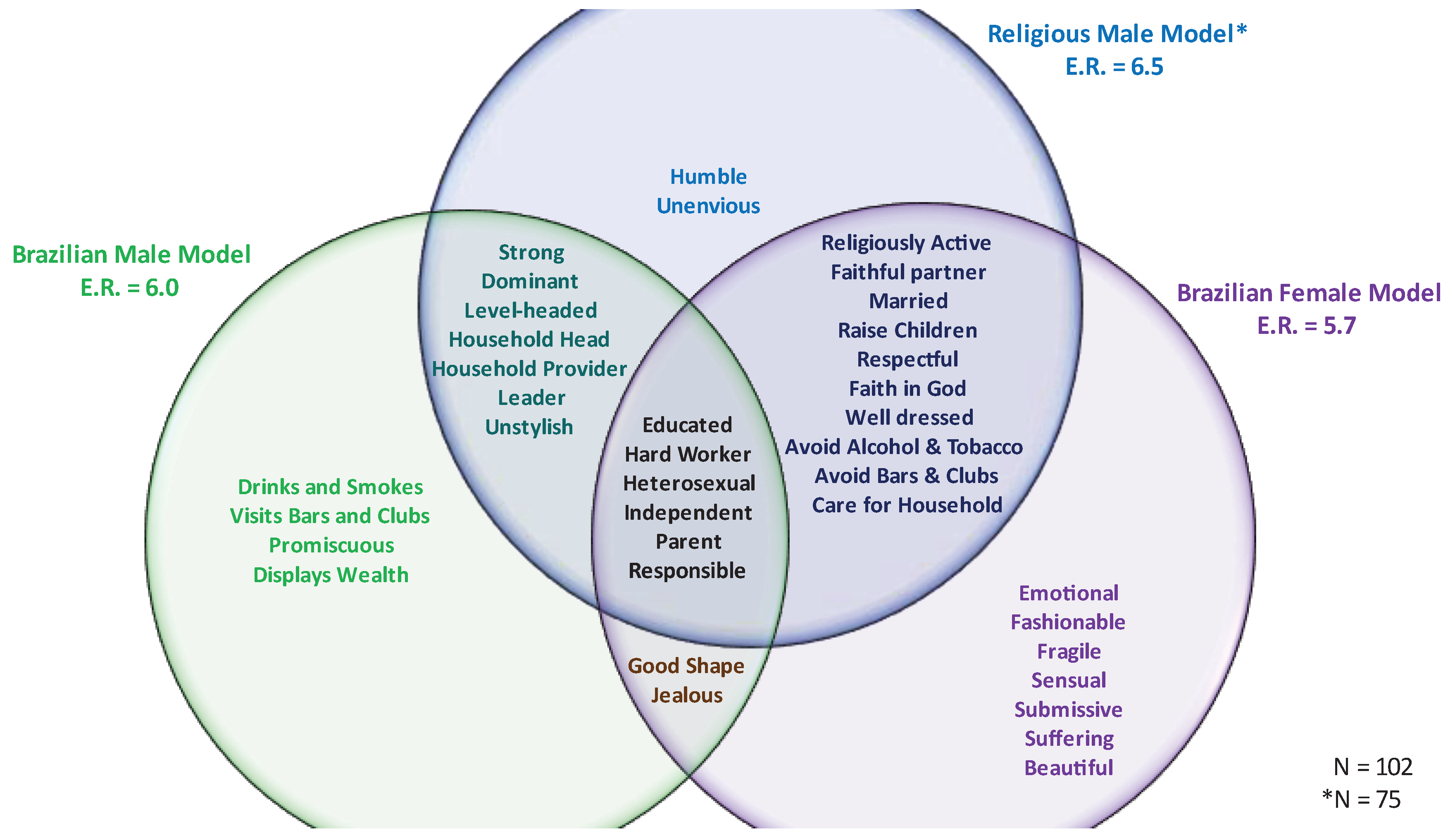
Figure 1 displays a Venn Diagram depicting the composition of each model. As described earlier (Dengah et al. 2022), for men an overall the male model was defined by chivalrous protection of the family (e.g., provider, father, worker), traits associated with the rua (e.g., terms associate with going to bars, drinking), and female conquest (e.g., promiscuous). Also described earlier, the female gender role model corresponds to the pan-Latin American marianismo model (e.g., mother, strong faith, faithful spouse, raising children, submissive, and suffering). At the same time, there are modern and “progressive” qualities to the model valuing education, independence, and working.
A key finding for the current study is that religion reforms, even domesticates, machismo. Findings suggest that the religious male model is indeed more aligned with female traits, compared to the secular male model (supporting H1a). The religious male model includes all the familial traits associated with women and rejects key aspects of the machismo model including excessive alcohol consumption and promiscuous behaviors (supporting H1b). Importantly, the model maintains an overall patriarchal focus, situating men as household heads, leaders, and providers. So, while the religious male model is aligned with female pursuits, it is anything but egalitarian (see Brusco 1995).
Again, it should be noted that agreement for this model was found across all religious informants, with no significant variation along the first or second factor for members of different faiths. This may be because the terms in this domain are rather general, and do not focus narrowly on specific religious activities or rituals, or more esoteric values promoted by certain denominations—such as the prohibition of soccer by some conservative Evangelical congregations. Further, religions define themselves apart from secular society by reorienting behaviors away from worldly pursuits and towards spiritual and family-oriented goals. Within Brazil, religions create cultural separation through reorienting male behaviors away from the destructive prestige complex of machismo.
Finding evidence of shared cultural models, we can ask (RQ2) “What motivates men to enact these religious gendered behaviors?” To answer this question, we first look at correlations between our predictor variables and religious consonance (see Table 2).
We include the variable of Protestant identification, since Evangélico groups were over sampled. Lower socioeconomic status is associated with an increase likelihood of Protestant affiliation, supporting the ethnographic accounts and census data that portray Evangelical faiths as particularly popular among Brazil’s lower and lower middle classes (Chesnut 1997; IBGE 2010). Being Protestant is associated with greater social network endorsement of the religious male model, and greater internalization of this model as a personal ideal, but was not significantly associated with consonance. However, being religiously active is predictive of internal motivation, as well as greater consonance with the model, supporting H2a. As expected, both motivators are significantly correlated with consonance.
To understand the relationship more fully between individuals and shared cultural norms, we regress our behavior (consonance) variable on the motivation variables (social network conformation, internalization) (Table 3).
The least squares linear regression shows that while controlling for covariates, including religious affiliation and activity, internalization is predictive of male behaviors, explaining the bulk of the variance (and supporting H2b). That is, religious Brazilian men in this sample were more likely to enact the religious style of masculinity if they internalized the model as personally meaningful. This differs substantially with how Brazilian men enact secular (i.e., machismo) gender norms. A separate linear regression analysis of this dataset, published elsewhere (Dengah et al. 2022), found that Brazilian men (controlling for age and SES) enacted secular gender roles (consonance) if they had greater knowledge (competence) of gendered norms (Beta = 0.33, p < 0.05), viewed their social network as endorsing machismo masculinity (social network conformation) (Beta = 0.32, p < 0.05) (R2 = 0.4).
4. Discussion
The analysis of how religious Brazilian men are motivated to perform a masculinity counternarrative sheds light onto how individuals are differentially motivated to enact culture. The data show that depending on the population and the domain, cultural performances (i.e., consonance) are compelled by different pressures. Our previous research indicated that secular Brazilian male identity performance (i.e., machismo) is motivated by one’s peers and social environment. This machista male configuration of performing the gendered role is socially located in street, the bars, and fields on which football is played, spaces that are male and public (DaMatta 1997). The social pressure of correct gender performance compels compliance even if their own views differ, or else individuals leave themselves open for ridicule and social sanctions, often in the form of their manhood being challenged (see West and Zimmerman 1987).
For Brazilian women, the cultural consensus analysis clearly indicated that the marianista model was shared and that women were more likely to be culturally consonance with that model if they internalized it (i.e., regarded that configuration as personally important to them). Brazilian women, according to this model, are expected to be loving, morally pure, whose devotion and ability to suffer for her family knows no bounds. As described by DaMatta (1997), the model is enacted in the domestic space of the home.
Religious Brazilian men, however, have a different model of masculinity, and a different motivation for performing these cultural prescribed behaviors. Coinciding with Brusco’s description of religious men in Columbia, the ideal religious man in Brazil is more aligned with female domestic goals, and rejects the deleterious aspects of machismo. This model still positions men in positions of authority, though within the context of faith and family. Indeed, this gender model promotes a counter narrative of masculinity that is, quite explicitly, a rejection of a machismo prestige complex. Brazilian religions, to distinguish themselves from the “secular” world, and to heal the (social) ills of their members, promote a style of masculinity that, while not challenging the patriarchal structure of family and society, promotes a “domesticated” style of masculinity that aligns men and women in family and domestic goals. Evangelical and Catholic sermons often warn men against the dangers of (excessive) drinking and extra-marital sexual liaisons, and Candomblé terreiros elevate the role of women and align male pursuits with the desires of the mae-de-Santos and the orixa goddesses.
In fact, some faiths make efforts to separate men from the third-places that are epicenters of Brazilian masculine performance—the futebol fields. Evangelical faiths, such as the Assembleia de Deus, forbid their members from playing futebol-- not because the sport is inherently evil; rather, it is the peer pressure of the other men that can persuade an otherwise outstanding Christian to drink, smoke, and engage in elicit sexual encounters (Chesnut 1997; Dengah 2013). As one of our respondents, Jorge, 23, explains:
“To be an evangelical, you have to have a different (gender) attitude. Because sometimes you think, ‘I’m a man, I should be doing that!’, but as an Evangelical you can’t. But then you have friends who…after a game are at a bar or churrasco…and you hang out with them. But even if you weren’t intending to, you start to drink because of the influence of your friends, and end up getting mixed up in the wrong things.”
By rejecting key aspects of machismo, these religious males realign and internalize their gender performance similar to marianismo women. Moreover, this internalization of culture as a personal belief occurs within the context of religiously framed gender roles. For men, adopting a religious role results in a rupture with traditional secular male performances, and with it, traditional ways of male bonding. For converts and the newly religious, this may result in the dissolution of friendships and social networks; even life-long faithful face reduced social capital opportunities by eschewing and avoiding male-centric spaces of barzinhos, putarias, and clubes. Indeed, it is not uncommon for men who have rejected certain aspects of machismo to face ridicule, such is the derogatory term, “pau-mandado” (henpecked, whipped). Being consonant with this religious male model requires substantial internalization of the model as a personal guiding principle for individuals. This model functions as a counter narrative of masculinity, and as such, is subject to marginalization and sanctions from dominant cultural and social institutions that operate to promote an orthodoxic model of machismo.
This tension religious Brazilian men feel in relation to wider society regarding gender roles can be seen in the quotes of some of our informants. Lucas, 39, another of our respondents, is a life-long evangelical, who defines the religious man in contrast to the secular Brazilian man:
“In my religion, the man, he was born to be the leader, the head of the house. This is biblical, he is the priest of the house...But I think, as an evangelical man, he has to be a person of integrity, honesty, who values the family…Some people think that a man wasn’t born to be inside the house, washing clothes, washing dishes, changing a baby’s diaper. But for me, I have no problem with that. I clean the house, wash clothes, I help my wife…But if I talk about this to other men, they’ll say I’m not being a man.”
Lucas echoes Brazilian anthropologist Roberto da Matta’s description of the bifurcation of space in Brazilian society. Lucas views Brazilian society as not valuing the role of men in the house, even to the point of challenging his very gender identity. Yet, the ideal religious man for him is defined by their place in the house. For Lucas, his gender role comes from being the patriarchal leader of the household, but also the helpmate of his wife, focusing on the welfare of his family and household. Nevertheless, his understanding of his masculinity is well articulated and thought-out, suggesting a high degree of internalization. Indeed, given that some of his peer’s question his gender due to his actions, his motivation to perform his gender role comes from strong personal convictions rather than the expectations of society.
Jefferson is 34 and a practicing Catholic. Like Lucas, Jefferson feels like Brazilian society’s gendering of space makes it difficult for men to work at home or be homemakers.
People talk about how women suffer from prejudice. But men also suffer. For example, a man must have a traditional profession. If the guy is a writer, he is labeled a bum. If he does things for the home, he is labeled a bum. A “man” (according to Brazilian society) is someone who leaves in the morning for work, has lunch, and comes back home to his family. That is what society deems traditional.
It should be noted that Jefferson, himself, is employed as a salesman, outside the house. And he is also quick to explain that he, and society, feels that men should be the primary provider (but (women can work, that’s okay”), as long as the man is the “final boss.” Yet, Jefferson is working through what he feels is an unfair judgement for men who take on non-traditional employment or do more things around the house. He still has a very patriarchal world view, endorsed by both religious and secular Brazilian models of masculinity, but nevertheless feels prejudice from what he sees as a limiting secular model of appropriate maleness.
Jorge, Jefferson, Lucas, and the other religious Brazilian men in this study frame their own understandings of gender is contrast with, and even opposition to, key aspects of secular Brazilian masculinity. Even areas of general overlap with the machismo role, such as the expectation of men to be the chefe de casa (head of the household) is still qualified as being different than the secular role by being explicitly in service of the wellbeing of the family and household. That is, for religious men, they must position themselves as contrary, even deviant, with widely shared norms of masculinity, and internalize their religious counter-narratives to successfully perform as men.
A more agent-led theory of cognition and behavior provides context and explanatory power to these data. D’Andrade (1992b: 226) posits that “as models become more deeply internalized, they tend to include more functions.” Such “master motive models” are foundational within the self-schema, and serve as a catalyst for employing related models and schemas. However, such master-level models are often abstract, molar, and strongly associated with other (equally complex) models. In these cases, common knowledge of a model may result in different interpretations and associated behaviors among individuals, based on the pattern of cognitive linkages (Strauss 1992a). Such “connectionist” models are thought to be formed via a combination of both shared conceptual knowledge and individual life experiences (c.f. Vygotsky’s mediating devices in Holland and Valsiner 1988). The differences in association can result in individuals sharing a common schema, but act on it in divergent ways.
For religious Brazilian men, they share the same knowledge of machismo gender roles as the rest of society. Yet, they display significantly different choices of gendered behavior. The data shows that these men internalize and incorporate their religious identity as an important part of their self-schema. The reasons for this internalization, however, are varied. This study can only infer at the underlying individual psychological and personal experiences that compel the men in this study to value and display gender the way they do. However, a decade of research among Brazilian Evangelical communities in the study area by the first author has demonstrated that men engage in religious activity for a myriad of reasons (see Dengah 2013, 2014, 2017). Some do so because they were enculturated and socialized into the religious culture at an early age. Others convert via the actions of a loved one, or through a powerfully traumatic experience that compels them to reexamine their own self-schema. Each of these unique biographies creates particular connectionist networks, informing how and why these models are internalized and acted upon.
Importantly, the connectionism of models, and the internalization of them is a continual process. Spiro (1997) provides a description of the various levels of internalization—each successive level likely to have greater emotional and motivational power (D’Andrade 1992a). However, he doesn’t articulate exactly how this internalization takes place. Sociologist Margaret Archer’s theory of reflexivity may be insightful here. Archer (2007: 4) defines reflexivity as “the regular exercise of the mental ability, shared by all normal people, to consider themselves in relation to their (social) contexts and vice versa”. At its core is the supposition that humans are not passive players in their social or cultural structures. On the contrary, Archer’s theory contends that (outside contexts of doxa) individuals consciously meditate, to one degree or another, on their relationship with these external forces. Echoing Spiro’s own conception of internalization, reflexivity is the ability to arbitrate on what society and culture expects from them, and then react accordingly. In other words, the reaction or behavior of individuals to culture (e.g., cultural consonance) depends on how individuals interpret and relate to it.
Archer defines four (mutually inclusive) modes of reflexivity: communicative (derived from interactions and confirmation from social peers), autonomous (inner conversations that required no validation or conformation from others), meta (self-monitoring and critical inner conversations, often characterized by doubt and stress), and fractured (disorienting and distressing inner conversations that lead to inaction or inappropriate action) (see Caetano 2015). We see some of these types of reflexivity taking place in the ways by which religious Brazilian men understand their own gender roles. Jorge, Jefferson, and Lucas describe their own positionality and relationship with both secular and religious forms of masculinity in their own understanding of gender. Jorge’s reflection on gender potential displays both communicative and meta forms of reflexivity. He articulates that his thoughts and behaviors are influenceable, if not influenced, by his friends, which run counter to his own personal beliefs of what a good evangelical man should be. With a pitch of pain on his face, Jorge implies that he too had become “mixed up in the wrong things.”
While Lucas’ articulation is somewhat more cogent than Jefferson’s, there is nevertheless a clear mediation of how each feel in relation to dominant cultural expectations of men. (Archer would suggest that the differences in articulation may point to different types of reflexivity, possibly a more autonomous form for Lucas and meta style reflexivity for Jefferson.) The quantitative data shows a similar pattern. Those who internalize and incorporate a religious understanding of gender are more likely to enact corresponding behaviors in their own life. Indeed, for Archer, a key aspect of reflexivity is both the subjective interpretation of cultural structures, but equally importantly, how that informs and guides individual’s actions in the world. Archer (1995) contends that as societies undergo cultural shifts (a process she calls morphogenesis), the need for reflexivity rises as previous “taken-for-granted” forms of practice (i.e., habitus) are contested. The historical transformation of religion brought about by Protestantism, as well as the consciousness-raising of feminist movements, has meant that the implicit knowledge provided by conventional cultural models is at least incomplete, if not problematic. In other words, for Brazilian women and religious men, the doxic-nature of gender roles is no longer tacit, and requires them to actively “think about who they are…and modify their identity in the course of everyday being” (Akram and Hogan 2015: 608). For traditional Brazilian men, however, no such pressure exists; their taken-for-granted gender role requires less reflexivity and thus the internalization of the cultural model is less of an influence.
There are some limitations to this study that can inform future research. The sample size of this study skewed more educated than the general population. Archer (2013) argues that while reflexivity may vary depending on context, individuals tend to display certain reflexivity styles depending on their own autobiography. It is reasonable to suspect that education provides individuals with an increased capacity for (internally) vocalizing their own subjectivity and positionality with regards to culturally constructed norms and values. Along these lines, a parallel linguistic analysis would be beneficial methodological and theoretically. Finally, this study is limited by a small sample size. Given the high amount of variance explained by the internalization variable, this is unlikely a spurious association, but a larger, (educationally) diverse sample will provide a better assessment of how religious men relate to and are motivated by culture.
5. Conclusions
This study examined motivations that mediate the relationship between shared culture norms and individual actions. For the domain of gender roles among a Brazilian sample, sex and religious affiliation (for men) result in different configuration of the individual and culture. Findings suggest that due to changing and competing cultural models, Brazilian women and religious men are forced to reflexively “think” about which gender role to follow. This meditation is necessary for them to successfully navigate through cultural space, as compared to non-religious Brazilian men, whose gender role is so omnipresent and ubiquitous, it requires less negotiation of meaning between the individual and the shared model. This study demonstrates a methodological means for measuring and interpreting motivations, an important mediator in the relationship between culture and the individual.
Author Contributions
Conceptualization, H.D. and W.D.; Methodology, H.D and W.D..; Formal Analysis, H.D.; Investigation, H.D and A.F.; Data Collection, A.F. and H.D.; Writing – Original Draft Preparation, H.D. and W.D.; Writing – Review & Editing, H.D., W.D; Visualization, H.D.; Supervision, H.D.; Project Administration, H.D.; Funding Acquisition, H.D.
Funding
Funding for this study was provided by a Catalyst Research Grant from Utah State University.
Acknowledgments
The authors would like to thank the Cognitive Anthropology Discussion Group for their comments on an earlier draft of this paper.
Ethics Approval
This study was reviewed and approved by the Institutional Review Board at Utah State University, #9371, August 5, 2019. Informed consent was obtained from all informants involved in this study.
Competing Interests
The authors report no conflicts of interest.
References
- Anders, G. (1993). Machismo: Dead or alive? Hispanic, 6(1), 14–17.
- Archer, M. S. (1995). Realist social theory: The morphogenetic approach. Cambridge University Press.
- Archer, M. S. (2007). Making our way through the world: Human reflexivity and social mobility. Cambridge University Press.
- Archer, M. S. (2013). Reflexivity. Sociopedia.isa, 1-14.
- Arciniega, G. M., Anderson, T. C., Tovar-Blank, Z. G. & Tracey, T. (2008). Toward a fuller conception of machismo: Development of a traditional machismo and caballerismo scale. Journal of Counseling Psychology, 55(1), 19-33. [CrossRef]
- Akram, S. & Hogan, A. (2015). On reflexivity and the conduct of the self in everyday life: reflections on Bourdieu and Archer. The British Journal of Sociology, 66(4), 605-625. [CrossRef]
- Baldwin, J. & DeSouza, E. (2001). Modelo de Maria and machismo: The social construction of gender in Brazil. Revista Interamericana de Psicología/Interamerican Journal of Psychology, 35(1), 9–29.
- Bennardo, G. (2023). Using consensus analysis as a discovery and a verification procedure for cultural models. Qualitative Psychology, 10(2), 281–295. [CrossRef]
- Bennardo, G. & and de Munck, V. C. (2020). Cultural model theory in cognitive anthropology: recent developments and applications. Springer.
- Bond, R. & Smith, P. B. (1996). Culture and conformity: A meta-analysis of studies using Asch’s (1952b, 1956) line judgment task. Psychological Bulletin, 119(1), 111-137. [CrossRef]
- Boster, J. S. (1986). Exchange of varieties and information between Aguaruna manioc cultivators. American Anthropologist, 88(2), 428–436. [CrossRef]
- Brusco, E. (1993). The reformation of machismo: Asceticism and masculinity among Colombian Evangelicals. In V. Garrard-Burnett & D. Stoll (Eds.), Rethinking Protestantism in Latin America (pp. 143–158). Temple University Press.
- Brusco, E. (1995). The reformation of machismo: Evangelical conversion and gender in Colombia. University of Texas Press.
- Buunk, A. P. & Gibbons, F. X. (2007). Social comparison: The end of a theory and the emergence of a field. Organizational Behavior and Human Decision Processes, 102(1), 3–21. [CrossRef]
- Caetano, A. (2015). Defining personal reflexivity: A critical reading of Archer’s approach. European Journal of Social Theory, 18(1), 60–75. [CrossRef]
- Carless, W. (2015). Brazil’s shocking violence against women, in 5 charts. The World from PRX. Retrieved April 15, 2021. from https://www.pri.org/stories/2015-11-17/brazils-shocking-violence-against-women-5-charts.
- Chesnut, R. A. (1997). Born again in Brazil: The Pentecostal boom and the pathogens of poverty. Rutgers University Press. [CrossRef]
- Connell, R. W. & Messerschmidt, J. W. (2005). Hegemonic masculinity: Rethinking the concept. Gender & Society, 19(6), 829-859. [CrossRef]
- DaMatta, R. (1997). A casa e a rua. Rio de Janeiro: Rocco 5.
- D’Andrade, R. G. (1992a). Schemas and motivation. In R. D'Andrade & C. Strauss (Eds.), Human motives and cultural models (pp. 23–44). Cambridge University Press.
- D' Andrade, R. G. (1992b). Afterword. In R. D'Andrade & C. Strauss (Eds.), Human motives and cultural models (pp. 225-232). Cambridge University Press.
- D' Andrade, R. G. (1995). The development of cognitive anthropology. Cambridge University Press.
- D’Andrade, R. G. & Strauss, C., Eds. (1992). Human motives and cultural models. Cambridge University Press.
- Dengah II, H. J. F. (2013). The contract with God: patterns of cultural consensus across two Brazilian religious communities. Journal of Anthropological Research, 69(3), 347–372.
- Dengah II, H. J. F. (2014). How religious status shapes psychological well-being: Cultural consonance as a measure of subcultural status among Brazilian Pentecostals. Social Science & Medicine, 114, 18–25. [CrossRef]
- Dengah II, H. J. F. (2017). Religion as cultural models: Developing an emic measure of religiosity. Journal for the Scientific Study of Religion, 56(1), 104-125. [CrossRef]
- Dengah II, H. J. F., Gilmore, J., Brasileiro, M., Cohen, A. S., Thomas, E. B., Blackburn, J. B., Law, M., Swainston, J., & Thomas, R. (2019). Cultural models of raça: The calculus of Brazilian racial identity revisited. Journal of Anthropological Research, 75(2), 157–182. [CrossRef]
- Dengah II, H. J. F., Falcão, A. & and Henderson, N. (2022). Doing gender in Brazil: An examination of the motivations for cultural consonance. Ethos, 50(2), 131–152. [CrossRef]
- Dengah II, H. J. F., Hawvermale, E., Temple, E., Montierth, M., Dutson, T., Young, T., Thomas, E., Patterson, K., Bentley, A. & Tauber, D. (2016). Undergraduates deserve methods too: Using a research laboratory model to engage students in cognitive anthropological research. Annals of Anthropological Practice, 40(2), 178–192. [CrossRef]
- Dengah II, HJ François, Snodgrass, J. G., Polzer, E. R., & Nixon. W. C. (2020). Systematic Methods for Analyzing Culture: A Practical Guide. Routledge.
- DeSouza, E. R., Baldwin, J., Koller, S. H., & Narvaz, M. (2004). A Latin American perspective on the study of gender. In M. A. Paludi (Ed.), Praeger guide to the psychology of gender (pp. 41–67). Praeger Publishers/Greenwood Publishing Group.
- Dressler, W. W. (2012). Cultural consonance: Linking culture, the individual and health. Preventive Medicine, 55(5), 390-393. [CrossRef]
- Dressler, W. W. (2017). Culture and the individual: Theory and method of cultural consonance. Routledge.
- Dressler, W. W., Balieiro, M. C., & dos Santos, J. E. (2015). Finding culture change in the second factor: Stability and change in cultural consensus and residual agreement. Field Methods, 27(1), 22–38. [CrossRef]
- Dressler, W. W., Balieiro, M. C., & dos Santos, J. E. (2019). Agency, cultural consonance and depressive symptoms: A Brazilian example. Ethos, 47(2), 148–167. [CrossRef]
- Dressler, W. W., Balieiro, M. C., & dos Santos, J. E. (2023). Distance from a cultural prototype and psychological distress in urban Brazil: A model. Journal of Cognition and Culture, 23(1-2), 218-240. [CrossRef]
- Farzan, A. N. & Berger, M. (2020). Bolsonaro says Brazilians must not be ‘sissies’ about coronavirus, as ‘all of us are going to die one day.’ Washington Post. Retrieved April 15, 2021. from https://www.washingtonpost.com/world/2020/11/11/bolsonaro-coronavirus-brazil-quotes/.
- Festinger, L. (1954). A theory of social comparison processes. Human Relations 7(2), 117–140. [CrossRef]
- Freitas, I. C. M., & Moraes, S. A. (2011). Alcohol addiction and associated factors in adults in Ribeirão Preto, São Paulo state, Brazil, 2006: The OBEDIARP Project. Cadernos de Saude Publica, 27(10), 2021–2031. [CrossRef]
- Gibbons, F. X., Lane, D. J., Gerrard, M., Pomery, E. A., & Lautrup, C. L. (2002). Drinking and driving: A prospective assessment of the relation between risk cognitions and risk behavior. Risk, Decision and Policy, 7(3), 267–283. [CrossRef]
- Gill, L. (1990). ‘Like a veil to cover them’: Women and the Pentecostal movement in La Paz. American Ethnologist, 17(4), 708–721. [CrossRef]
- Goodenough, W. H. (1957). Cultural anthropology and linguistics. In P Garvin (Ed.), Report of the seventh annual round table meeting on linguistics and language study (pp. 167–173). Bobbs-Merrill.
- Hardin, M. (2002). Altering masculinities: The Spanish conquest and the evolution of the Latin American machismo. International Journal of Sexuality and Gender Studies, 7(1), 1–22. [CrossRef]
- Hayes, K. E. (2017). Women and religion in contemporary Brazil. In B. Schmidt & S. Engler (Eds.), Handbook of contemporary religions in Brazil (Vol. 13) (pp. 395-430). Brill.
- Holland, Dorothy C., and Jaan Valsiner. (1988). Cognition, symbols, and Vygotsky's developmental psychology. Ethos, 16(3), 247-272.
- Instituto Brasileiro de Geografia e Estatística (IBGE). (2010). Censo demográfico 2010. Retrieved May 4, 2023. from https://cidades.ibge.gov.br/brasil/sp/ribeirao-preto.
- Irons, C. & Gilbert, P. (2005). Evolved mechanisms in adolescent anxiety and depression symptoms: The role of the attachment and social rank systems. Journal of Adolescence, 28(3), 325–341. [CrossRef]
- Lacy, M. G., Snodgrass, J. G., Meyer, M. C., Dengah II, H. J. F., & Benedict, N. (2018). A formal method for detecting and describing cultural complexity: Extending classical consensus analysis. Field Methods, 30(3), 241–257. [CrossRef]
- Lizardo, O. (2021). Culture, cognition, and internalization. Sociological Forum, 36, 1177–1206. Wiley Online Library. [CrossRef]
- Maltseva, K. (2015). Norm internalization and the cognitive mechanism of cultural consonance. International Journal of Culture and Mental Health, 8(3), 255–273. [CrossRef]
- Mauss, A. L. (1994). The angel and the beehive: The Mormon struggle with assimilation. University of Illinois Press.
- Mayblin, M. (2010). Gender, Catholicism, and morality in Brazil: virtuous husbands, powerful wives. Springer.
- Meredith, S. (2018). 'Who is the ‘Trump of the Tropics?’: Brazil’s divisive new president, Jair Bolsonaro— in his own words. CNBC. Retrieved October 29, 2018. from https://www.cnbc.com/2018/10/29/brazil-election-jair-bolsonaros-most-controversial-quotes.html.
- Phillips, T. & Kaiser A. J. (2019). Brazil must not become a ‘gay tourism paradise’, says Bolsonaro. The Guardian. Retrieved April 25, 2019. from http://www.theguardian.com/world/2019/apr/26/bolsonaro-accused-of-inciting-hatred-with-gay-paradise-comment.
- Quinn, N. (1992). The motivational force of self-understanding: Evidence from wives’ inner conflicts. In R. D'Andrade & C. Strauss (Eds.), Human motives and cultural models (pp. 90-126). Cambridge University Press.
- Quinn, N., ed. (2005). Finding culture in talk. Palgrave MacMillan.
- Romney, A. K., Weller, S. C., & Batchelder, W. H. (1986). Culture as consensus: A theory of culture and informant accuracy. American Anthropologist, 88(2), 313–338. [CrossRef]
- Schachter, S. (1959). The psychology of affiliation: Experimental studies of the sources of gregariousness. Stanford University Press.
- Spiro, M. E. (1987). Collective representations and mental representations in religious symbol systems. In M. E. Spiro, B. Killborne & L. L. L. Langness (Eds.), Culture and human nature: Theoretical papers of Melford E. Spiro (pp. 161–184). Transaction Publishers.
- Spiro, M. E. (1997). Gender ideology and psychological reality: An essay on cultural reproduction. Yale University Press.
- Stevens, E. P. (1973). Machismo and Marianismo. Society, 10(6), 57–63. [CrossRef]
- Strauss, C. (1992a). “What makes Tony run?" Schemas as motives reconsidered. In R. D'Andrade & C. Strauss (Eds.), Human motives and cultural models (pp. 191-224). Cambridge University Press.
- Strauss, C. (1992b). Models and motives. In R. D'Andrade & C. Strauss (Eds.), Human motives and cultural models (pp. 1-20). Cambridge University Press.
- Strauss, C. & Quinn, N. (1997). A cognitive theory of cultural meaning. Vol. 9. Cambridge University Press.
- UOL (Universo Online). (2019). Treze frases de Bolsonaro de natureza sexual e machista. Congresso em Foco (blog). Retrieved August 13, 2019. from https://congressoemfoco.uol.com.br/governo/treze-frases-de-bolsonaro-de-natureza-sexual-e-machista/.
- Weller, S. C., Johnson, J. C., & Dressler, W. W. (2023). Validating cultural models with cultural consensus theory. Qualitative Psychology, 10(2), 359–369. [CrossRef]
- West, C., & Zimmerman, D.H. (1987). Doing gender. Gender & Society, 1(2), 125–151. [CrossRef]
- Wilson Center. (2019). Femicide hits all-time high in Brazil. Wilson Center. Retrieved January 27, 2021. from https://www.wilsoncenter.org/blog-post/femicide-hits-all-time-high-brazil.

Table 1.
Descriptive Statistics of Key Variables for Religious Men.
| Column1 | Range | Mean (Standard Deviation) |
|---|---|---|
| SES | -1.5 - 3.2 | 0.2 (± 1.1) |
| Age | 21 - 67 | 36.6 (± 12.6) |
| Religious Affiliation (Protestant) | 43% Protestant | |
| Religious Activity | < 1/week = 6; 1/week = 15; > 1/week = 9 | |
| Competence | -0.7 - 0.9 | 0.6 (± 0.3) |
| Social Network Conformation | 8 - 27 | 18.2 (± 5.6) |
| Internalization | 8 - 27 | 21.6 (± 4.2) |
| Cultural Consonance | 10 - 27 | 21.6 (± 4.3) |
Table 2.
Correlations of Research Variables.
| Age | Religious Affiliation | Religiously Active | Comp. | Social Conf. | Internalization | Consonance | |
|---|---|---|---|---|---|---|---|
| SES | -0.11 | -0.36* | -0.13 | -0.21 | -0.08 | -0.01 | 0.05 |
| Age | -0.37* | 0.18 | 0.14 | -0.01 | 0.13 | 0.22 | |
| ReligiousAffiliation (Protestant) | 0.45** | 0.08 | 0.38* | 0.41* | 0.34 | ||
| Religiously Active | -0.20 | 0.25 | 0.37* | 0.57** | |||
| Competence | 0.42* | 0.29 | 0.11 | ||||
| Social Network Conformation | 0.67** | 0.57** | |||||
| Internalization | 0.83** |
* . Correlation is significant at the 0.05 level. **. Correlation is significant at the 0.01 level.
Table 3.
Regression Models of Male Religious Cultural Consonance (R2 = .79).
| Column1 | Religious Male Sample |
|---|---|
| Standardized Coefficients (Beta) | |
| SES | 0.09 |
| Age | 0.07 |
| Religious Affiliation (Protestant) | -0.05 |
| Religious Activity | 0.30* |
| Competence | -0.05 |
| Social Network Conformation | 0.07 |
| Internalization | 0.70** |
* . Correlation is significant at the 0.05 level. **. Correlation is significant at the 0.01 level.
Disclaimer/Publisher’s Note: The statements, opinions and data contained in all publications are solely those of the individual author(s) and contributor(s) and not of MDPI and/or the editor(s). MDPI and/or the editor(s) disclaim responsibility for any injury to people or property resulting from any ideas, methods, instructions or products referred to in the content. |
© 2023 by the authors. Licensee MDPI, Basel, Switzerland. This article is an open access article distributed under the terms and conditions of the Creative Commons Attribution (CC BY) license (http://creativecommons.org/licenses/by/4.0/).
Copyright: This open access article is published under a Creative Commons CC BY 4.0 license, which permit the free download, distribution, and reuse, provided that the author and preprint are cited in any reuse.


