

Submitted:
17 December 2023
Posted:
18 December 2023
You are already at the latest version
Abstract
ICT and digital technology adoption, sustainable development, community empowerment and local wisdom and destinations uniqueness are keywords that will be further explored in the de-velopment of tourism villages in Kenderan as the most importance of tourism destinations de-velopment from the village level. Therefor this research is aimed at developing suitable model for post smart or wise tourism village through proposing Culture and Tradition Festival and the application of a circular economy. Circular economy development in tourism villages focuses on the application of sustainable production principles in the tourism value chain, namely in creating tourism experiences together with tourists (co-creation of experience) and integrated in a tourism system that supports environmental sustainability. This research is applied research conducted with a sequential mixed method research by conducting qualitative research through expert judgment and quantitative research by circulating questionnaire to tourists visiting Kenderan village, while the collected data is analyzed by Structural Equation Modelling to see the rela-tionship between variables. The results of this research show that creative event as the locality aspects of tourist village, digital competence, and sustainability practice are the building blocks of post smart tourism village, while digital competence and sustainable practice have significant mediating effect of locality on post smart tourism village. To make tourism village possesses sustainable competitive advantages, the village must explore and promote its locality aspects to differentiate its tourist village by identifying the valuable, rare, inimitable and non-substitutable tourism resources. The implication of this research is that to develop smart tourism destination wiser and distinctive, tourist village should explore their local values and resources, embed them into its tourism basic components and core resources, and co create, distribute, deliver and promote it to global market through technology adoption and global sustainability value.
Keywords:
post smart tourism
; wise tourism
; tourism sustainability
; circular economy
1. Introduction
Smart tourism destination (STD) is believed as an important tool to gain destination competitiveness [1,2]. It focuses on fulfilling tourist’s and other stakeholder’s needs through innovation combination of digital technology, tourism and smart city management [3], to create ultimate digital and physical experience for tourists, local communities and businesses [4]. While some scholars believe that sustainable practices are predecessor of smart tourism [5,6], some argue that smartness and sustainability should go together and be an integral part [7], and some even propose smart sustainable tourism destination (SSTD) as new concept for tourism development [8,9]. The extension of STD implementation that include high level of sustainable value adoption shows destination’s enhance competency to achieve better quality of natural environment and other sustainability aspects in general [9,10,11], which become the ground of SSTD concepts [8,12]. Further, Coca-Stefaniak [13] proposes the more humanistic, people-centred, wiser and encouraging destinations to show and explore their unique personality and local wisdom, apart from the tech savvy and sustainable practices adoption.
As the proliferation of the concept and practice of STD and its derivations, many scholars and destinations try to activate this concept in village level [14,15,16,17,18]. The consideration is based on the fact that villages and rural areas, with their uniqueness of natural and cultural resources, can be capitalized in order to create regional identity, improve local people’s welfare, accommodate the fulfilment of tourists’ needs for unique services and local development to response to the need of modern society entertainment [19]. Thus, rural tourism development can improve tourist service provision, community’s work diversification, preservation of rural culture and heritage, protection of natural environments, and improving living and working conditions. It can also be used to support the development of underdeveloped areas, increase household members exercising of invisible exports, the placement of domestic products, or the preservation of traditions, customs and crafts [20].
The development of tourism villages become important national rural development strategy especially since there are overall 83,981 villages in Indonesia that need access to development [17]. In fact, based on report from the Ministry of Tourism and Creative Economy of Republic of Indonesia states that during covid-19 pandemic, visitors to tourist villages actually experienced a significant increase of up to 30 percent [21]. Although it was still far below the number of tourist visits before the pandemic, however it but it had the power to stimulate the village’s stagnant economy. This was because traveling to rural areas considered to fulfil four aspects of the new normal tourism practices, namely: having more pollution-free air (hygiene), being able to reduce direct contact (low touch) with other people to avoid transmission of the covid-19 virus, staying away from crowds (less crowd), and the fact that tourists could only travel in proximity destinations to where they live (low mobility). Post-pandemic, the development of tourist villages will experience many changes that must be anticipated, such as aspects on good health and sanitation protocols, digitalization disruption, sustainability requirements, and other aspects that are the demands of rural tourism destination’s competitive advantages.
The development of tourist villages is believed to be a promising way to overcome poverty and underdevelopment problems through a people-centered approach and inclusion in tourism development at the village level. The village alone is an actual topic in current context, as villages face a lot of challenges such as economic crises, health crisis, or migration [18], and specifically on how to adapt the disruptive environment [22]. Therefore, smart tourism village becomes the panacea to allows local people integrate and share their resources, to utilize the digital technology and the improved tourism infrastructure in order to cater and create personalized good quality of products and services to accommodate tourist’s needs, so that the village can provide high quality of life, conserve natural resources, promote a more holistic life and sustainable practices, as well stimulate innovative and productive rural entrepreneurship [18]. Kenderan Village is a village known for its religious tradition, located in Gianyar Regency, Bali, Indonesia intends to develop a competitive and distinctive tourist village in Bali, despite a number of pioneer and leading tourist villages from Ubud and other areas have been widely famous for tourists which their offers are the unique nature and Balinese culture. Since Bali has become one of the world-class destinations, the development of a tourist village in Kenderan Village must have a differentiated and distinctive concept with global value to be able to stand out from the competition, so the tourist village can be immediately introduced and attract the potential market.
As religious village, the life of local community in Kenderan focuses on living Hindu ritual activities and traditions at the temple. The people claim that they implement Hindu culture in their daily lives, and even manifest their lives of the living culture and traditions that reflect the philosophy of Tri Hita Karana. As the main living culture product’ they develop their temple’s tradition become the highlight of tourist village products, that is living culture festivals that are hold twice in a year. Therefore, this study intends to explore and develop a tourism village model that not only respect local wisdom and values but also complement the new generation’s post smart and wiser tourism destination development that not only focus on technology adoption and sustainability values, but also respect the uniqueness of each tourism destination, and a more holistic and humanistic approach [13] that is fit more to Balinese living culture. Sustainable development and community empowerment are the next aspects that will be further explored in the development of Kenderan tourism village by employing circular economy in their religious temple’s daily lives by employing zero waste and energy saving concepts as the novel value which is integrated and packaged in a living culture festival as their lifestyle highlight in periodic ritual events. Therefore, in Kenderan village, the uniqueness of destination is the culture which becomes tradition, festivity and reflected in daily life of the people in Kenderan village. This paper intends to identify whether digital competence, circular economy adoption, and cultural festival as the more humanistic local wisdom manifestation can create a village smarter and more competitive.
2. Literature Review
2.1. Smart tourism destination, smart tourism village, post smart tourism village.
The term of smart tourism destination (STD) emerged from the global acceptance and application of smart city concept [23]. While STD and smart cities have different focus, however they complement each other [24]. Pranita et al. [5] used smart city’s dimension to determine smart tourism as tourism component become the core attention where Bulchand-Gidumal [25] explains that the difference between smart city and STD is the smart tourists dimension which become the focus of attention. Tran, Huertas and Moreno [24] proposes intelligence focus in tourism destination’s components, namely smart attractions, smart accessibility, smart facilities, smart ancillary services, smart activities, and smart packages. The smart concept in tourism is then used not only on cities or complex tourism destination, but also on tourist’s villages [15,16], as smart tourism is considered as a subset of smart villages that utilizes IoT, big data, and data analytics techniques.
The EU initiative’s concept on smart tourism destination focuses on four aspects, sustainability, digitalization, cultural heritage and creativity, and accessibility which provide tourism destination to adjust each smart tourism emphasis, so that smart tourism development can strengthen tourism-generated innovative development, increase destination attractiveness, and foster economic growth and job creation, as well as establish a framework for the exchange of best practices between cities and destinations [26], while World Tourism Organization defined Smart Tourism (ST) as the provision of clean, ecological, ethical and high-quality services at all levels. Similarly, Gretzel et al. [28] consider that this type of tourism includes all types of experiences that allow tourists to generate closer communication and interaction with citizens, tourism organizations, local government and environment/tourist attractions in the areas visited.
Smart Tourism according to Gretzel et al. [28] can be seen as a logical progression from traditional tourism and the foundation for innovation and technological orientation of the industry and consumers was laid earlier with the widespread adoption of information and communication technology (ICT) in tourism, for example in the form of global distribution and central reservation systems, integration of Web-based technologies that led to the emergence of e-Tourism. The definition of Smart Tourism can be broadly interpreted according to the objectives to be achieved in the design of the information system. The use of information technology is also not just as a means of promotion, but data processing regarding tourist objects or places will produce information for greater attractiveness. The adaptation of the concepts of green tourism and smart tourism can support the achievement of several aspects and objectives of the program that will or is being implemented. The sustainable tourism development model Pecsek (2018) considers aspects of economic, social and cultural sustainability; locality/local wisdom, focusing on the experience and achievement of community social welfare in Kenderan Village. Sustainability considerations are to ensure profitability, avoid foreign exchange leakage, ensure environmentally friendly investments and activities, manage carbon footprints and extend the length of tourist stays. The local wisdom aspect is aimed at developing local gastronomy, local culture, local businesses and empowering local human resources as well. The social welfare aspect is aimed at involving the community in consensus decision-making, reducing urbanization, welfare growth and harmonious community life (community cohesion). However, tourist destination development also needs to focus on quality tourist experiences, indicated by personalized and non-standard products, selective attractions, active programs, and supportive collective experiences.
As the growth spread of STD adoption in smart village development, many scholars argue that being smart is not enough, but sustainable aspects especially environmental concern should also become every destination’s including rural and village consideration [18]. After the acceptance of the emergence of smart sustainable concept in tourism destination development [6,14,17], post smart or wise tourism destination is introduces by Coca-Stefaniak [13] so that local wisdom and uniqueness of the destination can be considered and applied in the tourism destination, even though STD often intersects with culture tourism destinations, as technology often considered a disruptive factor to the cultural preservation and authenticity of a place [30,31]. Referring to Veerasamy and Goswami [32] that the presence of smart tourism in a region enables greater and coordinated efforts for innovation, quality of life, and sustainable tourism through a rich data infrastructure within the scope of a particular destination. Fundamental to the traveler experience is an aesthetic obsession with authenticity so the diversity of smart technologies can be applied to the cultural and spiritual experience in tourist village, the granular level, where religion still holds the glue of the tourism destination.

Table 1.
The evolution concept of smart tourism destination.
| Researcher | Concept |
|---|---|
| [1] | Current and future practices include single activities such as waste sorting, nature tourism (hiking, cycling and outdoor holidays; transportation (cycling, walking, and using trains and other forms of public transportation); accommodation, sharing and reusing materials. “Traditional Summer House Tourism” is suggested as a potential circular economy tourism practice in the future. The circular economy includes avoiding tourist hotspots and doing volunteer work during vacations in a way that avoiding tourist attractions can limit over-tourism in the city center, solving certain sustainability issues |
| [33] | Smart tourism is a social phenomenon arising from the convergence of ICTs with the tourism experience. It is defined as tourism supported by integrated efforts at a destination to collect and aggregate/harness data derived from physical infrastructure, social connections, government/organizational sources and human bodies/minds in combination with the use of advanced technologies to transform that data into on-site experiences and business value-propositions with a clear focus on efficiency, sustainability and experience enrichment. |
| [12] | Smart tourism is a logical evolutionary development of traditional tourism and e-tourism as the ground for technology-driven innovation inspired by the smart cities idea, innovative tourism destinations built upon a modern technology infrastructure that promotes sustainable and accessible development of tourist areas to improved tourism experiences, enhanced quality of life for residents, bolster business, or provide a smarter platform for distributing and collecting destination data. It facilitates the effective designation of tourism resources and help to integrate tourism providers at the micro- and macro-levels by developing the sustainability of tourism destinations and integrating it with information technology capabilities. |
| [4] | Smart tourism destination (STD) is putting together tourism ecosystem with web-based application to increase the efficiency of destinations as a solution to the changing expectation and needs of tourists and residents’ quality of life into holistic innovations that cover all stakeholders in tourism ecosystem as well as the adoption of the responsible use of environment and social resources. |
| [34] | Review some of key parallels between the concepts of smart cities and smart tourism destinations. This review will also cast a critical perspective on the smart concept, which has been traditionally dominated by technology-based approaches, even if a new generation of smart initiatives is beginning to emerge with a more human-centred focus. |
| [35] | Smart tourism as a branch of smart cities that aims to provide solutions to tourists’ travel-related needs, improve travel experience, and enhance the competitiveness of destinations. |
| [36] | STD use tools, technique, and technology to co create tourist’s experience, by using tourism platform to integrate services and other tourism resources. |
| [13] | Offer insights into a wiser tourism development as post smart tourism development that explore avenues for a more humanistic and local value context in STD so that each destination would have its own unique characteristics. |
| [8] | Smart sustainable tourism is the contribution of ICT, smart technology, and many applications by adapting the services provided to tourists. It is a system that use smart technology in the stages of creating, presenting, and marketing smart tourism experiences, managing and providing feedback. |
According to the above premises, after a decade of exploration and implementation, there is a need to rethinking of STD for a wiser, more humanistic that encourages with local content development as post smart tourism, where the emphasis is the distinctive of tourism destination, whether it a country, urban, or village.
2.2. Digital competence in smart tourism village
The concept of smartness is the vast use of technology for the purpose of improving day-to-day activities, information management, real time service offer, connect all local institutions and improves the efficiency in the services. To become smart, tourism should use an appropriate technological platform that integrates information from local natural and heritage resources, tourists, their actions, and their consumption habits, thus engage with stakeholders into acting proactively and directly in the dynamic use of these technologies in the joint creation of the tourism experience [37]. In STD, ICTs are heavily involved to promote the competitiveness of tourist destinations and generating new development and growth projects in the areas visited. It requires the use of a technology platform that is made up of three fundamental components: cloud computing services, IoT and end-user devices [13]. Smart tourism is the new buzzword describes technological, economic, and social developments fueled by technologies that relies on sensors, big data, open data, new ways of connectivity and exchange of information (IoT, RFID, and NFC) as well as abilities to infer and reason. It is not so much the individual technological advances but rather the interconnection, synchronization and concerted use of different technologies that constitutes smartness. Smart concept is exploiting operational, near-real-time real-world data, integrating and sharing data, and using complex analytics, modelling, optimization and visualization to make better operational decisions [33].
Digital skills have become a primary need in tourism industry [38] and the combination of big data technology, which is a technological innovation for data analysis [39], with specific applications in the tourism industry, that has become the ‘new normal’ in every aspect of life, which would be approached in smart tourism [40], together with digital marketing, online market research, and social networking. When it comes to digital skills for smart tourism destination development, the success indicator are the ability to acquire and utilize digital information for image-building, including the creation of digital business platforms [38]. Additionally, the application of smart tourism data mining technology can improve the foreign exchange income (FEI) of urban tourism, increase employment in tourism and drive the development of tourism-related industries by more than 70% within ten years [41].
Table 2.
Previous research on digital competence in smart tourism destination.
| Researcher | Concept |
|---|---|
| [42] | Smart destination is synonymous with smart tourism, which would serve as a destination founded on an advanced technology infrastructure that are capable of guaranteed sustainable development. Instruments for such feature include ICT infrastructures (cloud computing, IoA, IoE, IoM), mobile devices, virtual reality, service based on the user’s locations, and services based on the user’s location. The incorporation of technological development, innovative activities, tools that enable knowledge and information processing or transfer, as well as blended capacity with digital spaces must be present in it. |
| [43] | ICT had emerged from the digital revolution, enabling stakeholders and destination authorities to efficiently access knowledge and information concerning the tourism industry’s components and traveller’s experience which will then be evaluated. The presence of ICT would be a condition within the supply chain of smart tourism, especially in business operations and relations. |
| [37] | ICT serves as an important tool to improve process and brings about smart concept including smart tourism, which is the intelligent concept on the socio-technical paradigm where technology and people are perceived as similar actors to co-create value in economic, social and environmental prosperity of the involved sectors. |
| [10] | The surfacing of smart tourism’s concept is closely related with digitalization. It is seen that in smart tourism, ICT would have a role in supporting marketing and delivery of goods and tourist services as well as technological infrastructures. Although, it would still be difficult for many societies to transition to new socio-technical systems because of unbalanced economic interests and societal needs. |
| [44] | The technological capabilities of smart tourism destination enhance efficiency of resource management as well as sustainability together with opportunities for interactive activities, therefore increasing competitiveness which is why many regions are modernizing. ICTs found in smart tourism include cloud computing, intelligences, as well as recognition technology. Even with the various benefits of ICT, how it collects information could risk violation of traveller’s privacy. |
Based on the significant contribution of digital literacy to smart tourism, hypothesis 1 is proposed as follows:
Hypothesis 1 (H1)
Digital Competence has a significant effect on Post Smart Tourism
2.3. Circular economy in smart tourism village
Prieto-Sandoval, Jaca and Ormazabal [45] put forward that the concept of circular economy (CE) had been popularized by policy makers from China and the European Union as a method of reducing environmental damage done by countries, companies, and consumers. Elements found in CE is said to be older than the concept itself, with no fixed information on its birth. Although, the promotional work of the Ellen MacArthur Foundation which had also contributed to the transition from a linear economy system, served as the primary factor of the spread of this concept. CE, an environmental economics-based economic model, is commonly agreed to utilize a regenerative approach in material usage by reducing the amount being used and instead maintaining the value of resources as much as possible through a closed-loop development; therefore, building resource productivity and eco-efficiency [46]. Kaszás et al. [47] proposes that CE would be applicable to tourism due to how it is a way of economic development with a focus on nature’s conservation. The application of CE also has extensive opportunities in tourism development as the sector of tourism is interlinked with key industries such as agriculture, construction, supply of essential resources like water and electricity, and transportation [48]. The linear economy model, which Rodríguez, Florido and Jacob [46] had pointed out to exhaust natural resources due to its lack of material optimization by reusing nor recycling, is actually the leading cause as to why the tourism industry majorly contributes to environmental degradation [49].
Renfors [48] state that circular economy provides essential tools for solving environmental problems caused by tourism, and it contributes to the well-being of individuals and communities. Circular business models in the tourism industry improve environmental performance in tourism, and simultaneously they generate cost savings and the growth of revenue as well as help create local jobs. Circular economy is also connected to the long-term post-covid-19 recovery of the tourism industry, which will be influenced by the speed of the transformation of the current linear production system to a circular one. The application of CE in smart tourism would help enable sustainability in material usage while also minimizing environmental damage. Villages and rural areas offer natural and cultural resources that can be capitalized [19], and the minimization of environmental damage provided by CE’s model would be beneficial to its preservation without having to risk hindering economic development [48]. Green and Smart Tourism are concepts that can be used to support digital-based sustainable development in tourism. Green tourism as the answer to improving the competitiveness and ecological sustainability of tourism and also the policies of the United Nations (UN) and the European Union (EU), because it contributes to a smaller ecological footprint, fulfils nature protection objectives, increases competitiveness and market resilience, creates new business opportunities, is widely used to in-crease profits and benefits the local economy.
In a broader and holistic context, green tourism is one of the concepts used in the development and management of the circular economy (CE), which focuses on how business entities can apply the principles of sustainable production in the tourism value chain as a whole, namely in creating tourism experiences together with tourists (co-creation of experience) and integrated in a tourism system that supports environmental sustainability [50]. Although according to Girard and Nocca [51] circular tourism is not only green tourism but more aimed at efforts to limit consumption and waste of non-renewable energy sources. CE refers to a restorative economy that seeks to develop renewable energy and re-sources to limit waste by recycling products, components and resources for longer use, thus applying the 3Rs approach (reduce, reuse and recycle). Traditional tourism is based on a ‘take-make-waste’ logic that leaves an environmental impact as it implies travel that relies on cheap and easily accessible resources, leaving behind solid waste and wastewater and causing other environmental problems.
Developing a CE system in tourism is complex and requires a strong commitment from its managers as tourism involves different interdependent, complementary, and competing sectors and is largely concerned with hedonic consumption. Nevertheless, the development of a circular economy in Kenderan Village is a strategic step to create a destination competitive advantage that is expected to directly differentiate it from other tourist villages in Bali so as to accelerate its delivery to global tourists. The concept of circular economy is an effort to respond to the consequences of the scarcity of various resources and is taken as a step in encouraging transitional behavior towards sustainable economic development [52], directed at improving environmental performance by taking advantage of new opportunities. government, and it is necessary to utilize instruments for early detection.
Table 3.
The previous research on circular economy in smart tourism destination.
| Researcher | Concept |
|---|---|
| [48] | CE is an economic system that changes the standard of human and nature’s interaction in a system-level production to save resources, reduce waste and improve efficiency. CE can be implemented in company, tourist and destination level, with the aim to transform the loop of production and usage, and how resources are used and reused. This includes production, services, and consumption. |
| [53] | CE has two conceptual strands, of which were developed from industrial ecology: one strand regarding the way materials flow in an economy, the other focused on what existing conditions may cause the flow to be that way. |
| [54] | CE is a concept for future developments in sustainability with the idea of turning materials at the end of its service life into resources for others instead of having it turn to waste then. |
| [55] | CE’s concept serves as a strategy for sustainability and management of ecological deterioration and any shortages of resources. In handling materials, CE makes use of principles abbreviated as the 3Rs: to reduce, reuse, and recycle. |
As CE can be applied to make smart tourism more sustainable, therefore, we assumed that it has significant effect on Smart Tourism:
Hypothesis 2 (H2)
Circular economy has a significant effect on post smart tourism
2.4. Leveraging creative festivals to improve CE, DC and the attractiveness of smart tourism
Tourism or tourist villages are long-established rural communities that preserve ethno-folkloric values and traditions and have a rich historical background, while they also serve as hosts and caterers for visitors who are staying for an extended period of time for leisure or traveling with itinerant tourism programs, whether or not meals are provided [18]. Organizing festivals post-pandemic will face many challenges and become an urgent subject especially in exploring pro-social, responsible responses and sustainable festival tourism alternatives in the face of covid-19 crisis. Some aspects that festival organizers need to consider are the distribution of safe and healthy travel guides, raise awareness of visitors, especially to follow pro-social norms and practices, formulating certain service regulations in terms of online reservations and ticket purchases, the use of robots or drones, reminding visitors to wear masks, keep their distance, use sanitizers, temperature monitoring and so on. Collaboration between stakeholders for supervision and joint prevention efforts is also necessary.
European Union (EU) has initiated the development of smart tourism destination project for its member countries in accordance to the unique characteristics of the destination [26]. Dubrovnik, for example, in its smart tourism development boasts Dubrovnik Festival while Gdynia create theatre on the beach. Holding events and festivals have been used as ways to expedite the development of smart tourism destination [56], however the study that focus on how events or festivals improve smart tourism destination is very limited. WTCF (2019) sees smart tourism as innovation initiative not only in digital transformation, but also smart or intelligent in physical, social, institutional, and economic infrastructure [33], to create a better experience for city residents and tourists, and building a competitive, sustainable, and inclusive tourism that contributes to the wellbeing of local community in a sustainable environment. Smartness is a new paradigm which involves a wider stakeholder engagement, collecting and processing relevant and use of cutting-edge technology. Smart destination also develop strategy to enhance competitiveness by deploying natural and cultural resources in a sustainable manner.
Events and festivals are a social phenomenon that occur in almost all human cultures and have been defined as a time of sacred celebration characterized by special events performed either indoors or outdoors, or in virtual spaces, with a variety of management structures ranging from public sector provision, non-profit organizations, and private organizations. Festivals can be organized by the smallest communities to large-scale festivals and can have a global reach, be diasporic or rooted in local traditions and religions. Festivals make a major contribution to the global tourism industry and are a key driver of the tourism sector. Festivals can also be part of a destination’s overall cultural offering or a phenomenon that tourists encounter on their travels. Motivations for tourists to attend festivals include escape from everyday life, socialization, family togetherness or to build personal identity especially for festivals that offer transformational experiences. Festivals can strengthen social and communal identity and belonging, so that the human need for enjoyable interaction with others can be satisfied to develop cultural and social capital. Festivals make cities smarter by addressing livability and productivity of citizens through efforts in improving mobility, connectivity, healthcare, and public safety [33].
The development of smart festivals can certainly be related to the smart destinations development whose main principles are to engage tourists, share and co-create their tourist experiences online [56]. Cimbaljević et al. [56] states that smartness constitutes interconnection, synchronization and concerted use of different technologies. The development of smart festivals can certainly be related to the smart destinations development whose main principles are to engage tourists, share and co-create their tourist experiences online, provision of more intelligent platforms for collecting and distributing information within destinations, facilitation of the use of resources to gain value, integration of a large number of actors with the goal of distributing benefits to everyone, and generation and use of data at a much higher level through integrated smart system [56].
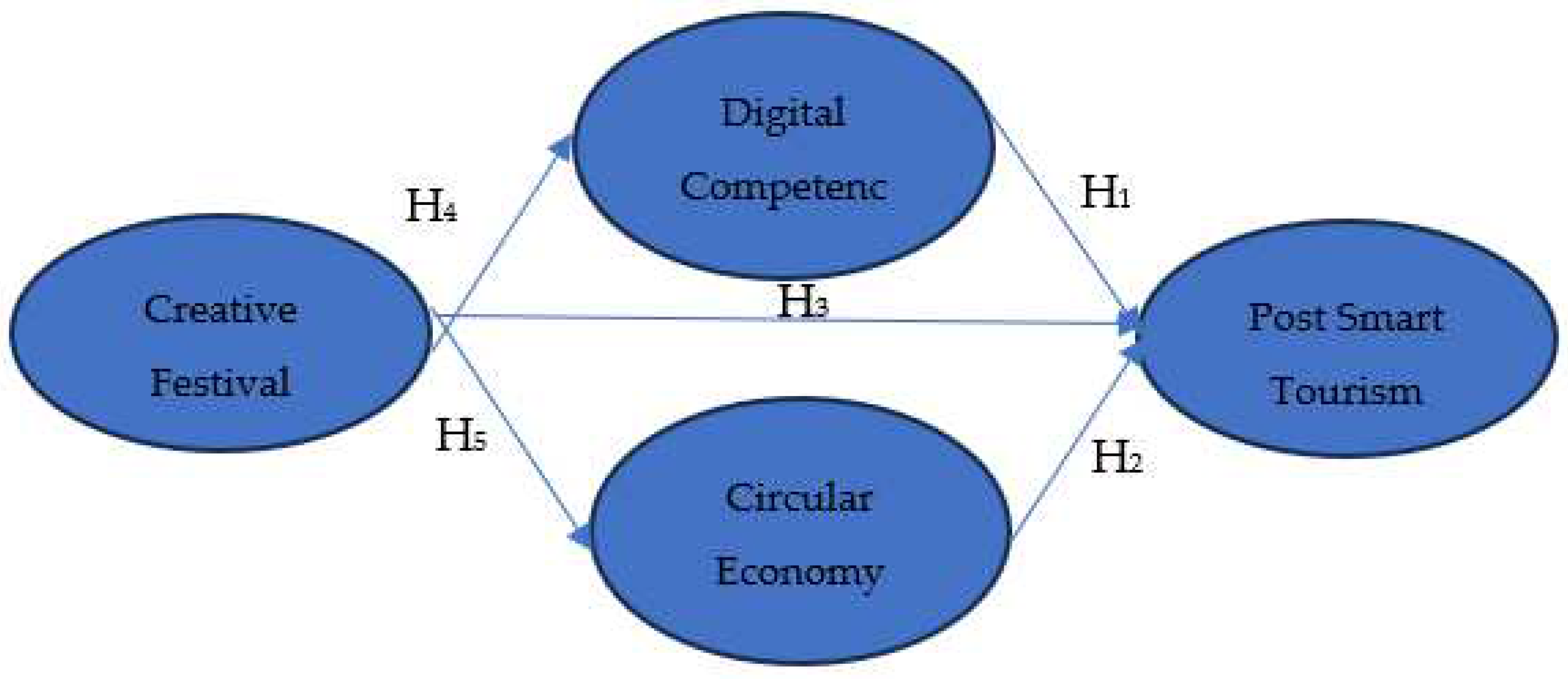
Based on Table 4 above, creative festivals influence the development and enhancement of smart tourism destination which reflect in the following hypothesis statement.
Hypothesis 3 (H3)
Hypothesis 4 (H4)
Creative event has a significant effect on digital competence. Events or festival can turn circular economy into circular society [64], while circular economy commitment can be obtained through circular festival (‘C-231 Green Deal on Circular Festivals’). This condition then makes the fifth hypothesis as follows.
Hypothesis 5 (H5)
Creative event has a significant effect on circular economy. Looking through on the relationships among variables, the research framework in this research as below.
Figure 1.
Research paradigm in the development of smart tourism village.
3. Materials and Methods
We employ mixed method research (MMR) for this paper. MMR is a research method that implements data collection, analysis and integrates quantitative and qualitative research in a study, while the type of MMR is triangulation research which includes three methods. Qualitative research was conducted by applying Expert Judgment through in-depth interviews and Focus Group Discussion (FGD), that includes representatives from government sectors, village leader, Kenderan tourism group, tourism business, local environmentalist, and so on, while quantitative research was designed to test hypotheses and determine the relationships and causality among variables to interpret and analyze the smart tourism model according to hypothesis tested in this research. The research observation uses cross-sectional or one shoot time coverage where the information or data obtained is the result of research conducted within a span of time in 2022-2023.
Qualitative research was conducted through expert judgment. The initial stage is to collect information from in-depth interviews with 10 Kenderan Village stakeholders. All opinions and statements were then being clustered and deduced, while the result was discussed and confirmed through an FGD. The output of the research is a qualitative research model that will be compared with the quantitative research model. Quantitative research was conducted through questionnaire distribution to Kenderan village visitors during December to March 2023. The questionnaire was made to identify visitors’ perception in Likert scale while Structural Equation Modelling (Lisrel) was used to test whether hypotheses are accepted or not, as well as evaluate the model fit. The result is the quantitative model. After getting both qualitative and quantitative smart tourism village models, we then combined and synthesize the model into the final proposed model for the new smart tourism village. The research methodology used in this research is described in Figure 2 below.
Primary data is obtained directly from questionnaires filled out by respondents. Primary data as information obtained directly from the original source according to the variables that are the object of research [66]. Research sampling was carried out by systematic random sampling on all tourism business units in Kenderan Village. The sampling technique according to Hartono (2014) is done by dividing the population into several parts and taking samples in each part randomly. The distribution of samples is done proportionally based on the population size of each business unit. Quantitative data was collected by distributing questionnaires sent directly to respondents or via the internet (google form) in the form of electronic data collection, while qualitative data was collected by conducting interviews and FGD. Interviews were conducted data and information from sources in-depth. Interviews were conducted by asking open-ended questions to leaders of tourism business units in Kenderan Village.
Question items from the indicators of each variable are assessed by respondents and classified into five alternative answers using an ordinal scale that describes the respondent’s answer. In this study using a Likert scale starting with a score of 1 (never) to a score of 5 (always). The likert scale is used to measure the attitudes, opinions and perceptions of a person or group about social events or symptoms [68]. In more detail, Riduwan explained that by using a Likert scale, the variables to be measured are translated into dimensions. The dimensions are translated into sub variables, then the sub variables are further translated into measurable indicators. So that measurable indicators can be used as a starting point for making instrument items in the form of statements or questions that need to be answered by respondents. The questionnaires that have been collected are then subjected to validity and reliability tests so that the questionnaire data can be used in answering research problems.
The indicators used by researchers in determining questionnaire questions are as follows:
Table 5.
Operating variables and indicators.
| Variables | Indicators |
|---|---|
| Digital Competence |
|
| Circular Economy in Tourism |
|
| Creative Festival |
|
| Smart Tourism Village |
|
The validity test shows the extent to which the measuring instrument measures what is desired or the extent to which the tool hits the target. The higher the validity of a test tool, the more the tool hits its target. A test can be said to have high validity if the test tool carries out its measurement function or provides measurement results in accordance with the meaning and purpose of holding tests in research. The type of validity used is construct validity where validity is obtained by correlating the score obtained by each item which can be a question or statement with the item score. This total score is the value obtained from the summation of all item scores. The statistical method used in data analysis is the Structural Equation Modelling (SEM) equation model based on variants or components. The reason for using SEM analysis is with the consideration that the causal relationship formulated uses a model that is not simple (complex) such as greening smart tourism that occurs with a circular economy. This form of causal relationship requires an analysis that is able to explain simultaneously about the relationship so that the SEM analysis method is used in this study.
The use of SEM as an analytical tool is based on the reasons for the complexity of the model used, the limitations of multidimensional analytical tools that are often used in quantitative research such as multiple regression, factor analysis, discriminant analysis and others. Primary data obtained from the research sample through questionnaires distributed were then analysed using SEM by utilizing Lisrel 8.8 program and SPSS 25. The Lisrel 8.8 program shows structural measurements and is used to test hypothesis models. This is due to the ability to estimate known coefficients from structural linear equations, accommodate models that are latent variables, accommodate measurement errors in endogenous and exogenous variables, accommodate simultaneous reciprocal warnings and interdependence. According to Hair et al. [69] that the use of SEM allows the analysis of a series of relationships simultaneously so as to provide statistical efficiency.
4. Results
4.1. Stakeholders’ View on Living Culture Festival, Circular Economy and Smart Tourism Village.
Kenderan Village is located in Tegallalang District, Gianyar Regency, Bali Province, has an area of approximately 7.18 km2 and is at an altitude of approximately 600 meters above sea level. Kenderan Village has superior village potential in the form of Artificial Resource Potential which includes agriculture, cultural arts, tourism, and economy. During the management of the tourism sector, there have been several problems, namely, the physical condition of village resources, the seasonal calendar, and local village institutional problems. Based on the problems, potential challenges and limitations faced by Kenderan Village, a vision for Kenderan Village Development for 2015-2020 was established, namely “The realization of a Prosperous, Just and Prosperous Kenderan Village Community Based on Agriculture Imbued with Tri Hita Karana”.
Table 6.
FGD Results.
| Stake Holders | Expert Opinion | Focus |
|---|---|---|
| Head of Rural Area Empowerment, Department of PMD Gianyar | To support Kenderan village, the local residential government will provide policy and budget especially for managing waste, improving people’s welfare, and facilitate SME business growth | Supporting tourism village |
| Secretary of Cooperative Office | Support event that can activate local participation in SME business and propose idea that Temple can become the hub for local community’s activities | Use temple to support local business and SMEs |
| Digital Ambassador of Gianyar Region | Provide digital access for community business and coordination | Digital accessibility |
| Religious Leader | The potential for Temple to become agent of change, center of religious life, economic, socio-cultural and conservation activities, as well as piloting program for Smart and Circular Economy based Tourism Village development. | Improve the role of temple in community’s daily productive lives |
| Village Leader | Tourism villages build excellence/uniqueness in order to win the competition | Focus on economic and welfare gain from tourism or creative industry |
| Tourism Group Leader | Tri Hita Karana philosophy, circular economy and living culture festival as means for tourist village differentiation | Local wisdom and events for developing thematic tourism |
| Environmentalist | The people lack of sustainable awareness and practices. Free plastic usage and sustainable practice campaign at Tegalalang. During pandemic working together with donators/local phylantrophists hold exchange 1 kg of waste with 1 kg of rice. | Sustainable awareness for destination preservation |
| Tourism Business Group Leader | Local wisdom, local produce, creativity (tourism packages also integrated local businesses are urgently required) | Local business enhancement |
| Creative Industry Leader | Implement more sustainable products by implementing planning one tree for every use of one log. | Sustainable practice to increase business |
| Village owned enterprises (BUMDES) | Utilizing local festivals as means to activate, promote, and improve informal economy and SMEs | Improve business and local welfare. |
Based on information from Table 5 above, Kenderan Village has already realized the role of tourism sector for their welfare and that their religion, unique culture and way of life could become their valuable tourism resource. The locals also believe that their religious activities can be designed into creative festivals that shows their living traditions and become calendar of events that will attract international tourists to their villages as the festival still showing the genuine tradition.
While community leaders have realized the importance of conserving the nature and managing waste by promoting several conservation activities such as exchange the household waste into rice as certain group collected donation during covid-19 as well as supported by their philosophy of Tri Hita Karana which means respect three pillars of life, the relationship with Gods, humankind, and the environment they live in. However, the temple is still becoming the source of offering waste that the locals throw into the creek. Through the FGD, the locals have a strong belief that should Kenderan Village has a big tendency to be able to implement circular economy by making the practice as their village positioning and branding, while making the temple as the agent of change through the religious leader’s cause to change the way the locals manage waste and return to the Balinese philosophy, Tri Hita Karana, especially to respect next generation and their living habitats. Through FGD it is also sought that temple can be the center and the pilot of circular economy implementation, while festival as the lever to communicate and promote their commitments in active sustainable development program in Kenderan Village. Tourism destinations around the world utilize events and festivals as means for economic development and destination marketing by tourism destinations around the world [70], as well as enhance tourist experience at the destinations [71], while could also be employed in order to promote sustainability [72].
From the FGD data collection, we can identify that in order to be a successful smart tourism village in Kenderan cannot only rely on technology innovation alone but employ technology as enabler or tools to make the tourism village accessible and co create experience. To create smart tourism village, Kenderan Village should identify local context, in this context Tri Hita Karana, which also comply with the value of sustainable practice represented by BE.
Figure 3.
Qualitative Model of Post Smart Tourism Destination for Kenderan Village.
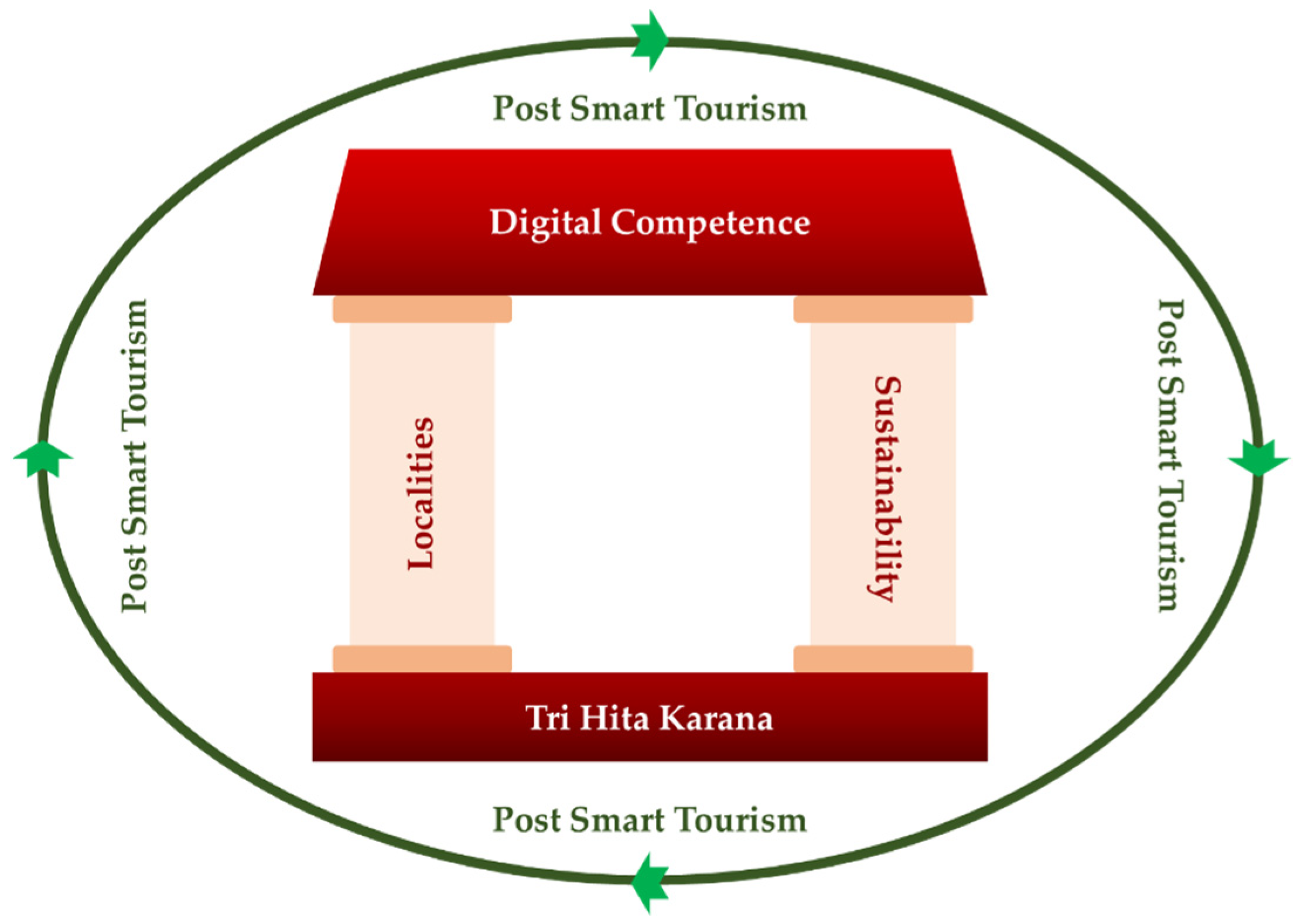
To ensure the diffusion of idea to the locals, get collective acceptance and support inclusion, Kenderan Village should design their temple as the generator and agent of change, so that tourism village differentiation can be deeply experienced by all human’s senses while technology adoption could become new digital accessibility for tourists and all stakeholders to co-create the demanded experience. This concept is relevant with the ideas that developing sustainable tourism destination including its spatial planning, especially rural tourism, should be based on each destination’s unique attraction resources and local wisdom [73,74] while technology supports tourism value chain ecosystem [27,75,76,77].
To make Kenderan Village an inclusive and innovative tourism destination, several steps need to be taken into consideration, including efforts to form a team that has a variety of skills and expertise needed to plan and implement the transformation of Kenderan Village. Next, it is necessary to carry out a feasibility study to determine the potential and needs of the village and create a strategic plan that includes short-term and long-term goals, as well as how to achieve them. Involvement of local communities, regional government, business actors and other related parties in the planning and decision-making process is needed for village development. Ensure that infrastructure and services in the village meet the needs of all types of visitors including those with physical limitations including accessibility, disability-friendly accommodation and training programs for local communities. It is important to provide training and support for local communities in adopting technology including the use of smartphones, online booking platforms and other digital tools that will enable them to engage in the digital tourism industry. Utilize social media, websites and online booking platforms to market Kenderan Village and ensure information about attractions, accommodation and activities is available online. Consider engaging in activities that allow tourists to interact with local communities and understand their culture including craft workshops, lectures on local history, or other cultural events. With these steps, Kenderan Village has a great opportunity to become an agent of change that integrates tourist village differentiation with technology adoption, creating a unique and inclusive tourism destination.
4.2. Quantitative Analysis
The level of absolute fit with RMSEA of this research model shows <0.05 indicating the level of fit of the model in the excellent category. Goodness of Fit Indices (GFI) and Adjusted Goodness of Fit Ind ex (AGFI) > 0.80, and Root Mean Square Error of Approximation (RMSEA) and RMR values are smaller than 0.05, so it can be concluded that the research model is in accordance with empirical conditions. The Chi-Square value of this study with degrees of freedom with p value> 0.05, according to the Chi-Square index, the fit of this research model is very good [69]. The measurement model explains the relationship between each construct and the indicators where the values are used to test validity and reliability. This analysis can be explained by the value of discriminant validity, loading factor, construct validity and composite reliability. Construct validity is explained by the factor loading value. Composite reliability and Cronbach Alpha are used to see the reliability or level of reliability of dimensions in measuring research variables. Analysis of the relationship between indicator variables and their latent variables is referred to as the measurement equation which is displayed as follows.
The table above shows the results of first order construct measurement for variables with factor loading (λ) > 0.50 with prob < 0.05, meaning that the indicator has good enough validity to explain the latent construct [78]. The results show that six variables have valid dimensions and indicators with count> t table at α = 0.05. The Construct Reliability (CR) value shows that all dimensions and indicators have a fairly high consistency with a value > 0.7. Discriminant validity is explained by the square root value of average variance extracted (AVE). The recommended value is above 0.5. and the results show that the AVE> 0.5. So in general that the indicators and dimensions reflect all latent variables. The t statistics for hypothesis testing on the operational variables shows that all antecedent variables, namely digital competence, circular economy and creative events significantly affect the independent variable, post smart tourism consecutively 0.044; 0.270, and 0.300 as seen in Table 8 below.
Table 7.
Measurement Model Testing Results.
| Variable | Indicators | Code | Standardized Loading (l) | t | Prob. | Construct Reliability (CR) | Average Variance Extracted (AVE) |
|---|---|---|---|---|---|---|---|
| Creative Events | Tangible Environment | CE1 | 0,87 | 9,60 | 0,000 | 0,96 | 0,78 |
| Social Cohesion | CE2 | 0,9 | 9,98 | 0,000 | |||
| Innovative Novel Concept | CE3 | 0,89 | 9,78 | 0,000 | |||
| Sense of Professionalism | CE4 | 0,88 | 9,73 | 0,000 | |||
| Local Wisdom Content | CE5 | 0,89 | 9,85 | 0,000 | |||
| Special Performance | CE6 | 0,87 | 9,62 | 0,000 | |||
| Tourism Circular Economy | Preservation of Resources | TCE1 | 0,69 | - | - | 0,93 | 0,73 |
| Green Technology Adoption | TCE2 | 0,89 | 6,03 | 0,000 | |||
| Environmental Stewardship | TCE3 | 0,78 | 5,6 | 0,000 | |||
| Waste Management | TCE4 | 0,94 | 6,16 | 0,000 | |||
| Sustainable Environment | TCE5 | 0,95 | 6,19 | 0,000 | |||
| Digital Competence | Information Handling | DC1 | 0,89 | - | - | 0,95 | 0,81 |
| Social Networking | DC2 | 0,89 | 7,30 | 0,000 | |||
| Content Creation | DC3 | 0,92 | 7,48 | 0,000 | |||
| Safety Concern | DC4 | 0,91 | 7,45 | 0,000 | |||
| Post Smart Tourism | Digital Experience | Smart1 | 0,82 | - | - | 0,93 | 0,74 |
| Smart Business Ecosystem | Smart2 | 0,88 | 7,20 | 0,000 | |||
| Technological Infrastructure | Smart3 | 0,87 | 7,15 | 0,000 | |||
| Interactive Communication | Smart4 | 0,85 | 7,04 | 0,000 | |||
| Real Time Information | Smart5 | 0,87 | 7,18 | 0,000 |
Table 8.
Hypothesis Testing.
| No | Hypothesis | Coeff. Estimate | Standard error | t-stat | Prob. | R2 |
|---|---|---|---|---|---|---|
| 1 | Digital Competence → Post Smart Tourism | 0,440* | 0,120 | 3,800 | 0,000 | 0,194 |
| 2 | Tourism Circular Economy → Post Smart Tourism | 0,270* | 0,110 | 2,390 | 0,018 | 0,073 |
| 3 | Creative Events → Post Smart Tourism | 0,300* | 0,130 | 2,240 | 0,026 | 0,090 |
| 4 | Creative Events → Digital Competence | 0,660* | 0,095 | 6,930 | 0,000 | 0,436 |
| 5 | Creative Events → Tourism Circular Economy | 0,690* | 0,120 | 5,900 | 0,000 | 0,476 |
| 6 | Creative Events → Tourism Circular Economy → Post Smart Tourism | 0,186** | 0,083 | 2,257 | 0,025 | 0,186 |
| 7 | Creative Events → Digital Competence → Post Smart Tourism | 0,290** | 0,090 | 3,243 | 0,001 | 0,290 |
* Signifikan pada (t table = 1.98), **sobel test.
Each hypothesis testing explanation as follows. Hypothesis 1 (H1), digital competence has a significant effect on post smart tourism. Digital competency has a direct coefficient of 0.440 and significant on Post Smart Tourism with prob. 0.000 <α (0.05), so hypothesis 1 is accepted. Digital competency has a positive effect on post smart tourism with an estimated value of 0.440, meaning that if digital competency increases by one unit, then post smart tourism also increases by 44%. The R2 value of 0.194 means that post smart tourism is influenced by digital competency by 19.4%, the rest is influenced by other variables.
Hypothesis 2 (H2), tourism circular economy has a significant effect on post smart tourism. Tourism circular economy has a direct coefficient of 0.270 and significant on post smart tourism with prob. 0.018 <α (0.05), so hypothesis 2 is accepted. Tourism circular economy has a positive effect on post smart tourism with an estimated value of 0.270, meaning that if circular economy increases by one unit, then post smart tourism also increases by 27%. R2 value of 0.073 means that post smart tourism is influenced by tourism circular economy by 7.3%, the rest is influenced by other variables.
Hypothesis 3 (H3) Creative event has a significant effect on post smart tourism destination. Creative event has a direct coefficient of 0.300 and significant on post smart tourism destination with prob. 0.026 <α (0.05), so hypothesis 3 is accepted. Creative event has a positive effect on post smart tourism with an estimated value of 0.300, meaning that if creative event increases by one unit, then post smart tourism destination also increases by 30%. The R2 value of 0.090 means that post smart tourism is influenced by creative event by 9%, the rest is influenced by other variables.
Hypothesis 4 (H4), creative event has a significant effect on digital competence. Creative event has a direct coefficient of 0.660 and significant on digital competency with prob. 0.000 <α (0.05), so hypothesis 4 is accepted. Creative event has a positive effect on digital competency with an estimated value of 0.660, meaning that if creative event increases by one unit, then digital competency also increases by 66%. The R2 value of 0.436 means that digital competency is influenced by creative event by 43.6%, the rest is influenced by other variables.
Hypothesis 5 (H5), creative event has a significant effect on tourism circular economy. Creative event has a direct coefficient of 0.690 and significant on tourism circular economy with prob 0.000 <α (0.05), so hypothesis 5 is accepted. Creative event has a positive effect on tourism circular economy with an estimated value of 0.69, meaning that if creative event increases by one unit, then tourism circular economy also increases by 69%. R2 value of 0.476 means that tourism circular economy is influenced by creative event by 47%, the rest is influenced by other variables.
Based on the hypothesis test above, it can be concluded that the direct influence can be felt if a tourist village has a creative event, it will have a direct impact on 3 variables, namely tourism circular economy, smart tourism and digital competency. For significant influence there are tourism circular economy and digital competency variables where the percentage of influence of each variable reaches 69% and 66%. While the influence on the post smart tourism variable is only 30%. Mediating effects of tourism circular economy and digital competence to post smart tourism. Creative event has an indirect coefficient of 0.186 and significant to smart tourism through tourism circular economy with prob. 0.025 < α (0.05). Based on the sobel test conducted, the t statistic is 2.257, meaning that tourism circular economy can mediate the effect of creative event on smart tourism because 2.257> 1.98 (t table) with an indirect effect of 18.6%. Creative event has an indirect coefficient of 0.290 and significant to smart tourism through digital competency with prob. 0.001 < α (0.05). Based on the sobel test conducted, a t statistic of 3.243 was obtained, meaning that digital competency can mediate the effect of creative event on smart tourism because 3.243> 1.98 (t table) with an indirect effect of 29%.
After knowing the direct effect and indirect effect, the total effect is described as follows. Total effect (influence and indirect) of creative events on post smart tourism through tourism circular economy: 0,300 + 0.186 = 0,486—48,6%. Total effect (influence and indirect) of creative events on post smart tourism through digital competency: 0,300 + 0,290 = 0,590—59%. Based on the analysis of direct and indirect impacts, digital competence has the greatest impact on post smart tourism. Where digital competence also has an influence on the implementation of creative events and tourism circular economy. In the 4 indicators owned by digital competence (information handling skills, social networking capability, content creation skills, and safety concern), content creation skills have the greatest relationship of 0.92 or 92% to the organization of creative events, tourism circular economy and post smart tourism.
Figure 4.
Structural Model Analysis.

4.3. Post-Smart Tourism Village Model
The triangulation of qualitative and quantitative research shows that the tourism core resources and destination’s components become the most important factors to be explored and developed with the local value, the uniqueness and differentiation aspects of the post smart tourism model, that locality aspects and sustainability practice are used in order to ensure the development of competitive and sustainable smart tourism destination model.
Figure 5.
Model Post-Smart Tourism.
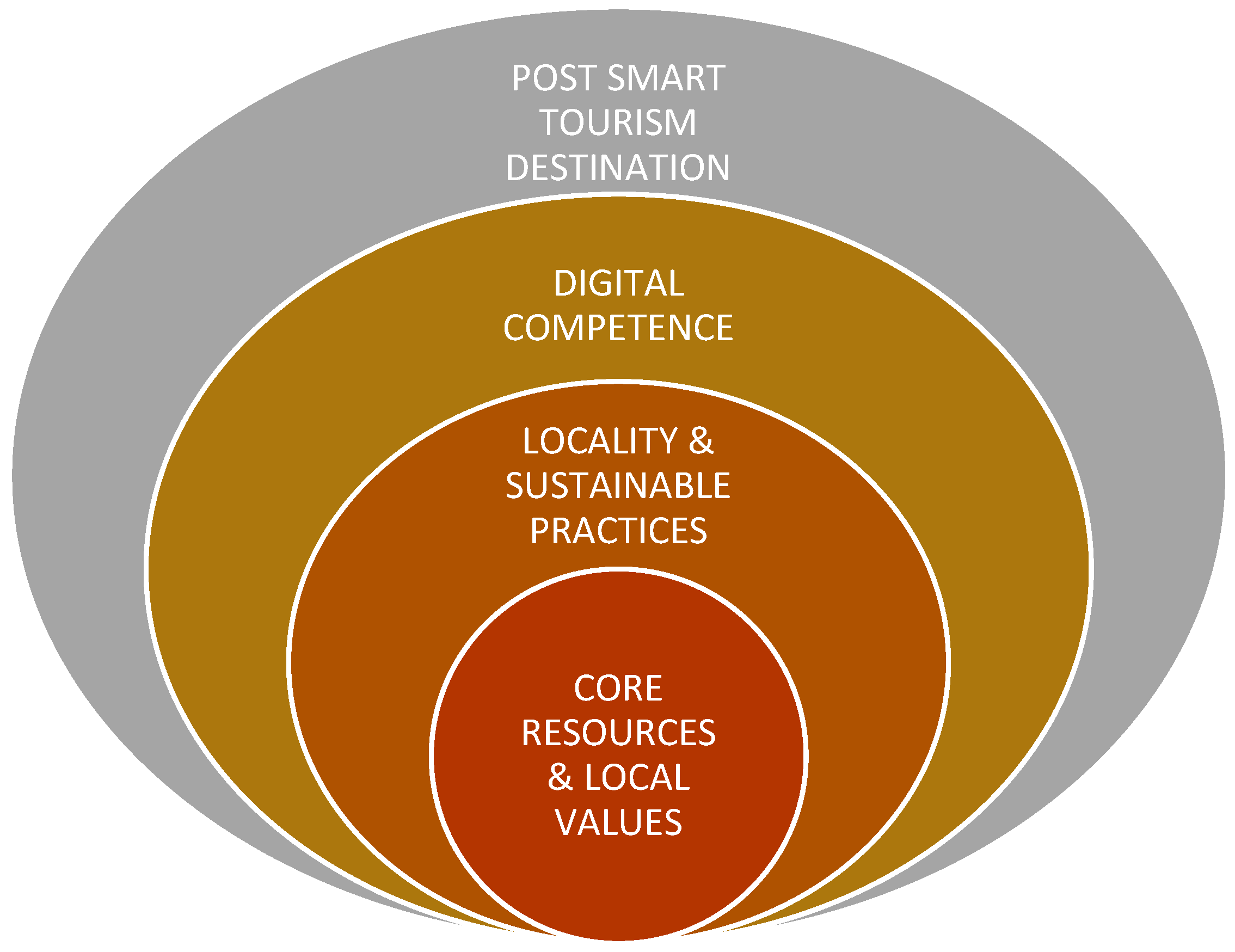
The model proposed is quite similar to the model proposed by Coca-Stefaniak [13] regarding post smart tourism. In Kenderan, the local value, the spiritual ideology Tri Hita Karana would strengthen the application of sustainable development, as it proposes a balance between God, man and nature, while digital competence will become enabler to make the destination accessible for tourists as well able to encourage stakeholder co create experience. The existence of creative events can invite various parties or new stakeholders to help accelerate and activate tourist villages not only to create smart tourism destination but also encourage the implementation of digitalization and circular economy that will form an ecosystem whose implementation considers natural, human and social capital as essential components for developing sustainable local and planet friendly destinations. Kenderan Living Culture Festival 2022 is an example of creative event organized by involving various groups, seen from the participants who contribute through Village UMKM stands that show agricultural products, carving products; local arts and cultural performances; gathering of environmental communities, academics, local village governments and other villages. If Kenderan Tourism Village can be persistent, then a resilient and sustainable Circular Economy Ecosystem can be realized. However, (CE360 Alliance, 2020) also mentioned that the process of transforming into a village that carries CE is an iterative project that needs to be supported starting from the trial and error process, then continuing to develop and strive for continuous improvement. To be successful, any changes made must consider the business context, external trends, desired market position, target customers, core capabilities, strengths and weaknesses of the village. In line with the definition of circular economy (CE) according to (CE360 Alliance, 2020) which is a deliberately designed socio-economic system inspired by natural systems, regenerative human and natural capital that works long term for all stakeholders. The high influence of creative events is due to external trends, namely the demand from today’s travelers who have a lot of interest in tranquility, comfort and meaningful travel. Revealed by (CE360 Alliance, 2020) that today’s travelers want to experience life like a local of the tourist attractions they visit, tend to look for the characteristics or uniqueness of the place, take a trip that is transformative, participatory and has a specific purpose such as Melukat spiritual tourism which boomed during the pandemic, etc. When connected to smart tourism and digital competency, it is related to the self-existence of millennial and gen Z tourists. Which, this generation of tourists prefers trips that can and have the aim of “Showing/showing off” to their peers or followers on social media so that access to information on a tourist attraction or the aesthetics and appearance of a tourist attraction that is “instagrammable” and can be “tagged” in its location is needed especially if it can be manifested through an attractive Event. As the village also promote its local values and locality aspects, then the tourist village will be able to gain its competitive advantage more sustainable as locality is the most valuable, rare, inimitable and hard to be substitute as the main exploration in placemaking of tourist destination.
To ensure the support and active participation of the event, Kenderan Village can encourage temple to take active role not only as center of community activities and venue but also as an agent to encourage community to empower themselves in cultural preservation and implement the philosophy of Tri Hita Karana in daily local people’s lives but also diffused the circular economy innovation including the initial use of renewable energy. The dominance of the influence of creative events is also accompanied by other demand trends mentioned by (CE360 Alliance, 2020), namely the increase in domestic travel interest after covid-19 due to the discovery of local attractions and local culture in less crowded destinations. This increases the pride of travelers who can enjoy local attractions and culture in a more private and discreet manner. Therefore, creative events also need to consider targeting tourists who are not only for large audiences, but also those who prefer privacy, where these people are usually willing to pay more.
5. Conclusions
Locality elements such as local values, cultural and natural heritage, creative events or festivals can be explored together with circular economy or other sustainability practices, and digital competency or other novel technologies as the building blocks of post smart tourism destinations and villages. Creative events can also be utilized as effective tools to promote post smart tourism implementation, encourage the adoption of digital technology and encourage the implementation of circular economy as supported by the sustainable local value in order to activate the meaningful travel experience. To make tourism village possesses sustainable competitive advantages, the village must explore and promote its locality aspects to differentiate its tourist village by identifying the valuable, rare, inimitable and non-substitutable tourism resources. To ensure that tourist villages have a sustainable competitive advantage by focusing on local aspects, it is necessary to identify all unique and valuable natural, cultural, historical and human potential and resources. Based on the identified resources, it is necessary to develop tourism products or experiences that are not only unique but also provide added value to visitors. Involving local communities in the management and promotion of tourist villages is very important to ensure support and involvement, as well as maintaining authentic local aspects. Ensure that tourism activities are carried out with attention to sustainability which includes environmentally friendly practices, conservation of natural resources, and community involvement in environmental management. Combining various elements of the tourism experience into an integrated package can be a good way to provide added value to visitors and ensure they can explore various aspects of the village. The implication of this research is that to develop smart tourism destination wiser and distinctive, tourist village should explore their local values and resources, embed them into its tourism basic components and core resources, and co create, distribute, deliver and promote it to global market through technology adoption and global sustainability value.
Author Contributions
Conceptualization, H.K., D.P.; methodology, D.P., S.S. and H.K.; validation, S.S., H.K., M.V. and M.S.R.; writing—original draft preparation, D.P. and S.S.; writing—review and editing, H.K., M.V., M.S.R. and H.K. All authors have read and agreed to the published version of the manuscript.
Funding
Research grant from Universitas Indonesia.
Institutional Review Board Statement
Not applicable.
Informed Consent Statement
Not applicable.
Data Availability Statement
The data was collected from survey data obtained directly at Kenderan in the form of data in the form of scientific journals presented elegantly.
Acknowledgments
The authors express their gratitude to the Universitas Indonesia for their assistance and contribution to completing this research.
Conflicts of Interest
The authors declare that they have personal relationships that may have inappropriately influenced them in writing this article.
References
- Koo C, Shin S, Gretzel U, Hunter WC, Chung N. Conceptualization of Smart Tourism Destination Competitiveness. Asia Pacific J Inf Syst. 2016;26(4):561–76.
- Ercan F. Smart tourism destination: A bibliometric review. Eur J Tour Res. 2023;34(2023):3409.
- Badri H, Hmioui A. SMART TOURISM DESTINATION COMPETITIVENESS: The EXPLOITATION of the BIG DATA in MOROCCO. Int Arch Photogramm Remote Sens Spat Inf Sci - ISPRS Arch. 2021;46(4/W5-2021):259–65.
- Göktaş Kulualp H, Sarı Ö. Smart Tourism, Smart Cities, and Smart Destinations as Knowledge Management Tools. 2020;(February):371–90.
- Pranita D, Sarjana S, Musthofa BM, Kusumastuti H, Rasul MS. Blockchain Technology to Enhance Integrated Blue Economy : A Case Study in Strengthening Sustainable Tourism on Smart Islands. Sustainability. 2023;15(5342):1–24.
- Madeira C, Rodrigues P, Gomez-suarez M. A Bibliometric and Content Analysis of Sustainability and Smart Tourism. Urban Sci. 2023;7(2):1–24.
- Hilty L, Aebischer B. Smart Sustainable Cities: Definition and Challenges. Adv Intell Syst Comput. 2015;310:351–65.
- Ilgaz B. AS A ROAD MAP OF SUSTAINABLE TOURISM SMART CITIES AND SMART. In: International conference on global practice of multidisciplinary scientific studies. 2023.
- Aguirre A, Zayas A, Gómez-Carmona D, López Sánchez JA. Smart tourism destinations really make sustainable cities: Benidorm as a case study. Int J Tour Cities. 2022.
- Gelter J, Fuchs M, Lexhagen M. Making sense of smart tourism destinations: A qualitative text analysis from Sweden. J Destin Mark Manag. 2022;23:100690.
- Bhuiyan KH, Jahan I, Zayed NM, Islam KMA, Suyaiya S, Tkachenko O, et al. Smart Tourism Ecosystem: A New Dimension toward Sustainable Value Co-Creation. Sustainability. 2022;14(22):15043.
- Shafiee S, Rajabzadeh Ghatari A, Hasanzadeh A, Jahanyan S. Developing a model for sustainable smart tourism destinations: A systematic review. Tour Manag Perspect. 2019;31:287–300.
- Coca-Stefaniak JA. Beyond smart tourism cities – towards a new generation of “wise” tourism destinations. J Tour Futur. 2021;7(2):251–8.
- Adamowicz M, Zwolinska-Ligaj M. The “smart village” as away to achieve sustainable development in Rural Areas of Poland. Sustain. 2020;12(16).
- Pranita D, Kesa DD, Marsdenia. Digitalization Methods from Scratch Nature towards Smart Tourism Village; Lessons from Tanjung Bunga Samosir, Indonesia. J Phys Conf Ser. 2021;1933(1).
- Flores-Crespo P, Bermudez-Edo M, Garrido JL. Smart tourism in Villages: Challenges and the Alpujarra Case Study. Procedia Comput Sci [Internet]. 2022;204:663–70. Available from: https://doi.org/10.1016/j.procs.2022.08.080. [CrossRef]
- Priyambodo TK, Artianingsih MD. Strategy for Sustainable Smart Tourism Village Development in Ponggok Village, Klaten, Central Java. Int J Sustain Compet Tour. 2022;1(02):1–10.
- Ciolac R, Iancu T, Popescu G, Adamov T, Feher A, Stanciu S. Smart Tourist Village—An Entrepreneurial Necessity for Maramures Rural Area. Sustain. 2022;14(14).
- Dorobantu MR, Gheorghe G, Nistoreanu PhD P. New Ways to Value Tourism Resources From Rural Environment. Compet Agro-Food Environ Econ. 2012;1:385–94.
- Košić K, Demirović D, Dragin A. Living in a Rural Tourism Destination - the Local Community’S Perspective. 2017;(November):267–78.
- Wilda. No Title. 2022.
- Rudwiarti LA, Pudianti A, Emanuel AWR, Vitasurya VR, Hadi P. Smart tourism village, opportunity, and challenge in the disruptive era. IOP Conf Ser Earth Environ Sci. 2021;780(1).
- Buhalis D, Amaranggana A. Smart Tourism Destinations. Inf Commun Technol Tour 2014. 2013;553–64.
- Tran HM, Huertas A, Moreno A. (SA)6: A new framework for the analysis of smart tourism destinations. A comparative case study of two Spanish destinations. Congr - Semin Destin Tur Intel 2017 - Libr Actas. 2017;320470350:190–214.
- Bulchand-Gidumal J. Post-COVID-19 recovery of island tourism using a smart tourism destination framework. J Destin Mark Manag. 2022;23.
- Initiative of the European Union. Leading Examples of Smart Tourism Practices in Europe. 2022;54–6.
- Gretzel U, Sigala M, Xiang Z, Koo C. Smart tourism: foundations and developments. Electron Mark. 2015;25(3):179–88.
- Gretzel U, Werthner H, Koo C, Lamsfus C. Conceptual foundations for understanding smart tourism ecosystems. Comput Human Behav [Internet]. 2015;50:558–63. Available from: http://dx.doi.org/10.1016/j.chb.2015.03.043. [CrossRef]
- Pecsek B. Working on holiday: the theory and practice of workcation. Balk J Emerg Trends Soc Sci. 2018;1:1–13.
- Shehade, Maria S-L. Revisiting Authenticity in the Age of the Digital Transformation of Cultural Tourism. In: Cultural and Tourism Innovation in the Digital Era, Sixth International IACuDiT Conference, Athens 2019 (pp3-16). 2020.
- Di Giuseppantonio Di Franco P, Galeazzi F, Vassallo V. Authenticity and Cultural Heritage in the Age of 3D Digital Reproductions. 2018. 138 p.
- Veerasamy S, Goswami S. Smart Tourism Intermingling with Indian Spiritual Destinations: Role of e-WoM Sentiments in marketing. ASEAN J Hosp Tour. 2022;20(2):100–16.
- Boodnah KD, Armoogum V, Jaunky VC, Armoogum S. Towards Smart Tourism: An individual appreciation of Porlwi-By-Light festival: An Ordered Probit Approach. 2016 IEEE Int Conf Emerg Technol Innov Bus Pract Transform Soc EmergiTech 2016. 2016;(August):323–8.
- Andres Coca-Stefaniak, J., & Seisdedos G. Smart urban tourism destinations at a crossroads-being “smart” and urban are no longer enough. In: AM Morrison and JA Coca-Stefaniak (eds). London: The Routledge Handbook of Tourism Cities; 2020.
- Qi S. Smart Tourism Development in Small and Medium Cities: The Case of Macao. J Smart Tour. 2021;1(2):27–36.
- Rahmat ENA. a Literature Review on Smart City and Smart Tourism. J Inov Penelit. 2021;1(12):2255–62.
- Morales-Urrutia X, Morales-Urrutia D, Simabaña-Taipe L, Ramírez CAB. Smart tourism and the application of ICT: The contribution of digital tools. RISTI - Rev Iber Sist e Tecnol Inf. 2020;2020(E 32):64–76.
- Boes K, Buhalis D, Inversini A. Smart tourism destinations: ecosystems for tourism destination competitiveness. Int J Tour Cities. 2016;2(2):108–24.
- Alexandru A, Alexandru CA, Coardos D, Tudora E, Definition ABD. Big Data : Concepts, Technologies and Applications in the Public Sector. 2016;(June 2017).
- Mello JC De, Faxina F. Smart City and Smart Tourist Destinations : Learning from New Experiences in the 21st century. 2021;9(May).
- Xu R. No Title. mdpi. 2023.
- da Costa Liberato PM, Alén-González E, de Azevedo Liberato DFV. Digital Technology in a Smart Tourist Destination: The Case of Porto. J Urban Technol. 2018;25(1):75–97.
- Mandić, A. and Garbin Praničević D. e-Review of Tourism Research (eRTR), Vol. 16, No. 2/3, 2019 http://ertr.tamu.edu. e-Review Tour Res. 2019;16(2):234–43.
- Yang S, Yumeng L, Ziqi Y. Tourists’ Risk Perception of Smart Tourism Impact on Tourism Experience. Proc 2022 Int Conf Soc Sci Humanit Arts (SSHA 2022). 2022;653(Ssha):368–75.
- Prieto-Sandoval V, Jaca C, Ormazabal M. Towards a consensus on the circular economy. J Clean Prod. 2018;179:605–15.
- Rodríguez C, Florido C, Jacob M. Circular economy contributions to the tourism sector: A critical literature review. Sustain. 2020;12(11).
- Kaszás N, Keller K, Birkner Z. Understanding circularity in tourism. Soc Econ. 2022;44(1):65–82.
- Renfors S. Circular Economy in Tourism : A System-Level Approach. 2023;(Sheldon 2022):261–6.
- Martínez-Cabrera J, López-Del-pino F. The 10 most crucial circular economy challenge patterns in tourism and the effects of covid-19. Sustain. 2021;13(9):1–41.
- Sørensen F, Bærenholdt JO, Greve KAGM. Circular economy tourist practices. Curr Issues Tour. 2020;23(22):2762–5.
- Girard LF, Nocca F. From linear to circular tourism. Aestimum. 2017;70:51–74.
- Mies A, Gold S. Mapping the social dimension of the circular economy. J Clean Prod [Internet]. 2021;321(128960):1–17. Available from: https://doi.org/10.1016/j.jclepro.2021.128960. [CrossRef]
- Ekins P, Domenech T, Drummond P, Bleischwitz R, Hughes N, Lotti L. The Circular Economy: What, Why, How and Where. Managing environmental and energy transitions for regions and cities. Manag Environ energy transitions Reg cities. 2019;1–89.
- Valavanidis A. Concept and Practice of the Circular Economy Concept and Practice of the Circular Economy. Athanasios Valavanidis. 2018;(July):1–30.
- Heshmati A. A review of the circular economy and its implementation. Int J Green Econ. 2017;11(3/4):251.
- Cimbaljević M, Stankov U, Demirović D, Pavluković V. Nice and smart: creating a smarter festival–the study of EXIT (Novi Sad, Serbia). Asia Pacific J Tour Res. 2021;26(4):415–27.
- WTCF. Global Report on Smart Tourism in Cities. 2019;112.
- Vecchio P Del, Mele G, Ndou V, Secundo G. Creating value from Social Big Data: Implications for Smart Tourism Destinations. Inf Process Manag. 2018;54(5):847–60.
- Coca-Stefaniak JA. Marketing smart tourism cities – a strategic dilemma. Int J Tour Cities. 2019;5(4):513–8.
- Fabry N, Sylvain Zeghni. Smart destination management driven by emotions and small data. HalArchives-OuvertesFr. 2022.
- Neuhofer B, Magnus B, Celuch K. The impact of artificial intelligence on event experiences: a scenario technique approach. Electron Mark. 2021;31(3):601–17.
- Mehrotra A, Lobo J. Technology Driving Event Management Industry to the Next Level. ICRITO 2020 - IEEE 8th Int Conf Reliab Infocom Technol Optim (Trends Futur Dir. 2020;436–41.
- Silva MP. The Age of Hybrid Events Amplifying the power of culture through digital experiences (Music Festivals feat. Technology). PORTO Account Bus Sch Polytech PORTO M MASTER DEGREE Digit Mark. 2021.
- Calisto M. From circular economy to circular society: analysing circularity discourses and policies and their sustainability implications. 2023.
- C-231 Green Deal on Circular Festivals.
- Sekaran U. Research Methods For Business, 4th Edition. Jakarta: Salemba Empat; 2006.
- Hartono J. Metodologi Penelitian Bisnis: Salah Kaprah dan Pengalaman-Pengalaman. Yogyakarta: BPFE; 2014.
- Riduwan. Skala Pengukuran Variabel-Variabel Penelitian. Bandung: Alfabeta; 2015.
- Hair JF, Black WC, Babin BJ, Anderson RE. Multivariate Data Analysis. NJ: Prentice Hall; 2014.
- Van Niekerk M. Contemporary issues in events, festivals and destination management. Int J Contemp Hosp Manag. 2017;29(3):842–7.
- Mariani MM. The Role of Partnerships in Staging Tourist Experiences. Tour Manag Mark Dev. 2016;(2015):173–93.
- Sharma A, Kumar J, Turaev B, Mohanty P. Festival and Event Tourism Building Resilience and Promoting Sustainability. 2022;(July):1–161.
- Farhan H, Anwar K. The Tourism Development Strategy Based on Rural and Local Wisdom. J Sustain Dev. 2016;9(3):170.
- Tou HJ, Noer M, Helmi, Lenggogeni S. Spatial Planning with Local Wisdom for Rural Tourism Development. IOP Conf Ser Earth Environ Sci. 2020;556(1).
- Gretzel U, Werthner H, Koo C, Lamsfus C. Conceptual foundations for understanding smart tourism ecosystems. Comput Human Behav. 2015;50:558–63.
- Buhalis D. Technology in tourism-from information communication technologies to eTourism and smart tourism towards ambient intelligence tourism: a perspective article. Tour Rev. 2020;75(1):267–72.
- Ivars-Baidal J, Casado-Díaz AB, Navarro-Ruiz S, Fuster-Uguet M. Smart tourism city governance: exploring the impact on stakeholder networks. Int J Contemp Hosp Manag. 2023.
- Ghozali I. Aplikasi Analisis Multivariate Dengan Program SPSS. Semarang: Badan Penerbit Universitas Diponegoro; 2011.
Figure 2.
Mixed-method flowchart.
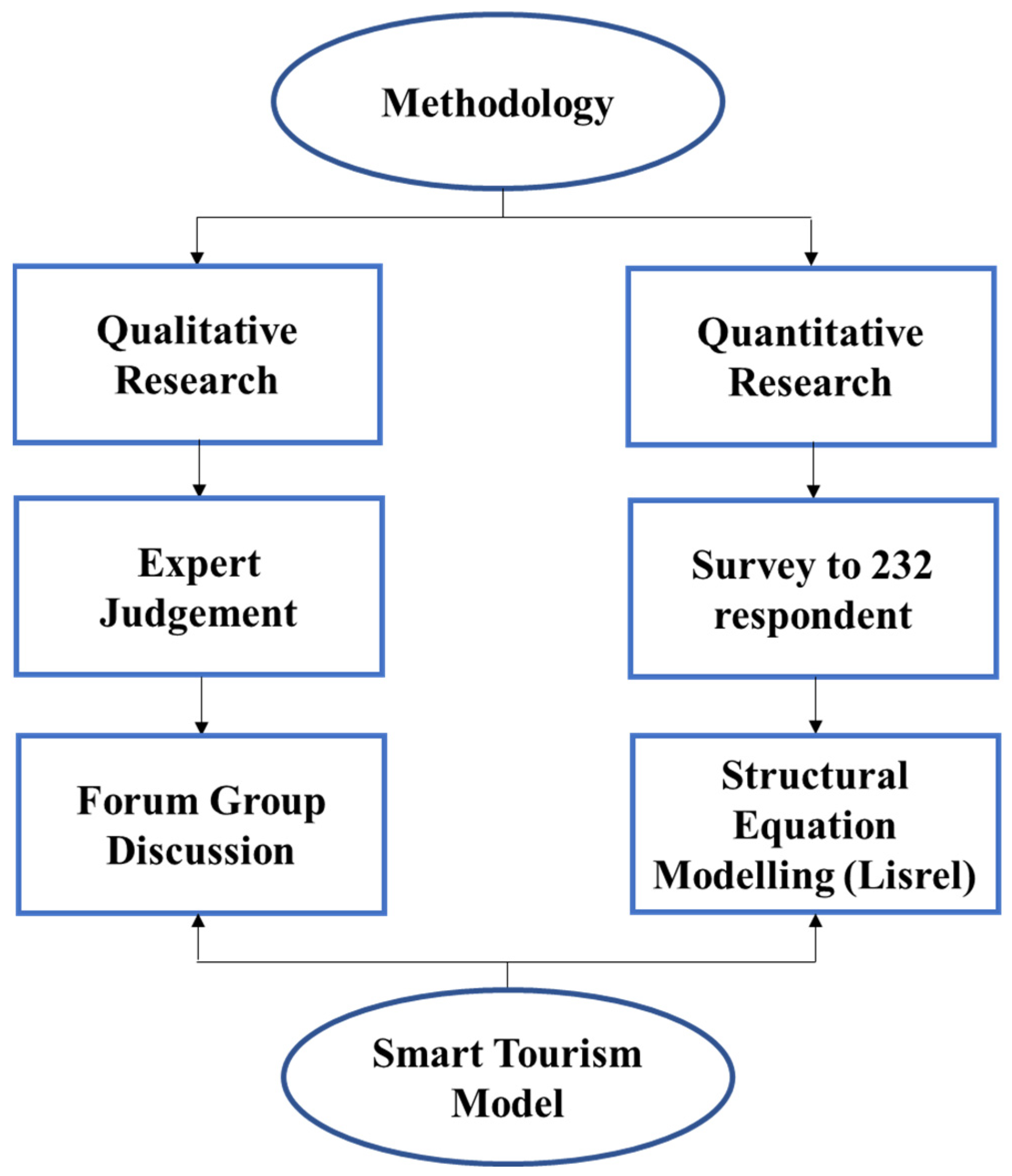
Table 4.
The previous research on festivals in smart tourism destination.
| Researcher | Concept |
|---|---|
| [58] | Creating cultural festivals and other events implies with the creation of smart experience, the STD’s attractiveness enhancement, the talks and engagement of STD, new business model as enabling dynamic connection with outside stakeholders, and improve business ecosystem interconnectedness. |
| [59] | Festivals and other social innovations could adverse effect of technology on cognitive functional human brain in processing of emotions, memory and storage of lived experiences in which STD should deliver not only through engagement with mobile media, but also the creativity, innovation and smartness in destination branding, as well as in preserving the authenticity of experience through distinctive destination’s ecosystem-centred approach |
| [56] | The emergence of smart technology enhances tourist experience and smart festivals that can be related to smart tourism destination. Smart festival is an event that contribute to the cultural life and constitute a tradition for destination, that together with smart technology embedded to influence visitor experience co creation, facilitate visitor activities and managing onsite to connect with the world in real time, and implies coordination and organization of all actors involved. |
| [60] | Festivals are tourist’s practices associated by emotion, that shapes tourism experiences and tourist’s memories, that should become the active response of visitor responses even in the smart tourism destination. |
Disclaimer/Publisher’s Note: The statements, opinions and data contained in all publications are solely those of the individual author(s) and contributor(s) and not of MDPI and/or the editor(s). MDPI and/or the editor(s) disclaim responsibility for any injury to people or property resulting from any ideas, methods, instructions or products referred to in the content. |
© 2023 by the authors. Licensee MDPI, Basel, Switzerland. This article is an open access article distributed under the terms and conditions of the Creative Commons Attribution (CC BY) license (http://creativecommons.org/licenses/by/4.0/).
Copyright: This open access article is published under a Creative Commons CC BY 4.0 license, which permit the free download, distribution, and reuse, provided that the author and preprint are cited in any reuse.