

Submitted:
13 December 2023
Posted:
14 December 2023
You are already at the latest version
Abstract
Higher traffic density in Russian cities and less uniform traffic due to congestions are reasons for increased emissions of pollutants contained in exhaust gases of vehicles. The paper presents the modeling results of pollutant dispersion in Magnitogorsk. The analysis of these results shows that now many blocks of flats and social infrastructure of the city are in a zone with an excess of maximum allowable concentration of pollutants. Having summarized the methodological framework formulated by Russian and foreign researchers, the authors systemized the existing methods used to decrease pollutants produced by vehicles. It is proposed to choose an optimal combination of such methods applying a developed mathematical model. By adopting an optimal combination of the methods, it is possible to ensure minimum air pollutant emissions from vehicles, allocating limited financial resources. The mathematical modeling of the solutions on changing traffic density and structure and implementing methods used to decrease pollutants on one of the Magnitogorsk crossroads with the heaviest traffic is used to draw a conclusion about efficiency of the designed model used as a tool for strategic planning of development and transformation of street networks.
Keywords:
environmental safety of cities
; air pollution
; maximum allowable concentration
; pollutant dispersion
; motor vehicles
; street network
; level of motorization
; crossroad
; mathematical modeling
1. Introduction
One of the factors negatively influencing health of citizens in present-day cities is unsatisfactory atmospheric air. Thus, the Ministry of Natural Resources and Environment of the Russian Federation, making the state report “On the environmental condition and protection in the Russian Federation in 2017” [1], mentioned some cities with the highest above-limit values of air pollution (a priority list). Air in Magnitogorsk, despite the observed improvement of environmental conditions in 2017, is still characterized as polluted (exceeded values of suspended solids, benzo(a)pyrene, hydrogen sulfide).
Air quality is determined by the rate of emissions from stationary (industrial, agricultural, and other enterprises) and mobile (vehicles) sources of pollution. Following the requirements of the Russian environmental legislation, industrial plants shall take measures aimed at reducing air pollutant emissions. Thus, in 2017 enterprises of the Chelyabinsk Region spent over 0.3 US$ bn on atmospheric air protection measures [3].
Regarding the mobile sources registered in the South Ural Region, 29–32% of gross pollutant emissions accounts for them over the past 5 years. This trend is particularly attributed to a rapid growth of the level of motorization [4,5]. Every year an aggregate contribution of pollutant emissions from the mobile sources increases; therefore, development of an integrated tool used to decrease the negative impact of vehicles on atmospheric air is currently important.
A significant contribution to air pollution in Magnitogorsk is made by industrial facilities (Figure 1); the largest of them is PJSC MMK [6,7,8]. So, in 2018 the air cleaning systems of this company collected over 90 thousand t of pollution components. However, a gross volume of emissions annually increases mostly due to high rates of growth of vehicles owned by Magnitogorsk citizens and companies.
As at the beginning of 2018, motor roads in Magnitogorsk were over 950 km long [9]. The rates of road construction over the past 2 years did not exceed 0.05% [10]. The most part of the right-bank area in the city was constructed over 40 years ago. At the time the urban street network was designed considering a prospective level of motorization amounting to 200–250 cars per 1000 citizens [4,11]. Limit crossroad capacity (when city motor roads are crossed on the same level) was rated within a range of 980–1210 cars/hour.
Now, the task of reducing pollutant emissions from mobile sources is attributed not only to a zone of functional interest of ecology, but also to current difficulties with ensuring people’s quality of life, as a person is deemed to be not only a consumer of transport services or a participant of a transport process, but also a holder of environmental, social and economic needs imposing definite constraints on development of transportation [12]. Thus, management solutions aimed at changing traffic or street network parameters should be assessed in view of environmental, social, and economic consequences [13].
For example, in rush hours on main transport routes of Magnitogorsk (Lenin, Marx, Sovetskaya, Gryaznov, Zavenyagin, Truda streets) spare crossroad capacity is reduced and, consequently, there is heavy traffic and lower speed of passing crossroads [14]. The reason is upset balance between the city street network parameters and an actual level of motorization, which is 1.22 times higher than the designed value recommended in [11], and the growth of the number of cars in Magnitogorsk is 1.5 times higher than the rates of road construction, revamping and widening.
From an environmental point of view, the most unfavorable operation modes of vehicles characterized by a significant increase in a volume of toxic emissions – fuel combustion products (Figure 2), are low speed [15], idle and intermittent car engine operation.
The Marx and Gryaznov crossroad is one of the crossroads with the heaviest traffic in Magnitogorsk. Aggregate traffic density on this crossroad in rush hours is over 3100 cars/h. (Figure 3).
Volume of pollutant emissions was calculated by the Method for calculating vehicle emissions to make summary calculations of urban air pollution approved by Order of the Russian State Committee for Environmental Protection No.66 dated 16.02.1999. The results are given in Table 1.
A model of the vehicle pollutant dispersion on the crossroad under study shows a multiple excess of maximum allowable concentration (MAC). The highest concentration of toxic substances is recorded in the direction of traffic movement (along Gryaznov street from west to east). The pollutant dispersion is visualized as a scale chart representing a coordinate grid at 100 m intervals, showing isolines of pollutant MAC. The example of modeling the carbon oxide emission dispersion on the crossroad under study is given in Figure 4.
Calculated annual gross emissions from vehicles passing the crossroad under the study are given in Table 2. MAC norms and hazard classes of pollutants are taken according to the reference book [16].
In the zone of maximum concentration of motor vehicle exhaust gases with a 2 to 17 times excess above MAC there are three bus stops; in the zone with a 1.1–4.2 times excess above MAC there are blocks of flats, social infrastructure, and shopping facilities.
The substances exceeding their MAC and revealed on the Magnitogorsk crossroad under study are regarded as toxic, tend to be accumulated and have a poisonous effect on a human body, cause the onset and aggressive growth of a broad list of diseases [5,8] (Table 3).
The analysis of the impact of atmospheric air on the disease rate showed that air pollution above the hygienic standards creates a risk of growth of non-infectious respiratory diseases among citizens. Primary incidence of asthma among the adult population of Magnitogorsk is 20.42% higher than the average values in the region (risk factors are excess MAC of suspended solids, nitrogen dioxide, formaldehyde).
The same situation is faced in other industrial cities of the Chelyabinsk Region. To compare the rate of total air pollution in Magnitogorsk to other cities of the region, we used a composite indicator – the air pollution index (the allowable value is 5), whose trend is given in Figure 5.
As the air pollution index in Magnitogorsk and the other cities of the Chelyabinsk Region is significantly higher than the limit value, there is a need for consistent and targeted environmental measures. As applied to the task of reduction of emissions from mobile sources, now this process is constrained by two main reasons: limited financial resources and no scientifically grounded method applied to choose an optimal combination of various methods to decrease pollutant emissions. Although there is an extensive legal framework for atmospheric air protection, the existing methods, tools, and solutions are of a particular nature and often cannot provide system improvement of the situation, because they do not include many factors determining their efficiency. There is a need for development of a method based on a system with various factors influencing city traffic parameters and environment of flow movement.
2. Literature review
Having analyzed research papers of Russian and foreign authors, we could summarize main findings and define the outlook for the research followed below.
Authors [17] provided rationale for a functional and statistical relation between transportation and social mobility of people.
Micro- and macro levels of factors of traffic congestion on street network elements are determined. Traffic jams are believed to occur on a micro level (crossroads) due to the excessive “demand” of car owners for traveling on a definite area. The micro level factors are aggravated at the macro level (trends in development of motorization, insufficient rates of development of the street network, features of regional economic conditions) [18].
Multi-level model of traffic analysis and scheduling is given. The authors determined micro-, meso- and macro data and described a method for disaggregating a macroscopic state of the city street network, whose control contributes to adjustment of values of micro- and meso properties of traffic flows [19].
Author of [20] studied traffic flow parameters having the most considerable influence on air pollution coming from vehicles: type of vehicles, speed and capacity of traffic flows and others. There is a rationale for the effect of a lower air quality on declining living standards (higher medical expenses, losses of workdays, lower prices for immovable property, reduced potential of land of various applications).
Authors introduced a concept of transportation demand management, which is understood as promotion of development of urban public transportation, creation of culture of using vehicles when travelling in the city contributing to changes in behavior of people and their attitude to the way of travelling. Transportation demand management is a new paradigm aimed at reducing or transforming needs and availability of transportation by reducing several private cars, developing and introducing ecologically clean types of public non-motorized transport. The paper contains a list of transportation demand management methods. The authors believe that a rationale for a reasonable structure of vehicles in urban agglomerations is still important [21].
Researchers in [22] explained their viewpoint that a process of changes in behavior of drivers (car owners) was characterized by inactivity and took a long time; therefore, at an early stage of creating culture of travelling traffic management should be based on planning and constructional measures.
Author proposed multidimensional cost models as tools to manage traffic and provided a rationale for an analytic hierarchy method. A target function of models is optimized by a criterion of aggregate cost of traveling of a total traffic flow or aggregate traveling period of all vehicles. An integral part of forming raw data for modeling is application of global positioning systems [23].
A mandatory aspect of studying the street network is the analysis of conflict points along a route entailing traffic congestion on a section of the street network. To solve this task, the author applies a decision tree method, using the following factors for branching: weather conditions, traffic direction, speed, parameters of the street network element [24].
Author of [25] described a methodological approach to developing special software and provided results of its application for traffic control. This software solves tasks of two levels: it calculates a gross volume of pollutant emissions from vehicles and assesses efficiency of the transportation policy (efficiency of measures) aimed at reducing CO2 emissions. The authors of the software applied the following abstraction level, when creating the model: 2 types of areas (urban and rural); 2 types of transportation services (passenger and cargo handling); 9 types of transport; 6 classes of vehicles; 10 types of fuel mixtures; 31 transmission types; 26-year classes of vehicles.
Researchers prepared recommendations on application of a mathematical tool for solving tasks of urban traffic management. A choice criterion is a scale of modeling of environmental measures: when a radius of effect of measures is 500 m or less, it is recommended to choose 3D Lagrange or Eulerian models, more accurately factoring in movement of pollutants by wind, soil morphology, movement of traffic flows; over 500 m – the Gaussian model [26].
Authors presented the results of testing a common transportation specification (developed by Google), which, acting as an agent of traffic control, performs information exchange between private and public transport, and in doing so it coordinates movement of traffic flows in the city and factors in both economic and ecological parameters of cities, and parameters of the transport access of services for people [27].
Scientist introduces a heterogeneity index – a qualitative indicator of assessment of a high-demand area (categories of land) along various sections of roads, which includes an apartment complex heterogeneity index, non-homogeneity of commercial and industrial facilities, heterogeneity of urban, social, and cultural facilities. Using a cumulative indicator, a demand for a street network element is determined, when organizing traffic flows, and, consequently, priority of bringing of ecological parameters on areas of urban transportation infrastructure to conformity [28].
Authors presented the results of simulation modeling of nitrogen oxide dispersion in the city and outside the city limits based on adjustment of a mathematical model factoring in features of urban development [29].
Researchers in [30] provide a solution to a design of the street network with a prospective option of widening a road in case of accelerating rates of motorization and limited resources used to expand transportation infrastructure. The authors studied how a street network topology influenced capacity of transport networks, which was proposed to be studied by three typical forms of networks: regular lattice, random graphs or small world maps.
Traffic control is considered from a viewpoint of their controllability (entropy). It is proposed to consider the city as a closed thermodynamic system, where vehicles contribute to creation and movement of all types of pollution. Efficiency of the system is determined by a decrease in energy and carbon emissions [31].
Efficient traffic control is based on a reasonable and long-term city-planning policy developed by analyzing mobility of citizens and planning routes between cultural, industrial, social, and other centers of a metropolis [32].
Authors in [33,34] listed their proposals on improvement of city transportation, primarily by applying technologies of rapid passenger transport (“tram-train”) ensuring involvement of higher urban and suburb passenger traffic flows, improving the quality of services for people in industrial and urban agglomerations, increasing efficiency of urban rail transport by combining the use of tramways and suburb sections of railway transport.
3. Methods
The present research systemizes methods for decreasing pollutant emissions and proposes a mathematical model to determine an optimal combination of such methods to achieve minimum concentration of emissions when there are financial resources in the required amount.
It is proposed to specify three subsets of factors: parameters of traffic flows in cities (density, inhomogeneity, etc.); street network parameters (capacity); environmental factors contributing to a higher (lower) volume of air pollutant emissions from vehicles.
Having analyzed studies [22,23,24,28,29,31,32,33,34,35], we revealed the currently applied methods of decreasing a negative influence of pollutant emissions from vehicles. These methods were broken down into four groups: organizational, architectural and construction, engineering, and technical, regulatory methods (Table 4).
The organizational methods are aimed at controlling traffic flow parameters to decrease the density and increase uniformity, reduce idling time.
The architectural and construction methods ensure improvement of the city street network, preparation of solutions on reasonable land management and building development, landscape preservation, greening and urban land improvement.
The engineering and technical methods provide for introduction of modern engineering, sanitary and technical and technological measures of environmental protection against pollutant effects at plants and vehicles, and technical innovations in a design of both vehicles and public roads.
The regulatory methods provide for development of a new ecological and legal outlook, efficient implementation of the state ecological policy, formulation of the applicable ecological legislation and a regulatory framework for environmental safety, and measures of state, administrative and public control of performance of environment protection functions. They are aimed at developing and functioning mechanisms of the ecological policy, environment protection legislation for vehicles, ecological standards, norms, guidelines and requirements for vehicles, fuel and petroleum, oil and lubricants, equipment, state of transport communications and others.
Table 4 contains the following data on every method: values of empirical efficiency factors Ek (it characterizes the influence of the k-th method on the decrease in the pollutant concentration) [18,19,20,21,25,26,27,30]; estimated costs of implementation of the k-th method on the j-th section of the street network; assessment of feasibility of the k-th method using the Marx – Gryaznov crossroad under study as an example.
It is proposed to combine the presented methods into three subgroups by the mechanism of reducing automotive pollutant emissions.
The first subgroup of the methods ensures lower emissions because of decreasing traffic flow parameters, in particular, its density and quantity of vehicles moving on definite elements of the street network. As a result, probability of congestions decreases and, consequently, uniformity of the flow increases. For example, such methods include traffic ban or limitation for heavy trucks on some sections of the street network, and organization of routes for traffic flows bypassing residential areas.
The second group of the methods mainly contains architectural and construction, engineering, and technical methods. Unlike the methods of the first subgroup, implementation of these methods ensures lower emissions not because of changing the traffic flow parameters, but by influencing the environmental factors attributed to the traffic flow (for example, greening of residential areas), and by improving the design of vehicles and quality of fuel (for example, by using fuel additives).
The third subgroup of the methods includes the methods providing for both changes in the traffic flow parameters and environmental and/or vehicle parameters at the same time. For instance, this subgroup contains the solutions on toughening requirements for a periodic technical condition inspection of vehicles, organization of lanes allocated for city passenger transport.
The proposed system of methods and a way of their grouping are taken as a principle for the developed mathematical model of choice about their optimal combination to minimize pollutant emissions from vehicles.
The developed mathematical model is based on the idea of choosing a combination of methods aimed at decreasing pollutant emissions from vehicles and focused on decreasing the traffic density, improving environmental parameters, and changing design and technical parameters of vehicles. The choice of methods is limited by available financial resources for their implementation and a need for ensuring the set demand for transport (traffic volume) in compliance with constraints on the capacity of street network elements.
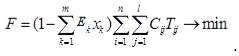
Let us assume that the city street network is a set of l sections, which correspond to various elements of the street network – streets, lanes, crossroads, etc., depending on the task to be solved. Along every j-th section there is a moving traffic flow consisting of n-groups of i-th vehicles (passenger cars, trucks, buses, trams, etc.). Let us denote the traffic flow density of vehicles of the i-th group on the j-th section as Tij (vehicles/hour), and volume of emissions from these vehicles is Сij (g/vehicle). Then the sum of products of these values will correspond to a total volume of emissions along the total street network.
Tij may decrease by adopting the methods of the first and third subgroups contributing to minimization of the target function. In case of implementation of the k-th method from m methods of the second or third subgroups, there is effect whose value is determined by empirical factor 0 < Ek < 1. This factor is a share of a decreased aggregate volume of emissions by implementing the k-th method. A condition of implementation of the k-th method is presented by binary variable xk in the model.
In view of the above designations, the target function of the task of decreasing the concentration of air pollutants from vehicles in the city is written as follows:
When changing (decreasing) traffic density Tij by implementing the methods of the first subgroup, it is required to comply with restrictions on satisfaction of a demand for traffic:
 where Nij is average number of passengers in a vehicle of the i-th group on the j-th section of the city street network, people; m’ is a number of methods in the first and third subgroups; Eki is effect from implementation of the k-th method expressed in changes in traffic density of vehicles from the i-th group (by increasing a share of buses and trams and decreasing a share of trucks and passenger cars in traffic); Мij is a need for traffic expressed by a forecast value of passenger traffic transported by vehicles of the i-th group on the j-th section of the street network, people.
The methods of the first and third subgroups may entail not only lower traffic density of passenger cars and trucks, but also a higher share of passenger cars in traffic. Therefore, the model should contain the set restriction on capacity of elements of the street network:
 where Pj is capacity of the j-th section of the street network, vehicles/hour.
By implementing some methods of the third subgroup (for example, priority lanes or construction of interchanges), we may vary capacity of sections of the street network allocated for vehicles of the i-th type – Pij. The equation of changes in capacity of the j-th section of the street network by applying the k-th method from m’’’ methods of the third subgroups is written as follows:
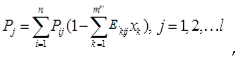 where Pij is capacity of the lane allocated for vehicles of the i-th type on the j-th section of the street network, vehicles/hour; m’’’ is a number of implemented methods changing capacity of elements of the street network (the third subgroup of the methods); Eki is effect from the implemented k-th method by changing capacity of the lane for vehicles of the i-th type on the j-th section of the street network.
A condition of limited financial resources allocated to implement a set of methods to decrease pollutant emissions from vehicles is:
 where Ck is costs for implementation of the k-th method, RUB; C is aggregate costs (budget), RUB.
Some pairs of methods cannot be implemented in common. For example, such methods include organization of cycle paths and construction of interchanges, which cannot be adopted on the same section of the street network. Therefore, we should set a condition of non-feasibility of methods in the model:

A condition of binary variables xk:

By solving an optimization model, we find values of variables xk. If xk=1, it is efficient to include relevant method k into a list of implemented methods. Otherwise (xk=0), the implemented k-th method does not satisfy the set restrictions. The modeling results also include calculated values of traffic density of vehicles of various types on every section of the street network – Tij, as well as recommended values of capacity Pij.
4. Case study
Using the developed optimization mathematical model, we made calculations for the Marx – Gryaznov crossroad (Magnitogorsk) under study. Data on traffic density, needs for traffic and capacity for the crossroad under study are taken from papers [10,14]. The calculations were made for various amounts of aggregate costs of the methods (from RUB 5 m to RUB 300 m).
Considering a small dimension of the task on finding an optimal combination of methods aimed at decreasing pollutant emissions for conditions of one certain crossroad, the presented mathematical model was implemented using the Solver tool in Excel. During the experiment, we changed the value of C – volume of funds spent on implementation of a combination of the methods.
Pollutant emissions are calculated using the method [38], Table 6. The calculation was made in a rectangle of 2500 х 2500 m for various wind directions and speeds characteristic of this area.
The diagrams show changes in the model parameters depending on the amount of costs of the methods decreasing pollutant emissions. Maximum effect of decreasing emissions for the crossroad under study is achieved at costs amounting to RUB 227 m required for all 15 methods applicable for this crossroad (see Table 4). In this case, pollutant emissions decrease by 4 times because of almost a three-fold decrease in traffic density of passenger cars and trucks on this section. In case of a more realistic scenario providing for 7 methods and relevant costs amounting to RUB 17 m, a two-fold decrease in emissions is forecasted by decreasing traffic of passenger cars and trucks by 60% on the section. However, in this case to satisfy a demand for passenger traffic, it is required to increase density of public transport on the section by over 6 times: from 129 units/day to 843 units/day.
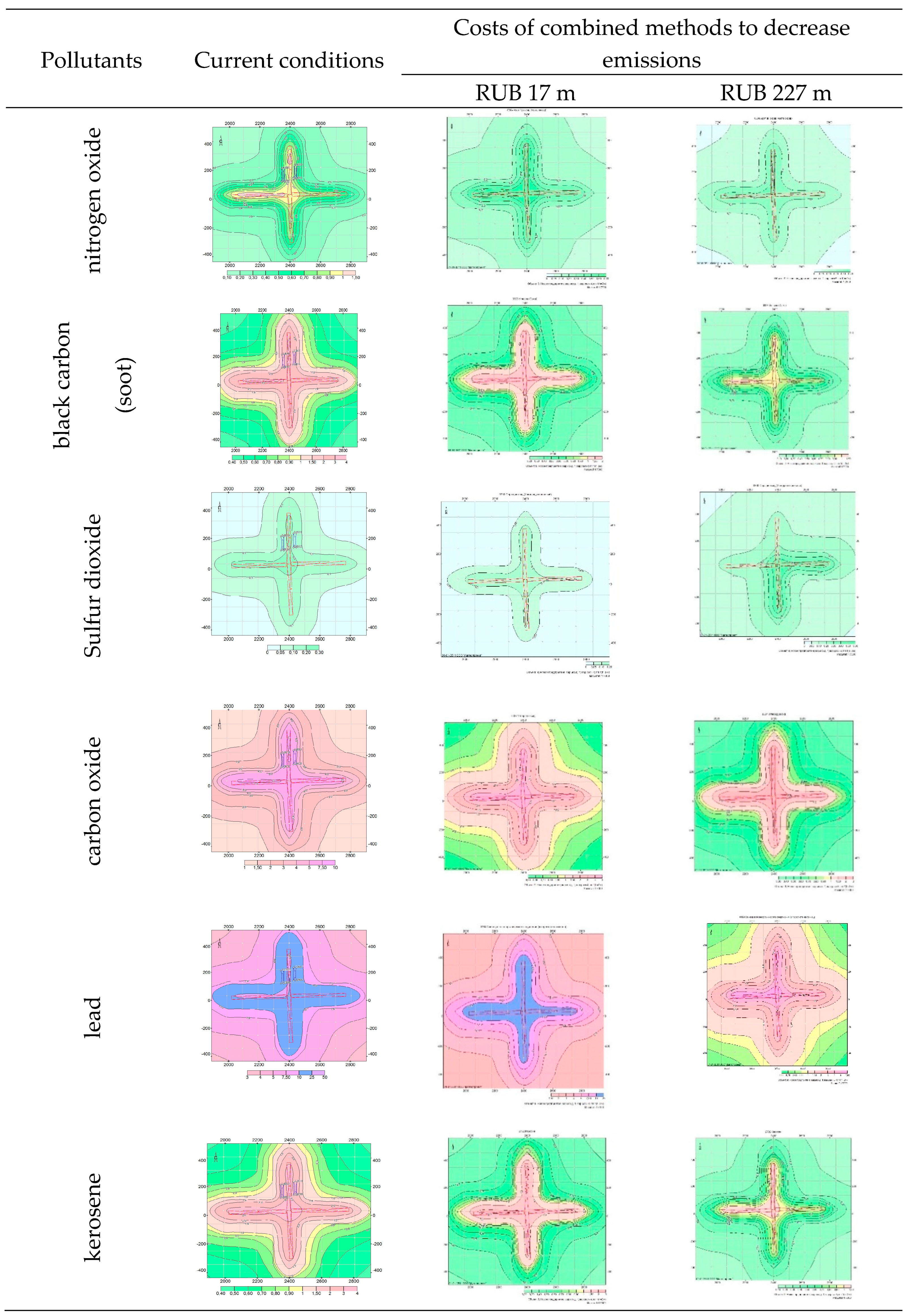
The modeling results served as a basis for building a cartogram of a dispersion process (Table 7) for every pollutant given in Table 2 and Table 3. The cartograms for the Marx – Gryaznov crossroad were built using Ecolog software (version 3.0) [37] developed in compliance with the regulatory document [38]. The cartograms are built for model conditions occurred upon implementation of two options characterized by costs of their implementation amounting to RUB 17 m and RUB 227 m. The cartograms of pollutant dispersion in current conditions are given for comparison.
The developed optimization model makes it possible to choose an optimal combination of methods to decrease pollutant emissions from vehicles depending on the budget. It is recommended to use the model, when developing strategies of development of city street networks and improving routes of passenger traffic and the system of road traffic arrangement in cities.
The budget was modeled in a range of RUB 5 – 227 m. The values of coefficients Ek, Cjk and xk used in the experiment are given in Table 4, the values of traffic density Tij are given in Figure 3. The Мij values calculated according to a proprietary methodology [10] and the calculated values Nij (average number of passengers) are given in Table 5.

Table 5.
Appropriate passenger traffic flows transported by vehicles of the i-th group on the j-th section of the street network, people per hour.
Table 5.
Appropriate passenger traffic flows transported by vehicles of the i-th group on the j-th section of the street network, people per hour.
| Group of vehicles, i | Street network section, j | |||||
| i | types of vehicles | average number of passengers, Ni, people |
j=1, N-S |
j=2, S-N |
j=3, W-E |
j=4, E-W |
| 1 | passenger cars | 2 | 1171 | 913 | 1454 | 860 |
| 2 | minibuses | 15 | 2196 | 1712 | 2727 | 1613 |
| 3 | trucks | 1 | 20 | 15 | 24 | 14 |
| 4 | trams | 65 | 1903 | 1484 | 2363 | 1398 |
| Total | 5290 | 4125 | 6569 | 3886 | ||
Table 6.
Volumes of emissions from the vehicle of the i-th group on the j-th section of the city street network, g/vehicle.
Table 6.
Volumes of emissions from the vehicle of the i-th group on the j-th section of the city street network, g/vehicle.
| Group of vehicles, i | Street network section, j | ||||
| i | types of vehicles |
j=1, N-S |
j=2, S-N |
j=3, W-E |
j=4, E-W |
| 1 | passenger cars | 5.9381 | 4.6300 | 7.3739 | 4.3623 |
| 2 | minibuses | 1.1134 | 0.8681 | 1.3826 | 0.8179 |
| 3 | trucks | 0.3711 | 0.2894 | 0.4609 | 0.2726 |
| 4 | trams | 0 | 0 | 0 | 0 |
Table 7.
Cartograms of pollutant dispersion on the Marx – Gryaznov crossroad (Magnitogorsk) for current and model conditions.
Table 7.
Cartograms of pollutant dispersion on the Marx – Gryaznov crossroad (Magnitogorsk) for current and model conditions.
 |
The results of the experiments with the developed model are given in Figure 6.
5. Conclusions
This section is not mandatory but can be added to the manuscript if the discussion is unusually long or complex. The analysis of the atmospheric air pollution index in Magnitogorsk showed that almost 30% of pollutant emissions accounted for mobile facilities. Concentration of pollutants is irregularly distributed among elements of the street network. The highest concentration is observed in points of changes of traffic density on crossroads. The studies on pollutant emissions from vehicles on the Magnitogorsk crossroad with the heaviest traffic showed that maximum allowable concentration of such substances was multiply exceeded.
To decrease negative impact of automotive pollutant emissions, it is proposed to use a system of the methods described in the paper. The chosen methods focus on decreasing traffic density in residential areas of the city, increasing uniformity of traffic flows, implementing environmental measures, creating environmental awareness among citizens, decreasing initial emission of pollutants due to engine operation, and improving a design of vehicles.
To choose an optimal combination of the methods aimed at decreasing pollutant emissions using a limited budget, the authors developed a mathematical optimization model. When choosing the methods, in addition to limits of financial resources the authors consider a condition of compliance with a demand for traffic (volume of passenger traffic), and constraints on capacity of street network sections.
A main drawback of the presented mathematical model is a difficulty with a description of continuous traffic resulting in a significant increase in the dimension of the model. This drawback may be overcome, and accuracy of modeling of traffic and environmental parameters may be increased by combining the developed mathematical model and a simulation model of the street network. Simulation modeling of traffic at various environmental conditions when changing the street network parameters, will be used to obtain more accurate model data about traffic on various street network sections and determine more accurate changes in these parameters by implementing an optimal combination of the methods aimed at decreasing the concentration of air pollutants from vehicles in the city.
Author Contributions
Conceptualization, A.R., O.P. and N.O.; methodology, A.R., O.P., N.O.; validation, A.R., O.P. and N.O.; formal analysis, O.P.; investigation, A.R., O.P. and N.O.; data curation, O.F.; writing—original draft preparation, A.R. and O.P.; writing—review and editing, A.R.; visualization, O.P.; project administration, A.R.; All authors have read and agreed to the published version of the manuscript.
Funding
The work was carried out with the financial support of the Russian Science Foundation No. 23-11-00164, https://rscf.ru/en/project/23-11-00164.
Institutional Review Board Statement
Not applicable.
Informed Consent Statement
Not applicable.
Data Availability Statement
Not applicable.
Conflicts of Interest
The authors declare no conflict of interest.
References
- The state report “On the state of the environment and environmental protection in Russian Federation in 2017”, Russian Federation ministry of natural resources and ecology. Moscow. 2018. 152 p.
- Trofimenko Y.V., Vorozhnin V.S. Method for environmental safety assessment of road users, Transport of the Urals,. 2015. № 1 (44). P. 73-78.
- The report “On the environmental situation in Chelyabinsk Region in 2017”. Chelyabinsk Region Ministry of Ecology. Chelyabinsk. 2018. 132 p.
- Pytaleva O. A., Fridrikhson O.V., Berdashkevich S.M. Justification for necessity to develop a set of activities to reduce vehicular air pollution in cities (on the example of Magnitogorsk), Ural industrialist. 2015. 1. 2015. №3 (3). P. 14-17.
- The state report “On the sanitary and epidemiologic well-being of population in Magnitogorsk in 2018”, Chelyabinsk Region Department of Russian Agency for Health and Consumer Rights in Magnitogorsk. Magnitogorsk. 2017. 106 p.
- Gladskikh V.I., Drobny O.F., Las’kov S.A., Cherchintsev V.D. Modernization of industrial and ecological safety systems at OJSC Magnitogorsk Iron and Steel Works as an obligatory condition for sustainable development, Vestnik of Nosov Magnitogorsk State Technical University. 2014. № 1(45). Р. 107-111.
- Maiorova T.V., Ponomareva O. S. Economic efficiency assessment methodology of metallurgical industry environmental management, Vestnik of Nosov Magnitogorsk State Technical University. 2015. № 4 (52). P. 112-116.
- Antropov V. A., Morozova E. N. Environmental management as a scientific sector of modern knowledge, Herald of the Ural State University of Railway Transport. 2015. № 1 (25). P. 56-62.
- Pytaleva O.A., Pytalev I.A. Transport system problems of Magnitogorsk, Modern problems of Russian transport complex. 2012. №2. P. 128-133.
- Kornilov S.N., Rakhmangulov A.N., Osintsev N.A., Cyganov A.V., Pytaleva O.A. Methodology for urban passenger transport route development (on the example of Magnitogorsk), Vestnik of Nosov Magnitogorsk State Technical University. 2011. №2. P. 49-58.
- Construction norms and regulations II-60-75. Planning and development of cities, villages and rural population centers, USSR State Committee for Construction. M.: USSR Central Institute of Model Design. 1985. 67 p.
- Bulaev V.G., Ryabukhin E. A. Identification of environmental aspects using Pareto and Ishikawa diagrams, Transport of the Urals. 2015. № 1 (44). P. 67-72.
- Kuznetsova E. Yu., Akulova А. А. Organization of the recycling in the Russian complex of automobile transport, Herald of the Ural State University of Railway Transport. 2015. № 4 (28). P. 81-90.
- Rakhmangulov A.N., Kornilov S.N., Pytaleva O.A. Safety and quality of passenger transport improvement in Magnitogorsk, Autotransportnoie predpriyatie 2009. №6. P. 41-44.
- Analytical Portal «TransSport». URL: http://transspot.ru/2013/03/05/skorost-avtomobilya-i-okruzhayushha ya-sreda-chast-2/?ocom=727http://mvf.klerk.ru/f1otchet/forma5_r7.htm (Access Date: 20.11.2021).
- The list and codes of air pollutants [Text]. SPb.: JSC “Scientific research institute Atmosphere”. 2012. 423 p.
- Bobrova Z.M., Somova YU.V., Somov V.A. Effects of industrial environment on people // Ural industrialist. 2015. №1 (1). P. 42-44.
- Rinku Roy Chowdhury, Kelli Larson, Morgan Grove, Colin Polsky, Elizabeth Cook, Jeffrey Onsted, Laura Ogden (2011). A Multi-Scalar Approach to Theorizing Socio-Ecological Dynamics of Urban Residential Landscapes. Cities and the Environment (CATE): Vol. 4: Iss. 1.
- Amudapuram Mohan Rao, Kalaga Ramachandra Rao. Measuring urban traffic congestion – a review, International Journal for Track and Transport Engineering, 2012, 2(4): 286 – 305.
- Adam Torok. Monte-Сarlo simulation of road transport emission. International Journal for Traffic and Transport Engineering, 2015, 5(3): 278 – 285. [CrossRef]
- Luka Novačko, Marjana Petrović, Danijela Barić. Application of macroscopic modelling in assessing noise level in urban areas. International Journal for Traffic and Transport Engineering, 2014, 4(1): 117 – 127. [CrossRef]
- Ljupko Šimunović, Davor Brčić, Huska Sadić. Choice of an optimal management strategy of transport demand using multi-criteria analysis: city of Zagreb case study. International Journal for Traffic and Transport Engineering, 2013, 3(1): 54 – 63. [CrossRef]
- Ádám Török. Investigation of road environment effects on choice of urban and interurban driving speed. International Journal for Traffic and Transport Engineering, 2011, 1(1): 1 – 9 p.
- Surendra Kukadapwar1, Dhananjay Parbat. Estimation of optimal path on urban road networks using AHP algorithm. International Journal for Traffic and Transport Engineering, 2016, 6(1): 13 – 24. [CrossRef]
- Md. Mahmud Hasan. Investigation of the effect of traffic parameters on road hazard using classification tree model. International Journal for Traffic and Transport Engineering, 2012, 2(3): 271 – 285.
- Giulio Materninia, Stefano Riccardia, Margherita Cadeia. Zero emission mobility systems in cities. inductive recharge system planning in urban areas. Eighth International Conference INPUT. Smart City - Planning for Energy, Transportation and Sustainability of the Urban System. Naples, 4-6 June 2014. 659-669.
- Davide Scannapieco, Vincenzo Naddeo, Vincenzo Belgiorno Trimestrale del Laboratorio, Territorio Mobilità e Ambiente. Dispersion models to forecast traffic-related emissions in urban areas. TeMALab. Vol 4 - No 3 - Settembre 2011 - p. 7-14.
- Jinjoo Bok, Youngsang Kwon. Comparable measures of accessibility to public transport using the general transit feed specification. Sustainability 2016, 8, 224-234. [CrossRef]
- Alok Bhushan Mukherjee, Nilanchal Patel, Akhouri Pramod Krishna. Development of heterogeneity index for assessment of relationship between land use pattern and traffic congestion. International Journal for Traffic and Transport Engineering, 2014, 4(4): 397 – 414.
- Y. Choi. The impact of satellite-adjusted NOx emissions on simulated NOx and O3 discrepancies in the urban and outflow areas of the Pacific and Lower Middle US Atmospheric Chemistry and Physics Atmos. Chem. Phys., 14, 675–690, 2014.
- Jianjun Wu, Xin Guo, Huijun Sun, Bo Wang. Topological effects and performance optimization in transportation continuous network design. Mathematical Problems in Engineering Volume 2014, Article ID 490483, 7 pages. [CrossRef]
- Michele Pezzagno, Marco Rosini. Smart City - Planning for Energy, Transportation and Sustainability of the Urban System. Eighth International Conference INPUT. Journal of Land Use, Mobility and Environment. Naples, 4-6 June 2014 817-828.
- Willem Salet. The quest for the regional city. New identities and institutional conditions in a context of metropolitan fragmentation. Geographica Helvetica Jg. 56 2001/Heft4 289-295. ISSN 0016-7312.
- Plakhotich S.А., Chemodanova К.Е. New technologies of population’s transport service in industrial and urban agglomeration // Herald of the Ural State University of Railway Transport. 2010. № 2. Р. 14-21.
- Pytaleva O.A., Pytalev I.A., Gridina YU.A. Prospects for establishing of a rapid passenger transport system in Magnitogorsk // Transport development in Russian regions: problems and prospects: Materials of II All-Russian academic and research conference with international participation. Branch of Moscow State Industrial University in Kirov, . / Edited by V.A Rozhina, V.M. Popov. Kirov. 2012. P. 68-72. 30 October.
- Study Guide on calculating, regulation and control of pollutant emissions into the atmospheric air (augmented and revised). SPb.: JSC “Scientific research institute Atmosphere”. 2012. 223 p.
- Unified program for air pollution control [Electronic resource]. URL: https://integral.ru/shop/cargo/372.html?yclid=3361483280743681847 (Access Date: 20.01.2021).
- The order of the Ministry of Natural Resources №273 dated 06.06.2017 “On the calculation method approval of harmful substance emission dispersion into the atmospheric air. URL: http://www.garant.ru/products/ipo/prime/doc/71642906/ (Access Date: 02.12.2021).
Figure 1.
Sources of atmospheric air pollutant emissions in Magnitogorsk a) by types of facilities, b) by types of business activities.
Figure 1.
Sources of atmospheric air pollutant emissions in Magnitogorsk a) by types of facilities, b) by types of business activities.
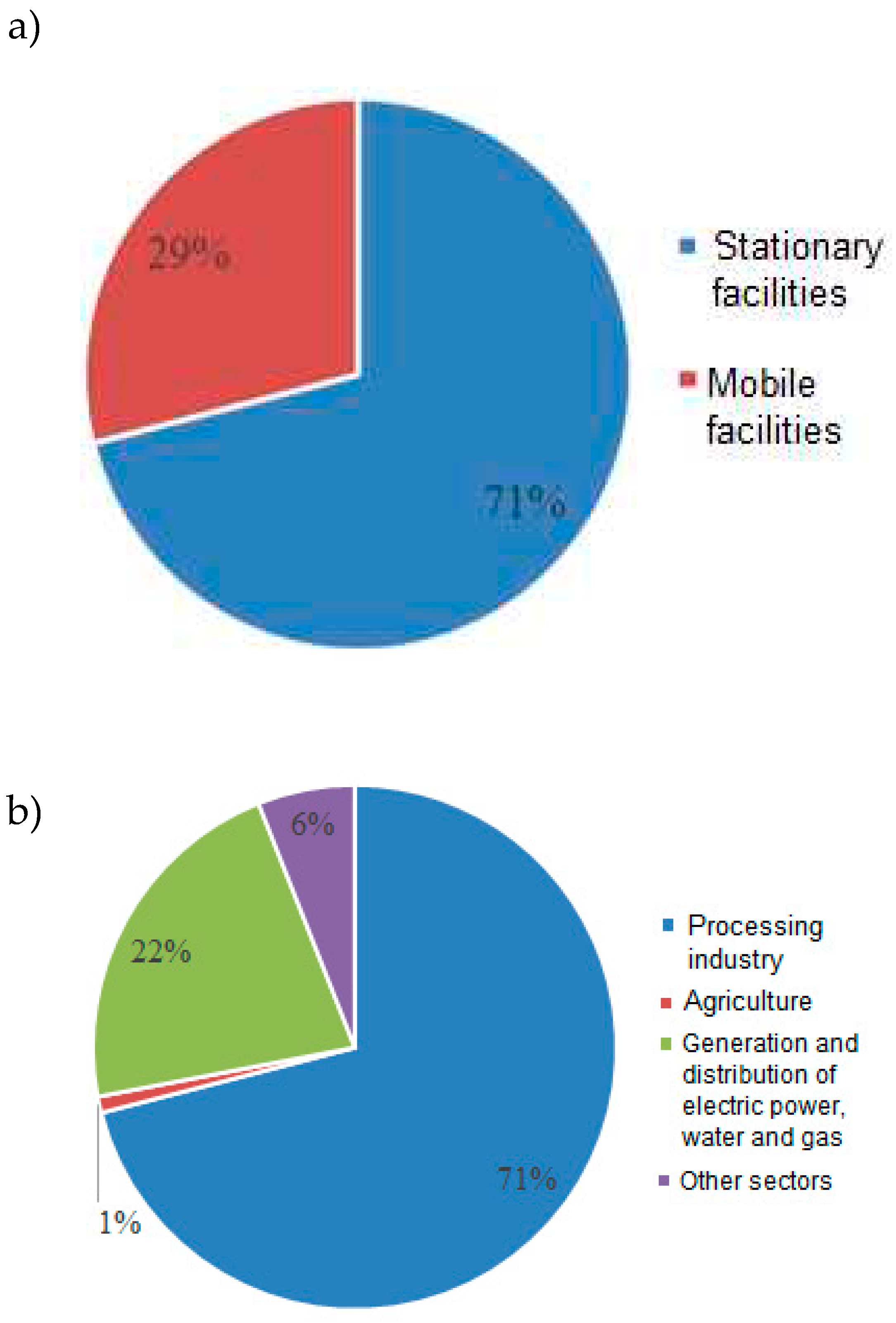
Figure 2.
Relation between the volume of pollutant emissions and vehicle speed
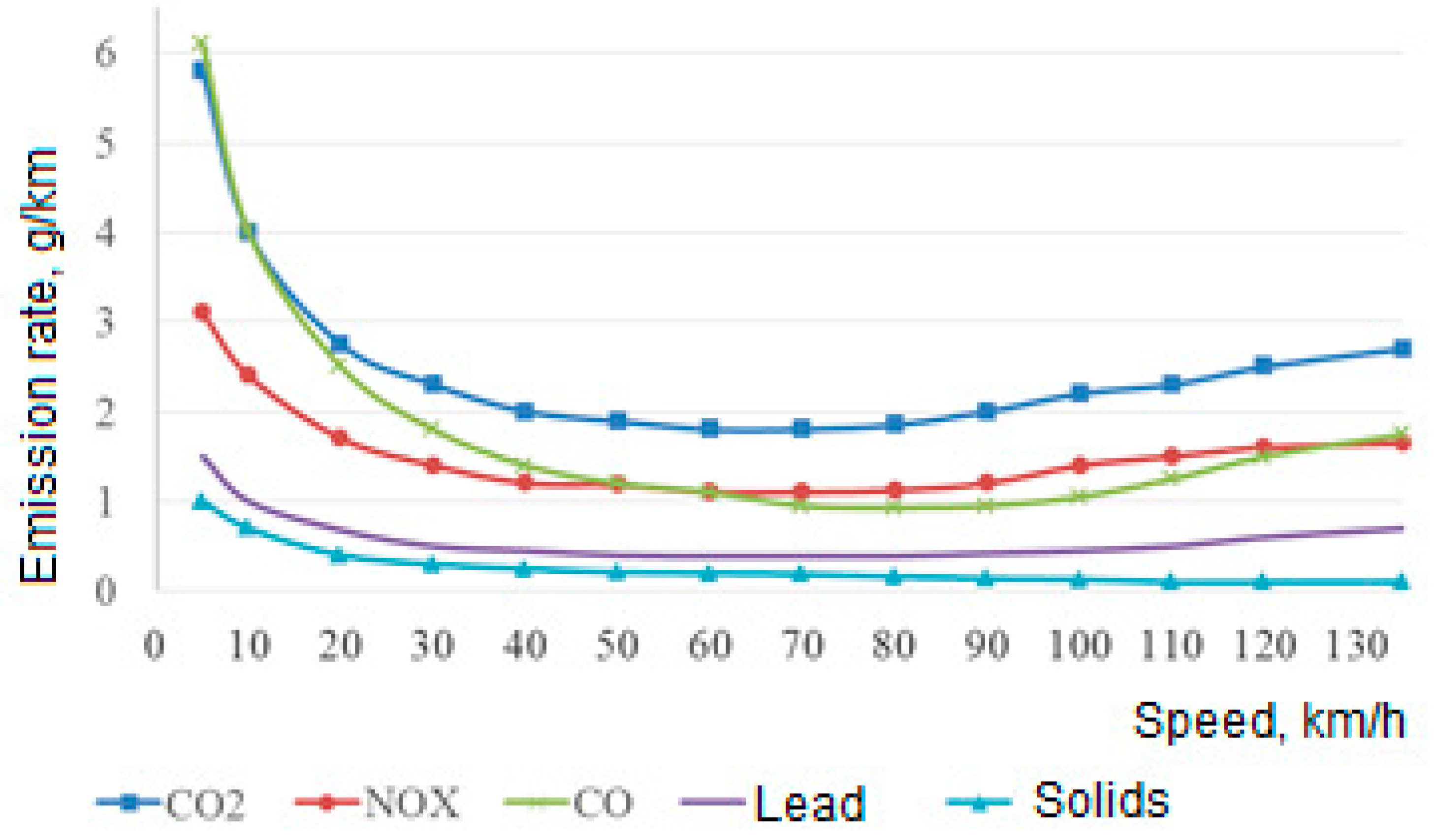
Figure 3.
Cartogram of traffic density on the Marx and Gryaznov crossroad, cars/hour
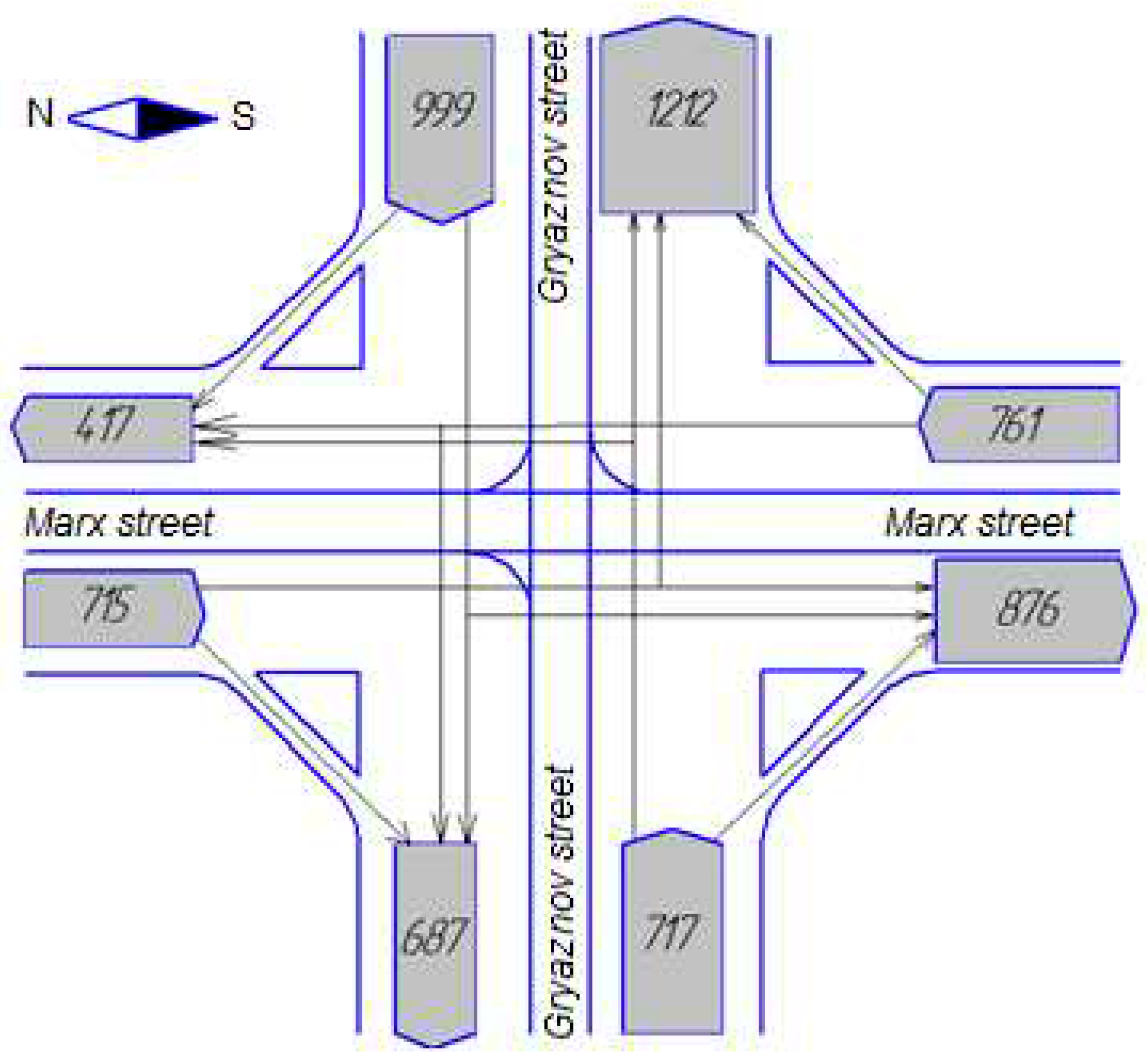
Figure 4.
Cartogram of the carbon oxide emission dispersion on the Marx and Gryaznov crossroad (Magnitogorsk)/
Figure 4.
Cartogram of the carbon oxide emission dispersion on the Marx and Gryaznov crossroad (Magnitogorsk)/
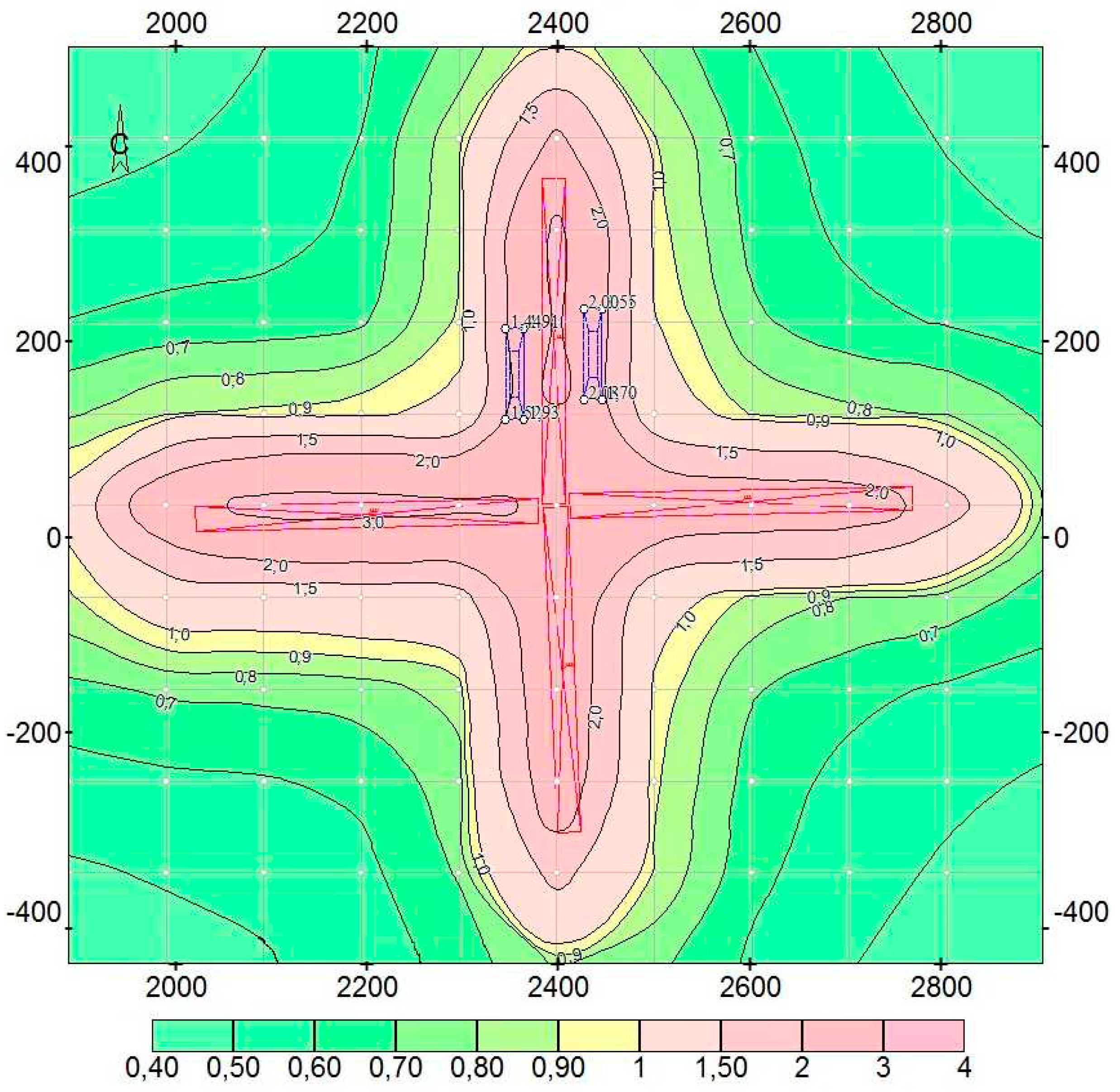
Figure 5.
Air pollution index in the cities of the Chelyabinsk Region [1]
Figure 5.
Air pollution index in the cities of the Chelyabinsk Region [1]
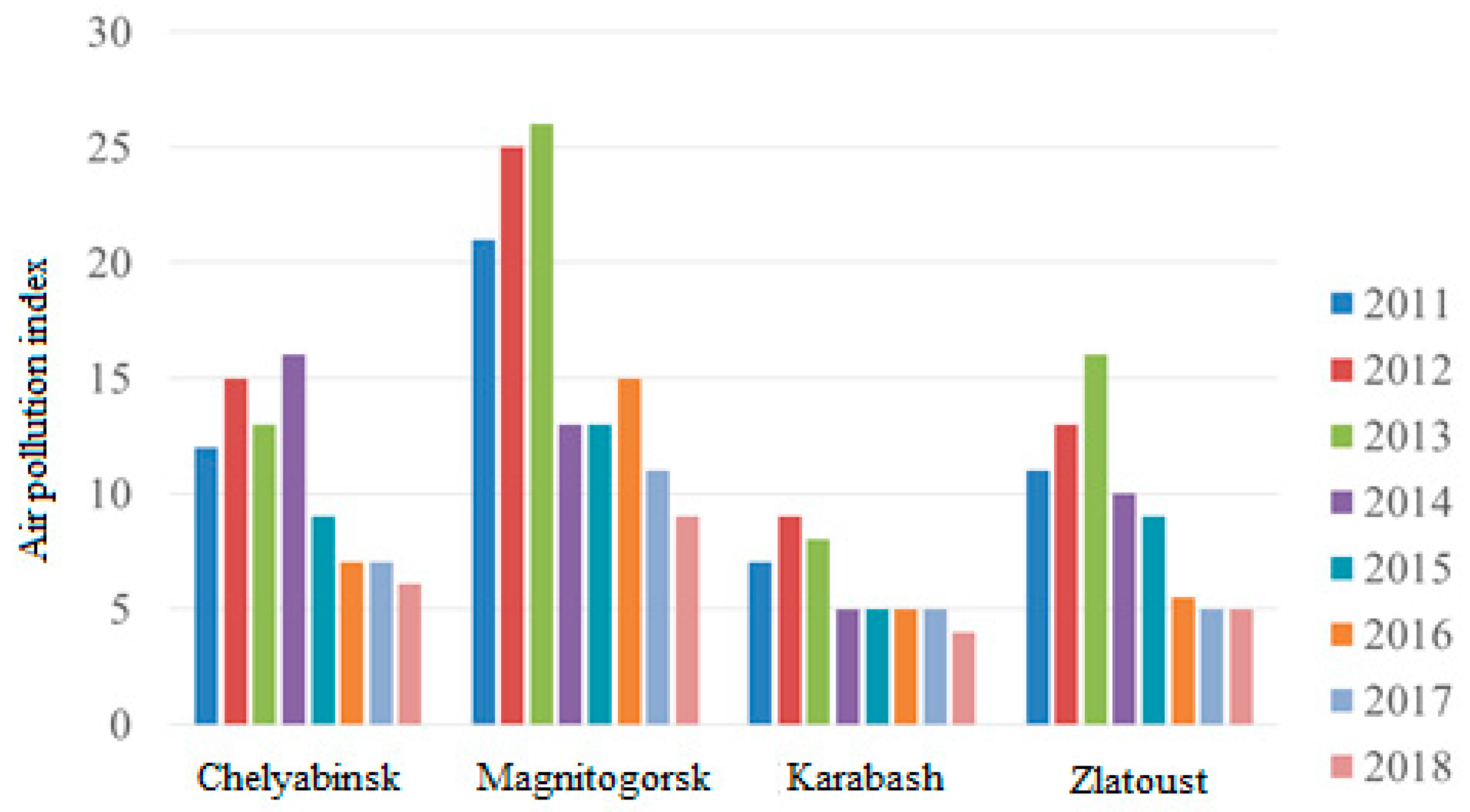
Figure 6.
Results of optimization of pollutant emissions from vehicles on the Marx – Gryaznov crossroad (Magnitogorsk).
Figure 6.
Results of optimization of pollutant emissions from vehicles on the Marx – Gryaznov crossroad (Magnitogorsk).
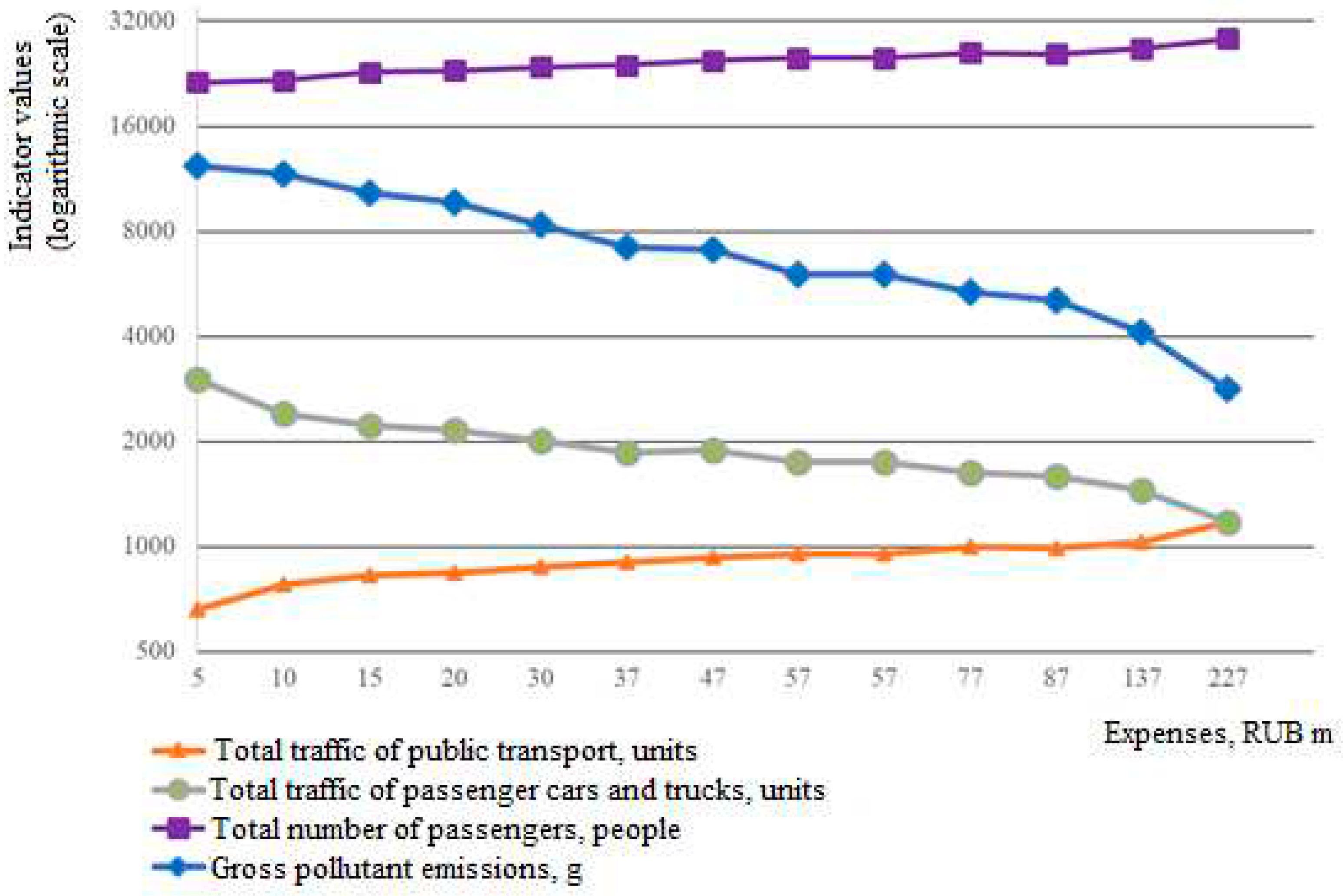
Table 1.
Vehicle emissions on the Marx and Gryaznov crossroad (Magnitogorsk).
| Traffic direction, number of cars |
Pollutants | Specific emissions in various operation modes, g/min | Engine idling time, min | Emission reduction factor | Emission rate, g/s | |
|---|---|---|---|---|---|---|
| Marx street (north–south), 876 |
Carbon oxide | 3.1 | 4.5 | 10 | 0.9 | 11.35 |
| Nitrogen dioxide | 0.064 | 0.04 | 1 | 0.11 | ||
| Nitrogen oxide | 0.0104 | 0.0065 | 1 | 0.01 | ||
| Kerosene | 1.1 | 0.45 | 0.9 | 1.23 | ||
| Soot | 0.470 | 0.04 | 0.8 | 0.13 | ||
| Sulfur dioxide | 0.019 | 0.012 | 0.95 | 0.03 | ||
| Lead | 0.004 | 0.003 | 0.9 | 0.01 | ||
| Marx street (south–north), 761 |
Carbon oxide | 3.1 | 4.5 | 10 | 0.9 | 8.85 |
| Nitrogen dioxide | 0.064 | 0.04 | 1 | 0.09 | ||
| Nitrogen oxide | 0.0104 | 0.0065 | 1 | 0.01 | ||
| Kerosene | 1.1 | 0.45 | 0.9 | 0.96 | ||
| Soot | 0.470 | 0.04 | 0.8 | 0.11 | ||
| Sulfur dioxide | 0.019 | 0.012 | 0.95 | 0.03 | ||
| Lead | 0.004 | 0.003 | 0.9 | 0.01 | ||
| Gryaznov street (west–east), 1212 |
Carbon oxide | 3.1 | 4.5 | 10 | 0.9 | 14.10 |
| Nitrogen dioxide | 0.064 | 0.04 | 1 | 0.14 | ||
| Nitrogen oxide | 0.0104 | 0.0065 | 1 | 0.02 | ||
| Kerosene | 1.1 | 0.45 | 0.9 | 1.53 | ||
| Soot | 0.470 | 0.04 | 0.8 | 0.17 | ||
| Sulfur dioxide | 0.019 | 0.012 | 0.95 | 0.04 | ||
| Lead | 0.004 | 0.003 | 0.9 | 0.01 | ||
| Gryaznov street (east–west), 999 |
Carbon oxide | 3.1 | 4.5 | 10 | 0.9 | 8.34 |
| Nitrogen dioxide | 0.064 | 0.04 | 1 | 0.09 | ||
| Nitrogen oxide | 0.0104 | 0.0065 | 1 | 0.01 | ||
| Kerosene | 1.1 | 0.45 | 0.9 | 0.91 | ||
| Soot | 0.470 | 0.04 | 0.8 | 0.10 | ||
| Sulfur dioxide | 0.019 | 0.012 | 0.95 | 0.02 | ||
| Lead | 0.004 | 0.003 | 0.9 | 0.01 | ||
Table 2.
Gross volume of air pollutants on the Marx and Gryaznov crossroad (Magnitogorsk)
| Code | Pollutants | Applied criteria | Criterion value, mg/m3 | Hazard classes | Emission rate | |
|---|---|---|---|---|---|---|
| g/s | t/year | |||||
| 301 | Nitrogen (IV) oxide (nitrogen dioxide) | Maximum single MAC |
0.2 | 2 | 0.43 | 0.25 |
| 304 | Nitrogen (II) oxide (nitrogen oxide) | 0.4 | 3 | 0.07 | 0.04 | |
| 328 | Black carbon (soot) | 0.15 | 3 | 0.51 | 0.29 | |
| 330 | Sulfur dioxide | 0.5 | 3 | 0.12 | 0.07 | |
| 337 | Carbon oxide | 5 | 4 | 42.66 | 24.57 | |
| 184 | Lead | 0.001 | 1 | 0.02 | 0.01 | |
| 2732 | Kerosene | TSEL1 | 1.2 | 0 | 4.62 | 2.66 |
| Total pollutants: 8 | 48.47 | 27.92 | ||||
| Including solid pollutants: 2 | 0.54 | 0.31 | ||||
| Liquid/gaseous pollutants: 6 | 47.92 | 27.60 | ||||
1 TSEL — tentative safe exposure level.
Table 3.
Effects of pollutants on a human body.
| Substances | General biological effects, diseases, symptoms |
|---|---|
| Nitrogen (IV) oxide (nitrogen dioxide) | It has general toxic action, causes damage to the respiratory organs and mucous membranes (from mild irritation of mucous membranes of the eyes and the nose to pulmonary edema). It leads to a change in blood composition (reduces hemoglobin). It promotes central nervous system depression, hemolysis, bilirubinemia, dilates blood vessels, lowers blood pressure, and raises blood sugar. |
| Nitrogen (II) oxide (nitrogen oxide) | It stimulates sensitivity to broncho stenosis (narrowing the bronchial lumen). It entails negative pulmonary effects for people with respiratory diseases. It causes headaches, heart palpitations, drops in blood pressure. It triggers poisoning, indigestion, nausea, weakness. |
| Black carbon (soot) | It is an adsorbent of carcinogens. It contributes to skin cancer. It leads to chronic respiratory diseases, development of asthma, bronchitis, pulmonary emphysema. It accelerates development of occupational diseases (silicosis, asbestosis, etc.). |
| Sulfur dioxide | It has general toxic action. It causes constant headaches, cough, runny nose, sore throat, nausea, vomiting, leads to pulmonary edema, gives rise to development of malignant tumors. It promotes allergic reactions. |
| Carbon oxide | It triggers development of diseases of lungs and bronchi, mucous membranes of the eyes, the cardiovascular system, anemia, inactivates hemoglobin, causes oxygen deficiency of tissues, nervous system disorder, leads to necrosis of brain cells and damage to the central nervous system. Intoxication is accompanied by headache, dizziness, irritability, memory impairment. |
| Lead | It leads to metabolic disorders, inhibits enzyme activity, triggers mental retardation and chronic brain disease among children, replaces calcium in bones, causes biochemical disorders in the myocardium and leads to hyperexcitability, depression and irritability. It has a negative effect on reproductive ability. |
| Kerosene | It causes surface inflammation of skin with erythema, swelling, infiltration, inflammation of deep layers of skin and folliculitis, vesicular hand dermatitis. It has resorptive effect and is manifested as a decrease in blood pressure. In case of a long-term contact, it triggers asthenic syndrome, nosebleeds, headaches, blood disorder. |
Table 4.
The system of methods used to decrease the concentration of air pollutants in cities
| Group of methods | Method description | Efficiency factor of the k-th method used to decrease the concentration of air pollutant, Ek | Costs of implementation of the k-th method used to decease the concentration of pollutants on the j-th section of the city street network, RUB m, Cjk |
Feasibility of the k-th method on the j-th section, xk |
| Organizational methods | traffic flow control using modern computer systems of traffic light control and dynamic message signs; introduction of intelligent transport systems | 0.06 | 10 | 1 |
| one-lane traffic on urban areas with narrow roads | 0.02 | 0.1 | 0 | |
| traffic ban or limitation for heavy trucks on some sections of the street network | 0.02 | 0.1 | 1 | |
| organization of lanes allocated for city passenger transport | 0.03 | 20 | 1 | |
| organization of cycle paths to motivate citizens to stop using private cars | 0.04 | 0.2 | 1 | |
| ban on parking vehicles on traffic ways of roads and streets | 0.04 | 0.2 | 1 | |
| creation and development of the environmental education system to form environmental awareness and behavior | 0.07 | 10 | 1 | |
| development of the system of priorities for public transport, when limiting the use of private cars | 0.07 | 20 | 1 | |
| ban on access of cars to some parts of the city | 0.03 | 0.5 | 1 | |
| organization of routes for traffic flows bypassing residential areas | 0.06 | 50 | 1 | |
| Architectural and construction methods | construction of interchanges on different levels | 0.06 | 200 | 0 |
| construction of pedestrian overpasses and underpasses | 0.05 | 30 | 1 | |
| improvement of the street network to increase traffic flow movement steadiness: organization of circular motion; removal of narrow entrances and exits from motorways, etc. | 0.06 | 7 | 0 | |
| greening of residential areas | 0.03 | 5 | 1 | |
| improvement of the road surface quality | 0.02 | 5 | 1 | |
| construction of protective screens | 0.03 | 5 | 1 | |
| construction of intercept parking lots | 0.04 | 100 | 0 | |
| placing zones of attraction of passenger flows (shopping centers, stadiums, etc.) outside residential areas | 0.05 | 70 | 1 | |
| Engineering and technical methods | timely replacement of air filters | 0.01 | 100 | 0 |
| introduction of motors using compressed natural gas or electrical energy as a source of energy | 0.01 | 100 | 0 | |
| installation of exhaust gas neutralizers, filters | 0.02 | 10 | 0 | |
| use of fuel additives | 0.01 | 10 | 0 | |
| use of automated driving systems | 0.01 | 10 | 0 | |
| introduction of a car engine operation mode control system using the “stop and go” technology | 0.02 | 100 | 0 | |
| step-by-step replacement of vehicles equipped with internal combustion engines with electric cars or cars with an engine displacement of less than 1799 cc | 0.02 | 100 | 0 | |
| Regulatory methods | tougher requirements for a periodic technical condition inspection of vehicles using diagnostic tools to maintain ecological parameters of driven vehicles at an acceptable level | 0.02 | 100 | 0 |
| introduction of tougher uniform standards Euro 4 and Euro 5 for cars manufactured in the country | 0.03 | 100 | 0 | |
| tougher requirements for petroleum fuel quality | 0.04 | 100 | 0 | |
| ban on driving vehicles lower than the approved ecological class in the city area | 0.03 | 1 | 1 |
Disclaimer/Publisher’s Note: The statements, opinions and data contained in all publications are solely those of the individual author(s) and contributor(s) and not of MDPI and/or the editor(s). MDPI and/or the editor(s) disclaim responsibility for any injury to people or property resulting from any ideas, methods, instructions or products referred to in the content. |
© 2023 by the authors. Licensee MDPI, Basel, Switzerland. This article is an open access article distributed under the terms and conditions of the Creative Commons Attribution (CC BY) license (http://creativecommons.org/licenses/by/4.0/).
Copyright: This open access article is published under a Creative Commons CC BY 4.0 license, which permit the free download, distribution, and reuse, provided that the author and preprint are cited in any reuse.


