

Submitted:
11 December 2023
Posted:
12 December 2023
You are already at the latest version
Abstract
Penrose’s singularity from 1965 predicted that in the center of the black hole space-time curvature is infinite and consequently gravity force there is infinite. In 2014 NASA measured universal space has Euclidean shape. This means that stellar objects cannot curve universal space and that the space-time singularity model has no physical existence. In the center of black holes energy density of superfluid space is so low that the electromagnetic properties of space are changed. This causes electromagnetic forces between the nucleus and orbiting electrons to become unstable. In the center of a black hole, atoms are falling apart into elementary particles. Black holes are rejuvenating systems of the universe, they transform old matter into fresh energy in the form of elementary particles. Astrophysical jets are the outcome of this process.
Keywords:
space-time singularity
; astrophysical jets
; energy density of superfluid space
1. Introduction
In 2014 NASA measured inner angles between three stellar objects. The sum of their inner angles was exactly . This confirms universal space has a Euclidean shape: “Thus the universe was known to be flat to within about 15% accuracy prior to the WMAP (Wilkinson Microwave Anisotropy Probe) results. WMAP has confirmed this result with very high accuracy and precision” [1]. In 1965 curvature of space was considered real, today we know space is flat. We have to re-evaluate space-time singularity in the light of NASA measurements. Recent research confirmed that universal space is time-invariant. There is no physical time in the universe as a 4th dimension of universal space. The only time that exists is the duration of a material change in time-invariant space [2]. In Penrose’s sketch which is in his 1965 article [3] (see Figure 1 below), we see an arrow that depicts the flow of time. In the universe, there is no flow of time, the flow of change runs in time-invariant space. Black holes exist in time-invariant space. The physical properties of black holes have nothing to do with the observer. In Penroses’s sketch, we see designed an “outside observer”. In his sketch, the radius of the black hole is 2 meters, and the infinite curvature of space is inside the space-time cone and is designed by the straight line that comes out of the black hole. Hypothetical singularity should be in the center of the black hole not on its border where stated and is prolonged in the center of the space-time cone. Penrose’s sketch design seems pure speculation that is based on some mathematical models which are non-realistic, they have no counterpart in physical reality.
2. Penrose’s Space-Time Singularity Contradicts Mathematical Laws and Contradicts Physical Laws
Let’s predict that Penrose’s singularity is possible. We have a straight line in universal space where there is a singularity. The unsolvable question is how this singularity is diminishing with the distance from the line. We know in mathematics that the cardinal number of natural numbers can never turn into a finite natural number. We know in physics that gravity diminishes with the square of distance. Having infinite value for gravity only in one point of the universal space, the entire space would have infinite gravity. Penrose’s singularity is against these basic rules of mathematics and physics. In mathematics infinity is an indispensable tool, its use in physics is problematic and leads to contradictions. In this article is proposed that singularities should be abolished from physics because “infinity” is not a metric term. We do not know its meaning, and its use in physics is highly problematic. It has created physics that is out of the reach of experimental research methodology. Nobody can prove or disprove the existence of singularities. In this sense, the singularity is not falsifiable.
Geometrization of gravity has brought in physics exotic models as closed time-like curves (CTC) where one could travel into the past, kill his grandfather and so it could not be born [4]. In 1935 Einstein and Rosen proposed the existence of wormholes where a black hole is connected with a white hole [5]. Still today their model is the basis for speculations about travel in time through these wormholes. It is clear today, that motion occurs in time-invariant space where time is the duration of motion and that time travel is categorically excluded. An astronaut can only move through universal space but not through time because time is the mere duration of astronaut motion in space [6]. We have to admit, that “black hole” is an inappropriate term because where a black hole is situated there is no hole in space, a better term is “dark star” which means that the star has such a strong gravity that light cannot escape.
3. Gravity Inside Black Holes
It is proposed in this article, that the geometrization of gravity where stars are supposedly warping space is a mere mathematical model that describes some fundamental physical properties of the superfluid universal space. In the intergalactic space energy density of superfluid space is at its maximum and has the value of Planck energy density. A given physical object diminishes the Planck energy density of space in its center by exactly the amount of its mass and energy, according to the following equation:
where is the mass of the object and is volume of the object. Eq. (1) can be written as follows:
Eq. (2) describes the extension of the mass-energy equivalence principle on superfluid space [6]. Every physical system tends toward a homogeneous distribution of energy. The same holds for superfluid universal space. Eq. (1) confirms that also in the center of the stellar object, the sum of the energy density of matter and the sum of the energy of superfluid space has the value of Planck energy density. The curvature of superfluid space in GR is a mathematical description of its energy density, more space is curved less is its energy density.
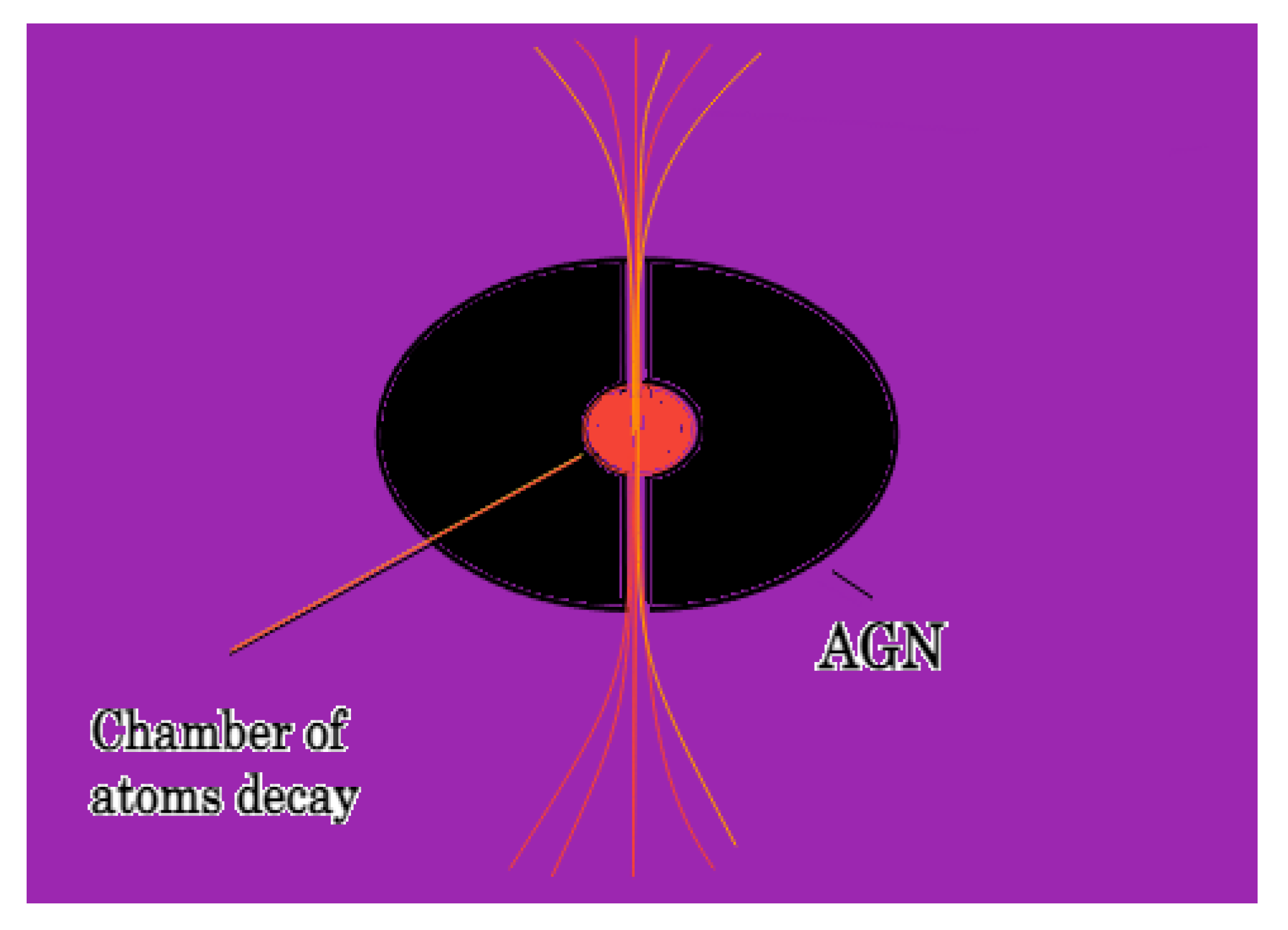
In the model presented in this article, stellar objects are not curving space, they are diminishing space energy density. In the center of a black hole, the energy density of space is so low that atoms become unstable. They fall apart into elementary particles. The transformation of matter into fresh energy in the form of elementary particles creates high pressure and a black hole can explode in a supernova. When the black hole is supermassive it cannot explode. The pressure of fresh energy creates the tunnel in the direction of the black hole’s rotational axis. Through this tunnel, fresh energy is thrown out into the intergalactic space in the form of an astrophysical jet, as we can see in Figure 2 below.
Every AGN (active galactic nuclei) has in its center the chamber where atoms are decaying in elementary particles. The matter of the walls of the chamber is transformed into fresh energy which is ejected in the form of jets into the intergalactic space, AGN is eating itself. AGNs are rejuvenating systems of the universe [6].
Using Eq. (1) we will calculate the energy density of superfluid space in the center of a proton, Moon, Earth, Sun, and some supermassive black holes:
- -
- In the center of the proton:
- -
- In the center of the Moon:
- -
- In the center of the Earth:
- -
- In the center of the Sun:
- -
- In the center of a supermassive black hole ASASSN-14li energy density of superfluid space is:
- -
- In the center of supermassive black hole GRS 1915+105 energy density of superfluid space is:
- -
- In the center of a supermassive black hole Cygnus X-1 energy density of superfluid space is:
The model of the variable energy density of superfluid space suggests that the extremely low energy density of superfluid space in the center of black holes causes electromagnetic forces between the nucleus of the atom and orbiting electrons to become too weak and atoms fall apart into elementary particles [7].
Black holes are “eating” themselves, that’s why they tend to shrink. Schwarzschild’s collapse of black holes is not due to the infinite gravity in the center, but instead, it is caused by the extremely low energy density of superfluid space in their center. Toward the center of the black hole, the gravity force diminishes according to Newton’s Shell theorem, as it diminishes in all other stellar objects [8].
In the center of a proton, the minimal energy density of superfluid space is for the order higher than in supermassive black hole ASASSN-14li. The extremely low energy density of superfluid space in the center of the proton suggests that the proton remains a stable particle also in the center of black holes because of its internal structure whose stability is not dependent on electromagnetism.
Besides other particles, protons also compose astrophysical jets coming out of AGN [9]. Blandford-Znajek’s mechanism explains the electromagnetic component of the jets [10], but it cannot explain the presence of protons. The model presented in this article suggests that the origin of protons in astrophysical jets is a consequence of the decay of atoms at the center of AGN.
4. Conclusions
With GR, the geometrization of gravity has led to a wrong understanding of gravity inside the event horizon of black holes. There is nothing mysterious inside the event horizon. All physical laws are in place, there is no gravitational singularity. Black holes tend to shrink because, in the center of black holes, matter is transformed into fresh energy that forms astrophysical jets.
References
- NASA https://map.gsfc.nasa.gov/universe/uni_shape.html. 2014.
- Šorli, A.S.; Čelan, Š. Time-Invariant Superfluid Quantum Space as the Unified Field Theory, RAPS, Vol. 4, No. 3 (2020) 2050007. [CrossRef]
- Penrose, R. (1965). Gravitational collapse and space-time singularities. Physical Review Letters, 14(3), 57. [CrossRef]
- Kurt Gödel (1949). An Example of a New Type of Cosmological Solution of Einstein’s Field Equations of Gravitation. Rev. Mod. Phys. 21 (3): 447–450. [CrossRef]
- A. Einstein and N. Rosen, The Particle Problem in the General Theory of Relativity, Phys. Rev. 48, 73 – Published 1 July 1935. [CrossRef]
- Sorli, A.; Jafari, S.; Fiscaletti, D.; Gorjup, N.; Gorjup, R.; Makovec, T. Evidence-Based Cosmology – Black holes are rejuvenating systems of the universe, RAPS, Vol.07, 2350012 (2023) https://www.worldscientific.com/doi/10.1142/S2424942423500123 (2023).
- Niko Gorjup, Amrit Sorli, Vector model of gravity, Advanced Studies in Theoretical Physics, Vol. 16, 2022, no. 4, 281-289. [CrossRef]
- Šorli, A. Irrefutable Proof of The Non-Existence of a Gravitational Singularity at The Centre of a Black Hole: Gravity and Black holes. International Journal of Fundamental Physical Sciences 2023, 13, 1–4. [Google Scholar] [CrossRef]
- Nizamov, B.A.; Pshirkov, M.S. Can Observations of 511 keV Line from the M31 Galaxy Shed Light on the AGN Jet Composition? Astron. Lett. 2023, 49, 9–17. [Google Scholar] [CrossRef]
- R. D. Blandford and R. L. Znajek, “Electromagnetic extraction of energy from Kerr black holes”, Mon. Not. R. Astr. Soc. 179:433-456 (1977). [CrossRef]
Figure 1.
Space-time singularity.
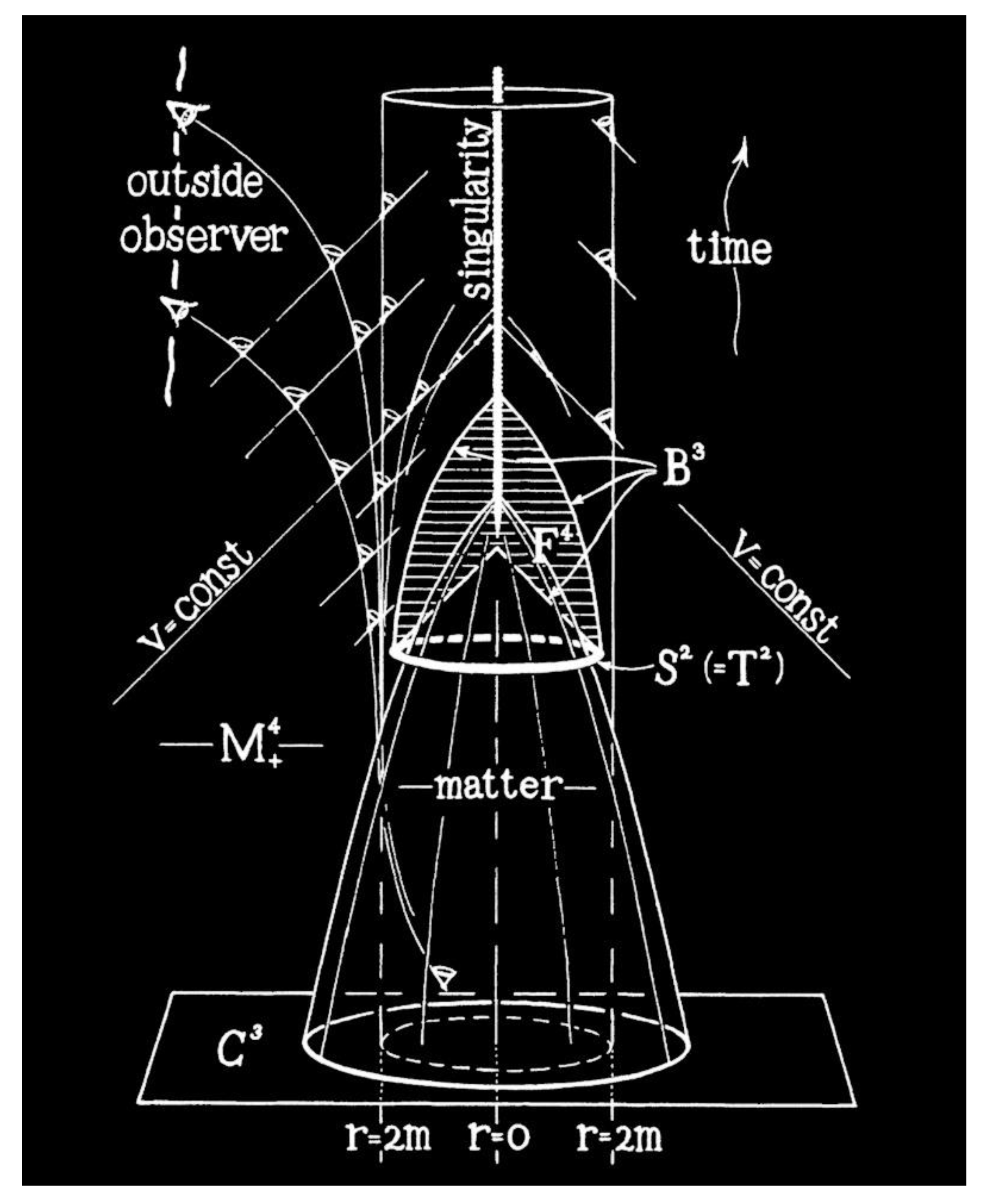
Figure 2.
AGN with the chamber of atom decay.
Disclaimer/Publisher’s Note: The statements, opinions and data contained in all publications are solely those of the individual author(s) and contributor(s) and not of MDPI and/or the editor(s). MDPI and/or the editor(s) disclaim responsibility for any injury to people or property resulting from any ideas, methods, instructions or products referred to in the content. |
© 2023 by the authors. Licensee MDPI, Basel, Switzerland. This article is an open access article distributed under the terms and conditions of the Creative Commons Attribution (CC BY) license (http://creativecommons.org/licenses/by/4.0/).
Copyright: This open access article is published under a Creative Commons CC BY 4.0 license, which permit the free download, distribution, and reuse, provided that the author and preprint are cited in any reuse.