
Submitted:
11 December 2023
Posted:
12 December 2023
You are already at the latest version
Abstract
Abstract: Rural digital governance is an inevitable requirement to improve the efficiency of rural governance, and is also an important means to realize the modernization of rural governance. In the context of the digital rural development strategy, the index measurement system of rural digital governance level is built around five key governance areas of "digital economy, digital ecology, digital culture, digital people's livelihood, and digital government affairs". The entropy weight Topsis model is used to measure and evaluate the level of rural digital governance in 31 provinces in China in 2021. The results show that there is a large gap in the level of digital governance in China's counties and villages, and the level of each region presents a decreasing spatial distribution from "east - middle - west". In terms of digital economy, the eastern region has a high score and good development, while the central and western regions have poor development. In terms of digital ecology, only the eastern region is higher than the national average; In terms of digital culture, only the central region is higher than the national average; In terms of digital livelihood and digital government, the central and eastern regions are slightly higher than the national average; The top three provinces in overall scores are Zhejiang, Guangdong and Jiangsu.
Keywords:
Digital governance
; Digital village
; Level measurement
; Entropy weight Topsis
1. Introduction
In the report of the 20th National Congress, the strategic goal of "comprehensively promoting rural revitalization, adhering to the priority development of agriculture and rural areas, and accelerating the construction of an agricultural power" was proposed. In 2019, the General Office of the CPC Central Committee issued the Outline of the Digital Countryside Development Strategy, proposing to fully build digital villages and realize rural revitalization. The modernization of rural governance is an important embodiment of comprehensively promoting rural revitalization and realizing the modernization of the national governance system and governance capacity. The No. 1 Central Document in 2022 proposes to increase efforts to improve rural governance; Rural digital governance is an important part of promoting digital countryside. To this end, rural grass-roots governments should mainly focus on improving the level of digital governance and play a role in various governance fields. The establishment of a measurement system for the level of rural digital governance is a key measure to understand the progress and stage of the development of the current level of digital governance, promote the comprehensive construction of digital villages, and realize the modernization of rural governance.
2. Literature review
After the outline of the Digital Countryside development strategy (hereinafter referred to as the Outline) was issued, the construction of digital countryside is an important strategic content of the current rural modernization construction in China. At present, domestic scholars mainly interpret the Outline and carry out research on the construction of digital countryside around its content. Zhao Xingyu et al. [1] believe that digital countryside can promote the modernization and transformation of rural areas and improve the penetration rate of digital technology, which is an effective path to boost rural revitalization. By observing counties such as Jiangsu Province, Li Yijie et al. [2] revealed that digital rural construction is the path choice for rural revitalization from three aspects: theoretical mechanism, practical path and policy inspiration. Liu Yanhong et al. [3] believe that the future should focus on the structure and efficiency of financial expenditure in the construction of digital countryside, and it is necessary to build a sustainable digital countryside.
The digital rural development strategy will inevitably put forward new requirements for the modernization of rural governance. Liu Junxiang et al. [4] analyzed the experience of digital governance in Zhejiang, Hubei and Guizhou, and believed that rural digital governance could drive rural revitalization from the aspects of government system, infrastructure construction and economic, social and people's livelihood. Zhang Zhaosu [5] conducted a case study on the digital governance platform of Huzhou City and believed that the panoramic governance of digital countryside could achieve precise governance. Wu Xiaolong [6] believes that digital governance is a process of constant change, and analyzes the scenario analysis of digital governance in five dimensions, including economy, ecology, culture, people's livelihood and governance, with the overall framework of "how to carry out, how to carry out and how to implement". Cui Yuanpei [7] et al. analyzed the innovative logic of rural digital governance during the 14th Five-Year Plan period, and proposed to accelerate the orientation of digital governance through eliminating digital divide, technology guidance, and multi-subject alliance.
Due to the late start and narrow coverage of digital governance in rural areas, this paper mainly discusses the constraints of digital governance in rural areas. Ding Bo [8] found the problems of digital formalism, estranged relationship and invisible work in the process of rural digital governance by constructing the analytical framework of "institution-technology-life", and proposed that the path of digital governance could be optimized from the three aspects of rules, organization and people. Huang Xinhua et al. [9] analyzed the governance dilemmas existing in digital governance from the aspects of social structure change, development transformation, and risk. Zhao Xiaofeng [10] et al. believe that the current rural digital governance will fall into multiple dilemmas in practice, such as the disconnection between supply and demand, digital dependence, technology flooding, and lack of governance rationality and sensibility. Li Xiaoxia et al. [11] believe that the operational mechanism of rural digital governance, urban-rural connection and industrialization docking are the key bottlenecks hindering governance.
In terms of the construction of rural digital governance indicators, Yang Yulei [12] studied the readiness of rural digital governance in Anhui province by taking infrastructure, digital subjects, scientific and technological innovation and government environment as the evaluation framework. Zhu Honggen et al. [13] measured the level of rural digital development in 30 provinces in China by constructing index systems such as digital capital investment, digital industry development, digital information foundation and digital service level. Zhang Hong et al. [14] constructed indicators from five aspects: digital macro environment, infrastructure support, information environment, government environment and application environment, and measured the development readiness of digital countryside. Wu Yuan [15] constructed indicators for the development of digital countryside from six aspects, including environment, economy and scientific and technological innovation, by collating policy documents.
Through the above literature review and combing, scholars have studied more on the implementation of the path of digital village construction; In the aspect of digital governance, it mainly studies by case analysis and empirical research. As the rural digital governance started late, mainly focused on the constraints of rural digital governance; In terms of index construction, scholars mostly evaluate the development of digital villages, and the fields involved in the evaluation indicators have different focuses. The existing measurement system for the level of rural digital governance applies a more traditional research paradigm, and there are no high requirements on the selection and empowerment methods of indicators. In view of the above problems, this paper analyzes the policy texts on rural digital governance and draws on the experience of scholars on the indicator system of governance level to build a measurement system of rural digital governance level, which provides reference for the measurement of rural digital governance level and improves governance efficiency.
3. Construction of index system of rural digital governance level
3.1. Selection of indicators of rural digital governance level
The fundamental starting point and purpose of constructing the measurement system of rural digital governance level is to provide scientific and effective theoretical guidance and improve the level of rural digital governance on the premise of truly reflecting the current situation of rural digital governance. The indicators selected in this paper are firstly based on policy text analysis and literature review, national policy documents on rural digital governance are consulted, the attributes and characteristics of indicators are analyzed in combination with literature research, and preliminary classification of indicators is carried out. Then, through the correlation analysis of the use of relevant indicators in the policy text, the cross-comparison analysis is carried out according to the core elements of the digital rural development strategy outline, and then the specific indicators are obtained. Finally, by consulting experts in related fields, the preliminary indicators are evaluated and analyzed, and the index system is adjusted and modified according to the expert opinions.
3.2. Index system design and construction
The index basis of this paper is mainly combined with the relevant indicators of the Outline of Digital Rural Development Strategy, China Digital Rural Development Report (2020), and Digital Rural Construction Guide 1.0, and draws on the experience of scholars on the indicator system of governance level. Based on the above basis, combined with the latest implementation measures of rural digital governance issued by various provinces and cities in China, it is concluded that digital governance is essentially a "Digital +N" situational application [15]. Centering on the five key governance areas of "digital economy, digital ecology, digital culture, digital people's livelihood, and digital government", the index measurement system of rural digital governance level is built.
- (1)
- Digital economy index design. The field of digital economy focuses on digital infrastructure, digitalization of rural industry and digital inclusive finance, which is an important prerequisite for the five key governance areas and a key factor for carrying out rural digital governance work. There are four indicators in the second-level indicator layer. Among them, digital infrastructure, as the foundation of the development of digital economy, can not only upgrade and transform obsolete facilities, but also bring new technologies to empower rural industries and effectively promote industrial transformation and high-quality development in rural areas [16]. The digital infrastructure index in the National County Digital Countryside Index (2020) released by Peking University is taken as a secondary index. By referring to the Evaluation of National County Digital Agriculture Rural Development Level (2020), the paper constructs a model with "Taobao Village" as the representative of agriculture-related e-commerce, and takes the proportion of Taobao villages in all administrative villages and the delivery rate of live agricultural products as the secondary indicators to reflect the digitalization situation of rural industries. Digital finance is an important support for the effective operation of rural economy. Inclusive finance increases the coverage of financial services, optimizes the allocation of financial resources, effectively alleviates the financing constraints of rural low-income groups, and greatly improves people's living standards [17]. The rural inclusive finance index in Peking University Digital Inclusive Finance Index (2021) is used as a secondary index.
- (2)
- Digital ecological index design. The field of digital ecology focuses on the combination of digital information or technology with agricultural and rural production, environment and other aspects to build a digital ecological environment of harmonious coexistence between man and nature. To this end, it is necessary to start from the aspects of agricultural science and technology investment, environmental remediation, and production safety. Among them, according to the "14th Five-Year Plan" to promote the modernization of agriculture and rural areas, the construction of local financial agricultural science and technology expenditure as a secondary index layer, through the financial investment in agricultural science and technology can understand the construction degree of digital ecology; Referring to the research of scholar Zhang Hong [14], the green development of digital agriculture and agricultural and rural informatization production environment are selected as the second-level index layer. The digital production index in the national digital rural index is used to reflect the rural digital production environment.
- (3)
- Digital culture index design. Digital culture focuses on how to promote excellent rural culture and tourism consultation through digital media. It reflects the "soft power" of rural development and is the key to the promotion and development of rural excellent culture. There are 3 indicators in this secondary index layer. The number of county-level financial media centers is taken as a secondary index to reflect rural network culture. The comprehensive strength of county tourism is taken as a secondary index to reflect the development of new rural business forms. The number of cultural stations in towns and villages is taken as a secondary index to reflect the spread of rural digital culture.
- (4)
- Digital livelihood index design. The field of digital livelihood aims at the idea of "people-centered", mainly including rural education, medical care, training and employment of professional farmers in the new era, and is an important internal cause to promote the high-quality development of rural public services. The second level of indicators is set up with 6 indicators. Among them, Internet + education has the advantage of empowering the development of rural basic education, which can improve the quality of rural basic education, and is also an effective path for precise poverty alleviation through education [18]. The proportion of rural education expenditure reflects the importance of rural education, and the coverage rate of rural distance education can reflect the actual situation of rural Internet + education. The new rural cooperative medical care and local financial medical expenditures reflect the specific situation of Internet + medical care; Rural productivity and employment are reflected by the employment situation of farmers (primary industry) and the number of training for new professional farmers.
- (5)
- Digital government index design. Digital government mainly promotes the sinking of government services to the rural grassroots by digital technology, mainly including Internet + government and comprehensive governance at the grassroots level, and three indicators are set in this secondary index layer. Among them, the proportion of villages and towns on wechat public service platform and the proportion of online disclosure of rural government information reflect the level of Internet + government affairs; The coverage rate of "Xueliang Project" administrative village reflects the level of comprehensive management at the grass-roots level.
4. Measurement and analysis of digital governance level of county rural areas in China
4.1. Data source and processing
In order to ensure the accessibility, representativeness and authenticity of indicator data, The data of 31 counties in the country involved in this paper comes from the National County Digital Rural Index (2020), China Taobao Village Research Report (2021), Peking University Digital Financial Inclusion Index (2021), National Bureau of Statistics (2021), China Rural Statistical Yearbook (2021), National Report on the Development of New Professional Farmers, and scholars Zhang Hong [14] and statistical yearbooks of counties across the country, and mined, collected and sorted relevant indicator data from the Internet through python, as shown in Table 1. For some counties where data is missing and difficult to collect, the average value is used to improve.
4.2. Evaluation method
At present, the index weighting methods in multi-index comprehensive evaluation can be roughly divided into subjective weighting methods, objective weighting methods and subjective and objective combination weighting methods: the common subjective weighting methods include Delphi method, analytic hierarchy process (AHP), chain scoring method, etc. Objective weighting methods include multi-objective programming method, principal component analysis method, entropy weight method, etc. [19], among which entropy weight method can effectively avoid the bias brought by subjective consciousness. Topsis method is a commonly used intra-group comprehensive evaluation method, which can make full use of the information of the original data, and its results can accurately reflect the gap between evaluation schemes. Scholars combine Topsis model with entropy weight method, that is, entropy weight Topsis model, and apply level measures in many fields [20,21,22]. For this reason, the entropy weight Topsis model is used in this study to measure the level of digital rural governance at county level in China, as shown in Table 2.
- (1)
- Index data standardization
Since each indicator is different in quantity, unit and other aspects, it is necessary to standardize the collected indicator data. The formula of range standardization method is as follows
- (2)
- Index weighting
First, through the matrix,Find the proportion of the index value of the i sample of the j index.
Secondly, calculate the entropy value of the J-th index, where, and .
Finally, the weights of each index are calculated.
- (3)
- To evaluate the governance level, the specific steps are as follows
Step1,construct the weighted normalized decision matrix in which.
Step 2, determine the positive ideal solution and negative ideal solution of the measure object .
Step 3, calculate the difference between each evaluation index and the optimal and worst vectors.

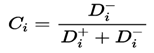
Step 4: Measure how close the object is to the optimal scheme.
The value range of is (0-1). The larger the value, the higher the level of rural digital governance in the county.
4.3. Analysis of the measurement results of digital governance level in county rural areas in China
The comprehensive scores and sub-system scores of digital governance level measurement in China's counties and villages in 2021 are shown in Table 3.
- (1)
- Analysis of the comprehensive development trend of digital governance level in county rural areas in China
According to the analysis, there are 14 provinces and cities whose digital governance level is higher than the national average (0.2641), mainly distributed in the central and eastern regions, namely Zhejiang, Jiangsu, Guangdong, Jiangsu, Sichuan, Shandong, Henan, Fujian, Hebei, Hubei, Yunnan, Hunan, Anhui, Jiangxi and Guizhou provinces. The overall score of digital governance level in the eastern region (0.3228) ranked first; The central region (0.2693) ranked second. Finally, the western region (0.1955) ranks the third, which has a certain correlation with geographical, environmental, economic and other factors in different regions.
From the numerical situation of the total score, the total score of county rural digital governance in 31 provinces is generally not high, the overall distribution is 0.171601 to 0.430000, and the median value of the total score is 0.2007 of Shanxi Province. Among counties, the highest level of rural digital governance was in Zhejiang Province (0.7047), followed by Guangdong Province (0.4822) and Jiangsu Province (0.4659), and the lowest level was in Tibet Autonomous Region (0.0708). The total score of the first place was about 9.953 times that of the last place. In general, it can be seen that in the total score of the digital governance level of counties and villages, the gap between counties and villages is very wide. In addition, the top five provinces and counties in the total score are Zhejiang, Guangdong, Jiangsu, Sichuan and Shandong, and the median of the top five is 0.4659, among which the fourth is Sichuan Province in the western region, and the other four provinces are eastern regions. The bottom five provinces and counties were Inner Mongolia, Tianjin, Ningxia, Qinghai and Tibet, and the median of the bottom five was 0.1172. The median value of the total score in the top five is about four times that of the median value in the bottom five, indicating once again that the difference between provinces and counties in the total score is significant.
In order to further explore the spatial distribution of county-level rural digital governance, this paper calculates the median total score of each region in the three regions and compares the level of county-level rural digital governance based on this. It can be clearly seen from Figure 1 that the scores of the eastern region in terms of the digital governance level of counties and villages are higher than the median values of the central and western regions and the whole country. The central region scored higher than the western region and the national median; The West is slightly below the national median. This indicates that the eastern region and the central region perform relatively well in the implementation of county rural digital governance, while the western region needs to strengthen the implementation of county rural digital governance.
- (2)
- Spatial difference analysis of digital governance level in China's counties and villages
In order to more intuitively present the differences in digital governance levels of provinces and counties across the country, the comprehensive scores of provinces and counties were divided into five groups using the natural break point method [23], namely, low digital governance level, low digital governance level, medium digital governance level, high digital governance level, and high digital governance level, as shown in Table 4.
According to the division of digital governance level of provinces and counties, the ArcMap10.8 software is used to visualize the spatial differences of rural digital governance level of 31 provinces and counties in China, as shown in Figure 2. It is found that there is a large gap in the level of rural digital governance in various counties in China, and the regional level presents a decreasing spatial distribution from "east - middle - west" in turn, as shown in Figure 1. There are 3 counties with significant effect on the level of rural digital governance, distributed in the east; There are 12 counties with high level of rural digital governance, which are concentrated in the eastern and central regions. There are 7 counties with medium level of rural digital governance, which are concentrated in the south. Nearly 30% of the country's regions are at a low level or low level of digital governance. Due to the early development of digital infrastructure, preferential policies, pilot work, and the economic development of provincial capitals, the eastern region attaches importance to the development of digital economy and digital government, and the comprehensive level of rural digital governance is more prominent. On the basis of attaching importance to digital government affairs, the central region focuses on the development of digital people's livelihood with rural medical care and education as the starting point. Due to the influence of hard factors such as geography and environment, the western region is lower than the national average in digital economy, ecology, people's livelihood and government affairs. Therefore, solving the problems faced by rural digital governance in western China is the key to realize the modernization of rural governance.
- (3)
- Analysis of the sub-systems of digital governance in China's county rural areas
First-level indicator is the core dimension for measuring the digital governance level of county and rural areas. By comparing the median of five first-level indicators of digital economy, digital ecology, digital culture and digital government at the level of digital people's livelihood in 31 provinces and counties, it can be found in which dimension the implementation level of digital governance level of county and rural areas in 31 provinces is making rapid progress. In which dimension is the construction deficient.
1.31. provinces and counties at each level of indicators score
According to Figure 3, it can be seen that the 31 provinces and counties have the highest scores in the first-level index dimension of digital livelihood, the first-level index scores of digital ecology and digital government are similar, followed by the first-level index of digital culture, and finally the lowest score of the first-level index of digital economy. Through the analysis of the median scores of 31 provinces in five first-level indicators, it can be shown that in the implementation of digital governance in counties and villages, on the whole, all provinces and counties have relatively good performance in digital livelihood, relatively flat performance in digital ecology, digital government and digital culture, while there are obvious shortcomings in digital economy.
- 2.
- The scores of the three regions at each level of the indicators
As can be seen from Figure 4, the digital economy, digital ecology and digital government in the eastern region are higher than the corresponding median values in the central and western regions as well as the whole country. In terms of digital culture and digital livelihood, the central region is higher than the eastern region, the western region and the corresponding national median value. The western region is higher than the national median value only in the aspect of digital culture, basically equal to the national median value in the aspect of digital livelihood, and lower than the national median value in other aspects. Overall, the eastern region performed better than the other two regions in the five first-level indicators, followed by the central region and the western region, while the total score of the western region was slightly below the national median value.
- (1)
- The level of digital economy mainly focuses on exploring how to drive farmers' poverty alleviation and income increase through "digital production", high-quality agricultural development, and digital financial inclusion. The average value and median value of 31 provinces and counties in the digital economy level are 0.0447 and 0.0270. It can be seen from Figure 5 that the scores of 31 provinces and counties in this dimension are mostly distributed in the range of 0.0100-0.0238. Among them, Zhejiang Province ranked first with a score of 0.2358, Guangdong and Shandong ranked second and third with scores above 0.1000. In addition, the top five provinces and counties are Zhejiang, Guangdong, Shandong, Jiangsu and Fujian, with a median value of 0.1013; The next five provinces and counties are Guizhou, Chongqing, Heilongjiang, Inner Mongolia and Xinjiang. It can be seen that all provinces except Heilongjiang belong to the western region, with a median value of 0.0161. The median value of the top five is about 6.266 times that of the bottom five. This shows that there is a clear gap in the level of digital economy between provinces and counties. Digital economy is the necessary basis for the normal development of digital governance, so the provinces and counties with low ranking, especially those in the western region, should pay attention to and strengthen the construction of the level of digital economy, such as the upgrading of obsolete facilities, can also bring new technologies to empower rural industries, and effectively promote the industrial transformation and high-quality development of rural areas. Given that the level of digital economy plays a fundamental and important role in the implementation of digital governance, the eastern and central regions still need to continue to strengthen the construction of this aspect, so as to provide a sustainable digital governance environment for the implementation of digital governance.
- (2)
- The level of digital ecology is mainly about how to build a rural humanistic ecological environment of harmonious coexistence between man and nature through digital monitoring. Specific secondary indicators include local financial expenditure on agriculture, forestry and water affairs, digital agricultural green development, digital production index and agricultural and rural information production environment. The average value and median value of the 31 provinces and counties in the digital ecological level are 0.0467 and 0.0394. It can be seen from Figure 6 that the scores of the 31 provinces in this dimension are mostly distributed in the range of 0.0238-0.0846. Among them, Jiangsu Province ranked first with a score of 0.1114, Zhejiang Province and Guangdong Province ranked second and third, and Zhejiang Province also scored more than 0.1000. In addition, the top five provinces and counties are Jiangsu, Zhejiang, Guangdong, Shandong and Hebei, with a median value of 0.0849; The last five provinces and counties are Ningxia, Qinghai, Shanxi, Tibet and Hainan in turn. It can be seen that all provinces except Hainan belong to the western region, with a median value of 0.0163, and the median value of the top five is about 5.2 times that of the bottom five, indicating that there is an obvious gap in the level of digital ecology among provinces and counties. Digital ecology is an important link in the normal development of digital governance, so the provinces and counties with low ranking, especially those in the western region, should pay attention to and strengthen the construction of digital ecology level, such as counties still need to increase financial expenditure on agriculture, forestry and water affairs, organically integrate digital technology with agricultural manufacturing, machinery and tools, and improve the quality and quantity of agricultural production. Given that the level of digital economy is an important condition for the implementation of digital governance, the eastern region and the central region still need to continue to strengthen the construction of this aspect, so as to provide a good digital ecological environment for the implementation of digital governance.
- (3)
- The level of digital culture in counties mainly focuses on how to empower rural culture through digital communication. The mean value and median value of digital literacy level of 31 provinces and counties in China are 0.0411 and 0.0313. It can be seen from Figure 7 that the scores of 31 provinces and counties in this dimension are mostly distributed in the range of 0.0238-0.0846. Among them, Zhejiang Province ranked first with a score of 0.1939, and Sichuan and Guizhou ranked second and third, with Sichuan scoring more than 0.1000. In addition, the top five provinces and counties are Zhejiang, Sichuan, Guizhou, Hunan and Jiangxi, with a median value of 0.0819; The last five provinces and counties are successively Beijing, Hainan, Tianjin, Ningxia and Shanghai, with a median value of 0.0021, and the median value of the top five is about 39 times that of the bottom five, which indicates that there is an obvious gap in the digital literacy level among provinces and counties. It should be noted that in addition to Ningxia, the last five provinces and counties belong to the western region, and the remaining four provinces and counties are from the eastern region, while in the top five provinces and counties, except Zhejiang Province, the remaining four provinces and counties are from the central region and the western region, which indicates that there is also a significant gap in the level of digital culture within the region. Digital culture is the "soul project" of the normal development of digital governance, so the provinces and counties with low scores should pay attention to and strengthen the construction of digital culture level, such as the promotion and inheritance of rural culture more widely through digital technology and platforms, and effectively promote the development of rural tourism. In view of the fact that the promotion of digital culture level is an important means to promote the common prosperity of rural areas and plays an important role in the implementation of digital governance, the eastern and western regions still need to continue to strengthen the construction of this aspect, so as to effectively play the comprehensive driving role of digital culture in rural economic and social development at the county level.
- (4)
- County digital livelihood mainly reflects how to use digital platforms to promote the high-quality development of rural public services, mainly including education, medical care and other aspects. The average value and median value of the 31 provinces and counties in the country in the level of digital livelihood are 0.0936 and 0.0854. It can be seen from Figure 8 that the scores of the 31 provinces and counties in this dimension are mostly distributed in the range of 0.0417-0.1457. Among them, Guangdong Province ranked first with a score of 0.1787, and Henan and Yunnan ranked second and third with scores above 0.1600. In addition, the top five provinces and counties are Guangdong, Henan, Yunnan, Sichuan and Hubei, with a median value of 0.1603; The bottom five provinces and counties are Beijing, Shanghai, Tianjin, Qinghai and Tibet, showing that the eastern region accounts for the majority, and there are no provinces and counties in the central region. The median value of the top five is 0.0334, and the median value of the top five is about 4.8 times of the median value of the bottom five. This shows that there is a clear gap in the level of digital livelihood between provinces and counties. Digital people's livelihood is an important guarantee for the normal development of digital governance, which is related to all aspects of rural villagers' lives. Therefore, provinces and counties with low scores, especially those in the western region, should attach importance to and strengthen the construction of digital people's livelihood, such as maintaining investment in people's livelihood and improving rural public services. In view of the fact that the level of digital livelihood is an important measure to promote the upgrading of rural digital governance, which can effectively improve the governance efficiency, the central and western regions still need to strengthen the construction of this aspect, so as to comprehensively improve the sense of gain, happiness and security of farmers.
- (5)
- The key area of county digital government level is how to achieve sustainable development and digital transformation of rural society through technology embedding. The average and median values of the 31 provinces and counties in China in the level of digital government affairs are 0.0380 and 0.0387. It can be seen from Figure 9 that the scores of the 31 provinces and counties in this dimension are mostly distributed in the range of 0.0238-0.0846. Among them, Zhejiang Province ranked first with a score of 0.0899, while Shanghai and Jiangsu ranked second and third with scores above 0.0800. In addition, the top five provinces and counties are Zhejiang, Shanghai, Jiangsu, Hubei and Anhui, with a median value of 0.0837; The bottom five provinces and counties are Ningxia, Liaoning, Yunnan, Xinjiang and Tibet, with a median value of 0.0095, and the median value of the top five is about 8.81 times that of the bottom five, indicating that there is an obvious gap in the level of digital government among provinces and counties. Digital government affairs is the extension of "Internet + government affairs services" to the countryside, making full use of information means to do a comprehensive and efficient job in government affairs services. Therefore, provinces and counties with low scores, especially those in the western region, should pay attention to and strengthen the construction of digital government affairs. For example, digital government will continue to play a positive role in policy communication, public opinion transmission, open village affairs, dispute mediation, etc., and fully protect the villagers' right to supervision and participation.
5. Conclusion and suggestion
5.1. Research conclusion
By using the weighted county-level rural digital governance measurement index system and based on relevant data, the overall analysis of the county-level rural digital governance level score of 31 provinces, the cluster analysis of the county-level rural score, the score ranking of the three major regions and the analysis of each first-level index are carried out. It is proved that the index system of county-level and rural digital governance with weights constructed in this paper has certain rationality and operability. In addition, the following findings were obtained.
First, on the whole, the score of county rural digital governance level in 31 provinces is generally not high, and only Zhejiang Province exceeds 0.7, which reflects that the level of county rural digital governance in China is still in its infancy at this stage.
Secondly, the paper analyzes the scores of rural digital governance in 31 provinces by natural breakpoint method, and divides 31 provinces and counties into five echelons. Among them, the scores of the first echelon of county rural digital governance are relatively leading, with Zhejiang, Guangdong and Jiangsu provinces; The scores of rural digital governance in the second tier of counties are relatively excellent, including 12 provinces such as Sichuan, Shandong and Henan. The scores of the third echelon of rural digital governance in counties are relatively average or moderate, which includes seven provinces and counties, including Shanxi and Guangxi. The fourth echelon includes six provinces and counties, including Chongqing, Xinjiang and Liaoning. The scores of the fifth tier of rural digital governance are relatively at the level of urgent development, including Ningxia, Qinghai and Tibet.
Third, through the comparative analysis of the three regions in five first-level indicators, it is found that the performance of the eastern region in digital economy, digital ecology and digital government is better than that of the other two regions. The central region performs better than the eastern and western regions in terms of digital culture and digital people's livelihood. The west is not performing well in any way.
5.2. Suggestions
By measuring the level of rural digital governance in 31 provinces and counties in 2021, this paper finds that there is a large gap in the level of rural digital governance in all counties in China, and the regional level presents a decreasing spatial distribution from "east - middle - west" in turn. Rural digital governance is the inevitable way to realize the modernization of rural governance. Each county should combine its own unique regional advantages, seize the dividend period of digital rural development, and comprehensively improve the level of digital governance. Therefore, countermeasures and suggestions for rural digital governance are proposed according to the following five aspects of measurement results.
(1)In terms of digital economy, digital economy as the "accelerator" of rural economic development, one is to improve the overall level of rural digital economy in the country, and digital economy can bring lasting dividends to rural economic development. First of all, all counties in the country should base on their own development, increase government policy support, stimulate enterprise investment and construction scale, and upgrade their own regional brand characteristics by optimizing the current policies, especially the counties in Tibet, Inner Mongolia, Heilongjiang and other provinces, which are ranked at the bottom, should timely improve the relevant rural digital economy policy content and increase policy support. Secondly, promote the integration of urban and rural areas, break the information barrier, accelerate the integration of urban and rural digital economy, realize the sharing of urban and rural technology, digital infrastructure and other resources, and then form a new development pattern of urban and rural integration. Second, it is necessary to narrow the gap of rural digital economy in various provinces, focusing on the construction of digital infrastructure for the first time, building a solid foundation for industrial digitalization, and narrowing the differences between counties through industrial digitalization. Second, the eastern region should maintain the momentum of sustainable development of digital economy, create more "Fengqiao experience", and give play to the "spillover effect" to do a good job of fixed-point and precise assistance to remote areas. At the same time, the policy should also increase efforts to tilt the construction of digital infrastructure in the western region.
(2)In terms of digital ecology, the eastern and central regions pay more attention. A good digital ecological environment is an important condition for realizing the goal of ecological basis. In terms of agricultural science and technology, counties still need to increase financial expenditure on agriculture, forestry and water affairs, organically integrate digital technology with agricultural manufacturing, machinery and tools, and improve the quality and quantity of agricultural production. In terms of smart green villages, county governments can actively promote the concept of green and sustainable development to farmers, guide farmers to achieve green and sustainable standards in agricultural production, processing and other aspects, and improve their subjective initiative. At the same time, they should also increase the punishment for agricultural production activities that pollute and destroy the environment. In terms of digital production, as there are a large number of small-scale agricultural cooperatives and enterprises in some regions, these cooperatives and enterprises do not have the conditions for digital production. Therefore, the county government can appropriately support local leading agricultural enterprises and guide them to generate "spillover benefits" under the drive of leading agricultural enterprises, thus driving the green development of regional agriculture. Improve the scale and digital degree of agricultural production, and then form a sound green agricultural production chain.
(3)In terms of digital culture, it is found from the evaluation scores of digital culture in various regions that the emphasis on digital culture is not high, resulting in a low overall score of digital culture. We should strengthen the emphasis and development of rural digital culture. Excellent rural culture is the soul of the countryside. Through digital technology and platform, rural culture can be carried forward and inherited more widely. In terms of the prosperity of rural network culture, the county-level government should take the lead in organizing and building more county-level financial media, strengthen the communication role of mainstream financial media, give full play to the local advantages of county-level financial media, spread excellent rural culture and folk stories to the public through financial media, and explore the establishment of local service models such as "financial media platform + government affairs + technology + culture". In addition, it is necessary to vigorously develop new rural business forms, and each county should enrich tourism, take local characteristics of culture and industry as an attraction point, and create "one village, one product" and other characteristics of tourism. In terms of digital communication, we should continue to promote the construction of digital village pilot projects, carry out digital transformation of township cultural stations, village-level libraries, rural libraries and other facilities, establish village-level electronic reading rooms, and improve the quality of rural public cultural services.
(4)In terms of digital people's livelihood, on the whole, all regions attach more importance to digital people's livelihood, and the central region has the highest evaluation score. The livelihood of the people is a major concern of the people, and we need to continue to maintain investment in the livelihood of the people. In terms of Internet + education, county governments should increase investment in rural education, and municipal education departments should actively communicate and contact with county education departments to share more educational resources through digital technology access, such as the improvement of rural teachers' ability and the cultivation of students' digital literacy. In terms of Internet + medical care, Wu Zhongan et al. found through the household survey data of farmers that the convenience of obtaining medical information through the Internet has a significant positive impact on the satisfaction of the new rural cooperative Medical care system, but the distance from the city has a negative impact. Therefore, it is necessary to pay attention to meet the needs of different age groups and different groups, and build diversified rural medical services. As a vulnerable group, farmers have low awareness of the new rural cooperative Medical system (NRCMS) and have a fluke mentality. Therefore, county governments should make more efforts to publicize the NRCMS policy. Secondly, they should reform the management mode of traditional NRCMS fund and integrate external resources to make farmers have a better understanding of the NRCMS. In terms of new professional farmers, county governments should seize the opportunity of digital rural construction to create a digital platform rural industry chain cultivation model, that is, to combine the training of new professional farmers with the operation of the agricultural industry chain, and achieve seamless connection between training and employment.
(5)In terms of digital government affairs, digital government affairs service is an important content and guarantee for the implementation of rural governance modernization and rural revitalization strategy. The eastern and western regions have launched the corresponding digital construction network technology of rural government services, which has created favorable conditions for each subject of rural digital governance. Therefore, all regions need to continue to give full play to the positive role of digital government in policy communication, public opinion transmission, village affairs disclosure, dispute mediation, etc., increase the proportion of online information disclosure, improve the network government platform, and fully protect the supervision and participation rights of villagers. In terms of comprehensive management at the grassroots level, the "Xueliang project" not only ensures the safety of villagers and maintains social security, but also promotes innovation in rural governance. To this end, it is necessary to continue to broaden the coverage of the "Snow bright project", upgrade infrastructure, increase participants, realize the "whole network sharing" of data resources, enhance the "precision" of rural governance, and improve the modernization level of rural governance.
5.3. Limitation
(1) Considering the availability of data, this paper only collected the relevant data of 31 provinces in 2021, which makes the analysis based on cross-sectional data unable to reflect the dynamic change of the corresponding county level of rural digital governance in each province.
(2) As far as measurement indicators are concerned, there is no direct reference for how to measure some specific measurement indicators in some aspects. Therefore, this paper is based on combing relevant studies to find specific measurement methods, which may harm the universality of indicators.
(3)Based on the fact that most of the data used in the research are objective data and the objectivity of the entropy weight method, the entropy weight Topsis model is chosen to assign weights to the measurement indicators, but the comparative advantages of the subjective weighting method are ignored to some extent.
Funding
This work was supported by National Social Science Fund (21BJY190) : Research on farmer behavior response and promotion mechanism of Digital village Construction and Social Science Fund Project of Hunan Province (22JD034) : Research on theoretical construction and practical path of agile governance of digital village in Hunan Province.
References
- ZHAO Xingyu, Wang Guibin, Yang Peng. Digital village construction under the background of rural revitalization strategy [J]. Journal of Northwest A&F University (Social Science Edition),2022,22(06):52-58.
- Li Jieyi, Hu Jinglan, Ma Zihan. Rural revitalization: Theoretical mechanism, practical Path and policy implications [J/OL]. Southwest Finance :1-12[2022-11-14].
- Liu Yan-Hong, Lv Peng. Objectives, achievements and challenges of digital village construction [J/OL]. Economy and Management :1-9[2022-11-14].
- Liu Junxiang, Zeng Sen. Intellectual attributes, top-level design and exploratory practice of rural digital governance in China [J]. Journal of Lanzhou University (Social Sciences Edition), 2019,48(01):64-71. (in Chinese)
- Zhang Zhaosu. Participation in dilemma, scene upgrading and panoramic governance of digital countryside: A case study of "One Map of Digital Countryside" governance platform in Huzhou City [J]. Zhejiang Journal,2022(05):88-99.
- Wu Xiaolong. Why Digital rural governance is possible: an overall analytical framework [J]. E-government,2022(06):37-48.
- Cui Yuanpei, Wei Zkun, Xue Qinglin. Innovation logic and orientation of rural digital governance during the 14th Five-Year Plan period [J]. Social Sciences of Ningxia,2022(01):103-110.
- Ding B. Digital empowerment or digital burden: Practical logic and governance reflection of digital rural governance [J]. E-government,2022(08):32-40.
- Huang Xinhua, Chen Baoling. Governance dilemma, digital empowerment and institutional supply: The realistic logic of the digital transformation of grassroots governance [J]. Journal of Theory,2022(01):144-151.
- Zhao Xiaofeng, Liu Haiying. Digital rural governance: Theoretical origins, development opportunities and unintended consequences [J]. Academia,2022(07):125-133. (in Chinese)
- Li Xiaoxia, Zhao Xiufeng, Zhang Tianzi. Digital rural governance: Practical basis, key issues and optimization strategies [J]. Journal of Agricultural Economics,2022(02):42-44.
- Yang Yulei. Research on evaluation of rural digital governance readiness in Anhui Province [J]. Journal of Taiyuan University (Social Sciences Edition),2022,23(05):30-40.
- Zhu Honggen, Chen Hui. The horizontal measurement, spatial-temporal evolution and advancing path of digital countryside development in China [J/OL]. Agricultural economic problems :1-14[2022-11-15].
- Zhang Hong, Du Kaiwen, Jin Bingyan. Research on Evaluation of Digital rural development Readiness under Rural Revitalization Strategy [J]. Journal of Xi 'an University of Finance and Economics, 2019,33(01):51-60.
- Wu Xiaolong. Why digital rural governance is possible: an overall analysis framework [J]. E-government,2022(06):37-48.
- Luo M Y. 5G new infrastructure enables the digital transformation of rural industry [J]. China Fruit Trees,2022(11):131. (in Chinese).
- Yan Jie, Guo Guo Ling, Liu Qingjuan. Financial inclusion, income increase and rural revitalization: Evidence from microfinance for poverty alleviation [J]. Jiangsu Agricultural Sciences, 2019,50(11):245-254.
- Nie Zhuming, Shi Yuhan. "Internet Plus" to promote targeted poverty alleviation through education: Problems, directions and paths [J]. Research on audio-visual Education, 21,42(12):48-54.
- Yang Y. Evaluation of weighting method in multi-index comprehensive evaluation. Statistics and Decision,2006(13):17-19. (in Chinese).
- Liu Qing, Chen Zhuanqing. Research on digital village measurement model based on entropy weight TOPSIS method [J]. Fuzzy Systems and Mathematics,2023,37(04):137-150. (in Chinese)
- Yang Shasha, Cheng Yin, Tang Tingting. Spatial and temporal differentiation and optimization path of digitalization and ecological civilization construction in urban agglomerations in China [J]. Statistics and Decision,2023,39(14):39-45. (in Chinese)
- Fan Y X, Lei S P. Evaluation and key driving forces of urban livability in Shaanxi Province under the overall layout of "five in one" [J/OL]. Journal of Peking University (Natural Science):1-14[2023-09-13].
- Wu Zenghai, Li Tao. Research on Spatial distribution of comprehensive performance in high-tech development zones: An analysis based on natural breakpoint method [J]. Statistics and Information Forum,2013,28(03):82-88.
Figure 1.
Comprehensive score of digital governance level in the three regions.
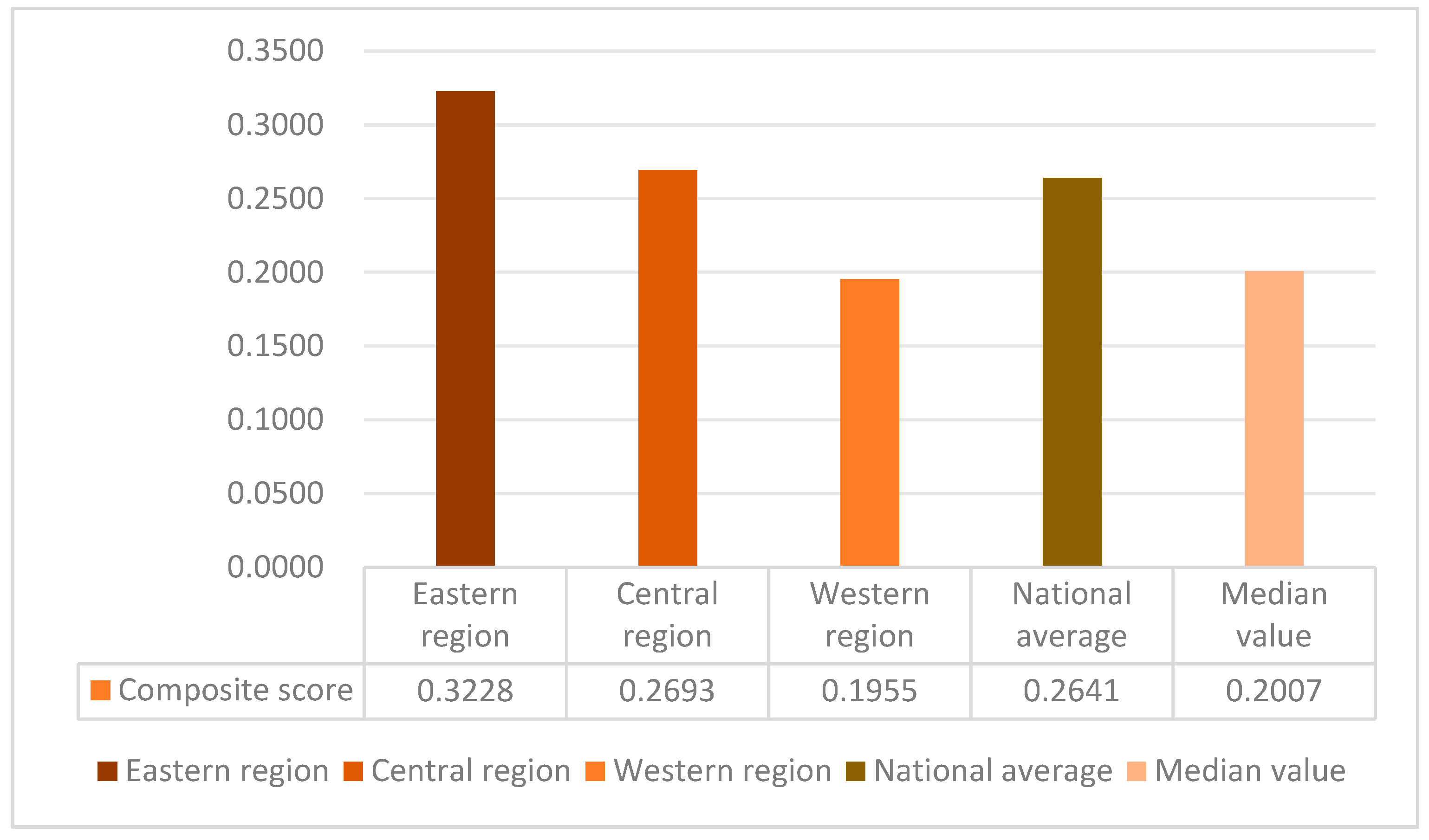
Figure 2.
Spatial distribution of digital governance level differences in counties and villages across the country.
Figure 2.
Spatial distribution of digital governance level differences in counties and villages across the country.
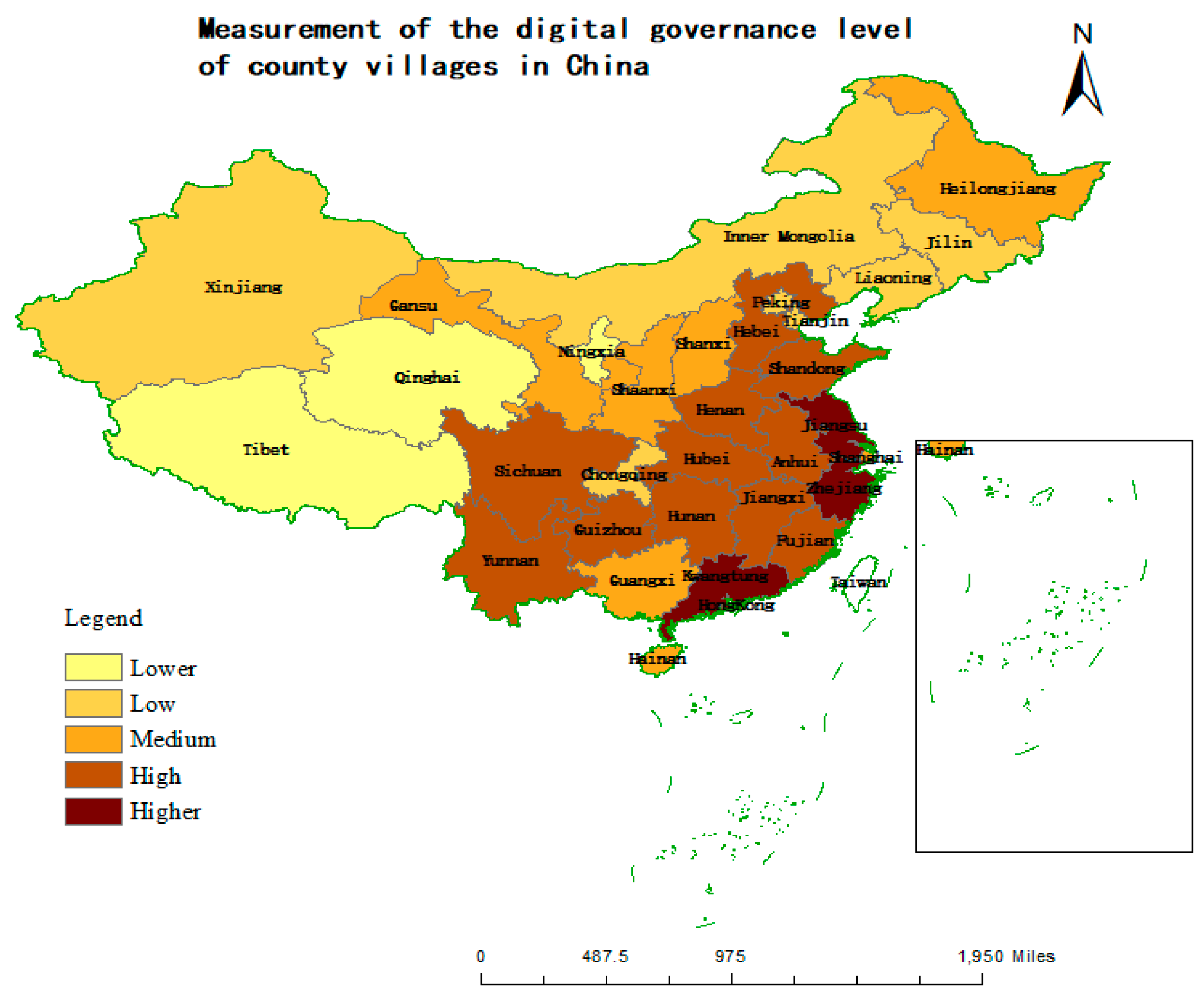
Figure 3.
The median scores of village level indicators in counties.
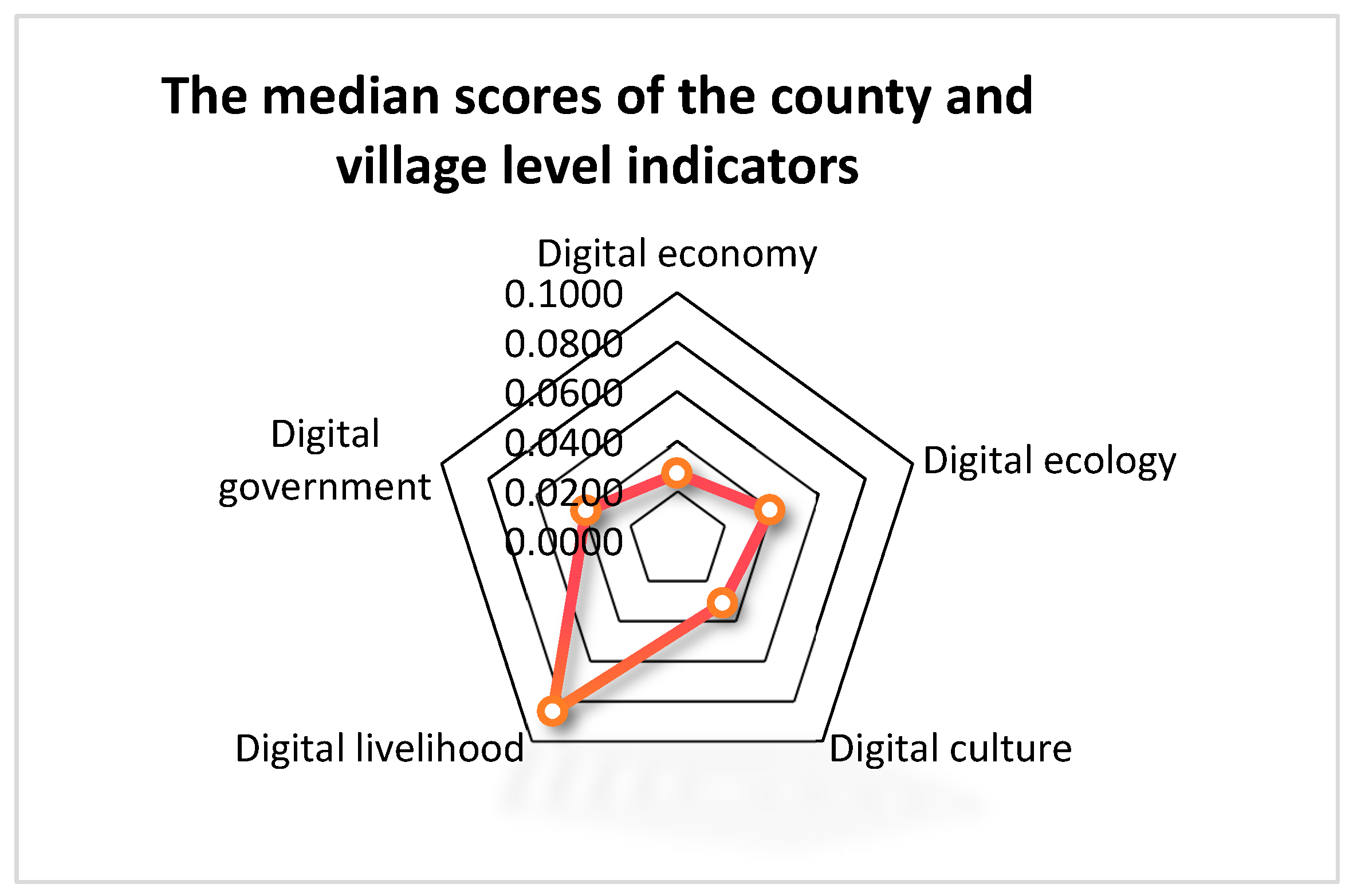
Figure 4.
First-level index scores of digital governance level in the three regions.
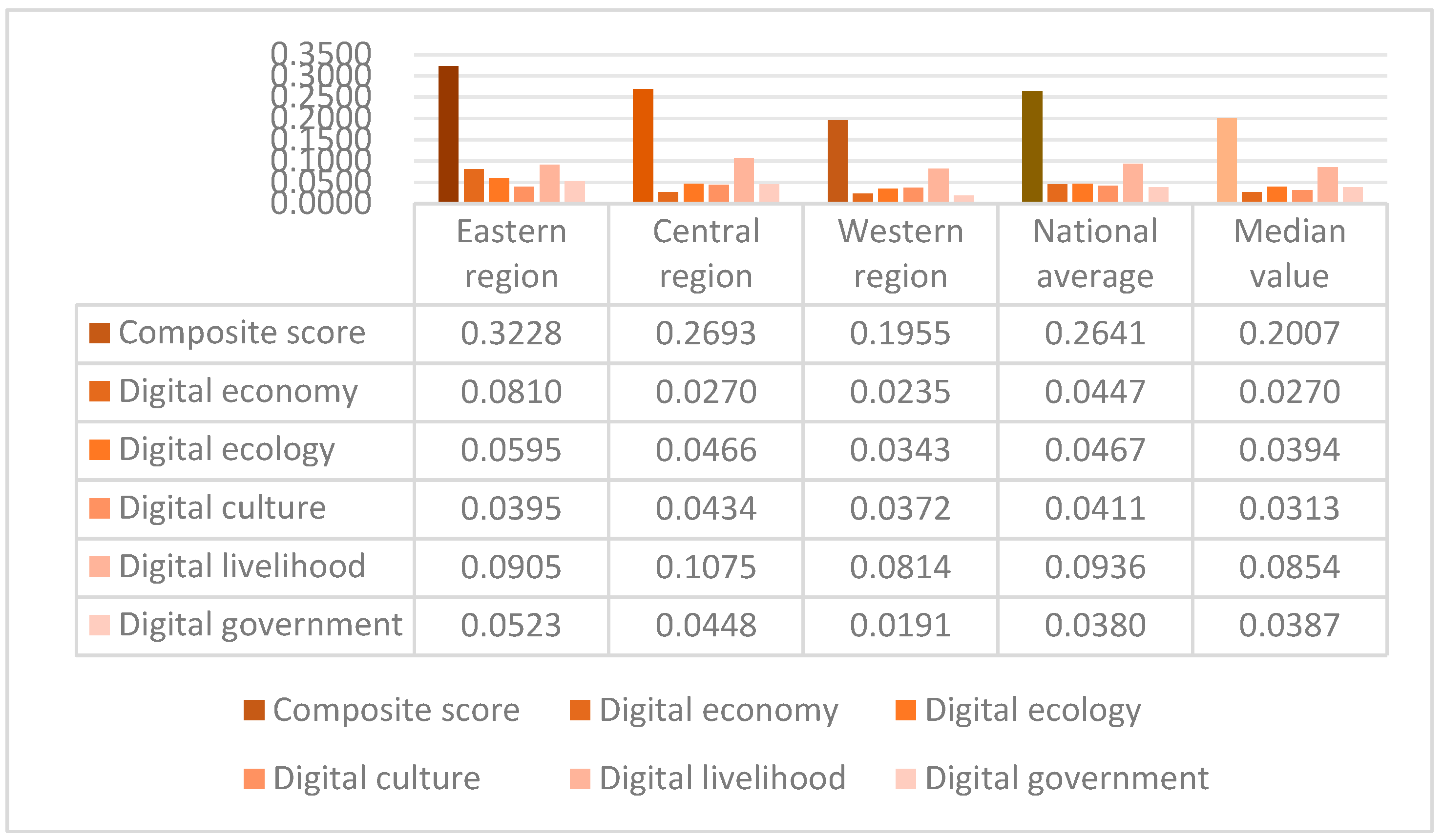
Figure 5.
Spatial distribution of digital economy level differences in counties and villages across the country.
Figure 5.
Spatial distribution of digital economy level differences in counties and villages across the country.
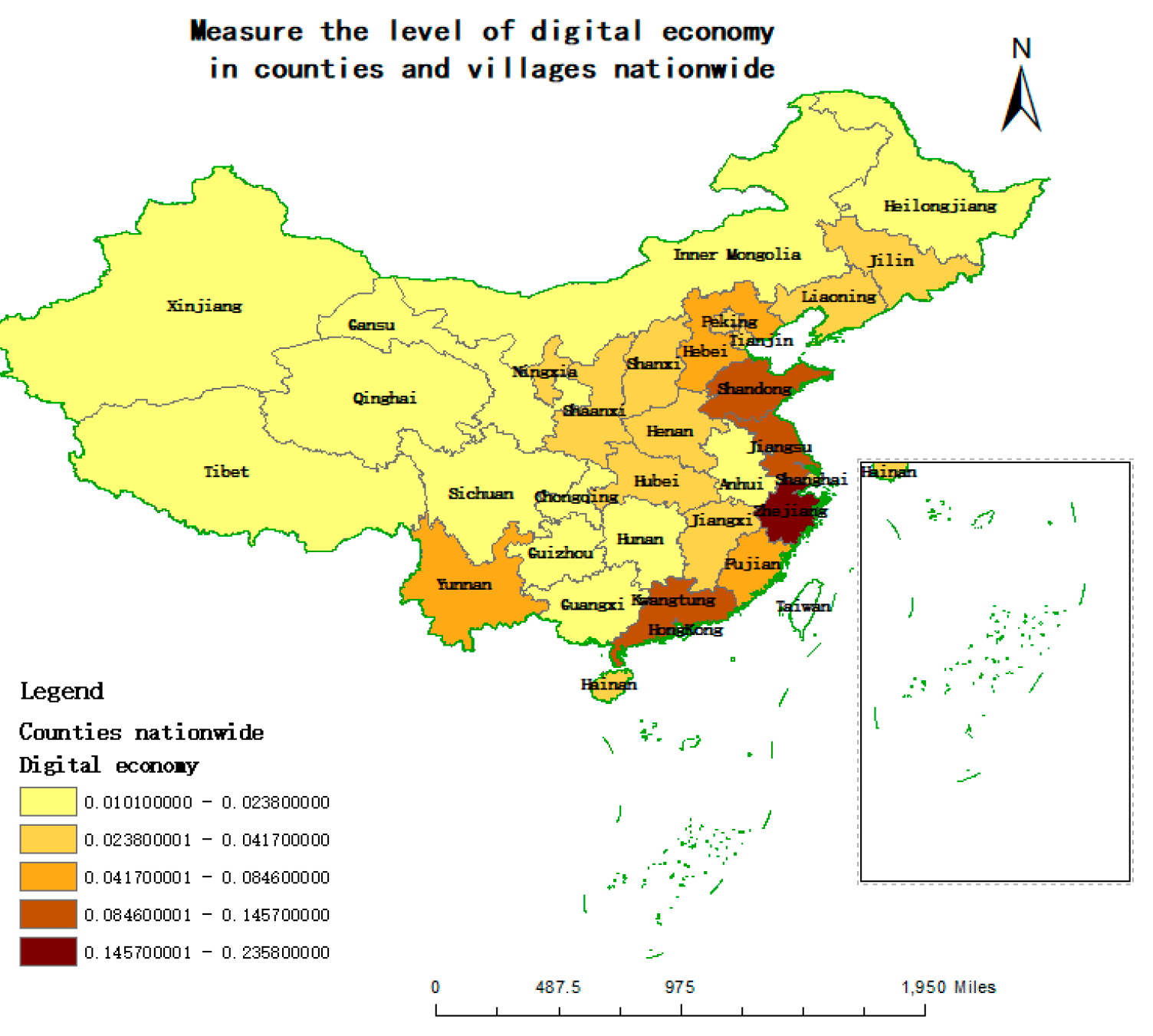
Figure 6.
Spatial distribution of digital economy level differences in counties and villages across the country.
Figure 6.
Spatial distribution of digital economy level differences in counties and villages across the country.
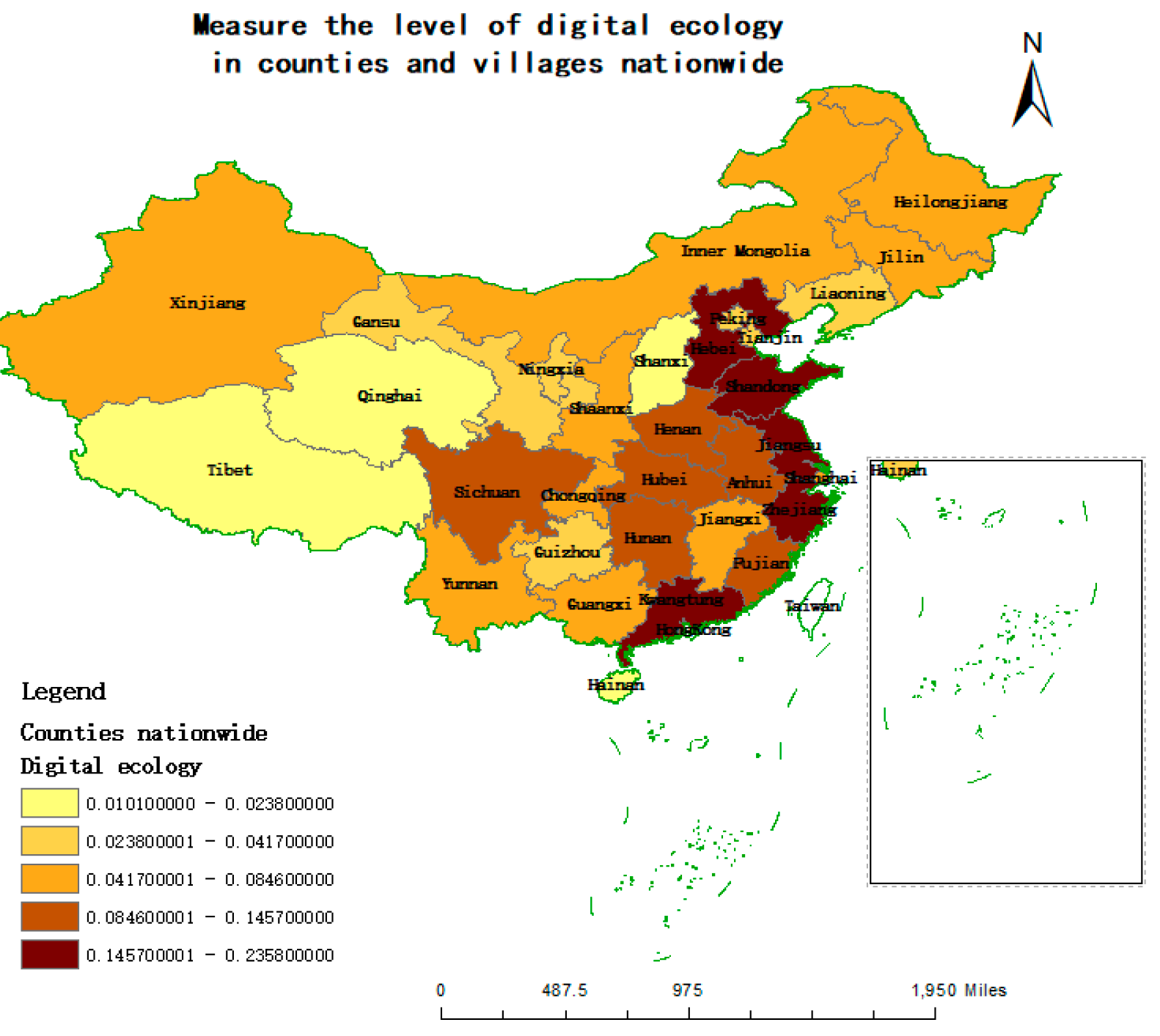
Figure 7.
Spatial distribution of digital literacy level differences in counties and villages across the country.
Figure 7.
Spatial distribution of digital literacy level differences in counties and villages across the country.
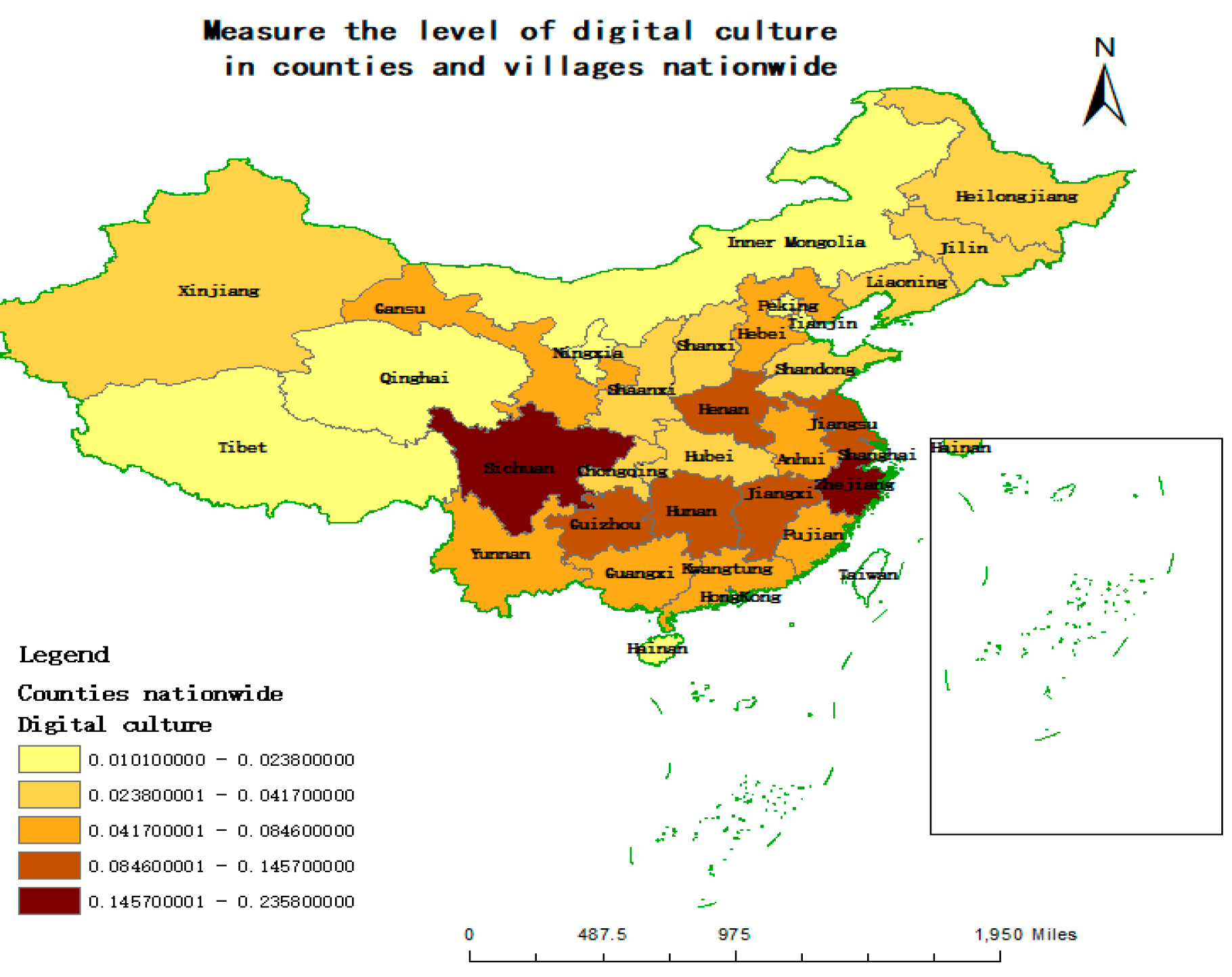
Figure 8.
Spatial distribution of the difference of digital people's livelihood level in counties and villages across the country.
Figure 8.
Spatial distribution of the difference of digital people's livelihood level in counties and villages across the country.
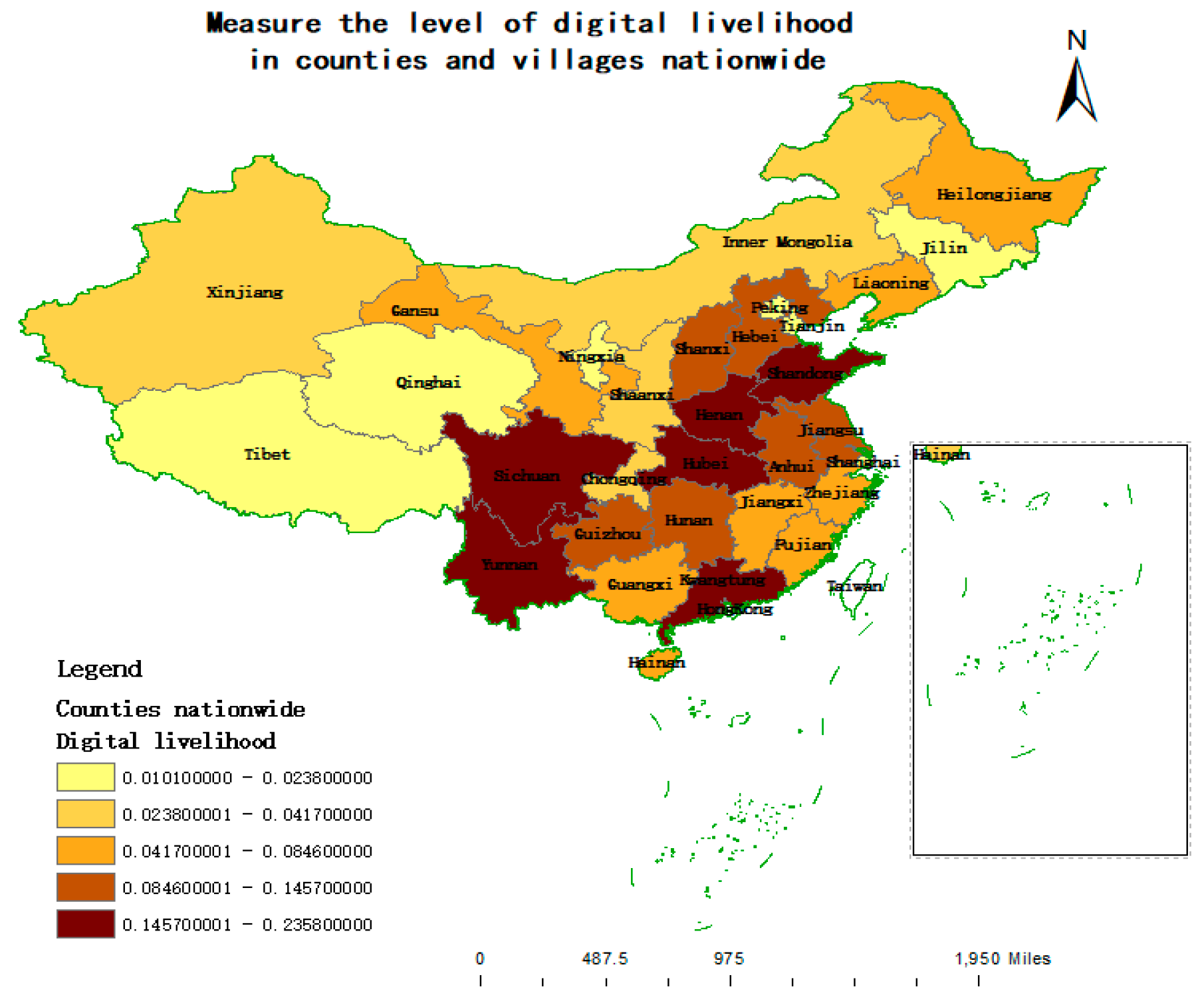
Figure 9.
Spatial distribution of digital government level differences in counties and villages across the country.
Figure 9.
Spatial distribution of digital government level differences in counties and villages across the country.
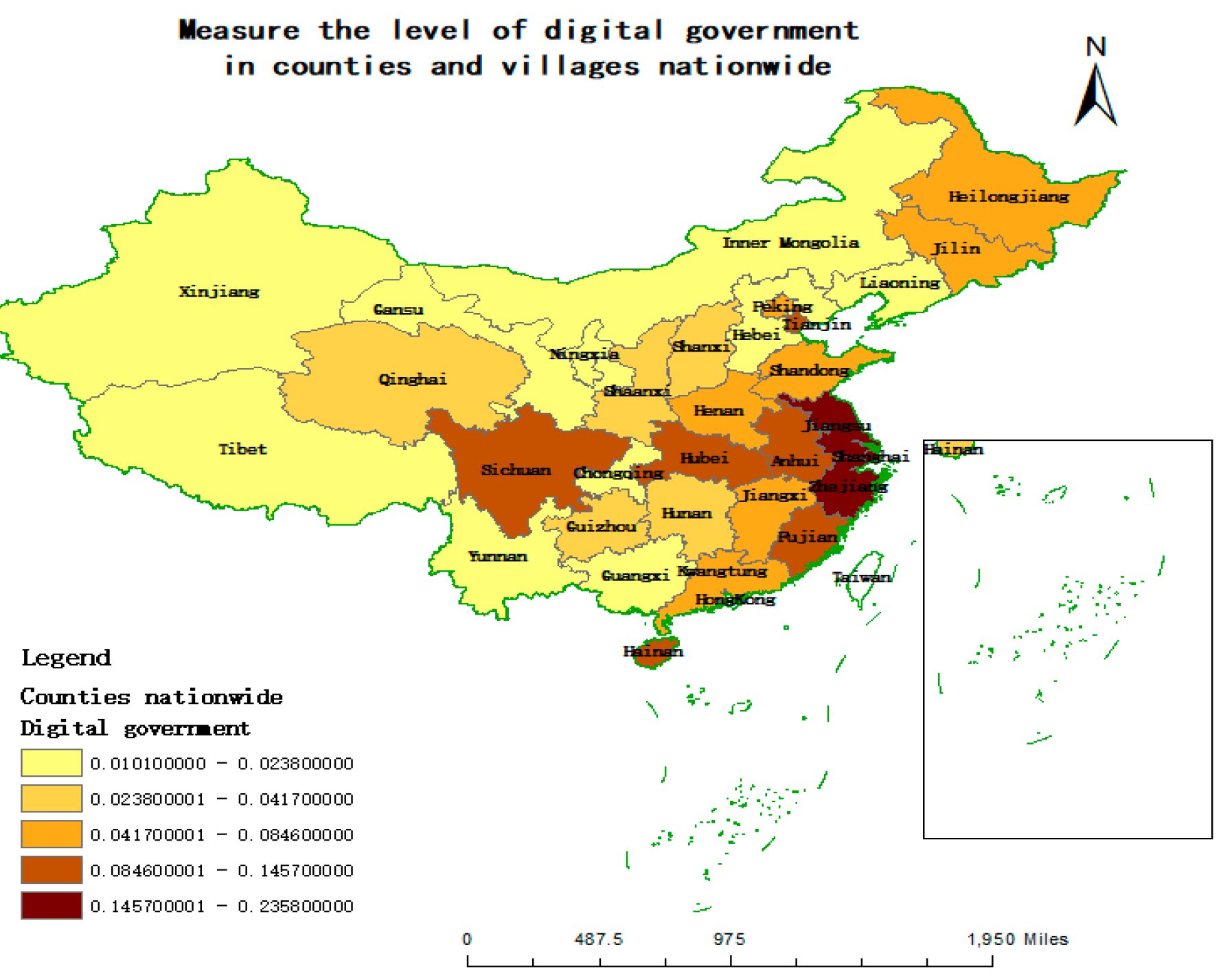

Table 1.
Indicators and sources at each level.
| Primary indicator layer | Secondary indicator layer | Attribute | Indicator source |
|---|---|---|---|
| Digital Economy | Digital Infrastructure Index | + | National Digital Rural Index (2020) |
| The proportion of Taobao villages in all administrative villages | + | China's Taobao Village Research Report (2021) | |
| Agricultural products live commodity delivery rate | + | Oteo Consulting (2021) | |
| Rural Financial Inclusion Digital Index | + | Peking University Digital Financial Inclusion Index (2021) | |
| Digital ecology | Local fiscal expenditures for agriculture, forestry and water conservancy affairs | + | National Bureau of Statistics (2021) |
| Green development of digital agriculture | + | Zhang Hong (2021) | |
| Digital production index | + | National Digital Rural Index (2020) | |
| Agricultural and rural informatization production environment | + | Zhang Hong (2021) | |
| Digital culture | Number of county-level financial media centers | + | Digital Village Development Action Plan (2021) |
| County tourism comprehensive strength top 100 | + | National County Tourism Research Report 2021 | |
| Number of township cultural stations | + | China Rural Statistical Yearbook (2021) | |
| Digital livelihood | The proportion of rural education expenditure | + | China Rural Statistical Yearbook (2021) |
| Rural distance education coverage | + | Digital Village Development Action Plan (2021) | |
| Number of new rural cooperative medical care | + | National Bureau of Statistics (2021) | |
| Local government medical expenditure | + | National Bureau of Statistics (2021) | |
| Rural Employment (Primary industry) | + | China Rural Statistical Yearbook (2021) | |
| The number of new professional farmer training | + | National Report on the Development of New Professional Farmers | |
| Digital government | The proportion of villages and towns on wechat public service platform | + | National Digital Rural Index (2021) |
| The proportion of rural government information disclosed online | + | National Bureau of Agriculture and Rural Affairs of Cities and Counties (2021) | |
| "Xueliang Project" administrative village coverage | + | Digital Village Development Action Plan (2021) |
Table 2.
Weight table of rural digital governance level measurement based on entropy weight Topsis model.
Table 2.
Weight table of rural digital governance level measurement based on entropy weight Topsis model.
| Primary indicator layer | weight | Secondary indicator layer | weight |
|---|---|---|---|
| Digital Economy | 0.2618 | Digital Infrastructure Index | 0.0134 |
| The proportion of Taobao villages in all administrative villages | 0.2061 | ||
| Agricultural products live commodity delivery rate | 0.0441 | ||
| Rural Financial Inclusion Digital Index | 0.0088 | ||
| Digital ecology | 0.1353 | Local fiscal expenditures for agriculture, forestry and water conservancy affairs | 0.0271 |
| Green development of digital agriculture | 0.0138 | ||
| Digital production index | 0.0613 | ||
| Agricultural and rural informatization production environment | 0.0385 | ||
| Digital culture | 0.3387 | Number of county-level financial media centers | 0.0523 |
| County tourism comprehensive strength top 100 | 0.1715 | ||
| Number of township cultural stations | 0.0406 | ||
| Digital livelihood | 0.1490 | The proportion of rural education expenditure | 0.0190 |
| Rural distance education coverage | 0.0240 | ||
| Number of new rural cooperative medical care | 0.0343 | ||
| Local government medical expenditure | 0.0413 | ||
| Rural Employment (Primary industry) | 0.0667 | ||
| The number of new professional farmer training | 0.0473 | ||
| Digital government | 0.1152 | The proportion of villages and towns on wechat public service platform | 0.0094 |
| The proportion of rural government information disclosed online | 0.0057 | ||
| "Xueliang Project" administrative village coverage | 0.0749 |
Table 3.
Measurement results of the digital governance level of counties and villages in China in 2021.
Table 3.
Measurement results of the digital governance level of counties and villages in China in 2021.
| Regional | Digital economy | Digital ecology | Digital culture | Digital livelihood | Digital government | Total score | Rank |
|---|---|---|---|---|---|---|---|
| Eastern region | 0.0769 | 0.0608 | 0.0406 | 0.0978 | 0.0506 | 0.3267 | - |
| Peking | 0.0417 | 0.0324 | 0.0026 | 0.0435 | 0.0387 | 0.1591 | 28 |
| Tianjin | 0.0289 | 0.0276 | 0.0021 | 0.0334 | 0.0532 | 0.1452 | 30 |
| Jiangsu | 0.0978 | 0.1114 | 0.0590 | 0.1140 | 0.0837 | 0.4659 | 3 |
| Liaoning | 0.0246 | 0.0284 | 0.0186 | 0.0793 | 0.0107 | 0.1616 | 27 |
| Shanghai | 0.0270 | 0.0364 | 0.0018 | 0.0376 | 0.0866 | 0.1894 | 19 |
| Zhejiang | 0.2358 | 0.1010 | 0.1939 | 0.0842 | 0.0899 | 0.7047 | 1 |
| Kwangtung | 0.1457 | 0.0849 | 0.0338 | 0.1787 | 0.0391 | 0.4822 | 2 |
| Shandong | 0.1013 | 0.0831 | 0.0313 | 0.1361 | 0.0457 | 0.3974 | 5 |
| Hebei | 0.0765 | 0.0811 | 0.0422 | 0.1165 | 0.0135 | 0.3297 | 8 |
| Henan | 0.0398 | 0.0691 | 0.0583 | 0.1683 | 0.0406 | 0.3761 | 6 |
| Hainan | 0.0273 | 0.0133 | 0.0025 | 0.0844 | 0.0553 | 0.1828 | 21 |
| Central region | 0.0334 | 0.0461 | 0.0565 | 0.1057 | 0.0489 | 0.2907 | - |
| Shanxi | 0.0255 | 0.0163 | 0.0287 | 0.0994 | 0.0307 | 0.2007 | 17 |
| Ji Lin. | 0.0249 | 0.0381 | 0.0207 | 0.0443 | 0.0436 | 0.1716 | 24 |
| Sichuan | 0.0226 | 0.0577 | 0.1419 | 0.1518 | 0.0559 | 0.4300 | 4 |
| Anhui | 0.0232 | 0.0568 | 0.0384 | 0.1111 | 0.0616 | 0.2912 | 12 |
| Jiangxi | 0.0345 | 0.0425 | 0.0717 | 0.0887 | 0.0459 | 0.2833 | 14 |
| Fujian | 0.0846 | 0.0545 | 0.0466 | 0.0876 | 0.0593 | 0.3327 | 7 |
| Hunan | 0.0225 | 0.0538 | 0.0739 | 0.1189 | 0.0296 | 0.2986 | 11 |
| Hubei | 0.0294 | 0.0494 | 0.0304 | 0.1435 | 0.0647 | 0.3174 | 9 |
| Western region | 0.0229 | 0.0334 | 0.0275 | 0.0759 | 0.0179 | 0.1776 | - |
| Inner Mongolia | 0.0153 | 0.0402 | 0.0125 | 0.0744 | 0.0121 | 0.1545 | 29 |
| Guangxi | 0.0238 | 0.0394 | 0.0348 | 0.0794 | 0.0130 | 0.1905 | 18 |
| Chongqing | 0.0182 | 0.0393 | 0.0268 | 0.0720 | 0.0129 | 0.1692 | 25 |
| Heilongjiang | 0.0162 | 0.0468 | 0.0249 | 0.0856 | 0.0419 | 0.2154 | 16 |
| Guizhou | 0.0182 | 0.0339 | 0.0819 | 0.1044 | 0.0299 | 0.2684 | 15 |
| Yunnan | 0.0589 | 0.0394 | 0.0442 | 0.1603 | 0.0095 | 0.3124 | 10 |
| Xizang. | 0.0186 | 0.0137 | 0.0066 | 0.0274 | 0.0045 | 0.0708 | 33 |
| Shaanxi | 0.0270 | 0.0376 | 0.0247 | 0.0649 | 0.0312 | 0.1853 | 20 |
| Gansu | 0.0193 | 0.0288 | 0.0354 | 0.0854 | 0.0122 | 0.1810 | 22 |
| Qinghai | 0.0200 | 0.0164 | 0.0038 | 0.0313 | 0.0269 | 0.0985 | 32 |
| Ningxia | 0.0293 | 0.0263 | 0.0020 | 0.0483 | 0.0114 | 0.1172 | 31 |
| Xinjiang | 0.0101 | 0.0389 | 0.0321 | 0.0772 | 0.0094 | 0.1678 | 26 |
| National average | 0.0449 | 0.0467 | 0.0412 | 0.0933 | 0.0381 | 0.2643 | - |
Note: The regional division refers to the division standard of economic geography concept: The eastern region includes 11 provinces, including Beijing, Tianjin, Hebei, Liaoning, Shanghai, Jiangsu, Zhejiang, Fujian, Shandong, Guangdong and Hainan; the central region includes: 8 provinces: Shanxi, Jilin, Heilongjiang, Anhui, Jiangxi, Henan, Hubei, Hunan; 12 provinces: Inner Mongolia, Guangxi, Chongqing, Sichuan, Guizhou, Yunnan, Tibet, Shaanxi, Gansu, Qinghai, Ningxia, Xinjiang.
Table 4.
Digital governance level division of counties.
| Area type | Counties | level |
|---|---|---|
| S≥0.430001 | Zhejiang, Jiangsu, Guangdong | Higher |
| 0.215401≤S<0.430000 | Sichuan, Shandong, Henan, Fujian, Hebei, Hubei, Yunnan, Hunan, Anhui, Jiangxi, Guizhou, Heilongjiang | High |
| 0.171601≤S<0.215400 | Shanxi, Guangxi, Shanghai, Shaanxi, Hainan, Gansu, Jilin | Medium |
| 0.117201≤S<0.171600 | Chongqing, Xinjiang, Liaoning, Beijing, Inner Mongolia, Tianjin | Low |
| S<0.117200 | Ningxia, Qinghai, Tibet | Lower |
Disclaimer/Publisher’s Note: The statements, opinions and data contained in all publications are solely those of the individual author(s) and contributor(s) and not of MDPI and/or the editor(s). MDPI and/or the editor(s) disclaim responsibility for any injury to people or property resulting from any ideas, methods, instructions or products referred to in the content. |
© 2023 by the authors. Licensee MDPI, Basel, Switzerland. This article is an open access article distributed under the terms and conditions of the Creative Commons Attribution (CC BY) license (http://creativecommons.org/licenses/by/4.0/).
Copyright: This open access article is published under a Creative Commons CC BY 4.0 license, which permit the free download, distribution, and reuse, provided that the author and preprint are cited in any reuse.


