

Submitted:
10 December 2023
Posted:
11 December 2023
You are already at the latest version
Abstract
Transitioning towards sustainable food systems and sustainable diets is critical in reducing environmental impact and achieving the Sustainable Development Goals established by the United Nations General Assembly. This transition requires collaborative efforts across multiple stakeholders, including the general public’s knowledge and attitudes. To assess the knowledge and attitudes towards food sustainability we carried out a cross-sectional study among Kuwait University students with a total of 278 participants aged ≥18 years (78% females and 22% males). A validated questionnaire was used for this study. Most respondents (>70%) recognized the concept of “local food” and “environmental impact.” The concept “green water-blue water” was least recognized among respondents (75%). Participants perceived that a sustainable diet was rich in vegetables, included plenty of fresh products and was affordable. Participants (>66%) perceived that a positive impact of meat and its derivatives towards sustainability, a misconception most common among males. Overall, participants with more knowledge about environmental concepts showed favorable attitudes towards a sustainable diet. Women showed more interest in changing their current dietary habits towards food sustainability. In conclusion, despite participants’ positive attitude towards food sustainability, lack of understanding persists, necessitating public health interventions aimed at educating consumers about sustainable diets and its impact on the environment.
Keywords:
sustainability
; food sustainability
; food knowledge and attitudes
; sustainable diet
1. Introduction
According to the latest Intergovernmental Panel on Climate Change (IPCC) report to control global warming within safe levels by 2030, countries worldwide should drastically change how they use their land [1]. Human behaviors have been suggested to be the main drivers of climate change, which in turn negatively affects health, the environment, and disrupts the food chain. The aforementioned report also emphasizes the need for a global strategy prioritizing sustainability to tackle climate change. According to data released by National Aeronautics and Space Administration (NASA), the “Earth’s global average surface temperature in 2020 was statistically tied with 2016 as the hottest year on record, implicating a long-term warming trend due to human activities” [2]. Kuwait is susceptible to the negative health effects of climate change and considering its high greenhouse gas (GHG) emissions, mean annual temperature is projected to rise by about 6.2°C on average from 1990 to 2100 [3].
More recently there has been a focus on the ecological footprint, which compares our rate of consumption of resources and waste generation to the rate at which nature can absorb and generate new resources [4]. Considering these methods, it would be ideal for countries to better understand its ecological footprint impact to improve sustainability.
In Africa and the Middle East and Central Asia region, the total ecological footprint per capita was found to be increasing more rapidly compared to other regions [5]. In particular, the carbon footprint which is the total amount of greenhouse gas emissions (GHG) including carbon dioxide and methane, were found to account for 60% of the world’s total ecological footprint and are considered the main cause of human-induced climate change [5]. Food security in Kuwait is another great challenge, due to its growing population, arid dry soil, limited natural water resources and climate change. As such, the most recent “Our World in Data” report found that GHG emissions in Kuwait ranked second highest among the GCC countries, where in 2018, 21.62 tonnes per capita GHG emissions were recorded [6]. In response, Kuwait has pledged to reduce its GHG emissions equivalent to 7.4% of its total emissions in 2035 with unconditional national efforts [7].
Global food systems including production, processing, distribution, and consumption account for 26% of global GHG [8]. “Globally, enough food is wasted every year to feed nearly 2 billion people a 2,100 kcal/day diet “[9], and approximately one third of the wasted food is responsible for nearly 6% of total GHG emissions [8]. The Food Waste Index Report in 2021 by the United Nations Environment Program (UNEP) showed that Kuwait wastes 397,000 tons of food yearly, with 95 kg per capita on average [10]. Food waste poses a negative environmental impact on agriculture and increases resource shortage [9], therefore it is empirical that efforts focus on the reduction of food waste through sustainable consumption and production and transition towards a low-carbon and green economy [11].
Sustainable diets promote intake of foods low in water and carbon footprints and the use of food biodiversity comprising of local and traditional foods [12]. The Food and Agricultural Organization (FAO) defines sustainable diets as “those diets with low environmental impacts, are protective of biodiversity and ecosystems, culturally acceptable, accessible, economically fair, affordable, nutritionally adequate, safe, and healthy, while optimizing natural and human resources” [12].
The FAO recognizes the Mediterranean diet as a healthy dietary pattern for humans with a low environmental impact and has been selected as a model to help achieve the Sustainable Development Goals [13]. A diverse diet, rich in plant-based foods such as cereals, fruits, vegetables, legumes, and healthy fats such as olive oil with moderate amounts of fish and red meat, the Mediterranean diet has shown to have numerous health benefits and a low environmental footprint [14]. One of the key messages of the EAT-Lancet Commission on healthy diets from sustainable food systems states: “Transformation to healthy diets by 2050 will require substantial dietary shifts, including a greater than 50% reduction in global consumption of unhealthy foods, such as red meat and sugar, and a greater than 100% increase in consumption of healthy foods, such as nuts, fruits, vegetables, and legumes” [15].
Individual food consumption behaviours can have a significant impact on GHG mitigation [13]. Despite the Mediterranean diet’s recognized health and environmental benefits, several studies have shown a global shift towards a “western-style dietary pattern,” characterized by excessive intake of calories, animal-based products, and processed foods such as refined carbohydrates, added sugars, salt, and saturated fat. This type of “western diet” is concurrently presenting challenges for population health and environmental sustainability [9].
Kuwait and neighbouring countries have experienced a similar shift in dietary patterns due to urbanization, economic development, food globalization, and lifestyle changes. The Kuwait Nutrition Profile prepared by the FAO highlighted that the food habits and dietary patterns have shifted from a traditional dietary pattern rich in grains, fish, camel milk, fruits, and vegetables to one that is high in fat and sugar. Several studies in Kuwait have reported a high prevalence of meat and fast-food consumption among adolescents. [16,17].
Food sustainability is thus an important topic. A shift towards a more healthy and sustainable food system requires individuals to be more aware of their dietary consumption patterns and understand that their food choices can directly impact the environment. In Kuwait, various awareness campaigns have addressed environmental issues and its impact of climate change. However, it is important to explore the public’s understanding and attitudes towards food sustainability and related environmental impact concepts. By identifying the level of knowledge and awareness, effective public health interventions and awareness campaigns can be tailored and developed to improve food sustainability in Kuwait, and aid in the control of the related environmental impacts. There are no studies that investigated the knowledge and attitudes towards food sustainability among the population in Kuwait. Therefore, this research was aimed at investigating the knowledge on food sustainability and its related attitudes among Kuwait University (KU) students.
2. Materials and Methods
2.1. Sample and Study Design
The study design was cross-sectional and study population were students at Kuwait University in Kuwait. Data was collected through convenience sampling using a self-administered questionnaire developed from a previous study carried out in Spain and was adapted for use in the present study [13]. The English language questionnaire was developed and validated by authors of the study, translated to Arabic and back translated to English, after which, pilot testing was done in both languages. The survey was reviewed by experts in the field to ensure questions were clear, easy to understand, and matched the research objectives.
The questionnaire was disseminated online via email and QR code with a link where participants filled out the questionnaire in either English or Arabic language. The purpose of the study was described at the start of the survey. Data was collected between February 2023 and March 2023. Composed of 30 questions, the questionnaire was divided into 4 sections (Appendix A), where section 1 collected student background information followed by sociodemographic details in section 2. Section 3 comprised of questions related to food sustainability and environmental impact concepts in which participants were asked about their knowledge on sustainability concepts (yes/no) and to rate attributes that contribute to a sustainable diet on a scale of 1 to 5, where 1 represented “Not important at all” and 5 represented “Very important.” A list of food groups was provided where participants were asked to choose whether each group had a positive or a negative impact towards sustainability of the planet. A question on perceived impact of water-use in food production was asked on a scale from 1 to 5 (1= totally disagree; 5 = totally agree) (Appendix A Section 3). A 5-Point Likert scale rating system was used in section 4 of the questionnaire to measure participants’ attitudes towards sustainable diets. Participants had to rate the significance of buying sustainable foods, their willingness to pay extra for food that is produced sustainably, and their willingness to change their current dietary habits towards more sustainability. Participants also rated their willingness to purchase a food or drink that is labelled with a low carbon and water footprint as well as their willingness to reduce consumption of a particular food or drink after knowing its environmental impact.
This study involved a total of 278 participants that were recruited using a convenience sampling method. With a 95% confidence interval, and 5% margin of error, the minimum sample size required was 221. Considering non-responders, the sample size was increased by 20%, and thus the required sample size for this study was 265.
2.2. Statistical Analyses
All data was analysed using SPSS v.26.0. Descriptive analysis was carried out to identify sociodemographic characteristics of the population, level of knowledge and attitudes. Results for categorical data was reported using frequencies and percentages. For results pertaining to knowledge of sustainability concepts and effects of various food groups towards sustainability, differences among groups were assessed using a chi-square test. A binary logistic regression was performed to determine the significant predictors for attitude toward food sustainability among KU students. Statistical significance was set at p < 0.05.
3. Results
Out of the 278 participants who completed the questionnaire, 78% were females and 22% were males, and most of them were between 18 and 22 years of age, while 18% of them were above 22 years. Most of the participants (94%) were undergraduates and non-medical students (82%). By employment status, 12% were employed in the government sector while 89% of the participants did not work. By health status, 66% of participants were of normal weight whereas, 34% were obese. Table 1 shows student background and socio-demographic characteristics of the sample population.
3.1. Level of Knowledge on Food Sustainability Concepts
As illustrated in Figure 1, over 50% of participants recognized only half of the concepts related to food sustainability. “Local food” and “environmental impact” were the most-known concepts whereas, “green water-blue water” and “food sustainability” were the least known concepts.
Most of the terms related to food sustainability were recognized by females than males. When participants were asked if they knew the concept of “environmental impact,” a statistical difference (p ≤ 0.05) was observed in which more females (77%) than male participants (61%) indicated awareness of this concept. In addition, the concept “ecological footprint” was least known by males (59% vs. 43% of females).
Interestingly, students’ knowledge for each concept increases with age group, as illustrated in Table 2, with a higher percentage among students >22 years compared to groups of 22-20 years and < 20 years. The term “green water/blue water” was the least known among all participants regardless of age or gender. In addition, statistical differences were observed (p < 0.05) between percentages of students who knew the terms “ecological footprint” and “biodiversity” in each age group.
Participants were given a list of aspects that contribute towards a sustainable diet (Table 3) and were asked to rate them accordingly from 1 to 5, 1 representing “not important at all” and 5 “very important”. Overall, participants perceived a sustainable diet comprises mainly of “diet rich in vegetables” (3.58 ± 1.733), “plenty of fresh products” (3.53 ± 1.806), and “affordable” (3.53 ± 1.826). In contrast, participants perceived “few ingredients” (1.72 ± 1.744), “no additives” (1.78 ± 1.903), and interestingly “low processing” (1.98 ± 1.947) as aspects that contribute the least towards a sustainable diet. The scores given by females were higher than those given by males for all aspects except for “low processing” and “locally produced”. When asked whether sustainable and healthy diets terms mean the same thing, 50% of the participants believed that both terms did not mean the same, with no statistical difference in gender and age.
Table 4 and Table 5 illustrate how participants viewed the impact of food groups on sustainability by gender and age group. Vegetables is a top indicator for perceived impact on sustainability in which over half of the participants (86%) stated that vegetables have a positive impact towards food sustainability. Similarly, 74% of students think that eggs have a positive effect on food sustainability, whereas 71% consider the same for fish and its derivatives, and 69% attribute a positive impact to dairy products as well as meat. The perception that meat contributes positively towards food sustainability is most common among males than females in which a statistical difference (p < 0.05) was also observed. On the other hand, participants believe that carbonated and processed drinks (78%), and processed food (73%) have a negative impact on food sustainability. More females (81%) than males (67%) think that carbonated and processed drinks contribute negatively to food sustainability in which statistical difference was found (p < 0.05).
Statistical differences were also found (Table 5) among the three age groups for processed food and, carbonated and processed drinks. The percentage tended to increase with age who attribute a negative impact by both food groups on food sustainability.
Table 6 shows the study population’s understanding of the significance of water usage in food production and our findings indicate that more water resources were required in the production of plant-based foods than for meat-based production. In addition, a third of the participants either “do not know” or “do not agree” whilst 56% of participants “mostly agree” to “completely agree” with the perception that “enough water for the planet is granted by the natural cycle of water”.
3.2. Attitudes towards Sustainable Diets
The study participants were inquired about their willingness to pay more for a food item that was sustainable on a scale from 1 to 5 with 1 corresponding to “not at all” and 5 “willing”, majority of them (37%) were moderately willing to pay more for a sustainable diet while 21% were unsure. Men were more likely to pay more for food and beverage that was sustainable. When asked to rate their willingness to change their current dietary habits towards a more sustainable one, majority of the participants were moderately willing to quite willing to do so. More women than men were willing to change their dietary habits towards sustainability (Table 7).
A third of participants (30%) were unsure whether they would purchase any food or drink labelled with a low carbon and water footprint, whilst majority of them (25%) were “moderately willing” to reduce consumption of certain foods after knowing that it was producing a negative impact towards the environment.
A bivariate analysis using Chi square test was performed as shown in Table 8 to identify the relationship between independent variables and dependent variable (Attitude: negative/positive). Higher knowledge on environmental concepts and food sustainability was significantly associated with a positive attitude towards sustainable diets. Participants who had more knowledge about environmental concepts and food sustainability showed a positive attitude towards sustainable diets whereas, those with poor knowledge had more of a negative attitude with a significant statistical difference (p < 0.001) found. Statistical differences (p < 0.05) were observed between faculty type, age-groups, governorate, and monthly income and attitudes towards food sustainability.
A binary logistic regression analysis was performed with backward elimination to further analyse the significance of the relationship between independent variables and dependent variable with a 95% C.I, as shown in Table 9. It was found that respondents with no income were 47% less likely to have a positive attitude towards sustainable diets when compared to respondents with a monthly income (p <0.05). It is worth noting that although there was no statistical significance observed between BMI and attitude in the bi-variate analysis, there seems to be a correlation between BMI and other variables as shown in the binary logistic regression model. Respondents with a normal BMI were 1.9 times more likely to have a positive attitude towards sustainable diets compared to the obese group. When comparing respondents’ area of residence, the analysis suggests that respondents living in Al-Ahmadi area were 54% less likely to have a positive attitude towards a sustainable diet than others. When comparing medical to non-medical students, the analysis shows that respondents from medical college were 2.6 times more likely to have a positive attitude towards a sustainable diet.
4. Discussion
4.1. Knowledge on Environmental Concepts and Food Sustainability
The aim of this study was to assess the knowledge and attitudes towards food sustainability among Kuwait University students. This is the first study in Kuwait that evaluates the level of knowledge of food sustainability and its related attitudes towards food sustainability of a small sample size of Kuwait University students. Overall, the results present a positive attitude of Kuwait University students towards a sustainable diet. Yet, the results also indicate some misconceptions and lack of knowledge among participants about sustainability concepts and food groups that have a major impact towards sustainability and the environment. A better knowledge on environmental concepts and food sustainability has a significant positive impact on attitude towards sustainable diets which in turn correlates with the willingness to buy sustainable products, to change dietary habits towards sustainability, and reduction in consumption of products that negatively impact the environment. Most of the study population were still unfamiliar with many environmental concepts and aspects that contribute to a sustainable diet indicating a need for greater efforts to increase knowledge of food sustainability and the importance given to sustainability concepts when making food choices. Research shows that only a small number of consumers have a good understanding of the attributes of sustainable food products [13]. Although participants acknowledged that they heard the term or know the concepts in relation to food sustainability, the level of knowledge was lower for certain concepts such as “green water/blue water” and interestingly “food sustainability”. This is in parallel with a study carried out by Gonzalez et al, in which its Spanish population had the least knowledge of the term “green water/blue water” [13]. Interestingly, they also identified that the best-known concepts among their study population were “local food” and “environmental impact” which was similar to our findings. Furthermore, our analysis revealed that the level of knowledge increased with each age group which is in accordance with a study by Gaspar et al. which identified that the level of knowledge of topics related to sustainability depended mainly on the level of formal education and therefore, related with the age of the participants [19].
When evaluating the importance of different aspects of a sustainable diet, the study population emphasized such a diet must be rich in vegetables, include plenty of fresh products, and must be affordable. In a similar way, the Eurobarometer, on perceptions of food sustainability, reported that “Europeans prioritize taste, food safety and cost over sustainability concerns when making their food purchases [20]“. Furthermore, the results from our study also reflect some of the elements stated in the FAO’s description of sustainable diets with “low environmental impacts which contribute to food and nutrition security and to healthy life for present and future generations. Sustainable diets are protective and respectful of biodiversity and ecosystems, culturally acceptable, accessible, economically fair and affordable; nutritionally adequate, safe and healthy; while optimizing natural and human resources” [12]. In this study, although the participants associated the importance of a sustainable diet with its affordability and taste, the average scores for all other aspects of the environmental dimension of food sustainability were less than 3. One of the aspects “few ingredients” scored the lowest similar to Irazusta-Garmendia et al., study in which ‘presence of few ingredients’ was given the lowest score [21].
Many sustainability aspects in this study were evaluated either as “not sure/don’t know” or “of little importance” indicating the need to incorporate education programmes to promote food sustainability concepts mainly to address its environmental dimensions. The EAT-Lancet project report indicates an increase in unhealthy food consumption, while the global average consumption of healthy foods is significantly lower than the recommended guidelines. [22]. A sustainable diet may help reduce the consumption of high calorie and processed and packaged foods, as they are dominated by low intake of animal-derived foods and more plant-based foods. “Transitioning toward more plant-based diets that are in line with global dietary guidelines could reduce global mortality by 6–10% and food-related greenhouse gas emissions by 29–70% compared with a reference scenario in 2050” [23].
The results of this study demonstrate the study population’s understanding that vegetables positively contribute towards the sustainability of the planet and that carbonated and sugar sweetened beverages and processed foods are detrimental towards sustainability. However, when evaluating other food groups’ impact towards sustainability of the environment, there seemed to be few misconceptions. About 66% of participants believe that meat and its by-products yield a positive impact towards sustainability, and close to 70% think similar of dairy products. Diets high in dairy products and meat, however, is generally correlated with the highest ecological footprint [24]. A study found that reducing meat consumption could significantly decrease food-related greenhouse gas emissions by nearly 50%. [15]. Reducing meat consumption and transitioning towards more plant-based diets would be the most effective way to reduce dietary footprint and mitigate climate change [25]. The lack of knowledge of the adverse effects of meat on sustainability has been reported in other studies. Macdiarmid et al., explored public awareness of the environmental impact of food and their willingness to reduce meat consumption and observed that its participants lacked awareness of the association between meat consumption and climate change [26]. Likewise, in another study by Gonzalez et al., half of the participants thought that meat and its byproducts have a positive effect towards food sustainability, and 70% thought the same for dairy products [13].
Global per capita meat intake is currently above healthy levels and dangerous climate change cannot be avoided unless food consumption trends change [27]. Almansour et al., found a high frequency of consumption of meat and fast food per day among Kuwait University students [28]. The idea that meat and its derivatives have a favorable influence on food sustainability is most common among males than females consistent with Gonzalez et al., study findings in which meat intake and its products in Spain is higher among men than women [13].
Most participants (71%) associated fish and its derivatives with positive impact towards a sustainable diet. Seafood in general is known to have a much lower carbon footprint than any other type of animal protein and fish-eaters, who consume no meat, have a similar emissions profile to strict vegetarians, who are the least impactful eaters [29]. The concern, however, lies in issues like ‘biodiversity loss’ that need to be considered while examining the effects of fish on food sustainability. A dietary survey carried out by Laird et al., in more than 2000 households reported high intake of fish and shellfish among the Kuwaiti population [30]. Global intake of seafood has more than doubled in the last 50 years [31]. The shift towards sustainable food habits also requires a better understanding of the implications of loss of biodiversity among the population of Kuwait.
All animal products have a water footprint, in general, more water is needed to produce meat than plant-based foods such as grains or beans [32]. The last questions in this section asked participants about the significance of water-usage in production of food. According to our findings, most participants perceive vegetable food production requires more water resources than meat-based foods indicating a lack of knowledge in this regard. When asked about the notion that “enough water for the planet is granted by the natural cycle of water,” most participants “moderately agree” demonstrating the need to create more awareness surrounding this topic.
4.2. Attitudes to Sustainable Diets
One of the objectives of this study was to investigate the correlation between sociodemographic factors, knowledge, and related attitudes among KU students contributing to food sustainability. A significantly positive association was found between level of knowledge on environmental concepts and food sustainability and attitudes towards sustainable diets. It was observed that participants who had greater knowledge about environmental concepts and food sustainability showed a positive attitude towards a sustainable diet whereas, poor knowledge was associated with a negative attitude. This is in accordance with another study by Irazusta-Garmendia et al., in which a positive association between greater knowledge and positive attitudes towards food sustainability was found among their sample population of students and faculty professors [21].
Our results indicate that respondents with no income were less likely to have a positive attitude towards sustainable diets when compared to respondents with a monthly income which is similar to a study by Sánchez-Bravo et al., in which consumers’ views and attitudes were assesed around food sustainability based on sociodemographic factors. They identified that in some cases income level was associated with environmental concern in which rising income lead to increase in sustainability concerns [33]. Respondents’ BMI, in this study, was also found to be associated with positive attitudes towards sustainable diets compared to the obese group. When comparing medical to non-medical students, the analysis shows that respondents from medical college were 2.6 times more likely to have a positive attitude towards a sustainable diet. In contrast, in another study by Syed Azhar et al., in assessing students’ attitude and perception towards sustainability, no significant difference was found among science students and non-science students of Universiti Sains Malaysia [34]. This could be due to the Malaysian higher education institutions’ emphasis on sustainability issues. In contrast, a study by Afroz & Ilham in which their aim was to assess knowledge, attitude and practice of university students towards SDGs found that science students possessed greater knowledge (science 85.8%, non-science 81.9%) and positive attitude (science 78.29%, non-science 68.84%) towards SDGs than non-science students [35]. This is in line with our findings in which medical students were more likely to have a positive attitude towards sustainability than non-medical students. This could be because medical students receive more exposure and education on sustainability concepts than non-medical students.
Participants were asked four questions on their inclination towards paying extra for a sustainable food, change current dietary habits, to purchase, and reduce consumption of products that would positively impact sustainable diets and the environment. Most of the participants were “moderately willing” to pay more for a sustainable diet that could be tied to the fact that affordability or price was one of the main barriers towards sustainability. Similarly, a Kuwaiti public perception survey revealed that consumers are willing to spend more on organic produce, particularly if it is locally grown and reasonably priced [36]. Our findings could further reinstate that respondents with no income were less likely to have a positive attitude towards sustainable diets.
In our study, men were more likely to spend extra for sustainable food and beverage than women despite their relatively small percentage from the sample population. When asked to rate their willingness to change their current dietary habits towards a more sustainable one, majority of the participants were moderately willing to quite willing to do so. Our results indicate that women showed more interest in changing their dietary habits towards sustainability in relation to men. This is consistent with another study by Tobler et al., in which they found that women were more inclined towards adopting ecological food consumption patterns [37]. In addition, a systematic review by Sánchez et al., found that females had higher levels of sustainable food consumption behaviours [33].
Most participants (30%) were unsure whether they would purchase any food or drink labelled with a low carbon and water footprint, followed by “moderately willing.” The response reflects a lack of understanding about the sustainable concepts among participants since half of the study population did not know the concepts as shown in our analysis, quite similar to Gonzalez et al., study where “carbon footprint” was one of the least familiar terms among participants [13].
The responses to our study’s last question indicate our study population’s interest in learning about the aspects of a sustainable diet. and thus, are open to changing certain behaviours that may positively impact the environment. Most participants were “moderately willing” to “willing” to reduce consumption of certain foods after knowing that it was producing a negative impact towards the environment. It can be said that population’s willingness to adopt an environment-friendly behaviour is greatly influenced by their level of knowledge about sustainability and its related concepts.
5. Study limitation
Despite the novelty of this study, this study comes with its limitations. The study sample was only Kuwait University students and therefore is not representative of the general population in Kuwait. Moreover the sampling method (convenience sampling) used in the study may have introduced participation bias.
6. Conclusion
In conclusion, this is the first study that assesses the knowledge and attitudes towards food sustainability in Kuwait. This study is relevant since food sustainability and climate change is of global concern. Neverthless, further research is needed with a larger sample size to ensure generalizability of findings. The results of this study suggest that the study population show positive attitude towards sustainable diets, however, more evidence-based knowledge is needed for people to fully understand food sustainability concepts and its environmental implications. The public health sector of Kuwait should contribute by creating awareness and empowering people to make sustainable choices. Campaigns and policies should be directed towards educating the public on how food consumption affects our planet and the future generations. The shift into a more sustainable future requires disseminating the right information and encourage the population to make the right diet choices. This study has addressed some important environmental concepts and identified related attitudes over establishing preliminary evidence that can be used in planning a more advanced and thorough study.
Author Contributions
D.T. Conceptualization; A.M. and D.T. methodology; A.N. software; A.M. validation; A.N. and A.M. formal analysis, A.M. and D.T. investigation; A.N. and A.M. data curation; A.M. writing—original draft preparation; A.M., A.N., and D.T. writing—review and editing; A.N. supervision; A.M. project administration. All authors have read and agreed to the published version of the manuscript.
Funding
This research received no external funding.
Institutional Review Board Statement
The study was approved by the Institutional Review Board of Ministry of Health, Kuwait (protocol code 2142/2022 and approval date : 19-01-2023).
Informed Consent Statement
Informed consent was obtained from all subjects involved in the study.
Conflicts of Interest
The authors declare no conflict of interest.
Appendix A. Questionnaire on Food Sustainability Knowledge and Attitudes
- Section 1: Student Background
- 1.
-
Which faculty are you currently enrolled in?
- -
- Faculty of Allied Health Sciences
- -
- Faculty of Architecture
- -
- Faculty of Arts
- -
- Faculty of Business Administration
- -
- Faculty of Computing Science and Engineering
- -
- Faculty of Dentistry
- -
- Faculty of Education
- -
- Faculty of Engineering and Petroleum
- -
- Faculty of Law
- -
- Faculty of Life Sciences
- -
- Faculty of Medicine
- -
- Faculty of Pharmacy
- -
- Faculty of Public Health
- -
- Faculty of Sciences
- -
- Faculty of Sharia and Islamic Studies
- -
- Faculty of Social Studies
- 2.
-
Which degree are you currently undertaking?
- -
- Bachelor’s degree
- -
- Master’s degree
- -
- Postdoctoral degree
- 3.
-
Which year of study are you currently in?
- -
- 1st
- -
- 2nd
- -
- 3rd
- -
- 4th
- -
- 5th
- -
- 6th
- -
- 7th
- 4.
-
What is your mode of study?
- -
- Full-time
- -
- Part-time
- 5.
-
Do you live in university accommodation?
- -
- Yes
- -
- No
- Section 2: Sociodemographic Data
- 6.
-
What is your gender?
- -
- Male
- -
- Female
- 7.
-
How old are you? (years)_____________________________________________________________________________________
- 8.
-
What is your nationality?
- -
- Kuwaiti
- -
- Non-Kuwaiti
- 9.
-
Which governorate do you live in?
- -
- Al-Ahmadi
- -
- Capital
- -
- Farwaniya
- -
- Hawali
- -
- Jahra
- -
- Mubarak Al-Kabeer
- 10.
-
What is your marital status?
- -
- Single
- -
- Married
- -
- Divorced
- -
- Widowed
- 11.
-
Do you have children?
- -
- Yes
- -
- No
- 12.
- If you answered yes, how many children do you have? ______
- 13.
-
Are you employed/self-employed?
- -
- Yes
- -
- No
- 14.
-
How long have you been employed for?
- -
- Less than a year
- -
- 2- 5 years
- -
- 5-10 years
- -
- 10-15 years
- 15.
-
Where are you employed?
- -
- Governmental sector
- -
- Private sector
- -
- Self/family business
- -
- Academia
- -
- Healthcare
- -
- Other
- 16.
-
What is your monthly income?
- -
- Less than 500 KD
- -
- 500 KD – 1000 KD
- -
- 1100 KD – 1500 KD
- -
- 1600 KD – 2000 KD
- -
- 2000 + KD
- 17.
-
What is your weight (in kilograms)?______
- 18.
-
What is your height (in meters, e.g. 1.65)?______
- 19.
-
Are you physically active?
- -
- Yes
- -
- No
- 20.
-
How many hours per week are you physically active?
- -
- Less than 3 hours per week
- -
- 3 to 5 hours per week
- -
- More than 5 hours per week
- Section 3: Questions on Knowledge on environmental impact concepts and Food Sustainability.
- 21.
- Do you know the following concepts?
| Concept | Yes | No | Heard the term but do not know what it means |
| Ecological footprint | |||
| Carbon footprint | |||
| Food sustainability | |||
| Environmental impact | |||
| Biodiversity | |||
| Local food | |||
| Greenhouse gas emissions | |||
| Green water–Blue water |
- 22.
- On a scale from 1 to 5, to what extent do you consider that each of the following aspects contributes to a sustainable diet?
1 “Not important at all” and 5: “Very important”
| Aspects | Not Important at all | Of little Importance | Moderately Important | Important | Very Important | Not sure / Don’t know |
| Low environmental impact | ||||||
| Respectful of biodiversity | ||||||
| No additives | ||||||
| Low processing | ||||||
| Few ingredients | ||||||
| Organic /ecologic products | ||||||
| Plenty of fresh products | ||||||
| Diet rich in vegetables | ||||||
| Diet typical from own culture | ||||||
| Locally produced | ||||||
| Affordable | ||||||
| Easy to follow |
- 23.
-
Do you believe that sustainable diet and healthy diet terms mean the same thing?
- -
- Yes
- -
- No
- -
- Don’t know
- 24.
- In your opinion, do the following foods have a positive or negative impact towards the sustainability of the planet.
| Food Type | Positive Impact | Negative Impact | I Don’t Know |
| Vegetables | |||
| Meat and its derivatives | |||
| Fish, shellfish, and its derivatives | |||
| Milk and Dairy | |||
| Eggs | |||
| Processed foods | |||
| Carbonated and processed drinks |
- 25.
- From 1 to 5, indicate to what extent you agree with the following statements related to water and its use in food production. 1: “Do not agree” and 5 : “Completely agree”.
| Do not agree | Agree a little | Mostly Agree | Agree | Completely agree | I don’t know | |
| Enough water for the planet is granted by the natural cycle of water | ||||||
| Production of meat-based foods require more input of water resources | ||||||
| Production of plant-based foods require more input of water resources |
- Section 4: Questions on Attitudes towards Sustainable Diets
- 26.
- From 1 to 5: How important is it for you that the products you consume are produced in a sustainable way? 1 Being “Not important at all” and 5 “Very important”.
| Not Important at All | Little Importance | Moderately Important | Important | Very Important | Not sure/Don’t know |
- 27.
- From 1 to 5: To what extent are you willing to pay more money for food and drink products that are produced in a sustainable way? 1 Being: “Not at all” and 5 “Willing”.
| Not at All | Unwilling | Moderately Willing | Quite Willing | Willing | Not sure/Don’t know |
- 28.
- To what extent are you willing to change your current dietary habits towards more sustainability? 1 Being: “Not at all” and 5 “Willing”.
| Not at All | Unwilling | Moderately Willing | Quite Willing | Willing | Not sure/Don’t know |
- 29.
- To what extent are you willing to purchase a food or drink that is labelled with a low carbon and water footprint? 1 Being: “Not at all” and 5 “Willing”.
| Not at All | Unwilling | Moderately Willing | Quite Willing | Willing | Not sure/Don’t know |
- 30.
- To what extent are you willing to reduce consumption of a particular food or drink after knowing that it is one of the foods producing more environmental impact ? 1 Being: “Not at all” and 5 “Willing”.
| Not at All | Unwilling | Moderately Willing | Quite Willing | Willing | Not sure/Don’t know |
References
- Key takeaways from the IPCC special report on climate change and land. unfoundation.org, 2019. Available online: https://unfoundation.org/blog/post/key-takeaways-from-the-ipcc-special-report-on-climate-change-and-land/ (accessed 14 April 2022).
- Global surface temperature, NASA. 2023. Available online: https://climate.nasa.gov/vital-signs/global-temperature/ (accessed on 17 February 2023).
- Climate and health country profile – 2015 Kuwait. Available online: https://apps.who.int/iris/rest/bitstreams/1031351/retrieve/ (accessed on 14 April 2022).
- Ecological footprint. Global Footprint Network. 2021. Available online: https://www.footprintnetwork.org/our-work/ecological-footprint/ (accessed on 26 May 2022).
- Lin, D.; Hanscom, L.; Murthy, A.; Galli, A.; Evans, M.; Neill, E.; Mancini, M.S.; Martindill, J.; Medouar, F.-Z.; Huang, S.; et al. Ecological Footprint Accounting for Countries: Updates and Results of the National Footprint Accounts, 2012–2018. Resources 2018, 7, 58. [Google Scholar] [CrossRef]
- Kuwait: CO2 Country Profile. Our World in Data 2020. Available online: https://ourworldindata.org/co2-and-greenhouse-gas-emissions/ (accessed 10 May 2022).
- Nationally Determined Contributions. State of Kuwait - October 2021. Available online: https://epa.gov.kw/Portals/0/PDF/KuwaitNDCEN.pdf (accessed 30 May 2022).
- Environmental impacts of Food Production. Our World in Data. Available online: https://ourworldindata.org/environmental-impacts-of-food/ (accessed 7 April 2022).
- Conrad, Z.; Niles, M.T.; Neher, D.A.; Roy, E.D.; Tichenor, N.E.; Jahns, L. Relationship between food waste, diet quality, and environmental sustainability. PLoS One 2018, 13, 4. [Google Scholar] [CrossRef] [PubMed]
- UNEP Food Waste Index Report 2021. Available online: https://www.unep.org/resources/report/unep-food-waste-index-report-2021/ (accessed 11 April 2022).
- Goal 12: Ensure sustainable consumption and production patterns. Available online: https://www.un.org/sustainabledevelopment/sustainable-consumption-production/ (accessed 14 April 2022).
- Burlingame, B., & Dernini, S. (Eds). Sustainable diets and biodiversity. Directions and solutions for policy, research, and action. FAO: Rome, 2010; 13-89.
- García-González, Á.; Achón, M.; Carretero Krug, A.; Varela-Moreiras, G.; Alonso-Aperte, E. Food Sustainability Knowledge and Attitudes in the Spanish Adult Population: A Cross-Sectional Study. Nutrients 2020, 12, 3154. [Google Scholar] [CrossRef] [PubMed]
- Dernini, S., & Berry, E. M. Mediterranean diet: From a healthy diet to a sustainable dietary pattern. Frontiers in Nutrition 2015, 2-15. [CrossRef]
- Barthelmie, R.J. Impact of Dietary Meat and Animal Products on GHG Footprints: The UK and the US. Climate 2022, 10, 43. [Google Scholar] [CrossRef]
- Shaban, L.; Alkazemi, D. Trends in Fast-food Consumption among Kuwaiti Youth. International journal of preventive medicine 2019, 10, 44. [Google Scholar] [CrossRef] [PubMed]
- Almansour, F. D.; Allafi, A. R.; Al-Haifi, A. R. Impact of nutritional knowledge on dietary behaviors of students in Kuwait University. Acta bio-medica : Atenei Parmensis 2020, 91(4), e2020183. [Google Scholar] [CrossRef] [PubMed]
- Vanhonacker, F.; Van Loo, E. J.; Gellynck, X.; Verbeke, W. Flemish consumer attitudes towards more sustainable food choices. Appetite 2013, 62, 7–16. [Google Scholar] [CrossRef] [PubMed]
- Gaspar, M. C. M. P., Celorio-Sardà, R., Comas-Basté, O., Latorre-Moratalla, M. L., Aguilera, M., Llorente-Cabrera, G. A., Puig-Llobet, M., & Vidal-Carou, M. C. Knowledge and perceptions of food sustainability in a Spanish university population. Frontiers in nutrition 2022, 9, 970923. [CrossRef]
- Making our food fit for the future – citizens’ expectations. Special Eurobarometer. Belgium: European Commission. Available online: https://health.ec.europa.eu/publications/making-our-food-fit-future-citizens-expectations_en/ (accessed 5 January 2023).
- Irazusta-Garmendia, A., Orpí, E., Bach-Faig, A., & González Svatetz, C. A. Food Sustainability Knowledge, Attitudes, and Dietary Habits among Students and Professionals of the Health Sciences. Nutrients 2023, 15(9), 2064. [CrossRef]
- Willett, W., Rockström, J., Loken, B., Springmann, M., Lang, T., Vermeulen, S., Garnett, T., Tilman, D., DeClerck, F., Wood, A., Jonell, M., Clark, M., Gordon, L. J., Fanzo, J., Hawkes, C., Zurayk, R., Rivera, J. A., De Vries, W., Majele Sibanda, L., Afshin, A., … Murray, C. J. L. Food in the Anthropocene: the EAT-Lancet Commission on healthy diets from sustainable food systems. Lancet 2019, 393(10170), 447–492. [CrossRef]
- Springmann, M., Godfray, H. C. J., Rayner, M., & Scarborough, P. Analysis and valuation of the health and climate change cobenefits of dietary change. PNAS 2016, 113, 4146 – 4151. https://www.pnas.org/doi/10.1073/pnas.1523119113. [CrossRef]
- Ruini, L. F., Ciati, R., Pratesi, C. A., Marino, M., Principato, L., & Vannuzzi, E. Working toward Healthy and Sustainable Diets: The "Double Pyramid Model" Developed by the Barilla Center for Food and Nutrition to Raise Awareness about the Environmental and Nutritional Impact of Foods. Frontiers in Nutrition 2015, 2, 9. [CrossRef]
- What we eat matters: Health and environmental impacts of diets worldwide. Health and environmental impacts of diets worldwide - Global Nutrition Report. Available online: https://globalnutritionreport.org/reports/2021-global-nutrition-report/health-and-environmental-impacts-of-diets-worldwide/ (accessed 9 May 2022).
- Macdiarmid, J. I., Douglas, F., & Campbell, J. Eating like there’s no tomorrow: Public awareness of the environmental impact of food and reluctance to eat less meat as part of a sustainable diet. Appetite, 2016, 96, 487–493. https://pubmed.ncbi.nlm.nih.gov/26476397/.
- Changing Climate, Changing Diets Pathways to Lower Meat Consumption. Chatham House Report. Available online: https://storage.googleapis.com/planet4-eu-unit-stateless/2018/08/ac718383-ac718383-chhj3820-diet-and-climate-change-18.11.15_web_new.pdf (accessed 11 November 2022).
- Almansour, F. D., Allafi, A. R., & Al-Haifi, A. R. Impact of nutritional knowledge on dietary behaviors of students in Kuwait University. Acta bio-medica:Atenei Parmensis, 2020, 91(4). https://pubmed.ncbi.nlm.nih.gov/33525277/.
- The environmental impact of Food & Seafood. Sustainable Fisheries UW. Available online: https://sustainablefisheries-uw.org/seafood-101/cost-of food/#:~:text=Seafood%20has%20a%20much%20lower,freshwater%20than%20land%2Dbased%20food.&text=In%20addition%20to%20being%20one,gone%20extinct%20due%20to%20fishing/ (accessed on 15 April 2022).
- Laird, B., Chan, H. M., Kannan, K., Husain, A., Al-Amiri, H., Dashti, B., Sultan, A., Al-Othman, A., & Al-Mutawa, F. Exposure and risk characterization for dietary methylmercury from seafood consumption in Kuwait. Science Direct 2017, 607-608, 375–380. [CrossRef]
- Guillen, J., Natale, F., Carvalho, N., Casey, J., Hofherr, J., Druon, J. N., Fiore, G., Gibin, M., Zanzi, A., & Martinsohn, J. T. Global seafood consumption footprint. Ambio, 2019, 48(2), 111–122. [CrossRef]
- Water: Thirsty animals, thirsty crops: Heinrich Böll stiftung: Brussels Office - European Union. Heinrich-Böll-Stiftung. Available online: https://eu.boell.org/en/2021/09/07/water-thirsty-animals-thirsty-crops/ (accessed 10 May 2022).
- Sánchez-Bravo, P., Chambers, E., 5th, Noguera-Artiaga, L., López-Lluch, D., Chambers, E., 4th, Carbonell-Barrachina, Á. A., & Sendra, E. Consumers’ Attitude towards the Sustainability of Different Food Categories. Foods (Basel, Switzerland) 2020, 9(11), 1608. [CrossRef]
- Syed Azhar, S. N. F., Mohammed Akib, N. A., Sibly, S., & Mohd, S. Students’ attitude and perception towards sustainability: The case of Universiti Sains Malaysia. MDPI, 2022, 14, 3925. https://www.mdpi.com/2071-1050/14/7/3925.
- Afroz, N., & Ilham, Z. Assessment of knowledge, attitude and practice of university students towards Sustainable Development Goals (sdgs). JISDeP, 2020, 1, 31-44. http://jurnal.pusbindiklatren.bappenas.go.id/lib/jisdep/article/view/12/4.
- Elmi, A., Anderson, A. K., & Albinali, A. S. Comparative study of conventional and organic vegetable produce quality and public perception in Kuwait. View of comparative study of conventional and organic vegetable produce quality and public perception in Kuwait. Kuwait Journal of Science, 2019, 46, 120-127. https://journalskuwait.org/kjs/index.php/KJS/article/view/6760/343.
- Tobler, C., Visschers, V. H., & Siegrist, M. Eating green. Consumers’ willingness to adopt ecological food consumption behaviors. Appetite, 2011, 57(3), 674–682. [CrossRef]
Figure 1.
Percentage of Kuwait University students that responded “yes” to knowing the terms related to food sustainability, by gender.
Figure 1.
Percentage of Kuwait University students that responded “yes” to knowing the terms related to food sustainability, by gender.
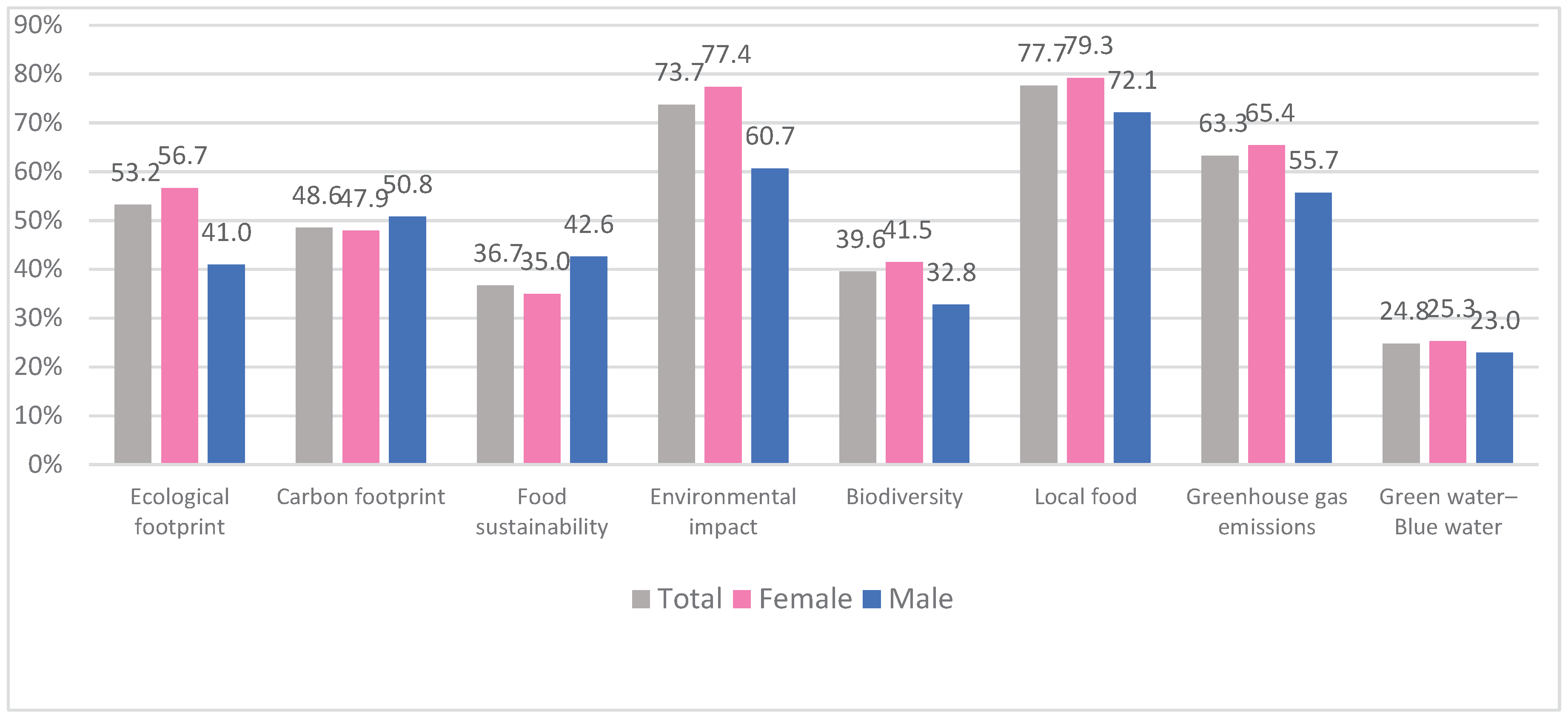

Table 1.
Background and Socio-demographic characteristics of Kuwait University students.
| Categories | % | |
|---|---|---|
| Gender | ||
| Female | 78 | |
| Male | 22 | |
| Age range (years) | ||
| <20 | 48 | |
| 20-22 | 34 | |
| >22 | 18 | |
| Type of Degree | ||
| Bachelor’s degree | 94 | |
| Master’s degree | 6 | |
| Mode of study | ||
| Full-time | 58 | |
| Part-time | 42 | |
| Year of study | ||
| <3rd year | 71 | |
| =>3rd year | 29 | |
| Nationality | ||
| Kuwaiti | 85 | |
| Non-Kuwaiti | 15 | |
| Faculty | ||
| Medical | 18 | |
| Non-medical | 82 | |
| Marital status | ||
| Single | 87 | |
| Married | 11 | |
| Divorced | 1 | |
| Children | ||
| No | 92 | |
| Yes | 8 | |
| Governorate | ||
| Al-Ahmadi | 18 | |
| Capital | 18 | |
| Farwaniya | 24 | |
| Hawali | 15 | |
| Jahra | 10 | |
| Mubarak Al-Kabeer | 12 | |
| Others | 2 | |
| Employment status | ||
| No | 89 | |
| Yes | 12 | |
| Length of Employment | ||
| None | 84 | |
| <=5 years | 10 | |
| >5 years | 5 | |
| Employment sector | ||
| Govt Sector | 9 | |
| Private Sector | 3 | |
| Other | 88 | |
| Income | ||
| None of the above | 42 | |
| <500 KD | 45 | |
| >=500 KD | 13 | |
| BMI | ||
| Non-Obese | 66 | |
| Obese | 34 | |
| Physically active | ||
| No | 36 | |
| Yes | 64 | |
| Physical activity - hrs/week | ||
| <3 hrs/week | 35 | |
| 3-5 hrs/week | 42 | |
| >5 hrs/week | 22 |
Table 2.
Percentage of Kuwait University students that responded “yes” to knowing the terms related to food sustainability, by age groups.
Table 2.
Percentage of Kuwait University students that responded “yes” to knowing the terms related to food sustainability, by age groups.
| Food Sustainability Related Term | Age Groups (in years) | ||||
|---|---|---|---|---|---|
| <20 | 20-22 | >22 | Total | p-value | |
| n = 133 | n = 95 | n = 50 | |||
| Ecological footprint | 44.4 | 57.9 | 68.0 | 53.2 | 0.046 |
| Carbon footprint | 42.1 | 53.7 | 56.0 | 48.6 | 0.295 |
| Food sustainability | 30.1 | 42.1 | 44.0 | 36.7 | 0.079 |
| Environmental impact | 69.2 | 74.7 | 84.0 | 73.7 | 0.277 |
| Biodiversity | 33.1 | 44.2 | 48.0 | 39.6 | 0.006 |
| Local food | 72.9 | 81.1 | 84.0 | 77.7 | 0.454 |
| Greenhouse gas emissions | 58.6 | 68.4 | 66.0 | 63.3 | 0.605 |
| Green water–Blue water | 26.3 | 20.0 | 30.0 | 24.8 | 0.546 |
Notes: Chi square test with significant value p < 0.05.
Table 3.
Mean and Standard Deviation (SD) of Perceived aspects that contribute to a sustainable diet, on a scale 1-5 (1 = not important at all to 5 = very important) among Kuwait University students.
Table 3.
Mean and Standard Deviation (SD) of Perceived aspects that contribute to a sustainable diet, on a scale 1-5 (1 = not important at all to 5 = very important) among Kuwait University students.
| Attribute | Mean | SD |
|---|---|---|
| Low environmental impact | 2.62 | 1.934 |
| Respectful of biodiversity | 2.47 | 1.928 |
| No additives | 1.78 | 1.903 |
| Low processing | 1.98 | 1.947 |
| Few ingredients | 1.72 | 1.744 |
| Organic /ecologic products | 2.88 | 1.884 |
| Plenty of fresh products | 3.53 | 1.806 |
| Diet rich in vegetables | 3.58 | 1.733 |
| Diet typical from own culture | 2.39 | 1.801 |
| Locally produced | 2.79 | 1.757 |
| Affordable | 3.53 | 1.826 |
| Easy to follow | 3.16 | 1.916 |
Table 4.
Perceived impact of food groups on sustainability among Kuwait University students, by gender.
Table 4.
Perceived impact of food groups on sustainability among Kuwait University students, by gender.
| Food type | Gender | I don’t know | Negative impact | Positive impact | P-value |
|---|---|---|---|---|---|
| Vegetables | Female | 13% | 2% | 85% | 0.658 |
| Male | 10% | 3% | 87% | ||
| Meat and its derivatives | Female | 22% | 15% | 63% | 0.032 |
| Male | 10% | 10% | 80% | ||
| Fish, shellfish, and its derivatives | Female | 21% | 11% | 68% | 0.131 |
| Male | 10% | 11% | 79% | ||
| Milk and dairy | Female | 17% | 17% | 66% | 0.252 |
| Male | 13% | 10% | 77% | ||
| Eggs | Female | 21% | 8% | 71% | 0.082 |
| Male | 15% | 2% | 84% | ||
| Processed food | Female | 16% | 76% | 8% | 0.133 |
| Male | 26% | 64% | 10% | ||
| Carbonated and processed drinks | Female | 13% | 81% | 6% | 0.01 |
| Male | 15% | 67% | 18% |
Notes: Chi square test with significant value p < 0.05. Sample size: Females n = 217; males n = 61.
Table 5.
Perceived impact of food groups on sustainability among Kuwait University students, by age group.
Table 5.
Perceived impact of food groups on sustainability among Kuwait University students, by age group.
| Food type | Age group (years) | Don’t know | Negative impact | Positive impact | P-value |
|---|---|---|---|---|---|
| Vegetables | <20 | 17.30% | 0.80% | 82.00% | 0.084 |
| 20-22 | 7.40% | 3.20% | 89.50% | ||
| >22 | 8.00% | 4.00% | 88.00% | ||
| Meat and its derivatives | <20 | 24.10% | 9.00% | 66.90% | 0.052 |
| 20-22 | 16.80% | 15.80% | 67.40% | ||
| >22 | 12.00% | 24.00% | 64.00% | ||
| Fish, shellfish,and its derivatives | <20 | 22.60% | 12.80% | 64.70% | 0.169 |
| 20-22 | 16.80% | 6.30% | 76.80% | ||
| >22 | 12.00% | 14.00% | 74.00% | ||
| Milk and dairy | <20 | 21.10% | 15.00% | 63.90% | 0.167 |
| 20-22 | 10.50% | 13.70% | 75.80% | ||
| >22 | 12.00% | 20.00% | 68.00% | ||
| Eggs | <20 | 23.30% | 6.00% | 70.70% | 0.293 |
| 20-22 | 15.80% | 5.30% | 78.90% | ||
| >22 | 16.00% | 12.00% | 72.00% | ||
| Processed food | <20 | 25.60% | 67.70% | 6.80% | 0.027 |
| 20-22 | 11.60% | 76.80% | 11.60% | ||
| >22 | 10.00% | 82.00% | 8.00% | ||
| Carbonated and processed drinks | <20 | 20.30% | 69.90% | 9.80% | 0.016 |
| 20-22 | 6.30% | 85.30% | 8.40% | ||
| >22 | 8.00% | 86.00% | 6.00% |
Notes: Chi square test with statistical differences between age groups (p ≤ 0.05). Sample size was <20 years n = 133; 20-22 n = 95; >22 n =50.
Table 6.
Importance of water-usage in food production, in a scale of 1-5 (1 - totally disagree; 5 - totally agree), total and by gender.
Table 6.
Importance of water-usage in food production, in a scale of 1-5 (1 - totally disagree; 5 - totally agree), total and by gender.
| Response | 1. Enough water for the planet is granted by the natural cycle of water | 2. Production of meat-based foods require more input of water resources | 3. Production of plant-based foods require more input of water resources | ||||||
|---|---|---|---|---|---|---|---|---|---|
| Gender | Total | Gender | Total | Gender | Total | ||||
| Female | Male | Female | Male | Female | Male | ||||
| I don’t know | 23% | 20% | 22% | 30% | 34% | 31% | 25% | 33% | 27% |
| Do not agree | 9% | 3% | 8% | 13% | 15% | 13% | 5% | 5% | 5% |
| Agree a little | 15% | 13% | 14% | 13% | 10% | 13% | 11% | 7% | 10% |
| Mostly agree | 21% | 18% | 20% | 19% | 18% | 19% | 16% | 11% | 15% |
| Agree | 21% | 30% | 23% | 18% | 11% | 17% | 24% | 26% | 24% |
| Completely agree | 12% | 16% | 13% | 6% | 11% | 8% | 19% | 18% | 19% |
Table 7.
Responses of attitudes towards a sustainable diet on a 5-point Likert scale.
| Response | To what extent are you willing to pay more money for food and drink products that are produced in a sustainable way? | To what extent are you willing to change your current dietary habits toward more sustainability? |
| Not sure/don’t know | 20.9% | 19.4% |
| Not at all | 4.0% | 4.3% |
| Unwilling | 10.1% | 10.1% |
| Moderately willing | 36.7% | 25.9% |
| Quite willing | 16.9% | 21.9% |
| Willing | 11.5% | 18.3% |
| To what extent are you willing to purchase food or drink that is labelled with a low carbon and water footprint? | To what extent are you willing to reduce consumption of a particular food or drink after knowing that it is producing more environmental impact? | |
| Not sure/don’t know | 30.6% | 22.3% |
| Not at all | 3.6% | 3.6% |
| Unwilling | 13.3% | 10.4% |
| Moderately willing | 21.2% | 25.2% |
| Quite willing | 12.2% | 15.8% |
| Willing | 19.1% | 22.7% |
Table 8.
Association between independent variable and dependent variable (Bivariate Analysis).
| Variable | Category | Attitude (DV) | Pearson Chi-square value | p-value | |
|---|---|---|---|---|---|
| Negative (n) | Positive (n) | ||||
| Faculty type | Medical | 10 | 41 | 7.551 | 0.006 |
| Non-medical | 91 | 136 | |||
| Degree level | Bachelor | 95 | 166 | 0.008 | 0.927 |
| Master | 6 | 11 | |||
| Knowledge | Poor | 40 | 73 | 65.78 | <0.001 |
| Good | 137 | 28 | |||
| Year of study | <3rd year | 78 | 119 | 3.112 | 0.078 |
| =>3rd year | 23 | 58 | |||
| Mode of study | Full-time | 53 | 108 | 1.925 | 0.165 |
| Part-time | 48 | 69 | |||
| University accommodation | No | 101 | 175 | 1.15 | 0.284 |
| Yes | 0 | 2 | |||
| Gender | Female | 78 | 139 | 0.064 | 0.801 |
| Male | 23 | 38 | |||
| Age | <20 years old | 58 | 75 | 6.462 | 0.04 |
| 20-22 years old | 26 | 69 | |||
| >22 years old | 17 | 33 | |||
| Nationality | Kuwaiti | 88 | 149 | 0.444 | 0.505 |
| Non-Kuwaiti | 13 | 28 | |||
| Governorate | Capital | 33 | 59 | 8.113 | 0.017 |
| Al-Ahmadi | 40 | 44 | |||
| Al-Farwaniya | 28 | 74 | |||
| Marital status | Single | 88 | 155 | 0.334 | 0.846 |
| Married | 11 | 20 | |||
| Divorced | 2 | 2 | |||
| Children | No | 92 | 163 | 0.085 | 0.771 |
| Yes | 9 | 14 | |||
| Employment status | Unemployed | 92 | 154 | 1.053 | 0.305 |
| Employed | 9 | 23 | |||
| None | 87 | 147 | 2.629 | 0.269 | |
| Length of Employment | <=5 years | 7 | 22 | ||
| >5 years | 7 | 8 | |||
| Employment sector | Govt Sector | 7 | 18 | 1.352 | 0.509 |
| Private Sector | 2 | 6 | |||
| Other | 92 | 153 | |||
| Monthly income | None | 54 | 63 | 8.524 | 0.014 |
| <500 KD | 36 | 90 | |||
| >=500 KD | 11 | 24 | |||
| BMI | Non-Obese | 61 | 121 | 2.182 | 0.14 |
| Obese | 40 | 54 | |||
| Physically active | No | 39 | 61 | 0.481 | 0.488 |
| Yes | 62 | 116 | |||
| Physical activity - hrs/week | <3 hrs/week | 37 | 61 | 0.249 | 0.883 |
| 3-5 hrs/week | 43 | 75 | |||
| >5 hrs/week | 21 | 41 | |||
Note: Chi square test with statistical significant difference of p < 0.05.
Table 9.
Binary logistic regression.
| Independent Variable | B | p-value | OR | 95% C.I.for EXP(B) | |
|---|---|---|---|---|---|
| Lower | Upper | ||||
| Constant | 0.511 | 0.057 | 1.666 | ||
| Income=None of the above(1) | -0.638 | 0.019 | 0.528 | 0.310 | 0.900 |
| BMI=Non-Obese(1) | 0.645 | 0.022 | 1.906 | 1.099 | 3.307 |
| Governorate=Al-Ahmadi(1) | -0.786 | 0.005 | 0.456 | 0.263 | 0.790 |
| Type_College=Medical(1) | 0.959 | 0.016 | 2.608 | 1.194 | 5.698 |
Notes: Significant value p <0.05. Adjusted R2 = 0.21. OR = Odds Ratio.
Disclaimer/Publisher’s Note: The statements, opinions and data contained in all publications are solely those of the individual author(s) and contributor(s) and not of MDPI and/or the editor(s). MDPI and/or the editor(s) disclaim responsibility for any injury to people or property resulting from any ideas, methods, instructions or products referred to in the content. |
© 2023 by the authors. Licensee MDPI, Basel, Switzerland. This article is an open access article distributed under the terms and conditions of the Creative Commons Attribution (CC BY) license (http://creativecommons.org/licenses/by/4.0/).
Copyright: This open access article is published under a Creative Commons CC BY 4.0 license, which permit the free download, distribution, and reuse, provided that the author and preprint are cited in any reuse.


