

Submitted:
27 January 2024
Posted:
29 January 2024
You are already at the latest version
Abstract
The fusion of penetrating peptides (PPs), e.g., cell penetration peptides (CPPs), or antimicrobial peptides (AMPs) together with antimicrobial agents is an expanding research field. Specific AMPs, such as lactoferricin B (LfcinB), have demonstrated strong antibacterial, antifungal, and antiparasitic activity, as well as valuable anticancer activity, proving beneficial in the development of anticancer conjugates. The resulting conjugates offer potential dual functionality, acting as both an anticancer and an antimicrobial agent. This is especially necessary in cancer treatment where microbial infections pose a critical risk. Leukemic cells frequently exhibit altered outer lipid membranes compared to healthy cells, making them more sensitive to compounds that interfere with their membrane. In this communication, we revisited and reanalyzed our earlier research on LfcinB and its conjugates. Furthermore, we carried out new experiments with a specific focus on cell proliferation, changes in membrane asymmetric phosphatidylserine location, intracellular reactive oxygen species (ROS) generation, mitochondrial functions, and in vitro bacterial topoisomerase inhibition.
Keywords:
alternative leukemia treatment
; antileukemic agents
; antimicrobial peptide
; dual-activity compounds
; bioconjugates
; cell penetration peptide
; ciprofloxacin
; hematopoietic stem cell transplantation
; levofloxacin
; lactoferricin B
; fluconazole
; fluoroquinolones.
1. Introduction
The possibility of combining different types of chemical compounds has given rise to the development of new molecules with improved pharmacological characteristics. Among these are peptides and antimicrobial conjugates, which offer expanded molecular targets, reduced toxicity, and the ability to overcome drug resistance when compared to their original substances [1,2,3,4,5,6,7,8]. CPPs and AMPs are two types of PPs that demonstrate not only antimicrobial properties but also anticancer potential [2,4,9,10,11,12,13,14,15,16,17]. Table 1 showcases the functional classification of PPs, and Table 2 outlines the methodology for classification.
The impact of PPs on biological systems can be altered, improved, and prolonged by making structural modifications to the peptide itself or by linking it to other compounds. As previously demonstrated, CPPs like TP10 and its fluoroquinolone conjugates show antibacterial and antileukemic effects, minimal generation of ROS, and a slight impact on mitochondrial functions [8,17]. Crucially, leukemic cells frequently display disturbances in the outer lipid membrane, making them highly sensitive to compounds that interfere with membrane integrity [18,19,20,21,22,23,24,25]. These lipid disturbances have been identified as a cellular target for hematological malignancies [26,27,28,29,30]. Microbial infections are a significant contributing factor to the morbidity and mortality of acute leukemia (AL) patients, with a median incidence reaching around 27% [31]. This issue is particularly pronounced in immune-deficient patients, such as children with acute AL, and older patients with various types of leukemia [32,33,34,35,36]. For this reason, treatment requires the use of immunosuppressive drugs, which in turn increases the risk of microbial infections. The standard antimicrobials employed in this context are ciprofloxacin (CIP) and levofloxacin (LVX) [37,38,39]. It's well established that the ability of CIP and LVX to exhibit antibacterial activity relies on the inhibition of topoisomerase (a mechanism also applied in cancer treatment) [40,41,42]. Unfortunately, both CIP and LVX demonstrate some unwanted effects, including toxicity induced by ROS [43,44,45,46].
Our data, obtained from fluoroquinolones conjugated to TP10 [8,17], as well as chimera peptides composed of human neutrophil peptide (HNP) [43], demonstrate selectivity against both microbes and leukemic cells, as opposed to healthy human cell cultures. To investigate the anticancer efficacy of a PP other than CPPs (TP10 and NHP) combined with antibiotics, we selected lactoffericin B (LfcinB), an AMP with established anticancer activity and low toxicity [47,48,49,50,51,52,53,54]. LfcinB is a shorter version of lactoferrin, and like the original peptide, it demonstrates anticancer properties [55,56,57,58,59,60,61,62].
In this latest update, delving deeper into the previously discussed results regarding the biological effects of LfcinB and its combination with an antibiotic [48], we conducted additional MTT tests specifically for compound 4 (LfcinB covalently linked to fluconazole (FLC)), focusing on the HL60 and HEK293 cell lines. Furthermore, we calculated the Bacteriostatic Selectivity Index (BSI), Fungistatic Selectivity Index (FSI), and Malignancy Selectivity Index (MSI). To assess the basal molecular impact of LfcinB and selected conjugates on bacteria, we examined S. aureus alterations in the membrane asymmetric distribution of phosphatidylserine. Additionally, we conducted in vitro bacterial topoisomerase inhibition assays. Furthermore, we expanded our research on potential toxicity by examining intracellular ROS generation in HL60 and HEK293, and assessing their influence on mitochondrial functions.
Highlighting their leukemic selectivity and antimicrobial activity, along with a minimal impact on ROS generation and mitochondrial function, we have identified an interesting compound, designated as number 3 (disulfide bridge between LfcinB and CIP). This conjugate demonstrates all these properties at an IC50 of a micromolar concentrations and an EC50 (effective concentration; IC normalized to cell number [63]) in the nanomolar range. It is worth noting that conjugate 3 serves as an example of a disulfide connection between parental drugs, representing a promising target for enzymatic reduction.
2. Results
2.1. Inhibition of Cancer Cell Proliferation and EC50 of Lfcin and its Conjugates
To enhance the previously published dataset on the inhibition of cancer cell growth by LfcinB and its conjugates [48], we conducted additional experiments for conjugate 4 on HL60 and HEK293. The antiproliferative effects of LfcinB and its conjugate 4 were evaluated using the MTT assay, and the calculated IC50 values are detailed in Supplementary Table ST1. However, the cellular response to compound 4 for HL60 was approximately 65 μM. It is noteworthy that the IC50 of the leukemic cells was still approximately 2.5 times lower than that observed in healthy HEK293 cells.
When it comes to calculating and comparing EC50 values for LfcinB and all its conjugates (Figure 1a) on HL60, BT20, A549, and HEK293 cell lines, conjugates 1 (covalently bounded LfcinB and LVX) and 3 proved to be the most active against cancer cells, with EC50 ranging from 3 to 69 nM (Supplementary Table ST2). In contrast, conjugate 4 exhibited an EC50 of 108 nM in healthy HEK293 cells. Notably, the FLC conjugate, compared to those containing CIP and LVX, showed approximately twice as high EC50 values on all tested cancer cell lines (Supplementary Table ST2). The most significant growth inhibition was observed for conjugate 3 on HL60, with an EC50 of 3 nM, while the highest values were recorded for LfcinB (499 nM) and conjugate 3 (409 nM) in HEK293. The most sensitive cell line to the action of LfcinB and all tested conjugates was HL60, with EC50 ranging from 3 to 13 nM, and the least sensitive turned out to be HEK293, with EC50 ranging from 108 to 499 nM (Supplementary Table ST2).
2.2. The Biological Selectivity of LfcinB and its Conjugates
2.2.1. Bacteriostatic selectivity
BSI values were analyzed concerning bacteria strains: S. epidermidis, B. subtilis, S. aureus, E. coli, P. aeruginosa, and B. cereus, as well as cell cultures: leukemia (HL60), breast cancer (BT20), nonsmall cell lung cancer (A549), and noncancerous embryonic kidney cells (HEK293), represented by MIC/IC50 (Supplementary Table S2) and BSI indexing as illustrated in Figure 1b.
LfcinB and conjugate 3 demonstrated the most favorable BSI across all tested cell lines and bacterial strains (Figure 1b). S. epidermidis exhibited highly favorable BSI, with BSI >5 and <472, while B. cereus showed the least favorable values with BSI <0.7 and <16 (Figure 1b and Supplementary Table ST2). For HEK293, all BSI calculations for LfcinB and its conjugates indicated high favorability (>2) against all tested strains. Conjugate 3 achieved the best score against S. epidermidis with a BSI >471, and LfcinB showed a BSI >179.
The least favorable index was noted for the HL60 cell line, where, apart from the values for S. epidermidis with BSI ranging from (>6 to <13), the index varied from unfavorable (BSI >0.7), as seen in the case of conjugate 3 on B. cereus, to very good (BSI >13 and <14), as observed with conjugate 2 (alternative disulfide bridge connection between peptide and CIP) on S. epidermidis, but mostly was not more than around 3, mainly ranging approximately around 0.7 (Figure 1b and Supplementary Table ST2). This outcome exhibits that, in HL60, the bacteriostatic effect is less efficient than the cytostatic effect obtained on leukemic cells. For the BT20 cell line, the BSI results were similar to HL60, with the cancer cytostatic effect, especially for conjugates 1 and 2, surpassing the bacteriostatic one (Figure 1b). Notably, the difference in the action of conjugates 2 and particularly 3 (connected by disulfide bonds) between HL60 and BT20 for E. coli, P. aeruginosa, and B. cereus suggests that such a difference in combination might be associated with a more selective cytostatic effect against leukemia (Figure 1b).
2.2.2. Fungistatic selectivity
FSI values were analyzed concerning bacteria strains: C. krusei, C. parapsilosis, C. albicans, C. glabrata, and C. tropicalis as well as cell cultures: HL60 (leukemia), BT20 (breast cancer BT20), nonsmall cell lung cancer (A549), and HEK293 (noncancerous embryonic kidney cells), represented by MIC/IC50 (Supplementary Table S2) and FSI indexing in Figure 1b.
Conjugate 4 (containing FLC) and LfcinB exhibited the most desirable FSI across all tested cell lines and bacterial strains (Figure 1b). C. krusei showed a favorable FSI of >7 and <34, while the other three strains demonstrated lower values with FSI <0.7 and <18 (Figure 1b and Supplementary Table ST2). Similarly, for HEK293, all FSI calculations for LfcinB and its conjugates indicated favorability (>2) against all tested strains. Conjugate 3 exhibited favorable Fsi, ranging from >15 to <31 for all strains.
The least favorable index was noted for HL60 (Figure 1b). The index was mostly unfavorable (FSI > 0.7) or moderate (<0.7 and >1), and very good in the case of C. krusei for compounds 1 and 4, with FSI values of 2.9 and 2.4, respectively. As for BSI, the fungistatic effect was lower than the antiproliferative effect on leukemic culture.
The FSI results for BT20 resembled those for HL60. The main differences observed across all strains were a more favorable FSI for BT20 with LfcinB and conjugate 3, while it was less favorable for conjugate 2. Therefore, as in the case of BSI, the differences in FSI may suggest a more selective cytostatic effect against leukemic cells (Figure 1b).
2.2.3. Malignancy selectivity
To evaluate their effect on leukemia, cancer, and noncancer cells, the Malignancy Selectivity Index was calculated as MSI = EC50 (noncancerous) / EC50 (leukemic or cancerous) or EC50 (leukemic or cancerous) / EC50 (leukemic or cancerous). These data are presented in Supplementary Table ST3 and visualized in Figure 1c. Most compounds displayed higher MSI for cancerous, especially leukemic, cells than for healthy cells (Figure 1c, Supplementary Table ST3).
MSI for all compounds reached their peak for HL60, with a range of between >3 and the highest score <136 obtained for compound 3 on HEK293 (refer to Supplementary Table ST3). LfcinB also displayed promising MSI parameters for HL60, attaining values of between >8 and <52. Furthermore, disulfide bridge conjugates 2 and 3 exhibited higher MSI in HL60 than their counterpart 1 and without the bridge connection (see Figure 1c). HL60 was the only cell line that exhibited favorable MSI across all compounds when compared to the two other cancer cell lines and the noncancerous HEK293 cells. Notably, all the compounds demonstrated selectivity towards healthy cells, indicated by negative MSI (Figure 1c).
2.3. LfcinB and its Conjugates Eliminating Bacteria
2.3.1. Switch the asymmetry in membrane phospholipids
Our study incorporates insights from Dwyer's research, emphasizing that bacteria can display essential characteristics of eukaryotic cell death [64]. In the dot plots shown in Figure 2a (7AAD vs. Annexin V), there is a notable reduction in the number of events in samples treated with compounds compared to the untreated control over 6 hours. Specifically, when compared to LfcinB, the impact of conjugate 3 (at MIC concentrations) is more pronounced, as reflected in a lower number of events from the first hour to 6 hours. At this point in time, we observe essential disturbances in the asymmetric distribution of phosphatidylserine in the membrane (as indicated by the Annexin V level), leading to a loss of integrity (evidenced by 7AAD accumulation) and subsequent cell death. Consequently, the bacteriostatic effect induced by the compound also manifests as bactericidal (Figures 1b and 2a).
2.3.2. DNA gyrase and topoisomerase IV inhibition
Disruptions in the membrane, triggered by the treatment with compounds, result in a loss of cell integrity, enhancing the entry of these compounds into the cell. Our study indicates that topoisomerase IV serves as the primary target for quinolones and their conjugates. We evaluated seven compounds for their inhibitory effects on S. aureus topoisomerases using three assays: gyrase activity, relaxation, and topoisomerase IV activity (Figure 2b). The LfcinB peptide alone exerted the most significant impact on topoisomerase IV relaxation activity, while compound *5 (chimera CH9 of HNP-1; for more details please refer to [43]) demonstrated the highest inhibitory effect among tested compounds (Figure 2b). Notably, LfcinB, when conjugated with CIP, exhibited a relatively high inhibitory effect on all enzyme activities, compared to its connection to LVX (Figure 2b).
2.4. LfcinB and its Conjugates Exhibit Low Toxicity in Human Cell Lines
To verify whether the observed leukemic-selective cytostatic effect is potentially toxic, we expanded our previous studies [48] to include the evaluation of intracellular ROS generation by compound 4 (Figure 2c). Furthermore, we investigated the impact of the selected conjugate on mitochondrial functions (Figure 2d). The ROS-generating activity of conjugate 4 with FLC was evaluated in HL60 and HEK293 cell lines (Figure 3a). We employed the fluorescent CM-H2DCFDA probe for ROS detection, with H2O2 used as a positive control due to its known role as an ROS inducer. Incubation with compound 4 (at 2-fold IC90) resulted in negligible levels of cellular ROS (Figure 2c). Importantly, these findings align with the data reported for conjugates 1–3, as detailed in our earlier publication [48]. The obtained evidence strongly suggests that the cytostatic effect is ROS-independent (Figure 2c). To investigate further, we examined whether the compounds could cause mitochondrial dysfunction. To confirm this, we assessed mitochondrial potential through flow cytometry using HL60 cells stained with DIOC6 and treated with compound 3 (Figure 2d). Our analysis showed that the tested conjugate showed a minimal impact on mitochondrial potential, suggesting a low risk of toxicity in this context.
3. Discussion
Antimicrobial Effect
AMPs are small molecules with positively charged molecules with amphipathic structures. They are found widely in animal tissues and serve as a crucial first line of defense against infections. AMPs exhibit a broad spectrum of activity, mainly targeting bacteria, fungi, and viruses [65], and this phenome extends to LfcinB and its conjugates as well (Figure 1a,b). The primary mode of action involves the direct disruption of microbial cell membranes, selectively binding to negatively charged phospholipid head groups on bacterial membranes [66]. According to our findings, this type of effect occurs not only for LfcinB (Figure 2a). Importantly, AMPs are not attracted to neutral host cell membranes [67]. This effect might have influenced the low activity of all tested compounds against noncancerous HEK293 cells and their significantly higher activity against cancerous and leukemic cells (Figure 1c).
In addition to membrane disruption, AMPs can impact microbial cells through various mechanisms, including interactions with intracellular targets such as nucleic acids or proteins, as well as the disruption of cellular processes. Fluoroquinolones exert their antimicrobial effect by inhibiting two essential enzymes involved in bacterial DNA synthesis: DNA gyrase and topoisomerase IV [68]. DNA gyrase introduces negative supercoils in bacterial DNA, facilitating the separation of daughter chromosomes necessary for replication initiation. Topoisomerase IV is responsible for the decatenation process, separating daughter chromosomes at the end of replication [69,70]. Fluoroquinolones form complexes with either DNA gyrase or topoisomerase IV bound to bacterial DNA, causing conformational changes that deactivate these enzymes. This interference impedes the progression of the replication fork and bacterial DNA synthesis, ultimately leading to rapid bacterial cell death [68]. Figure 2b illustrates the inhibition of the DNA-gyrase in Gram-negative and DNA-topoisomerase IV in Gram-positive bacteria in an in vitro assay induced by fluoroquinolones.
The impact of lactoferrin on gut microbiota and toll-like receptors (TLRs) in mice undergoing microbiota imbalance due to antibiotic treatment was also published [71]. The effects of antibiotic therapy on gut microbiota were explored, emphasizing the potential for dysbiosis, a disruption in microbial balance. The primary focus was on understanding how the composition of gut microbiota and TLR expression was regulated by lactoferrin. Concluding insights underscored the significance of the findings, emphasizing the intricate interplay between lactoferrin, gut microbiota, and the immune system.
Antileukemic Selectivity and Low Potential Toxicity
Leukemic cells, sensitive to compounds disrupting the outer lipid membrane, represent a target for hematological malignancies [72]. As we previously demonstrated with CPP, TP10, and its conjugates with CIP and LVX, these compounds exhibited selective and low toxicity toward leukemic cells [17]. Consequently, certain AMPs may also be active against these cell types. Our research revealed that LfcinB and its conjugates exhibit selectivity towards leukemic cells, antimicrobial activity, and minimal impact on ROS generation and mitochondrial function (Figure 1 and Figure 2 c,d). These AMPs, when combined with antimicrobial agents, demonstrate potential for effectively targeting leukemic cells and managing infections during HCT.
In terms of structure, the distinction between conjugates and a mixture of LfcinB with an antibiotic (CIP or LVX or FLC) is characterized by the presence of a covalent or disulfide bridge bond linking LfcinB to the antibacterial or antifungal agent. In the case of conjugates, the delivery inside cells is coordinated and potentially improved, as the cell membrane can be made permeable by the presence of conjugate oligomers. These conjugates, located within cellular components, serve as effective targets for enzymatic reduction, leading to the subsequent release of individual components within the cell, binding to certain targets and causing damage to cellular pathways. Various mechanisms may contribute to making conjugates more advantageous in vivo, aspects that prove challenging to discern within an in vitro environment. These factors encompass co-targeting specific tissues, heightened metabolic stability, decreased toxicity prior to linker cleavage, and a diminished likelihood of developing resistance during prolonged treatment. It's important to note that these considerations remain speculative until promising candidate drugs are selected for animal studies.
Analyzing data from lactoferrin studies in both rats [73] and humans [74,75,76,77], as well as talactoferrin [78] studies in humans, indicates that LfcinB can be classified as biologically safe. There were no reported hematological, hepatic, or renal toxicities during therapy. Notably, 88% of patients observed a reduction in their tumor growth rate. The research also revealed a positive correlation with the immune system through binding mechanisms [79,80]. LfcinB demonstrates potential immunomodulatory functions, influencing the host's immune response. By enhancing the immune system's ability to recognize and eliminate pathogens, LfcinB contributes to overall biological safety by fortifying the body's natural defense mechanisms. The peptide's stability and resistance to enzymatic degradation further contribute to its biological safety. These characteristics ensure the sustained availability of LfcinB at the site of action, optimizing its therapeutic efficacy while minimizing potential systemic side effects.
4. Materials and Methods
4.1. Drugs
The following compounds were purchased from Sigma-Aldrich (USA): 7-aminoactinomycin (Cat. A9400), CCCP (Cat. 215911), ciprofloxacin (Cat. 17850), levofloxacin (Cat. 1362103), DMSO (Cat. D8418), LfcinB, and conjugates 1–4 were synthesized using the method detailed in our previous work [48]. The characterizations of these conjugates, including HPLC purities and mass spectroscopy, are presented in Supplementary Table ST5 and Supplementary Figure S1. Compound *5 was synthesized according to the procedure described in Ptaszyńska et al. (2018). All drugs were dissolved in DMSO at concentrations ranging from 2 to 10 mM and stored at −20 °C. 7-AAD was dissolved in MeOH:H2O (4:6) and stored at 4 °C.
4.2. Cell Cultures
HL60, CEM, and A-549 were acquired from ATCC. HL60 was cultured in RPMI-1640 medium (Cat. R5158, Merck) and HEK293 Eagle’s Minimum Essential Medium (Cat. M5775, Merck). Both lines were supplemented with 10% FBS (Cat. F7524, Sigma-Aldrich), 2 mM L-glutamine (Cat. G8540, Sigma-Aldrich), and the antibiotics penicillin (100 U/mL) and streptomycin (100 mg/mL) at 37 °C in a humidified atmosphere of 5% CO2 and 95% air. Cell lines were routinely screened for mycoplasma contamination. Cell density was measured using Coulter Z2 (Beckman, USA) equipped with a 100 µm aperture or using the flow cytometer Guava EasyCyte 8HT (Merck-Millipore, USA).
4.3. Determination of Drug Cytotoxicity
As mentioned in [61], we followed detailed procedures, including the composition of media and growth conditions, for the application of conjugate 4 on both HL60 and HEK293 in the MTT drug sensitivity assay. The initial cellular density for cultures seeded in a 96-well plate was 5000 cells/well for HL60 and 1500 cells/well for HEK293.
4.4. Switch of S. Aureus Asymmetric Phosphatidylserine Location
Bacterial cultures with an OD200, as utilized in bacteriostatic experiments (Ptaszyńska et al., 2019), were plated on Petri dishes. Compounds were added at the MIC concentration to the test sample, while no compound was added to the negative control. After an appropriate incubation period (45 min, 2.45 min, and 5.45 min), samples were collected and promptly washed with PBS. The pellet was then suspended in 100 μL of annexin binding buffer (BioSource International), which included 0.25 μL of 7-AAD (7-aminoactinomycin D, 1 mg/mL, Sigma) and 1 μL of Annexin-FITC (Thermo Fisher). Following the addition of 400 μL of annexin binding buffer, the samples were left in the dark for 15 min. Subsequently, the samples were placed on ice and immediately read by the Guava EasyCyte (Merck-Millipore, Burlington, MA, USA). Flow results were analyzed with the free online software https://floreada.io/ (accessed in November 2023; the last update was carried out in June 2023).
4.5. Inhibition of S. Aureus Gyrase and Topoisomerase IV Activities
Inhibitory concentrations for three gyrase and topoisomerase IV activities were assessed: gyrase supercoiling, TOPO IV relaxation, and TOPO IV decatenation. For this, commercially available kits were used (S. aureus gyrase supercoiling assay kit, S. aureus topoisomerase IV relaxation assay kit, and topoisomerase IV decatenation kit all purchased from Inspiralis (UK)). The procedure was carried out according to the manufacturer’s instructions. The substrates for the reactions were: 500 ng of the relaxed pBR322 plasmid, 500 ng of supercoiled pBR322, or 200 ng of kinetoplast DNA (kDNA) from Crithidia fasciculate, respectively. The studied compounds were dissolved and diluted in dd H2O at the experimentally selected concentrations (gyrase: 2000–250 μM for CIP, 1000–50 μM – LVX, 500–50 μM conjugates, topoisomerase: 500–5 μM CIP/LVX, 250–10 μM – conjugates). Appropriate controls were included (with or without the enzyme or without the addition of the tested compound). After the addition of the indicated amount of the enzyme, the reaction proceeded at 37 °C for 30 min. Loading buffer was used for reaction termination. The studied compounds were extracted from the reaction mixtures with 30 µL of chloroform/isoamyl alcohol solution (24:1; v/v). After centrifugation (3 min, 20,000 g), the upper aqueous phase was loaded on 1% agarose gels and run at 90 V for 4 hours in TBE buffer (90 mM Tris-base, 70 mM boric acid, 1 mM EDTA, pH 8). Gels were stained with 1 μg/mL ethidium bromide (Sigma, USA) for 15 min to visualize DNA, and unbound ethidium bromide was removed by washing gel in dd H2O for 15 min.
4.6. Intracellular ROS Generation
Cell lines were cultured as mentioned above and seeded in Petri dishes (Falcon, USA) in the amount of 25x103 per Φ35 dish. HEK293 cells were allowed to attach overnight. ROS generation potential was tested for selected compounds after 0.25, 0.5, 1, 3, 6, and 24 h of incubation. CM-H2DCFDA molecular probe (Thermo Fisher Scientific, Waltham, USA) at a final concentration of 1 µM was added 15 min before the analysis. After staining, HEK293 cells were trypsinized, harvested, and suspended in fresh media. 7AAD (Cat. A9400, Sigma Aldrich) was added just before analysis. Analyses were carried out with a Guava EasyCyte flow cytometer (Merck-Millipore, USA). Flow cytometry data were processed with Flowing Software 2.5.1 (Turku Bioscience, Finland).
4.7. Investigation of Mitochondrial Potential
HL60 was incubated with 100 nM 3,3`-dihexyloxacarbocyanine iodide (DiOC6) (Cat. D273, Thermo Fisher Scientific). Cells were stained under culture conditions for 15 min, washed with prewarmed PBS, and examed by Guava EasyCyte flow cytometer (Merck-Millipore, USA). Results of flow cytometry were analyzed with Flowing Software 2.5.1 (Turku Bioscience, Finland).
5. Conclusions
Combining PPs with antimicrobial agents shows potential for effectively targeting leukemic cells and addressing infections during HCT. So far, there haven't been similar applications of such compounds in leukemia treatment. The conventional approach, as seen in AML, still relies on the use of nonspecific therapies while simultaneously aiming for autologous transplantation. In the processes of conditioning, myeloablation, and immunosuppression, cytostatics like cyclophosphamide [82,83,84,85,86,87] and preventive antibiotics such as CIP or LVX are employed. Cyclophosphamide exhibits low selectivity, and the administration of antibiotics is combined with it, resulting in a less intense synergistic effect and less tissue-specific availability compared to LfcinB. We believe that our research will involve the generation of new structures successfully applicable in the development of therapy for treating leukemia and infections. The optimization of these structures can occur through the careful selection of the PP type and the attached bacterial or anticancer compound.
Supplementary Materials
The following supporting information can be downloaded at the website of this paper posted on Preprints.org.
Author Contributions
Conceptualization, J.J.L., K.G., M.H., A.S., N.P., A.Ł., B.P., J.J.B. and K.R.; methodology, J.J.L., K.G., A.S. and M.H.; software, J.J.L, K.G. and M.H.; validation, J.J.L., K.G., A.S. and M.H.; formal analysis, J.J.B. and K.R.; investigation, J.J.L, K.G., M.H., A.S., J.J.B. and K.R.; resources, K.R.; data curation, J.J.L., K.G. and M.H.; writing—original draft preparation, J.J.L., K.G., M.H., A.S., N.P., A.Ł., B.P., N.M., A.G.D., D.D., J.J.B. and K.R.; visualization, J.J.L. and K.G.; supervision, J.J.L. and K.R.; project administration, J.J.L. and K.R.; funding acquisition, K.R.
Funding
This work was supported by the National Science Centre (NCN, Poland) under grant no. UMO-2016/21/B/ST5/00101
Institutional Review Board Statement
Not applicable.
Informed Consent Statement
Not applicable.
Data Availability Statement
The authors declare that all the imaging and biological data supporting the findings of this study are available within the paper and its Supplemental Data.
Conflicts of Interest
The authors declare no conflict of interest.
References
- Duan, Z.; Chen, C.; Qin, J.; Liu, Q.; Wang, Q.; Xu, X.; Wang, J. Cell-penetrating peptide conjugates to enhance the antitumor effect of paclitaxel on drug-resistant lung cancer. Drug delivery 2017, 24, 752–764. [Google Scholar] [CrossRef] [PubMed]
- Felício, M.R.; Silva, O.N.; Gonçalves, S.; Santos, N.C.; Franco, O.L. Peptides with Dual Antimicrobial and Anticancer Activities. Frontiers in chemistry 2017, 5, 5. [Google Scholar] [CrossRef]
- Ruczyński, J. , Rusiecka, I., Turecka, K., Kozłowska, A., Alenowicz, M., Gągało, I., Kawiak, A., Rekowski, P., Waleron, K., & Kocić, I. Transportan 10 improves the pharmacokinetics and pharmacodynamics of vancomycin. Scientific reports 2019, 9, 3247. [Google Scholar] [CrossRef] [PubMed]
- Tornesello, A.L.; Borrelli, A.; Buonaguro, L.; Buonaguro, F.M.; Tornesello, M.L. Antimicrobial Peptides as Anticancer Agents: Functional Properties and Biological Activities. Molecules 2020, 25, 2850. [Google Scholar] [CrossRef] [PubMed]
- Reissmann, S.; Filatova, M.P. New generation of cell-penetrating peptides: Functionality and potential clinical application. Journal of peptide science: an official publication of the European Peptide Society 2021, 27, e3300. [Google Scholar] [CrossRef]
- Xie, J.; Bi, Y.; Zhang, H.; Dong, S.; Teng, L.; Lee, R.J.; Yang, Z. Cell-Penetrating Peptides in Diagnosis and Treatment of Human Diseases: From Preclinical Research to Clinical Application. Frontiers in pharmacology 2020, 11, 697. [Google Scholar] [CrossRef]
- Zeiders, S.M.; Chmielewski, J. Antibiotic-cell-penetrating peptide conjugates targeting challenging drug-resistant and intracellular pathogenic bacteria. Chemical biology & drug design 2021, 98, 762–778. [Google Scholar] [CrossRef]
- Lica, J.J.; Heldt, M.; Wieczór, M.; Chodnicki, P.; Ptaszyńska, N.; Maciejewska, N.; Łęgowska, A.; Brankiewicz, W.; Gucwa, K.; Stupak, A.; Pradhan, B.; Gitlin-Domagalska, A.; Dębowski, D.; Milewski, S.; Bieniaszewska, M.; Grabe, G.J.; Hellmann, A.; Rolka, K. Dual-Activity Fluoroquinolone-Transportan 10 Conjugates Offer Alternative Leukemia Therapy during Hematopoietic Cell Transplantation. Molecular pharmacology 2023, 105, 39–53. [Google Scholar] [CrossRef] [PubMed]
- Rusiecka, I.; Jarosław, R.; Magdalena, A.; Piotr, R.; Ivan, K. Transportan 10 improves the anticancer activity of cisplatin. Naunyn-Schmiedeberg's archives of pharmacology 2016, 389, 485–497. [Google Scholar] [CrossRef]
- Feni, L.; Neundorf, I. The Current Role of Cell-Penetrating Peptides in Cancer Therapy. Advances in experimental medicine and biology 2017, 1030, 279–295. [Google Scholar] [CrossRef]
- Zhang, F.; Yang, D.; Jiang, S.; Wu, L.; Qin, L.; He, H.; Zhang, P. Current Delivery Strategies to Improve the Target of Cell Penetrating Peptides Used for Tumor-Related Therapeutics. Current pharmaceutical design 2018, 24, 541–548. [Google Scholar] [CrossRef]
- Habault, J.; Poyet, J.L. Recent Advances in Cell Penetrating Peptide-Based Anticancer Therapies. Molecules 2019, 24, 927. [Google Scholar] [CrossRef]
- Burdukiewicz, M.; Sidorczuk, K.; Rafacz, D.; Pietluch, F.; Bąkała, M.; Słowik, J.; Gagat, P. CancerGram: An Effective Classifier for Differentiating Anticancer from Antimicrobial Peptides. Pharmaceutics 2020, 12, 1045. [Google Scholar] [CrossRef]
- Zorko, M.; Jones, S.; Langel, Ü. Cell-penetrating peptides in protein mimicry and cancer therapeutics. Advanced drug delivery reviews 2022, 180, 114044. [Google Scholar] [CrossRef]
- Rusiecka, I. , Gągało, I., & Kocić, I. Cell-penetrating peptides improve pharmacokinetics and pharmacodynamics of anticancer drugs. Tissue barriers 2022, 10, 1965418. [Google Scholar] [CrossRef]
- Zhou, M.; Zou, X.; Cheng, K.; Zhong, S.; Su, Y.; Wu, T.; Tao, Y.; Cong, L.; Yan, B.; Jiang, Y. The role of cell-penetrating peptides in potential anti-cancer therapy. Clinical and translational medicine 2022, 12, e822. [Google Scholar] [CrossRef]
- Ptaszyńska, N.; Gucwa, K.; Olkiewicz, K.; Heldt, M.; Serocki, M.; Stupak, A.; Martynow, D.; Dębowski, D.; Gitlin-Domagalska, A.; Lica, J.; Łęgowska, A.; Milewski, S.; Rolka, K. Conjugates of Ciprofloxacin and Levofloxacin with Cell-Penetrating Peptide Exhibit Antifungal Activity and Mammalian Cytotoxicity. International journal of molecular sciences 2020, 21, 4696. [Google Scholar] [CrossRef]
- Klock, J.C.; Pieprzyk, J.K. Cholesterol, phospholipids, and fatty acids of normal immature neutrophils: comparison with acute myeloblastic leukaemia cells and normal neutrophils. Journal of lipid research 1979, 20, 908–911. [Google Scholar] [CrossRef]
- Sánchez-Martín, C.C.; Dávalos, A.; Martín-Sánchez, C.; de la Peña, G.; Fernández-Hernando, C.; Lasunción, M.A. Cholesterol starvation induces differentiation of human leukemia HL60 cells. Cancer research 2007, 67, 3379–3386. [Google Scholar] [CrossRef]
- Nirmalanandhan, V.S.; Hurren, R.; Cameron, W.D.; Gronda, M.; Shamas-Din, A.; You, L.; Minden, M.D.; Rocheleau, J.V.; Schimmer, A.D. Increased pressure alters plasma membrane dynamics and renders acute myeloid leukemia cells resistant to daunorubicin. Haematologica 2015, 100, e406–e408. [Google Scholar] [CrossRef]
- Morel, S.; Leahy, J.; Fournier, M.; Lamarche, B.; Garofalo, C.; Grimard, G.; Poulain, F.; Delvin, E.; Laverdière, C.; Krajinovic, M.; Drouin, S.; Sinnett, D.; Marcil, V.; Levy, E. Lipid and lipoprotein abnormalities in acute lymphoblastic leukemia survivors. Journal of lipid research 2017, 58, 982–993. [Google Scholar] [CrossRef]
- Sun, L. , Shi, Y. , Wang, G., Wang, X., Zeng, S., Dunn, S. E., Fairn, G. D., Li, Y. J., & Spaner, D. E. PPAR-delta modulates membrane cholesterol and cytokine signaling in malignant B cells. Leukemia 2018, 32, 184–193. [Google Scholar] [CrossRef]
- Zhao, L.; Zhan, H.; Jiang, X.; Li, Y.; Zeng, H. The role of cholesterol metabolism in leukemia. Blood science (Baltimore, Md.) 2019, 1, 44–49. [Google Scholar] [CrossRef]
- Giacomini, I.; Gianfanti, F.; Desbats, M.A.; Orso, G.; Berretta, M.; Prayer-Galetti, T.; Ragazzi, E.; Cocetta, V. Cholesterol Metabolic Reprogramming in Cancer and Its Pharmacological Modulation as Therapeutic Strategy. Frontiers in oncology 2021, 11, 682911. [Google Scholar] [CrossRef]
- Mehta, A.; Ratre, Y.K.; Soni, V.K.; Shukla, D.; Sonkar, S.C.; Kumar, A.; Vishvakarma, N.K. Orchestral role of lipid metabolic reprogramming in T-cell malignancy. Frontiers in oncology 2023, 13, 1122789. [Google Scholar] [CrossRef]
- Li, H.Y.; Appelbaum, F.R.; Willman, C.L.; Zager, R.A.; Banker, D.E. Cholesterol-modulating agents kill acute myeloid leukaemia cells and sensitize them to therapeutics by blocking adaptive cholesterol responses. Blood 2003, 101, 3628–3634. [Google Scholar] [CrossRef]
- Hilchie, A.L.; Vale, R.; Zemlak, T.S.; Hoskin, D.W. Generation of a hematologic malignancy-selective membranolytic peptide from the antimicrobial core (RRWQWR) of bovine lactoferricin. Experimental and molecular pathology 2013, 95, 192–198. [Google Scholar] [CrossRef]
- Li, K.; Lv, X.X.; Hua, F.; Lin, H.; Sun, W.; Cao, W.B.; Fu, X.M.; Xie, J.; Yu, J.J.; Li, Z.; Liu, H.; Han, M.Z.; Hu, Z.W. Targeting acute myeloid leukemia with a proapoptotic peptide conjugated to a Toll-like receptor 2-mediated cell-penetrating peptide. International journal of cancer 2014, 134, 692–702. [Google Scholar] [CrossRef]
- Maja, M.; Tyteca, D. Alteration of cholesterol distribution at the plasma membrane of cancer cells: From evidence to pathophysiological implication and promising therapy strategy. Frontiers in physiology 2022, 13, 999883. [Google Scholar] [CrossRef]
- Brendolan, A.; Russo, V. Targeting cholesterol homeostasis in hematopoietic malignancies. Blood 2022, 139, 165–176. [Google Scholar] [CrossRef] [PubMed]
- Torres-Flores, J.; Espinoza-Zamora, R.; Garcia-Mendez, J.; Cervera-Ceballos, E.; Sosa-Espinoza, A.; Zapata-Canto, N. Treatment-Related Mortality From Infectious Complications in an Acute Leukemia Clinic. Journal of hematology 2020, 9, 123–131. [Google Scholar] [CrossRef]
- O'Connor, D.; Bate, J.; Wade, R.; Clack, R.; Dhir, S.; Hough, R.; Vora, A.; Goulden, N.; Samarasinghe, S. Infection-related mortality in children with acute lymphoblastic leukemia: an analysis of infectious deaths on UKALL2003. Blood 2014, 124, 1056–1061. [Google Scholar] [CrossRef]
- Dandoy, C.E.; Ardura, M.I.; Papanicolaou, G.A.; Auletta, J.J. Bacterial bloodstream infections in the allogeneic hematopoietic cell transplant patient: new considerations for a persistent nemesis. Bone marrow transplantation 2017, 52, 1091–1106. [Google Scholar] [CrossRef]
- Wang, C.H.; Chang, F.Y.; Chao, T.Y.; Kao, W.Y.; Ho, C.L.; Chen, Y.C.; Dai, M.S.; Chang, P.Y.; Wu, Y.Y.; Lin, J.C. Characteristics comparisons of bacteremia in allogeneic and autologous hematopoietic stem cell-transplant recipients with levofloxacin prophylaxis and influence on resistant bacteria emergence. Journal of microbiology, immunology, and infection 2018, 51, 123–131. [Google Scholar] [CrossRef]
- Peterson, S.L.; Priddy, E.; Dong, B.Y.; Ghazi, C.A.; Dinglasan LA, V. Evaluation of Infection Risk Factors in Adult Hematologic Malignancy Patients. Biology of Blood and Marrow Transplantation 2019, 25, S347. [Google Scholar] [CrossRef]
- Chen, L.; Zheng, Y.; Yu, K.; Chen, S.; Wang, W.; Gale, R.P.; Liu, Z.X.; Liang, Y. Changing causes of death in persons with haematological cancers 1975-2016. Leukemia 2022, 36, 1850–1860. [Google Scholar] [CrossRef]
- Sezgin Evim, M. , Tüfekçi, Ö. , Baytan, B., Ören, H., Çelebi, S., Ener, B., Üstün Elmas, K., Yılmaz, Ş., Erdem, M., Hacımustafaoğlu, M. K., & Güneş, A. M. Invasive Fungal Infections in Children with Leukemia: Clinical Features and Prognosis. Turkish journal of haematology : official journal of Turkish Society of Haematology 2022, 39, 94–102. [Google Scholar] [CrossRef]
- Patel, B.; Noda, A.; Godbout, E.; Stevens, M.; Noda, C. Levofloxacin for Antibacterial Prophylaxis in Pediatric Patients With Acute Myeloid Leukaemia or Undergoing Hematopoietic Stem Cell Transplantation. The journal of pediatric pharmacology and therapeutics : JPPT : the official journal of PPAG 2020, 25, 629–635. [Google Scholar] [CrossRef]
- Gardner, J.C.; Courter, J.D.; Dandoy, C.E.; Davies, S.M.; Teusink-Cross, A. Safety and Efficacy of Prophylactic Levofloxacin in Pediatric and Adult Hematopoietic Stem Cell Transplantation Patients. Transplantation and cellular therapy 2022, 28, 167.e1–167.e5. [Google Scholar] [CrossRef]
- Hooper, D.C. Mechanisms of action of antimicrobials: focus on fluoroquinolones. Clinical infectious diseases : an official publication of the Infectious Diseases Society of America 2001, 32 Suppl. 1, S9–S15. [Google Scholar] [CrossRef]
- Blondeau, J.M. Fluoroquinolones: mechanism of action, classification, and development of resistance. Survey of ophthalmology 2004, 49 Suppl 2, S73–S78. [Google Scholar] [CrossRef]
- Redgrave, L.S.; Sutton, S.B.; Webber, M.A.; Piddock, L.J. Fluoroquinolone resistance: mechanisms, impact on bacteria, and role in evolutionary success. Trends in microbiology 2014, 22, 438–445. [Google Scholar] [CrossRef]
- Ptaszyńska, N.; Gucwa, K.; Łęgowska, A.; Dębowski, D.; Gitlin-Domagalska, A.; Lica, J.; Heldt, M.; Martynow, D.; Olszewski, M.; Milewski, S.; Ng, T.B.; Rolka, K. Antimicrobial Activity of Chimera Peptides Composed of Human Neutrophil Peptide 1 (HNP-1) Truncated Analogues and Bovine Lactoferrampin. Bioconjugate chemistry 2018, 29, 3060–3071. [Google Scholar] [CrossRef]
- Michalak, K.; Sobolewska-Włodarczyk, A.; Włodarczyk, M.; Sobolewska, J.; Woźniak, P.; Sobolewski, B. Treatment of the Fluoroquinolone-Associated Disability: The Pathobiochemical Implications. Oxidative medicine and cellular longevity 2017, 2017, 8023935. [Google Scholar] [CrossRef]
- Hussen NH, A.; Qadir, S.H.; Rahman, H.S.; Hamalaw, Y.Y.; Kareem PS, S.; Hamza, B.A. Long-term toxicity of fluoroquinolones: a comprehensive review. Drug and chemical toxicology 2023, 1–12, Advance online publication. [Google Scholar] [CrossRef]
- Du, J.; Liu, Q.; Pan, Y.; Xu, S.; Li, H.; Tang, J. The Research Status, Potential Hazards and Toxicological Mechanisms of Fluoroquinolone Antibiotics in the Environment. Antibiotics (Basel, Switzerland) 2023, 12, 1058. [Google Scholar] [CrossRef]
- Furlund, C.B.; Ulleberg, E.K.; Devold, T.G.; Flengsrud, R.; Jacobsen, M.; Sekse, C.; Holm, H.; Vegarud, G.E. Identification of lactoferrin peptides generated by digestion with human gastrointestinal enzymes. Journal of dairy science 2013, 96, 75–88. [Google Scholar] [CrossRef]
- Ptaszyńska, N.; Olkiewicz, K.; Okońska, J.; Gucwa, K.; Łęgowska, A.; Gitlin-Domagalska, A.; Dębowski, D.; Lica, J.; Heldt, M.; Milewski, S.; Ng, T.B.; Rolka, K. Peptide conjugates of lactoferricin analogues and antimicrobials-Design, chemical synthesis, and evaluation of antimicrobial activity and mammalian cytotoxicity. Peptides 2019, 117, 170079. [Google Scholar] [CrossRef]
- Shah, P.; Wu, W.S.; Chen, C.S. Systematical Analysis of the Protein Targets of Lactoferricin B and Histatin-5 Using Yeast Proteome Microarrays. International journal of molecular sciences 2019, 20, 4218. [Google Scholar] [CrossRef]
- Ligtenberg, A. J. M. , Bikker, F. J., & Bolscher, J. G. M. LFchimera: a synthetic mimic of the two antimicrobial domains of bovine lactoferrin. Biochemistry and cell biology = Biochimie et biologie cellulaire 2021, 99, 128–137. [Google Scholar] [CrossRef]
- Ostrówka, M.; Duda-Madej, A.; Pietluch, F.; Mackiewicz, P.; Gagat, P. Testing Antimicrobial Properties of Human Lactoferrin-Derived Fragments. International journal of molecular sciences 2023, 24, 10529. [Google Scholar] [CrossRef]
- Aslanli, A.; Domnin, M.; Stepanov, N.; Efremenko, E. Synergistic Antimicrobial Action of Lactoferrin-Derived Peptides and Quorum Quenching Enzymes. International journal of molecular sciences 2023, 24, 3566. [Google Scholar] [CrossRef]
- Ohradanova-Repic, A. , Praženicová, R., Gebetsberger, L., Moskalets, T., Skrabana, R., Cehlar, O., Tajti, G., Stockinger, H., & Leksa, V. Time to Kill and Time to Heal: The Multifaceted Role of Lactoferrin and Lactoferricin in Host Defense. Pharmaceutics 2023, 15, 1056. [Google Scholar] [CrossRef]
- Wu, J.; Zang, M.; Wang, S.; Qiao, X.; Zhao, B.; Bai, J.; Zhao, Y.; Shi, Y. Lactoferricin, an antimicrobial motif derived from lactoferrin with food preservation potential. Critical reviews in food science and nutrition 2023, 1–13. Advance online publication. [CrossRef]
- Duarte, D.C.; Nicolau, A.; Teixeira, J.A.; Rodrigues, L.R. The effect of bovine milk lactoferrin on human breast cancer cell lines. Journal of dairy science 2011, 94, 66–76. [Google Scholar] [CrossRef]
- Arias, M.; Hilchie, A.L.; Haney, E.F.; Bolscher, J.G.; Hyndman, M.E.; Hancock, R.E.; Vogel, H.J. Anticancer activities of bovine and human lactoferricin-derived peptides. Biochemistry and cell biology = Biochimie et biologie cellulaire 2017, 95, 91–98. [Google Scholar] [CrossRef]
- Chea, C.; Haing, S.; Miyauchi, M.; Shrestha, M.; Imanaka, H.; Takata, T. Molecular mechanisms underlying the inhibitory effects of bovine lactoferrin on osteosarcoma. Biochemical and biophysical research communications 2019, 508, 946–952. [Google Scholar] [CrossRef]
- Ramírez-Sánchez, D.A.; Arredondo-Beltrán, I.G.; Canizalez-Roman, A.; Flores-Villaseñor, H.; Nazmi, K.; Bolscher JG, M.; León-Sicairos, N. Bovine lactoferrin and lactoferrin peptides affect endometrial and cervical cancer cell lines. Biochemistry and cell biology = Biochimie et biologie cellulaire 2021, 99, 149–158. [Google Scholar] [CrossRef]
- Rocha, V.P.; Campos SP, C.; Barros, C.A.; Trindade, P.; Souza LR, Q.; Silva, T.G.; Gimba ER, P.; Teodoro, A.J.; Gonçalves, R.B. Bovine Lactoferrin Induces Cell Death in Human Prostate Cancer Cells. Oxidative medicine and cellular longevity 2022, 2022, 2187696. [Google Scholar] [CrossRef]
- Chea, C.; Miyauchi, M.; Inubushi, T.; Okamoto, K.; Haing, S.; Takata, T. Molecular Mechanisms of Inhibitory Effects of Bovine Lactoferrin on Invasion of Oral Squamous Cell Carcinoma. Pharmaceutics 2023, 15, 562. [Google Scholar] [CrossRef]
- Arredondo-Beltrán, I.G.; Ramírez-Sánchez, D.A.; Zazueta-García, J.R.; Canizalez-Roman, A.; Angulo-Zamudio, U.A.; Velazquez-Roman, J.A.; Bolscher JG, M.; Nazmi, K.; León-Sicairos, N. Antitumor activity of bovine lactoferrin and its derived peptides against HepG2 liver cancer cells and Jurkat leukemia cells. Biometals : an international journal on the role of metal ions in biology, biochemistry, and medicine 2023, 36, 639–655. [Google Scholar] [CrossRef] [PubMed]
- Ghaly, G.; Tallima, H.; Dabbish, E.; Badr ElDin, N.; Abd El-Rahman, M.K.; Ibrahim MA, A.; Shoeib, T. Anti-Cancer Peptides: Status and Future Prospects. Molecules (Basel, Switzerland) 2023, 28, 1148. [Google Scholar] [CrossRef] [PubMed]
- Lica, J.J.; Wieczór, M.; Grabe, G.J.; Heldt, M.; Jancz, M.; Misiak, M.; Gucwa, K.; Brankiewicz, W.; Maciejewska, N.; Stupak, A.; Bagiński, M.; Rolka, K.; Hellmann, A.; Składanowski, A. Effective Drug Concentration and Selectivity Depends on Fraction of Primitive Cells. International journal of molecular sciences 2021, 22, 4931. [Google Scholar] [CrossRef] [PubMed]
- Dwyer, D.J.; Collins, J.J.; Walker, G.C. Unraveling the physiological complexities of antibiotic lethality. Annual Review of Pharmacology and Toxicology 2014, 55, 313–332. [Google Scholar] [CrossRef] [PubMed]
- Xia, X.; Cheng, L.; Zhang, S.; Wang, L.; Hu, J. The role of natural antimicrobial peptides during infection and chronic inflammation. Antonie Van Leeuwenhoek 2018, 111, 5–26. [Google Scholar] [CrossRef] [PubMed]
- Hilchie, A.L.; Wuerth, K.; Hancock, R.E. Immune modulation by multifaceted cationic host defense (antimicrobial) peptides. Nature Chemical Biology 2013, 9, 761–768. [Google Scholar] [CrossRef] [PubMed]
- Pirtskhalava, M.; Vishnepolsky, B.; Grigolava, M.; Managadze, G. Physicochemical Features and Peculiarities of Interaction of AMP with the Membrane. Pharmaceuticals 2021, 14, 471. [Google Scholar] [CrossRef]
- Hooper, D.C.; Jacoby, G.A. Topoisomerase Inhibitors: Fluoroquinolone Mechanisms of Action and Resistance. Cold Spring Harbor Perspectives in Medicine 2016, 6, a025320. [Google Scholar] [CrossRef]
- Gubaev, A.; Klostermeier, D. The mechanism of negative DNA supercoiling: a cascade of DNA-induced conformational changes prepares gyrase for strand passage. DNA Repair (Amst) 2014, 16, 23–34. [Google Scholar] [CrossRef] [PubMed]
- Helgesen, E.; Sætre, F.; Skarstad, K. Topoisomerase IV tracks behind the replication fork and the SeqA complex during DNA replication in Escherichia coli. Scientific Reports 2021, 11, 474. [Google Scholar] [CrossRef]
- Bellés, A. , Aguirre-Ramírez, D., Abad, I., Parras-Moltó, M., Sánchez, L., & Grasa, L. Lactoferrin modulates gut microbiota and Toll-like receptors (TLRs) in mice with dysbiosis induced by antibiotics. Food & function 2022, 13, 5854–5869. [Google Scholar] [CrossRef]
- Arrouss, I.; Decaudin, D.; Choquet, S.; Azar, N.; Parizot, C.; Zini, J.M.; Nemati, F.; Rebollo, A. Cell penetrating peptides as a therapeutic strategy in chronic lymphocytic leukemia. Protein and Peptide Letters 2015, 22, 539–546. [Google Scholar] [CrossRef]
- Yamauchi, K. , Toida, T. , Nishimura, S., Nagano, E., Kusuoka, O., Teraguchi, S., Hayasawa, H., Shimamura, S., & Tomita, M. 13-Week oral repeated administration toxicity study of bovine lactoferrin in rats. Food and chemical toxicology : an international journal published for the British Industrial Biological Research Association 2000, 38, 503–512. [Google Scholar] [CrossRef]
- Siqueiros-Cendón, T.; Arévalo-Gallegos, S.; Iglesias-Figueroa, B.F.; García-Montoya, I.A.; Salazar-Martínez, J.; Rascón-Cruz, Q. Immunomodulatory effects of lactoferrin. Acta pharmacologica Sinica 2014, 35, 557–566. [Google Scholar] [CrossRef]
- Presti, S.; Manti, S.; Parisi, G.F.; Papale, M.; Barbagallo, I.A.; Li Volti, G.; Leonardi, S. Lactoferrin: Cytokine Modulation and Application in Clinical Practice. Journal of clinical medicine 2021, 10, 5482. [Google Scholar] [CrossRef]
- Abd El-Hack, M.E.; Abdelnour, S.A.; Kamal, M.; Khafaga, A.F.; Shakoori, A.M.; Bagadood, R.M.; Naffadi, H.M.; Alyahyawi, A.Y.; Khojah, H.; Alghamdi, S.; Jaremko, M.; Świątkiewicz, S. Lactoferrin: Antimicrobial impacts, genomic guardian, therapeutic uses and clinical significance for humans and animals. Biomedicine & Pharmacotherapy 2023, 164, 114967. [Google Scholar] [CrossRef]
- Zhao, X.; Zhang, X.; Xu, T.; Luo, J.; Luo, Y.; An, P. Comparative Effects between Oral Lactoferrin and Ferrous Sulfate Supplementation on Iron-Deficiency Anemia: A Comprehensive Review and Meta-Analysis of Clinical Trials. Nutrients 2022, 14, 543. [Google Scholar] [CrossRef]
- Hayes, T.G.; Falchook, G.F.; Varadhachary, G.R.; Smith, D.P.; Davis, L.D.; Dhingra, H.M.; Hayes, B.P.; Varadhachary, A. Phase I trial of oral talactoferrin alfa in refractory solid tumors. Investigational new drugs 2006, 24, 233–240. [Google Scholar] [CrossRef]
- Coccolini, C. , Berselli, E., Blanco-Llamero, C., et al. Biomedical and Nutritional Applications of Lactoferrin. International Journal of Peptide Research and Therapeutics 2023, 29, 71. [Google Scholar] [CrossRef]
- Molotla-Torres, D.E.; Hernández-Soto, L.M.; Guzmán-Mejía, F.; Godínez-Victoria, M.; Drago-Serrano, M.E.; Aguirre-Garrido, J.F. Oral bovine lactoferrin modulation on fecal microbiota of mice underwent immobilization stress. Journal of Functional Foods 2022, 95, 105153. [Google Scholar] [CrossRef]
- Holter-Chakrabarty, J.L.; Pierson, N.; Zhang, M.J.; Zhu, X.; Akpek, G.; Aljurf, M.D.; Artz, A.S.; Baron, F.; Bredeson, C.N.; Dvorak, C.C.; Epstein, R.B.; Lazarus, H.M.; Olsson, R.F.; Selby, G.B.; Williams, K.M.; Cooke, K.R.; Pasquini, M.C.; McCarthy, P.L. The Sequence of Cyclophosphamide and Myeloablative Total Body Irradiation in Hematopoietic Cell Transplantation for Patients with Acute Leukemia. Biology of blood and marrow transplantation : journal of the American Society for Blood and Marrow Transplantation 2015, 21, 1251–1257. [Google Scholar] [CrossRef] [PubMed]
- Ahlmann, M.; Hempel, G. The effect of cyclophosphamide on the immune system: implications for clinical cancer therapy. Cancer chemotherapy and pharmacology 2016, 78, 661–671. [Google Scholar] [CrossRef] [PubMed]
- Zhao, Y.R.; Song, H.M.; Ni, L. Cyclophosphamide for the treatment of acute lymphoblastic leukemia: A protocol for systematic review. Medicine 2019, 98, e14293. [Google Scholar] [CrossRef] [PubMed]
- Bao, L.; Hao, C.; Wang, J.; Wang, D.; Zhao, Y.; Li, Y.; Yao, W. High-Dose Cyclophosphamide Administration Orchestrates Phenotypic and Functional Alterations of Immature Dendritic Cells and Regulates Th Cell Polarization. Frontiers in pharmacology 2020, 11, 775. [Google Scholar] [CrossRef] [PubMed]
- Symons, H.J.; Zahurak, M.; Cao, Y.; Chen, A.; Cooke, K.; Gamper, C.; Klein, O.; Llosa, N.; Zambidis, E.T.; Ambinder, R.; Bolaños-Meade, J.; Borrello, I.; Brodsky, R.; DeZern, A.; Gojo, I.; Showel, M.; Swinnen, L.; Smith, B.D.; Luznik, L.; Jones, R.J.; … Fuchs, E.J. Myeloablative haploidentical BMT with posttransplant cyclophosphamide for hematologic malignancies in children and adults. Blood advances 2020, 4, 3913–3925. [Google Scholar] [CrossRef]
- Kurosawa, S.; Shimomura, Y.; Itonaga, H.; Najima, Y.; Kobayashi, T.; Ozawa, Y.; Kanda, Y.; Kako, S.; Kawakita, T.; Matsuoka, K.I.; Maruyama, Y.; Ota, S.; Nakazawa, H.; Imada, K.; Kanda, J.; Fukuda, T.; Atsuta, Y.; Aoki, J. Fludarabine/busulfan versus busulfan/cyclophosphamide as myeloablative conditioning for myelodysplastic syndrome: a propensity score-matched analysis. Bone marrow transplantation 2021, 56, 3008–3015. [Google Scholar] [CrossRef]
- Ogino, M.H.; Tadi, P. Cyclophosphamide. In StatPearls. StatPearls Publishing. 2023. [Google Scholar]
Figure 1.
Compound Structures and Selectivity Indexing Panels. (a) Chemical structures of LfcinB, antibiotics, and conjugates; LfcinB structure was generated by https://www.rcsb.org/ (accessed in November 2023); Peptide SMILES was generated by https://www.novoprolabs.com/ (accessed in November 2023); (b) Antimicrobial selectivity normalized to IC50 HL60; (c) Malignancy selectivity normalized to EC50; Selectivity indexing: Red – none, Yellow – moderate, Light green – good, Deep green – very good; IC50 – Inhibitory concentration; EC50 – Effective concentration (IC normalized to cell number); Abbreviations: S. e. – Staphylococcus epidermidis ATCC 12228; B. s. – Bacillus subtilis ATCC 6633; S. a. – Staphylococcus aureus ATCC 25923; Escherichia coli ATCC 25922; P. a. - Pseudomonas aeruginosa ATCC 27853; B. c. – Bacillus cereus PCM 2003; C. k. – Candida krusei DSM 6128; C. p. – Candida parapsilosis DSM 5784; C. a. – Candida albicans ATCC 10231; C. g. – Candida glabrata DSM 11226; C. t. – Candida tropicalis CZD 519. For more detailed information please refer to Supplementary Table ST2.
Figure 1.
Compound Structures and Selectivity Indexing Panels. (a) Chemical structures of LfcinB, antibiotics, and conjugates; LfcinB structure was generated by https://www.rcsb.org/ (accessed in November 2023); Peptide SMILES was generated by https://www.novoprolabs.com/ (accessed in November 2023); (b) Antimicrobial selectivity normalized to IC50 HL60; (c) Malignancy selectivity normalized to EC50; Selectivity indexing: Red – none, Yellow – moderate, Light green – good, Deep green – very good; IC50 – Inhibitory concentration; EC50 – Effective concentration (IC normalized to cell number); Abbreviations: S. e. – Staphylococcus epidermidis ATCC 12228; B. s. – Bacillus subtilis ATCC 6633; S. a. – Staphylococcus aureus ATCC 25923; Escherichia coli ATCC 25922; P. a. - Pseudomonas aeruginosa ATCC 27853; B. c. – Bacillus cereus PCM 2003; C. k. – Candida krusei DSM 6128; C. p. – Candida parapsilosis DSM 5784; C. a. – Candida albicans ATCC 10231; C. g. – Candida glabrata DSM 11226; C. t. – Candida tropicalis CZD 519. For more detailed information please refer to Supplementary Table ST2.
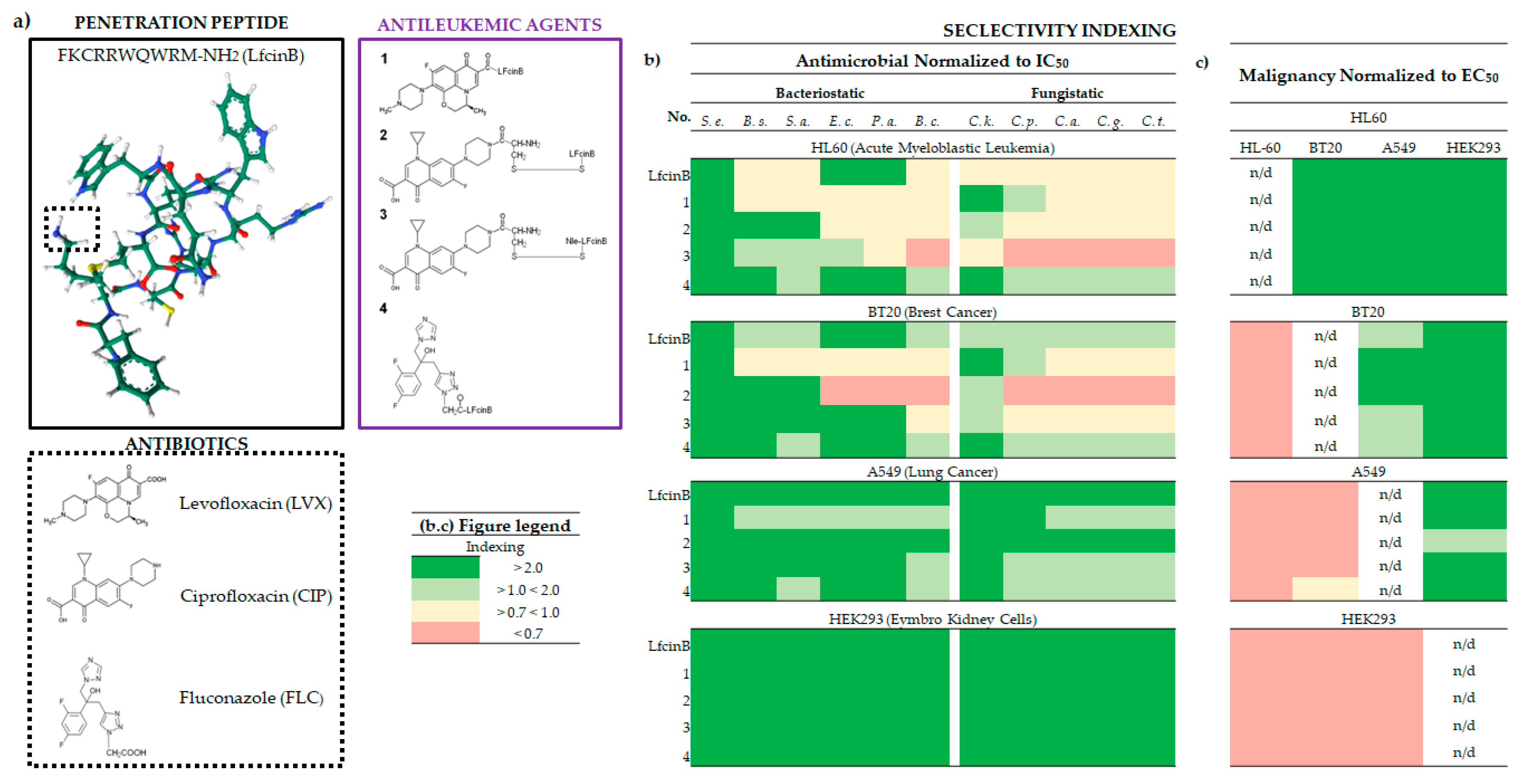
Figure 2.
Effectiveness of LfcinB and its Bioconjugates in Biological Systems. (a) The bactericidal activity of LfcinB and its bioconjugate 3; Two-parameter dot plots showcase the shift in the asymmetric localization of phosphatidylserine in the external membrane induced by the compound in S. aureus (Annexin V-positive events derived from the right top and bottom squares of the discriminator); The outcomes of the flow cytometry were analyzed with the free online software Floreada.io (https://floreada.io/ (accessed in November 2023; the last update was carried out in June 2023)); Representative data are based on three independent repetitions; (b) The compound hinders the supercoiling activity of gyrase. Controls include KBZ, representing the sample without the compound, and KBE, representing the sample without the enzyme; The compounds underwent testing within the range of 1000 to 50 μM. For more data on the additional compound *5, please refer to [43]; (c) The impact of LfcinB and its conjugate 4 on intracellular ROS generation in HL60, and HEK293 measured using CM-H2DCFDA; (d) Dot plots illustrating the mitochondrial potential of HL60-treatedcompound 3, assessed through DIOC6 staining; A positive control with 50 μM CCCP was applied; LB, left bottom; RB, right bottom; LT, left top; RT, right top; Flow data were analyzed by Flowing Software 2.5.1 (Turku Bioscience, Finland); Values represented from three independent experiments.
Figure 2.
Effectiveness of LfcinB and its Bioconjugates in Biological Systems. (a) The bactericidal activity of LfcinB and its bioconjugate 3; Two-parameter dot plots showcase the shift in the asymmetric localization of phosphatidylserine in the external membrane induced by the compound in S. aureus (Annexin V-positive events derived from the right top and bottom squares of the discriminator); The outcomes of the flow cytometry were analyzed with the free online software Floreada.io (https://floreada.io/ (accessed in November 2023; the last update was carried out in June 2023)); Representative data are based on three independent repetitions; (b) The compound hinders the supercoiling activity of gyrase. Controls include KBZ, representing the sample without the compound, and KBE, representing the sample without the enzyme; The compounds underwent testing within the range of 1000 to 50 μM. For more data on the additional compound *5, please refer to [43]; (c) The impact of LfcinB and its conjugate 4 on intracellular ROS generation in HL60, and HEK293 measured using CM-H2DCFDA; (d) Dot plots illustrating the mitochondrial potential of HL60-treatedcompound 3, assessed through DIOC6 staining; A positive control with 50 μM CCCP was applied; LB, left bottom; RB, right bottom; LT, left top; RT, right top; Flow data were analyzed by Flowing Software 2.5.1 (Turku Bioscience, Finland); Values represented from three independent experiments.
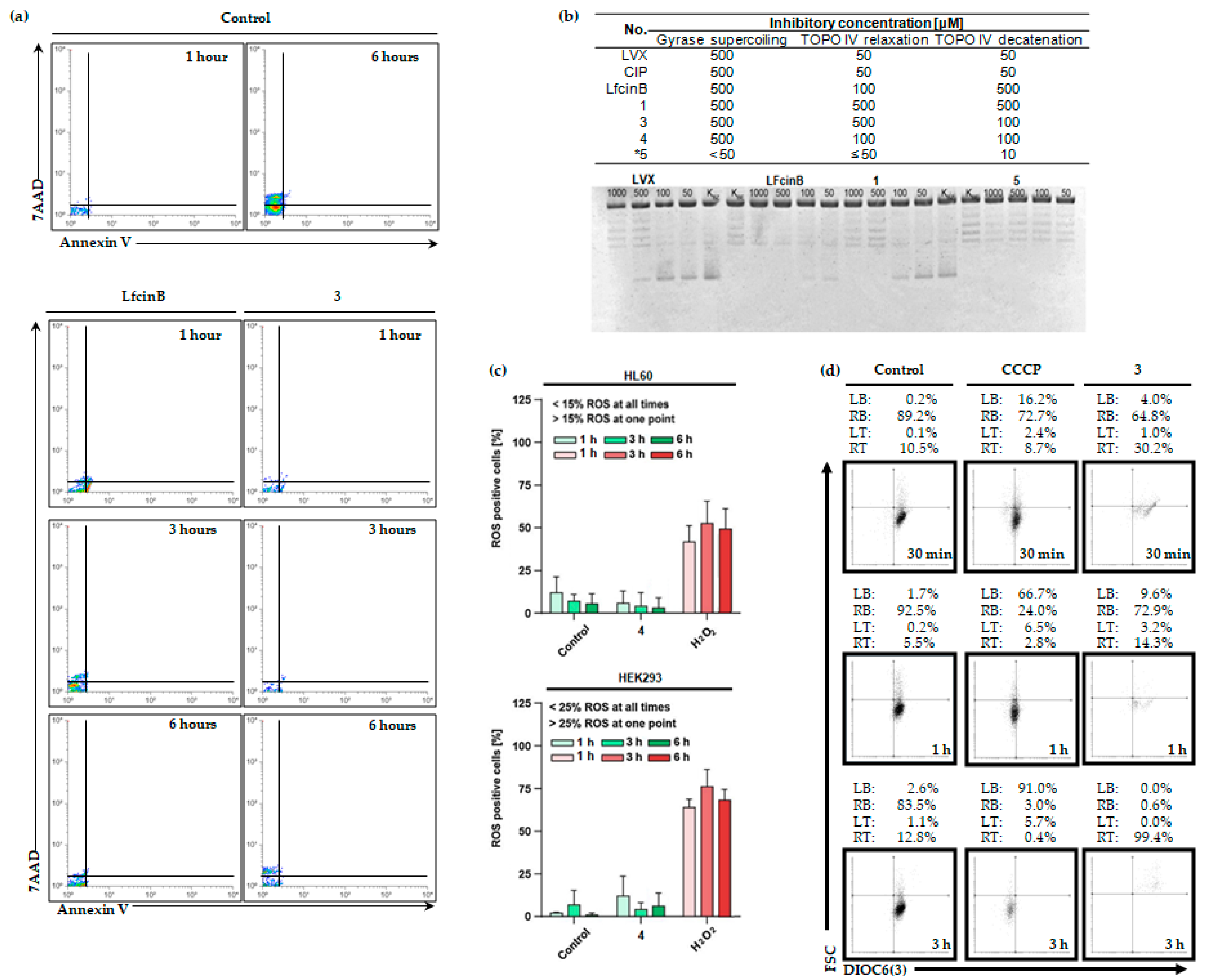

Table 1.
Functional classification of penetration peptides (PPs).
| Penetration Peptides Classification | |||
|---|---|---|---|
| AMP Type | Biological Effect | ||
| Anticancer | Antimicrobial | Healthy Cells | |
| Canonical | Poor | Significant | Poor |
| Transporters | Poor | Poor | Poor |
| Dual Activity | Significant | Significant | Poor |
| Toxic | Poor | Poor | Significant |
| CPP Type | Biological Effect | ||
| Anticancer | Antimicrobial | Healthy Cells | |
| Canonical | Poor | Poor | Poor |
| Antimicrobial | Poor | Significant | Poor |
| Anticancer | Significant | Poor | Poor |
| Dual Activity | Significant | Significant | Poor |
| Toxic | Poor | Poor | Significant |
Table 2.
Methodology for classification of penetration peptides (PPs). *ENEM – epithel al/non-epithelial malignancy; EC – effective concentration; IC – inhibitory concentration; FIC – fungistatic inhibitory concentration; *NEM – non-epithelial malignancy; MIC – minimal inhibitory concentration.
Table 2.
Methodology for classification of penetration peptides (PPs). *ENEM – epithel al/non-epithelial malignancy; EC – effective concentration; IC – inhibitory concentration; FIC – fungistatic inhibitory concentration; *NEM – non-epithelial malignancy; MIC – minimal inhibitory concentration.
| no. | Biological Effects of Penetration Peptides Predicted by Selectivity Index | |||
|---|---|---|---|---|
| 1 | Conduct the Cell Proliferation Tests for Determining Pharmacological Values | |||
| Human Cell Lines | Bacteria | Fungi | ||
| IC50 | EC50 | MIC | FIC | |
| 2 | Antimicrobial Effect Determined by Selectivity Index | |||
| Bacteriostatic (BSI) | Fungistatic (FSI) | |||
| MIC/IC50 < 0.7 Poor | FIC/IC50 < 0.7 Poor | |||
| MIC/IC50 > 0.7 < 1.0 Moderate | FIC/IC50 > 0.7 < 1.0 Moderate | |||
| MIC/IC50 > 1.0 < 2.0 Good | FIC/IC50 > 1.0 < 2.0 Good | |||
| MIC/IC50 > 2.0 Significant | FIC/IC50 > 2.0 Significant | |||
| 3 | Antimalignancy Effect Determined by Selectivity Index | |||
| 3a | Anticancer | |||
| EC50 Cancer / EC50 of Healthy or *NEM Cells < 0.7 Poor | ||||
| EC50 Cancer / EC50 of Healthy or *NEM Cells > 0.7 < 1.0 Moderate | ||||
| EC50 Cancer / EC50 of Healthy or *NEM Cells > 1.0 < 2.0 Good | ||||
| EC50 Cancer / EC50 of Healthy or *NEM Cells > 2.0 Significant | ||||
| 3b | Antileukemic | |||
| EC50 Leukemia / EC50 of Healthy or *EANEC Cells < 0.7 Poor | ||||
| EC50 Leukemia / EC50 of Healthy or *EANEC Cells > 0.7 < 1.0 Moderate | ||||
| EC50 Leukemia / EC50 of Healthy or *EANEC Cells > 1.0 < 2.0 Good | ||||
| EC50 Leukemia / EC50 of Healthy or *EANEC Cells < 2.0 Significant | ||||
| 4 | Neutral Transporters | |||
| EC50 Healthy / EC50 of *E/NEM Cells < 0.7 Poor | ||||
| EC50 Healthy / EC50 of *E/NEM Cells > 0.7 < 1.0 Moderate | ||||
| EC50 Healthy / EC50 of *E/NEM Cells > 1.0 < 2.0 Good | ||||
| EC50 Healthy / EC50 of *E/NEM Cells < 2.0 Significant | ||||
Disclaimer/Publisher’s Note: The statements, opinions and data contained in all publications are solely those of the individual author(s) and contributor(s) and not of MDPI and/or the editor(s). MDPI and/or the editor(s) disclaim responsibility for any injury to people or property resulting from any ideas, methods, instructions or products referred to in the content. |
© 2024 by the authors. Licensee MDPI, Basel, Switzerland. This article is an open access article distributed under the terms and conditions of the Creative Commons Attribution (CC BY) license (http://creativecommons.org/licenses/by/4.0/).
Copyright: This open access article is published under a Creative Commons CC BY 4.0 license, which permit the free download, distribution, and reuse, provided that the author and preprint are cited in any reuse.


