

Submitted:
23 November 2023
Posted:
08 December 2023
Read the latest preprint version here
Abstract
A symbolic analysis of Archimedes’ periodical number system is developed, from which a natural link emerges with the modern positional number systems with zero. After the publication of Fibonacci’s Liber Abaci, the decimal Indo-Arabic positional system was the basis of the algorithmic and algebraic trend of modern mathematics, but even if zero plays a crucial role in algebra and mathematical analysis, zeroless positional systems show the same capability of producing efficient arithmetical algorithms based on operation tables over digits. The crucial role of digits is assessed, by considering a representation of numbers based on strings in lexicographic order. A new algorithm for the determination of decimal periods is presented,, by remarking the cruciality of this topic in number theory. Periods of ordinal numbers, and enumerations of recursive enumerability are shortly recalled. Concluding remarks are formulated about the deep relationship among numbers and information, which shed new light on a red line passing through the whole history of mathematics
Keywords:
Number Representation Systems
; Zeroless positional systems
; Arithmetic Algorithms
; Ordinals
; Recursive enumerability
1. Arenarius’ System
In The Sand Reckoner, entitled “Arenarius” in the Latin tradition, Archimedes of Syracuse (III century BC) considers the problem of giving an evaluation of the size of the universe, according to Aristarchus of Samos’ model, by counting the number of sand grains filling that universe.
For this reason, the great mathematician introduces a systematic method for representing numbers of unlimited size, based on orders and periods. In modern terms such a notion could be defined as an “Enumeration System”, where linguistic or symbolic expressions denoting numbers, that is numerals, are generated in a totally ordinate manner, in such a way that each numeral is different from those previously generated and greater than all of them (creativity and order), and the rules of generation can be always applied for producing a new numeral after any already generated numeral (infinity). This idea is completely new, because all the numerals of the ancient languages reach a biggest number after that is possible, of course, to provide expressions for bigger numbers, such as “the double of …” or the “…plus one”, but no systematic and efficient way was available for going up in the succession of numbers.
The method given by Archimedes is very simple [2,9]. He starts from a finite set of initial numerals, the words of Ionic tradition for numbers frorm 1 to (the double myriad , being one Myriad equal to ). The ordinate list of numerals
is called by Archimedes the first order. Then, the second order is the progression of numerals
, going on, in the same way, the last th order is:
The given orders determine the first period. The second period continues the same rule of generation, where is replaced by . It is clear that this method is a recurrent method where all the numbers are denoted by means of expressions constructed by the numerals of the first order, and of course, there is no limit in this process. in fact, after the first period, the second one can be generated, terminating with , and so on for any following period.
The first two periods, by using modern exponential notation, are given below.
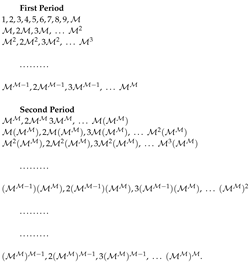 The numbers denoted by this method are exponentials (of base ) or multiples of exponentials, for tis reason we denoted them in the modern exponential notation. However Archimedes does not use any symbolic notation, but expresses the logic of his method in natural language (Greek), and discovers some basic properties of these numbers and in particular a rule that corresponds to the identity:
a sort of anticipation of the product-sum rule of logarithms.
The numbers denoted by this method are exponentials (of base ) or multiples of exponentials, for tis reason we denoted them in the modern exponential notation. However Archimedes does not use any symbolic notation, but expresses the logic of his method in natural language (Greek), and discovers some basic properties of these numbers and in particular a rule that corresponds to the identity:
a sort of anticipation of the product-sum rule of logarithms.
The numbers denoted by this method are exponentials (of base ) or multiples of exponentials, for tis reason we denoted them in the modern exponential notation. However Archimedes does not use any symbolic notation, but expresses the logic of his method in natural language (Greek), and discovers some basic properties of these numbers and in particular a rule that corresponds to the identity:The basic rule of Archimedes’ enumeration method is that orders are arithmetic progressions, where any order has numerals, and the last numeral of any order coincides with the first numeral of the next order and with the ratio of the progression. The first period has orders, the second one orders, and so on for the following periods.
2. From Arenarius to zeroless decimal systems
Now we consider Archimedes’ system with a symbolic notation adherent to Arenarius’ formulation given in natural language. For this purpose, we introduce a symbol expressing the end of orders and periods, realized as a circled superscript. We use an initial order of ten numerals, denoted by the usual decimal symbols 1, 2, 3, 4, 5, 6, 7, 8, 9, but ten is denoted by 1o because it corresponds to the end of the first order. The first period is given completely, the second period is indicated, by omitting some orders.
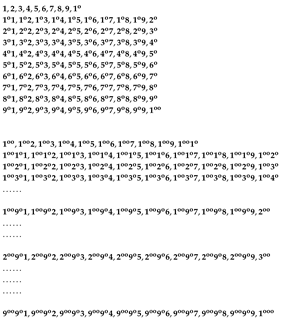 In the above representation any numeral is a sequence of digits and symbol for indicating the end of a cycle (order or period). A number of k consecutive determines a period of level k, also called k-period. For example, is the numeral of the first 1-period of the first 2-period, at its third order, in the sixth position. In fact, periods are arranged in increasing levels and within a period of level there are ten -periods (nono-circled digits correspond to orders). These circled numerals correspond to exponentials, but their forms resemble the linguistic expression of the periodical mechanism used by Archimedes, where small circles provide the arrangement of a cyclic generation of numerals. The translation of circled numerals in exponentials is the product of the exponential interpretation of the circled digits, where: , and so on. For example, represents .
In the above representation any numeral is a sequence of digits and symbol for indicating the end of a cycle (order or period). A number of k consecutive determines a period of level k, also called k-period. For example, is the numeral of the first 1-period of the first 2-period, at its third order, in the sixth position. In fact, periods are arranged in increasing levels and within a period of level there are ten -periods (nono-circled digits correspond to orders). These circled numerals correspond to exponentials, but their forms resemble the linguistic expression of the periodical mechanism used by Archimedes, where small circles provide the arrangement of a cyclic generation of numerals. The translation of circled numerals in exponentials is the product of the exponential interpretation of the circled digits, where: , and so on. For example, represents .The circle, which was the central topic of many Archimedes’ investigations [16], emerges in this symbolism as the basic mechanism of a counting process, by adding to the already seen properties of number enumerations (creativity, order, infinity) the property of recurrence. In fact, all numerals are represented by a finite sets of symbols that continuously recur in the generation. Expressions such as “third order” and “second prime period” translate respectively in 3o and .
An enumeration is complete when it generates the numerals of all numbers. In a complete enumeration a number denoted by a numeral coincides with its position in the enumeration. It is reasonable to suppose that John Wallis, who translated Arenarius, when introduced in 1655 the symbol ∞ for infinity,, by rotating the digit 8 in the position of ∞, impressed by the enormous size of Archimedes’ numbers, and inspired by the Archimedean term “octad”, which refers to eight consecutive powers of ten. By the way, the size of universe was evaluated by Archimedes at the eighth order of his first period with a value around (assuming particles in a sand grain, we obtain the modern evaluation for the particles contained in our universe).
The enumeration given above can be defined as a linear ordering defined on monads, where we call monad a digit in or a circled digit, that is, a digit with a number of circles as exponents. Monads are ordered by requiring that if has a number of circles greater than , or when they have the same number of circles, if the digit of is greater than the digit of (9 > 8 > 7 > 6 > 5 > 4 > 3 > 2 >1). A numeral is a sequence of monads where any monad needs to have a smaller number of circles than those on its left. Then, if are DAS numerals, when their leftmost monads and satisfy .
The Archimedes’ enumeration is not complete, because it represents numbers, but not all numbers of the natural succession. In fact, only exponentials or multiples of them appear. However, if we change the interpretation by considering each numeral as the successor of the previous one, then we get a complete enumeration. The obtained system, which we call Decimal Archimedes’ System (DAS), results to be a zeroless system very close to the usual decimal system, which we call 0-decimal system (0DS).
Now, we will translate DAS into another zeroless decimal system, which we call X-decimal system (XDS). At this end, we translate monads in strings over the alphabet of digits 1, 2, 3, 4, 5, 6, 7, 8, 9, X:
and so on, for monads with greater number of circles (X, XX, abbreviates 1X, 1XX, respectively, when they occur as first monads, from the left). In this way, the first period of DAS in XDS becomes:
X1, X2, X3, X4, X5, X6, X7, X8, X9, 2X
2X1, 2X2, 2X3, 2X4, 2X5, 2X6, 2X7, 2X8, 2X9, 3X
3X1, 3X2, 3X3, 3X4, 3X5, 3X6, 3X7, 3X8, 3X9, 4X
4X1, 4X2, 4X3, 4X4, 4X5, 4X6, 4X7, 4X8, 4X9, 5X
5X1, 5X2, 5X3, 5X4, 5X5, 5X6, 5X7, 5X8, 5X9, 6X
6X1, 6X2, 6X3, 6X4, 6X5, 6X6, 6X7, 6X8, 6X9, 7X
7X1, 7X2, 7X3, 7X4, 7X5, 7X6, 7X7, 7X8, 7X9, 8X
8X1, 8X2, 8X3, 8X4, 8X5, 8X6, 8X7, 8X8, 8X9, 9X
9X1, 9X2, 9X3, 9X4, 9X5, 9X6, 9X7, 9X8, 9X9, XX
For example, the XDS translation of is . The logic of XDS enumeration is based on powers of ten. 1, X, XX, XXX, …. Any numeral is the concatenation of multiples of these powers, and their sum provides the number expressed by the numeral. It is interesting to remark that this structure resembles exactly the construction of numerals in many natural languages. However, neither DAS, nor XDS are positional systems in the strict sense of our usual decimal system with zero, but could be better characterized as polynomial systems (where monads are monomials). Polynomial system of number representation occur, in primitive forms, in many ancient systems, and in the measurement of angles. The mathematician and astronomer Claudius Ptolomaeus (first century, author of the Almagest) used circled digits, and in some contexts his circle resembles zero.
Going back to DAS numerals, we could avoid to put circles to digits when in a numeral all the monads smaller than the leftmost monad occur. In fact, in that case the level of any monad corresponds to its position. For example, is completely expressed by 136. But, if circles are deleted in and we get, in both cases, 16, which does not distinguish between the two different numerals. However, we can avoid circles if the missing monads are indicated.
Therefore zero, which was discovered at the end of fifth century within the Indo-Arabic mathematical tradition [11], has a natural motivation in Archimedes’ periodical system, as a new digit 0 expressing the absence of any monad having a number of circles corresponding to its position (distance from the rightmost digit).
Nevertheless, zero digit is not necessary for having a positional systems, because zeroless positional systems in the sense of 0DS can be defined. One of such systems is based on the strings that can be constructed over a finite sets of digits [2,15]. Let us assume the ten digits (without zero) in the order:
For each digit, the sting of two digits are generated according to the following square, where ordering is from left to the right in the rows, and from the top to the bottom for the columns:
1(1, 2, 3, 4, 5, 6, 7, 8, 9, X)
2(1, 2, 3, 4, 5, 6, 7, 8, 9, X)
3(1, 2, 3, 4, 5, 6, 7, 8, 9, X)
4(1, 2, 3, 4, 5, 6, 7, 8, 9, X)
5(1, 2, 3, 4, 5, 6, 7, 8, 9, X)
6(1, 2, 3, 4, 5, 6, 7, 8, 9, X)
7(1, 2, 3, 4, 5, 6, 7, 8, 9, X)
8(1, 2, 3, 4, 5, 6, 7, 8, 9, X)
9(1, 2, 3, 4, 5, 6, 7, 8, 9, X)
X(1, 2, 3, 4, 5, 6, 7, 8, 9, X)
In general, numerals are generated by orders , for .
and:
where numerals of follow those of , and for any digit D, the following equation holds:
with for any in , and . This is the structure of any enumeration system, over strings, based on orders and periods.
The ordering associated to this enumeration corresponds to the lexicographic ordering, characterized by the following conditions ( is the length of string , and are any digits):
We call this enumeration LXS (Lexicographic X-decimal System). LXS is a positional system, where digits contribute to the value of the denoted number according to their positions.
An enumeration system based on orders and periods is an Archimedean Enumeration System (AES). An AES is natural if it is represents all the numbers, it is monotone if its numerals are non empty strings over a finite set of symbols, and any numeral followed by a digit x is a numeral too, such that the number denoted by it coincides with the number of orders before the order where occurs. Such a system has period p if its initial order has p numerals. XDS, as well as the usual decimal positional system D0S, are Archimedean natural monotone enumeration systems.
The following theorem easily generalizes a well-known theorem of positional systems to natural monotone AES.
Theorem 1.
Let E be an Archimedean monotone enumeration system of period p. Then, the following recurrent equation holds in E, for any digit x:
from which the base representation equation follows.
Proof.
From the hypotheses on E, the product represents the number of numerals before the order where occurs, then we have the asserted equation above. If we apply iteratively equation (2), we get the fundamental base representation equation of a positional number systems of base :
□
3. The algorithmic value of digits
One of the main novelties of digits is the algorist trend as opposed to the abacist approach of ancient methods of number calculation (from abacus). In 1585 Simon Stevin published a book in Flemish, entitled De Thiende (the Tenth) [20], where the algorithms for computing the four arithmetical operation are given, which correspond to the methods that are now taught in the primary schools. These methods are independent from the particular basis, and essentially reduce the computation of any operation to the knowledge of its results for all the pair of digits., that is, to a finite set of basic rules. The same situation arises with zeroless positional systems.
Let us consider the zeroless lexicographic systems of four digits, having the following first 16 numerals:
| - | 1 | 2 | 3 | 4 | 11 | 12 | 13 | 14 | 21 | 22 | 23 | 24 | 31 | 32 | 33 | 34 |
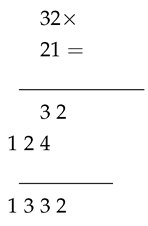
For example, in the 4-lexicographic system is obtained from the above tables and provides the same result obtained in the usual decimal system:
In conclusion, zero is not necessary for having positional systems, even if it is essential for further developments of mathematics: in the infinitesimal analysis, and in the algebraic structures. In fact, the negative enumeration, which from zero goes back in the opposite direction of the natural (positive) enumeration, gives the negative of any number, makes integers an additive group with zero as neuter element.
In his 1585 book, Stevin introduces a notation essentially equivalent to usual decimal notation. Using this notation, Stevin’s division algorithm applied to , with , provides a decimal representation of type for the fraction , where are decimal digits.
The following theorem is an easy consequence of the pigeonhole principle, where is the succession of prime numbers (if n objects are distributed among cells, then there exists some cell containing more than an object).
Theorem 2.
For the fraction has a decimal representation with infinite digits, obtained by the division algorithm, where a sequence of digits, called period, repeat indefinitely, and the length of the period is surely lesser that .
In virtue of the above theorem any fraction has a finite decimal representation or an infinite one, but periodical. Therefore, an infinite decimal representation that is not periodical represent a number that is not a fraction, and is called an irrational number (Greek mathematicians use the term Logoi for irrationals). In conclusion, the existence of irrational numbers follow from Stevin’s representation.
The following theorem is the converse of the above theorem, that is, for any periodical decimal representation there is an equivalent fraction.
Theorem 3.
For every fraction with (set of integers) there exist such that:
with .
Both theorems above can be easily extended to any positional system with zero and base >1. However, computing the exact periodical representation of a fraction and showing its correctness is not an easy task. After Stevin work and Napier’s formulation, in his second book on logarithms [21], a tradition of works on decimal faction was developed in 17th and 18th centuries [1].
Now we show as a simple theorem can give an efficient solution for a systematic and reliable determination of the exact periodical representation of fractions. In fact, the following theorem, which can be easily proven, is the basis for efficient algorithms (extensible to any base) for computing fraction periods and for checking their correctness.
Theorem 4
(Concatenation Theorem). Stevin algorithms for the basic arithmetical operations can be “concatenated”. Let us express this fact only for division and multiplication (concatenation of additions and subtractions are obvious), where Greek letters denote strings of digits of decimal representations.
if with remainder r and with remainder 1.
For some natural n:
if for some naturals :
with and .
By using the theorem above, when arithmetic operations have a precision of p decimal digits, then operations can be concatenated by obtaining periodical representations of any period length, and proving the correctness of the obtained results.
Given the length limits of computer number representation, no computer can directly compute the exact decimal value of a simple fraction such as . The representation of fraction for , based on division and multiplication concatenations, are given below, where periods are indicated within brackets, and stars mark periods that reach the maximum possible length.
1/2 = 0,5 = 0,4[9]
1/3 = 0,[3]
1/5 = 0,2 = 0,1[9]
1/7 = 0,[142857]*
1/11 = 0,[09]
1/13 = 0,[076923]
1/17 = 0,[0588235294117647]*
1/19 = 0,[052631578947368421]*
1/23 = 0,[0434782608695652173913]
1/29 = 0,[0344827586206896551724137931]*
1/31 = 0,[032258064516129]
1/37 = 0,[027]
1/41 = 0,[02439]
1/43 = 0,[023255813953488372093]
1/47 = 0,[0212765957446808510638297872340425531914893617]*
!/53 = 0,[0188679245283]
1/59 = 0,[0169491525423728813559322033898305084745762711864406779661]*
1/61 = 0,[016393442622950819672131147540983606557377049180327868852459]*
1/67 = 0,[014925373134328358208955223880597]
1/71 = 0,[01408450704225352112676056338028169]
1/73 = 0,[013698630136986301369863]
1/79 =0,[01265822784810126582278481]
1/83 = 0,[01204819277108433734939759036144578313253]
1/89 = 0,01123595505617977528089887640449438202247191]
1/97 = 0,[0103092783505154639175257731958762886597938144329896907216494
84536082474226804123711340206185567]*
All these representations were checked by using multiplication concatenation. Moreover they coincide with those, up to 1/67, of Johann III Bernoulli’s table (1771-1773) reported in [1]. We remark that fraction periodical representations is an issue extensively investigated by Carl Friedrich Gauss, who introduced an entire theory for their calculation [1].
As an example, the computation of is here reported, by using operations reliable up 12 digits.
Remainder = 3
where the open bracket is put after the last digit of the period. Namely, digits 058823 coincide the initial digits of the first division. Therefore, by concatenating the two divisions, according to Concatenation Theorem, we have:
Now, we prove the correctness of the above periodical representation, by concatenating two multiplications:
that is:
in fact, and , and the concatenation of the two results, according to Concatenations Theorem, is just 9999999999999999.
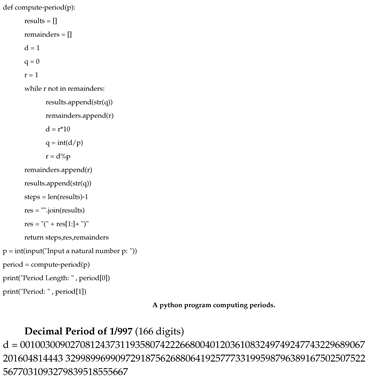
Gauss spent years in computing decimal periods of prime fractions. For this purpose, he developed a theory [1] (of indices), which was the seed of his theory of congruences. The biggest fraction he computed was 1/997, which we computed in seconds with the following Python program, by using Stevin’s division algorithm going up until a remainder is obtained that was already generated. By the way, it is interesting to observe that unitary division is the essence of any division, which is always equivalent to a multiplication of the result of a unitary division.
Let us conclude the section, by shortly reporting other crucial passages that are based on the diffusion in Europe of the positional representation of numbers, after the publication by Leonardo Fibonacci, in 1202, of his Liber Abaci, along a process of four centuries of conceptual and notational development of the roots of modern mathematics [3,13].
In 1591 François Viète’s book [23] appeared where expressions with symbol for indeterminates appear, and ars speciosa is also the name of a new arithmetic perspective that is the seed of modern algebra. In 1619 John Napier introduces logarithms [21], where he provides a synchronization between geometrical and arithmetical progressions covering with good approximation a real interval. This passage in modern mathematics is crucial and full of practical and theoretical consequences.
The passage from symbols with numeric meanings to indeterminates of unknown numeric values, on which operations can be performed independently from their meaning, is a crucial step toward variables, which become the main tool of Cartesian geometry. where in 1637 René Descartes introduces coordinates, by reversing the Greek relationship between space and numbers. From this point, the process of arithmetization of mathematics starts, toward the foundational perspectives of 19th and 20th centuries.

Table 4.
Proving that decimal period of 1/997 is correct: The column on tn the left gives, in consecutive rows, blocks of the period d of 1/997. In each equation of the second column, the last 3 digits added to the first 3 digits of the number below provides 999, therefore, according to the Concatenation Theorem, the equations above prove that . whence, being a period, it follows that .
Table 4.
Proving that decimal period of 1/997 is correct: The column on tn the left gives, in consecutive rows, blocks of the period d of 1/997. In each equation of the second column, the last 3 digits added to the first 3 digits of the number below provides 999, therefore, according to the Concatenation Theorem, the equations above prove that . whence, being a period, it follows that .
| 00100300902 | × | |
|---|---|---|
| 7081243731 | × | |
| 1935807422 | × | |
| 266800401 | × | |
| 2036108324 | × | |
| 97492477432 | × | |
| 29689067201 | × | |
| 60481444332 | × | |
| 99899699097 | × | |
| 2918756268 | × | |
| 8064192577 | × | |
| 7331995987 | × | |
| 96389167502 | × | |
| 507522567703 | × | |
| 10932798395 | × | |
| 18555667 | × |
4. Enumerations in ordinals and in computability
Archimedes’ mark is not only in the roots of moderne mathematics, and in the infinitesimal calculus, for his introduction of geometric representation of infinitesimals, especially in his Method, a book that got lost and was discovered at beginning of twentieth century (and lost again during the second world war, but now completely restored) [17]. In fact, the crucial role of recurrence in Archimedes’ enumeration is apparent in Cantor’s ordinal numbers [4], and in the theory of computability [22]. Rigorous foundations of numbers were provided by Dedekind, Frege, and Peano [5,8,18], but the most synthetic and expressive definition of numbers is that one given in terms of set theory, according to a construction due to John von Neumann: a number is the set of numbers that precede it, in a number enumeration. In this way 0 coincides with the empty set ∅, 1 is the set containing the empty set , 2 is the set , and so on. In this formulation, even if “a number enumeration” is mentioned, the numbers stem prescinding from any specific system of counting, in a very abstract manner, where the process of counting results the true essence of numbers. In fact if is any enumeration and the corresponding numbers, then , , , and so on, by obtaining exactly what von Neumann defined. Moreover, the theory of ordinals can be expressed in terms of enumerations of enumerations, in the same way as Archimedes’ periods are generated, because the essence of a recurrent enumeration is that a number is the position where its numeral is, and this position is completely identified by the numeral that precede it. In this way, if a name a given to an entire enumeration, this name is a sort of hypernumeral that we can imagine as the last position of its numerals. Then, let us call the natural enumeration
if we assume as the first infinite order, we can go further with the following orders in an analogous way as Archimedes’ periodical system:
where the name of any (infinite) enumeration is put at the end of it, and usual symbols for ordinals are intended as names of the consecutive enumerations preceding them (enumerations of enumerations, and so on, at successive levels). It is not our intention to go into further details of such an approach to ordinals, but this short outline suggests clearly as ordinals are a natural generalization of Archimedes’ periods.
It can be shown that a 1-to-1 correspondence can be established between the natural enumeration and ordinals at any exponential level (), but no 1-to-1 correspondence exists between and real numbers, which are represented by infinite sequences of decimal digits (and the set of ordinals 1-to-1 with is an ordinal that is not 1-to-1 with ). This crucial result, based on a famous diagonal argument, is the access gate to cardinal numbers and abstract sets, or Cantor Paradise, as Hilbert defined set theory [10], within which any mathematical theory can be expressed.
In 1936 Turing published an epochal paper on computable numbers, that is, real numbers where the sequence of digits can be generated by means of a computing device, a Turing machine. Sets of numbers that can be generated by Turing machine, as outputs of computing process, are called Turing enumerable, or recursively enumerable, sets. However, in general, there is no Turing machine that, given a Turing enumerable set A and a number n, is able to tell, in a finite number of steps, if a does belong or not to A. The sets for which this is possible ale called decidable or recursive. The recursively enumerable sets for which this decision possibility does not hold are called semidecidable. A function is computable if, and only if its graphic is recursively enumerable.
What is really surprising is that Turing proves the existence of recursively enumerable sets, by adapting Cantor’s diagonal argument according to which real numbers are not 1-to-1 with any natural enumeration. This story tells us that an infinity line [12] links, along centuries, Archimedes with Cantor and Turing: these three giants follow a common idea: counting the infinite: according to an arithmetical perspective, to a more general set theoretic perspective, or to a computational perspective of symbolic manipulation processes, performed by machines.
A function on natural numbers is Turing computable if it is computed by some Turing machine (giving as output the image of the function in correspondence to any argument given as input). Turing machines are identified by Turing programs, which are strings, which when put in a lexicographic ordering provide an enumeration. From this, again by a diagonal argument, the following theorem can be proved.
Theorem 5.
Turing computable functions surely include partial functions, which do not give results in correspondence of some arguments, and no Turing machine can exist that can always tell, in finite time, if a Turing machine gives a result in correspondence of a given argument.
5. Conclusions
Numbers need numerals to be expressed and manipulated, but numerals are strings, that is, linear forms of information representation, able to encode any kind of data. On the other hand, strings, when considered in a lexicographic order represent numbers, with the empty string naturally associated to zero. Therefore, an intrinsic circularity links numbers to strings, or equivalently numbers to information. Nevertheless, while numbers are abstract entities, independent from any physical reality, symbols and strings are necessarily based on physical realities. At the same time, their physicality even if necessary is not essential, in the sense that any physical support can be replaced equivalently by another one, and similarly any encoding of data as strings can be translated in another one. The theory of information, which together with computability is the basis to the new informational age, according tho Shannon’s perspective, introduced in his famous booklet of 1948 [19], discovered the possibility of measuring information independently from specific codes and from specific physical supports. In this approach, information is expressed in terms of negative logarithms of probabilities. But probabilities are pure numbers (between 0 and 1), therefore “pure” information coincides with numbers, and conversely, numbers coincide with pure information, because their essence abstracts from any specific system of numerals. This simple remark explains why number theoretic properties are so crucial in information processing, at many different levels, from cryptography to the theory of codes, and to the algebraic and algorithmic perspectives of computer science. This means that Arithmetics, the oldest mathematical theory, is strongly linked to the youngest theory of information, computation and communication, born in the twentieth century. Then, the image of circle, so often evoked in this paper, is a very appropriate image for the conclusion of this bird fly over the landscape of mathematics, going from Archimedes, to Fibonacci, Stevin, Viète, Napier, Descartes, Gauss, Cantor, Turing, and Shannon, just for reminding the great minds mentioned in our travel.
References
- Bullynck, M.: Decimal periods and their tables: A German research topic (1765–1801), Historia Mathematica 36,137-160 (2009).
- Boute, R. T.: Zeroless Positional Number Representation and String Ordering. The Amer. Math. Monthly, Vol 107, No. 5, 437-444 (2000).
- Cajori, F.: A History of Mathematical Notation. Dover Publications. (1993).
- Cantor, G.: Contributions to the founding of the theory of transfinite numbers. Dover Publications (1915).
- Dedekind, R.: Essays on the theory of numbers. Dover Publications (1963).
- Descartes, R.: The Geometry of René Descartes, Dover Publications (1954).
- Dijksterhuis, E. J.: Archimedes, Princeton University Press (1987).
- Frege, G.: The Foundation of Arithmetic. Northwestern University Press (1960).
- Heath, W.: The Works of Archimedes. Dover Publication (2002).
- Hilbert, D.: Über das Unendlich (1924) in: David Hilbert’s lectures on the foundations of arithmetic and logic 1917-1933, Heiderberg Springer-Verlag (2013).
- Ifrah, G.: The Universal History of Numbers: From Prehistory to the Invention of the Computer. Wiley, New-York (2000).
- Kaplan, R., Kaplan, E.: The Art of the Infinite. Oxford University Press (2003).
- Kline, M.: Mathematical Thought from Ancient to Modern Times, 3 Voll., Oxford University Press (1990).
- Knuth, D.: The art of computer programming, Volume 2: Seminumerical algorithms. Addison-Wesley (1997).
- Manca, V.: On the lexicographic representation of numbers. Cornell University Library ArXiv.org, 1–15 (2015).
- Manca, V.: Lezioni Archimedee. Biblioteca Alagoniana, Quaderno N. 6, Siracusa (2020).
- Netz, R, Noel, W.: The Archimedes Codex, W&N (2007).
- Peano, G.: Formulario Mathematico. Edizioni Cremonese (1960).
- Shannon, C. The Mathematical Theory of Communication, University of Illinois Press (1998).
- Swetz, F. J.: The Principal Works of Simon Stevin, C. V. Swets & Zeitlinger, Amsterdam (1958).
- Swetz, F. J. Mathematical Treasure: John Napier’s Mirifici Logarithmorum. American Mathematical Association (2013).
- Turing, A. M.: On Computable Numbers, with an Application to the Entscheidungsproblem. Proceedings of the London Mathematical Society 42 (1):230-265 (1936).
- Viète, F.: The Analytic Art (Translated by Witmer, T. R.). Dover Publication, Inc. (2006).
Table 1.
Table of sum for a lexicographic system of 4 digits.
| + | 1 | 2 | 3 | 4 |
|---|---|---|---|---|
| 1 | 2 | 3 | 4 | 11 |
| 2 | 3 | 4 | 11 | 12 |
| 3 | 4 | 11 | 12 | 13 |
| 4 | 11 | 12 | 13 | 14 |
Table 2.
Table of multiplication for a lexicographic system of 4 digits.
| × | 1 | 2 | 3 | 4 |
|---|---|---|---|---|
| 1 | 1 | 2 | 3 | 4 |
| 2 | 2 | 4 | 12 | 14 |
| 3 | 3 | 12 | 21 | 24 |
| 4 | 4 | 14 | 24 | 34 |
Table 3.
A multiplication in the lexicographic system of base 4.
 |
Disclaimer/Publisher’s Note: The statements, opinions and data contained in all publications are solely those of the individual author(s) and contributor(s) and not of MDPI and/or the editor(s). MDPI and/or the editor(s) disclaim responsibility for any injury to people or property resulting from any ideas, methods, instructions or products referred to in the content. |
© 2023 by the authors. Licensee MDPI, Basel, Switzerland. This article is an open access article distributed under the terms and conditions of the Creative Commons Attribution (CC BY) license (http://creativecommons.org/licenses/by/4.0/).
Copyright: This open access article is published under a Creative Commons CC BY 4.0 license, which permit the free download, distribution, and reuse, provided that the author and preprint are cited in any reuse.