

Submitted:
07 December 2023
Posted:
08 December 2023
You are already at the latest version
Preprints.org 2023 Most Popular Preprints Award Winner Collection
Abstract
Purpose: This study investigates the implementation and impact of maker culture—viewed as a tool for developing green digital skills—in higher education institutions in Hong Kong. Maker culture, a collaborative educational approach, embraces students’ capacity for self-paced, autonomous learning and applies this knowledge to creative problem-solving and innovation, key aspects of sustainability education.
Methods: An empirical study was conducted, focusing on the experiences of teachers in the higher education sector in Hong Kong. Eight individuals were interviewed to gain insights into their perceptions and experiences with maker education within sustainability contexts. The sample was limited to ensure cross-sectional comparability and direct weighting of teachers’ experiences within a singular, complementary educational setting.
Results: The findings provide valuable insights into the benefits and challenges of integrating maker education into traditional educational systems to foster green digital skills. It became evident that adequate resources, effective teachers, and improved administrative systems play significant roles in the successful implementation of this approach.
Conclusion: Maker education, as a tool for developing green digital skills, offers a promising alternative to traditional performance-based studies. It has the potential to lead to a future of education that is creative, innovative, and student-directed, fostering sustainability competences. Therefore, despite the challenges, with the right support and resources, the integration of maker culture into educational systems could significantly transform teaching and learning processes, advancing sustainability education.
Keywords:
maker education
; green digital skills
; problem-solving
; innovation
; creativity
; engagement
; sustainable education
1. Introduction
In a critical review of maker culture, Ayivor [1] reflected that there are three categories of people in the world: wanters, wishers, and makers. Learning by making, the philosophy of maker education demonstrates a transformation from the traditional transmission of knowledge to the capture of relevant concepts [2]. Although innovation is ubiquitous in the digital society, the role of the manufacturer is often understated, and the secondary figure is overshadowed by the finished product and its practical benefits. However, maker culture is itself an inspirational proposition, with well-known role models such as Kamkwamba [3] (the Boy Who Harnessed the Wind) not only recognising a problem (I did not have a drill) but also designing and developing a solution to that problem (So I had to make my own). From an educational standpoint, however, maker culture opposes the structured and curricular priorities of a standardised base of knowledge, assessments, and scores [4]. While many students will likely contribute meaningfully to society and perhaps create the next disruptive innovation or solution, the rigidity and exclusivity of traditional educational systems reject the emergent maker movement, which is gradually transforming educational theory and practices.
As educational institutions pursue innovative solutions to changing learner needs and expectations, the emergence of maker education as both a modality and pedagogical tool contributes to a paradigm shift in classroom and curriculum design. Lundberg and Rasmussen [4] formally define maker education as a ‘type of project-based learning where the learner produces a physical object or artefact resulting from newly learned concepts and skills’. As a form of expansionary learning, maker programs encourage teachers and students to apply critical problem-solving capabilities to contextual scenarios in which new or adapted solutions are required. Characterised as both a movement and an educational tool, maker culture encompasses a variety of disciplines, including (1) experimental play, (2) maker space community, and (3) activities focused on learning and working with technology [5]. In terms of social practices, Morado et al. [6] observed that students in maker-inspired courses engage in science, technology, engineering, and mathematics (STEM) curriculum learning phases that are self- and peer-actualised through the attainment of innovative literacy in immersive (atypical) environments. This study explores the practical and educational advantages of the emergent discourse surrounding maker culture and its application in educational practices. Maker education has gained momentum and is a feasible solution in the wake of the COVID-19 pandemic era, as students are expected to translate and share their learning with their peer groups on a seamless online learning platform such as a spatial visualisation-based course for machine drawing [7].
This study critically analysed the role of maker education in modern classroom settings, weighing the structure and design of innovative pedagogical solutions against student learning outcomes and opportunities. In pursuing this research aim, this study accomplished several objectives:
- To critically review prior literature related to maker culture and educational settings.
- To design a conceptual framework representing the targets and priorities of maker educational programmes.
- To conduct an empirical study of teacher experiences with maker culture and its application in educational settings.
Through a synthesis of these multistage findings, an in-depth discussion of maker culture and its effects on educational innovation and pedagogy was conducted and targeted conclusions were drawn. The following section presents the core literature reviewed in this study and outlines the conceptual framework extrapolated from previous findings.
2. Literature Review
Despite its lack of congruence with traditional educational assessment standards, it is possible to assess maker education and determine whether students meet expectations regarding key dimensions related to focus, participation, and problem solving. Specifically, Lundberg and Rasmussen [4] suggest that educators can revise their focus away from performative standards (e.g., scoring, accuracy, and consistency) and prioritise process-based logic by (1) teaching a design cycle, (2) focusing on process over product, (3) engaging in real world problem solving, (4) establishing an iterative learning process, (5) transforming their role from teacher to encourager, (6) providing student choice, and (7) applying value to play and experimentation. Derived from the theoretical proposition of ‘expansive learning’ in educational systems, maker culture seeks an understanding of ‘new ideas, practices, and technologies’ by ‘looking at current problems and tensions found in a context’ [8]. Where traditional educational systems prioritise the accumulation or appropriation of knowledge, maker culture prioritises the expansion of the known into domains that are unknown or only partially known to encourage students to think critically and formulate a solution or shift the state of an object beyond their normal or average capabilities [8,9,10].
Importantly, for maker education to have a positive effect on student learning outcomes, several foundational practices must be applied to each exercise. By crafting a problem or challenge according to a normalised framework (e.g., prompt, solution, reflection), students are encouraged to apply iterative problem-solving to the development of practical solutions with real-world applications [4,11]. Furthermore, researchers, including Krummeck and Rouse [12], Chou [13], and Zhan et al. [14], demonstrated how students must actively participate in problem-solving exercises rather than allow peers or teachers to guide or influence their interpretation of potential solutions. This means that the effectiveness of imaginative design, building, testing, and critical reflection is contingent upon internalisation and self-actualisation within the problem or project [13,14].
Empirical evidence related to various maker experiences highlights the applicability of iterative problem-solving exercises in supporting maker education procedures. For example, Lock et al. [15] described the application of Arduino module-computing solutions to robotic design via collaborative group work over an extended (multimonth) delivery cycle. By involving members in an open forum discussion of procedures, each student in a functional group presents solutions to key problems throughout the process before the work is completed, which not only reinforces key engineering concepts but also allows new or innovative solutions to be funnelled into the end solution [16,17,18]. In applications of maker collaboration, Shin et al. [18] demonstrated how brainstorming sessions and subsequent 3D drafting of models allowed students to scientifically and collectively design, prototype, and scale artefacts, prototypes, and physical models of community improvement projects based on sustainability goals and measurable network impacts. Drawing on the diverse backgrounds and knowledge bases of these students, such exercises challenge conventional expectations regarding community solutions and extend the tacit knowledge held by individuals into collaborative solutions [18,19,20].
From an institutional perspective, there is an underlying need to support maker culture and maker-based educational systems within a broader network or collective interest based on successful (and failed) lessons and programs [8,21]. Hsu et al. [5] argued that sufficient and consistent resources must be provided (e.g., makerspaces, resources, mentors) for students to achieve tangible benefits from maker education systems. Although some STEM education systems have integrated maker concepts into classroom exercises, efforts to preserve traditionalism and restrict the creativity and empowerment of maker cultures continue to dilute the effectiveness of such learning systems [5]. Described by Webb [21] as instruments of change, these makerspaces would depend upon an array of innovative technologies that include software (e.g., VR), networking (e.g., Cloud, AI), and physical resources (e.g., Arduino, 3D printing). However, to achieve this standard, educators responsible for such technological advances to attain the theories and skills required to meet constantly changing student needs are essential [5,22].
Empirical evidence of the effectiveness of maker education as a conceptual support tool has shown a positive effect on student knowledge acquisition and skill learning [13]. From a psychological perspective, De Backer et al. [22] observed that group settings and complex problem-solving exercises could be used to develop shared metacognitive regulations in educational environments. As co-functioning teams, students’ ability to rely on team achievements for personal success can be translated into a catalyst for productive collaborative learning that enhances their belief in their achievement during future exercises [23]. Based on the expectation of differential knowledge in educational settings, Rambe [23] observed that team-based collaboration is often adopted in education as a democratisation process. However, in maker culture, there is a sense of collaborative empowerment which Clapp et al. [24] recognise as a catalyst for knowledge reinforcement and capacitation outcomes that spark confidence in learner approaches to future problems.
To formalise guidelines for educators to support maker culture in educational settings, researchers such as Setiaputra and Yoas [25] and Morado et al. [6] introduced guidelines for a learning-by-making (LBM) approach to classroom design and coursework administration. Based upon the ‘constructionist roots’ of learning by doing, learning shifts students from a formal classroom setting into an experiential space, drawing connections between individuals and objects that allow for knowledge and role exchange based upon constructive exercises [6]. Theoretically, such externalisation of learning involves drawing upon higher cognitive functions, adapting skills and pattern recognition to a variety of media, and developing specific intentions which Morado et al. [6] suggest allows students to engage more actively and purposefully with the content. While the creativity of the LBM may initially inspire students to seek their unique solutions, Cohen et al. [26] and Setiaputra and Yoas [25] demonstrated empirically that to facilitate the link between experimentation and knowledge, students should pursue a more scientific approach to problem-solving. This approach involves drawing from prior evidence and physical models to inform the design and support the development of creative but purposeful alternatives (e.g., a Soapbox car with oversized wheels as opposed to one with square pegs that will not roll) [26,28].
As students shift beyond physical learning forms and engage in digital learning and virtual resources in their maker space, this concept of constructive functionality becomes even more important because of its relationship with real-world solutions and innovations [29]. Researchers, including Hall et al. [29] and Shu and Huang [30], introduced the virtualisation of events or environments as an immersive alternative to the collective narratives of populations, allowing students to engage in capturing knowledge through doing, rather than just reading or listening. Such interactive, mapped spaces, forged in virtual landscapes, allow students to make decisions and select alternatives that affect the narrative and allow for critical investigation of the How, Why, What, and Where storyline or historical event [30]. In a similar project, An et al. [31] highlighted the effectiveness of asynchronous learning across digital discussion boards and virtual education (following the pandemic) by applying a ‘thinking’ (think and tinkering) approach to the digital and physical construction of objects specific to problem prompts. By designing virtual experiments and engaging students in constructing solutions through group discussions, solution sharing, and revisions, the reflective domain of the virtual landscape shifts beyond the individual to a collaborative, creative sphere of group feedback and information exchange [32,33].
2.1. Conceptual framework
A review of the prior literature has outlined the aspirational pursuit of maker culture in educational settings, a proposition conditioned by an array of supportive and restrictive variables. The conceptual framework visualised in Figure 1 provides a representation of the key variables contributing to the realisation of a functional and continuously evolving system in which student learning is supported by immersive experimentation and problem-solving. The acronym GEARS was developed to reflect the priorities of this model, including the central goal, enablers, activators, recognition, and solutions. The following is a summary of the core variables and concepts of this framework.
- Solution: Whether successful or failed, the result represents the capacity of students to demonstrate new knowledge [8].
4. Research Methods
This study critically analysed the role of maker education in modern classroom settings, weighing the structure and design of innovative pedagogical solutions against student learning outcomes and opportunities. Therefore, when designing an appropriate research methodology, consideration must be given to how maker education techniques are integrated into classroom settings and students’ learning experiences. Any methodological approach needs to focus on capturing such insights, presenting meaningful evidence, and offering recommendations for improving the application of maker education solutions, as outlined in the core objectives of this study.
Chou [13], for example, developed experimental tests that could be applied to in-classroom experiences to assess student content knowledge and problem-solving skills. Bryman [33] characterises this philosophy as underlying a quantitative approach such as positivism, suggesting that when events or patterns can be compared quantitatively, researchers often adopt rigorous and strict methods to improve replicability and reliability. This study initially considered that a quantitative survey of students and teachers regarding maker education could be used to highlight the variations in experiential outcomes and the effects of maker exercises on students’ learning performance. Despite such valuable insights, Jonker and Pennink [34] and Saunders et al. [35] remind us that the rigor and structural focus of positivist research often restricts the scope of findings to a limited range of insights constrained by instrument design and the scale of participation. Furthermore, the time demands and resource expectations associated with such quantitative research techniques would have required a much longer timeframe and investment in the procedures and administration of this study.
Beyond statistical techniques, alternative social research philosophies focus on the unique experiences and perspectives of the stakeholders themselves. For example, constructivism is a philosophical proposition that embraces the socially constructed effects of behavioural and situational evolution, drawing upon narrative insights and phenomenology to highlight the relationships between individuals and their environments [36,39]. In an application of this philosophy, Lock et al. [15] employed a case-based analysis of maker education to highlight the effectiveness of various kits and teacher resources by comparing their effects on learning processes and practices. A core advantage of constructivism in social research is its ability to allow narratives to inform interpretations through inductive analysis and comparative weighting of similar or variant experiential reports [40,41]. While the threat of subjectivity and its potential impact on reliability are significant, the depth of focus and insider insights that could be captured through constructivism were viewed as advantages for the current study [42].
To frame the problems and opportunities surrounding maker education, a socially constructed perspective was targeted to interpret various in-classroom experiences and expectations against several targeted open-ended prompts [36]. This study was conducted in several stages, including the design of the instrument, selection of participants, and administration and collection of the results.
4.1. Instrument design
A series of five open-ended prompts were developed for the interview instrument, allowing the entire process to be administered in 10-15 minutes. Petersen [40] describes this selective and targeted approach to small-scale research as a rigorous exploration of specific themes or core theories designed to increase the focus and relevance of the findings. To achieve this object of a big picture interview with a short time frame, the questions were purposefully restricted to themes related to the (1) advantages of maker projects, (2) disadvantages of maker projects), (3) maker experience, (4) classroom best practices, and (5) future intentions.
4.2. Sampling approach
This study focused on teachers and classrooms within the Hong Kong higher education system. To narrow its focus and ensure that the feedback from the participants was representative and comparable, a purposive sampling approach was adopted that narrowed the sampling procedure to individuals who met specific inclusion criteria [36]. The key inclusion criteria were: (1) current educators at Hong Kong-based higher education institutions, (2) direct experience with implementing maker education in the classroom, and (3) willingness to complete the interview process during the 2-week time frame allowed for the interview procedure. Initially, a sample cohort of 15–20 teachers was included. However, following discussions with school administrators at multiple higher institutions, it was determined that the research had to be limited in terms of availability and interest. Therefore, e-mails were distributed across nine institutions outlining the research intentions and querying participants. Subsequent discussions with teachers in key departments such as math and science revealed that a peer-based snowball sampling method would allow for a broader sample [44]. The result was a small sample size representative of individuals throughout the Hong Kong higher education system.
The participants were eight teacher representatives who were experienced in maker education and student coaching. All of them completed the procedure remotely via telephone, Zoom, or Microsoft Teams. The responses remained anonymous, and identifying information was excluded from the transcripts to ensure protection and research fairness [45,46].
4.3. Analysis of findings
The transcribed results were analysed thematically to identify similarities in the responses. This approach involved applying Merriam’s and Tisdell’s [44] line-by-line coding technique to identify similarities and variations in the responses. When the frequency of specific themes was higher, these items served to represent the majority of the feedback from the group, establishing a form of consensus [44]. Other deviations or inconsistencies provided insights into the variations in responses and the potentially unique experiences encountered by educators in the field. The results are presented sequentially to highlight the specific questions and underlying responses associated with each query.
3. Findings and Discussion
3.1. Interview findings
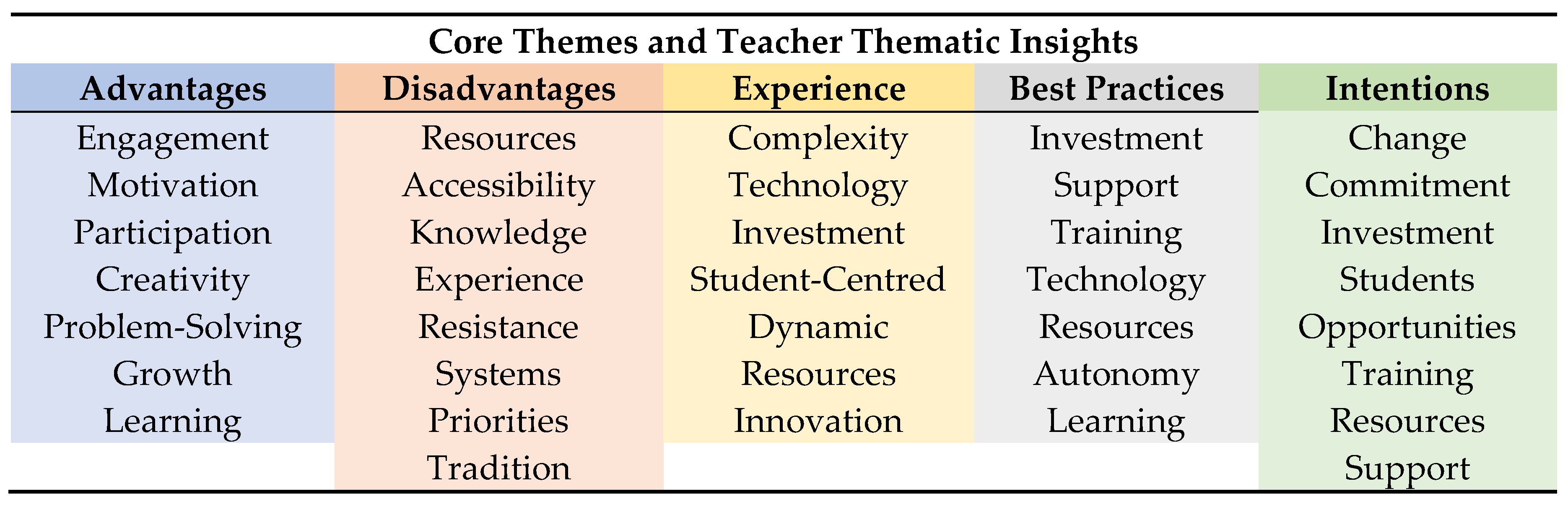
The core empirical element of this study was the collection of primary insights and responses from a small sample of teachers with experience in maker education and classroom design. Figure 2 provides a visual representation of the major themes explored in each of the five questions and the underlying subthemes identified by the teachers in relation to each of these prompts. For example, the primary advantages identified by the teachers in relation to Q1 included engagement, motivation, and creativity. For teachers to improve the application of maker education in future practice, Q4 revealed that support, resources, and autonomy are the best practices needed to improve performative outcomes. The following sections present and discuss the feedback on each question with direct reference to the teachers’ insights and responses.
- Q1) What do you feel are the greatest advantages of maker projects and educational strategies in the classroom?
- Major Themes: Engagement, Motivation, Participation, Creativity, Problem-Solving, Growth, Learning
The educator feedback to this question indicated a variety of advantages linked to student learning outcomes and active engagement with the educational process. P8, for example, reflected that ‘the idea of making something, even if only short-term, inspires students, it sparks creative juices that might otherwise be squashed by tradition and procedure.’ Similarly, P2 suggested that ‘it is really about keeping students interested in the content; could they learn about circuit design from a book or online lessons? Of course, but when they touch those connectors and solder those prongs, there is something tangible that emerges.’ This observation of the productive value of active involvement in the acquisition of knowledge is an important insight that links the practical or tacit aspects to the internal and referential aspects. Highlighting maker strategies from a broader institutional perspective, P4 observed as follows:
I think it shifts our priorities away from the narrow bands of curriculum that shackle our wrists and engages students in a new way of thinking, a worldly perspective, a social agenda that links personal success to the creation of something valuable. It is empowering.
This insight suggests that curriculum dependency restricts the accessibility and implementation of maker-based opportunities, potentially undermining the creativity and empowerment of a system that could otherwise reward innovation and diversify problem-solving.
- Q2) What do you feel are the greatest disadvantages or weaknesses of maker projects in the classroom?
- Major Themes: Resources, Accessibility, Knowledge, Experience, Resistance, Systems, Priorities, Tradition
Through feedback from these educators, there was one clear inhibitor affecting the realisation of a functional maker culture: tradition. P3, for example, indicated our dependency upon curriculum and traditions that define knowledge outcomes rather than creating functional, productive learners. What are we really teaching kids except to memorise facts and procedures?’ This same limiting effect was extended to an institutional domain when P7 argued, ”if you don’t have leadership support, then how can you achieve progress; we are restricted in our maker attempts by the rigid structure and goals of our school. The administration must be on board.’ This proposition of support and participation is important, as it makes acquiring what P5 suggested were ‘costly resources and technologies’ a more feasible objective. Further, P2 reflected that without the support of school administrators and institutional managers, ‘there is no way to seamlessly integrate maker culture into the normal science or computer curriculum without displacing some other step or expectation.’ This lack of cohesion between maker culture and school traditions highlights the systemic gap that P8 cautioned could be viewed as follows:
A complete and utter mess. A lack of cohesion. A breakdown of policies and school systems. There are no standard grading rubrics, there is no expectation or guideline. It is about as close to anarchy as we have gotten, and even then, there would be some kind of target or goal.
Echoing concerns regarding the openness of the school structure and support systems to student maker culture, the feedback suggested that cultural gaps limited the consistent execution of a more dynamic and integrative maker solution.
- Q3) How would you design your ideal maker experience given unlimited resources and time?
- Major Themes: Complexity, Technology, Investment, Student-Centred, Dynamic, Resources, Innovation
Although there were a variety of responses, the core themes identified within the participant feedback emphasised resources, technology, and innovativeness. For example, P1 indicated that ‘I envision a black box classroom with a big problem and almost no assistance to start with; it’s a brainstorming tsunami and everyone is drilling down until we have a path, and then we are given all the resources we need to make it happen.’ This idealised version of an adaptive classroom environment was supported by other educators including P3 who envisioned a ‘fully stocked maker lab with 3D printers, AI computing, and cloud-based devices to scale our projects to any conceivable level without interruption.’ Further, P5 recommended that ‘schools develop some form of empowerment programme that lets students identify a problem or innovation they want to pursue, and then uses robust resources to make it a success. Such visions were based on two central needs: resources to achieve the goal and the elimination of barriers (e.g., time, space, and mentors) to achieve this goal. P2 reflected that ‘we should be working with cutting-edge corporations and outside mentors to help these students envision a new future; they should see their results in commercial form.’ Ultimately, this form of integrative solution could facilitate a more tangible link between curricular advantages and long-term career-level impacts on student development.
- Q4) What do you feel are the most important objectives or outcomes of a maker-based educational experience?
- Major Themes: Investment, Support, Training, Technology, Resources, Learning, Autonomy
Feedback from the participants was subdivided into student and program outcomes, with educational opportunities serving as the primary mechanism of alignment. From a student perspective, P7 reflected that ‘I have witnessed significant growth in self-confidence and motivation; kids are just geared towards the maker culture now; it is so different than their traditional classes.’ Similarly, P2 indicated that ‘we have students awarded scholarships in technology, rewarded with grants, offered full time careers; it is a maker revolution and a lot of our student body wants to be a part of it.’ From a programme perspective, P5 recognised that ‘I am witnessing administrative changes and rule-bending that offers new opportunities for education, new collaborations, and really a whole new school culture because of maker opportunities.’ Extending this discussion to reflect on the tangible effects of maker-based education on various opportunities, P1 reported the following observations:
We were siloed, and subdivided into quads, into teacher/student enclaves. Now we are a collective, a community of practice that thinks critically together. We are making waves in the curricular water, and it’s bringing us all on board this new raft of creativity and innovation. We are not teaching from a book. We are teaching from experiences.
Such feedback highlights concerns about the lack of coordination in framing maker culture within Hong Kong’s educational settings, raising questions about opportunities for reframing creativity as a foundation of the educational system rather than as an afterthought.
- Q5) Do you plan on employing maker learning approaches in your future educational practices? Why or why not?
- Major Themes: Commitment, Change, Investment, Support, Students, Opportunities, Resources. Training
Participants’ feedback unanimously supported the future of maker culture in educational practices. However, there were variations in the objectives that represented various hurdles within these courses and institutions. P6, for example, reported that ‘I would love to continue in a maker context full time; but we have a resource issue and we have a staff issue, how do we keep people like me in place when we lack the funding to support such full time programmes? It’s frustrating.’ P8 indicated that ‘I think that if the administration was open to it, we could cycle entire classes through Maker courses every semester. We could have different problems or challenges and compare the results across classes. But the structure would have to change. There has to be more opportunities.’ Owing to funding and teacher access hurdles, the goal of full-time maker education is reportedly restricted by various structural limitations. P4 argued that not all of our students want to participate in such programmes, but for those who do, there needs to be a creative outlet.’ To realise this objective, however, P3 recognises that ‘I myself and going to need more training; I will need ongoing education in advanced technologies. I have to be able to support my students.’ Similarly, P7 indicated that ‘we need to see more advanced training and support. We need high tech resources and need to invest in tools to make functional projects.’ Without such solutions, the burden of innovation becomes a ‘remarkable ideal and hope, but a programme that must be driven by investment and engagement at all levels.’ (P5). Such insights suggest that all teachers would prefer to engage in maker culture in future educational settings, but are confronted with the realities of resource barriers and systemic hurdles that must be overcome to make such creative solutions a reality in the future.
4. Discussion
The future of maker education in classrooms is inexorably linked to technological innovations and resources that modernise institutions, curricula, and student learning systems. Based on feedback from these educators, it is evident that a variety of central strengths connect maker culture and educational strategies to tangible and highly effective student-centred learning outcomes. First, there was a motivational dimension, in which the teachers in this study observed sparked student creativity and sustained engagement in classroom activities, learning processes, and group work. Second, the educators interviewed in this study reported a developmental opportunity that links maker culture and coursework to a productive and dynamic identity supported by skills and knowledge mastery. Acquisition of tacit knowledge through active learning can be linked to increased productivity in community activism, future learning motivation, and long-term career development [19]. When applied to specific concepts or learning objectives (e.g., mechanical engineering and systems design), Chou [13] demonstrated that maker-based education has a superior impact on student learning compared to non-makers and traditional educational practices. These teachers also confirmed such opportunities and validated the potential for improved engagement in innovative and creative maker cultures in Hong Kong’s institutions.
Despite the advantages afforded by maker culture in educational institutions, educators have reported that the effort to shift policy- and procedure-based systems away from their traditional dependencies was difficult and often restricted. Lundberg and Rasmussen [4] argue that educators in a modern, technology-enhanced learning space, have a responsibility to shift away from ‘a system that tells students about how the world works’ and instead engage their creativity and innovativeness in practical problem solving. It is this ideal of creative and adaptive problem-solving that makes the rigidity and selectivity of curricular agendas inadequate for supporting student learning. Therefore, Santo et al. [8] and the educators in this study identified institutional support as an important antecedent to productive maker education, with resources such as maker classrooms, carts, and materials being provided free to encourage teacher appropriation.
Despite these advantages, Hsu et al. [5] reported that access to such resources varies, with some institutions neglecting the makerspaces needed to facilitate deeper, immersive learning. Feedback from these educators confirmed that school administrators are resistant to new, emergent technologies as the cost and disruptive effects of such solutions are viewed as destabilising and potentially threatening the long-term goals of the educational system. As schools adopt an increasingly hybridised educational system, the virtualisation of resources and expansion of the digital and VR landscape towards immersive, student-oriented problem solving will have an important, transformative effect on learner goals and experiences [32]. Furthermore, the juxtaposition of goal setting and goal-oriented reflective learning strategies would impact learners’ learning behaviours in the VR process and facilitate their learning behaviours and motivation [49]. Through an LBM modelling approach, learners become active participants in the solution or outcome, engage in collective discussions that stimulate motivated investment in complex, and evolve processes that positively impact their overall knowledge base [26].
There is an experiential hurdle or skills gap associated with pedagogy and maker culture, which the educators have identified as challenging and undersupported. Central to such disciplines are competency and proficiency in framing group-learning exercises and challenging students to develop high-impact solutions to problems attained via information exchange and productive dialogue across teams. The empirical evidence presented by Lock et al. [15] and Shin et al. [18] highlights the critical role of brainstorming and group-based idea testing in maker initiatives, and weighs the contributions of individual skill sets and awareness against the combined advantages of collaborative problem solving. Predicated upon a form of metacognitive and collective belief in their team’s potential to achieve, evidence suggests that the productive and purposeful exchange of knowledge through tangible maker-oriented exercises can significantly improve student performance and knowledge gains [23,25]. Educators should be supported in shaping student learning by developing competencies in metacognition, technological expertise, group negotiations, and iterative project design to attain improved outcomes from future maker courses.
5. Conclusions
As educational practices continue to evolve towards a more immersive standard, the developmental advantages of maker education are lauded as a catalyst for engagement-oriented learning practices. Accordingly, the primary aim of this study was to critically analyse the role of maker education in modern classroom settings, weighing the structure and design of innovative pedagogical solutions against student learning outcomes and opportunities. This study began with a critical review of the literature, which resulted in a multidimensional conceptual framework explaining the motives and challenges surrounding the maker education phenomenon. The subsequent empirical evaluation of teachers’ experiences was targeted at identifying potential best practices and solutions that could be used to improve educational outcomes in future maker environments.
The first objective of this study was to critically review the previous literature related to maker culture in educational settings. Previous research in this field shares a common theme of creativity or innovativeness which radicalises teachers and their students towards a new approach to learning. However, most traditional educational systems are standard-based and curriculum-focused. Therefore, the flexibility of such expectations is limited by comparative, performative standards. While maker culture idealises productive, high-performing outcomes, failure is also viewed as a form of achievement, particularly when aligned with specific learning processes and skills. The challenge in such cases is anchored in the dependence on educational systems to assess student knowledge based on rigid and inflexible performance systems. This form of pass-fail ideology is not conducive to creative or innovative making and, based on feedback from these educators, remains a controversial rollover from the traditionalist movement of education.
The second research objective was to develop a conceptual framework that represented the targets and priorities of maker education programs. A review of the literature in this field resulted in the GEARS-based acronym for goals, enablers, activators, recognition, and solutions in maker education. This model applies to a broad range of educational systems and classroom learning environments, drawing on student and teacher knowledge to develop creative and innovative learning solutions. Finally, the third objective was to conduct an empirical study of teachers’ experiences with maker culture and its application in educational settings. Feedback from the participants confirmed that core elements, such as communities of practice, mentors, and adequate resources, are important antecedents to maker cultural success in educational systems. Based on these findings, the future of educational practices can be characterised in a constructive form as an iterative evolution of the discipline and focus on a practical solution to an omnipresent problem: the problem of meaningful learning. Given these narratives, it is difficult to argue for a student’s passion and motivated engagement in robotics design or green energy experimentation; however, educational systems need to be instrumentalised to recognise and support the achievements in such dynamic maker cultures.
This study addresses the challenging question of the opportunities and limitations of maker education in Hong Kong-based higher education classrooms and explores how teachers resolve the challenges they encounter in applying these techniques to creative classroom solutions. This research might be limited by the number of teacher participants and the scope of the questionnaire that was completed in the process of analysing these perspectives. Furthermore, this study was based only on Hong Kong higher education, a network of institutions with varying requirements and expectations when considering maker culture and its application in school settings. Therefore, future research should weigh teacher and student perspectives and assess how maker culture is perceived and administered in interactive settings. Furthermore, it is recommended that program comparisons be made to determine the knowledge and technology challenges that affect teacher development and pedagogy as they aspire to a new standard of maker education.
Funding
No funding was received for this research.
Institutional Review Board Statement
All procedures performed in studies involving human participants were in accordance with the ethical standards.
Informed Consent Statement
Informed consent was obtained from all individual participants included in the study.
Data Availability Statement
Data will be made available on reasonable request to corresponding author.
Conflicts of Interest
There is no conflict of interest.
References
- Ayivor, I. 101 Keys to Everyday Passion; CreateSpace Independent Publishing: New York, 2016. [Google Scholar]
- Wu, T.-T.; Lin, C.-J.; Wang, S.-C.; Huang, Y.-M. Tracking visual programming language-based learning progress for computational thinking education. Sustainability 2023, 15, 1983. [Google Scholar] [CrossRef]
- Kamkwamba, W. The Boy Who Harnessed the Wind; HarperCollins Publishers: New York, 2010. [Google Scholar]
- Lundberg, M.; Rasmussen, J. Foundational principles and practices to consider in assessing maker education. J. Educ. Technol.; Educational Resources Information Center—EJ–179517—Foundational Principles and Practices to Consider in Assessing Maker Education. Journal of Educational Technology 2018, 14, 1–12. [Google Scholar]
- Hsu, Y.C.; Baldwin, S.; Ching, Y.H. Learning through making and maker education. TechTrends 2017, 61, 589–594. [Google Scholar] [CrossRef]
- Morado, M.F.; Melo, A.E.; Jarman, A. Learning by making: A framework to revisit practices in a constructionist learning environment. Br. J. Educ. Technol. 2021, 52, 1093–1115. [Google Scholar] [CrossRef]
- Sharma, G.V.S.S.; Prasad, C.L.V.R.S.V.; Rambabu, V. Online machine drawing pedagogy—A knowledge management perspective through maker education in the COVID-19 pandemic era. Knowl. Process Manag. 2022, 29, 231–241. [Google Scholar] [CrossRef]
- Santo, R.; Peppler, K.; Ching, D.; Hoadley, C. 2015. Maybe a maker space? Organizational learning about maker education within a regional out-of-school network. Fab Learn, pp. 1–10. Available online: d1wqtxts1xzle7.cloudfront.net.
- Vuopala, E.; Guzmán Medrano, D.G.; Aljabaly, M.; Hietavirta, D.; Malacara, L.; Pan, C. Implementing a maker culture in elementary school—Students’ perspectives. Technol. Pedagog. Educ. 2020, 29, 649–664. [Google Scholar] [CrossRef]
- Tabarés, R.; Boni, A. Maker culture and its potential for STEM education. Int. J. Technol. Des. Educ. 2023, 33, 241–260. [Google Scholar] [CrossRef]
- Bento Silva, J.; Nardi Silva, I.; Meister Sommer Bilessimo, S. Technological structure for technology integration in the classroom, inspired by the maker culture. J. Inf. Technol. Educ. Res. 2020, 19, 167–204. [Google Scholar] [CrossRef]
- Krummeck, K.; Rouse, R. Can you DIG it? Designing to support a robust maker culture in a university makerspace. Int. J. Des. Learn. 2017, 8, 1–15, Available online: https://www.learntechlib.org/p/209627/. [Google Scholar] [CrossRef]
- Chou, P.N. Skill development and knowledge acquisition cultivated by maker education: Evidence from Arduino-based educational robotics. Eurasia J. Math. Sci. Technol. Educ. 2018, 14, 1–15. [Google Scholar] [CrossRef]
- Zhan, W.; Hur, B.; Wang, Y.; Cui, S.; Yalvac, B. Creating maker culture in an engineering technology program. Int. J. Eng. Educ. 2021, 37, 712–720, 13_ijee4062 712..720. [Google Scholar]
- Lock, J.; Gill, D.; Kennedy, T.; Piper, S.; Powell, A. Fostering learning through making: Perspectives from the international maker education network. Int. J. E Learn. Distance Educ. 2020, 35, 1–26, Fostering Learning through Making: Perspectives from the International Maker Education –etwork—ProQuest. [Google Scholar]
- Godhe, A.L.; Lilja, P.; Selwyn, N. Making sense of making: Critical issues in the integration of maker education into schools. Technol. Pedagog. Educ. 2019, 28, 317–328. [Google Scholar] [CrossRef]
- Li, B. The construction path of innovation and entrepreneurship education in secondary vocational schools from the perspective of the maker era. Int. J. New Dev. Educ. 2021, 3, 50–54. [Google Scholar] [CrossRef]
- Shin, M.; Lee, J.J.; Nelson, F.P. Funds of knowledge in making: Re-envisioning maker education in teacher preparation. J. Res. Technol. Educ. 2022, 54, 635–653. [Google Scholar] [CrossRef]
- Zhan, W.; Hur, B.; Wang, Y.; Cui, S.; Yalvac, B. Actively engaging project based learning through a Mini Maker Faire in an engineering technology program. ASEE Virtual Conference. Available online: https://peer.asee.org/actively-engaging-project-based-learning-through-a-mini-maker-faire-in-an-engineering-technology-program, 2020; Vol. 28818.
- Maaia, L.C. Inventing with maker education in high school classrooms. Technol. Innov. 2019, 20, 267–283. [Google Scholar] [CrossRef]
- Webb, K.K. Makerspaces: High-tech and low-tech locations to expand creativity in the academic library. Elsevier Connect, Available At: Makerspaces: High-tech and low-tech locations to expand creativity in the academic library. Available online: elsevier.com, 2019.
- De Backer, L.; Van Keer, H.; Valcke, M. The functions of shared metacognitive regulation and their differential relation with collaborative learners’ understanding of the learning content. Learn. Interact. 2022, 77, 1–11. [Google Scholar] [CrossRef]
- Rambe, P. Spaces for interactive engagement or technology for differential academic participation? Google Groups for collaborative learning at a South African University. J. Comput. High. Educ. 2017, 29, 353–387. [Google Scholar] [CrossRef]
- Clapp, E.P.; Ross, J.; Oxman, J.R.; Tishman, S. Maker-Centered Learning: Empowering Young People to Shape Their Worlds; Jossey-Bass: San Francisco, CA, 2016. [Google Scholar]
- Setiaputra, B.; Yoas, J.H. Design exploration and collaboration within groups in learning-by-making (LBM) approach. IOP Conf. Ser. Mater. Sci. Eng. 2020, 960, 1–10. [Google Scholar] [CrossRef]
- Cohen, J.; Jones, W.M.; Smith, S.; Calandra, B. Makification: Towards a framework for leveraging the maker movement in formal education. J. Educ. Multimedia Hypermedia 2017, 26, 1–10, Makification: Towards a Framework for Leveraging the Maker Movement in Formal Education—Learning & Technology Library (LearnTechLib). [Google Scholar]
- Zhang, X.; Hu, J. A study on the learning behaviors and needs of design-maker communities of practice in the era of mobile learning. Libr. Hi Tech 2022, 1–10. [Google Scholar] [CrossRef]
- Carbonell, R.M.; Boklage, A.; Clayton, P.; Borrego, M. Making improvements; Pedagogical iterations of designing a class project in makerspace. ASEE Virtual Conference, 2020; Vol. 30352. ASEE PEER—Making Improvements: Pedagogical Iterations of Designing a Class Project in a Maker Space.
- Hall, R.; Shapiro, B.R.; Hostetler, A.; Lubbock, H.; Owens, D.; Daw, C.; Fisher, D. Here-and-then: Learning by making places with digital spatial story lines. Cogn. Instruction 2020, 38, 348–373. [Google Scholar] [CrossRef]
- Shu, Y.; Huang, T.C. Identifying the potential roles of virtual reality and STEM in maker education. J. Educ. Res. 2021, 114, 108–118. [Google Scholar] [CrossRef]
- An, H.; Sung, W.; Yoon, S.Y. Hands-on, minds-on, hearts-on, social-on: A collaborative maker project integrating arts in a synchronous online environment for teachers. TechTrends 2022, 66, 590–606. [Google Scholar] [CrossRef]
- Cortiz, D.; Silva, J.O. Web and virtual reality as platforms to improve online education experiences. 10th International Conference on Human System Interactions, 2017. [CrossRef]
- Bryman, A. Social Research Methods, 4th ed.; Oxford University Press: Oxford, NY, 2012. [Google Scholar]
- Jonker, J.; Pennink, B.J.W. The Essence of Research Methodology: A Concise Guide for Master and PhD Students in Management Science; Springer Verlag: Heidelberg, 2010. [Google Scholar]
- Saunders, M.; Lewis, P.; Thornhill, A. Research Methods for Business Students; Pearson Education Limited: Harlow, 2015. [Google Scholar]
- Patton, M.Q. Qualitative Research and Evaluation Methods: Integrating Theory and Practice; Sage Publications: Thousand Oaks, CA, 2015. [Google Scholar]
- Tracy, S.J. Qualitative Research Methods: Collecting Evidence, Crafting Analysis, Communicating Impact; Wiley-Blackwell: Chichester, 2013. [Google Scholar]
- Morgan, D.L. Integrating Qualitative and Quantitative Methods: A Pragmatic Approach; Sage: Los Angeles, CA, 2014. [Google Scholar]
- O’Reilly, M.; Kiyimba, N. Advanced Qualitative Research: A Guide to Using Theory; Sage Publications Ltd.: London, 2015. [Google Scholar]
- Petersen, N.J. Designing a rigorous small sample study. In Best Practices in Quantitative Methods, Osborne, J.W., Ed.; Sage Publications: Los Angeles, CA, 2008; pp. 137–152. [Google Scholar]
- Ragin, C.C.; Amoroso, L.M. Constructing Social Research: The Unity and Diversity of Method; Sage Publications: Los Angeles, CA, 2018. [Google Scholar]
- Hammersley, M.; Trainou, A. Ethics in Qualitative Research: Controversies and Contexts; Sage Publications: Los Angeles, CA, 2012. [Google Scholar]
- Babbie, E.R. The Practice of Social Research, 14th ed.; Cengage Learning: Boston, MA, 2015. [Google Scholar]
- Merriam, S.B.; Tisdell, E. J. Qualitative Research: A Guide to Design and Implementation, 4th ed.; Jossey-Bass: San Francisco, CA, 2015. [Google Scholar]
- King, N.; Horrocks, C. Interviews in Qualitative Research; Sage Publications: Los Angeles, CA, 2010. [Google Scholar]
- Chu, S.-T.; Hwang, G.-J.; Hwang, G.-H. A goal-oriented reflection strategy-based virtual reality approach to promoting students’ learning achievement, motivation and reflective thinking. Sustainability 2023, 15, 3192. [Google Scholar] [CrossRef]
Figure 1.
Conceptual framework of educational maker culture (Created for study).
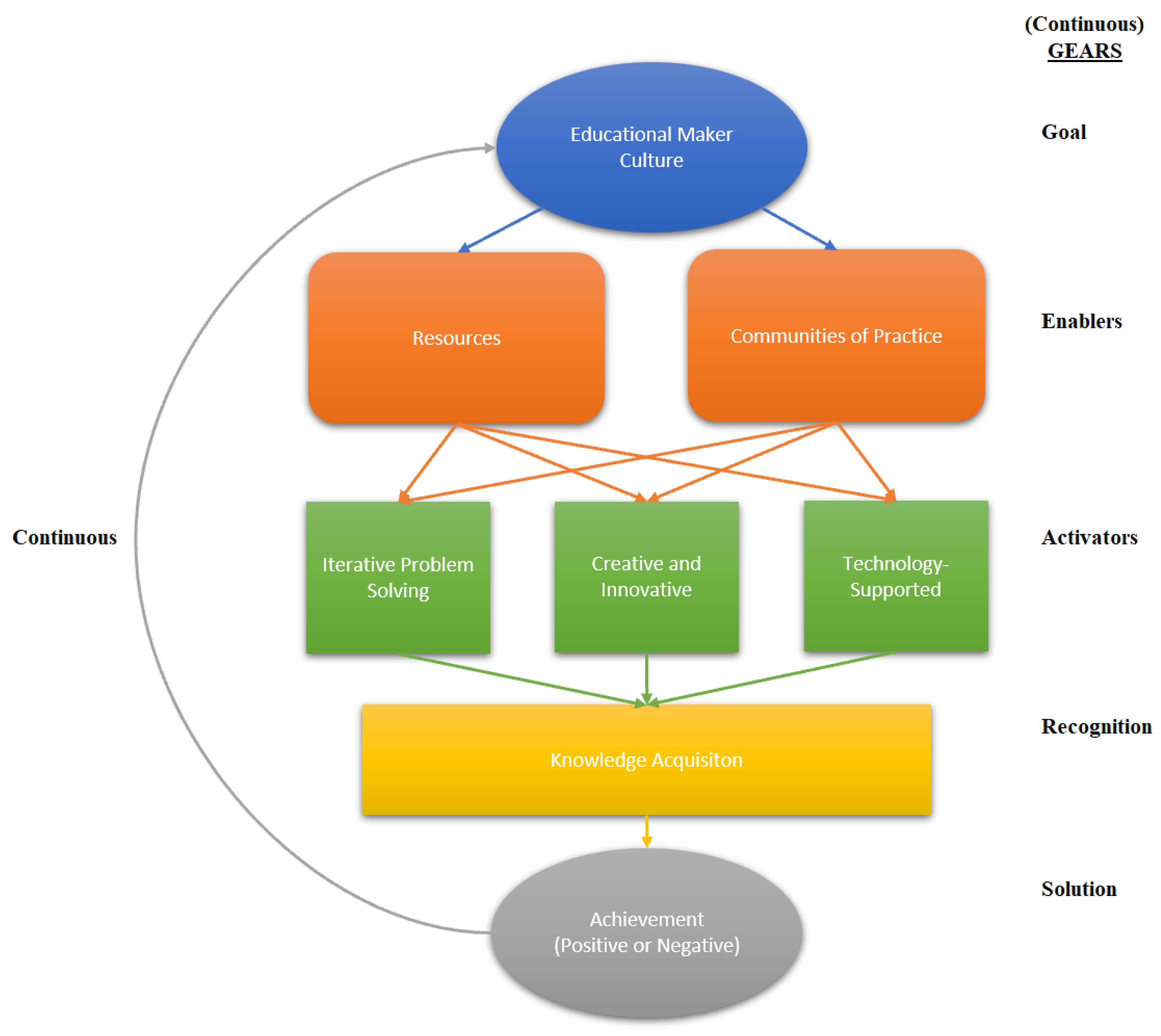
Figure 2.
Core themes and teacher thematic insights.
Disclaimer/Publisher’s Note: The statements, opinions and data contained in all publications are solely those of the individual author(s) and contributor(s) and not of MDPI and/or the editor(s). MDPI and/or the editor(s) disclaim responsibility for any injury to people or property resulting from any ideas, methods, instructions or products referred to in the content. |
© 2023 by the authors. Licensee MDPI, Basel, Switzerland. This article is an open access article distributed under the terms and conditions of the Creative Commons Attribution (CC BY) license (http://creativecommons.org/licenses/by/4.0/).
Copyright: This open access article is published under a Creative Commons CC BY 4.0 license, which permit the free download, distribution, and reuse, provided that the author and preprint are cited in any reuse.


