
Submitted:
05 December 2023
Posted:
06 December 2023
You are already at the latest version
Abstract
This paper introduces a Unified Field Theory through the generalization of General Relativity, following the methodology outlined by Einstein for incorporating complex metrics in the pursuit of a comprehensive Unified Field Theory.
Keywords:
Unified Field Theory
; General Relativity
; Complex metrics
; Einstein
Introduction
Electromagnetic energy [1] is understood to be a fundamentally different property of space-time [2] than gravitomagnetic energy [3]. The mathematical structures are identical in the sense that when the property of charge is replaced with mass, the Maxwell equations of electrodynamics produce a similar framework for the dynamic cases of gravity. Since protons are known to contain quarks and gluons were detected in 1979 [4], it should be assumed for any unified theory [5] that the color property of matter is a fundamentally different type of property that would give rise to a distinct energy similar to the cases where gravitational and electromagnetic potentials are different energies produced by mass and charge.
Postulate #1: Each type of energy has an associated space-time type. And each type of fundamental energy is created by the fundamental particle properties.
The fact that the Lagrangian [6] for Newtonian mechanics can be shown to be approximated by a more general lagrangian for relativistic mechanics in the low velocity limit [7] implies that general lagrangians can be used to derive more specific lagrangians from mathematical operations on the integral definition of the lagrangian.
Postulate #2: All Lagrangians can be defined by integrals which contain different spaces of functions and each space-time type belongs to a different space of functions. Additionally other action integral transformations can produce more general mathematical objects and completely different function spaces, which means that each type of lagrangian can be described as a particular parameterization and transformation of the most general possible lagrangian that contains a space of all other lagrangians.
The Feynman space-time representation of photons [8,9] describes photons indicates that particles must be described with complex numbers with the localized interpretation required by relativity. The Complex Number Theory of General Relativity indicates that complex space-times must be analytically continuous. If particles reside in complex space-time relative to a macroscopic observer, then it must be true that their trajectories in complex space-time must be analytically continuous.
Postulate #3: A Lagrangian of each type for all energy types within the universe can be constructed by the generalization of the integral of the form described by the Complex Number Theory of General Relativity with the scaling factor.
Being more specific, if we can approximate in the quantum frame [10] what it means to be near a particle by its field effects such as magnetic moment [11], electromagnetic field, gravity field, electroweak [12] and quantum fields, by the motion of a particle then useful approximations can be obtained on the fundamental description of particles
Postulate #4: All particles can be represented by point masses with fundamentally different types of energy where the energy functions can be used to construct Lagrangian functions for the dynamic system.
Within complex space the motion of the particle similar to how the frequency space gives a different interpretation of circuit phenomenon when the Fourier transform [13] is applied to the time dependent differential equation, the meanings of the definitions change. So in the quantum frame it appears like there is motion in the complex space [14]. But this is imperceptible to a macroscopic observer larger than the particle radius [15] estimates by classical means. This is similar to not being able to see the quarks within the proton radius. The viewpoint of an infinitely small point indicates that there is no true defined radius. This is merely a mathematical model for which it is useful to define particles in this manner.
Postulate #5: The different fundamental motions of particles is the responsible mechanism for the different types of energies.
A unified field theory must require not only equivalence of gravity and electromagnetism but that the classical probability laws by Newton [16] are transformed to the quantum probability laws [17] under the quantum transform.
Postulate #6: The differences between Quantum Mechanics and the theory of relativity in the description of particles can be obtained by a coordinate transformation of the lagrangian for which quantum phenomena can be described. By transforming coordinates to the view the quantum system the integrand of the Action Integral transforms. The transform of the action integral essentially creates new mathematical objects relative to the classical framework much in the same way that nearing the speed of light such that the relativity framework is used introduces new terms relative to the Newtonian equations.
In revisiting the foundational work of Einstein from his 1915 papers on relativity [18], it has become evident that his comprehensive framework of general relativity (GR) was not the terminal point but rather a stepping stone toward a more intricate understanding of the universe. Remarkably, it appears that Einstein, in his exploration, had foreseen the necessity of incorporating complex tensors [19], a key insight that has largely been overlooked until recent investigations.
While my initial journey may have commenced without full knowledge of the extent of Einstein's contributions, this inadvertent detour led me to amass disparate insights, ultimately culminating in a distinct approach to substantiate Einstein's conjecture. The culmination of these endeavors has coalesced into a comprehensive depiction of the unified field theory, marking a significant departure from the conventional trajectories of contemporary physics. Today, it has almost become fashionable among certain physicists to tout Einstein's purported inaccuracies regarding the failure of his unified field theory. However, it is imperative to recognize that the constraints of the physical world, coupled with the absence of computational resources during Einstein's later years, precluded the realization of his envisioned unified field theory [20].
Curiously, the trajectory of modern physics diverged from Einstein's profound groundwork, gravitating toward the reformulation of quantum field theories, inadvertently neglecting the continuum initiated by general relativity. Yet, a pivotal revelation has emerged, demonstrating an intriguing equivalence between the space-time frameworks of general relativity and quantum mechanics. This revelation unveils an unprecedented opportunity to bridge the gap between the standard model and gravitational theory through a progressive extension of Einstein's unified field theory. In the ensuing discourse, we expound upon the implications and ramifications inherent within this unified framework, illuminating the uncharted territories that beckon at the intersection of the macroscopic and quantum domains. There is thus no need to differentiate the “general theory of general relativity” naming convention from Einstein’s but we do need to fill in the details to eliminate the inconsistencies.
Considering various compelling reasons, the inclusion of a complex metric tensor in the framework of general relativity stands as a pivotal proposition. Evidently, research has highlighted the ubiquity of complex tensors in numerous contexts, thereby underscoring the necessity of considering their role in the overarching construct of the theory. Implicit in this consideration is the postulation that the coordinates of functions intricately hinge on the quantum wave function and the relative quantum coordinates, ultimately necessitating the inclusion of complex-valued quantum metric tensors to reconcile the pertinent complexities.
To address this fundamental intricacy, it becomes imperative to introduce a key postulate that accounts for the profound impact of scaling alterations on the individual functions, notably gamma, within the purview of the Lagrangians and coordinates. Notably, as we delve into finer scales, the inherent fluctuations within the Lagrangians correspondingly engender a metamorphosis in the categorization of energy, contingent upon the relativistic factor gamma.
It is essential to delineate the reasons behind these assertions comprehensively, elucidating the intricacies that prompt the inclusion of complex metric tensors in this extended paradigm. Subsequently, this line of inquiry finds resonance in the precedent set by the "pseudo-complex theory of general relativity," while simultaneously drawing attention to Albert Einstein's discerning references concerning the imperative role of complex tensors, serving as a testament to the foundational significance of this nuanced proposition.
Moreover, it is within our purview to anticipate the profound utility of applying analytic continuation in conjunction with the modern tools of complex analysis to the intricate functions and equations constituting this unified field theory. Notably, it is reasonable to posit that the complex metric adheres to the stringent Riemann-Cauchy conditions [21], converging in alignment with the analytical prerequisites outlined within my theoretical framework on the zeta function.
In this context, the formulation of extremal conditions necessitates a comprehensive integration of the Euler-Lagrange equations [22], establishing a coherent link between the extremal conditions and the intricate dynamics encapsulated within the theory. Crucially, the application of the Euler-Lagrange equations to the complex system, specifically to the function, stands poised to illuminate the nuanced underpinnings of the Riemann-Cauchy conditions, fostering a comprehensive understanding of the intricate interplay between the underlying principles governing this unified field theory.
Field Equations and Equations of Motion:
The Euler-Lagrange equations are indeed a fundamental tool in classical mechanics and field theory, including the theory of general relativity. They are applied to the Lagrangian, which is a function that summarizes the dynamics of a system. In classical mechanics, this function can describe the kinetic and potential energies of a system, while in field theory, the Lagrangian represents the dynamics of fields.
In the context of general relativity, the Einstein field equations describe the fundamental interaction of gravitation as a result of space-time being curved by matter and energy. The field equations are derived from the Einstein-Hilbert action, which is an action integral that includes the Ricci scalar curvature and the cosmological constant, with the gravitational action being coupled to the matter action.
By applying the principles of least action (or stationary action), variations of the action integral with respect to the metric tensor give rise to the Einstein field equations. This involves varying the action with respect to the metric tensor and then setting the variation to zero, which results in the field equations.
Geodesic equations, on the other hand, are derived from the concept of geodesics, which are the shortest paths between points in a curved space. In the context of general relativity, geodesic equations describe the motion of particles moving under the influence of gravity alone. These equations can be derived from the principle that a freely falling particle follows a path that extremizes the proper time along its trajectory. This principle is also related to the variational principle, where the action for a free particle is extremized to yield the geodesic equations.
In summary, the Euler-Lagrange equations are used to derive the field equations from the action in the context of general relativity, while the geodesic equations are derived from the principle of extremizing proper time for freely falling particles in a curved spacetime.
When it comes to the derivation of the geodesic equations in the context of general relativity, the principle of least action can be related to the variational principle for geodesics. Geodesics, in the context of general relativity, represent the paths that particles follow under the influence of gravity alone, with no other forces acting upon them.
The variational principle for geodesics can be understood as follows: the trajectory of a freely falling particle in a curved spacetime is the one that extremizes the proper time along the path. This means that the actual path followed by a particle in spacetime is such that the proper time is either a maximum or minimum, making the action stationary.
The action integral for a freely falling particle is proportional to the proper time along its trajectory. By applying the principle of least action or the variational principle, one can find the geodesic equations, which govern the paths of particles moving under the influence of gravity alone in a curved spacetime. These geodesic equations describe the motion of particles along the paths that extremize proper time and are central to understanding the behavior of particles in the presence of gravitational fields in the framework of general relativity.
This endeavor marks not a mere recalibration or a reconfiguration of existing paradigms, but rather an intricate synthesis of disparate elements into a coherent tapestry, potentially unraveling myriad manifestations through which the entire spectrum of physical laws can be seamlessly derived. A pivotal challenge that confronts this unification process resides in the persistence of infinities and divergences within the fabric of Lagrangians. In response to this pressing concern, my proposed approach offers a transformative pathway, envisioning the integration of quantum Lagrangians that circumvent the generation of such problematic infinities. To this end, the general Lagrangian assumes a definitive form, serving as a foundational pivot in the construction of this unified field theory, denoted as:
It is imperative to underscore that in lieu of mere summations, the continuous nature of the gamma factor necessitates an integration approach, specifically integrating over the scale factor, gamma. In light of this, it becomes pivotal to present a comprehensive elucidation encompassing all known Lagrangians within the purview of this unified field theory.
The explication of these Lagrangians warrants a meticulous categorization based on their inherent gamma factors, thereby facilitating a systematic organization that delineates the distinct scale ranges across which each Lagrangian manifests its influence. This rigorous classification serves to underscore the crucial role of gamma across various scales, elucidating its transformative influence from atomic dimensions to molecular configurations, further extending its imprint into the intricate architectures of cellular formations and beyond.
Listing the lagrangians for each scale:
| Classical Mechanics | Thermodynamics | ||
| Free Particle Lagrangian | Describes the motion of a particle without any external forces acting upon it. | Irreversible thermodynamics and the second law of thermodynamics | |
| Simple Harmonic Oscillator Lagrangian | Models the behavior of a system exhibiting simple harmonic motion, such as a mass-spring system. | Lagrangians of Engines | Dynamics of engines |
| Double Pendulum Lagrangian | Characterizes the motion of a system consisting of two connected pendulums, commonly used to study complex coupled oscillatory systems. | Lagrangians of N-body particle systems | Dynamics of thermal activity |
| Rigid Body Lagrangian | Describes the motion of a rigid body, considering both its translational and rotational dynamics. | Lagrangian for gas compression | |
| Lagrangian for Systems with Constraints | Used to study systems with constraints, incorporating the constraints into the formulation of the Lagrangian. | Lagrangian for endothermic reactions | |
| Lagrangian for a Gyroscope | Describes the motion of a gyroscope, considering its rotation and precession under the influence of external torques. | Lagrangians for exothermic reactions |
| Fluid Dynamics | Biophysics | ||
| Navier-Stokes Lagrangian | Accounts for the dynamics of viscous fluids, incorporating the effects of viscosity and momentum transport in the flow field. | Mechanobiology Lagrangian | Describes the mechanical behavior of biological structures and tissues, aiding in the understanding of processes such as cell mechanics, tissue deformation, and mechanotransduction. |
| Vortex Filament Lagrangian: | Describes the dynamics of vortex filaments in fluid flows, providing insights into the behavior of vortices and their interactions. | Biopolymer Lagrangian | Characterizes the dynamics of biopolymers, including proteins, DNA, and RNA, offering insights into their structural properties, folding pathways, and mechanical behavior. |
| Eulerian Lagrangian: | Describes the motion of fluid particles in the Eulerian framework, providing insights into the kinematics and dynamics of fluid flow. | Membrane Biophysics Lagrangian | Accounts for the dynamics of biological membranes, elucidating phenomena such as membrane elasticity, fluidity, and the interactions of membrane-bound proteins and lipids. |
| Magnetohydrodynamics lagrangian | Bioenergetics Lagrangian | Describes the energy conversion processes within biological systems, encompassing the dynamics of enzymes, metabolic pathways, and the principles of energy transduction in living organisms. | |
| Hurricane system lagrangians | Neurobiophysics Lagrangian | Pertains to the dynamics of neuronal systems, including the electrical activity of neurons, synaptic transmission, and the principles underlying signal processing in the brain | |
| Tornado system lagrangians | Biomechanics Lagrangian | Describes the mechanical behavior of biological structures and systems, ranging from the movement of individual cells to the biomechanics of complex organs and organisms. |
| Molecular Physics | Special Relativity | ||
| Molecular Vibrational and Rotational Lagrangians: | Describe the vibrational and rotational motions of molecules, providing insights into their energy levels and spectroscopic properties. | Relativistic free particle Lagrangian | This Lagrangian incorporates the relativistic kinetic energy of the particle and is formulated in terms of the proper time along the particle's worldline. |
| Molecular Electronic Structure Lagrangians | Account for the electronic structure of molecules, describing the behavior of electrons and their interactions within molecular systems. | Far away galaxies in the future | |
| Born-Oppenheimer Lagrangian | Enables the separation of nuclear and electronic motions in molecules, providing a framework for studying the dynamics of molecular systems. | ||
| Lagrangian for Molecular Interactions and Forces: | Describes the intermolecular forces and interactions between molecules, providing insights into the behavior of molecular systems in different environments. |
| Quantum Mechanics | Quantum Field Theory | ||
| Quantum Harmonic Oscillator Lagrangian | Models the dynamics of a quantum harmonic oscillator, an essential system in quantum mechanics, with applications ranging from solid-state physics to quantum field theory. | Path Integral Formulation Lagrangian | Utilized in the path integral formulation of quantum mechanics, providing a powerful approach to calculating transition amplitudes and correlation functions in quantum systems. |
| Spinor Field Lagrangian | Describes the dynamics of spinor fields, such as those describing fermions in quantum field theory, playing a crucial role in the description of fundamental particles. | ||
| Scalar Field Lagrangian | Used in the description of scalar fields, which often arise in the context of the Higgs mechanism and other phenomena in quantum field theory. |
| Electrodynamic | Quantum Electrodynamic | ||
| Maxwell's Electromagnetic Field Lagrangian | Describes the dynamics of classical electromagnetic fields, incorporating the electromagnetic field tensor and the electromagnetic field energy. | Quantum Electrodynamics (QED) Lagrangian | Describes the dynamics of electromagnetic interactions in the quantum field theory framework, including the interactions between electrons, positrons, and photons. |
| Lagrangian for Charged Particle Interacting with Electromagnetic Field | Accounts for the dynamics of a charged particle moving in an electromagnetic field, incorporating the Lorentz force and the interaction between the particle's charge and the electromagnetic field. |
| Gravitational | Chromodynamics | ||
| Einstein-Hilbert Action | Describes the dynamics of the gravitational field in terms of the curvature of space-time, forming the basis of Einstein's field equations in general relativity. | Yang-Mills Lagrangian for Non-Abelian Gauge Fields | Generalizes the concept of electromagnetism to describe the dynamics of non-Abelian gauge fields, such as those encountered in quantum chromodynamics (QCD) and the electroweak theory. |
| Palatini Action | Extends the Einstein-Hilbert action by considering the connection and the metric as independent variables, providing an alternative formulation of general relativity. | QCD Lagrangian | Describes the dynamics of quarks and gluons and incorporates the principles of color charge, gluon self-interactions, and quark-gluon interactions. |
| Gauss-Bonnet Action | Incorporates higher-order curvature terms into the action, contributing to the understanding of higher-dimensional gravity and the role of topological invariants. | Gauge Field Lagrangian for Gluons | Characterizes the dynamics of the gluon field, incorporating the self-interactions and the interactions with quarks in the framework of non-Abelian gauge theories. |
| Lovelock Action: | Generalizes the Einstein-Hilbert action to include higher-dimensional analogs, incorporating higher-order curvature terms in a manner consistent with the requirements of gravitational dynamics. | Quark Field Lagrangian | Accounts for the dynamics of quarks, considering their interactions with gluons and the principles of confinement and asymptotic freedom. |
| Chiral Lagrangian | Describes the dynamics of light quarks and the spontaneous breaking of chiral symmetry, providing insights into the low-energy behavior of QCD and the properties of hadrons. |
| Electroweak | Standard Model | ||
| Weinberg-Salam Model Lagrangian | Forms the basis of the electroweak theory, incorporating the dynamics of the gauge bosons (W and Z bosons) and the Higgs boson, along with the interactions between these particles and the fermions. | Higgs Field Lagrangian | Describes the dynamics of the Higgs field and its interactions with other particles, including the generation of masses for the W and Z bosons and the fermions through the Higgs mechanism. |
| Gauge Boson Field Lagrangian | Describes the dynamics of the W and Z bosons, incorporating the principles of gauge symmetry and the spontaneous breaking of the electroweak symmetry. | Yukawa Lagrangian | Describes the interactions between fermions and the Higgs field, leading to the generation of fermion masses through the Yukawa coupling. |
| Fermion Field Lagrangian with Chiral Couplings | Accounts for the interactions between the fermions and the gauge bosons in the electroweak theory, incorporating the principles of chiral symmetry and the origin of fermion masses through the Higgs mechanism. | Neutrino Oscillation Lagrangian | Accounts for the oscillations of neutrinos between different flavors, providing a framework for understanding the phenomenon of neutrino flavor mixing. |
| Lepton Sector Lagrangian | Describes the dynamics of leptons and their interactions, encompassing the behavior of electrons, muons, taus, and their associated neutrinos within the Standard Model. | ||
| Quark Sector Lagrangian | Describes the dynamics of quarks and their interactions, providing a comprehensive framework for understanding the behavior of quarks and their bound states within the context of the Standard Model. | ||
| Quartic Gauge Boson Interaction Lagrangian | Describes the self-interactions of the electroweak gauge bosons (W and Z bosons) and provides insights into the dynamics of weak interactions at high energies. | ||
| Chiral Lagrangian for Hadrons | Accounts for the dynamics of mesons and baryons in the context of quantum chromodynamics (QCD), providing a low-energy effective theory for the interactions of strongly interacting particles. | ||
| Electroweak Symmetry Breaking Lagrangian | Describes the breaking of the electroweak symmetry and the generation of masses for the W and Z bosons and the fermions, elucidating the mechanism responsible for the origin of particle masses. |
To facilitate a more concrete understanding, the definition of gamma can be effectively correlated with the comprehensive annotations encapsulated within the images detailing the scale variations of diverse entities. These images highlight the unifying thread that permeates the intricate changes in the coordinates of x, y, and z, while the pivotal factor of gamma orchestrates a seamless transition across these diverse scales. Commencing with the foundational scale of atoms, the progression extends into the realm of molecules, subsequently unfurling into the complex tapestry of cellular structures and beyond.
In line with this comprehensive exposition, the action assumes a refined definition, serving as a cornerstone in the elucidation of the foundational principles inherent within this unified field theory. Emphasizing the critical interplay between the dynamic interdependencies of the action and the inherent complexities of the gamma factor, the action can be expounded upon as:
Where from the field equations for each scale can be derived if we define a set of matrix equations:
Or:
These equations serve as the foundational pillars of our comprehensive field theory. It is crucial to underscore the direct relationship between the intricacy of the Lagrangian and the complexity of solving the equations, often rendering manual computations infeasible. Fortunately, our methodology is intricately intertwined with sophisticated computational tools, allowing for efficient and accurate analysis.
The Euler-Lagrange operator, a fundamental element within our framework, emerges from the variation of the integral. In the realm of operator theory, the concept of "variation" manifests as a vector of derivative rules. The establishment of this relationship is fortified through the rigorous derivation of E-L type equations, underscoring the depth and rigor of our approach.
Moreover, this framework readily lends itself to a broader scope, facilitating the incorporation of various equations and the potential expansion to a generalized matrix. Such an approach accommodates not only the Euler-Lagrange equations' operations but also the application of diverse general operators that give rise to distinct families and types of equations. Utilizing matrices within matrix entries represents a systematic notation, adept at succinctly encapsulating the comprehensive intricacies of operators.
Notably, stands as one such operator, governing the dynamics of the Lagrangian, which represents a specific category of energy function. It is essential to acknowledge the existence of other energy functions, such as Hamiltonians [23], which engender familiar systems of equations. Consequently, a transformation of operators and related functions is conceivable within this framework, preserving the essence of the familiar expressions.
This matrix representation not only signifies an apparent connection to my previous work on the Riemann hypothesis and the zeta matrix but also underscores the potential synergy between group theory, the symmetries of physics, and the intricate fabric of these matrices.
In this formal setup, the derivation of equations unveils their nuanced application at distinct scales, a phenomenon intricately tied to the additional information encapsulated within the corresponding matrix at each specific scale.
Delving further, the phenomenon of sign swapping at the boundary and the consequential energy conversion mechanism come to the forefront of discussion. Notably, a critical juncture arises in the theory of relativity if the particle's velocity surpasses the speed of light. However, an intriguing proposition emerges, suggesting that the complete energy conversion to an alternative form could transmute the particle into one characterized by real and imaginary values where since there is a bounding by the relativistic speed limit occurs only when the electromagnetic energy is converted into other types of energy.
Consider the compelling notion that upon breaching the speed-of-light boundary, the phasor of the electromagnetic Lagrangian undergoes a transformative shift, leading to a state of obscurity relative to the observer—a state commonly referred to as "darkness." This intriguing transition to darkness might ensue as a result of the profound alteration in electromagnetic velocity scaling, exceeding the confines permissible within the electromagnetic boundary.
Thus, this passage through the electromagnetic boundary could conceivably trigger the conversion of matter's energy, relative to the observer at scale gamma 1, into a distinct energy characteristic of dark matter. In essence, the intricate process involves the conversion of electromagnetic energy into negative gravity energy and potentially other forms as the boundary is crossed, fundamentally altering the energy landscape in relation to our observation.
This indeed would potentially imply that Or that the speed of light is not constant with scaling changes since For all gamma but it is for the range of gamma for the applicability of electromagnetic lagrangian.
This prompts contemplation on whether the constancy of the speed of light remains a universal principle across other observable universes, raising plausible skepticism regarding its assumed invariance. Indeed, indications suggest a departure from this constancy, particularly when considering the absence of an exclusive selection of an inertial reference frame during the alteration of the scaling factor. Consequently, the anticipation of surpassing the finite speed of light remains justified within the context of this formulation, allowing for the potential scaling to outpace the growth of light in our theoretical simulations. While gamma serves as a mathematical construct, its application resonates intuitively, offering an effective means of elucidating various phenomena.
A critical conjecture arises, contemplating the potential demonstration of an electron's energy transformation at these spatial extents, yielding the characteristic equation of dark matter for specific gamma values. Such an exploration has the potential to establish a compelling correlation, suggesting the transformation of the Unified field equations for the electron beyond the confines of the speed-of-light boundary into the distinctive framework characterizing dark matter.
Hence, a comprehensive and overarching Lagrangian governing the intricate dynamics of the electron warrants further exploration. Notably, given the celestial bodies' rotational motion, which contributes to the object's relative velocity, the electrons, too, are presumed to undergo rotational motion. This phenomenon is observed not only within the swiftly rotating outer planets in specific solar systems within the region where the rotation curve maintains a uniform profile but also in their high-velocity traversal across the galactic expanse. Evidently, the considerable velocity associated with the electrons' rapid motion appears to exceed the speed of light relative to an observer at a specific scale, prompting the contemplation of potentially nuanced velocity behaviors across varying scales.
Consequently, the intricate fabric of electron motion extends beyond the conventional circular orbit around the galaxy, necessitating a more intricate understanding of the underlying complexities. It is crucial to acknowledge that all the observed light is essentially a product of accelerated charges, prominently including the electron, thus underscoring the necessity of accounting for these intricate motion dynamics in our comprehensive analysis.
Considerations for the electron's behavior on a planet extend to:
There are very likely other lagrangians accommodating for the underlying motion of the point particle.
In essence, the increment in the scale factor gamma leads to a discernible evolution in the associated Lagrangian functions. This implies that each constituent term of the Lagrangian is intrinsically reliant on the scale factor gamma. I begin this discourse as an exploration of energy function descriptions yields invaluable insights into various particle properties, thereby contributing to a holistic understanding of their intricate dynamics.
For instance, the fundamental equation - suggests a critical segregation within the Lagrangian governing the underlying motion. This partition arises from the realization that the underlying motion, as described by the gravitational Lagrangian, distinctly differs from that governed by the electromagnetic Lagrangian. Consequently, a comprehensive approach necessitates the dissection of the underlying motion Lagrangian into its constituent parts, acknowledging the discrete nature of the constituent Lagrangians governing the underlying motion for each dynamic force.
This interrelationship becomes apparent at the juncture where the Lagrangian of underlying motion converges to an evaporation point, signifying the equilibrium between the kinetic energy and the potential function or the complete dissipation of both factors. Here, a pertinent observation emerges: . This alignment aligns with expectations, particularly in scenarios where the Lagrangian primarily embodies kinetic components, as this precise boundary signifies a critical juncture for energy conversion.
In the context of our dark matter theory, the anticipation arises that at the velocity, the object in consideration undergoes the Schwarzschild sign-swapping condition, wherein spatial and temporal units interchange their significance. A manipulation of the equation: L_Motion=∞, reveals an inherent divergence within the Lagrangian or the energy, effectively attributable to the breakdown induced by the speed of light. This critical phenomenon reflects the limitations inherent to our current theoretical framework, urging a more nuanced understanding of the intricate dynamics governing these complex energy transformations.
Given our comprehensive extension of all variables in the realm of relativity, incorporating the complex metric, the Lagrangians now function as derivatives of these generalized complex spacetime coordinates, thereby necessitating the inclusion of the primed coordinates. Notably, the intricate structure presents a subscript within a subscript, where the distinctive placement of the mu subscript at a different y value relative to the s value assumes critical significance. Within this complex framework, the functions u and v, indicated in lowercase, respectively represent the real and imaginary components of the given coordinate denoted by the immediate right subscript, thereby underscoring its pivotal role in delineating the function's real nature.
Consequently, we would derive a set of novel Lorentz equations in the complex plane, following the same fundamental principles that govern the underlying dynamics. This procedure can be executed as demonstrated in the subsequent illustration:
Where, here we let
And inserting this into the interval equation above:
Which expands into:
Now, grouping the real and imaginary parts:
Using condition #2 in my paper on the proof of the Riemann Hypothesis [81]:
So in other words, in this frame, we expect that the squaring of the complex space-time interval gives rules for the complex space time as well as the expected form of the complex tensor. We can do this by defining the above equation with some manipulation as a matrix equation:
We define the space time interval phasor and this produces 2 conditions instead of the usual 1 condition to derive the Lorentz equation since we have more coordinates. If we assume that all the coordinates are analytic they must follow the Riemann Cauchy conditions. This equation goes to show how the time and spatial coordinates transform when they are complex. The time components are visible with the being out front and it can be seen that the “transformed to” coordinates each are functions of time and space in a manner that has the hyperbolic structure embedded within each of the components.
These equations can be solved under certain conditions and assumptions. Define the functions:
This allows us to write the phasor in the form:
Consequently, the fundamental principles of relativity persist in a compatible form, signifying that both the real and imaginary components adhere to hyperbolic geometry relative to each other. This is analogous to Einstein’s 1905 paper [24] in the sense that we have a beam of light traveling in the (X, T) axis but also the light is traveling in the imaginary (tau, sigma) axis as well as pairs of flat transforms for each of those. The light beam in other words is traveling in time in the imaginary domain in a fundamentally different manner than in the real domain.
| (Lorentz) Transformation Equations | Inverse Equations |
|
|
|
| By condition #2 we also have: |
|
And this produces the complex Lorentz equations that can be used to form the basis of complex special relativity for which the basis of the unified field theory:
| (Lorentz) Transformation Equations | Inverse Equations |
|
|
|
|
|
|
Enabling the consideration of complex coordinates within the Lorentz transformations [25] introduces a pivotal shift that profoundly impacts the discussions articulated in Einstein's groundbreaking paper. This crucial adjustment fundamentally broadens the scope of our understanding of the interplay between space and time, enabling an exploration of the intricate dynamics within the framework of unified field theory.
Incorporating the notion of complex coordinates in the Lorentz transformations expands the theoretical framework to encompass hyperbolic geometry, thereby presenting an innovative avenue for comprehending the intricacies of the space-time continuum. This extension presents a nuanced interpretation of the interrelationship between the real and imaginary dimensions, offering profound insights into the complex dynamics of particle interactions and energy transformations.
By infusing the considerations of complex coordinates into the Lorentz transformations, we transcend the conventional limitations of Einstein's discussions, delving into a realm where the spatial and temporal dimensions intertwine within the complex domain. This innovative perspective not only refines our comprehension of the foundational principles outlined by Einstein but also paves the way for a more comprehensive and unified understanding of the dynamics governing the universe.
By integrating the concept of complex coordinates into the Lorentz transformations, we initiate an exploration into a realm of complex energy dynamics. This extension might offer a transformative perspective on the intricate behavior of the electron, encompassing its multifaceted interactions within the context of the unified field theory.
The incorporation of complex coordinates not only necessitates a reevaluation of the dynamics of the electron but also prompts a profound investigation into the transformative nature of Newton's equations. Within this comprehensive framework, the real and imaginary components assume critical significance, with the primed coordinates being effectively determined through the application of the standard Lorentz equations. This approach enables us to navigate the complexities of particle dynamics and energy transformations, shedding new light on the interconnected nature of the physical universe. This would only be applicable beyond the boundary where or such that we have selected coordinates for which the space-time is complex valued.
A simultaneous divergence occurs at the critical juncture when the value of c equals v, resulting in the equation . Interestingly, since we establish the equivalence between and the equation arises. Although seemingly paradoxical, this logical consistency becomes apparent when considering the entire system of coordinates, which essentially accounts for twice the number of coordinates within the unprimed system.
I propose that these equations should not be concealed under the guise of preserving symmetry, as they are often implicitly implied. Such concealment could lead to an oversight of the comprehensive symmetric set of equations governing the system. Consequently, while the emergence of an infinite value is inevitable, it finds equilibrium within the comprehensive framework as the primed coordinates also accommodate a corresponding infinity. Hence, our equations should be meticulously articulated as follows:
More precisely, if assumes an infinite value, we derive the equation ', particularly relevant in the context of the electron's internal energy. This equality signifies that both equations concurrently yield infinity, synchronously encapsulating the divergence of the primed and unprimed coordinates. Significantly, both sets of coordinates undergo a mutual inversion of their defined characteristics, thereby establishing a delicate equilibrium between their respective divergences within the overarching framework.
Consequently, both the primed and unprimed coordinates seamlessly transition into a complex state beyond this critical boundary. A similar phenomenon manifests in the relativistic breakdown, distinctly observed in the escape velocity equation, which approximates the Schwarzschild solution under specific assumptions and constraints. The occurrence of the Schwarzschild radius equation, a direct consequence of setting in the escape velocity equation, underscores the phenomenon of black hole blackness at this critical velocity threshold.
This prompts the query as to whether the spatial and temporal coordinates of photons interchange at this specific juncture. Furthermore, pondering the implications of an electron approaching 99 percent of the speed of light within the Schwarzschild radius leads us to contemplate potential inversions within the magnetic and electric fields (electromagnetic space-time). Such a proposition gains credence, hinting at the plausibility of establishing an intrinsic similarity between the underlying particle structure of photons and the electron model elucidated in this discourse.
At the critical point where the Lorentz equations reach infinity, a remarkable divergence emerges, notably affecting multiple Lagrangians, particularly the quantum electromagnetic energy, which exhibits a divergence owing to its relatively smaller gamma value. This divergence serves as an intricate inflection point, prompting a transformative change in energy dynamics at the boundary where v equals c. It is conceivable that the assertion of might hold true solely for a specific scaling, denoted by the generalized velocity function: This proposition implies that at this particular gamma value, the speed of light aligns with the designated value, while the possibility exists that it might differ for other gamma values, challenging the notion of an absolute speed of light. Surpassing this boundary may be similar to passing the boundary of a black hole. There is breakdown at the Schwarzschild radius. Maybe the coordinates need to be changed to obtain the analytically continuous story.
A nuanced consideration arises from the recognition that fundamentally highlighting the disparities between different gamma values. This observation gains relevance when contemplating the disparities between the speed of the electron and the motion of a celestial body, such as a star, hinting at the inherent complexities arising from the composite atomic structure of stars. Such complexities fundamentally underscore the intricate interplay between the diverse scaling factors and the corresponding dynamical behaviors within this comprehensive theoretical framework.
The overarching generalization of these principles effectively aligns with my initial hypothesis, positing that alternate universes may exhibit distinct speeds of light, consequently yielding variations in the formulation of the field equations. Notably, the foundational fields and constants in physics inherently function as a product of the speed of light, underscoring the significant role this parameter plays within the broader theoretical framework. Anticipations regarding the disparity in the speed of light across different universes stem from the fundamental conjectures concerning the relativity of time, both within our own universe and across various scaling factors.
A compelling visual analogy elucidates this concept, observing the motion of an object approaching Earth in a video. From a distant perspective, the object appears to move at a relatively slower pace in relation to its size, whereas upon zooming in to focus on the object's frame, its velocity is perceived as significantly accelerated. This perceptual shift stems from the inherent disparities in the coordinate frames, underscoring the critical role played by the relativistic dynamics between diverse spatial scales.
Consequently, these postulates yield a direct modification of the Lorentz equations, reflecting the nuanced intricacies inherent within the structure of alternate universes and their distinct cosmological frameworks. This question first arose to me when considering relativistically spinning objects on relativistically spinning objects which are moving at relativistic speeds around a galaxy. We are assured that the object is not moving faster than the speed of light by the fact that we can not actually determine the intrinsic structure of some of the objects far away based on the observational data we have alone since there are other types of data we need to determine the details on some planets and places far away. This is a relativistic form of the Heisenberg uncertainty principle and calls to question what actually infinity is and the relationship of infinity to singularity. Does some similar phenomena occur for the metric tensor and the electromagnetic space-time and gravitational space-time at the boundary where a similar condition of the Schwarzschild radius type due to the relativistic size and scale of the Milky Way or are the additional forces beyond the Milky Way resultant from extra galactic supercluster contributions?
A comprehensive examination of electron motion necessitates a series of intricate coordinate transformations, extending beyond the mere transition to the primed frame. Each distinct Lagrangian scaling serves as a unique vantage point, contributing to the multifaceted analysis of the electron's dynamics. In light of this, it is reasonable to anticipate a general relationship expressed as:
, reflecting the intricate interplay between the diverse scaling factors and the dynamic behaviors characteristic of the electron's motion.
Moreover, a critical inquiry emerges concerning the representation of the Schrödinger wave function, alongside the intricate nuances of the quantum electrodynamics Lagrangian, and their potential implications within the purview of the unified field theory. Unraveling these complex relationships presents an opportunity to glean deeper insights into the underlying fabric of particle interactions and energy dynamics, effectively aligning with the foundational principles outlined in Einstein's 1905 paper on special relativity, albeit with the incorporation of complex numbers to articulate the complex energy dynamics governing the electron.
Lastly the theory of CGR may be defined as the variation of the Complex Einstein Hilbert Action and the Complex matter Lagrangian relative to the Complex metric.
Calculus of Variations
In this framework, the space-time metric tensor is a function of the electric and magnetic potentials. From operator theory, we can define the variation of a lagrangian function by:
Where the action A is extremized through the operation of the variation with respect to a. This variation is represented by the lowercase delta. The expression above can be construed as the trajectory undertaken by the system between times and , and configurations and , such that the action is stationary to first order. The variable a encompasses all mathematical entities relative to which Scan be varied within the field theory. S is defined by the appropriate Lagrangian. In Euler's work from 1744, titled "Addifanentum 2 methodus Inveniendi Lineas Curves Maximi Minive proprietate Gaudentes," [26] Euler articulates "Euler's principle."
Applying the variational principle to Hamilton's principle effectively situates the system within the domain of the calculus of variations, a field largely developed by Lagrange and Euler for formulating the Euler-Lagrange equations. Extending this generalization to vector fields results in field equations and equations of motion. To express the principle of variation more explicitly, "considering that a particle initiates its trajectory at position at and concludes at position at , the physical path connecting these two endpoints is an extremum of the action integral." It's noteworthy that field equations can undergo further generalization through repeated integration by parts to explore higher-order equations.
Actions are functionals, and a functional is said to have an extremum at the function f if has the same sign for all a in an arbitrarily small neighborhood of . the function f is called an extremal function or extremal.
With some work it can be shown that
With this being said, here are some lagrangians to consider such as the relativistic lagrangian for n bodies:
The Lagragian density in Newtonian gravity:
Variation of this lagrangian with respect to the electric potential gives gauss’ law for Newtonian gravity. If the vector potential for gravity were considered there would be extra terms to add such as in the case of the electromagnetic lagrangian. Relativistic lagrangians of the simplest form take the representation from special relativity where the kinetic energy is on the LHS of the next equation with the flat space time metric
For a Charged particle in an electromagnetic field, the metric is no longer flat and now the 4 vector potential must be used. Then the lagrangian for a special relativistic test particle in an electromagnetic field:
And in general coordinate systems this becomes:
And varying this with respect to the potential should give gauss law, and varying with respect to the magnetic potential should give amperes law Then analogously the lagrangian for the linear approximation of general relativity or gravitodynamics is:
Definition: Property Transform. By performing a property transform of a theory with the same static potential, an equivalent lagrangian can be formed or in other words:
Under property transform of m to q, the laws essentially stay the same because the lagrangian is invariant with the replacement of m with q. This symmetry between electromagnetism and gravity forms a group. A property transform implies a transformation of the types of energies. According to the symmetry between the theory of electrodynamics and the linearized theory of general relativity, gravitodynamics, then electromagnetism can be expressed with the lagrangian:
More generally the lagrangian should be written with the above kinetic term on the LHS with the electromagnetic field tensor. The simplest case of relativistic lagrangian has no potential such as the relativistic 1-d free particle:
The relativistic Lagrangian in question stipulates a constant velocity, implying that the acceleration x double dot is zero. Another consideration is the relativistic hooke’s equation produced by the relativistic harmonic oscillator. This characteristic is emblematic of the special relativistic one-dimensional harmonic oscillator. This Lagrangian, which encapsulates the dynamics of the system, plays a pivotal role in describing the motion and energy of the relativistic harmonic oscillator:
General relativistic constant force lagrangian:
In this notation we have:
With
And
Classical Mechanics
Now let us look at a short summary of the Classical theory of fields [27].The extension of Einstein's unified field theory through the incorporation of complex coordinates engenders a profound transformation within classical mechanics. By adopting the Lagrangian approach, the complex extension of classical mechanics introduces a paradigm shift, redefining the fundamental principles governing the behavior of physical systems. Notably, this transformative paradigm adheres to the foundational principle that in cases where the functions are analytic, they must invariably adhere to the Riemann-Cauchy conditions. Furthermore, this extension upholds the consistency of the extremal Euler-Lagrange equations, ensuring a seamless integration of complex dynamics within the overarching framework. From multivariable calculus we have tangent vector fields to
Taking the derivative:
The covariant derivative is
Where the Christoffel symbols are defined as:
If we “transform nto the new primed frame for the complex coordinate transform these equations transform.
The incorporation of complex coordinates enables a refined understanding of classical mechanics, paving the way for a more nuanced interpretation of the intricate interplay between fundamental forces and physical phenomena. This extension necessitates a comprehensive reevaluation of the dynamic rules governing classical mechanics, emphasizing the crucial role of analytic functions in maintaining the integrity and consistency of the underlying theoretical framework.
The integration of the Lagrangian formalism within this complex framework signifies a departure from traditional interpretations, ushering in a new era of analytical exploration characterized by a heightened emphasis on the intrinsic interrelationship between complex dynamics and classical mechanics. This transformative approach not only underscores the intrinsic complexities of physical systems but also serves as a gateway to unraveling the deeper intricacies governing the fundamental laws of nature within the purview of Einstein's unified field theory. There are many known instances in classical mechanics where the solutions to the equations are complex functions.
CGR can essentially be derived by the complexification of the equations of general relativity and complex metrics with complex velocities.
Equations and Governing Physics:
The extremization of an integral such as in chapter 2.6, page 69, “Mathematics of Classical and Quantum Physics,” Frederick Byron [28]:
“where (, D is some domain in the n-dimensional space, and is some prescribed function defined on the (n – 1)- dimensional boundary of D. The Euler-Lagrange equation which gives the extremizing function is:
where we have introduced, , the so called functional derivative.” This tells one how the coordinates are related, that is what the equation of motions is. These are a coupled second order differential equation. The result of varying the integral of the Lagrangian density is the Euler-Lagrange equations, which of course with the reduction to 3 spatial variables, will become the Newton Equations of motion. Just as these equations of motion are produced with the extremization principles. The Lagrangian Density and the volume integral of it is a numerical surface from which the equations of motion are modeled.
The equations which govern the electromagnetic fields can be written in Lagrangian Form from “Mathematics of Classical and Quantum Physics,” page 83 [9]:
A Lagrangian density for classical electrodynamics is:
With
Where the four vectors { and { are defined by:
{ = { = {A, }, { = { = {J, }
Where A is the vector potential, is the scalar potential
Apparently the Lagrangian Density takes the form which is familiar to our class, which is on the same page, as:
A construction of a complex theory of electrodyanamics seems like it could be accomplished without fear of the issues in definition by defining the complex lagrangian energy density. The complex field equations and equations of motion would result from the variation of the definitions. The complex extension allows for the tools of complex analysis to be applied to electrodynamics. What is immediately obvious when doing something of the sort, is that take for example a lagrangian function which goes negative, and makes the coordinates imaginary. The idea is that the complex geometry is enough to suffice the issue currently faced in a unified theory of gravity because General Relativity is defined with similar principles, where instead of the Maxwell field equations [29] which were derived from the variation of the electromagnetic lagrangian energy density, the Einstein Field Equations are derived by the variation of the Einstein Hilbert action. The geodesic equations are similarly derived as those mentioned here. From attending the Dark Matter seminar at Case Western Reserve University and getting the newsletter, and other evidence, it seems that a future model could better be constructed to transform the Newtonian equations to the relativistic equations. Although a fully functioning model requires more work, it is not something which is out the realm of possibilities. It is my goal in future work to develop a functioning model of this phenomena. These concepts here are known mathematics which would have to serve as the basis for such a functioning theory. Many modern theoretical physicists also seek to do something of the sort as it would have huge pay offs in terms of understanding. It is for this reason that I have worked to describe complex functions such as the Riemann Zeta Function [30] efficiently with graphing software as it seems to be the next best step for quickly solving differential equations.
Quantum Mechanics
Similarly to the classical and quantum theory, we can use the error function method to essentially define the theory of quantum mechanics as the proper equations, and the Newtonian equations essentially need modified in order to accommodate for the quantum corrections due to the fact that we are viewing the Newtonian equations from the quantum frame through a coordinate transform of the Newtonian rules. The inner product definition for the Probability function is what constrains the possible set of probability functions that occur in quantum mechanics to Hilbert Space. The earliest relativistic framework for the quantum theory of the electron cam from Dirac [31] This probability integral is an integral transform, and this has been shown by the work of Richard Feynman that the Wave Function can be represented as an integral of a quantum electrodynamic action and lagrangian. The Hilbert Space [32] can be shown to be one type of space that can belong to the Poisson Space [33] that contains more general mathematical objects [34] than the Hilbert Space. Just as the wave function is what contains the information for the inner product space [35] defining the probability function. So just as the probability distribution given by the quantum wave function is contained within the Hilbert space the Poisson probability distribution [36] is what contains the information on the classical wave function [37]. In this sense, it can be seen that the rules we used restricted the space of functions that the wave function could be and the quantum functions require the functions to belong within Hilbert Space.
This is actually similar it appears to what happens when you consider Newtonian versus relativistic cases. Simply we must adjust the rules and underlying postulates to arrive to the new equations of motion and rules. By adjusting the rules, the general integral product space for the generalized lagrangian defined over a sum of different types of integral spaces [38] and transforms like a linear sum of all possible integral spaces, we can determine what set of spaces correspond to which set of rules. The definitions of the operators in each space transform according to the bases. It can be shown that the quantum and classical operators [39] are not the same things where quantum operators are known to have imaginary numbers multiplied out front classical operators do not have imaginary numbers multiplied out front.
The underlying framework for quantum mechanics within the context of the unified field theory rests upon several fundamental postulates aimed at effectively bridging quantum theory with the intricate dynamics of complex coordinate transforms. Notably, the foundational assumption revolves around the premise that the coordinates themselves function as intricate expressions of the Schrödinger equation [40], representing the fundamental equation of motion governing quantum phenomena.
Moreover, the interplay between quantum mechanics and quantum field theory (QFT) [41] underscores the essential derivation of quantum mechanics from the broader framework of QFT, indicative of the seamless connection between these two fundamental pillars of modern physics. This seamless transition not only enables a comprehensive understanding of the wave function but also emphasizes the equivalence between the Euler-Lagrange geodesics for quantum mechanics and the intricate nature of the wave function itself.
The transformative aspect of this framework lies in the nuanced realization that the complex coordinates are fundamentally intertwined with the wave function, serving as intricate functions of the dynamic interplay between particles. Consequently, a thorough transformation of these complex coordinates becomes imperative to gain deeper insights into their underlying nature and behavior, elucidating the intricate complexities and interrelationships within the quantum realm.
The first fundamental postulate , where is the generalized wave function for the nth particle. The second fundamental postulate is that there is a fundamental underlying motion of the infinitely small mathematical point situated where the particle is localized in space. This is essentially equivalent, seemingly more physically satisfying than string theory [42] but essentially again it means the same thing expressed in a different mathematical form.
The Heisenberg Uncertainty principle [43] would be stated in a different form for this theory, but the same essential information would be communicated that we cannot make accurate simultaneous measurements of the particles 4 vector for space time and the 4 momentum. It is very likely that there are relativistic effects in the quantum space-time fields that can cause metrics that are not expected at those scales.
This small characteristic motion has been researched before me in connection to the Bohm’s quantum theory [44] and that is called zitterbewegung [45]. The general theory incorporates DeBroglie’s work in Debroglie-Bohmian mechanics [46]. This concept was given to me from my professor and apparently it as discussed from schrodinger as solutions in the 1930s. This should be researched more. Zitterbewegung in my theory occurs in the 5th dimension so as we zoom the motion become visible. It turns out that in quantum electrodynamics, the negative energy states are replaced by positrons states, and the zitterbewegung is understood as the result of interaction of the electron with spontaneously forming and annihilating electron-positron pairs. It is interpreted that zitterbewegung is the result of the interference between positive and negative energy wave components.
Essentially summarizing the bridge from quantum theory for the unified field theory, if we use modified relativity where we have general mathematical objects for the space-time metrics.
The theory of the electron has been explored by many scientists and physicists throughout history such by P. Dirac. Written in his paper, “The Quantum Theory of the Electron,” By P. A. M. Dirac, St. John's College, Cambridge [47] says in discussing a relativistic definition of the wave equation from the Gordan relativity theory “The second difficulty in Gordon's interpretation arises from the fact that if one takes the conjugate imaginary of equation (1), one gets
which is the same as one would get if one put - e for e.” Is it possible that an electron with negative charge may be defined as an electron with positive charge and imaginary velocity in some coordinate selection? If time reversal of the charge underlying motion results in a positron, does that imply that time reversal of the mass underlying motion results in a “dark electron” with negative mass? The property transform would imply this is true at least mathematically. The operation of taking the conjugate produces the equation which is the same that describes the positive charge because of symmetry. In other words, the electron with negative charge can be viewed as a rotation of the electron moving in time with internally flipped mechanisms which produce the definition of charge. Dirac shows this in terms of Quantum Mechanics with the Pauli Matricies. Dirac’s description of the electron also shows notation which must be defined in the complex way and with momenta terms that have imaginary components. It is also known today that there are other avenues such as the introduction of the fine structure constant to compensate in the known variations from Coulombic potential the electron would have from the proton interaction.
Bohmian Mechanics is an alternative to quantum mechanics, which similarly to Feynman’s Path Integral formulation of nonrelativistic quantum mechanics defines the Schrödinger wave function. The differential equation describing the bohemian trajectories Bohmian Mechanics described by Roderich Tumulka in his article “Feynman’s Path Integrals and Bohm’s Particle Paths” [48] is “For a system of N particles, their positions Qi(t) ∈ R3 change according to the equation of motion:”
The theoretical particle trajectories which would match the observed two slit phenomena seem look very bizarre and there are many illustrations which show possibly what real trajectories could be taken by the electron in a double slit experiment with an electron fired one at a time in order to produce the observed probability distribution.
With more information in 2018 than was available when Bohmian Mechanics was first constructed, the precise meaning of the equivalent mathematical formulation has changed due to the fact that it has been discovered that there is deviation of the observed paths and the theoretical paths as shown by Basil J. Hiley and Peter Van Reeth in “Quantum Trajectories: Real or Surreal?” [49].
Combined with the statistical interpretation by Born that the probability density of finding the particle is given by the multiplication of the wave function with its conjugate, , this gives a functional representation of quantum mechanics from a definition of particles with discretized spatial-temporal locations. What is clear with the two most accepted particle path theories, Bohmian, and Feynmanian, the definitions of the particles depend on the route to define the wave function.
The following three equations (Eq 3) to Eq 5)) from R. P. Feynman’s 1965 Nobel Lecture, “The Development of the Space-Time View of Quantum” [50] summarizes the approach that Feynman was able to successfully use in developing a space-time approach to nonrelativistic quantum mechanics:
Which describes the action. This formulation is dependent on an integral definitions of the Lagrangian:
And the description of the wave function with the path integral formulation apparently is arrived to with the following integral definition of the wave function:
The path integral formulation of quantum mechanics can be viewed as a sum of infinitely many paths which through methods of discretization, the individual events can altogether be summed to produce an integral definition of the wave function. Because the quantum mechanical states are predictable after the statistical distribution of the system is known, the evolution of the general behavior of the system is known. The exact details, as with any statistical system are not precisely known, which leaves room for interpretation of the exact meaning of the path arbitrarily, although in reality, all observers must agree on every path if the particles path were somehow to be known without detection which affects the measurements otherwise there would be variations in the meaning of the event on average which is not actually what is observed. The exact details are what provide relative meaning to the statistics.
From a Nature Physics article describing the slit experiment with the traditional quantum mechanical view, “On the superposition principle in interference experiments” Aninda Sinha et al. [51] constructed a very excellent view image of the path integral description for a three slit experiment and discussed the variation of the classical and quantum path interpretation. This result also shows that the expected trajectory for the particle is far different from what actually occurs without a complex definition of the electron.
The following article from Nature Physics written by Jussi Lindgren and Jukka Liukkone “Quantum Mechanics can be understood through stochastic optimization on spacetimes,” [52] also discusses the connection of Quantum Theory to Control Theory and it also shows how complex numbers arise in a physics definition where they conclude on the connection to relativity, “Therefore the inclusion of the Minkowskian metric volume form brings about the integrand which includes the imaginary unit.”
The theory of diffraction can be derived with a phasor interpretation through the Fresnel-Huygens integral definition of the electromagnetic wave. The integral which defines the electric field with this definition takes the familiar form of the product of two functions for the integrand which is also true for the integral transformations such as the Fourier Transformation. The Huygens description of matter allows the interference patterns which are experimentally observed to be mathematically derived from first principles and summing small wavelets.
Using the Maxwellian electromagnetic radiation definition of light moving towards the slits, the correct interference pattern is arrived to compared to what is observed and this is the usual sinc squared intensity pattern.
Other slit experiments utilize beam collimators such as lenses to observe the effect of the photon intensity on the screen, more slits, and sometimes even the usage of relativistic beams. What ultimately the end result shows is the inherent wave nature of the electron and light which is being collected on the screen because the probability distribution has interference patterns. The slit experiment shows the crux of quantum behavior and the wave-particle duality which appears to be inherent in the nature of fundamental particles.
Thus it is inescapable when describing quantum mechanics with sums of paths that the definitions must be complex and this, due to the fact that the theory is continuous implies that any other physical field theory should too obey this property where precise definitions are used for particle trajectories. The usage of complex numbers in engineering which describe deterministic systems usually imply that the real values measured are part of a complex phasor. This is a way to account for the uncertainties induced by the time variations of inductive and capacitive loads. It is therefore reasonable to expect that the theory which can derive the equations which describe the circuits which are modeled with the s and z domain techniques, Electrodynamics can be described and which exhibit the same Complex behavior. The connection to electrodynamics will be discussed in the following sections and a definition of the photon from absorption will be discussed from this.
What further illustrates this connection is when single photon emissions are sent towards the screen and measured such as in the electron experiment. What is achieved over time is the usual sinc2 intensity distribution for the double slit experiment.
The covariant formulation of Electrodynamics is designed to find alternate and more mathematically concise ways to derive the equations of Electrodynamics which are Lorentz Invariant. In “Formulation of Electrodynamics with an External Source in the Presence of a Minimal Measurable Length,” S. K. Moayedi et. al. [53], the standard Lagrangian formulation of Electrodynamics is discussed in addition to a Quantum Extension of the Lagrangian where they write: If we neglect terms of order (ℏ√2𝛽)4 and higher, we will obtain the following Lagrangian density:
As can be seen in “Geometric phase from Aharonov– Bohm to Pancharatnam–Berry and beyond” written by Eliahu Cohen et. al, [54] shows that there is a “Geometric phase” from Bohm’s experiment. This shows that there is a phase shift in the intensity pattern depending on the presence of a magnetic field residing within the slit experiment which is what would need to occur for a complex deterministic definition of the electron. Another experiment for which quantum theory describes is the Stern-Gerlach experiment [55]. Defining complex electromagnetic waves in effect defines the electron as a constantly spinning phasor with an E field which creates a B field.
Apparently inserting a solenoid within the slit apparatus yields the shifted interference pattern because there exists a magnetic vector potential and therefore in theory a phase shift of the complex field definition electron because it does not actually see a magnetic force. This modified experiment shows that the when the magnetic vector potential is nonzero and ultimately this shifts the interference pattern because of the fact that in the view that the particle possesses an intrinsic magnetic moment which is a phasor quantity pointing in a random direction, it has intrinsic motional properties residing within a complex B field, and so there is a force on average on the electrons. Defining the electron as a phasor quantity provides the ability for the photon to be defined through emission and also as a phasor quantity.
Some other variations of the two slit experiment have been described such as in the following article, “Exotic looped trajectories of photons in three-slit interference” by Omar S. Magan et al. [56] and what is true also in these analyses is that the standard integral form which is a product of two s domain functions in the integrand. This general integral definition is used in the definition of the Fourier Transformation, Mellin Transformation [57], and Riemann Zeta Function.
Defining E and H to be complex here shows that the fields have to have specific definitions and parameterizations if they are defined to be complex otherwise not all phenomena can be described. The approach I have taken is to define new notations which fit these requirements so that the new notation which is easier to use can be exploited to in general see how the method of analysis of the fields must be performed. Comparing the methods gives a way to see the relative meaning in the definitions. The vector multiplication which would leave the form of the standard equations of Electrodynamics unaffected can be achieved by defining the dot product as:
Where are the zeros, and infinity by arbitrary definition means all zeros. This product definition shows how the real and imaginary components of the complex defined field would produce a hyperbolic geometry which is something which is known to occur in Relativity and different geometries in other cases, depending upon how the real and imaginary components are selected to be related.
If the electric field were defined to be complex, the squaring of the field in the Lagrangian would cause a variation of the field theory from classical theory because then the real parts would be affected without proper relative definitions of the notation. A way to fix this issue is to constrain the domain of the complex E and B fields by specifically relating the complex quantities in such a way that the known geometry is achieved. In other words, considering that the imaginary parts are functions of the real parts and vice versa and defining them based on the problem to achieve how the complex surfaces look. This way, a parameterization can be selected that reduces the theory in the real domain to the same theory we know well. Doing this defines the imaginary matter with respect to the real matter. The exact same would occur for the general theory of relativity; however, it appears that due to the fact that the coordinates are curvilinear the complex components could add real energy to the complex system because of the fact that the coordinates are functions of coordinate transformations. Analytic functions may be written as a product of its zeros and if the Lagrangian is Analytic then the vector product has to be analytic. This constraining by assertion is similar to the convergence of Special Relativity with the usual classical results in the low velocity limit and how SR can be mathematically described in a few different ways. Trying to continually define the notation to be Real every time the complex numbers pop out is very constraining.
In general, therefore, if this is accepted, then the electron’s fields and trajectories would appear to be very chaotic in the cases that the complex components do not actually cancel out because of the geometries which result from the fields which is not truly always Cartesian for the electron at the quantum scale. This with respect to GR in generality seems to make sense based on the fact that the geometries of space-time are known to be nonlinear and deviate from the Newtonian cases in the large scale regime. One should expect wacky paths because the geometries of complex electromagnetic wave when viewed on the small scale limit modifies the wave differential equation by a sign difference. The homogenous wave equation differs from the Laplace differential equation which describes Harmonic functions. Using the parameterization that the time is imaginary in the wave equation, it becomes the Laplace differential equation. The equations are therefore of the same kind, but viewed in a different coordinate frame. The single assertion of the time being imaginary results in radically different geometries. If this is accepted, then it should be accepted that the electron is described as a complex entity because the electromagnetic radiation which is emitted from it is complex.
Using the phasor definition of the electromagnetic radiation the radiation moving towards the screen may be represented as a particle which resides in complex space-time that is emitted from the acceleration of electrons. In other words, the phasor definition of the two slit experiment allows a way to define the continuous quantities once the emission process of the electrons at the emitter is accounted for. It is therefore necessary to define the photon as a 3-D Phasor quantity with the acceptation of the electron being defined similarly. It should be defined from the field where the position can be extrapolated in a similar sense from the electron.
Therefore, in general, the electric and magnetic fields of the electron should be defined with respect to classical theory as Eq 15) – Eq 16):
General relativity
Firstly, general relativity must be extended to the complex plane to produce something like CGR or maybe even more general but CGR is at least a starting point for us to do this since it gives the mathematical and coordinate transform principles as well as the scaling definition that can be generalized with the matrix notation to define gravity in a separate field from the electromagnetic force as well as the other forces.
The postulates I have come up with can most simply be expressed as the modification of newton’s law to complex numbers with:
Electrodynamics
Standard Model
Since we assume there is a particle going a fundamental motion, each particle would have different values for each of the extended newton force vector and there would be an equivalence such that the external force felt is because of the direct forces required for the particle to be undergoing any such fundamental dynamics:
Different Lagrangians mean different types of space times and different types of energies for each properties a particle defined with the mathematical point object description. is a nested vector field such that each component of the unified field theory force vector is a vector field corresponding to each type of force in nature. The different types of energies result in different types of forces and the total force is a sum of all these forces. An equality can be formed by the sum of forces with: where in the simplest case.
The fundamental modification of Newton’s law due to the fact that the newton law for each lagrangian can be derived essentially from the geodesic principle. In the most general form this would mean we express the fundamental forces as matrices, where the matrix could be directly input within the vectors here. Since there are different fundamental types of forces and there are 4 known, newtons law should be extended. Since relativistic field theory is extended from newtons laws, writing the forces in this manner should do the same thing. I would like to state the obvious that the electromagnetic mass is actually the electric charge in the case of a charged particle.
If it were to be discovered that indeed there are other fundamental types of energies, then we would extend from this four vector view of force to the number of types of fundamental energies or masses since this is merely a mathematical representation of the event. Energy can be defined from the work function:
Which gives us a way, even if we restrict the forces to the real values to define a complex valued energy function based on the 2 vector representation of the complex phasor and its relationship to the coordinate transforms in flat space.
But what is ? This is a vector field that is the sum of each type of vector field according to the unified field theory force vector field. It seems that more generally can be expressed as a matrix multiplied into the unified field theory force vector field . This vector is defined as a matrix operating on something like:
F is defined as a matrix multiplied times the unified force vector field. The sum of the forces for the unified force is defined as a dot product of the unified force vector and the unit vector. The here is the force along each axis, including the temporal axis since we define the Minkowski space with the complex vector where the imaginary components are essentially given by the temporal coordinates. The matrix essentially is there because the angle to the x axis for each force will be different because each force is dependent on different scaling of x. There should be different types of angles. In other words we have:
So general relativity forms the basis of the Unified Field Theory with the appropriate modifications, by adding more indices in the tensors to account for more objects and the different types of forces they undergo and then we essentially have a unified field theory. When we are able to make the extrapolations of GR to point mass representations of the Electron, we have succeeded in a quantum-relativity unification. The rest of the fields however still need related to the theory of relativity and the general program we should do this with is the lagrangians for each theory. We should just take these lagrangians and apply the Einstein method to derive the equations so we can express the unified space-time metric as a variation of the known terms from each quantum theory such as spinor fields, wave functions, etc. Then we can express the quantum space-time metric in terms of the quantum field theory lagrangian and terms. In this way, we can determine the unified field equations and the unified geodesic equations by the appropriate type of variation of the appropriate action and lagrangian density.
Particle structure within this UFT model
The main components of the structure have to deal with force particle emission as well as particle-antiparticle annihilation [58]. All the work we develop about the force particle photon should apply to the other force particles.
Electron-positron annihilation [59] can be generalized to all particles and their respective annihilation. By defining the particle with an underlying motion such as zitterbewegung, then with the unified theory framework the positron can be defined as the electron with a zitterbewegung or tiny rapid motion in the opposite direction of the electron. The tiny rapid motion is what allow the electron to have a time dependent wave function when it is completely stationary, or residing within a well with no forces. The idea is that the underlying motion creates the force fields and the force fields are essentially the space-time fields. The wave function in essence would create the quantum space times [60] that must belong to Hilbert Space because the motion of (charge,mass) produces fluctuating gravitational and electromagnetic force fields, where essentially the motion of the particle induces the field but it can be perceived that the field induces the motion of the particle. The point mass is not alone though. For both the positron and electron correspond to a virtual particle [61] in virtual space that sustains this motion. Feynman’s definition is essentially exactly the same as our definition of the point mass, and it implies that the positron [62] is a time reversed electron [63]. The time reversal occurs in the small oscillation that creates the quantum space-time.
Defining the mathematical point in space where the particle resides, then we can associate properties to the particles in the usual form by choice depending on which particles we are using if we define the set of particle properties PP = (mass, charge, colour, frequency, radius, spin), then PP is what induces the fields, so the lagrangians are functions of PP as well as the metric, velocities, and positions. The type of field is produced by the type of properties considered. The type of lagrangian needed is essentiall determined then by the type of properties being considered. The space of functions for the metric then are determined by the types of properties as well.
It seems that the accompanying virtual particle to each particle allows it to possess this random underlying motion as well as emit photons, and possess the required symmetries for electron-positron annihilation.
Quasiparticles [64] such as phonons seem to suggest that particles are a relativistic illusion in some cases when it appears that a particle is present, really the field effect is what is being perceived as a particle. It seems that a space-time representation of the phonon in the analogous sense of the photon the gluon [65] and weak bosons [66]. The gluons, weak bosons and photons [67] as well as the phonons [68] can be represented as a virtual-real particle interaction with a transformed type of motion. By symmetry of the framework, we can make implications about the other force particles by the definitions of the photon.
The W boson [69] can decay into an electron and a neutrino [70] which has a small mass and is electrically neutral but it has a half spin, or magnetic moment. In the viewpoint that the magnetic moment of the point mass in induced from the constant relative motion between the electron and its virtual pair, it seems that the relative motion of the type of the electron is converted into the motions for the W boson and the neutrino. These particles decay very quickly, so it can be stated that the electron and its virtual pair [71] combined with the neutrino and its virtual pair [72] are an unstable combination and will decay quickly into the separate parts. The W and Z bosons [73] theoretically then can be viewed as weak field space-time effect in the same way that the photon is a space-time effect when we formulate the equality between the space-time representation and electrodynamics. The gluon as well can be represented as a virtual particle in space-time. Field particles would essentially be virtual particles that are orthogonal to the Real space. The quantum electrodynamic Lagrangian is defined as:
With
And
Then, converting between theories comes down to determining the appropriate transform:
And similarly:
Then the transforms can be defined as operators that convert between frameworks. The strong field, electroweak and gluon transforms can be defined also. It seems the lagrangian of the electron would need to be modified from the Feynman definition for general motions. The gravity is so small it is ignorable relative to us but theoretically the lagrangian for the electron should have an Einstein-Hilbert component to contain the information of space-time. In the viewpoint that the particle is moving rapidly, the lagrangian of the rapidly moving mass and charge as we zoom in to view the particle, zooming in smaller than the size of the electron radius, would be equal to the quantum lagrangian which is introduced into Feynman’s Quantum Electrodynamics:
Where we have
It should be understood that there is somehow an equality between the Einstein Hilbert terms for space-time and the Maxwell terms so that the action of the lagrangian is something like:
It is potentially possible that we are missing the charge kinetic energy and the charge part analogous to the mass kinetic energy, and if for the quarks there might be a color energy that has to be added in replacement or in addition to the color energy. It is possible and likely that a =0 in the charge kinetic energy or that it becomes meaningful in a relative way but is it true generally that the charge energy velocity is localized at the same location of the mass kinetic energy? If the fundamental motions of the point that create mass and charge are different in the quantum zoom, it may be necessary to add such a term since this term contains the mechanism that creates the fields relatively to the macroscale. It is probably in addition so that there is an exchange between the electrodynamic and matter energy. This simple form is appealing but it appears possible that there might be cases where there are different metrics for each force but they still take the more general not so simple form so that there is one general metric which is composed of each of the different types of space-time metrics.
When we write the equations in this formulation, then we can use the Feynman sum over histories approach to write the wave function as a function of the Lagrangian. The lagrangian is different for each particle and if we wanted to add the entire standard model the idea would be essentially the same that we should add a lagrangian that contains the terms for the entire standard model but then add an Einstein Hilbert action term for each possible particle as well as a general relativistic matter, charge, and color terms and electroweak terms to model the total interaction.
Where the curvature tensor in this case here is essentially the electrodynamic space-time curvature metric tensor. Here then the lagrangian for the electron is complex valued since the metric for the curvature tensor is complex valued. I would like to state as well that this is just the first order of the Einstein Hilbert action and that if needed for these types of spaces, the higher order terms can be added to this integral. Here we have .
When the action is set to zero, it shows that the energy from the motion of the electron is caused by the energy of the quantum electrodynamic space-time. When we perform the different variations of this integral we will obtain the different governing laws of the electron in the system. This Ricci-Maxwell tensor is complex valued since it is the quantum domain. This lagrangian would change based on the experiment, such as for example in the double slit experiment [74], the lagrangian here would be modified. This approach here is essentially a generalization of the Feynman path integral method so that the space-times are not flat. So we will get answers but the real answers are going to be functions of those answers we get.
In general this would imply that that the lagrangian for the quarks would be similar to the above procedure:
Where is the he gauge invariant gluon field tensor, analogous to the electromagnetic field tensor as well as the gluon fields [75] similar to the electric and magnetic fields in analog to the electromagnetic fields. Now in deriving the field equations we must consider variation of the action relative to the gluon fields.
A variation with respect to the wave function, with respect to the quantum space time metric, and the quantum coordinates would give the right equations. Then the particle can take any infinitely many crazy paths it might take because the quantum space time is a function of the initial unpredictable initial conditions of the electrons motion. The weak field limit case of this should in theory reduce to the de Broglie-Bohm particle representation for some cases. I don’t know if that would be true for all cases since the Debrogle-Bohm representation is not relativistic and there would likely be extra terms needed to be added to the Debroglie-Bohm framework to accommodate for such shortcomings. Electrons and boson interactions would take the form theoretically:
Where the extra terms here are from the quark fields, Higgs field [76], Yukawa interaction [77]. It looks like the Yukawa part [78] would still be there but the quark field part is not there for the electron. I think an equation like this form would give the approximate general form for the lagrangian for which the position of the particles could be given. Clearly the differential equations constrain the particle trajectories. It says where the particle can and cannot be. We would need to sum over all possible solutions to the differential equations given the set of all possible initial conditions to the differential equation.
Wave particle duality and relativity paradoxes essentially disappear when we consider that the quantum space-time is induced by the rapid relative motion of the particle and its virtual pair invisible to us. Where theoretically the L quantum is created by this small underlying motion. It should be noted that the rapid oscillations could also very well be a motion in a 5th variable such as frequency omega. It seems possible that the fifth variable is the de Broglie frequency, so that the characteristic oscillation of the particle corresponds to: . This way time reversed motions would give: , a conjugate of the de Broglie oscillation radius. Cases in which the time becomes complex would make this become: , where then by separating this expression into real and imaginary parts this becomes: In this view the quantum gravitodynamic as well as the quantum electrodynamic component would both release energy relative to the 5th variable so that there is a balancing between these quantum forces to sustain the circular motion of the election and its virtual pair. In this viewpoint, the appilication of the zoom operator to view the quantum landscape, the definitions change of all the functions including the definition of time itself. The constant creation of the waves emanating in quantum space would create mass and charge energy. So it is possible that motions on the intermediate scale such as might theoretically be possible for the actual illusion of spin and magnetic moment as the particle and its virtual pair oscillate in this 5th variable. These intermediate motions, or spin [79] would give rise to the W and Z bosons and are according to the motion of the electron that occurs below the electron boundary of perception. In the weak field limit, the forces become simply the Newtonian plus the Coulomb, spherical potentials [80].
Extending the Taylor Theorem of Integral Transforms to Nested Matricies
Suppose you consider the Riemann Zeta function defined with the single variable [81]. What happens when you consider a new variable which is a function of s? In other words, what if we considered the more difficult function to analyze, ? The operation of summing the numbers to infinity is the same as the operation of summing the numbers to infinity of , except with the difference that the n functions spit out different numbers due to the fact that s' is dependent on but not necessarily equal to s. can obviously only equal to if the numbers together somehow converge the series to the same number, which is not possible other than if s' and s obey certain symmetry relations that the operation inherently possesses. This is due to continuity. s' is obviously relative to s, and obeys the Cauchy-Riemann equations and therefore has a and which are harmonic functions. There is a clear relationship that the functions obey, and from this, there exist a necessary notational symmetry, which can actually be seen with what is known as the functional equation if one considers the simpler case that s' is linear and not a function of s. In such a case, one would find that there are certain conditions that due to the fact s' is an analytic function and possesses continuity, the solutions are respectively guaranteed to be unique. It is therefore that the zeros of are relative to the zeros of . Because is a mapping of the complex surface to a new number, and is a mapping of the complex surface (x' +iy') to the new number U'+iV', a single parameterization of any of the coordinates relates all of the coordinates due to the fact that the Cauchy-Riemann equations guarantee analyticity. This means that, although s' might equal , a zero, there is no chance that simultaneously is zero , unless s and s' are related as defined with the functional equation, because then the zeros which are apparently symmetric could not possibly simultaneously line up, and therefore there would be infinitely many places where the rules of symmetry are broken. Consider now the simple case that s' is linear, and is nothing more than a rotation of s. Well, this means that the zeros must also be a rotation of the domain. The action of on the domain which is rotated with respect to the first should do nothing more than rotate the zeros. In order for the infinitely many zeros which lie on the critical line to be in the same coordinate locations after a transformation would be a 180 degree rotation of the phasor that describes s. This is because there are infinitely many zeros in the negative x of . The complex zeros would remain in the same place with a simple rotation of the 3-D plot which draws with respect to x, but then there would be infinitely many places that the zeros do not align on the x axis, so these type of rotations are entirely ruled out. It is because of symmetry that and can only possess zeros if the real 3-D's plot were to keep the same zeros in the same location, but that were rotated with respect to
The most general distribution which would relatively obey similar relations therefore is a combination of n continuous operators acting on ((). The problem with such is that there are infinitely many operators and infinitely many coordinate selections one could choose, so actually guessing solutions by forming general rules would be difficult without some sort of mechanism to disregard sets of solutions simply because they are illogical. The general distributions discussed in this manner relate the distribution of prime numbers to infinitely many coordinate reference frames. Being able to express these general matrices in terms of function expansions can be done with the Taylor expansion, but such a route is numerically expensive in terms of time consumption, and so better numerical methods for analyzing functions like this, which can be described as generalized function expansions could most certainly yield a better and more efficient way to model, interpret, and utilize signals in advanced circuits.
The definition of the bilateral Laplace Transformation is:
Where s is the complex variable s = . Most signals are unilateral, and only consider integration from zero to infinity, so engineers use the unilateral description. Very similarly, the Riemann Zeta Function is defined more generally, as actions on an integral transformation:
In analogy, the real variable, is being transformed to the s domain which is characterized by the Riemann Zeta Function as opposed to the Laplace Transformation. Following my work on generalizing the Taylor Expansion [82], my idea then for generalization of this line of logic so that it is less restrictive than that of the RZF is what I will leave off with, and that is a modified kernel with generalized operations instead of the division of the gamma function, specifically:
N linear combinations of the possible operations (which could be nested operations) that can be applied to the most general integral transformation is a general equation which can reduce to the Laplace Transform, definition of the RZF, and other integral transformations. The study of this general distribution is inherently the study of a vast network of differential equations, and the solutions of these equations are important because they tell one about the roots of functions which can be used for purposes of modeling scientific phenomena. Although these analytical techniques are powerful, practically speaking, what is left of importance from this analysis is the development of numerical methods which would expedite the rate of calculations for these topics because then this would save computational time and therefore electrical power and user time in the event that large computations must be performed. Such a numerical method would likely give rise to quickly forming computational solutions for any set of differential equations. Analytic methods usually help with spotting how a good numerical method is if enough geometry is involved. Perhaps other methods could be usefully built upon by these analytical ideas
Then to obtain the true polynomial definition, the Taylor Expansion for the coefficients must be done. Thus, we define a general transformation equation by representation of the kernel as a general matrix:
From which we can define the matrix integral transform:
This integral transform [83] definition can be allowed to be complex valued and each can be extended to 4 variables. Using the fundamental theorem of calculus [84] and the integration by parts formula, we can define an integral transform for each in the matrix and for each individual transform as was seen with the expansion of the integral transform by integration by parts [85], we can obtain the function expansion for the matrix for each . It is clear that since there is a polynomial for each and with the fact that the polynomial can be represented as a determinant, there is a matrix representation of each . And we can define sets of transformation equations such as:
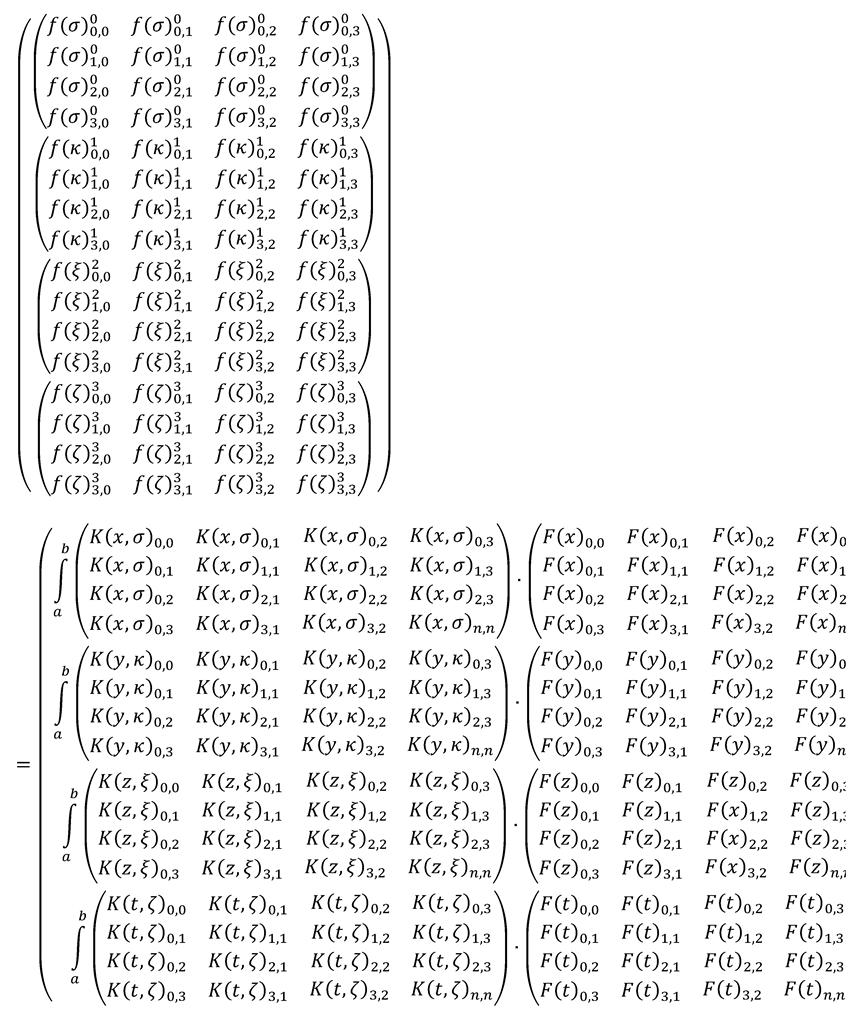
Using the notation we can define
And
And
Which reduces the nasty integral equation to standard form:
From this not only can we apply the Euler lagrange equations from the calculus of variations, but we can use the repeated integration by parts and the method above to define the general polynomial expansion for this matrix. I want to state here that the matrix contraction can allow this space to be represented as a single vector. The k functions can be general functions of any of the coordinates. I here chose to have the transformations follow the pattern above.
So, from here the equations can be set up the fundamental theorem of calculus with this integral and then apply the integration by parts to achieve the generalized Taylor expansion for the unified field theory vector force field. This should be done for the primed coordinates as well, for all four variables
Noting on the matrix relationships: with a vector inserted for each element in the multidimensional matrix would produce: where for example with nu = 2 and beta =2, alpha =2, mu =2, we receive the basic nested 2x2 representation. It isn’t really a huge statement in physics to say that every element in this matrix has a Taylor expansion since continuity is generally expected from functions in dynamical systems.
With the complex contour relation and the conversion with greens theorem the complex contour integral can be written as a nth order integral over all 2n dimensional Complex space.
Ultimately even after the complex notation we can make the same fundamental theorem, Taylor’s Theorem to be true:
Defining , we can see how if this is required in the quantum frame, and we select some zoomed out frame given by:
Where in the massively zoomed out frame with the application of the Zoom operator, in the large scale where we can see features on the sun or the earth, the frame where particle trajectories are complex, the zoomed frame will have:
We note that infinity is a relative concept and since some functions converge infinitely faster than others in some regions it is fair to suggest that there are different infinities, , , which are infinities in each scaling but maybe imperceptible in some other scaling. To be precise, we would have to integrate from , to , in the next frame, essentially over the scaling factor again which is a function of time and , from the new frame is essentially zero, but from the old frame , is still infinity. IT goes to show how in some cases, gravity might exhibit different effects and how the complex definitions of particles could be viewed from this frame.
And combining these two equations:
We can define the Taylor Expansion of this nested complex equation as:
Because as we discussed earlier, the dependence on time makes the partial derivatives pop up when you consider that the full derivative in time from the continuous sheet made from the function in time.
What’s more, we can consider the regular case of relativity where in this frame we can ignore all the craziness and define the primed functions for which essentially the regular equations of relativity can be derived. In this frame infinity two is equal to zero. But in general the space time interval equation would take the same form:
This essentially makes it so that in order for Einstein’s theory to be extended to all scales, we must only make minor changes to the equations from here. The geodesic equations [86] of the extended theory can be defined as:
Noting the tensor contraction [87] with nu = mu. And the Einstein equations in this frame are:
It is possible to instead of defining the number on the upper left hand side, instead we include a 5th variable, gamma which is needed for scaling changes. Then when scaling changes are sufficient we simply need to extend all the equations by using n = 4 instead of n =3 in the chain rule equations, and it can be shown how all the coordinates are functions of the 5th coordinate but this only matters when the scaling changes are sufficient. This would go to state that space-time is truly a 5 dimensional object and not 4 in some frames. This would produce a Kaluza-Klein type theory but the fundamental divergence of this point is that there is no need to recognize a new fifth force since the scaling changes perturb space-time in such a manner that a force is induced by the scaling change. The 5th variable would produce a space-time similar to Kaluza Klein but the dependence of this variable on the others would have to be in such a way that the singularities in the 4d theory can be made continuous. 5d space-time would essentially be space-time accounting for the scaling factor changes. Essentially the form of the equations is the same but there are extra terms in the cases where the scaling factor matters. Instead of adding extra forces, the interpretation here is that the transformation of the space time is what causes the changes in the equations. The space time is transformed by the “zoom” operation. Or zoom operator.
We can explicitly define the zoom operator as: All along I have been putting gamma in the upper left but it has now clicked that if indeed there is dependence on gamma, this is essentially the same thing as having a 5th coordinate, which, if we are not mistaken, essentially is the same thing. The fundamental postulate I guess would be that the 5th variable, gamma, Which essentially does not change the form of the equations in the scaling where gamma doesn’t matter and this equations reduces to the regular equations due to the matrix contraction of the variables. In the light that the scaling factor from the zoom operator is another variable similar to Kaluza-Klein, gamma should probably not be the name for the fifth variable and we should be wise to avoid other coordinates we already use for integral transformations to avoid confusion.
These seem to be far reaching conclusions but it is essentially just the result of the functions being analytic or in terms of elementary calculus, being smooth and differentiable. The fundamental theorem of calculus can be generalized to n dimensions, as well as can the extreme value theorem and the Taylor theorem as shown in this paper. The fundamental relationship between the Taylor polynomial representation and the fundamental theorem of calculus can be seen by using the operation integration by parts n times to produce the Taylor polynomial. This algorithm taken to infinity gives us the polynomial definition of the function. By simply generalizing the integrand for the integration by parts formula one can relate a set of integral transforms defined with functions that essentially are replaced with matrices. Defining the tensors to be complex and requiring them only to be analytic shows that with integral transformations over the scale factor, allows, because in one frame this is essentially the inverse transform, the regular space-time 4 vectors to be defined in the usual way, with the scale factor being visible. We can see that similar to how the boundaries of the Taylor expansion define the nth order approximation, they also determine the structure of the equation.
This essentially leads us to 3 major modifications of the classical field theory of general relativity:
- 1)
- All coordinates take the form: ,
- 2)
- The scaling factor gamma that transforms the equations acts as a 5th variable since there is a dependence on the other variables, and this 5th variable can be used to construct the “zoom operator.” This goes to suggest that the 5th variable is at play at the quantum scale which is why the relativity equations are so crazy. The 5th variable is essentially the glue that sticks the matrix orthogonal to the original matrix together.
- 3)
- the space time matrix of relativity essentiall resides within a larger matrix that includes the 4 different known types of space time.
From these three modifications of the theory we achieve essentially the theory described for the unified field theory if we accommodate for the statistical mechanics of quantum mechanics and the fact that the statistical rules of quantum mechanics are deduced from the equations under certain transformation of the UFT integrand.
Future work should do computations with my theory to produce the solutions and show how they can be reduced to the regular known solutions given the appropriate modifications. Data must be fitted to these lagrangians and as well as exact estimates for the fundamental motions. The exact estimates and approximations theoretically would yield a string theory equivalent definition of particles but more generally it can achieve any definition based on the selected mathematical objects and operators. It also must be firmly established how the quantum probability laws are derived from the general lagragian and how this is compatible with the quantum motion-point mass model.
It did not occur to me that the scaling factor gamma should be an additional coordinate dimension but defining the transformations of the matrices with the zoom operator shows that there was essentially no difference in viewing the scaling factor as an additional dimension that the other variables and functions depend on in certain cases. In this way, the usual classical field theory of relativity is a straightforward extension to quantum space-times and n other types of space times if necessary. I expect however that according to the standard model there is no need for dimensions greater than 5 but it is possible that we discover something we do not know about on another scale and so we would have to modify the equations but this unified theory is defined over n dimensions and complexified. These changes cause profound changes in relativity.
Conclusion:
In summary, the inclusion of complex coordinates as fundamental components in various physical systems has led to the natural extension of the theory of relativity, accommodating the inclusion of flat complex space-time’s. The introduction of complex space-time’s not only implies the presence of complex energy functions, lagrangians, coordinates, and mass but also paves the way for a comprehensive understanding of the intricate dynamics governing the fundamental principles of the universe. This research presents a glimpse into the diverse range of possibilities for extending the foundational principles of general relativity by leveraging complex space-time’s.
By leveraging the zoom operator and pertinent notation, we have successfully formulated a comprehensive framework that delineates a general lagrangian capable of adopting distinct forms across varying scales. This intricate framework facilitates the construction of lagrangians tailored to each specific scaling, thereby enabling the derivation of anticipated field equations for each theoretical construct. Through logical deductions, we have elucidated the precise form of the Newtonian force matrix for underlying motions within a classical framework, thereby highlighting the reduction of the properties of matter to this comprehensive expression.
The insights gained from this research open new avenues for understanding the fundamental properties of matter within the broader context of the unified field theory. By integrating the intricate dynamics of complex space-time’s and the underlying lagrangian principles, we have paved the way for a more nuanced understanding of the complex interplay between fundamental physical processes and the structural dynamics of matter. This work sets the stage for further explorations and advancements in the field, contributing to the ongoing discourse on the fundamental principles governing the behavior of matter and energy within the fabric of the universe.
In the last part we looked at the mathematical components of UFT by extending Einstein’s theory and by generalizing the mathematical objects used within relativity.
References
- Maier, S.A.; Atwater, H.A. Plasmonics: Localization and guiding of electromagnetic energy in metal/dielectric structures. J. Appl. Phys. 2005, 98, 011101. [Google Scholar] [CrossRef]
- Misner, Charles W., Kip S. Thorne, and John Archibald Wheeler. Gravitation. Macmillan, 1973.
- Maartens, Roy, and Bruce A. Bassett. "Gravito-electromagnetism.". Classical and Quantum Gravity 1998, 15, 705.
- Ellis, Jonathan Richard. "Gluons.". Comments Nucl. Part. Phys. 1980, 9, 153–68.
- Einstein, Albert. "Unified field theory of gravitation and electricity.". Session Report of Prussian Acad. Sci, 1925; 414–419.
- Brizard, Alain J. Introduction To Lagrangian Mechanics, An. World Scientific Publishing Company, 2014.
- Poisson, Eric, and Clifford M. Will. Gravity: Newtonian, post-newtonian, relativistic. Cambridge University Press, 2014.
- Feynman, R.P. Space-Time Approach to Non-Relativistic Quantum Mechanics. Rev. Mod. Phys. 1948, 20, 367–387. [Google Scholar] [CrossRef]
- Feynman, Richard Phillips. "Space-time approach to quantum electrodynamics." Quantum Electrodynamics. CRC Press, 2018. 178-198.
- de la Hamette, Anne-Catherine, et al. "Perspective-neutral approach to quantum frame covariance for general symmetry groups. arXiv arXiv:2110.13824.
- Stöckinger, Dominik. "The muon magnetic moment and supersymmetry.". Journal of Physics G: Nuclear and Particle Physics 2006, 34, R45.
- Csáki, C.; Graesser, M.L.; Kribs, G.D. Radion dynamics and electroweak physics. Phys. Rev. D 2001, 63. [Google Scholar] [CrossRef]
- Bracewell, Ronald N. "The fourier transform.". Scientific American 1989, 260, 86–95. [CrossRef]
- Hess, Peter O., and Walter Greiner. "Pseudo-complex general relativity.". International Journal of Modern Physics E 2009, 18, 51–77. [CrossRef]
- Lee, G.; Arrington, J.R.; Hill, R.J. Extraction of the proton radius from electron-proton scattering data. Phys. Rev. D 2015, 92, 013013. [Google Scholar] [CrossRef]
- Sheynin, Oscar B. "Newton and the classical theory of probability.". Archive for History of Exact Sciences 1971, 7, 217–243. [CrossRef]
- Feynman, Richard P. "The concept of probability in quantum mechanics." Proceedings of the Second Berkeley Symposium on Mathematical Statistics and Probability. Vol. 2. University of California Press, 1951.
- Einstein, Albert. "The foundation of the general theory of relativity.". Annalen Phys 1916, 49, 769–822.
- Che, M.; Wei, Y. Theory and Computation of Complex Tensors and its Applications; Springer Science and Business Media LLC: Dordrecht, GX, Netherlands, 2020. [Google Scholar]
- Einstein, A.; Straus, E.G. A Generalization of the Relativistic Theory of Gravitation, II. Ann. Math. 1946, 47, 731. [Google Scholar] [CrossRef]
- Gray, J. D., and S. A. Morris. "When is a function that satisfies the Cauchy-Riemann equations analytic?.". The American Mathematical Monthly 1978, 85, 246–256. [CrossRef]
- Agrawal, O.P. Generalized Variational Problems and Euler–Lagrange equations. Comput. Math. Appl. 2010, 59, 1852–1864. [Google Scholar] [CrossRef]
- Bell, John Stewart. "Hamiltonian mechanics." (1987).
- Einstein, Albert. "On the electrodynamics of moving bodies.". Annalen der physik 1905, 17, 891–921.
- Lee, A.R.; Kalotas, T.M. Lorentz transformations from the first postulate. Am. J. Phys. 1975, 43, 434–437. [Google Scholar] [CrossRef]
- Euler, Leonhard. "Methodus inveniendi lineas curvas maximi minive proprietate gaudentes." Bousquet, Lausanne & Geneva (1744) 1744 (1744).
- Landau, L.D.; Lifshitz, E.M. The Classical Theory of Fields, 4th ed. 1975; Volume 2. [Google Scholar] [CrossRef]
- Byron, F.W.; Fuller, R.W.; Merzbacher, E. Mathematics of Classical and Quantum Physics, Vol. I and II . Phys. Today 1971, 24, 52–53. [Google Scholar] [CrossRef]
- Maxwell, James C. A dynamical theory of the electromagnetic field. Wipf and Stock Publishers, 1996.
- Titchmarsh, Edward Charles, and David Rodney Heath-Brown. The theory of the Riemann zeta-function. Oxford university press, 1986.
- Dirac, Paul Adrien Maurice. "The quantum theory of the electron." Proceedings of the Royal Society of London. Series A, Containing Papers of a Mathematical and Physical Character 1928, 117, 610–624.
- Young, N. An Introduction to Hilbert Space; Cambridge University Press (CUP): Cambridge, United Kingdom, 1988. [Google Scholar]
- Oh, S.-Q.; Park, C.-G.; Shin, Y.-Y. QUANTUM -SPACE AND POISSON -SPACE. Commun. Algebra 2002, 30, 4197–4209. [Google Scholar] [CrossRef]
- Hussey, E. Aristotle on Mathematical Objects. Apeiron 1991, 24, 105–134. [Google Scholar] [CrossRef]
- Day, Mahlon M. "Some characterizations of inner-product spaces.". Transactions of the American Mathematical Society 1947, 62, 320–337. [CrossRef]
- Hu, Hao. "Poisson distribution and application." A Course in Department of Physics and Astronomy; University of Tennessee at Knoxville: Knoxville, TN, USA. 2008.
- Davis, M.J.; Heller, E.J. Multidimensional wave functions from classical trajectories. J. Chem. Phys. 1981, 75, 3916–3924. [Google Scholar] [CrossRef]
- Henstock, Ralph. "THE INTEGRAL OVER PRODUCT SPACES AND WIENER'S FORMULA." Real Analysis Exchange 1991, 737-744.
- Jordan, Thomas F. Linear operators for quantum mechanics. Courier Corporation, 2012.
- Berezin, Feliks Aleksandrovich, and Mikhail Shubin. The Schrödinger Equation. Vol. 66. Springer Science & Business Media, 2012.
- Itzykson, Claude, and Jean-Bernard Zuber. Quantum field theory. Courier Corporation, 2012.
- Lüst, D.; Theisen, S.J. Lectures on String Theory; Springer Science and Business Media LLC: Dordrecht, GX, Netherlands, 1989; ISBN 9783540518822. [Google Scholar]
- Heisenberg, Werner. "Heisenberg Uncertainty Principle." 1927.
- Bohm, David. Quantum theory. Courier Corporation, 2012.
- Barut, A. O., and A. J. Bracken. "Zitterbewegung and the internal geometry of the electron.". Physical Review D 1981, 23, 2454. [CrossRef]
- Tumulka, Roderich. "Bohmian mechanics. 2021, arXiv:1704.08017.
- Dirac, Paul Adrien Maurice. "The quantum theory of the electron." Proceedings of the Royal Society of London. Series A, Containing Papers of a Mathematical and Physical Character 1928, 117, 610–624.
- Tumulka, Roderich. "Feynman's path integrals and Bohm's particle paths.". European Journal of Physics 2005, 26, L11. [CrossRef]
- Hiley, B.J.; Van Reeth, P. Quantum Trajectories: Real or Surreal? Entropy 2018, 20, 353. [Google Scholar] [CrossRef]
- Feynman, R.P. The development of the space-time view of quantum electrodynamics. Phys. Today 1966, 19, 31–44. [Google Scholar] [CrossRef]
- Sinha, A.; Vijay, A.H.; Sinha, U. On the superposition principle in interference experiments. Sci. Rep. 2015, 5, 10304. [Google Scholar] [CrossRef]
- Lindgren, J.; Liukkonen, J. Quantum Mechanics can be understood through stochastic optimization on spacetimes. Sci. Rep. 2019, 9, 1–8. [Google Scholar] [CrossRef] [PubMed]
- Moayedi, S.K.; Setare, M.R.; Khosropour, B. Formulation of Electrodynamics with an External Source in the Presence of a Minimal Measurable Length. Adv. High Energy Phys. 2013, 2013, 1–7. [Google Scholar] [CrossRef]
- Cohen, Eliahu, et al. "Geometric phase from Aharonov–Bohm to Pancharatnam–Berry and beyond." Nature Reviews Physics 2019, 1, 437–449.
- Rosen, N.; Zener, C. Double Stern-Gerlach Experiment and Related Collision Phenomena. Phys. Rev. B 1932, 40, 502–507. [Google Scholar] [CrossRef]
- Magaña-Loaiza, O.S.; De Leon, I.; Mirhosseini, M.; Fickler, R.; Safari, A.; Mick, U.; McIntyre, B.; Banzer, P.; Rodenburg, B.; Leuchs, G.; et al. Exotic looped trajectories of photons in three-slit interference. Nat. Commun. 2016, 7, 13987. [Google Scholar] [CrossRef]
- Bertrand, Jacqueline, Pierre Bertrand, and Jean-Philippe Ovarlez. "The mellin transform." 1995.
- Baldes, I.; Bell, N.F.; Petraki, K.; Volkas, R.R. Particle-Antiparticle Asymmetries from Annihilations. Phys. Rev. Lett. 2014, 113, 181601–181601. [Google Scholar] [CrossRef] [PubMed]
- Basham, C.L.; Brown, L.S.; Ellis, S.D.; Love, S.T. Energy Correlations in Electron-Positron Annihilation: Testing Quantum Chromodynamics. Phys. Rev. Lett. 1978, 41, 1585–1588. [Google Scholar] [CrossRef]
- Doplicher, S.; Fredenhagen, K.; Roberts, J.E. The quantum structure of spacetime at the Planck scale and quantum fields. Commun. Math. Phys. 1995, 172, 187–220. [Google Scholar] [CrossRef]
- Jaeger, G. Are Virtual Particles Less Real? Entropy 2019, 21, 141. [Google Scholar] [CrossRef]
- Feynman, Richard P. "The theory of positrons." Quantum Electrodynamics. CRC Press, 2018. 167-177.
- Keller, Jaime. The Theory of the Electron. Springer Netherlands, 2001.
- Weinberg, S. Quasiparticles and the Born Series. Phys. Rev. B 1963, 131, 440–460. [Google Scholar] [CrossRef]
- Creutz, Michael. Quarks, gluons and lattices. Cambridge University Press, 1983.
- Baur, Ulrich, and Edmond L. Berger. "Probing the weak-boson sector in Z γ production at hadron colliders.". Physical Review D 1993, 47, 4889. [CrossRef] [PubMed]
- Cohen-Tannoudji, Claude, Jacques Dupont-Roc, and Gilbert Grynberg. Photons and atoms-introduction to quantum electrodynamics. 1997.
- Chaput, L.; Togo, A.; Tanaka, I.; Hug, G. Phonon-phonon interactions in transition metals. Phys. Rev. B 2011, 84. [Google Scholar] [CrossRef]
- ALEPH Collaboration, et al. "Electroweak measurements in electron–positron collisions at W-boson-pair energies at LEP.". Physics reports 2013, 532, 119–244. [CrossRef]
- Reines, Frederick, and CLYDE L. COWANjun. "The neutrino.". Nature 1956, 178, 446–449.
- Kriesten, B.; Meyer, A.; Liuti, S.; Diaz, L.C.; Keller, D.; Goldstein, G.R.; Gonzalez-Hernandez, J.O. Extraction of generalized parton distribution observables from deeply virtual electron proton scattering experiments. Phys. Rev. D 2020, 101, 054021. [Google Scholar] [CrossRef]
- Grimus, W.; Stockinger, P. Real oscillations of virtual neutrinos. Phys. Rev. D 1996, 54, 3414–3419. [Google Scholar] [CrossRef] [PubMed]
- Ansari, R.; Bagnaia, P.; Banner, M.; Battiston, R.; Bernlöhr, K.; Booth, C.; Borer, K.; Borghini, M.; Carboni, G.; Cavasinni, V.; et al. Measurement of the standard model parameters from a study of W and Z bosons. Phys. Lett. B 1987, 186, 440–451. [Google Scholar] [CrossRef]
- Carnal, O.; Mlynek, J. Young’s double-slit experiment with atoms: A simple atom interferometer. Phys. Rev. Lett. 1991, 66, 2689–2692. [Google Scholar] [CrossRef] [PubMed]
- Bordag, M., and V. Skalozub. "Gluon polarization tensor in color magnetic background.". The European Physical Journal C-Particles and Fields 2006, 45, 159–178.
- Fradkin, E.; Shenker, S.H. Phase diagrams of lattice gauge theories with Higgs fields. Phys. Rev. D 1979, 19, 3682–3697. [Google Scholar] [CrossRef]
- Aoki, Mayumi, et al. "Models of Yukawa interaction in the two Higgs doublet model, and their collider phenomenology.". Physical Review D 2009, 80, 015017. [CrossRef]
- Pich, A. Flavour constraints on multi-Higgs-doublet models: Yukawa alignment. Nucl. Phys. B - Proc. Suppl. 2010, 209, 182–187. [Google Scholar] [CrossRef]
- Leader, Elliot. Spin in particle physics. Cambridge University Press, 2001.
- Bacry, H.; Ruegg, H.; Souriau, J.-M. Dynamical groups and spherical potentials in Classical Mechanics. Commun. Math. Phys. 1966, 3, 323–333. [Google Scholar] [CrossRef]
- Hardy. D. "A Proof of the Riemann Hypothesis," [INSERT LINK].
- Hardy, Devin. "A Series Representation of Analytically Continuous Complex Functions with Negative Powers." 2023. [CrossRef]
- Davies, Brian. Integral transforms and their applications. Vol. 41. Springer Science & Business Media, 2002.
- Sobczyk, Garret, and Omar León Sánchez. "Fundamental theorem of calculus.". Advances in Applied Clifford Algebras 2011, 21, 221–231. [CrossRef]
- Grozin, Andrey G. "Integration by parts: an introduction.". International Journal of Modern Physics A 2011, 26, 2807–2854. [CrossRef]
- Hackmann, E.; Kagramanova, V.; Kunz, J.; Lämmerzahl, C. Analytic solutions of the geodesic equation in higher dimensional static spherically symmetric spacetimes. Phys. Rev. D 2008, 78, 124018. [Google Scholar] [CrossRef]
- Huang, Jianyu, Devin A. Matthews, and Robert A. van de Geijn. "Strassen's algorithm for tensor contraction.". SIAM Journal on Scientific Computing 2018, 40, C305–C326. [CrossRef]
Disclaimer/Publisher’s Note: The statements, opinions and data contained in all publications are solely those of the individual author(s) and contributor(s) and not of MDPI and/or the editor(s). MDPI and/or the editor(s) disclaim responsibility for any injury to people or property resulting from any ideas, methods, instructions or products referred to in the content. |
© 2024 by the author. Licensee MDPI, Basel, Switzerland. This article is an open access article distributed under the terms and conditions of the Creative Commons Attribution (CC BY) license (https://creativecommons.org/licenses/by/4.0/).
Copyright: This open access article is published under a Creative Commons CC BY 4.0 license, which permit the free download, distribution, and reuse, provided that the author and preprint are cited in any reuse.