
Submitted:
29 November 2023
Posted:
30 November 2023
You are already at the latest version
Abstract
The loss or dysfunction of skeletal tissue often necessitates surgical intervention, particularly in cases involving trauma, tumors, or abnormal development leading to critical-sized defects. Despite autografts being considered the gold standard for bone grafts, their limitations and complications prompt the exploration of alternative approaches for bone repair and regeneration. Current advancements in bone tissue engineering have led to innovative strategies aiming to regenerate injured bone structures, providing viable alternatives to traditional autografts or allografts. Among these strategies, Hydrogel Microparticles (HMPs) have emerged as promising scaffolds due to their notable characteristics, including high porosity and mechanical tunability. HMPs play an important role in facilitating vasculature formation, mineral deposition, and overall bone tissue regeneration. HMPs, fabricated through various techniques, exhibit versatility in functions such as drug and cell delivery, structural scaffolding, and bioinks for 3D printing. In addition, these microgels can be injected for minimally invasive delivery and can display modular properties with different designs and configurations. This review exclusively focuses on the advancements in HMPs for bone regeneration, delving into synthesis and functionalization techniques while highlighting their diverse applications documented in the literature. Our aim is to shed light on the unique benefits and potential of HMPs in the intricate field of engineering bone tissue.
Keywords:
Hydrogel Microparticles
; Microgels
; Bone Tissue Engineering
; Bone Regeneration
; Cell Delivery
; Bioactive Factor Delivery
; HMP-based scaffolds
; HMP incorporated scaffolds
1. Introduction
The loss or dysfunction of skeletal tissue due to trauma, tumors, or abnormal development frequently require surgical intervention to restore normal tissue function. Depend on the depth, type, and extend of the injury, the innate capacity of bones can be compromised or even inhibited, especially with the large critical sized defects[1] . To date autografts have been considered as the gold standard for bone grafts due to their non-immunogenicity, histocompatibility, and possession of essential properties needed for an effective bone graft material. However, numerous studies have highlighted the significant deficiencies, complications, and limitations of current clinical approaches to bone repair and regeneration, including autografts and allografts[2,3,4,5] . Tissue engineered bone-grafts are viable alternative treatment option which offers uniform architecture and composition without the potential donor-site morbidity or infection transmission. Traditional bone tissue engineering approach is composed of 3D scaffolds containing cells and growth factors. The success of tissue engineering hinges on the harmonious interaction and integration of cells and tissues using suitable cellular and physical cues[6] . Injectable materials, such as hydrogels, have been explored extensively in the recent years as an alternative to invasive surgical procedures.
Hydrogels, which consist of crosslinked hydrophilic polymers forming intricate networks, represent a crucial class of materials in tissue engineering applications. These remarkable materials have the capacity to absorb significant quantities of water, ranging from 10% to several times their own weight, resulting in pronounced swelling[7,8] . This swelling ability enables hydrogels to facilitate the transport of molecular and nano-scale substances within the material while maintaining solid-like mechanical properties. This exceptional characteristic, along with their versatility and similarity to the native extracellular matrix (ECM), has propelled the widespread adoption of hydrogels as scaffolding materials across various biomedical applications, including drug delivery[9,10] , tissue engineering[11,12] , and wound healing[13,14] .
Typically, hydrogels are crosslinked to form bulk materials with dimensions at the millimeter scale. However, there are instances where micron-scale pore sizes are necessary, which can be achieved through various techniques like electrospinning[15] , cryogel formation[16] , and porogen leaching[17] . Nevertheless, hydrogels may not always be the optimal choice, particularly when injection or smaller sizes are required, for example in the case of irregular shaped bone defects[18] . At the micron scale, hydrogels are referred to as microgels or hydrogel microparticles (HMPs), typically ranging from 1 to 1,000 µm in size[19] . When the size of hydrogel particles is reduced to submicrometer ranges, they are referred to as nanogels[20] .
HMPs offer unique advantages over bulk hydrogels for bone tissue regeneration. They allow for minimally invasive delivery due to their small size, exhibit shear-thinning behavior for easy injection, and offer modularity through mixing multiple HMP populations, all while providing significant porosity for cell support and proliferation[21,22,23] .
This review will concentrate exclusively on the advancement of the hydrogel microparticles for bone regeneration purposes, exploring synthesis and functionalization techniques, as well as highlighting the applications of HMPs for bone regeneration documented in the literature.
2. Fabrication of HMPs
2.1. Batch Emulsions
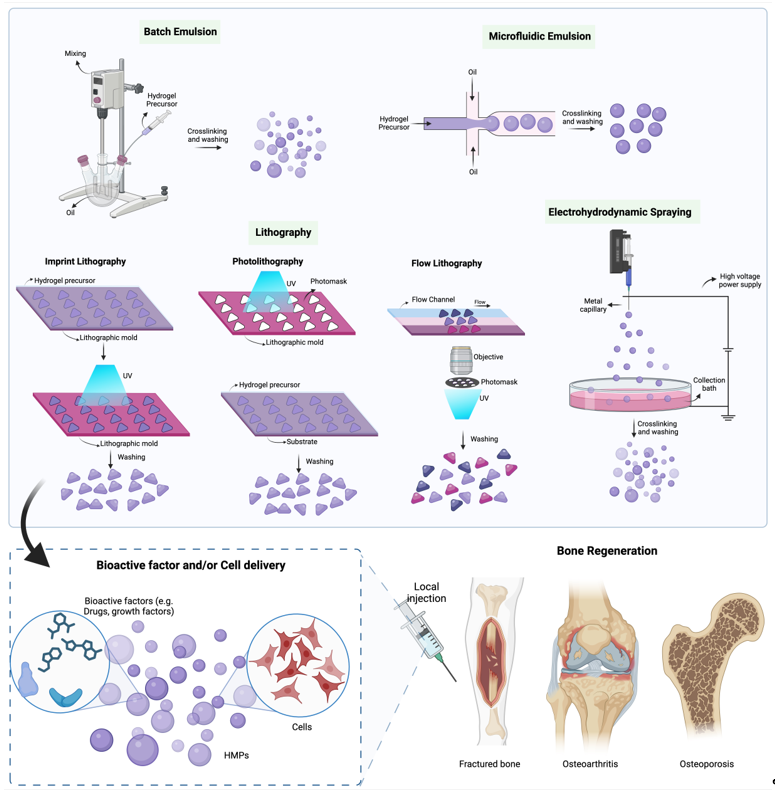
Batch emulsion, also known as inverse emulsion, employs the water-in-oil polymerization method, where simultaneously formed water-soluble droplets are evenly distributed within a continuous organic phase, facilitated by oil-soluble surfactants[24] (Figure 1). The surfactant's role is to hinder the re-aggregation of the droplets. Consistent formulations are obtained through mechanical agitation, where extent and timing affect the dispersity and the size of the HMPs. After crosslinking, the oil phase is removed by subsequent washing steps, centrifugation, and filtration, and optionally lyophilized for storage[25] . Crosslinking of the aqueous droplets can be achieved upon addition of a radical initiator in either phase and using various techniques including photocrosslinking and thermal crosslinking[26] . Proteins/drug molecules or cells can be incorporated into the water phase during HMP formation if photocrosslinking[27] is used or can be loaded post-synthesis through diffusion-based incubation of HMPs with concentrated protein solution[28] .
Initiators can be replaced by chemical crosslinkers, such as those involving gelatin microgels crosslinked with genipin or glutaraldehyde, also eliminating the need for a heating step and thermally initiated free radical polymerization[28,29] . This method is compatible with biological molecules as they can be loaded directly into the aqueous phase before emulsification and polymerization steps.
The batch emulsion method offers several advantages, primarily its simplicity and potential for scalable synthesis, with limitations defined by container size and the efficacy of emulsion mixing (Table 1). However, inherent polydispersity in the HMPs produced through batch emulsion can lead to batch-to-batch variations unless production is precisely replicated in each reaction[30,31] . This polydispersity presents challenges when aiming for controlled drug release or cell encapsulation since it becomes challenging to regulate the quantity of drugs or the number of cells encapsulated in HMPs[30,32] . Furthermore, the release profile reported to differ between monodisperse and polydisperse HMPs, with monodisperse microparticles exhibiting significantly reduced burst release compared to their polydisperse counterparts[33] . Collecting a specific size of HMPs can be achieved using sieves[34] or filters[35] .
2.2. Microfluidic Emulsion
In contrast to batch emulsion method, microfluidics offers several distinct advantages as it allows for a precise control of microparticle size and shape, facilitating the production of monodisperse populations with a wide range of shapes and compositions. HMPs are formed using droplet microfluidics in a junction geometry (such as T junction) fabricated usually using poly(dimethylsiloxane) (PDMS) by soft lithography[36,37] (Figure 1). PDMS channels were produced from the SU-8 molds which were fabricated using photolithography techniques. Although alternative materials such as glass, silicon, and thiolene have been used in microfluidics, PDMS stands out due to its cost-effective manufacturing process and the ability to exert precise control over surface properties[38], [39]. Methods to fabricate different types of microfluidic devices have been described in detail by Duffy et al. (1998)[38], Li et al. (2018)[40], and Lu et al. (2020)[41], Moreira et al. (2021).
The microparticle formation using microfluidics technique involves a continuous phase (usually oil), a surfactant to prevent coalescence of the microparticles, and an aqueous hydrogel precursor phase. Droplets are generated due to the interaction of shear stress and interfacial tension forces between the different phases, and the HMPs are solidified either within or outside the microfluidic device using crosslinking methods such as photocrosslinking[42], chemical or ionic crosslinking[43]. Following crosslinking HMPs are collected and washed by centrifugation and stored in lyophilized form. The size and shape of the resulting particles can be adjusted by altering flow rates, fluid composition, microfluidic device geometry, and channel size[39,40,44].
Microfluidic emulsions are versatile for encapsulating proteins, small molecules, and cells. The monodisperse characteristics of HMPs produced through this technique enable precise control over release profiles and the quantity of cells enclosed in each HMP. Microfluidics offers several significant advantages when it comes to controlling chemical reactions, including precise management of factors such as heat and mass transport rates, reduction of waste, and the ability to finely tune the characteristics of microparticles (Table 1). Moreover, it enables the production of composite microparticles by effectively combining various streams through the double emulsion technique[45,46]. Furthermore, microfluidics can seamlessly integrate with additional components like heaters, coolers, sensors, and microscopy tools, significantly enhancing its utility in the realm of biological experiments[41].
The primary limitation of microfluidics lies in their comparatively lower throughput when compared to batch emulsion methods[47]. This concern becomes particularly pronounced when generating small-diameter HMPs since throughput tends to decrease with decreasing diameters[22]. To address this challenge, parallelized microfluidic designs, incorporating multiple junctions within a single device have been employed[48,49]. However, it is crucial to design the channel geometry in these systems with meticulously intricacy, ensuring effective management of pressure drops and flow fluctuations across the entire device.
2.3. Lithography
Lithographic processing methods, which enable the precise and reproducible templating of hydrogels, have emerged as an appealing "top-down" alternative to traditional approaches for synthesizing HMPs. Lithographic methods to produce HMPs can be categorized into three distinct groups: imprint lithography, photolithography, and flow lithography. While these techniques may vary in format and specific processing steps, they typically adhere to a common workflow methodology. The initial step involves the preparation of a patterned template, then the fluid reservoir is filled with the hydrogel precursor fluid(s), followed by the synthesis of HMPs through the concurrent processes of pattern transfer and crosslinking reactions, and the particles are recovered from the reservoir at the final step[50] (Figure 1). Imprint lithography involves using a patterned mold, typically made of polymer, to replicate the negative features of the particles to be generated. The master template, essential for this process, is created from a silicon wafer through soft lithography. This versatile technique offers the capability to produce microparticles in a wide range of shapes and sizes[51,52] (Table 1). Nonetheless, the complex nature of HMPs impose practical limitations on the use of imprint lithography. Issues like bending and buckling of the patterned template can hinder the successful replication of complex patterns, particularly those with intricate internal designs[50]. Photolithography and flow lithography both leverage a patterned photomask for the selective curing of hydrogel precursor regions, leading to the fabrication of HMPs[53]. In flow lithography, a flowing liquid is employed, with crosslinking taking place at regular intervals to form HMPs[50,54].
The major advantage of the lithography techniques to form HMPs is that the geometrical features can be well controlled and monodisperse particles can be obtained. These techniques also allow formation of particles loaded with cells and it does not involve any surfactant or oil to form the particles[52]. However, the main disadvantage of the lithography methods is their low throughput compared to other techniques where the size of the molds and the range of the light source are the main limitation factors[22,54].
2.4. Electrohydrodynamic spraying
Electrohydrodynamic (EHD) spraying is a one-step HMP production system which does not require any additional solvents than those used in the suspension itself[55]. In this system a high electrical potential difference is applied on the flowing liquid by applying voltage at the needle tip, breaking the hydrogel solution into small droplets which are then collected in an earthed collection bath. Beyond a specific critical threshold, the electrical forces imposed become stronger than the surface tension that accumulates the charges on the surface of the liquid droplets. Elevating the applied voltage further results in the creation of a conical-shaped liquid meniscus at the needle's tip, referred to as a Taylor cone. Subsequently, this Taylor cone gives rise to a continuous jet that fragments into fine droplets upon reaching the collector's surface followed by crosslinking in the collecting solution[56,57] (Figure 1). The reaction is carried out at room temperature. Depending on factors such as the applied voltage, the inherent properties of the biomaterial, and the geometry of the needle, this technique enables the creation of intricate and complex structures with sizes as small as 1–2 micrometers[55,58] (Table 1). While achieving monodisperse particles can be challenging, it is possible to filter the particles to obtain a monodispersed particle distribution[22].
Table 1 presents a comparison of various HMP fabrication techniques, highlighting their particle size, advantages, and disadvantages.

Table 1.
Comparison of common HMP fabrication techniques.
| Fabrication Method | Particle Size | Advantages | Disadvantages | References |
|---|---|---|---|---|
| Batch Emulsion | From a few micrometers to several millimeters | Simple and easily scalable, compatible with wide range of materials | Batch-to-batch variations, limited control over the size of HMPs, uneven drug/cell encapsulation | [27,29,30,31] |
| Microfluidics | From a few micrometers to several millimeters | Reproducible, well controlled HMP size, even drug/cell loading, ease in production of composite HMPs, aseptic | Low throughput, time-consuming | [36,38,39,40,43,44,47] |
| Lithography | From a few micrometers to several hundred micrometers | Control over size and shape, monodisperse particles, does not require surfactant or oil to form the particles | Low throughput, non-scalable, cost for photolithography masks | [50,51,52,53] |
| Electrohydrodynamic Spraying | From a few micrometers to several hundred micrometers | Simple, high encapsulation rate, no additional solvents | Difficult to control particle size and shape | [55,56,57,58] |
3. Composition of HMPs
3.1. Natural Polymers
In the field of tissue engineering, a combination of stem cells, polymers, and various forms of physical, chemical, or biological stimuli is employed to establish a microenvironment that closely mimics in vivo conditions. To achieve this objective, both natural and synthetic polymers have been harnessed to create biocompatible and biodegradable polymeric structures. Natural polymers stand out among the options. They offer superior biocompatibility, biodegradability, and pose no toxicity concerns[59]. These polymers feature numerous side groups along their molecular structure for further functionalization. Additionally, they often contain specific sequences, such as RGD (Arginine-Glycine-Aspartic acid), as seen in gelatin, which enhance cellular behavior and improve cell adhesion properties[60]. While natural polymers frequently carry intrinsic cues for guiding stem cell behavior, a notable concern is the potential loss of their biological activity during processing or fabrication. This loss can not only affect their ability to direct stem cell fate but may also lead to an immune response[61,62].
3.2. Collagen HMPs
Collagen, as the most abundant protein in the human body, plays a pivotal role in various biomedical applications, with type I collagen being the most prevalent and widely studied. Bone is primarily comprised of a mineral component, hydroxyapatite (60% of its composition), along with water (10%), and organic elements (30%), predominantly collagen (17-20%)[63,64]. Collagen`s remarkable properties including its abundance, biocompatibility, low antigenicity, hydrophilicity, high porosity, and the capacity for crosslinking make it an ideal candidate for bone tissue engineering[61,65] (Table 2). The preparation of collagen HMPs often involves the widely used water-in-oil emulsification method. In this process, the hydrogel precursor is homogenized, leading to the formation of collagen droplets that undergo subsequent gelation, resulting in the creation of spherical collagen particles which can carry bioactive small molecules intended for bone regeneration[66]. By adjusting the crosslinking density or introducing electrostatic interactions between biomolecules and the collagen network, it becomes possible to fine-tune and control the kinetics of drug release from these particles[67,68]. In the literature, collagen HMPs have been used as a vehicle for bioactive agents such as BMP-2 (bone morphogenic protein) and/or cells such as MSCs (mesenchymal stem cells) for bone tissue engineering. In their study, Khatami et al. employed the electrohydrodynamic spraying method to create collagen-alginate-nano silica HMPs encapsulated with human osteoblast-like MG-63 cells [69]. Their findings revealed that the incorporation of collagen into the HMPs led to a fourfold increase in cell proliferation, enhanced osteogenesis, as demonstrated by elevated levels of alkaline phosphatase activity and matrix mineralization. Additionally, the expression of osteocalcin and BMP-2 was substantially higher when compared to the control group (alginate + nano-silica), showing the osteoconductivity of the collagen HMPs. In another study Chan et al. developed MSC encapsulated collagen HMPs by forming 2.5 mL droplets directly into culture dishes with gelation occurring at 37°C under culture conditions (5% CO2)[70]. Their study revealed that collagen HMPs showed positive staining for alkaline phosphatase and calcium deposition, providing evidence for their osteogenicity , calcium phosphate deposition in the particles demonstrated their osteoconductivity, and osteogenic differentiation of the MSCs showed osteoinductive potential of the collagen particles.
Nonetheless, the utilization of collagen in HMP formation has been limited due to challenges associated with collagen such as poor mechanical properties, suboptimal processing conditions, and propensity for denaturation during the particle formation process[60]. To address mechanical limitations, collagen particles were prepared in blends with other materials such as calcium phosphate[71] and chitosan[72]. Another issue related to collagen is its zoogenic sources, which may trigger immune reactions. The utilization of recombinant human collagen offers a robust alternative for fabricating HMPs is both safe, predictable, reproducible, and scalable[73,74].
3.3. Gelatin HMPs
Gelatin, a denatured form of collagen, is a prominent material in biomedical applications due to its attractive biological properties and cost-effectiveness. It shares beneficial biological characteristics with collagen and is often used for medical or cosmetic purposes owing to its water solubility, nontoxicity, biocompatibility, and ability to promote strong cell adhesion[75]. Gelatin is particularly favored for its controllable degradation rates, gentle gelling behavior, the ease with tailoring the crosslinking conditions, and ease of functionalization and modification due to its diverse functional groups[76,77] (Table 2). Moreover, the production of gelatin HMPs is typically a straightforward process, often through batch emulsion[78] or microfluidics techniques[79]. The loading of bioactive molecules can be achieved by simple diffusion after the formation of gelatin particles, effectively separating the steps of crosslinking and drug loading[28]. This strategy offers the advantage of achieving controlled release kinetics by adjusting the crosslinking density and particle size before the introduction of active molecules. This approach protects the integrity of the loaded molecules, preventing any potential damage that might occur under harsh production conditions or during subsequent washing steps[78,80]. Moreover, gelatin offers significant advantages as a drug carrier especially when loading charged biomolecules since the isoelectric point (IEP) of gelatin can be customized by selecting gelatin derived from either alkaline or acidic treatments[81].
Gelatin HMPs have found extensive application in the field of bone tissue engineering. In their research, Fan et al. conducted a study in which they embedded mouse osteoblast MC3T3-E1 cells within gelatin HMPs[82]. The results indicated significantly higher cell viability, enhanced proliferation, and differentiation capabilities, both in vitro and in vivo, as compared to cells cultured in gelatin hydrogels. In another study, a composite HMP consisting of gelatin and hydroxyapatite (G-HA) was fabricated through a wet-chemical method[83]. Results showed that G-HA composite particles enhanced proliferation and differentiation of osteoblast-like cells. Moreover, in a rat calvarial defect model, the composite particles displayed superior osteoconductive and bioactive properties compared to both fibrin glue and Osteoset® Bone Graft Substitute.
While gelatin offers desirable characteristics, it presents significant challenges, including the inability to load cells during processing and the utilization of toxic chemicals for crosslinking[84]. The diverse functional groups present in gelatin allow for easy modification of its backbone. Notably, methacrylation of amine groups, referred to as methacrylated gelatin (GelMA), emerges as a widely adopted technique among these modifications which facilitates hydrogel formation rapidly under UV or visible light in the presence of a photoinitiator[84,85,86]. The versatility of GelMA has found extensive applications in tissue engineering, particularly in bone tissue engineering, where it is employed in hydrogel scaffolds and HMPs production for cell and bioactive factor delivery using a variety of fabrication methods discussed above[87,88,89]. Another concern with gelatin is the risk of triggering immunogenic reactions due to its animal-derived origin as in collagen. To address these limitations, recent efforts have focused on the creation of microspheres composed of recombinant gelatin with well-defined and tunable amino acid sequences, molecular weights, and isoelectric points[90].
3.4. Alginate HMPs
Alginate, a naturally occurring polysaccharide found in brown algae and brown seaweed cell walls, has been widely used in tissue engineering and regenerative medicine due to its appealing properties including biocompatibility, hydrophilicity, lack of immunogenicity, ease of cell encapsulation, and cost-effectiveness[91,92] (Table 2). Crosslinking of alginate hydrogel precursors is achieved using a diverse range of crosslinking agents, mainly calcium-based materials. When the sodium alginate is placed into the divalent cation, such as Ca2+, containing bath, divalent cations replace sodium ion in the polymer, a process called ionotropic gelation[93]. This mild crosslinking conditions allowed encapsulation of sensitive cells and/or biomolecules into the alginate particles. For example, in a recent study conducted by Kong and colleagues demonstrated the superior repair ability of MSCs encapsulated of MSCs alginate HMPs and BMP-2 loaded polylactic acid (PLLA) on a rat calvarial defect[94]. Their study showed MSCs in Ca2+ crosslinked alginate HMPs retained their viability and potentials to differentiate toward osteogenic lineage, while BMP-2 loaded PLLA particles supported differentiation of the encapsulated MSCs in vitro and osteogenesis in vivo, by displaying a sustained release profile.
Despite its numerous advantages, alginate HMPs do present limitations, notably in terms of cell adhesion due to the absence of cell-adhesion sites and slow degradation rates. However, chemical and physical modification of alginate enable fine-tune the properties such as biodegradability, gelation property, mechanical strength, and cell binding affinity[95]. For example, modification of alginate with growth factors such as BMP-2 and/or peptides such as RGD have been reported for bone tissue regeneration[96,97]. For instance, Moshaverinia et al. harnessed RGD-modified alginate HMPs to encapsulate gingival mesenchymal stem cells (GMSCs) and assessed their bone regeneration ability in vitro and in vivo on mice[98]. Their findings demonstrated a significant enhancement in the viability and osteogenic differentiation of MSCs in vitro and in vivo when encapsulated in RGD-modified alginate HMPs. This enhancement was evidenced by the expression of osteogenic markers, including Runx2 (Runt-related transcription factor 2), ALP (Alkaline Phosphatase), and osteocalcin in vitro, coupled with effective repair of critical-sized calvarial defects in mice in vivo. These findings highlight the potential of RGD-modified alginate HMPs in accelerated craniofacial bone tissue regeneration.
3.5. Chitosan HMPs
Chitosan, a natural biopolymer derived from chitin, is widely studied for bone regeneration applications owing to its remarkable characteristics including biocompatibility, biodegradability, ease of processing, and antibacterial nature (Table 2). Most of these distinctive characteristics are attributed to the primary amines found along the chitosan structure. Through these amino groups, chitosan has the capacity to be functionalized or establish ionic complexes with a wide range of anionic species such as synthetic polymers like poly(acrylic acid), proteins, lipids, and DNA[99]. The degradability of chitosan is modulated by its amino groups and its polysaccharide composition, which incorporates glycosidic bonds that can be broken down in vivo by various proteases, primarily lysozyme[100].
Chitosan-based HMPs are manufactured through a variety of techniques[101,102,103,104], with batch emulsion being the most commonly employed method[60]. For example, Cai et al. fabricated chitosan HMPs either with positive charges to carry osteoinductive BMP-2 or negative charges to load antibacterial factor, berberine (Bbr), using batch emulsion method[105]. Their studies demonstrated stimulated osteogenic differentiation, enhanced in vivo bone reconstruction and high antibacterial activity in a sustainable manner, showing the efficacy of the chitosan HMPs in promoting bone healing while preventing bacterial infections. Nevertheless, chitosan on its own exhibits suboptimal mechanical properties. As a result, it is commonly incorporated into blends with bioceramics[104], proteins[106,107], or polymers[108] to augment its effectiveness in bone regeneration. For instance, Wise and colleagues combined chitosan with collagen and successfully encapsulated MSCs within chitosan-collagen HMPs using the batch emulsion method[107]. Following pre-differentiation of MSCs toward the osteogenic lineage, they introduced these particles into a mouse calvarial defect model. Combining with collagen and employing pre-differentiation strategy within the HMPs significantly enhanced the repair of bone defects compared to undifferentiated control cells.
3.6. Synthetic Materials
Synthetic materials are attractive alternatives of natural materials, offering numerous advantages. Many synthetic materials are non-immunogenic, biocompatible, biodegradable, possess greater mechanical and chemical stability, reproducible with minimal batch to batch variation, and can be modified easily. Their mechanical properties and degradation rates can be finely tuned through adjustments in production and processing conditions[7]. Furthermore, unlike their natural counterparts, synthetic materials are not constrained by limited sources. Despite these advantages, the exploration of synthetic hydrogels for microencapsulation remains relatively limited in the literature due to the harsh processing conditions involved, such as nonphysiological pH, high temperatures, or the use of organic solvents. These conditions are often not compatible with sensitive cells and proteins. Among the synthetic polymers, Poly(ethylene glycol) (PEG) and poly(vinyl alcohol) (PVA) have been employed in the fabrication of HMPs for bone regeneration.
3.7. Poly(ethylene glycol) (PEG) HMPs
PEG, an FDA (Food and Drug Administration) approved polymer, is one of the extensively studied synthetic polymers for hydrogel formation in tissue engineering, due to its hydrophilicity, biocompatibility, and non-toxicity[109,110] (Table 2). Various methods, including EHD spraying[111], lithography[112], batch emulsion[113], and microfluidic emulsion[114], are employed to produce PEG Hydrogel Microparticles (HMPs). In the case of acrylated or methacrylated PEG HMPs, crosslinking takes place in an aqueous environment through UV polymerization, in the presence of a suitable photoinitiator[114]. In a notable study, Sonnet et al. synthesized poly(ethylene glycol) diacrylate and microencapsulated Wistar skin fibroblasts transduced by adenovirus expressing BMP2[115]. The fabrication of HMPs was facilitated by a hydrophobic photoinitiator, (2,2-dimethoxy-2-phenyl acetophenone in 1-vinyl-2-pyrrolidinone), allowing for white light crosslinking during the batch emulsion. Their study showed complete healing of a 5 mm-long femur defect in a rat model in less than 3 weeks, achieved with 100-fold lower levels of BMP-2 protein compared to various doses of recombinant BMP-2 protein, which require 2-3 months for healing.
Despite its advantages, the slow degradation rates of PEG in body fluids and its resistance to protein and cell adhesion limit its applicability. To address slow degradation issue, one approach is to modify the degradation rate of PEG by incorporating degradable monomers like poly(propylene fumarate) (PPF) or integrating degradable terminal cyclic acetals[116]. Additionally, the resistance to cell adhesion of PEG can be overcome by incorporating cell-adhesive peptide sequences such as RGD, which has been demonstrated to significantly enhance MSC viability[117,118].
Poly(vinyl alcohol) (PVA) HMPs
PVA, obtained from partial hydrolysis of poly(vinyl acetate) is another widely used synthetic polymer in HMP preparations because of their biodegradability, biocompatibility, high swelling ratio, and FDA approval for oral medicine[36,119] (Table 2). PVA-based HMPs/hydrogels have been reported for cell encapsulation and enzyme immobilization, often produced using microfluidics[120] or emulsion[121,122] methods. In their study, Hu et al. utilized a high-throughput microfluidic technology to develop injectable degradable HMPs based on poly(vinyl alcohol) (PVA), incorporating MSCs and BMP-2[123]. The tunable mechanical and degradable properties of the polymer backbone were achieved through the functionalization of PVA with vinyl ether acrylate (VEA) and thiol (SH) groups. Their findings revealed that encapsulating BMP-2 into the particles along with MSCs enhanced osteogenic differentiation which was evidenced by a significant increase in ALP activity, calcium content, and the expression levels of RunX2 and OPN (Osteopontin) genes. While PVA, like other neutral hydrogels, may not be inherently attractive for cells and proteins[8,119], the fabrication of composite HMPs consisting of PVA with hydroxyapatite[124,125], proteins[126], or other natural materials[127] have been studied to enhance bioactivity.
Table 2 provides an overview of the biomaterials employed in the fabrication of HMPs, by comparing their respective advantages and disadvantages.
Table 2.
Summarized comparison of biomaterials in HMP fabrication.
| Biomaterial Classification | Biomaterial | Advantages | Disadvantages | HMP Fabrication Techniques | References |
|---|---|---|---|---|---|
| Natural | Collagen | Biocompatible, degradable, good bone conduction activity | Low mechanical features, suboptimal processing conditions, risk of denaturation during processing | Batch emulsion, EHD spraying | [60,61,65,66,128] |
| Gelatin | Biocompatible, nontoxic, tunable degradation, tailored crosslinking conditions, ease of functionalization and modification | Risk of triggering immunogenic reactions | Batch emulsion, microfluidics, EHD spraying, lithography | [75,76,77,78,79,80,129] | |
| Alginate | Biocompatible, lack of immunogenicity, cost-effective, gentle crosslinking, tunable mechanical properties | Lack of cell adhesion sites, slow degradation | Microfluidic emulsion, EHD Spraying, Batch emulsion | [87,91,93,94,95,96,130] | |
| Chitosan | Biocompatible, ease of processing, antibacterial nature, tunable degradation rates | Suboptimal mechanical properties, batch to batch variation | Batch emulsion, microfluidics, EHD Spraying | [99,100,101,102,103,105] | |
| Synthetic | Poly(ethylene glycol) (PEG) | Biocompatible, Non-toxic, ease of functionalization and modification | Slow degradation rates, resist protein and cell adhesion | Batch emulsion, microfluidic emulsion, lithography, EHD spraying | [109,110,111,112,113,114,117,118] |
| Poly(vinyl alcohol) (PVA) | Biodegradable, biocompatible, FDA approved, ease of functionalization | Lack of cell-adhesion sites | Microfluidics, batch emulsion, lithography | [36,119,120,121,122,131] |
4. Applications of HMPs for Bone regeneration
The unique properties of HMPs mentioned above make them attractive for numerous biomedical applications, as well as bone tissue regeneration. This section explores several applications such as the delivery of bioactive-factor and cells, scaffold building with HMPs, and their incorporation as reinforcing materials in scaffolds.
4.1. Bioactive-factor delivery
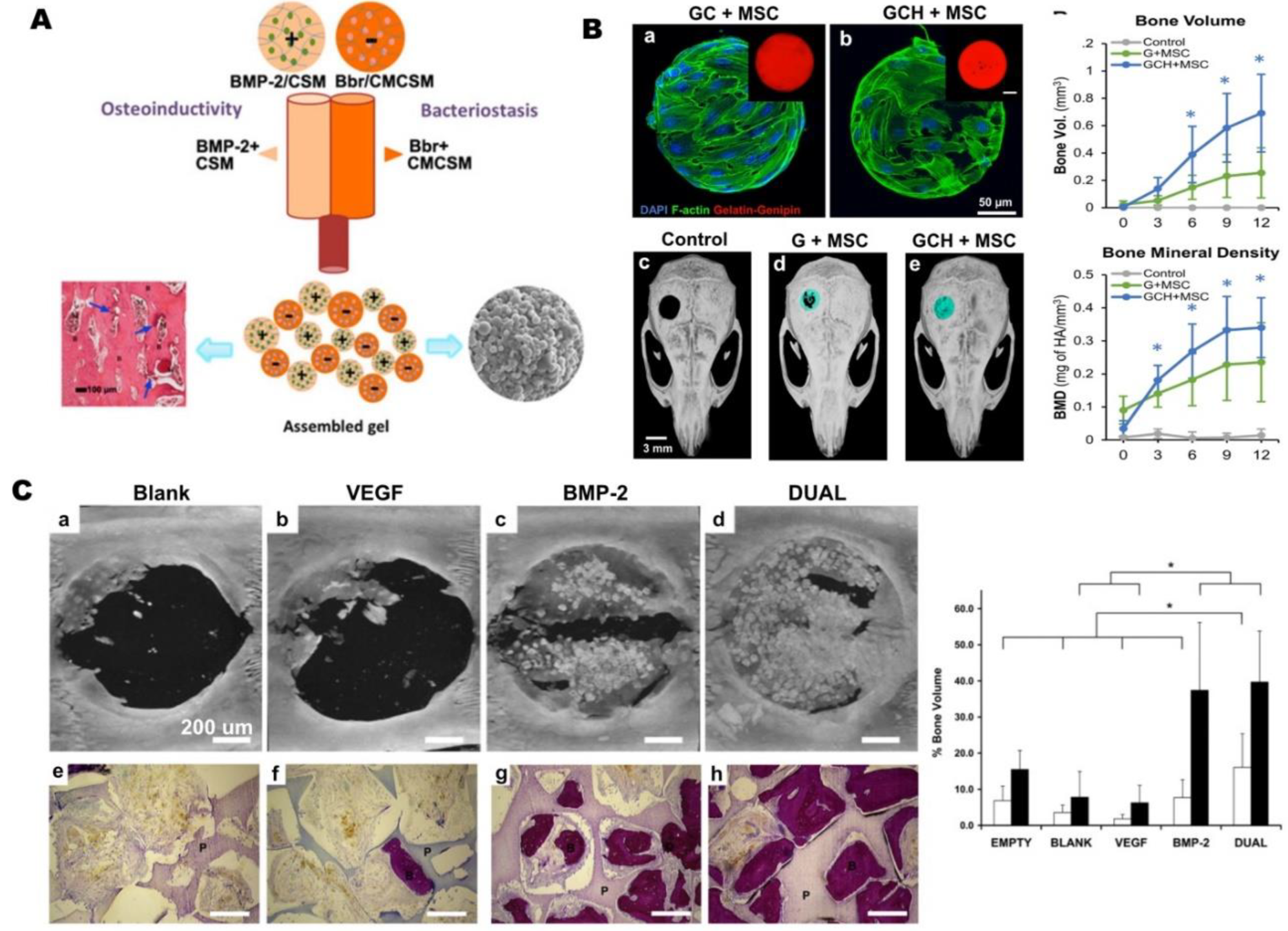
HMPs show significant promise in the field of bone regeneration for delivery of bioactive factors, such as growth factors or small molecules, by protecting, transporting, and releasing these factors in a controlled manner[132]. This functionality addresses numerous limitations associated with conventional drug-administration routes, including intravenous and oral methods, which typically require high doses, repeated administration, and may lead to off-target effects[133]. Conversely, the small size of HMPs facilitates the transport of pre-engineered microtissues through small needles and catheters[134]. Additionally, HMPs offer remarkable versatility, as multiple HMP populations can be seamlessly combined, integrating diverse release profiles and degradation behaviors into a single injection[105] (Figure 2A). This adaptability holds promising advantages for tissue-repair strategies, aligning effectively with biological signaling cascades.
The water retention capacity, ECM-mimicking environment, biocompatibility, and degradability of HMPs make them an excellent host for bioactive factors, enabling their encapsulation and controlled release[135]. Among these factors, BMP-2 has attracted significant attention as an FDA-approved growth factor[136], and has been extensively studied in vitro, in vivo, and clinically for bone regeneration[115,137,138]. As a carrier HMP, natural, synthetic, or composite materials have been reported in the literature to carry BMP-2. For instance, gelatin-based HMPs created through the batch emulsion method were employed to encapsulate BMP-2, resulting in enhanced bone repair in vivo in osteoporotic goats after a 45-day implantation period[139]. The findings revealed increased bone mineralization when BMP-2 was delivered in encapsulated form within gelatin HMPs, in conjunction with bone cement, compared to BMP-2 administered solely with bone cement and without microgels. In another example, BMP-2 was encapsulated within chitosan microspheres and incorporated into collagen sponges for implantation into 15 mm radius defects in rabbits[72]. Remarkably, within just 4 weeks, the HMP-loaded scaffolds successfully bridged the defects, and the complete healing of the defects, accompanied by the recanalization of the bone marrow cavity, was achieved within 12 weeks. Mixed populations of HMPs have also shown promise in bone repair. In a study conducted by Patel and colleagues, vascular endothelial growth factor (VEGF) was utilized as an angiogenic factor, and BMP-2 as an osteogenic factor, both carried by gelatin microgels[140]. The dual delivery of VEGF and BMP-2 in a rat calvarial critical-size defect, measuring 8 mm in diameter, demonstrated enhanced bone repair, with increased osteoid secretion and mineralization compared to groups where either of the factors was used alone (Figure 2C). In addition to growth factors, the incorporation of bioceramics, such as hydroxyapatite, into the composition of HMPs stands out as a common and widely discussed approach in the literature. This method aims to mimic the natural ECM, enhancing the mechanical strength of the particles and augmenting their bioactive properties more accurately[141,142,143,144]. As an example, in their investigation, Patrick et al. presented an osteogenic microgel comprising chitosan, gelatin, and hydroxyapatite, designed to mimic the bone matrix[142]. This formulation supported robust cell attachment, proliferation, and MSC differentiation, and notably, exhibited successful bone regeneration in a critical-sized defect, achieving over 95% closure within 12 weeks (Figure 2B). This underscores the efficacy of multiphasic scaffolds with tissue-specific biochemical and biophysical properties.
Figure 2.
Applications of HMPs in bioactive factor delivery. A) Schematic representation of oppositely charged chitosan (positive) and O-carboxymethyl chitosan (negative) HMPs loaded with BMP-2 and berberine, promoting osteogenic and antimicrobial activities, respectively. Reprinted from [105] with permission. Copyright 2018, American Chemical Society. B MSCs seeded in osteogenic HMPs, composed of a) gelatin and chitosan (GC), and b) gelatin, chitosan, and hydroxyapatite (GCH). Composite HMPs exhibited the highest defect closure (e), bone volume, and bone mineral density (upper right graphs). Reprinted from [142] with permission. Copyright 2022, Nature. C) Dual delivery of VEGF and BMP-2 from gelatin HMPs embedded in porous poly(propylene fumarate) scaffolds, demonstrating effective defect closure (d) compared to other groups (a-c), resulting in significant bone formation in both the pores and along the scaffold surfaces (h), and the highest bone volume (bottom right graph). Reprinted from [140] with permission. Copyright 2008, Elsevier. .
Figure 2.
Applications of HMPs in bioactive factor delivery. A) Schematic representation of oppositely charged chitosan (positive) and O-carboxymethyl chitosan (negative) HMPs loaded with BMP-2 and berberine, promoting osteogenic and antimicrobial activities, respectively. Reprinted from [105] with permission. Copyright 2018, American Chemical Society. B MSCs seeded in osteogenic HMPs, composed of a) gelatin and chitosan (GC), and b) gelatin, chitosan, and hydroxyapatite (GCH). Composite HMPs exhibited the highest defect closure (e), bone volume, and bone mineral density (upper right graphs). Reprinted from [142] with permission. Copyright 2022, Nature. C) Dual delivery of VEGF and BMP-2 from gelatin HMPs embedded in porous poly(propylene fumarate) scaffolds, demonstrating effective defect closure (d) compared to other groups (a-c), resulting in significant bone formation in both the pores and along the scaffold surfaces (h), and the highest bone volume (bottom right graph). Reprinted from [140] with permission. Copyright 2008, Elsevier. .
4.2. Cell Delivery
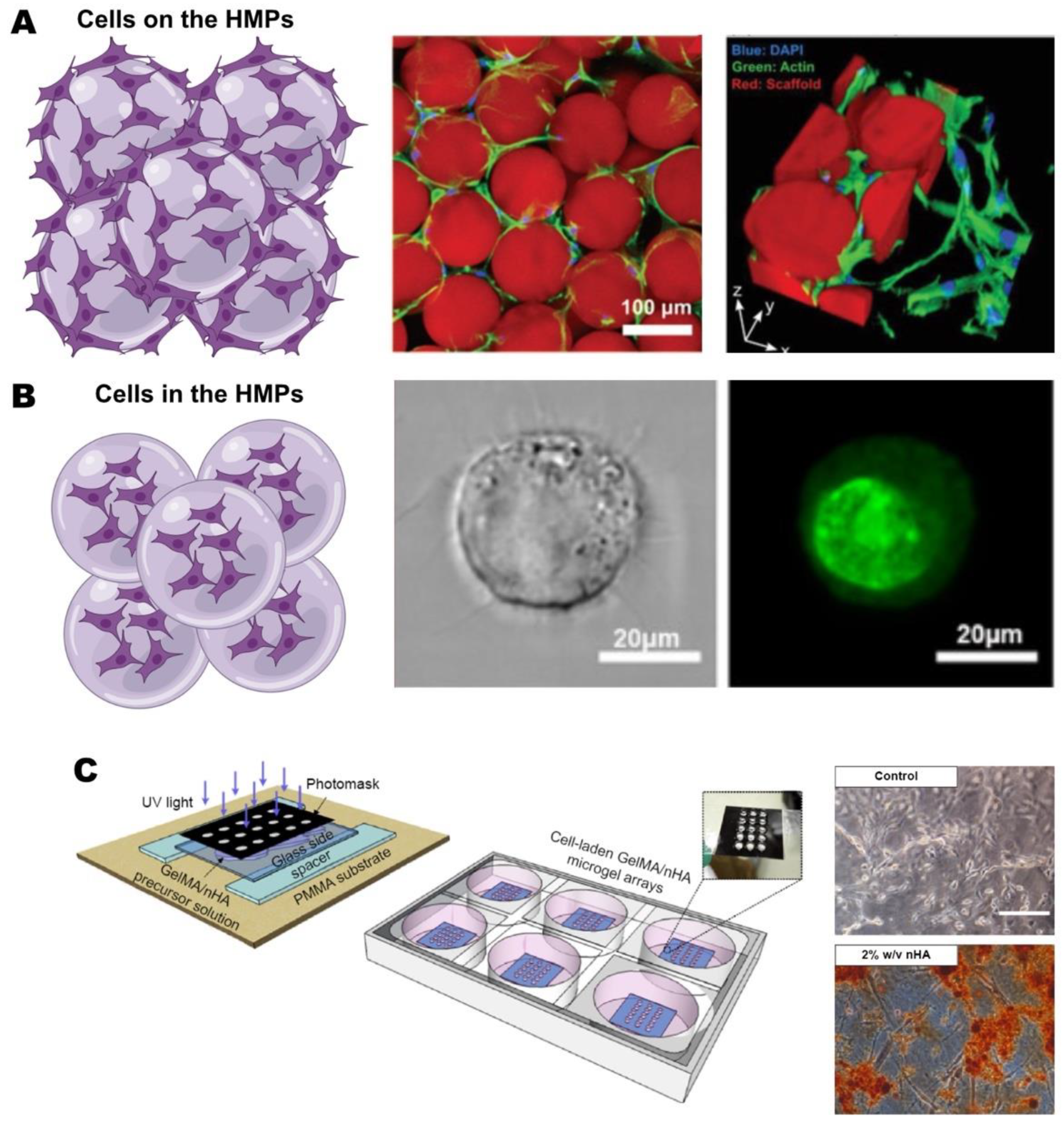
Delivering cells to damaged and diseased tissues hold great potential; however, challenges such as limited cell survival and engraftment post-delivery have hindered progress in this field[145,146]. Consequently, there is growing interest in utilizing delivery vehicles to enhance cell integration, viability, and function. HMPs offer an efficient platform for encapsulating, growing, and delivering cells, with fabrication techniques like emulsion, electrohydrodynamic spraying, and microfluidics being compatible with cell encapsulation (Figure 3A). HMPs provide a substantial adhesion surface for cells, and those featuring surface pores enhance nutrient and oxygen diffusion[21,147].
The design of HMPs is crucial in optimizing their benefits, with the selection of material for cell embedding and the processing conditions for optimal cell encapsulation holding great importance. Both these factors shape the properties of HMPs, encompassing degradation and mechanical strength, important for controlling the timing of cell delivery and achieving effective integration with the environment and the particles themselves[22]. In some cases, cell delivery occurs on the surface of HMPs instead of within them, enhancing nutrient and oxygen availability for the cells and maximizing their viability[24]. HMPs can undergo additional crosslinking to immobilize the particles and stabilize the packing configuration, referred to as microporous annealed particles (MAP)[148] (Figure 3A).
HMPs have been extensively used to deliver MSCs for bone tissue repair. For example, Moshaverinia et al. co-encapsulated anti-BMP2 monoclonal antibody and MSCs in RGD-coupled alginate HMPs by extruding droplets of alginate mixture into a calcium chloride solution to achieve crosslinking[149]. The co-delivery system demonstrated enhanced osteogenic differentiation, evident through elevated expression of key osteogenesis regulators, namely Runx2 and Smad 1 (Suppressor of Mother against Decapentaplegic) in vitro, and showed complete bone healing in critical-sized calvarial defects in mice in vivo. In a similar approach, MSCs and BMP-2 were encapsulated within GelMA-based HMPs employing microfluidic emulsion technology[150]. This approach showed the microgel system's capability to sustain cell viability, promote cell migration, and induce cell differentiation in vitro, subsequently leading to robust bone regeneration in vivo.
Utilizing microfluidics technology, continuous encapsulation of cells is also possible at the single cell level. In a study by An et al., single MSC encapsulation in alginate HMPs was achieved using microfluidics techniques[151] (Figure 3B). Their research demonstrated that these cell-laden microgels enhanced bone formation in a rat tibial model by creating a highly controlled osteogenic microenvironment, compared to MSCs mixed with microgels.
A synergistic approach involving desired cell populations for promoting bone repair has also been documented in the literature. Wise et al. utilized pre-differentiated MSCs alongside freshly isolated Bone Marrow Mononuclear Cells (BMMC) within collagen-chitosan HMPs[107]. A robust synergistic effect on volume and ectopic bone formation was observed after a 5-week implantation of microgels into a subcutaneous rat dorsum model, surpassing the outcomes achieved with either cell type alone. Similarly, Grellier et al. employed a comparable strategy by immobilizing human osteoprogenitors derived from MSCs alongside human umbilical vein endothelial cells (HUVECs) within RGD-modified alginate HMPs[97]. Their study revealed upregulated gene expressions of ALP and osteocalcin, along with increased mineralization deposits in the co-immobilized HMPs in vitro. Furthermore, in vivo studies conducted on a bone defect in nude mice demonstrated significant bone mineralization in and around the site when employing the co-immobilization approach.
To better mimic the native ECM of bone tissues and enhance the biological properties of materials, nanofeatures can be incorporated into HMPs. A popular approach involves the use of nanohydroxyapatite (nHAp), which has been shown to enhance osteoblast adhesion, proliferation, and differentiation by directly influencing biocompatibility, specific surface area, and the surface roughness of the HMPs[152]. For example, Chen et al. fabricated periodontal ligament stem cell-laden GelMA/nHAp microgel arrays (Figure 3C) and demonstrated promoted osteogenic differentiation by elevated levels of calcium deposition and osteogenic markers such as ALP, Runx2, OCN, and BSP[141]. Furthermore, in vivo experiments in nude mice revealed enhanced osteogenesis, characterized by augmented formation of mineralized tissue and increased vascularization compared to the pure GelMA group.
Figure 3.
Applications of HMPs in cell delivery. A) Delivery of the cells on the HMPs, and B) in the HMPs. Reprinted from [148] and [151] with permission. Copyright 2019, John Wiley and Sons and 2020, Elsevier, respectively. C) Schematic representation of GelMA/nHA HMP fabrication and representative images of cell-laden microgels with and without nHA after 10 days of osteoinduction, stained with Alizarin Red S staining for calcium deposition. Reprinted from [141] with permission. Copyright 2016, Dovepress. Schematics of A and B are created with BioRender.com.
Figure 3.
Applications of HMPs in cell delivery. A) Delivery of the cells on the HMPs, and B) in the HMPs. Reprinted from [148] and [151] with permission. Copyright 2019, John Wiley and Sons and 2020, Elsevier, respectively. C) Schematic representation of GelMA/nHA HMP fabrication and representative images of cell-laden microgels with and without nHA after 10 days of osteoinduction, stained with Alizarin Red S staining for calcium deposition. Reprinted from [141] with permission. Copyright 2016, Dovepress. Schematics of A and B are created with BioRender.com.
4.3. Scaffold Design with HMPs
As mentioned earlier, HMPs find extensive application in delivering bioactive factors or cells for diverse tissue engineering strategies, including bone tissue regeneration. They can be delivered as standalone entities, utilized as fundamental building blocks to create comprehensive scaffolds, or employed as a dispersed phase enveloped by a continuous matrix. In this section, two primary scaffold designs for bone tissue engineering will be discussed: HMP-based scaffolds and HMP-reinforced scaffolds.
4.3.1. HMP-based scaffolds
Scaffolds based on HMPs are crafted using a "bottom-up" strategy, gaining significant popularity in recent years for its meticulous integration of biomaterials, cells, and biomolecules through the precise assembly of microgels as fundamental building blocks. The interstitial spaces between these particles, crucial for enabling cell ingrowth, facilitate continuous nutrient and oxygen transfer[153,154]. HMP-based scaffolds are constructed through random packing, directed assembly, and 3D bioprinting techniques.
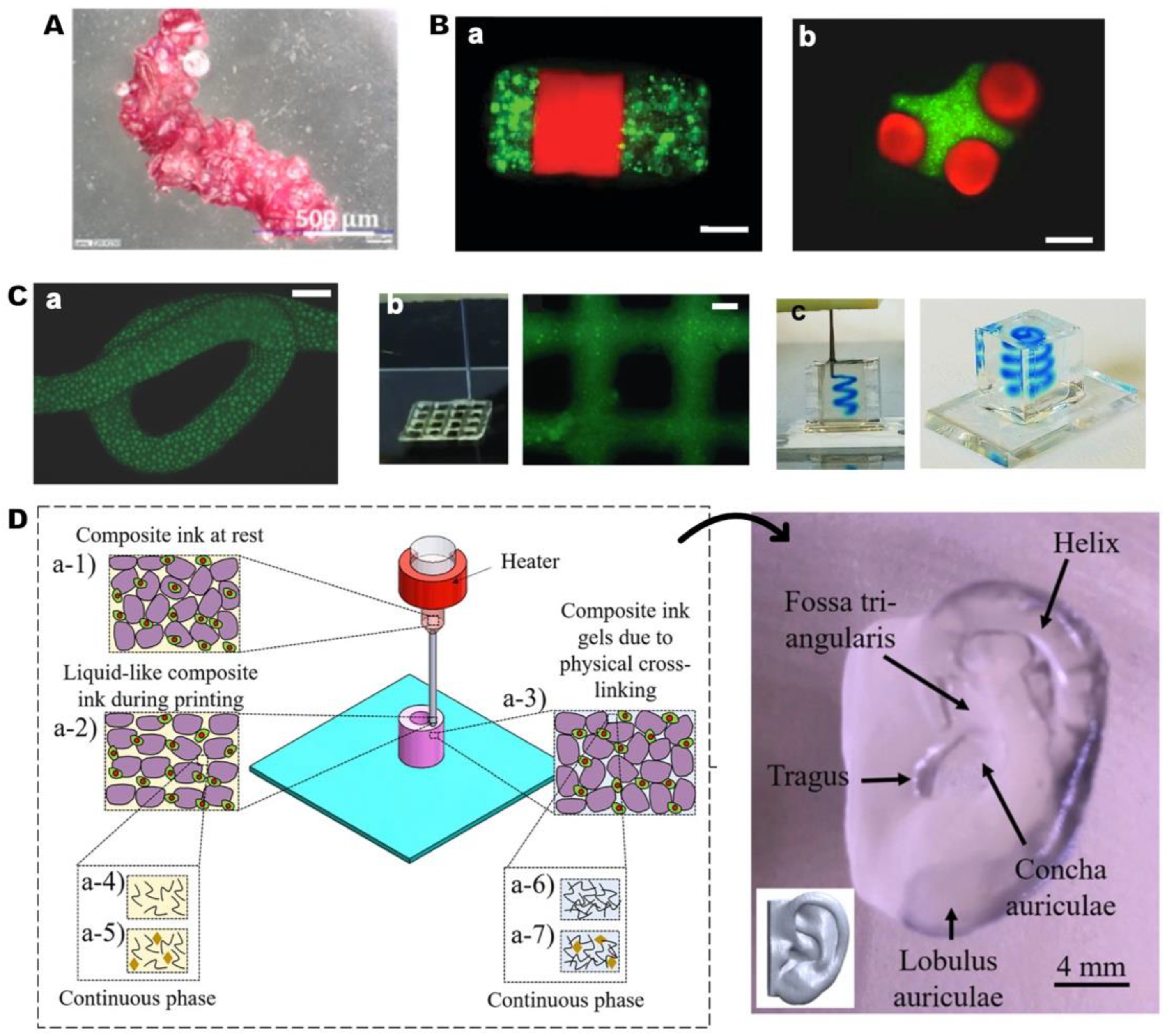
In the random packing approach, HMPs are randomly assembled to create a 3D scaffold, optimizing the delivery of bioactive factors and cells to the target site. In a relevant study, Mielan et al. demonstrated the auto-assembly of collagen-coated poly(L-lactide-co-glycolide) (PLGA) microspheres seeded with preosteoblast MC3T3-E1 cells for bone regeneration[155]. Their findings revealed that collagen coating facilitated cell growth, proliferation, and osteogenic differentiation, with auto-assembly observed by day 7 (Figure 4A). However, due to the reliance on interparticle interactions, concerns arise regarding the mechanical stability, potentially leading to the dissociation of individual particles from the defect site[60]. To address this issue, glues[156] and crosslinking agents[157] have been suggested in the literature to prevent microspheres from flowing out of the treatment site. For example, in a recent study, Nisal et al. introduced a unique bone regeneration approach utilizing silk fibroin microgels, randomly packed with the assistance of a dilute silk fibroin solution[158]. The resulting 3D HMP-based construct exhibited mechanical properties akin to native cancellous bone, demonstrating biocompatibility and supporting cell adhesion, proliferation, and differentiation in vitro. In vivo implantation in rabbit femurs revealed woven bone formation after just 4 weeks, highlighting the promising potential of this method. In random packing, the structure of the resulting 3D scaffold can be fine-tuned by incorporating various customized particles encapsulating biomolecules, bioceramics, or cells.
Creating HMP-based scaffolds through the direct assembly method involves utilizing cohesive forces such as hydrophobic interactions, magnetic forces, or electrostatic forces. In contrast to random packing, this approach enables the creation of microengineered tissues in a directed and scalable manner, providing precise control over the scaffold's structure[159]. The directed assembly of cell-laden microgels for scaffold fabrication was initially documented in 2008 by Du et al. In their pioneering work, controlled assembly was achieved at the oil-water interface through mechanical agitation and manual manipulation using a pipette tip[160]. This innovative approach resulted in various structures, including linear (Figure 4B-b), random, branched, offset, and lock-and-key shaped (Figure 4B-c) microgels. Subsequent to this groundbreaking study, numerous research groups have further explored and applied this method, showcasing controlled assembly of various HMP types into diverse shapes[161,162,163,164]. While many current studies are in the proof-of-concept stage, these advancements hold significant potential for various tissue engineering applications, including bone tissue regeneration.
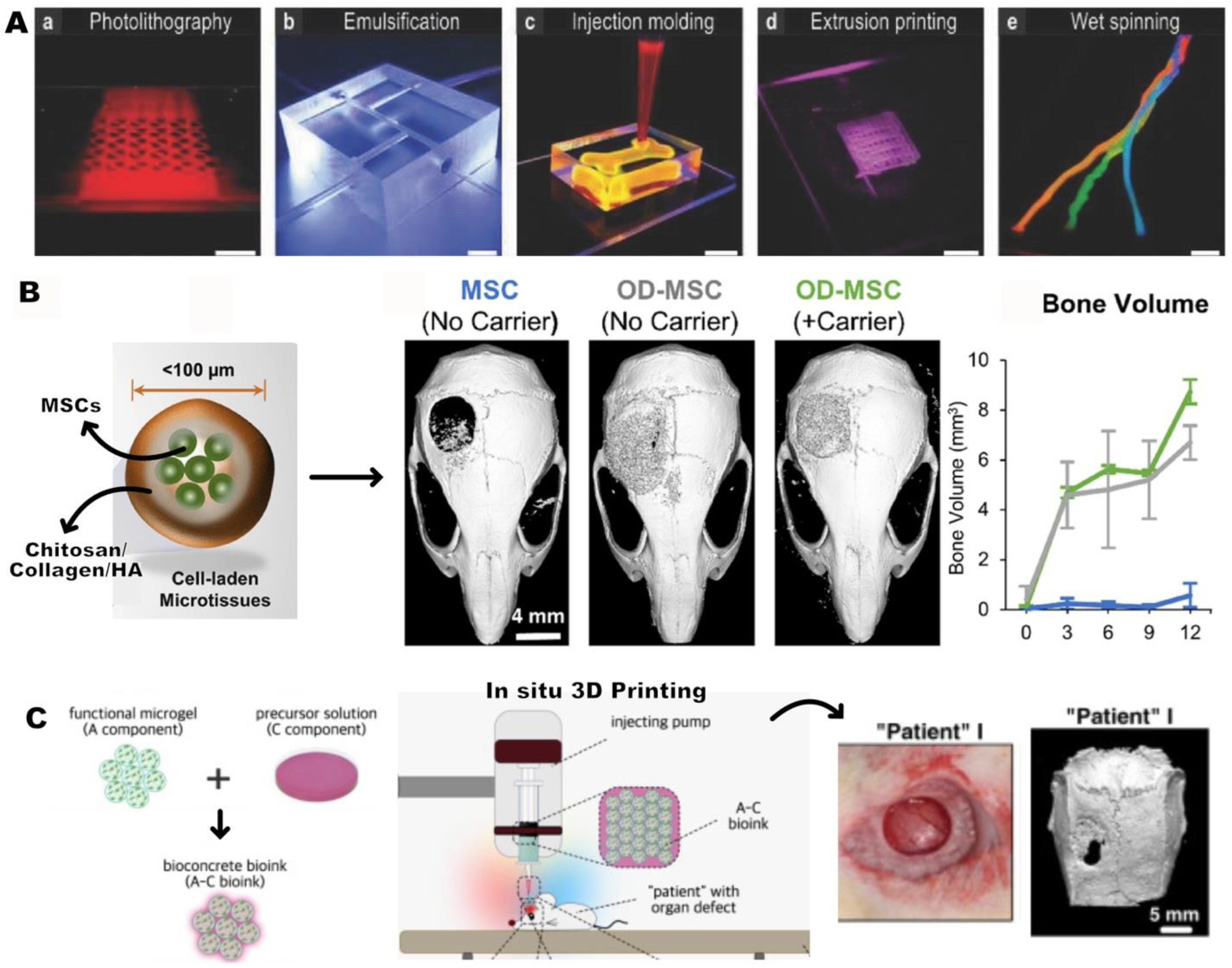
3D bioprinting is a powerful technique for precisely designing 3D structures in personalized tissue engineering and regenerative medicine applications, utilizing computer-aided design (CAD) data for custom architectures. Among various 3D printing technologies like stereolithography, inkjet printing, or fused deposition modeling, extrusion bioprinting stands out due to its compatibility with hydrogels, offering cost-effectiveness and mild printing conditions[165]. Hydrogel precursor solutions, known as bioinks, require high viscosity to maintain structural integrity after extrusion, which can affect the cell viability. Unlike conventional hydrogel precursors utilized in bioprinting, microgels demonstrate shear-thinning behavior. They act as solids but exhibit fluidic collective movement under external forces, allowing for flow and rapid recovery upon deposition, thereby ensuring high cell viability[166,167]. As a proof of concept, Highly et al. demonstrated the utilization of cell-laden HMPs engineered from diverse materials, such as thiol-ene crosslinked hyaluronic acid, photo-crosslinked PEG, and thermosensitive agarose[166]. Following particle fabrication, they subjected them to "jamming" through vacuum-driven filtration, loaded them into a syringe using centrifugation, and proceeded with bioprinting. This innovative approach enabled them to bioprint customized structures without the need for additional materials or crosslinkers for stabilization (Figure 4C). However, given that this technique relies solely on physical interactions between particles, ensuring the long-term stability of the constructs poses a challenge. The inclusion of a carrier bioink material can enhance the stability of HMP-based bioprinted constructs[168] (Figure 4D). For example, in their research, Chai et al. designed core-shell HMPs with a collagen core layer and an alginate shell using a multichannel microfluidic device and blended them with GelMA and methacrylated silk fibroin (SilMA) hydrogel precursors for the fabrication of 3D printed constructs[87]. The incorporation of cells in the microgels notably improved the survival rate of the stem cells. Upon subcutaneous implantation in Spraque-Dawley rats, the resulting constructs demonstrated enhanced bone formation compared to those without microgels, highlighting the efficacy of this technique.
Figure 4.
HMP-based scaffolds. A) Auto-assembled MC3T3-E1 cells-laden PLGA microspheres, collagen-coated, in osteogenic media on Day 7, displaying positive staining for alkaline phosphatase. Reprinted from [155] with permission. Copyright 2021, MDPI. B) Directed assembly of cell-laden PEGDA (polyethylene glycol diacrylate) microgels into a) rod-shaped and b) lock-and-key assemblies, stained with FITC-dextran (green) and Nile red (red). Reprinted from [160] with permission. Copyright 2008, PNAS. C) Jammed HMPs fabricated by 3D bioprinting, including a) extruded filament of norbornene-modified hyaluronic acid HMPs, b) 3D bioprinting on a platform, and c) within a shear-thinning support transparent hydrogel reservoir. Reprinted from [166] with permission. Copyright 2018, John Wiley and Sons. D) Schematic representation of direct printing of gelatin HMP-based composite bioink, demonstrating applicability for complex organ engineering, such as the human ear. Reprinted from [168] with permission. Copyright 2020, American Chemical Society.
Figure 4.
HMP-based scaffolds. A) Auto-assembled MC3T3-E1 cells-laden PLGA microspheres, collagen-coated, in osteogenic media on Day 7, displaying positive staining for alkaline phosphatase. Reprinted from [155] with permission. Copyright 2021, MDPI. B) Directed assembly of cell-laden PEGDA (polyethylene glycol diacrylate) microgels into a) rod-shaped and b) lock-and-key assemblies, stained with FITC-dextran (green) and Nile red (red). Reprinted from [160] with permission. Copyright 2008, PNAS. C) Jammed HMPs fabricated by 3D bioprinting, including a) extruded filament of norbornene-modified hyaluronic acid HMPs, b) 3D bioprinting on a platform, and c) within a shear-thinning support transparent hydrogel reservoir. Reprinted from [166] with permission. Copyright 2018, John Wiley and Sons. D) Schematic representation of direct printing of gelatin HMP-based composite bioink, demonstrating applicability for complex organ engineering, such as the human ear. Reprinted from [168] with permission. Copyright 2020, American Chemical Society.
4.3.2. Reinforcing scaffolds: HMPs incorporated scaffolds
Another approach involves incorporating HMPs into a continuous matrix rather than utilizing them alone. HMPs incorporated scaffolds are typically produced through a multistep process using a conventional "top-down" approach, wherein the HMPs are mixed with the bulk scaffold matrix to form the final construct. This method aims to achieve controlled delivery of bioactive factors, carry cells with high viability, and provide porosity to facilitate oxygen and nutrient exchange[169]. As a proof of concept, Kamperman et al. demonstrated the utilization of single-cell-encapsulated HMPs as building blocks for modular tissue engineering and mixed them with various hydrogel precursor solutions, including agarose, PEGDA, dextran-tyramine, collagen, alginate/GelMA, and alginate[170] (Figure 5A). The resulting HMP-based bioinks were processed using diverse biofabrication techniques such as extrusion bioprinting, wet spinning, injection molding, emulsification, and photolithography, wherein the cells exhibited over 70% viability.
For bone regeneration, microspheres are reported to be delivered within a carrier gel to facilitate their transportation to the defect site. For example, Annamalai et al. incorporated MSCs into a chitosan-collagen matrix to create modular tissues, and particles were embedded into fibrin gels to fill critical-size defects in mice[171]. The microtissues within the carrier gel exhibited complete healing, particularly when the MSCs were utilized in a pre-differentiated form (Figure 5B). In a similar investigation, GelMA hydrogel precursor served as the carrier for electrosprayed MSC-laden GelMA microgels designed for bone regeneration[172]. This innovative approach was subsequently applied in the in-situ cranial repair of rats using bioprinting techniques. The assessment through Micro-computed Tomography (Micro-CT) revealed a pattern of new bone formation extending from the periphery toward the center of various defect morphologies, showing the feasibility of the HMP-based 3D bioprinting approach (Figure 5C). In a different study, the sequential release of BMP-2 and BMP-7 growth factors, loaded into poly-electrolyte complexes consisting of poly(4-vinyl pyridine) (P4VP) and alginic acid microspheres, was successfully accomplished within PLGA scaffolds[173]. This approach exhibited an improved osteogenic differentiation of MSCs when both factors were co-administered.
Injectable scaffolds incorporating HMPs are gaining attention in bone regeneration due to the minimally invasive nature of this technique. For example, Yan et al. engineered gelatin HMPs loaded with tetracycline hydrochloride (TH) and incorporated them, along with hydroxyapatite, into alginate-based injectable gel scaffolds[174]. The resulting HMP-reinforced scaffolds exhibited improved mechanical strength, controlled release of bioactive factors, and significantly higher viability of osteoblasts seeded in the composite gel compared to scaffolds without HMPs.
HMPs can be seamlessly integrated into solid structures, including those crafted through advanced 3D printing techniques. In a recent study, Zhuang et al. showcased a sustained BMP-2 release from core-shell HMPs with heparin-coated polylactic acid (PLA) cores fabricated through emulsion and alginate shells via electrospraying[175]. These HMPs were integrated into 3D printed polycaprolactone (PCL) scaffolds, demonstrating their ability to promote osteogenesis both in vitro and in vivo. This highlights the effectiveness of hybrid systems employing both scaffolds and HMPs.
Figure 5.
A) Fabrication process of PEGDA HMPs using a) photolithography, b) emulsification, c) injection molding collagen, d) extrusion bioprinting alginate/GelMA, and e) wet spinning with subsequent weaving of alginate. Reprinted from [170] with permission. Copyright 2016, John Wiley and Sons. B) MicroCT images depict the newly formed bone volume in the defect area treated with HMPs loaded with MSC, pre-differentiated MSCs (Osteogenic Differentiated, OD), and pre-differentiated MSCs in a fibrin carrier, demonstrating complete healing with the carrier. Reprinted from [171] with permission. Copyright 2019, Elsevier. C) In situ 3D printing of bioconcrete bioink (GelMA HMPs and GelMA cement) on the patient, illustrating effective bone formation within 6 weeks. Reprinted from [172] with permission. Copyright 2022, Springer Nature.
Figure 5.
A) Fabrication process of PEGDA HMPs using a) photolithography, b) emulsification, c) injection molding collagen, d) extrusion bioprinting alginate/GelMA, and e) wet spinning with subsequent weaving of alginate. Reprinted from [170] with permission. Copyright 2016, John Wiley and Sons. B) MicroCT images depict the newly formed bone volume in the defect area treated with HMPs loaded with MSC, pre-differentiated MSCs (Osteogenic Differentiated, OD), and pre-differentiated MSCs in a fibrin carrier, demonstrating complete healing with the carrier. Reprinted from [171] with permission. Copyright 2019, Elsevier. C) In situ 3D printing of bioconcrete bioink (GelMA HMPs and GelMA cement) on the patient, illustrating effective bone formation within 6 weeks. Reprinted from [172] with permission. Copyright 2022, Springer Nature.
5. Conclusion
Hydrogel Microparticles (HMPs), fabricated through diverse techniques, emerge as versatile entities, contributing to drug and cell delivery, scaffold production, and bioink development for 3D printing. Their injectability for minimally invasive delivery, coupled with modular properties when composed of different populations, marks them as key players in advancing bone tissue engineering. This injectability characteristic introduces the potential for delivering microspheres multiple times, thereby enhancing current clinical approaches. The adaptability of HMPs for modifications adds to their attractiveness. For instance, beyond their capacity to incorporate antibiotics, HMPs can be designed to be entirely degradable, featuring a cellular "safety switch" that induces cellular apoptosis in carrier cells before hydrogel degradation. The biomaterial can then undergo selective degradation through the inclusion of specific protease sites, allowing tunable degradation post-injury healing[176].
In the broader context, microspheres exhibit the potential not only to create three-dimensional scaffolds but also to seamlessly integrate into scaffold matrices for bone regeneration. Despite extensive research in this domain, the development of a flawless system capable of fully replacing bone tissue remains an ongoing endeavor. Scaffolds utilizing microspheres, particularly functional ones serving as molecular carriers, present promising avenues for advancements in bone tissue engineering. The multifaceted attributes of HMPs, ranging from injectability, degradability, suitable for the delivery of cell and biological factors, position them as valuable tools in the evolving landscape of bone regeneration research and clinical applications.
References
- Amini, A.R.; Laurencin, C.T.; Nukavarapu, S.P. Bone tissue engineering: recent advances and challenges. Crit Rev Biomed Eng 2012, 40, 363–408. [Google Scholar] [CrossRef] [PubMed]
- Baroli, B. From natural bone grafts to tissue engineering therapeutics: Brainstorming on pharmaceutical formulative requirements and challenges. J Pharm Sci 2009, 98, 1317–1375. [Google Scholar] [CrossRef] [PubMed]
- Gazdag, A.R.; Lane, J.M.; Glaser, D.; Forster, R.A. Alternatives to Autogenous Bone Graft: Efficacy and Indications. J Am Acad Orthop Surg 1995, 3, 1–8. [Google Scholar] [CrossRef] [PubMed]
- Katz, M.S.; et al. Postoperative Morbidity and Complications in Elderly Patients after Harvesting of Iliac Crest Bone Grafts. Medicina-Lithuania.
- Arrington, E.D.; Smith, W.J.; Chambers, H.G.; Bucknell, A.L.; Davino, N.A. Complications of iliac crest bone graft harvesting. Clin Orthop Relat R 1996, 329, 300–309. [Google Scholar] [CrossRef] [PubMed]
- Malikmammadov, E.; Tanir, T.E.; Kiziltay, A.; Hasirci, V.; Hasirci, N. PCL-TCP wet spun scaffolds carrying antibiotic-loaded microspheres for bone tissue engineering. J Biomat Sci-Polym E 2018, 29, 805–824. [Google Scholar]
- Hasirci, N.; Kilic, C.; Kömez, A.; Bahcecioglu, G.; Hasirci, V. GELS HANDBOOK: Fundamentals, Properties and Applications Volume 2: Applications of Hydrogels in Regenerative Medicine. World Scientific, 2016; pp. 1–52. [Google Scholar]
- Slaughter, B.V.; Khurshid, S.S.; Fisher, O.Z.; Khademhosseini, A.; Peppas, N.A. Hydrogels in Regenerative Medicine. Adv Mater 2009, 21, 3307–3329. [Google Scholar] [CrossRef] [PubMed]
- Ma, X.; et al. Doxorubicin loaded hydrogel microparticles from microfluidics for local injection therapy of tumors. Colloid Surface B 2022, 220. [Google Scholar] [CrossRef] [PubMed]
- Wang, K.; Lin, S.; Nune, K.C.; Misra, R.D.K. Chitosan-gelatin-based microgel for sustained drug delivery. J Biomat Sci-Polym E 2016, 27, 441–453. [Google Scholar] [CrossRef] [PubMed]
- Kilic Bektas, C.; Hasirci, V. Cell loaded 3D bioprinted GelMA hydrogels for corneal stroma engineering. Biomater Sci-Uk 2020, 8, 438–449. [Google Scholar] [CrossRef] [PubMed]
- Flégeau, K.; Puiggali-Jou, A.; Zenobi-Wong, M. Cartilage tissue engineering by extrusion bioprinting utilizing porous hyaluronic acid microgel bioinks. Biofabrication 2022, 14. [Google Scholar] [CrossRef]
- Thangavel, P.; Vilvanathan, S.P.; Kuttalam, I.; Lonchin, S. Topical administration of pullulan gel accelerates skin tissue regeneration by enhancing collagen synthesis and wound contraction in rats. Int J Biol Macromol 2020, 149, 395–403. [Google Scholar] [CrossRef]
- Cui, T.T.; et al. Micro-Gel Ensembles for Accelerated Healing of Chronic Wound via pH Regulation. Adv Sci 2022, 9. [Google Scholar] [CrossRef] [PubMed]
- Semitela, A.; et al. Electrospinning of bioactive polycaprolactone-gelatin nanofibres with increased pore size for cartilage tissue engineering applications. J Biomater Appl 2020, 35, 471–484. [Google Scholar] [CrossRef] [PubMed]
- Sharma, A.; Bhat, S.; Nayak, V.; Kumar, A. Efficacy of supermacroporous poly(ethylene glycol)-gelatin cryogel matrix for soft tissue engineering applications. Mat Sci Eng C-Mater 2015, 47, 298–312. [Google Scholar] [CrossRef] [PubMed]
- Burger, D.; Beaumont, M.; Rosenau, T.; Tamada, Y. Porous Silk Fibroin/Cellulose Hydrogels for Bone Tissue Engineering via a Novel Combined Process Based on Sequential Regeneration and Porogen Leaching. Molecules 2020, 25. [Google Scholar] [CrossRef] [PubMed]
- Xue, X.; Hu, Y.; Deng, Y.H.; Su, J.C. Recent Advances in Design of Functional Biocompatible Hydrogels for Bone Tissue Engineering. Adv Funct Mater 2021, 31. [Google Scholar] [CrossRef]
- Kessler, M.; Nassisi, Q.; Amstad, E. Does the Size of Microgels Influence the Toughness of Microgel-Reinforced Hydrogels? Macromol Rapid Comm 2022, 43. [Google Scholar]
- Raemdonck, K.; Demeester, J.; De Smedt, S. Advanced nanogel engineering for drug delivery. Soft Matter 2009, 5, 707–715. [Google Scholar] [CrossRef]
- Newsom, J.P.; Payne, K.A.; Krebs, M.D. Microgels: Modular, tunable constructs for tissue regeneration. Acta Biomaterialia 2019, 88, 32–41. [Google Scholar] [CrossRef] [PubMed]
- Daly, A.C.; Riley, L.; Segura, T.; Burdick, J.A. Hydrogel microparticles for biomedical applications. Nat Rev Mater 2020, 5, 20–43. [Google Scholar] [CrossRef]
- Nguyen, T.P.T.; et al. Cell-laden injectable microgels: Current status and future prospects for cartilage regeneration. Biomaterials 2021, 279. [Google Scholar] [CrossRef]
- Vanderhoff, J.W.; Bradford, E.B.; Tarkowski, H.L.; Shaffer, J.B.; Wiley, R.M. Polymerization and polycondensation processes; American Chemical Society, 1962; Volume 34, pp. 32–51. [Google Scholar]
- Kilic Bektas, C.; et al. Self-Assembled Hydrogel Microparticle-Based Tooth-Germ Organoids. Bioengineering (Basel) 2022, 9. [Google Scholar] [CrossRef] [PubMed]
- Franco, C.L.; Price, J.; West, J.L. Development and optimization of a dual-photoinitiator, emulsion-based technique for rapid generation of cell-laden hydrogel microspheres. Acta Biomaterialia 2011, 7, 3267–3276. [Google Scholar] [CrossRef] [PubMed]
- Chang, S.; et al. Emulsion-based encapsulation of pluripotent stem cells in hydrogel microspheres for cardiac differentiation. Biotechnol Progr 2020, 36. [Google Scholar] [CrossRef]
- Patel, Z.S.; Yamamoto, M.; Ueda, H.; Tabata, Y.; Mikos, A.G. Biodegradable gelatin microparticles as delivery systems for the controlled release of bone morphogenetic protein-2. Acta Biomaterialia 2008, 4, 1126–1138. [Google Scholar] [CrossRef] [PubMed]
- Gelli, R.; Mugnaini, G.; Bolognesi, T.; Bonini, M. Cross-linked Porous Gelatin Microparticles with Tunable Shape, Size, and Porosity. Langmuir 2021, 37, 12781–12789. [Google Scholar] [CrossRef] [PubMed]
- Gupta, V.; Khan, Y.; Berkland, C.J.; Laurencin, C.T.; Detamore, M.S. Microsphere-Based Scaffolds in Regenerative Engineering. Annual Review of Biomedical Engineering 2017, 19, 135–161. [Google Scholar] [CrossRef] [PubMed]
- Varde, N.K.; Pack, D.W. Microspheres for controlled release drug delivery. Expert Opin Biol Th 2004, 4, 35–51. [Google Scholar] [CrossRef] [PubMed]
- Blaker, J.J.; Knowles, J.C.; Day, R.M. Novel fabrication techniques to produce microspheres by thermally induced phase separation for tissue engineering and drug delivery. Acta Biomaterialia 2008, 4, 264–272. [Google Scholar] [CrossRef] [PubMed]
- Xu, Q.B.; et al. Preparation of Monodisperse Biodegradable Polymer Microparticles Using a Microfluidic Flow-Focusing Device for Controlled Drug Delivery. Small 2009, 5, 1575–1581. [Google Scholar] [CrossRef]
- Lu, S.; Lee, E.J.; Lam, J.; Tabata, Y.; Mikos, A.G. Evaluation of Gelatin Microparticles as Adherent-Substrates for Mesenchymal Stem Cells in a Hydrogel Composite. Ann Biomed Eng 2016, 44, 1894–1907. [Google Scholar] [CrossRef]
- Cohen, N.; et al. PEG-fibrinogen hydrogel microspheres as a scaffold for therapeutic delivery of immune cells. Front Bioeng Biotech 2022, 10. [Google Scholar] [CrossRef] [PubMed]
- Jiang, W.Q.; Li, M.Q.; Chen, Z.Z.; Leong, K.W. Cell-laden microfluidic microgels for tissue regeneration. Lab Chip 2016, 16, 4482–4506. [Google Scholar] [CrossRef] [PubMed]
- Liu, A.L.; Garcia, A.J. Methods for Generating Hydrogel Particles for Protein Delivery. Ann Biomed Eng 2016, 44, 1946–1958. [Google Scholar] [CrossRef] [PubMed]
- Duffy, D.C.; McDonald, J.C.; Schueller, O.J.A.; Whitesides, G.M. Rapid prototyping of microfluidic systems in poly(dimethylsiloxane). Anal Chem 1998, 70, 4974–4984. [Google Scholar] [CrossRef] [PubMed]
- Moreira, A.; Carneiro, J.; Campos, J.B.L.M.; Miranda, J.M. Production of hydrogel microparticles in microfluidic devices: a review. Microfluid Nanofluid 2021, 25. [Google Scholar] [CrossRef]
- Li, W.; et al. Microfluidic fabrication of microparticles for biomedical applications. Chem Soc Rev 2018, 47, 5646–5683. [Google Scholar] [CrossRef] [PubMed]
- Lu, et al. Modular and Integrated Systems for Nanoparticle and Microparticle Synthesis-A Review. Biosensors-Basel 2020, 10. [CrossRef] [PubMed]
- Chen, C.H.; Abate, A.R.; Lee, D.Y.; Terentjev, E.M.; Weitz, D.A. Microfluidic Assembly of Magnetic Hydrogel Particles with Uniformly Anisotropic Structure. Adv Mater 2009, 21, 3201–3204. [Google Scholar] [CrossRef]
- Martinez, C.J.; et al. A microfluidic approach to encapsulate living cells in uniform alginate hydrogel microparticles. Macromol Biosci 2012, 12, 946–951. [Google Scholar] [CrossRef]
- Li, Q.; Chang, B.; Dong, H.; Liu, X. Functional microspheres for tissue regeneration. Bioact Mater 2023, 25, 485–499. [Google Scholar] [CrossRef]
- Li, Y.N.; et al. Composite core-shell microparticles from microfluidics for synergistic drug delivery. Sci China Mater 2017, 60, 543–553. [Google Scholar] [CrossRef]
- Zhao, X.; et al. Hierarchically porous composite microparticles from microfluidics for controllable drug delivery. Nanoscale 2018, 10, 12595–12604. [Google Scholar] [CrossRef] [PubMed]
- Guo, T.W.; et al. New Hope for Treating Intervertebral Disc Degeneration: Microsphere-Based Delivery System. Front Bioeng Biotech 2022, 10. [Google Scholar] [CrossRef] [PubMed]
- Hwang, Y.H.; Um, T.; Ahn, G.N.; Kim, D.P.; Lee, H.Y.M. Robust and scalable production of emulsion-templated microparticles in 3D-printed milli-fluidic device. Chem Eng J 2022, 431. [Google Scholar] [CrossRef]
- Jans, A.; et al. High-Throughput Production of Micrometer Sized Double Emulsions and Microgel Capsules in Parallelized 3D Printed Microfluidic Devices. Polymers-Basel 2019, 11. [CrossRef]
- Helgeson, M.E.; Chapin, S.C.; Doyle, P.S. Hydrogel microparticles from lithographic processes: Novel materials for fundamental and applied colloid science. Curr Opin Colloid In 2011, 16, 106–117. [Google Scholar] [CrossRef] [PubMed]
- Acharya, G.; et al. The hydrogel template method for fabrication of homogeneous nano/microparticles. J Control Release 2010, 141, 314–319. [Google Scholar] [CrossRef] [PubMed]
- Bin Hamzah, Y.; Hashim, S.; Abd Rahman, W.A.W. Synthesis of polymeric nano/microgels: a review. J Polym Res 2017, 24. [Google Scholar] [CrossRef]
- Li, B.; He, M.H.; Ramirez, L.; George, J.; Wang, J. Multifunctional Hydrogel Microparticles by Polymer-Assisted Photolithography. Acs Appl Mater Inter 2016, 8, 4158–4164. [Google Scholar] [CrossRef]
- Merkel, T.J.; et al. Scalable, Shape-Specific, Top-Down Fabrication Methods for the Synthesis of Engineered Colloidal Particles. Langmuir 2010, 26, 13086–13096. [Google Scholar] [CrossRef]
- Naqvi, S.M.; et al. Living Cell Factories - Electrosprayed Microcapsules and Microcarriers for Minimally Invasive Delivery. Adv Mater 2016, 28, 5662–5671. [Google Scholar] [CrossRef] [PubMed]
- Imaninezhad, M.; Jain, E.; Zustiak, S.P. Cell Microencapsulation in Polyethylene Glycol Hydrogel Microspheres Using Electrohydrodynamic Spraying. Organoids 2019, 1576, 313–325. [Google Scholar]
- Qayyum, A.S.; et al. Design of electrohydrodynamic sprayed polyethylene glycol hydrogel microspheres for cell encapsulation. Biofabrication 2017, 9. [Google Scholar] [CrossRef] [PubMed]
- Xie, J.W.; Jiang, J.; Davoodi, P.; Srinivasan, M.P.; Wang, C.H. Electrohydrodynamic atomization: A two-decade effort to produce and process micro-/nanoparticulate materials. Chem Eng Sci 2015, 125, 32–57. [Google Scholar] [CrossRef]
- Koons, G.L.; Diba, M.; Mikos, A.G. Materials design for bone-tissue engineering. Nat Rev Mater 2020, 5, 584–603. [Google Scholar] [CrossRef]
- Wang, H.A.; Leeuwenburgh, S.C.G.; Li, Y.B.; Jansen, J.A. The Use of Micro- and Nanospheres as Functional Components for Bone Tissue Regeneration. Tissue Eng Part B-Re 2012, 18, 24–39. [Google Scholar] [CrossRef] [PubMed]
- Ullah, S.; Chen, X. Fabrication, applications and challenges of natural biomaterials in tissue engineering. Appl Mater Today 2020, 20. [Google Scholar] [CrossRef]
- Wee, C.Y.; Yang, Z.J.; Thian, E.S. Past, present and future development of microspheres for bone tissue regeneration: a review. Mater Technol 2021, 36, 364–374. [Google Scholar] [CrossRef]
- Ferreira, A.M.; Gentile, P.; Chiono, V.; Ciardelli, G. Collagen for bone tissue regeneration. Acta Biomaterialia 2012, 8, 3191–3200. [Google Scholar] [CrossRef]
- Feng, X. Chemical and Biochemical Basis of Cell-Bone Matrix Interaction in Health and Disease. Curr Chem Biol 2009, 3, 189–196. [Google Scholar]
- Mano, J.F.; et al. Natural origin biodegradable systems in tissue engineering and regenerative medicine: present status and some moving trends. J R Soc Interface 2007, 4, 999–1030. [Google Scholar] [CrossRef] [PubMed]
- Rossler, B.; Kreuter, J.; Scherer, D. Collagen Microparticles - Preparation and Properties. Journal of Microencapsulation 1995, 12, 49–57. [Google Scholar] [CrossRef] [PubMed]
- Chan, O.C.M.; So, K.F.; Chan, B.P. Fabrication of nano-fibrous collagen microspheres for protein delivery and effects of photochemical crosslinking on release kinetics. J Control Release 2008, 129, 135–143. [Google Scholar] [CrossRef] [PubMed]
- agai, N. et al. Preparation and characterization of collagen microspheres for sustained release of VEGF. J Mater Sci-Mater M 2010, 21, 1891–1898. [CrossRef] [PubMed]
- Khatami, N.; Khoshfetrat, A.B.; Khaksar, M.; Zamani, A.R.N.; Rahbarghazi, R. Collagen-alginate-nano-silica microspheres improved the osteogenic potential of human osteoblast-like MG-63 cells. Journal of Cellular Biochemistry 2019, 120, 15069–15082. [Google Scholar] [CrossRef]
- Chan, B.P.; Hui, T.Y.; Wong, M.Y.; Yip, K.H.K.; Chan, G.C.F. Mesenchymal Stem Cell-Encapsulated Collagen Microspheres for Bone Tissue Engineering. Tissue Eng Part C-Me 2010, 16, 225–235. [Google Scholar] [CrossRef]
- Seong, Y.J. et al. Porous calcium phosphate-collagen composite microspheres for effective growth factor delivery and bone tissue regeneration. Materials Science and Engineering C-Materials for Biological Applications 2020, 109. [CrossRef]
- Hou, J.; et al. Segmental bone regeneration using rhBMP-2-loaded collagen/chitosan microspheres composite scaffold in a rabbit model. Biomed Mater 2012, 7. [Google Scholar] [CrossRef]
- Yang, C.L.; et al. The application of recombinant human collagen in tissue engineering. Biodrugs 2004, 18, 103–119. [Google Scholar] [CrossRef]
- Wang, T.; Lew, J.; Premkumar, J.; Poh, C.L.; Win Naing, M. Production of recombinant collagen: state of the art and challenges. Engineering Biology 2017, 1, 18–23. [Google Scholar] [CrossRef]
- Liu, D.S.; Nikoo, M.; Boran, G.; Zhou, P.; Regenstein, J.M. Collagen and Gelatin. Annu Rev Food Sci T 2015, 6, 527–557. [Google Scholar] [CrossRef] [PubMed]
- Hoque, M.E.; Nuge, T.; Yeow, T.K.; Nordin, N.; Prasad, R. Gelatin based scaffolds for tissue engineering-a review. Polym. Res. J 2015, 9, 15. [Google Scholar]
- Dong, Z.X. et al. Progress of gelatin-based microspheres (GMSs) as delivery vehicles of drug and cell. Mat Sci Eng C-Mater 2021, 122. [CrossRef] [PubMed]
- Patel, Z.S.; Ueda, H.; Yamamoto, M.; Tabata, Y.; Mikos, A.G. In vitro and in vivo release of vascular endothelial growth factor from gelatin microparticles and biodegradable composite scaffolds. Pharm Res 2008, 25, 2370–2378. [Google Scholar] [CrossRef] [PubMed]
- Park, K.S.; Kim, C.; Nam, J.O.; Kang, S.M.; Lee, C.S. Synthesis and characterization of thermosensitive gelatin hydrogel microspheres in a microfluidic system. Macromol Res 2016, 24, 529–536. [Google Scholar] [CrossRef]
- Foox, M.; Zilberman, M. Drug delivery from gelatin-based systems. Expert Opin Drug Del 2015, 12, 1547–1563. [Google Scholar] [CrossRef] [PubMed]
- Santoro, M.; Tatara, A.M.; Mikos, A.G. Gelatin carriers for drug and cell delivery in tissue engineering. J Control Release 2014, 190, 210–218. [Google Scholar] [CrossRef] [PubMed]
- Fan, C.J. et al. Cross-linked gelatin microsphere-based scaffolds as a delivery vehicle of MC3T3-E1 cells: and evaluation. Materials Science and Engineering C-Materials for Biological Applications 2020, 108. [CrossRef] [PubMed]
- Chao, S.C.; Wang, M.J.; Pai, N.S.; Yen, S.K. Preparation and characterization of gelatin-hydroxyapatite composite microspheres for hard tissue repair. Materials Science and Engineering C-Materials for Biological Applications 2015, 57, 122. [Google Scholar] [CrossRef]
- Kilic Bektas, C.; Hasirci, V. Mimicking corneal stroma using keratocyte-loaded photopolymerizable methacrylated gelatin hydrogels. J Tissue Eng Regen M 2018, 12, E1899–E1910. [Google Scholar] [CrossRef]
- Yue, K. et al. Synthesis, properties, and biomedical applications of gelatin methacryloyl (GelMA) hydrogels. Biomaterials 2015, 73, 254–271. [CrossRef] [PubMed]
- Xiao, S.N. et al. Gelatin Methacrylate (GelMA)-Based Hydrogels for Cell Transplantation: an Effective Strategy for Tissue Engineering. Stem Cell Rev Rep 2019, 15, 664–679. [CrossRef] [PubMed]
- Chai, N.W. et al. Construction of 3D printed constructs based on microfluidic microgel for bone regeneration. Compos Part B-Eng 2021, 23. [CrossRef]
- Jalandhra, G.K.; Molley, T.G.; Hung, T.T.; Roohani, I.; Kilian, K.A. In situ formation of osteochondral interfaces through bone-ink printing in tailored microgel suspensions. Acta Biomaterialia 2023, 156, 75–87. [Google Scholar] [CrossRef] [PubMed]
- Cui, X.L. et al. 3D bioassembly of cell-instructive chondrogenic and osteogenic hydrogel microspheres containing allogeneic stem cells for hybrid biofabrication of osteochondral constructs. Biofabrication 2022, 14. [CrossRef] [PubMed]
- Tuin, A.; Kluijtmans, S.G.; Bouwstra, J.B.; Harmsen, M.C.; Van Luyn, M.J.A. Recombinant Gelatin Microspheres: Novel Formulations for Tissue Repair? Tissue Eng Pt A 2010, 16, 1811–1821. [Google Scholar] [CrossRef] [PubMed]
- Raus, R.A.; Nawawi, W.M.F.W.; Nasaruddin, R.R. Alginate and alginate composites for biomedical applications. Asian J Pharm Sci 2021, 16, 280–306. [Google Scholar] [CrossRef] [PubMed]
- Lee, K.Y.; Mooney, D.J. Alginate: Properties and biomedical applications. Prog Polym Sci 2012, 37, 106–126. [Google Scholar] [CrossRef] [PubMed]
- Venkatesan, J.; Bhatnagar, I.; Manivasagan, P.; Kang, K.H.; Kim, S.K. Alginate composites for bone tissue engineering: A review. International Journal of Biological Macromolecules 2015, 72, 269–281. [Google Scholar] [CrossRef]
- Kong, Y.; Zhao, Y.; Li, D.; Shen, H.W.; Yan, M.M. Dual delivery of encapsulated BM-MSCs and BMP-2 improves osteogenic differentiation and new bone formation. Journal of Biomedical Materials Research Part A 2019, 107, 2282–2295. [Google Scholar] [CrossRef]
- Sahoo, D.R.; Biswal, T. Alginate and its application to tissue engineering. Sn Appl Sci 2021, 3. [Google Scholar] [CrossRef]
- Sun, J.C.; Tan, H.P. Alginate-Based Biomaterials for Regenerative Medicine Applications. Materials 2013, 6, 1285–1309. [Google Scholar] [CrossRef] [PubMed]
- Grellier, M.; et al. The effect of the co-immobilization of human osteoprogenitors and endothelial cells within alginate microspheres on mineralization in a bone defect. Biomaterials 2009, 30, 3271–3278. [Google Scholar] [CrossRef] [PubMed]
- Moshaverinia, A.; et al. Bone Regeneration Potential of Stem Cells Derived from Periodontal Ligament or Gingival Tissue Sources Encapsulated in RGD-Modified Alginate Scaffold. Tissue Eng Pt A 2014, 20, 611–621. [Google Scholar] [CrossRef]
- Croisier, F.; Jérome, C. Chitosan-based biomaterials for tissue engineering. Eur Polym J 2013, 49, 780–792. [Google Scholar] [CrossRef]
- Levengood, S.K.L.; Zhang, M.Q. Chitosan-based scaffolds for bone tissue engineering. Journal of Materials Chemistry B 2014, 2, 3161–3184. [Google Scholar] [CrossRef] [PubMed]
- Sinha, V.R.; et al. Chitosan microspheres as a potential carrier for drugs. Int J Pharmaceut 2004, 274, 1–33. [Google Scholar] [CrossRef] [PubMed]
- Gu, Z.; et al. Glucose-Responsive Microgels Integrated with Enzyme Nanocapsules for Closed-Loop Insulin Delivery. Acs Nano 2013, 7, 6758–6766. [Google Scholar] [CrossRef]
- Sartipzadeh, O.; Naghib, S.M.; Haghiralsadat, F.; Shokati, F.; Rahmanian, M. Microfluidic-assisted synthesis and modeling of stimuli-responsive monodispersed chitosan microgels for drug delivery applications. Sci Rep-Uk 2022, 12. [Google Scholar] [CrossRef]
- Chen, J.D.; Pan, P.P.; Zhang, Y.J.; Zhong, S.N.; Zhang, Q.Q. Preparation of chitosan/nano hydroxyapatite organic-inorganic hybrid microspheres for bone repair. Colloid Surface B 2015, 134, 401–407. [Google Scholar] [CrossRef]
- Cai, B.; et al. Injectable Gel Constructs with Regenerative and Anti-Infective Dual Effects Based on Assembled Chitosan Microspheres. ACS Appl Mater Interfaces 2018, 10, 25099–25112. [Google Scholar] [CrossRef] [PubMed]
- Bagheri-Khoulenjani, S.; Mirzadeh, H.; Etrati-Khosroshahi, M.; Shokrgozar, M.A. Particle size modeling and morphology study of chitosan/gelatin/nanohydroxyapatite nanocomposite microspheres for bone tissue engineering. Journal of Biomedical Materials Research Part A 2013, 101, 1758–1767. [Google Scholar] [CrossRef] [PubMed]
- Wise, J.K.; Alford, A.I.; Goldstein, S.A.; Stegemann, J.P. Synergistic enhancement of ectopic bone formation by supplementation of freshly isolated marrow cells with purified MSC in collagen-chitosan hydrogel microbeads. Connect Tissue Res 2016, 57, 516–525. [Google Scholar] [CrossRef] [PubMed]
- Wu, H.W. et al. Reconstruction of Large-scale Defects with a Novel Hybrid Scaffold Made from Poly(L-lactic acid)/Nanohydroxyapatite Alendronate-loaded Chitosan Microsphere: in vitro and in vivo Studies. Sci Rep-Uk 2017, 7. [CrossRef] [PubMed]
- Wang, Y.T.; Guo, L.X.; Dong, S.L.; Cui, J.W.; Hao, J.C. Microgels in biomaterials and nanomedicines. Adv Colloid Interfac 2019, 266, 1–20. [Google Scholar] [CrossRef] [PubMed]
- Lin, C.C.; Anseth, K.S. PEG Hydrogels for the Controlled Release of Biomolecules in Regenerative Medicine. Pharm Res-Dordr 2009, 26, 631–643. [Google Scholar] [CrossRef] [PubMed]
- Xin, S.J.; Wyman, O.M.; Alge, D.L. Assembly of PEG Microgels into Porous Cell-Instructive 3D Scaffolds via Thiol-Ene Click Chemistry. Advanced Healthcare Materials 2018, 7. [Google Scholar] [CrossRef] [PubMed]
- Panda, P.; et al. Stop-flow lithography to generate cell-laden microgel particles. Lab Chip 2008, 8, 1056–1061. [Google Scholar] [CrossRef]
- Olabisi, R.M.; et al. Hydrogel Microsphere Encapsulation of a Cell-Based Gene Therapy System Increases Cell Survival of Injected Cells, Transgene Expression, and Bone Volume in a Model of Heterotopic Ossification. Tissue Eng Pt A 2010, 16, 3727–3736. [Google Scholar] [CrossRef]
- Chung, S.E.; et al. Optofluidic maskless lithography system for real-time synthesis of photopolymerized microstructures in microfluidic channels. Appl Phys Lett 2007, 91. [Google Scholar] [CrossRef]
- Sonnet, C.; et al. Rapid healing of femoral defects in rats with low dose sustained BMP2 expression from PEGDA hydrogel microspheres. J Orthop Res 2013, 31, 1597–1604. [Google Scholar] [CrossRef] [PubMed]
- Dreifke, M.B.; Ebraheim, N.A.; Jayasuriya, A.C. Investigation of potential injectable polymeric biomaterials for bone regeneration. Journal of Biomedical Materials Research Part A 2013, 101, 2436–2447. [Google Scholar] [CrossRef] [PubMed]
- Nicodemus, G.D.; Bryant, S.J. Cell encapsulation in biodegradable hydrogels for tissue engineering applications. Tissue Eng Part B-Re 2008, 14, 149–165. [Google Scholar] [CrossRef] [PubMed]
- Nuttelman, C.R.; Tripodi, M.C.; Anseth, K.S. Synthetic hydrogel niches that promote hMSC viability. Matrix Biol 2005, 24, 208–218. [Google Scholar] [CrossRef] [PubMed]
- Kumar, A.; Han, S.S. PVA-based hydrogels for tissue engineering: A review. Int J Polym Mater Po 2017, 66, 159–182. [Google Scholar] [CrossRef]
- Young, C.; Rozario, K.; Serra, C.; Poole-Warren, L.; Martens, P. Poly(vinyl alcohol)-heparin biosynthetic microspheres produced by microfluidics and ultraviolet photopolymerisation. Biomicrofluidics 2013, 7. [Google Scholar] [CrossRef] [PubMed]
- Bezemer, J.M.; et al. Microspheres for protein delivery prepared from amphiphilic multiblock copolymers 1. Influence of preparation techniques on particle characteristics and protein delivery. J Control Release 2000, 67, 233–248. [Google Scholar] [PubMed]
- Piacentini, E.; Yan, M.Y.; Giorno, L. Development of enzyme-loaded PVA microspheres by membrane emulsification. J Membrane Sci 2017, 524, 79–86. [Google Scholar] [CrossRef]
- Hou, Y.; et al. Injectable degradable PVA microgels prepared by microfluidic technology for controlled osteogenic differentiation of mesenchymal stem cells. Acta Biomaterialia 2018, 77, 28–37. [Google Scholar] [CrossRef]
- Xue, K.; Teng, S.H.; Niu, N.; Wang, P. Biomimetic synthesis of novel polyvinyl alcohol/hydroxyapatite composite microspheres for biomedical applications. Mater Res Express 2018, 5. [Google Scholar] [CrossRef]
- Sinha, A.; Mishra, T.; Ravishankar, N. Polymer assisted hydroxyapatite microspheres suitable for biomedical application. J Mater Sci-Mater M 2009, 19, 2009–2013. [Google Scholar] [CrossRef] [PubMed]
- Nguyen, T.-H.; Ventura, R.; Min, Y.-K.; Lee, B.-T. Genipin cross-linked polyvinyl alcohol-gelatin hydrogel for bone regeneration. Journal of Biomedical Science and Engineering 2016, 9, 419–429. [Google Scholar] [CrossRef]
- García-García, P. et al. Alginate-hydrogel versus alginate-solid system. Efficacy in bone regeneration in osteoporosis. Mat Sci Eng C-Mater 2020, 115. [CrossRef] [PubMed]
- Lama, M.; et al. Self-Assembled Collagen Microparticles by Aerosol as a Versatile Platform for Injectable Anisotropic Materials. Small 2020, 16. [Google Scholar] [CrossRef] [PubMed]
- Tapia-Hernández, J.A.; et al. Micro- and Nanoparticles by Electrospray: Advances and Applications in Foods. J Agr Food Chem 2015, 63, 4699–4707. [Google Scholar] [CrossRef]
- Lee, S.M.; Choi, G.; Yang, Y.J.; Il Joo, K.; Cha, H.J. Visible light-crosslinkable tyramine-conjugated alginate-based microgel bioink for multiple cell-laden 3D artificial organ. Carbohydrate Polymers 2023, 313. [Google Scholar] [CrossRef] [PubMed]
- Baudis, S.; et al. Modular Material System for the Microfabrication of Biocompatible Hydrogels Based on Thiol-Ene-Modified Poly(vinyl alcohol). J Polym Sci Pol Chem 2016, 54, 2060–2070. [Google Scholar] [CrossRef]
- Bysell, H.; Månsson, R.; Hansson, P.; Malmsten, M. Microgels and microcapsules in peptide and protein drug delivery. Adv Drug Deliver Rev 2011, 63, 1172–1185. [Google Scholar] [CrossRef]
- Sultana, A.; Zare, M.; Thomas, V.; Kumar, T.S.S.; Ramakrishna, S. Nano-based drug delivery systems: Conventional drug delivery routes, recent developments and future prospects. Medicine in Drug Discovery 2022, 15, 100134. [Google Scholar] [CrossRef]
- Malmsten, M.; Bysell, H.; Hansson, P. Biomacromolecules in microgels - Opportunities and challenges for drug delivery. Curr Opin Colloid In 2010, 15, 435–444. [Google Scholar] [CrossRef]
- Meena, L.K.; Rather, H.; Kedaria, D.; Vasita, R. Polymeric microgels for bone tissue engineering applications - a review. Int J Polym Mater Po 2020, 69, 381–397. [Google Scholar] [CrossRef]
- Gillman, C.E.; Jayasuriya, A.C. FDA-approved bone grafts and bone graft substitute devices in bone regeneration. Materials Science and Engineering C-Materials for Biological Applications 2021, 130. [Google Scholar] [CrossRef] [PubMed]
- Oliveira, E.R.; et al. Advances in Growth Factor Delivery for Bone Tissue Engineering. Int J Mol Sci 2021, 22. [Google Scholar] [CrossRef]
- Ramly, E.P. et al. Safety and Efficacy of Recombinant Human Bone Morphogenetic Protein-2 (rhBMP-2) in Craniofacial Surgery. Prs-Glob Open 2019, 7. [CrossRef] [PubMed]
- Li, M.; Liu, X.Y.; Liu, X.D.; Ge, B.F. Calcium Phosphate Cement with BMP-2-loaded Gelatin Microspheres Enhances Bone Healing in Osteoporosis: A Pilot Study. Clin Orthop Relat R 2010, 468, 1978–1985. [Google Scholar] [CrossRef] [PubMed]
- Patel, Z.S.; et al. Dual delivery of an angiogenic and an osteogenic growth factor for bone regeneration in a critical size defect model. Bone 2008, 43, 931–940. [Google Scholar] [CrossRef] [PubMed]
- Chen, X.; et al. Fabrication of gelatin methacrylate/nanohydroxyapatite microgel arrays for periodontal tissue regeneration. Int J Nanomed 2016, 11, 4707–4718. [Google Scholar]
- Patrick, M.D.; Keys, J.F.; Kumar, H.S.; Annamalai, R.T. Injectable nanoporous microgels generate vascularized constructs and support bone regeneration in critical-sized defects. Sci Rep-Uk 2022, 12. [Google Scholar] [CrossRef] [PubMed]
- Li, H.B. et al. Bioactive apatite incorporated alginate microspheres with sustained drug-delivery for bone regeneration application. Mat Sci Eng C-Mater 2016, 62, 779–786. [CrossRef]
- Leeuwenburgh, S.C.G.; et al. Mineralization, Biodegradation, and Drug Release Behavior of Gelatin/Apatite Composite Microspheres for Bone Regeneration. Biomacromolecules 2010, 11, 2653–2659. [Google Scholar] [CrossRef]
- Labusca, L.; Herea, D.D.; Mashayekhi, K. Stem cells as delivery vehicles for regenerative medicine-challenges and perspectives. World Journal of Stem Cells 2018, 10, 43–56. [Google Scholar] [CrossRef] [PubMed]
- Balistreri, C.R.; et al. Stem cell therapy: old challenges and new solutions. Mol Biol Rep 2020, 47, 3117–3131. [Google Scholar] [CrossRef] [PubMed]
- Lastra, M.L.; Ribelles, J.L.G.; Cortizo, A.M. Design and characterization of microspheres for a 3D mesenchymal stem cell culture. Colloid Surface B 2020, 196. [Google Scholar] [CrossRef] [PubMed]
- de Rutte, J.M.; Koh, J.; Di Carlo, D. Scalable High-Throughput Production of Modular Microgels for In Situ Assembly of Microporous Tissue Scaffolds. Adv Funct Mater 2019, 29. [Google Scholar] [CrossRef]
- Moshaverinia, A.; et al. Co-encapsulation of anti-BMP2 monoclonal antibody and mesenchymal stem cells in alginate microspheres for bone tissue engineering. Biomaterials 2013, 34, 6572–6579. [Google Scholar] [CrossRef] [PubMed]
- Zhao, X.; et al. Injectable Stem Cell-Laden Photocrosslinkable Microspheres Fabricated Using Microfluidics for Rapid Generation of Osteogenic Tissue Constructs. Adv Funct Mater 2016, 26, 2809–2819. [Google Scholar] [CrossRef]
- An, C.F.; et al. Continuous microfluidic encapsulation of single mesenchymal stem cells using alginate microgels as injectable fillers for bone regeneration. Acta Biomaterialia 2020, 111, 181–196. [Google Scholar] [CrossRef]
- Alkhursani, S.A. et al. Application of Nano-Inspired Scaffolds-Based Biopolymer Hydrogel for Bone and Periodontal Tissue Regeneration. Polymers-Basel 2022, 14. [CrossRef] [PubMed]
- Alzanbaki, H.; Moretti, M.; Hauser, C.A.E. Engineered Microgels-Their Manufacturing and Biomedical Applications. Micromachines-Basel 2021, 12. [Google Scholar] [CrossRef]
- Du, Y.; Lo, E.; Vidula, M.K.; Khabiry, M.; Khademhosseini, A. Method of Bottom-Up Directed Assembly of Cell-Laden Microgels. Cell Mol Bioeng 2008, 1, 157–162. [Google Scholar] [CrossRef]
- Mielan, B.; et al. Polymeric Microspheres/Cells/Extracellular Matrix Constructs Produced by Auto-Assembly for Bone Modular Tissue Engineering. Int J Mol Sci 2021, 22. [Google Scholar] [CrossRef] [PubMed]
- Lemperle, G.; Morhenn, V.B.; Pestonjamasp, V.; Gallo, R.L. Migration studies and histology of injectable microspheres of different sizes in mice. Plast Reconstr Surg 2004, 113, 1380–1390. [Google Scholar] [CrossRef] [PubMed]
- Arimura, H.; Ouchi, T.; Kishida, A.; Ohya, Y. Preparation of a hyaluronic acid hydrogel through polyion complex formation using cationic polylactide-based microspheres as a biodegradable cross-linking agent. J Biomat Sci-Polym E 2005, 16, 1347–1358. [Google Scholar] [CrossRef] [PubMed]
- Nisal, A. et al. Silk fibroin micro-particle scaffolds with superior compression modulus and slow bioresorption for effective bone regeneration. Sci Rep-Uk 2018, 8. [CrossRef]
- Feng, Q.; Li, D.G.; Li, Q.T.; Cao, X.D.; Dong, H. Microgel assembly: Fabrication, characteristics and application in tissue engineering and regenerative medicine. Bioactive Materials 2022, 9, 105–119. [Google Scholar] [CrossRef] [PubMed]
- Du, Y.A.; Lo, E.; Ali, S.; Khademhosseini, A. Directed assembly of cell-laden microgels for fabrication of 3D tissue constructs. P Natl Acad Sci USA 2008, 105, 9522–9527. [Google Scholar] [CrossRef] [PubMed]
- Yanagawa, F. et al. Directed assembly of cell-laden microgels for building porous three-dimensional tissue constructs. Journal of Biomedical Materials Research Part A 2011, 97, 93–102. [CrossRef] [PubMed]
- Zamanian, B.; et al. Interface-Directed Self-Assembly of Cell-Laden Microgels. Small 2010, 6, 937–944. [Google Scholar] [CrossRef] [PubMed]
- Dinh, N.D.; et al. Effective Light Directed Assembly of Building Blocks with Microscale Control. Small 2017, 13. [Google Scholar] [CrossRef]
- Morley, C.D.; Tordoff, J.; O'Bryan, C.S.; Weiss, R.; Angelini, T.E. 3D aggregation of cells in packed microgel media. Soft Matter 2020, 16, 6572–6581. [Google Scholar] [CrossRef]
- Gurkan, U.A.; Tasoglu, S.; Kavaz, D.; Demirel, M.C.; Demirci, U. Emerging Technologies for Assembly of Microscale Hydrogels. Advanced Healthcare Materials 2012, 1, 149–158. [Google Scholar] [CrossRef] [PubMed]
- Highley, C.B.; Song, K.H.; Daly, A.C.; Burdick, J.A. Jammed Microgel Inks for 3D Printing Applications. Adv Sci 2019, 6. [Google Scholar] [CrossRef]
- Xin, S.J.; et al. Generalizing hydrogel microparticles into a new class of bioinks for extrusion bioprinting. Sci Adv 2021, 7. [Google Scholar] [CrossRef] [PubMed]
- Song, K.D.; Compaan, A.M.; Chai, W.X.; Huang, Y. Injectable Gelatin Microgel-Based Composite Ink for 3D Bioprinting in Air. Acs Appl Mater Inter 2020, 12, 22453–22466. [Google Scholar] [CrossRef]
- Huang, W.; Li, X.L.; Shi, X.T.; Lai, C. Microsphere based scaffolds for bone regenerative applications. Biomater Sci-Uk 2014, 2, 1145–1153. [Google Scholar] [CrossRef] [PubMed]
- Kamperman, T.; et al. Single Cell Microgel Based Modular Bioinks for Uncoupled Cellular Micro- and Macroenvironments. Advanced Healthcare Materials 2017, 6. [Google Scholar] [CrossRef]
- Annamalai, R.T.; et al. Injectable osteogenic microtissues containing mesenchymal stromal cells conformally fill and repair critical-size defects. Biomaterials 2019, 208, 32–44. [Google Scholar] [CrossRef] [PubMed]
- Xie, M.J.; et al. In situ 3D bioprinting with bioconcrete bioink. Nature Communications 2022, 13. [Google Scholar] [CrossRef] [PubMed]
- Basmanav, F.B.; Kose, G.T.; Hasirci, V. Sequential growth factor delivery from complexed microspheres for bone tissue engineering. Biomaterials 2008, 29, 4195–4204. [Google Scholar] [CrossRef] [PubMed]
- Yan, J.X. Injectable alginate/hydroxyapatite gel scaffold combined with gelatin microspheres for drug delivery and bone tissue engineering. Mat Sci Eng C-Mater 2016, 63, 274–284. [Google Scholar] [CrossRef]
- Zhuang, W.D.; et al. A 3D-printed bioactive polycaprolactone scaffold assembled with core/shell microspheres as a sustained BMP2-releasing system for bone repair. Biomater Adv 2022, 133. [Google Scholar] [CrossRef] [PubMed]
- Alvarez-Urena, P.; et al. Development of a Cell-Based Gene Therapy Approach to Selectively Turn Off Bone Formation. Journal of Cellular Biochemistry 2017, 118, 3627–3634. [Google Scholar] [CrossRef] [PubMed]
Figure 1.
Schematic representation of HMP fabrication methods and their use in bone regeneration. Created with BioRender.com.
Figure 1.
Schematic representation of HMP fabrication methods and their use in bone regeneration. Created with BioRender.com.
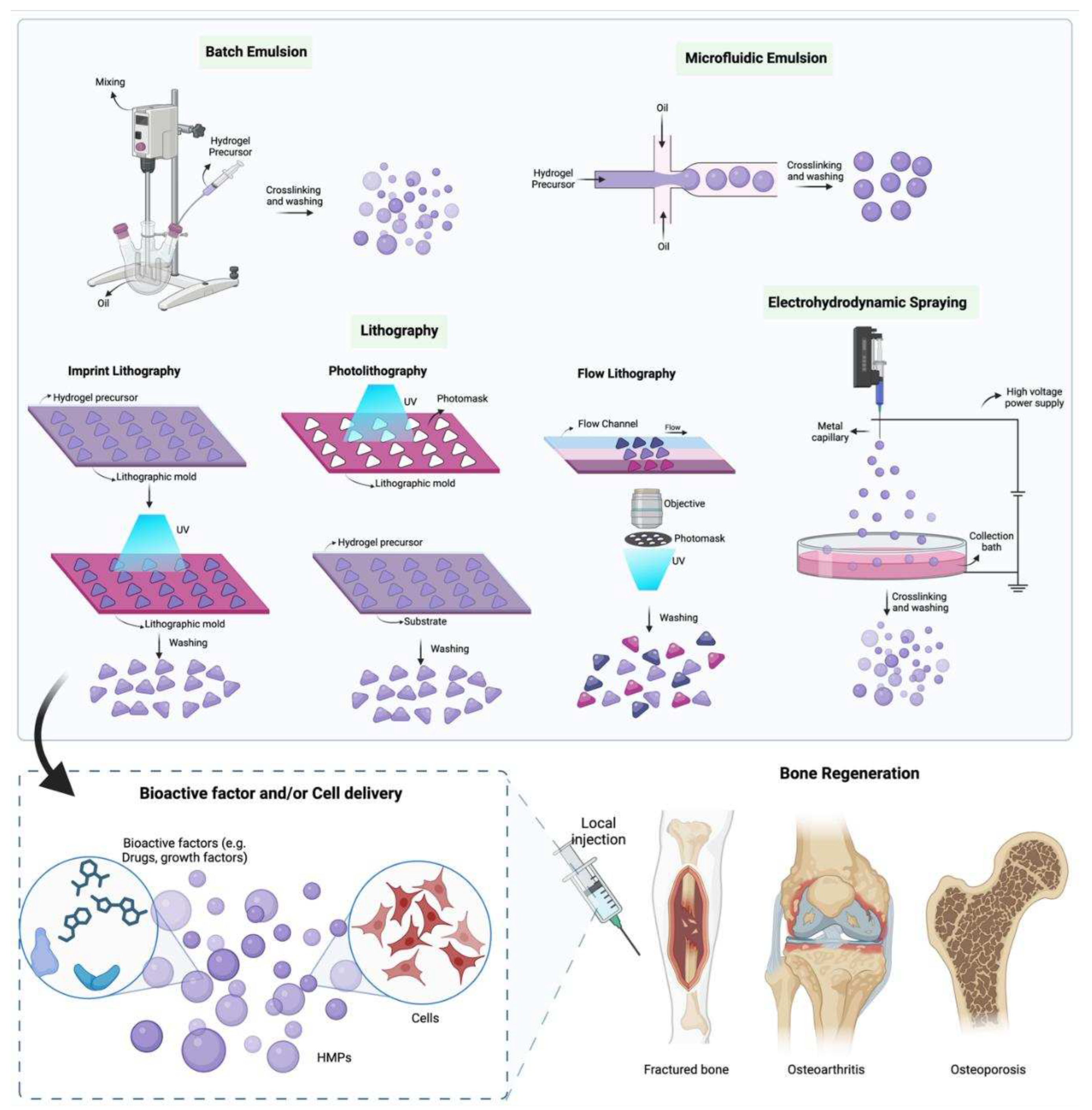
Disclaimer/Publisher’s Note: The statements, opinions and data contained in all publications are solely those of the individual author(s) and contributor(s) and not of MDPI and/or the editor(s). MDPI and/or the editor(s) disclaim responsibility for any injury to people or property resulting from any ideas, methods, instructions or products referred to in the content. |
© 2023 by the authors. Licensee MDPI, Basel, Switzerland. This article is an open access article distributed under the terms and conditions of the Creative Commons Attribution (CC BY) license (http://creativecommons.org/licenses/by/4.0/).
Copyright: This open access article is published under a Creative Commons CC BY 4.0 license, which permit the free download, distribution, and reuse, provided that the author and preprint are cited in any reuse.


