

Submitted:
24 November 2023
Posted:
28 November 2023
You are already at the latest version
Abstract
The study aimed to investigate the effect of climate change exposure on affect and pro-environmental behavioural intentions in a randomised controlled trial. An online survey was completed by 100 adult participants and included measures of affect and pro-environmental behavioural intentions pre- and post-exposure. Participants were randomly allocated to a group that saw a climate change video (n=55) or a group that saw a non-climate change video (n=45). The findings showed were that participants in the climate change group showed a significant increase in negative affect and pro-environmental behavioural intention scores post-video exposure compared to the non-climate change video group. This suggests that climate change video exposure negatively influences affect but also potentially increases the intention to act pro-environmentally. These findings have the potential to support policies and societal change, however further investigation into the type of contents, actual behaviour change, and impacts on diverse populations (e.g., minority groups) is needed that influences pro-environmental behaviours is required. Furthermore, to achieve a greater impact, future research should be conducted measuring actual pro-environmental behaviour change, including with those from diverse populations.
Keywords:
climate change
; positive and negative affect
; pro-environmental behavioural intentions
; climate anxiety
1. Introduction
Climate change is described as a global phenomenon resulting from an increasing population, unsustainable consumption, and ecological changes such as deforestation [1]. Increasing literature over the past two decades has highlighted how human activity has significantly altered global climate systems, with impacts such as rising ocean and surface temperatures and increasing greenhouse gases [2,3]. The World Health Organization in 2020 reported that climate change and the loss of biodiversity are increasingly affecting people's mental and physical health and well-being around the world. For example, higher sea levels result in floods causing injury and fatalities with certain social groups, such as those in developing countries being more vulnerable to the effects of climate change [2,4]. The effects of climate change are often portrayed in the media as being catastrophic in nature [5], with newspapers utilising visual information to provoke an emotional response from the viewer [6].
Despite increasing awareness and concern around such topics, people’s actions are inconsistent with their thoughts [7]. It is noted that emotional experiences such as anxiety, worry and fear are a result of the changing climate and affect thoughts, attitudes, and behaviours [4,8]. These negative emotional experiences can be more prevalent in those who value the natural world, and younger people due to the future projection of climate impacts [2,9,10].
In moderation, worry and anxiety are said to assist with adaptative responses to climate change such as climate action [8,11]. Climate anxiety is defined as ‘anxiety which is significantly related to anthropogenic climate change’ [12] [p. 3)]. However, the link between climate anxiety/worry and behaviour is unclear. For example, climate anxiety may inhibit people from taking effective action due to ‘eco paralysis’, which is a state of apathy characterised by excessive anxiety and helplessness or hopelessness [13,14]. In contrast, other research by Reser et al (2012) showed that climate change distress was a strong predictor for behavioural engagement [15,16]. The intention to act pro-environmentally is said to determine pro-environmental behaviour, but environmental knowledge and awareness are key components [17,18]. Earlier studies have contested that knowledge of climate change does not necessarily foster pro-environmental behaviour [19]. Lawrence et al (2021) highlight the current gap in research around the links between climate change and mental health, and the connections between climate change and mental well-being are at an early stage of development [20].
Data gathered from 32 different countries showed that climate anxiety has been positively linked to pro-environmental behaviours but negatively linked to mental health [21]. The findings showed that both direct and indirect experiences and exposure increased negative emotional responses, and impact-related information and the amount of attention paid to it predicted climate anxiety, not the volume of content. Furthermore, solution-related information was not significantly related to climate anxiety. In a sample of 312 Italian university students aged 18-26 years who reported multiple exposures to climate change-related content, attention was also found to be positively related to climate anxiety as well as individual and collective self-efficacy [11]. Self-efficacy is described as a person’s perceived confidence in their abilities to perform a behaviour, and perceived usefulness of that behaviour [22]. The findings from Maran and Begotti (2021) found that when attention paid to climate change increases, so do efficacy beliefs which may have been impacted by the content. Furthermore, Brulle et al (2012) found that media coverage directly affects public levels of concern over climate change, with greater coverage equating to greater concern [23].
Like Ogunbode et al (2022), several studies have reported how emotional responses to climate change can be caused by indirect as well as direct exposure, such as through media exposure [8,16,24]. Zacher and Rudolph (2023) found through a longitudinal study with German adults, that personality traits, conscientiousness and emotional stability were negative predictors of climate anxiety. The findings showed that the greater the knowledge of environmental issues the lower the climate anxiety. Women were also found to experience less climate anxiety compared to men [25]. Tilikidou (2007) did not find a strong correlation between environmental knowledge and pro-environmental purchasing behaviour among a sample of Greek consumers but did however acknowledge that lack of knowledge is a barrier to purchasing change [26].
Searle and Gow (2010) found females under the age of 35 who have pro-environmental beliefs and specific personality traits, such as higher levels of future anxiety are more prone to experience climate change-related distress [27]. Casalo et al., (2019) also found women exhibited higher levels of pro-environmental behaviours [28]. McBride et al (2021) examined longitudinal relations between climate change concern and psychological well-being in New Zealand adults and found that although younger people showed slightly higher levels of climate change concern, there was no evidence that young people are more negatively affected by climate change [29].
The Theory of Planned Behaviour (TPB) [30] and the Norm Activation Model (NAM) [31] are theoretical models that aim to explain intentional or planned behaviour. Nigbur et al., (2010) suggest that intention is in fact the closest predictor of behaviour, which the TPB also postulates [32,33]. The NAM was developed to explain pro-social behaviour. Schwartz (1977) proposed that activated personal normative influences or ‘personal norms lead to altruistic or pro-social behaviours. Personal norms are defined as an individual’s sense of obligation or an individual’s beliefs of what is right or wrong [34,35]. Studies have shown that the main determinants of the TPB such as attitudes and subjective norms were successful in predicting the intention to perform pro-environmental behaviours [36,37], however, self-identity was a key variable that determined behavioural intentions [33,38]. Self-identity is defined as how an individual sees themselves and includes values, personal goals, and personality traits [39]. Although the NAM has been successfully applied to pro-environmental behaviours such as littering behaviour and organic vegetable consumerism [35,40], it was less successful in behaviours deemed as ‘high cost’ such as reduction in car use [41,42].
Study Aim
To address these links between climate change information exposure, affect, pro-environmental behavioural intentions and behaviour, the current study was designed to investigate the effects that climate change video exposure had on affect and pro-environmental behavioural intentions. More specifically, the effects of increased knowledge and awareness of climate change on affect and behaviour. Affect and pro-environmental behavioural intentions were measured through self-reported questionnaires pre and post video exposure to a video on either climate change or non-climate change related information.
Independent variables (IV) were:
- Type of video content (climate change or non-climate change).
- Time (pre or baseline and post-intervention).
Dependent variables (DV) were:
- Positive and negative affect.
- Pro-environmental behavioural intentions.
It was hypothesised that (a) IV1 (video content) would significantly effect both DV1 (positive and negative affect) and DV2 (pro-environmental behavioural intentions) in the climate change group. (b) IV2 (time, pre and post exposure) would significantly effect DV1 and DV2 in the climate change group. (c) IV1 and IV2 combined would cause a significant interaction effect between DV1 and DV2 where the climate change video group would have a significantly higher negative affect and pro-environmental behaviour intention scores post-exposure compared to the non-climate change exposure group. Furthermore, there would also be a significantly lower positive affect score when compared to the control condition.
2. Materials and Methods
2.1. Participants and Recruitment
140 participants were initially recruited using opportunity sampling and were provided with an anonymous link or a QR code through Facebook, Instagram, Twitter, Linkedin and Reddit. The inclusion criteria were that participants are 18 years of age or over. Ethical approval was granted by the University of Derby (Number ETH2223-1342). Data Collection occurred between 25th of February 2023 until 1st of May 2023.
After the removal of incomplete responses on the survey platform due to the absence of a forced response option, 100 full responses were collected and used for analysis.
Ages ranged between 19 and 86 years old (Mean age=33.56, SD=14.53) with 71% of females, 25% of males, 2% prefer not to say, 1% non-binary and 1% transgender and non-binary. 56% of participants recorded their ethnicity as White British, 1% as any other ethnic group, 2% Asian British, 3% Chinese, 5% Indian, 1% Pakistani, 1% Black British, 3% Black African, 3% Mixed/White and Black Caribbean, 19% Other Asian and White background, 2% prefer not to say, 2% White Asian, and 2% White Irish. Compared to the general population in the UK, the survey was predominantly distributed to university students, however, the exact figures for university and non-university students were not captured. Other participants included friends and family members of the researcher. The sample consisted of a majority of white females. Please refer to Table 1 for specific baseline demographics of each group [43].
2.2. Measures
- Positive and Negative Affect (PANAS)
Positive and Negative Affect was measured using the PANAS [44] Positive and Negative Affect Scale). The scale consists of a total of 20 items, which further consists of two 10-item mood scales to measure two dimensions of mood: positive and negative affect. Participants are asked to rate to what extent they felt a feeling or emotion in the present moment such as ‘Interested’, ‘Proud’ or ‘Irritable’. The ratings were on a 5-point Likert scale with 1 being ‘very slightly or not at all’ and 5 being ‘extremely’.
The PANAS [47] is a reliable, valid and highly consistent measure, which is brief to complete. The Cronbach Alpha coefficient values range from .86 to .90 for Positive Effect and from .84 to .87 for Negative Effect. Higher scores in items representing a positive mood (e.g., Interested, alert, excited) indicate a positive affect and higher scores in items representing a negative mood (e.g., Upset, hostile, afraid) indicate a negative affect. Scores ranged from 10-50 [45].
- Scale Adaptation - Pro-environmental Behaviour Intentions (PEBI)
To assess behavioural intentions an adaptation was made to the existing Recurring Pro-environmental Behaviour scale or RPEBS [46], creating a new scale titled the Pro-environmental Behavioural Intentions scale (PEBI). The other scales that were reviewed and short-listed, including RPEBS measured environmental attitudes and behaviours instead of intentions and were not appropriate for a ‘before and after’ time measure design for this study. The PEBI was appropriate for gathering data at two immediate points in time, whereas the RPEBS [46] is applicable for longer time periods. The scale consists of a total of 21 items. Participants were asked to rate their intended behaviour and frequency instead of actual behaviour on a 5-point Likert scale with 1 being ‘Never’ and 5 being ‘Always’. Examples of item questions are, ‘When you visit the grocery store, how often do you intend to use reusable bags’ and ‘How often do you intend to eat meat’. The original RPEBS [46] has a Cronbach Alpha coefficient value range of .82 to .87 and is a reliable, valid and highly consistent measure. The current adapted scale showed good internal consistency with a Cronbach Alpha score of .812. Four items of the scale are reversed scored (4,6,7 and 14). A high total score indicates higher levels of engagement (or intended engagement) in pro-environmental behaviours.
2.3. Other Materials
Demographic data along with self-reported measures were collected through an online survey platform called Qualtrics. The participant was presented with demographic questions prior to completing scale data such as age, ethnicity, and gender. Ethnicity was asked to further describe the study sample.
Video content was accessible through the online video sharing and social media platform YouTube, which was embedded into Qualtrics. The videos were randomised through the Qualtrics randomiser feature titled "Randomly but evenly present elements”, which ensured a roughly even split of participants. The participants were then randomised into the experimental condition (climate change) or control condition (non-climate change). The climate change video was an animated infographic on the science behind human accelerated climate change, its effects on the planet, why action is required and how individuals can contribute to the solution. The non-climate change video was a documentary about the world’s most modern hotel and was chosen due to its potentially neutral affect and was unlikely to impact positive or negative affect.
2.4. Procedure
An anonymous link or QR code for Qualtrics was presented to participants along with an invitation to participate. Upon clicking the link or scanning the code, participants were presented with details about the study, confidentiality, and the right to withdraw. Participants were then asked to accept consent information. If consent was gained, the participant was presented with demographic questions followed by the PANAS [44] and the adapted RPEBS [46]. A YouTube video of either an 8.4-minute climate change-focused video or a 9.3-minute non-climate change-focused video was presented. After video viewing, participants were asked to repeat the completion of the PANAS [44] and adapted RPEBS [46]. De-brief information was then presented, which included contact information for support organisations due to the potential negative effects. Links were also provided about how participants can get involved in helping with climate change and positive psychology videos.
2.5. Statistical Analysis
The data was analysed using IBM SPSS Statistics Versions 27 software. The study was a 2x2 Factorial Mixed ANOVA design. The descriptive statistics such as the means and standard deviation (SD) of affect and intention scores for both groups pre- and post-video exposure were generated. IV1 was video content (climate change and non-climate change), and IV2 was time pre- and post-content exposure. DV1 was negative affect, DV2 was positive affect and DV3 was pro-environmental behaviour intentions. Three 2x2 Factorial Mixed ANOVA designs were conducted. The first ANOVA looked at differences in negative affect scores in climate change and non-climate change conditions pre- and post-exposure. The second ANOVA examined the differences between positive affect scores in both conditions pre- and post-exposure. Finally, the third ANOVA examined differences between pro-environmental behaviour intentions in both conditions pre- and post-exposure. The hypotheses were tested through the Factorial Mixed ANOVAs to assess significant differences between groups (video content type) and within each group (pre and post) on the three dependent variables. All p-values were considered significant if less than 0.05.
3. Results
3.1. Scale Reliability
Overall, the adapted RPEBS [46] initially appeared to have good internal consistency Cronbach Alpha coefficient (α = .802). However, one item had item-total correlation values below optimal (r < .2), suggesting it should be removed. Sequential removal of this item (item 4) improved the overall internal consistency of the scale (α = .812). The final 20 items correlated with the total scale to an acceptable degree (lowest r = .242).
3.2. Baseline Demographics
There was no significant baseline difference between the two groups in demographics, and dependent variables: negative and positive affect and pro-environmental behavioural intentions (p > .05). Please see Table 1 below.
All three data sets were screened to check the requirements for parametric assumptions.
3.3. Data Sets (1–3)
Data set 1:
There was no significant main effect of video content, with a small effect size, F(1, 98) = 3.391, p = .069, η2 = .030. However, there was a significant main effect of time (before and after), with a very small effect size, F(1, 98) = 5.166, p = .025, η2 = .003. There was also a significant interaction effect between video content and time (before and after), with a small effect size, F(1, 18) = 16.556, p = <.001, η2 = .012; the climate change group negative affect scores were higher post video content exposure, while the non-climate change group negative affect scores decreased post video content exposure (see Table 2). Please see (Figure 1) plot showing the mean for the four conditions and non-parallel lines that indicate an interaction effect [47].
Data set 2:
There was no significant main effect of video content, with a very small effect size, F(1, 98) = .287, p = .593, η2 = .003, and there was no significant main effect of time (before and after), with a very small effect size, F(1, 98) = 1.787, p = .184, η2 = .002. There was also no significant interaction effect between video content and time (before and after), with a very small effect size, F(1, 98) = .538, p = .465, η2 = .0006; the climate change group positive affect scores remained similar pre and post video content exposure, while the non-climate change group positive affect scores scored similar to the climate change group pre-video content, the scores decreased compared to the climate change content post video content exposure (see Table 3).
Data set 3:
There was a significant main effect of video content, with a medium effect size, F(1, 98) = 7.455, p = .008, η2 = .006, and a significant main effect of time (before and after), with a small effect size, F(1, 98) = 40.517, p = <.001, η2 = .005. There was also a significant interaction effect between video content and time (before and after), with a small effect size, F(1, 98) = 13.658, p = <.001, η2 = .02; the climate change group intention scores were higher post video content compared to pre-video content, whereas the non-climate change content group intention scores remained similar pre and post video content, scoring lower post video content compared to the climate change group (see Table 3). Please see (Figure 2) plot showing mean scores for the four conditions and non-parallel lines which indicate an interaction effect [47].

Table 3.
Mean pro-environmental behavioural intention scores for data set 3 before and after video exposure of climate change and non‐climate change content (with standard deviations).
Table 3.
Mean pro-environmental behavioural intention scores for data set 3 before and after video exposure of climate change and non‐climate change content (with standard deviations).
| Pro-environmental behavioural intention scores (pre) | Pro-environmental behavioural intention scores (post) | Total | |
|---|---|---|---|
| Climate change content | 63.82 (9.42) | 72.11 (12.52) | 67.96 (11.79) |
| Non-climate change content | 60.87 (11.94) | 63.07 (12.76) | 61.97 (12.34) |
| Total | 62.35 (10.68) | 67.59 (12.64) |
4. Discussion
The aims of the present study were to investigate the effects of climate change content exposure on affect, and pro-environmental behavioural intentions, specifically, whether increased awareness and knowledge influenced affect and behavioural intentions.
The main findings of the study suggest that climate change video content exposure and awareness do influence affect and pro-environmental behavioural intentions. The findings showed that there was a significant main effect of time on negative affect and pro-environmental behavioural intentions before and after participants were exposed to climate change information, therefore time before and after content exposure influenced both the negative affect and intention scores. More interestingly, there was a significant interaction effect between the condition and time on both pro-environmental behavioural intentions and negative affect scores. Specifically, participants in the climate change group showed a significant difference in scores post-video exposure compared to the non-climate change video group. This was a key finding as it suggests that climate change video exposure negatively influences affect but also potentially influences pro-environmental behavioural intentions. The significant results were mostly small or very small in effect size, therefore they do not explain the full variation and other factors such as gender and age need further study to establish causes of variation.
Consistent with research by Brulle et al., (2012), Clayton, (2020), Ogunbode et al (2022) and Stewart, (2021), the current study supports previous research on the effects of indirect climate change media exposure on negative emotional responses to climate change [8,16,21,23]. The current study exposed participants to a brief 8.4-minute video of climate change discussing the impacts and possible solutions that an individual can take to lessen the effects. The results of this video exposure showed increased negative affect post-exposure. The volume of content and its effect on the negative emotional responses requires more investigation. Previous research found that attention paid to the content rather than volume relates significantly to negative emotional responses. The current study did not collate frequencies of exposure, so it was unknown how much exposure the participants had prior to partaking in the study, however, it could be argued that the brief exposure in this study had an impact. It is difficult though to determine whether the current findings resulted in a combined effect of previous and current exposure.
Attention to content is emphasised by existing research around climate anxiety, and to a certain extent, the current study also verifies attention as a predictor of climate anxiety as per Ogunbode et al (2022) and Maran and Bergotti (2021). The findings could also lend some support to stimulated self-efficacy and eco-paralysis [11]. For example, the current study showed higher negative affect scores but also higher intentions to engage, which could support that increased attention also increases self-efficacy [48]. This may also indicate that the climate change content used in the study was appropriate for enhancing self-efficacy and in turn the motivation of pro-environmental behaviours [14].
The type of content that is linked to negative emotional responses remains somewhat unclear in the literature. Previous research on the type of content found impact-related information along with the amount of attention paid to it a predictor of climate anxiety [21], whereas solution-based information was not significantly related. Furthermore, other studies do not specify the type of content participants were exposed to [11]. The current findings partially contribute to previous findings as the video content contained both impact-related and solution-based content. However, it is uncertain how the impact and solution-based information as independent factors influenced the negative affect and intention scores.
One explanation of the current findings could be that young people, particularly females are more affected by a changing climate [2,9,10,27,29]. Furthermore, females are more likely to exhibit greater levels of pro-environmental behaviour [28,36]. The population sampled consisted of mainly adults under 35 with a mean age of 33, and it had previously been found that younger people, particularly young females showed higher levels of climate change anxiety and climate-related concern [27,29]. Similarly, with gender, the current sample consisted of 71% of females so it could be said that this influenced the intended behaviour scores post-exposure. Hence it was difficult to decipher how much influence age and gender had on these findings. Furthermore, the study did not officially measure climate anxiety but positive and negative affect therefore the different scales may have yielded different results [49].
In relation to knowledge and awareness of climate-related issues on mental health and behaviour, previous literature described the inconsistencies around climate concerns, awareness, and action [7]. The current study attempted to provide knowledge and awareness of climate change effects, which showed an increase in intentions to behave pro-environmentally. In contrast to Zacher and Rudolph (2023), the current findings of higher negative affect and pro-environmental behavioural intentions suggest that greater environmental knowledge increases negative emotional responses instead of decreases. It could be argued however that Zacher and Rudolph’s (2023) study was longitudinal and utilised environmental test score data, which the current study did not. The increase in environmental awareness appears to be an appropriate predictor of pro-environmental behaviours through the increase in pro-environmental intention scores [50], and support for significant links between problem awareness and intentions to engage in pro-environmental behaviours, in turn predicting the likelihood of pro-environmental behaviour [28,35,36]. The relationship between intention and behaviour is complex, and much of the past research on behaviours and intentions found that whether a behaviour is carried out is due to an individual’s perceptions of themselves and others, which is subjective. These include a person’s individual sense of moral obligation [40], or self-identity [33,38,41]. This makes it particularly difficult to pinpoint the cause and effect of behaviour.
It is acknowledged that behaviour was not measured in the current study, however, a 6–12-month follow-up study should be conducted utilising the RPEBS [46] and the subjective variables further explored. This would assess the validity and reliability of the new PEBI by establishing if the intended behaviours were carried out and establish whether the intentions to behave remain over an extended period.
There are several limitations to the study, firstly, the validity and reliability of the adapted PEBI scale require assessment. Moreover, self-report measures are susceptible of response biases [51]. The study consisted of a predominantly white British, female sample, therefore more investigation is needed into the experiences of non-white samples, other genders and those from developing countries and different cultures [52,53]. The use of opportunity sampling may have limited the generalisability of the findings in the study, hence the sample representation may not be representative of the general population [43]. Due to the study being solely online, the environment where the study was conducted was not controlled [54]. Hence, distractions when watching the video content were not accounted for. Intervention contamination was not examined. In addition, the limited time frame for climate change exposure made it difficult to assess how much effect 8-9 minutes of video exposure had on participants. Furthermore, a measure relating to existing knowledge of environmental issues as implemented by Zacher and Rudolph (2023), would have been useful in drawing conclusions about its relation to emotions and pro-environmental behaviour. Much of the literature focused on climate anxiety, therefore in retrospect, it would have been useful to have measured climate anxiety specifically as a separate variable, perhaps in addition to the PANAS [44]. The strength of the study was that the study was somewhat able to contribute to the links and gaps between mental health and climate change highlighted by Lawrance et al., (2021) and Romeu (2021), by showing the effects of climate change information on negative affect [55]. The intervention was relatively simple, and due to it being solely online, could be completed anywhere in the world with internet access and language provisions. Furthermore, it helps inform digital health tool research, which currently has a big emphasis in the mental health and education field [53].
In addition to the follow-up study, future research should investigate the type of content that influences negative emotional responses and behaviours; this could provide a clearer explanation of self-efficacy and how content relates to both maladaptive and adaptive forms of climate anxiety. In relation to knowledge and awareness, as recently suggested by Innocenti et al (2023) and Casalo et al (2019), it may be wise to create education programmes to enhance public knowledge about environmental issues as it may foster pro-environmental behaviours [56]. Furthermore, sample data from developing countries and different cultural groups is needed to maximize the global impact.
5. Conclusions
This study investigated the effects of climate change content exposure on affect, and pro-environmental behavioural intentions (PEBI), specifically, whether increased awareness and knowledge influenced affect and behavioural intentions. Specifically, this contributes to existing literature, and gaps around climate change information awareness and positive and negative affect. The present results provide additional insights into the complexities between negative emotional responses, pro-environmental behavioural intentions, and climate change video content exposure. The main findings from the present study appear to show that climate change exposure and awareness do influence affect and pro-environmental behavioural intentions. The results are mainly consistent with previous research, regarding climate change video content exposure, negative emotional responses and predicted behavioural intentions. However, subsequent research is required on how the type of content exposure impacts behaviour. As the current study consisted of participants from developed countries, future research should aim to recruit participants from developing countries to expand knowledge on the topic. Furthermore, a follow-up study would validate the efficacy of the new PEBI scale and establish if the intentions measured were manifested into behaviours.
Supplementary Materials
The following supporting information can be downloaded at the website of this paper posted on Preprints.org. Video S1: Climate Change – We are the PROBLEM & the SOLUTION (Animated Infographic) - YouTube; Video S2: World’s Most Modern Hotel | Doc Bites – YouTube.
Author Contributions
S.G: Conceptualization, methodology development, data curation, formal analysis, writing original draft and rewriting. C.H: Conceptualisation, methodology development, supervision, writing review and editing. Y.K: Writing – review and editing. All authors have read and agreed to the published version of the manuscript.
Funding
This research received no external funding.
Institutional Review Board Statement
This study received ethical approval from the University of Derby.
Informed Consent Statement
All participants gave informed consent to participate in the research with the knowledge that the data collected may lead to pub-lication and public dissemination of findings.
Data Availability Statement
Participants did not give permission for original data to be shared beyond the research team, hence data is not available.
Acknowledgements
The authors would like to thank the participants of this research.
Conflicts of Interest
The authors declare no conflict of interest.
Appendix A
- Scale 1: Recurring Pro-environmental Behaviour Scale (adapted PEBI version)
The participants were asked to rate intended behaviour (what behaviour they intend to carry out and how often this occurs). and frequency on a 5-point Likert scale with 1 being ‘Never’, 2, ‘Rarely’, 3, ‘Sometimes’, 4, ‘Often’ and 5 being ‘Always’.
The list of the 21 items are as follows:
- When you visit the grocery store, how often do you intend to use reusable bags?
- How often do you intend to walk, bicycle, carpool or take public transportation instead of driving a vehicle by yourself?
- How often do you intend to drive slower than 60mph on the highway?
- How often do you intend to go on personal travel (non-business) air travel?
- How often do you intend to compost your household food garbage?
- How often do you intend to eat meat?
- How often do you intend to eat dairy products such as milk, cheese, eggs, or yoghurt?
- How often do you intend to eat organic food?
- How often do you intend to eat local food?
- How often do you intend to eat a home vegetable garden (during the growing season)?
- How often do you intend to turn your personal electronics off or in low-power mode when not in use?
- When you buy light bulbs, how often do you intend to buy high-efficiency compact fluorescent (CFL) or LED bulbs?
- How often do you intend to act to conserve water, when showering, cleaning clothes, dishes, watering plants, or other uses?
- How often do you intend to use aerosol products?
- When you are in PUBLIC, how often do you intend to sort trash into recycling?
- When you are in PRIVATE, how often do you intend to sort trash into the recycling?
- How often do you intend to discuss environmental topics, either in person or with online posts (Facebook, Twitter, etc.)?
- When you buy clothing, how often do you intend it to be from environmentally friendly brands?
- How often do you intend to carry a reusable water bottle?
- How often do you intend to engage in political action or activism related to protecting the environment?
- How often do you intend to educate yourself about the environment?
References
- Spence, A., Pidgeon, N., & Uzzell, D. Climate change—Psychology’s contribution. Psychologist. 2009, 22, 108–111.
- Lawrance, D. E., Thompson, R., Fontana, G., & Jennings, D. N. The impact of climate change on mental health and emotional wellbeing: Current evidence and implications for policy and practice. 2021, 36, 36. [CrossRef]
- Wachholz, S., Artz, N., & Chene, D. Warming to the idea: University students’ knowledge and attitudes about climate change. Int Journal of Sustainability in Higher Ed. 2014, 15, 128–141. [CrossRef]
- World Health Organization. WHO global strategy on health, environment and climate change: the transformation needed to improve lives and wellbeing sustainably through healthy environments. 2020. Retrieved 21 April 2023, from https://apps.who.int/iris/bitstream/handle/10665/331959/9789240000377-eng.pdf.
- Reser, J. P., & Swim, J. K. Adapting to and coping with the threat and impacts of climate change. American Psych. 2011, 66, 277–289. [CrossRef]
- Smith, N. W., & Joffe, H. Climate change in the British press: The role of the visual. Journal of Risk Research. 2009, 12, 647–663. [CrossRef]
- Barbett, L., Stupple, E., Sweet, M., Schofield, M., & Richardson, M. Measuring Actions for Nature—Development and Validation of a Pro-Nature Conservation Behaviour Scale. Sustainability. 2020, 12, 4885. [CrossRef]
- Stewart, A. E. Psychometric Properties of the Climate Change Worry Scale. Int Journal of Environ Research and Pub Health. 2021, 18, 494. [CrossRef]
- Hogg, T. L., Stanley, S. K., O’Brien, L. V., Wilson, M. S., & Watsford, C. R. The Hogg Eco-Anxiety Scale: Development and validation of a multidimensional scale. Global Environ Change. 2021, 71, 102391. [CrossRef]
- Ojala, M. Hope and climate change: The importance of hope for environmental engagement among young people. Environ Ed Research. 2012, 18, 625–642. [CrossRef]
- Maran, D. A., & Begotti, T. Media Exposure to Climate Change, Anxiety, and Efficacy Beliefs in a Sample of Italian University Students. Int Journal of Environ Research and Pub Health 2021, 18, 9358. [CrossRef]
- Clayton, S., & Karazsia, B. T. Development and validation of a measure of climate change anxiety. Journal of Environ Psych. 2020, 69, 101434. [CrossRef]
- Albrecht, G. Chronic environmental change: Emerging ‘psychoterratic’syndromes. Climate Change and Human Well-Being: Global Challenges and Opportunities. Springer: New York, NY, USA, 2011; pp. 43–56. 2011, pp. 43–56.
- Innocenti, M., Santarelli, G., Lombardi, G. S., Ciabini, L., Zjalic, D., Di Russo, M., & Cadeddu, C. How Can Climate Change Anxiety Induce Both Pro-Environmental Behaviours and Eco-Paralysis? The Mediating Role of General Self-Efficacy. Int Journal of Environ Research and Pub Health. 2023, 20, Article 4. [CrossRef]
- Reser, J. P., Bradley, G. L., Glendon, A. I., Ellul, M. C., & Callaghan, R. Public risk perceptions, understandings and responses to climate change and natural disasters in Australia, 2010 and 2011. 2012. National Climate Change Adaptation Research Facility Gold Coast. 2012. Retrieved 3 October 2023, from https://www.unisdr.org/preventionweb/files/30470_finalreportreserpublicriskperceptio.pdf.
- Clayton, S. Climate anxiety: Psychological responses to climate change. Journal of Anxiety Dis. 2020, 74, 102263. [CrossRef]
- Arlt, D., Hoppe, I., & Wolling, J. Climate change and media usage: Effects on problem awareness and behavioural intentions. Int Comm Gazette. 2011, 73, 45–63. [CrossRef]
- Kaiser, F. G., Wölfing, S., & Fuhrer, U. Environmental attitude and ecological behaviour. Journal of environ psych. 1999, 19, 1-19. [CrossRef]
- Diekmann, A., & Preisendörfer, P. Environmental behavior: Discrepancies between aspirations and reality. Rationality and Soc. 1998, 10, 79–102. [CrossRef]
- Romeu, D. Is climate change a mental health crisis? BJPsych Bulletin. 2021, 45, 243–245. [CrossRef]
- Ogunbode, C. A., Doran, R., Hanss, D., Ojala, M., Salmela-Aro, K., van den Broek, K. L., Bhullar, N., Aquino, S. D., Marot, T., Schermer, J. A., Wlodarczyk, A., Lu, S., Jiang, F., Maran, D. A., Yadav, R., Ardi, R., Chegeni, R., Ghanbarian, E., Zand, S., … Karasu, M. Climate anxiety, wellbeing and pro-environmental action: Correlates of negative emotional responses to climate change in 32 countries. Journal of Environ Psych. 2022, 84, 101887. [CrossRef]
- Schunk, D. H., & DiBenedetto, M. K. Learning from a social cognitive theory perspective. In International Encyclopedia of Education, 4th ed.; R. J. Tierney, F. Rizvi, & K. Ercikan Eds., Elsevier, Oxford, UK, 2023; pp. 22–35. [CrossRef]
- Brulle, R. J., Carmichael, J., & Jenkins, J. C. Shifting public opinion on climate change: An empirical assessment of factors influencing concern over climate change in the U.S., 2002–2010. Climatic Change. 2012, 114, 169–188. [CrossRef]
- Harth, N. S. Affect, (group-based) emotions, and climate change action. Current Opinion in Psych. 2021, 42, 140–144. [CrossRef]
- Zacher, H., & Rudolph, C. W. Environmental knowledge is inversely associated with climate change anxiety. Climatic Change. 2023, 176, 32. [CrossRef]
- Tilikidou, I. The effects of knowledge and attitudes upon Greeks’ pro-environmental purchasing behaviour. Corporate Soc Respons and Environ Man. 2007, 14, 121–134. [CrossRef]
- Searle, K., & Gow, K. Do concerns about climate change lead to distress? International Journal of Climate Change Strat and Man. 2010, 2, 362–379. [CrossRef]
- Casaló, L. V., Escario, J.-J., & Rodriguez-Sanchez, C. Analyzing differences between different types of pro-environmental behaviors: Do attitude intensity and type of knowledge matter? Resources, Conservation and Recycling. 2019, 149, 56–64. [CrossRef]
- McBride, S. E. , Hammond, M. D., Sibley, C. G., & Milfont, T. L. Longitudinal relations between climate change concern and psychological wellbeing. Journal of Environ Psych. 2021, 78, 101713. [Google Scholar] [CrossRef]
- Ajzen, I. The theory of planned behavior. Organizational Behavior and Human Decision Processes. 1991, 50, 179–211. [Google Scholar] [CrossRef]
- Schwartz, S. H. Normative influences on altruism. In Adv in exp soc psych, Academic Press: 1977; pp. 221-279. [CrossRef]
- Nigbur, D. , Lyons, E., & Uzzell, D. Attitudes, norms, identity and environmental behaviour: Using an expanded theory of planned behaviour to predict participation in a kerbside recycling programme. British Journal of Soc Psych. 2010, 49, 259–284. [Google Scholar] [CrossRef]
- Fielding, K. S. , McDonald, R., & Louis, W. R. Theory of planned behaviour, identity and intentions to engage in environmental activism. Journal of Environ Psych. 2008, 28, 318–326. [Google Scholar] [CrossRef]
- Kaiser, F. , Hübner, G., & Bogner, F. Contrasting the Theory of Planned Behavior With the Value-Belief-Norm Model in Explaining Conservation Behavior. Journal of Applied Soc Psych. 2006, 35, 2150–2170. [CrossRef]
- Faletar, I. , Kovačić, D., & Cerjak, M. Purchase of organic vegetables as a form of pro-environmental behaviour: Application of norm activation theory. Journal of Central Euro Agri. 2021, 22, 211–225, Scopus. [Google Scholar] [CrossRef]
- Echegaray, F. , & Hansstein, F. V. Assessing the intention-behavior gap in electronic waste recycling: The case of Brazil. Journal of Cleaner Prod. 2017, 142, 180–190. [Google Scholar] [CrossRef]
- Yuriev, A. , Boiral, O., & Guillaumie, L. Evaluating determinants of employees’ pro-environmental behavioral intentions. Int Journal of Manpower. 2020, 41, 1005–1019. [Google Scholar] [CrossRef]
- van der Werff, E. , Steg, L., & Keizer, K. The value of environmental self-identity: The relationship between biospheric values, environmental self-identity and environmental preferences, intentions and behaviour. Journal of Environ Psych. 2013, 34, 55–63. [Google Scholar] [CrossRef]
- Gatersleben, B. , Murtagh, N., & Abrahamse, W. Values, identity and pro-environmental behaviour. Contemp Soc Sci. 2014, 9, 374–392. [Google Scholar] [CrossRef]
- de Kort, Y. A. W. , McCalley, L. T., & Midden, C. J. H. Persuasive Trash Cans: Activation of Littering Norms by Design. Environ and Beh. 2008, 40, 870–891. [Google Scholar] [CrossRef]
- Bamberg, S. , & Schmidt, P. Incentives, Morality, Or Habit? Predicting Students’ Car Use for University Routes With the Models of Ajzen, Schwartz, and Triandis. Environ and Beh. 2003, 35, 264–285. [Google Scholar] [CrossRef]
- Steg, L. , & Vlek, C. Encouraging pro-environmental behaviour: An integrative review and research agenda. Journal of Environ Psych. 2009, 29, 309–317. [Google Scholar] [CrossRef]
- Kotera, Y. , Adhikari, P., & Sheffield, D. Mental health of UK hospitality workers: Shame, self-criticism and self-reassurance. The Service Industries Journal. 2019, 41, 1076–1096. [Google Scholar] [CrossRef]
- Watson, D. , Clark, L. A., & Tellegen, A. Development and validation of brief measures of positive and negative affect: the PANAS scales. Journal of personality and soc psych 1988, 54, 1063. [CrossRef]
- Crawford, J. R. , & Henry, J. D. The Positive and Negative Affect Schedule (PANAS): Construct validity, measurement properties and normative data in a large non-clinical sample. British Journal of Clin Psych. 2004, 43, 245–265. [Google Scholar] [CrossRef]
- Brick, C. , Sherman, D. K., & Kim, H. S. “Green to be seen” and “brown to keep down”: Visibility moderates the effect of identity on pro-environmental behavior. Journal of Environ Psych. 2017, 51, 226–238. [Google Scholar] [CrossRef]
- Clark-Carter, D. Quantitative psychological research: The complete student’s companion. Taylor & Francis Group: London, UK, 2018.
- Kotera, Y., Mayer, C.-H., & Vanderheiden, E. Cross-Cultural Comparison of Mental Health Between German and South African Employees: Shame, Self-Compassion, Work Engagement, and Work Motivation. Frontiers in Psych. 2021, 12. https://www.frontiersin.org/articles/10.3389/fpsyg.2021.627851.
- Kotera, Y. , Richardson, M., & Sheffield, D. Effects of Shinrin-Yoku (Forest Bathing) and Nature Therapy on Mental Health: A Systematic Review and Meta-analysis. Int Journal of Mental Health and Addic. 2022, 20, 337–361. [Google Scholar] [CrossRef]
- Verplanken, B. , Marks, E., & Dobromir, A. I. On the nature of eco-anxiety: How constructive or unconstructive is habitual worry about global warming? Journal of Environ Psych. 2020, 72, 101528. [Google Scholar] [CrossRef]
- 54. Kotera, Y., Van Laethem, M., & Ohshima, R. Cross-cultural comparison of mental health between Japanese and Dutch workers: Relationships with mental health shame, self-compassion, work engagement and motivation. Cross Cultural & Strategic Management. 2020, 27, 511–530. [Google Scholar] [CrossRef]
- Kotera, Y., Kirkman, A., Beaumont, J., Komorowska, M. A., Such, E., Kaneda, Y., & Rushforth, A. Self-Compassion during COVID-19 in Non-WEIRD Countries: A Narrative Review. Healthcare. 2023, 11, Article 14. [CrossRef]
- Kotera, Y. , Taylor, E., Brooks-Ucheaga, M., & Edwards, A.-M. Need for a tool to inform cultural adaptation in mental health interventions. Int Journal of Beh Develop 2023, pp. 2–5.
- Kotera, Y. , Chircop, J., Hutchinson, L., Rhodes, C., Green, P., Jones, R.-M., Kaluzeviciute, G., & Garip, G. Loneliness in online students with disabilities: Qualitative investigation for experience, understanding and solutions. Int Journal of Edu Tech in Higher Edu. 2021, 18, 64. [Google Scholar] [CrossRef]
- Kotera, Y. , Rennick-Egglestone, S., Ng, F., Llewellyn-Beardsley, J., Ali, Y., Newby, C., Fox, C., Slade, E., Bradstreet, S., Harrison, J., Franklin, D., Todowede, O., & Slade, M. Assessing Diversity and Inclusivity is the Next Frontier in Mental Health Recovery Narrative Research and Practice. JMIR Mental Health. 2023, 10, e44601. [Google Scholar] [CrossRef]
- Kotera, Y. , Rawson, R., Okere, U., Brooks-Ucheaga, M., Williams, A., Chircop, J., Lyte, G., Spink, R., & Green, P. Teaching sustainability to online healthcare students: A viewpoint. Int Journal of Higher Ed and Sust. 2022, 4, 38–48. [Google Scholar] [CrossRef]
Figure 1.
Mean scores and interation effects pre and post intervention for negative affect (data set 1).
Figure 1.
Mean scores and interation effects pre and post intervention for negative affect (data set 1).
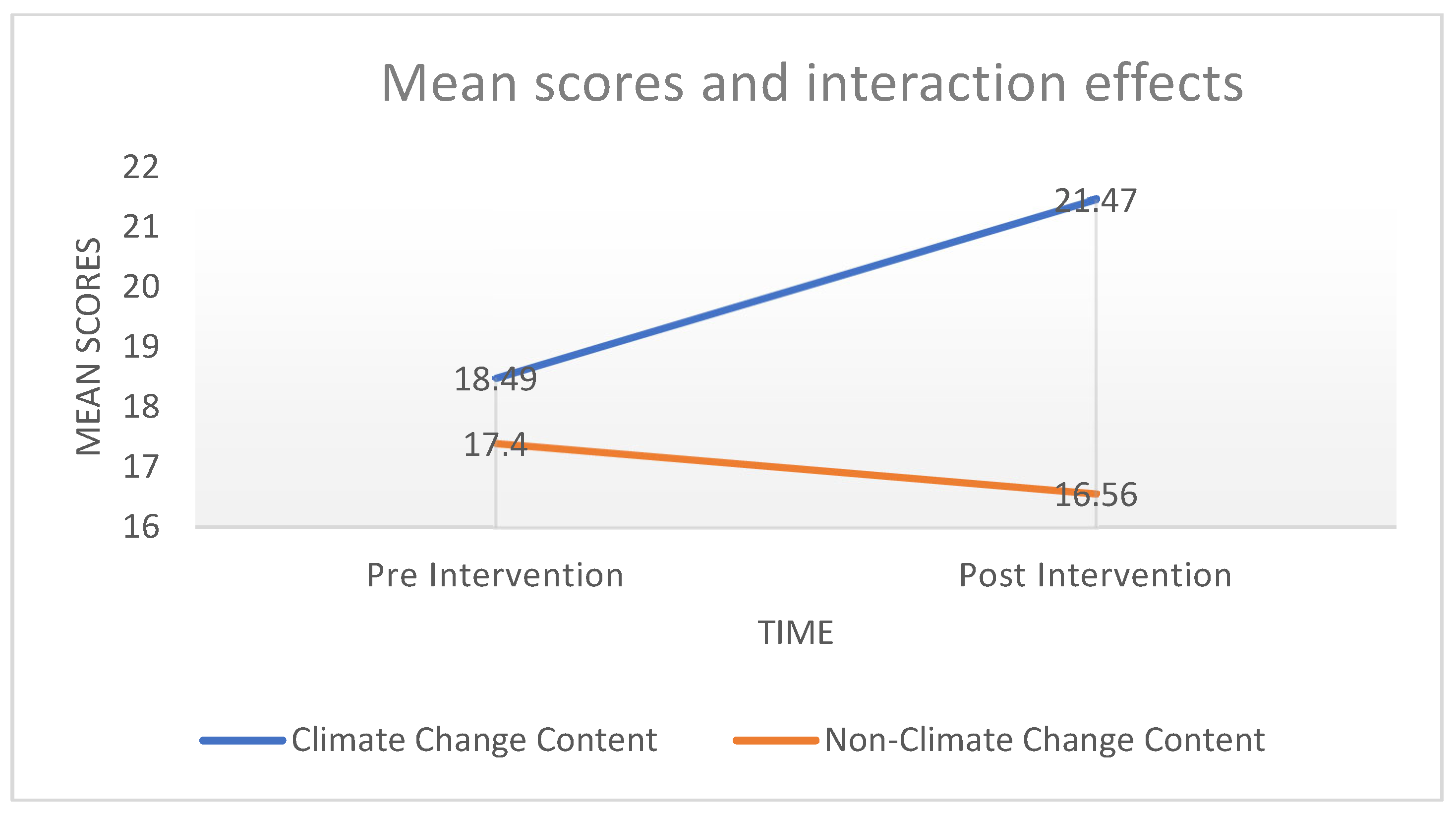
Figure 2.
Mean scores and interation effects pre and post intervention for pro-environmental intentions (data set 3).
Figure 2.
Mean scores and interation effects pre and post intervention for pro-environmental intentions (data set 3).
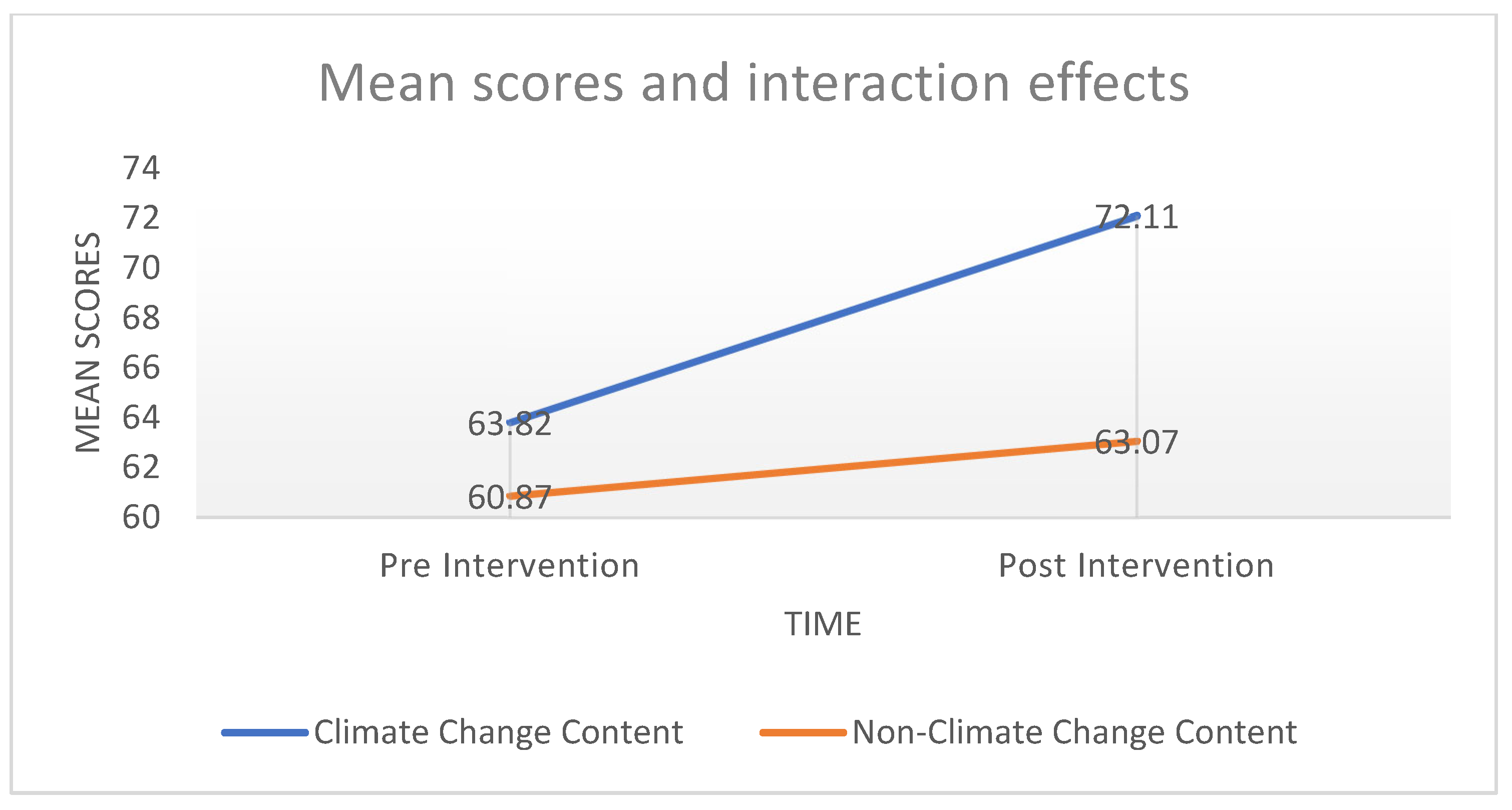
Table 1.
Baseline demographic characteristics.
| Climate Change Exposure group (n=55) | Control group (n=45) | ||
|---|---|---|---|
| Participants characteristics | |||
| Sex | |||
| Male | 14 (25.45%) | 11 (24.44%) | |
| Female | 39 (70.91%) | 32 (71.11%) | |
| Prefer not to say | 1 (1.82%) | 1 (2.22%) | |
| Non-binary | 1 (2.22%) | ||
| Transgender and non-binary | 1 (1.82%) | ||
| Ethnicity | |||
| White | 39 (70.91%) | 34 (75.56%) | |
| Non-white | 16 (29.09%) | 11 (24.44%) | |
| Age (years) | 33.62 (14.84) | 33.48 (14.53) | |
| Participant-rated outcome scores (Baseline) | |||
| PANAS (n=100) | |||
| Negative affect | 18.49 (8.18) | 17.40 (7.94) | |
| Positive affect | 27.55 (8.49) | 27.06 (10.03) | |
| PEBI (n=100) | |||
| Intentions | 63.82 (9.42) | 60.87 (11.94) |
Data are percentage (%) or mean (SD). PANAS= Positive and Negative Affect Scale, PEBI= Pro-Environmental Behavioural Intentions.
Table 2.
Mean negative affect scores for data screening 1 before and after video exposure of climate change and non-climate change content (with standard deviations).
Table 2.
Mean negative affect scores for data screening 1 before and after video exposure of climate change and non-climate change content (with standard deviations).
| Negative affect scores (pre) | Negative affect scores (post) | Total | |
|---|---|---|---|
| Climate change content | 18.49 (8.18) | 21.47 (9.14) | 19.98 (8.77) |
| Non-climate change content | 17.40 (7.94) | 16.56 (8.37) | 16.98 (8.12) |
| Total | 17.95 (8.06) | 19.02 (8.76) |
Table 3.
Mean positive affect scores for data screening 2 before and after video exposure of climate change and non-climate change content (with standard deviations).
Table 3.
Mean positive affect scores for data screening 2 before and after video exposure of climate change and non-climate change content (with standard deviations).
| Positive affect scores (pre) | Positive affect scores (post) | Total | |
|---|---|---|---|
| Climate change content | 27.55 (8.49) | 27.16 (8.21) | 27. 35 (8.32) |
| Non-climate change content | 27.06 (10.03) | 25.76 (10.69) | 26.41 (10.33) |
| Total | 27.31 (9.26) | 26.46 (9.45) |
Disclaimer/Publisher’s Note: The statements, opinions and data contained in all publications are solely those of the individual author(s) and contributor(s) and not of MDPI and/or the editor(s). MDPI and/or the editor(s) disclaim responsibility for any injury to people or property resulting from any ideas, methods, instructions or products referred to in the content. |
© 2023 by the authors. Licensee MDPI, Basel, Switzerland. This article is an open access article distributed under the terms and conditions of the Creative Commons Attribution (CC BY) license (http://creativecommons.org/licenses/by/4.0/).
Copyright: This open access article is published under a Creative Commons CC BY 4.0 license, which permit the free download, distribution, and reuse, provided that the author and preprint are cited in any reuse.


