

Submitted:
17 November 2023
Posted:
20 November 2023
You are already at the latest version
Abstract
Air pollution has been a major environmental issue worldwide from the last few decades. It is a man-made issue that has a serious harmful impact on the environment and the health of humans. There are different sources of emission, but industrial processes and motor vehicles contribute to a chief part of air pollution. It has acute as well as chronic effects on the health of humans and affects different organs. It is thought the main environmental risk factor in the incidence and progression of several diseases such as lung cancer, asthma, Alzheimer's and Parkinson's diseases. Long-term exposure to air pollution has different toxicological impacts on humans such as respiratory and cardiovascular diseases, neuropsychiatric complications, eye irritation and skin diseases. As per the study by the World Health Organization (WHO), nitrogen oxides (NOx), carbon monoxide (CO), ozone (O3), sulfur dioxide (SO2), volatile organic compounds (VOCs) and heavy metals are the major air contaminants. These pollutants are different in their properties, composition and time of disintegration. The aim of this study is to review the different sources, types, impacts, challenges and mitigation of air pollution in detail.
Keywords:
Air pollution
; Human health
; Environment
; Carbon monoxide (CO)
; Sulfur dioxide (SO2)
; Nitrogen oxides (NOx)
; Ozone (O3)
; Volatile organic compounds (VOCs)
1. Introduction
Air pollution refers to the existence of detrimental elements in the air that can be harmful to the environment and the health of humans. These elements are known as air contaminants. Air pollution can be either natural or man-made (Bhardwaj and Vikram, 2023). It may exist in gas, solid and liquid (Chambers, 2013). It can be categorized based on the sources and the nature of the pollutants involved. It is the major cause of climate change (Bhardwaj, 2023). It originates in one nation, but its impact may be felt in other nations. It is a severe and pervasive issue that impact the environment, public health and economy. Rapid urbanization has contributed to increased air pollution, particularly in developing countries where industrial growth and higher populations have let to elevated emissions from transportation, industries and energy consumption (Liang et. al., 2019).
There are various types of air contaminants that originate from different sources and have different impacts on human health and the environment. These contaminants can be categorized into criteria and non-criteria (Grifin, 2007). Criteria contaminants are those contaminants whose concentration limit has been set between poor or acceptable air quality such as NOx, PM10, benzene, SO2, lead (Pb), O3 and CO. While non-criteria contaminants are those contaminants that are designated as toxic substances by the authority. The concentration of air contaminants is increasing with the increasing of populations and urbanization (Andrew, 2014). Some air contaminants are as follows:
- (i)
- Particulate matter (PM10 and PM2.5): They are tiny particles suspended in the air. They can be liquid or solid. They can be natural (dust and pollen) or human-made (smoke and soot). They arise from various sources such as vehicle exhausts, industrial processes and natural activities. They are classified based on size (PM2.5 and PM10). PM2.5 includes fine particles of 2.5 micrometers or smaller while PM10 includes coarse particles with a diameter of 10 micrometers. They can enter into the lungs and bloodstream.
- (ii)
- Nitrogenous oxides (NOx): They are emitted primarily from vehicles, power plants and industrial activities. They contribute to the formation of smog and acid rain and impact respiratory health. They contribute to the development of ground-level O3 and particulate matter.
- (iii)
- Sulfur dioxide (SO2): This gas is mainly released by industrial processes and burning fossil fuels. It can react with other mixtures in the atmosphere to form fine particles and secondary pollutants. It can lead to respiratory issues and acid rain.
- (iv)
- Volatile organic compounds (VOC s): These organic chemicals are released from various sources like vehicle emissions and industrial processes such as paints, varnishes carpets, etc. They can contribute to the development of ground-level ozone and smog. They can cause respiratory difficulties.
- (v)
- Carbon monoxide (CO): It is an odourless and colourless gas and emitted by the incomplete burning of carbon-containing fuels. The main causes of CO include industrial processes and vehicle emissions. It can be deadly in high concentrations, as it hinders the blood’s capacity to transport oxygen (O2).
- (vi)
- Ozone (O3): Ground-level O3 is a secondary contaminant formed by the reaction of VOCs and NOx in the presence of sunlight. High concentrations of O3 can cause respiratory issues and other health problems.
- (vii)
- Heavy metals: Metals like Pb, mercury (Hg) and cadmium (Cd) are emitted into the air through various industrial processes such as Pb battery manufacturing, mining and coal-fired power plants (Alam et. al., 2023). These metals can be harmful even in trace amounts, when inhaled or ingested (Bhardwaj and Sharma, 2021; Bhardwaj et.al., 2023). Pb exposure can cause adverse health effects, particularly in children. Hg can accumulate in the environment and pose health risks, particularly to neurological health.
- (viii)
- Persistent organic pollutants (POPs): These are toxic and volatile chemicals that stay in the environment for a long time (Bhardwaj et. al., 2018). They can bioaccumulate in living organisms and can have long-term impacts on human health and the environment. They include substances like dioxins and polychlorinated biphenyls (PCBs).
- (ix)
- Ammonia (NH3): It is released from agricultural activities such as fertilizer application and livestock waste. It contributes to the development of fine particulate matter and can damage ecosystems.
Air pollution was first reported in the 13th century in London. As per the report of the Clean Air Act (CAA), there are two categories of air quality standards. The primary standard has the standard limits of pollutants for the protection of the health of the children and community while the secondary standard has the standard limits of pollutants to protection against crops, buildings and vegetation. Smeets (1982) stated that the European Commission (EC) has set the air quality standard in 1980 for suspended particulates and SO2. Grambsch (2001) stated that the United States Environmental Protection Agency (USEPA) has set the air quality standard for O3, CO, NOx, Pb and particulate matter.
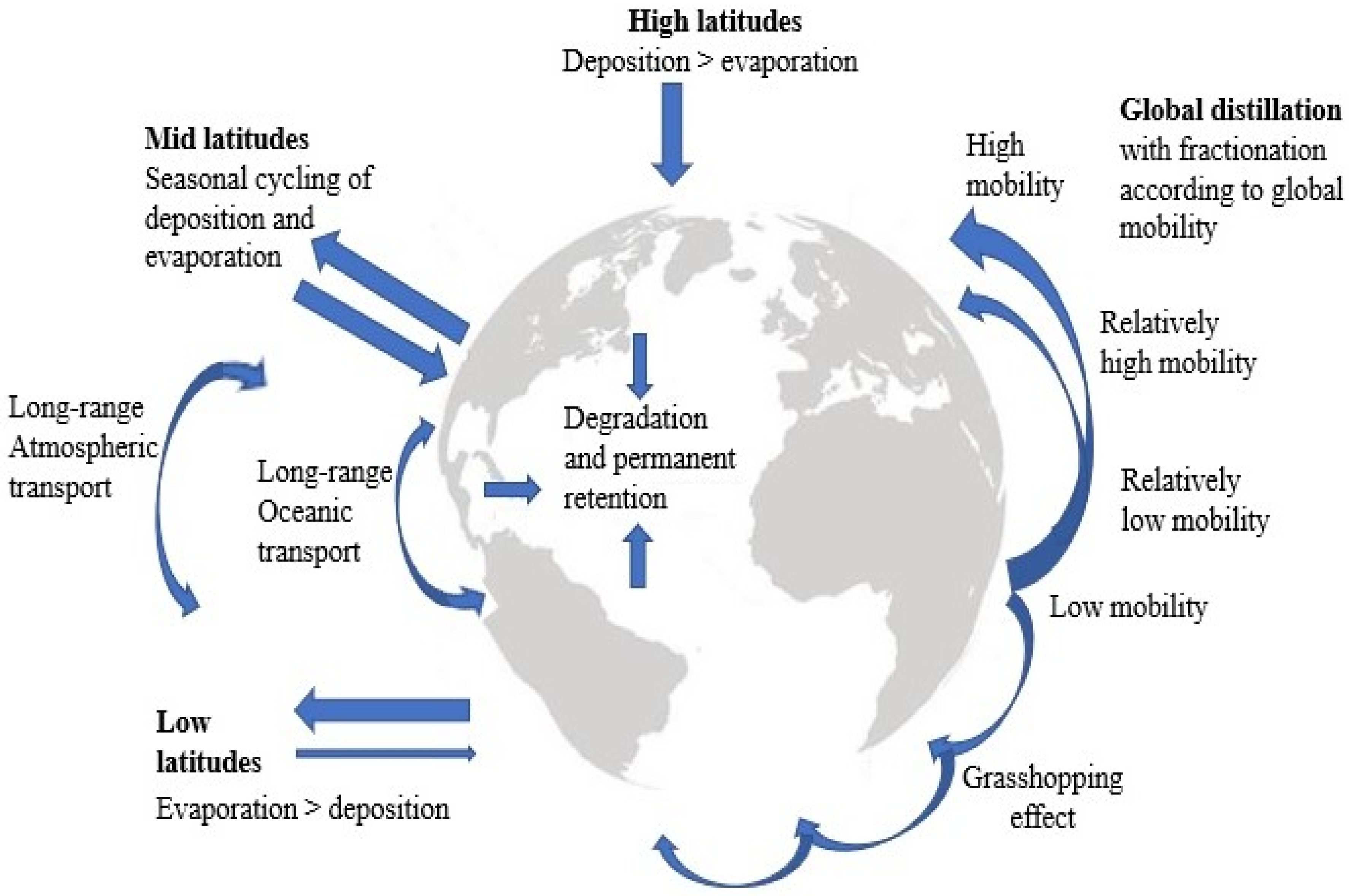
Due to anthropogenic activities as well as the long-range atmospheric transport mechanism, these air contaminants are transported to the polar region also and can be stored in snow/ice for several years (Bhardwaj et. al., 2019; Bhardwaj and Jindal, 2020; Bhardwaj et. al., 2021). So, the polar regions are known as the receivers of air contaminants. Organochlorine pesticides (OCPs), polybrominated diphenyl ethers (PBDEs) and PCBs were reported in the air samples collected from Antarctica (Hao et. al., 2019). “Grasshopper” and “Cold Finger” mechanisms for the transportation of air contaminants to the polar region have been presented by Lebedev et. al., (2015) and Bhardwaj et. al., (2018) in their study (Figure 1). We reviewed different sources, types, impacts, challenges and mitigation of air pollution very well in this study.
2. Sources of Air Pollution
The sources of air pollution can vary based on geographical location. These may be remote and local (Arnold et. al., 2016). They include transportation (cars, trucks and airplanes), industrial facilities, agricultural activities, construction, waste burning and natural sources like volcanic eruptions and wildfires. Emissions from thermal power plants, refineries and petrochemicals are the major traces of air pollution. Dust from construction sites and faulty vehicles contribute to air pollution.
Air contaminants are mainly released from the burning process (Friedrich and Reis, 2013). The burning of wood could be the source of polycyclic aromatic hydrocarbons (PAHs). VOCs are directly released from various sources and these sources may be anthropogenic as well as natural. NOx is released from static as well as mobile sources and falls with rain in the form of nitric acid (HNO3) (Ojumu, 2013). Marelle et. al., (2016) stated that the resident sources of air pollution influence the atmospheric composition.
3. Impact Of Air Pollution on Human Health
Air pollution can be harmful to the health of humans and living organisms. The impacts of air pollution are multifaceted and significant and have long been known to have a hostile impact. The impacts can include respiratory diseases, cardiovascular issues, aggravation of existing health conditions, reduced air quality, damage to crops and ecosystems and climate change. The changes in the air contaminants impact the balance of radiation and influence polar climate warming (Shindell and Faluvegi, 2009). The harmful effects of air pollution are far-reaching and can manifest in various ways:
- (i)
- Respiratory problems: Air with high concentrations of PM10 and PM2.5 can lead to respiratory issues such as asthma, bronchitis, reduced lung function and chronic obstructive pulmonary disease (COPD). The presence of NO2 in the air also causes respiratory disease.
- (ii)
- Cardiovascular issues: Long time exposure to air pollution has been connected to heart disease and the risk of heart attacks.
- (iii)
- Cancer risk: Air contaminants like formaldehyde (CH2O) and benzene (C6H6) are known carcinogens and long-time exposure to them can increase the risk of cancers.
- (iv)
- Neurological effects: Some studies reported the link between air pollution and neurological disorders. High levels of pollutants have been associated with cognitive decline and increased risk of conditions like Alzheimer’s and Parkinson’s disease. Ingested high concentrations of Pb can damage the brain.
- (v)
- Adverse pregnancy outcomes: Exposure to air pollution during pregnancy can lead to low birth weight, preterm birth, and developmental issues in children.
- (vi)
- Affecting children’s health: Children are more susceptible to the effects of air pollution. Exposure to air pollution can lead to respiratory issues, developmental problems and lifelong health implications. The developing nervous system can stop in children due to air pollution.
- (vii)
- Harm to ecosystems: Air pollution can damage plant life, aquatic ecosystems and forests. Acid rain, caused by air contaminants like SO2 and NOx, can damage vegetation, water bodies and soil (Sivaramanan, 2015).
- (viii)
- Climate change: Some air contaminants like CO2 contribute to climate change, leading to widespread environmental and ecological impacts.
- (ix)
- Reduced quality of life: Air pollution can have social and economic consequences. It affects the quality of life. It increases healthcare costs due to increased illness and hospitalizations. It decreases productivity. CO decreases the O2 delivery into humans and causes severe headaches or death (Rose et. al., 2017).
- (x)
- Disproportionate impact on vulnerable communities: Air pollution exacerbates social inequalities, as marginalized and lower-income communities are often disproportionately affected and face several health problems.
4. Mitigation of Air Pollution
The efforts to control air pollution involve regulatory measures, technological advancements to decrease emissions, transitioning to cleaner energy sources, and public awareness and participation in reducing individual contributions to air pollution. It involves a range of strategies and actions at various levels like individual, community, industrial and governmental. There are some effective ways to reduce and control air pollution:
- (i)
- Promotion of clean energy sources: Encouraging and investing in renewable energy sources such as wind, hydroelectric power and solar can significantly reduce emission from traditional fossil fuel-based energy production.
- (ii)
- Improving industrial processes: Implementing cleaner production technologies, using low-emission fuels, and installing pollution control devices in industries can reduce harmful emissions.
- (iii)
- Enhanced vehicle emission control: Promoting electric vehicles, improving public transportation and adopting stricter vehicle emission standards can significantly reduce vehicle emission.
- (iv)
- Better urban planning: Designing cities to prioritize public transportation, pedestrian-friendly areas, and efficient traffic management can reduce congestion and vehicular emissions.
- (v)
- Regulations and policy implementation: Implementing and enforcing strict emission standards and regulations for industries and vehicles to control and reduce pollutant emissions.
- (vi)
- Waste management and recycling: Efficient waste management practices such as proper disposal and recycling, can reduce the release of air contaminants from landfills and incineration (Gupta et. al., 2023).
- (vii)
- Afforestation and green spaces: Creating green spaces and planting trees can absorb contaminants and help in improve air quality. Trees act as natural filters and contribute to cleaner air.
- (viii)
- Public awareness and education: Educating the community about the health impacts of air pollution and promoting individual actions to reduce emissions, such as using energy-efficient appliances and reducing personal vehicle use, can make a significant difference.
- (ix)
- International cooperation: Collaborating across borders to address transboundary air pollution is crucial. International agreements and collaborations can help mitigate the impact of pollutants that cross national boundaries.
- (x)
- Monitoring and research: Continuous monitoring of air quality and investing in research and innovation for cleaner technologies are vital to understanding the sources and effects of air pollution and developing effective mitigation strategies.
5. Challenges in the Mitigation of Air Pollution
Several challenges persist in addressing and mitigating air pollution worldwide. Some of the key challenges include:
- (i)
- Complexity of sources: The sources of air pollution are diverse. The coordination efforts to control toxic gases generated from the different sources is complex.
- (ii)
- Urbanization and population growth: Rapid urbanization and population growth lead to increased vehicular traffic, industrial activities, and energy consumption, resulting in higher emissions and exacerbating air pollution problems.
- (iii)
- Lack of awareness and education: Many people are not fully aware of the health impacts of air pollution or the measures that can be taken to reduce it. Awareness and education campaigns are necessary to engage and inform the public.
- (iv)
- Technological and infrastructural challenges: Upgrading infrastructure and implementing cleaner technologies require substantial investment and time. This transition often faces resistance due to cost implications and technological limitations.
- (v)
- Political and regulatory hurdles: Implementing effective policies and regulations to control emissions often faces political and economic challenges. Balancing environmental concerns with economic interests can be a significant obstacle.
- (vi)
- Global nature of issue: Air pollution doesn’t respect political or geographical boundaries. Cross-border transport of pollutants adds complexity, as addressing air quality often requires international cooperation and agreements.
- (vii)
- Climate change and air quality: Climate change and air quality are closely linked. Some measures to reduce greenhouse gas emissions might inadvertently increase air pollution, necessitating a balanced approach to tackle both issues simultaneously.
- (viii)
- Environmental justice: Air pollution disproportionately affects marginalized communities and low-income areas. Achieving equity in addressing air quality issues in a challenge due to social, economic, and political factors.
- (ix)
- Monitoring and data collection: Adequate monitoring systems to track air quality and collect data on pollutants levels are crucial. However, setting up comprehensive and accurate monitoring systems can be challenging, especially in developing regions.
- (x)
- Innovative solutions and research: Finding innovative, cost-effective solutions to mitigate air pollution while continuing research into new technologies and strategies is an ongoing challenge.
6. Conclusions and Recommendations
Over the last few decades, air pollution is a most important concern for developing as well as developed nations. The environment of these countries is now changing due to several anthropogenic activities such as mining, construction, vehicular emissions, etc. Air pollution negatively affects the health of humans and other wildlife animals and may lead to death. Health consequences such as respiratory issues, cardiovascular diseases, and neurological problems are linked to air pollution. Air pollution can also affect the environment of the polar regions after travelling long distances. Understanding and controlling air pollution is crucial in mitigating its impact on the environment and the health of humans.
Now, researchers are focusing on this issue and they are concerned about the health impacts through air pollution. They are in favour of strict cleaner air policies and regulations. Advancements in clean energy technologies, electric vehicles, and pollution control devices in industries have shown promise in reducing air pollution levels. During the COVID-19 pandemic, air pollution was reduced in many regions due to lockdowns, but it was a temporary phase because at this time industrial activities and vehicular emissions were decreased. Researchers want to a sustainable solution for this issue and suggest several recommendations to minimize the problem of air pollution.
- These recommendations are as follows.
- Regular monitoring of air contaminants and their harmful effects is necessary worldwide.
- More sophisticated instruments are required for the analysis of air contaminants in trace levels.
- Several awareness programs related to the health impact of air pollution should be conducted by the government/authority for the people.
- International collaborations and agreements should be increased to address transboundary air pollution.
- Addressing the challenges of air pollution requires concerted efforts from communities, individuals, governments and industries to implement comprehensive strategies, regulations, and technological advancements.
Author Contributions
All authors have equal contributions.
Funding
This study was not supported by any funding agency.
Acknowledgments
The authors thank Amity University for providing the platform to do this study.
Availability of Data and Materials
Not applicable.
Conflicts of interest/Competing Interest
There is no conflict of interest between the authors.
Code availability
Not applicable.
References
- Alam, S. , Bhardwaj, L. K., Mallick, R., & Rai, S. Estimation of heavy metals and fluoride ion in vegetables grown nearby the stretch of River Yamuna, Delhi (NCR), India. Indian Journal of Environmental Protection 2023, 43, 64–73. [Google Scholar]
- Andrew, R. (2014). Socio-Economic Drivers of Change in the Arctic. AMAP Technical Report No. 9 (2014). Arctic Monitoring and Assessment Programme (AMAP).
- Arnold, S. R. Arnold, S. R., Law, K. S., Brock, C. A., Thomas, J. L., Starkweather, S. M., von Salzen, K., Stohl, A., Sharma, S., Lund, M.T., Flanner, M.G., Petäjä, T., Tanimoto, H., Gamble, J., Dibb, J.E., Melamed, M., Johnson, N., Fidel, M., Tynkkynen, V.P., Baklanov, A., Eckhardt, S., Monks, S.S., Browse, J., & Bozem, H. Arctic air pollution: Challenges and opportunities for the next decade. Elementa: Science of the Anthropocene 2016, 4. [Google Scholar]
- Bhardwaj, L. K., & Jindal, T. Persistent organic pollutants in lakes of Grovnes Peninsula at Larsemann Hill area, East Antarctica. Earth Systems and Environment 2020, 4, 349–358.
- Bhardwaj, L. K., & Sharma, A. Estimation of physico-chemical, trace metals, microbiological and phthalate in PET bottled water. Chemistry Africa 2021, 4, 981–991.
- Bhardwaj, L. K., Sharma, S., & Jindal, T. Occurrence of polycyclic aromatic hydrocarbons (PAHs) in the Lake water at Grovnes Peninsula Over East Antarctica. Chemistry Africa. Chemistry Africa 2021, 4, 965–980.
- Bhardwaj, L. K., Sharma, S., & Jindal, T. Estimation of Physico-Chemical and Heavy Metals in the Lakes of Grovnes & Broknes Peninsula, Larsemann Hill, East Antarctica. Chemistry Africa 2023, 1–18.
- Bhardwaj, L., Chauhan, A., Ranjan, A., & Jindal, T. Persistent organic pollutants in biotic and abiotic components of Antarctic pristine environment. Earth Systems and Environment 2018, 2, 35–54.
- Bhardwaj, L., Sharma, S., Ranjan, A., & Jindal, T. Persistent organic pollutants in lakes of Broknes peninsula at Larsemann Hills area, East Antarctica. Ecotoxicology 2019, 28, 589–596.
- Bhardwaj, L.K. A Comprehensive Review on the Climate Change and Its Impact on Health. Preprints.org 2023, 2023, 2023050159. [CrossRef]
- Bhardwaj, L.K., & Vikram, V. (2023). Air Pollution and Its Effect on Human Health. [CrossRef]
- Chambers, L. A. (2013). Classification and extent of air pollution problems. Air Pollution Volume I.
- Friedrich, R., & Reis, S. (Eds.). Emissions of air pollutants: measurements, calculations and uncertainties. Springer Science & Business Media.2013.
- Grambsch, A. Climate change and air quality. Department of Tansportation Centre for Climate Change and Environmental Forecasting, Washington DC 2001, 25.
- Griffin, R. D. Principles of air quality management, Boca Raton, FL: CRC.2007.
- Gupta, P., Sharma, A., & Bhardwaj, L.K. Solid Waste Management (SWM) and Its Effect on Environment & Human Health. 2023. [CrossRef]
- Hao, Y., Li, Y., Han, X., Wang, T., Yang, R., Wang, P., Xiao, K., Li, W., Lu, H., Fu, J., Wang, Y., Shi, J., Zhang, Q., & Jiang, G. Air monitoring of polychlorinated biphenyls, polybrominated diphenyl ethers and organochlorine pesticides in West Antarctica during 2011–2017: Concentrations, temporal trends and potential sources. Environmental Pollution 2019, 249, 381–389.
- Lebedev, A. T., Mazur, D. M., Polyakova, O. V., & Hänninen, O. Snow samples as markers of air pollution in mass spectrometry analysis. In Environmental Indicators, 515-541. Springer, Dordrecht.2015. 2015.
- Liang, L., Wang, Z., & Li, J. The effect of urbanization on environmental pollution in rapidly developing urban agglomerations. Journal of cleaner production 2019, 237, 117649.
- Marelle, L., Thomas, J. L., Raut, J. C., Law, K. S., Jalkanen, J. P., Johansson, L., Roiger, A., Schlager, H., Kim, J., Reiter, A., & Weinzierl, B. Air quality and radiative impacts of Arctic shipping emissions in the summertime in northern Norway: from the local to the regional scale. Atmospheric Chemistry and Physics 2016, 16, 2359–2379.
- Ojumu, A. M. Transport of Nitrogen Oxides and Nitric Acid Pollutants over Sout h Africa and Air Pollution in Cape Town. MSc, University of South Africa.2013. 2013.
- Rose, J. J., Wang, L., Xu, Q., McTiernan, C. F., Shiva, S., Tejero, J., & Gladwin, M. T. Carbon monoxide poisoning: pathogenesis, management, and future directions of therapy. American journal of respiratory and critical care medicine 2017, 195, 596–606.
- Shindell, D., & Faluvegi, G. Climate response to regional radiative forcing during the twentieth century. Nature Geoscience 2009, 2, 294–300.
- Sivaramanan, S. Acid rain, causes, effect and control strategies. Central Environmental Authority, Battaramulla 2015, 1.
- Smeets, J. Air quality limit and guide values for sulphur dioxide and suspended particulates—A European community directive. Environmental Monitoring and Assessment 1982, 1, 373–382. [Google Scholar] [CrossRef] [PubMed]
Figure 1.
The Long-range Transport Mechanism (Grasshopper Effect) for Air Contaminants.
Disclaimer/Publisher’s Note: The statements, opinions and data contained in all publications are solely those of the individual author(s) and contributor(s) and not of MDPI and/or the editor(s). MDPI and/or the editor(s) disclaim responsibility for any injury to people or property resulting from any ideas, methods, instructions or products referred to in the content. |
© 2023 by the authors. Licensee MDPI, Basel, Switzerland. This article is an open access article distributed under the terms and conditions of the Creative Commons Attribution (CC BY) license (http://creativecommons.org/licenses/by/4.0/).
Copyright: This open access article is published under a Creative Commons CC BY 4.0 license, which permit the free download, distribution, and reuse, provided that the author and preprint are cited in any reuse.


