

Submitted:
17 November 2023
Posted:
17 November 2023
You are already at the latest version
Preprints on COVID-19 and SARS-CoV-2
Abstract
The SARS-CoV-2 pandemic continues to pose a global threat. While its virulence has subsided, it has persisted due to the continual emergence of new mutations. Although many high-risk conditions related to COVID-19 have been identified, the understanding of protective factors remains limited. Intriguingly, epidemiological evidence suggests a low incidence of the COVID-19-infected CD patients. The present study explores whether their genetic background, namely the associated HLA-DQs, offers protection against severe COVID-19 outcomes. We hypothesize that the HLA-DQ 2/8 alleles may shield CD patients from SARS-CoV-2 and its subsequent effects, possibly due to memory CD4 T cells primed by previous exposure to human-associated common cold coronaviruses (CCC) and higher affinity to those allele's groove. In this context, we examined potential cross-reactivity between SARS-CoV-2 epitopes and human-associated CCC and assessed the binding affinity (BA) of these epitopes to HLA-DQ 2/8. Using computational methods, we analyzed sequence similarity between SARS-CoV-2 and four distinct CCC. Of 924 unique immunodominant 15-mer epitopes with at least 67% identity, 37 exhibited significant BA to HLA-DQ 2/8, suggesting a protective effect. We present various mechanisms that might explain the protective role of HLA-DQ2/8 in COVID-19-afflicted CD patients. If substantiated, these insights could enhance our understanding of gene-environment enigma and viral-host relationship, guiding potential therapeutic innovations against the ongoing SARS-CoV-2 pandemic.
Keywords:
celiac disease
; human leukocyte antigen
; HLA-I
; HLA-II
; SARS-CoV-2
; COVID-19
; protective genes
; gastrointestinal tract.
1. Introduction
The COVID-19 pandemic has been a global health concern for more than the last three years. Its worldwide geographical propagation, contagious ability, multi-faceted clinical presentation, prognosis, morbidity, mortality and short/long-term outcome has driven the scientific and clinical teams to study the disease’s geoepidemiology, in terms of susceptible environmental [1,2] and genetic predisposing factors [3,4]. In contrast to predisposing factors, several immune-biological parameters (decreased ACE2 expression, increased anti-inflammatory cytokines, antibody response and T cell activation), environmental factors (healthy diet, sufficient nutrition, atopic conditions and COVID-19 vaccination) or genetic polymorphisms, were reported to attenuate COVID-19 severity [5,6]
One of the most explored human genetic factors related to SARS-CoV-2 infection is the human leukocyte antigen (HLA) genotypes [7,8,9]. In humans, the HLA comprises a complex of genes on the 6th chromosome that coordinate and regulate the immune systems by encoding cell-surface proteins. Being a major and indispensable vital antigen-presenting pathway, they play a pivotal role in establishing susceptibility to infectious conditions. Their crucial role in adaptive immunity impacts and their vast diversity in the human genome dictates the quality and strength of the reactive immune response to hostile pathogens [10]. The HLAs’ distinct sequences and three-dimensional structures influence peptide binding efficiency and determine the adaptive immune response. In fact, facing a viral infection, the HLA allelic repertoire impacts the transmission, phenotype, symptomatic intensity and outcome of the invading virus. The same holds for the actual COVID-19 viruses [11] and specific vaccine development against SARS-CoV-2 [12].
Most probably, individual susceptibility to the SARS-CoV-2 virus and its corresponding COVID-19 disease is determined by the host HLA genes' variations [7,8]. The wide range of the infected hosts and the innate and reactive immune responses to SARS-CoV-2 is HLA allele-dependent. No less important are the relationships between HLA polymorphisms and multiform COVID-19 disease presentations, courses and outcomes. The cross-talks between the HLA vast repertoire and the virus are more complicated since SARS-CoV-2 was recently established as an auto-immunogenic virus [13,14,15,16,17], and autoimmune diseases are heavily HLA allele-dependent [18]. Interestingly, most recently the predisposition to autoimmune diseases was expanded to the post-COVID vaccine syndromes [17,19], thus augmenting the concerns regarding a future increase in the incidence of those conditions [20].
Multiple reports exist on the relations between HLA variants and COVID-19 susceptibility and outcome [3,4,7,8]. Based on some new observations, the present study concentrates on the potential protective effects of HLA polymorphisms on SARS-CoV-2 infection. Furthermore, the dual role played by the specific HLA-DQ 2 and 8 in celiac disease (CD) susceptibility is discussed. HLA-DQ 2 and 8 are the major genetic predisposing factors for CD [21,22]. In fact, the preferential binding of HLA-DQ2 (90–95%) and HLA-DQ8 (5–10%) to gluten peptides provides a strong inherited basis for CD. On the other hand, the same haplotypes were recently suggested to protect the CD patients from COVID-19 disease [23]. It seems that those HLAs represent a double-edged sword in CD-COVID-19 interplay.
The aims of the current study were: 1. To summarize the literature on CD-HLA-SARS-CoV-2 interrelations, highlighting the CD-protective HLA genes, 2. To explore sequence alignment between SARS-CoV-2 epitopes, CCC antigens and HLA-DQ2/8, and 3. To suggest potential mechanisms for HLA-DQ2/8 protection from COVID-19.
1.1. Protective HLA alleles in Celiac disease
The topics of protective HLA polymorphism related to autoimmune diseases in general [24,25] and, more specifically, to SARS-CoV-2 infectivity have been extensively reported [8,26,27,28,29,30,31,32,33,34,35,36], despite some controversary on the latter topic [37]. Interestingly, some HLA variants were described to confer resistance to CD development. Logically, a severe, morbid and lethal autoimmune disease, like CD, before gluten was discovered as the offending environmental inducer, should have decreased in incidence or even disappeared, along the course of human evolution [38,39]. Intriguingly, its incidence is consistently increasing, mounting to 1-2% in many countries [40,41]. Table 1 summarizes those CD-protective HLA variants.
1.2. The human gastrointestinal tract is a target organ for SARS-CoV-2
Despite the plethora of extraintestinal manifestations of CD [52,53,54], its primary target organ is the small bowel [55,56]. Indeed, SARS-CoV-2 preferentially infects the upper respiratory tract, but, the gastrointestinal tract (GIT) and its associated organs are no less affected [57,58,59,60,61,62,63,64]. The enteric aspects that were described during the COVID-19 pandemic are summarized in Table 2.
It is concluded that the SARS-CoV-2 virus penetrates, infects, overcomes the gut protective barrier mechanisms, damages the enteric mucosa, activates the mucosal immune systems, is excreted in the feces, is transmitted feco-orally and is spread into the surrounding environment. It should be stressed that those events were not explored in connection to the CD/SARS-Cov-2 interplay.
1.3. COVID-19-celiac disease interplay
The COVID-19-CD relationship is characterized by a typically wobbly movement, considering risks and morbidity. The pendulum went from potential risk [58], no increased risk at all for of COVID-19 [61,83,84,85,86,87,88,89,90], lower incidence of CD diagnosis during the present pandemic compared to previous years [91], to increased impact of COVID-19 lockdown and restrictions on CD therapy [92,93] and potential life-threatening delay in CD diagnosis [94,95]. The elderly CD patients are susceptible to a more complicated and stormier course of COVID-19 due to their gut functional senescence and associated comorbidity [61,90]. Most recently, increase in new-onset childhood CD during the COVID-19 pandemic was described [96]. In contrast, risk of hospitalization is mitigated by anti-COVID-19 vaccinations [97]. Intriguingly, a potential outbreak of CD during the COVID-19 epidemic or in the post-covid era, in the forthcoming future, was lately hypothesized [98,99]. However, this pessimistic outcome was most recently contradicted by Greco N et al. [23].
Based on the above, it seems that the topic of the risk of COVID-19 in CD patients is highly controversial. Until a systemic review and a meta-analysis will be performed, the jury is not out yet. Since it was suggested that the CD-associated HLA DQ2/DQ8 haplotype might have a protective role against COVID-19 infection [23], the aims of the present study are to explore this relationship by analyzing sequence similarities between known SARS-CoV-2 epitopes and CCC, and identifying epitopes with significant BA to HLA-DQ2 and DQ8.
Our hypothesis is that increased sequence similarity to CCC and specific CD-associated HLA BA to the virus epitopes elicit a greater protective production of anti-SARS-CoV-2 antibodies, resulting in full protection or attenuated disease course.
2. Materials and Methods
2.1. Data Sources
For this study, our primary data were obtained from two distinct databases, CCC Protein Sequences (protein sequences related to CCC were extracted from the UniProt Knowledgebase [100], accessible via: https://www.uniprot.org/), and SARS-CoV-2 Epitope Data (extracted from the Immune Epitope Database and Analysis Resource (IEDB) as of 17 August 2023 [101], accessible via: https://www.iedb.org/).
- Protein Sequences Extraction of Common Cold Coronaviruses:
Protein sequences corresponding to various CCC strains were obtained from the UniProt Knowledgebase, including OC43 (Taxon ID 31631), HKU1 (Taxon ID 443239 Isolate N1), NL63 (Taxon ID 277944), and 229E (Taxon ID 11137). Of particular interest, due to their recognized immunodominance in clinical research, were the Spike Glycoprotein, Nucleoprotein, and certain non-structural proteins (NSPs) from Replicase Polyprotein 1ab—specifically NSP3, NSP4, NSP12, and NSP13 [102,103]. They correspond to the following UniProt IDs: Q5MQD0, P36334, Q6Q1S2, P15423, Q5MQC6, P33469, Q6Q1R8, P15130, P0C6X2, P0C6X5, P0C6X6, and P0C6X1.
- Data Retrieval from IEDB:
IEDB data were retrieved on August 17, 2023, using the specific filters mentioned below:
- Organism: SARS-CoV-2 (ID:2697049).
- Antigens: Spike glycoprotein (P0DTC2), Nucleoprotein (P0DTC9), Replicase polyprotein 1ab (P0DTD1).
- Epitope Structure: Linear Sequence.
- Assay Type: Only positive assays pertaining to T-cell epitopes and MHC ligands were considered. This refers to epitopes validated through laboratory experiments.
- MHC Restriction: Class II.
- Host: Human.
- Diseases: No specific restrictions; all diseases were considered.
Around six thousand SARS-CoV-2 epitope entries were extracted from the IEDB, focusing on MHC-II ligands and T-cell assays.
2.2. Sequence Similarity Identification
Using the EMBOSS Matcher, a robust Pairwise Local Alignment tool [104,105], sequence similarities between SARS-CoV-2 epitopes and CCC protein sequences were identified. Based on Bill Pearson's Lalign application algorithm (version 2.0u4, February 1996), the Matcher reveals local sequence resemblances. As a cutoff, we only considered sequences that displayed at least 11 identical amino acids (AAs) within a 15-mer epitope span. This threshold draws upon findings by Mateus et al., where an epitope homology exceeding 67% between SARS-CoV-2 and human CCC resulted in CD4 T cells cross-reactivity in 57% of the instances [106]. This analysis pinpointed 924 unique immunodominant 15-mer epitopes from SARS-CoV-2 with a minimum of 67% similarity to at least one human CCC strain under examination.
2.3. Binding Affinity Prediction to HLA-DQ2, DQ8
Given that immunodominant SARS-CoV-2 epitopes are associated with the capacity to bind to multiple HLA allelic variants, we aimed to scrutinize the 924 epitopes’ BA to HLA-DQ2 and HLA-DQ8 complexes. These complexes are encoded by the leukocyte histocompatibility antigen genes DQA1*05:01-DQB1*02:01 and DQA1*03:01-DQB1*03:02, respectively, both located on chromosome 6p21, and are key factors in predisposing individuals to CD [107]. We employed predictive tools from DTU Health Tech, specifically the NetMHCIIpan-4.2 method, which is accessible at DTU Health Tech Services. The 4.2 version offers superior predictive accuracy and broader molecular coverage, particularly as an HLA-DQ data model [108]. The model provides a %rank score, which predicts how likely a peptide will naturally bind to a selected HLA receptor. This score is normalized based on predictions from a random peptide set, and it indicates where their predicted BA stands in relation to a distribution derived from these random natural peptides. Specifically, we use a %Rank of less than 5% as our cutoff to determine significant binding, either "strong" or "weak" binders. Epitopes with a %Rank below 1% are categorized as strong binders (SB), while those with rankings between 1% and 5% are termed weak binders (WB). For a comprehensive overview of our methodology, refer to the flowchart presented in Figure 1.
3. Results
A total of 6,301 SARS-CoV-2 epitope entries were sourced from IEDB. Many of these epitopes were identified using multiple assays: 3,249 through T-cell assays and 11,851 as MHC-II ligand assays. Out of these, 924 distinct 15-mer SARS-CoV-2 epitopes were identified, displaying at least 67% similarity with the listed human CCC strains [106]. These epitopes were predominantly found in the immunologically prevalent proteins: Spike Glycoprotein, Nucleoprotein, and specific immunodominant non-structural proteins (NSPs) from Replicase Polyprotein 1ab, such as NSP3, NSP4, NSP12, and NSP13 [102].
Upon applying a computational BA prediction tool (NetMHCIIpan-4.2) to the 924 epitopes, 37 showed considerable BA to either HLA-DQ2 or HLA-DQ8 alleles. Delving deeper, 3 were associated with the Spike Glycoprotein (all WB), 1 with NSP3 (WB), 20 with NSP12 (3 SB, 17 WB), and 13 with NSP13 (1 SB, 12 WB). Neither the Nucleoprotein nor NSP4 exhibited epitopes with notable BA to HLA-DQ2 or HLA-DQ8 alleles. Importantly, one epitope, DKVEAEVQIDRLITG, echoed findings from Obermair et al., correlated positively with HLA-DQA103:01/DQB103:02 alleles [109]. Given the multiple studies suggesting pre-existing immune memory to SARS-CoV-2 antigens in unexposed individuals [106,110], the present results might indicate that the presence of HLA-DQ2/HLA-DQ8 alleles could facilitate the activation and proliferation of CD4 T cells that cross-react with SARS-CoV-2 epitopes. In Figure 2, the homology levels of each SARS-CoV-2 15-mer epitope are compared with CCC epitope sequences, highlighting those with a similarity of 40% or higher. Each figure corresponds to a specific protein, with regions with high similarity (above 67%) and significant BA to HLA-DQ2/HLA-DQ8 alleles marked in red.
Table 3 illustrates the 15-mer SARS-CoV-2 epitopes that not only display at least 67% homology with CCCs but also have a significant BA for HLA-DQ2/HLA-DQ8 alleles. The two columns on the right-hand side display the binding rank. Those ranked in the top 1% were classified as potential SB, and those ranked in the top 5% were classified as WB.
4. Discussion
By screening the IEDB, 924 distinct 15-mer SARS-CoV-2 epitopes were identified, displaying at least 67% similarity with the listed human CCC strains. Applying the computational BA prediction tool, 37 of those epitopes exposed a considerable BA to either HLA-DQ2 or HLA-DQ8 alleles, (20 associated with NSP12, 13 with NSP13, 3 with the Spike Glycoprotein and 1 with NSP3). Higher sequence similarity and a more effective affinity to specific HLAs were associated with a higher antibody's response, thus conferring a more efficient protection against a virus. A similar explanation can explain the fact that CD patients are relatively protected against COVID-19. The present results add a new dimension to the CD-COVID-19 cross-talks. The HLA-DQ 2/8 can represent a double edge sword, being the most prevalent CD-susceptible genes, hence protective ones against the SARS-CoV-2.
It is well accepted that more than 95% of celiacs have the HLA DQ2 (DQA1*05:01-DQB1*02:01, abbreviated as DR3-DQ2), and a minority carries DQ8 haplotype (DQA1*03:01-DQB1*03:02, abbreviated as DR4-DQ8) [21]. In fact, those genetic markers can help in substantiating the diagnosis of CD in uncertain cases, considering its negative predictive value [111]. They can help in following the genetic family tree of affected members [112]. Additionally, they may assist in predicting or discriminating individuals at high-risk of CD like first- and second-degree relatives, or associated conditions such as various autoimmune diseases or specific genetic disorders (Down, Turner or Williams syndromes) [113].
In contrast to those predisposing CD-associated HLA-DQs, a new hypothesis was most recently forwarded by Greco N, et al. [23], suggesting a protective role against COVID-19 in CD-affected populations. The authors found that only 5.8% of their 191 active and none-active CD-tested population were positive for SARS-CoV-2, most of them exhibiting no or mild symptoms and never hospitalized.
The protective role of HLAs against bacteria [114], parasites [115], and even viruses is well reported. Their role in fighting viruses like HIV [116], HCV [117], HBV [118] and SARS [8,26,27,28,29,30,31,32,33,34,35,36,119,120,121] have been documented. Interestingly, the protective role of the CD associated HLA II, suggested by Greco N et al. [23], represents a refreshing new idea that can help in our understanding of the celiac-COVID-19-HLA axis. The low incidence of the COVID-19-infected CD patients and their a/hypo-symptomatic presentation have been discussed in numerous publications on the celiac's resilience to SARS-CoV-2 infection [61,83,84,85,86,87,88,89]. Interestingly, several other non-celiac associated HLAs are associated with asymptomatic (HLA-B*15:01, HLA-DRB1*04:01) or milder forms (HLA-B*15, HLA-DRB1*04) of COVID-19 [122,123].
Several mechanisms can be speculated to explain this HLA-DQ2 and 8, COVID-19 protection in CD patients:
- 4.1. High affinity between SARS-CoV-2 antigens and HLA-DQ immune presentation to the T cells enhances anti-SARS-CoV-2 immunity. In fact, the HLA allele most associated with COVID-19 deterioration is HLA-A*11. However, HLA II also plays a role in the disease severity, HLA-DRB1*15:01 and HLA-DRB1*04 alleles being examples [124].. Unfortunately, the CD-associated HLA-DQs were not explored when the binding affinities of 438 HLA alleles were screened [124]. Nevertheless, asymptomatic and mildly/moderate affected patients likely develop an effective early immune response to clear the virus [125]. A reasonable explanation for the associations between CD, SARS-CoV-2 and HLA-DQ2/8 observed presently is that most of the strong HLA binders of coronavirus peptides are also, strong binders of other sequences, and hence, are likely to be a general strong binders that probably underwent selection in the past [124].
- 4.2. SARS-CoV-2 naïve people might have a certain measure of HLA-dependent immune defense, presented by antibodies cross-reactive to other CCC [126]. Most of those HLAs belong to HLA class I, hence, a minority of them are part of class II. Unfortunately, the CD-associated HLA-DQ were not explored [126]. The topic of a potential protective cross-reactivity against the COVID-19 virus in uninfected CD patients, conferred by their HLA-DQ 2/8 is a subject for further investigation.
- 4.3. Individual HLA variant has its unique repertoire of peptides with a specific sequence structure to stick in the peptide-binding groove of HLA. It appears that certain HLA haplotypes have higher preferences to present peptides with specific molecular functions [127]. This HLA preferential presentation was extrapolated to explain the protective effect of certain HLA alleles in infectious diseases, including COVID-19. Indeed, Karnaukhov V. et al reported-on HLA-A/HLA-B and HLA-A/HLA-C variants having a more distinct functional antigen's preference presentations, but the HLA-DQ2/8 ones were not explored [127]. The authors reported on HLA differential presentation of SARS-CoV-2 antigens mainly by HLA type I alleles, hence, the CD-associated HLA-DQs haplotypes might play a protective or attenuative role in COVID-19 disease. Notably, several studies reported on HLA-DQ variants associated with a dominant T cell response against the SARS-CoV-2 virus, resulting in a milder disease [122,128,129], including a higher production of antibodies post mRNA-based vaccination [130].
- 4.4. Cross reactive antibodies shared between SARS-CoV-2 and gluten? If cross-reactivity exists between the virus and gluten, those reactive antibodies might attenuate the severity of COVID-19 and protect the untreated or the non-compliant CD patients. In fact, Vojdani A, et al. reported on such cross-reactive antibodies [131]. Screening 180 different food antigens and peptides, the authors showed that SARS-CoV-2 proteins share cross-reactive epitopes with various food antigens that had not been previously explored. Wheat and alpha-gliadin were shown to cross-react with SARS-CoV-2 spike protein and nucleoprotein [131]. More so, the authors reported on sequence similarity between SARS-CoV-2 proteins and alpha-gliadin toxic peptides and glutenin, thus, reinforcing a potential effect of the COVID-19-food axis relationships. It should be stressed that the potential protective effects of the above-mentioned cross-reactive antibodies and the sequence similarity were not substantiated and should be further evaluated.
- 4.5. Increase in anti-inflammatory factors in COVID-19-infected celiac patients. Recently, Asri N et al. studied naïve CD patients for various inflammatory and anti-inflammatory markers [86]. The CD patients exposed an increase expression of anti-inflammatory molecules like CD4, CD25 (IL-2Rα) and FOXP3, compared to severe COVID-19 patients and controls. However, the HLA-DQs allelic status was not investigated. The increase anti-inflammatory profile might be beneficial to the CD patients, by lowering COVID-19 severity and attenuating the disease course. The relationship of those markers to the HLA-DQs should farther be explored.
- 4.6. HLA-DQ2/8 might be important in fighting human viruses. The mechanism of CD risk modification by HLA heterogeneity might involve differential presentation of autoantigenic sequences by HLA class II proteins. The HLA-DQ2 and DQ8 presentation of viral epitopes were reported concerning coxsackievirus specific peptides [132]. The authors speculated that the phenomenon might represent a protective adaptive mechanism to maximize anti-enterovirus responses. The same can be speculated for the COVID-19 virus and the HLA-DQ2/8 epitopic presentation in CD, alluding to the potential protective role of those HLAs in fighting SARS-CoV-2 viruses.
- 4.7. HLA class II: Evolutionary protective mechanisms for CD survival. The wide range of COVID-19 manifestations, morbidity and mortality, seen across various ethnicities and geographical distribution was suggested to be host genetic dependent [133]. This genetic adaptative diversity may apply to CD. Interestingly, selective advantage mechanisms for polymorphic genes were speculated to contribute to the evolutionally survival of the CD populations [38,39,134] (Table 1). In fact, the human HLA's genetic heterogeneity is a known major anti-infectious mechanism to fight microbes, parasites and even viruses, SARS-CoV-2 included. Although the variants of class II HLA loci were less frequently analyzed, they can impact COVID-19 outcome. Most recently, HLA class II DRB1*01:01, DRB1∗04:01 and DRB1*03:01 were reported to reduce disease duration and attenuated COVID-19 course [135,136,137]. Unfortunately, the HLA-DQ repertoire was not screened in those studies. Of note, the topic is still controversial and some studies denied the association between HLA polymorphism and COVID-19 outcome [138,139].
5. Celiac disease and long COVID-19 syndromes
Most of the scientific studies were done on COVID-19 in CD, but the relationship between CD and the long COVID-19 syndrome is in its infancy. Nevertheless, typical symptoms like fatigue, poor appetite, abdominal pain, diarrhea and nausea can overlap between the two entities [140,141]. Since most of the CD patients are undiagnosed, are a- or hypo-symptomatic, the question arises: should the long COVID-19 affected patients be screened for CD? The jury is not yet out on that question. Intriguingly, nutritional deficiencies were proposed recently to impact COVID-19 and long COVID-19 outcomes [142]. One wonders if nutritional deficiencies during undiagnosed or gluten-free diet-treated CD patients [143,144] might subject them to long-term consequences of post COVID-19 diseases. Most recently, Vojdani A et al. suggested that SARS-CoV-2 might activate latent Epstein–Barr virus and human herpesvirus 6, thus impacting the long COVID-19 phenotype [145]. Interestingly, both viruses were implicated as drivers of CD autoimmunity [145,146,147]. The question of whether HLA-DQ 2 or 8 protects the CD patient population from long COVID-19 outcome is still unresolved. Thus, despite the above-mentioned potential mechanistic pathways, the issue of HLA-DQ2\8- SARS-CoV-2 protective cross talks is far from being deciphered.
6. Conclusions
HLA class II genes are widely heterogenic, very polymorphic and pivotal in presenting foreign antigens to T cells. Being important in fighting viral infection, the cross-talks between specific HLA II alleles and SARS-CoV-2 are important to understand the HLA genetic-COVID-19 outcome axes. Recent data is indicative of HLA-DQ 2/8 protecting CD patients from SARS-CoV-2 infection or attenuating the COVID-19 course. We highlight the sequence similarity and the HLAs’ increased affinity as two novel mechanisms that might protect the CD patients from COVID-19 morbidity. Several potential mechanisms can be suggested to drive the phenomenon; however, the explanation is far from being elucidated. The present forwarded hypothesis that CD patients are protected from COVID-19 severity, morbidity and associated acute and long-term complications should be further investigated.
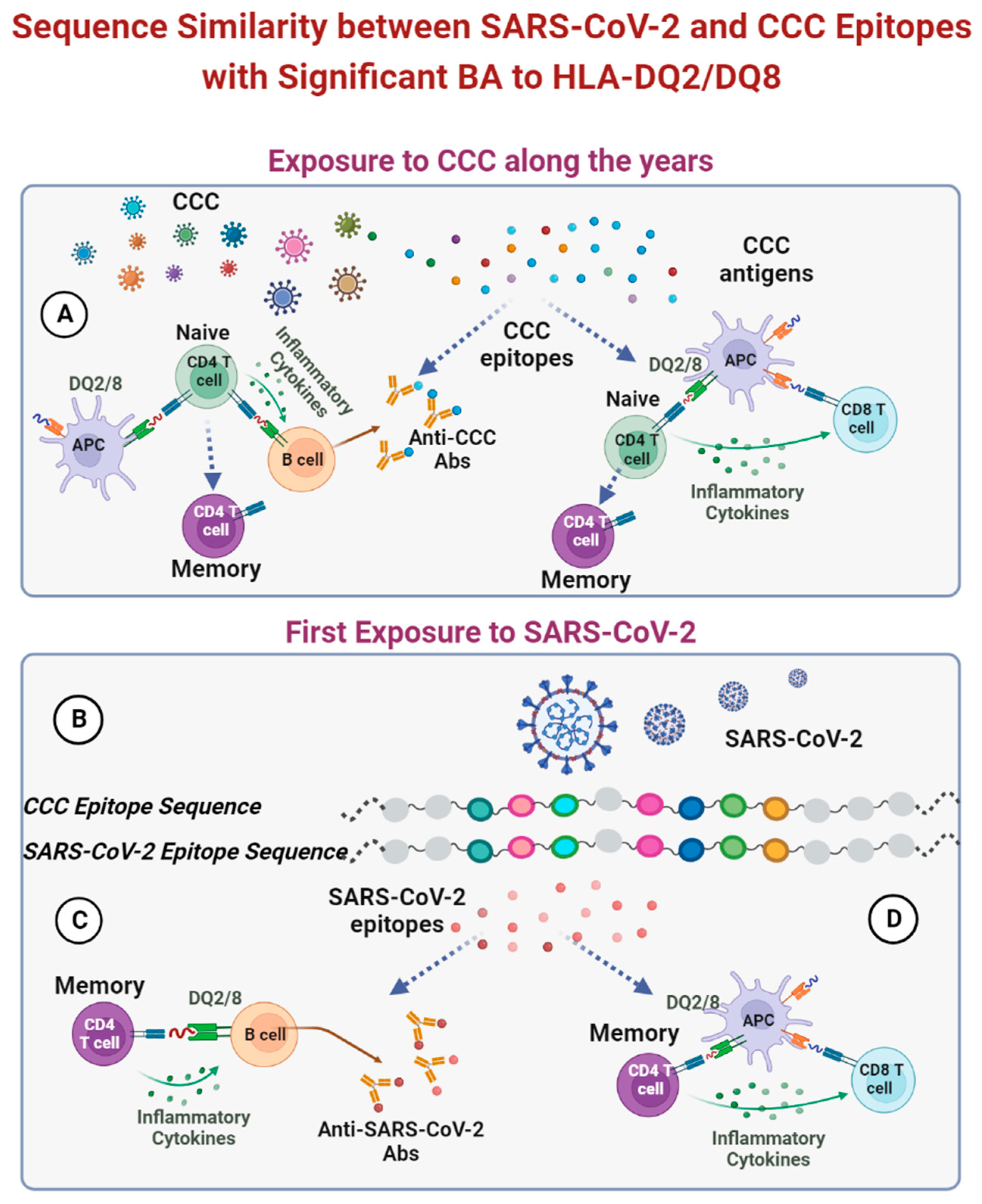
Figure 3.
A schematic representation of 15mer CCC epitopes with a minimum of 67% sequence identity to SARS-CoV-2 and strong binding to the celiac-associated HLA-DQ2/DQ8. (A) Exposure to CCC. Epitopes are presented, particularly on HLA-DQ2/8, to naïve CD4 T cells, leading to activation and proliferation, initiating an immune response. (B) Exposure to SARS-CoV-2. Some 15mer epitopes have a minimum of 67% sequence identity to CCC and a significant BA to CD associated HLA-DQ2/8 (C, D). Those are presented to memory CD4 T cells, activating B cells, and CD8 T cells.
Figure 3.
A schematic representation of 15mer CCC epitopes with a minimum of 67% sequence identity to SARS-CoV-2 and strong binding to the celiac-associated HLA-DQ2/DQ8. (A) Exposure to CCC. Epitopes are presented, particularly on HLA-DQ2/8, to naïve CD4 T cells, leading to activation and proliferation, initiating an immune response. (B) Exposure to SARS-CoV-2. Some 15mer epitopes have a minimum of 67% sequence identity to CCC and a significant BA to CD associated HLA-DQ2/8 (C, D). Those are presented to memory CD4 T cells, activating B cells, and CD8 T cells.
Author Contributions
AL - screened the literature, designed and wrote the manuscript, CB - screened the literature, wrote, edited and revised the manuscript, designed the figures with BioRender.com permission. AV - designed and edited and supervised the manuscript. The three authors agreed to the published version of the manuscript.
Funding
This research received no external funding.
Institutional Review Board Statement
Not applicable.
Informed Consent Statement
Not applicable.
Data Availability
The data and software that supports the findings of this study are openly available in.:
- UniProt Knowledgebase www.uniprot.org, reference [100].
- Pairwise Local Alignment tool, EMBOSS Matcher, at www.emboss.sourceforge.net, reference [104,105], A python script can be found at https://raw.githubusercontent.com/ebi-wp/webservice-clients/master/python/emboss_matcher.py
- Binding Affinity Prediction tool from DTU Health Tech, the NetMHCIIpan-4.2 method, at https://services.healthtech.dtu.dk/services/NetMHCIIpan-4.2/ [108]
Conflicts of Interest
The authors declare that the research was conducted in the absence of any commercial or financial relationships that could be construed as a potential conflict of interest.
Abbreviations
GIT-gastrointestinal tract, CD-celiac disease, IEDB-Immune Epitope Database and Analysis Resource, CCC- common cold coronaviruses.
References
- Wang, D.; Wu, X.; Li, C.; Han, J.; Yin, J.; Gan, J. The impact of geo-environmental factors on global COVID-19 transmission: A review of evidence and methodology. 2022. [CrossRef]
- Begou, P.; Kassomenos, P. The ecosyndemic framework of the global environmental change and the COVID-19 pandemic. Sci. Total Environ. 2023, 857. [Google Scholar] [CrossRef] [PubMed]
- Zguro, K.; Fallerini, C.; Fava, F.; Furini, S.; Renieri, A. Host genetic basis of COVID-19: from methodologies to genes. Eur. J. Hum. Genet. 2022, 30, 899–907. [Google Scholar] [CrossRef] [PubMed]
- Ji, X.S.; Chen, B.; Ze, B.; Zhou, W.H. Human genetic basis of severe or critical illness in COVID-19. Front. Cell. Infect. Microbiol. 2022, 12. [Google Scholar] [CrossRef] [PubMed]
- Zhang, J. jin; Dong, X.; Liu, G. hui; Gao, Y. dong Risk and Protective Factors for COVID-19 Morbidity, Severity, and Mortality. Clin. Rev. Allergy Immunol. 2023, 64, 90–107. [Google Scholar] [CrossRef] [PubMed]
- Dobrijević, Z.; Robajac, D.; Gligorijević, N.; Šunderić, M.; Penezić, A.; Miljuš, G.; Nedić, O. The association of ACE1, ACE2, TMPRSS2, IFITM3 and VDR polymorphisms with COVID-19 severity: A systematic review and meta-analysis. EXCLI J. 2022, 21, 818–839. [Google Scholar] [CrossRef] [PubMed]
- Migliorini, F.; Torsiello, E.; Spiezia, F.; Oliva, F.; Tingart, M.; Maffulli, N. Association between HLA genotypes and COVID-19 susceptibility, severity and progression: a comprehensive review of the literature. Eur. J. Med. Res. 2021, 26. [Google Scholar] [CrossRef] [PubMed]
- Srivastava, A.; Hollenbach, J.A. The immunogenetics of COVID-19. Immunogenetics 2023, 75, 309–320. [Google Scholar] [CrossRef] [PubMed]
- Ghazy, A.A.; Alrasheedi, A.N.; Elashri, M.; Moussa, H.H.; Rashwan, E.K.; Amer, I.; El Sharawy, S.; Elgamal, S.; Tawfik, S.; Abdelnasser, M.; et al. Relevance of HLA-DP/DQ and INF-λ4 Polymorphisms to COVID-19 Outcomes. Br. J. Biomed. Sci. 2023, 80. [Google Scholar] [CrossRef] [PubMed]
- Pishesha, N.; Harmand, T.J.; Ploegh, H.L. A guide to antigen processing and presentation. Nat. Rev. Immunol. 2022, 22, 751–764. [Google Scholar] [CrossRef] [PubMed]
- Arab, F.; Mollazadeh, S.; Ghayourbabaei, F.; Moghbeli, M.; Saburi, E. The role of HLA genotypes in understanding the pathogenesis of severe COVID-19. Egypt. J. Med. Hum. Genet. 2023, 24. [Google Scholar] [CrossRef] [PubMed]
- Lin, F.; Lin, X.; Fu, B.; Xiong, Y.; Zaky, M.Y.; Wu, H. Functional studies of HLA and its role in SARS-CoV-2: Stimulating T cell response and vaccine development. Life Sci. 2023, 315. [Google Scholar] [CrossRef] [PubMed]
- Dotan, A.; Muller, S.; Kanduc, D.; David, P.; Halpert, G.; Shoenfeld, Y. The SARS-CoV-2 as an instrumental trigger of autoimmunity. Autoimmun. Rev. 2021, 20. [Google Scholar] [CrossRef] [PubMed]
- Dotan, A.; Mahroum, N.; Bogdanos, D.P.; Shoenfeld, Y. COVID-19 as an infectome paradigm of autoimmunity. J. Allergy Clin. Immunol. 2022, 149, 63–64. [Google Scholar] [CrossRef] [PubMed]
- Baiocchi, G.C.; Vojdani, A.; Rosenberg, A.Z.; Vojdani, E.; Halpert, G.; Ostrinski, Y.; Zyskind, I.; Filgueiras, I.S.; Schimke, L.F.; Marques, A.H.C.; et al. Cross-sectional analysis reveals autoantibody signatures associated with COVID-19 severity. J. Med. Virol. 2023, 95. [Google Scholar] [CrossRef] [PubMed]
- Lavi, Y.; Vojdani, A.; Halpert, G.; Sharif, K.; Ostrinski, Y.; Zyskind, I.; Lattin, M.T.; Zimmerman, J.; Silverberg, J.I.; Rosenberg, A.Z.; et al. Dysregulated Levels of Circulating Autoantibodies against Neuronal and Nervous System Autoantigens in COVID-19 Patients. Diagnostics 2023, Vol. 13, Page 687 2023, 13, 687. [Google Scholar] [CrossRef] [PubMed]
- Chang, R.; Yen-Ting Chen, T.; Wang, S.I.; Hung, Y.M.; Chen, H.Y.; Wei, C.C.J. Risk of autoimmune diseases in patients with COVID-19: A retrospective cohort study. EClinicalMedicine 2023, 56. [Google Scholar] [CrossRef] [PubMed]
- Miyadera, H.; Tokunaga, K. Associations of human leukocyte antigens with autoimmune diseases: challenges in identifying the mechanism. J. Hum. Genet. 2015, 60, 697–702. [Google Scholar] [CrossRef] [PubMed]
- Jara, L.J.; Vera-Lastra, O.; Mahroum, N.; Pineda, C.; Shoenfeld, Y. Autoimmune post-COVID vaccine syndromes: does the spectrum of autoimmune/inflammatory syndrome expand? Clin. Rheumatol. 2022, 41, 1603–1609. [Google Scholar] [CrossRef] [PubMed]
- Dotan, A.; David, P.; Arnheim, D.; Shoenfeld, Y. The autonomic aspects of the post-COVID19 syndrome. Autoimmun. Rev. 2022, 21. [Google Scholar] [CrossRef] [PubMed]
- Brown, N.K.; Guandalini, S.; Semrad, C.; Kupfer, S.S. A Clinician’s Guide to Celiac Disease HLA Genetics. Am. J. Gastroenterol. 2019, 114, 1587–1592. [Google Scholar] [CrossRef] [PubMed]
- Del Pozzo, G.; Farina, F.; Picascia, S.; Laezza, M.; Vitale, S.; Gianfrani, C. HLA class II genes in precision-based care of childhood diseases: what we can learn from celiac disease. Pediatr. Res. 2021, 89, 307–312. [Google Scholar] [CrossRef] [PubMed]
- Greco, N.; Meacci, A.; Mora, B.; Vestri, A.; Picarelli, A. Coeliac disease in the COVID-19 pandemic: does HLA have a protective effect? Ann. Med. 2022, 54, 617–621. [Google Scholar] [CrossRef] [PubMed]
- Furukawa, H.; Oka, S.; Tsuchiya, N.; Shimada, K.; Hashimoto, A.; Tohma, S.; Kawasaki, A. The role of common protective alleles HLA-DRB1*13 among systemic autoimmune diseases. Genes Immun. 2017, 18, 1–7. [Google Scholar] [CrossRef] [PubMed]
- Bettencourt, A.; Carvalho, C.; Leal, B.; Brás, S.; Lopes, D.; Martins Da Silva, A.; Santos, E.; Torres, T.; Almeida, I.; Farinha, F.; et al. The Protective Role of HLA-DRB1(∗)13 in Autoimmune Diseases. J. Immunol. Res. 2015, 2015. [Google Scholar] [CrossRef] [PubMed]
- Rabaan, A.A.; Mutair, A. Al; Aljeldah, M.; Shammari, B.R.A.; Sulaiman, T.; Alshukairi, A.N.; Alfaresi, M.; Al-Jishi, J.M.; Al Bati, N.A.; Al-Mozaini, M.A.; et al. Genetic Variants and Protective Immunity against SARS-CoV-2. Genes (Basel). 2022, 13. [Google Scholar] [CrossRef] [PubMed]
- Lani, R.; Senin, N.A.; AbuBakar, S.; Hassandarvish, P. Knowledge of SARS-CoV-2 Epitopes and Population HLA Types Is Important in the Design of COVID-19 Vaccines. Vaccines 2022, 10. [Google Scholar] [CrossRef] [PubMed]
- Troshina, E.; Yukina, M.; Nuralieva, N.; Vasilyev, E.; Rebrova, O.; Akhmatova, R.; Ikonnikova, A.; Savvateeva, E.; Gryadunov, D.; Melnichenko, G.; et al. Association of Alleles of Human Leukocyte Antigen Class II Genes and Severity of COVID-19 in Patients of the “Red Zone” of the Endocrinology Research Center, Moscow, Russia. Dis. (Basel, Switzerland) 2022, 10, 99. [Google Scholar] [CrossRef] [PubMed]
- Hernández-Doño, S.; Sánchez-González, R.A.; Trujillo-Vizuet, M.G.; Zamudio-Castellanos, F.Y.; García-Silva, R.; Bulos-Rodríguez, P.; Vazquez-Guzmán, C.A.; Cárdenas-Ramos, X.; de León Rodríguez, D.; Elías, F.; et al. Protective HLA alleles against severe COVID-19: HLA-A*68 as an ancestral protection allele in Tapachula-Chiapas, Mexico. Clin. Immunol. 2022, 238. [Google Scholar] [CrossRef] [PubMed]
- Mocci, S.; Littera, R.; Tranquilli, S.; Provenzano, A.; Mascia, A.; Cannas, F.; Lai, S.; Giuressi, E.; Chessa, L.; Angioni, G.; et al. A Protective HLA Extended Haplotype Outweighs the Major COVID-19 Risk Factor Inherited From Neanderthals in the Sardinian Population. Front. Immunol. 2022, 13. [Google Scholar] [CrossRef] [PubMed]
- Suslova, T.A.; Vavilov, M.N.; Belyaeva, S. V.; Evdokimov, A. V.; Stashkevich, D.S.; Galkin, A.; Kofiadi, I.A. Distribution of HLA-A, -B, -C, -DRB1, -DQB1, -DPB1 allele frequencies in patients with COVID-19 bilateral pneumonia in Russians, living in the Chelyabinsk region (Russia). Hum. Immunol. 2022, 83, 547–550. [Google Scholar] [CrossRef] [PubMed]
- Deb, P.; Zannat, K. e.; Talukder, S.; Bhuiyan, A.H.; Jilani, M.S.A.; Saif-Ur-Rahman, K.M. Association of HLA gene polymorphism with susceptibility, severity, and mortality of COVID-19: A systematic review. HLA 2022, 99, 281–312. [Google Scholar] [CrossRef] [PubMed]
- Bubnova, L.; Pavlova, I.; Terentieva, M.; Glazanova, T.; Belyaeva, E.; Sidorkevich, S.; Bashketova, N.; Chkhingeria, I.; Kozhemyakina, M.; Azarov, D.; et al. HLA Genotypes in Patients with Infection Caused by Different Strains of SARS-CoV-2. Int. J. Environ. Res. Public Health 2022, 19. [Google Scholar] [CrossRef] [PubMed]
- Ng, M.H.L.; Lau, K.M.; Li, L.; Cheng, S.H.; Chan, W.Y.; Hui, P.K.; Zee, B.; Leung, C.B.; Sung, J.J.Y. Association of human-leukocyte-antigen class I (B*0703) and class II (DRB1*0301) genotypes with susceptibility and resistance to the development of severe acute respiratory syndrome. J. Infect. Dis. 2004, 190, 515–518. [Google Scholar] [CrossRef] [PubMed]
- Nguyen, A.; David, J.K.; Maden, S.K.; Wood, M.A.; Weeder, B.R.; Nellore, A.; Thompson, R.F. Human leukocyte antigen susceptibility map for SARS-CoV-2. J. Virol. 2020, 94, 1–12. [Google Scholar] [CrossRef] [PubMed]
- Tavasolian, F.; Rashidi, M.; Hatam, G.R.; Jeddi, M.; Hosseini, A.Z.; Mosawi, S.H.; Abdollahi, E.; Inman, R.D. HLA, Immune Response, and Susceptibility to COVID-19. Front. Immunol. 2021, 11. [Google Scholar] [CrossRef] [PubMed]
- Ben Shachar, S.; Barda, N.; Manor, S.; Israeli, S.; Dagan, N.; Carmi, S.; Balicer, R.; Zisser, B.; Louzoun, Y. MHC Haplotyping of SARS-CoV-2 Patients: HLA Subtypes Are Not Associated with the Presence and Severity of COVID-19 in the Israeli Population. J. Clin. Immunol. 2021, 41, 1154–1161. [Google Scholar] [CrossRef] [PubMed]
- Lerner, A. The last two millennias echo-catastrophes are the driving forces for the potential genetic advantage mechanisms in celiac disease. Med. Hypotheses 2011, 77, 773–776. [Google Scholar] [CrossRef] [PubMed]
- Lerner, A. Balanced polymorphism: a survival advantage in celiac disease. Med. Hypotheses 2011, 77, 1–2. [Google Scholar] [CrossRef] [PubMed]
- King, J.A.; Jeong, J.; Underwood, F.E.; Quan, J.; Panaccione, N.; Windsor, J.W.; Coward, S.; Debruyn, J.; Ronksley, P.E.; Shaheen, A.A.; et al. Incidence of Celiac Disease Is Increasing Over Time: A Systematic Review and Meta-analysis. Am. J. Gastroenterol. 2020, 115, 507–525. [Google Scholar] [CrossRef] [PubMed]
- Lerner, A.; Jeremias, P.; Matthias, T. the World Incidence of Celiac Disease Is Increasing: a Review. Int. J. Recent Sci. Res. 2015, 6, 5491–5496. [Google Scholar]
- Hadley, D.; Hagopian, W.; Liu, E.; She, J.X.; Simell, O.; Akolkar, B.; Ziegler, A.G.; Rewers, M.; Krischer, J.P.; Chen, W.M.; et al. HLA-DPB1*04:01 Protects Genetically Susceptible Children from Celiac Disease Autoimmunity in the TEDDY Study. Am. J. Gastroenterol. 2015, 110, 915–920. [Google Scholar] [CrossRef] [PubMed]
- Balamtekin, N.; Baysoy, G.; Tan, Ç.; Kızılkan, N.U.; Demir, H.; Temizel, İ.N.S.; Özen, H.; Yüce, A.; Tezcan, İ.; Gürakan, F. The HLA groups and their relationship with clinical features in Turkish children and adolescents with celiac disease. Turk. J. Pediatr. 2021, 63, 118–125. [Google Scholar] [CrossRef] [PubMed]
- Ruiz Del Prado, M.Y.; Olivares López, J.L.; Lázaro Almarza, A.; Lasierra Díaz, M.P. HLA system. Phenotypic and gene frequencies in celiac and healthy subjects from the same geographical area. Rev. Esp. Enfermedades Dig. 2001, 93, 110–113. [Google Scholar]
- Silva, E.M.B.T.; Fernandes, M.I.M.; Galvão, L.C.; Sawamura, R.; Donadi, E.A. Human Leukocyte Antigen Class II Alleles in White Brazilian Patients With Celiac Disease. J. Pediatr. Gastroenterol. Nutr. 2000, 31, 391–394. [Google Scholar] [CrossRef] [PubMed]
- Laadhar, L.; Toumi, A.; Kallel-Sellami, M.; Zitouni, M.; Bouraoui, S.; Maherzi, A.; Makni, S.; Ben Hariz, M. HLA class II polymorphism in children with coeliac disease in Tunisia: is there any influence on clinical manifestation? Eur. J. Gastroenterol. Hepatol. 2009, 21, 1286–1290. [Google Scholar] [CrossRef] [PubMed]
- Boy, M.F.; Balestrieri, A.; Cherchi, M. V.; Usai, P.; La Nasa, G. Distribution of HLA-DPBL, -DQB1 -DQA1 Alleles Among Sardinian Celiac Patients. Dis. Markers 1994, 12, 199–204. [Google Scholar] [CrossRef]
- Lopez-Vazquez, A. MHC class I chain related gene A (MICA) modulates the development of coeliac disease in patients with the high risk heterodimer DQA1*0501/DQB1*0201. Gut 2002, 50, 336–340. [Google Scholar] [CrossRef] [PubMed]
- Bilbao, J.R.; Martín-Pagola, A.; Vitoria, J.C.; Zubillaga, P.; Ortiz, L.; Castaño, L. HLA-DRB1 and MHC class 1 chain-related A haplotypes in Basque families with celiac disease. Tissue Antigens 2002, 60, 71–76. [Google Scholar] [CrossRef] [PubMed]
- BILBAO, J.R.; MARTÍN-PAGOLA, A.; PÉREZ DE NANCLARES, G.; CALVO, B.; VITORIA, J.C.; VÁZQUEZ, F.; CASTAÑO, L. HLA-DRB1 and MICA in Autoimmunity. Ann. N. Y. Acad. Sci. 2003, 1005, 314–318. [Google Scholar] [CrossRef]
- Bravo, F.P.-; Araya, M.; Mondragón, A.; Rı́os, G.; Alarcón, T.; Roessler, J..; Santos, J.. Genetic differences in HLA-DQA1∗ and DQB1∗ allelic distributions between celiac and control children in Santiago, Chile. Hum. Immunol. 1999, 60, 262–267. [Google Scholar] [CrossRef]
- Lerner, A.; Matthias, T.; Wusterhausen, P. Autoimmunity in celiac disease: Extra-intestinal manifestations. Autoimmun. Rev. 2019, 18, 241–246. [Google Scholar] [CrossRef] [PubMed]
- Lerner, A.; Matthias, T. Extra intestinal manifestations of CD: Common pathways in the gut- remote organs’ axes. Int. J. Celiac Dis. 2017, 5, 24–27. [Google Scholar] [CrossRef]
- Lerner, A.; Matthias, T. GUT-the Trojan Horse in remote organs’ Autoimmunity. J. Clin. Cell. Immunol. 2016, 7, 1–10. [Google Scholar] [CrossRef]
- Catassi, C.; Verdu, E.F.; Bai, J.C.; Lionetti, E. Coeliac disease. Lancet (London, England) 2022, 399, 2413–2426. [Google Scholar] [CrossRef]
- Lerner, A. New therapeutic strategies for celiac disease. Autoimmun. Rev. 2010, 9, 144–147. [Google Scholar] [CrossRef] [PubMed]
- Ghazanfar, H.; Kandhi, S.; Shin, D.; Muthumanickam, A.; Gurjar, H.; Qureshi, Z.A.; Shaban, M.; Farag, M.; Haider, A.; Budhathoki, P.; et al. Impact of COVID-19 on the Gastrointestinal Tract: A Clinical Review. Cureus 2022. [Google Scholar] [CrossRef] [PubMed]
- Lerner, A. Are my patients with celiac disease at higher risk of COVID-19 virus. Int. J. Celiac Dis. 2020, 8, 35–38. [Google Scholar] [CrossRef]
- Lerner, A. Covid-19 and the human gut: A new runner on the tract. Int. J. Celiac Dis. 2020, 8, 64–67. [Google Scholar] [CrossRef]
- Lerner, A. The COVID-19 vaccination debate: CoV-2 in celiac disease: A Pathogen or just along for the ride? Int. J. Celiac Dis. 2021, 9, 6–9. [Google Scholar] [CrossRef]
- Samasca, G.; Lerner, A. Celiac disease in the COVID-19 pandemic. J. Transl. Autoimmun. 2021, 4. [Google Scholar] [CrossRef]
- Clerbaux, L.-A.; Mayasich, S.A.; Muñoz, A.; Soares, H.; Petrillo, M.; Albertini, M.C.; Lanthier, N.; Grenga, L.; Amorim, M.-J. Gut as an Alternative Entry Route for SARS-CoV-2: Current Evidence and Uncertainties of Productive Enteric Infection in COVID-19. J. Clin. Med. 2022, 11, 5691. [Google Scholar] [CrossRef] [PubMed]
- Lerner, A.; McCarty, M.F. The aging bowel dysfunction and elderly vulnerability towards COVID-19 infection. Life (Basel, Switzerland) 2021, 11, 1–12. [Google Scholar] [CrossRef] [PubMed]
- McCarty, M.F.; Lerner, A. Perspective: Prospects for Nutraceutical Support of Intestinal Barrier Function. Adv. Nutr. 2021, 12, 316–324. [Google Scholar] [CrossRef] [PubMed]
- Jin, X.; Lian, J.S.; Hu, J.H.; Gao, J.; Zheng, L.; Zhang, Y.M.; Hao, S.R.; Jia, H.Y.; Cai, H.; Zhang, X.L.; et al. Epidemiological, clinical and virological characteristics of 74 cases of coronavirus-infected disease 2019 (COVID-19) with gastrointestinal symptoms. Gut 2020, 69, 1002–1009. [Google Scholar] [CrossRef] [PubMed]
- Xu, X.W.; Wu, X.X.; Jiang, X.G.; Xu, K.J.; Ying, L.J.; Ma, C.L.; Li, S.B.; Wang, H.Y.; Zhang, S.; Gao, H.N.; et al. Clinical findings in a group of patients infected with the 2019 novel coronavirus (SARS-Cov-2) outside of Wuhan, China: Retrospective case series. BMJ 2020, 368. [Google Scholar] [CrossRef] [PubMed]
- FANG, D.; MA, J.; GUAN, J.; WANG, M.; SONG, Y.; TIAN, D.; LI, P. Manifestations of Digestive system in hospitalized patients with novel coronavirus pneumonia in Wuhan, China: a single-center, descriptive study. Chinese J. Dig. 2020, E005–E005. [Google Scholar] [CrossRef]
- Zhang, H.; Kang, Z.; Gong, H.; Xu, D.; Wang, J.; Li, Z.; Cui, X.; Xiao, J.; Meng, T.; Zhou, W.; et al. The digestive system is a potential route of 2019-nCov infection: a bioinformatics analysis based on single-cell transcriptomes. bioRxiv 2020, 2020.01.30.927806. [Google Scholar] [CrossRef]
- Zhang, H.; Li, H.B.; Lyu, J.R.; Lei, X.M.; Li, W.; Wu, G.; Lyu, J.; Dai, Z.M. Specific ACE2 expression in small intestinal enterocytes may cause gastrointestinal symptoms and injury after 2019-nCoV infection. Int. J. Infect. Dis. 2020, 96, 19–24. [Google Scholar] [CrossRef] [PubMed]
- Tian, Y.; Rong, L.; Nian, W.; He, Y. Review article: gastrointestinal features in COVID-19 and the possibility of faecal transmission. Aliment. Pharmacol. Ther. 2020, 51, 843–851. [Google Scholar] [CrossRef] [PubMed]
- Liu, Q.; Wang, R.S.; Qu, G.Q. Gross Examination Report of a COVID-19 Death Autopsy. J. Forensic Med. 2020, 36, 21–23. [Google Scholar] [CrossRef]
- YANG, Z.; LI, G.; DAI, X.; LIU, G.; LI, G.; JIE, Y. Three cases of novel coronavirus pneumonia with viral nucleic acids still positive in stool after throat swab detection turned negative. Chinese J. Dig. 2020, E002–E002. [Google Scholar] [CrossRef]
- Zhang, J.C.; Wang, S. Bin; Xue, Y.D. Fecal specimen diagnosis 2019 novel coronavirus–infected pneumonia. J. Med. Virol. 2020, 92, 680–682. [Google Scholar] [CrossRef] [PubMed]
- Kumar, M.; Taki, K.; Gahlot, R.; Sharma, A.; Dhangar, K. A chronicle of SARS-CoV-2: Part-I-Epidemiology, diagnosis, prognosis, transmission and treatment. 2020. [CrossRef]
- Natarajan, A.; Zlitni, S.; Brooks, E.F.; Vance, S.E.; Dahlen, A.; Hedlin, H.; Park, R.M.; Han, A.; Schmidtke, D.T.; Verma, R.; et al. Gastrointestinal symptoms and fecal shedding of SARS-CoV-2 RNA suggest prolonged gastrointestinal infection. Med (New York, N.Y.) 2022, 3, 371–387.e9. [Google Scholar] [CrossRef] [PubMed]
- Jones, D.L.; Baluja, M.Q.; Graham, D.W.; Corbishley, A.; McDonald, J.E.; Malham, S.K.; Hillary, L.S.; Connor, T.R.; Gaze, W.H.; Moura, I.B.; et al. Shedding of SARS-CoV-2 in feces and urine and its potential role in person-to-person transmission and the environment-based spread of COVID-19. Sci. Total Environ. 2020, 749. [Google Scholar] [CrossRef] [PubMed]
- Lavania, M.; Joshi, M.S.; Ranshing, S.S.; Potdar, V.A.; Shinde, M.; Chavan, N.; Jadhav, S.M.; Sarkale, P.; Mohandas, S.; Sawant, P.M.; et al. Prolonged shedding of SARS-CoV-2 in feces of COVID-19 positive patients: Trends in genomic variation in first and second wave. Front. Med. 2022, 9. [Google Scholar] [CrossRef] [PubMed]
- Lavania, M.; Joshi, M.S.; Ranshing, S.S.; Potdar, V.A.; Shinde, M.; Chavan, N.; Jadhav, S.M.; Sarkale, P.; Mohandas, S.; Sawant, P.M.; et al. Prolonged Shedding of SARS-CoV-2 in Feces of COVID-19 Positive Patients: Trends in Genomic Variation in First and Second Wave. Front. Med. 2022, 9. [Google Scholar] [CrossRef] [PubMed]
- Gandhi P, A.; Singh, T. Feco-Oral Transmission of SARS-CoV-2. Asia-Pacific J. public Heal. 2020, 32, 370. [Google Scholar] [CrossRef] [PubMed]
- Targoński, R.; Gąsecka, A.; Prowancki, A.; Targoński, R. An alternative to airborne droplet transmission route of SARS-CoV-2, the feco-oral route, as a factor shaping COVID-19 pandemic. Med. Hypotheses 2022, 166. [Google Scholar] [CrossRef] [PubMed]
- Foladori, P.; Cutrupi, F.; Segata, N.; Manara, S.; Pinto, F.; Malpei, F.; Bruni, L.; La Rosa, G. SARS-CoV-2 from faeces to wastewater treatment: What do we know? A review. Sci. Total Environ. 2020, 743. [Google Scholar] [CrossRef] [PubMed]
- Karthikeyan, S.; Levy, J.I.; De Hoff, P.; Humphrey, G.; Birmingham, A.; Jepsen, K.; Farmer, S.; Tubb, H.M.; Valles, T.; Tribelhorn, C.E.; et al. Wastewater sequencing reveals early cryptic SARS-CoV-2 variant transmission. Nature 2022, 609, 101–108. [Google Scholar] [CrossRef]
- Schiepatti, A.; Alimenti, E.; Maimaris, S.; Nicolardi, M.L.; La Barbera, F.M.; Baiardi, P.; Biagi, F. Prevalence, incidence and clinical features of SARS-CoV-2 infection in adult coeliac patients. Eur. J. Gastroenterol. Hepatol. 2021, 33, 1361–1366. [Google Scholar] [CrossRef]
- Gokden, Y.; Hot, S.; Adas, M.; Ogutmen Koc, D.; Atak, S.; Hot, A.B. Celiac disease and COVID-19 pandemic: Should we worry? Acta Gastroenterol. Belg. 2020, 83, 517–525. [Google Scholar] [PubMed]
- Gholam-Mostafaei, F.S.; Asri, N.; Parvani, N.; khamene, E.A.; Barzegar, F.; Rostami-Nejad, M.; Rezaei-Tavirani, M.; Shahbazkhani, B.; Jahani-Sherafat, S.; Rostami, K.; et al. Prevalence and outcome of COVID-19 among Iranian celiac patients. Gastroenterol. Hepatol. from Bed to Bench 2022, 15, 153–157. [Google Scholar] [CrossRef]
- Asri, N.; Nazemalhosseini Mojarad, E.; Mirjalali, H.; Mohebbi, S.R.; Baghaei, K.; Rostami-Nejad, M.; Yadegar, A.; Rezaei-Tavirani, M.; Asadzadeh Aghdaei, H.; Rostami, K.; et al. Toward finding the difference between untreated celiac disease and COVID-19 infected patients in terms of CD4, CD25 (IL-2 Rα), FOXP3 and IL-6 expressions as genes affecting immune homeostasis. BMC Gastroenterol. 2021, 21. [Google Scholar] [CrossRef] [PubMed]
- Li, J.; Tian, A.; Yang, D.; Zhang, M.; Chen, L.; Wen, J.; Chen, P. Celiac Disease and the Susceptibility of COVID-19 and the Risk of Severe COVID-19: A Mendelian Randomization Study. Clin. Transl. Gastroenterol. 2022, 13, e00480. [Google Scholar] [CrossRef] [PubMed]
- Zhen, J.; Stefanolo, J.P.; Temprano, M. de la P.; Tedesco, S.; Seiler, C.; Caminero, A.F.; de-Madaria, E.; Huguet, M.M.; Vivas, S.; Niveloni, S.I.; et al. The Risk of Contracting COVID-19 Is Not Increased in Patients With Celiac Disease. Clin. Gastroenterol. Hepatol. 2021, 19, 391–393. [Google Scholar] [CrossRef] [PubMed]
- Hadi, Y.B.; Sohail, A.H.; Lakhani, D.A.; Naqvi, S.F.; Kupec, J.T.; Pervez, A. Outcomes of SARS-CoV-2 infection in patients with celiac disease: a multicenter research network study. Ann. Gastroenterol. 2022, 35, 164–168. [Google Scholar] [CrossRef] [PubMed]
- Rathore, S.S.; Velasquez-Botero, F.; Nieto-Salazar, M.A.; Flowers, T.C.; Hasan, J.; Parashar, A.K.; Tanveer, K.; Aneis, H.; Buremoh, A.I.; Yusuf, K.; et al. Prevalence and clinical outcomes of COVID-19 in patients with pre-existing celiac disease: A systematic review and meta-analysis. Rev. Med. Virol. 2023, 33. [Google Scholar] [CrossRef] [PubMed]
- Crocco, M.; Calvi, A.; Canzoneri, F.; Malerba, F.; Zampatti, N.; Chiaro, A.; Arrigo, S.; Gandullia, P.; Proietti, S.; Bonassi, S. The Influence of SARS-CoV-2 Pandemic on the Diagnosis of Celiac Disease and Clinical Practice in Pediatric Gastroenterology. Nutrients 2023, 15. [Google Scholar] [CrossRef] [PubMed]
- Elli, L.; Barisani, D.; Vaira, V.; Bardella, M.T.; Topa, M.; Vecchi, M.; Doneda, L.; Scricciolo, A.; Lombardo, V.; Roncoroni, L. How to manage celiac disease and gluten-free diet during the COVID-19 era: proposals from a tertiary referral center in a high-incidence scenario. BMC Gastroenterol. 2020, 20, 387. [Google Scholar] [CrossRef]
- Monzani, A.; Lionetti, E.; Felici, E.; Fransos, L.; Azzolina, D.; Rabbone, I.; Catassi, C. Adherence to the Gluten-Free Diet during the Lockdown for COVID-19 Pandemic: A Web-Based Survey of Italian Subjects with Celiac Disease. Nutrients 2020, 12, 3467. [Google Scholar] [CrossRef]
- Catassi, C.; Verdu, E.F.; Bai, J.C.; Lionetti, E. Coeliac disease. Lancet 2022, 399, 2413–2426. [Google Scholar] [CrossRef] [PubMed]
- Catassi, G.N.; Vallorani, M.; Cerioni, F.; Lionetti, E.; Catassi, C. A negative fallout of COVID-19 lockdown in Italy: Life-threatening delay in the diagnosis of celiac disease. Dig. Liver Dis. 2020, 52, 1092–1093. [Google Scholar] [CrossRef] [PubMed]
- Cakir, M.; Guven, B.; Issi, F.; Ozkaya, E. New-onset celiac disease in children during COVID-19 pandemic. Acta Paediatr. 2022, 111, 383–388. [Google Scholar] [CrossRef] [PubMed]
- Li, W.; Chen, Y.; Prévost, J.; Ullah, I.; Lu, M.; Gong, S.Y.; Tauzin, A.; Gasser, R.; Vézina, D.; Anand, S.P.; et al. Structural basis and mode of action for two broadly neutralizing antibodies against SARS-CoV-2 emerging variants of concern. Cell Rep. 2022, 38. [Google Scholar] [CrossRef] [PubMed]
- Trovato, C.M.; Montuori, M.; Pietropaoli, N.; Oliva, S. COVID-19 and celiac disease: A pathogenetic hypothesis for a celiac outbreak. Int. J. Clin. Pract. 2021, 75. [Google Scholar] [CrossRef] [PubMed]
- Kumar, A.; Faiq, M.A.; Pareek, V.; Raza, K.; Narayan, R.K.; Prasoon, P.; Kumar, P.; Kulandhasamy, M.; Kumari, C.; Kant, K.; et al. Relevance of SARS-CoV-2 related factors ACE2 and TMPRSS2 expressions in gastrointestinal tissue with pathogenesis of digestive symptoms, diabetes-associated mortality, and disease recurrence in COVID-19 patients. Med. Hypotheses 2020, 144. [Google Scholar] [CrossRef] [PubMed]
- Bateman, A.; Martin, M.J.; Orchard, S.; Magrane, M.; Agivetova, R.; Ahmad, S.; Alpi, E.; Bowler-Barnett, E.H.; Britto, R.; Bursteinas, B.; et al. UniProt: the universal protein knowledgebase in 2021. Nucleic Acids Res. 2021, 49, D480–D489. [Google Scholar] [CrossRef] [PubMed]
- Fleri, W.; Paul, S.; Dhanda, S.K.; Mahajan, S.; Xu, X.; Peters, B.; Sette, A. The immune epitope database and analysis resource in epitope discovery and synthetic vaccine design. Front. Immunol. 2017, 8. [Google Scholar] [CrossRef] [PubMed]
- Tarke, A.; Sidney, J.; Kidd, C.K.; Dan, J.M.; Ramirez, S.I.; Yu, E.D.; Mateus, J.; da Silva Antunes, R.; Moore, E.; Rubiro, P.; et al. Comprehensive analysis of T cell immunodominance and immunoprevalence of SARS-CoV-2 epitopes in COVID-19 cases. Cell Reports Med. 2021, 2. [Google Scholar] [CrossRef]
- Verhagen, J.; van der Meijden, E.D.; Lang, V.; Kremer, A.E.; Völkl, S.; Mackensen, A.; Aigner, M.; Kremer, A.N. Human CD4+ T cells specific for dominant epitopes of SARS-CoV-2 Spike and Nucleocapsid proteins with therapeutic potential. Clin. Exp. Immunol. 2021, 205, 363–378. [Google Scholar] [CrossRef]
- Madeira, F.; Pearce, M.; Tivey, A.R.N.; Basutkar, P.; Lee, J.; Edbali, O.; Madhusoodanan, N.; Kolesnikov, A.; Lopez, R. Search and sequence analysis tools services from EMBL-EBI in 2022. Nucleic Acids Res. 2022, 50. [Google Scholar] [CrossRef]
- Rice, P.; Longden, L.; Bleasby, A. EMBOSS: the European Molecular Biology Open Software Suite. Trends Genet. 2000, 16, 276–277. [Google Scholar] [CrossRef] [PubMed]
- Mateus, J.; Grifoni, A.; Tarke, A.; Sidney, J.; Ramirez, S.I.; Dan, J.M.; Burger, Z.C.; Rawlings, S.A.; Smith, D.M.; Phillips, E.; et al. Selective and cross-reactive SARS-CoV-2 T cell epitopes in unexposed humans. Science 2020, 370. [Google Scholar] [CrossRef] [PubMed]
- Aboulaghras, S.; Piancatelli, D.; Taghzouti, K.; Balahbib, A.; Alshahrani, M.M.; Al Awadh, A.A.; Goh, K.W.; Ming, L.C.; Bouyahya, A.; Oumhani, K. Meta-Analysis and Systematic Review of HLA DQ2/DQ8 in Adults with Celiac Disease. Int. J. Mol. Sci. 2023, 24. [Google Scholar] [CrossRef] [PubMed]
- Nilsson, J.B.; Kaabinejadian, S.; Yari, H.; Peters, B.; Barra, C.; Gragert, L.; Hildebrand, W.; Nielsen, M. Machine learning reveals limited contribution of trans-only encoded variants to the HLA-DQ immunopeptidome. Commun. Biol. 2023, 6. [Google Scholar] [CrossRef] [PubMed]
- Obermair, F.J.; Renoux, F.; Heer, S.; Lee, C.H.; Cereghetti, N.; Loi, M.; Maestri, G.; Haldner, Y.; Wuigk, R.; Iosefson, O.; et al. High-resolution profiling of MHC II peptide presentation capacity reveals SARS-CoV-2 CD4 T cell targets and mechanisms of immune escape. Sci. Adv. 2022, 8. [Google Scholar] [CrossRef] [PubMed]
- Le Bert, N.; Tan, A.T.; Kunasegaran, K.; Tham, C.Y.L.; Hafezi, M.; Chia, A.; Chng, M.H.Y.; Lin, M.; Tan, N.; Linster, M.; et al. SARS-CoV-2-specific T cell immunity in cases of COVID-19 and SARS, and uninfected controls. Nature 2020, 584, 457–462. [Google Scholar] [CrossRef] [PubMed]
- Sciurti, M.; Fornaroli, F.; Gaiani, F.; Bonaguri, C.; Leandro, G.; Di Mario, F.; De’angelis, G.L. Genetic susceptibilty and celiac disease: What role do HLA haplotypes play? Acta Biomed. 2018, 89, 17–21. [Google Scholar] [CrossRef] [PubMed]
- Sahin, Y.; Mermer, S. Frequency of celiac disease and distribution of HLA-DQ2/DQ8 haplotypes among siblings of children with celiac disease. World J. Clin. Pediatr. 2022, 11, 351–359. [Google Scholar] [CrossRef]
- Megiorni, F.; Pizzuti, A. HLA-DQA1 and HLA-DQB1 in Celiac disease predisposition: practical implications of the HLA molecular typing. J. Biomed. Sci. 2012, 19. [Google Scholar] [CrossRef]
- Oliveira-Cortez, A.; Melo, A.C.; Chaves, V.E.; Condino-Neto, A.; Camargos, P. Do HLA class II genes protect against pulmonary tuberculosis? A systematic review and meta-analysis. Eur. J. Clin. Microbiol. Infect. Dis. 2016, 35, 1567–1580. [Google Scholar] [CrossRef] [PubMed]
- Walker-Sperlin, V.; Digitale, J.C.; Viard, M.; Martin, M.P.; Bashirova, A.; Yuki, Y.; Ramsuran, V.; Kulkarni, S.; Naranbhai, V.; Li, H.; et al. Genetic variation that determines TAPBP expression levels associates with the course of malaria in an HLA allotype-dependent manner. Proc. Natl. Acad. Sci. U. S. A. 2022, 119. [Google Scholar] [CrossRef]
- Zhang, Y.; Chikata, T.; Kuse, N.; Murakoshi, H.; Gatanaga, H.; Oka, S.; Takiguchi, M. Immunological Control of HIV-1 Disease Progression by Rare Protective HLA Allele. J. Virol. 2022, 96. [Google Scholar] [CrossRef] [PubMed]
- Crux, N.B.; Elahi, S. Human Leukocyte Antigen (HLA) and Immune Regulation: How Do Classical and Non-Classical HLA Alleles Modulate Immune Response to Human Immunodeficiency Virus and Hepatitis C Virus Infections? Front. Immunol. 2017, 8. [Google Scholar] [CrossRef] [PubMed]
- Ou, G.; Liu, X.; Xu, H.; Ji, X.; Liu, X.; Wang, J. Variation and expression of HLA-DPB1 gene in HBV infection. Immunogenetics 2021, 73, 253–261. [Google Scholar] [CrossRef] [PubMed]
- Castelli, E.C.; de Castro, M. V.; Naslavsky, M.S.; Scliar, M.O.; Silva, N.S.B.; Pereira, R.N.; Ciriaco, V.A.O.; Castro, C.F.B.; Mendes-Junior, C.T.; Silveira, E. de S.; et al. MUC22, HLA-A, and HLA-DOB variants and COVID-19 in resilient super-agers from Brazil. Front. Immunol. 2022, 13. [Google Scholar] [CrossRef] [PubMed]
- SHAKOOR, S.; ISMAIL, A.; SABRAN, M.R.; MOHTARRUDIN, N.; KAKA, U.; NADEEM, M. In-vivo study of synthetic and natural food colors effect on biochemical and immunity parameters. Food Sci. Technol. 2021. [Google Scholar] [CrossRef]
- Langton, D.J.; Bourke, S.C.; Lie, B.A.; Reiff, G.; Natu, S.; Darlay, R.; Burn, J.; Echevarria, C. The influence of HLA genotype on the severity of COVID-19 infection. HLA 2021, 98, 14–22. [Google Scholar] [CrossRef] [PubMed]
- Augusto, D.G.; Hollenbach, J.A. HLA variation and antigen presentation in COVID-19 and SARS-CoV-2 infection. 2022, 6, 1–8.
- Augusto, D.G.; Murdolo, L.D.; Chatzileontiadou, D.S.M.; Sabatino, J.J.; Yusufali, T.; Peyser, N.D.; Butcher, X.; Kizer, K.; Guthrie, K.; Murray, V.W.; et al. A common allele of HLA is associated with asymptomatic SARS-CoV-2 infection. Nature 2023, 620, 128–136. [Google Scholar] [CrossRef]
- Barquera, R.; Collen, E.; Di, D.; Buhler, S.; Teixeira, J.; Llamas, B.; Nunes, J.M.; Sanchez-Mazas, A. Binding affinities of 438 HLA proteins to complete proteomes of seven pandemic viruses and distributions of strongest and weakest HLA peptide binders in populations worldwide. HLA 2020, 96, 277–298. [Google Scholar] [CrossRef]
- Purbey, P.K.; Roy, K.; Gupta, S.; Paul, M.K. Mechanistic insight into the protective and pathogenic immune-responses against SARS-CoV-2. Mol. Immunol. 2023, 156, 111–126. [Google Scholar] [CrossRef] [PubMed]
- Buckley, P.R.; Lee, C.H.; Pereira Pinho, M.; Ottakandathil Babu, R.; Woo, J.; Antanaviciute, A.; Simmons, A.; Ogg, G.; Koohy, H. HLA-dependent variation in SARS-CoV-2 CD8 + T cell cross-reactivity with human coronaviruses. Immunology 2022, 166, 78–103. [Google Scholar] [CrossRef] [PubMed]
- Karnaukhov, V.; Paes, W.; Woodhouse, I.B.; Partridge, T.; Nicastri, A.; Brackenridge, S.; Shcherbinin, D.; Chudakov, D.M.; Zvyagin, I. V.; Ternette, N.; et al. HLA variants have different preferences to present proteins with specific molecular functions which are complemented in frequent haplotypes. Front. Immunol. 2022, 13. [Google Scholar] [CrossRef] [PubMed]
- Hyun, Y.S.; Lee, Y.H.; Jo, H.A.; Baek, I.C.; Kim, S.M.; Sohn, H.J.; Kim, T.G. Comprehensive Analysis of CD4+ T Cell Response Cross-Reactive to SARS-CoV-2 Antigens at the Single Allele Level of HLA Class II. Front. Immunol. 2022, 12. [Google Scholar] [CrossRef] [PubMed]
- Naemi, F.M.A.; Al-adwani, S.; Al-khatabi, H.; Al-nazawi, A. Association between the HLA genotype and the severity of COVID-19 infection among South Asians. J. Med. Virol. 2021, 93, 4430–4437. [Google Scholar] [CrossRef] [PubMed]
- Gutiérrez-Bautista, J.F.; Sampedro, A.; Gómez-Vicente, E.; Rodríguez-Granger, J.; Reguera, J.A.; Cobo, F.; Ruiz-Cabello, F.; López-Nevot, M.Á. HLA Class II Polymorphism and Humoral Immunity Induced by the SARS-CoV-2 mRNA-1273 Vaccine. Vaccines 2022, 10. [Google Scholar] [CrossRef] [PubMed]
- Vojdani, A.; Vojdani, E.; Melgar, A.L.; Redd, J. Reaction of SARS-CoV-2 antibodies with other pathogens, vaccines, and food antigens. Front. Immunol. 2022, 13, 5254. [Google Scholar] [CrossRef]
- Ellis, R.J.; Varela-Calvino, R.; Tree, T.I.M.; Peakman, M. HLA Class II molecules on haplotypes associated with type 1 diabetes exhibit similar patterns of binding affinities for coxsackievirus P2C peptides. Immunology 2005, 116, 337–346. [Google Scholar] [CrossRef] [PubMed]
- Adli, A.; Rahimi, M.; Khodaie, R.; Hashemzaei, N.; Hosseini, S.M. Role of genetic variants and host polymorphisms on COVID-19: From viral entrance mechanisms to immunological reactions. J. Med. Virol. 2022, 94, 1846–1865. [Google Scholar] [CrossRef]
- David, J.; Mody, B. Potential selective advantage mechanism for polymorphic genetics in celiac disease. Med. Hypotheses 2011, 77, 3–4. [Google Scholar] [CrossRef]
- Fischer, J.C.; Schmidt, A.G.; Bölke, E.; Uhrberg, M.; Keitel, V.; Feldt, T.; Jensen, B.; Häussinger, D.; Adams, O.; Schneider, E.M.; et al. Association of HLA genotypes, AB0 blood type and chemokine receptor 5 mutant CD195 with the clinical course of COVID-19. Eur. J. Med. Res. 2021, 26. [Google Scholar] [CrossRef] [PubMed]
- Littera, R.; Campagna, M.; Deidda, S.; Angioni, G.; Cipri, S.; Melis, M.; Firinu, D.; Santus, S.; Lai, A.; Porcella, R.; et al. Human Leukocyte Antigen Complex and Other Immunogenetic and Clinical Factors Influence Susceptibility or Protection to SARS-CoV-2 Infection and Severity of the Disease Course. The Sardinian Experience. Front. Immunol. 2020, 11. [Google Scholar] [CrossRef] [PubMed]
- Parker, R.; Partridge, T.; Wormald, C.; Kawahara, R.; Stalls, V.; Aggelakopoulou, M.; Parker, J.; Powell Doherty, R.; Ariosa Morejon, Y.; Lee, E.; et al. Mapping the SARS-CoV-2 spike glycoprotein-derived peptidome presented by HLA class II on dendritic cells. Cell Rep. 2021, 35. [Google Scholar] [CrossRef] [PubMed]
- Gutiérrez-Bautista, J.F.; Rodriguez-Nicolas, A.; Rosales-Castillo, A.; López-Ruz, M.Á.; Martín-Casares, A.M.; Fernández-Rubiales, A.; Anderson, P.; Garrido, F.; Ruiz-Cabello, F.; López-Nevot, M.Á. Study of HLA-A, -B, -C, -DRB1 and -DQB1 polymorphisms in COVID-19 patients. J. Microbiol. Immunol. Infect. 2022, 55, 421–427. [Google Scholar] [CrossRef] [PubMed]
- Copley, H.C.; Gragert, L.; Leach, A.R.; Kosmoliaptsis, V. Influence of HLA Class II Polymorphism on Predicted Cellular Immunity Against SARS-CoV-2 at the Population and Individual Level. Front. Immunol. 2021, 12. [Google Scholar] [CrossRef] [PubMed]
- Greenhalgh, T.; Sivan, M.; Delaney, B.; Evans, R.; Milne, R. Long covid-an update for primary care. BMJ 2022, 378. [Google Scholar] [CrossRef] [PubMed]
- Davis, H.E.; McCorkell, L.; Vogel, J.M.; Topol, E.J. Long COVID: major findings, mechanisms and recommendations. Nat. Rev. Microbiol. 2023, 21, 133–146. [Google Scholar] [CrossRef] [PubMed]
- Piazza, M.; Di Cicco, M.; Pecoraro, L.; Ghezzi, M.; Peroni, D.; Comberiati, P. Long COVID-19 in Children: From the Pathogenesis to the Biologically Plausible Roots of the Syndrome. Biomolecules 2022, 12, 1–17. [Google Scholar] [CrossRef] [PubMed]
- Lerner, A.; O’Bryan, T.; Matthias, T. Navigating the Gluten-Free Boom: The Dark Side of Gluten Free Diet. Front. Pediatr. 2019, 7. [Google Scholar] [CrossRef]
- Lerner, A.; Matthias, T. Gluten-free diet tough alley in torrid time. Int. J. Celiac Dis. 2017, 5, 50–55. [Google Scholar] [CrossRef]
- Vojdani, A.; Vojdani, E.; Saidara, E.; Maes, M. Persistent SARS-CoV-2 Infection, EBV, HHV-6 and Other Factors May Contribute to Inflammation and Autoimmunity in Long COVID. Viruses 2023, 15. [Google Scholar] [CrossRef] [PubMed]
- Shariati, A.; Aslani, H.R.; Shayesteh, M.R.H.; Taghipour, A.; Nasser, A.; Safari, H.; Alizade-Sani, M.; Dehghan, A.; Azimi, T. Are Viruses and Parasites Linked to Celiac Disease? A Question that Still has no Definite Answer. Curr. Pharm. Biotechnol. 2019, 20, 1181–1193. [Google Scholar] [CrossRef] [PubMed]
- Calabretto, M.; Di Carlo, D.; Falasca, F.; Mazzuti, L.; Meacci, A.; Donato, G.; Greco, N.; Mezzatesta, L.; Morrone, A.; Turriziani, O.; et al. Analysis of viral nucleic acids in duodenal biopsies from adult patients with celiac disease. Eur. J. Gastroenterol. Hepatol. 2022, 34, 1107–1110. [Google Scholar] [CrossRef] [PubMed]
- Vita, R.; Mahajan, S.; Overton, J.A.; Dhanda, S.K.; Martini, S.; Cantrell, J.R.; Wheeler, D.K.; Sette, A.; Peters, B. The immune epitope database (IEDB): 2018 update. Nucleic Acids Res. 2019, 47, D339–D343. [Google Scholar] [CrossRef] [PubMed]
Figure 1.
A graphical representation of the workflow for searching sequence similarity and HLA-DQ2/HLA-DQ8 binding affinity. Data Aggregation: SARS-CoV-2 epitopes were extracted from IEDB. UniProt was searched to retrieve proteins sequences of four CCC strains, OC43, HKU1, NL63, and 229E. Sequence Alignment: Emboss Matcher was employed; 924 Similar Sequences were found with a cut-off >= 11 identical AAs on 15mer sequences. Data Validation: NetMHCIIpan-4.2 method was employed on the 924 sequences, and 37 were found to have a significant BA to HLA-DQ2/DQ8. Created with BioRender.com.
Figure 1.
A graphical representation of the workflow for searching sequence similarity and HLA-DQ2/HLA-DQ8 binding affinity. Data Aggregation: SARS-CoV-2 epitopes were extracted from IEDB. UniProt was searched to retrieve proteins sequences of four CCC strains, OC43, HKU1, NL63, and 229E. Sequence Alignment: Emboss Matcher was employed; 924 Similar Sequences were found with a cut-off >= 11 identical AAs on 15mer sequences. Data Validation: NetMHCIIpan-4.2 method was employed on the 924 sequences, and 37 were found to have a significant BA to HLA-DQ2/DQ8. Created with BioRender.com.
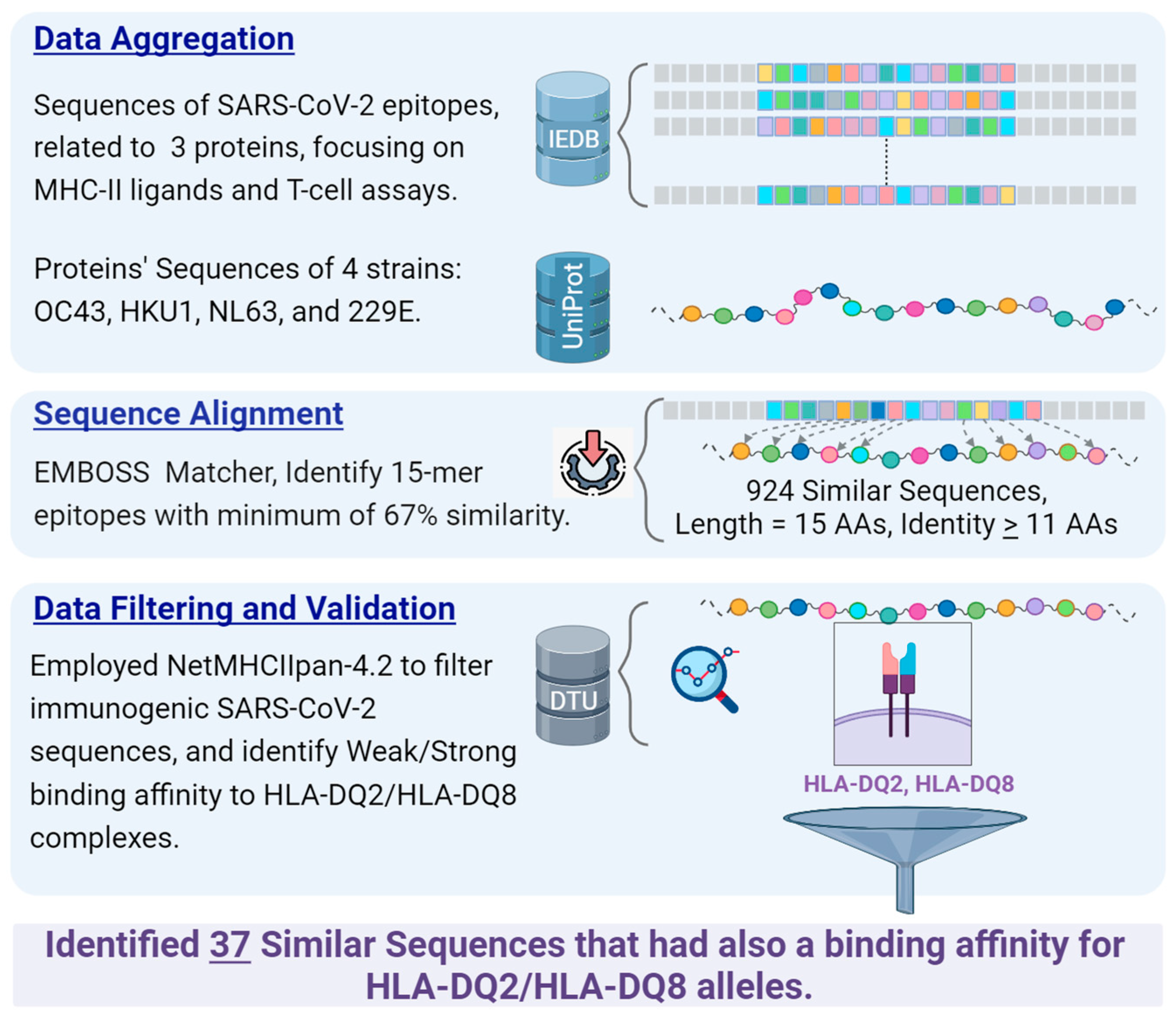
Figure 2.
Homology between SARS-CoV-2 and CCC epitope sequences, in relation to HLA-DQ2/8. Each panel represents a specific protein: (A) Spike Glycoprotein, (B) NSP3, (C) NSP12, and (D) NSP13. The dark blue lines indicate the percentage of homology between SARS-CoV-2 and the highest matching CCC (among 229E, NL63, HKU1, and OC43). Only similarities of 40% or above are shown. Regions displaying significant binding to HLA-DQ2/HLA-DQ8 alleles are highlighted in red.
Figure 2.
Homology between SARS-CoV-2 and CCC epitope sequences, in relation to HLA-DQ2/8. Each panel represents a specific protein: (A) Spike Glycoprotein, (B) NSP3, (C) NSP12, and (D) NSP13. The dark blue lines indicate the percentage of homology between SARS-CoV-2 and the highest matching CCC (among 229E, NL63, HKU1, and OC43). Only similarities of 40% or above are shown. Regions displaying significant binding to HLA-DQ2/HLA-DQ8 alleles are highlighted in red.
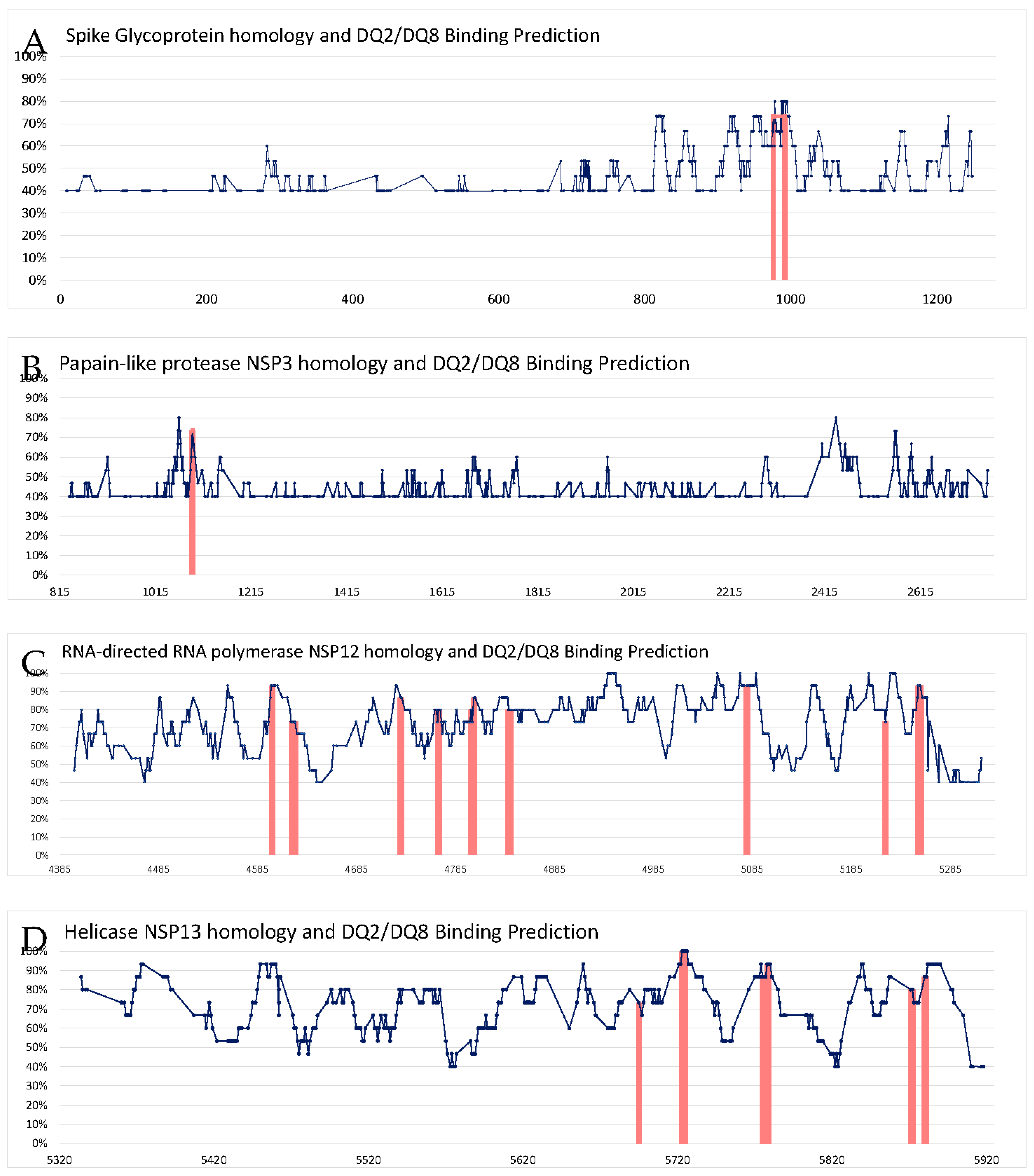

Table 1.
Protective HLA variants in celiac disease.
| Protective HLA alleles | Country | References |
|---|---|---|
| HLA-DPB1*04:01 | Germany, Finland, Sweden, and the United States | [42] |
| HLA C14, DR11, DR15, DQ3 | Turkey | [43] |
| Cw4 and DQ1 | Spain | [44] |
| HLADQB1*06 | Brazil | [45] |
| DRB1*13, DQA1*0102, DQB1*06 | Tunisia | [46] |
| DQB1*0502/DQA1*0102 | Sardinia | [47] |
| MICA-A5.1 | Spain | [48] |
| MICA-A9 | Basque country, Spain | [49,50] |
| DQA1*0101, DQA1*0201, DQB1*0301 | Chile | [51] |
It can be concluded that multiple HLA are protective towards CD.
Table 2.
Intestinal features, events and transmission of COVID-19.
| Gastrointestinal aspects | Enteric features | References |
|---|---|---|
| Symptoms | Diarrhea, nausea, vomiting | [65,66,67] |
| ACE2 expression | All along the GIT | [68,69] |
| Inflammation and damage | Lymphocytic infiltration, edema, necrosis, degeneration, cellular shedding | [70,71] |
| Viral particles, nucleocapsid proteins | In the stomach, duodenum and colonic cells | [70,71,72,73] |
| Stool shading | SARS-CoV-2 RNA in stool | [74,75,76,77] |
| Gut replication | SARS-CoV-2 multiplication in the gut | [76] |
| Feco-Oral Transmission | Infectious virus is recovered from stool and urine samples. | [76,78,79,80] |
| Sewage, Wastewater transmission | SARS-CoV-2 particles, RNA and infectivity | [81,82] |
Table 3.
Sequence alignment between SARS-CoV-2 15-mer epitopes and CCC antigens and HLA-DQ2/8 binding affinity rank.
Table 3.
Sequence alignment between SARS-CoV-2 15-mer epitopes and CCC antigens and HLA-DQ2/8 binding affinity rank.
| SARS-CoV-2 Parent Protein | CCC protein ID | Epitope Sequence CCC vs SARS-CoV-2 |
Identity | % Identity | start | end | HLA-DQA10301-DQB10302 *rank | HLA-DQA10501-DQB10201 *rank |
|---|---|---|---|---|---|---|---|---|
| NSP3 Replicase polyprotein 1ab P0DTD1 | P0C6X5 |
SKDYISSNGPLKVG SDDYIATNGPLKVG |
11/15 | 73.4% | 1086 | 1100 | 4.28 | |
| NSP12 Replicase polyprotein 1ab P0DTD1 | P0C6X2 P0C6X6 P0C6X1 P0C6X5 |
VVGVLTLDNQDLNGN IVGVLTLDNQDLNGN |
14/15 | 93.3% | 4593 | 4607 | 4.33 | |
| P0C6X2 |
DFIQTAPGFGVAVAD DFIQTTPGSGVPVVD |
11/15 | 73.3% | 4613 | 4627 | 3.38 | ||
|
FIQTAPGFGVAVADS FIQTTPGSGVPVVDS |
11/15 | 73.3% | 4614 | 4628 | 1.15 | 4.18 | ||
|
IQTAPGFGVAVADSY IQTTPGSGVPVVDSY |
11/15 | 73.3% | 4615 | 4629 | 0.76 | 2.75 | ||
|
QTAPGFGVAVADSYY QTTPGSGVPVVDSYY |
11/15 | 73.3% | 4616 | 4630 | 0.63 | 2.24 | ||
| P0C6X2 P0C6X6 |
RQIFVDGVPFVVSIG RKIFVDGVPFVVSTG |
13/15 | 86.7% | 4723 | 4737 | 4.34 | ||
|
KDLLLYAADPAMHVA KELLVYAADPAMHAA |
12/15 | 80.0% | 4761 | 4775 | 4.3 | |||
| P0C6X6 |
TSGVKFQTVKPGNFN TNNVAFQTVKPGNFN |
12/15 | 80.0% | 4794 | 4808 | 3.03 | ||
|
SGVKFQTVKPGNFNQ NNVAFQTVKPGNFNK |
11/15 | 73.3% | 4795 | 4809 | 1.6 | |||
| P0C6X2 P0C6X6 |
VKFQTVKPGNFNQD VAFQTVKPGNFNKD |
12/15 | 80.0% | 4796 | 4810 | 0.7 | ||
|
VKFQTVKPGNFNQDF VAFQTVKPGNFNKDF |
13/15 | 86.7% | 4797 | 4811 | 2.98 | |||
|
FFFTQDGNAAITDYN FFFAQDGNAAISDYD |
12/15 | 80.0% | 4832 | 4846 | 2.9 | |||
|
FFTQDGNAAITDYNY FFAQDGNAAISDYDY |
12/15 | 80.0% | 4833 | 4847 | 1.98 | |||
|
FTQDGNAAITDYNYY FAQDGNAAISDYDYY |
12/15 | 80.0% | 4834 | 4848 | 2.12 | |||
| P0C6X5 P0C6X1 P0C6X2 P0C6X6 |
SSGDATTAFANSVFN SSGDATTAYANSVFN |
14/15 | 93.3% | 5073 | 5087 | 4.91 | 2.73 | |
| P0C6X2 |
DYVYLPYPDPS DYVYLPYPDPS |
11/15 | 73.3% | 5213 | 5227 | 4.02 | ||
| P0C6X5 P0C6X1 P0C6X2 P0C6X6 |
LLIERFVSLAIDAYP LMIERFVSLAIDAYP |
14/15 | 93.3% | 5246 | 5260 | 3.36 | 1.42 | |
|
LIERFVSLAIDAYPL MIERFVSLAIDAYPL |
14/15 | 93.3% | 5247 | 5261 | 4.39 | 1.75 | ||
|
IERFVSLAIDAYPL IERFVSLAIDAYPL |
14/15 | 93.3% | 5248 | 5262 | 1.53 | |||
|
ERYVSLAIDAYPLSK ERFVSLAIDAYPLTK |
13/15 | 86.7% | 5249 | 5263 | 3.4 | |||
| NSP13 Replicase polyprotein 1ab P0DTD1 | P0C6X5 P0C6X1 |
PEVNADIVVVDEVSM PETTADIVVFDEISM |
11/15 | 73.3% | 5688 | 5702 | 1.08 | |
| P0C6X2 P0C6X6 |
RAKHYVYIGDPAQLP RAKHYVYIGDPAQLP |
15/15 | 100.0% | 5716 | 5730 | 3.24 | ||
| P0C6X5 P0C6X1 P0C6X2 P0C6X6 |
AKHYVYIGDPAQLPA AKHYVYIGDPAQLPA |
15/15 | 100.0% | 5717 | 5731 | 2.45 | ||
|
KHYVYIGDPAQLPAP KHYVYIGDPAQLPAP |
15/15 | 100.0% | 5718 | 5732 | 3.52 | |||
|
CPKEIVDTVSALVYE CPAEIVDTVSALVYD |
13/15 | 86.7% | 5768 | 5782 | 3.27 | |||
|
PKEIVDTVSALVYEN PAEIVDTVSALVYDN |
13/15 | 86.7% | 5769 | 5783 | 2.67 | 1.3 | ||
|
EIVDTVSALVYENK EIVDTVSALVYDNK |
13/15 | 86.7% | 5770 | 5784 | 1.09 | 0.65 | ||
|
EIVDTVSALVYENKL EIVDTVSALVYDNKL |
14/15 | 93.3% | 5771 | 5785 | 1.61 | 2.77 | ||
| P0C6X6 P0C6X2 |
IVETVSALVYDNKLK IVDTVSALVYDNKLK |
14/15 | 93.3% | 5772 | 5786 | 4.2 | ||
| P0C6X5 P0C6X1 P0C6X2 P0C6X6 |
EYDYVIYSQTAETAH EYDYVIFTQTTETAH |
12/15 | 80.0% | 5864 | 5878 | 3.76 | ||
| P0C6X1 P0C6X2 P0C6X6 |
YDYVIYSQTAETAHS YDYVIFTQTTETAHS |
12/15 | 80.0% | 5865 | 5879 | 3.07 | ||
| P0C6X1 P0C6X5 P0C6X2 P0C6X6 |
TAETAHSVNVNRFNV TTETAHSCNVNRFNV |
13/15 | 86.7% | 5873 | 5887 | 3.43 | ||
|
ETAHSVNVNRFNVA ETAHSCNVNRFNVA |
13/15 | 86.7% | 5874 | 5888 | 2.98 | |||
| Spike glycoprotein P0DTC2 | Q5MQD0 |
FGAISSSLQEILSR FGAISSVLNDILSR |
11/15 | 73.4% | 969 | 983 | 4.86 | |
| P36334 Q5MQD0 |
DALEAQVQIDRLING DKVEAEVQIDRLITG |
11/15 | 73.3% | 985 | 999 | 4.45 | 4.48 | |
|
DALEAQVQIDRLING DPPEAEVQIDRLITG |
11/15 | 73.3% | 985 | 999 | 2.93 | 3.24 |
* The two columns on the right-hand side display the binding rank. Those ranked in the top 1% were classified as potential SB, and those ranked in the top 5% were classified as WB.
Disclaimer/Publisher’s Note: The statements, opinions and data contained in all publications are solely those of the individual author(s) and contributor(s) and not of MDPI and/or the editor(s). MDPI and/or the editor(s) disclaim responsibility for any injury to people or property resulting from any ideas, methods, instructions or products referred to in the content. |
© 2023 by the authors. Licensee MDPI, Basel, Switzerland. This article is an open access article distributed under the terms and conditions of the Creative Commons Attribution (CC BY) license (http://creativecommons.org/licenses/by/4.0/).
Copyright: This open access article is published under a Creative Commons CC BY 4.0 license, which permit the free download, distribution, and reuse, provided that the author and preprint are cited in any reuse.


