

Submitted:
10 November 2023
Posted:
16 November 2023
You are already at the latest version
Abstract
Background and Objectives: Previous studies revealed anti-angiogenic, antiproliferative and anti-inflammatory effects of Vitamin D on cancer cells. Although this body of evidence supported the correlation of high Vitamin D levels with reduced incidence rates for various malignancies, contradictory results were reported regarding non-melanoma skin cancer (NMSC). Aim of this overview was to summarize the available evidence from the existing pool of systematic reviews and meta-analyses, focusing on Vitamin D serum status, dietary intake, and Vitamin D receptor (VDR) polymorphisms in correlation to NMSC incidence. Materials and Methods: A literature search in electronic databases was conducted from inception to January 2023. Inclusion criteria were systematic reviews and meta-analyses published in peer-reviewed journals, evaluating Vitamin D serum levels, dietary and/or supplementary intake, or VDR gene polymorphisms, and reporting data on NMSC. Results: A total of 10 studies were included in the data analysis models. A positive association between Vitamin D serum levels and NMSC is highlighted. However, dietary/supplementation of Vitamin D doesn’t exhibit a likewise strong linkage to NMSC. Despite the contradictory findings, VDR polymorphisms may play a crucial role in the intricate NMSC pathogenesis. Conclusions: This umbrella review showed that high Vitamin D levels are associated with increased NMSC incidence, potentially due to its direct correlation with increased sun exposure. Further research on VDR polymorphisms is suggested to explore their true effect size on NMSC risk.
Keywords:
Non-melanoma skin cancer
; Vitamin D
; risk
; Vitamin D receptor
; review
; VDR polymorphism
1. Introduction
Non-melanoma skin cancer (NMSC) remains the prevailing malignancy in the Caucasian population, displaying a steadily rising yearly rate, with basal cell carcinoma (BCC) and squamous cell carcinoma (SCC) being the most frequent [1-3]. Primary NMSC risk factors are considered the cumulative amounts of ultraviolet radiation, as well as the aging population, earlier disease detection, improved registration processes, and climate change [4,5]. Despite the low mortality rates witnessed, these tumors exert a hefty economic burden on the health systems and present significant morbidity, specifically in patients with facial tumors, who may require challenging reconstructive operations [6,7].
Vitamin D is a fat-soluble vitamin widely debated over the past decade for its multi-dimensional functionality, currently considered of hormonal nature. Its actions are mediated by its binding to the Vitamin D receptor (VDR), which then translocates to the nucleus to regulate the expression of genes. Apart from its vital contribution to the bone and muscle strength, Vitamin D acts as a progenitor of the steroidal hormones, and actively modulates the immune system, exerting anti-angiogenic, antiproliferative, and anti-inflammatory effects on cancer cells [8]. The efficiency of these mechanisms is widely supported by the current literature, as several studies correlate high Vitamin D serum levels with reduced incidence rates for various malignancies such as colon, breast, ovarian, and lung cancer [9,10].
The principal source of Vitamin D is cutaneous synthesis through direct sun exposure, while dietary intake contributes to a lesser extent, since only mere quantities have been traced in various foods. However, excessive exposure to ultraviolet radiation induces DNA damage and gene mutations in skin cells, promoting photoaging and skin cancer [11]. The dietary supplements have been introduced to combat the worldwide phenomenon of Vitamin D deficiency, with estimations suggesting that about a billion people display deficient or insufficient vitamin levels [12]. Nonetheless, current data on the association between Vitamin D and NMSC stand conflicting [13,14].
The aim of this overview is to summarize the evidence from the existing pool of systematic reviews (SR), and meta-analyses (MA), focusing on Vitamin D serum status, dietary intake and VDR polymorphisms in correlation to NMSC, synthesize the findings to explore any potential causal relations, and finally investigate contradictive results.
2. Materials and Methods
An umbrella review was conducted using a predetermined protocol established according to the Cochrane guide for Overviews of Reviews [15]. The review adhered to the PRIOR (Preferred Reporting Items for Overviews of Systematic Reviews) guidelines (Table S1) [16]. The review protocol was registered at PROSPERO (registration no. CRD42023397779).
2.1. Search strategy
An electronic literature search in MEDLINE (PubMed), Scopus, and the Cochrane Database of Systematic Reviews electronic databases was conducted from inception to January 2023. The string search [“vitamin D”] and [“NMSC”] was applied. The PubMed search strategy can be found in Appendix A. No time and language restrictions were applied. This search was supplemented by a review of reference lists of potentially eligible studies and a manual search of key journals in the field of skin cancer over the last 10 years.
2.2. Eligibility of Relevant Studies
The target population was adult patients diagnosed with non-melanoma skin cancer for whom Vitamin D serum levels were recorded. Studies met the following inclusion criteria: (1) Systematic review of randomized controlled trials (RCT) or meta-analysis. SRs of both randomized and observational trials were considered eligible for inclusion, only in case they presented a subgroup analysis of RCTs; (2) evaluation of NMSC patients; (3) reported data on Vitamin D serum levels, dietary and/or supplemental intake, or relevant gene polymorphisms; and (4) publication in a peer-reviewed journal. We excluded studies reporting vitamin D in patients with other cancer types than NMSC, and review articles, duplicate reports, editorials, and correspondences.
2.3. Data Collection and Risk of Bias Assessment
Data extraction was conducted independently by two authors using a standardized form. Discrepancies were resolved by consensus. The reviewers extracted data, including the general study characteristics (including databases searched, primary studies, existence of a pre-registered protocol, reporting according to PRISMA, assessment of risk of bias), population characteristics, and outcomes of interest (estimates of effect and NMSC relative risks assessed by every SR). Data regarding the assessment of publication bias and heterogeneity of studies were also recorded.
The quality of studies was evaluated using the AMSTAR-2 (Assessment of Multiple Systematic Reviews-2) tool [17].
2.4. Data synthesis and analysis
Narrative synthesis was performed due to the high heterogeneity of the retrieved data. We presented the estimate of the pooled effect sizes of the intervention from included meta-analyses, with their corresponding 95% confidence intervals and p-values, with hazard ratio (HR) for continuous, and odds ratio (OR) or risk ratio (RR) for dichotomous variables.
To make decisions about the inclusion of overlapping SRs in our overview, we used the evidence-based decision tool, which was developed by Pollock et al [18]. According to this, we decided to follow the full inclusion scenario, thus including all eligible Cochrane and non-Cochrane reviews, regardless of the extent of overlap, and if they addressed the same research question, as this is the most comprehensive approach [18]. We then assessed the extent of overlapping among the chosen SRs by estimating the overall corrected covered area (CCA) considering chronological structural missingness [19]. We visualized the overlapping SRs with a heatmap using the “ccaR” package in R, version 4.2.3 (R Foundation for Statistical Computing, Austria) [20,21].
3. Results
Our literature search yielded a total of 269 relevant articles. Ten SRs fulfilled our eligibility criteria and were included in the review, with 7 of those conducting meta-analysis of the data [13,14,22-29]. The study selection process is depicted by the flow diagram (Figure 1).
The studies included in our overview were published between 2009 and 2022. Their detailed characteristics are presented on Table 1. The most searched database was Pubmed utilized by all authors, followed by EMBASE and ISI Web of Science. Six of these studies directly investigated the association of Vit D and NMSC, mainly in Europe and USA, one study investigated Vitamin D and BCC formation while another study focused on several types of cancer including NMSC. The remaining two examined the chemoprotective role of Vitamin D on BCC and SCC, with Sutedja et al. testing its role in patients with confirmed malignancies [27]. Of note, Abdelwahab et al. included 4 studies from Mahamat-Saleh et al. in their review [22].
Overall, 4 RCTs were included in 4 out of the total 10 SRs, included in the overview, as portrayed in the citation matrix (Table S2). The degree of overlap of primary studies across the SRs, based on the overall corrected covered area (CCA) was 15.1% and 23.6% when chronological structural missingness was considered, which indicates high overlap among studies. The heatmap in Figure 2 presents the degree of overlap between pairs of SRs where the CCA values have been adjusted for structural missingness.
Odds ratios (with 95% CI) of the outcomes of interest are analyzed and presented below, as forest plots, along with core information of the overview (Table 2, Table 3 and Table 4).
3.1. Vitamin D serum levels & NMSC
Table 2 summarizes the study characteristics, regarding the association of Vit D serum levels and NMSC. Five SRs, with 3 of those undertaking meta-analysis, reported data on the outcome of interest, incorporating one RCT among the studies. The 3 MAs compared the highest vs the lowest quantiles of Vitamin D serum level concentration and the formation of NMSC. Two out of three reported a significant positive association for the highest quantile with 1.64 RR ([1.11-2.43], I2=86%, 249108 patients) and 1.64 RR [1.02-2.65], I2=81%, 2317 patients) while the third also marked a trend towards the same direction (1.67 RR [0.61-4.56], I2=91%, 3899 patients) [13,23,24].
Mahamat-Saleh et al. explored NMSC risk per 30 nmol/L of Vitamin D increment in a dose response meta-analysis, posting 1.30 RR [1.13-1.49], I2=86%) [13]. The strongest relative risk for NMSC was observed at a level of approximately 60 nmol/L of 25(OH) D with a weaker association beyond this level. Stratification for BCC and SCC cancer types showed an increased risk for BCC 1.41 RR ([1.19-1.67, I2=44%) and a positive trend for the SCC 1.57 RR ([0.64-3.86], I2=88.4%). In their highest vs lowest quantile analysis, the results were 1.82 RR [1.49-2.21] and 1.80 RR [0.64-5.04]. Caini et al. also performed a stratified quantile analysis for BCC and SCC formation, reporting significant results only for the BCC cancer type, with 1.82 RR ([1.38-2.40], I2=0%) and 1.68 RR ([0.44-6.39], I2=81%) respectively [23]. Furthermore, in their most recent SR, Caini et al. engaged in a linear dose response analysis which showed significant results in 3 of the studies and a trend towards the same direction in two more [24].
Two SRs conducted narrative synthesis of the data, displaying conflicting results. Abdelwahab et al. concluded that 4 studies supported an association between BCC formation and high levels of Vitamin D, whereas the other 4 studies supported an association between BCC formation and low levels of Vitamin D [22]. Giammanco et al stated that two of the studies included in their review pinpointed a positive association between plasma levels of Vitamin D and NMSC including SCC and BCC, while one study highlighted decreased risk of NMSC in older Caucasian men [26].
3.2. Vitamin D dietary and/or supplemental intake
The results of the data extraction on Vitamin D dietary and/or supplement intake and NMSC are presented on Table 3. Five SRs with 2 of those undertaking meta-analysis reported data on the outcome of interest, incorporating two RCTs among the studies.
Mahamat-Saleh et al. concluded that there is a significantly increased risk of BCC with Vitamin D dietary intake (100UI/day) (1.04 RR ([1.02-1.06], I2=9.8%), but also for supplemental intake (100UI/day) (1.02 RR [1.00-1.03], I2=36.7%) and for total Vitamin D intake (1.02 RR [1.00-1.03], I2=77.7%)[13]. Similar results were reached after a highest vs lowest quantile analysis for dietary intake with 1.13 RR ([1.08-1.18], I2=0%), supplemental intake (1.07 RR [1.03-1.12], I2=0%) and for total intake of Vitamin D (1.10 RR [1.05-1.15], I2=0%). However, no significant associations were highlighted in the case of SCC. In their MA, Caini et al. also performed a quantile analysis for Vit D dietary intake and discovered a positive trend for NMSC (1.03 RR [0.95-1.13], I2=0%) without achieving statistical significance though [23].
In a recent SR, Caini et al. proceeded in a narrative synthesis of the data they extracted, due to the high heterogeneity observed among the 5 studies they included [24]. Only one study indicated a significant association of increased risk for BCC among those in the highest quantile of intake, while on the other hand, no such outcome was produced for SCC. Gandini et al. discovered a protective effect in the highest quantile for cutaneous melanoma, but when NMSC was incorporated in the analysis no indication of a possible association remained [14]. Sutedja et al. investigated the chemoprotective properties of Vitamin D after administration in patients diagnosed with skin malignancies [27]. Three out of 4 studies reported a potential protective effect displaying a trend in reducing incidence rates of NMSC and inducing tumor regression. The fourth study indicated significant tumor regression after combination treatment with Vitamin D and diclofenac.
3.3. VDR polymorphisms and NMSC
The results of the data extraction on VDR polymorphisms and NMSC are presented on Table 4. In total, 5 SRs reported data on the outcome of interest, with 4 of those undertaking meta-analysis, incorporating no RCTs among the studies.
The Apal polymorphism was studied in relation to NMSC in 3 of the SRs included, giving varying results. Zhao et al. found that genotypes in specific were correlated with significantly increased chances of developing NMSC (Aa vs AA: 1.72 OR [1.51-2.57], Aa+aa vs AA: 1.50 OR [1.03-2.17]) [29]. In contrast, Xu et al. demonstrated a significant negative association only for AA+aa vs AA genotype with BCC formation (0.59 OR [0.39,0.91]), as all others were insignificant [28]. On the other hand, Caini et al. presented no significant associations [24].
The Taql polymorphisms were also studied in the previously mentioned 3 SRs. Zhao et al. indicated significant results for 3 genotypes displaying increased chances of developing NMSC (Tt vs TT: 1.88 OR [1.29- 2.74], Tt vs TT: 2.00 OR [1.22-3.28], Tt+tt vs TT: 1.92 OR [1.35, 2.73], with Xu et al. supporting these associations by reporting 4 genotypes with increased likelihood of BCC (tt vs TT: 2.12 OR [1.21–3.71] I2=26.4%, Tt vs TT:2.14 OR [1.38–3.32] I2=0%, tt+Tt vs TT: 2.14 OR [1.43–3.22] I2=16%, t allele vs T allele 1.59 OR [1.20-2.11] ] I2=49.4%) [28,29]. Once again, no significant associations were highlighted by Caini et al [24].
The Fokl polymorphism was also investigated in 3 SRs. Zhao et al. reported a significant association between the ff vs FF genotype and NMSC (2.42 OR [1.03-5.68]), with Gandini et al. indicating a positive relationship for Ff and ff vs. wildtype genotypes (1.30 OR [1.03-1.63] I2=0%)[14,29]. In the SR of Caini et al., one of the 2 studies reporting on the Fokl polymorphism highlighted a significant association for TT (Hom) which greatly increased the chances of BCC (10.14 OR)[24].
The Bsml polymorphism was studied in 4 SRs. In their review, Denzer et al. pinpointed a significant relationship for BB genotype and SCC (1.51 OR)[25]. Moreover, the interaction between the Bsml polymorphism and high total Vitamin D intake led to an almost 2-fold higher risk of SCC in women with BB genotype (2.38 OR). Gandini et al. showed positive trends for the Bb and BB genotypes vs. the wild type concerning SCC formation, reporting 1.05 OR [0.76-1.44] and 1.51 OR [1.00-2.28][14]. On the other hand, Zhao et al. and Caini et al. marked no significant associations for this polymorphism [24,29].
3.4. Methodological quality of included studies
According to the AMSTAR-2 tool, the overall confidence in the results of the included studies is characterized as low. One study (10%) reported on the existence of a predetermined study protocol [23]. Selection of studies in duplicate was carried out for 2 studies (20%) [23,24]. A higher percentage on duplicate data extraction was reached, since 4 studies (40%) proceeded accordingly [13,23,28,29].
Most of the studies’ literature searches (80%) were considered as “partially comprehensive” [13,14,22-24,26,27,29]. A list of excluded primary studies after full- text review, accompanied by justification for the exclusions, was not provided by any of the included studies. None of the SRs reported on any funding of their included primary studies. All SRs reported potential conflict of interest in their design, including any funding received. A risk of bias assessment with an appropriate tool was performed in 40% of the SRs [13,22-24].
4. Discussion
Our overview highlights a positive association between Vitamin D serum levels and NMSC, even though some studies suggest the presence of an inverse relationship. On the other hand, high dietary or supplemental Vitamin D intake doesn’t seem to exhibit a likewise strong linkage to NMSC. Only in one meta-analysis the populations of the highest circulating values displayed increased rates of BCC formation specifically, with low relative risks, however. No such significant differences were reproduced for the SCC subgroups or for NMSC in general among the other SRs reporting on this outcome. Furthermore, despite the contradictory body of the evidence, VDR polymorphisms may partake in the intricate pathogenesis of NMSC. More data are surely mandated to properly establish their influence on skin tumor formation.
Vitamin D has been the focus of intense research because it is regarded as critical, participating in several physiological functions, and thus its blood concentration optimization is suggested. The unique trait of Vitamin D is its synthesis in the body through direct sun exposure. Ultraviolet radiation interacts with a form of cholesterol in the skin, triggering a cascade of reactions eventually resulting in Vitamin D production [30]. Afterwards, by binding to carrier proteins, in particular VDPB, it is transported to the liver and kidneys where it is converted to calcitriol, its active form, also known as 1,25-dihydroxyvitamin D3 [31]. This is the most active form of Vitamin D, which promotes its functions by binding to a single receptor present in almost all tissues of the human body, the VDR, thus regulating gene expression and cellular metabolism [32]. The VDR is a member of the class II of steroidal hormones, showing close relations to the retinoic acid, and thyroid hormone receptor [33]. Of all the genes identified to date, the most powerfully regulated is the CYP24 or 24-hydroxylase enzyme, which is responsible for Vitamin D degradation [33].
Traditionally, Vitamin D is regarded to promote calcium and phosphate absorption, maintaining a delicate balance between these two metabolites, and ultimately inducing bone and teeth health. However, Vitamin D possesses also anti-tumor properties, with its ability to impede or delay the growth of specific cancer types [9,10]. This anti-tumor effect is exerted, among others, by regulating cell proliferation. Calcitriol, for example, can prevent the growth of malignant cells by inducing cell cycle arrest, promoting apoptosis, and encouraging the differentiation of both normal and cancerous cells [34,35]. It is also known to stimulate the differentiation of a variety of immature hematopoietic myeloid cells into mature cells [36]. Moreover, it can encourage myeloid leukemia cell lines to differentiate terminally into monocytes/macrophages. Studies conducted on numerous colorectal cancer models have demonstrated the tumor-inhibiting and pro-differentiation effects of calcitriol or its analogs [37]. Additionally, Vitamin D's anti-cancer properties involve the regulation of androgen and estrogen receptor signaling, while it also plays a crucial role in the modulation of growth factors, oncogene and tumor-suppressor gene expression [37]. Inflammation contributes to the development of many cancers, with inflammatory mediators like cytokines, chemokines, and prostaglandins enhancing malignancy potential [38,39]. Recent findings regarding Vitamin D anti-inflammatory properties support its beneficial role in combating carcinogenesis, by regulating key molecular pathways involved in inflammation, such as inhibiting prostaglandin and cytokine synthesis, inhibiting nuclear factor signaling, and suppressing pro-angiogenic factors [37].
In contrast to the evident and well-established protective role of Vitamin D against several malignancies, the results of our overview indicate a positive association between Vitamin D serum levels and NMSC occurrence. Conversely, sun exposure which is the key factor required in the process of Vitamin D production may act as a confounding factor in this association, since data on this aspect is generally lacking [40]. In particular, ultraviolet radiation induces skin carcinogenesis through a complex process involving DNA damage, inflammation, and immune suppression as it penetrates the epidermis and is absorbed by cellular components, specifically DNA [41]. The resulting DNA damage from the production of cyclobutene pyrimidine dimers and reactive oxygen species can cause mutations potentially affecting critical tumor-suppressor genes and proto-oncogenes, that ultimately lead to cancer [41,42]. Critical assessment of this data generates the assumption that Vitamin D levels have to be limited to a specific range and, if possible, its absorption should be maintained through dietary or supplemental intake. Thus, sun exposure should remain reasonable for Vitamin D production and its anti-tumor effects to be achieved, but not excessive, which can instigate carcinogenesis. Indeed, Mahamat-Saleh et al. support that the strongest relative risk for NMSC peaked at approximately 60nmol/L,by examining the evidence of non-linear dose response association [13]. The same notion is backed by Abdelwahab et al., concluding that keeping Vitamin D levels between 15 and 30 nmol/L is considered safe, without increasing the risk of tumor progression [22].
Concerning Vitamin D dietary or supplementation intake, most studies display no association. Mahamat-Saleh et al. report, however, a weak, yet positive relationship between increased dietary and/or supplemental Vitamin D intake and BCC formation [13]. Moreover, one study included by Caini et al. showcases similar results [24]. It is extremely hard to construct a concrete explanation on this phenomenon, bearing in mind the mounting evidence of the protective effects Vitamin D exerts in tumorigenesis. Nonetheless, the association observed was mild and limited only to BCC with data provided solely from observational studies, which are known for their susceptibility to biases. None of these associations were confirmed in the strict context of a RCT. Therefore, it is relatively safe to say that a strong association between Vitamin D intake or supplementation and NMSC is unlikely. To this direction, well-conducted experimental studies should enhance the existing pool of evidence and promote supplementation or intake as a safe way of raising Vitamin D serum levels, preserving thus its manifested benefits.
Vitamin D receptor gene polymorphisms obviously play a significant role in the complex path of NMSC development, according to the results of this overview. The resulting alteration can lead to impaired Vitamin D functionality or even unsettle its own metabolism. For instance, the Fokl polymorphism leads to an entirely different gene product [43]. The f allele, which results in this longer protein, appears to be less effective in the transcription of a VDR, showing its relevance on functional impairment [44]. The Bsml and Taql are 3’-end polymorphisms and display no evidence of a functional effect on VDR activity [45]. Nonetheless, these 3'-end polymorphisms is thought to influence messenger RNA stability and VDR gene transcription regulation [46]. The combined impact of bb, ff, and tt genotypes could potentially result in decreased cellular activity within the Vitamin D system, with some in vitro studies confirming these hypotheses (Bsml/Apal/Taql) [47]. On the other hand, the Cdx2 polymorphism alters the transcriptional activity of the promoter region, as A allele correlates with increased VDR gene transcription activity [48]. Surely more research is due on this specific field to properly determine the measures of effect, since the number of relevant studies are relatively few.
Network meta-analyses and umbrella reviews present the most recent advances in the era of Evidence-based Medicine, enabling the analysis and synthesis of the best data available on a complicated research question, while highlighting questions to be further explored [49,50]. This overview is the first attempt to synthesize all relevant evidence on the effects of Vitamin D on NMSC incidence. Essentially, it provides a methodologically induced summary of the existing information, gathered in a single research paper, contributing to the interpretation of the data, and thus guiding research and clinical decision making. Among the strengths of this overview, is the rigorous methodology implemented, limiting the study risk of bias, and thereforeenhancing the presented outcomes of interest. In addition, the utilization of a tool to grade the confidence of the reported results further improved the analysis of the outcomes studied.
Nevertheless, this overview is still subject to limitations. Of note are the methodological quality scores of the included SRs, as evaluated by the relevant but stringent AMSTAR tool, potentially introducing bias. The relatively small number of RCTs contained in the SRs is also worth mentioning. Moreover, the degree of primary study overlap was observed to be remarkable, which is indicative of reproducibility of outcomes among the SRs.
5. Conclusions
In conclusion, despite the cataclysmic positive evidence of Vitamin D anti-tumor effects, significant associations have been established between the vitamin high serum levels and NMSC incidence. To mitigate this risk while maintaining the health benefits of Vitamin D, alternate sources of the vitamin, such as the dietary or supplementation intake, may be the preferred approaches. This could potentially reduce the well-associated NMSC risk with increased sun exposure. Further research should be conducted on VDR polymorphisms to shed light on our understanding of their true effect size on NMSC genesis.
Author Contributions
Conceptualization, N.B. and K.S.; literature survey and database curation, N.B. and K.S.; writing—original draft preparation, N.B. and K.S.; writing—review and editing the full content of the manuscript, K.S and C.S.; supervision, K.S. and C,.S. All authors have read and agreed to the published version of the manuscript.
Funding
None.
Institutional Review Board Statement
Not applicable.
Informed Consent Statement
Not applicable.
Data Availability Statement
Not applicable.
Conflicts of Interest
The authors declare no conflict of interest.
References
- Demers, A.A.; Nugent, Z.; Mihalcioiu, C.; Wiseman, M.C.; Kliewer, E.V. Trends of nonmelanoma skin cancer from 1960 through 2000 in a Canadian population. J Am Acad Dermatol 2005, 53, 320–328. [Google Scholar] [CrossRef] [PubMed]
- Staples, M.P.; Elwood, M.; Burton, R.C.; Williams, J.L.; Marks, R.; Giles, G.G. Non-melanoma skin cancer in Australia: the 2002 national survey and trends since 1985. Med J Aust 2006, 184, 6–10. [Google Scholar] [CrossRef] [PubMed]
- Rogers, H.W.; Weinstock, M.A.; Feldman, S.R.; Coldiron, B.M. Incidence Estimate of Nonmelanoma Skin Cancer (Keratinocyte Carcinomas) in the U.S. Population, 2012. JAMA Dermatol, 2015; 151, 1081–1086. [Google Scholar]
- Roewert-Huber, J.; Lange-Asschenfeldt, B.; Stockfleth, E.; Kerl, H. Epidemiology and aetiology of basal cell carcinoma. Br J Dermatol 2007, Suppl 2, 47–51. [Google Scholar] [CrossRef]
- Nan, H.; Kraft, P.; Hunter, D.J.; Han, J. Genetic variants in pigmentation genes, pigmentary phenotypes, and risk of skin cancer in Caucasians. Int J Cancer 2009, 125, 909–917. [Google Scholar] [CrossRef] [PubMed]
- Seretis K, Bounas N, Lykoudis EG. Repair of a Large Defect Involving the Cheek and Ear. Dermatol Surg 2023, 49, 197–199. [Google Scholar] [CrossRef]
- Thomaidis, V.; Seretis, K.; Fiska, A.; Tamiolakis, D.; Karpouzis, A.; Tsamis, I. The scalping forehead flap in nasal reconstruction: report of 2 cases. J Oral Maxillofac Surg 2007, 65, 532–440. [Google Scholar] [CrossRef]
- Jeon, S.M.; Shin, E.A. Exploring vitamin D metabolism and function in cancer. Exp Mol Med 2018, 50, 1–14. [Google Scholar] [CrossRef]
- Garland, C.F.; Garland, F.C.; Gorham, E.D.; Lipkin, M.; Newmark, H.; Mohr, S.B.; Holick, M.F. The role of vitamin D in cancer prevention. Am J Public Health 2006, 96, 252–261. [Google Scholar] [CrossRef]
- Zhang, L.; Wang, S.; Che, X.; Li, X. Vitamin D and lung cancer risk: a comprehensive review and meta-analysis. Cell Physiol Biochem 2015, 36, 299–305. [Google Scholar] [CrossRef]
- Narayanan, D.L.; Saladi, R.N.; Fox, J.L. Review: Ultraviolet radiation and skin cancer. Int J Dermatol 2010, 49, 978–986. [Google Scholar] [CrossRef] [PubMed]
- Holick, M.F. Vitamin D deficiency. N Engl J Med 2007, 357, 266–281. [Google Scholar] [CrossRef] [PubMed]
- Mahamat-Saleh, Y.; Aune, D.; Schlesinger, S. 25-Hydroxyvitamin D status, vitamin D intake, and skin cancer risk: a systematic review and dose-response meta-analysis of prospective studies. Sci Rep 2020, 10, 13151. [Google Scholar] [CrossRef] [PubMed]
- Gandini, S.; Raimondi, S.; Gnagnarella, P.; Doré, J.F.; Maisonneuve, P.; Testori, A. Vitamin D and skin cancer: a meta-analysis. Eur J Cancer 2009, 45, 634–641. [Google Scholar] [CrossRef] [PubMed]
- Pollock, M.; Fernandes, R.M.; Becker, L.A.; Pieper, D.; Hartling, L. Chapter V: Overviews of Reviews. Cochrane Training. Cochrane 2022, 6. [Google Scholar]
- Bougioukas, K.I.; Bouras, E.; Apostolidou-Kiouti, F.; Kokkali, S.; Arvanitidou, M.; Haidich, A.B. Reporting guidelines on how to write a complete and transparent abstract for overviews of systematic reviews of health care interventions. J Clin Epidemiol 2019, 106, 70–79. [Google Scholar] [CrossRef]
- Shea, B.J.; Reeves, B.C.; Wells, G.; Thuku, M.; Hamel, C.; Moran, J.; Moher, D.; Tugwell, P.; Welch, V.; Kristjansson, E.; Henry, D.A. AMSTAR 2: a critical appraisal tool for systematic reviews that include randomised or non-randomised studies of healthcare interventions, or both. BMJ 2017, 358, j4008. [Google Scholar] [CrossRef] [PubMed]
- Pollock, M.; Fernandes, R.M.; Newton, A.S.; Scott, S.D.; Hartling, L. A decision tool to help researchers make decisions about including systematic reviews in overviews of reviews of healthcare interventions. Syst Rev 2019, 8, 29. [Google Scholar] [CrossRef]
- Pieper, D.; Antoine, S.L.; Mathes, T.; Neugebauer, E.A.; Eikermann, M. Systematic review finds overlapping reviews were not mentioned in every other overview. J Clin Epidemiol 2014, 67, 368–375. [Google Scholar] [CrossRef] [PubMed]
- Bougioukas, K.I.; Diakonidis, T.; Mavromanoli, A.C.; Haidich, A.B. ccaR: A package for assessing primary study overlap across systematic reviews in overviews. Res Synth Methods 2022, 14, 443–454. [Google Scholar] [CrossRef]
- R Core Team. R: A language and environment for statistical computing. R Foundation for Statistical Computing, Vienna, Austria. 2016.
- Abdelwahab, R.; Huang, R.; Potla, S.; Bhalla, S.; AlQabandi, Y.; Nandula, S.A.; Boddepalli, C.S.; Gutlapalli, S.D.; Lavu, V.K.; Mohammed, L. The Relationship between Vitamin D and Basal Cell Carcinoma: A Systematic Review. Cureus 2022, 14, e29496. [Google Scholar] [CrossRef] [PubMed]
- Caini, S.; Boniol, M.; Tosti, G.; Magi, S.; Medri, M.; Stanganelli, I.; Palli, D.; Assedi, M.; Marmol, V.D. Gandini, S. Vitamin D and melanoma and non-melanoma skin cancer risk and prognosis: a comprehensive review and meta-analysis. Eur J Cancer 2014, 50, 2649-2658.
- Caini, S.; Gnagnarella, P.; Stanganelli, I.; Bellerba, F.; Cocorocchio, E.; Queirolo, P.; Bendinelli, B.; Saieva, C.; Raimondi, S. Gandini, S. Vitamin D and the Risk of Non-Melanoma Skin Cancer: A Systematic Literature Review and Meta-Analysis on Behalf of the Italian Melanoma Intergroup. Cancers (Basel) 2021, 13, 4815.
- Denzer, N.; Vogt, T.; Reichrath, J. Vitamin D receptor (VDR) polymorphisms and skin cancer: A systematic review. Dermatoendocrinol 2011, 3, 205–210. [Google Scholar] [CrossRef] [PubMed]
- Giammanco, M.; Di Majo, D.; La Guardia, M.; Aiello, S.; Crescimannno, M.; Flandina, C.; Tumminello, F.M.; Leto, G. Vitamin D in cancer chemoprevention. Pharm Biol 2015, 53, 1399–1434. [Google Scholar] [CrossRef] [PubMed]
- Sutedja, E.K.; Arianto, T.R.; Lesmana, R.; Suwarsa, O. Setiabudiawan, B. The Chemoprotective Role of Vitamin D in Skin Cancer: A Systematic Review. Cancer Manag Res 2022, 14, 3551-3565.
- X.u, Y.; He, B.; Pan, Y.; Deng, Q.; Sun, H.; Li, R.; Gao, T.; Song, G.; Wang, S. Systematic review and meta-analysis on vitamin D receptor polymorphisms and cancer risk. Tumour Biol, 2014; 35, 4153–4169. [Google Scholar]
- Zhao, X.Z.; Yang, B.H.; Yu, G.H.; Liu, S.Z.; Yuan, Z.Y. Polymorphisms in the vitamin D receptor (VDR) genes and skin cancer risk in European population: a meta-analysis. Arch Dermatol Res 2014, 306, 545–553. [Google Scholar] [CrossRef] [PubMed]
- Webb, A.R. Who, what, where and when-influences on cutaneous vitamin D synthesis. Prog Biophys Mol Biol 2006, 92, 17–25. [Google Scholar] [CrossRef] [PubMed]
- Lehmann, B.; Meurer, M. Vitamin D metabolism. Dermatol Ther 2010, 23, 2–12. [Google Scholar] [CrossRef]
- Kato, S. The function of vitamin D receptor in vitamin D action. J Biochem 2000, 127, 717–722. [Google Scholar] [CrossRef]
- Jones, G.; Strugnell, S.A.; DeLuca, H.F. Current understanding of the molecular actions of vitamin D. Physiol Rev 1998, 78, 1193–1231. [Google Scholar] [CrossRef]
- Deeb, K.K.; Trump, D.L.; Johnson, C.S. Vitamin D signalling pathways in cancer: potential for anticancer therapeutics. Nat Rev Cancer 2007, 7, 684–700. [Google Scholar] [CrossRef]
- Gombart, A.F.; Luong, Q.T.; Koeffler, H.P. Vitamin D compounds: activity against microbes and cancer. Anticancer Res 2006, 26, 2531–2542. [Google Scholar]
- O'kelly, J.; Morosetti, R.; Koeffler, HP. Vitamin D and hematological malignancy. Vitamin D: Elsevier 2005, 1727-1740.
- Krishnan, A.V.; Feldman, D. Mechanisms of the anti-cancer and anti-inflammatory actions of vitamin D. Annu Rev Pharmacol Toxicol 2011, 51, 311–336. [Google Scholar] [CrossRef]
- Allavena, P.; Garlanda, C.; Borrello, M.G.; Sica, A.; Mantovani, A. Pathways connecting inflammation and cancer. Curr Opin Genet Dev 2008, 18, 3–10. [Google Scholar] [CrossRef] [PubMed]
- Mantovani, A.; Allavena, P.; Sica, A.; Balkwill, F. Cancer-related inflammation. Nature 2008, 454, 436–444. [Google Scholar] [CrossRef]
- Bogh, M.K. Vitamin D production after UVB: aspects of UV-related and personal factors. Scand J Clin Lab Invest Suppl 2012, 243, 24–31. [Google Scholar]
- Hussein, M.R. Ultraviolet radiation and skin cancer: molecular mechanisms. J Cutan Pathol 2005, 32, 191–205. [Google Scholar] [CrossRef] [PubMed]
- Kammeyer, A.; Luiten, R.M. Oxidation events and skin aging. Ageing Res Rev 2015, 21, 16–29. [Google Scholar] [CrossRef] [PubMed]
- 43. Nejentsev S, Godfrey L, Snook H, Rance H, Nutland S, Walker NM, et al. Comparative high-resolution analysis of linkage disequilibrium and tag single nucleotide polymorphisms between populations in the vitamin D receptor gene. Hum Mol Genet, 2004; 13, 1633–1639.
- Haussler, M.R.; Whitfield, G.K.; Haussler, C.A.; Hsieh, J.C.; Thompson, P.D.; Selznick, S.H.; Dominguez, C.E.; Jurutka, P.W. The nuclear vitamin D receptor: biological and molecular regulatory properties revealed. J Bone Miner Res 1998, 13, 325–349. [Google Scholar] [CrossRef] [PubMed]
- Zmuda, J.M.; Cauley, J.A.; Ferrell, R.E. Molecular epidemiology of vitamin D receptor gene variants. Epidemiol Rev 2000, 22, 203–217. [Google Scholar] [CrossRef] [PubMed]
- Uitterlinden, A.G.; Fang, Y.; Van Meurs, J.B.; Pols, H.A.; Van Leeuwen, J.P. Genetics and biology of vitamin D receptor polymorphisms. Gene 2004, 338, 143–156. [Google Scholar] [CrossRef]
- Carling, T.; Rastad, J.; Akerström, G.; Westin, G. Vitamin D receptor (VDR) and parathyroid hormone messenger ribonucleic acid levels correspond to polymorphic VDR alleles in human parathyroid tumors. J Clin Endocrinol Metab 1998, 83, 2255–2259. [Google Scholar] [CrossRef]
- Arai H, Miyamoto KI, Yoshida M, Yamamoto H, Taketani Y, Morita K, et al. The polymorphism in the caudal-related homeodomain protein Cdx-2 binding element in the human vitamin D receptor gene. J Bone Miner Res. 2001;16, 1256-64.
- Seretis, K.; Bounas, N.; Papaspyrou, F. Antibiotic Prophylaxis in Reduction Mammaplasty: A Network Meta-Analysis. Aesthetic Plast Surg 2023, 47, 1009–1017. [Google Scholar] [CrossRef]
- Seretis, K.; Bounas, N. The efficacy of different nerve blocks on postoperative pain and sequela in patients undergoing abdominoplasty: a network meta-analysis. Aesthet Surg J 2023, 43, NP325–NP336. [Google Scholar] [CrossRef] [PubMed]
Figure 1.
Modified PRISMA Flowchart for the Overview of Systematic Reviews.
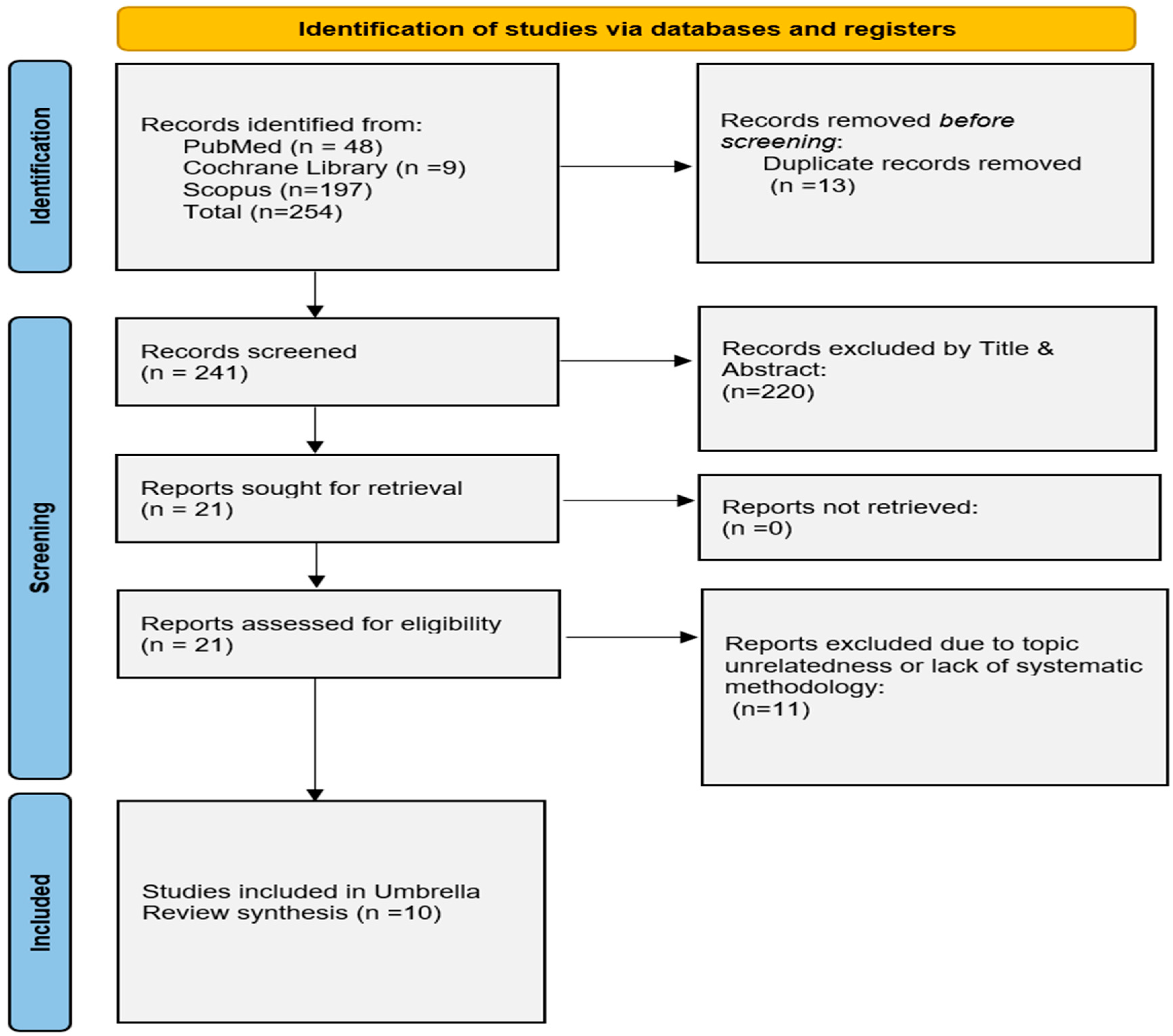
Figure 2.
Heatmap for visualization of overlap adjusted for structural missingness. The degree of overlap of primary studies between pairs of reviews (CCA=0% represents no overlap of primary studies [white color], CCA=100% represents complete overlap of primary studies between the SRs [deep green color]).
Figure 2.
Heatmap for visualization of overlap adjusted for structural missingness. The degree of overlap of primary studies between pairs of reviews (CCA=0% represents no overlap of primary studies [white color], CCA=100% represents complete overlap of primary studies between the SRs [deep green color]).
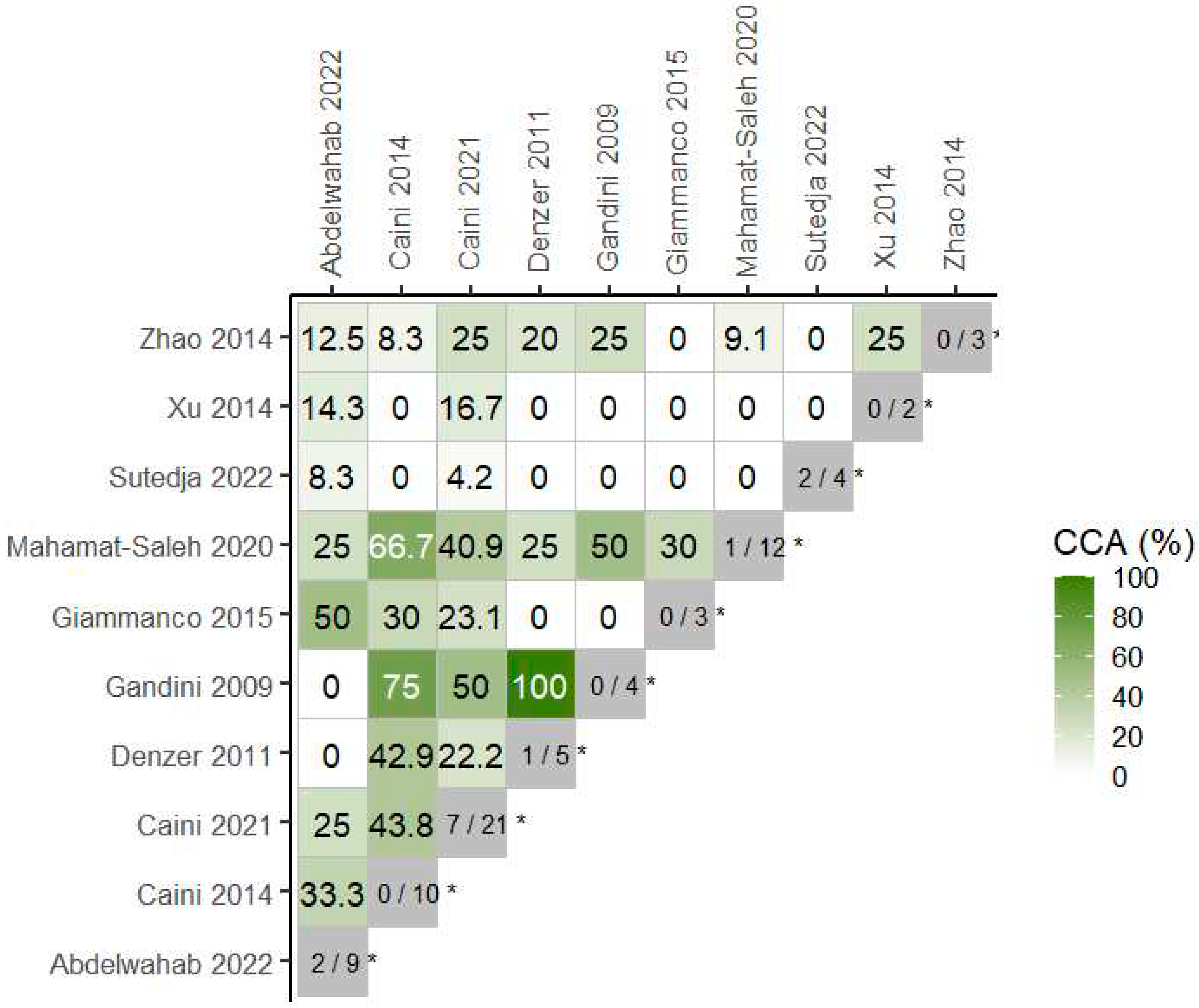

Table 1.
Study characteristics.
| Author, Year | Databases searched | Total Studies | Included RCTs | Outcomes measured | NMSC cases/ Total | Risk of Bias |
|---|---|---|---|---|---|---|
| Abdelwahab, 2022 | Pubmed, Google Scholar, Cochrane Library, Science Direct | 10 | 1 | Vit D serum levels & NMSC | 28763/152.488 | >70% on each quality assessment tool |
| Sutedja, 2022 | Pubmed, Scopus, Science Direct | 4 | 3 | Vit D supplementation anti-cancer effects on NMSC | 955/3003 | NR |
| Caini, 2021 | Pubmed, EMBASE | 24 | 2 | Vit D serum levels & NMSC | 3899/61962 | Moderate for the observational studies and low for the RCTs |
| Vit D Linear dose-response & NMSC | 7771/273991 | |||||
| Vit D intake & NMSC | 27299/175792 | |||||
| VDR, VDPB polymorphisms & NMSC | 1318/10284 | |||||
| Mahamat-Saleh, 2020 | Pubmed | 11 | 0 | Vit D serum levels & NMSC | 7485/249108 | 6 studies with high risk and 5 with moderate risk of bias |
| Vit D intake & NMSC | 30981/228479 | |||||
| Giammanco, 2015 | Pubmed, ISI Web of Science, Medline, Scopus, Google Scholar | 3 | 0 | Vit D serum levels & NMSC | 1003/8387 | NR |
| Caini, 2014 | Pubmed, Ovid, Medline, EMBASE, ISI Web of Knowledge | 10 | 1 | Vit D serum levels & NMSC | 2317/21964 | NR |
| Vit D intake & NMSC | 7408/156559 | |||||
| Xu,2014 | Pubmed | 2 | 0 | Taql polymorphism | 332/525 | NR |
| Apal polymorphism | 332/525 | |||||
| Zhao, 2014 | Pubmed, ISI Web of Knowledge, Medline, EMBASE, Google Scholar | 3 | 0 | Fokl polymorphism | 918/1984 | NR |
| Taql polymorphism | 332/525 | |||||
| Apal polymorphism | 332/525 | |||||
| Denzer, 2011 | Pubmed | 2 | 0 | Bsml polymorphism | 563/1417 | NR |
| Cdx2 | 563/1417 | |||||
| Gandini, 2009 | Pubmed, ISI Web of Science, EMBASE | 5 | 0 | Vit D intake & NMSC | 4084/116953 | NR |
| Fokl polymorphism | 586/1459 | |||||
| Bsml polymorphism | 586/1459 |
Table 2.
Results on Vit D serum levels & NMSC incidence.
| Author, Year | Total Studies/RCTs | Patients | Outcome | Pooled effect | Heterogeneity (I2) |
|---|---|---|---|---|---|
| Abdelwahab et. al,2022 | 10/1 | 152488 | Vit D serum levels & BCC formation | 4 studies support BCC association with low levels of Vit D and 4 studies support BCC association with high levels of Vit D | - |
| Caini et. al, 2021 | 10/0 | 3899 | Highest vs lowest Vit D concentration & NMSC | 1.67 RR [0.61-4.56] | 91% |
| 6/0 | Linear dose response | 3 studies reported a significant association between increasing Vit D concentration & NMSC, and a trend in the same direction emerged in 2 more. | |||
| Mahamat-Saleh et. al, 2020 | 8/0 | 249108 | Highest vs lowest Vit D concentration & NMSC | 1.64 RR [1.11-2.43] | 86% |
| NMSC risk per 30nmol/L Vit D increment | 1.30 RR [1.13-1.49] | 86% | |||
| Giammarco et. al, 2015 | 3/0 | 13859 | Vit D serum levels & NMSC formation | Positive relationship between plasma levels of Vit D and NMSC including SCC and BCC in 2 studies, while 1 study highlighted decreased risk of NMSC in older Caucasian men | - |
| Caini et. al, 2014 | 6/0 | 2317 | Highest vs lowest Vit D concentration & NMSC | 1.64 RR [1.02-2.65] | 81% |
| BCC |
1.82 RR [1.38-2.40] | 0% | |||
| SCC | 1.68 RR [0.44-6.39] | 81% |
Table 3.
Results on Vit D dietary/supplementation & NMSC.
| Author, Year | Total Studies/RCTs | Patients | Outcome | Pooled effect | Heterogeneity (I2) |
|---|---|---|---|---|---|
| Sutedja, 2022 | 4/3 | 3013 | Vit D oral administration & NMSC | Reduced incidence of NMSC in the oral Vit D groups | - |
| Caini, 2021 | 5/2 | 175792 | Highest vs lowest quantiles of Vit D intake/supplementation & NMSC | Only 1 study with significant association between highest intake quantile and increased risk for BCC (not for SCC) | - |
| Mahamat-Saleh, 2020 | 5/0 | 228479 | Vit D dietary intake + suppl. (100IU/day) & BCC/SCC | 1.02 RR [1.00-1.03] / 0.99 RR [0.97-1.01] | 77.7% / 0% |
| Highest vs lowest quantiles of Vit D dietary intake+suppl. & BCC/SCC | 1.10 RR [1.05-1.15] / 1.02 RR [0.89-1.17] | 0% / 0% | |||
| Vit D dietary intake (100IU/day) & BCC/SCC | 1.04 RR [1.02-1.06] / 1.02 RR [0.97-1.07] | 9.8% / 0% | |||
| Highest vs lowest quantiles of Vit D dietary intake & BCC/SCC | 1.13 RR [1.08-1.18] / 1.14 RR [0.95-1.36] | 0%/ 41.3% | |||
| Vit D suppl. (100IU/day) & BCC/SCC | 1.02 RR [1.00-1.03] / 0.98 RR [0.95-1.01] | 36.7% / 0% | |||
| Highest vs lowest quantiles of Vit D suppl. & BCC/SCC | 1.07 RR [1.03-1.12] / 0.95 RR [0.83-1.10] | 0% / 0% | |||
| Caini, 2014 | 4/1 | 7408 | Highest vs lowest quantiles of Vit D dietary intake & NMSC | 1.03 RR [0.95-1.13] | 0% |
| Gandini, 2009 | 3/0 | 4084 | Highest vs lowest quantiles of Vit D dietary intake & NMSC | No association | - |
Table 4.
Results on VDR polymorphisms and NMSC.
| Author, Year | Total Studies/RCTs | Patients | Outcome | Pooled effect | Heterogeneity (I2) |
|---|---|---|---|---|---|
| Caini, 2021 | 5/0 | 2301 | VDR gene polymorphisms & NMSC | No associations for Apal, Bsml, Taql,Cdx2. Fokl TT (Hom) significantly increased BCC in one study by 10.14 OR | 0% (47% for Hom vs WT Bsml) |
| 7983 | VDBP polymorphisms & NMSC | One study for VDPB(rs7041,rs4588) with no association for BCC | - | ||
| Xu, 2014 | 2/0 | 525 | Taql& BCC | tt vs TT: 2.12 OR [1.21–3.71] Tt vs TT:2.14 OR [1.38–3.32] tt+Tt vs TT: 2.14 OR [1.43–3.22] tt+TT vs TT: 1.39 OR [0.84-2.31] t allele vs T allele 1.59 OR [1.20-2.11] |
26.4% 0% 16.0% 0% 49.4% |
| Apal& BCC | aa vs AA+Aa 0.59 OR [0.39,0.91] while all else were insignificant |
0% | |||
| Zhao, 2014 | 3/0 | 1984 | Fokl& NMSC | ff vs FF: 2.42 OR [1.03-5.68] | - |
| Taql& NMSC | Tt vs TT: 1.88 OR [1.29- 2.74] Tt vs TT: 2.00 OR [1.22-3.28] Tt+tt vs TT: 1.92 OR [1.35, 2.73] |
||||
| Apal& NMSC | Aa vs AA: 1.72 OR [1.51-2.57] aa vs AA: 1.15 OR [0.72-1.81] Aa+aa vs AA: 1.50 OR [1.03-2.17] |
||||
| Bsml& NMSC | No association | ||||
| Denzer, 2011 | 2/0 | 1417 | Bsml& NMSC | BB genotype: 1.51 OR BB genotype + high Vit D intake 2.38 OR in women |
- |
| Cdx2 & NMSC | No association | ||||
| Gandini, 2009 | 1/0 | 563 | Fokl& NMSC | Ff and ff vs wildtype 1.30 OR [1.03-1.63] | 0% |
| Bsml& NMSC | Bb vs wild type 1.05 OR [0.76-1.44] BB vs wild type 1.51 OR [1.00-2.28] |
- |
Disclaimer/Publisher’s Note: The statements, opinions and data contained in all publications are solely those of the individual author(s) and contributor(s) and not of MDPI and/or the editor(s). MDPI and/or the editor(s) disclaim responsibility for any injury to people or property resulting from any ideas, methods, instructions or products referred to in the content. |
© 2023 by the authors. Licensee MDPI, Basel, Switzerland. This article is an open access article distributed under the terms and conditions of the Creative Commons Attribution (CC BY) license (http://creativecommons.org/licenses/by/4.0/).
Copyright: This open access article is published under a Creative Commons CC BY 4.0 license, which permit the free download, distribution, and reuse, provided that the author and preprint are cited in any reuse.


