

Submitted:
14 November 2023
Posted:
15 November 2023
You are already at the latest version
Abstract
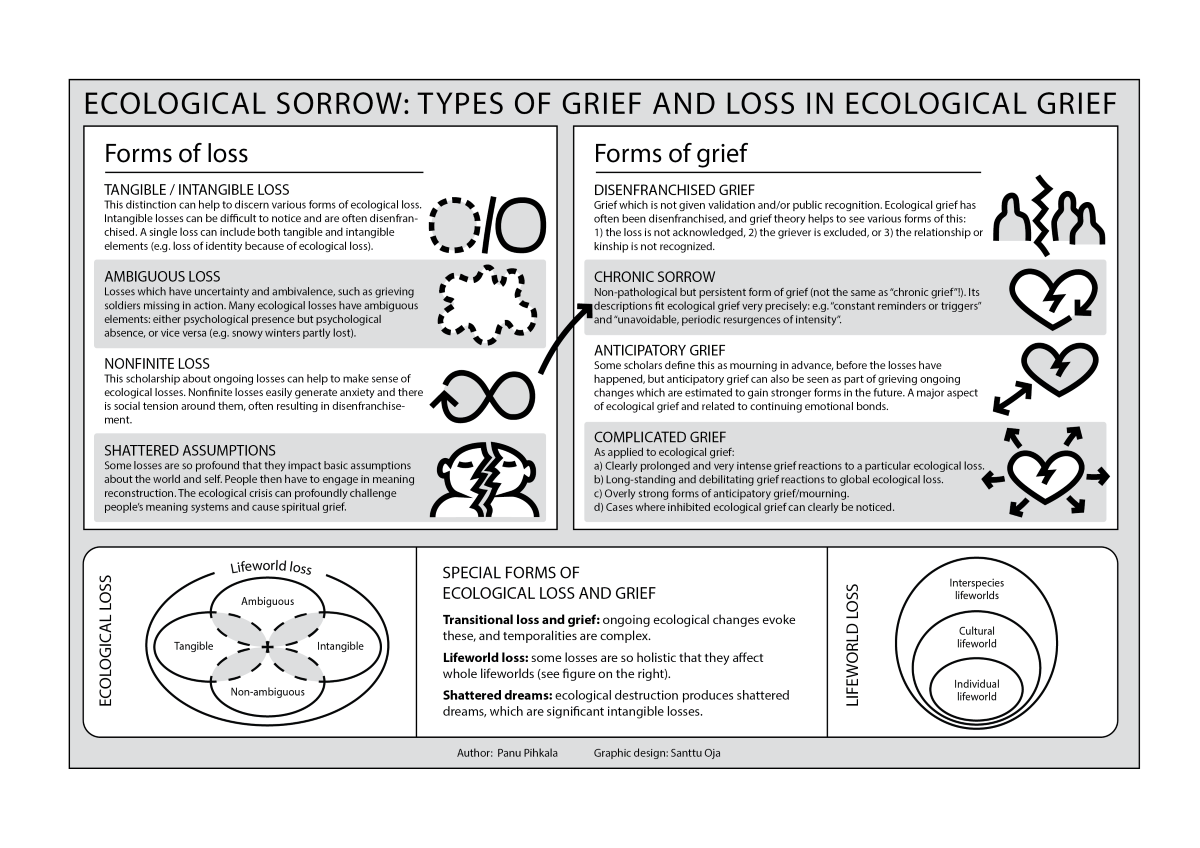
Ecological changes evoke many felt losses and types of grief. These affect sustainability efforts in profound ways. Scholarship on the topic is growing, but the relationship between general grief research and ecological grief has received surprisingly little attention. This interdisciplinary article applies theories of grief, loss, and bereavement to ecological grief. Special attention is given to research about “non-death loss” and other broad frameworks about grief. Dynamics related to both local and global ecological grief are discussed. Kinds of potential losses arising out of ecological issues are clarified with the frameworks of tangible/intangible loss, ambiguous loss, nonfinite loss, and shattered assumptions. Various possible types of ecological grief are illuminated by discussing the frameworks of chronic sorrow and anticipatory grief/mourning. Earlier scholarship about disenfranchised ecological grief is augmented by further distinctions about various forms it may take. The difficulties in defining complicated or prolonged grief in ecological context are discussed, and four types of “complicated ecological grief” are explored. Based on the findings, three special forms of ecological loss and grief are named and discussed: transitional loss and grief, lifeworld loss, and shattered dreams. The implications of the results for ecological grief scholarship, counselling and coping are briefly discussed. The results can be used by psychological and healthcare professionals and researchers, but also by members of the public who wish to reflect on their eco-emotions.
Keywords:
climate grief
; solastalgia
; bereavement
; eco-anxiety
; chronic sorrow
; nonfinite loss
; sadness
; disenfranchised grief
; anticipatory mourning
; ambiguous loss
1. Introduction
1.1. General introduction
In the era of ecological crises, various changes and losses evoke many kinds of sad feelings. Several terms have been proposed to describe the sad feelings that result from environmental crises, such as environmental grief [1], ecological grief (e.g. [2]) and solastalgia (e.g. [3]). Leading scholars Cunsolo and Ellis define ecological grief as “the grief felt in relation to experienced or anticipated ecological losses, including the loss of species, ecosystems and meaningful landscapes due to acute or chronic environmental change” ([2], p.275).
What feels as a loss is partly dependent on persons and their different value orientations and emotional attachments, which are shaped by many kinds of psychosocial and cultural factors [4,5]. Some changes related to ecological crises can be so vast and profound that they evoke feelings of loss in numerous members of the community, such as the loss of a very important hunting species due to climate change or loss of possibilities for agriculture [6,7]. Some other ecological changes evoke feelings of loss only in part of people, and there may even be contradictory feelings among various people about an ecological change [8,9]. The distinction made in research between loss and grief is an important one, since these two are not the same (e.g. [10]), and not all ecological losses engender sadness in all people (e.g. [11,12]).
Especially those who have close emotional ties with more-than-human environments have long observed ecological grief, well before there were special names for these feelings. Indigenous peoples have felt profound ecological grief over the centuries due to colonial destruction of their ecosystems and relations (e.g. [13,14]). Historical, western examples include the poetry of Gerard Manley Hopkins in the 1800s, where for example the felling of trees is mourned (e.g. the poem “Binsey Poplars”, see [15]), and several writings by the early 20th Century ecologist Aldo Leopold (e.g. [16], see the discussion in [17]]. In the 1980s and 1990s, writers connected with the broad field of eco-psychology started naming various forms of ecological grief and developed practices to encounter the related feelings (e.g. [18,19]). Many ecological scientists and environmentalists felt profound ecological loss and grief, but this was rarely spoken about in public, and pioneering pleas were made by a few authors to start engaging with this grief (esp. [20,21], more recently, [22]). Ecological grief is a major issue for sustainability professionals and advocates.
Research on various forms and intensities of ecological grief has gradually grown in the 2000s. Albrecht’s neologism solastalgia, created in the early 2000s, provided a special term for feelings of longing, homesickness and nostalgia caused by human-induced ecological changes such as open pit mining [3], more widely [23]. Solastalgia has been studied in various parts of the world, although with slightly different connotations [24]. The work of Cunsolo and colleagues around ecological grief, climate grief and mourning has been influential since the early 2010s e.g. [2,12,25], and case studies have been conducted for example among indigenous peoples [6,26,27]. Significant scholarship about ecological grief has also been made as part of what can be called eco-anxiety research: study of anxiety, distress and worry caused by ecological issues for reviews, see [28,29,30]. Broadly, ecological grief situates itself as part of a wider spectrum of ecology-related emotions and feelings, and it is especially intimately connected with sadness [8,31,32], see already [33]. Scholars have continuously tried to develop measures for various kinds of these eco-emotions, including ecological grief and solastalgia e.g. [34,35,36,37].
General scholarship on grief, bereavement and mourning has grown into a rather wide research field since the early 20th Century. It has been closely connected with Death studies, and indeed the field has been very much shaped by a focus on grief resulting from the death of a close human person [38]. Gradually, there have emerged frameworks which focus on a broader spectrum of possible losses and griefs, and tellingly these are nowadays often called “non-death loss and grief” [39,40]. As a whole, this research field is fundamentally about the wide variety of sadness and loss, which has been argued to be an elemental part of human existence in a mortal world e.g. [41,42], in popular press, [43]. However, much academic research on grief and bereavement has focused on clinically significant and “pathological” forms of the phenomena, and there have been long-standing debates about where the lines go between normal and abnormal grieving e.g. [44,45].
This general grief and bereavement research – later called “grief research” in this article – is a natural discussion partner for studies about ecological grief. However, there is surprisingly little literature about the in-depth relation between these topics and research frameworks e.g. [46]. Several pioneers in ecological grief research have made important observations and sometimes adaptations of general grief theory. Psychotherapist Randall [47] applied eminent grief scholar Worden’s theories into climate grief see also many articles in [12]. Comtesse and colleagues [48] briefly discussed several grief theories and ecological grief, calling for more research about the topic see also [49].
This article answers to this call by engaging more deeply with various theories of grief and bereavement in the context of ecological grief. Special attention is given to grief theories which also discuss non-death losses. The aim is to gain more understanding about various forms of ecological loss and grief with the help of general grief theory. At the same time, this endeavor helps to bridge these two fields of grief scholarship, bringing out similarities and differences. It is hoped that this would a) encourage grief researchers to engage more with ecological grief with their expertise, and b) encourage people who are interested about ecological grief to read grief research and the many popular books about its key results. In general, this supports sustainability efforts by providing more understanding of important dynamics related to them.
The author has a long history of engagement with grief research, and he has focused on ecological emotions for nearly a decade. He has worked mainly in the Western world, and a possible bias towards forms of ecological grief which are prevalent there is recognized.
As for terminology, this article uses ‘sadness’ to refer to sad emotions and feelings, and ‘grief’ to refer to an emotional response to loss which is often long-lasting. In practice, the concepts of sadness and grief overlap. There is much discussion in research and philosophy about what exactly do the concepts of grieving and mourning mean and include e.g. [50,51,52]. This article will not participate in those debates, but instead uses these terms simply to refer to practical forms of engaging with grief and the related time spans. The concept of sorrow is used in the title to bring both loss and grief together for other uses of sorrow as a term for ecological loss and grief, see [36,53,54].
The rest of this Introduction is as follows. First, forms of ecological grief and loss are discussed in the light of earlier research. This section clarifies the viewpoint of this article in relation to particular and more global causes of ecological grief. After that, a brief description of grief research and especially research about various kinds of non-death loss is given.
1.2. Forms of ecological grief and loss: building from earlier research
Some cases of ecological grief are straightforward, such as when clearly manifested physical losses in ecosystems cause grief. The concept of solastalgia is sometimes used to study these kinds of losses, especially when one’s sense of home becomes eroded or lost in some way [24]. However, ecological grief can also result from more subtle changes, and some losses are immaterial, as will be discussed below. The relationship between ecological changes in the material world and feelings of ecological loss and grief can be complex.
In an influential article, Cunsolo & Ellis [2] delineated three climate-related contexts where ecological grief has been reported: “Grief associated with physical ecological losses and attendant ways of life and culture”, “Grief associated with disruptions to environmental knowledge systems and resulting feelings of loss of identity”, and “Grief associated with anticipated future losses of place, land, species, and culture” (pp. 276-278). Cunsolo & Ellis point out that these three do not comprise all possible types of loss which can generate ecological grief and that future research is needed (p. 276).
Already from these three categories, it becomes clear, however, that there can be simultaneously many kinds of felt losses arising from ecological and socioecological changes. When physical ecological losses take place, they can at the same time produce negative impacts to identity and to ways of living. Furthermore, temporalities can combine: for example, past and present ecological losses can intensify anticipatory loss and grief. Ecological grief scholar Saint-Amour writes about this:
Rooted in losses that can begin in the deep past and extend into the deep future, it [ecological grief] exceeds the span of human seasons, lifetimes, epochs, and even species-being. And while the losses that prompt ecological grief can be actual losses in the present, these losses have a meaning beyond themselves: they are semaphores that point to planetary-scaled, often permanent losses in the future. [55], p.139
This brings out the close connection between ecological grief arising from particular ecological losses and possible grief and/or anxiety about the global ecological situation. The latter has been called with many names, with eco-anxiety and ecological distress being some of the most popular terms [30,56]. However, some call this global-level phenomenon with grief terminology, for example “climate grief” e.g. [57]. The author has argued in previous research that the process of encountering the ecological state of the world evokes a combination of what is called eco-anxiety and ecological grief [58]. There are various kinds of losses, changes and threats, and the emotions related to anxiety and grief arise in order to help people to react to those [28,59,60]. Because the ecological situation is so difficult, the emotions easily become very difficult, too. Thus, the potential for such eco-anxiety and grief which needs psychosocial support increases, and these issues can become – or contribute to – mental health disturbances [61]. While this article focuses on ecological grief, the close connections with eco-anxiety are constantly kept in mind, and elements from grief research which may be helpful in understanding these connections are searched for.
As regards forms of ecological loss and grief, this article starts from the understanding that there can be ecological grief both related to particular losses and to the global situation. These two modalities are here called “local ecological grief” and “global ecological grief”. Interconnections between these two are evident but also complex. In some cases, local ecological grief dominates and global ecological grief may not play a major role for a case example, see [62]. In other cases, both can overlap, or then global grief can dominate people’s experiences for case examples, see [63]. In the contemporary world, many local and regional changes have connections to global phenomena and often people know this, which makes any complete separation of local from global difficult. A category of “regional ecological grief” could be conceptualized between these two for a case examples of that, see [64].
Because of this complexity, this article respects the multifaceted character of people’s experiences of ecological loss and grief. Instead of trying to neatly separate local and global dimensions of ecological grief from each other, this article explores how general grief theory might help to discern various aspects of ecological loss and grief. Sometimes the focus will be more on local ecological grief and sometimes on global. Between these are regional ecological changes which are felt as losses.
1.3. Theories of grief and bereavement
In handbooks about grief and bereavement research [38,65,66,67,68,69], certain grief theories emerge as especially prominent. These include the task-based approach of Worden [68], the Dual Process Model of Bereavement developed by Stroebe and Schut [70], the framework of “continuing bonds” [71], and the meaning reconstruction framework of Neimeyer and colleagues [72]. All these theories have engaged critically with older “grief work” approaches, modifying and integrating various parts of it for an overview of developments in grief and bereavement theory, see [73]. In brief, grief work approaches see grief as something that can be worked on, and classic views about it often emphasized the need to remove emotional attachments from the lost person and move on in life e.g. [65], Chapter 1. However, scholars have observed that people often want to continue their emotional bonds with those who have been lost, instead of breaking those bonds [74]. Space does not permit here a full introduction to all the relevant grief theories, but many of them will be discussed later in this article in relation to ecological grief.
While certain grief scholars and philosophers have observed various kinds of losses and griefs for a long time e.g. [42], Chapter 2, non-death-loss has received growing attention only recently [39]. Earlier, Walter & McCoyd [75] developed a framework of “maturational loss”, where they observe that developmental phases bring both losses and things felt as positive. Harris [76] has written about “living losses” which have an ongoing character. Hooyman and Kramer [65] have studied typical and nontypical losses as related to age phases, and these losses include a wide variety. Schultz and Harris [77] have charted various “uncommon losses”, many of which are non-death-related. Ratcliffe and Richardson [40] discuss philosophically the relationship between classic cases of bereavement and non-death losses.
The recent collection of articles, Non-Death Loss and Grief [39], makes significant steps forward by bringing together scholars both from classic bereavement research and other grief studies. It is strange, however, that Walter & McCoyd’s work is not discussed. Insights and results from grief and bereavement theory are applied to various kinds of non-death losses, and contributors feature noted grief researchers (e.g. Pauline Boss, Robert A. Neimeyer). Chapters of that book are much used in this article. The book features also a chapter about environmental grief by Kevorkian [78], which includes for example a brief discussion of ecological grief and chronic sorrow, a topic which is given more extensive discussion below. Grief researchers have not yet engaged much with ecological grief, but recently there are signs of a rising interest for this e.g. [79], p. 15.
2. Materials and Methods
2.1. Sources
Theories of grief and loss are engaged with through handbooks, review articles, research articles and monographs. The selection has been influenced by the author’s long-time engagement with theories of grief and features many prominent theories.
Sources about ecological grief include studies and literature which use a variety of terminology and methods, including the following:
- Studies which use other formulations which include the word grief, such as “environmental grief” e.g. [1]. Environmental grief is an older term than ecological grief, but it did not spark as much interest among scholars then. Some often-cited articles and essays use the word grief or loss combined with other words, such as Windle’s “Ecology of grief” [20] or Randall’s “Loss and climate change” [47].
2.2. Method, research questions, and structure
The article uses a philosophical and interdisciplinary method. The main research questions of this perspective article are as follows. Based on studying both a) general research about grief and bereavement and b) interdisciplinary ecological grief studies,
- What frameworks and concepts of loss seem helpful for an increased understanding about ecological loss? (Section 3.1.)
- What frameworks and concepts of grief seem helpful for an increased understanding about various forms of ecological grief? (Section 3.2.)
- In the light of the analysis, what kind of new frameworks and concepts about ecological loss and grief could be useful? (Section 4.1.)
The rest of section 4 brings together the results (Section 4.2.), and discusses the implications for ecological grief scholarship (Section 4.3.). Finally, section 4.4. mentions many themes for further research and development, such as applying grief counseling literature to ecological grief.
3. Types of ecological loss and forms of ecological grief
3.1. Types of ecological loss
After engaging with literature, four frameworks of loss emerged as especially helpful for providing more understanding about ecological loss: tangible/intangible loss (section 3.1.1.), ambiguous loss (section 3.1.2.), nonfinite loss (section 3.1.3.), and shattered assumptions (section 3.1.4.). Many of these have not been yet explicitly discussed in relation to ecological loss and grief in earlier research.
It is noteworthy that different characterizations could be made, such as adding traumatic loss as a separate category. In the following four types, traumas may be present, and for example shattered assumptions are often linked with trauma (see Section 3.1.4. below).
3.1.1. Tangible and intangible loss
“When Ganga is no more,” she said, “we won’t have any identity”. [62], p. 27
As observed in the Introduction, scholars of ecological grief have noted that there may be many kinds of immaterial losses that people feel amidst ecological changes. A framework in grief theory, the distinction into tangible and intangible loss [88], can help to map these various kinds of possible losses.
Tangible losses may be perceived with senses, at least when people pay attention. For example, a creature or their limb is no longer there, or a landscape is so much damaged that the changes are evident. Intangible losses have sometimes been called invisible losses, exactly because they are so difficult or even impossible to notice with senses. They include “lack of physical signs or something obvious to the casual observer” [88], p. 239. Intangible losses can often be more abstract and sometimes symbolic, and they can have an existential character. Examples include the following:
- Loss or change in identity or sense of self
- Loss of connection to others
- Loss of social status
- Loss of meaning, faith or hope [88]
These kind of intangible losses can easily be discerned in accounts of ecological loss and grief, as will be discussed below.
Particular losses can contain both tangible and intangible aspects, and a single tangible loss can include many kinds of intangible losses for a person or a collective. Furthermore, there can be complex combinations of losses and gains. For example, selling one’s car in order to reduce climate emissions – a chosen loss – can result in both feelings of pride and feelings of loss. The tangible loss is the car, but possible intangible losses include lesser autonomy in mobility and a changed status in the eyes of other car owners. To name another example, if a couple decides not to try to have a baby because of the ecological crisis, this can generate many intangible losses for them and their own parents, such as the loss of an identity of a parent or grandparent see [47,89].
Grief scholar Rando’s concept of secondary loss can be helpful in thinking about causalities of loss, even when these are sometimes complex. Rando distinguishes between primary loss and the resulting secondary losses, which can include in her terminology also symbolic losses [90],see the discussion in [91]. For example, the loss of fish in a body of water is a tangible loss, which can generate for fishermen loss of identity, loss of social status and loss of meaning in life. It should be noted that also intangible losses can generate other, secondary intangible losses.
Tangible losses such as loss of place, loss of creatures, and loss of living beings have been the main target of studies about ecological grief and solastalgia [2,7]. Up to the author’s knowledge, the framework of tangible and intangible loss has not been extensively applied to ecological grief. However, the importance of paying attention to intangible losses have been lifted up by Cunsolo and colleagues [2], p. 278,6, pp. 52-3, and many intangible losses have been observed e.g. [80,92], p. 28. More broadly, Tschakert and colleagues [93,94] have insightfully charted the many possible kinds of intangible climate-related losses, as Table 1 shows.
Exploring the various tangible and intangible aspects of ecological loss can be argued to be an important task so that people’s experiences can be better understood and responded to for this point in general grief research, see [42,95]. Grief scholars point out that intangible loss is very often disenfranchised because it is not so obvious [88], and as such the intangible aspects of ecological grief deserve special attention similarly [94].
Grief research may help also in seeing new aspects of ecological loss and understanding links between these and general forms of loss. For example, Harris notes that “loss of familiarity” in the world is a common form of intangible loss for example for immigrants [88]. Broadly, loss of familiarity in the world has been observed in experiences of ecological grief: people may feel that the world is not the same anymore because of ecological damage and change, and feelings of isolation and grief may result e.g. [96]. This issue is closely linked with solastalgia and local ecological grief. However, it may be linked also with global environmental change. In the contemporary polycrisis, people have muttered that the world seems to be unfamiliar now for changes in Earth, see [97]. That might be a form of ecological loss which is typical for older people, while younger people are more prone to feel intangible losses related to loss of future plans, for example.
Pastoral psychologists and grief researchers Anderson and Mitchell (1983) have made distinctions which can provide further conceptual help. They categorize the following kinds of loss:
- Material loss
- Relationship loss
- Intrapsychic loss
- Functional loss
- Role loss
- Systematic loss [95]
Some of these types of loss are tangible – most notably material loss – and some of them are intangible, and there can be complex combinations of both aspects. Anderson & Mitchell themselves do not use explicitly the framework of tangible/intangible loss, which is a newer feature. Many of their concepts can bring light to ecological losses and complement the exploration of Tschakert and colleagues (see Table 1 above). The concept of role loss can help to see certain intangible losses arising out of ecological damage and change, as in the case of the lost role of parent or grandparent, or the lost role of a hunter in an indigenous community [6]. The concept of relationship loss may help to see both human relationships and cross-species relationships which suffer because of ecological damage and change for discussion about mourning non-human animals, see [11,98,99]. Systematic loss refers to losses which resonate with many areas of life, even to the whole organic system of how one’s life is organized. Examples are losing a job or losing the family of one’s childhood when one moves away for university study. This concept can easily be applied to ecological loss as well, where it points to the complex ripple effects and general systems-wide strength of ecological loss [100].
With “functional loss” Anderson & Mitchell refer to bodily functions, muscular or neurological. However, the concept might perhaps be used more broadly and combined with role loss in many ways. For example, a small-scale farmer losing the possibility to function as a farmer due to climate change suffers role loss, identity loss, and also loss of a central function in life; “I have lost a sense of dignity as a man”, says such as farmer in Ghana in a recent study [80].
One of the most interesting of these categories for ecological loss is intrapsychic loss. Anderson & Mitchell describe it as follows: “Intrapsychic loss is the experience of losing an emotionally important image of oneself, losing the possibilities of ‘what might have been,’ abandonment of plans for a particular future, the dying of a dream” [95], p. 40. These formulations help to notice significant possible aspects of intangible ecological loss, and the concept of intrapsychic loss complements the concept of intangible loss. The list provided by Tschakert and colleagues, displayed in Table 1 above, could thus be extended by certain forms of intangible, partly intrapsychic losses, such as the loss of dreams about the future, which will be more discussed below.
Sometimes the major aspect of ecological loss is intangible, and sometimes there are combinations of both tangible and intangible aspects. Table 2 shows examples of simultaneous tangible and intangible aspects in ecological loss, using empirical studies as source material. The studies themselves do not use the framework of tangible/intangible loss.

Table 2.
Examples of tangible and intangible losses from empirical research about ecological loss.
| Source | Subject | Tangible and intangible aspects (examples) |
| Drew 2013 | Local people’s feelings about the perceived and feared changes in river Ganga, Indian Himalayas | Tangible: changes in river flowIntangible: loss of identity, because people identify with the river and the goddess that it manifests to them; fear of lifeworld loss (see section 4) and fear of spiritual loss |
| Brugger et al. 2013 | Local people’s feelings about glacier retreat in three regions around the world | Tangible: retreating glaciers; diminishing water supply; sometimes a secondary tangible loss of tourism incomeIntangible: aesthetic loss; for some, loss of local identity |
| Cunsolo et al. 2020 | Inuit feelings about declining numbers of caribou and related dynamics | Tangible: less caribou, restricted access to hunting them, loss of social practicesIntangible: many aspects, such as loss of identity, loss of relations, loss of shared experiences, role loss (e.g. hunter), loss of environmental knowledge |
| Amoak et al. 2023 | Climate change –induced grief among smallholder farmers in Ghana | Tangible: loss of local trees and changes in landscapes, social unrestIntangible: many aspects, such as loss of environmental knowledge; losses related to culture, identity, and traditions; role loss especially for men |
The framework of tangible and intangible losses thus helps to clarify various aspects of ecological loss. It can also be used to discern various intangible aspects which have so far been discussed implicitly: see, for example, the fictional ecological grief example by Comtesse and colleagues, where a mountaineer “does not even know who he really is without the cherished environment and has a diminished sense of security and control” [48, p. 3].
3.1.2. Ambiguous loss
Leah experienced solastalgia for predictable New England winters; her embodied, beyond words grief became more salient as autumn turned to winter and the predictable, sustained cold temperatures from her childhood had changed due to climate warming. [101], p. 6
Ecological grief scholars Cunsolo & Ellis have observed that “ecological grief may also expose new understandings of ‘ambiguous loss’” [2], p. 279, because ecological losses may be ongoing, unending, and ambivalent see also [6], p. 51,101. They briefly refer to grief scholar Boss’ pioneering work in relation to this concept and framework. The “ongoing” and “unending” aspects of ecological grief are better captured by the concepts of nonfinite loss (see Section 3.1.3. below) and transitional loss (see Section 4.1.1.), but the many kinds of potential ambiguities in ecological losses can be explored by engaging more deeply with grief research about ambiguous loss.
Ambiguous loss refers to such felt losses where there is either uncertainty about the exact state of the loss or then something is partly lost and partly not. The term was coined by Boss in the 1970s and she has written extensively on the topic. A classic example is mourning soldiers who are missing in action. Grief is often complicated by this kind of ambiguity, sometimes becoming “frozen grief” because closure is not reachable. Furthermore, grief arising from ambiguous loss often becomes disenfranchised by others (more about this in section 3.2.1), because of the uncertainties about the loss and the difficulty of supporting people who grieve for extended periods [10,102,103,104].
Boss and colleagues have observed that there can be two ways of ambiguity in relation to absence and presence of human persons: physical and psychological. A person can be “physically absent but psychologically present”, as with soldiers missing in action; or a person may be “physically present but psychologically absent", as with people who have severe dementia [103]. Ratcliffe [52], p. 189 observes a unifying theme: in both cases, there are “competing possibilities” which complicate grieving.
The first aspect seems very common in ecological loss: something about the ecosystems is gone, at least for now, but there is psychological presence of it [12]. The second aspect needs more adaptation for an ecological context, but it seems also possible. The key idea is that there are cases where something or someone is in one way present, though key aspects of its essence are gone. A person with severe dementia has lost something essential; a forest which has lost birdsong might be an example of an ecological loss of this kind [105]. The recent proposal by Cáceres and colleagues [37] for a solastalgia scale includes a related survey item: “The place I live in has lost its inherent characteristics”. Human geographer Maddrell [106] has proposed the term “absence-presence” to describe complex dynamics of grief see also [107], and this term might also be useful for ecological loss studies for general reflections on the role of absence in ecological grief, see [11].
The concept of intangible loss can be helpful and highly relevant here, and sometimes the intangible aspects of ecological loss are the ambiguous ones. For example, the person who feels to have lost the role of a grandparent because their child has chosen voluntary childlessness due to the ecological crisis can feel ambiguous loss: is the role of a grandparent completely lost or will some of their children someday have a child?
Table 3 shows a few examples of various kinds of ambiguous loss, both in general and in relation to ecological loss.
More broadly, the general aspect of ambiguity is evidently a major feature in ecological loss, as Cunsolo and Ellis pointed out [2]. Many creatures, features, relations and things are currently partly lost and partly not, and there can be great uncertainty whether they are completely lost or not. Climate change increases many kinds of uncertainty and instability in ecosystems, producing many kinds of ambiguous losses. For example, in places where for many people winters and snow are important, climate change has produced ambiguous loss, “snow anxiety” and “winter grief”. One can never know if and when there will be snow during the forthcoming winter [101,108,109,110].
This element of uncertainty produces a major link between anxiety and grief in the context of ambiguous loss. Uncertainty breeds anxiety for eco-anxiety and this, see [30], and grieving ambiguous ecological losses can complicate eco-anxiety in a kind of vicious circle. This is why the practice-based and research-based recommendations of Boss for engaging with ambiguous loss seem very helpful for the joint landscape of both ecological grief and eco-anxiety, such as learning to live with ambiguity and resisting ideals of total mastery and closure [10] (see Section 4.4.).
3.1.3. Nonfinite loss
Ashlee Cunsolo Willox … has studied the impact of a changing climate on mental health Inuit communities in Labrador. Visible signs of climate change in the North from month to month or year to year make the repercussions inescapable for the people who live there, she says.
"People ... talk about experiencing strong emotional reactions: sadness and anger and frustration," she says. "It's a grief without end. Every day it's changing and there's a sense of loss." [111]
In the literature review, a framework in grief research was found which resonates strongly with empirical evidence of ecological loss: nonfinite loss. It deals directly with the aforementioned dynamics of ongoing and unending losses, which have been noticed by several scholars e.g. [2,8,21,55].
The framework of nonfinite loss was developed originally by grief scholars Bruce & Schultz around the year 2000 this history is discussed in [77,112]. It been used for example in studies about parents who mourn the disabilities that their children have, and about the experiences of women with involuntary childlessness. Nonfinite loss can be generated by a single powerful event, but its defining feature is the ongoing presence of the loss. There is something which reminds the person of the loss, triggering difficult feelings [39,77].
Explicit applications of the framework of nonfinite loss to ecological grief are currently almost non-existing except the thesis by [113], possibly because nonfinite loss as a concept is not very widely known in societies, although the experience often seems to be familiar. The concept can help to give recognition to an important but often unspoken dimension of ecological loss. Furthermore, research around nonfinite loss can help to clarify many important dynamics of ecological loss and grief.
Aspects of nonfinite loss, as identified in general research, can easily be found in accounts of people who experience ecological loss, grief and distress. These aspects are next discussed in two sequences. First, key characteristics of nonfinite loss are quoted, and then the more exact features are cited and linked with ecological loss. Here is how scholars define nonfinite loss:
- “The loss (and grief) is continuous and ongoing in some way. While the initial event may be time-limited, an element of the experience will stay with the individual(s) for the rest of life.
- An inability to meet normal expectations of everyday life due to physical, cognitive, social, emotional, or spiritual losses that continue to be manifest over time.
- The inclusion of intangible losses, such as the loss of one’s hopes or ideals related to what a person should have been, could have been, or might have been.
- Awareness of the need to continually accommodate, adapt, and adjust to an experience that derails expectations of what life was supposed to be like. The term living losses is sometimes used to refer to nonfinite losses because of the awareness that an individual will live with this loss or some aspect of it for an indefinite period of time, and most likely for the rest of that individual’s life” [77],see also [114]
These characteristics of nonfinite loss are perhaps the most descriptive about global ecological grief. While more particular ecological losses can also cause long-standing grief, the global changes and damages are the ones which have a nonfinite character on a human timescale. Naturally, these two can combine, and if local ecological losses happen regularly, the experience of nonfinite loss is intensified.
The second characteristic, “an inability to meet normal expectations of everyday life”, is not a feature of all instances of ecological grief. Based on current research, it seems that the majority of ecological grief is not this intense, but many people do suffer at least periods when ecological grief and anxiety affect their daily functioning [36,115,116]. Perhaps clarifying words such as “inability to often/sometimes meet normal expectations” would be more fitting to the fluctuating character of nonfinite loss. That is also in line with the nonpathological character of chronic sorrow (see Section 3.2.2.), which is a common response to nonfinite loss [77,103,117].
The “cardinal features” of nonfinite loss, which grief researchers have charted, are next cited and linked with studies about ecological emotions in Table 4.
It has to be emphasized that there are numerous examples of discussions about these kind of features in eco-emotion literature, even while the term nonfinite loss is not mentioned, and many sources about ecological grief include discussion about practically all of these features e.g. [84,85,86]. Windle wrote already in the 1990s: “Environmental losses are intermittent, chronic, cumulative, and without obvious beginnings and endings” [20], p. 144. Thus, the framework of nonfinite loss seems very relevant indeed for ecological grief and anxiety similarly [113].
The first feature explicitly links loss and grief with anxiety, and the fourth feature focuses on feelings of helplessness and powerlessness, which have been found to be very common eco-emotions e.g. [120]. The last feature mentions continuing despair and dread, originally added to the list by Jones and Beck via a study of death row inmates and their close ones [126], and these kind of difficult feelings have often been discussed by ecological grief and anxiety scholars e.g. [127], for a review, see [32]. Since mortality and fear of death have been explicitly discussed as related to eco-anxiety and ecological grief by many scholars e.g. [128,129,130], there may be even deeper links between the dynamics explored by Jones and Beck and these eco-emotions.
The many social dimensions which are mentioned in the list of features are further discussed below, especially in relation to disenfranchised grief (section 3.2.1.).
Researchers of nonfinite loss often discuss intangible losses. These include the loss of dreams and hopes as well as identity struggles (see Sections 3.1.1. and 4.1.3.). The changes are so profound that “The individual feels compelled to engage in a significant search for meaning” [77], p. 240, which brings us to the next and final theme related to losses.
3.1.4. Shattered assumptions
“When I’m thinking about careers as well, I’m thinking, ‘Oh, well I’m going to find a job, but then the world’s kind of coming to an end’. I feel like that sounds really dramatic, but it does feel like, ‘What’s all this for?’ (Izzy)” [131], p. 480
“when you realize how serious, how far-reaching and how fast we need to act in the climate crisis … That’s an experience that shakes your entire foundation, in every possible way. It changes your entire view on the world in every aspect.” (young Swedish climate activist, [132], p. 27)
There is evidence of such ecological loss and grief which is so powerful that it threatens to shatter people’s fundamental beliefs about the world and themselves [131,133,134]. Grief research offers tools for understanding these kind of dynamics, and especially relevant seem to be the frameworks of shattered assumptions and meaning reconstruction. These frameworks are also referred to by scholars of ambiguous loss and nonfinite loss [117].
Many factors are always contributing to whether people experience losses so strongly that basic assumptions about life are either profoundly challenged or even shattered. This is an interplay of the event, the persons experiencing it, and various moderating factors [5]. Certain events and losses are so powerful that they easily generate challenges to basic assumptions of all kinds of people, such as sudden violent losses or very large changes which affect whole communities. But any loss which includes strong damage to emotional bonds can challenge people’s meaning systems [52].
In grief theory, these kind of losses and the resulting grief processes have been explored prominently in several frameworks. The work around trauma by Janoff-Bulman has been highly influential here. Her view, based on empirical research, is that traumas are generated exactly by shattered assumptions [135]. One closely related framework has been the study of “traumatic grief” for an overview, see [136], and more broadly the relationship between trauma and grief [137]. Another close framework is existential crisis, which is defined by leading scholars as involving turmoil about fundamental assumptions and beliefs e.g. [138]. Some scholars approach the phenomenon by focusing on the concept of meaning and people’s crises about meaning and purpose e.g. [139], historically [140].
Among grief scholars, for example Attig [141] has engaged deeply with existential themes and meaning issues and Parkes with assumptive worlds [69,142]. In the last decades, grief dynamics related to people’s meaning systems have been very prominently studied by Neimeyer and colleagues. They utilize a constructivist framework of meaning reconstruction, pointing out that grief processes include a very substantial element of reworking one’s system of meanings e.g. [72,143]. This is an integrative grief theory, which incorporates for example the framework of continuing bonds and Attig’s view of grief as a process of “relearning the world”. Narrative methods are in an important role in meaning reconstruction: Neimeyer and colleagues argue that people need to process both the “event story” of the loss and the “back story” of how they relate to the loss. People are invited to build a narrative which continues to the future and incorporates the experiences around losses, effectively reconstructing their life paths e.g. [144], see also the “meaning attribution” framework by Smid in [145].
Testimonies and studies of ecological loss show that deep processes of meaning reconstruction among shattered assumptions can arise from both particular ecological losses and global ecological grief [131,133,134,146]. The following description of “The assumptive world and loss” by grief scholars Harris and Winokuer seems very fitting to many of these experiences:
Significant life-changing events can cause us to feel deeply vulnerable and unsafe, because the world that we once knew, the people that we relied on, and the images and perceptions of ourselves may prove to be no longer relevant in light of what we have experienced. Grief is both adaptive and necessary in order to rebuild the assumptive world after its destruction. [66], p. 122
In the ecological context, this kind of loss clearly has aspects of ambiguous loss, because the earlier world is partly lost and partly not, and there may be uncertainty about the extent of future loss for case examples, see [57,84]. This is related also to anticipatory grief and mourning, which will be discussed in section 3.2.3.
The need to relearn the world – echoing Attig – in ecological grief has been briefly discussed by some scholars [84,109], and the possible traumas included in deep processes of ecological loss and grief have been noted by many researchers e.g. [19,147,148]. Human geographer Head has observed how ecological grief may include grieving the modern subject and major assumptions about the future [21]. However, as far as the author can tell, there are not yet explicit adaptations of the frameworks of shattered assumptions and meaning reconstruction to ecological grief, and it seems that these would be very helpful. Neimeyer and colleagues have also written much about grief counselling and meaning reconstruction in practice, and these insights could be explored in relation to coping with ecological loss and grief (see section 4.4.).
These kind of processes are closely related to worldviews and people’s possible religiosity and spirituality, in other words their systems of meaning. Ecological loss can be a factor in engendering or strengthening a spiritual crisis or a spiritual struggle [for various kinds of spiritual crises, see [149], which can be seen as a form of existential crisis [138]. Losses related to worldviews and religious traditions have been noted in research about intangible losses caused by climate change (see Table 1), but loss related to meaning systems as such has not received yet much attention.
Worldviews and meaning systems shape people’s experiences and practices, and if they are in turmoil, there are ripple effects for numerous aspects of people’s lives, including identity, social roles, and a felt sense of order or safety in the world [149,150]. Such impacts of loss are seen in the writings of many religious persons who have been deeply struck by the severity of the ecological crisis, and many of these people tell of a profound process of reorganizing and reshaping their worldview and spirituality e.g. [151,152,153]. People may even feel that they are “losing their religion”, to quote the famous pop song by REM; for some people, a major aspect of ecological loss and grief can be felt loss in relation to meaning systems or spirituality or religion. This topic needs further research, including studies of whether ecological grief may result in “complicated spiritual grief” [154].
Table 5 shows key terms related to these deep forms of ecological loss.
3.2. Forms of ecological grief
After engaging with literature, four frameworks of grief emerged as especially helpful for providing more understanding about ecological grief: disenfranchised grief (section 3.2.1.), chronic sorrow (section 3.2.2.), anticipatory grief and mourning (section 3.2.3.), and complicated grief (section 3.2.4.). Some of these have not yet been explicitly discussed in relation to ecological loss and grief in earlier research, and all of them are given here deeper attention than before.
The relationship between various kinds of ecological loss and these forms of ecological grief is multifaceted, and will be discussed more in Section 4. Some forms of ecological grief are intimately tied with certain types of ecological loss, such as chronic sorrow with nonfinite loss, but others such as disenfranchised grief can manifest in relation to many types of ecological loss.
3.2.1. Disenfranchised grief and its varieties
… my friend Liz loved a certain forest in New Hampshire. … She was a teenager when a fierce storm blew into that forest, wiping out a large swath of trees. Liz was heartbroken. She had lost a friend, a spiritual presence, a guide. The next time her high school English teacher assigned the class an essay, she wrote about her love and grief for the forest. The teacher read the essay aloud to the class – not to praise it but to scorn it. When he finished reading, he chastised Liz for her sentimentality and her misguided notion that it was possible to love a mere thing like a forest. She was twice bereaved: once by the damage to her beloved forest and once by disrespect for her grief. [155], p. 19
The concept of disenfranchised grief refers to various kinds of dynamics where grief is not “openly acknowledged”, “socially validated”, and/or “publicly mourned” [156], p. 26. The background is that there are contextual norms in societies and communities about grief, “grieving rules” [157]. Grief philosopher Ratcliffe condenses the core of disenfranchised grief: “others fail to acknowledge or legitimate one’s grief, in ways that affect one’s access to processes that shape grief’s trajectory” [52], p. 211. A key developer of this framework has been grief researcher Doka e.g. [158,159] and the framework is commonly featured in grief research. Doka himself has briefly discussed disenfranchised grief in relation to non-death loss [156], but most research about it has focused on classic bereavement.
Dynamics of disenfranchised grief have often been observed in ecological grief research both explicitly and implicitly. Many kinds of ecological grief have not been understood in various communities [2,12,78] and sometimes ecological grief has been deliberately silenced or ridiculed, as in the quote above. As a result, ecological mourners have often felt belittled and isolated e.g. [96,160]. Grief research shows that social support is one key factor in engaging constructively with grief, and if that is missing or complicated, many problems can ensue for grief processes e.g. [68].
However, the more exact dynamics of disenfranchised grief have not been discussed in ecological grief research. A deeper engagement with grief research can help to see various factors and dynamics in disenfranchised ecological grief. More broadly, this research and topic raises up the importance of paying attention to social dynamics around grief and mourning, and provides opportunities to link disenfranchised grief more deeply with the existing ethical and political critiques of dismissal of ecological grief, which are often inspired by feminist philosophy such as [12,161].
Doka makes several distinctions about various possible dynamics of disenfranchised grief, including: “the relationship is not recognized”, “the loss is not acknowledged”, and/or “the griever is excluded” [156], pp. 29-30. In addition, some circumstances of losses are prone to increase disenfranchised grief for example via social stigma, and various grieving styles may affect the responses of others, including disenfranchisement (p. 31). Grief scholar Corr [162,163] extended the list to grief reactions and expressions of them, ways of mourning and rituals, and outcomes of grief [164]. Sociologist Thompson [165] observes that non-death losses are especially prone to disenfranchisement.
When the aforementioned distinctions are applied to literature about ecological grief, it becomes evident that all these dynamics of disenfranchised grief can take place in relation to ecological grief. However, some forms of these have received more attention than others, and closer engagement with the distinctions can help to discern important dynamics.
In ecological grief scholarship, the second dynamic mentioned by Doka, “the loss is not recognized”, has often been discussed. Scholars have noted that various kinds of ecological loss, including many climate change -related losses, have not been socially validated or they have been contested e.g. [166,167]. The reasons for not recognizing ecological losses can be very diverse. Fundamentally, anthropocentric ideas are often in the background, and sometimes these have been combined with colonial, patriarchal and/or racist leanings [12,161]. There may also be economic factors at play: people may not want to recognize an ecological loss if that recognition would include admitting that current economic practices should be changed [168]. Furthermore, the general psychosocial difficulty of connecting with ecological grief impacts the situation [169,170,171,172].
The first dynamic mentioned by Doka, lack of recognition of the relationship, provokes further thinking about ecological grief. Doka writes that if there are no “recognizable kin ties”, grief can get disenfranchised: for example, if there was a secret love relationship between the deceased and another person, that another person may not be given any recognition for their grief [156]. In the case of ecological grief, this dynamic leads again to issues of anthropocentrism and speciesism. As for example ecological grief scholar Braun [99] has noted, anthropocentric societies deny kinship between humans and many other parts of the natural world, which many indigenous peoples have recognized. Braun calls for a renewed understanding of the fundamental importance of interspecies relations and kinship, and warns that ecological mourning may sometimes be simply adjustment to a changed environment, not including necessary ethical and relational transformations in human attitudes.
In both kinds of ecological grief – not recognizing the relationship or not recognizing the loss – there seems to be versions where part of the loss is recognized, but not its actual depth. This often happens also with general forms of grief. It is noticed that something is lost, but no real recognition is offered and thus there is “an empathic failure”, as grief scholars write [173]. For example, when a companion animal such as a dog dies and a person feels strong grief, others may say things such as “You can always get a new dog” or “Don’t be so sad, it’s only a dog” for related dynamics, see [98]. Or if a person feels ecological grief about a clearcutting of an old forest, people may say: “But the forest will grow there again!” [174]. The idea that the loss could easily be replaced is often deeply insulting to mourners and may lead to disruptions in social relations and loneliness among mourners. The framework of intangible loss is highly relevant here: what are often totally disenfranchised are the intangible aspects of the loss.
By the formulation “the griever is excluded”, Doka means that sometimes “the characteristics of the bereaved in effect disenfranchise their grief”; the person “is not socially defined as capable of grief” [156], p. 30. Examples mentioned are persons with dementia or disabilities, and very young children.
When applied to ecological grief, this reminds that sometimes people’s characteristics can be used as an excuse to exclude them from ecological grief. For example, many children and old people often mourn the destruction of nature areas in cities, including city trees, but they may be disenfranchised because of their age and social status [174,175]. However, Doka seems not to pay enough attention to power structures and active disenfranchisement here, which are raised up by Corr [162,163], Attig [164] and Thompson [176] (2020). Grievers are often excluded because their communities and groups are held in a subordinate position [162]. For example, grief by indigenous peoples about ecological and cultural changes has often not been recognized by white people in power e.g. [177]. Furthermore, there are studies of also white people who become “emotional outlaws” because of their ecological grief [96].
Attig [164] argues that disenfranchised grief is not only an empathic failure, but also an ethical failure and often a political failure: communities and/or societies fail to give recognition both to the loss and to the rights of mourners.
Disenfranchising messages actively discount, dismiss, disapprove, discourage, invalidate, and delegitimate the experiences and efforts of grieving. And disenfranchising behaviors interfere with the exercise of the right to grieve by withholding permission, disallowing, constraining, hindering, and even prohibiting it. [164], p. 198
This dimension of disenfranchised grief is further elaborated by sociologist Thompson [165,176] and philosopher Rinofner-Kreidl [178]. Thompson discusses social injustices related to grieving, including discrimination and oppression which can manifest in dynamics of disenfranchised grief. The losses and griefs of some people are even more probably disenfranchised than others, and long-standing justice issues such as racism, sexism, colonialism and ableism are evident here. This could be linked with the discussions in ecological grief research about philosopher Judith Butler’s ideas and her concept of what is deemed “grievable” [50], see many articles in [12], and to the framework of “affective injustice” [179,180], which has been applied to ecological grief by van den Bosch [161].
Rinofner-Kreidl [178] argues that grief both affects social relations and is affected by them (similarly [52]). She points out that the existential difficulty of facing death and mortality easily strengthens a general disposition towards disenfranchising grief in Western and industrial societies: “there is a far more extensive latent readiness to disenfranchise grief, which takes effect in our society for the sake of warding off deep existential anxieties” [178, p. 203, italics in original]. In general, social aversion to grief and mourning in the West has been discussed by many scholars e.g. [44,76], and several authors have linked it with denial of death for a classic discussion, see [181]. These kind of dynamics have been discussed by several authors in relation to ecological grief and anxiety e.g. [169,182,130], but usually not in conversation with theories of disenfranchised grief.
As for Doka’s distinctions about circumstances of the loss or the ways of grieving as causes for disenfranchising, more research is needed to study these in relation to ecological grief. Broadly, circumstances of losses naturally affect grief responses and social dynamics around them, but Doka and other grief researchers have focused on stigma-producing circumstances and anxiety-producing circumstances. Some classic examples of stigmatized loss are suicide and death because of substance overdose [156], p. 31. In relation to ecological grief, a related but complex case would be a suicide where the dead person has left a note telling that the ecological crisis is a major reason for the suicide; these kind of cases have already been reported e.g. [183]. Mourning a close one who has committed a suicide at least partly because of ecological despair is perhaps not explicitly ecological grief – it depends on how the term is used –, but it is at least closely related to the broad topic of sorrow caused by the ecological crisis.
It is an open question whether the ways of grieving and particular mourning practices around ecological grief could be more of the cause for disenfranchising than the unrecognition of the loss, relationship, or griever. One can speculate for example about cases where the ecological loss would be at least partly recognized, but a person’s very emotional grief reaction would be the cause for disenfranchising. The same uncertainty applies to outcomes of mourning: whether others may claim that a person’s outcome of ecological grief is in some ways wrong or inadequate in their minds, whether this outcome is depression or acceptance.
More broadly, it seems important to think about what kinds of ecological grief and mourning are socially supported in various societies and communities – and which are not. This issue is related to normativity of eco-emotions and climate emotions e.g. [9,184]. Certain “affective displays” and “grieving rules” [156] of ecological grief can be supported and others disenfranchised.
People can also internalize societal grieving rules and thus self-initiate disenfranchised grief [156], p. 28,165, p. 20 or strengthen the disenfranchising started by others. These kind of dynamics are discussed also below in section 3.2.4. in relation to “inhibited grief”. There can be a literally ecological, reciprocal and complex process of disenfranchising grief where individuals and collectives both do their part. Grief philosopher Ratcliffe points out that people can simply have a lack of “interpretative resources” to make sense of their grief [52], p. 135, and this seems very evident in relation to ecological grief which is a new topic for many people.
The literally ecological character of disenfranchised grief is actually discernable in the definition of empathic failure by grief scholars Neimeyer and Jordan, which is cited also by Doka: “the failure of one part of the system to understand the meaning and experience of another” [156,173], p. 96. However, as discussed above, this definition needs more awareness of a) intentional use of power and b) collective dimensions.
Table 6 brings together various aspects of disenfranchised grief and when possible, links them with studies about ecological grief. Many aspects need further study and are marked with “?”.
3.2.2. Chronic sorrow
Here is a well of grief we’re going to have to drop into over and over again for all our lives, no matter if we are eighty or eight: the wrecking power of climate change. [155], p. 13
Grief theory includes a framework which brings together many aspects which have been discussed above and which seems highly relevant for ecological grief, namely chronic sorrow. The name can be misleading: it is to be noted that this is not the same as ‘chronic grief’, which will be more discussed in section 3.2.4. The phenomenon which is targeted by chronic sorrow is ancient: a type of grief which persists for a long time but includes variations in strength. Indeed, scholars have linked the old Greek word parapono, having a heavy heart, with chronic sorrow. This is a grief which is difficult but not pathological, because it has a very real reason [185,186,66,103].
The concept of chronic sorrow was spearheaded in the 1960s by rehabilitation counselor and leader Simon Olshansky, and it became used in nursing professions. In the 2000s, the concept and framework has been much developed by grief scholar Roos [185]. Chronic sorrow was first observed especially in parents of children with disabilities, but later the framework has been applied to a wide variety of cases. Roos defines chronic sorrow as follows: “a normal yet profound, pervasive, continuing, and recurring set of grief responses resulting from a loss or absence of crucial aspects of oneself (self-loss) or another living person (other-loss) to whom there is a deep attachment” [186], p. 194. A deep feature of chronic sorrow is “a painful discrepancy” between what was supposed to be and what has happened: for example the feelings of parents who realize that their child will not develop similar abilities than most other children.
As grief scholars have observed, there is significant overlap between theories of nonfinite loss, ambiguous loss, and chronic sorrow [10,117]. There is a difference, however: nonfinite loss and ambiguous loss focus on type of loss, while chronic sorrow focuses on type of grief. The theories complement each other, helping to see various kinds of losses and related grief dynamics. Chronic sorrow is a natural response to significant nonfinite loss, and often aspects of ambiguous loss and/or disenfranchised grief make it more difficult [10,117].
The term chronic may sound pathologizing, but actually one of the major emphases in the whole framework of chronic sorrow has been to oppose pathologizing. Practitioners and scholars have wanted to bring into fore that when losses are ongoing and complex, it is natural to experience grief in long-standing and variable ways [66,185]. This fits ecological grief, especially in its global dimension, very well, and also gives a strong message about the fundamental non-pathological character of such ecological grief.
As noted above, a special feature of the chronic sorrow framework is that it prominently includes both self-related loss and other-related loss as potential causes of such grief. In “self-loss”, some aspect of the self is felt to be lost, and in “other-loss”, this happens to somebody other. These losses are often tangible, such as a disabling injury, but they can also be intangible or include both kinds of aspects. Involuntary childlessness is one example of such a loss which can produce chronic sorrow; again the “painful discrepancy” between expectations (and hopes) and reality is very evident there [117,186], compare with 40. Fundamentally, both the self and the world are at play in chronic sorrow, and especially the experience of the self in the world [185], esp. 54-59. The first realization of the loss which results in chronic sorrow can often be traumatic [185], p. 65, and chronic sorrow prominently includes shattered assumptions and the need for meaning reconstruction (see section 3.1.4.; and [117]). Thus, there are natural elements of an existential crisis in processes of chronic sorrow [185], esp. chapter 6.
As is the case with its loss-related counterpart, nonfinite loss, the framework of chronic sorrow has not yet been extensively discussed in ecological loss and grief research. Kevorkian [78], p. 222 briefly observes the fittingness of the concept for many dynamics of ecological grief, but up to the author’s knowledge, this article is the first time that chronic sorrow is discussed in more length in an ecological context.
Table 7 shows the characteristics that Roos links with chronic sorrow and connects literature about ecological grief with those, showing how the aspects of this framework resonate closely with it. These will be discussed below.
As Table 7 shows, all these characteristics of chronic sorrow can rather easily be found in studies and literature about ecological grief. Chronic sorrow seems to serve as a helpful unifying grief framework especially for experiences of global ecological grief, such as broad climate grief, and for such local ecological griefs which have a profound and lasting impact on people. It is usually non-pathological but difficult (characteristic A in Table 7, see also section 3.2.4.). It is often disenfranchised because it is so difficult (characteristic B, see section 3.2.1.). It can include many kinds of tangible and intangible losses, including shattered assumptions (characteristic C, see sections 3.2.1. and 3.1.4.). It often has a traumatic beginning (characteristic D, see sections 3.1.4. and 3.2.4.), and it is closely connected with nonfinite loss (characteristic E, see section 3.1.3.).
Environmental grief scholar Kevorkian observes three aspects of chronic sorrow. She writes: “the loss [producing ecological grief] is ongoing without a foreseeable end and there are constant reminders of what has been lost and the potential of what will be lost with time”[78], p. 222. Thus, Kevorkian links chronic sorrow and its characteristics (e) – which is practically nonfinite loss – and (f), constant reminders, with ecological grief. She also discusses trauma and ecological grief, emphasizing the “insidious” and “slow” trauma possible amidst long-time ecological changes and losses. Kevorkian notes that there may not be a “single identifiable incident” of trauma behind ecological grief, but rather a more compounded experience of various losses causing trauma for further discussions of related dynamics, see [148,190]. This is an important observation, but it must be added that, in some cases, there can be single incidents which cause ecological trauma and grief, whether these are experiences of “natural” disasters or traumatic awakenings to the severity of the ecological crisis see [187,191,192].
Research about the characteristics F-J of chronic sorrow seems to offer especially novel insights for ecological grief scholarship. While fluctuations in ecological grief have been observed by several scholars e.g. [58,86], chronic sorrow research offers nuanced concepts about various aspects of these kind of phenomena.
Chronic sorrow scholars have observed that there is usually a first, more intense period of crisis and grief following the realization of a significant loss. They note that this can last for several years [185], p. 84. This correlates with attempts of ecological grief and anxiety researchers in charting an initial, intense process and then a continued process with fluctuations [58,187].
“Constant reminders or triggers” [185], pp. 84-85 are closely related to nonfinite loss, but they can also simply arise out of the experience of chronic sorrow. Many kinds of things, both inner and outer, can contribute to a triggering effect [66], p. 126. Something in the outer world may remind the person of the loss and the grief; or something internal, such as a mood or a feeling, may lead the person to the triggering of the grief. In many forms of ecological grief, the array of potential triggers is vast. For example, carbon emissions are interlinked with a nearly endless amount of things in contemporary societies, and a person sensitized to climate grief can be reminded of their grief simply by seeing a new construction site, because the construction causes carbon emissions [193]. Grief scholar Harris writes about “unavoidable reminders of the loss” [117], p. 294, and this wording seems very suitable for experiences of ecological grief e.g. [87,194].
Chronic sorrow scholars also observe “predictable and unpredictable stress points” (characteristic H), sometimes discussing “critical stress points” [185], pp. 80-81. These are closely related to characteristic G, “unavoidable, periodic resurgence of intensity”, and the feature of “temporary adaptation” in chronic sorrow [117], p. 292.
In classic types of chronic sorrow, many stress points have been identified. For example, a parent of a seriously disabled child may feel stronger stress and grief when the other children of the same age reach a developmental milestone that the disabled child does not. These kind of events are called “life markers” by Roos, and a person experiencing chronic sorrow may be left “marker bereft” [185], pp. 83-84. To mention another example, a person suffering from involuntary childlessness may feel unusually bad during an annual Mother’s Day or Father’s Day. Stronger feelings of anxiety are one possible impact.
In ecological grief research, these concepts can give tools for observing similar dynamics and linking them with broader grief research. Triggers and stress points have been passingly observed in ecological grief and anxiety research, but more attention is needed to explore them. Some already known stress points include publications of new and alarming climate change reports and periods in life where big decisions should be made but the ecological crisis complicates them e.g. [57,84,87]. The concepts of “life markers” and being “marker bereft” apply for example to those ecological mourners who have decided not to try to have children and who see others celebrating children’s births and development stages.
The alternation between psychic numbness and being emotionally flooded in chronic sorrow [66], p. 126,185, p. 86 seems also to have its counterparts in people’s experiences of ecological grief and anxiety [169,118,84]. Chronic sorrow research could be validating for people who experience fluctuations in their ecological grief. Furthermore, it could help them to accept that in response to significant and ongoing losses, it is normal to feel persistent sorrow.
3.2.3. Anticipatory grief and mourning
Leah wept about her children’s futures and the immensity of intensified suffering for all living beings. At times, the grief was in response to a present irretrievable loss and at other times, the mourning was about imagined future loss. [101], p. 6
Anticipatory grief and mourning have been much discussed in grief research [195,196], for a review of research until mid-1990s, see [197]. The topic has been prominent also in ecological grief research, because many dire environmental changes are predicted for the future. Cunsolo and Ellis delineate “grief associated with anticipated future losses” as a category of their threefold classification [2, p. 278]. Many scholars of ecological grief discuss the topic and mention the term ‘anticipatory’, combined with ‘grief’ or ‘grieving’ [11], esp. chapter 2,46, [198], p. 172, [199], p. 242, [200], p. 197], or with solastalgia [201]. However, ecological grief scholarship has not yet engaged extensively with general grief research about anticipatory grief and mourning, such as Rando’s work [90,196,202].
A major theme in general grief research about anticipatory grief and mourning has been its usefulness. Scholars have wondered: is anticipatory grief/mourning helpful or harmful? Or which forms, and in which circumstances? [197], p. 1353 Many debates around anticipatory grief and mourning have roots in different understandings about what grief itself is. If grief is seen more in the vein of “grief work”, then there is a possibility to think that such work could be done in advance, with various consequences as in [195]. But if grief is seen as a process e.g. [52,142], it is quite natural that such a process can start with “forewarning of loss”, a term grief researchers sometimes use [197]. Especially in relation to ongoing losses, the temporalities of present and future are intimately connected.
Rando, a major scholar of anticipatory grief and mourning, has consistently argued that the phenomenon should be seen in a wide way. In her view anticipatory mourning is:
“the phenomenon encompassing the processes of mourning, coping, interaction, planning, and psychosocial reorganization that are stimulated and begun in part in response to the awareness of the impending loss of a loved one and the recognition of associated losses in the past, present, and future” [196], p. 24
Rando thus includes the complexity of temporalities in her definition, and sees grief and mourning strongly as a process. Later she added the task of “balancing conflicting demands” to this characterization [202]. Rando prefers the term anticipatory mourning, instead of grief, because of the width of the phenomenon for critical discussion, see [203,204]. Because various scholars use different terms and in various nuances, here the term “anticipatory grief/mourning” is used.
Worden [68], pp. 204-208 also warns against simple interpretations related to anticipatory grief/mourning and its effects, because grief is so multi-determined. The positive possibility is that having a longer period of knowing about the loss can help people in tasks of grief by providing possibilities to work through acceptance of the loss and the many emotions which can be connected to it.
A special theme in anticipatory grief/mourning is the possibility of cutting off emotional bonds before the actual loss has happened in an effort to lessen the potential pain [196,197]. This theme is closely linked to the whole debate about the Freudian concept of decathexis and the grief work hypothesis. The influential framework of continuing bonds is a response to this: contemporary grief researchers usually see the aim of grief not to be the cutting of emotional bonds, but instead re-working and continuation of them [74] (see section 1.3.).
These discussions and distinctions in grief research can provide nuance to ecological grief scholarship. The idea of decathexis has been discussed both explicitly and implicitly in environmental research, but the framework of continuing bonds and the nuances of anticipatory grief/mourning have not received attention. A classic example of implicit discussion related to decathexis is the discourse about “biophobia” as defined by Sobel [205] in environmental education and psychology: the possibility that especially children and young people start to avoid natural environments because they reminds them of emotional distress caused by awareness of environmental crises. Scholars have wondered whether people may cut, or try to cut, emotional bonds with more-than-human world in an effort to protect themselves from pain in the future e.g. [206,207].
Several scholars of ecological grief have explicitly and critically discussed the concept and phenomenon of decathexis in relation to ecological grief, and argued that instead of it, the aim should be to continue relationships with the more-than-human world e.g. [11,55]. These scholars also point out that various temporalities become intertwined in experiences of ecological grief. For example, Barnett writes:
“Rather than liberating ourselves from the dead or disappeared, we can see grief as a way of sustaining connections with those whose loss we have survived. We can also see grief as an anticipatory stance, an orientation toward the vulnerability of the earth and our fellow travellers, that summons us to support and calls us to care.” [11], p. 23
Explicit engagement with continuing bonds theory and anticipatory mourning theory would help to link this with the larger body of grief research.
The moral emphasis of many ecological grief writers is clearly visible in Barnett’s writing: anticipatory grief/mourning has also an ethical function. Broadly, this is linked to a classic theme in environmentalism: warning about future losses as an effort to spark preventive action now. This was evident in Rachel Carson’s Silent Spring in the 1960s and in many classic texts of the environmental movement e.g. [208]. However, what is new is that Barnett and certain other ecological grief scholars have explicitly linked grieving with this. They argue that grieving allows people to continue to care [11,198,200]; this has been proposed also by certain environmental organizations such as branches of Extinction Rebellion e.g. [54]. Furthermore, they argue that learning skills and practices of grieving also prepares people to encounter the even more severe ecological losses that are predicted to happen in the future, for example because of the amount of atmospheric gases loaded already in the climate system e.g. [11,209].
Thus, ecological grief scholars are on one hand implicitly arguing for what Rando has described anticipatory mourning to be: engaging in processes of “mourning, coping, interaction, planning, psychosocial reorganization, and balancing conflicting demands” [196,202]. But on the other hand, processes of ecological grief are even more about a) ongoing and multiple losses and b) processes of transformation [58,210] than classic cases of anticipatory mourning. Even while Rando links various temporalities together in her frame of anticipatory mourning, ecological losses and grief are more complex.
One aspect of this is what Cunsolo and colleagues call “cascading ecological grief”: “sequential, ongoing, and interrelated forms of grief triggered by a singular ecological loss” [6], p. 52. Even a singular loss can result in complex cascades. But often people are facing multiple ecological and social losses at the same time [100]. These can intensify each other or at least cause very potential overwhelm for the grievers for overwhelm, eco-anxiety and ecological grief, see [30,58]. People may realize, as the Inuits did in case studies by Cunsolo and colleagues, that the losses experienced now will grow more intense [6,26,198]. Ongoing loss and anticipatory aspects combine [199], again echoing the work of Rando and others, but this time the sorrow manifests on a cultural scale. Cunsolo and Ellis [2] observe elements of this:
This [ecological] grief is both acute and chronic, carried psychologically and emotionally, but is not linked to any one event or break moment, and develops over time, with knowledge of what could come based both on already-experienced changes (for example, declining sea ice in the North and on-going drought conditions in Australia) and projected changes. [2], p. 278
This produces big challenges for collective and individual coping with ecological grief, and points to the need for transformation. This has been explored in frameworks such as “transformational resilience” [189] and “affective adaptation” [146], for an overview of proposals, see [58].
Randall [47] has discussed both anticipatory loss and “transitional loss” in her exploration of climate change -related loss and grief. The latter concept, which itself is not widely used in grief research, refers to loss experienced during transitional periods in life, such as moving from one life stage to another. In relation to life stages, this is what McCoyd & Walter [75] have studied under the frame of “maturational loss”: the ambivalent effects of transitions, often producing both feelings of sadness and feelings of achieving something. These kind of transitions are intimately related to anticipatory grief/mourning in cases when a person or a group reacts to a forthcoming transition. As Randall [47] points out, the concept of transitional loss can be a useful tool for paying attention to these kind of dynamics in relation to many kinds of losses, including ecological ones, and this framework could complement anticipatory grief/mourning (see Section 4.1.1. below).
In general, the future-orientation in anticipatory grief/mourning produces strong links with anxiety and worry. Rando [202] discusses the role of traumatic stress and anxiety in processes of anticipatory mourning. Worden [68] notes that engaging with potential serious loss can also increase people’s personal death awareness, producing existential anxiety – and potentially existential growth. In relation to this, Plant [211] has explored the dimension of self-mourning in anticipatory grief/mourning, drawing on earlier work on the topic and concept by Attig [212]. They both note that grief processes often include a dimension of dealing with the griever’s own mortality: the death of another reminds of one’s own inevitable death. This issue is linked with the philosophical observations of the role of changes in self as part of grief processes e.g. [52,178] and with existential literature in general, where the psychological dynamics of mortality are a major theme [213]. These observations provoke the need to think about the potential role of grieving one’s own mortality as a factor affecting ecological grief: anticipated ecological loss and one’s own anticipated death can resonate with each other for reflections, see [182,214,215] (see also Section 3.2.1. above).
Furthermore, simply the need to wait for the actualization of the loss can produce anxiety. Anxiety emotions [216] may be also engendered by the inherent uncertainty in even most precise future predictions: Will the loss happen in the way which is predicted? There are evident possibilities for grieving either too strongly or too weakly in advance, and this leads us to the final form of grief which is discussed in this chapter, complicated grief. Before that, Table 8 shows key concepts related to this section.
3.2.4. Complicated grief
The patient reported that preoccupation with climate change was impairing his ability to perform activities of daily living, and that he had been experiencing financial difficulties as he had stopped working secondary to this stressor. [220], p. 1
One major part of grief research has been the effort to study which kind of forms of grief would require or at least strongly benefit from clinical support for an overview, see [73]. There are significant differences in opinion about what counts as normal and what as abnormal grief, and many scholars have pointed out that social and cultural factors strongly shape these notions e.g. [52]. If people experience serious problems in relation to grief, many other psychological phenomena are close to that, especially depression and anxiety, and the debates about abnormality have psychiatric and insurance-related consequences e.g. [44,45].
Some ecological grief scholars, especially those coming from backgrounds related to medical professions and psychology, have called for more research about possible complicated forms of ecological grief e.g. [48]. Furthermore, the emerging research about “eco-depression” and “climate depression” [221] has close connections to this topic. In the following, insights from grief research about complicated grief are applied to explore these issues.
Many different terms have been used of those forms of grief which are considered to be in some way complicated. These include for example “prolonged grief”, “chronic grief”, “debilitating grief”, “inhibited grief”, and “unresolved grief” for an overview, see [68], pp. 131-157. The various terms have overlap, but some of them target different kinds of complicatedness. Many terms refer to persistence and strength of grief, such as ‘prolonged’, ‘chronic’, or ‘debilitating’ grief. Other terms refer to grief which is not allowed expression and causes complications because of that, such as ‘absent’, ‘inhibited’, ‘suppressed’, or ‘repressed’ grief. “Masked grief” is a term used to describe reactions of acting-out which arise because of grief, but without the person realizing the cause of these reactions [68], pp. 147-149. Here, the commonly used term complicated grief is utilised as the general term, also because “prolonged ecological grief” is a more complex concept to define than “complicated ecological grief”, as will be discussed below.
Grief researchers have mapped many factors and dynamics related to complicated grief e.g. [222]. Worden’s frame about “mediators of mourning” [68] is one relevant tool here; Parkes and Prigerson write about “determinants of grief” [69]. Aspects which can increase the difficulty of grief include the following:
- Violent losses
- Losses which could have been prevented
- Sudden and powerful losses
- An ambivalent relationship with the subject of loss
- Personal or collective lack of grief skills and practices
These kind of frameworks can be applied to explore factors which can have impact on both particular ecological griefs and the experiences of global ecological grief see also [48]. Contextual analysis of these kind of factors can help to explain why certain people in certain situations feel more intensive ecological grief than others. Moreover, some factors seem especially relevant for ecological grief in general, such as preventability, violence, severity of the loss, guilt dynamics, and lack of social support.
Losses which cause trauma are closely related to complicated grief e.g. [223]: the more traumatic a loss is, the more probable are complicated grief reactions e.g. [136]. This reminds once again of the possible connections between ecological grief and ecological trauma.
Guilt is a common feature in grief [224], and sometimes complications of grief orient around complicated guilt. The person or group may get stuck in feeling that they should have done more to prevent the loss. While this may be the case, it is also very common that people over-exaggerate the guilt. This is why Worden recommends “reality testing” the guilt in bereavement in order to help coping [68], pp. 21-22, 97. If people have actual culpability for the loss, a process with repentance and reparation is needed. All these kind of dynamics can affect ecological grief. Many scholars have observed the close connections between ecological guilt and ecological grief e.g. [124,122,225], and closer engagement with the guilt-related research in grief theory could increase understanding about related dynamics.
Overall, defining complicated grief even in relation to the classic subject of grief research, the death of a close person, has proved to be difficult and contested. For example, there are strong debates whether there can or should be “closure” in grief, and if so, what kind of closure or “acceptance” [52,102]. These difficulties seem to be even greater in relation to ecological grief, where the objects of grief can be multiple and varied, and the root cause is persistent ecological damage which continues over generations. What intensity and length of grief counts as “normal” in relation to such losses? (This question is touched upon in many articles in [12])
The question about normality is even more complex in cases where there is much disenfranchising of grief. Many people who feel long-standing ecological grief have argued that their grief is a normal response to the intensity of losses e.g. [93, while other people may have accused them of grieving in wrong ways or wrong intensity e.g. [167]. These issues are closely related to discussions about possible medicalisation and pathologizing of ecological emotions [56,226].
As has been discussed above, most forms of ecological grief seem to be normal in relation to the dire ecological crisis [28,48]. However, certain categories of complicated ecological grief can be delineated on the basis of grief research. Table 9 shows a proposal for these.
These four types resonate in many ways with the three categories of ecological grief characterized by Cunsolo & Ellis [2]. Type a) is a complicated form of “Grief associated with physical ecological losses” and type c) is a complicated form of “Grief associated with anticipated future losses”. The third category of Cunsolo & Ellis, “Grief associated with disruptions to environmental knowledge systems and resulting feelings of loss of identity”, can be a factor which affects the intensity of all types a-d.
In the following, the four types are briefly discussed. Further research about them is warranted, and it is clear that there can be interconnected or overlapping psychological phenomena: variations of depression, anxiety, and adjustment disorders are close to these [61].
a) Clearly prolonged and very intense grief reactions to a particular ecological loss. Because of the particularity of the loss, the definition of complicated grief is easier to make here than in relation to the ongoing experiences of global ecological grief. Still, defining this may be difficult, because particular ecological losses can damage significant emotional attachments and affect whole lifestyles, understandably causing persistent grief e.g. [6,7]. The wording used here, “clearly prolonged and very intense”, refers to cases where it is evident that tasks of mourning have not been met, even though there is already a long time since the loss. Research frameworks around prolonged grief could be critically applied to discern these [see 222,227]. A particular ecological loss may cause chronic sorrow which lasts for ages, but that is different from experiencing debilitating grief continuously.
It is not argued here that people’s experiences of difficult grief in relation to particular ecological losses should easily be diagnosed; instead, grief theory is here applied to discern a possible form of prolonged and complicated ecological grief, in the hope that this might help to notice people who need special support in their eco-grief.
b) Long-standing, very strong and debilitating grief reactions to global ecological loss. This type is intimately related to discourses of ecological distress and eco-anxiety, including climate anxiety. In general grief theory, the amount and persistence of distress is one major factor which is considered in evaluations of complicated grief [see 227]. The question of what counts as overly strong distress and grief in relation to global ecological loss is a complex one, since the problems are so immense. Psychologists have argued that if symptoms of eco-distress are severe and long-lasting, various diagnostic criteria can be used, while at the same time the fundamental cause is not related to pathology but instead to very real ecological problems [61]. Ecological grief scholars Cunsolo & Ellis [2], p. 279 ponder about the possibility of applying the term “frozen grief”, made famous by grief scholar Boss [104], to describe some forms of complicated ecological grief.
Perhaps one could speak also about a dimension of complicated ecological grief in some strong and persistent forms of eco-anxiety/distress. In those cases, the alleviation of strong eco-anxiety symptoms would depend on engaging with tasks of mourning: in working with complicated ecological grief (for this kind of suggestions, without using the term complicated grief, see e.g. [85,86,228].
c) Overly strong forms of anticipatory grief/mourning. Once again, defining “overly strong” may be tricky here, because the predicted ecological damages are so vast. Clear cases of this kind of complicated ecological grief include strong catastrophizing: for example believing that societies will collapse because of ecological crisis in the very near future, and grieving the loss of everything in advance. While it is difficult to estimate future events and possible collapses cannot be ruled out, there is a difference between realistic thinking about them and catastrophizing. Closely related frameworks here are anxiety and existential crisis.
Ecological grief and anxiety scholars have observed these kind of possibilities, although not by linking the concept of complicated grief with them. Mark and di Battista [199], p. 242 write about the possibility of “perpetual anticipatory anxiety” see also [48]. Therapist Babbott utilizes the frame of “pre-traumatic stress” (PTS), proposed by both clinician Lise van Susteren [229] and environmental humanities scholar Kaplan [230], and observes that: “Just as PTSD entraps people in the past, PTS can entrap people in the future. Therefore, one goal of treatment is to help clients live mostly in the present moment with fluid integration of past memories and future imaginings” [101], p. 5. Losses related to the future may be mourned via transitional loss and grief (see Section 4.1.1. below), avoiding overly strong anticipatory grief.
d) Cases where inhibited ecological grief can clearly be noticed. Research about ‘inhibited’, ‘delayed’, ‘suppressed’, ‘repressed’, or ‘masked’ grief has been conducted most of all in relation to the death of a close human person. It is usually presumed that deep emotional attachments, which become impacted by the death, need to be reworked via grief. If grief is very absent, researchers warn about the possible complications caused by this e.g. [69], p. 39. However, there are also debates about the issue, and for example grief researcher Bonanno has argued that most people are resilient in their grieving, thus criticizing the notion of delayed grief [45]. Worden argues that delayed grief is a real phenomenon, but its study needs large-enough samples and long-enough time spans [68], pp. 143-145.
Inhibited and delayed ecological grief are tricky subjects, but they do seem to exist. A person’s or a group’s depth of attachment with ecosystems naturally affects these dynamics [175]. Some people do not grieve the changes in local ecosystems even when they know about them, because they do not have attachments with these ecosystems, or related values. But this is complicated by several things: the global character of the ecological crisis, the intricate connections between local and global, and the many possible intangible losses involved. People with anthropocentric values may still grieve the changes for societies and their life paths caused by the ecological crisis [99].
If people do not express any kind of ecological grief even when they feel ecological losses, one can speak of inhibited, suppressed or repressed ecological grief. Several interview studies show dynamics which can be described with these terms, such as Norgaard’s ethnographic observations in Norway [118], Lertzman’s in-depth interviews in the US [171], and many observations among environmental professionals e.g. [231,232]. In addition, many theorists of ecological grief have explored this [169,233,228,225], pp. 161-167. Lack of engagement with ecological grief which is present somewhere in people’s bodyminds can cause various kinds of impacts, which can be explored in future research via the knowledge about inhibited grief gathered in general grief research. There may also be delayed ecological grief responses.
What is here called inhibited ecological grief has been argued to be a major cultural and environmental problem. People suffer from the lack of emotional flow, and complications can hinder engagement with sustainability efforts e.g. [171,21,225]. This is linked with the discussions above in Section 3.2.1. about various kinds of disenfranchised grief, which can be enacted both by individuals themselves and by others. An important part of the dynamics around inhibited ecological grief is a cultural-level “inability to mourn”, and the impacts of such inability have been argued to be very problematic for societies e.g. [234]. Not being in touch with emotions can reduce empathy and functioning.
Naturally, not all people who do not seem to feel ecological grief manifest inhibited grief. Some people probably do not yet realize the extent of ecological losses, some don’t care, and some may be resilient in relation to feelings of grief. As grief scholars often remind, people grieve in widely varied ways, and it is problematic to construct only one normative model of grieving, ecological or otherwise. But as a category of potential complicated ecological grief, it is important to notice the existence of inhibited ecological grief.
4. Discussion
The analysis above has explored many aspects of ecological loss and grief by engaging with general grief research. In this section, the results are discussed in relation to each other and needs for further research are named.
In section 4.1., three special forms of ecological loss and grief are explored: transitional loss and grief, lifeworld loss, and shattered dreams. These complement existing research and the need for these became evident through the analysis above. Some of these terms have been used before, at least in some connotations, but some are rather new ones and at least their application to ecological loss and grief in this scale is new.
In section 4.2., types of ecological loss and forms of ecological grief which have been discussed in this article are brought together. In section 4.3, the implications of the results for contemporary scholarship on ecological grief, such as surveys, is briefly discussed. Finally, in section 4.4., the possibility to apply grief counselling and coping literature to ecological grief is probed, and many themes for further research are explored. Strengths and limitations of the current research are discussed along the way.
4.1. Special forms of ecological loss and grief
Based on the research in this article, three forms of ecological loss and grief emerge as deserving special attention: transitional loss and grief (Section 4.2.1.), lifeworld loss (Section 4.2.2.) and shattered dreams (Section 4.2.3).
4.1.1. Transitional loss and grief
“You have people who for thousands of years have been connected to a cold and ice environment ... and suddenly in one generation, you're looking at ice-free winters and what that does to people, the utter devastation it causes.” [111]
“Over the course of my lifetime I’ve seen much of what I love just disappear . . . It just feels traumatic, I don’t know how to describe it. Because it just feels like grief and trauma.” [131], p. 478
As was discussed above in Section 3.2.3., grief research features many explorations about sorrow in life transitions [65,75,235], but there is no commonly used terminology for this. Randall’s term, transitional loss [47], is useful, but it should be added that there may also be transitional grief. It is here proposed that the term “transitional loss and grief” helps to draw attention to reactions about ongoing changes. There are many reasons why this concept of transitional loss and grief is useful in relation to ecological loss and grief:
- There are many ongoing, transitional ecological losses and these need recognition. These may involve both physical transitions and psychological transitions.
- Paying attention to transitional loss and grief may help to bridge various temporalities and enable wise integration of anticipatory grief/mourning into theories of ecological grief (for reflections of this in relation to grief and loss in general, see [52], pp. 188-189).
- On a global scale, there is a wide-scale planetary transition going on from Holocene to new phases (cf. discourses around the contested term Anthropocene, see [236]). This is literally a life transition, in the sense of the Greek word bios, concerning whole planetary life, and this means that transitional ecological loss is a global phenomenon.
- An understanding about dynamics of transition connects with the idea of transformation; scholars have argued that processes of eco-anxiety and ecological grief require transformation (see [58,188,189,210])
- “Sustainability transitions” [237], social and political changes which are done to increase sustainability, can also include losses (e.g. [166]). A concept such as transitional loss can help to name these. One aspect of this is what Randall [47] calls “chosen loss” due to environmental reasons.
It should be noted that the life transitions which are traditionally studied in grief research may also resonate with ecological grief. For example, growing up in the era of ecological crises can involve new kinds of maturational losses see also [92,219], and a transition to old age can involve difficult dynamics related to ecological losses and grief [238]. Existential crises are common in relation to life transitions (e.g. [239], pp. 15-17), and there can be complex combinations of “eco-existential crises” and life transition crises [131,133,134,182].
4.1.2. Lifeworld loss
“Losing the farm would be like a death. … we know this is where we’re meant to be, I think if you took us out of that it would be like [… ] It’s like making sense of a whole new map.” [2], p. 277
“I have become a weakling of no fault of mine. You plant, the crops die. You switch to maize; you can’t buy fertilizer. You can tell that your year is going to be bad even as you plant your crops. But what can I do? This is all I know… It’s a disgrace. You are not a man if you cannot provide for your family. I am not a man. It is just me and my alcohol now. (Male farmer, 40, Nakong [Ghana]) [80]
Many different aspects of loss have been charted in grief research, but an important and wide-ranging aspect has been difficult to capture: loss of whole lifeworlds and ways of living. Perhaps this level of inquiry has been more typical for cultural studies and anthropology than for grief research and death studies, but sorrow is definitely included in such dynamics (e.g. [240,241]). The framework of tangible and intangible losses (see Section 3.1.1.) allows the investigation of many of the related aspects, such as losses related to “Culture, lifestyle, traditions & heritage” ([93,94], see Table 1). If these losses are comprehensive, the total effect is even more than its parts: the loss of whole lifeworlds, both individually and culturally.
It is here proposed that the concept of lifeworld loss would be a helpful tool for ecological grief research, and perhaps also for studies of other kinds of comprehensive loss. The concept of lifeworld has roots in phenomenological philosophy and especially in Husserl’s thought [242,243]. Various thinkers have defined it in nuanced ways, such as Habermas [244]. The concept is nowadays used in many disciplines and refers broadly to the total way in which a person – or a group – experiences the world. A lifeworld is strongly constituted by relations. It is the lived experience and the resulting “world” of creatures amidst other creatures, in combinations of natural environment and built environment (e.g. [245]).
The concept of lifeworld has been briefly mentioned in some writings about ecological grief (e.g. [198], p. 168, [246], p. 138), but up to the author’s knowledge it hasn’t been explicitly developed and discussed in this context. There are many implicit discussions of such wide-scale losses (see e.g. [7,80]) and they are especially prominent among indigenous peoples e.g. [13,14]. Some research tools include related items: for example, in the recent Inventory of Climate Emotions, one item related to “climate sorrow” is: “The thought that the world I know is disappearing forever because of climate change makes me sad” [36]. This kind of lifeworld loss includes loss of familiarity in the world and thus has close connections to solastalgia.
The scale of these losses makes them close to the topics of shattered assumptions and meaning reconstruction (see Section 3.1.4.). Scholarship about non-death loss is once again helpful here. Harris emphasizes that many kinds of loss are often combined in people’s experiences of non-death loss and grief. This produces what Harris calls an “all-encompassing” aspect:
The self and the world must be relearned at profound levels that are central to the individual’s ability to function and navigate in the world. The process is often all-encompassing: redefining aspects of the world, others, and one’s self in ways that ripple across all aspects of daily life, including one’s hopes and dreams. [117], p. 294
In addition to such individual lifeworlds, ecological damage can provoke changes in whole cultural lifeworlds e.g. [80,240]. Indeed, the certain individualistic orientation in parts of grief research should be complemented by a broader social and cultural perspective similarly [51], for this and climate distress, see [226].
However, from a truly ecological point of view, lifeworld loss is even more collective: what is being lost or profoundly changed is a set of relations and practices, including both psychic and material aspects [247,248,11], p. 27. Ecological grief scholar Ryan argues that ecological losses should indeed be seen ecologically in the deep sense, directly discussing the concept of lifeworld:
A posthumanistic model suggests that the understanding and experience of mourning can become intrinsically ecological, moving from the disappearance of individual species or the impoverishment of the human life-world towards an ecology of mourning that is much more complex, inclusive, intersubjective, evocative of place, and deserving of research. [246], p. 128
Posthumanistic scholars such as van Dooren have explored how non-human animals may themselves feel deep losses [249]. On a wide level, ecological losses can be experienced by multiple species and perhaps sometimes together by several species: for example, both humans and other animals can be feel sad because a wildfire has just destroyed their usual habitat cf. [191]. Lifeworld loss can thus be visualized as having potential interlapping dimensions, as Figure 1 shows.
Grief philosopher Ratcliffe sees the task of grief to be “moving between worlds” [52], esp. Chapter 4. He notes that the losses and changes in one’s structure of life and meaning system can be a felt loss in itself, a kind of profound secondary loss which causes and intensifies grief. Various aspects of lifeworld loss need attention so that (ecological) grief can be engaged with more constructively: habitants of ecosystems face the task of moving from an old world to a new kind of world.
4.1.3. Shattered dreams
“[Climate] [a]nxiety for me is when I’m sitting doing my schoolwork and feeling like it is useless because I might not have a future to work towards” [111]
A special kind of loss is shattered dreams, discussed poignantly by grief scholar Bowman. As a concept, it is closely related to loss of assumptive worlds and to altered or lost expectations [250]. Dreams may become shattered in many ways, either quickly and violently or then slowly and insidiously. Broadly, this issue is part of the loss of integral possibilities in life which some grief scholars see as central to grief experience [40,52] use involuntary childlessness as an example.
Both local and global ecological losses can result in shattered dreams. For example, the loss of local farming conditions ecosystem may shatter the dreams of local farmers [7,80]. One large group of people who suffer from shattered dreams because of the ecological crisis are young people. They may or may not use the concept, but the phenomenon is clearly there: grief and other feelings because they feel that at least many of their dreams about the future are shattered due to growing ecological damage for research, see [251,120,252] [for youth voices, see [253,254].
Bowman discusses moral injury in relation to shattered dreams [250], p. 248, and eco-emotion scholars have discussed the same concept in relation to impacts of climate change [120]. Moral injury means that people’s basic moral system becomes damaged because they are not allowed, due to structural factors or local use of power, to follow their ethical code, and sometimes they are indeed forced to act against it, which can be traumatic. Moral injury can be a deep intangible loss in the ecological crisis and since it resonates with people’s whole systems of meaning and ethics, it is related to shattered assumptions.
Bowman also discusses “historical and collective shattered dreams” and uses as an example the fates of many North American indigenous peoples [250], pp. 247-249. This is linked with scholarship about lifeworld loss (see section 4.1.2. above).
In addition to lifeworld loss, shattered dreams are related to many other aforementioned concepts of loss and grief. They are intangible losses, and ones which may be psychologically very difficult to recognize for example by adults who would like the youth to have a bright future e.g. [255]. They easily become disenfranchised. They are usually nonfinite losses and can cause chronic sorrow. They are related to shattered assumptions and the need for meaning reconstruction. They can have intimate connections with anticipatory grief/mourning and with transitional loss. There can be catastrophizing and complicated ecological grief in relation to them, but it is complex to define this because there is so much uncertainty about the exact ecological futures, and this produces often anxiety. In other words, there can often be elements of ambiguous loss in shattered dreams.
Naming shattered dreams as a dimension of ecological loss and grief will be validating for many people who experience them, and this recognition allows for more explicit engagement with them. This is related to futures literacy and work with utopias e.g. [256]: what kind of dreams are still possible, even when some dreams have been shattered? The narrative methods of Neimeyer and colleagues e.g. [143] in meaning reconstruction in grief could be combined with this.
4.2. Bringing types of loss and forms of grief together
The types of loss and forms of grief which have been analysed in this article can have overlap and complex connections with each other. As mentioned, these are not the only possible frameworks and concepts, but these bring out important dimensions which have not yet received enough recognition. In this section, several important aspects related to the results are briefly discussed: moderating factors, relations between various phenomena, and the dynamics of the results in relation to local and global ecological grief.
There can be named numerous kinds of factors which can have an impact on both ecological loss and grief (see the brief discussion of these in [48]). In further research, these should be explored in more nuance. Available resources include for example a) systems thinking or socio-ecological modelling e.g. [257], and b) grief theory about moderators of mourning [68], esp. Chapter 3 or determinants of grief [69].
For example, it is highly important to note that the possible violence and/or suddenness in ecological losses has powerful impacts on ecological grief. In general, the injustices connected with ecological damage greatly affect dynamics of ecological grief e.g. [25]. In grief research, it has been noted that people may be torn if they perceive that the losses could have been prevented [68], p. 64. The character of many ecological losses as violent, unjust, and in principle preventable makes ecological grief much more difficult in general, see [11,12], and grief research about violent losses could be applied in more nuance to ecological grief in future research. The way in which grievances and grief are combined in grief of Black Americans [258] could shed light on dynamics of ecological grief. A special type of loss is deprivation: being deprived of something before ever having it [42], p.21, and this could be explored in relation to ecological loss and grief.
Another important aspect is the existence of concurrent losses and stresses [68], pp. 75-76, which is evident in people’s simultaneous experiences of eco-anxiety and ecological grief e.g. [100,29,58]. In terminology of grief research, concurrent and cumulative losses can contribute to “overload” in the grief process [259], which seems a very real possibility amidst the comprehensive changes in contemporary life.
In order to explore the relations between various aspects of loss and grief, different tools could be created, such as visualizations. Below is an example of this: a figure which shows various dimensions of ecological loss and displays some of the different possibilities in relation to ambiguous loss and tangible/intangible loss.
Local and global ecological grief can have differences in dynamics in relation to the aforementioned types of loss and forms of grief. Experiences of local ecological grief and solastalgia may resonate with global concerns, but the following table 10 explores potential differences. The estimations of occurrence are made by the author on the basis of existing data, but future research should explore these further.
4.3. Analyzing current ecological grief scholarship in the light of the results
4.3.1. Varieties of ecological grief (by Cunsolo & Ellis)
The three forms of ecological grief as suggested by Cunsolo & Ellis [2] (see section 1.2. above) capture certain important aspects of ecological loss and grief. This categorisation has sparked further research and provided important research-based information. However, as they themselves mention, additional work is needed in relation to the categorisation. A more nuanced model would pay more attention to temporal dynamics in all the categories and the complex dynamics of what various people feel to be lost, including varieties of intangible losses. These issues are here briefly discussed in the light of the analysis above.
First, the temporality of ecological grief is complex. As Cunsolo and Ellis observe, some people may grieve first and foremost anticipated future losses [see also 260]. This links grief research about anticipatory grief/mourning with ecological grief (see Section 3.2.3. above). Cunsolo and Ellis also note that this anticipatory dimension may combine with the two other categories [2].
Based on the research and analysis above, it seems important to pay attention to all three temporalities, past and present and future, in relation to all forms of ecological grief. Many forms of ecological grief are happening in relation to ongoing and sometimes nonfinite losses (Section 3.1.3. above). Past, present and future losses can combine in people’s experiences, thoughts, and feelings e.g. [55]. Sometimes one or two temporal aspects may dominate the experience. If the future orientation dominates, then the general grief scholarship about anticipatory grief/mourning is especially helpful, but broadly people seem to often engage in an effort to grapple with transitional loss and the coping requirements of the situation in which they live [47] (see Section 4.1.1. above). It seems overly strong to say, as Frantzen [46] does, that “In essence, ecological grief is anticipatory” (p. 224); perhaps one could rather say that the future dimension is strongly present in many forms of ecological grief and especially in global ecological grief (see Section 4.2. above).
Second, it was noted above that there can be numerous kinds of potential intangible losses in people’s experiences of ecological loss and change. It was argued that some additions should be made to the pioneering lists of intangible ecological loss made in earlier research [94], such as loss of future plans and dreams. This wide array of possible intangible losses causes the need to extend the second category of Cunsolo and Ellis, so that various contexts can be better evaluated. Perhaps the second category could be renamed as “Losses to identity, culture, environmental knowledge and other intangible losses”. Cunsolo and colleagues themselves venture towards this direction in their more recent work [6], p. 53.
These issues are directly related to questionnaires and other research methods, which are discussed next.
4.3.2. Questionnaires and research methods
Emerging research includes surveys which aim to study various aspects of ecological grief e.g. [35,36,37]. The analysis in this article can provide insights for such research.
First and foremost, the contexts where ecological grief is studied should be taken into account. There is a need to pay attention to a wide potential array of intangible losses. For example, the pioneering research by Cunsolo and colleagues was performed among Inuits, where there is still a joint community and a strongly shared culture. There, the losses related to social practices, identity, and lifeworlds are much easier to recognize and probably also more strongly felt by people. In the research by Ágoston and colleagues, which led to a proposal for a measure of ecological grief [35,115], the people were Central Europeans, living in complex social settings where people’s identities and social groups have much stronger differences. It is thus no wonder that the scholars did not notice much ecological grief related to the second category of Cunsolo and Ellis: research about those kinds of felt losses in urban contexts is demanding. But as the interview-based research in a neighboring country, Poland, shows, people do feel grief because of the impacts of ecological crisis on social dynamics and identity [63].
Recognition of various forms of ecological grief requires nuanced observation, probably interviews in addition to surveys. In surveys, there should be questions which allow people to reflect on various kinds of loss and grief. The proposed new formulation, “Losses to identity, culture, environmental knowledge and other intangible losses”, might help in this, since the concept of “loss of environmental knowledge” is more complex in urban contexts.
Another recent proposal, Inventory of Climate Emotions (ICE) [36,261], includes more survey items about intangible losses under the title “Climate Sorrow”, and one item implicitly targets lifeworld loss. But then again, ICE omits local sources of climate grief, while the measure by Ágoston and colleagues includes several aspects of that, partly because they utilize the older Environmental Distress Scale [34]. It thus seems, based on this research article, that elements from various measures should be combined in order to study both tangible and intangible aspects of ecological loss and grief, including more specific climate grief.
4.4. Coping, counseling, and other themes for further research
Grief research and literature includes much exploration of how to cope with various kinds of losses and grief. Many grief researchers are themselves also grief counsellors, and they discuss related practices both in their academic work and in popular books e.g. [66,68]. Sometimes researchers have been specialized in a certain type of loss or form of grief, and then their practical work focuses on that framework: an example is Boss, whose books for a popular audience operate with ambiguous loss [79].
In future research and practice, it would be useful to think about aspects of ecological loss and grief with popular and therapeutic grief literature. For example: what insights could literature about coping with ambiguous loss provide for ecological grief, since ecological grief often has elements of ambiguous loss? These kind of questions cannot be here explored further, but Table 11 shows examples of practical guidance about ambiguous loss and nonfinite loss, and these kind of suggestions do seem fruitful in the light of research about ecological loss and grief.
Therapists, psychologists, social workers and other professionals who encounter ecological grief in their work could consult books about grief counselling and apply their content to the topic. Ecological grief researchers could help in discerning similarities and differences between other grief and ecological grief in relation to the insights of this literature. It seems that for example the counselling tips offered by Neimeyer and colleagues in relation to meaning reconstruction e.g. [144] could be highly useful for ecological grief.
Many themes for further research have already been mentioned, and the following list names a few other important topics.
- Moderators of mourning, or more broadly factors which affect grief processes. How well do the frameworks about these in general grief research serve ecological grief research? What is similar and what is different?
- Emotions and feelings closely linked with grief processes, such as anger, guilt, despair, and hope, and their ecology-related forms. If these eco-emotions are explored via the literature about their role in grief processes, what kind of insights may emerge?
- The relation between grievances and grief, especially in an ecological context. These two are intimately connected both etymologically and in substance, but the research fields about environmental grievances and ecological grief have remained separate.
- Contextual and culturally sensitive dynamics of grief. Much grief research has been done in the Global North. There are also other, often more communal forms of grieving. How would the exploration of these forms of grieving increase understanding about various possible dynamics of ecological grief?
- Growth via grief and positively valenced impacts of grief. This is a topic discussed both in grief research and in closely related literature, such as post-traumatic growth studies e.g. [262,263]. More broadly, one could speak of adversarial growth: difficulties which are both painful and can lead to growth or transformations [264]. The possibility of such growth via ecological grief and anxiety has been mentioned by some scholars [58,101], but it would deserve more attention.
5. Conclusions
This article has clarified various aspects of ecological loss and grief by engaging with general grief research and interdisciplinary environmental research. Section 3.1. focused on four types of loss, and section 3.2. focused on four types of grief. In Section 4.1, three special forms of ecological loss and grief were newly characterised: transitional loss and grief, lifeworld loss, and shattered dreams. Section 4.2. brought the content together and in Section 4.3., the implications of this study for scholarship about ecological grief were discussed. Issues related to coping and counselling were briefly named in 4.4.
The dynamics between these various forms of loss and types of grief are complex, as has been noted above. Practically all these losses are prone to disenfranchised grief, but as was observed above, there can be various kinds of dynamics of disenfranchising. Nonfinite loss is closely linked with chronic sorrow, but there are possibilities of learning to live with nonfinite losses in a way where there is still sadness but not actual chronic sorrow.
It has been observed in this article that there can be numerous kinds of intangible losses in experiences of ecological loss and grief. Sometimes it is these intangible aspects which become disenfranchised, which also leads to a greater danger of complicated grief. Broader sensitivity to various kinds of intangible losses would be highly important for both ecological grief research and counselling. It was proposed that shattered dreams (Section 4.1.3.) are a poignant loss related to ecological damage and need further attention in eco-emotion research.
Some losses are so wide-ranging that they deserve conceptualisation of their own. It was proposed that the concept of lifeworld loss could serve as a helpful tool to capture holistic kinds of loss (Section 4.1.2.). This is related to changes in worldviews and challenges to people’s basic assumptions. Ecological grief can be intertwined with processes of meaning reconstruction and existential crises. There are layers of lifeworld loss, from individual to cultural and interspecies lifeworld loss.
The analysis in this article has shown that the temporalities of ecological grief are complex, which has implications on how the concepts of anticipatory grief and mourning are utilized. Scholarship in grief research about anticipatory grief/mourning was found useful, but it must be critically applied to the topic area of ecological grief. Ecological grief is about past, ongoing and future losses. It was proposed that the concepts of transitional loss and grief are useful tools to pay attention to the impacts of ongoing changes (Section 4.1.1.).
Grief research about ambiguous loss was found in many ways helpful for study of ecological grief. The varieties of ambiguous loss were critically applied to ecological grief. Especially global ecological grief includes many ambiguous elements, which connects strongly with the potential for various kinds of anxiety. Literature about ambiguous loss seems thus highly relevant for the study of the joint processes of ecological grief and anxiety.
Finally, the article applied grief research about complicated or prolonged grief to ecological grief, mapping out four possible broad forms of “complicated ecological grief”. Because ecological losses are so vast and complex, it is sometimes challenging to differentiate these from “normal” ecological grief, but the four heuristic categories hopefully help to pay attention to potential issues.
Science shows that ecological losses will continue to grow at least in the near future. Ecological grief will be a part of people’s lives, and deserves nuanced attention. As scholars remind, it should not be seen as a problem in itself, but instead as an understandable emotional and psychosocial reaction to changes. It serves life by helping people to process losses and it can give motivation to cherish valued things. It is a communal task to develop ways in which the varied forms of ecological grief could be encountered constructively in societies, and this task is highly important for advancing sustainability efforts.
Funding
This research was partly funded by grants from the Kone Foundation (general calls 2020 and 2021).
Acknowledgments
The author thanks Charlie Kurth for his comments about the draft. Special thanks to Thomas Doherty and Sofia Laine for discussions about ecological grief.
Conflicts of Interest
The author declares no conflict of interest.
References
- Kevorkian, K.A. Environmental Grief: Hope and Healing, Union Institute & University: Cincinnati, 2004, Vol. Dissertation.
- Cunsolo, A.; Ellis, N.R. Ecological Grief as a Mental Health Response to Climate Change-Related Loss. Nature Climate Change 2018, 8, 275–281. [Google Scholar] [CrossRef]
- Albrecht, G.; Sartore, G.-M.; Connor, L.; Higginbotham, N.; Freeman, S.; Kelly, B.; Stain, H.; Tonna, A.; Pollard, G. Solastalgia: The Distress Caused by Environmental Change. Australasian psychiatry: Bulletin of the Royal Australian and New Zealand College of Psychiatrists 2007, 15, S95–S98. [Google Scholar] [CrossRef]
- Barnett, J.; Tschakert, P.; Head, L.; Adger, W.N. Commentary: A Science of Loss. Nature Climate Change 2016, 6, 976–978. [Google Scholar] [CrossRef]
- Harvey, J.H.; Miller, E.D. Toward a Psychology of Loss. Psychol Sci 1998, 9, 429–434. [Google Scholar] [CrossRef]
- Cunsolo, A.; Borish, D.; Harper, S.L.; Snook, J.; Shiwak, I.; Wood, M. ; The Herd Caribou Project Steering Committee “You Can Never Replace the Caribou”: Inuit Experiences of Ecological Grief from Caribou Declines. American Imago 2020, 77, 31–59. [Google Scholar] [CrossRef]
- Ellis, N.R.; Albrecht, G. Climate Change Threats to Family Farmers’ Sense of Place and Mental Wellbeing: A Case Study from the Western Australian Wheatbelt. Soc.Sci.Med. 2017, 175, 161–168. [Google Scholar] [CrossRef]
- Neckel, S.; Hasenfratz, M. Climate Emotions and Emotional Climates: The Emotional Map of Ecological Crises and the Blind Spots on Our Sociological Landscapes. Social Science Information 2021, 60, 253–271. [Google Scholar] [CrossRef]
- González-Hidalgo, M.; Zografos, C. Emotions, Power, and Environmental Conflict: Expanding the ‘Emotional Turn’ in Political Ecology. Progress in Human Geography 2020, 44, 235–255. [Google Scholar] [CrossRef]
- Boss, P. Understanding and Treating the Unresolved Grief of Ambiguous Loss: A Research-Based Theory to Guide Therapists and Counselors. In Non-Death Loss and Grief: Context and Clinical Implications; Harris, D.L., Ed.; Routledge: New York, 2020; pp. 73–79. [Google Scholar]
- Barnett, J.T. Mourning in the Anthropocene: Ecological Grief and Earthly Coexistence; Michigan State University Press: East Lansing, 2022. [Google Scholar]
- Mourning Nature: Hope at the Heart of Ecological Loss & Grief; Cunsolo, A., Landman, K., Eds.; McGill-Queen’s University Press: Montreal & Kingston, 2017. [Google Scholar]
- Williamson, B.; Weir, J.; Cavanagh, V.I. Strength from Perpetual Grief: How Aboriginal People Experience the Bushfire Crisis. The Conversation 2020. [Google Scholar]
- Meloche, K. Mourning Landscapes and Homelands: Indigenous and Non-Indigenous Peoples’ Ecological Griefs. Canadian Mountain Network website 2018. [Google Scholar]
- Parham, J. Green Man Hopkins: Poetry and the Victorian Ecological Imagination; Editions Rodopi: Amsterdam, NLD, 2010; ISBN 978-90-420-3107-4. [Google Scholar]
- Leopold, A. A Sand County Almanac and Sketches Here and There; Oxford University Press: New York, 1949. [Google Scholar]
- Christie, D.E. The Blue Sapphire of the Mind: Notes for a Contemplative Ecology; Oxford University Press: New York, 2013; ISBN 978-0-19-981232-5. [Google Scholar]
- Macy, J. Despair and Personal Power in the Nuclear Age; Philadelphia: New Society Publishers, 1983. [Google Scholar]
- Glendinning, C. My Name Is Chellis and I’m in Recovery from Western Civilization; New Catalyst Books: Gabriola Island, 1994. [Google Scholar]
- Windle, P. The Ecology of Grief. In Ecopsychology: Restoring the earth, healing the mind; Roszak, T., Gomes, M.E., Kanner, A.D., Eds.; Sierra Club: San Francisco, 1995; pp. 126–145. [Google Scholar]
- Head, L. Hope and Grief in the Anthropocene: Re-Conceptualising Human–Nature Relations; Routledge research in the anthropocene; Routledge, Taylor & Francis Group: London, 2016; ISBN 9781315739335. [Google Scholar]
- Vulnerable Witness: The Politics of Grief in the Field, 1st ed.; Gillespie, K., Lopez, P.J., Eds.; University of California Press: Berkeley, 2019; ISBN 978-0-520-29784-5. [Google Scholar]
- Albrecht, G. Earth Emotions: New Words for a New World; Cornell University Press: Ithaca, 2019; ISBN 978-1-5017-1522-8. [Google Scholar]
- Galway, L.P.; Beery, T.; Jones-Casey, K.; Tasala, K. Mapping the Solastalgia Literature: A Scoping Review Study. Int. J. Environ. Res. Public Health 2019, 16. [Google Scholar] [CrossRef]
- Cunsolo Willox, A. Climate Change as the Work of Mourning. Ethics & the Environment 2012, 17, 137–164. [Google Scholar]
- Cunsolo Willox, A.; Harper, S.L.; Edge, V.L.; Landman, K.; Houle, K.; Ford, J.D. ; the Rigolet Inuit Community Government ‘The Land Enriches the Soul:’ On Climatic and Environmental Change, Affect, and Emotional Health and Well-Being in Rigolet, Nunatsiavut, Canada. Emotion, Space and Society 2013, 6, 14–24. [Google Scholar] [CrossRef]
- Middleton, J.; Cunsolo, A.; Jones-Bitton, A.; Wright, C.J.; Harper, S.L. Indigenous Mental Health in a Changing Climate: A Systematic Scoping Review of the Global Literature. Environmental Research Letters 2020, 15. [Google Scholar] [CrossRef]
- Cunsolo, A.; Harper, S.L.; Minor, K.; Hayes, K.; Williams, K.G.; Howard, C. Ecological Grief and Anxiety: The Start of a Healthy Response to Climate Change? The Lancet.Planetary health 2020, 4, e261–e263. [Google Scholar] [CrossRef]
- Ojala, M.; Cunsolo, A.; Ogunbode, C.A.; Middleton, J. Anxiety, Worry, and Grief in a Time of Environmental and Climate Crisis: A Narrative Review. Annual review of environment and resources 2021, 46. [Google Scholar] [CrossRef]
- Pihkala, P. Anxiety and the Ecological Crisis: An Analysis of Eco-Anxiety and Climate Anxiety. Sustainability 2020, 12, 7836. [Google Scholar] [CrossRef]
- Landmann, H. Emotions in the Context of Environmental Protection: Theoretical Considerations Concerning Emotion Types, Eliciting Processes, and Affect Generalization. Umweltpsychologie 2020, 24, 61–73. [Google Scholar]
- Pihkala, P. Toward a Taxonomy of Climate Emotions. Frontiers in Climate 2022, 3. [Google Scholar] [CrossRef]
- Böhm, G. Emotional Reactions to Environmental Risks: Consequentialist versus Ethical Evaluation. J.Environ.Psychol. 2003, 23, 199–212. [Google Scholar] [CrossRef]
- Higginbotham, N.; Connor, L.; Albrecht, G.; Freeman, S.; Agho, K. Validation of an Environmental Distress Scale. EcoHealth 2006, 3, 245–254. [Google Scholar] [CrossRef]
- Ágoston, C.; Urbán, R.; Nagy, B.; Csaba, B.; Kőváry, Z.; Kovács, K.; Varga, A.; Dúll, A.; Mónus, F.; Shaw, C.A.; et al. The Psychological Consequences of the Ecological Crisis: Three New Questionnaires to Assess Eco-Anxiety, Eco-Guilt, and Ecological Grief. Climate risk management 2022, 37, 100441. [Google Scholar] [CrossRef]
- Marczak, M.; Wierzba, M.; Zaremba, D.; Kulesza, M.; Szczypiński, J.; Kossowski, B.; Budziszewska, M.; Michałowski, J.; Klöckner, C.A.; Marchewka, A. Beyond Climate Anxiety: Development and Validation of the Inventory of Climate Emotions (ICE): A Measure of Multiple Emotions Experienced in Relation to Climate Change. Global Environmental Change 2023, 83, article–102764. [Google Scholar] [CrossRef]
- Cáceres, C.; Leiva-Bianchi, M.; Serrano, C.; Ormazábal, Y.; Mena, C.; Cantillana, J.C. What Is Solastalgia and How Is It Measured? SOS, a Validated Scale in Population Exposed to Drought and Forest Fires. International Journal of Environmental Research and Public Health 2022, 19, 13682. [Google Scholar] [CrossRef]
- Death, Dying, and Bereavement: Contemporary Perspectives, Institutions, and Practices; Attig, T., Stillion, J.M., Eds.; Springer Publishing Company: New York, 2015; ISBN 0826171427. [Google Scholar]
- Non-Death Loss and Grief: Context and Clinical Implications; Harris, D.L., Ed.; Routledge: New York, 2020. [Google Scholar]
- Ratcliffe, M.; Richardson, L. Grief over Non-Death Losses: A Phenomenological Perspective. Passion 2023, 1, 50–67. [Google Scholar] [CrossRef]
- Solomon, R.C. On Grief and Gratitude. In Defense of Sentimentality; Solomon, R.C., Ed.; Oxford University Press: Oxford, 2004; pp. 75–107. ISBN 978-0-19-514550-2. [Google Scholar]
- Simos, B.G. A Time to Grieve: Loss as a Universal Human Experience; Family Service Association of America: New York, 1979; ISBN 0-87304-153-4. [Google Scholar]
- Tait, D. Planet Grief: Redefining Grief for the Real World; Flint: Cheltenham, UK, 2021. [Google Scholar]
- Horwitz, A.V.; Wakefield, J.C. The Loss of Sadness : How Psychiatry Transformed Normal Sorrow into Depressive Disorder; Oxford University Press: Oxford, 2007; ISBN 0-19-804269-8. [Google Scholar]
- Bonanno, G.A.; Wortman, C.B.; Lehman, D.R.; Tweed, R.G.; Haring, M.; Sonnega, J.; Carr, D.; Nesse, R.M. Resilience to Loss and Chronic Grief: A Prospective Study From Preloss to 18-Months Postloss. Journal of personality and social psychology 2002, 83, 1150–1164. [Google Scholar] [CrossRef]
- Frantzen, M.K. “A Grief More Deep than Me” - on Ecological Grief. In Cultural, existential and phenomenological dimensions of grief experience; Køster, A., Kofod, E.H., Eds.; Routledge: Abingdon, Oxon; New York, 2022; pp. 214–228. ISBN 978-0-367-56811-5. [Google Scholar]
- Randall, R. Loss and Climate Change: The Cost of Parallel Narratives. Ecopsychology 2009, 1, 118–129. [Google Scholar] [CrossRef]
- Comtesse, H.; Ertl, V.; Hengst, S.M.C.; Rosner, R.; Smid, G.E. Ecological Grief as a Response to Environmental Change: A Mental Health Risk or Functional Response? International journal of environmental research and public health 2021, 18, 734. [Google Scholar] [CrossRef]
- Jones, L.; Halstead, F.; Parsons, K.J.; Le, H.; Bui, L.T.H.; Hackney, C.R.; Parson, D.R. 2020-Vision: Understanding Climate (in)Action through the Emotional Lens of Loss. Journal of the British Academy 2021, 9s5, 29–68. [Google Scholar] [CrossRef]
- Butler, J. Precarious Life: The Powers of Mourning and Violence; Verso: London, 2003; ISBN 1-84467-005-8. [Google Scholar]
- Cultural, Existential and Phenomenological Dimensions of Grief Experience; Køster, A., Kofod, E.H., Eds.; Routledge: Abingdon, Oxon; New York, 2022; ISBN 978-0-367-56811-5. [Google Scholar]
- Ratcliffe, M. Grief Worlds: A Study of Emotional Experience; MIT Press: Cambridge, MA & London, 2022. [Google Scholar]
- Todd, S. Creating Aesthetic Encounters of the World, or Teaching in the Presence of Climate Sorrow. Journal of Philosophy of Education 2020, 54, 1110–1125. [Google Scholar] [CrossRef]
- Orbach, S. Climate Sorrow. In This is not a drill: an Extinction Rebellion handbook; Penguin Books: London, 2020; pp. 67–70. [Google Scholar]
- Saint-Amour, P., K. There Is Grief of a Tree. American imago 2020, 77, 137–155. [Google Scholar] [CrossRef]
- Wardell, S. Naming and Framing Ecological Distress. Medicine Anthropology Theory 2020, 7, 187–201. [Google Scholar] [CrossRef]
- Newby, J. Beyond Climate Grief: A Journey of Love, Snow, Fire, and an Enchanted Beer Can; NewSoundBooks: Sydney, 2021. [Google Scholar]
- Pihkala, P. The Process of Eco-Anxiety and Ecological Grief: A Narrative Review and a New Proposal. Sustainability 2022, 14, 16628. [Google Scholar] [CrossRef]
- Kurth, C.; Pihkala, P. Eco-Anxiety: What It Is and Why It Matters. Frontiers in Psychology 2022, 13. [Google Scholar] [CrossRef] [PubMed]
- Sangervo, J.; Jylhä, K.M.; Pihkala, P. Climate Anxiety: Conceptual Considerations, and Connections with Climate Hope and Action. Global Environmental Change 2022, 76, 102569. [Google Scholar] [CrossRef]
- Doherty, T.; Lykins, A.; Piotrowski, N.A.; Rogers, Z.; Sebree, D.D.; White, K.E. Clinical Psychology Responses to the Climate Crisis. In Reference Module in Neuroscience and Biobehavioral Psychology; Elsevier, 2021. [Google Scholar]
- Drew, G. Why Wouldn’t We Cry? Love and Loss along a River in Decline. Emotion, space and society 2013, 6, 25–32. [Google Scholar] [CrossRef]
- Zaremba, D.; Kulesza, M.; Herman, A.M.; Marczak, M.; Kossowski, B.; Budziszewska, M.; Michałowski, J.M.; Klöckner, C.A.; Marchewka, A.; Wierzba, M. A Wise Person Plants a Tree a Day before the End of the World: Coping with the Emotional Experience of Climate Change in Poland. Curr Psychol 2022. [Google Scholar] [CrossRef] [PubMed]
- Marshall, N.; Adger, W.N.; Benham, C.; Brown, K.; Curnock, M.I.; Gurney, G.G.; Marshall, P.; Pert, P.L.; Thiault, L. Reef Grief: Investigating the Relationship between Place Meanings and Place Change on the Great Barrier Reef, Australia. Sustain Sci 2019, 14, 579–587. [Google Scholar] [CrossRef]
- Hooyman, N.R.; Kramer, B.J. Living through Loss: Interventions across the Life Span; Foundations of social work knowledge; Columbia University Press: New York, 2008; ISBN 0-231-51072-1. [Google Scholar]
- Winokuer, H.R.; Harris, D. Principles and Practice of Grief Counseling; Third Edition.; Springer Publishing Company: New York, 2019; ISBN 0-8261-7184-2. [Google Scholar]
- Grief and Bereavement in Contemporary Society: Bridging Research and Practice; Neimeyer, R.A., Harris, D.L., Winokuer, H.R., Thornton, G., Eds.; Series in death, dying, and bereavement; Routledge: New York, 2011; ISBN 978-0-203-84086-3. [Google Scholar]
- Worden, J.W. Grief Counseling and Grief Therapy: A Handbook for the Mental Health Practitioner; 5th ed.; Springer: New York, 2018; ISBN 978-0-8261-3474-5. [Google Scholar]
- Parkes, C.M.; Prigerson, H.G. Bereavement: Studies of Grief in Adult Life, 4th ed.; Routledge, 2013; ISBN 0-415-45118-3. [Google Scholar]
- Stroebe, M.; Schut, H. Bereavement in Times of COVID-19: A Review and Theoretical Framework. Omega: Journal of Death and Dying 2021, 82, 500–522. [Google Scholar] [CrossRef]
- Continuing Bonds: New Understandings of Grief; Silverman, P.R., Nickman, S.L., Klass, D., Eds.; Series in death education, aging, and health care; Taylor & Francis: Washington, DC, 1996; ISBN 978-1-56032-336-5. [Google Scholar]
- Neimeyer, R.A. Meaning Reconstruction in Bereavement: Development of a Research Program. Death studies 2019, 43, 79–91. [Google Scholar] [CrossRef]
- Hall, C. Bereavement Theory: Recent Developments in Our Understanding of Grief and Bereavement. Bereavement Care 2014, 33, 7–12. [Google Scholar] [CrossRef]
- Root, B.L.; Exline, J.J. The Role of Continuing Bonds in Coping With Grief: Overview and Future Directions. Death studies 2014, 38, 1–8. [Google Scholar] [CrossRef] [PubMed]
- Walter, C.A.; McCoyd, J.L.M. Grief and Loss across the Lifespan: A Biopsychosocial Perspective; Second edition.; Springer Publishing Company, LLC: New York, NY, 2016; ISBN 0-8261-2029-6. [Google Scholar]
- Counting Our Losses: Reflecting on Change, Loss, and Transition in Everyday Life; Harris, D.L., Ed.; Series in Death, Dying, and Bereavement; Taylor and Francis, 2011; ISBN 0-415-87529-3. [Google Scholar]
- Schultz, C.L.; Harris, D.L. Giving Voice to Nonfinite Loss and Grief in Bereavement. In Grief and bereavement in contemporary society: Bridging research and practice; Neimeyer, R.A., Harris, D.L., Winokuer, H.R., Thornton, G., Eds.; Series in death, dying, and bereavement; Routledge: New York, 2011; pp. 235–245. ISBN 978-0-203-84086-3. [Google Scholar]
- Kevorkian, K.A. Environmental Grief. In Non-Death Loss and Grief: Context and Clinical Implications; Harris, D.L., Ed.; Routledge: New York, 2020; pp. 216–226. [Google Scholar]
- Boss, P. The Myth of Closure: Ambiguous Loss in a Time of Pandemic and Change; First edition.; W.W. Norton & Company New York, NY: New York, NY, 2022; ISBN 978-1-324-01681-6. [Google Scholar]
- Amoak, D.; Kwao, B.; Ishola, T.O.; Mohammed, K. Climate Change Induced Ecological Grief among Smallholder Farmers in Semi-Arid Ghana. SN Soc Sci 2023, 3, 131. [Google Scholar] [CrossRef]
- du Bray, M.; Wutich, A.; Larson, K.L.; White, D.D.; Brewis, A. Anger and Sadness: Gendered Emotional Responses to Climate Threats in Four Island Nations. Cross-Cultural Research 2019, 53, 58–86. [Google Scholar] [CrossRef]
- Askland, H.H.; Bunn, M. Lived Experiences of Environmental Change: Solastalgia, Power and Place. Emotion, Space and Society 2018, 27, 16–22. [Google Scholar] [CrossRef]
- Brugger, J.; Dunbar, K.W.; Jurt, C.; Orlove, B. Climates of Anxiety: Comparing Experience of Glacier Retreat across Three Mountain Regions. Emotion, Space and Society 2013, 6, 4–13. [Google Scholar] [CrossRef]
- Wray, B. Generation Dread: Finding Purpose in an Age of Climate Crisis; Alfred A. Knopf: Toronto, 2022. [Google Scholar]
- Weber, J.A. Climate Cure: Heal Yourself to Heal the Planet; Llewellyn Publications: Woodbury, 2020. [Google Scholar]
- Gillespie, S. Climate Crisis and Consciousness: Re-Imagining Our World and Ourselves; Routledge: London & New York, 2020; ISBN 0-367-36534-0. [Google Scholar]
- Sherrell, D. Warmth: Coming of Age at the End of the World; Penguin Books: New York, 2021; ISBN 978-0-14-313653-8. [Google Scholar]
- Harris, D.L. Tangible and Intangible Losses. In Non-Death Loss and Grief: Context and Clinical Implications; Harris, D.L., Ed.; Routledge: New York, 2020; pp. 237–242. [Google Scholar]
- Schneider-Mayerson, M.; Leong, K.L. Eco-Reproductive Concerns in the Age of Climate Change. Clim.Change 2020, 163. [Google Scholar] [CrossRef]
- Rando, T.A. Grieving: How to Go on Living When Someone You Love Dies; Lexington Books: Lexington, Mass, 1995; ISBN 978-0-669-17021-4. [Google Scholar]
- Gatchel, R.J.; Adams, L.; Polatin, P.B.; Kishino, N.D. Secondary Loss and Pain-Associated Disability: Theoretical Overview and Treatment Implications. Journal of occupational rehabilitation 2002, 12, 99. [Google Scholar] [CrossRef]
- Goldman, L. Climate Change and Youth: Turning Grief and Anxiety into Activism; Routledge: New York & London, 2022. [Google Scholar]
- Tschakert, P.; Barnett, J.; Ellis, N.; Lawrence, C.; Tuana, N.; New, M.; Elrick-Barr, C.; Pandit, R.; Pannell, D. Climate Change and Loss, as If People Mattered: Values, Places, and Experiences. Wiley interdisciplinary reviews.Climate change 2017, 8, e476. [Google Scholar] [CrossRef]
- Tschakert, P.; Ellis, N.R.; Anderson, C.; Kelly, A.; Obeng, J. One Thousand Ways to Experience Loss: A Systematic Analysis of Climate-Related Intangible Harm from around the World. Global Environ.Change 2019, 55, 58–72. [Google Scholar] [CrossRef]
- Mitchell, K.R.; Anderson, H. All Our Losses, All Our Griefs : Resources for Pastoral Care; 1st ed.; Westminster Press: Philadelphia, 1983; ISBN 978-0-664-24493-4. [Google Scholar]
- Kretz, L. Emotional Solidarity: Ecological Emotional Outlaws Mourning Environmental Loss and Empowering Positive Change. In Mourning Nature: Hope at the Heart of Ecological Loss & Grief; Cunsolo Willox, A., Landman, K., Eds.; McGill-Queen’s University Press: Montreal & Kingston, 2017; pp. 258–291. [Google Scholar]
- McKibben, B. Eaarth: Making a Life on a Tough New Planet; St. Martin’s Press, 2010. [Google Scholar]
- DeMello, M. Mourning Animals: Rituals and Practices Surrounding Animal Death; Michigan State University Press: East Lansing, 2016. [Google Scholar]
- Braun, S.F. Mourning Ourselves and/as Our Relatives: Environment as Kinship. In Mourning Nature: Hope at the Heart of Ecological Loss & Grief; Cunsolo Willox, A., Landman, K., Eds.; McGill-Queen’s University Press: Montreal & Kingston, 2017; pp. 64–91. [Google Scholar]
- Berry, H.; Waite, T.D.; Dear, K.B.G.; Capon, A.G.; Murray, V. The Case for Systems Thinking about Climate Change and Mental Health. Nature Climate Change 2018, 8, 282–290. [Google Scholar] [CrossRef]
- Babbott, M. Pretraumatic Climate Stress in Psychotherapy: An Integrated Case Illustration. Ecopsychology 2023. [Google Scholar] [CrossRef]
- Boss, P. Ambiguous Loss: Learning to Live With Unresolved Grief; Harvard University Press: Cambridge, 1999. [Google Scholar]
- Boss, P.; Roos, S.; Harris, D. Grief in the Midst of Ambiguity and Uncertainty: An Exploration of Ambiguous Loss and Chronic Sorrow. In Grief and bereavement in contemporary society: Bridging research and practice; Neimeyer, R.A., Harris, D.L., Winokuer, H.R., Thornton, G., Eds.; Series in death, dying, and bereavement; Routledge:: New York, 2011; pp. 163–175. ISBN 978-0-203-84086-3. [Google Scholar]
- Boss, P. The Trauma and Complicated Grief of Ambiguous Loss. Pastoral Psychol 2010, 59, 137–145. [Google Scholar] [CrossRef]
- Krause, B. Mourning the Loss of Wild Soundscapes: A Rationale for Context When Experiencing Natural Sound. In Mourning Nature: Hope at the Heart of Ecological Loss and Grief; Cunsolo Willox, A., Landman, K., Eds.; McGill-Queen’s University Press: Montreal & Kingston, 2017; pp. 27–38. [Google Scholar]
- Maddrell, A. Living with the Deceased: Absence, Presence and Absence-Presence. Cultural Geographies 2013, 20, 501–522. [Google Scholar] [CrossRef]
- Fuchs, T. Presence in Absence: The Ambiguous Phenomenology of Grief. Phenom Cogn Sci 2018, 17, 43–63. [Google Scholar] [CrossRef]
- Steingraber, S. Raising Elijah: Protecting Our Children in an Age of Environmental Crisis; Da Capo Press: Boston, 2011. [Google Scholar]
- Pihkala, P. Climate Grief: How We Mourn a Changing Planet. BBC Website, Climate Emotions series 2020. [Google Scholar]
- Zimmer, K. The Snowy Countries Losing Their Identity. Available online: https://www.bbc.com/future/article/20210215-winter-grief-how-warm-winters-threaten-snowy-cultures (accessed on 16 December 2021).
- McKie, D.; Keogh, D.; Buckley, C.; Cribb, R. Across North America, Climate Change Is Disrupting a Generation’s Mental Health. The National Observer 2020. [Google Scholar]
- Bruce, E.J.; Schultz, C.L. Nonfinite Loss and Grief : A Psychoeducational Approach; Paul H. Brookes Pub. Baltimore, Md.: Baltimore, Md, 2001; ISBN 1-55766-517-6. [Google Scholar]
- Gelderman, G. To Be Alive in the World Right Now: Climate Grief in Young Climate Organizers. Master’s Thesis, Theological Studies, St. Stephen’s College: Edmonton, 2022. [Google Scholar]
- Harris, D.L. Nonfinite Loss: Living with Ongoing Loss and Grief. In Non-Death Loss and Grief: Context and Clinical Implications; Harris, D.L., Ed.; Routledge: New York, 2020; pp. 139–146. [Google Scholar]
- Ágoston, C.; Csaba, B.; Nagy, B.; Kőváry, Z.; Dúll, A.; Rácz, J.; Demetrovics, Z. Identifying Types of Eco-Anxiety, Eco-Guilt, Eco-Grief, and Eco-Coping in a Climate-Sensitive Population: A Qualitative Study. International journal of environmental research and public health 2022, 19, 2461. [Google Scholar] [CrossRef] [PubMed]
- Marczak, M.; Winkowska, M.; Chaton-Østlie, K.; Morote Rios, R.; Klöckner, C.A. “When I Say I’m Depressed, It’s like Anger.” An Exploration of the Emotional Landscape of Climate Change Concern in Norway and Its Psychological, Social and Political Implications. Emotion, Space and Society 2023, 46, 100939. [Google Scholar] [CrossRef]
- Harris, D.L. Pulling It All Together - Change, Loss, and Transition. In Non-Death Loss and Grief: Context and Clinical Implications; Harris, D.L., Ed.; Routledge: New York, 2020; pp. 291–295. [Google Scholar]
- Norgaard, K.M. Living in Denial: Climate Change, Emotions, and Everyday Life; MIT Press: Cambridge, 2011; ISBN 978-0-262-29577-2. [Google Scholar]
- Jamail, D. End of Ice: Bearing Witness and Finding Meaning in the Path of Climate Disruption.; The New Press: New York, 2019; ISBN 978-1-62097-234-2. [Google Scholar]
- Hickman, C.; Marks, E.; Pihkala, P.; Clayton, S.; Lewandowski, R.E.; Mayall, E.E.; Wray, B.; Mellor, C.; Susteren, L. van Climate Anxiety in Children and Young People and Their Beliefs about Government Responses to Climate Change: A Global Survey. The Lancet Planetary Health 2021, 5, e863–e873. [Google Scholar] [CrossRef]
- Galway, L.P.; Field, E. Climate Emotions and Anxiety among Young People in Canada: A National Survey and Call to Action. The Journal of Climate Change and Health 2023, 9, 100204. [Google Scholar] [CrossRef]
- Jensen, T. Ecologies of Guilt in Environmental Rhetorics; Palgrave studies in media and environmental communication; Palgrave Macmillan: Cham, 2019; ISBN 978-3-030-05650-6. [Google Scholar]
- Pike, S.M. For the Wild: Ritual and Commitment in Radical Eco-Activism; University of California Press: Oakland, 2017. [Google Scholar]
- Menning, N. Environmental Mourning and the Religious Imagination. In Mourning Nature: Hope at the Heart of Ecological Loss & Grief; Cunsolo Willox, A., Landman, K., Eds.; McGill-Queen’s University Press: Montreal & Kingston, 2017; pp. 39–63. [Google Scholar]
- Clark, T. Ecological Grief and Anthropocene Horror. American Imago 2020, 77, 61–80. [Google Scholar] [CrossRef]
- Jones, S.J.; Beck, E. Disenfranchised Grief and Nonfinite Loss as Experienced by the Families of Death Row Inmates. Omega: Journal of Death and Dying 2006, 54, 281–299. [Google Scholar] [CrossRef]
- Kool, R.; Kelsey, E. Dealing with Despair: The Psychological Implications of Environmental Issues. In Innovative approaches to education for sustainable development; Filho, W.L., Salomone, M., Eds.; Environmental Education, Communication and Sustainability Vol. 25; Peter Lang: Frankfurt, 2006; pp. 193–202. [Google Scholar]
- Pihkala, P. Death, the Environment, and Theology. Dialog 2018, 57, 287–294. [Google Scholar] [CrossRef]
- Guthrie, D. How I Learned to Stop Worrying and Love the Eco-Apocalypse: An Existential Approach to Accepting Eco-Anxiety. Perspect Psychol Sci 2022, 17456916221093612. [Google Scholar] [CrossRef] [PubMed]
- van Kessel, C. Teaching the Climate Crisis: Existential Considerations. Journal of Curriculum Studies Research 2020, 2, 129–145. [Google Scholar] [CrossRef]
- Rehling, J.T. Conceptualising Eco-Anxiety Using an Existential Framework. South African Journal of Psychology 2022, 52, 472–485. [Google Scholar] [CrossRef]
- Berglund, K. There Is No Alternative: A Symbolic Interactionist Account of Swedish Climate Activists, Lund University, Department of Sociology, 2019, Vol. Master’s Thesis.
- Budziszewska, M.; Jonsson, S.E. From Climate Anxiety to Climate Action: An Existential Perspective on Climate Change Concerns Within Psychotherapy. The Journal of humanistic psychology 2021, 61. [Google Scholar] [CrossRef]
- Passmore, H.-A.; Lutz, P.K.; Howell, A.J. Eco-Anxiety: A Cascade of Fundamental Existential Anxieties. Journal of Constructivist Psychology 2022, 1–16. [Google Scholar] [CrossRef]
- Janoff-Bulman, R. Shattered Assumptions: Towards a New Psychology of Trauma; Free Press & Maxwell Macmillan Canada: New York & Toronto, 1992; ISBN 0-02-916015-4. [Google Scholar]
- Rubin, S.S.; Malkinson, R.; Witztum, E. Traumatic Bereavements: Rebalancing the Relationship to the Deceased and the Death Story Using the Two-Track Model of Bereavement. Frontiers in Psychiatry 2020, 11. [Google Scholar] [CrossRef]
- Williams, M.B.; Zinner, E.S.; Ellis, R.R. The Connection Between Grief and Trauma: An Overview. In When A Community Weeps; Routledge: New York, 1998; pp. 3–17. ISBN 978-0-203-77801-2. [Google Scholar]
- Van Deurzen, E. Rising from Existential Crisis: Life beyond Calamity; PCCS Books Monmouth, UK: Monmouth, UK, 2021; ISBN 1-910919-85-3. [Google Scholar]
- Vos, J. The Meaning Sextet: A Systematic Literature Review and Further Validation of a Universal Typology of Meaning in Life. Journal of Constructivist Psychology 2023, 36, 204–231. [Google Scholar] [CrossRef]
- Frankl, V. Man’s Search for Meaning; Beacon Press: Boston, 1959. [Google Scholar]
- Attig, T. Seeking Wisdom about Mortality, Dying, and Bereavement. In Death, Dying, and Bereavement: Contemporary Perspectives, Institutions, and Practices; Attig, T., Stillion, J.M., Eds.; Springer Publishing Company: New York, 2015; pp. 1–15. ISBN 0826171427. [Google Scholar]
- Parkes, C.M. Bereavement as a Psychosocial Transition: Processes of Adaptation to Change. Journal of Social Issues 1988, 44, 53–65. [Google Scholar] [CrossRef]
- Neimeyer, R.A.; Burke, L.A.; Mackay, M.M.; van Dyke Stringer, J.G. Grief Therapy and the Reconstruction of Meaning: From Principles to Practice. J Contemp Psychother 2010, 40, 73–83. [Google Scholar] [CrossRef]
- Neimeyer, R.A. Treating Complicated Bereavement: The Development of Grief Therapy. In Death, Dying, and Bereavement: Contemporary Perspectives, Institutions, and Practices; Attig, T., Stillion, J.M., Eds.; Springer Publishing Company: New York, 2015; pp. 307–320. ISBN 0826171427. [Google Scholar]
- Smid, G.E. A Framework of Meaning Attribution Following Loss. European journal of psychotraumatology 2020, 11, 1776563–1776563. [Google Scholar] [CrossRef]
- Verlie, B. Bearing Worlds: Learning to Live-with Climate Change. Environmental Education Research 2019, 25, 751–766. [Google Scholar] [CrossRef]
- White, B. States of Emergency: Trauma and Climate Change. Ecopsychology 2015, 7, 192–197. [Google Scholar] [CrossRef]
- Woodbury, Z. Climate Trauma: Toward a New Taxonomy of Trauma. Ecopsychology 2019, 11, 1–8. [Google Scholar] [CrossRef]
- Pargament, K.I.; Exline, J.J. Working with Spiritual Struggles in Psychotherapy : From Research to Practice; Guilford Publications New York: New York, 2022; ISBN 978-1-4625-4789-0. [Google Scholar]
- Vos, J. Meaning in Life: An Evidence-Based Handbook for Practitioners; Bloomsbury: London, 2018. [Google Scholar]
- Ward, F. Like There’s No Tomorrow: Climate Crisis, Eco-Anxiety and God; Sacristy Press: Durham, 2020. [Google Scholar]
- Words for a Dying World: Stories of Grief and Courage from the Global Church; Malcolm, H., Ed.; SCM Press: London, 2020. [Google Scholar]
- Pihkala, P. Eco-Anxiety and Pastoral Care: Theoretical Considerations and Practical Suggestions. Religions 2022, 13. [Google Scholar] [CrossRef]
- Burke, L.A.; Crunk, A.E.; Neimeyer, R.A.; Bai, H. Inventory of Complicated Spiritual Grief 2.0 (ICSG 2.0): Validation of a Revised Measure of Spiritual Distress in Bereavement. Death studies 2021, 45, 249–265. [Google Scholar] [CrossRef]
- Johnson, T. Fierce Consciousness: Surviving the Sorrows of Earth and Self; Calliope Books, 2023; ISBN 9798218063894. [Google Scholar]
- Doka, K. Disenfranchised Grief and Non-Death Losses. In Non-Death Loss and Grief: Context and Clinical Implications; Harris, D.L., Ed.; Routledge: New York, 2020; pp. 25–35. [Google Scholar]
- Kalich, D.; Brabant, S. A Continued Look at Doka’s Grieving Rules: Deviance and Anomie as Clinical Tools. Omega: Journal of Death and Dying 2006, 53, 227–241. [Google Scholar] [CrossRef]
- Doka, K.J. Disenfranchised Grief; Lexington Books: Lexington, Mass, 1989; ISBN 0-669-17081-X. [Google Scholar]
- Doka, K.J. Disenfranchised Grief: New Directions, Challenges, and Strategies for Practice; Research Press Champaign, Ill.: Champaign, Ill, 2002; ISBN 0-87822-427-0. [Google Scholar]
- Diffey, J.; Wright, S.; Uchendu, J.O.; Masithi, S.; Olude, A.; Juma, D.O.; Anya, L.H.; Salami, T.; Mogathala, P.R.; Agarwal, H.; et al. “Not about Us without Us” – the Feelings and Hopes of Climate-Concerned Young People around the World. International Review of Psychiatry 2022, 34, 499–509. [Google Scholar] [CrossRef]
- van den Bosch, H. Grieving Nature in a Time of Climate Change: An Eco-Feminist Reflection on the Contemporary Responses towards Eco-Grief from a Perspective of Injustice. MA Thesis, Philosophy of Contemporary Challenges, Tilburg University Humanities Faculty: Tilburg, 2020.
- Corr, C.A. Enhancing the Concept of Disenfranchised Grief. Omega: Journal of Death and Dying 1999, 38, 1–20. [Google Scholar] [CrossRef]
- Corr, C.A. Rethinking the Concept of Disenfranchised Grief. In Disenfranchised grief: New directions, challenges, and strategies for practice; Doka, K.J., Ed.; Research Press Champaign, Ill.: Champaign, Ill, 2002; pp. 39–60. ISBN 0-87822-427-0. [Google Scholar]
- Attig, T. Disenfranchised Grief Revisited: Discounting Hope and Love. Omega: Journal of Death and Dying 2004, 49, 197–215. [Google Scholar] [CrossRef]
- Thompson, N. The Social Context of Loss and Grief. In Non-Death Loss and Grief: Context and Clinical Implications; Harris, D.L., Ed.; Routledge: New York, 2020; pp. 17–23. [Google Scholar]
- Marshall, G. Don’t Even Think about It: Why Our Brains Are Wired to Ignore Climate Change; Bloomsbury Publishing USA: New York, 2015. [Google Scholar]
- Stoknes, P.E. What We Think About When We Try Not To Think About Global Warming: Toward a New Psychology of Climate Action; Chelsea Green Publishing: White River Junction, 2015. [Google Scholar]
- Gifford, R.; Lacroix, K.; Chen, A. Understanding Responses to Climate Change: Psychological Barriers to Mitigation and a New Theory of Behavioral Choice. In Psychology and climate change: human perceptions, impacts, and responses; Clayton, S.D., Manning, C.M., Eds.; Academic Press: Amsterdam, 2018; pp. 161–183. [Google Scholar]
- Nicholsen, S.W. The Love of Nature and the End of the World: The Unspoken Dimensions of Environmental Concern; MIT Press: Cambridge, 2002; ISBN 0-262-14076-4. [Google Scholar]
- Burton-Christie, D. The Gift of Tears: Loss, Mourning and the Work of Ecological Restoration. Worldviews: Global Religions, Culture, and Ecology 2011, 15, 29–46. [Google Scholar] [CrossRef]
- Lertzman, R.A. Environmental Melancholia: Psychoanalytic Dimensions of Engagement; Routledge: Hove and New York, 2015. [Google Scholar]
- Hoggett, P. Climate Psychology: On Indifference to Disaster; Studies in the Psychosocial; Palgrave Macmillan: Cham, 2019. [Google Scholar]
- Neimyer, R.A.; Jordan, J.R. Disenfranchisement as Empathic Failure: Grief Therapy and the Co-Construction of Meaning. In Disenfranchised grief: New directions, challenges, and strategies for practice; Doka, K.J., Ed.; Research Press Champaign, Ill.: Champaign, Ill, 2002; pp. 95–117. ISBN 0-87822-427-0. [Google Scholar]
- Kovalainen, R. ; Seppo, Sanni. Metsänhoidollisia Toimenpiteitä; Hiilinielu: Kemiö, 2009; ISBN 978-952-99113-4-9. [Google Scholar]
- Bodnar, S.; Aljovin, P.; O’Neill, P.; Alavi, S.; Gamoran, J.; Liaqat, A.; Bitensky, D.; Bi, H.; Grella, E.; Kiefer, M.; et al. The Environment as an Object Relationship: A Two-Part Study. Ecopsychology 2022. [Google Scholar] [CrossRef]
- Thompson, N. Discrimination, Oppression, and Loss. In Non-Death Loss and Grief: Context and Clinical Implications; Harris, D.L., Ed.; Routledge: New York, 2020; pp. 50–60. [Google Scholar]
- Whyte, K.P. Is It Colonial Déjà vu? Indigenous Peoples and Climate Injustice. In Humanities for the Environment: Integrating knowledge, forging new constellations of practice; Adamson, J., Davis, M., Eds.; Routledge, 2017; pp. 88–104. [Google Scholar]
- Rinofner-Kreidl, S. On Grief’s Ambiguous Nature. Quaestiones Disputatae 2016, 7, 178–207. [Google Scholar] [CrossRef]
- Whitney, S. Affective Intentionality and Affective Injustice: Merleau-Ponty and Fanon on the Body Schema as a Theory of Affect. The Southern journal of philosophy 2018, 56, 488–515. [Google Scholar] [CrossRef]
- Srinivasan, A. The Aptness of Anger. The journal of political philosophy 2018, 26, 123–144. [Google Scholar] [CrossRef]
- Becker, E. The Denial of Death; Free Press: New York, 1973; ISBN 0-02-902150-2. [Google Scholar]
- Pienaar, M. An Eco-Existential Understanding of Time and Psychological Defenses: Threats to the Environment and Implications for Psychotherapy. Ecopsychology 2011, 3, 25–39. [Google Scholar] [CrossRef]
- Brown, P. Remembering and Honoring Linda Zhang. The Inside Press 2021. [Google Scholar]
- Mosquera, J.; Jylhä, K.M. How to Feel About Climate Change? An Analysis of the Normativity of Climate Emotions. International Journal of Philosophical Studies 2022, 1–24. [Google Scholar] [CrossRef]
- Roos, S. Chronic Sorrow: A Living Loss; Second edition.; Routledge: New York, 2018. [Google Scholar]
- Roos, S. Chronic Sorrow. In Non-Death Loss and Grief: Context and Clinical Implications; Harris, D.L., Ed.; Routledge: New York, 2020; pp. 192–204. [Google Scholar]
- Hoggett, P.; Randall, R. Engaging with Climate Change: Comparing the Cultures of Science and Activism. Environmental Values 2018, 27, 223–243. [Google Scholar] [CrossRef]
- Moser, S.C. Waves of Grief and Anger: Communicating through the “End of the World” as We Knew It. In Global Views on Climate Relocation and Social Justice; Ajibade, I.J., Siders, A.R., Eds.; Routledge: Abingdon, Oxon, GBR, 2021; p. Chapter 20. ISBN 978-1-00-314145-7. [Google Scholar]
- Doppelt, B. Transformational Resilience: How Building Human Resilience to Climate Disruption Can Safeguard Society and Increase Wellbeing; Taylor & Francis: Saltaire, 2016; ISBN 978-1-351-28387-8. [Google Scholar]
- Pihkala, P. The Cost of Bearing Witness to the Environmental Crisis: Vicarious Traumatization and Dealing with Secondary Traumatic Stress among Environmental Researchers. Social Epistemology: The Cost of Bearing Witness: Secondary Trauma and Self-Care in Fieldwork-Based Social Research; Guest Editors: Nena Močnik and Ahmad Ghouri 2020, 34, 86–100. [Google Scholar] [CrossRef]
- Celermajer, D. Summertime: Reflections on a Vanishing Future; Unabridged.; Penguin Random House: London, 2021; ISBN 9781761042836; 1761042831. [Google Scholar]
- Fisher, S.R. Life Trajectories of Youth Committing to Climate Activism. Environmental education research 2016, 22, 229–247. [Google Scholar] [CrossRef]
- Toiviainen, P. Ilmastonmuutos.Nyt; Otava: Helsinki, 2007. [Google Scholar]
- Solastalgia: An Anthology of Emotion in a Disappearing World; Bogard, P., Ed.; University of Virginia Press Charlottesville: Charlottesville, 2023; ISBN 978-0-8139-4885-0. [Google Scholar]
- Lindemann, E. Symptomatology and Management of Acute Grief. American Journal of Psychiatry 1944, 141–149. [Google Scholar] [CrossRef]
- Loss and Anticipatory Grief; Rando, T.A., Ed.; The Free Press: Lexington, Mass, 1986; ISBN 978-0-669-11144-6. [Google Scholar]
- Fulton, G.; Madden, C.; Minichiello, V. The Social Construction of Anticipatory Grief. Soc Sci Med 1996, 43, 1349–1358. [Google Scholar] [CrossRef]
- Cunsolo, A. Climate Change as the Work of Mourning. In Mourning Nature: Hope at the Heart of Ecological Loss & Grief; Cunsolo, A., Landman, K., Eds.; McGill-Queen’s University Press: Montreal & Kingston, 2017; pp. 169–189. [Google Scholar]
- Mark, A.; Di Battista, A. Making Loss the Centre: Podcasting Our Environmental Grief. In Mourning Nature: Hope at the Heart of Ecological Loss and Grief; Cunsolo Willox, A., Landman, K., Eds.; McGill-Queen’s University Press: Montreal & Kingston, 2017; pp. 227–257. [Google Scholar]
- Barr, J.M. Auguries of Elegy: The Art and Ethics of Ecological Grieving. In Mourning Nature: Hope at the Heart of Ecological Loss & Grief; Cunsolo Willox, A., Landman, K., Eds.; McGill-Queen’s University Press: Montreal & Kingston, 2017; pp. 190–226. [Google Scholar]
- Moratis, L. Proposing Anticipated Solastalgia as a New Concept on the Human-Ecosystem Health Nexus. Ecohealth 2021, 18, 411–413. [Google Scholar] [CrossRef]
- Clinical Dimensions of Anticipatory Mourning: Theory and Practice in Working with the Dying, Their Loved Ones, and Their Caregivers; Rando, T.A., Ed.; Research Press Champaign, Ill.: Champaign, Ill, 2000; ISBN 978-0-87822-380-0. [Google Scholar]
- Fulton, R. Anticipatory Mourning: A Critique of the Concept. Mortality (Abingdon, England) 2003, 8, 342–351. [Google Scholar] [CrossRef]
- Kauffman, J. On Robert Fulton’s Anticipatory Mourning: A Critique of the Concept. Mortality (Abingdon, England) 2005, 10, 155–156. [Google Scholar] [CrossRef]
- Sobel, D. Beyond Ecophobia: Reclaiming the Heart in Nature Education; Orion Society: Great Barrington, 1996; ISBN 0-913098-50-7. [Google Scholar]
- Pihkala, P. Environmental Education After Sustainability: Hope in the Midst of Tragedy. Global Discourse 2017, 7, 109–127. [Google Scholar] [CrossRef]
- Larson, B.M.H.; Fischer, B.; Clayton, S. Should We Connect Children to Nature in the Anthropocene? People and Nature 2022, 4, 53–61. [Google Scholar] [CrossRef]
- Lockwood, A. The Affective Legacy of Silent Spring. Environmental Humanities 2012, 1, 123–140. [Google Scholar] [CrossRef]
- Moser, S.C. Whither the Heart(-to-Heart)? Prospects for a Humanistic Turn in Environmental Communication as the World Changes Darkly. In Handbook on Environment and Communication; Hansen, A., Cox, R., Eds.; Routledge: London, 2015; pp. 402–413. [Google Scholar]
- Verlie, B. Learning to Live with Climate Change: From Anxiety to Transformation; Routledge Focus; Routledge: London, 2022. [Google Scholar]
- Plant, B. Living Posthumously: From Anticipatory Grief to Self-Mourning. Mortality (Abingdon, England) 2022, 27, 38–52. [Google Scholar] [CrossRef]
- Attig, T. Coping with Mortality: An Essay on Self-Mourning. Death studies 1989, 13, 361–370. [Google Scholar] [CrossRef]
- Yalom, I.D. Existential Psychotherapy; Basic Books: New York, 1980; ISBN 0-465-02147-6. [Google Scholar]
- Foster, J. After Sustainability: Denial, Hope, Retrieval; Routledge: London and New York, 2015. [Google Scholar]
- Dickinson, J.L. The People Paradox: Self-Esteem Striving, Immortality Ideologies, and Human Response to Climate Change. Ecology & Society 2009, 14, 1–17. [Google Scholar]
- Kurth, C. The Anxious Mind: An Investigation into the Varieties and Virtues of Anxiety; The MIT Press: Cambridge, 2018; ISBN 978-0-262-03765-5. [Google Scholar]
- Shapiro, E.R. Grief in Freud’s Life: Reconceptualizing Bereavement in Psychoanalytic Theory. Psychoanalytic psychology 1996, 13, 547–566. [Google Scholar] [CrossRef]
- Johnson, T. Radical Joy for Hard Times: Finding Meaning and Making Beauty in Earth’s Broken Places; North Atlantic Books: Berkeley, 2018. [Google Scholar]
- Pihkala, P. Climate Anxiety, Maturational Loss and Adversarial Growth. The Psychoanalytic Study of the Child 2024, 77. [Google Scholar] [CrossRef]
- Mulligan, D.; O’Callaghan, A.; Guérandel, A. “Don’t Look Up”: Eco-Anxiety Presenting in a Community Mental Health Service. Irish journal of psychological medicine 2023, 1–4. [Google Scholar] [CrossRef] [PubMed]
- Budziszewska, M.; Kałwak, W. Climate Depression. Critical Analysis of the Concept. Psychiatr. Pol. 2022, 56, 171–182. [Google Scholar] [CrossRef] [PubMed]
- Prigerson, H.G.; Shear, M.K.; Reynolds, C.F. Prolonged Grief Disorder Diagnostic Criteria—Helping Those With Maladaptive Grief Responses. JAMA psychiatry (Chicago, Ill.) 2022, 79, 277–278. [Google Scholar] [CrossRef]
- Mason, T.M.; Tofthagen, C.S.; Buck, H.G. Complicated Grief: Risk Factors, Protective Factors, and Interventions. Journal of social work in end-of-life & palliative care 2020, 16, 151–174. [Google Scholar] [CrossRef]
- Li, J.; Stroebe, M.; Chan, C.L.W.; Chow, A.Y.M. Guilt in Bereavement: A Review and Conceptual Framework. Death Stud 2014, 38, 165–171. [Google Scholar] [CrossRef] [PubMed]
- Weintrobe, S. Psychological Roots of the Climate Crisis: Neoliberal Exceptionalism and the Culture of Uncare; Bloomsbury: New York, 2021. [Google Scholar]
- Kałwak, W.; Weihgold, V. The Relationality of Ecological Emotions: An Interdisciplinary Critique of Individual Resilience as Psychology’s Response to the Climate Crisis. Frontiers in psychology 2022, 13. [Google Scholar] [CrossRef] [PubMed]
- Szuhany, K.L.; Malgaroli, M.; Miron, C.D.; Simon, N.M. Prolonged Grief Disorder: Course, Diagnosis, Assessment, and Treatment. FOC 2021, 19, 161–172. [Google Scholar] [CrossRef]
- Macy, J.; Brown, M.Y. Coming Back to Life: The Updated Guide to the Work That Reconnects; New Society Publishers: Gabriola Island, 2014. [Google Scholar]
- Susteren, L.V.; Al-Delaimy, W.K. Psychological Impacts of Climate Change and Recommendations. In Health of People, Health of Planet and Our Responsibility: Climate Change, Air Pollution and Health; Al-Delaimy, W.K., Ramanathan, V., Sánchez Sorondo, M., Eds.; Springer: Cham, 2020; pp. 177–192. [Google Scholar]
- Kaplan, E.A. Is Climate-Related Pre-Traumatic Stress Syndrome a Real Condition? American Imago 2020, 77, 81–104. [Google Scholar] [CrossRef]
- Fraser, J.; Pantesco, V.; Plemons, K.; Gupta, R.; Rank, S.J. Sustaining the Conservationist. Ecopsychology 2013, 5, 70–79. [Google Scholar] [CrossRef]
- Head, L.; Harada, T. Keeping the Heart a Long Way from the Brain: The Emotional Labour of Climate Scientists. Emotion, Space and Society 2017, 24, 34–41. [Google Scholar] [CrossRef]
- Weller, F. The Wild Edge of Sorrow: Rituals of Renewal and the Sacred Work of Grief; North Atlantic Books: Berkeley, 2015. [Google Scholar]
- Jones, O.; Rigby, K.; Williams, L. Everyday Ecocide, Toxic Dwelling, and the Inability to Mourn: A Response to Geographies of Extinction. Environmental Humanities 2020, 12, 388–405. [Google Scholar] [CrossRef]
- van Wielink, J.; Wilhelm, L.; van Geelen-Merks, D. Loss, Grief, and Attachment in Life Transitions: A Clinician’s Guide to Secure Base Counseling; Death, Dying and Bereavement; Routledge & CRC Press: New York, 2019. [Google Scholar]
- Brondizio, E.S.; O’Brien, K.; Bai, X.; Biermann, F.; Steffen, W.; Berkhout, F.; Cudennec, C.; Lemos, M.C.; Wolfe, A.; Palma-Oliveira, J.; et al. Re-Conceptualizing the Anthropocene: A Call for Collaboration. Global Environmental Change 2016, 39, 318–327. [Google Scholar] [CrossRef]
- Markard, J.; Raven, R.; Truffer, B. Sustainability Transitions: An Emerging Field of Research and Its Prospects. Research Policy 2012, 41, 955–967. [Google Scholar] [CrossRef]
- Dennis, M.K.; Stock, P. “You’re Asking Me to Put into Words Something That I Don’t Put into Words.”: Climate Grief and Older Adult Environmental Activists. Journal of Gerontological Social Work 2023, 1–16. [Google Scholar] [CrossRef] [PubMed]
- Fuchs, T. Grief, Melancholy, and Depression. In Cultural, existential and phenomenological dimensions of grief experience; Køster, A., Kofod, E.H., Eds.; Routledge: Abingdon, Oxon; New York, 2022; pp. 11–24. ISBN 978-0-367-56811-5. [Google Scholar]
- Pretty, J. The Edge of Extinction : Travels with Enduring People in Vanishing Lands; Cornell University Press Ithaca, NY: Ithaca, NY, 2015; ISBN 978-0-8014-5504-9. [Google Scholar]
- Rogers, R.A. Rough and Plenty: A Memorial; Life writing series; Wilfrid Laurier University Press Waterloo, Ontario: Waterloo, Ontario, 2020; ISBN 1-77112-438-5. [Google Scholar]
- Smith, D.W. Phenomenology. In The Stanford Encyclopedia of Philosophy; Zalta, E.N., Ed.; Metaphysics Research Lab, Stanford University, 2018.
- Beyer, C. Edmund Husserl. In The Stanford Encyclopedia of Philosophy; Zalta, E.N., Nodelman, U., Eds.; Metaphysics Research Lab, Stanford University, 2022.
- Fairtlough, G.H. Habermas’ Concept of “Lifeworld”. Systems Practice 1991, 4, 547–563. [Google Scholar] [CrossRef]
- Breyer, T.; Widlok, T. The Situationality of Human-Animal Relations: Perspectives from Anthropology and Philosophy / Thiemo Breyer, Thomas Widlok (Eds.).; Human-animal studies ; volume 15; Transcript-Verlag: Bielefeld, 2018; ISBN 3-8394-4107-2. [Google Scholar]
- Ryan, J.C. Where Have All the Boronia Gone? A Posthumanist Model of Environmental Mourning. In Mourning Nature: Hope at the Heart of Ecological Loss & Grief; Cunsolo, A., Landman, K., Eds.; McGill-Queen’s University Press: Montreal & Kingston, 2017; pp. 117–143. [Google Scholar]
- Wright, K. Transdisciplinary Journeys in the Anthropocene: More-than-Human Encounters; Routledge Environmental Humanities; Routledge: London & New York, 2017; ISBN 978-1-138-91114-7. [Google Scholar]
- Spark, A. The Authentic Hypocrisy of Ecological Grief. In Vulnerable Witness: The Politics of Grief in the Field; Gillespie, K., Lopez, P.J., Eds.; University of California Press: Berkeley, 2019; pp. 80–90. ISBN 978-0-520-97003-8. [Google Scholar]
- Dooren, T. van Flight Ways: Life and Loss at the Edge of Extinction; Columbia University Press: New York, 2014; p. 208 Pages; ISBN 978-0-231-53744-5.
- Bowman, T. The Threshold of Shattered Dreams. In Non-Death Loss and Grief: Context and Clinical Implications; Harris, D.L., Ed.; Routledge: New York, 2020; pp. 243–255. [Google Scholar]
- Jones, C. Life in the Shadows: Young People’s Experiences of Climate Change Futures. Futures 2023, 154, 103264. [Google Scholar] [CrossRef]
- Sinkkonen, J. Nuorten ilmastotoimijoiden kerronnallisesti rakentuvat aktivisti-identiteetit. Master’s Thesis, Philosophical faculty, School of Educational Sciences and Psychology, Psychology, University of Eastern Finland: Joensuu, 2022. [Google Scholar]
- admin, A. Eco Nightmare: Shattered Dreams, Broken Future. Aliran 2020.
- Zulfiqar, S. Hopes and Dreams Shattered by Climate Change. Available online: https://www.3blmedia.com/news/hopes-and-dreams-shattered-climate-change (accessed on 24 October 2023).
- Hickman, C. We Need to (Find a Way to) Talk about … Eco-Anxiety. Journal of Social Work Practice 2020, 34, 411–424. [Google Scholar] [CrossRef]
- Friederici, P. Beyond Climate Breakdown : Envisioning New Stories of Radical Hope; One planet (MIT Press); The MIT Press Cambridge, Massachusetts: Cambridge, Massachusetts, 2022; ISBN 978-0-262-54393-4. [Google Scholar]
- Crandon, T.J.; Scott, J.G.; Charlson, F.J.; Thomas, H.J. A Social–Ecological Perspective on Climate Anxiety in Children and Adolescents. Nat. Clim. Chang. 2022, 123–131. [Google Scholar] [CrossRef]
- Wilson, D.T.; O’Connor, M.-F. From Grief to Grievance: Combined Axes of Personal and Collective Grief Among Black Americans. Frontiers in Psychiatry 2022, 13. [Google Scholar] [CrossRef]
- Stroebe, M.; Schut, H. Overload: A Missing Link in the Dual Process Model? Omega (Westport) 2016, 74, 96–109. [Google Scholar] [CrossRef]
- Harper, S.L.; Cunsolo, A.; Aylward, B.; Clayton, S.; Minor, K.; Cooper, M.; Vriezen, R. Estimating Climate Change and Mental Health Impacts in Canada: A Cross-Sectional Survey Protocol. PLOS ONE 2023, 18, e0291303. [Google Scholar] [CrossRef]
- Marczak, M.; Wierzba, M.; Kossowski, B.; Marchewka, A.; Rios, R.M.; Klöckner, C.A. Emotional Responses to Climate Change in Norway and Ireland: Cross-Cultural Validation of the Inventory of Climate Emotions (ICE) 2023.
- Calhoun, L.G.; Tedeschi, R.G.; Cann, A.; Hanks, E.A. Positive Outcomes Following Bereavement: Paths to Posttraumatic Growth. Psychologica Belgica 2010, 50, 125–143. [Google Scholar] [CrossRef]
- Tedeschi, R.G.; Shakespeare-Finch, J.; Kanako, T.; Calhoun, L.G. Posttraumatic Growth: Theory, Research, and Applications; Routledge: New York, 2018. [Google Scholar]
- Blackie, L.E.R.; Weststrate, N.M.; Turner, K.; Adler, J.M.; McLean, K.C. Broadening Our Understanding of Adversarial Growth: The Contribution of Narrative Methods. Journal of Research in Personality 2023, 103, 104359. [Google Scholar] [CrossRef]
Figure 1.
Interlapping dimensions of lifeworld loss.
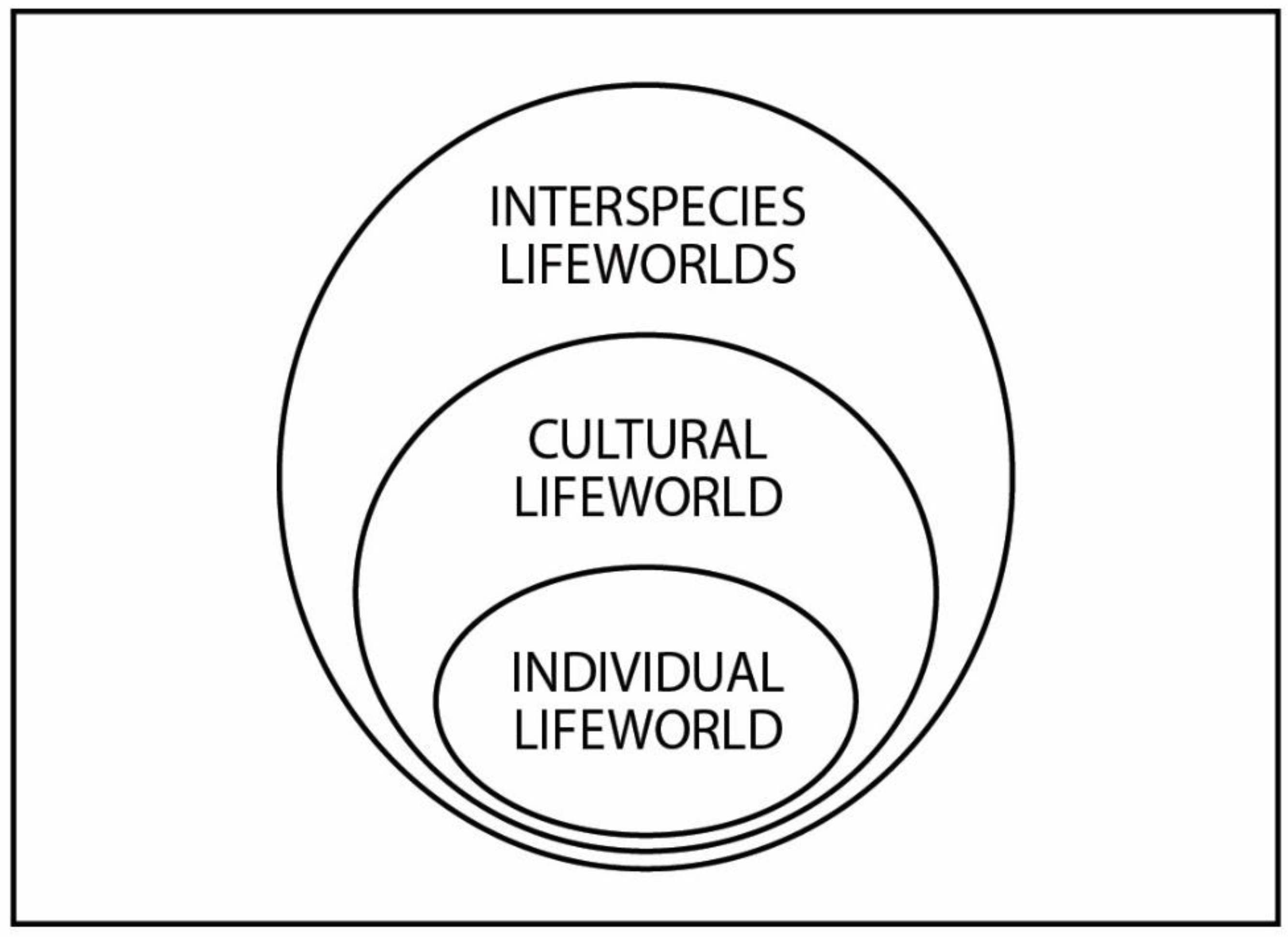
Figure 2.
Possible aspects of ecological loss.
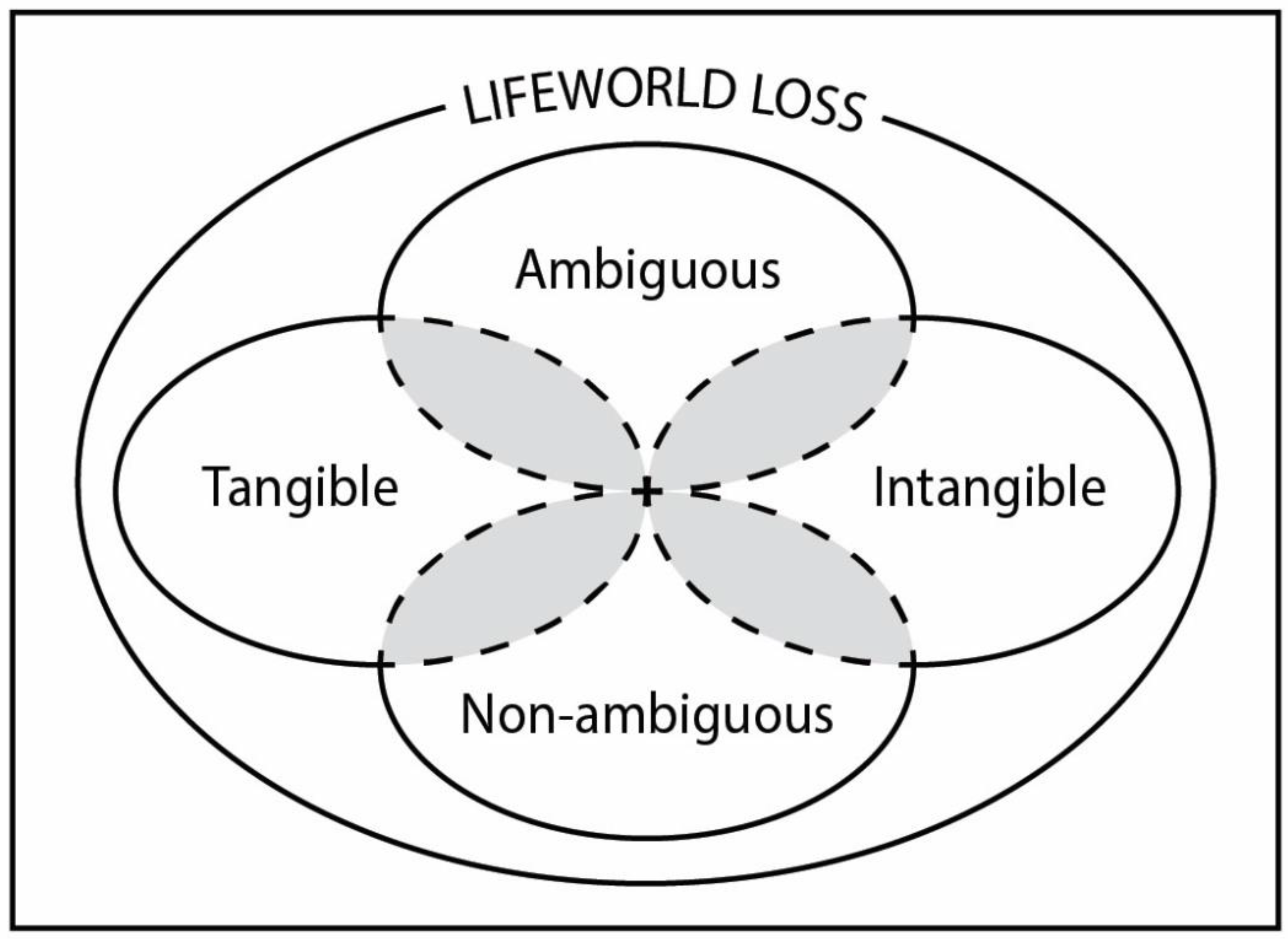
Table 1.
Intangible losses related to climate change according to Tschakert et al. (2019).
| Culture, Lifestyle, Traditions & Heritage Physical health Mental and Emotional Well-being Human Mobility Indirect Economic Benefits and Opportunities Sense of place Social fabric Ecosystem Services, Biodiversity and Species Productive Land and Habitat Knowledge and Ways of Knowing Human life [span] Identity Self-determination and Influence Order in the world Dignity Territory Ability to Solve Problems Collectively Sovereignty |
Table 3.
Types of ambiguous loss and examples of ecological loss.
| Type of ambiguous loss | Example | Ecological loss example |
| Physically absent but psychologically present | a soldier missing in action | ambiguous loss of birds which are expected to be present |
| Psychologically absent but physically present | a person with dementia | a nearby forest still standing but without biodiversity |
Table 4.
“Cardinal features” of nonfinite loss according to Harris (2020, p. 141) and Bruce & Schultz (2001).
Table 4.
“Cardinal features” of nonfinite loss according to Harris (2020, p. 141) and Bruce & Schultz (2001).
| Aspect of nonfinite loss | Themes | Examples of similar dynamics in eco-emotion studies |
| "There is an ongoing uncertainty regarding what will happen next. Anxiety is often the primary undercurrent to the experience." | The central role of uncertainty; anxiety as closely intertwined with loss | Overview: Pihkala 2020 [30] |
| "There is often a sense of disconnection from the mainstream and what is generally viewed as 'normal' in human experience." | Feeling apart from others, possible attempts of pathologization by others, possible isolation | Norgaard (2011), Kretz (2017) [96,118] |
| "The magnitude of the loss is frequently unrecognized or not acknowledged by others." | Disenfranchized grief, lack of recognition of mourners, or lack of acknowledgement of the actual severity of the loss | Jamail (2019), Gillespie (2020) [86,119] |
| "There is an ongoing sense of helplessness and powerlessness associated with the loss." | helplessness, powerlessness | Hickman et al. (2021), Galway & Field (2023) [120,121] |
| "Nonfinite losses may be accompanied by shame, embarrassment, and self-doubting that further complicates existing relationships, thereby adding to the struggle with coping." | shame, embarrassment, implicitly guilt, possible self-doubting and low self-esteem | Jensen (2019); Ágoston et al. (2022) [35,122] |
| "There are typically no rituals that assist to validate or legitimize the loss, especially if the loss was symbolic or intangible." | lack of rituals | Pike (2017); Menning (2017) [123,124] |
| "chronic despair and ongoing dread" (added by Jones & Beck 2007) | chronic despair, ongoing dread, and other similar phenomena with various terms | Macy (1983), Clark (2020) [18,125] |
Table 5.
Key concepts and frameworks related to shattered assumptions and meaning reconstruction.
| Concept or framework | General sources | Main ideas | Examples of similar dynamics in ecological loss and grief |
| Shattered assumptions | Janoff-Bulman 1992 | Major loss and trauma can shatter fundamental assumptions about self and world | Verlie 2019 |
| Existential crisis | van Deurzen 2021 | Events in life and the world can cause people deep existential turmoil | Rehling 2022; Budzisewska & Jonsson 2021 |
| Relearning the world | Attig 2015 | Deep processes of grief and loss require relearning the world and one’s relation to it | Newby 2022; Wray 2022 |
| Meaning reconstruction | Neimeyer 2019 | Major loss causes the need to work through changes in one’s meaning system and narrative understanding of life | Passmore et al. 2022; Jamail 2019 |
| Spiritual crisis | Pargament & Exline 2022 | Major loss can trigger religious and spiritual crises | Ward 2020 |
| Complicated spiritual grief | Burke et al. 2021 | Spiritual grief can become complicated and include e.g. isolation | Malcolm 2020 |
Table 6.
Various dynamics of disenfranchised grief.
| Dynamic | Example | Ecological grief literature and related dynamics |
| The relationship is not recognized (Doka 2020) | An extra-marital lover is not allowed to grieve | Kinship with non-human others not recognized, e.g. Braun 2017 [99] |
| The loss is not acknowledged (Doka 2020) | Intangible losses are not recognized | Tschakert et al. 2017 [93] |
| The griever is excluded (Doka 2020) |
A young child is deemed incapable of grieving | Ecological mourners excluded, e.g. Kretz 2017 [96] |
| Circumstances of loss (Doka 2020) |
Death due to drug abuse produces stigma and silence | Suicides of people who feel severe eco-depression and grief? |
| Ways of grieving (Doka 2020) |
A family member presupposes that another should grieve exactly in a similar way with them | Normative understandings of ways of ecological grieving? |
| Grief reactions and expressions of them (Corr 2002) | Not allowing a strong grief reaction | Allowing a mild ecological grief but not a strong form of it, Cunsolo & Landman 2017 [12] |
| Mourning and rituals (Corr 2002) |
Not allowing a particular mourning ritual | No funeral for non-human animals, DeMello 2016 [98] |
| Outcomes of grief (Corr 2002) |
Not allowing grief which lasts long | Social disapproval of certain outcomes of ecological grief? |
| Disenfranchising because of existential anxieties (Rinofner-Kreidl 2016) |
Not allowing a grief response because it reminds of mortality | Nicholsen 2002 [169] |
Table 7.
Chronic sorrow and ecological grief.
|
Characteristics of chronic sorrow (Roos 2020) |
Ecological grief literature about similar characteristic |
| “(A) its non-pathological nature” | Comtesse et al. (2021) [48] |
| “(B) its essential disenfranchisement” | Cunsolo & Ellis (2018) [2] |
| “(C) references to self- and/or other-loss” | Lertzman (2015) [171] |
| “(D) its frequent traumatic onset” | Hoggett & Randall (2018) [187] |
| “(E) its having no foreseeable end” | Saint-Amour (2020) [55] |
| “(F) constant reminders or triggers” | Gillespie (2020) [86] |
| “(G) unavoidable, periodic resurgences of intensity” | Moser (2021) [188] |
| “(H) predictable and unpredictable stress points” | Wray (2022) [84] |
| “(I) not being a state of permanent despair” | Stoknes (2015) [167] |
| “(J) continuation of functioning by the affected person” | Doppelt (2016) [189] |
Table 8.
Key concepts related to anticipatory grief / mourning.
| Concept | Key idea and an example of research | Example in context of ecological grief |
| Anticipatory grief | Grieving in advance [195] | Grieving anticipated ecological losses beforehand [2] |
| Anticipatory mourning | Rando’s proposal for a wider framework [202] | Ecological mourning which includes also reactions to ongoing losses and transformation [58] |
| Decathexis | Removing emotional bonds from a (lost) object; historical links to Freud, see [217] | Similarities with biofobia as defined by Sobel [205] |
| Continuing bonds | People wish to continue emotional bonds with the lost person [74] | Finding ways to still be in contact with a damaged environment [218] |
| Transitional loss | Losses felt due a transition in life [47] | Losses related to transitions brought by the climate crisis [47] |
| Maturational loss | Losses related to changing life stages, can exist along felt gains [75] | Growing up amidst the climate crisis brings various maturational losses [219] |
| Self-mourning | Anticipatory grief/mourning includes a dimension of mourning one’s own mortality [211] | Ecological grief can activate self-mourning about one’s own mortality [182] |
Table 9.
Theoretical categories of complicated ecological grief
 |
Table 10.
Selected types of ecological loss and grief in relation to local and global ecological grief.
Table 10.
Selected types of ecological loss and grief in relation to local and global ecological grief.
| Concept | Local ecological grief | Global ecological grief |
| Tangible / intangible loss | Often heavy tangible aspects; many potential intangible aspects | Amount of tangible aspects varies between contexts; very many potential intangible aspects |
| Ambiguous loss | Often | Many aspects |
| Nonfinite loss | Sometimes | Very clearly |
| Shattered assumptions | Sometimes | Prominently |
| Disenfranchised grief | Very often | Very often |
| Chronic sorrow | Sometimes | Dominantly |
| Anticipatory grief/mourning | Often | Often |
| Transitional loss and grief | Very often | A prominent dynamic |
| Lifeworld loss | If happens, deeply felt | Global lifeworld loss? |
| Shattered dreams | Sometimes (often?) | Often |
Table 11.
Examples of practical advise about coping with loss: Ambiguous loss and nonfinite loss.
|
Ambiguous loss (Boss 2020) |
Nonfinite loss (Schultz & Harris 2011) |
| Finding meaning | Name and validate the loss(es). |
| Adjusting mastery | Normalize the ongoing nature of the loss. |
| Reconstructing identity | Find supports and resources. |
| Normalizing ambivalence | Recognize the loss(es) and identify what is not lost. |
| Revising attachment | Allow for the possibility of meaning making and growth. |
| Discovering new hope and purpose for life | Initiate rituals where none exist. |
Disclaimer/Publisher’s Note: The statements, opinions and data contained in all publications are solely those of the individual author(s) and contributor(s) and not of MDPI and/or the editor(s). MDPI and/or the editor(s) disclaim responsibility for any injury to people or property resulting from any ideas, methods, instructions or products referred to in the content. |
© 2023 by the authors. Licensee MDPI, Basel, Switzerland. This article is an open access article distributed under the terms and conditions of the Creative Commons Attribution (CC BY) license (http://creativecommons.org/licenses/by/4.0/).
Copyright: This open access article is published under a Creative Commons CC BY 4.0 license, which permit the free download, distribution, and reuse, provided that the author and preprint are cited in any reuse.


