

Submitted:
14 November 2023
Posted:
15 November 2023
Read the latest preprint version here
Abstract
This study examined the relationships between attitude, subjective norms, perceived behavioral control, and behavioral intention through the perceived value of Pilates participants. The par-ticipants of this study were 301 Pilates students using Pilates studios located in Busan, Ulsan, and Gyeongbuk Province. The participants were selected by convenient sampling, a non-probability sampling method. The collected data were analyzed using descriptive analysis, reliability analysis, correlation analysis, confirmatory factor analysis, and structural equation modeling analysis using SPSS 22.0 and AMOS 24.0. The results can be summarized as follows. First, among the three sub-factors of perceived value, functional and social values had a positive effect on attitude. Second, attitude, subjective norms, and perceived behavioral control, which are three main components of the Theory of Planned Behavior, had a positive effect on the behavioral intention for Pilates. These results suggest that Pilates instructors require meticulous planning and efforts to develop an en-vironment for promoting spontaneous interest and participation to attract students and engage their attention and interest in the field.
Keywords:
Pilates
; Perceived Value
; Sustainable behavioral intention
; Extended Theory of Planned Behavior (ETPB)
1. Introduction
1.1. Background and Objectives
Pilates is an exercise technique that was developed by Joseph Hubertus Pilates (1880–1967) in the 1920s, and has been since developed and practiced in many countries around the world, including Korea [1] This exercise method can improve various motor functions, such as muscular strength and endurance of the human body [2], static and dynamic balance [3], and flexibility [4] through a continuous and repetitive workout using particular parts of the body.
According to a report by the Ministry of Culture, Sports, and Tourism (2022) in Korea, regarding the reason for participation in sports activities, ‘health maintenance and promotion’ (50.1%) was the primary reason given by the largest proportion of respondents, followed by ‘good use of leisure’(14.5%) and ‘weight control and body shape management’ (13.3%). In response to the question about the kind of sports they wanted to participate in, golf (16.2%) was chosen by the largest proportion of respondents, followed by Pilates (7.8%) and swimming (7.8%), showing higher levels of preference for these sports activities. The strong preference for Pilates can be attributed to the fact that Pilates was introduced as a type of exercise program for maintaining health and fitness through various media and has been gradually perceived as a kind of sports activity for daily exercise. As a result, the participation rate in Pilates is growing continuously, and the number of related facilities is also increasing yearly because of steady demand [5]. Given the growing interest in Pilates, there is a need for research to make in-depth predictions about Pilates participation behavior by identifying the types of major values influencing participation in Pilates among Pilates students and investigating the factors affecting their participation intention and behaviors.
Value is an essential factor affecting attitudes and behaviors based on the subjective values of consumers. It has been identified as the most important factor in determining customer behaviors in several studies in various fields [6,7,8]. The value refers to the profit or benefits that consumers expect from a product (good/service), and it acts as a more critical factor in making a purchase decision than the price that needs to be paid for the product [9,10]. In addition, the perceived value generated in the purchase behavior stage of consumers is derived from emotions, and mental associations arising during the consumption process were a major antecedent affecting customers’ attitudes and behaviors [11]. Furthermore, value is a goal or social factor given to individuals that induces them to exhibit a particular behavior, and it has a hierarchical structure that affects individuals’ attitudes or behaviors [10,12].
Various theories have been developed and applied to understand and predict human behaviors. The Theory of Planned Behavior (TPB) proposed by Ajzen(1991) is a representative theory of human behavior, and the TPB has made a significant contribution to explaining exercise behavior at the decision-making level. In the TPB, non-intentional aspects of the individuals’ behaviors were reflected by adding a variable called perceived behavioral control (PBC) to the existing Theory of Reasoned Action (TRA) to predict the behaviors and intentions of individuals better. This perceived behavioral control can be defined as an individual’s perceived ease or difficulty in performing a particular behavior [13]. The concept of perceived behavioral control (PBC) was generated based on the perceived presence of factors impeding or facilitating the performance of a particular behavior and the function of the perceived power of the control factor facilitating a behavior [13,14]. Considering perceived behavioral control (PBC) in analyzing human behavior has improved the predictive power for individual decision-making [15,16].
Against this theoretical background, Hagger, Chatzisarantis, and Biddle (2002) attempted to predict exercise behavior by applying TPB. They reported that attitude toward exercise, subjective norms, and perceived behavioral control were found to affect behavioral intention. In addition, relatively consistent results were reported by several previous studies, including a study to predict participation intention and actual participation in fitness exercise among female fitness exercise participants [17] and a study to predict the intention of continuous exercise participation among college students attending liberal arts courses related to physical education [18]. Previous studies have shown that TPB provides a robust theoretical framework for explaining behavioral intentions and exercise behaviors [19].
Therefore, this study examined the major values and participation intention of Pilates students by applying an extended model of the Theory of Planned Behavior (TPB). In particular, this study evaluated the effects of functional, emotional, and social value on the attitudes toward Pilates and the impact of attitude, subjective norms, and perceived behavioral control on the behavioral intention and continuous participation intention for Pilates. The results are expected to help establish strategies for guiding individuals to make rational decisions by developing a behavior model for predicting the behavior of Pilates students.
1.2. Theoretical framework and research hypotheses
1.1.1. Perceived value
Value can be defined as consumers’ overall evaluation of a product [9], and value, which is developed from benefits gained from a product and the cost related to the benefits, leads to a positive evaluation of the company in the long run [20]. The value types can be categorized based on three dichotomous dimensions: self-oriented or other-oriented, active or reactive, and intrinsic or extrinsic [21]. Consumers' perceived value is the fourth most important factor to attract consumers after quality, satisfaction, and loyalty [11]. Research on the multidimensional measurement of perceived value has been conducted steadily by many scholars. Babin, Darden, and Griffin [22] reported that consumption behavior produces practical and hedonic results in the consumption experience. They explained the perceived value by categorizing it into utilitarian and hedonic values. Sheth, Newman, and Gross [23] expanded the concept of perceived value by presenting its five elements: social, emotional, functional, conditional, and epistemic. In this study, a multidimensional approach was taken to investigate perceived value, and the analysis of perceived value was based on Sweeney, Soutar, and Johnson (1999)’s study [24] of social, functional, and emotional value.
Homer and Kahle [25] argued that customer value forms attitudes toward a product and the company and has a hierarchical structure affecting customer behavior. The study also proposed a hierarchical relationship between variables about the value-attitude-behavior (VAB) model. Kiatkawsin and Han [26] applied the VAB model in a study to attract continuous visits to Chiang Mai, Thailand. They showed that value has a significant effect on attitude, and attitude has a positive effect on revisit intention. In addition, Teng, Wu, and Huang [27] assessed the intention to visit an eco-friendly restaurant by applying the VAB model and reported that higher perceived value is linked to a higher level of positive attitude and a higher positive attitude is associated with a stronger behavioral intention and visit intention. They also claimed that attitude mediates the causal relationship between the perceived value and behavioral intention.
As described above, previous studies on the influence relationship between perceived value and attitude suggested that perceived value is a variable applicable as an indicator for predicting the potential customers’ behavior [28]. Therefore, this study examined what value has a positive effect on the attitudes among Pilates participants by applying a multidimensional concept of perceived value and examined the influence relationship between the Pilates participants’ attitudes formed through perceived value and their behavioral intention by applying a model of the Extended Theory of Planned Behavior (ETPB).
Hypothesis H1.
Pilates participants’ functional value will have a significant positive effect on their attitude toward Pilates.
Hypothesis H2.
Pilates participants’ emotional value will have a significant positive effect on their attitude toward Pilates.
Hypothesis H3.
Pilates participants’ social value will have a significant positive effect on their attitude toward Pilates.
1.1.2. Theory of Planned Behavior (TPB) and Extended Theory of Planned Behavior (ETPB)
Fishbein and Ajzen [29] proposed the Theory of Planned Behavior (TPB); it represents a concept derived through the extension of the Theory of Reasoned Action (TRA). In an analysis applying a TPB model, it was assumed that the behavioral intention and behavior prediction depend on the following three processes: behavior attitude, subjective norms, and perceived behavioral control [30]. Among the three factors, attitude is divided into positive or negative evaluations of the actual behaviors [31], and subjective norms include social influence and refer to the people’s general views on performing a behavior [32]. The perceived behavioral control refers to an individual’s ability or confidence to control necessary factors in performing a particular behavior [13], which means the ease of behavior [33]. In other words, the TPB claims that an individual’s will directly affects the execution of behaviors. This is manifested through attitude, subjective norms, and perceived behavioral control, which were postulated as antecedents in the TPB [34].
In addition, Ajzen [13] suggested that additional predictor variables can be used if it increases in the explanatory power of the TPB. Although the TPB is generally evaluated as superior to existing behavioral theories in terms of the prediction of behavioral intentions and actual behaviors [35,36], some researchers claimed that because the TPB does not have sufficiently high explanatory power for behavioral intention or actual behavior, there is a need to add antecedents that can improve the explanatory power of a theoretical model [37,38,39,40]. As a result, studies have emerged attempting to apply an ETPB model by incorporating a new variable or new variables in addition to three variables presented in the TPB. Hence, attitude, subjective norms, and perceived behavioral control, which constitute the basic variables of the TPB and characteristics of individual consumers, may influence the purchase intention and purchase behavior. With respect to previous studies using a modified or extended model of the TPB, Yun, Oh, and Yun [41] applied an ETPB model by including perceived risk and prior knowledge as additional variables to investigate the Koreans’ intention for international travel. Quintal, Lee, and Soutar [42] conducted research by including perceived risk and uncertainty in the analysis. Lin and Chen [43] added prior knowledge as a variable in their study. They asserted that this variable positively affects a consumer’s purchase decision and decision-making process for choosing a brand, which strongly impacts behavioral intention. Jin [44] evaluated an ETPB model by adding perceived value as a variable to the TPB as in the present study. They reported that customers’ perceived value of local food significantly affects the repurchase intention. Kim and Moon [45] examined the influence of value on the behavioral intention for outdoor recreational activities in automobile campers.
Therefore, this study examined the influence relationships related to the behavioral intention of Pilates participants through a conceptual extension of the TPB by considering the perceived value as an additional variable based on previous studies(Figure 1).
Hypothesis H4.
Pilates participants’ attitudes will have a significant effect on their behavioral intention for Pilates.
Hypothesis H5.
Pilates participants’ subjective norms will have a significant effect on their behavioral intention for Pilates.
Hypothesis H6.
Pilates participants’ perceived behavioral control will have a significant effect on their behavioral intention for Pilates.
2. Materials and Methods
2.1. Participants
Data was collected through a questionnaire survey in personal on-site visits among Pilates participants. The participants were selected by convenience sampling, a non-probability sampling method, and the target population was Pilates students enrolled in Pilates centers located in Busan, Ulsan, and Gyeongbuk Province. Three hundred and one copies of questionnaires were distributed. They were collected after the participants were asked to complete the questionnaire by a self-administered survey method. Of the 301 questionnaires collected, 288 copies were finally included in the analysis, excluding 13 copies with problems, such as insincere or double responses. Table 1 lists the general characteristics of the participants.
2.2. Measures
In this study, a questionnaire survey was conducted to collect data. Except for ques-tions on the general characteristics of participants, each item on functional, emotional, and social values, subjective norms, perceived behavioral control, and the behavioral intention was rated on a five-point Likert scale ranging from ‘Strongly disagree/Not at all’ to ‘Strongly agree/Extremely.’
First, for the scale for the perceived value that explains attitude toward behavior and is composed of the three dimensions of functional, emotional, and social values, a modified version of the scale developed by Sweeney and Soutar [46] was produced and used through the modification and complementation of the original version by Sweeney and Soutar [46] and the scale used by Yun, Oh and Hah [47] considering the purpose of this study. This scale to assess the perceived value was composed of 11 questions, including four items on functional value, four items on emotional value, and three items on social value.
For the scale on TPB, a modified version of the scale developed by Ajzen and Driver [48] and Ajzen [49] was used by modifying and complementing the existing version considering the purpose of this study, based on Soh [50]. The scale on the TPB used in this study consisted of 16 items, including five items on attitude, four items on subjective norms, three items on perceived behavioral control, and four items on behavioral intention.
2.3. Statistical analysis
In this study, 288 copies of questionnaires were finally selected as valid samples, and data analysis was carried out using SPSS 22.0 ver. First, frequency analysis, a descriptive analysis, was performed to examine the demographic characteristics of the participants. In addition, reliability analysis was conducted using Cronbach’s α coefficient to secure internal consistency. Confirmatory factor analysis was carried out using AMOS 24.0 ver. to assess the convergent validity, and correlation analysis was performed to test multicollinearity. Finally, structural equation model analysis was conducted to examine the causal relationships between measured variables.
2.4. Confirmatory factor analysis and reliability analysis
After constructing the assessment scale or questionnaire for this study based on previous studies, the suitability of questionnaire items was verified by asking a physical education professor and two other researchers with a Ph. D in physical education to evaluate content validity. The factor analysis model was verified using the collected questionnaires as analysis data and confirmatory factor analysis was performed to determine if the internal structure of each variable was constructed adequately. In addition, reliability analysis was performed using Cronbach’s α coefficient to assess construct validity and reliability. In addition, among the model fit indices, CFI, TLI, and RMSEA, which are relatively insensitive to the sample size and consider model simplicity, were applied [51]. The thresholds for model fit indices were set to .90 or higher for CFI and TLI and .80 or lower for RMSEA [52,53], and the threshold conditions were all satisfied. In addition, for each factor, the average variance extracted (AVE) value was 0.6 or higher, and the construct reliability and Cronbach’s α coefficient were 0.7 or higher, exceeding the threshold for the convergent validity [51]. Table 2 lists details of the above analysis results.
3. Results
3.1. Correlation analysis
Correlation analysis between constructs can be used for hypothesis verification in exploratory research, which provides a broad outline of relationships between variables by showing the strength of a relationship between important variables used in all research hypotheses before performing hypothesis testing. Therefore, Pearson's correlation analysis examined the correlations and directionality for each scale related to each research unit; Table 3 lists the results. As a result, the analysis results of the relationships between vari-ables agreed with the hypotheses formulated in this study, and correlation coefficients were lower than .80, indicating no multicollinearity.
3.2. Tests of model fit for the research model
Based on previous studies, the tests of the model fit for the research model were conducted using CFI (comparative fit index), TLI (Tucker–Lewis Index), and RMSEA (root mean square error of approximation) among the fit indices. As a result of assessing the model fit of the proposed model, CFI of .927 (>.90), TLI of .916 (>.90), and RMSEA of .077 (<.08) were obtained, indicating a good model fit in terms of the simplicity and suitability of the mod-el (Table 4)
3.3. Hypothesis verification
The path coefficients between the variables given in Figure 1 are presented in the order of hypotheses as follows to verify the hypotheses of this study.
H1. In the analysis to examine the relationship between functional value and PBT (attitude), the path coefficient was estimated to be 0.174 (t=2.148, p<.05), indicating that the functional value has a significant positive effect on attitude.
H2. In the analysis to identify the relationship between emotional value and PBT (at-titude), the path coefficient was 0.126 (t=1.685, p=.092), suggesting that emotional value does not significantly affect attitude.
H3. As a result of the analysis to identify the relationship between social value and PBT (attitude), the path coefficient was 0.364 (t=3.900, p<.001), indicating that social value has a significant positive effect on attitude.
H4. In the analysis to identify the relationship between attitude and behavior intention, the path coefficient was estimated to be 0.192 (t=3.576, p<.001), indicating that attitude positively affects the behavioral intention.
H5. In the analysis of the relationship between subjective norms and behavior intention, the path coefficient was 0.199 (t=3.185, p<.001), indicating that the subjective norms have a statistically significant effect on behavior intention.
H6. In the analysis to identify the relationship between perceived behavioral control and behavior intention, the estimated path coefficient was 0.127 (t=1.981, p<.05), indicating that perceived behavioral control has a significant positive effect on the behavior intention.
4. Discussion
This study attempted to predict the behavior of Pilates participants based on the per-ceived value related to the formation process of Pilates participation intention.
The results of the present study showed that among the three subfactors of perceived value, functional and social values positively affect the attitudes toward Pilates. In contrast, emotional value does not have a significant effect. In addition, the subjective norms and perceived behavioral control positively affected the Pilates behavioral intention. The significance and implications of these results are as follows.
First, in the analysis of the relationships between functional, emotional, and social values and attitudes in relation to the prediction of the formation process of Pilates behavioral intention of Pilates participants, the functional and social values had a positive effect on the formation process of attitude toward Pilates among Pilates participants, but the emotional value did not. These results are consistent with the findings of a study on the watching behavior of spectators of traditional dance performances by M.-J. Park and T.-S. Park [54], which reported that the functional and social value of spectators influenced their watching behavior, while their emotional value did not affect it. J. Yun and S.-G. Lee [55] reported that functional, emotional, and social values positively affected the attitude among marina yacht users. On the other hand, Y.-M. Jeon [44] reported that emotional and social value affected the local food purchase behavior while the consumers’ functional value did not. In this study, the overall hypotheses on the in-fluence of the perceived value on the attitude have been partially adopted. In other words, the analysis results of this study indicated that the social value related to overall social aspects, such as the improvement of interpersonal relationships through Pilates, economic aspects, and time, is perceived as more important than the emotional value among Pilates participants. These results appear to show that although the value of Pilates has a significant impact on attitude in the decision-making process of Pilates participants, the participants place greater importance on the utilitarian value obtained through Pilates than the emotional value formed through Pilates exercise activities. On the other hand, as shown by previous studies, emotional value cannot be dismissed entirely as meaningless. Therefore, adequate consideration should also be given to the method to ensure that the experience of participating in Pilates exercise will generate positive emotions for Pilates students.
Therefore, to promote the continuous growth of the rapidly growing Pilates industry, an attempt to form the main features of each Pilates studio must be preceded by efforts and investment for developing differentiated programs that reflect the emotional and sensory dimensions of Pilates participants to ensure that Pilates participation will be perceived as an enjoyable and attractive experience. In other words, the study results suggest that exercise programs with inventive elements that stimulate students' interest are more likely to be more effective than the typical, indistinctive exercise programs of general Pilates studios.
Second, with respect to the prediction about the formation process of Pilates behavioral intention of Pilates participants, the analysis results of relationships between attitude, subjective norms, perceived behavioral control, and behavioral intention revealed that at-titude, subjective norms, and perceived behavioral control all have a positive impact on the behavioral intention in the formation process of the Pilates behavioral intention in Pi-lates participants. These results are consistent with a study of the purchase intention for green products among Tai consumers by Maichum, Parichatnon and Peng [56], who reported that the attitude, subjective norms, and perceived behavioral control all have a positive effect on the purchase intention. Lee [57] reported the positive effects of variables of the Theory of Planned Behavior (TPB) on participation in sports for all among the physically disabled. Jang and Kim [58] also reported that attitude, subjective norms, and perceived behavioral control positively affect the behavioral intention for continuous exercise participation among college students. The results of these three prior studies support the findings of the present study. Therefore, it is necessary to help them develop a positive attitude toward participation behavior to increase the behavioral intention of Pilates students. In this connection, subjective norms refer to the perception that other individuals or surrounding groups influence an individual's disapproval or approval of a particular behavior [59]. In other words, this concept suggests that students and their relationship with their significant others, such as the instructor and colleagues, should also be considered. In addition, it is necessary to explore methods to improve participation in Pilates exercise and solve related problems considering the location, equipment, amenities and welfare facilities available, and the transportation environment of each Pilates studio.
In summary, this study applied the PTB to predict the behavioral intention of Pilates participants and identify the characteristics of their perceived value. In other words, higher levels of individuals’ positive attitudes toward Pilates, subjective norms, and perceived behavioral control lead to improved behavior intention. In addition, a higher level of Pilates participation intention is related to a greater degree of continuous participation. These processes are believed to be elevated if various types of perceived value are satisfied. Therefore, promoting the positive effects of Pilates, belief in the benefits of Pilates, sponta-neous willingness to participate, and forming positive relationships with the surrounding people will help to increase continuous participation.
5. Conclusions and suggestions
This study analyzed the behavioral intention of Pilates participants applying an ETPB model by incorporating the perceived value (functional, social, and emotional value) as an additional factor in the existing TPB model, and the following conclusions were drawn from the analysis results.
The analysis results suggested that the behavioral intention of Pilates participants can be improved through behavioral attitude toward Pilates exercise and perceived behavioral control, which is also influenced by subjective norms. In addition, the behavioral attitude and behavioral intention can be improved through perceived value used as an additional explanatory variable. Therefore, to improve the behavioral intention of Pilates participants, there is a need for endeavors to prevent the reduction of behavioral attitude and perceived behavioral control for Pilates activities. Moreover, it is also necessary to make active efforts to elevate the functional value of Pilates exercise and promote the formation of active social value accompanying participation in Pilates exercise. For example, with respect to methods to promote participation in Pilates activities and increase the perceived value of these activities, it is necessary to hold various events to induce participation, such as pro-grams linked to social clubs of people who pursue a shared hobby or interest and provide various kinds of up-to-date information including information on facilities, locations, and participation effects via the homepage and various media.
In addition, study results will serve as empirical data that can be utilized to establish intervention strategies to elicit or increase behavioral intention for continuous participa-tion in Pilates exercises in the field. Academically, this study may provide the empirical data required to use the perceived value subfactors as explanatory variables in follow-up research to extend the TPB.
Concerning the limitations of this study, although the perceived value had already been formed to some extent and affected the performance of Pilates behavior among Pilates participants, this study did not conduct a comparative analysis of the perceived value by considering the Pilates participants’ length of experience of Pilates exercise. Therefore, a comparative analysis considering this factor in follow-up research is expected to provide more elaborate interpretations and suggestions. In addition, various explanatory variables reflecting the motivation factor should be employed in future analyses of behavioral intention by extending the TPB to provide a broader understanding of the behavioral intention of Pilates participants and produce meaningful research outcomes that can be actively applied in the field.
Author Contributions
Conceptualization: S. Kim; methodology: J. Ha; software: J. Ha; validation: J. Ha and S. Kim; formal analysis: S. Kim; investigation: S. Kim; resources: J. Ha; data curation: S. Kim; writing—original draft preparation: J. Ha; writing—review and editing: S. Kim; visualization: J. Ha; supervision: J. Ha; project administration: S. Kim; funding acquisition: J. Ha.
Funding
This research was supported by Sunchunhyang University, South Korea.
Institutional Review Board Statement
The study was conducted in accordance with the set of
ethical principles the Declaration of Helsinki.
Informed Consent Statement
Informed consent was obtained from all subjects involved in the study.
Data Availability Statement
Data can be made available from corresponding author upon reasonable request.
Conflicts of Interest
The authors declare no conflict of interest.
References
- Joseph, E.M.; Simona, C. Pilates and the "Powerhouse" - II. J. Bodyw Mov. Ther. 2004, 8, 122–130. [Google Scholar] [CrossRef]
- Sekendiz, B.; Altun, O.; Korkusuz, F.; Akın, S. Effects of Pilates Exercise on Trunk Strength, Endurance, and Flexibility in Sedentary Adult Females. J. Bodyw Mov. Ther. 2007, 11, 318–326. [Google Scholar] [CrossRef]
- Fitt, S.; Sturman, J.; McClain-Smith, S. Effects of Pilates-Based Conditioning on Strength, Alignment, and Range of Motion in University Ballet and Modern Dance Majors. Kinesiol. Med. Dance 1994, 16, 36–51. [Google Scholar]
- Latey, P. Updating the Principles of the Pilates Method - Part 2. J. Bodyw Mov. Ther. 2002, 6, 94–101. [Google Scholar] [CrossRef]
- Jung, H.W.; Lee, J.R. Problems and Improvements of Pilates Lessons: Focusing on Instructors. Korean Phy. Edu. 2019, 58, 77–95. [Google Scholar] [CrossRef]
- Dahlen, M.; Granlund, A.; Grenros, M. The Consumer Perceived Value of Non-Traditional Media: Effects of Brand Reputation, Appropriateness, and Expense. J. Consumer Market. 2009, 26, 155–163. [Google Scholar] [CrossRef]
- Eid, R. Integrating Muslim Customer Perceived Value, Satisfaction, Loyalty, and Retention in the Tourism Industry: An Empirical Study. Int. J. Tourism Res. 2015, 17, 249–260. [Google Scholar] [CrossRef]
- Kim, S.J.; Ryu, D.S. The Relationships between Values, Brand Attitude and Intended Action in University Tae-Kwon-Do Competition. Korea Cont. Asso. 2016, 16, 464–476. [Google Scholar] [CrossRef]
- Zeithaml, V.A. Consumer Perceptions of Price, Quality, and Value: A Means-End Model and Synthesis of Evidence. J. Marketing 1988, 52, 2–22. [Google Scholar] [CrossRef]
- Lee, H.-J. The Effect of Tourism Destination Image on Perceived Values, Attitudes, and Behavioral Intentions: Focused on Walking Tourists. Int. J. Tourism Hosp. Res. 2021, 35, 21–32. [Google Scholar] [CrossRef]
- Jamal, S.A.; Muhammad, N.M.N. Tourist perceived value in a community-based home stay visit: An investigation into the functional and experiential aspect of value. J. Vacation Marketing 2011, 17, 5–15. [Google Scholar] [CrossRef]
- Kim, G.-A. Study on Relationship between Perceived Value, Attitude and Behavioral Intention of Fair Tourism - Focus on Tourist’s Experience to The Gamcheon Cultural Village. J. Cult. Policy 2014, 28, 174–196. [Google Scholar]
- Ajzen, I. The theory of planned behavior. Organ. Behav. Hum. Decis. Process. 1991, 50, 179–211. [Google Scholar] [CrossRef]
- Trafimow, D.; Sheeran, P.; Conner, M.; Finlay, K.A. Evidence that Perceived Behavioral Control is a Multidimensional Construct: Perceived Control and Perceived Difficulty. Br. J. Soc. Psychol. 2002, 41, 101–121. [Google Scholar] [CrossRef] [PubMed]
- Armitage, C.J.; Conner, M. Efficacy of the Theory of Planned Behavior: A Meta-Analytic Review. Br. J. Soc. Psychol. 2001, 40, 471–499. [Google Scholar] [CrossRef] [PubMed]
- Ajzen, I.; Fishbein, M. Attitudes and the attitude-behavior relation: Reasoned and automatic processes. Eur. Rev. Soc. Psychol. 2000, 11, 1–33. [Google Scholar] [CrossRef]
- Kwon, H.; Kim, D.; Shin, J.-e. Fitness Participation Intention and the Actual Participation Behavior Predicted by the Theory of Planned Behavior. Korean J. Sport Manag. 2017, 22, 55–69. [Google Scholar] [CrossRef]
- Seo, Y.-H.; Moon, H.; Lee, J.-E.; Shin, J.-H.; Jeong, H.-J.; Kim, K. The Prediction of Participating in Continuous Exercise Applying Extended the Theory of Planned Behavior: Focus on Participating Students in University Physical Education Class. Korean J. Sports Sci. 2015, 24, 211–226. [Google Scholar]
- Hausenblas, H.A.; Carron, A.V.; Marck, D.E. Application of the rhetorics of reasoned action and planned behavior to exercise behavior: A meta-analysis. J. Sport Exerc. Psychol. 1997, 19, 36–51. [Google Scholar] [CrossRef]
- Porter, M.E.; Kramer, M.R. Creating Shared Value: How to reinvent Capitalism. Harv. Bus. Rev. 2011.
- Holbrook.; Morris. Consumer Value: A Framework for Analysis and Research, Introduction to Consumer Value. in Holbrook, M.(Ed.) 1999, New York: Routledge.
- Babin, B.J.; Darden, W.R.; Griffin, M. Work and/or Fun: Measuring Utilitarian Shopping Value. Con. Res. 1994, 20, 644–656. [Google Scholar] [CrossRef]
- Sheth; Newman; Gross. Why We Buy What We Buy: A Theory of Consumption Values. J. Bus. Res. 1991, 22, 159–170. [Google Scholar] [CrossRef]
- Sweeney, J.C.; Soutar, G.; Johnson, L.W. The Role of Perceived Risk in the Quality-Value Relationship: A Study in a Retail Environment. J. Re-tailing 1999, 75, 77–105. [Google Scholar] [CrossRef]
- Homer, P.M.; Lynn, R.K. A Structural Equation Test of the Value—Attitude-Behavior Hierarchy. J. Pers. Soc. Psychol. 1988, 54, 638–646. [Google Scholar] [CrossRef]
- Kiatkawsin, K.; Han, H. Young travelers' intention to behave pro-environmentally: Merging the value-belief-norm theory and the expectancy theory. Tour. Manage. 2017, 59, 76–88. [Google Scholar] [CrossRef]
- Teng, Y.M.; Wu, K.S.; Huang, D.M. The influence of green restaurant decision formation using the VAB model: the effect of environmental concern upon intent to visit. Sustainability 2014, 6, 8736–8755. [Google Scholar] [CrossRef]
- Bae, S.-H.; Noh, J.-H.; Kang, H.-J. A Study for the Effect about Intention of Participation in Medical Tourism to Korea by Using Theory of Planned Behavior (TPB): Focusing on the Potential Medical Tourist in Japan. J. Tourism Sci. 2015, 39, 165–183. [Google Scholar]
- Fishbein, M.; Ajzen, I. Belief, attitude, intention, and behavior: An introduction to theory and research. Reading, Massachusetts: Addison-Wesley. 1975.
- Ahmed, I.; Alzahrani, I.M.; Ramayah, T.; Alfarraj, O.; Alalwan, N. Extending the theory of planned behavior (TPB) to explain online game playing among Malaysian undergraduate students. Telemat. Inform. 2017, 34, 239–251. [Google Scholar] [CrossRef]
- Seo, H.-R.; Lee, C.-G. A Study of Chinese Tourists' Decision-Making Process in Visiting South Korea Using Extended Theory of Planned Behavior. J. Hosp. Tourism Stud. 2015, 17, 1–16. [Google Scholar]
- Cho, S.-H. A Comparative Study on the Structural Equation Model between Theory of Planned Behavior (TPB) and Extended Planned Behavior Theory (ETPB): Focused on Green Marketing of Coffee Shop in Daejeon. J. Hosp. Tourism Stud. 2019, 21, 155–171. [Google Scholar] [CrossRef]
- Lee, H.-M.; Lee, J.; Lim, J.-P.; Lee, C.-K. Examining Decision-Making Process of Scuba Diving Tourists by Using Extended Theory of Planned Behavior. J. Hosp. Tourism Stud. 2014, 16, 1–19. [Google Scholar]
- Taylor, S.; Peter, A.T. Understanding information technology usage: a test of competition models. Inf. Syst. Res. 1995, 6, 144–176. [Google Scholar] [CrossRef]
- Dawkins, C.E.; Frass, J.W. Decision of union workers to participate in employee involvement: an application of the theory of planned behavior. Employee Relat. 2005, 27, 511–531. [Google Scholar] [CrossRef]
- Lam, T.; Hsu, C.H.C. Theory of Planned Behavior: Potential Travels from China. J. Hosp. Tourism Res. 2004, 28, 463–482. [Google Scholar] [CrossRef]
- Bagozzi, R. Attitude, Intentions, and Behavior: A Test of Some Key Hypotheses. J. Pers. Soc. Psychol. 1981, 41, 607–627. [Google Scholar] [CrossRef]
- Ouellette, J.A.; Wood, W. Habit and Intention in Everyday Life: The Multiple Processes by Which Past Behavior Predicts Future Behavior. Psychol. Bull. 1998, 124, 54–74. [Google Scholar] [CrossRef]
- Vallerand, R.J.; Pelletier, L.G.; Blais, M.R.; Brière, N.M.; Senècal, C.; Vallières, E.F. On the Assessment of Intrinsic, Extrinsic, and Motivation in Education: Evidence on the Concurrent and Construct Validity of the Academic Motivation Scale. Educ. Psychol. Meas. 1993, 53, 159–172. [Google Scholar] [CrossRef]
- Zhang, L.; Fan, Y.; Zhang, W.; Zhang, S. Extending the Theory of Planned Behavior to Explain the Effects of Cognitive Factors across Different Kinds of Green Products. Sustainability 2019, 11, 4222. [Google Scholar] [CrossRef]
- Yoon, S.-M.; Oh, S.-Y.; Yoon, S.-J. A Study for the Effect Relationship about Overseas Trip Intention of Local by Using Theory of Planned Behavior (TPB): Focusing on the Additional Role of Prior Knowledge and Perceived Risk. K. J. Hosp. Tourism 2010, 19, 289–307. [Google Scholar]
- Quintal, M.V.; Lee, J.; Soutar, G. Risk, Uncertainty, and the TPB: A Tourism Example. Tourism Management 2010, 31, 797–805. [Google Scholar] [CrossRef]
- Lin, L.Y.; Chen, C.S. The Influence of the Country-of-Origin Image, Product Knowledge, and Product Involvement on Consumer Purchase Decisions: An Empirical Study of Insurance and Catering Services in Taiwan. J. Consumer Market. 2006, 23, 248–265. [Google Scholar] [CrossRef]
- Jin, Y.M. Effect of Perceived Value of Local Food on Repurchase Intention: Extended Theory of Planned Behavior. Table Food Coo. 2022, 17, 19–39. [Google Scholar] [CrossRef]
- Kim, J.-O.; Moon, B.-Y. The Influence of Auto-Camper's Value on Attitude and Behavioral Intention: An Application of the Extended Theory of Planned Behavior. J. Tourism Leisure Res. 2015, 27, 39–58. [Google Scholar]
- Sweeney, J.C.; Soutar, G.N. Consumer Perceived Value: The Development of a Multiple Item Scale. J. Retailing 2001, 77, 203–220. [Google Scholar] [CrossRef]
- Yoon, S.-M.; Oh, S.-Y.; Ha, J.-Y. Analysis for Effect Relationship among Perceived Value, Satisfaction, Attitude, and Behavioral Intention of Visitor in Local Festival: The Case of Andong Mask Dance Festival Visitors. J. Hosp. Tourism Stud. 2011, 13, 82–97. [Google Scholar]
- Ajzen, I.; Driver, B.L. Application of the Theory of Planned Behavior to Leisure Choice. J. Leisure Res. 1992, 24, 207–224. [Google Scholar] [CrossRef]
- Ajzen, I. Nature and Operation of Attitudes. Annu. Rev. Psychol. 2001, 52, 27–58. [Google Scholar] [CrossRef] [PubMed]
- So, Y.-H. Analysis on Behavioral Intention of Marine Sports Participants by Using Extended Theory of Planned Behavior. Korean. Phy. Edu. 2021, 60, 371–385. [Google Scholar] [CrossRef]
- Hair, J.F.; Black, W.C.; Babin, B.J.; Anderson, R.E. Multivariate Data Analysis: A Global Perspective, 7th ed.; Pearson Prentice Hall: Upper Saddle River, NJ, 2010. [Google Scholar]
- Hu, L.T.; Bentler, P. Cutoff Criteria for Fit Indexes in Covariance Structure Analysis: Conventional Criteria Versus New Alternatives. Struct. Equ. Model. 1999, 6, 1–55. [Google Scholar] [CrossRef]
- Kline, R.B. Principle and Practice of Structural Equation Modeling; The Guilford Press: New York, London, 2011. [Google Scholar]
- Park, T.-S.; Park, M.-J. Effect of Service Quality in Non-Face-to-Face Taekwondo Performance on Audience Satisfaction and Revisit Intention. Korean J. Sport 2021, 19, 335–345. [Google Scholar] [CrossRef]
- Yoon, J.; Lee, S.-K. The Structural Relationship among Perceived Value, Attitude, and Behavioral Intention of Marina Yacht Experience Participants: Focused on Geoje Marinabay Yacht Users. Int. J. Tourism Hosp. Res. 2019, 33, 47–60. [Google Scholar] [CrossRef]
- Maichum, K.; Parichatnon, S.; Peng, K。-C. Application of the Extended Theory of Planned Behavior Model to Investigate Purchase Intention of Green Products among Thai Consumers. Sustainability. 2016, 8, 1077. [Google Scholar] [CrossRef]
- Lee, H.-S. Analysis of Model of Sport for All Participate Behavior with People with Physical Disabilities Applied to the TPB. Korean J. Phys. Educ. 2012, 51, 431–440. [Google Scholar]
- Jang, B.; Kim, S. A Structural Relationships between College Athletes’ Perceived Coaching Behaviors, Affective Responses, Emotional Intelligence, and Performance. Korean Soc. Sport Psychol. 2019, 30, 1–13. [Google Scholar] [CrossRef]
- Balderjahn, I.; Mennicken, C.; Vernette, E. New developments and approaches in consumer behavior research; Macmillan Press Ltd: London, 1998. [Google Scholar]
Figure 1.
Conceptual model.
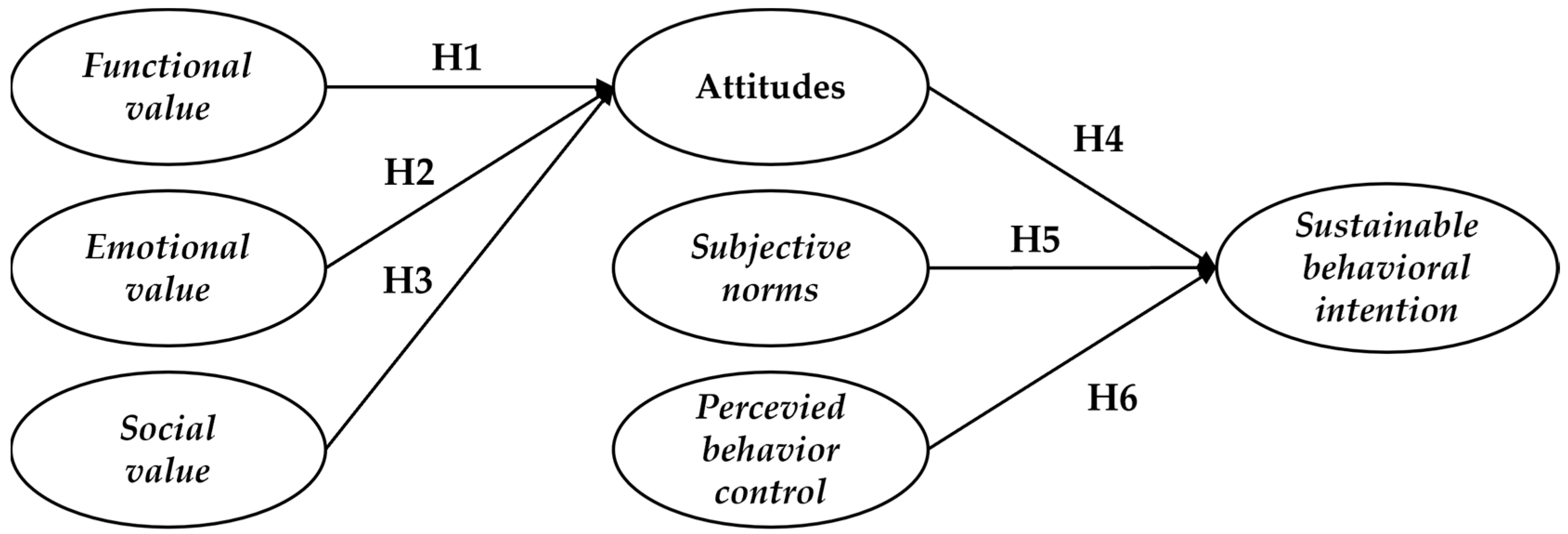

Table 1.
Characteristics of subjects.
| Characteristics | N(%) | |
| Gender | Male | 38(13.1) |
| Female | 250(86.8) | |
| Ages | 10’s | 15(0.5) |
| 20’s | 104(36.1) | |
| 30’s | 112(38.8) | |
| 40+ years old | 57(19.7) | |
| Careers | Less than 6 months | 61(21.1) |
| 6 months - less than 1 year | 74(24.6) | |
| More than 1 year - Less than 2 years | 62(21.5) | |
| More than 2 years - Less than 3 years | 59(20.4) | |
| More than 3 years | 32(11.1) |
Table 2.
Summarized results for the validity and reliability assessments.
| Variable | Items |
Standardization factor |
ConceptTrust | AVE | α | |||
| Perceived value | Functional Value (FV) |
1 | .784 | .894 | .680 | .893 | ||
| 2 | .881 | |||||||
| 3 | .830 | |||||||
| 4 | .802 | |||||||
| Emotional Value (EV) |
5 | .710 | .906 | .709 | .911 | |||
| 6 | .796 | |||||||
| 7 | .901 | |||||||
| 8 | .942 | |||||||
| Social Value (SV) |
9 | .761 | .834 | .628 | .833 | |||
| 10 | .787 | |||||||
| 11 | .828 | |||||||
| Theory of Behavior | Attitudes (AT) |
1 | .844 | .937 | .751 | .924 | ||
| 2 | .923 | |||||||
| 3 | .838 | |||||||
| 4 | .900 | |||||||
| 5 | .826 | |||||||
| Subjective Norms (SN) |
6 | .870 | .951 | .829 | .951 | |||
| 7 | .910 | |||||||
| 8 | .909 | |||||||
| 9 | .952 | |||||||
| Perceived Behavioral Control (PBC) |
10 | .741 | .860 | .674 | .770 | |||
| 11 | .932 | |||||||
| 12 | .778 | |||||||
| Sustainable Behavioral Intention (SBI) |
1 | .889 | .962 | .864 | .967 | |||
| 2 | .849 | |||||||
| 3 | .972 | |||||||
| 4 | 1.002 | |||||||
| χ2=651.024, df=301 , CFI=.959, TLI=.953, RMSEA=.058 | ||||||||
Table 3.
Model fit.
| χ2 | df | CFI | TLI | RMSEA | |
| Fit | 933.897 | 306 | .927 | .916 | .077 |
Table 4.
Discriminant Validity.
| FV | EV | SV | ATT | SB | PBC | SBI | |
| FV | 1 | ||||||
| EV | .517** | 1 | |||||
| SV | .576** | .646** | 1 | ||||
| ATT | .235** | .287** | .134** | 1 | |||
| SB | .165** | .169** | .067** | .763** | 1 | ||
| PBC | .226** | .185** | .190** | .604** | .503** | 1 | |
| SBI | .010** | −.037** | −.113** | .029** | .130** | .125** | 1 |
| ** p<.01 | |||||||
Table 5.
Hypothesis test by structural parameter estimates.
| Factors | Path (β) | S.E. | t | Results | |
| H1 | Functional value → Attitudes | .174 | .092 | 2.148* | Accepted |
| H2 | Emotional value → Attitudes | .126 | .072 | 1.685 | Verified |
| H3 | Social value→ Attitudes | .364 | .070 | 3.900*** | Accepted |
| H4 | Attitudes → behavioral intention | .192 | .054 | 3.576*** | Accepted |
| H5 | Subjective Norms → behavioral intention | .199 | .061 | 3.185*** | Accepted |
| H6 | perceived behavioral control → behavioral intention | .127 | .067 | 1.981* | Accepted |
Disclaimer/Publisher’s Note: The statements, opinions and data contained in all publications are solely those of the individual author(s) and contributor(s) and not of MDPI and/or the editor(s). MDPI and/or the editor(s) disclaim responsibility for any injury to people or property resulting from any ideas, methods, instructions or products referred to in the content. |
© 2023 by the authors. Licensee MDPI, Basel, Switzerland. This article is an open access article distributed under the terms and conditions of the Creative Commons Attribution (CC BY) license (http://creativecommons.org/licenses/by/4.0/).
Copyright: This open access article is published under a Creative Commons CC BY 4.0 license, which permit the free download, distribution, and reuse, provided that the author and preprint are cited in any reuse.


