

Submitted:
11 November 2023
Posted:
13 November 2023
You are already at the latest version
Abstract
In the scientific community, it is difficult to find a consensus on defining BIM. Just as the acronym BIM is developed in different ways, it is also understood in different ways. Depending on its understanding, different definitions emerge. It is defined differently by organizations and standards, still differently by academics. Many years of academic discourse on the subject have failed to produce a solution. Despite the fact that the acronym BIM has already done its work for the construction industry, it still stirs up excitement. There is still no clear definition, as the view of BIM varies from one perspective to another. This article attempts to sort out the definitions cited so far by important organizations and key academics. The review was based on deep literature study has attempted to be inclusive and consistent. The question still remains open: do we need a single, correct definition of BIM? The aim of the article is to try to answer this question, open up a renewed discussion and come to a satisfactory consensus. BIM can be identified with an activity, product or system. The article breaks down the definitions of BIM, identifies six key attributes of BIM, presents the evolution of the understanding of BIM and proposes new definitions in a narrow and broad approach.
Keywords:
Building Information Modelling (BIM)
; BIM definitions
; BIM technology
; BIM process
; BIM methodology
1. Introduction
The first documented representation of the concept of BIM - “building information modelling” was a scientific article by Giles A. (Sander) van Nederveen and Frits P. Tolman, which so named the techniques for multi-faceted representation of a building using views of its model (van Nederveen, Tolman, 1992). Of course, earlier still there was the concept of ‘building modelling’ itself, which would contemporarily correspond to our understanding of BIM (Aish, 1986), and was used in the context of the RUCAPS software system. Before BIM dissemination, there was decades of work on PPM (Product and Process Modelling), which is considered a precursor to BIM. The beginnings could be traced back to PRONTO (1957), first commercial computer-aided machining (CAM) software. Further development Sketchpad, CAD with graphical user interface (1963), through the concept Building Description System (1974), extension of Graphical Language for Interactive Design (1977), up to the first version RADAR CH (1983). Undoubtedly, it can be said that BIM as an advanced evolution of Computer-Aided Design contributes to a greater extent in the construction industry (Alhasan, Kumar, Thanikal, 2017).
The original BIM concept itself did not gain much publicity and was forgotten for almost a decade. Only the beginning of the 21st century and the figure of Jerry Laiserin changed the course of events. In a series of articles, Laiserin (2002, 2003, 2005, 2007) popularized the concept of BIM, noting in 2007 that the definition he had created in 2002 had already evolved considerably. At that time, in his view, “BIM is a representation process that creates and provides, in all respects, a multi-dimensional view into the building data throughout the life cycle of the building” (Laiserin, 2002). Since the early definition from Building SMART, the concept and connotation of BIM has been evolving with the deepening and broadening of applications (Zhang, Luo , Xu, 2022). Still many people see the beginning of BIM with the spread of the acronym by BIM (Gobesz, 2020). Today, despite the passage of many years, it is difficult to point to a single ‘correct’ definition of BIM.
Most develop the acronym BIM as Building Information Modelling. Regardless of the chosen development, the understanding of the acronym is usually limited to the idea of a 3D model of a building. Such a narrowing is severely limiting and detrimental to the development of BIM. Many newcomers to BIM equate it with software such as Revit or Archicad. The phrases ‘BIM is Revit’ are heard in the AEC industry. Definitions that claim BIM is simply a three-dimensional model of an object are far from the truth and do not adequately communicate the potential of digital, object-oriented, interoperable building information modelling processes and tools and modern communication methods. The multiplicity of BIM definitions confuses users and hinders everyday communication.
Theory and practice point to at least a number of different perspectives from which the understanding of BIM can vary considerably. Is it possible to choose the ‘right’ one from among them? A good solution would be to cite all the important and popular definitions. The review of definitions started with leading organizations and well-known or widely used standards.
2. Methodology
The present work was carried out using the method of deep literature study. The research questions are: how is BIM understood? do we need a single definition of BIM? is a systematic literature review necessary for this purpose? In order to answer these questions, an attempt has been made to synthesize the results of basic research through transparent literature search methods, in a responsible and updatable manner. The literature review for BIM definitions covered the most important best-known literature - books and scientific articles. In addition, BIM definitions were analyzed from the point of view of large and prominent organizations that promote BIM. The review is intended to provide sound evidence in an accessible way to users outside the scientific community: decision-makers and professionals in many areas of society, including education (teachers, civil servants, social workers, lawyers, etc.). The review is intended to be a source of evidence for business and education practitioners. The purpose of this review is to summarize the best available research providing answers to the specific questions formulated in detail above. The results of the literature survey can be used for subsequent efforts perhaps towards a systematic review.
3. Definitions of BIM by Organisations and Standards
One of the oldest and still current definitions is that cited by the National BIM Standard-United States Project Committee (NBIMS-US) organization. As defined in the original NBIMS document: “BIM is a digital representation of the physical and functional characteristics of an object. As such, it serves as a common knowledge resource for information about an object, forming a reliable basis for decision-making throughout its life cycle, from inception.” (National BIM Standard United States, 2008). This definition highlights 3 extremely important points. Firstly, in a BIM-led investment process, a ‘knowledge and information resource’ is created. Thus, the resource being built is saturated with data, which, if appropriate, structured and delivered on time, becomes information. Information gives the necessary knowledge and knowledge gives wisdom (according to the almost century-old well-known DIKW scheme: data -> information -> knowledge -> wisdom). Secondly, it is the enumerated ‘wisdom’ that provides the basis for decision-making, or at least reduces uncertainty and increases understanding of a phenomenon. Thirdly, the exchanged resource should accompany the building object throughout its life cycle. From the earliest conception to its potential demolition. During this cycle, the form and scope of the resource changes, but it inherently always accompanies the building object as its digital twin. All three aspects mentioned are still relevant and emphasized by many.
In the UK, the main definition of BIM is phrased a little differently with an emphasis on process. The UK Task Group emphasizes that BIM is not a technology but a process. They define it as follows: “BIM is the process of designing, constructing and operating a building or infrastructure facility using object-oriented electronic information.” (BS 8536-1:2015 based on PAS 1192-2:2013, 2015). BS 8536-1:2015 is part of a suite of documents developed to support BIM at maturity level 2 (as per the Bew-Richards ramp), which is required for centrally funded public projects from April 2016. Level 2 BIM requires fully collaborative 3D BIM, with all project and asset information, documentation and data being electronic. The cited definition emphasizes the implementation of a process, which is made up of stages. Electronic information is used in each of these stages. The UK definition ignores the outcome of delivering a tangible product/service and, in a way, treats BIM as a tool to achieve the goal of delivering the investment. Undoubtedly, this definition raises the debate as to whether BIM is a technology, a process, a methodology or perhaps a bit of everything?
An interesting definition of BIM is cited by the well-known online BIM dictionary: “Building Information Modelling (BIM) is a set of technologies, processes and principles (standards) that enable multiple stakeholders to collaboratively design, build and operate a facility in a virtual space” (bimdictionary.com, 2022). The dictionary authors add that the term BIM has evolved over the years and is therefore best understood as an ‘expression of digital innovation’ across the construction industry. Thus, the above definition notes that BIM uses techniques (technological advances), that BIM is both a process (or a set of smaller processes) and uses a certain set of principles (usually by this we mean methodology). The fusion of these 3 important aspects is used by stakeholders throughout the entire life cycle of a facility: from the design phase, through project implementation, operation and potential demolition. The phrase ‘virtual space’ appears in the definition. This concept is broad enough that it seems safe even in the case of changes that are rapid and at times revolutionary in the development of BIM. Thus, we are not limited to the 3D dimension. In the glossary after the definition, it is noted that in the international standard ISO 19650 Part 1, BIM refers to “the use of a common digital representation of a built Asset to facilitate the design, construction and operation processes to provide a reliable basis for decision-making” (ISO 19650-1, 2022). Again, the need for a digital twin to function throughout the lifecycle of a built asset is highlighted, which can facilitate decision-making. The word ‘reliable’ appears here which further emphasizes and somewhat suggests the existence of advantages and benefits of using BIM.
A similar definition is cited by ISO 29481-1: 2016 Building Information Models - Information Delivery Manual - Part 1: Methodology and Format: “BIM is the use of a common digital representation of a building object (including buildings, bridges, roads, manufacturing plants, etc.) to facilitate design, construction and operation to provide a sound basis for decision-making.” (ISO 29481-1: 2016, 2022). In this definition, in addition to life cycle and knowledge, different types of building objects are mentioned making some people aware that BIM is not only about buildings. This should be clearly emphasized that BIM can apply to basically any space, not only buildings, but also assemblies/collections of such buildings, fragments of public spaces or entire settlements or cities. Any such restriction narrows the potential use and development of BIM.
The definitions listed above generally attempt to reduce BIM to a single understanding. The organization buildingSMART has taken a slightly different approach. It breaks the BIM acronym into three separate concepts and defines each of them separately. Developing as a Building Information Model is understood as files (often in unique formats) that can be extracted, exchanged or combined to support decision-making about a building or other facility. BIM developing as Building Information Modelling is a process involving the generation and management of digital representations of the physical and functional characteristics of a building. Developed as Building Information Management is understood as the organization and control of investment processes through the use of the parameters of a digital building model to exchange information about asset components throughout the investment cycle. The synthesis of all these 3 definitions, however, boils down to the same thing: a relational database accompanying a building object throughout its life cycle, which can serve a variety of purposes (not just decision-making). In many areas, not just AECO, the term is emerging as Better Information Management (Bosch, Ross, Beeton, 2003). This expansion of the acronym BIM in turn shows the trend away from BIM towards IM itself. Information management itself is beginning to take center stage. And it doesn’t matter whether it concerns a building, a structure, an infrastructure facility or a public space.
Whatever the definition, the BIM concept has its well-known assumptions. Current efforts to realize the BIM concept are still stages in the development and use of the tools and techniques associated with it, and therefore concern selected elements of it and only realize part of the assumptions. Based on the literature review, the following target assumptions of the BIM concept can be formulated, the fulfilment of which will allow its full utilization:
- -
- the building object model contains information in the form of data suitable for automatic processing,
- -
- all the information contained in the BIM model is true (the actual building is constructed in full compliance with the building model) and up-to-date (e.g. the building model is modified at the same time as a change is made to the building),
- -
- the building model accompanies the building throughout its life cycle,
- -
- the building model and its digital representation are independent of any specific software and the software used is interoperable,
- -
- the information contained in the BIM model is accessible (to an adequate extent) to all participants in the construction process, the building object model functions as an area of cooperation between them,
- -
- the elements of the BIM model contain information about their nature and behavior.
At this point it should be emphasized, depending on the software used and the processes employed, the BIM model may partially fail to meet the assumptions mentioned. Software has its limitations and processes often fail (they are too complex or not there at all). Software development has not kept pace with the dynamic development of BIM.
In conclusion, different organizations highlight different attributes of BIM. The graphic below distinguishes the 6 most frequently indicated. These can be divided into two groups: technical and organizational. Among the technical ones is the cited 3D model, which is built through semantic, often graphical databases and is a resource for information and therefore knowledge. Among the organizational attributes, it is emphasized that BIM is no longer just a technology, but a process and/or methodology, used throughout the life cycle of an object of interest (Figure 1).
4. Definitions of BIM from the Literature
A deep study of the literature in terms of definitions, began by citing the definitions of BIM ‘giants’. Well-known BIM researchers, promoters and philosophers. Charles Eastman in his publications points out: we define BIM as a modeling technology and associated set of processes to produce, communicate, and analyze building models. More broadly, Eastman and his group define it as follows: Building Information Modeling (BIM) is a collaborative way for multidisciplinary information storing, sharing, exchanging, and managing throughout the entire building project lifecycle including planning, design, construction, operation, maintenance, and demolition phase (Eastman et al., 2011). They have previously framed BIM as follows: A BIM system is a system or a set of systems that “enables” users to integrate and reuse building information and domain knowledge through the lifecycle of a building (Lee, Sacks, Eastman, 2006). At the beginning of the second decade of the 20th century, there was a perception that BIM was a technology, yes serving many groups, but nevertheless limited to the AECO industry. In 2010, Gu and London highlighted, in line with definitions at the time, that BIM is an IT-based approach that involves the use and maintenance of an integral digital representation of all building information throughout the various phases of the project lifecycle in the form of a data repository. The building information involved in a BIM approach can include both geometric and non-geometric data. The authors predicate that BIM is one of the important areas in current virtual reality (VR) research and is expected to enable effective collaboration, provide data integrity, more accurate documentation, universal access and retrieval of building data, and a high-quality project outcome through improved performance analysis as well as multidisciplinary planning and coordination (Gu, London, 2010). Thus, in the first decade of the 21st century, BIM was usually understood as a technology - a tool to streamline and digitize processes in the AECO industry.
Isikdag and Underwood defined BIM as the information management process throughout the lifecycle of a building which focuses on collaborative use of semantically rich 3D Building Information Models (BIMs) (Isikdag, Underwood, 2010). Azhar in 2011 points out that BIM representing a new paradigm shift in the AEC industry, can be used for 3D visualization, simulation, construction sequencing, conflict interference, forensic analysis etc. (Azhar, 2011). Azhar, Khalfan, Maqsood in their 2012 publication point out that BIM is not just software and technology. BIM is a process that involves making significant changes to the workflow and delivery processes of design and construction. This has been evident in the implementation of BIM in the UK, where it has been observed that BIM drives the formalization of the conventional document management process into a fully integrated, digital construction team practice, facilitating the transformation of the current fragmentation and inefficiencies in the AEC industry (Georgiadou, 2019). During the implementation of BIM in the UK, it was noted that BIM is used in modelling and management. Race in 2013 writes that BIM is both an activity and a thing (Race, 2013).The integrative use of BIM in the building lifecycle not only facilitates the integration of disconnected practices, but can also act as a catalyst for business process change (Aranda-Mena et al., 2009). It was already predicted that BIM would be developed in multiple ways in terms of organizational culture, education and training, and information management. However, each of the aforementioned categories implies a different perspective on BIM implementation, and the emphasis during the transformation, will constantly shift from technology and people, to data and process. Therefore, there is a need for complementary methodologies, such as soft systems methodology (people-oriented), information engineering (data-driven approach) and process innovation (process-oriented approach) (Khosrowshahi, Arayici, 2012). At about the same time, researchers are showing that BIM-based methodologies can be used to increase the efficiency of companies or entire industries (Sacks, Melhado, 2011).
In contrast, another publication from 2014, which explored the concepts of BIM from 1975 to 2013, emphasizes that BIM is becoming a new methodology that includes the use of technology to improve the collaboration and communication of construction actors as well as the management of documentation (Latiffi, Brahim, Fathi, 2014). Similarly, Scherer and Katranuschkov conceive of BIM: is rapidly advancing as an efficient new approach to cooperative building design and construction. However, BIM methodology is still mainly developed and applied for new building projects (Scherer, Katranuschko, 2018). BIM is becoming an essential methodology in the architecture, engineering, and construction (AEC) industry (Rojas et al. 2019). Around the same time, other researchers note that it can be difficult to establish a common definition of BIM across the construction industry. In other words, there is confusion about what BIM is and what BIM is not. This can lead to confusion about what is expected from the various stakeholders involved in developments that use BIM. The authors suggest that the definition of BIM should not be one-sided, but rather encompass several key characteristics that have been attributed to BIM (Abbasnejad, Moud, 2013). Holzer in 2016 writes that BIM instilling new ways of working, changing process, the importance of good communication, and the need for continuous skill acquisition. In addition, he points out that getting BIM right can never be linear process as BIM is an ever-moving target. This shows that BIM is evolving and will continue to evolve. At this point, it is impossible not to mention the creator of SONATA, Jonathan Ingram, whose software was intended to be the ‘new CAD’ and, in a way, fulfilled all the assumptions of the BIM concept, which we only learned about later. Ingram specifies that: BIM is not just about the technology though, it is concerned with work practices and in fact, engenders new practices. These work practice changes are effectively “enforced” by the BIM technology. It has been stated that BIM is the process and not the technology, but one without the other is not effective (Ingram, 2020).
Many people emphasize that BIM can be considered more than a representation tool or a means for developing a model or prototype to generate intelligent input (Goulding, Rahimian, Wang, 2014). BIM is a new way of organizing work, BIM is about giving value to the client, BIM is about better collaboration and communication, BIM is finally about improving the efficiency and productivity that the construction industry so badly needed. Although still largely perceived as a 3D model, BIM is not an information model or information management tool. This misperception of BIM and the low uptake of 3D asset management (AM) is one of the main reasons for slow customer adoption in the AECOO industry (Munir, Kiviniemi, Jones, 2019). BIM can be applied in determining the life cycle of building or construction projects, including the design stage, construction stage, and operation stage (Lin, Hsu, Hu, 2022). Preidel and Borrmann emphasise that during the different phases of a BIM-based construction project, models are created by the various stakeholders resulting in a comprehensive digital representation of the building. BIM provides an excellent tool as the digital building model provides in principle the required geometric and semantic information (Preidel, Borrmann, 2018; Salehi, Yitmen, 2018). The history of BIM shows (Figure 2) that many discoveries are behind us, but also more ahead. BIM is changing, BIM is being shaped by practitioners, BIM will continue to drive construction.
BIM can be conceived as an activity, a product or a system (Maunula, 2008). As an activity, we usually refer to data modelling, information gathering and generation, resource acquisition or updating the database of a construction object. When we talk about a product, we usually mean a thing that can carry value to someone. The BIM model provides such value to many stakeholders in the investment process. When we think of a system we have more components in mind, and the BIM model is only part of it (Arayici, 2015). BIM is such a component of, for example, digital twins, which are built and used in many industries and disciplines. And this approach seems the most reasonable (Figure 3).
Race emphasises in his book that technology and methodology must form an integrated whole for BIM to be successful. BIM may be a force that changes the approach to organising work, creates new opportunities and allows construction to become more efficient and productive (Race, 2013). Jerningan, in turn, points out that BIM describes the virtual planning, design, construction, and management of the built world, using software on compatible hardware systems (Jerningan, 2017). BIM is an emerging technology that has established itself in the last decade as a leading tool for the life cycle management of buildings (Alvanchi et al., 2021). It is apparent that BIM is sometimes understood hard-technically from the perspective of engineers and designers, and sometimes soft-organisational from the perspective of managers and executives.
Seeing the evolution of the concept of BIM shows a tendency for perceptions of BIM to change as it matures (Figure 4). Depending on the time of adoption and the sophistication of the work in a given organisation, the understanding of BIM also evolves. Initially it is understood as a technology, later as a process and, in the most mature approach, as a methodology. Perhaps this is not the end of this evolution, one can see an increasing shift in emphasis from BIM towards IM itself, marginalising the object of interest which may be the building, civil or infrastructure facility.
Some define BIM in a much broader sense as follows: Building information modeling (BIM) refers to a combination or a set of technologies and organizational solutions that are expected to increase interorganizational and disciplinary collaboration in the construction industry and to improve the productivity and quality of the design, construction, and maintenance of buildings (Miettinen, Paavola, 2014). Race emphasises that BIM is a state of mind, and is in fact an incomplete and infinite concept (Race, 2013). “Workarounds” (Holzer, 2016), the maturity ramp (Bew, Richards, 2008) or the effort curves (MacLeamy, 2010) shows that a clear definition of BIM is needed not only from the perspective of stakeholders in the investment process, but also from the perspective of those in power or society as a whole.
5. Evolution of BIM and Fusion with Lean
BIM is on a path of continuous development. BIM enhances the collaboration and integration level through projects (Haji et al., 2023). Increasingly, BIM is using artificial neural networks (Hong et al., 2020), blockchain technology for smart contracts in construction (Shojaei et al., 2019) or mixed reality to present the results of design work (El Ammaria, Hammad, 2019). BIM is also beginning to be used in risk analysis. Lack of proper risk management can not only lead to difficulties in achieving project objectives, but also affect spatial planning and urban design widely in future urban development. To improve the above situation, some standards or government documents (e.g. ISO 31010:2009, CDM regulations) emphasize that foreseeable risks should be identified and mitigated at an early stage, and that risk information should be documented and updated during the project development process. BIM can not only be used as a tool for systematic risk management in the development process, but also act as a generator of baseline data and a platform for other BIM-based tools to perform further risk analysis (Zou, Kiviniemi, Jones, 2017).
BIM is increasingly being used to optimize construction projects for energy efficiency and environmental protection (Kocatürk, Koskela, 2010). BIM will increasingly be used for prefabrication planning and production, which will increase the efficiency of construction processes and reduce project delivery times (Ji et al., 2020). At the city scale, BIM models can track the mobility of individuals. As residents frequently move around the city (e.g. from residential to commercial areas during working hours), urban systems that optimize traffic and those responsible for energy delivery and their interaction play an increasingly important role in achieving smart cities (Deng, Menassa, Kamat, 2021).
All the advantages and developments of BIM mentioned are in line with the very popular Lean Management methodology. Lean methodology (sometimes also referred to as lean philosophy) is a set of principles and tools that are used to optimize processes and eliminate waste in order to improve efficiency and quality. The first focus is on customer needs and delivering value to the customer in a fast and flexible manner. Lean implies that any activity or process that does not contribute to the delivery of customer value should be eliminated. Collaboration and information exchange should be maximized between the various participants in the process, allowing a better understanding of the customer’s needs and expectations and enabling a faster response to changing conditions. Lean implies that one should constantly look for ways to improve processes and eliminate waste in order to increase efficiency and quality. This can be assisted by employees, who should be given the freedom and the right tools and opportunities to solve problems and improve processes themselves, thus making better use of their potential and competencies.
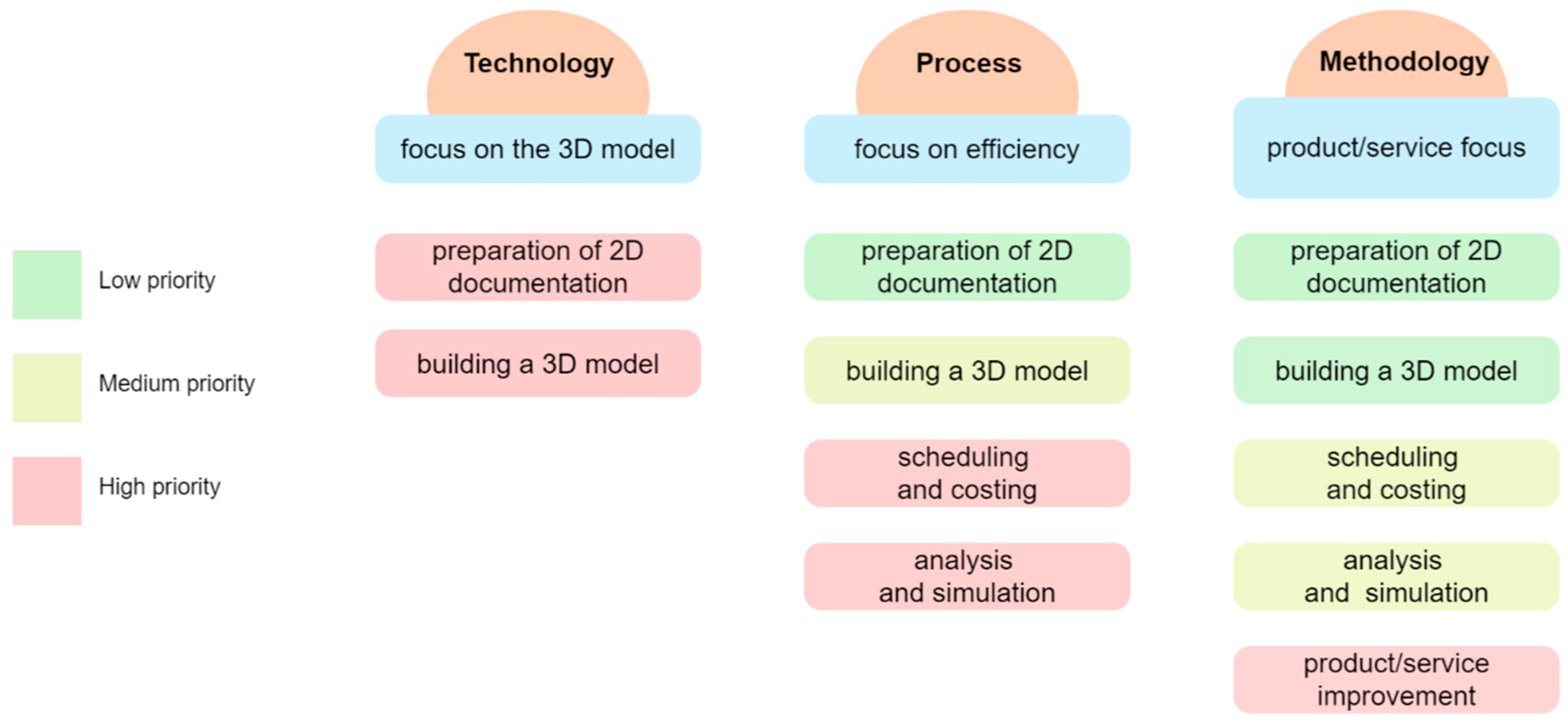
Lean is causing a shift in the thinking of many people and a reduction in emphasis from the focus (product or service) to the ‘value’ that this focus delivers. In the case of BIM, this can be seen in the evolution in the understanding of BIM: from technology to process to methodology. The more mature the approach, the greater the focus on the product/service and not necessarily on the 3D model and its components (Figure 5). Technical excellence in building models and in producing analyses and simulations results in optimized data and information flow processes. In the lean approach, it is mostly a process of minimizing or eliminating unnecessary work.
6. Definitions of BIM in Broad and Narrow Approaches
The definitions of BIM to date try to put the whole context in one perspective. However, the emphasis of the modeler in the design process is different from that of the information manager on the client/client side. Thus, BIM needs to be considered from two perspectives: a narrow one, which covers mostly design processes, and a broad one, which is not limited to the design and construction phases only, but looks holistically at the whole investment process, or the whole life cycle of a given investment in general. At this point it should be made clear that the driving force behind BIM is people. People, combined with the right policies and economics, drive what is used in BIM: tools, processes, standards and protocols (Kumar, 2015). The author, in the course of many years of literature studies and based on his experience, formulates the following definition (Borkowski, 2023):
BIM can be considered from two perspectives - a broader and a narrower one. BIM sensu largo is a process based on the collaboration of people, information systems, databases and software. In a much broad sense, it can also include hardware, tangible and intangible resources or knowledge. BIM sensu stricto is a semantic database of the construction object accompanying it throughout its life cycle.
BIM in a broad sense should be considered as part of a larger whole. Globally, a trend away from BIM is increasingly being seen. Many people and communities are pointing out that BIM is merely a tool to achieve a goal and meet a need. Companies wishing to achieve their goal (to deliver the required product/service) seek to maximize their profits by increasing efficiency and productivity. This is often done by overstretching staff, aberrating from standards, skipping important processes or cutting costs. However, from the purchaser’s point of view, the most important thing is a high-quality product/service that meets their requirements. Hence, companies should priorities the customer and maximize the quality of the delivered product. However, they can minimize the work they do in doing so, in line with the concept of Lean Management. This is how Lean differs from the traditional approach (where everyone tends to think about themselves and only about the customer) that dominates the construction industry. Lean, as an integrated approach, closely links planning with production. The planning and design stage of a volume or infrastructure is just as important as its ‘production’ (construction). A company or organization should deliver value in both cases. Value in lean processes always comes from the end user, and defining value is one of the first, necessary steps of action in this methodology. Furthermore, because digital twinning is about virtualizing whole futures, our knowledge capture and information management systems must be scaled from the product level to the project level and even the asset life cycle level (El-Diraby, 2023).
The work of a business, bringing value, is defined by three important characteristics:
- -
- it is an action that changes the product or service,
- -
- the activity is done right the first time,
- -
- the customer is willing to pay for it.
- -
- In the lean concept, there are three types of work in economic processes:
- -
- work that brings value VA (Value Added) - basic work that creates value on the job (e.g. on a computer or on a construction site),
- -
- work that does not bring value but is required to support VA work, called essential NVA (Non-Value Added) - these are preparatory activities, such as tidying up the workstation, cleaning the tools afterwards, in offices e.g. adjusting computers, installing software, etc;
- -
- unnecessary work that does not add value to NVA (i.e. the usual wastage and waste, e.g. over-engineered inspection and supervision processes on site).
The results of recent research have revealed great synergy between lean and BIM in control interactions and variation reduction, and there are many undiscovered areas in this field. The number of published articles covering the integration of both lean and BIM tools is small. There is a clear gap in understanding the synergistic interactions of lean concepts and combinations of digital information in specific construction applications such as sustainable infrastructure projects, tunneling or so-called ‘mega’ projects (Sepasgozar et al., 2020).
7. Limitations and Future Research Directions
The primary limitation was the availability of studies. The review was limited to papers written in a specific language (English), which largely excludes studies not reported in the literature published in other languages. Today, BIM is dominated by the English language, which results, among other things, in an overrepresentation of studies conducted in Anglo-Saxon countries. This leads to problems in generalizing the results (external validity) to other populations, interventions or socio-institutional contexts - other than those covered by the studies analyzed. Another limitation was the quality of available research. Many of the definitions cited in scientific publications may not meet quality criteria, lack the basic information necessary to describe the study, or are the subjective experiences of the authors. A universal problem is the burden of selective publication of research results (publication bias). Scientific articles usually do not faithfully reflect all the research and analysis conducted. From here it seems necessary to conduct a systematic review. Problems may be associated with the conceptualization of such a review. This is because it should refer to the theory of the phenomenon in question, which is usually the starting point of specific research. Therefore, a future systematic review should have a well-defined purpose and strong theoretical assumptions. Valuable and up-to-date reports on BIM can be found in the following types of sources:
- -
- review journals (posting reviews or systematic reviews, based on high-quality scientific research);
- -
- specialized, peer-reviewed journals in traditional and electronic form;
- -
- so-called “gray literature”: unpublished or published for a narrow audience reports, internal academic publications of scientific institutions and research centers, state institutions;
- -
- specialized full-text databases;
- -
- publications made available on the websites of relevant institutions and web services websites.
8. Conclusions
The article attempts to sort out the definitions cited so far by important organizations and key researchers. Many of the BIM definitions mentioned are now outdated. Some of them need to be questioned and others are too complicated. The question still remains open: do we need a single, correct definition of BIM? Six key attributes of BIM are listed, which could be used to build a new definition of BIM. This has been attempted in the hope of reopening the BIM discussion as it happened in the early 20th century. The evolution of the understanding of BIM shown in the figure indicates the direction of development and blazes new trails. New areas for exploration of BIM and fusion with other new technologies may result in even greater, much-needed efficiency in construction.
The new definitions of BIM presented in the article pave the way for a unified understanding and comprehension of BIM regardless of the function performed in the investment process. The broad view covers designers (architect, constructor, surveyor, etc.), investors (client, customer) or other stakeholders. The narrow view focuses on individuals and companies building BIM models that are then used by others.
We no longer have to decide whether BIM is a technology, a process or a methodology. We can say simply that it is a collaboration of people that provides benefits. BIM has already done work in the built environment. It is time to go further.
References
- Abbasnejad B., Moud H.I. (2013). BIM and Basic Challenges Associated with its Definitions, Interpretations and Expectations, International Journal of Engineering Research and Applications (IJERA), Vol. 3, Issue 2, March -April 2013, pp. 287-29.
- Aish R. (1986). Building Modelling: The Key to Integrated Construction CAD, CIB 5th International Symposium on the Use of Computers for Environmental Engineering Related to Building, 7-9 July 1986.
- Alhasan A., Kumar B., Thanikal J.V. (2017). Effectiveness of implementing 5D functions of building information modeling on professions of quantity surveying – a review, International Journal of Civil Engineering and Technology, Vol. 8, Issue 5, May 2017, pp. 783–800.
- Alvanchi A., TohidiFar A., Mousavi M., Azad R., Rokooei S. (2021). A critical study of the existing issues in manufacturing maintenance systems: Can BIM fill the gap?, Computers in Industry, Vol. 131: 103484. [CrossRef]
- Arayici Y. (2015). Building Information Modeling, 1st Editon, bookboon, 261 p.
- Azhar S. (2011). Building information modeling (BIM): trends, benefits, risks, and challenges for the AEC industry, Leadership and management in engineering, 2011, 11.3: pp. 241-252. [CrossRef]
- Azhar S., Khalfan M., Maqsood T. (2012). Building Information Modeling (BIM): Now and beyond. The Australasian Journal of Construction Economics and Building, 12(4), pp. 15–28. https://search.informit.org/doi/10.3316/informit.013120167780649 (Accessed on 12 December 2022).
- Aranda-Mena G., Crawford J., Chevez A. Froese T. (2009). Building information modeling demystified: does it make business sense to adopt BIM?, International Journal of Managing Projects in Business, Vol. 2 No. 3, pp. 419-34. [CrossRef]
- bimdictionary.com, https://bimdictionary.com/en/building-information-modelling/2 (Accessed on 7 December 2022).
- Borkowski A. S. (2023). Evolution of BIM: epistemology, genesis and division into periods. Journal of Information Technology in Construction (ITcon), 28(34), pp. 646-661. [CrossRef]
- Bosch O.J.H., Ross A.H., Beeton, R.J.S. (2003). Integrating science and management through collaborative learning and better information management. Syst. Res., 20: 107-118. [CrossRef]
- BS 8536-1:2015 based on PAS 1192-2:2013, https://knowledge.bsigroup.com/products/briefing-for-design-and-construction-code-of-practice-for-facilities-management-buildings-infrastructure/tracked-changes (Accessed on 7 December 2022).
- Deng M., Menassa C.C., Kamat V.R. (2021). From BIM to digital twins: a systematic review of the evolution of intelligent building representations in the AEC-FM industry, Journal of Information Technology in Construction, Vol. 26 (pp. 58-83), https://itcon.org/papers/2021_05-ITcon-Deng.pdf (Accessed on 27 December 2022).
- Eastman C. M., Eastman C., Teicholz P., Sacks R., Liston K. (2011). BIM handbook: A guide to building information modeling for owners, managers, designers, engineers and contractors, John Wiley & Sons, 626 p.
- El Ammari K., Hammad A., (2019). Remote interactive collaboration in facilities management using BIM-based mixed reality, Automation in Construction, Vol. 107: 102940. [CrossRef]
- El-Diraby T. E. (2023). How typical is your project? The need for a no-model approach for information management in AEC, ITcon Vol. 28, pp. 19-38. [CrossRef]
- Georgiadou M.C. (2019). An overview of benefits and challenges of building information modelling (BIM) adoption in UK residential projects, Construction Innovation, Vol. 19, Issue 3, pp. 298-320. [CrossRef]
- Gobesz F.Z. (2020). The Roots of Bim, Műszaki Tudományos Közlemények, vol.12, no.1, 2020, pp. 42-49. [CrossRef]
- Gu N., London K. (2010). Understanding and facilitating BIM adoption in the AEC industry, Automation in Construction, Vol. 19, Issue 8, pp. 988-999. [CrossRef]
- Goulding J.S., Rahimian F.P., Wang X. (2014). Virtual reality-based cloud BIM platform for integrated AEC projects, Journal of Information Technology in Construction, Vol. 19, pp. 308-325. https://www.itcon.org/2014/18 (Accessed on 25 January 2023).
- Haji M. D., Behnam B., Sebt M.H. et al. (2023). BIM-Based Safety Leading Indicators Measurement Tool for Construction Sites. International Journal of Civil Engineering, 21, pp. 265–282. [CrossRef]
- Hong Y., Hammad A.W.A, Akbarnezhad A., Arashpour M. (2020). A neural network approach to predicting the net costs associated with BIM adoption, Automation in Construction, Vol 119: 103306. [CrossRef]
- Holzer D. (2016). The BIM Manager’s Handbook: Guidance for Professionals in Architecture, Engineering, and Construction, John Wiley & Sons Ltd., United Kingdom, 214 p.
- Ingram J. (2020). Understanding BIM: The Past, Present and Future, Taylor & Francis Group, 288 p.
- Isikdag U., Underwood J. (2010). A Synopsis of the Handbook of Research on Building Information, Modeling. Paper presented at the In Proceedings of CIB 2010 World Building Congress. http://www.cib2010.com/ (Accessed on 24 Janurary 2023).
- ISO, 2009. Risk Management Risk Assessment Techniques, IEC FDIS 31010:2009, International Organization for Standardization, https://www.iso.org/standard/51073.html (Accessed on 23 December 2022).
- ISO 19650-1 – part 1, https://www.bsigroup.com/ (Accessed on 7 December 2022).
- ISO 29481-1: 2016 Building Information Models – Information Delivery Manual – Part 1: Methodology and Format, https://www.iso.org/standard/60553.html (Accessed on 8 December 2022).
- Jerningan F. (2017). BIG BIM 4.0 Ecosystems for a Connected World, Eds. M.Bordenaro, 4 Site Press, 444 p.
- Ji Y., Qi K., Qi Y., Li Y., Li H.X., Lei Z. Liu Y. (2020). BIM-based life-cycle environmental assessment of prefabricated buildings, Engineering, Construction and Architectural Management, Vol. 27 No. 8, pp. 1703-1725. [CrossRef]
- Khosrowshahi F. Arayici Y. (2012). Roadmap for implementation of BIM in the UK construction industry, Engineering, Construction and Architectural Management, Vol. 19 No. 6, s. 610-635. [CrossRef]
- Kocatürk T., Koskela L. (2010). The evolving BIM concept: From 3D CAD to intelligent model, Automation in Construction, Vol. 19, Issue 5, pp. 486-493.
- Kumar B.(2015). A Practical Guide to Adopting BIM in Construction Projects, Whittles Publishing, 128 p.
- Laiserin J. (2002). Comparing pommes and naranjas, http://www.laiserin.com/features/issue15/feature01.php (Accessed on 8 December 2022).
- Latiffi A. A., Brahim J., Fathi, M. S. (2014). The Development of Building Information Modeling (BIM) Definition, Applied Mechanics and Materials, 567, pp. 625–630. [CrossRef]
- Lee G., Sacks R., Eastman C. (2006). Specifying parametric building object behavior (BOB) for a building information modeling system, Automation in Construction, Vol. 15, Issue 6, pp. 758-776. [CrossRef]
- Lin Y. C., Hsu Y. T., Hu,H. T. (2022). BIM model management for BIM-based facility management in buildings. Advances in Civil Engineering, 2022, pp. 1-13. [CrossRef]
- MacLeamy P. (2010). The future of the Building Industry (3/5): Effort curve, YouTube, Feb. 2, 2010 [Video file]. Available: https://www.youtube.com/watch?v=9bUlBYc_Gl4 (Accessed on 21 Jaunuary 2023).
- Maunula A., Smeds R., Hirvensalo A. (2008). Implementation of Building Information Modeling (BIM) –A Process Perspective, APMS 2008 Innovations in Networks, pp. 379-386, https://www.researchgate.net/publication/288247883_Implementation_of_Building_Information_Modeling_BIM_-_A_process_perspective (Accessed on 25 April 2023).
- Miettinen R., Paavola S. (2014). Beyond the BIM utopia: Approaches to the development and implementation of building information modeling, Automation in Construction, Vol. 43, 2014, pp. 84-91. [CrossRef]
- Munir M., Kiviniemi A. Jones S.W. (2019). Business value of integrated BIM-based asset management, Engineering, Construction and Architectural Management, Vol. 26 No. 6, pp. 1171-1191. [CrossRef]
- National BIM Standard United States, https://nationalbimstandard.org/nbims-us-v3 (Accessed on 7 December 2022).
- Preidel C., Borrmann A. (2018). BIM-Based Code Compliance Checking. In: Borrmann, A., König, M., Koch, C., Beetz, J. (eds) Building Information Modeling. Springer, Cham. [CrossRef]
- Race S. (2013). BIM Demystified, 2nd edition, RIBA Publishing, 159 p.
- Richards M. (2010). Building information management: A standard framework and guide to BS 1192, BSI Standards, London. 135 p.
- Rojas M. J., Herrera R. F., Mourgues C., Ponz-Tienda J. L., Alarcón L. F., Pellicer E. (2019). BIM use assessment (BUA) tool for characterizing the application levels of BIM uses for the planning and design of construction projects. Advances in Civil Engineering, 2019, pp. 1-9. [CrossRef]
- Sacks R., Melhado S. B. (2011). Key performance indicators to analyze and improve management of information flow in the BIM design process, Proceedings of the CIB W78-W102.
- Salehi S. A., Yitmen İ. (2018). Modeling and analysis of the impact of BIM-based field data capturing technologies on automated construction progress monitoring. International Journal of Civil Engineering, 16, pp. 1669–1685. [CrossRef]
- Scherer R.J., Katranuschkov P. (2018). BIMification: How to create and use BIM for retrofitting, Advanced Engineering Informatics, Vol 38, pp. 54-66. [CrossRef]
- Sepasgozar S. M. E., Hui F. K. P., Shirowzhan S., Foroozanfar M., Yang L., Aye L. (2020). Lean Practices Using Building Information Modeling (BIM) and Digital Twinning for Sustainable Construction. Sustainability, 13(1), 161. MDPI AG. [CrossRef]
- Shojaei A., Flood I., Moud H. I., Hatami M., Zhang X. (2019). An implementation of smart contracts by integrating BIM and blockchain, w: Proceedings of the Future Technologies Conference (pp. 519-527). Springer, Cham.
- van Nederveen G.A., Tolman F.P. (1992). Modelling multiple views on buildings, Automation in Construction, vol. 1, no. 3, (pp. 215–224). [CrossRef]
- Zhang J., Luo H., Xu J. (2022). Towards fully BIM-enabled building automation and robotics: A perspective of lifecycle information flow, Computers in Industry, Vol. 135: 103570. [CrossRef]
- Zou Y., Kiviniemi A., Jones. S.W. (2017). A review of risk management through BIM and BIM-related technologies, Safety Science, Vol. 97, pp. 88-98. [CrossRef]
Figure 1.
The six attributes of BIM (own elaboration).
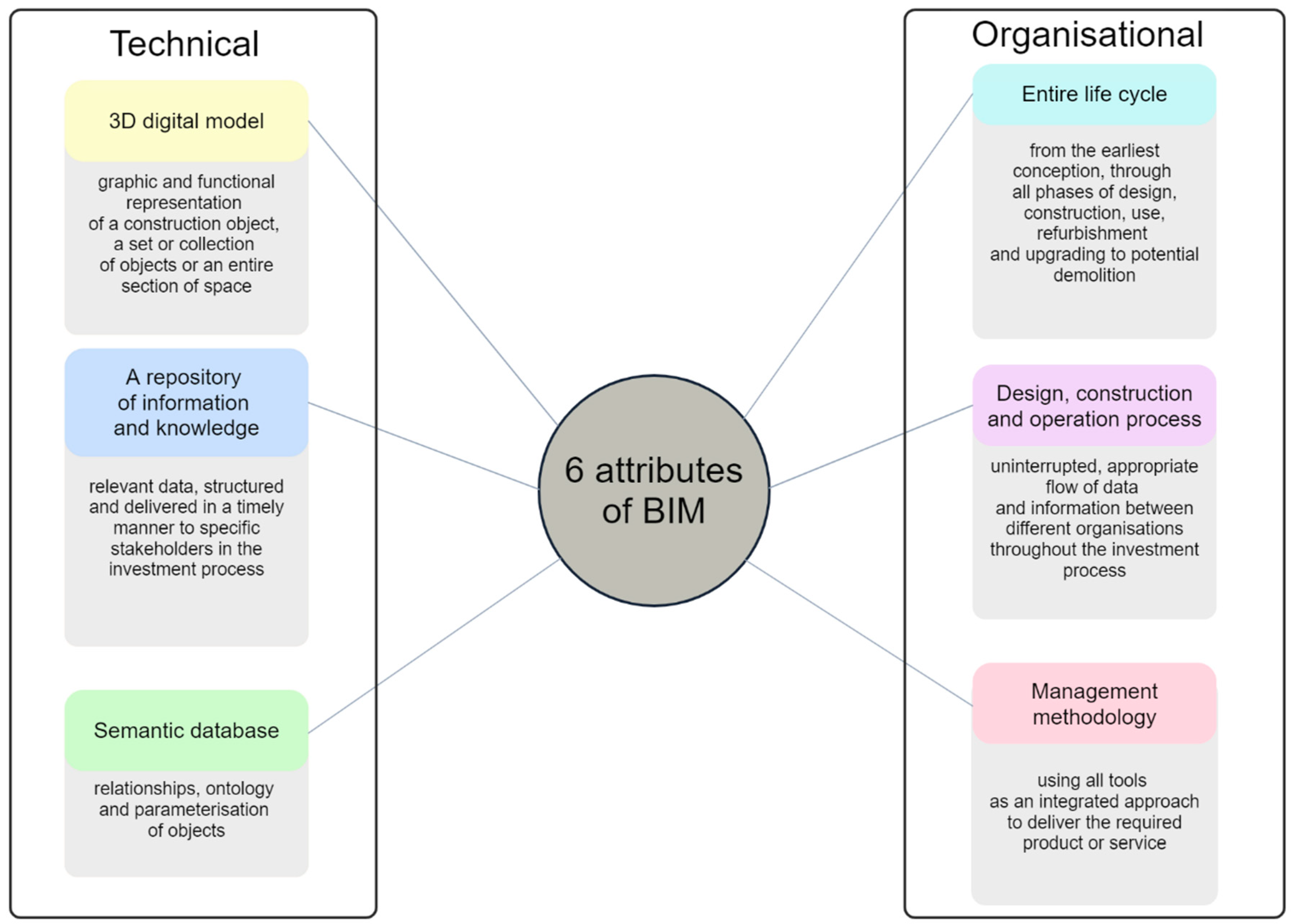
Figure 2.
Timeline with major events and development of various concepts (own elaboration).
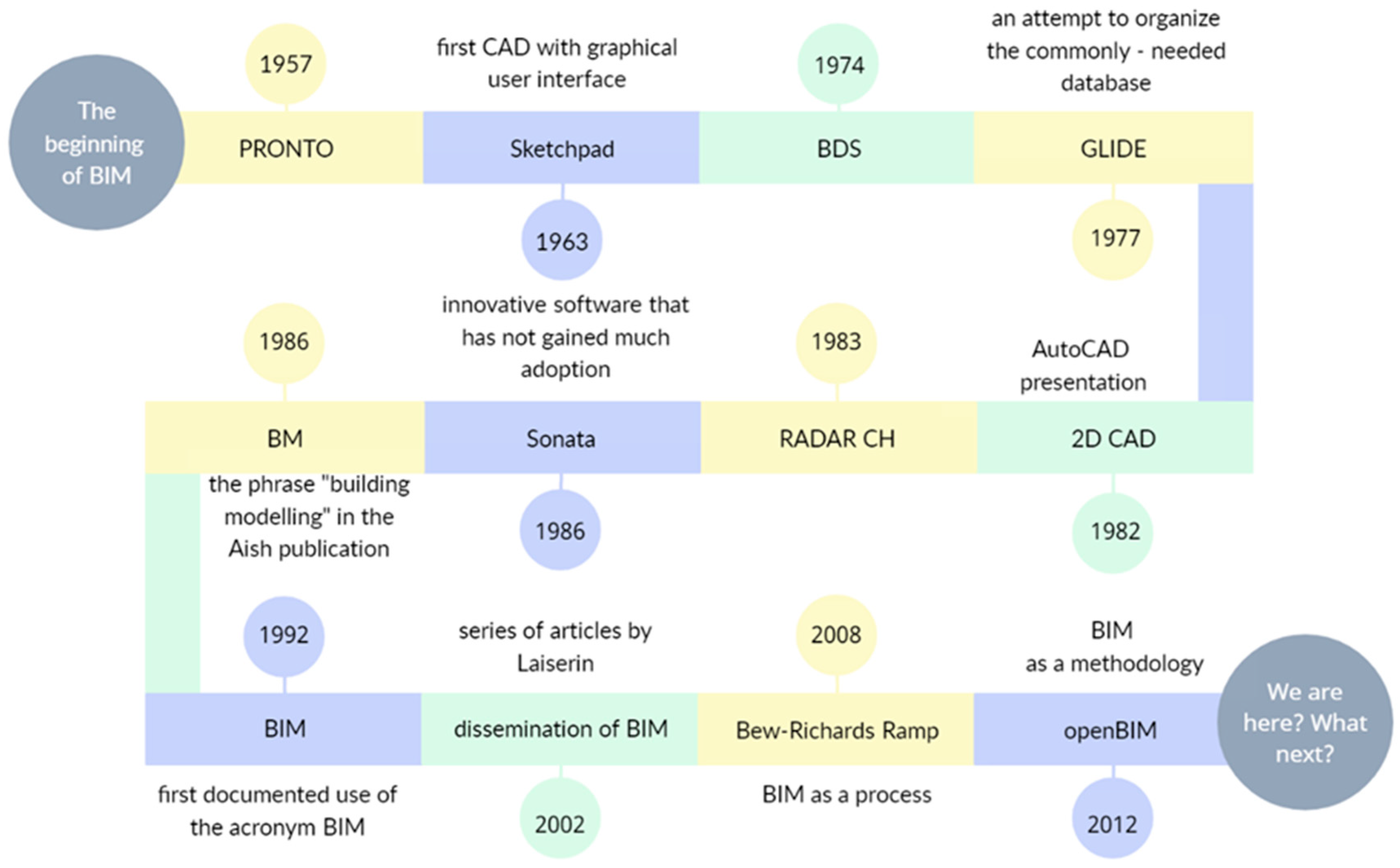
Figure 3.
Different ways of looking at BIM (own elaboration based on Maunula et al., 2008 and Arayici, 2015).
Figure 3.
Different ways of looking at BIM (own elaboration based on Maunula et al., 2008 and Arayici, 2015).
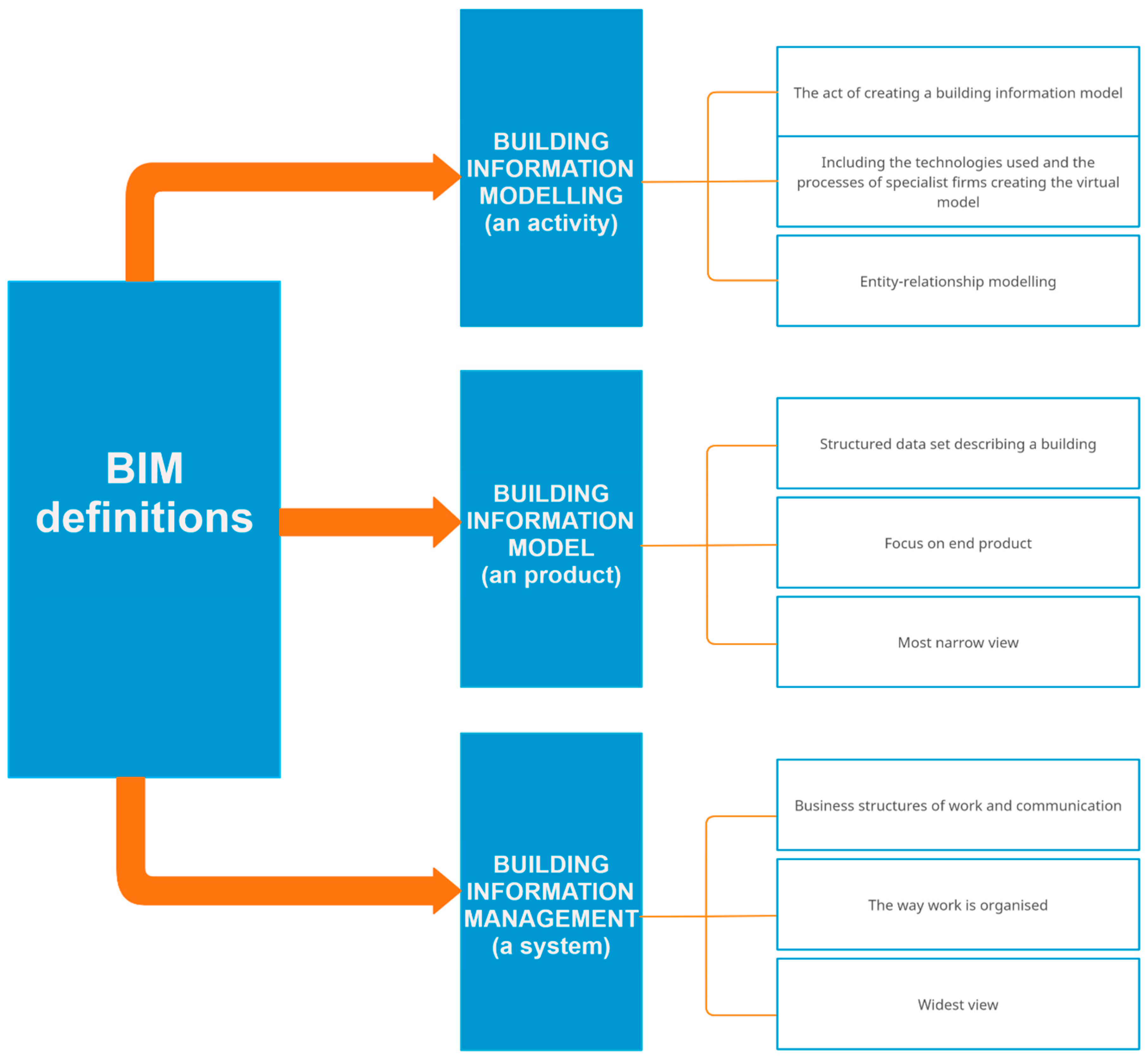
Figure 4.
Evolution of the understanding of BIM (own elaboration).
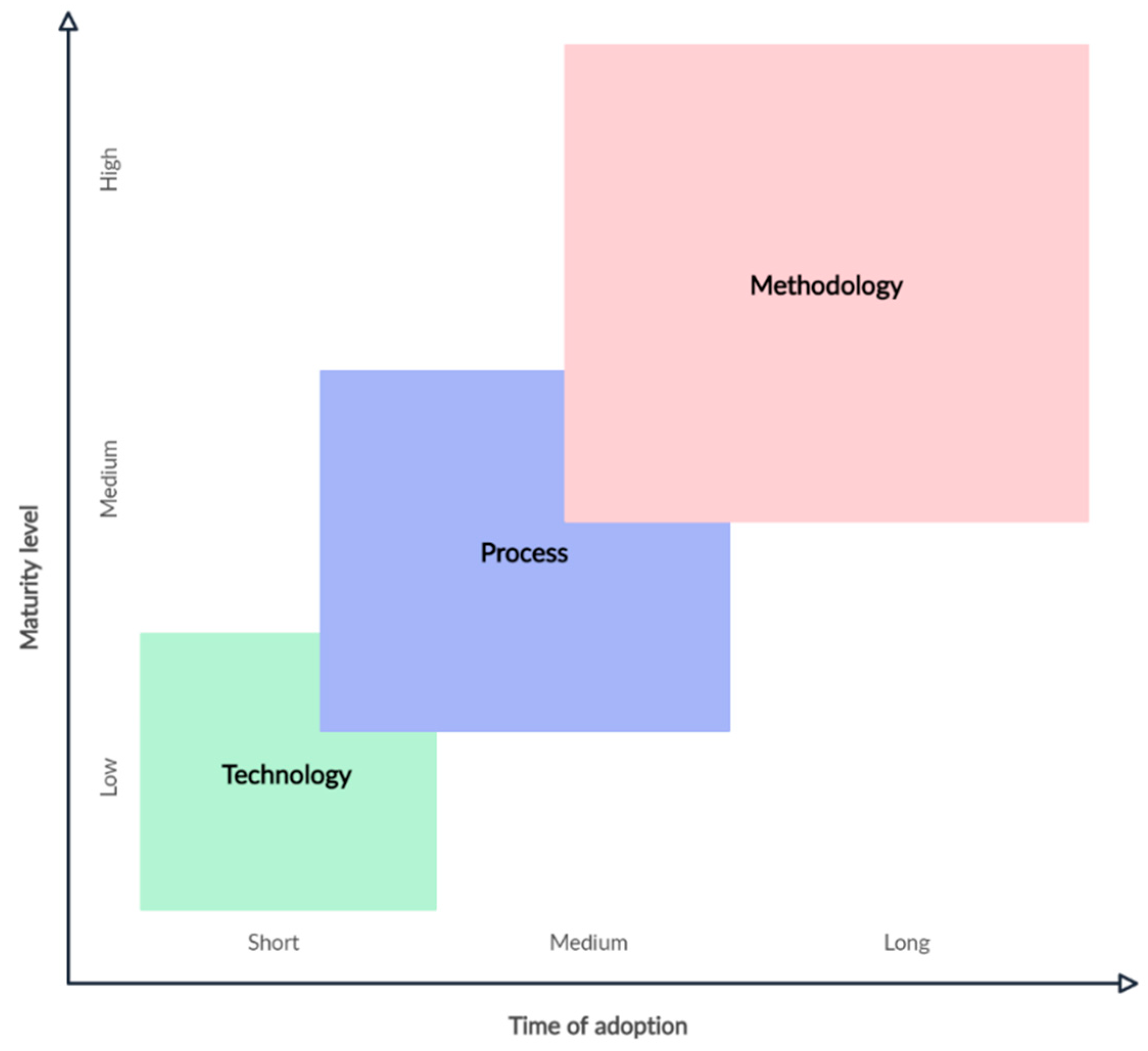
Figure 5.
Changing emphasis on different aspects with the development of BIM (own elaboration).
Disclaimer/Publisher’s Note: The statements, opinions and data contained in all publications are solely those of the individual author(s) and contributor(s) and not of MDPI and/or the editor(s). MDPI and/or the editor(s) disclaim responsibility for any injury to people or property resulting from any ideas, methods, instructions or products referred to in the content. |
© 2023 by the authors. Licensee MDPI, Basel, Switzerland. This article is an open access article distributed under the terms and conditions of the Creative Commons Attribution (CC BY) license (http://creativecommons.org/licenses/by/4.0/).
Copyright: This open access article is published under a Creative Commons CC BY 4.0 license, which permit the free download, distribution, and reuse, provided that the author and preprint are cited in any reuse.


