

Submitted:
19 November 2024
Posted:
19 November 2024
Read the latest preprint version here
Abstract
Recent advances in emissions accounting present a new understanding of climate change drivers. These advances are unconventional but promise a more consistent and inclusive accounting of greenhouse gases. We apply these advances, namely: consistent gross accounting of CO2 sources; linking land use emissions with sectors; using Effective Radiative Forcing (ERF) rather than Global Warming Potentials (GWPs) to compare emissions; and inclusive accounting of heating and cooling emissions. This approach boosts perceived carbon emissions from deforestation, and finds agriculture, the most extensive land user, to be the leading emissions sector and to have caused 60% (44%-86%) of global surface air temperature (GSAT) change from 1750 to 2020. We also find that fossil fuels are responsible for 23% of warming, a reduced contribution due to masking from cooling co-emissions. We test the validity of this accounting and find it useful for determining sector responsibility for present-day warming and for framing policy response, while recognising the dangers of assigning value to cooling emissions, due to health impacts and future warming.
Keywords:
1. Introduction
2. Review of Novel Emissions Accounting Advances
2.1. Consistent CO2 Emissions Accounting
2.2. Inclusive Accounting
2.3. Using ERF for Less Contentious Sector Comparison
3. Materials and Methods
3.1. Data Sources
3.2. Attributing ERF and GSAT to Sectors
3.3. Errors and Accuracy
4. Results
4.1. Consistent Gross LULUCF CO2 Accounting
4.2. Sector ERF and GSAT

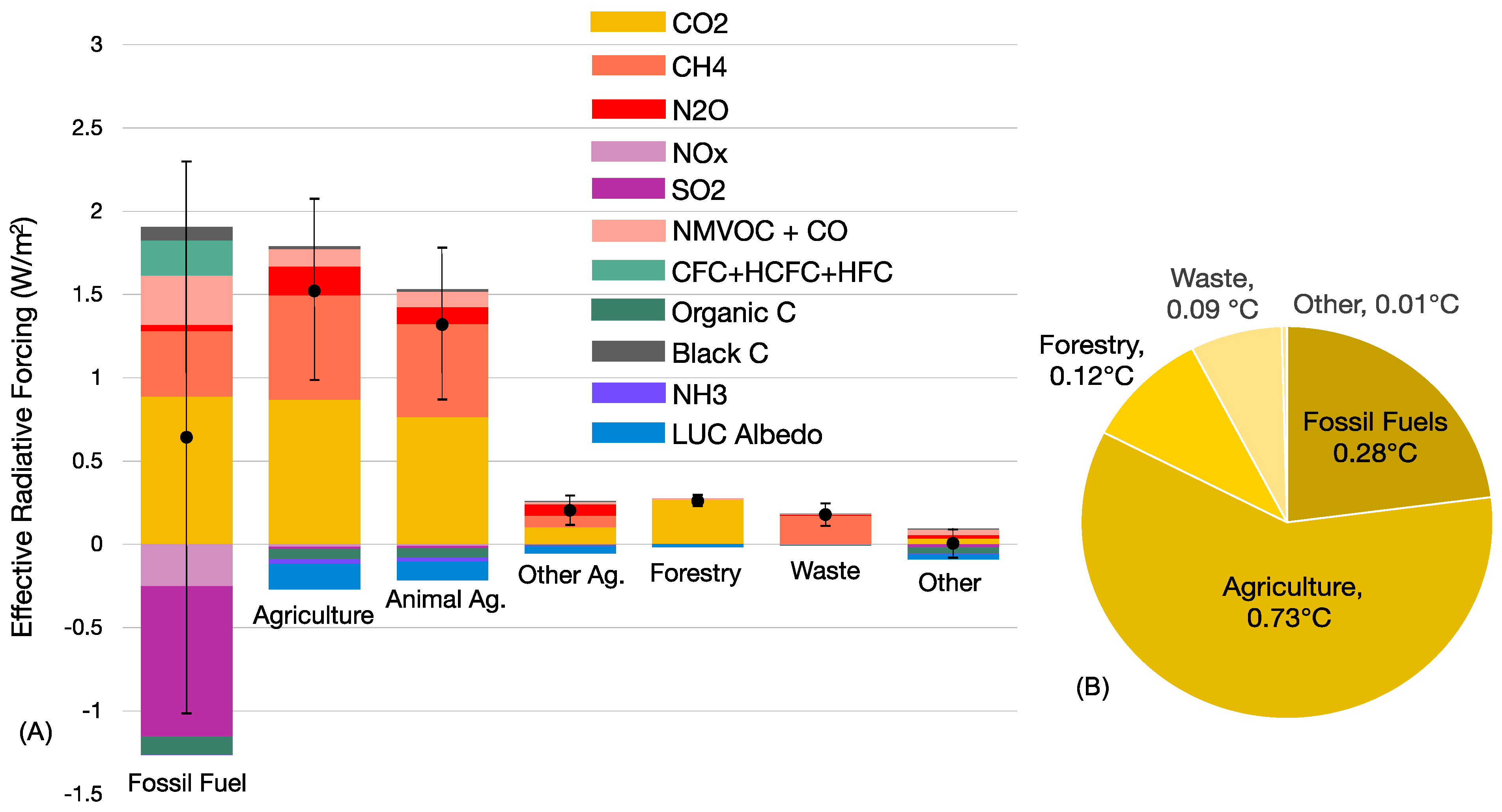
| Emissions-based Effective Radiative Forcing (ERF) and Global Surface Air Temperature (GSAT) Rise by Emission and Sector | ||||||||||||||
|---|---|---|---|---|---|---|---|---|---|---|---|---|---|---|
| Fossil Fuel & Industry | Animal Agriculture | Other Agriculture | Forestry | Waste | Other | |||||||||
| Emission Species | ERF | GSAT | ERF | GSAT | ERF | GSAT | ERF | GSAT | ERF | GSAT | ERF | GSAT | ERF by gas | GSAT by gas |
| CO2 | 0.89 | 0.41 | 0.76 | 0.35 | 0.11 | 0.05 | 0.27 | 0.12 | 0.00 | 0.00 | 0.04 | 0.02 | 2.06 | 0.95 |
| Methane | 0.39 | 0.20 | 0.56 | 0.28 | 0.07 | 0.03 | 0.00 | 0.00 | 0.17 | 0.09 | 0.00 | 0.00 | 1.20 | 0.60 |
| N2O | 0.04 | 0.02 | 0.10 | 0.05 | 0.07 | 0.03 | 0.00 | 0.00 | 0.01 | 0.00 | 0.02 | 0.00 | 0.24 | 0.11 |
| NOx | -0.25 | -0.13 | -0.01 | -0.01 | -0.00 | -0.00 | 0.00 | -0.00 | -0.00 | -0.00 | 0.00 | -0.00 | -0.27 | -0.14 |
| SO2 | -0.91 | -0.48 | -0.01 | -0.01 | -0.00 | -0.00 | -0.00 | 0.00 | -0.00 | -0.00 | -0.02 | -0.00 | -0.94 | -0.50 |
| NMVOC+CO | 0.30 | 0.17 | 0.09 | 0.06 | 0.01 | 0.01 | 0.01 | 0.00 | 0.00 | 0.00 | 0.03 | 0.02 | 0.44 | 0.25 |
| Halocarbons | 0.21 | 0.10 | 0.00 | 0.00 | 0.00 | 0.00 | 0.00 | 0.00 | 0.00 | 0.00 | 0.00 | 0.00 | 0.21 | 0.10 |
| Organic C | -0.11 | -0.05 | -0.06 | -0.03 | -0.01 | -0.00 | 0.00 | 0.00 | -0.00 | -0.00 | -0.04 | -0.01 | -0.21 | -0.09 |
| Black Carbon | 0.08 | 0.05 | 0.02 | 0.01 | 0.00 | 0.00 | 0.00 | 0.00 | 0.00 | 0.00 | 0.01 | -0.00 | 0.11 | 0.06 |
| Ammonia | -0.00 | -0.00 | -0.02 | -0.01 | -0.01 | -0.00 | -0.00 | -0.00 | -0.00 | -0.00 | 0.00 | -0.00 | -0.03 | -0.02 |
| Albedo LUC | 0 | 0 | -0.11 | -0.06 | -0.04 | -0.02 | -0.02 | -0.01 | 0 | 0 | -0.03 |
-0.12 | -0.20 | -0.10 |
| Net ERF & GSAT | 0.64 | 0.28 | 1.32 | 0.63 | 0.20 | 0.10 | 0.26 | 0.12 | 0.18 | 0.09 | 0.00 | 0.01 | 2.60 | 1.22 |
| % Net ERF & GSAT | 25% | 23% | 51% | 52% | 8% | 8% | 10% | 10% | 7% | 7% | 0% | 0% | ||
| ERF SE +/- | 1.66 | 0.45 | 0.09 | 0.03 | 0.07 | 0.08 | ||||||||
4.3. Validation and Sensitivity Analyses
5. Discussion
5.1. Significant Findings
5.2. Usefulness of This Accounting
- Offers a more comprehensive and transparent account of sectors driving climate change.
- Properly values emissions from past deforestation that are not visible with conventional greenhouse inventory accounting, but which still contribute to warming.
- Values current deforestation and avoided deforestation more consistently.
- Provides a more transparent and less contentious means to compare emission species.
- Re-focuses our attention on forests as a major climate disruptor, giving reason for optimism because deforestation is reversible.
5.3. The Dangers of Aerosol Cooling
5.4. Policy Implications
6. Conclusions
Supplementary Materials
Author Contributions
Funding
Data Availability Statement
Acknowledgments
Conflicts of Interest
References
- Ascui F, Lovell H. As frames collide. Accounting, Auditing and Accountability. 2011;24(8):978–99.
- Wedderburn-Bisshop G. Deforestation – a call for consistent carbon accounting. Environ Res Lett [Internet]. 2024 [cited 2024 Sep 23]; Available from: http://iopscience.iop.org/article/10.1088/1748-9326/ad7d21. [CrossRef]
- Szopa S, Naik V, Adhikary B, Artaxo P, Berntsen T, Collins S, et al. Short-Lived Climate Forcers. In: Climate Change 2021: The Physical Science Basis Contribution of Working Group I to the Sixth Assessment Report of the Intergovernmental Panel on Climate Change. Cambridge, UK and New York: Cambridge University Press; 2021. p. 817–922.
- Houghton J, Meira Filho L, Lim B, Treanton K, Mamaty I, Bonduki Y, et al. Revised 1996 IPCC Guidelines for National Greenhouse Gas Inventories [Internet]. IPCC, UK Meteorological Office; 1996. Available from: https://www.ipcc.ch/report/revised-1996-ipcc-guidelines-for-national-greenhouse-gas-inventories/.
- Dreyfus GB, Xu Y, Shindell DT, Zaelke D, Ramanathan V. Mitigating climate disruption in time: A self-consistent approach for avoiding both near-term and long-term global warming. Proceedings of the National Academy of Sciences. 2022 May 31;119(22):e2123536119. [CrossRef]
- Polonik P, Ricke K, Burney J. Paris Agreement’s Ambiguity About Aerosols Drives Uncertain Health and Climate Outcomes. Earth’s Future. 2021;9(5):e2020EF001787. [CrossRef]
- Davis SJ, Burney JA, Pongratz J, Caldeira K. Methods for attributing land-use emissions to products. Carbon Management. 2014 Mar 4;5(2):233–45. [CrossRef]
- Hayek MN, Harwatt H, Ripple WJ, Mueller ND. The carbon opportunity cost of animal-sourced food production on land. Nature Sustainability. 2021;1–4. [CrossRef]
- Allen M, Lynch J, Cain M, Frame DJ. Climate metrics for ruminant livestock. 2022 Jul 14 [cited 2022 Sep 13]; Available from: https://policycommons.net/artifacts/2539344/programme-briefing/3561773/.
- Abernethy S, Jackson RB. Global temperature goals should determine the time horizons for greenhouse gas emission metrics. Environ Res Lett. 2022 Feb;17(2):024019. [CrossRef]
- Lee DS, Fahey DW, Skowron A, Allen MR, Burkhardt U, Chen Q, et al. The contribution of global aviation to anthropogenic climate forcing for 2000 to 2018. Atmospheric Environment. 2021 Jan 1;244:117834. [CrossRef]
- Brazzola N, Wohland J, Patt A. Offsetting unabated agricultural emissions with CO2 removal to achieve ambitious climate targets. PLOS ONE. 2021 Mar 17;16(3):e0247887. [CrossRef]
- Thornhill GD, Collins WJ, Kramer RJ, Olivié D, Skeie RB, O’Connor FM, et al. Effective radiative forcing from emissions of reactive gases and aerosols – a multi-model comparison. Atmospheric Chemistry and Physics. 2021 Jan 21;21(2):853–74. [CrossRef]
- Matthews HD, Gillett NP, Stott PA, Zickfeld K. The proportionality of global warming to cumulative carbon emissions. Nature. 2009 Jun;459(7248):829–32. [CrossRef]
- Quaas J, Jia H, Smith C, Albright AL, Aas W, Bellouin N, et al. Robust evidence for reversal of the trend in aerosol effective climate forcing. Atmospheric Chemistry and Physics. 2022 Sep 21;22(18):12221–39. [CrossRef]
- Erb KH, Kastner T, Plutzar C, Bais ALS, Carvalhais N, Fetzel T, et al. Unexpectedly large impact of forest management and grazing on global vegetation biomass. Nature. 2018 Jan;553(7686):73–6. [CrossRef]
- Smith P, Bustamante M, Ahammad H, Clark H, Dong H, Elsiddig E, et al. Agriculture, Forestry and Other Land Use (AFOLU). In: IPCC AR5 WG3 Chapter 11 Agriculture, Forestry and Other Land Use (AFOLU) [Internet]. Cambridge UK and NY: Cambridge University Press,; 2014. Available from: https://www.researchgate.net/publication/280076738_IPCC_AR5_WG3_Chapter_11_Agriculture_Forestry_and_Other_Land_Use_AFOLU.
- Singh C, Persson UM. Global patterns of commodity-driven deforestation and associated carbon emissions [Internet]. 2024 [cited 2024 Apr 24]. Available from: https://eartharxiv.org/repository/view/7000/.
- Roesch CM, Ballinger AP, Schurer AP, Hegerl GC. Combining temperature and precipitation to constrain the aerosol contribution to observed climate change. Journal of Climate [Internet]. 2024 Apr 24 [cited 2024 May 1];1(aop). Available from: https://journals.ametsoc.org/view/journals/clim/aop/JCLI-D-23-0347.1/JCLI-D-23-0347.1.xml. [CrossRef]
- Forster P, Storelvmo T, Armour K, Collins W, Dufresne JL, Frame D, et al. The Earth’s Energy Budget, Climate Feedbacks, and Climate Sensitivity. In: Climate Change 2021: The Physical Science Basis Contribution of Working Group I to the Sixth Assessment Report of the Intergovernmental Panel on Climate Change [Internet]. Cambridge University Press, Cambridge, United Kingdom and New York, USA; 2021. Available from: https://www.ipcc.ch/report/ar6/wg1/chapter/chapter-7/.
- Lal R, Monger C, Nave L, Smith P. The role of soil in regulation of climate. Philosophical Transactions of the Royal Society B: Biological Sciences. 2021 Aug 4;376(1834):20210084.
- Friedlingstein P, O’Sullivan M, Jones MW, Andrew RM, Bakker DCE, Hauck J, et al. Global Carbon Budget 2023. Earth System Science Data. 2023 Dec 5;15(12):5301–69.
- Grassi G, Schwingshackl C, Gasser T, Houghton RA, Sitch S, Canadell JG, et al. Harmonising the land-use flux estimates of global models and national inventories for 2000–2020. Earth System Science Data. 2023 Mar 10;15(3):1093–114. [CrossRef]
- Jia G, Shevliakova E, Artaxo P, Noblet-Ducoudre N, Houghton R, House J, et al. Land–climate interactions. In: Shukla P, Skea J, Calvo Buendia E, Masson-Delmotte V, Portner H, Roberts D, et al., editors. Climate Change and Land: an IPCC special report on climate change, desertification, land degradation, sustainable land management, food security, and greenhouse gas fluxes in terrestrial ecosystems [Internet]. Intergovernmental Panel on Climate Change; 2019. Available from: https://www.ipcc.ch/site/assets/uploads/sites/4/2020/08/05_Chapter-2-V3.pdf.
- Houghton RA, Castanho A. Annual emissions of carbon from land use, land-use change, and forestry from 1850 to 2020. Earth System Science Data. 2023 May 23;15(5):2025–54. [CrossRef]
- Bayer AD, Lindeskog M, Pugh TAM, Anthoni PM, Fuchs R, Arneth A. Uncertainties in the land-use flux resulting from land-use change reconstructions and gross land transitions. Earth System Dynamics. 2017 Feb 1;8:91–111. [CrossRef]
- Qin Y, Xiao X, Wigneron JP, Ciais P, Brandt M, Fan L, et al. Carbon loss from forest degradation exceeds that from deforestation in the Brazilian Amazon. Nat Clim Chang. 2021 May;11(5):442–8. [CrossRef]
- Winkler K, Fuchs R, Rounsevell M, Herold M. Global land use changes are four times greater than previously estimated. Nat Commun. 2021 May 11;12(1):2501. [CrossRef]
- Heinrich V, House J, Gibbs DA, Harris N, Herold M, Grassi G, et al. Mind the gap: reconciling tropical forest carbon flux estimates from earth observation and national reporting requires transparency. Carbon Balance and Management. 2023 Nov 20;18(1):22. [CrossRef]
- Gasser T, Crepin L, Quilcaille Y, Houghton RA, Ciais P, Obersteiner M. Historical CO emissions from land use and land cover change and their uncertainty. Biogeosciences. 2020 Aug 13;17(15):4075–101. [CrossRef]
- Kaplan JO, Krumhardt KM, Ellis EC, Ruddiman WF, Lemmen C, Goldewijk KK. Holocene carbon emissions as a result of anthropogenic land cover change. The Holocene. 2011 Aug 1;21(5):775–91. [CrossRef]
- van der Werf GR, Randerson JT, Giglio L, van Leeuwen TT, Chen Y, Rogers BM, et al. Global fire emissions estimates during 1997–2016. Earth System Science Data. 2017 Sep 12;9(2):697–720. [CrossRef]
- Ray DK, Sloat LL, Garcia AS, Davis KF, Ali T, Xie W. Crop harvests for direct food use insufficient to meet the UN’s food security goal. Nat Food. 2022 May;3(5):367–74. [CrossRef]
- Clark M, Springmann M, Rayner M, Scarborough P, Hill J, Tilman D, et al. Estimating the environmental impacts of 57,000 food products. Proceedings of the National Academy of Sciences. 2022 Aug 16;119(33):e2120584119.
- Sato A, Nojiri Y. Assessing the contribution of harvested wood products under greenhouse gas estimation: accounting under the Paris Agreement and the potential for double-counting among the choice of approaches. Carbon Balance and Management. 2019 Nov 26;14(1):15. [CrossRef]
- IPCC. IPCC Special Report on Climate Change, Desertification, Land Degradation, Sustainable Land Management, Food Security, and Greenhouse gas fluxes in Terrestrial Ecosystems Summary for Policymakers [Internet]. Intergovernmental Panel on Climate Change (IPCC); 2019 Aug. Available from: https://www.ipcc.ch/site/assets/uploads/2019/08/4.-SPM_Approved_Microsite_FINAL.pdf.
- Fu B, Gasser T, Li B, Tao S, Ciais P, Piao S, et al. Short-lived climate forcers have long-term climate impacts via the carbon–climate feedback. Nat Clim Chang. 2020 Sep;10(9):851–5. [CrossRef]
- Lelieveld J, Klingmüller K, Pozzer A, Burnett RT, Haines A, Ramanathan V. Effects of fossil fuel and total anthropogenic emission removal on public health and climate. PNAS. 2019 Apr 9;116(15):7192–7. [CrossRef]
- Hansen J, Kharecha P, Sato M. Climate forcing growth rates: doubling down on our Faustian bargain. Environ Res Lett. 2013 Mar;8(1):011006. [CrossRef]
- Samset BH, Sand M, Smith CJ, Bauer SE, Forster PM, Fuglestvedt JS, et al. Climate Impacts From a Removal of Anthropogenic Aerosol Emissions. Geophysical Research Letters. 2018;45(2):1020–9. [CrossRef]
- Chowdhury S, Pozzer A, Haines A, Klingmüller K, Münzel T, Paasonen P, et al. Global health burden of ambient PM2.5 and the contribution of anthropogenic black carbon and organic aerosols. Environment International. 2022 Jan 15;159:107020. [CrossRef]
- Diamond MS, Wanser K, Boucher O. “Cooling credits” are not a viable climate solution. Climatic Change. 2023 Jul 4;176(7):96.
- Wilkinson K. The Drawdown Review: Climate Solutions for a New Decade [Internet]. International: Project Drawdown; 2020 [cited 2020 Mar 23]. Available from: https://www.drawdown.org/drawdown-framework/drawdown-review-2020.
- Eisen MB, Brown PO. Rapid global phaseout of animal agriculture has the potential to stabilize greenhouse gas levels for 30 years and offset 68 percent of CO2 emissions this century. PLOS Climate. 2022 Feb 1;1(2):e0000010. [CrossRef]
- Campbell B, Beare D, Bennett E, Hall-Spencer J, Ingram J, Jaramillo F, et al. Agriculture production as a major driver of the Earth system exceeding planetary boundaries. Ecology and Society [Internet]. 2017 Oct 12 [cited 2017 Dec 13];22(4). Available from: https://www.ecologyandsociety.org/vol22/iss4/art8/. [CrossRef]
- Damania R, Balseca E, de Fontaunbert C, Gill J, Kim K, Rentschler J, et al. Detox Development: Repurposing Environmentally Harmful Subsidies [Internet]. Washington, DC: World Bank Group; 2023. Available from: https://openknowledge.worldbank.org/server/api/core/bitstreams/61d04aca-1b95-4c06-8199-3c4a423cb7fe/content?utm_source=Plant+Based+Treaty&utm_campaign=20db4d4929-EMAIL_CAMPAIGN_2023_08_12_04_47&utm_medium=email&utm_term=0_-20db4d4929-%5BLIST_EMAIL_ID%5D&mc_cid=20db4d4929&mc_eid=5787831cf1.
- Morris V, Jacquet J. The animal agriculture industry, US universities, and the obstruction of climate understanding and policy. Climatic Change. 2024 Feb 26;177(3):41. [CrossRef]
- Hoesly RM, Smith SJ, Feng L, Klimont Z, Janssens-Maenhout G, Pitkanen T, et al. Historical (1750–2014) anthropogenic emissions of reactive gases and aerosols from the Community Emissions Data System (CEDS). Geoscientific Model Development. 2018 Jan 29;11(1):369–408. [CrossRef]
- Millington JDA, Perkins O, Smith C. Human Fire Use and Management: A Global Database of Anthropogenic Fire Impacts for Modelling. Fire. 2022 Aug;5(4):87. [CrossRef]
- Lauk C, Erb KH. Biomass consumed in anthropogenic vegetation fires: Global patterns and processes. Ecological Economics. 2009 Dec;69(2):301–9. [CrossRef]
- FAO. Forest Resource Assessment 2020 Remote Sensing Survey [Internet]. Rome: FAO; 2022 [cited 2022 Aug 1]. Available from: http://www.fao.org/documents/card/en/c/cb9970en.
- Stern DI, Kaufmann RK. Estimates of global anthropogenic methane emissions 1860–1993. Chemosphere. 1996 Jul 1;33(1):159–76.
- Gütschow J, Pflüger M. The PRIMAP-hist national historical emissions time series (1750-2021) v2.4.1 [Internet]. Zenodo; 2023 [cited 2023 Oct 10]. Available from: https://zenodo.org/record/7585420.
- Canadell, Monterio P, Costa M, Cotrim da Cunha L, Cox P, Eliseev A, et al., editors. Global Carbon and Other Biogeochemical Cycles and Feedbacks. In: Climate Change 2021 – The Physical Science Basis: Working Group I Contribution to the Sixth Assessment Report of the Intergovernmental Panel on Climate Change [Internet]. Cambridge: Cambridge University Press; 2021 [cited 2023 Jul 14]. p. 673–816. Available from: https://www.cambridge.org/core/books/climate-change-2021-the-physical-science-basis/global-carbon-and-other-biogeochemical-cycles-and-feedbacks/93DFD13E855AC1F1B502965CABE28B7F.
- O’Rourke PR, Smith SJ, Mott A, Ahsan H, McDuffie EE, Crippa M, et al. CEDS v_2021_02_05 Release Emission Data [Internet]. Zenodo; 2021 [cited 2023 Jul 23]. Available from: https://zenodo.org/record/4509372.
- Andela N, Morton DC, Giglio L, Paugam R, Chen Y, Hantson S, et al. The Global Fire Atlas of individual fire size, duration, speed and direction. Earth System Science Data. 2019 Apr 24;11(2):529–52. [CrossRef]
- Sankaran M, Hanan NP, Scholes RJ, Ratnam J, Augustine DJ, Cade BS, et al. Determinants of woody cover in African savannas. Nature. 2005 Dec 8;438(7069):846–9. [CrossRef]
| Proposed Novel Accounting Change | ||
|---|---|---|
| Description / Proposed by | Validity Test | |
| Consistent CO2 emissions accounting (2.1) | Gross accounting applied to all CO2 emissions. Wedderburn-Bisshop 2024, Houghton & Castanho, 2023 | Test cumulative gross emissions against present day carbon deficit. |
| Inclusive sector accounting to include heating and cooling emissions: (2.2) | Include all emissions, heating and cooling. Thornhill et al., 2021, Brazzola et al., 2021., Dreyfus et al., 2022, Lee et al., 2021 | Compare with related studies. |
| Compare sectors using emissions-based Effective Radiative Forcing (ERF) of individual gases, rather than conventional GWP100 (2.3) | Advances in modelling ERF (IPCC AR6, 2021), make sector contributions more transparent. Dreyfus et al., 2022, Szopa et al, 2021., Lee et al., 2021 | Test warming of the two main gases, CO2 and methane since 1750, related to global warming potential; compare with related studies. |
Disclaimer/Publisher’s Note: The statements, opinions and data contained in all publications are solely those of the individual author(s) and contributor(s) and not of MDPI and/or the editor(s). MDPI and/or the editor(s) disclaim responsibility for any injury to people or property resulting from any ideas, methods, instructions or products referred to in the content. |
© 2024 by the authors. Licensee MDPI, Basel, Switzerland. This article is an open access article distributed under the terms and conditions of the Creative Commons Attribution (CC BY) license (http://creativecommons.org/licenses/by/4.0/).