

Submitted:
07 July 2025
Posted:
08 July 2025
You are already at the latest version
Abstract
This study aims at the sustainable valorization of eggshells (ES) from different countries of origin in cement concrete as a cement replacement for Hong Kong. For this purpose, sixteen different eggshell samples from different regions across the world, imported into Hong Kong, were selected from the local market. Firstly, the extent of uniformity in the weight and mineral content of eggshell samples was assessed by specific gravity test and thermogravimetric analysis (TGA), respectively. It was found that specific gravity varies between 2.02 and 2.39 with an average value of 2.20 ± 0.01, whereas the CaCO3 varies between 94.65 % and 97.23 % with an average value of 96.33 %. These values were a bit lower than extra-pure limestone (LS) because of having an organic part and the porous structure of eggshells. Secondly, three different eggshells were selected for cement replacement in cement concrete, both in the uncalcined and calcined state, based on having the highest, medium, and lowest CaCO3 content, respectively. To get the calcined eggshells (CES), the selected eggshells were calcined at 800 °C for three hours. It was found that the strength of eggshells varies with the CaCO3, but the variation was acceptable. The calcined eggshells showed comparatively more compressive strength and were close to the LS because of free CaO and the absence of the organic part. In general, the variation in the basic properties of eggshells from different regions across the world is negligible and is suitable for use as a cement replacement with acceptable variation in the strength in Hong Kong.
Keywords:
eggshells
; calcined eggshells
; specific gravity
; thermogravimetric analysis
; calcium carbonate
; compressive strength
1. Introduction
Hong Kong is the second-largest consumer of eggs in the world, with the domestic supply of 184,000 tons and food supply quantity of 24.05 kg/capita/year in 2022, as reported by the Food and Agriculture Organization (FAO) [1]. According to the Observatory of Economic Complexity (OEC), eggs were the 135th most imported product out of 1207 in Hong Kong in 2023, with a total import value of 302 million USD, ranking Hong Kong third in the list of most egg-importing countries [2]. Given these figures, Hong Kong’s landfill sites have an abnormal load of waste eggshells, while dumping this waste on landfill can affect the environment and cause outbreaks of diseases due to the decomposition of the organic membrane attached to waste eggshells [3,4]. Encouragingly, the people of Hong Kong – particularly restaurants management – have expressed a positive attitude towards the recycling of waste eggshells [5]. Therefore, repurposing waste eggshells in cementitious materials instead of dumping them in landfills is a viable and sustainable solution. However, Hong Kong’s market has diverse kinds of eggs from different countries of origin, with an import quantity of 186,000 tons in the year 2022 [1]. Figure 1 below shows the world map which indicates all 22 countries from where eggs were imported in 2023. This highlights the necessity of investigating the variability and suitability of waste eggshells for partial replacement with cement.
Eggshells fulfill the requirements of a standard limestone for calcium silicate products as per ASTM standard specifications for limestone [6]. Incorporating eggshells as a partial replacement of cement improves the strength and other properties of cementitious materials, e.g., reduction in the setting time [7,8,9], good radiation shielding properties [10,11], and can be used up to a 20 % replacement level under the elevated temperature condition [12]. Limestone has complete reactivity up to 5% replacement [13], and some previous studies report 5 % as an optimal replacement of eggshells with general-purpose cement, considering strength as an indicator [14,15,16,17,18]. Eggshells have also been effectively blended in cement along with supplementary cementitious materials (SCMs) such as silica fume (SF) [19,20,21], fly ash (FA) [22,23,24], rice husk ash (RHA) [25], rice straw ash (RSA) [26], glass powder [27], palm oil fuel ash (POFA) [28,29,30,31], bagasse ash [32], saw dust ash [33], wheat straw ash [34], and water hyacinth ash [35]. In general, using eggshells either in an uncalcined or calcined state has a positive impact on the hydration kinetics of cementitious materials [36,37,38]. Additionally, eggshells have been used in special concrete as well, both in uncalcined and calcined forms, like Foamed concrete [39,40], self-compacting concrete [41,42,43,44,45], self-healing concrete [46], and geopolymer concrete [47].
Chemical composition of SCMs may vary depending on several factors such as production processes and regions. For example, the composition of steel slag may vary depending on the type of furnace being used in the process of conversion from iron to steel [48]. Similarly, the Australian FA contains more SiO2 content than the Indonesian FA and accordingly imparts more strength due to its more pozzolanic activity [49]. Limestone is a less reactive SCM [50], and biological limestone, like eggshells, has similar properties, containing an overwhelmingly high content of CaCO3. A study reports 94 % - 97 % CaCO3 as an average value depending on mineral nutrition, housing system for hens, age, and animal genotype [51]. A study also reports a higher content of 98.2 % CaCO3 [52], whereas another study reports as low as 86.75 % in eggshells of white silky chicken [53]. The quality of eggshells is defined as their resistance against breakage during the handling of eggs [54]. This resistance varies from case to case and depends upon the breed and age of eggs [55], weight grade [56], color [57], and housing system [58,59]. However, this resistance primarily depends on the weight of an eggshell [60,61,62,63,64]. Therefore, a good quality egg must have a heavier eggshell, while the weight of the eggshell also varies with its size, but an average value is about 10% of the total weight of the eggshell [63]. Local weather is a significant factor affecting not only egg production but eggshell quality as well. For example, the high air temperature and the relative humidity cause heat stress, and that affects egg production and eggshell quality [65,66,67]. Hens in hot and humid environments cannot consume sufficient calcium and produce softer eggshells [67,68]. Likewise, it is quite possible that eggs and eggshells from different countries could have different properties depending on their mineral contents. However, a diversity of weather conditions is possible across big countries like China and the USA, resulting in regional differences in the eggshell characteristics. The variation in the specific gravity of waste eggshell is evidenced in the literature. For example, a study reports 1.95, which is relatively lower [69], while another study reports a higher specific gravity of 2.66 from Bangladesh [70]. Hence, it is important to analyze the eggshells from different countries of origin available in Hong Kong before proposing them for large-scale industrial applications in cementitious materials.
Many studies have been carried out on the viability of eggshells in cementitious materials as a cement replacement, but the effect of different eggshells from different regions on the mechanical properties of cementitious material, considering the quality, has not been studied yet. The proposed study aims to assess the feasibility of using eggshells from different countries of origin as a cement replacement in cementitious material. For this purpose, the extent of variation in the basic properties (e.g., specific gravity and mineral content) of different eggshells and their effect on the end cementitious products were analyzed. This study will facilitate the stakeholders to develop environmentally friendly concrete containing eggshells as a cement replacement for commercial applications in Hong Kong.
2. Materials and Methods
2.1. Market Survey and Collection of Samples
Hong Kong imported eggs from 22 different countries across the globe, including countries in North America, South America, Africa, Europe, Asia, and Oceania, in 2023, as shown above in Figure 1. To collect eggshells, a market survey was conducted in five different supermarkets to assess the number of egg brands based on their country of origin. Out of five, three supermarkets were selected based on having the highest number of stores, one was selected based on having a variety of egg brands, and one was selected for selling through an online mode. A total of 50 different egg brands were found, from eleven different countries. Japan had the highest number of brands, followed by Thailand, the USA, and China, as shown in Figure 2(a). Whereas the import share of top importing countries, as per data from OEC for 2023, is shown in Figure 2(b). Finally, sixteen different eggshells of imported eggs were collected based on their popularity. Among them, twelve were collected from the supermarket, whereas the remaining four were also collected from restaurants. The details of these samples are listed below in Table 1.
Eggshell samples were then prepared for the measurement of specific gravity, thermogravimetric analysis (TGA), and for cement replacement. For this purpose, each eggshell sample was cleaned with tap water and dried in the air. Since no commercial method is available right now to separate the eggshell membrane on a large scale [71], an attempt was not made to remove the eggshell membrane through any dedicated method to meet the practical requirements. However, cracking and grinding can detach the membrane [72]; it can be presumed that a part of the organic membrane was drained off due to crushing during the cleaning process.
2.2. Measurement of Specific Gravity
The specific gravity of the waste eggshell is necessary to determine because it is an important factor in the mix design of concrete. It was measured using the density bottle and ethanol as a solvent on ground eggshell samples passed through an ASTM No. 200 sieve. The methodology was based on liquid displacement, using ethanol as the displacement liquid. The use of ethanol is recommended over kerosene (as recommended in ASTM C188) because it provides comparatively more accurate results [73]. The density bottle was half-filled with a dried powder sample while the remaining part was filled with ethanol and was kept undisturbed for three days to allow any trapped air to escape. Ultimately, the specific gravity of eggshell powder was calculated using the difference in mass and volume displaced by ethanol following the standard formula (Equation (1)). Additionally, the specific gravity of each eggshell sample was also compared with industrial-grade extra-pure Limestone (LS).
Specific gravity of dried powder sample
Weight of empty flask
Weight of flask with eggshells (Half-filled or 50 g is recommended)
Weight of filled flask with ethanol up to the top containing eggshells.
Weight of flask filled with ethanol only up to the top
Specific gravity of ethanol at 25 oC (0.787)
2.3. Thermogravimetric Analysis (TGA)
Thermogravimetric Analysis (TGA) was performed on each eggshell sample to find its phase composition and compare it with the LS. For this purpose, dried eggshells were ground and passed through ASTM No. 200 sieve. The prepared eggshells having a mass of less than 10mg were put in a 20mg sample holder, and Al2O3 powder was used as reference material. Each sample was heated at the rate of 10 °C/min up to 1000 °C in an argon environment. Later, the results were presented in the form of the Thermogravimetric (TG) curve and Differential Thermogravimetric (DTG) curve to detect the components and their quantity. The tangential method was used to determine the mass loss corresponding to each phase change. Furthermore, the results from TGA analysis were also verified by stoichiometric analysis.
2.4. Use of Eggshells as a Cement Replacement
2.4.1. Selection of Eggshells
To replace the eggshells with cement, three different eggshells from the three different countries of origin were selected based on their popularity and mineral contents. To make the selection based on mineral contents, eggshells with low calcium carbonate, medium calcium carbonate, and high calcium carbonate were selected.
2.4.2. Properties of OPC, LS, and Selected ES
Before incorporating the eggshells in the concrete mix, each type of eggshell was ground in a ball mill under a constant weight of 12 kg for 6 hours and later sieved through an ASTM No. 200 sieve. The Particle Size Distribution (PSD) for each type of eggshell, LS, and CEM I 52.5N Portland cement was carried out by the laser diffraction method using ethanol as a solvent. Furthermore, the oxide composition of cement by X-Ray Fluorescence (XRF) was analyzed, and its Bogue’s components were found as shown below in Table 2. Each type of eggshell was also calcined at 800 °C for three hours. It was done so because calcination is the effective method to remove the organic matrix [74], and the resulting ash at this calcination condition consists of a blend of CaCO3, Ca(OH)2, and CaO [37,75]. Furthermore, a powder X-Ray Diffraction (XRD) was also performed to validate this phase composition after calcination.
2.4.3. Details of Concrete Mixes and Strength Measurement
The maximum size of fine aggregates was 1.18 mm, whereas coarse aggregates ranged between 4.75 mm and 10 mm. Eight batches of concrete were prepared with a general-purpose mix composition of 1:1:2 to assess the feasibility of ES and CES in concrete. Among them were the control mix, the mix with 5 % limestone (LS), the mix with 5 % ES, and the mixes with 5 % CES, as listed below in Table 3. The replacement level was taken as 5 % because limestone is completely reactive at 5 % replacement [13] and some studies also suggest it as an optimal replacement level [14,15,16,17,18]. Finally, each of these specimens was tested to determine the 7th-day and 28th-day compressive strength.
3. Results
3.1. Specific Gravity of Sample Eggshells
The specific gravity measured for all sixteen samples listed below in Table 4 varies between 2.02 and 2.39, with an average value of 2.20 ± 0.01. Those reported in the literature, listed below in Table 5 as designated with ESL, vary comparatively more widely, ranging from 1.95 to 2.66, with a slightly higher average value of 2.29 ± 0.21. This variation is also represented below in Figure 3, depicting that the measured specific gravity of industrial-grade extra-pure limestone (i.e., 2.71), is higher than both the measured specific gravity of eggshell samples and those reported in the literature, indicating the purity of LS. Additionally, specific gravities of eggshells available in Hong Kong are likely more consistent than the rest of the world.
The specific gravity of eggshells is typically lower than that of LS (i.e., 2.71), which is due to the porous structure of the eggshells [92]. Moreover, the specific gravity of SCM is normally lower than that of cement [93]. The presence of residual eggshell membrane also affects the specific gravity of the eggshell powder [94]. It can also be seen that eggshells with a specific gravity higher than average (i.e., 2.20) are either light brown or dark brown. In contrast, all the white eggshells (i.e., ES4, ES6, ES9, and ES16) have a specific gravity less than the average. Therefore, brown pigmentation does affect the quality of eggshells, but it needs to be investigated further in the given case. Since the specific gravity of eggshells is lower than compared of both limestone and OPC, it can also be used in the production of lightweight concrete [95,96].
3.2. Quantification of Minerals
Eggshell consists of volatile components, usually water, organic components, which are proteins, and the mineral part, which is CaCO3 [75,97,98]. A typical thermogram is shown below in Figure 4. Based on the TGA analysis, the average composition of eggshell samples comprised volatile components 1.17 ± 0.16 %, organic components 2.5 ± 0.63 %, and CaCO3 96.33 ± 0.67 %. After complete decomposition of CaCO3 during calcination, there was on average CaO 54.24 ± 1.12 %, CO2 emission 42.09 ± 1.05 % whereas the calcium content was 38.76 ± 0.80 % as tabulated below in Table 6. Furthermore, the measured mineral part by TGA was correlated with the calculation by stoichiometric analysis, as shown below in Figure 5. The correlation for CO2 is slightly lower due to the possibility of having uncertainty. CO2 is measured by deducting the weight of volatiles and organics from total weight loss, while it is possible that some part of the organic membrane washes away with water during the cleaning of eggshells, or sometimes there is a possibility of its concentration in the given specimen. So, such a partially true quantity of organics and volatiles directly makes the calculated CO2 uncertain. The CaCO3 in all eggshells ranges from 94.65 % to 97.23 %, which is slightly less than the extra pure limestone, whereas pigmentation has no clear effect on the mineral content. In general, the average composition of the mineral part of eggshells is very similar to that of extra pure limestone, as tabulated below in Table 7.
3.3. Application of Eggshells as a Cement Replacement
3.3.1. Selection of Eggshells and their Properties
To replace the cement with eggshells, three types of eggshells from eggshell samples were selected based on their popularity and mineral contents, i.e., low, medium, and high. Among them were American eggshells (ES7) with CaCO3 96.71 %, Chinese eggshells (ES13) with CaCO3 95.35 %, and Japanese eggshells (ES16) with CaCO3 94.65 %. All these selected eggshells were also calcined under the above-mentioned calcination conditions to get the calcined eggshells. The corresponding calcined American eggshells were designated as CES7, calcined Chinese eggshells as CES13, and calcined Japanese eggshells as CES16.
Since the fineness of additives plays an essential role in hydration kinetics and strength development, it is of prime importance to investigate the PSD of OPC, LS, ES, and CES. For this purpose, the PSD curve for each type of material is shown below in Figure 6, along with D[4,3], D(50), and D(90) particle sizes in Table 8.
The calcium carbonate in ES, upon calcination, converts into CaO along with the liberation of CO2. Later, the CaO, because of its high reactivity with water vapors in the atmosphere, converts into Ca(OH)2 [99]. The partially decomposed calcium carbonate may likely consist of a mixture of CaCO3, Ca(OH)2, and CaO. In the given case, all the calcined eggshells consisted of a mixture of all these three components, as shown below in an XRD spectrum of LS, ES, and CES in Figure 7. The quantities of this phase composition by Rietveld refinement in the Match software are shown below in Table 9. It can be seen that Ca(OH)2 is the major phase due to the reaction of CaO with the water vapors in the atmosphere. Therefore, the formation of Ca(OH)2 may vary depending on the relative humidity of the environment.
3.3.2. Compressive Strength and Relative Change in Strength of Concrete Specimens
It has been found that replacing cement either with uncalcined eggshells or calcined eggshells is viable based on the compressive strength, as shown below in Figure 8(a). Both types of ES provide adequate strength, while the relative change in strength is shown in Figure 8(b). Calcined eggshells show higher strength than uncalcined eggshells. Furthermore, the eggshells with the highest mineral content (i.e., ES7) show higher compressive strength both in calcined and uncalcined states and vice versa. Table 10 below shows the average compressive strength of specimens containing both uncalcined and calcined eggshells, compared to the control specimens and the specimens with LS. Given these results, incorporating eggshells, both in uncalcined and calcined eggshells, yields acceptable compressive strength.
4. Discussions
4.1. Calcium carbonate vs Specific Gravity in Uncalcined Eggshells
As explained earlier, measuring specific gravity is a direct way to measure the quality of eggshells. However, the quantity of minerals can also affect the quality of the eggshell by making it harder or softer [100]. A correlation is shown below in Figure 9 between both parameters of quality assessment, i.e., CaCO3 and the specific gravity of eggshell samples. It can be observed that specific gravity varies linearly with the CaCO3 content in the given eggshells, whereas this correlation is a bit lower. There could be many reasons behind this low correlation; the most plausible reason is the presence of residual shell membrane [94]. The complete removal of organic membrane from the eggshells during physical washing and cleaning is not easy, because there is also an internal shell membrane in addition to the external shell membrane, and that can only be removed by rubbing the internal surface of the shell membrane. To completely remove the organic part, it is necessary to do heat treatment like calcination [74] or a chemical treatment like a reaction with bleach solution [101].
In addition, the low correlation depicts that both specific gravity and CaCO3 contents are not enough to describe the quality of eggshells in the given case. The brown pigmentation imparts strength and the eggshell quality, while it does not correlate with the egg’s internal quality [102]. Therefore, the brown eggshells are linked to the higher specific gravity [103]. This also justifies the given case like, ES2, ES3, ES7, ES11, ES13, and ES14 are heavier eggshells and are either dark brown or light brown. Unlike specific gravity, brown pigmentation has no clear link with the mineral content in the given case. This is controversial to some of the previous studies because brown eggshells have more mineral content as compared to white eggshells [14,63,100]. For example, a study reports that brown eggshells have 96 % to 97 % CaCO3, while this quantity is around 94 % in white eggshells [14]. However, there is also a conflicting opinion in some previous studies as well, which indicates that brown pigmentation is not a reliable tool for assessing the quality of eggshells [103,104]. Therefore, microstructure is another factor that can affect both specific gravity and CaCO3, and ultimately the quality of eggshells. Bain [105] suggested that orientation of palisade columns in the palisade layer affects the shell quality in addition to the crystal size. Since the palisade layer is the biggest layer that defines the major structural part, a change in the palisade layer may likely affect the whole structure of an eggshell. Moreover, the housing system of egg-laying hens is an important factor that can affect the microstructure of a shell and ultimately the shell thickness and strength. It has been observed that higher numbers of pores are present in cage housing systems than in litter housing systems [106]. Hence, the cage housing system accounts for more cracked and broken eggs [107]. Although the housing system for the eggshell samples in the present study is not known, an inference can be made that there is a diversity in the structure or pores of the eggshells, which is the cause of the low correlation between specific gravity and the mineral content, in addition to the presence of residual membrane. Moreover, it must be noted here that this correlation also includes the LS, which has a higher specific gravity due to its higher mineral content and non-porous microstructure as compared to eggshells. In general, the quality of eggshells from different regions should be defined by their structure in addition to their mineral content and specific gravity.
4.2. Role of Calcium Carbonate
4.2.1. Calcium Carbonate vs Strength Development
The use of eggshells in their uncalcined form from different regions, in this case, is viable as a cement replacement. There is some variation compared to the control mix and the mix with LS, depending on the mineral content, but this variation is within the acceptable limit. It is necessary to understand the determinants involved in strength development. Eggshells in an uncalcined state are an impure form of limestone and thus give inferior strength [14]. A good correlation between the strength development and the mineral content can be seen below in Figure 10. The CaCO3 is both inert and reactive, having complete reactivity up to 5 % replacement [108]. It reacts with the C3A and C4AF and forms additional hydrates like carboaluminates, which impart strength [108,109]. The quantity of CaCO3 is the main strength contributing factor in addition to the clinker; therefore, those mixes containing the highest CaCO3 quantity (i.e., M-ES7 and M-CES7) show the highest strength as compared to the mixes with the lowest CaCO3 (i.e., M-ES16 and M-CES16). It can also be seen that the correlation for 28th-day strength is a bit lower as compared to the correlation for 7th-day strength, and the LS significantly improves the 7th-day strength in contrast to 28th-day strength by providing additional sites for nucleation and growth of hydrates [110,111,112,113,114]. The more variation or uncertainty in 28th-day strength is due to the dilution effect [114,115,116,117]. This is because the mixes containing the LS and eggshells require less water due to the decrease of cementing part and cause the increase of w/c ratio [14,114]. Incorporation of CaCO3 improves the compressive strength due to improvement in the degree of hydration at a low w/c ratio, but the w/c ratio is high in the given case, which is causing the dilution effect and the impairment of compressive strength at later ages [118].
4.2.2. Filler Effect and Heterogeneous Nucleation
The strength development due to the addition of CaCO3 is due to the filler effect, in which the finer particles of CaCO3 fill up the voids in cement. The filler effect produces a denser microstructure and increases the packing density. However, this filler effect cannot be seen if the particle size of CaCO3 is comparable to or bigger than the cement’s particle size [119]. In the given case, the D[4,3] particle size of LS, ES, and CES ranges between 13.94 μm and 31.27 μm, which is comparable to or bigger than cement (i.e., 17.53 μm). Similarly, the D(50) and D(90) particle sizes are also bigger than cement (i.e., D(50) = 11.56 μm & D(90) = 42.86 μm) in most of the specimens. Therefore, a reduction in strength can be seen due to the dilution effect, particularly in the specimens with uncalcined eggshells. However, strength development in the specimens with LS is comparable to control mix because D(90) particle size is lower than that of cement, in addition to the absence of an organic matrix. In contrast, the strength development in specimens with CES is comparatively greater, while the quantity of CaCO3 is relatively less due to its decomposition. This mechanism is justified with explanation in the next section.
In addition to the filler effect, heterogeneous nucleation is another phenomenon that can improve hydration due to the addition of CaCO3. Unlike homogenous nucleation, the CaCO3 particles behave as a nucleation site for C-S-H and improve the degree of hydration [116]. This is because the planar configuration of Ca and O atoms in the CaCO3 particles is very similar to that of Ca and O atoms in the C-S-H [120]. The factors influencing the heterogeneous nucleation are the particle sizes [121], surface structure [122], and the quantity of CaCO3[123]. The surface energy and absorption capacity of CaCO3 particles increase with the decrease of particle sizes for the formation of heterogeneous nucleation. Likewise, the potential for the formation of heterogeneous nucleation also increases with the increase of CaCO3 content. However, the contribution of different factors has not been understood yet [114]. Since the quantity of CaCO3 is constant in the given case, it can be assumed that both the filler effect and the heterogeneous nucleation depend on the particle sizes. While the particle sizes in all non-controlled mixes are either comparable or greater than the cement particle sizes, the dilution effect is quite explicit. Therefore, only particles that are smaller than cement are taking part in the strength development due to the filler effect and heterogenous nucleation in addition to the CaCO3 content. Despite the dilution effect, the variation in the strength of both mixes with uncalcined and calcined eggshells is acceptable.
4.3. Role of Calcium Oxide in Strength Development in Mixes with CES
Specimens containing calcined eggshells are showing better strength despite having a low quantity of CaCO3. The major reason is the absence of an organic matrix, which decomposed during the calcination process. Additionally, the strength contributing factor is the presence of CaO in addition to the CaCO3, which contributes to a slight increase in the strength development up to a certa in limit [124,125] while the Ca(OH)2 does not affect the strength [126]. This additional CaO accounts for more heat of hydration at an early stage due to its exothermic reaction with water [8,127]. Also, adding a given CES consisting of free CaO in the binder matrix can increase the strength of the concrete by improving the Hydraulic Modulus (HM) and Lime Saturation Factor (LSF) [128]. Given below are the mathematical equations (Equations (2) and (3)) for the estimation of HM and LSF.
It must be noted here that the CaO content for the binder mix with CES consists of both CaO from XRF of OPC and from Rietveld analysis of CES. The details of HM and LSF for OPC and the binders with 5 % CES replacement are shown below in Table 11. Since most of the CaO was converted into Ca(OH)2 and the replacement level is only 5 aw%, therefore, an extremely slight increase can be observed in HM and LSF of binders with CES. It means that the quantity of free CaO from the CES contributing to the strength is negligible, while CaCO3 is still present and contributing to the strength. It is hard to find which phase is contributing more to strength in addition to the absence of the organic part, but both CaO and CaCO3 are the strength contributors. Furthermore, it is recommended to incorporate pozzolanic materials along with CES with decomposed calcium carbonate to consume the additional Ca(OH)2 produced during the calcination to achieve high durability.
5. Conclusions
This study was carried out to assess the suitability of waste eggshells from different countries of origin for application in cementitious materials as a cement replacement. The focus was on the extent of variation in eggshell quality and its effect on the concrete cement when replaced with cement. The following conclusions can be drawn based on a detailed investigation of sixteen different eggshells from different countries of origin.
- The specific gravity of eggshells from across the world is lower than that of the industrial-grade extra-pure limestone due to the presence of an organic matrix. Thus, eggshells are impure biological limestone, having less mineral content than an industrial-grade extra-pure limestone. The brown pigmentation in eggshells causes higher specific gravity, but it does not affect the mineral content. Furthermore, the quality of eggshells from different regions across the world is recommended to be defined by their micro-structure in addition to their specific gravity and mineral contents.
- The eggshells from different regions across the globe, both in the uncalcined state and calcined state with decomposed CaCO3, are viable to use as a replacement for cement in Hong Kong. The variation in strength due to the variation in mineral content is acceptable. However, the strength of mixes with calcined eggshells is closer to the control mix and the mix with limestone. The CaCO3 content is the major contributor towards strength development by producing filler/dilution effect and heterogenous nucleation, depending upon the size of particles, in addition to the CaCO3 content, whereas CaO is another factor towards strength development by increasing the quantity of free CaO in the cementitious matrix containing calcined eggshells.
Acknowledgments
The authors wish to express their gratitude to Hong Kong Polytechnic University for financial and technical support. Furthermore, the technical support from the concrete technology laboratory and concrete materials laboratory of the University is highly commendable.
References
- FAOSTAT Food Balance Sheets. 2020. Available online: http://www.fao.org/faostat/en/#data/FBS (accessed on 24 April 2020).
- OEC Trade Balance of Eggs in Hong Kong Available online:. Available online: https://oec.world/en/profile/bilateral-product/eggs/reporter/hkg?yearExportSelector=exportYear1. (accessed on 28 June 2023).
- Quina, M.J.; Soares, M.A.; Quinta-Ferreira, R. Applications of industrial eggshell as a valuable anthropogenic resource. Resour. Conserv. Recycl. 2017, 123, 176–186. [Google Scholar] [CrossRef]
- Ummartyotin, S.; Manuspiya, H. A Critical Review of Eggshell Waste: An Effective Source of Hydroxyapatite as Photocatalyst. Journal of Metals, Materials and Minerals 2018, 28, 124–135. [Google Scholar] [CrossRef]
- Maqsood, S.; Eddie, L.S.S.; Yi, N.H.; Afzal, M. An Insight on the Sufficiency of Waste Eggshells in Hong Kong for Sustainable Commercial Applications in Cementitious Products. Preprints (Basel) 2023. [CrossRef]
- ASTM ASTM C911-Standard Specification for Quick Lime, Hydrated Lime, and Limestone for Selected Chemical and Industrial Uses. In ASTM Standards; West Conshohocken, PA, 2011; Vol. 06, pp. 6–8.
- Ujin, F.; Ali, K.S.; Harith, Z.Y.H. Viability of Using Eggshells Ash Affecting the Setting Time of Cement. International Journal of Civil, Environmental, Structural, Construction and Architectural Engineering 2016, 10, 327–331. [Google Scholar]
- Maqsood, S.; Eddie, L.S. Effect of using calcined eggshells as a cementitious material on early performance. Constr. Build. Mater. 2022, 318. [Google Scholar] [CrossRef]
- Liu, Y.; Afzal, M.; Cheng, J.C.P.; Gan, J. Extension of IFC Model Schema for Automated Prefabrication of Steel Reinforcement in Concrete Structures. In Proceedings of the 8th International Conference on Innovative Production and Construction (IPC 2020); Hong Kong, China; 2020. [Google Scholar]
- Binici, H.; Aksogan, O.; Sevinc, A.H.; Cinpolat, E. Mechanical and radioactivity shielding performances of mortars made with cement, sand and egg shells. Constr. Build. Mater. 2015, 93, 1145–1150. [Google Scholar] [CrossRef]
- Sevinç, A.H.; Durgun, M.Y. A novel epoxy-based composite with eggshell, PVC sawdust, wood sawdust and vermiculite: An investigation on radiation absorption and various engineering properties. Constr. Build. Mater. 2021, 300. [Google Scholar] [CrossRef]
- Cree, D.; Pliya, P. Effect of elevated temperature on eggshell, eggshell powder and eggshell powder mortars for masonry applications. J. Build. Eng. 2019, 26. [Google Scholar] [CrossRef]
- Matschei, T.; Lothenbach, B.; Glasser, F.P. Thermodynamic properties of Portland cement hydrates in the system CaO–Al2O3–SiO2–CaSO4–CaCO3–H2O. Cem. Concr. Res. 2007, 37, 1379–1410. [Google Scholar] [CrossRef]
- Pliya, P.; Cree, D. Limestone derived eggshell powder as a replacement in Portland cement mortar. Constr. Build. Mater. 2015, 95, 1–9. [Google Scholar] [CrossRef]
- Niyasom, S.; Tangboriboon, N. Development of biomaterial fillers using eggshells, water hyacinth fibers, and banana fibers for green concrete construction. Constr. Build. Mater. 2021, 283. [Google Scholar] [CrossRef]
- Yerramala, A. Properties of Concrete with Eggshell Powder as Cement Replacement. Indian Concrete Journal 2014, 88, 94–102. [Google Scholar]
- Gowsika, D.; Kokila, S.; Sargunan, K. Experimental Investigation of Egg Shell Powder as Partial Replacement with Cement in Concrete. Int. J. Eng. Trends Technol. 2014, 14, 65–68. [Google Scholar] [CrossRef]
- EXPERIMENTAL STUDY ON PARTIAL REPLACEMENT OF CEMENT WITH EGG SHELL POWDER AND SILICA FUME. Rasayan J. Chem. 2017. [CrossRef]
- Gowsika, D.; Kokila, S.; Sargunan, K. Experimental Investigation of Egg Shell Powder as Partial Replacement with Cement in Concrete. Int. J. Eng. Trends Technol. 2014, 14, 65–68. [Google Scholar] [CrossRef]
- EXPERIMENTAL STUDY ON PARTIAL REPLACEMENT OF CEMENT WITH EGG SHELL POWDER AND SILICA FUME. Rasayan J. Chem. 2017. [CrossRef]
- Sohu, S.; Bheel, N.; Jhatial, A.A.; Ansari, A.A.; Shar, I.A. Sustainability and mechanical property assessment of concrete incorporating eggshell powder and silica fume as binary and ternary cementitious materials. Environ. Sci. Pollut. Res. 2022, 29, 58685–58697. [Google Scholar] [CrossRef] [PubMed]
- Teara, A.; Ing, D.S. Mechanical properties of high strength concrete that replace cement partly by using fly ash and eggshell powder. Phys. Chem. Earth, Parts A/B/C 2020, 120. [Google Scholar] [CrossRef]
- Teara, A.; I Doh, S.; Chin, S.C.; Ding, Y.J.; Wong, J.; Jiang, X.X. Investigation on the durability of use fly ash and eggshells powder to replace the cement in concrete productions.CONFERENCE NAME, LOCATION OF CONFERENCE, COUNTRYDATE OF CONFERENCE; p. 012025.
- Fatahillah, F.; Sumarno, A. The Effect of Concrete Mixture on Usage Fly Ash and Chicken Egg Shell Powder as Cement Substitutions in Concrete Compressive Strength. Neutron 2022, 22, 24–30. [Google Scholar] [CrossRef]
- Asman, N.S.A.; Dullah, S.; Ayog, J.L.; Amaludin, A.; Amaludin, H.; Lim, C.H.; Baharum, A.; Zainorizuan, M.; Yong, L.Y.; Siang, L.A.J.M.; et al. Mechanical Properties of Concrete Using Eggshell Ash and Rice Husk Ash As Partial Replacement Of Cement. MATEC Web Conf. 2017, 103, 01002. [Google Scholar] [CrossRef]
- Oliko, C.; Kabubo, C.K.; Mwero, J.N. Rice Straw and Eggshell Ash as Partial Replacements of Cement in Concrete. Eng. Technol. Appl. Sci. Res. 2020, 10, 6481–6487. [Google Scholar] [CrossRef]
- Chandrasekaran, V.; M, V.; S, T.; T, M.P. Experimental Investigation of Partial Replacement of Cement with Glass Powder and Eggshell Powder Ash in Concrete. Civ. Eng. Res. J. 2018, 5, 1–9. [Google Scholar] [CrossRef]
- Mohamad, M.E.; Mahmood, A.A.; Min, A.Y.Y. ; A.R., N.N.; Noor, N.M.; Azhari, A. Palm Oil Fuel Ash (POFA) and Eggshell Powder (ESP) as Partial Replacement for Cement in Concrete.CONFERENCE NAME, LOCATION OF CONFERENCE, COUNTRYDATE OF CONFERENCE; p. 01004.
- Hamada, H.; Tayeh, B.; Yahaya, F.; Muthusamy, K.; Al-Attar, A. Effects of nano-palm oil fuel ash and nano-eggshell powder on concrete. Constr. Build. Mater. 2020, 261. [Google Scholar] [CrossRef]
- Khalid, N.A.A.; Rasid, N.N.A.; Sam, A.R.M.; Lim, N.A.S.; Zardasti, L.; Ismail, M.; Mohamed, A.; A Majid, Z. The hydration effect on palm oil fuel ash concrete containing eggshell powder.CONFERENCE NAME, LOCATION OF CONFERENCE, COUNTRYDATE OF CONFERENCE; p. 012047.
- A Khalid, N.H.; A Rasid, N.N. ; Mohd.Sam, A.R.; Lim, N.H.A.S.; Ismail, M.; Zardasti, L.; Mohamed, A.; A Majid, Z.; Ariffin, N.F. Characterization of palm oil fuel ash and eggshell powder as partial cement replacement in concrete.CONFERENCE NAME, LOCATION OF CONFERENCE, COUNTRYDATE OF CONFERENCE; p. 032002.
- Amin, M.; Attia, M.M.; Agwa, I.S.; Elsakhawy, Y.; Abu El-Hassan, K.; Abdelsalam, B.A. Effects of sugarcane bagasse ash and nano eggshell powder on high-strength concrete properties. Case Stud. Constr. Mater. 2022, 17. [Google Scholar] [CrossRef]
- Fahad, F.; Bhuiyan, K.I.; Montasir, F.; Dey, P.; Akash, A.A.; Kumer, A. Evaluating the use of eggshell powder and sawdust ash as cement replacements in sustainable concrete development. J. Sustain. Constr. Mater. Technol. 2025, 10, 1–21. [Google Scholar] [CrossRef]
- Hussein, A.O.; Ghayyib, R.J.; Radi, F.M.; Jawad, Z.F.; Nasr, M.S.; Shubbar, A. Recycling of Eggshell Powder and Wheat Straw Ash as Cement Replacement Materials in Mortar. Civ. Eng. J. 2024, 10, 83–99. [Google Scholar] [CrossRef]
- Kusuma, H.S.; Agung, A.M.S.; Putri, N.A.; Shifu, M.; Illiyanasafa, N.; Widyaningrum, B.A.; Amenaghawon, A.N.; Darmokoesoemo, H. Production and characterization of eco-cement using eggshell powder and water hyacinth ash. Hybrid Adv. 2025, 9. [Google Scholar] [CrossRef]
- Shiferaw, N.; Habte, L.; Thenepalli, T.; Ahn, J.W. Effect of Eggshell Powder on the Hydration of Cement Paste. Materials 2019, 12, 2483. [Google Scholar] [CrossRef]
- Maqsood, S.; Eddie, L.S. Effect of using calcined eggshells as a cementitious material on early performance. Constr. Build. Mater. 2022, 318. [Google Scholar] [CrossRef]
- Dezfouli, A.A. Effect of Eggshell Powder Application on the Early and Hardened Properties of Concrete. J. Civ. Eng. Mater. Appl. 2022, 4, 209–221. [Google Scholar] [CrossRef]
- Kamaruddin, S.; Goh, W.I.; Jhatial, A.A.; Lakhiar, M.T. Chemical and Fresh State Properties of Foamed Concrete Incorporating Palm Oil Fuel Ash and Eggshell Ash as Cement Replacement. Int. J. Eng. Technol. 2018, 7, 350–354. [Google Scholar] [CrossRef]
- Siong, L.R. Water Absorption and Strength Properties of Lightweight Foamed Concrete with 2.5% and 5.0% Eggshell as Partial Cement Replacement Material, Universiti Tunku Abdul Rehman, 2015.
- Ofuyatan, O.M.; Adeniyi, A.G.; Ijie, D.; Ighalo, J.O.; Oluwafemi, J. Development of high-performance self compacting concrete using eggshell powder and blast furnace slag as partial cement replacement. Constr. Build. Mater. 2020, 256. [Google Scholar] [CrossRef]
- Aadi, A.S.; Sor, N.H.; Mohammed, A.A. The behavior of eco-friendly self – compacting concrete partially utilized ultra-fine eggshell powder waste.CONFERENCE NAME, LOCATION OF CONFERENCE, COUNTRYDATE OF CONFERENCE;
- Hilal, N.; Al Saffar, D.M.; Ali, T.K.M. Effect of egg shell ash and strap plastic waste on properties of high strength sustainable self-compacting concrete. Arab. J. Geosci. 2021, 14, 1–11. [Google Scholar] [CrossRef]
- Liu, Y.; Afzal, M.; Cheng, J.C.P.; Gan, J. Concrete Reinforcement Modelling with IFC for Automated Rebar Fabrication. In Proceedings of the The 8th International Conference on Production and Construction (IPC 2020) will jointly organize with The 8th International Conference on Construction Engineering and Project Management (ICCEPM 2020); Hong Kong, China; 2020. [Google Scholar]
- Afzal, M. Evaluation and Development of Automated Detailing Design Optimization Framework for RC Slabs Using BIM and Metaheuristics, Hong Kong University of Science and Technology, 2019.
- Asamenew, Z.M.; Cherkos, F.D. Physio-mechanical and micro-structural properties of cost-effective waste eggshell-based self-healing bacterial concrete. Clean. Mater. 2024, 12. [Google Scholar] [CrossRef]
- Shekhawat, P.; Sharma, G.; Singh, R.M. Strength behavior of alkaline activated eggshell powder and flyash geopolymer cured at ambient temperature. Constr. Build. Mater. 2019, 223, 1112–1122. [Google Scholar] [CrossRef]
- Shi, C. Steel Slag—Its Production, Processing, Characteristics, and Cementitious Properties. J. Mater. Civ. Eng. 2004, 16, 230–236. [Google Scholar] [CrossRef]
- Zhou, Z.; Sofi, M.; Lumantarna, E.; Nicolas, R.S.; Kusuma, G.H.; Mendis, P. Strength Development and Thermogravimetric Investigation of High-Volume Fly Ash Binders. Materials 2019, 12, 3344. [Google Scholar] [CrossRef]
- Suraneni, P.; Hajibabaee, A.; Ramanathan, S.; Wang, Y.; Weiss, J. New insights from reactivity testing of supplementary cementitious materials. Cem. Concr. Compos. 2019, 103, 331–338. [Google Scholar] [CrossRef]
- Kristl, M.; Jurak, S.; Brus, M.; Sem, V.; Kristl, J. Evaluation of calcium carbonate in eggshells using thermal analysis. J. Therm. Anal. Calorim. 2019, 138, 2751–2758. [Google Scholar] [CrossRef]
- King`oRi, A. A Review of the Uses of Poultry Eggshells and Shell Membranes. Int. J. Poult. Sci. 2011, 10, 908–912. [Google Scholar] [CrossRef]
- Ajayan, N.; P, S.K.; U. , A.A.; Soman, S. Quantitative Variation in Calcium Carbonate Content in Shell of Different Chicken and Duck Varieties. Adv. Zoöl. Bot. 2020, 8, 1–5. [Google Scholar] [CrossRef]
- Butcher, G.D.; Miles, R. Concepts of Eggshell Quality 2012, 1–2.
- Suk, Y.O.; Park, C. Effect of Breed and Age of Hens on the Yolk to Albumen Ratio in Two Different Genetic Stocks. Poult. Sci. 2001, 80, 855–858. [Google Scholar] [CrossRef] [PubMed]
- Casiraghi, E.; Hidalgo, A.; Rossi, M. Influence of Weight Grade on Shell Characteristics of Marketed Hen Eggs. In Proceedings of the XI th European Symposium on the Quality of Eggs and Egg Products; Doorwerth, Netherlands; 2005; pp. 23–26. [Google Scholar]
- Yang, H.M.; Wang, Z.Y.; Lu, J. Study on the Relationship between Eggshell Colors and Egg Quality as Well as Shell Ultrastructure in Yangzhou Chicken. Afr J Biotechnol 2009, 8, 2898–2902. [Google Scholar]
- Vlčková, J.; Tůmová, E.; Ketta, M.; Englmaierová, M.; Chodová, D. Effect of housing system and age of laying hens on eggshell quality, microbial contamination, and penetration of microorganisms into eggs. Czech J. Anim. Sci. 2018, 63, 51–60. [Google Scholar] [CrossRef]
- Galic, A.; Filipovic, D.; Janjecic, Z.; Bedekovic, D.; Kovacev, I.; Copec, K.; Pliestic, S. Physical and mechanical characteristics of Hisex Brown hen eggs from three different housing systems. South Afr. J. Anim. Sci. 2019, 49, 468–476. [Google Scholar] [CrossRef]
- Altuntas, E.; Sekeroglu, A. MECHANICAL BEHAVIOR AND PHYSICAL PROPERTIES OF CHICKEN EGG AS AFFECTED BY DIFFERENT EGG WEIGHTS. J. Food Process. Eng. 2010, 33, 115–127. [Google Scholar] [CrossRef]
- Hamilton, R. Methods and Factors That Affect the Measurement of Egg Shell Quality, Poult. Sci. 1982, 61, 2022–2039. [Google Scholar] [CrossRef]
- Wolford, J.H.; Tanaka, K. Factors Influencing Egg Shell Quality—A Review. World's Poult. Sci. J. 1970, 26, 763–780. [Google Scholar] [CrossRef]
- Hunton, P. Research on eggshell structure and quality: an historical overview. Braz. J. Poult. Sci. 2005, 7, 67–71. [Google Scholar] [CrossRef]
- Roberts, J.R. Factors Affecting Egg Internal Quality and Egg Shell Quality in Laying Hens. J. Poult. Sci. 2004, 41, 161–177. [Google Scholar] [CrossRef]
- Muiruri, H.K.; Harrison, P.C. Effect of Roost Temperature on Performance of Chickens in Hot Ambient Environments. Poult. Sci. 1991, 70, 2253–2258. [Google Scholar] [CrossRef]
- Nardone, A.; Ronchi, B.; Lacetera, N.; Ranieri, M.S.; Bernabucci, U. Effects of climate changes on animal production and sustainability of livestock systems. Livest. Sci. 2010, 130, 57–69. [Google Scholar] [CrossRef]
- Dayyani, N.; Bakhtiari, H. Heat Stress in Poultry: Background and Affective Factors. International journal of Advanced Biological and Biomedical Research 2013, 1, 1409–1413. [Google Scholar]
- Roberts, J.R. Factors Affecting Egg Shell and Internal Egg Quality. In Proceedings of the Proc. 18th Annual ASAIM SE Asian Feed Technology and Nutrition Workshop. Le Meridien Siem Reap, Cambodia; 2010; pp. 1–9. [Google Scholar]
- M, D.; J, S.N.; A, C. A Comparative Study on Egg Shell Concrete with Partial Replacement of Cement by Fly Ash. Int. J. Eng. Res. 2015, V4. [Google Scholar] [CrossRef]
- Kiran, M.K.; Sharma, M.A. An Experimental Study on Partial Replacement of Cement with Brick Dust (Surkhi) in Concrete. J. Civ. Construct. Eng. 2017, 3. [Google Scholar]
- Katti̇mAni̇, V.; Panga, G.S.K.; E K, G. Eggshell membrane separation methods-waste to wealth-a scoping review. 19, 18. [CrossRef]
- Wang, R.H.; Ren, F.Z.; Huang, Z.J.; Zhao, H.; Guo, H.Y.; Cui, J.Y. Research of Jointing Impact Crushing, Flotation and Acid Treatment of Avian Eggshell Membrane Extraction Method. Science and Technology of Food Industry 2012, 33, 291–299. [Google Scholar]
- Helsel, M.A.; Ferraris, C.F.; Bentz, D. Comparative Study of Methods to Measure the Density of Cementitious Powders. J. Test. Evaluation 2016, 44, 2147–2154. [Google Scholar] [CrossRef] [PubMed]
- Yoo, S.; Hsieh, J.S.; Zou, P.; Kokoszka, J. Utilization of calcium carbonate particles from eggshell waste as coating pigments for ink-jet printing paper. Bioresour. Technol. 2009, 100, 6416–6421. [Google Scholar] [CrossRef]
- Mohadi, R.; Anggraini, K.; Riyanti, F.; Lesbani, A. Preparation Calcium Oxide From Chicken Eggshells. Sriwij. J. Environ. 2016, 1, 32–35. [Google Scholar] [CrossRef]
- Mohamad, M.E.; Mahmood, A.A.; Min, A.Y.Y.; Khalid, N.H.A. A Review of the Mechanical Properties of Concrete Containing Biofillers.CONFERENCE NAME, LOCATION OF CONFERENCE, COUNTRYDATE OF CONFERENCE; p. 012064.
- Yadav, V.H.; Eramma, H. Experimental Studies on Concrete for the Partial Replacement of Cement By Egg Shell Powder and Ggbs. International Research Journal of Engineering and Technology 2017, 4, 144–150. [Google Scholar]
- Karthikeyan, S.; Suresh, C.; Manikandan, S.; Divya, M.; Nandhakumar, R. An Experimental Investigation of Eggshell Concrete. Journal of Chemical and Pharmaceutical Sciences 2015, 8, 851–852. [Google Scholar]
- Prasanth, T.; Sasidharan, B.; Udhayakumar, M.R.; Yuvasakthi, V.; Hameed A., A. Replacement of Cement Using Eggshell and Fully Replacement by Red Sand. International Journal of Intellectual Advancements and Research in Engineering Computation 2018, 6, 1133–1136. [Google Scholar]
- Kumar, R.R.; Mahendran, R.; Nathan, S.G.; Sathya, D.; Thamaraikannan, K. An Experimental Study on Concrete Using Coconut Shell Ash and Egg Shell Powder. South Asian Journal of Engineering and Technology 2017, 3, 151–161. [Google Scholar]
- Pandey, S. A Study on Compressive Strength of Concrete by Partial Replacement of Cement with Dolomite Powder. Int. J. Res. Appl. Sci. Eng. Technol. 2019, 7, 502–503. [Google Scholar] [CrossRef]
- Harms, R. Specific Gravity of Eggs and Eggshell Weight from Commercial Layers and Broiler Breeders in Relation to Time of Oviposition. Poult. Sci. 1991, 70, 1099–1104. [Google Scholar] [CrossRef] [PubMed]
- N. Mesha, A. N. Mesha, A. Roopa, P.S.B. A Thesis on Partial Replacement of Cement by Eggshell Powder and Fine Aggregate by Crushed Gullet Pieces. International Journals of Advanced Research in Computer Science and Software Engineering ISSN: 2277-128X (Volume-8, Issue-4) 2018, 347–354.
- Yerramala, A. Properties of Concrete with Eggshell Powder as Cement Replacement. Indian Concrete Journal 2014, 88, 94–102. [Google Scholar]
- Adogla, F.; Paa Kofi Yalley, P.; Arkoh, M. Improving Compressed Laterite Bricks Using Powdered Eggshells. Int J Eng Sci (Ghaziabad) 2016, 5, 65–70. [Google Scholar]
- Mishra, G.; Pathak, N. Strength and Durability Study on Standard Concrete with Partial Replacement of Cement and Sand Using Egg Shell Powder and Earthenware Aggregates for Sustainable Construction. International Journal for Research & Development in Technology 2017, 8, 360–371. [Google Scholar]
- Chen, Y.; Sun, Y.; Wang, K.; Kuang, W.; Yan, S.; Wang, Z.; Lee, H. Utilization of bio-waste eggshell powder as a potential filler material for cement: Analyses of zeta potential, hydration and sustainability. Constr. Build. Mater. 2022, 325. [Google Scholar] [CrossRef]
- Hama, S.M. Improving mechanical properties of lightweight Porcelanite aggregate concrete using different waste material. Int. J. Sustain. Built Environ. 2017, 6, 81–90. [Google Scholar] [CrossRef]
- Freire, M.N.; Holanda, J.N.F. Characterization of avian eggshell waste aiming its use in a ceramic wall tile paste. 52. [CrossRef]
- Hailemariam, B.Z.; Yehualaw, M.D.; Taffese, W.Z.; Vo, D.-H. Optimizing Alkali-Activated Mortars with Steel Slag and Eggshell Powder. Buildings 2024, 14, 2336. [Google Scholar] [CrossRef]
- Alqaisi, R.; Le, M.-T.; Khabbaz, H.; Fatahi, B. Eggshell Powder as an Ameliorating Agent for Cement-Stabilised Expansive Soil in Road Construction. In Proceedings of the International Conference on Transportation Geotechnics; Springer, 2024; pp. 55–68. [Google Scholar] [CrossRef]
- Dupoirieux, L.; Pourquier, D.; Souyris, F. Powdered eggshell: a pilot study on a new bone substitute for use in maxillofacial surgery. J. Cranio-Maxillofacial Surg. 1995, 23, 187–194. [Google Scholar] [CrossRef]
- Li, Z. Materials for Making Concrete. In Advanced Concrete. In Advanced Concrete Technology; John Wiley and Sons: Hoboken, New Jersey, 2011; ISBN 9780470437438. [Google Scholar]
- Tsai, W.; Yang, J.; Lai, C.; Cheng, Y.; Lin, C.; Yeh, C. Characterization and adsorption properties of eggshells and eggshell membrane. Bioresour. Technol. 2006, 97, 488–493. [Google Scholar] [CrossRef]
- Hama, S.M. Improving mechanical properties of lightweight Porcelanite aggregate concrete using different waste material. Int. J. Sustain. Built Environ. 2017, 6, 81–90. [Google Scholar] [CrossRef]
- Hamada, H.M.; Tayeh, B.A.; Al-Attar, A.; Yahaya, F.M.; Muthusamy, K.; Humada, A.M. The present state of the use of eggshell powder in concrete: A review. J. Build. Eng. 2020, 32. [Google Scholar] [CrossRef]
- Murakami, F.S.; Rodrigues, P.O.; de Campos, C.M.T.; Silva, M.A.S. Physicochemical study of CaCO3 from egg shells. Food Sci. Technol. 2007, 27, 658–662. [Google Scholar] [CrossRef]
- Witoon, T. Characterization of calcium oxide derived from waste eggshell and its application as CO2 sorbent. Ceram. Int. 2011, 37, 3291–3298. [Google Scholar] [CrossRef]
- Lesbani, A.; Tamba, P.; Mohadi, R.; Fahmariyanti, F. PREPARATION OF CALCIUM OXIDE FROM Achatina fulica AS CATALYST FOR PRODUCTION OF BIODIESEL FROM WASTE COOKING OIL. Indones. J. Chem. 2013, 13, 176–180. [Google Scholar] [CrossRef]
- Ajayan, N.; P, S.K.; U. , A.A.; Soman, S. Quantitative Variation in Calcium Carbonate Content in Shell of Different Chicken and Duck Varieties. Adv. Zoöl. Bot. 2020, 8, 1–5. [Google Scholar] [CrossRef]
- Cree, D.; Rutter, A. Sustainable Bio-Inspired Limestone Eggshell Powder for Potential Industrialized Applications. ACS Sustain. Chem. Eng. 2015, 3, 941–949. [Google Scholar] [CrossRef]
- Yang, H.M.; Wang, Z.Y.; Lu, J. Study on the Relationship between Eggshell Colors and Egg Quality as Well as Shell Ultrastructure in Yangzhou Chicken. Afr J Biotechnol 2009, 8, 2898–2902. [Google Scholar]
- Joseph, N.S.; Robinson, N.A.; Renema, R.A.; Robinson, F.E. Shell Quality and Color Variation in Broiler Breeder Eggs. J. Appl. Poult. Res. 1999, 8, 70–74. [Google Scholar] [CrossRef]
- Richards, P.D.G.; Deeming, D. Correlation between shell colour and ultrastructure in pheasant eggs. Br. Poult. Sci. 2001, 42, 338–343. [Google Scholar] [CrossRef] [PubMed]
- Solomon, S.E. Egg & Eggshell Quality.; Iowa State University Press, 1997; ISBN 0813828279.
- Tůmová, E.; Englmaierová, M.; Ledvinka, Z.; Charvátová, V. Interaction between housing system and genotype in relation to internal and external egg quality parameters. Czech J. Anim. Sci. 2011, 56, 490–498. [Google Scholar] [CrossRef]
- Ketta, M.; Tůmová, E. Eggshell structure, measurements, and quality-affecting factors in laying hens: a review. Czech J. Anim. Sci. 2016, 61, 299–309. [Google Scholar] [CrossRef]
- Matschei, T.; Lothenbach, B.; Glasser, F.P. Thermodynamic properties of Portland cement hydrates in the system CaO–Al2O3–SiO2–CaSO4–CaCO3–H2O. Cem. Concr. Res. 2007, 37, 1379–1410. [Google Scholar] [CrossRef]
- Ipavec, A.; Gabrovšek, R.; Vuk, T.; Kaučič, V.; Maček, J.; Meden, A. Carboaluminate Phases Formation During the Hydration of Calcite-Containing Portland Cement. J. Am. Ceram. Soc. 2010, 94, 1238–1242. [Google Scholar] [CrossRef]
- Sharma, R.; Pandey, S. Influence of mineral additives on the hydration characteristics of ordinary Portland cement. Cem. Concr. Res. 1999, 29, 1525–1529. [Google Scholar] [CrossRef]
- Thomas, J.J.; Jennings, H.M.; Chen, J.J. Influence of Nucleation Seeding on the Hydration Mechanisms of Tricalcium Silicate and Cement. J. Phys. Chem. C 2009, 113, 4327–4334. [Google Scholar] [CrossRef]
- Kadri, E.H.; Aggoun, S.; De Schutter, G.; Ezziane, K. Combined effect of chemical nature and fineness of mineral powders on Portland cement hydration. Mater. Struct. 2009, 43, 665–673. [Google Scholar] [CrossRef]
- Schöler, A.; Lothenbach, B.; Winnefeld, F.; Ben Haha, M.; Zajac, M.; Ludwig, H.-M. Early hydration of SCM-blended Portland cements: A pore solution and isothermal calorimetry study. Cem. Concr. Res. 2017, 93, 71–82. [Google Scholar] [CrossRef]
- Wang, D.; Shi, C.; Farzadnia, N.; Shi, Z.; Jia, H. A review on effects of limestone powder on the properties of concrete. Constr. Build. Mater. 2018, 192, 153–166. [Google Scholar] [CrossRef]
- Bonavetti, V.; Donza, H.; Menéndez, G.; Cabrera, O.; Irassar, E. Limestone filler cement in low w/c concrete: A rational use of energy. Cem. Concr. Res. 2003, 33, 865–871. [Google Scholar] [CrossRef]
- Cyr, M.; Lawrence, P.; Ringot, E. Efficiency of mineral admixtures in mortars: Quantification of the physical and chemical effects of fine admixtures in relation with compressive strength. Cem. Concr. Res. 2006, 36, 264–277. [Google Scholar] [CrossRef]
- Wang, Q.; Yang, J.; Chen, H. Long-term properties of concrete containing limestone powder. Mater. Struct. 2017, 50, 1–13. [Google Scholar] [CrossRef]
- Wang, X.-Y. Modeling of Hydration, Compressive Strength, and Carbonation of Portland-Limestone Cement (PLC) Concrete. Materials 2017, 10, 115. [Google Scholar] [CrossRef]
- Schutter, G. De Effect of Limestone Filler as Mineral Addition in Self Compacting Concrete. In Proceedings of the 36th Conference on Our World in Concrete and Structures: “Recenet Advances in the Technology of Fresh Concrete”; Ghent University, Department of Structural Engineering: Ghent, 2011; pp. 49–54. [Google Scholar]
- Rode, S.; Oyabu, N.; Kobayashi, K.; Yamada, H.; Kühnle, A. True Atomic-Resolution Imaging of (101̅4) Calcite in Aqueous Solution by Frequency Modulation Atomic Force Microscopy. Langmuir 2009, 25, 2850–2853. [Google Scholar] [CrossRef] [PubMed]
- Vance, K.; Aguayo, M.; Oey, T.; Sant, G.; Neithalath, N. Hydration and strength development in ternary portland cement blends containing limestone and fly ash or metakaolin. Cem. Concr. Compos. 2013, 39, 93–103. [Google Scholar] [CrossRef]
- Bentz, D.P.; Ardani, A.; Barrett, T.; Jones, S.Z.; Lootens, D.; Peltz, M.A.; Sato, T.; Stutzman, P.E.; Tanesi, J.; Weiss, W.J. Multi-scale investigation of the performance of limestone in concrete. Constr. Build. Mater. 2015, 75, 1–10. [Google Scholar] [CrossRef]
- Thongsanitgarn, P.; Wongkeo, W.; Chaipanich, A.; Poon, C.S. Heat of hydration of Portland high-calcium fly ash cement incorporating limestone powder: Effect of limestone particle size. Constr. Build. Mater. 2014, 66, 410–417. [Google Scholar] [CrossRef]
- Aïtcin, P.C. Supplementary Cementitious Materials and Blended Cements; Elsevier Ltd: Amsterdam, The Netherlands, 2016; ISBN 9780081006962. [Google Scholar]
- Mtarfi, N.H.; Rais, Z.; Taleb, M. Effect of Clinker Free Lime and Cement Fineness on the Cement Physicochemical Properties. Journal of Materials and Environmental Science 2017, 8, 2541–2548. [Google Scholar]
- Aïtcin, P.C. Supplementary Cementitious Materials and Blended Cements; Elsevier Ltd: Amsterdam, The Netherlands, 2016; ISBN 9780081006962. [Google Scholar]
- Ju, C.; Liu, Y.; Jia, M.; Yu, K.; Yu, Z.; Yang, Y. Effect of calcium oxide on mechanical properties and microstructure of alkali-activated slag composites at sub-zero temperature. J. Build. Eng. 2020, 32. [Google Scholar] [CrossRef]
- Shih, P.-H.; Chang, J.-E.; Chiang, L.-C. Replacement of raw mix in cement production by municipal solid waste incineration ash. Cem. Concr. Res. 2003, 33, 1831–1836. [Google Scholar] [CrossRef]
Figure 1.
World map showing countries exporting eggs in Hong Kong. Redrawn and adapted from OEC’s data (2023), with modifications to data representation [2].
Figure 1.
World map showing countries exporting eggs in Hong Kong. Redrawn and adapted from OEC’s data (2023), with modifications to data representation [2].
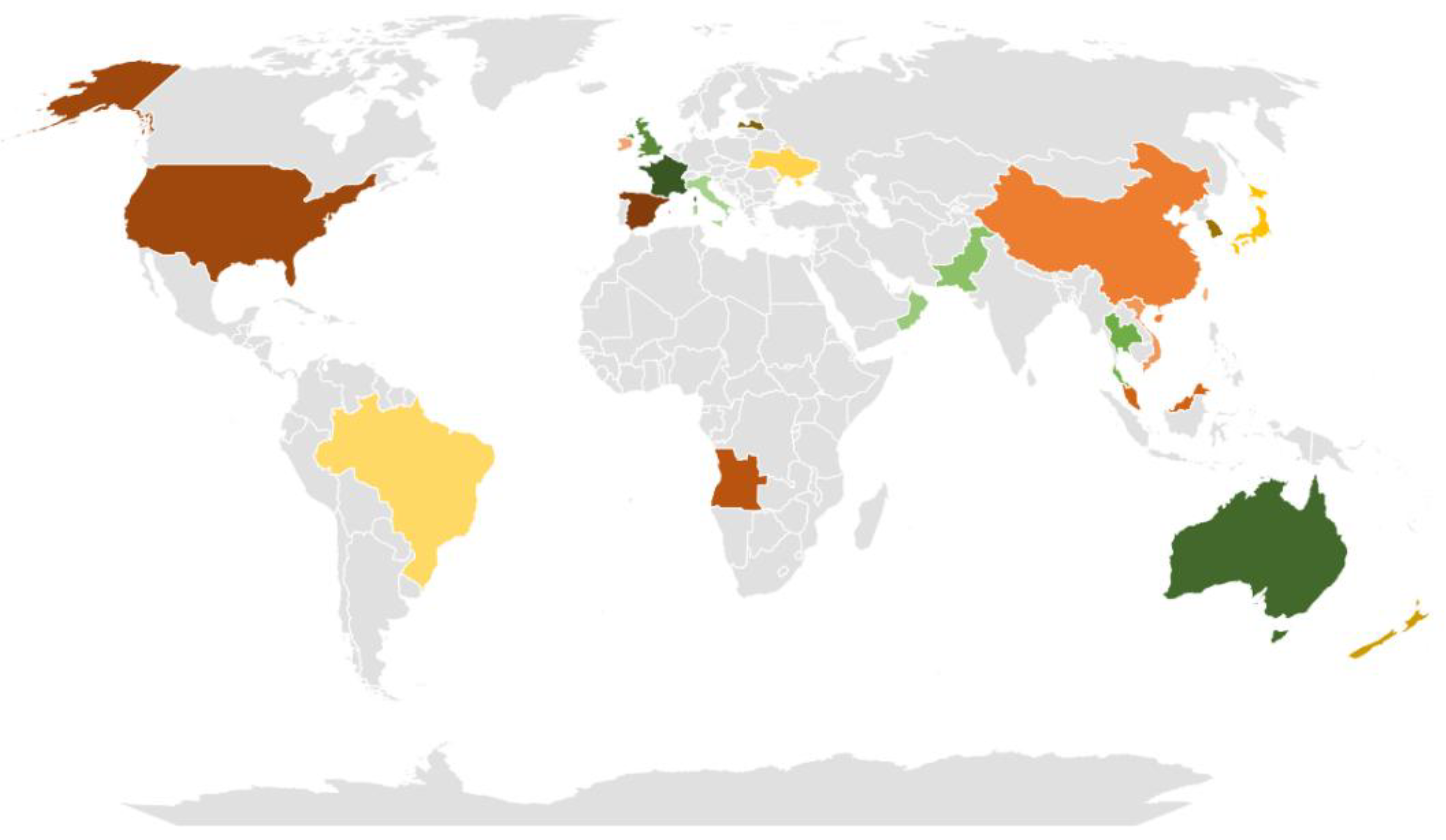
Figure 2.
Eggs available in Hong Kong markets (a) Number of egg brands by country of origin (b) Share of different countries in the import of eggs. Redrawn and adapted from OEC’s data (2023), with modifications to data representation [2].
Figure 2.
Eggs available in Hong Kong markets (a) Number of egg brands by country of origin (b) Share of different countries in the import of eggs. Redrawn and adapted from OEC’s data (2023), with modifications to data representation [2].
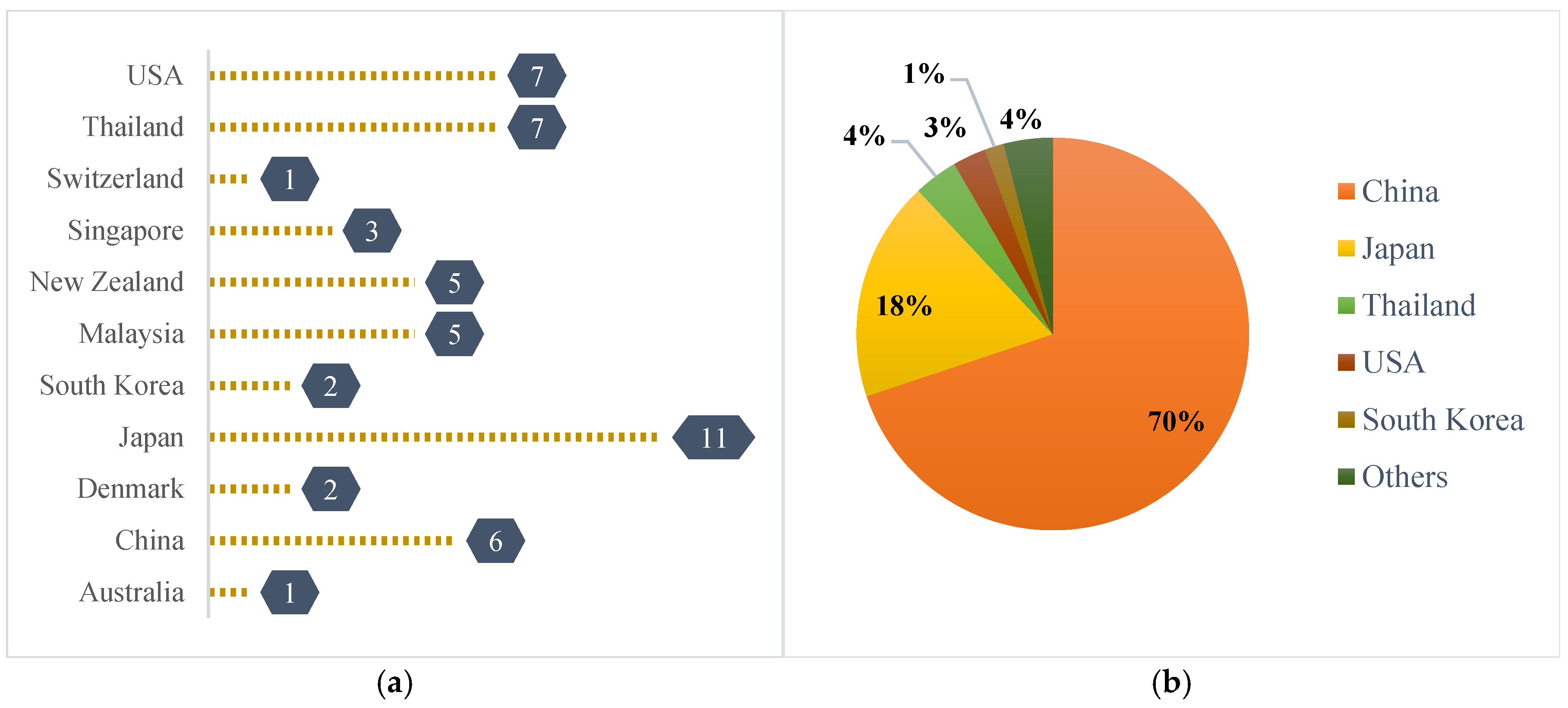
Figure 3.
Measured specific gravity vs specific gravity reported in the literature. (a) Measured, (b) reported in the literature.
Figure 3.
Measured specific gravity vs specific gravity reported in the literature. (a) Measured, (b) reported in the literature.
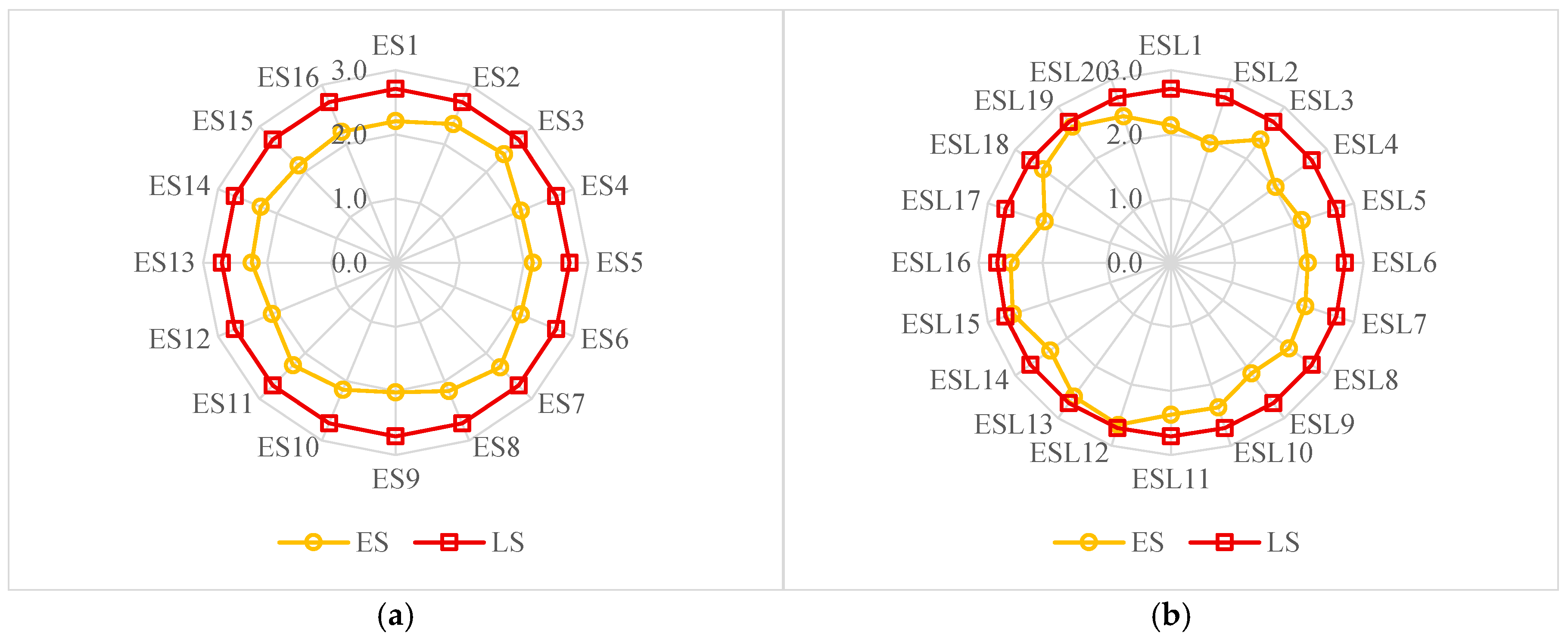
Figure 4.
Typical thermogram for eggshell (a) Weight loss (b), Differential Thermogravimetric Curve (DTG).
Figure 4.
Typical thermogram for eggshell (a) Weight loss (b), Differential Thermogravimetric Curve (DTG).
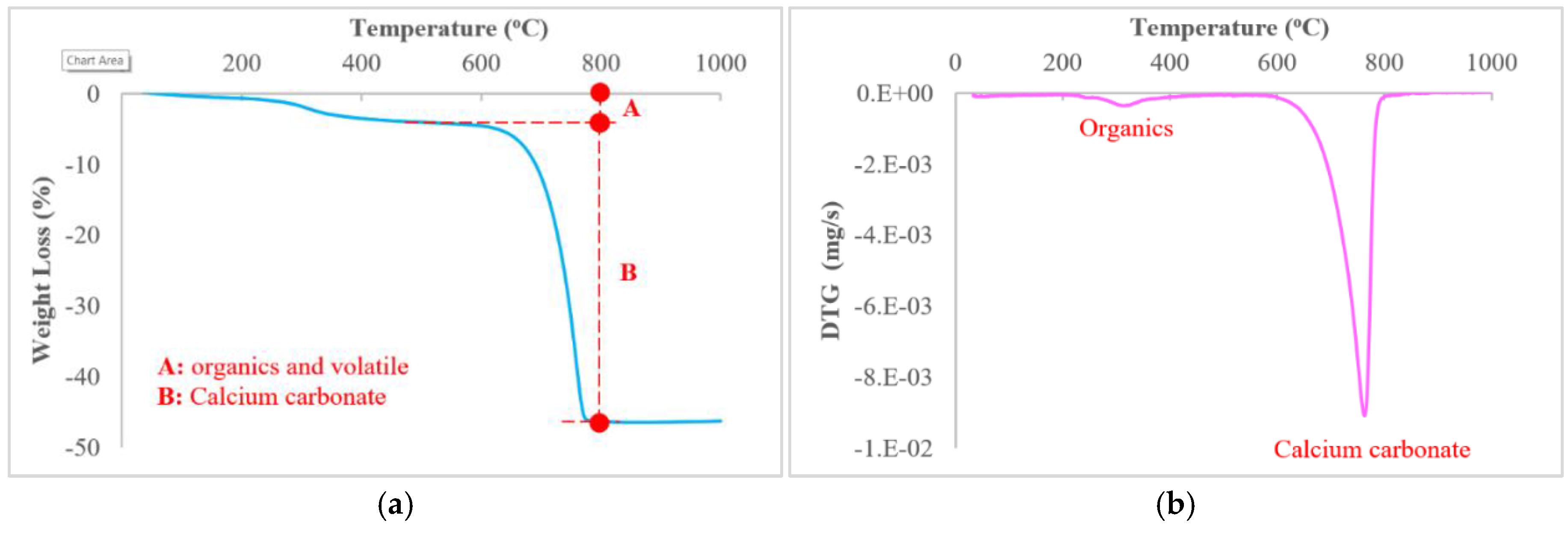
Figure 5.
Correlation between the stoichiometric analysis and thermogravimetric analysis of sample eggshells for mineral part.
Figure 5.
Correlation between the stoichiometric analysis and thermogravimetric analysis of sample eggshells for mineral part.
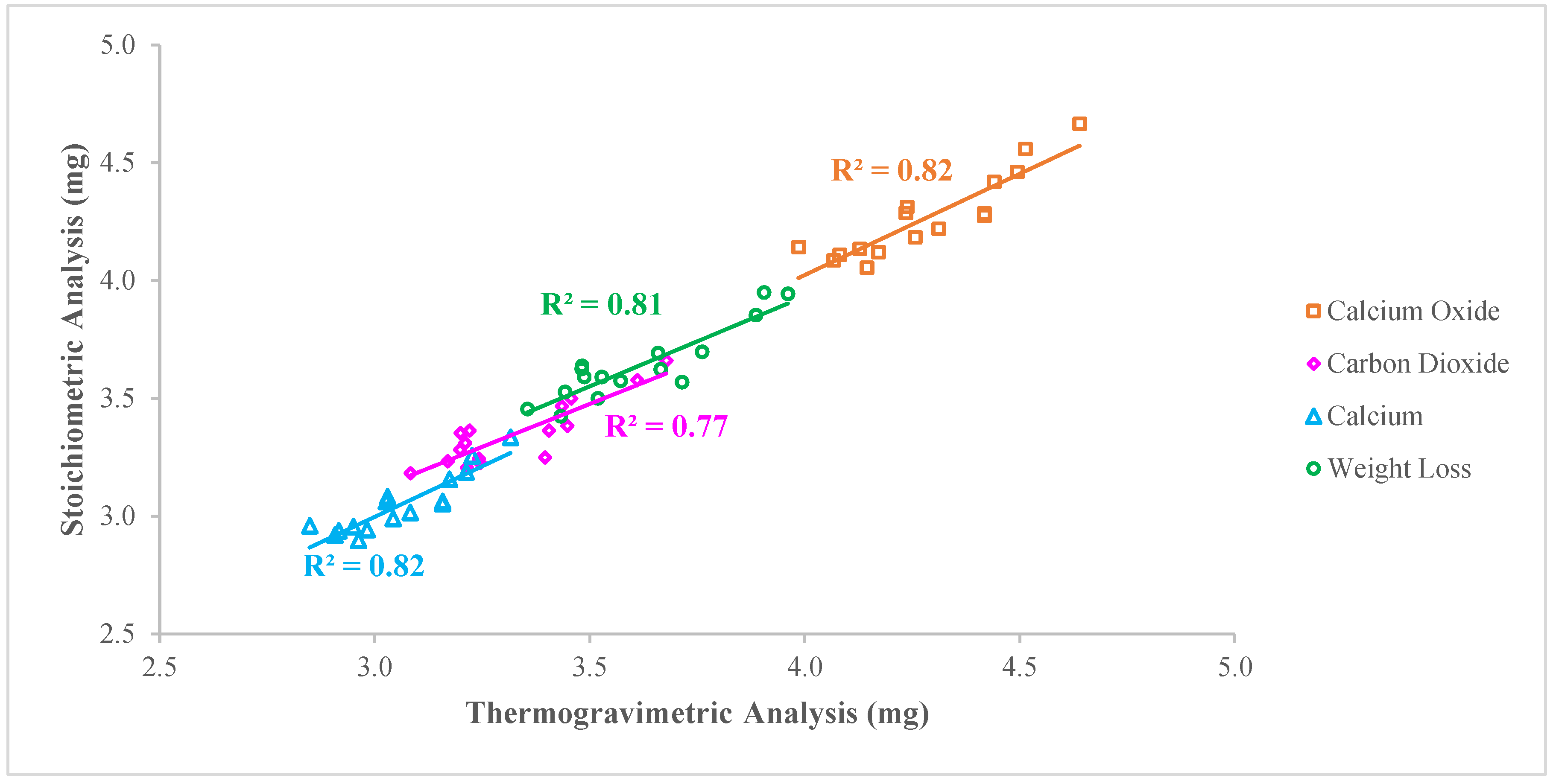
Figure 6.
Particle Size Distribution (PSD) curve of OPC, LS, ES and CES.

Figure 7.
XRD spectrum of CES indicates the presence of a blend of calcium carbonate, calcium hydroxide, and calcium oxide compared to LS and ES.
Figure 7.
XRD spectrum of CES indicates the presence of a blend of calcium carbonate, calcium hydroxide, and calcium oxide compared to LS and ES.
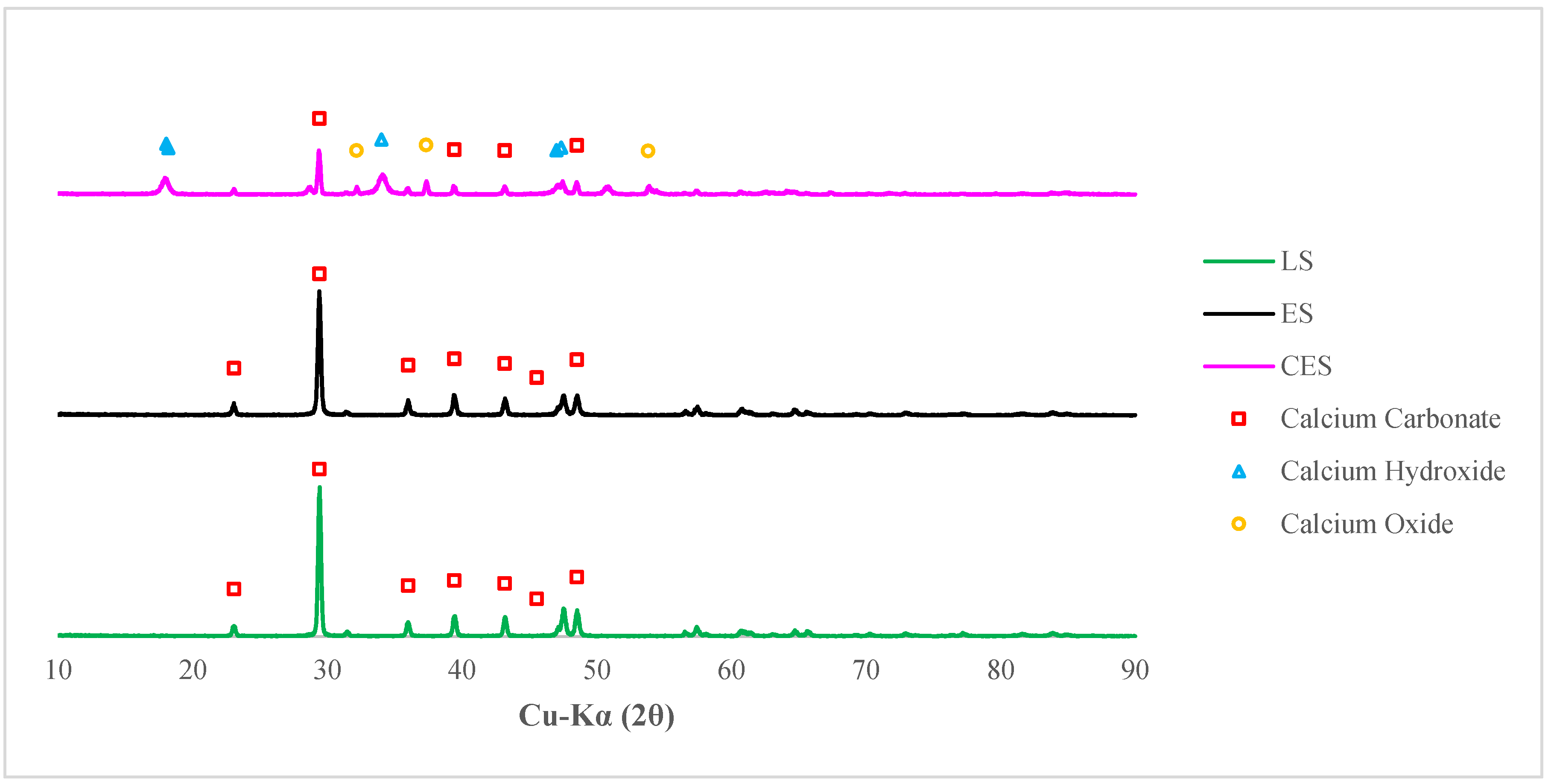
Figure 8.
Compressive strength comparison of eggshell samples. (a) Compressive strength for 7th and 28th day, (b) Change in compressive strength relative to the control mix for 7th day and 28th day.
Figure 8.
Compressive strength comparison of eggshell samples. (a) Compressive strength for 7th and 28th day, (b) Change in compressive strength relative to the control mix for 7th day and 28th day.
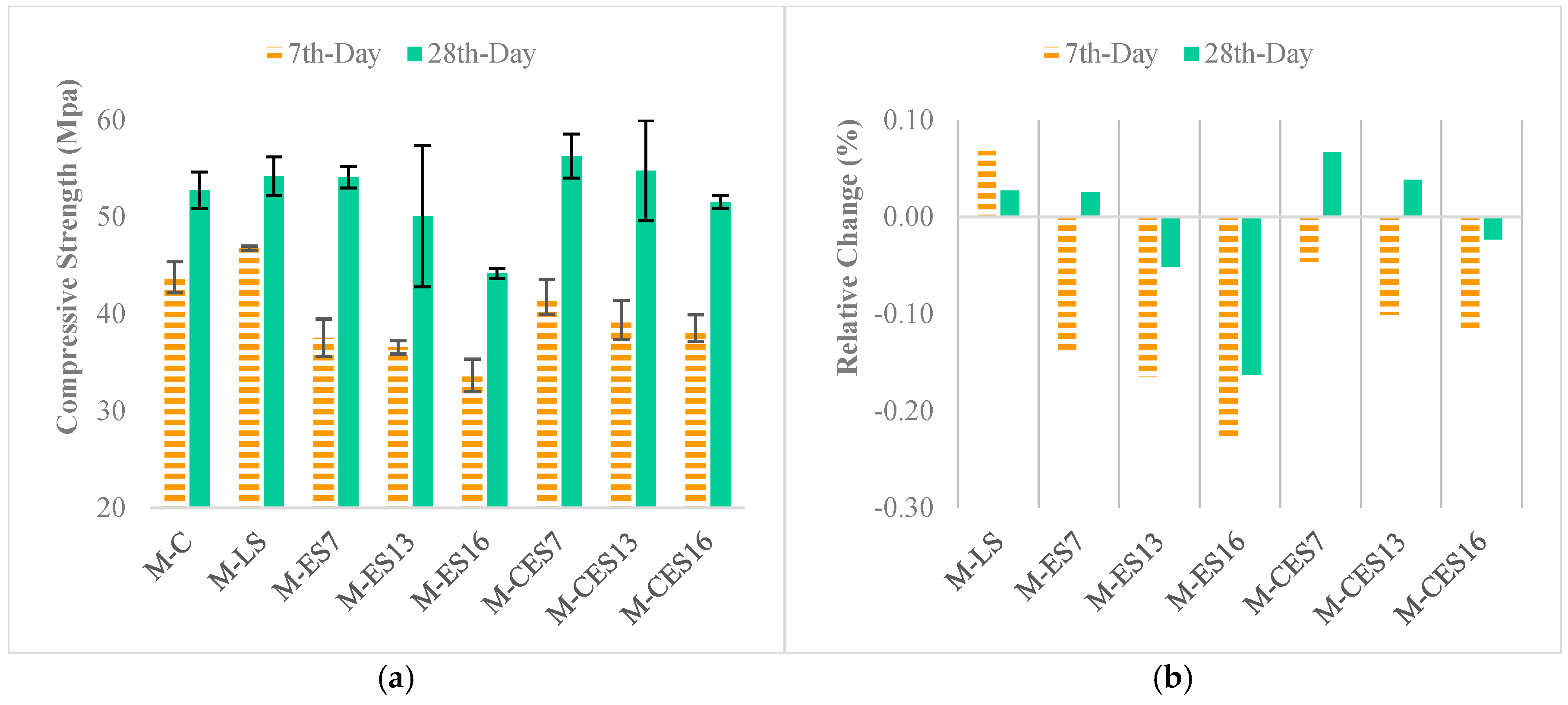
Figure 9.
Correlation between specific gravity and the CaCO3 in ES and LS.
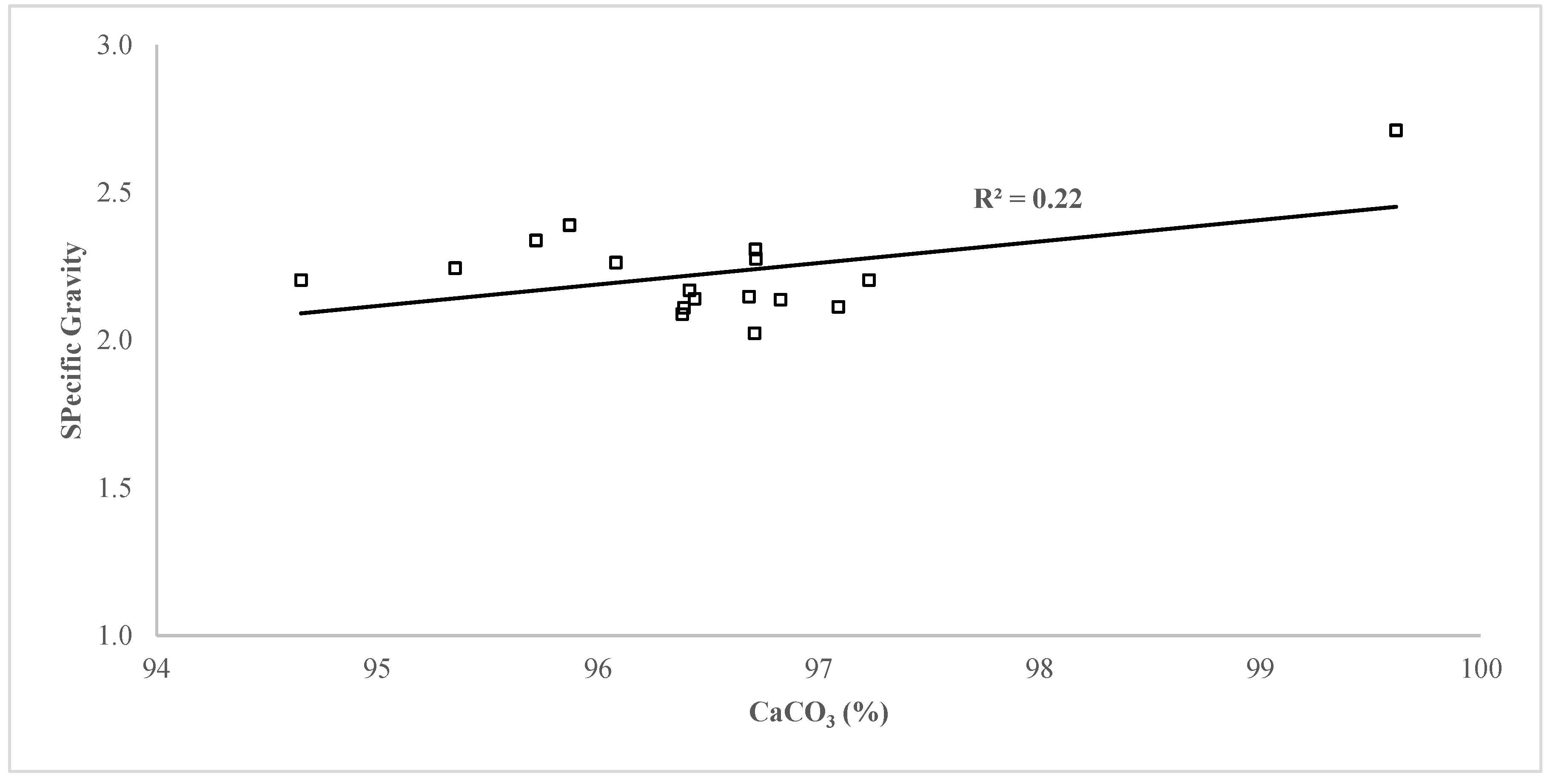
Figure 10.
Correlation between compressive strength and the CaCO3 content in mixes with uncalcined eggshells.
Figure 10.
Correlation between compressive strength and the CaCO3 content in mixes with uncalcined eggshells.
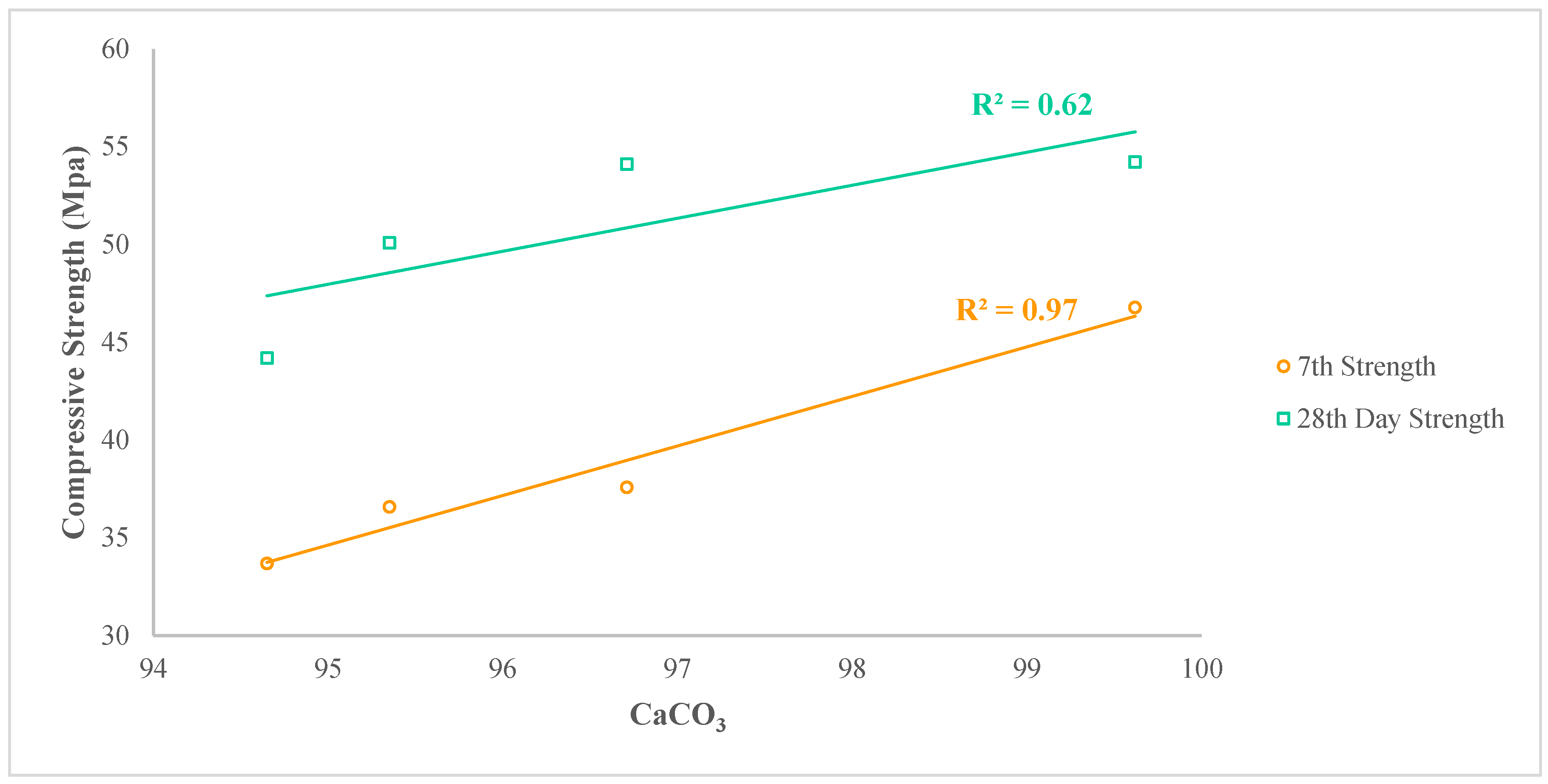

Table 1.
Details of sample eggshells for experimentation.
| Designation | Country | Color | Source |
|---|---|---|---|
| ES1 | China | Dark Brown | Market |
| ES2 | China | Light Brown | |
| ES3 | Thailand | Dark Brown | |
| ES4 | Japan | White | |
| ES5 | Japan | Dark Brown | |
| ES6 | USA | White | |
| ES7 | USA | Dark Brown | |
| ES8 | Singapore | Dark Brown | |
| ES9 | Singapore | White | |
| ES10 | Malaysia | Dark Brown | |
| ES11 | New Zealand | Dark Brown | |
| ES12 | South Korea | Dark Brown | |
| ES13 | China | Dark Brown | Restaurants |
| ES14 | China | Light Brown | |
| ES15 | Japan | Dark Brown | |
| ES16 | Japan | White |
Table 2.
Composition of OPC.
| Oxide Composition (%) | Bogue’s Components (%) | |||||||||||
|---|---|---|---|---|---|---|---|---|---|---|---|---|
| MgO | Al2O3 | SiO2 | P2O5 | SO3 | K2O | CaO | Fe2O3 | Others | C3S | C2S | C3A | C4AF |
| 1.12 | 5.45 | 19.10 | 0.13 | 4.51 | 0.67 | 65.50 | 3.00 | 0.43 | 67.66 | 3.74 | 9.37 | 9.13 |
Table 3.
Details of concrete mixes.
| Specimen | OPC | LS/ES/CES | Fine Aggregates | Coarse Aggregates | w/b | a/b |
|---|---|---|---|---|---|---|
| Kg/m3 | Kg/m3 | Kg/m3 | Kg/m3 | |||
| Control | 600 | - | 600 | 1200 | 0.5 | 3 |
| Non-Control | 570 | 30 | 600 | 1200 | 0.5 | 3 |
Table 4.
Measured specific gravity for eggshells in Hong Kong.
| Designation | Country | Specific Gravity |
|---|---|---|
| ES1 | China | 2.20 |
| ES2 | China | 2.34 |
| ES3 | Thailand | 2.39 |
| ES4 | Japan | 2.11 |
| ES5 | Japan | 2.14 |
| ES6 | USA | 2.11 |
| ES7 | USA | 2.31 |
| ES8 | Singapore | 2.17 |
| ES9 | Singapore | 2.02 |
| ES10 | Malaysia | 2.15 |
| ES11 | New Zealand | 2.26 |
| ES12 | South Korea | 2.09 |
| ES13 | China | 2.24 |
| ES14 | China | 2.28 |
| ES15 | Japan | 2.14 |
| ES16 | Japan | 2.20 |
| Average | 2.20 ± 0.01 | |
Table 5.
Specific gravities of eggshells reported in the literature.
| Reference | Designation | Region | Specific Gravity |
|---|---|---|---|
| [76] | ESL1 | Malaysia | 2.14 |
| [69] | ESL2 | India | 1.95 |
| [47] | ESL3 | India | 2.37 |
| [77] | ESL4 | India | 2.01 |
| [78] | ESL5 | India | 2.14 |
| [79] | ESL6 | NA | 2.13 |
| [80] | ESL7 | NA | 2.20 |
| [81] | ESL8 | Pakistan | 2.27 |
| [82] | ESL9 | USA | 2.09 - 2.18 |
| [83] | ESL10 | NA | 2.37 |
| [84] | ESL11 | India | 2.37 |
| [70] | ESL12 | Bangladesh | 2.66 |
| [85] | ESL13 | Ghana | 2.58 |
| [86] | ESL14 | India | 2.33 |
| [87] | ESL15 | South Korea | 2.59 |
| [14] | ESL16 | Canada | 2.50 |
| [88] | ESL17 | Iraq | 2.07 |
| [89] | ESL18 | Brazil | 2.47 |
| [90] | ESL19 | Ehtiopia | 2.62 |
| [91] | ESL20 | Australia | 2.40 |
| Average | 2.29 ± 0.21 | ||
Table 6.
Comparative composition of eggshells by thermogravimetric and stoichiometric analysis.
| Sample | A1 | B2 | |||||||||
|---|---|---|---|---|---|---|---|---|---|---|---|
| O3 | V4 | Thermogravimetric Analysis | Stoichiometric Analysis | CaCO3 | |||||||
| CaO | ΔW | CO2 | Ca | CaO | ΔW | CO2 | Ca | ||||
| % | % | % | % | % | % | % | % | % | % | % | |
| LS | 0.38 | - | 55.79 | 44.21 | 43.82 | 39.87 | 55.78 | 44.22 | 43.84 | 39.92 | 99.62 |
| ES1 | 1.14 | 1.63 | 54.83 | 45.17 | 42.40 | 39.18 | 54.44 | 45.56 | 42.79 | 38.96 | 97.23 |
| ES2 | 0.94 | 3.35 | 53.61 | 46.39 | 42.10 | 38.31 | 53.59 | 46.41 | 42.12 | 38.36 | 95.72 |
| ES3 | 1.24 | 2.89 | 51.76 | 48.24 | 44.11 | 36.99 | 53.68 | 46.32 | 42.19 | 38.42 | 95.87 |
| ES4 | 0.91 | 2.00 | 54.23 | 45.77 | 42.86 | 38.76 | 54.36 | 45.64 | 42.73 | 38.91 | 97.09 |
| ES5 | 1.09 | 2.08 | 55.29 | 44.71 | 41.54 | 39.51 | 54.22 | 45.78 | 42.61 | 38.80 | 96.83 |
| ES6 | 1.15 | 2.46 | 53.70 | 46.30 | 42.69 | 38.37 | 53.97 | 46.03 | 42.42 | 38.63 | 96.39 |
| ES7 | 1.30 | 1.99 | 53.61 | 46.39 | 43.10 | 38.31 | 54.15 | 45.85 | 42.56 | 38.76 | 96.71 |
| ES8 | 1.22 | 2.37 | 55.92 | 44.08 | 40.50 | 39.96 | 53.98 | 46.02 | 42.43 | 38.64 | 96.41 |
| ES9 | 1.05 | 2.23 | 53.95 | 46.06 | 42.77 | 38.55 | 54.15 | 45.85 | 42.56 | 38.76 | 96.71 |
| ES10 | 1.22 | 2.10 | 55.93 | 44.08 | 40.76 | 39.97 | 54.14 | 45.86 | 42.55 | 38.75 | 96.69 |
| ES11 | 1.34 | 2.58 | 52.98 | 47.02 | 43.10 | 37.86 | 53.80 | 46.20 | 42.28 | 38.50 | 96.08 |
| ES12 | 1.51 | 2.11 | 55.27 | 44.73 | 41.11 | 39.49 | 53.97 | 46.03 | 42.42 | 38.62 | 96.38 |
| ES13 | 1.23 | 3.42 | 54.18 | 45.82 | 41.17 | 38.72 | 53.39 | 46.61 | 41.96 | 38.21 | 95.35 |
| ES14 | 1.01 | 2.28 | 53.73 | 46.27 | 42.98 | 38.40 | 54.15 | 45.85 | 42.56 | 38.76 | 96.72 |
| ES15 | 1.09 | 2.47 | 55.28 | 44.72 | 41.15 | 39.51 | 54.00 | 46.00 | 42.44 | 38.65 | 96.44 |
| ES16 | 1.34 | 4.01 | 53.51 | 46.49 | 41.15 | 38.24 | 53.00 | 47.00 | 41.66 | 37.93 | 94.65 |
| Aver. | 1.17 | 2.50 | 54.24 | 45.76 | 42.09 | 38.76 | 53.94 | 46.06 | 42.39 | 38.61 | 96.33 |
1 Organic and volatile components. 2 Mineral components. 3 organic components. 4 Volatile components.
Table 7.
Comparison of average composition of eggshells from different countries and extra pure limestone (LS).
Table 7.
Comparison of average composition of eggshells from different countries and extra pure limestone (LS).
| Component | Stochiometric Analysis | Thermogravimetric Analysis | ||
|---|---|---|---|---|
| Extra Pure Limestone | Eggshells from different countries | Difference | ||
| % | % | % | % | % |
| Ca | 40.08 | 40.03 | 40.24 | 0.21 |
| C | 11.99 | 12.01 | 11.93 | 0.08 |
| O | 47.93 | 47.97 | 47.83 | 0.13 |
| CO2 | 43.92 | 43.99 | 43.70 | 0.30 |
| CaO | 56.08 | 56.01 | 56.30 | 0.30 |
Table 8.
Details of D[4,3], D(50), and D(90) particles sizes of OPC, LS, ES, and CES.
| Material | D [4,3] | D (50) | D (90) |
|---|---|---|---|
| (μm) | (μm) | (μm) | |
| OPC | 17.53 | 11.56 | 42.86 |
| LS | 20.27 | 17.74 | 38.90 |
| ES-7 | 21.26 | 14.62 | 51.45 |
| ES-13 | 16.76 | 10.14 | 42.67 |
| ES-16 | 13.94 | 8.00 | 35.98 |
| CES-7 | 30.21 | 24.98 | 63.83 |
| CES-13 | 24.09 | 16.43 | 56.25 |
| CES-16 | 31.27 | 24.87 | 66.68 |
Table 9.
Quantities of different phases based on Rietveld analysis.
| S. No | Calcined Eggshells | CaCO3 | Ca(OH)2 | CaO |
|---|---|---|---|---|
| % | % | % | ||
| 1 | CES7 | 37.5 | 55.3 | 7.2 |
| 2 | CES13 | 37.6 | 55.1 | 7.4 |
| 3 | CES16 | 36.7 | 54.6 | 8.7 |
Table 10.
Comparison of the average compressive strengths of control mix, mixes with limestone, eggshells, and calcined eggshells.
Table 10.
Comparison of the average compressive strengths of control mix, mixes with limestone, eggshells, and calcined eggshells.
| Specimens | Compressive Strength | |
|---|---|---|
| 7th Day | 28th | |
| MPa | MPa | |
| Control | 43.79 ± 1.59 | 52.76 ± 1.85 |
| M-LS5 | 46.77 ± 0.23 | 54.20 ± 2.01 |
| M-ES | 35.93 ± 2.19 | 49.45 ± 4.39 |
| M-CES | 39.90 ± 2.09 | 54.20 ± 3.54 |
Table 11.
HM and LSF for the OPC and the OPC with 5% CES.
| Mix | CaO in CES | CaO in OPC | SiO2 | Al2O3 | Fe2O3 | HM | LSF |
|---|---|---|---|---|---|---|---|
| % | % | % | % | % | |||
| OPC | - | 65.5 | 19.1 | 5.45 | 3 | 2.377 | 1.057 |
| M-CES7 | 7.2 | 65.5 | 19.1 | 5.45 | 3 | 2.391 | 1.063 |
| M-CES13 | 7.4 | 65.5 | 19.1 | 5.45 | 3 | 2.392 | 1.063 |
| M-CES16 | 8.7 | 65.5 | 19.1 | 5.45 | 3 | 2.394 | 1.064 |
Disclaimer/Publisher’s Note: The statements, opinions and data contained in all publications are solely those of the individual author(s) and contributor(s) and not of MDPI and/or the editor(s). MDPI and/or the editor(s) disclaim responsibility for any injury to people or property resulting from any ideas, methods, instructions or products referred to in the content. |
© 2025 by the authors. Licensee MDPI, Basel, Switzerland. This article is an open access article distributed under the terms and conditions of the Creative Commons Attribution (CC BY) license (http://creativecommons.org/licenses/by/4.0/).
Copyright: This open access article is published under a Creative Commons CC BY 4.0 license, which permit the free download, distribution, and reuse, provided that the author and preprint are cited in any reuse.


