
Submitted:
09 October 2023
Posted:
11 October 2023
You are already at the latest version
Abstract
This paper defines the two main causes of global warming in the UK and seeks to cut climate change using green hydrogen made from renewable electricity sources. Combustion vehicles powered by fossil gasoline and diesel emit a third of UK climate-warming CO2 while buildings heated by natural gas provide a quarter. First, current UK grid problems are defined: Electricity grid, gas grid and petroleum grid. Then experiments on the private energy community of Keele University allow electrolysis demonstrations producing green hydrogen for buildings and vehicle refueling. Next, the model supply chain is planned and tested. Finally, experiments and calculations are outlined, analyzing the optimum system design criteria proposed. We conclude that economic green hydrogen can displace diesel and gasoline in vehicle transport, while also displacing natural gas for combined heat and power in buildings. In addition, the prospect in 2023 is that profits can now be made all along the green hydrogen supply chain, such that new businesses involved in clean communities can beat the National Grid monopoly and other large dominant fossil grid companies.
Keywords:
Wind turbines
; solar farms
; renewable electricity
; electrolysis
; green hydrogen
; compression
; storage
; hydrogen fuel cell electric vehicles
; green buildings.
1. Introduction
The two largest problems for UK global warming are vehicles that combust petroleum-based fuels, plus buildings reliant on natural gas for heating [1]. Together, these two sources of fossil CO2 add up to more than half of UK climate change emissions. This paper explains how both problems could be rationally solved using green hydrogen on thousands of private community sites distributed across Britain.
Vehicle emission has been the worst issue because fossil CO2 from transport has continued to rise whilst other polluters like industry and the electrical power network have cut fossil CO2 over the last 30 years since coal mining was phased out. Buildings come second because there has been progress in new-build where energy standards have risen, with an EU prospect of mandatory solar panel installation from 2027 [2]. This contrasts with vehicle exhausts which continue to rise as cars doubled in weight over the last 50 years, multiplying fossil CO2 emissions by a factor 2, while still increasing to 40.7M in 2023.
The present advance [3] of solar renewable energy in UK homes reached almost 1.2 million in 2023 out of 26 million houses, giving around 2% penetration. Electric car penetration was also near 2%, but only half green because the grid delivering the battery-charging is still dependent on natural gas until 2035 when off-shore wind should have largely replaced the existing gas and coal fired power stations.
The first part of this paper discusses the major difficulties for our grids eliminating fossil-fuelled buildings and vehicles, then moves on to defining the key areas that need attention immediately if progress is to be substantial. Second: the model of an optimum green hydrogen community is invoked, using Keele University as the experimental area, the largest campus in Britain with 12,000 population using about 7MW of power on average throughout the year, mainly for buildings but also for recharging battery electric vehicles (BEVs). Then, experiments are described on making green hydrogen on-site, followed by estimates of scale-up costs and benefits as the present gas and electricity grids are transformed by community renewables. Finally, the conclusion is that green hydrogen can play a huge profitable part in cutting the Keele fossil CO2 intensity as the campus moves from 30% to 100% green by 2030.
2. Can the Grids change from fossil to renewable energy?
Three main grids supply energy around Britain: electricity, gas and petroleum. Since privatisation of gas in 1986 and electricity in 1990, the government policy has been to define several main energy sources where electricity is generated or fuels are imported, with regional distribution run by around 6 large gas/electric companies and 5 big liquid fuel companies [4]. Transport fuels and natural gas dominate but the National Grid company running UK electricity infrastructure supplies about 20% of UK energy (Table 1) through cables and this has been viewed as the future technology that should overtake the others, but it is only number 7 in the league table of UK energy companies at present. National Grid is monopolistic in owning the English high voltage wires which other companies must use, so prices are among the highest in Europe. A key problem is that the present electricity grid has little storage so balancing supply and demand is a minute-by-minute process that differs from storing diesel liquid in tanks or natural gas in caverns. The diesel grid could consist of pipes, but it is easier and cheaper to ship this liquid fuel by road tankers.
As things stand in 2023, there is little chance that National Grid can increase its energy deliveries by a factor 5 to replace gas and petroleum with green electricity. In the first place, it has swopped the feed-in tariff to a ‘smart export guarantee’ in 2019, reducing payments to green electricity generators. The original Grid feed in tariff was much more generous and made solar panels popular since 2010, based on the German law of 2000, requiring energy companies to accept power from homes with solar generators. Secondly, the National Grid has not provided sufficient electricity to charge electric vehicles effectively. Thirdly, hundreds of green energy projects are stalled waiting for Grid permissions to connect. Finally, National Grid supplies most of its energy from 181 large power stations and has not embraced distributed energy, which includes both wind and solar power, that are today established as our cheapest energy sources [5].
The gas grid is now being modified to carry green hydrogen in its pipes, but it is still not clear what the quality will be, mainly because odorants must be added to detect leaks by smell. Several projects have put hydrogen into houses, but problems of gas leaks and flame speed remain. In thermodynamic terms, combusting hydrogen is both toxic and inefficient, and would be more efficiently replaced by electrochemical Combined Heat and Power (CHP) based on hydrogen fuel cells. Nearly 100GW of green hydrogen production will be needed to replace natural gas throughout the UK and this will take decades to achieve at best [6].
Petroleum companies are finding it easier to address the green transition because they have been adding biofuels to their fossil liquids since 2010 and are now experimenting on hydrogen as a zero-emission fuel in buses and trucks. This is readily tested by shipping hydrogen tube trailers to petrol stations and changing the dispenser to suit the hydrogen vehicles. The cost of this shipping process is well understood throughout the UK’s 8000 petroleum refuelling station infrastructure because various alternative fuels (eg diesel, LPG, biofuel, LNG) have been tried over the last 50 years. £500,000 is sufficient to get results on a green hydrogen refueler, whereas a permanent hydrogen station like the 2021 Tyseley (Figure 1a) installation cost near £5M because it includes an electrolyser, large storage vessels and compressors to deliver both 700bar and 350 bar pressurised gas. Moving to battery charging of electric vehicles across the refueling station network is another major difficulty because high powered rapid chargers are needed, up to 100kW DC, which require new electric power supplies, while the 80% charging time of 30 minutes is 6 times slower than hydrogen filling, meaning that many more electric charging units are required than hydrogen dispensers.
The conclusion is that the existing grids cannot easily change so it is now vital to consider distributed energy across the UK in the form of thousands of private wire renewable solar/wind electrical communities with big hydrogen storage for use in buildings and vehicles. Changing vehicles from combustion to hydrogen fuel cell battery electric vehicles (HFCBEVs) is the simplest first move because vehicle fuels are shipped and can be flexible, so hydrogen merely adds to petrol, diesel, biofuel, propane, LNG on 8000 existing sites that can gradually go green.
3. Green hydrogen vehicle refueling problems identified in UK
The first UK green hydrogen refueling station was installed by the author at University of Birmingham in 2008 (Figure 1b) and the enthusiasm for more stations around Britain then started, with Loughborough University following in 2009 and further plants built during the next decade as shown in Figure 2b. The result was not surprising because many innovative products rise rapidly for several years while first-users test the performance and lifetime. An innovative product may then be seen to have problems which require correction before the anticipated full growth. This is what happened in 2015 when the installation of hydrogen stations stopped, then dropped as refuellers were closed, as shown by results shown in Figure 2. Shell closed several of their hydrogen stations in 2020-2023 so that only three were operational across England in 2023.
Figure 2 shows that the first phase of development was long, with experimentation from 1980 but seriously starting in 1999 at the opening of the first hydrogen station at Munich airport. Then Los Angeles started its project on hydrogen cars and refuellers in 2005 along with Japan which was manufacturing hydrogen cars at an increasing rate. Britain was behind but showed rapid growth (Fig2b) until 2015 when the Aberdeen station opened. Although the Government and UK industry had predicted 65 by 2020, small loss-making stations started to close, for example the Coventry and Birmingham University units which were too small and had low demand. The final blow came in 2022 when Shell closed three stations in England, leaving just Rotherham, Birmingham and Heathrow.
This graph differs from the standard product lifetime description of development, introduction, growth, maturity and decline illustrated in Figure 2a [7], fitted by hydrogen stations built in Germany, Japan and China, none of which are green at present. However, it is known that there is often an early product sales dip when consumers realise that snags arise over the first years, followed by correction and optimisation to produce steady rapid growth later. The interesting differentiation of UK from Germany and China is that large hydrogen subsidies were not deployed in Britain so the premature acceleration to hundreds of refueling stations seen overseas was killed by £M financial losses of companies like Motive Fuels and Shell. A similar closing of hydrogen stations happened at Everfuel in Denmark because losses were high due to low demand from hydrogen vehicles. However, in 2023 it was demonstrated in UK that profits could be made along the green hydrogen supply chain, allowing capitalist forces to grow the market further as predicted by the dashed line predicting rapid growth of UK hydrogen stations after 2023 in Figure 2b.
Problems that caused the financial issues were readily identified [8]. First was the lack of demand from hydrogen vehicles, whose numbers rose very slowly at first because all hydrogen vehicles were imported and consumers did not buy them. Second, battery electric vehicles were strongly supported by the government with substantial subsidies, distracting hydrogen vehicle enthusiasts, who received no such incentives. The third and most important issue was that the largest hydrogen refuelling installations were powered by grid electricity, which was neither green nor economic, costing twice the desired price-point of £10/kg that could compete with diesel prices.
The main loss-making decision was to manufacture hydrogen by electrolysis of water using grid electricity. Whereas the first station in Birmingham (Figure 1b) had used green biohydrogen and the 2015 ITM station in Rotherham had used wind-power green electricity, other units depended on the Grid which is generally too expensive with prices ranging from £100/MWh to above £160/MWh which leads to a retail price in Birmingham of £23/kg, far too high to compete with diesel at current prices. The fact is that electricity price for powering electrolysis is the main factor dictating green hydrogen cost. £10/kWh is required at the retail point, so the price at the hydrogen manufacturer must be much less, around £5/kg or lower. £10/kg is near the German retail price, which is subsidised. California appears to have the same problem since retail hydrogen price rocketed to $36/kg from the original $13/kg in 2023. This makes green hydrogen motoring non-competitive with fossil powered transport.
Refusing National Grid electricity is necessary to move forward on green hydrogen as described now.
3. The Green Private Community model for Green Hydrogen
The profitable supply chain model described here was evaluated first in 2022 [8], using Keele University community of 12,000 people as an example of a private wire integrated green energy system using green hydrogen as a massive energy storage material. At present, the system is running according to the model supply chain illustrated in Figure 3.
Wind is combined with solar electricity on the left of Figure 3 to feed a battery that can bridge short-term fluctuations (hours) while feeding buildings to replace the usual grid power. Surplus electricity is produced at peak wind/solar operation, going to a water electrolyser with low pressure storage that powers buildings with CHP (combined heat and power by fuel cell) when renewable electricity is low. The hydrogen is compressed to 500 bar to feed tube trailer storage which can bridge days of low renewables, and which can also ship hydrogen. 500 bar hydrogen runs the hydrogen refueller for trucks and buses, while 700bar compression is needed for cars and vans.
Keele may be viewed as a small village community of 12,000 requiring 7MW on average, whereas a larger private site may rise to 30,000 souls, a town requiring about 20MW for homes. In 2022, the Keele Smart Energy Network Demonstration (SEND project) was opened to cut grid electricity input to Keele by a factor 2, saving approximately £2M per annum, at a capital investment of £8.1M for design/build by Siemens and run by Equans [9]. Small quantities around 0.2MW of green hydrogen were also produced but insufficient to make Keele campus fully green, which would require 10MW of electrolyser capacity to absorb peak renewable electricity production, producing 2 tons per day of hydrogen to be stored for bridging days of low wind/solar generation. A town is predicted to need over 20MW of hydrogen generation by electrolysis, to feed vehicles and buildings.
Early results shown smoothed in Figure 4 reveal that a typical low-power autumn Keele day provides excess power from solar around noon for several hours, with 20MWh of energy fed back into the National Grid. This was a day where wind was near zero, so solar input dominated the electricity measured. The National Grid buying price was low, about £50/MWh which is normal in the UK because the Grid is a monopoly that commands low prices for spare electricity. To avoid this, the excess Keele green power was fed experimentally to the water electrolyser manufacturing green hydrogen for storage as shown in Figure 3, electrolysing water to make green hydrogen for application in buildings and vehicle refueling. To go fully green, the renewable energy input would need to be 14MW average such that 10MWof hydrogen could be stored to avoid using the Grid as a reservoir. Better yet would be a heat storage tank underground to make use of renewable electricity generation not accepted by the electrolyser. Because green hydrogen should retail at £10/kg when refueling cars, it was estimated that the average surplus 10MWh/day grid-fed at £50/MWh (ie £500) shown in Figure 4 would generate £700,000/a from retail hydrogen at £10/kg, four times more than Grid receipts for feed-in of spare Keele electricity generated.
4. Going 100% green at Keele using green hydrogen
Right now, Keele private wire community of 12,000 people is one-third--green and is paying back the original £8.1M investment in about 4 years, owing to the approx £3M saved from utility bills. The prediction is that another £3M/a will be saved by installing 6 more MW of renewable electricity, with a predicted similar payback time. However, investment cost must rise because more green hydrogen needs to be produced by electrolysis to give energy storage supplying days of stored energy which can drive campus buildings through CHP driven by fuel cells when wind and solar inputs are low. Going from the 3MW electrolyser needed now to 10MW in 2025 will utilise most of the excess renewable electricity, more than absorbed by buildings and vehicles, producing stored hydrogen gas in bigger low-pressure containers. Typically, the electrolyser can then be run for about 12 hours per day when sun and wind are good, manufacturing 2000kg/day of green hydrogen worth £20000/day at retail (£3.6M/a). The extra equipment requiring investment includes the electrolyser, storage, hydrogen pipes and fuel cells in buildings. Further excess electricity production can be stored in a hot water tank for heating buildings.
The key point about the Keele proposed plant is that it uses only renewable electricity that would have returned to the grid at £0.05/kWh and so can produce green hydrogen at a low electricity cost of £2/kg, contrasting with £8/kg for Grid electricity at Tyseley station (Figure 1a). This high Grid electricity price dominates hydrogen cost, with the other costs mainly for compressors and storage tanks. The conclusion is that green hydrogen can be produced at Keele community site at a cost near £5/kg whereas Tyseley makes un-green hydrogen costing about £12/kg, leading to £23/kg price for consumers at retail.
5. Reproducing community green hydrogen production across the UK
If the Keele community project can be completed to reach 100% green, with hydrogen used as the major energy storage medium on-site, with an attractive pay-back time about 4 years, then it is timely to consider the benefits of multiplying this technology across the UK.
Recent analyses of the existing Government plan to supply UK electricity from extensive offshore wind farms [10] suggest that the green energy for 2035 is planned to be transmitted along the National Grid to all citizens, or converted to hydrogen that can be piped across the country. This sounds fine but there are substantial difficulties that must be considered: First, there are only about 100km of UK hydrogen pipelines at present, but it is believed that 2000 km of the natural gas pipes could be repurposed to convey hydrogen instead [11]; second, the National Grid pylon network would need to expand by a factor 4 to carry all the electricity needed to power transport, buildings and industry that currently use petroleum or gas. This erection of unsightly new overhead cable structures could create a public backlash like that occurring in the 1940s when the original National Grid was established [12]. Both hydrogen pipes and electric cables are under consideration, but a key alternative is community onshore wind turbines and solar farms effectively banned by David Cameron in 2015 because he disliked their appearance. The dilemma this decade is choosing between pylons and turbines, which are discussed now.
6. Doubling wind turbines or four-times more pylons
The present UK government effectively banned wind turbines onshore in 2015. If a single person complained about a wind turbine, the installation could be halted, and planning consent was deleted. Yet, the government now plans to double the number of National Grid pylons soon and is going ahead in 2023 [12]. There will probably be negative reaction to this from the public, many of whom lose house valuation because of nearby ugly transmission lines. Keele University installed its 2MW of wind turbines by reducing their height, hiding them behind trees and responding to answer all complainants. They also installed the solar farm shown in Figure 5 without serious questions from the public.
The interesting fact is that pylons in UK number around 22000, far more than the 10,000 onshore wind turbines approved before the David Cameron ban. Yet, the British government has produced a model of the UK running completely on grid electricity and therefore is beginning to erect between 2 and 5 times more pylons because the grid must replace both natural gas and petroleum to achieve net zero by 2050. The plausible outcome of this irrational policy is that 88000 pylons might be required, to be detested by many citizens (Figure 6b).
Instead of considering a logical scheme for distributed power based on natural energy sources like solar and wind near every community, the huge utility companies are planning to continue the outdated 20th century concept of hundreds of remote off-shore power farms (Figure 6a) feeding the national wire grid, rather than millions of renewable generators on most buildings.
In this paper, we suggest that hydrogen cars will be distributed across the UK, leading to a requirement for thousands of distributed green hydrogen refueling stations that will be on private wire sites, each containing a 5MW wind turbine and 5MW of solar panels, modelled on the Keele experiment. 10,000 such filling stations would produce green hydrogen for communities, buildings and vehicles, totalling 100GW of new clean power to replace fossil gas and petroleum. For such quantities of locally stored hydrogen, above 1 ton, regulations will need to be applied [16].
The map of Figure 6 shows that the Midlands around Birmingham contains virtually no wind turbines, yet is trying to introduce millions of hydrogen cars, vans, trucks and buses [15] whereas Scotland and coastal areas have close access to green wind generated hydrogen. The final tally of onshore wind turbines should reach 20,000 by 2035, still less than the existing 22000 pylons, and far neater than the 88,000 predicted by government eventually.
7. Conclusion
- The existing UK electrical and hydrogen grids cannot develop fast enough to replace fossil energy by 2030. It is essential now to consider distributed renewable electricity making hydrogen, because solar and wind are naturally spread thin on energy content, while being the lowest cost installations on-shore.
- Green Hydrogen is the storage molecule that allows fluctuating renewables, wind and solar, to be stored successfully and economically, powering vehicles and buildings, our main fossil carbon problem-sectors.
- Private wire local communities can produce distributed renewable energy using green hydrogen as the main storage and transmission material, producing a new standard for energy prices, replacing the current UK Grid prices which are among the highest in Europe, too high to manufacture competitive green hydrogen.
- Local new micro-grids: electric and hydrogen; can link the communities and back-up the surrounding energy systems without much increase in the grid pylon numbers.
- Economic green hydrogen has been produced at the Keele community and is being tested in buildings and in vehicles, with emphasis on scale-up to find a suitable optimised community operating level.
- If this Energy Community at Keele turns out to be an optimum dimension near 10MW of wind/solar capacity, then it could be reproduced across the UK 10,000 times to power UK vehicles and buildings giving100GW of new UK power generation, with an estimated cost of £60bn and payback time of around 5 years.
References
- K Kendall, Green Hydrogen in the UK: Progress and Prospects. Clean Technol. 2022, 4, 345–355. [CrossRef]
- S. Geschwindt, EU set to make solar panels mandatory, May27, 2022, https://buildindigital.com/.
- How Many People Have Solar Panels in the UK? - The Eco Experts.
- F La Camera, Renewable Power Generation costs in 2020, IRENA 2021, 1-179.
- BEIS, UK energy in brief 2022, www.gov.uk/government/statistics/uk-energy-in-brief-2022. 2022.
- UK poised to drop plans to replace home gas boilers with hydrogen alternatives | Hydrogen power | The Guardian.
- Product life cycle - Product - Higher Business management Revision - BBC Bitesize.
- K Kendall, Economic green hydrogen for UK refuelling stations and buildings, Renewable and Sustainable Energy. 2023.
- Fan, Z. , Cao, J., et al., The role of ‘living laboratories’ in accelerating the energy system decarbonization, Energy Reports 2022, 8:11858-11864. [CrossRef]
- Bamisile, A., Hatton, L., Jansen, M., Staffell, I., Enabling the UK to become the Saudi Arabia of wind, Energy Futures Lab, Imperial College, London. 2023.
- National Grid Studying UK Hydrogen Pipeline Network Potential | Pipeline and Gas Journal (pgjonline.com).
- N. Pratley, The next UK net zero battleground is electricity pylons, The Guardian, 26 sept 2023. 2023.
- Substations, pylons and overhead lines | National Grid ET.
- Onshore and offshore wind map.
- K Kendall, Midlands Green Hydrogen Conference, Millennium Point, Birmingham, 21 Sept 2023, HydrogenUnited.org.
- G. Majumder-Russell, C Rihoy, K Mitchell, Hydrogen Law, Regulations and strategy in the UK, CMS 2022, Hydrogen law and regulation in the United Kingdom | CMS Expert Guides.
Figure 1.
(a) Tyseley hydrogen station refuelling a Toyota Mirai; (b) First UK green hydrogen refueler opened in 2008 in University of Birmingham.
Figure 1.
(a) Tyseley hydrogen station refuelling a Toyota Mirai; (b) First UK green hydrogen refueler opened in 2008 in University of Birmingham.
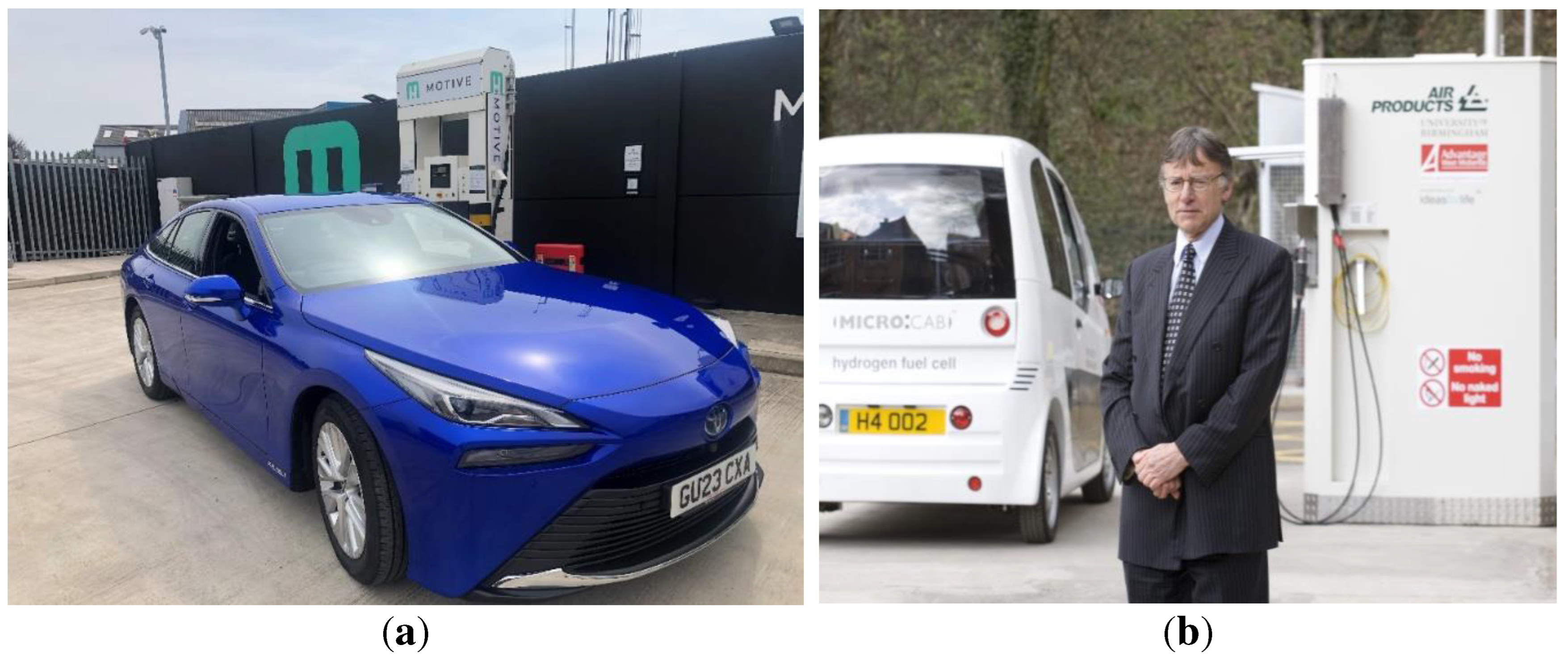
Figure 2.
(a) Standard model for product lifetime [6]; (b) Observed growth of England hydrogen stations showing the long development period from 1980, the introduction in 2008 followed by rise and fall leading to a second lift-off by 2025.
Figure 2.
(a) Standard model for product lifetime [6]; (b) Observed growth of England hydrogen stations showing the long development period from 1980, the introduction in 2008 followed by rise and fall leading to a second lift-off by 2025.
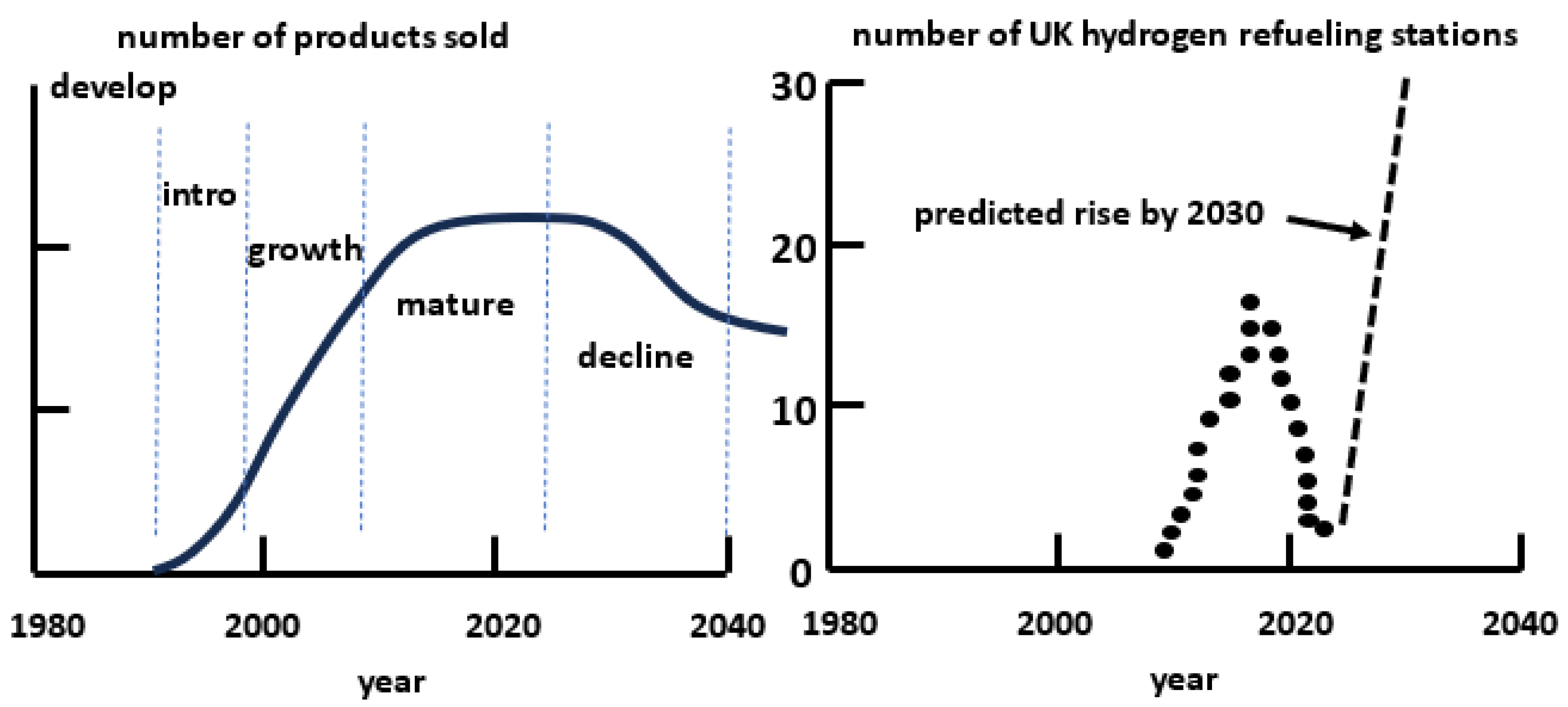
Figure 3.
Diagram of the supply chain for a green private wire community starting on left with solar/wind charging a battery that feeds buildings and powers an electrolyser /hydrogen store leading to hydrogen shipping plus vehicle refuelling and buildings energy.
Figure 3.
Diagram of the supply chain for a green private wire community starting on left with solar/wind charging a battery that feeds buildings and powers an electrolyser /hydrogen store leading to hydrogen shipping plus vehicle refuelling and buildings energy.
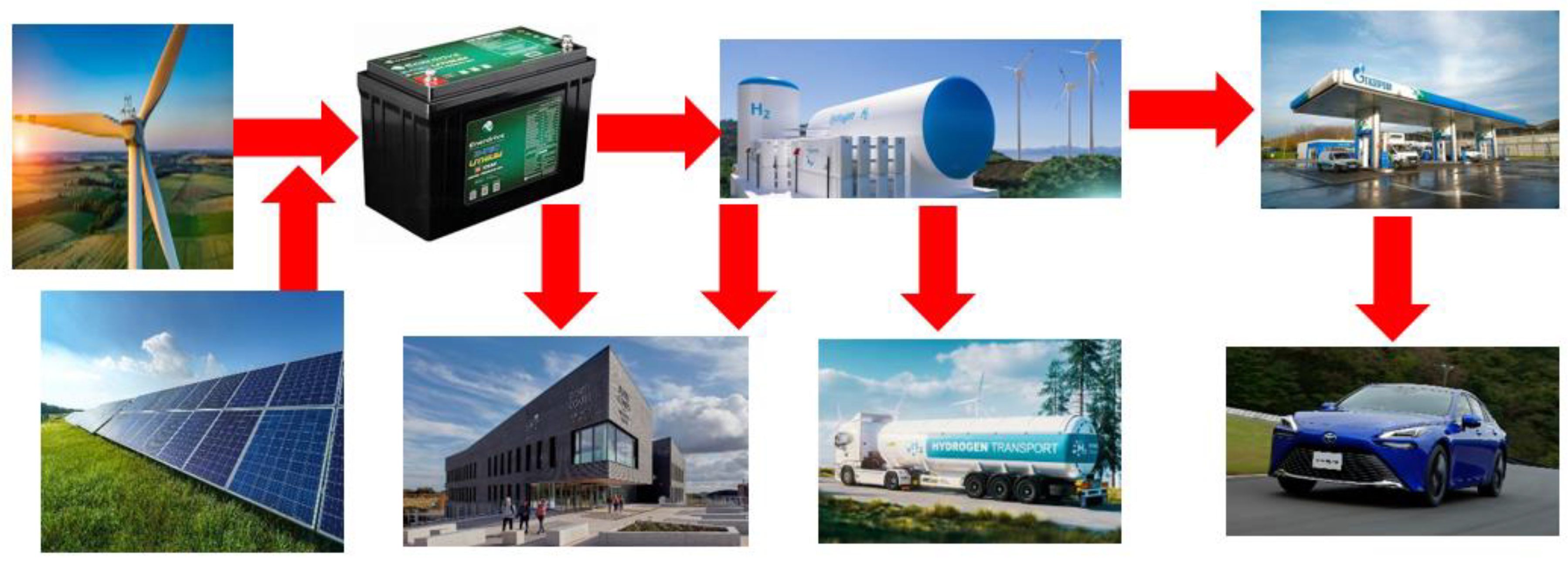
Figure 4.
Smoothed Keele results [9] for 24 hours on 27 September 2022 showing surplus green electricity fed-in to Grid when it could alternatively produce green hydrogen.
Figure 4.
Smoothed Keele results [9] for 24 hours on 27 September 2022 showing surplus green electricity fed-in to Grid when it could alternatively produce green hydrogen.
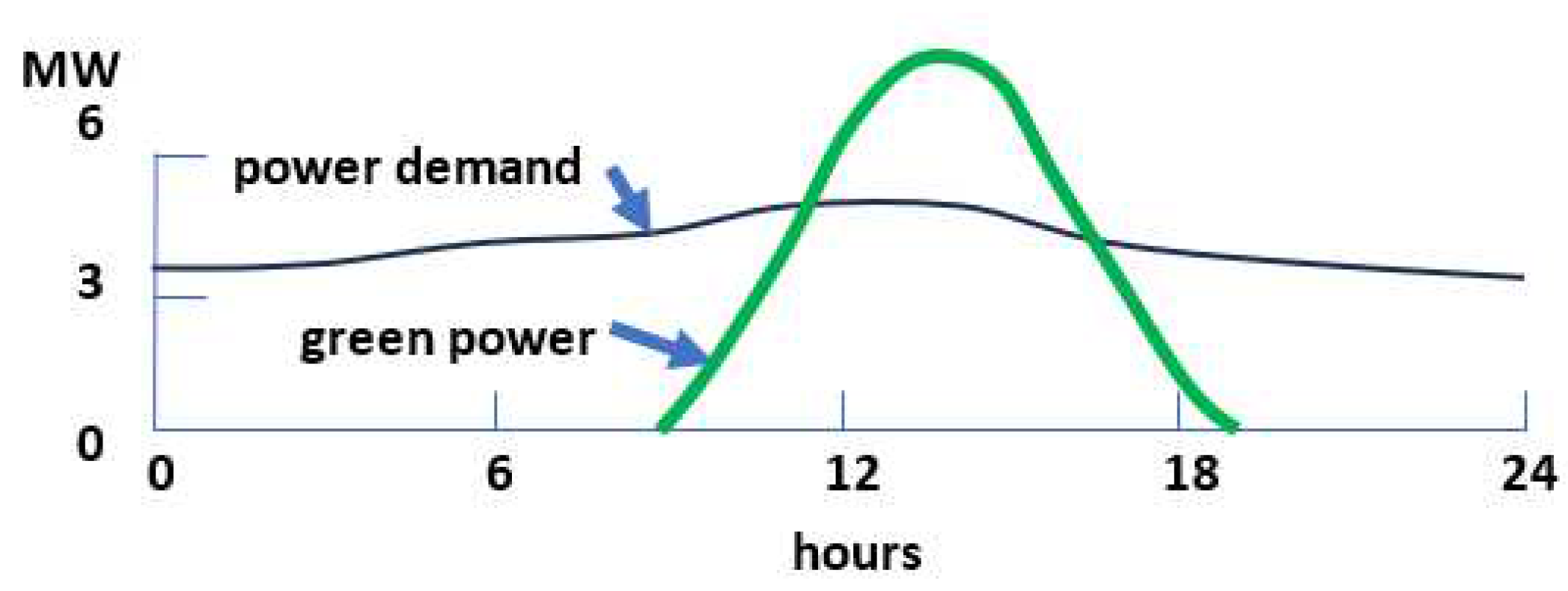
Figure 5.
The Keele renewable generator equipment showing the two small wind turbines of 1MW each, plus the solar panel array contributing 4.4MW.
Figure 5.
The Keele renewable generator equipment showing the two small wind turbines of 1MW each, plus the solar panel array contributing 4.4MW.
Figure 6.
(a) Map of onshore and offshore wind turbines across the UK showing the lack of windpower in the Midlands [14]; (b) a typical Grid pylon in UK.
Figure 6.
(a) Map of onshore and offshore wind turbines across the UK showing the lack of windpower in the Midlands [14]; (b) a typical Grid pylon in UK.
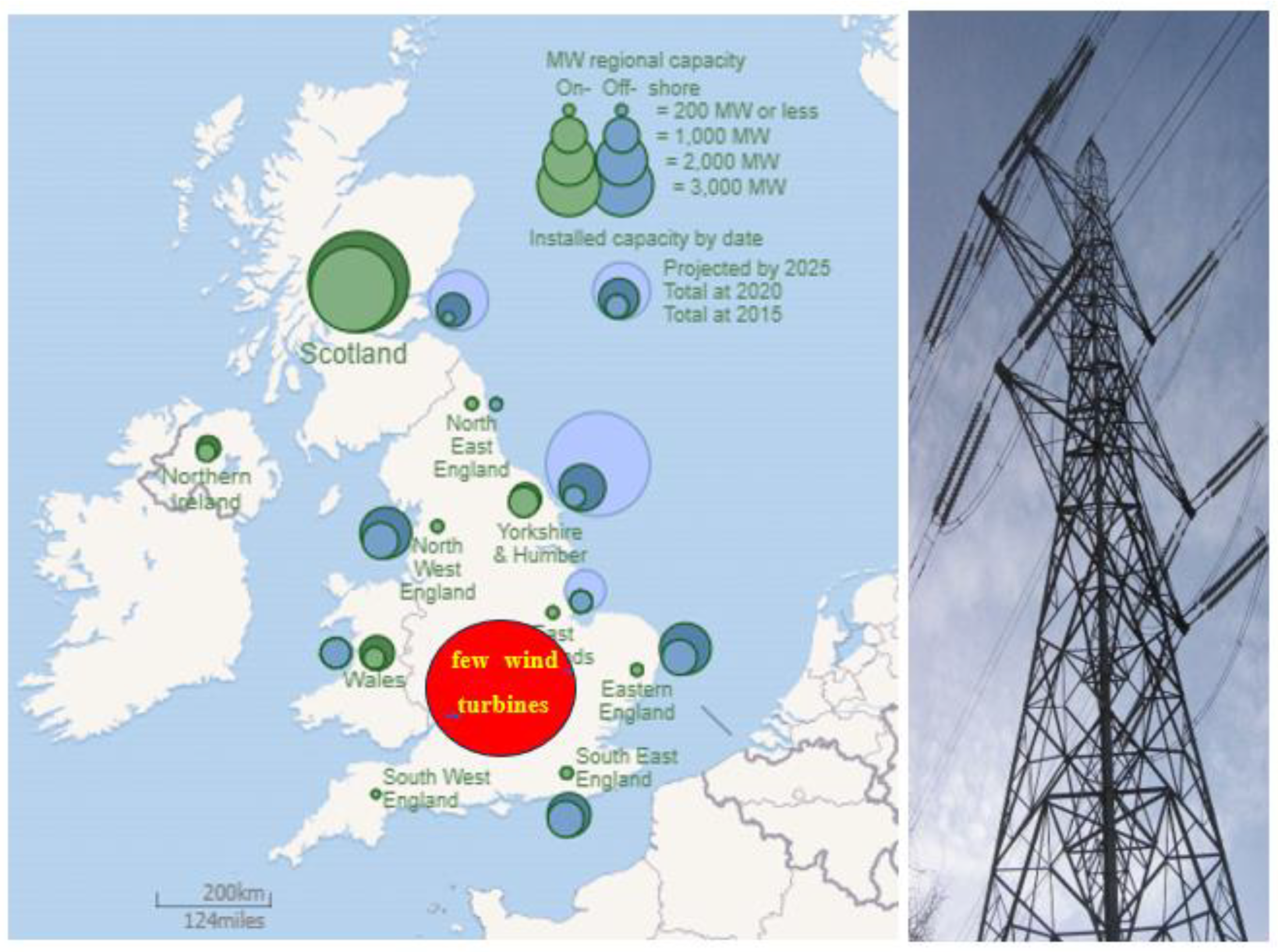

Table 1.
UK energy split in 2021 [4].
Table 1.
UK energy split in 2021 [4].
| Energy supplied | TWh | percentage |
|---|---|---|
| Electricity Grid | 308 | 21% |
| Gas Grid | 485 | 34% |
| Petroleum | 638 | 45% |
| Total | 1431 | 100% |
Disclaimer/Publisher’s Note: The statements, opinions and data contained in all publications are solely those of the individual author(s) and contributor(s) and not of MDPI and/or the editor(s). MDPI and/or the editor(s) disclaim responsibility for any injury to people or property resulting from any ideas, methods, instructions or products referred to in the content. |
© 2024 by the author. Licensee MDPI, Basel, Switzerland. This article is an open access article distributed under the terms and conditions of the Creative Commons Attribution (CC BY) license (https://creativecommons.org/licenses/by/4.0/).
Copyright: This open access article is published under a Creative Commons CC BY 4.0 license, which permit the free download, distribution, and reuse, provided that the author and preprint are cited in any reuse.