

Submitted:
07 October 2023
Posted:
10 October 2023
You are already at the latest version
Abstract
Conditional Privacy Preserving Authentication (CPPA) schemes are an effective way of securing communications in Vehicular Adhoc Networks (VANETs), as well as ensuring user privacy and accountability. Cryptanalysis plays a crucial role in pointing out the vulnerabilities in existing schemes to enable the development of more resilient ones. In 2019, Zhang proposed a CPPA scheme for VANET security (PA-CRT), based on identity batch verification (IBV) and Chinese remainder theorem (CRT). In 2023, this scheme was crypt-analyzed by Tao. In this paper we provide our own crypt analysis of Zhang’s scheme and propose counter measures to mitigate Tao’s attacks. Furthermore, in 2021, Xiong proposed a Certificateless Aggregate Signature (CLAS) scheme which was cryptanalyzed by Shim in 2023. Xiong subsequently proposed a modified CLAS scheme which is also cryptanalyzed in this paper.
Keywords:
vehicular adhoc networks
; conditional privacy preserving authentication schemes
; identity based batch verification
; certificateless aggregate signature schemes
1. Introduction
Cooperative Intelligent Transportation Systems (C-ITS) are systems that employ inter-vehicular communication to provide a safer and more comfortable driving experience to road users, by sensing the surrounding road environment and pooling their collective data to make reliable decisions [1]. A C-ITS is composed of vehicles, roadside infrastructure and a traffic management authority, communication takes place in an ad-hoc manner through self-organized networks called vehicular ad-hoc networks (VANETs). The development of C-ITS has garnered substantial attention from the international community. The American government identified intelligence and connectivity as two of its core strategies, Japan recently released a report to share guidelines of autonomous driving, and Korea released a long term development plan aiming to achieve intelligent transportation systems nation-wide by 2040 [2]. While cellular communication can be used in specific cases, the main standards of vehicular communication are the dedicated short range communications (DSRC) standard developed in the US, and the Intelligent Transportation System (ITS-G5) protocol developed by the European Telecommunications standards institute (ETSI) [1]. While both standards are fundamentally based on the IEEE 802.11p access layer developed for vehicular networks, a competing alternative called C-V2X has recently emerged, satisfying the low latency requirements as well as supporting high vehicle densities and/or speeds [3]. More efficient and scalable alternatives have recently come to light, like 802.11bd and New Radio V2X [4] striving to satisfy stringent requirements of low latency, reliability, a maximum packet error rate of 10% with a minimum transmission radius of 300m. To ensure proper functioning of C-ITS applications, it is required that large amounts of data are continuously exchanged. Owing to the life-critical nature of this data; authentication, confidentiality, integrity, privacy and revocability are non-negotiable security requirements to ensure proper functioning of VANETs.
To that effect, a multitude of works have strived to create Conditional Privacy Preserving Authentication (CPPA) schemes, which can be broadly classified into certificate-based schemes/Public Key Infrastructure (PKI) schemes, Identity- based schemes (IB), Group-signature-based schemes (GS) and Certificateless schemes (CL). In order to support scenarios of large vehicular densities, techniques to verify a batch of digital signatures simultaneously have been developed, leading to extensions of IB and CL schemes into identity-based batch verification schemes (IBV) and certificateless aggregate signature schemes (CLAS) respectively. While researchers are quick to claim that their schemes are provably secure, the literature proves otherwise since many contributions involve pointing out weaknesses in previous schemes, which is a necessary pre-requisite to their development. This highlights the importance of works that cryptanalyze prior works and point out points of vulnerability, which shall undoubtedly enhance the resilience of future schemes.
In 2019, Zhang et al. proposed an IBV scheme, PA-CRT [5], based on the Chinese Remainder Theorem and in 2023, PA-CRT was crypt analyzed by Tao et al. [6]. However, we propose a simple modification to circumvent Tao’s attacks and conduct our own cryptanalysis of the PA-CRT scheme in this paper. In 2021, Xiong et al. proposed a CLAS scheme, CPPA-D [7], which was cryptanalyzed by Shim [8] in 2023. The authors introduced an improved scheme [9] in 2023 which we also cryptanalyze in this paper. Accordingly, in this paper, our main contributions are as follows:
- We show [1]that Zhang’s IBV scheme [5] is vulnerable to impersonation attacks where any member of a VANET can easily obtain the private information of other members and generate and sign messages on their behalf. We discuss causes and propose general improvements to the scheme to mitigate this attack. We also show that the same scheme [5] is vulnerable to repudiation attacks where malicious users can send messages with false information using fake identities and escape retribution accordingly. This encourages them to send false information to suit their own purposes and easily escape accountability in case their messages are reported to a trusted authority. Finally, we point out the deficiencies in Tao’s [6] cryptanalysis of Zhang’s IBV scheme [5]
- We show that Xiong’s CLAS scheme [9] is vulnerable to bogus information attacks since partial private keys and pseudo-identities are not adequately verified and can be replaced by the sender of the message and still perform successful verification at the receiver’s end. We also show that the scheme is vulnerable to the same repudiation attack that afflicts Zhang’s scheme and point out a mistake in the batch verification equation.
The rest of this paper sets out as follows. Section 2 gives a general introduction to VANET security requirements, Section 3 presents related works, in which we succinctly describe earlier contributions of IBV and CLAS schemes and their development in recent years, Section 4 presents mathematical preliminaries, Section 5 presents our crypt analysis of Zhang’s scheme, Section 6 presents our crypt analysis of Xiong’s scheme and Section 7 presents our concluding remarks. A list of notations can be found in Table 1.
2. VANET Security Requirements
In VANETs, vehicles communicate regularly with other vehicles as well as road infrastructure (RSUs) in order to exchange periodic safety messages. This communication is necessarily subject to stringent security requirements to preserve the safety and well-being of VANET users. In order to receive a message, it must be ensured that the vehicle has the capacity to receive and process the message (availability), furthermore, the vehicle must be able to verify that the message was sent by a legitimate participant (authentication) and contains valid information that is temporally relevant (integrity). From the sender’s perspective, it must be ensured that they are not vulnerable to any revelation of their private information (privacy) except by relevant authorities so that they may be held accountable in case of dispute (traceability) and cannot deny having sent the message (non-repudiation). The features of privacy and traceability combined together constitute what has come to be one of the fundamental objectives of VANET security systems: conditional privacy. Conditional privacy stipulates that messages are transmitted anonymously by all participating members in VANETs, and that all external parties, except law enforcement authorities, are incapable of discerning the identity of the sender of any message. Finally, one of the most important security objectives in any communication network is to guarantee that none but the intended recipient has the ability to infer sensible information from the contents of a message (confidentiality). While the importance of confidentiality in VANETs has been downplayed under the premise that everyone deserves access to the contents of basic safety messages that vehicles periodically transmit [10], others have pointed out that confidentially is necessary in paid services and have constructed symmetric key exchange schemes accordingly [11].
In order to guarantee the abovementioned security objectives, a combination cryptographic approaches and intrusion detection approaches is used. Cryptographic protection can be construed as the first line of defense that offers preemptive protection against possible attacks, but once an attack occurs, intrusion detection may be employed to take necessary measures of damage control. This paper is primarily concerned with cryptographic techniques employed to preserve secure communications in VANETs. Intrusion detection in VANETs is also being studied extensively in contemporary literature and reviews on contributions can be found in [12,13,14].
2.1. Attacks on Availability
The objective of availability in VANETs is threatened by denial-of-service attacks and spamming attacks, in which a malicious user sends an excessive number of spam messages to a vehicle or RSU in order to prevent them from being able to access valid messages containing critical information. The attacker in this case is considered malicious since they do not derive any personal benefits from this attack. They are also considered active since they are not restricted to obtaining information but are instead instigating material change within the network. Finally, they could be insiders or outsiders since both have the ability to jam the network with spam messages. This type of attack is detected by machine-learning-based intrusion detection and could be mitigated by frequency hopping and channel switching techniques. Other threats to the objective of availability include blackhole and greyhole attacks in which malicious VANET users receive safety messages from other vehicles but refrain from transmitting all packets (blackhole) or selected packets (greyhole) and hence legitimate users do not receive the required information. Attackers in this case are considered malicious since they do not reap personal rewards, active since they affect the network and must be insiders in order to receive the messages to begin with. Finally, the threat of malware attack very imminently affects the objective of availability since Malware afflicts VANET system components like OBUs and RSUs rendering them unable to send or receive messages.
2.2. Attacks on Authentication
The objective of authentication in VANETs is threatened by a variety of impersonation attacks, in which an attacker claims a false identity in order to illegally obtain confidential information and perhaps send fake messages as well. Different impersonation attacks include masquerading attack, in which the attacker assumes the identity of a legitimate node and sends and receives messages under this guise; man-in-the-middle attack, in which the attacker impersonates two legitimate users having a private conversation and addresses each on behalf of the other, thus obtaining sensitive private information about both [15]; certificate replication attack, in which the attacker duplicates the identities of legitimate users in order to avert the Trusted Authority (TA) that supervises VANET communications. Other more elaborate forms of impersonation attacks include sybil attack, where for example, the attacker, generates 100 different identities and sends the same fake message of an upcoming road congestion through all of them, thus reinforcing the validity of this synthesized illusion and encouraging all legal participants to switch course to avoid the congestion, hence freeing up the road for this attacker. Other threats to authentication include attacks in which location information of the sender is falsified, like tunneling/wormhole attacks, in which the attacker exploits an alternative communication channel to create the illusion of being a neighboring node whereas in fact they are operating remotely, a similar example is GPS spoofing attack in which the attacker falsifies their GPS information. Attackers in these cases are usually insiders to the VANET network, they could operate rationally or maliciously depending on whether they intend to simply cause harm or reap personal benefits as in the example of the Sybil attack, or even more sinisterly launch these attacks for the purpose of terrorism. They could also be active or passive depending on whether they simply seek to extract useful information about other users for future exploitation or whether they seek to immediately send false messages within the network. These attacks are mitigated cryptographically using digital signatures, which are bound to the identity of the user using digital certificates [15] as well as message authentication codes (MACs) which are keyed hash functions used to preserve message integrity and authentication.
2.3. Attacks on Integrity
The objective of message integrity is strongly intertwined with that of authentication, since in very simplistic terms, if an attacker were to send false information, they would probably assume a false identity to do so in order to avoid accountability. The same cryptographic primitives used to guarantee authentication (digital signatures and message authentication codes) also implicitly guarantee the integrity of the message since any change in the contents of the message would immediately change the associated digital signature/ authentication code. In [16], an alternative way to mitigate attacks on message integrity was suggested, namely through verification by correlation, where data from multiple sources are correlated using reputation based systems in order to ensure the validity of received messages. Attacks on message integrity include message tampering, broadcast tampering and bogus information attacks, all of which involve injecting false data into the message and altering its contents. Other attacks on integrity include the replay attack where valid data is transmitted fraudulently under the premise of being temporally relevant, when it actually concerns a previous irrelevant time slot. Defense against replay attacks is achieved by appending a timestamp to each digitally signed message.
2.4. Attacks on Conditional Privacy
The objective of conditional privacy is threatened by attacks in which user data (specifically location data) is extracted from their sent messages, to be later used in exploiting them if valid data is inferred about locations which the user frequently visits. Protection against such attacks is achieved using privacy preserving techniques which include anonymous certificates (pseudo-identities), or group signatures, in which members within a VANET group anonymously sign messages on behalf of the group and other members can verify the signatures using the public key of the group. A group manager/opener is the only entity that has the authority to divulge the identity of the group member that signed the message in case of dispute, but other members can only verify that the signer is one of the legitimate group members without ascertaining which member of the group that is.
2.5. Attacks on Non-Repudiation
The objective of non-repudiation is inherently achieved in any system that employs public key cryptography where users sign messages using their private key and broadcast their public key to enable other users to authenticate. Since the private key of any user is inextricably linked to their public key, this implicitly guarantees that the signer of the message did in fact sign the message, so that they cannot deny having signed it later on. While symmetric key cryptography (in which both parties have equal access to the same encryption/decryption key) is advantageous over public key cryptography (in which users retain their private keys and only share public keys) in terms of efficiency and speed, it is only the latter that can guarantee non-repudiation which renders public key cryptography indispensable in any network security system, despite its relative complexity and high computational cost. The most common attack is repudiation attack where the attacker can find means by which to escape accountability for their sent messages, this is achieved if the attacker exploits weaknesses in a scheme in order to broadcast messages using fake identities that do not undeniably condemn them.
2.6. Attacks on Confidentiality
Finally, the objective of confidentiality is achieved by simply encrypting messages before transmission. While the importance of confidentiality has been downplayed in many contributions, other contributions like [17] focus exclusively on cryptographically ensuring confidentiality in VANETs and devising lightweight ciphers to achieve that. Attacks on confidentiality include eavesdropping attacks, which are passive rational attacks in which the attacker listens in on private conversations to extract useful information for personal gain, and traffic analysis attacks in which attackers analyze the frequency of transmitted messages in order to derive purposeful information.
Having detailed the various security objectives of VANETs, it is also important to mention another important objective without which VANET systems fail to operate reliably; namely that of efficiency. Vehicles periodically send safety messages every 0.3 seconds, so for a high-density area, a vehicle would receive a huge number of messages every 0.3 seconds that need to be verified before the next batch comes in, hence batch verification (the simultaneous verification of a multiple of messages) is an essential component of VANET security.
In Table 2, we provide a summary of different VANET security requirements, threats and protection approaches.
Having outlined the essential security requirements of VANETs, we discuss the historical development of IBV and CLAS schemes in the following section.
3. Related Work: IBV and CLAS Schemes
In this section, we detail the development of IBV schemes and CLAS schemes; from their theoretical underpinnings to their first concrete instantiations in context of VANET and finally to the recent developments.
3.1. IBV schemes
Identity Based Batch Verification (IBV) schemes are schemes that involve a Key Generation Center which issues public and private keys for all members and acts as the primary entity of authentication.
3.1.1. History of IBV
The main advantage of IB schemes is that they avoid the complexity of managing certificate revocation. In 1985, it was proposed in [18] that a TTP/CA would generate a public key for the network member (Alice) using an aspect of her identity. Then, using its private key, the TTA would generate a private key for Alice that would be a function of both the TTA’s private key and Alice’s public key . If Bob wanted to send a message to Alice, Bob would use both and the TTA’s public key to encrypt the message. In fact, under IBC, it is feasible that Bob sends a message to Alice before Alice receives her private key (decryption key) from the TTA and that Alice only be allowed to read the received message if she is still a legitimate member of the network, hence circumventing the tedious task of certificate revocation. By including a timestamp along with , the TTP would only allow Alice to obtain a decryption key if has not expired before Bob’s message was sent. In [19], 16 years after the initial proposition in [18], the first practical IBC-based scheme was proposed, which used bilinear pairings in its implementation.
3.1.2. IBV in the Context of VANETs
The first application of IB based cryptography to VANETs was achieved by C. Zhang et al. [20] in 2008. They proposed IBV, an identity-based authentication scheme that supports batch verification. In their scheme, pseudonymity is achieved by changing the PID with each message, which is generated using the master private key of the system that is securely stored inside the TPD of the vehicle. Pseudo-IDs conceal the real ID of the vehicle by El Gamal Encryption over ECC and only the TTP can retrieve the real identity from the pseudo identity as follows: , where is the master private key of the system. RSUs receive requests from vehicles and either handle them locally or forward them to the TTP depending on the nature of the request, they also monitor and summarize the traffic situation at their location and report it to the traffic control center. The signature on the message is a one-time identity-based signature of length 21 bytes, the pseudo identity is 42 bytes, so the total overhead is much smaller than certificate-based schemes which involve the 125-byte-sized IEEE 1609.2 certificate. However, the scheme assumes ideal TPDs in vehicles, which is unreasonable to assume since these are expensive to install in every vehicle, and if side channel attacks are successful in recovering the system master key from the TPD then the whole network is compromised. The verification cost of a single signature is 1 map to point hash, one multiplication and 3 bilinear pairings, which is relatively high, but batch verification cost for signatures is multiplications, map to point hashes and only 3 pairings as well, which presents substantial efficiency gains compared to sequential verification of individual signatures. In this scheme, during batch verification, an invalid batch is automatically dropped, which is inefficient. Accordingly, they extend their scheme in 2011 [21] which employs a group testing technique for false signature detection prior to batch verification. Noteworthy is the fact that in their earlier paper in 2008 their scheme was based on the assumption that vehicles send messages to the RSU, which verifies them and subsequently broadcasts to other vehicles in the region, but they modified that in 2011 so that vehicles immediately received and verified transmitted messages by other vehicles without the intermediation of the RSU. C. Zhang’s IBV scheme is of particular interest since it elicited multiple response papers in future years, which we shall detail subsequently in this section.
3) Criticisms of C. Zhang’s scheme and improvements
In 2011 Chim et al. [22] proposed SPECS, a software based solution that does not rely on TPDs and uses two shared secrets to satisfy the privacy requirements in VANETs. They proposed RSU-based message verification using 2 bloom filters to achieve low overhead, where one stores valid signatures and the other stores the invalid ones. The scheme also employs binary search techniques during batch verification to identify the invalid signature in a batch. Their scheme also facilitates RSU-managed groups which vehicles can join after being authenticated. They assume the TA is always online and fully trusted, and propose redundant TAs with identical databases to avert single point of failure threats. During system setup, the TA generates a system master key and generates and publishes the corresponding system parameters. During registration, the vehicle receives its real ID (RID) and password (PWD), then receives new pseudo-IDs from the TA whenever it passes a new RSU. The pseudo-IDs are unlinkable since they involve hashing the real identity with a random nonce, which the vehicle encrypts with the TA’s public key before transmitting through the RSU. SPECS achieves greater efficiency than IBV by using 2 bilinear pairings instead of 3, and 2 bloom filters with opposite indications are employed simultaneously to reduce the false positive rates of traditional bloom filters by 89.6%. The authors also perform cryptanalysis of Zhang’s IBV scheme and point out its overdependence on ideal TPDs in vehicles as well as its lack of consideration of the V2V scenario. The latter comment was actually modified in Zhang’s extension of the scheme in 2011, as we pointed out earlier. The authors point out that IBV suffers from privacy violation, anti-traceability and impersonation attacks; we shall detail their point of view and explain why we disagree with them. In SPECs it is incorrectly stated of IBV that any malicious vehicle can obtain the real ID of an honest vehicle from its pseudo-id (using the same extraction method we outlined above); but this assumes that a malicious user has easy access to the master secret key of the system that is securely stored in the TPD of the vehicle, which isn’t a practical assumption to make, since the IBV scheme assumes ideal TPDs that self-destruct if it recognizes attempts at infiltration. If the assumption in SPECs is true, this would intuitively lead to privacy violation followed by possible impersonation attacks as well. Finally, they criticize IBV because of its anti-traceability, assuming that a malicious vehicle can change its own real ID to any random value to prevent the TA from holding it accountable, which again assumes easy and convenient access to the values securely stored within the TPD as well as the ability to overwrite them. We conclude by stating that the only justified criticism of the IBV scheme is its over-reliance on ideal TPDs stored in each vehicle, which is both too expensive and too risky to implement in reality, but we do not concur with the criticisms stated in SPECs.
In 2012, Shim et al. [23] proposed CPAS which tackles the deficiencies of C Zhang’s IBV scheme [20]. They point out that the assumption of ideal TPDs in each vehicle is too strong, and propose to use realistic TPDs in which the vehicle’s secret parameters are stored but the system’s secret parameters are not. They further point out the exorbitant costs of map to point hash functions used in Zhang’s scheme to map pseudonym information to a point on an elliptic curve; the CPAS scheme does not use map to point functions at all. They claim to have reduced batch verification time by 18% compared to Zhang’s IBV scheme. The scheme is generally similar to IBV, but pseudonyms are no longer fully generated within the TPD (since the master key no longer exists there); instead, part of the pseudonym is prestored in the TPD then securely transmitted to a tracing manager (TRA) which subsequently generates the second part of the pseudonym and resends to the vehicle to be securely stored in the TPD. Accordingly, none but the TRA can unmask the vehicle’s real identity.
In 2013, Lee et al. [24] performed a cryptanalysis of C. Zhang’s IBV scheme and proved that it is vulnerable to replay attacks and does not guarantee signature non-repudiation. Replay attacks are mitigated by the simple measure of appending a timestamp to each message (which the authors of IBV implemented in their extended scheme in 2011). Non-repudiation is jeopardized, according to Lee et al., as follows: suppose a malicious vehicle generates three messages with three signatures and then swaps the signatures so that message 1 gets signature 3 for example, if the messages are verified sequentially the signatures will be invalid but if they are verified using Zhang’s batch verification scheme the batch will be deemed valid. In that sense, a sender can later deny having sent these messages and achieve repudiation by proving that the signatures on the individual messages do not hold out. Accordingly, Lee et al. propose a vector parameter with small sized elements (to minimize overhead) so that the method of swapping signatures would yield an invalid outcome during batch verification. However, in order to achieve this, Lee made a minor change to the secret key generation scheme where became . In that sense, Lee unknowingly rendered the signing key extractable from the signature and accordingly rendered the entire scheme vulnerable to impersonation attacks. This was pointed out by Bayat in [25] which is a response to Lee’s scheme, but doesn’t mention C. Zhang’s original scheme. Incidentally, Bayat’s proposed modification scheme is nothing but Zhang’s original scheme with an added timestamp. Bayat also proposed to remove the vector parameter suggested by Lee without any justification, but we observe that undoing Lee’s modification renders the vector parameter mathematically unusable during batch verification. The issues with Lee’s scheme were also pointed out by Tzeng et al. in [26] where they also proposed an identity based batch verification scheme that requires two bilinear pairings instead of three.
In 2020, Ali et al. [27] proposed an identity-based CPPA scheme for V2I using bilinear maps. They employ general one-way hash functions instead of map to point hash functions for efficiency. In their scheme, a tracing manager TRM generates pseudo-identities for vehicles and a database to trace real identities of vehicles, while the KGC generates keys for vehicles. Their batch verification scheme requires only one bilinear pairing. However, it was pointed out in [28] that vehicles could generate their own pseudo-identities using fictitious secret values to escape accountability.
3.2. CLAS Schemes
Certificateless Schemes are conceptually similar to identity-based schemes except for the fact that the KGC no longer has access to the full private key of each member.
3.2.1. History of CLAS Schemes
Proposed in [29] as a solution to the key escrow problem of identity based cryptography (IBC), certificateless cryptography diverges from IBC in limiting the TTP’s knowledge of the user’s private keys to partial knowledge. In other words, the TTP creates a private key for each user based on their public key (identity string), but this key becomes a partial private key to which each user appends their own randomly generated secret value. This approach is advantageous in the sense that it still guarantees the authenticity of the participating members since the private key of each user is partially comprised of a TTP-issued string, but in case of an attack on the TTP, the attacker does not have access to the full private key of any user and therefore cannot decrypt any of their messages or sign messages on their behalf. The only disadvantage is that the user’s public key is no longer solely a function of their identity string and the TTP’s public key, so the user must publish their public key on the side since it is now affected by their privately generated in addition to their private key. However, the public key need not be transmitted securely [29] since a part of the public key depends on the TTP’s private key hence it is verifiable at the receiver’s end. There are two types of adversaries in CLAS schemes: is a malicious adversary which reveals the vehicle’s secret key or the vehicle’s public key or changes but cannot reveal the master secret key of the system nor get access to the vehicle’s partial private key . is a malicious but passive KGC who dominates the construction of the master key pair and any vehicle’s partial secret key . Attacks launched by are called Type I attacks and attacks launched by are called Type II attacks.
3.2.2. CLAS in the Context of VANETs
In [30,31] authors proposed protocols that utilized certificateless aggregate signatures for secure identity authentication but they do not provide significant efficiency gains over traditional schemes due to their employment of bilinear pairings and hash-to-point operations; and they also suffer from the same high storage requirements of pseudonyms [32]. In [33], a certificateless aggregate signature scheme was proposed for V2I communication, with security against adaptively chosen message attacks in the random oracle model, however, it was later shown in [34] that the scheme is vulnerable to malicious passive KGC attacks. Furthermore, the authors in [35] showed that the same scheme cannot withstand public key replacement attack and the authors in [36] showed that it cannot withstand the man in the middle attack. In [37], authors achieved superior efficiency to the scheme proposed in [33] by avoiding the use of bilinear pairings, but it was shown that their scheme cannot withstand a malicious KGC attack by [35,38,39]. In [38], a full aggregation pairing-free certificateless scheme was proposed but in [35] it was pointed out that this scheme cannot resist Type I and Type II adversary attacks. A certificateless scheme that strived towards maximizing efficiency without affecting reliability was proposed in [40]. However, it was shown in [41] that the scheme cannot withstand malicious KGC attack and it was also shown in [42] that the scheme cannot preserve identity privacy. The authors in [30] claimed that their certificateless scheme is more efficient than the one proposed in [40] but it was pointed out in [31,38,39] that the scheme cannot withstand malicious KGC attack. Full aggregation certificateless schemes were also proposed in [31,38,43].
Having concluded our discussion of IBV and CLAS schemes, we provide a brief overview of the mathematical preliminaries and complexity assumptions next.
4. Preliminaries
In this section, we outline the theoretical underpinnings of the cryptanalyzed schemes, as well as the generic network model for VANET security schemes.
4.1. Elliptic curves
We assume denotes a finite field with prime order , for elliptic curve with equation where and . We assume that denotes the point at infinity. The points of ECC make an additive group with order and generator Point addition: Let and be 2 random points on ECC such that where the point generates the group with large prime order . When then can be computed where denotes the intersection point of curve and line , when then denotes the intersection of curve with the tangent to at .
Scalar Point Multiplication: The scalar multiplication of is defined as (m times) where Elliptic Curve Discrete Logarithm Problem (ECDLP): Given two random points on curve E, where , it has been proved difficult to calculate given
4.2. Chinese Remainder Theorem
The Chinese Remainder Theorem (CRT) states that knowledge of the remainders of the Euclidean division of an integer by several integers facilitates the determination of the remainder of the division of by the product of these integers under the condition that they are pairwise relatively prime.
Let be pairwise relatively prime positive integers such that and be any random integers. The Chinese Remainder Theorem (CRT) states that the congruences: has a unique solution modulo where .
To obtain this solution, the key server calculates where and
4.3. Network Model
The most common network architecture used to model VANET security is the two-layer model which comprises a Trusted Authority (TA) in the top layer and vehicles and road-side units (RSUs) in the bottom layer.
- Trusted Authority (TA): This is also known as the Trusted Third Party (TTP) or the Central Authority (CA). It is generally known to comprise a Key Generation Center (KGC) and a Tracing Authority/ Tracing Manager (TRA/TRM). IBV schemes tend to combine the role of the KGC and the TRM while CLAS schemes necessarily posit them as distinct entities. The KGC is meant to generate public and private keys (or partial keys) for all members to enable digital signature verification, while the TRM is meant to generate verifiable pseudo-identities for each member to enable traceability in case of disputes. Schemes occasionally propose redundant TAs with access to the same data repository to avert single points of failure.
- Roadside Units (RSUs): They are connected to the TA with secure wired links and to vehicles with insecure wireless connections. Different schemes assume different levels of RSU trustworthiness, where the predominant assumption is that RSUs are honest but curious. The role of RSUs varies in different schemes, from being merely a gateway to relay messages from the TA to vehicles (and back) to being a group manager that issues signing and verification keys to members within its domain and managing localized groups.
- Vehicles: Vehicles are assumed to be untrustworthy. They are equipped with On Board Units (OBUs) which contain a tamper proof device (TPD). It is assumed that all vehicles will be equipped with TPDs but schemes diverge on the assumption of an ideal TPD (secure enough to store the master secret key of the system for self-authentication) or a realistic TPD (where only the secret key of the corresponding user is stored, and authentication is carried out elsewhere).
5. Zhang et al.’s Scheme
In this section, we describe Zhang et al.’s scheme [5] then perform cryptanalysis. Posited as a development to traditional IBV schemes, Zhang’s scheme seeks to overcome the traditional problem of storing the master key of the system in the TPD of each vehicle by introducing a Chinese Remainder Theorem-based group key exchange. The idea is that each legitimate vehicle uses its pre-stored secret key to compute a shared group key from information regularly updated by the TA and broadcasted to vehicles via the RSUs. Having obtained the group key by computing the broadcasted value modulo their prestored key, vehicles then proceed to generate digital signatures on their message using both the obtained group key and their own generated random nonces. In what follows, we describe the detailed proceedings of the scheme and then suggest possible attacks.
5.1. Description
We detail the procedure of Zhang’s scheme in Table 3.
5.2. Cryptanalysis
In what follows, Bob is assumed to be an honest user and Oscar to be a malicious user, both are legitimate members of the same VANET. Figure 1 shows the setup and group key computation phases of the protocol, in the presence of malicious attacker Oscar.
5.2.1. Impersonation Attack
Bob broadcasts to the network, this information is received by Oscar, who is a legitimate member of the network and therefore has access to group key . Accordingly, Oscar computes then computes and . Then, Oscar computes and consequently computes .
Oscar now has access to Bob’s real identity and the group key and can impersonate Bob in future messages. Figure 2 shows the impersonation attack.
5.2.2. Repudiation/Spoofing Attack
Oscar obtains regularly from the broadcast, generates a fake identity and computes a corresponding pseudoidentity Oscar uses and in all further communication, messages sent will be verifiable since the signature does not change if the value of changes since each member generates the values of based on their own generated random nonce. Even though it could be argued that the TPD prevents any member of the VANET from changing the value of their , Oscar could still collude with Eve who is not constrained by a TPD, by giving her the group key and Eve can broadcast valid messages with verifiable signatures using a fake identity . Since the value of is fake or non-existent, Oscar (or Eve) could escape retribution for any false messages sent. Figure 3 shows the Repudiation attack.
5.3. Causes and Countermeasures
In what follows, we point out the underlying causes and possible counter measures for each attack.
5.3.1. Impersonation Attack
The problem with Zhang’s scheme is that the signature is only dependent on two private values: the group key and a random nonce, hence knowledge of the group key can immediately lead to the computation of the random nonce. Since which is equivalent to , and since are hash outputs of public values (and therefore computable by all members), and is known to all legitimate members of the VANET, any legitimate member can obtain from received from any user. If the scheme is modified so that during signing, the TPD chooses a random value and computes and modifies to then publishes value with the broadcast, the verification equation at the receiver’s end becomes: This checks out because:
This simple modification incurs a cost of one additional elliptic point addition at the verifier’s end.
5.3.2. Repudiation Attack
The technique of generating pseudo-identities using a random nonce so that the real identity becomes irrecoverable except by the TA/TRM is optimal for solving the pseudonymity problem in VANETs. However, the scheme does not provide a method of verifying that the received pseudo-identities are indeed valid pseudo-identities. We suggest introducing pseudo-identity verification prior to signature verification; furthermore, the TA must play a role in generating the pseudo-identities for verification to be of any consequence. If the TPD is assumed to play the role of the TA in guaranteeing that only the real identity is used in the generation of pseudo-identities, an insider member (Bob) could very well share the group key with an outsider (Oscar) and then Oscar can share false information with valid self-generated credentials based on a fake identity.
5.4. A Commentary on the Cryptanalysis of this Scheme by TAO et al. [6]
In [6], it was stated that an outsider can collect different values of then, using the equation and the fact that is constant and that only changes, the outsider can find as , then the outsider can compute .
We contest these claims on the grounds that is not in fact a constant, since and every time a member joins (/leaves) the network, their corresponding is added (/subtracted) accordingly. Hence, changes with every join or leave operation. Despite the fact that it could be suggested that the scheme is still insecure because could be computed from successive broadcasts between which no join or leave operations occurred, we propose a simple countermeasure to that proposition. The TA can include a certain number of secret keys not given to any user in its computation of the group key, then, the TA could impose its own join/leave operations between successive broadcasts, utilizing any random subset of the fictitious secret keys to do so. In that sense, the TA could ensure that the value of changes between any two successive broadcasts without affecting system performance in any significant way. Furthermore, a collusion attack between an insider and an outsider can easily achieve the same effect as Tao’s proposed attack, since the insider has access to and can share it with an outsider without being implicated. Finally, the group key, is meaningless without possession of a legitimate value of and the attacker cannot create a valid signature without the latter, even if they are in possession of .
Having described and cryptanalyzed Zhang’s scheme, we proceed to describe and cryptanalyze Xiong’s scheme in the following section.
6. Xionf et al.’s Scheme
In this section, we describe Xiong et al.’s scheme [9] then perform cryptanalysis. Xiong’s scheme is an extension of their previous scheme with modifications to resist collusion attacks and also achieve efficiency gains. We now proceed to the detailed description of the scheme followed by a cryptanalysis.
6.1. Description
We detail the procedure of Xiong’s scheme in Table 4.
6.2. Cryptanalysis
In what follows, Oscar is assumed to be a legitimate member of the VANET with malicious intentions, Bob is also a legitimate member but with honest intentions. Figure 4 depicts the setup, pseudo-identity generation and partial-private-key generation phases of the protocol.
6.2.1. Bogus Information and Repudiation Attack
Oscar honestly executes the setup phase, pseudo-identity generation phase and partial private key phase of the protocol. Then, Oscar generates a fake identity and computes a new on the basis of . Oscar also substitutes with which is any randomly self-generated value such that . Oscar continues the rest of the protocol normally and inputs any fake information in the message to suit their own purpose (bogus information attack). Verification of the message is successful because the verifier uses the transmitted to verify. Furthermore, if the message is later reported to the tracing manager, it cannot retrieve since the fake identity was used in the generation of the transmitted . The attack is depicted in Figure 5.
6.2.2. Other Flaws
Another issue with the scheme, in the signature aggregation phase, is that the verifier randomly chooses then accordingly calculates , however, the batch verification would not check out unless , we assume this is an unintentional mistake in the scheme, since all other random nonces in other phases were multiplied by to obtain their corresponding public values.
6.3. Causes and Counter Measures
There are two main problems in Xiong’s scheme. The first problem is that the TRM does not verify the generated pseudo-identities, as we indicated in our analysis of Zhang’s scheme, which gives malicious users the ability to generate based on fictitious values of . This issue is common to both schemes. However, in Xiong’s scheme, even though the generation of the by the KGC is mathematically related to the input , by and , however, the verifier only uses the values transmitted by the sender to verify the message, which gives the sender the ability to generate any random and using it to calculate subsequent parameters which leads to correct verification.
To counter these problems, we propose that the TRM validates the user-generated in such a way that the KGC is first able to verify their validity before issuing a . We also propose that , based on a validated , be part of the verification process. The reason is that Oscar would not be able to generate a fake that satisfies the equation . Finally, we propose that be verified separately in order to prevent Oscar from substituting with .
7. Conclusions and Future Work
Recently, Zhang et al. [5] and Xiong et al. [9] proposed CPPA schemes based on IBV and CLAS respectively. We first showed that, in Zhang’s scheme, an attacker Oscar can impersonate an honest user Bob by obtaining their real identity value and using it to send malicious messages. We also showed that in both schemes, Oscar can generate a fictitious value to replace their real identity which would enable them to broadcast any malicious content or misleading information and escape retribution. Furthermore, in Xiong’s CLAS scheme, Oscar could replace the KGC-granted partial private key with a random value of their own creation and still pass verification successfully. Furthermore, we proposed modifications in Zhang’s scheme to circumvent Tao’s attacks in [6]. Finally, we discussed causes and countermeasures of our cryptanalysis on both schemes. Having pointed out the vulnerabilities in both schemes, we intend to propose a CLAS scheme that employs CRT based group key distribution without exposure to impersonation and repudiation attacks.
References
- B. Hammi, J.-P. Monteuuis, and J. Petit, “PKIs in C-ITS: Security functions, architectures and projects: A survey,” Vehicular Communications, vol. 38, p. 100531, 2022. [CrossRef]
- H. Chen, J. Liu, J. Wang, and Y. Xun, “Towards secure intra-vehicle communications in 5G advanced and beyond: Vulnerabilities, attacks and countermeasures,” Vehicular Communications, p. 100548, 2022.
- V. Mannoni, V. Berg, S. Sesia, and E. Perraud, “A comparison of the V2X communication systems: ITS-G5 and C-V2X,” in 2019 IEEE 89th Vehicular Technology Conference (VTC2019-Spring), 2019, pp. 1-5: IEEE.
- E. L. Cominetti, M. V. M. Silva, M. A. Simplicio Jr, H. K. Patil, and J. E. Ricardini, “Faster verification of V2X basic safety messages via Message Chaining,” Vehicular Communications, p. 100662, 2023. [CrossRef]
- J. Zhang, J. Cui, H. Zhong, Z. Chen, and L. Liu, “PA-CRT: Chinese remainder theorem based conditional privacy-preserving authentication scheme in vehicular ad-hoc networks,” IEEE Transactions on Dependable Secure Computing vol. 18, no. 2, pp. 722-735, 2019. [CrossRef]
- Q. Tao, H. Ding, T. Jiang, and X. Cui, “B-DSPA: A Blockchain-based Dynamically Scalable Privacy-Preserving Authentication Scheme in Vehicular Ad-hoc Networks,” IEEE Internet of Things Journal, 2023. [CrossRef]
- W. Xiong, R. Wang, Y. Wang, F. Zhou, and X. Luo, “CPPA-D: Efficient conditional privacy-preserving authentication scheme with double-insurance in VANETs,” IEEE Transactions on Vehicular Technology, vol. 70, no. 4, pp. 3456-3468, 2021. [CrossRef]
- K.-A. Shim, “Security Analysis of Conditional Privacy-Preserving Authentication Schemes for VANETs,” IEEE Access, vol. 11, pp. 33956-33963, 2023. [CrossRef]
- W. Xiong, R. Wang, Y. Wang, Y. Wei, F. Zhou, and X. Luo, “Improved certificateless aggregate signature scheme against collusion attacks for vanets,” IEEE Systems Journal, vol. 17, no. 1, pp. 1098-1109, 2022. [CrossRef]
- M. Raya and J.-P. Hubaux, “Securing vehicular ad hoc networks,” Journal of computer security, vol. 15, no. 1, pp. 39-68, 2007. [CrossRef]
- Y. Chen, J. Yuan, and Y. Zhang, “An improved password-authenticated key exchange protocol for VANET,” Vehicular Communications, vol. 27, p. 100286, 2021. [CrossRef]
- S. Sharma and A. Kaul, “A survey on Intrusion Detection Systems and Honeypot based proactive security mechanisms in VANETs and VANET Cloud,” Vehicular communications, vol. 12, pp. 138-164, 2018. [CrossRef]
- F. Gonçalves et al., “A systematic review on intelligent intrusion detection systems for VANETs,” in 2019 11th International Congress on Ultra Modern Telecommunications and Control Systems and Workshops (ICUMT), 2019, pp. 1-10: IEEE.
- H. Bangui and B. Buhnova, “Recent advances in machine-learning driven intrusion detection in transportation: Survey,” Procedia Computer Science, vol. 184, pp. 877-886, 2021. [CrossRef]
- C. Paar and J. Pelzl, Understanding cryptography: a textbook for students and practitioners. Springer Science & Business Media, 2009.
- M. Raya and J.-P. Hubaux, “The security of vehicular ad hoc networks,” in Proceedings of the 3rd ACM workshop on Security of ad hoc and sensor networks, 2005, pp. 11-21.
- H. N. Noura, O. Salman, R. Couturier, and A. Chehab, “LoRCA: Lightweight round block and stream cipher algorithms for IoV systems,” Vehicular Communications, vol. 34, p. 100416, 2022. [CrossRef]
- A. Shamir, “Identity-based cryptosystems and signature schemes,” in Advances in Cryptology: Proceedings of CRYPTO 84 4, 1985, pp. 47-53: Springer.
- D. Boneh and M. Franklin, “Identity-based encryption from the Weil pairing,” in Advances in Cryptology—CRYPTO 2001: 21st Annual International Cryptology Conference, Santa Barbara, California, USA, August 19–23, 2001 Proceedings, 2001, pp. 213-229: Springer.
- C. Zhang, R. Lu, X. Lin, P.-H. Ho, and X. Shen, “An efficient identity-based batch verification scheme for vehicular sensor networks,” in IEEE INFOCOM 2008-The 27th Conference on Computer Communications, 2008, pp. 246-250: IEEE.
- C. Zhang, P.-H. Ho, and J. Tapolcai, “On batch verification with group testing for vehicular communications,” Wireless Networks, vol. 17, pp. 1851-1865, 2011. [CrossRef]
- T. W. Chim, S.-M. Yiu, L. C. Hui, and V. O. Li, “SPECS: Secure and privacy enhancing communications schemes for VANETs,” Ad Hoc Networks, vol. 9, no. 2, pp. 189-203, 2011.
- K.-A. Shim, “CPAS: an efficient conditional privacy-preserving authentication scheme for vehicular sensor networks,” IEEE transactions on vehicular technology, vol. 61, no. 4, pp. 1874-1883, 2012. [CrossRef]
- C.-C. Lee and Y.-M. Lai, “Toward a secure batch verification with group testing for VANET,” Wireless networks, vol. 19, pp. 1441-1449, 2013. [CrossRef]
- M. Bayat, M. Barmshoory, M. Rahimi, and M. R. Aref, “A secure authentication scheme for VANETs with batch verification,” Wireless networks, vol. 21, pp. 1733-1743, 2015. [CrossRef]
- S.-F. Tzeng, S.-J. Horng, T. Li, X. Wang, P.-H. Huang, and M. K. Khan, “Enhancing security and privacy for identity-based batch verification scheme in VANETs,” IEEE Transactions on Vehicular Technology, vol. 66, no. 4, pp. 3235-3248, 2015. [CrossRef]
- I. Ali and F. Li, “An efficient conditional privacy-preserving authentication scheme for Vehicle-To-Infrastructure communication in VANETs,” Vehicular Communications, vol. 22, p. 100228, 2020. [CrossRef]
- S. O. Ogundoyin and I. A. Kamil, “An efficient authentication scheme with strong privacy preservation for fog-assisted vehicular ad hoc networks based on blockchain and neuro-fuzzy,” Vehicular Communications, vol. 31, p. 100384, 2021. [CrossRef]
- S. S. Al-Riyami and K. G. Paterson, “Certificateless public key cryptography,” in Asiacrypt, 2003, vol. 2894, pp. 452-473: Springer.
- H. Zhong, S. Han, J. Cui, J. Zhang, and Y. Xu, “Privacy-preserving authentication scheme with full aggregation in VANET,” Information Sciences, vol. 476, pp. 211-221, 2019. [CrossRef]
- Q. Mei, H. Xiong, J. Chen, M. Yang, S. Kumari, and M. K. Khan, “Efficient certificateless aggregate signature with conditional privacy preservation in IoV,” IEEE Systems Journal, vol. 15, no. 1, pp. 245-256, 2020. [CrossRef]
- J. Qi, T. Gao, X. Deng, and C. Zhao, “A pseudonym-based certificateless privacy-preserving authentication scheme for VANETs,” Vehicular Communications, vol. 38, p. 100535, 2022. [CrossRef]
- S.-J. Horng, S.-F. Tzeng, P.-H. Huang, X. Wang, T. Li, and M. K. Khan, “An efficient certificateless aggregate signature with conditional privacy-preserving for vehicular sensor networks,” Information Sciences, vol. 317, pp. 48-66, 2015. [CrossRef]
- J. Li, H. Yuan, and Y. Zhang, “Cryptanalysis and improvement of certificateless aggregate signature with conditional privacy-preserving for vehicular sensor networks,” Cryptology ePrint Archive, 2016.
- Y. Zhao, Y. Hou, L. Wang, S. Kumari, M. K. Khan, and H. Xiong, “An efficient certificateless aggregate signature scheme for the Internet of Vehicles,” Transactions on Emerging Telecommunications Technologies, vol. 31, no. 5, p. e3708, 2020. [CrossRef]
- Y. Ming and X. Shen, “PCPA: A practical certificateless conditional privacy preserving authentication scheme for vehicular ad hoc networks,” Sensors, vol. 18, no. 5, p. 1573, 2018. [CrossRef]
- J. Cui, J. Zhang, H. Zhong, R. Shi, and Y. Xu, “An efficient certificateless aggregate signature without pairings for vehicular ad hoc networks,” Information Sciences, vol. 451, pp. 1-15, 2018. [CrossRef]
- I. A. Kamil, S. O. Ogundoyin, and applications, “An improved certificateless aggregate signature scheme without bilinear pairings for vehicular ad hoc networks,” Journal of information security, vol. 44, pp. 184-200, 2019.
- C. Li, G. Wu, L. Xing, F. Zhu, and L. Zhao, “An efficient certificateless aggregate signature scheme designed for VANET,” %J Computers, Materials Continua vol. 63, no. 2, pp. 725-742, 2020.
- A. K. Malhi and S. Batra, “An efficient certificateless aggregate signature scheme for vehicular ad-hoc networks,” Discrete Mathematics Theoretical Computer Science vol. 17, no. Distributed Computing and Networking, 2015. [CrossRef]
- P. Kumar, S. Kumari, V. Sharma, X. Li, A. K. Sangaiah, and S. H. Islam, “Secure CLS and CL-AS schemes designed for VANETs,” the journal of supercomputing, vol. 75, pp. 3076-3098, 2019. [CrossRef]
- Y. Zhang, R. H. Deng, G. Han, and D. Zheng, “Secure smart health with privacy-aware aggregate authentication and access control in Internet of Things,” Journal of Network Computer Applications vol. 123, pp. 89-100, 2018. [CrossRef]
- Z. Xu, D. He, N. Kumar, and K.-K. R. Choo, “Efficient certificateless aggregate signature scheme for performing secure routing in VANETs,” J Security Communication Networks vol. 2020, pp. 1-12, 2020. [CrossRef]
Figure 1.
Setup and Group Key Computation Phases.in Zhang’s Scheme
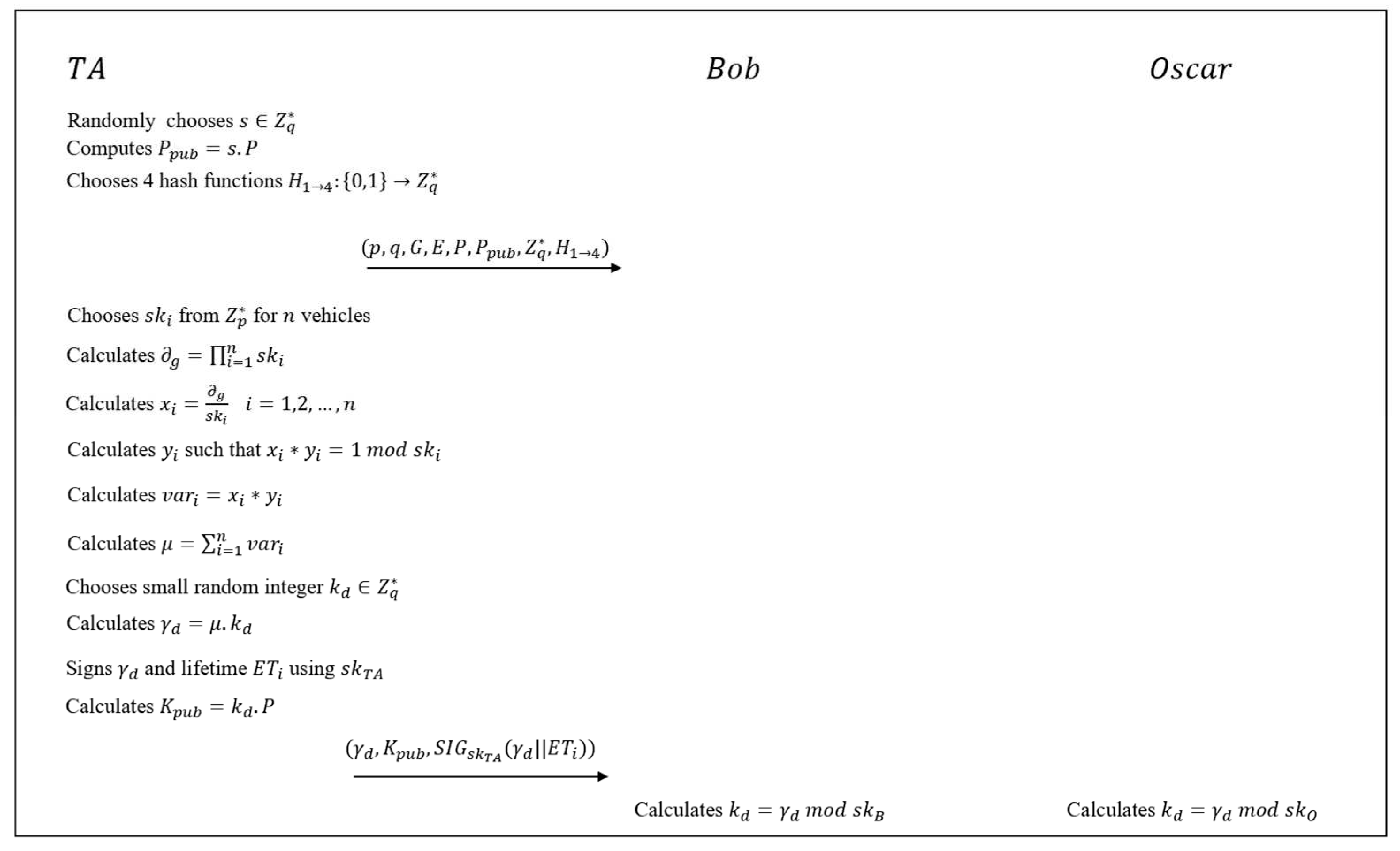
Figure 2.
Impersonation Attack on Zhang’s Scheme
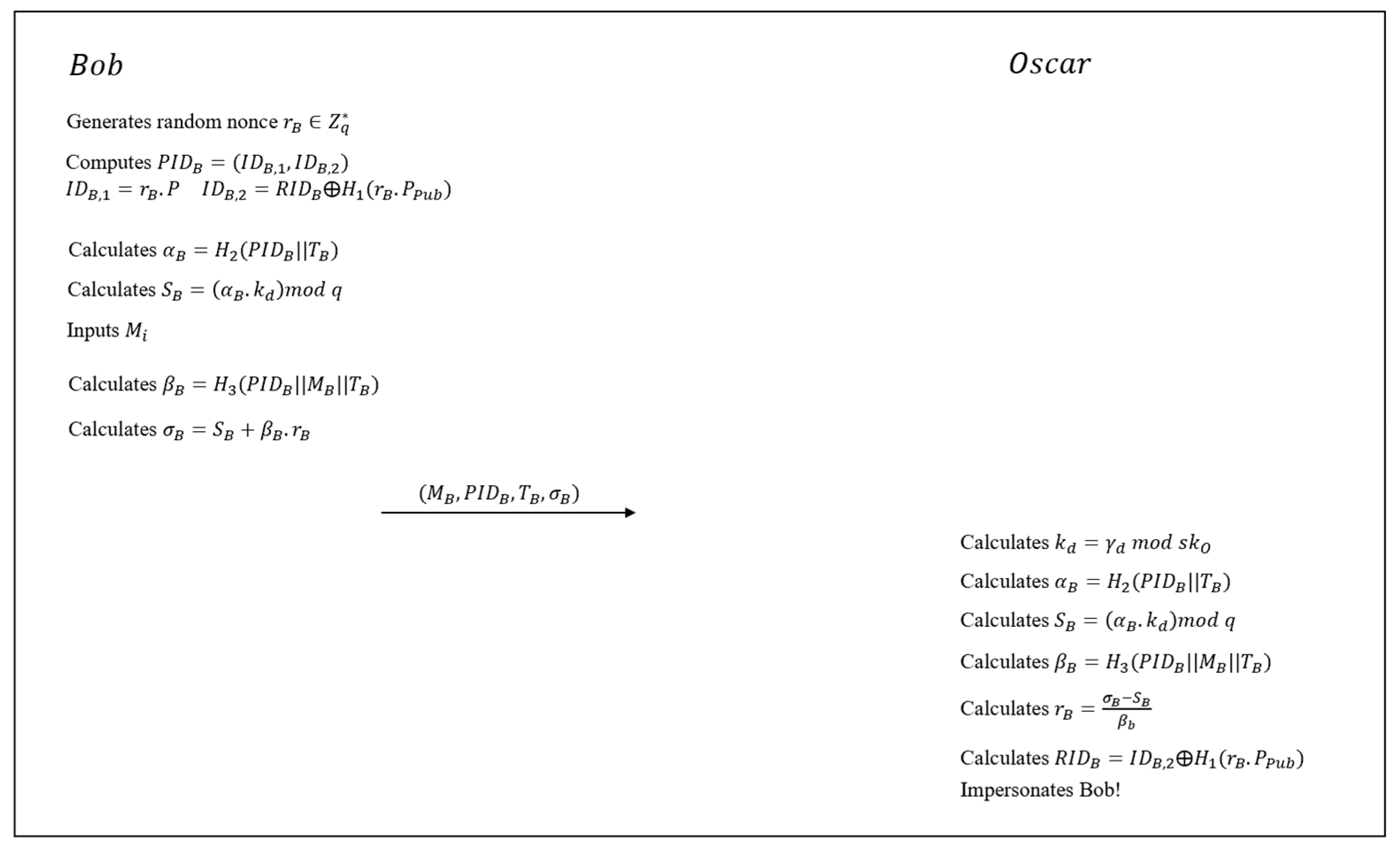
Figure 3.
Repudiation Attack on Zhang’s scheme.
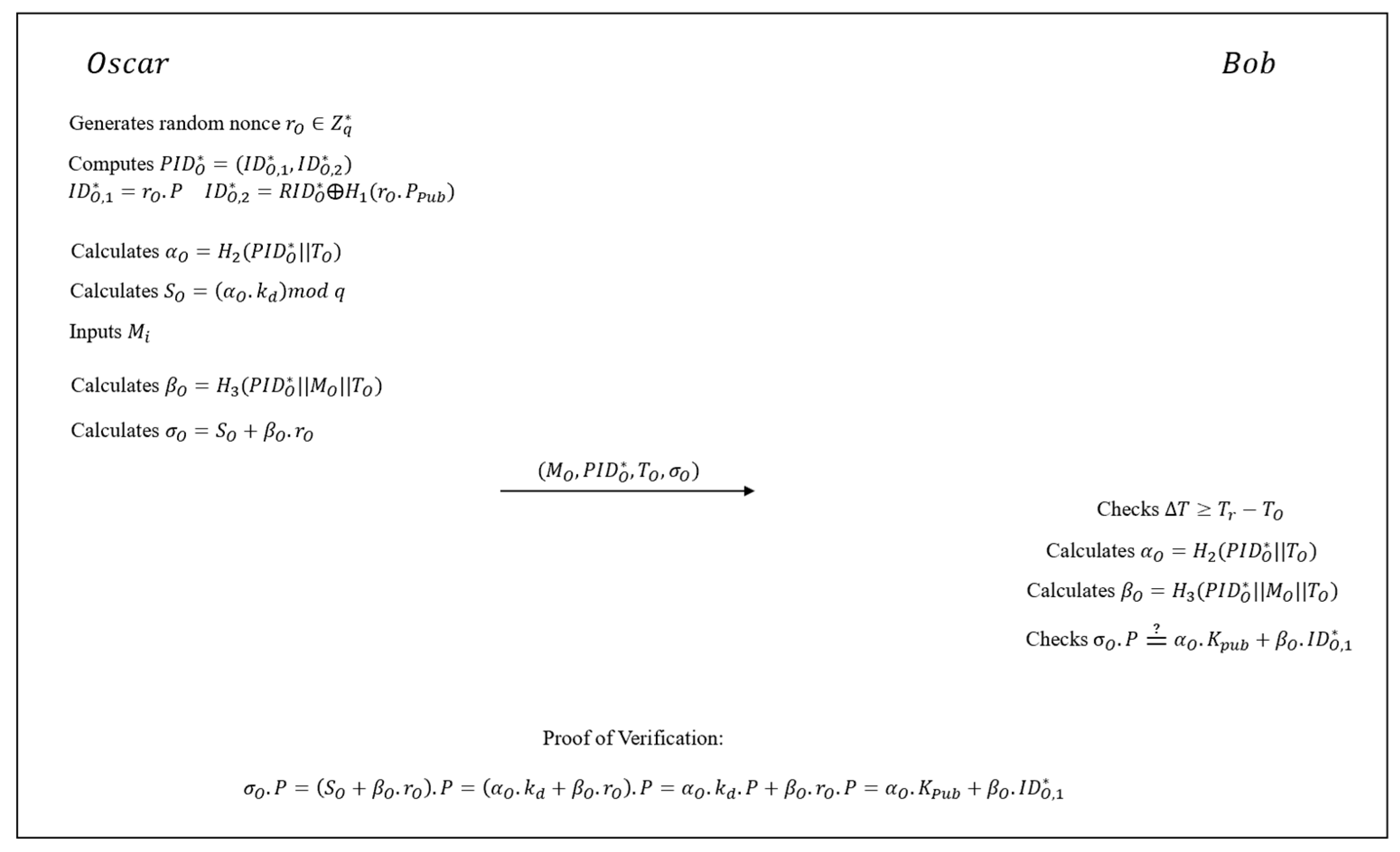
Figure 4.
Setup, PID and PPK Generation Phases in Xiong’s scheme
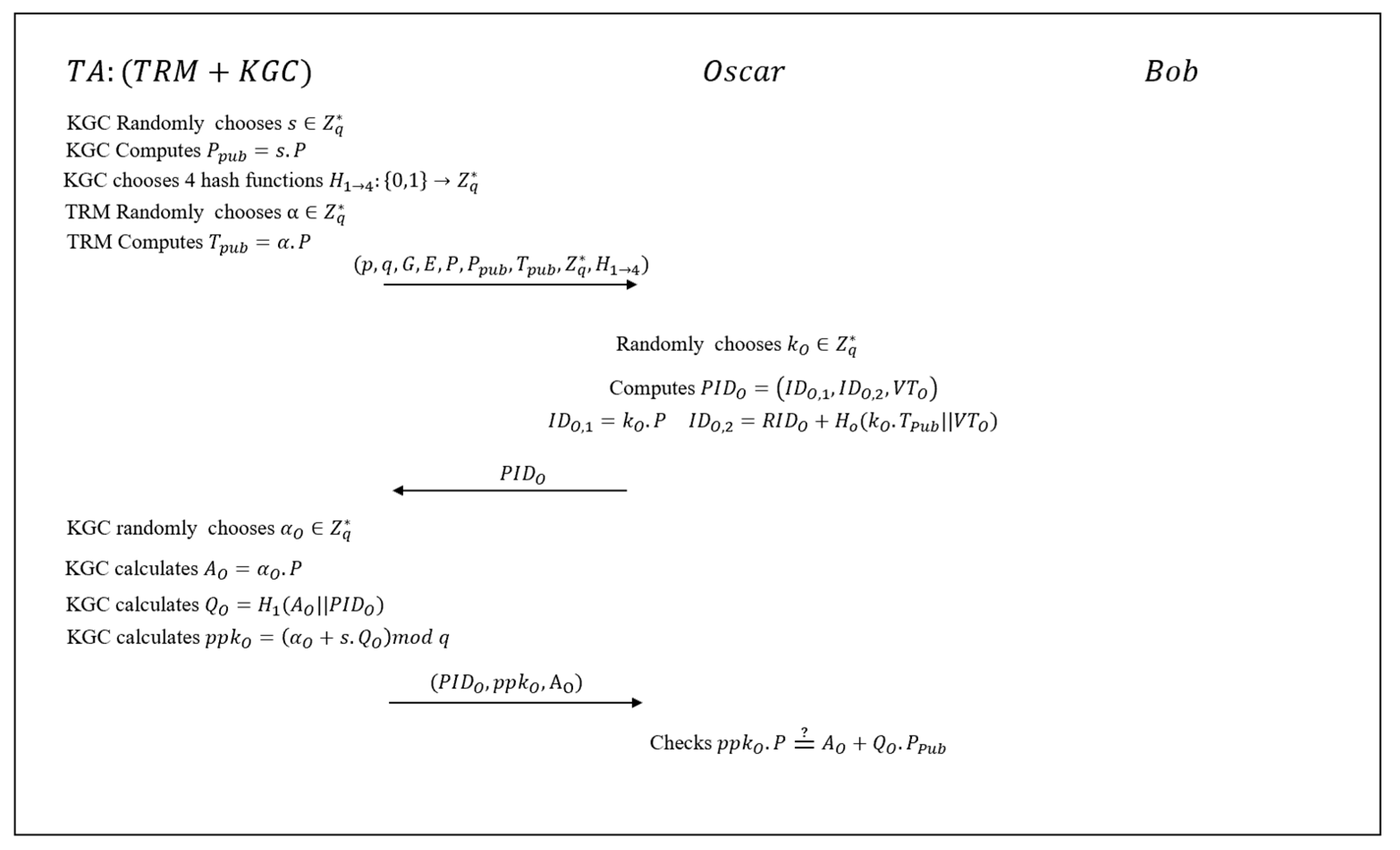
Figure 5.
Repudiation Attack on Xiong’s scheme.


Table 1.
Notations and Definitions.
| Notation | Definition |
|---|---|
| CA | Central Authority |
| CRT | Chinese Remainder Theorem |
| C-ITS | Cooperative Intelligent Transportation Systems |
| CL | Certificateless (Schemes) |
| CLAS | Certificateless Aggregate Signature (Schemes) |
| CPPA | Conditional Privacy Preserving Authentication |
| DSRC | Dedicated Short Range Communications |
| EC(C) | Elliptic Curve (Cryptography) |
| ECDLP | Elliptic Curve Discrete Logarithm Problem |
| GS | Group Signature |
| IBC | Identity Based Cryptography |
| IBV | Identity Based Batch-Verification (Schemes) |
| KGC | Key Generation Center |
| MAC | Message Authentication Code |
| OBU | On Board Unit |
| PKI | Public Key Infrastructure |
| PID | Pseudo Identity |
| PWD | Password |
| RID | Real Identity |
| RSU | Road Side Unit |
| TA/TTP | Trusted Authority/Trusted Third Party |
| TPD | Tamper Proof Device |
| TRA/TRM | Tracing Authority/Tracing Manager |
| VANET | Vehicular Adhoc Network |
| V2I | Vehicle-to-Infrastructure |
| V2V | Vehicle-to-Vehicle |
| V2X | Vehicle-to-Everything |
Table 2.
Summary of VANET security requirements, threats and protection approaches.
| Requirement | Description | Attacks | Protection |
|---|---|---|---|
| Availability | Timely arrival of critical information | Denial of service, spamming Blackhole, greyhole Malware |
Frequency hopping Channel Switching IDS |
| Authentication | Messages are sent by a legitimate user | Impersonation Sybil Wormhole, tunneling |
Digital Signatures MAC Tags IDS |
| Integrity | Message contents have not been modified | Message/broadcast tampering Replay |
Digital Signatures MAC Tags |
| Conditional Privacy | Only authorized entities have access to user identity | Location extraction attacks ID disclosure attacks |
Pseudonyms Group Signatures |
| Non-repudiation | Sender cannot deny having sent the message | Repudiation attacks | Public Key Cryptography |
| Confidentiality | Third party cannot extract meaningful information from any message | Eavesdropping Traffic Analysis |
Encryption |
Table 3.
Zhang et al.’s scheme.
| Phase | Scheme | Comments |
|---|---|---|
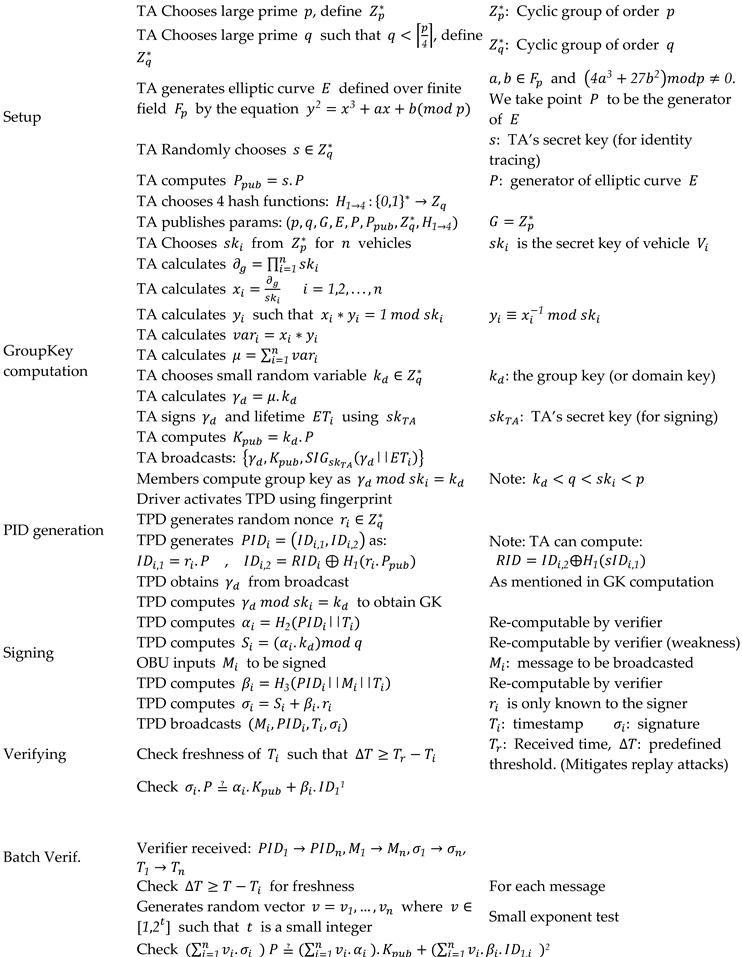 | ||
Table 4.
Xiong et al.’s scheme.
| Phase | Scheme | Comments |
|---|---|---|
| Setup: TA= KGC+TRM |
, defines | Cyclic groups of order respectively |
| defined over finite field by the equation , | and . We take point to be the generator of | |
| KGC’s secret key | ||
| KGC computes | generator of elliptic curve | |
| TRM randomly chooses | TRM’s secret key | |
| TRM computes | ||
| PID Generation |
pseudonym validity time Note: TRM can compute: |
|
|
generates as: , | ||
| PPK Gen. | ||
| to securely | partial private key of vehicle | |
| checks: | ||
| USK Gen | randomly chooses | user secret key of vehicle |
| Re-computable by verifier | ||
| the public key of | ||
| Signing | randomly chooses | |
| computes | ||
| Message | ||
| Signature | ||
| sends: | ||
| Verifying | such that | Mitigates replay attacks |
| (Proof: LHS: → RHS) | ||
| Agg. sign | , , , | |
| for freshness | ||
| randomly chooses | here is the receiver/verifier | |
| computes | ERROR: should be | |
| computes | ||
| computes | ||
| Batch Verify | computes | pair |
| computes | ||
| checks if (Proof: LHS: → RHS) | ||
| computes (Proof: LHS →RHS) | ||
Disclaimer/Publisher’s Note: The statements, opinions and data contained in all publications are solely those of the individual author(s) and contributor(s) and not of MDPI and/or the editor(s). MDPI and/or the editor(s) disclaim responsibility for any injury to people or property resulting from any ideas, methods, instructions or products referred to in the content. |
© 2023 by the authors. Licensee MDPI, Basel, Switzerland. This article is an open access article distributed under the terms and conditions of the Creative Commons Attribution (CC BY) license (http://creativecommons.org/licenses/by/4.0/).
Copyright: This open access article is published under a Creative Commons CC BY 4.0 license, which permit the free download, distribution, and reuse, provided that the author and preprint are cited in any reuse.


