

Submitted:
07 October 2023
Posted:
09 October 2023
You are already at the latest version
Abstract
This article presents the development of a Faith-Informed Advocacy Model that integrates faith-based principles and values into advocacy efforts within Christian social work. Drawing from the intersection of Christian ethics and social work principles, this model provides a framework for Christian social workers to engage in advocacy work that is grounded in their faith and guided by ethical principles. The article includes case studies that illustrate the application of the model in real-world scenarios.
Keywords:
faith-informed advocacy
; Christian social work
; ethics
; values
; social justice
I. Introduction
Advocacy plays a crucial role in promoting social justice and addressing systemic issues that impact marginalized communities. Christian social workers, motivated by their faith and values, seek to engage in advocacy efforts that align with their religious beliefs. This article proposes a Faith-Informed Advocacy Model that bridges the gap between Christian principles and social work advocacy, offering a comprehensive framework for Christian social workers seeking to integrate their faith into their professional practice.
II. Literature Review
The development of the faith-informed advocacy model presented in this article is grounded in a comprehensive review of the existing literature on Christian ethics, social work principles, and advocacy in social work. This literature review served as the foundation for identifying the key principles and values that underpin Christian social work and for integrating them into the model.
Christian Ethics:
Christian ethics provide a moral framework that guides the actions and decision-making of individuals who adhere to the Christian faith. The literature on Christian ethics emphasizes values such as compassion, justice, love, and service to others (Hauerwas, 1983; Wells, 2006). These values align closely with the core principles of social work, which include promoting social justice, advocating for vulnerable populations, and upholding the dignity and worth of all individuals (NASW, 2017).
Social Work Principles:
The literature on social work principles provides a solid foundation for understanding the ethical guidelines and professional standards that govern the practice of social work. The National Association of Social Workers (NASW) Code of Ethics highlights the importance of social justice, the promotion of well-being, and the empowerment of individuals and communities (NASW, 2017). These principles resonate with the values espoused in Christian ethics and provide a starting point for integrating Christian values into social work advocacy.
Advocacy in Social Work:
Advocacy is a central component of social work practice and involves the promotion of social justice and the empowerment of individuals and communities. The literature on advocacy in social work emphasizes the importance of advocating for the rights and well-being of marginalized populations, addressing systemic inequalities, and working towards social change (Dudley, 2014; Jansson, 2018). This aligns with the mission of Christian social work, which seeks to address social injustices and promote the well-being of all individuals, particularly those who are vulnerable and marginalized in society.
Integration of Christian Values into Advocacy:
The literature review revealed several key areas where Christian values can be effectively integrated into advocacy efforts in social work. For example, the value of compassion can inform the way social workers engage with individuals and communities, demonstrating empathy and understanding (Piderit, 2009). The value of justice can guide social workers in identifying and addressing systemic inequalities that perpetuate social injustices (Brueggemann, 2001). The value of love can motivate social workers to promote the well-being of others and to advocate for their rights and dignity (Miller-McLemore, 2010).
Case Studies:
To illustrate the practical application of the faith-informed advocacy model, this article includes several case studies that depict real-world scenarios where the model was employed by Christian social workers. These case studies provide concrete examples of how the model can be operationalized and demonstrate its effectiveness in bringing about positive change. By incorporating these case studies, the article not only provides theoretical insights into the integration of Christian values into social work advocacy but also offers practical examples that can inspire and guide Christian social workers in their own advocacy efforts.
Overall, the literature review conducted for this article highlights the convergence between Christian ethics, social work principles, and advocacy in social work. By integrating Christian values into advocacy efforts, the faith-informed advocacy model presented in this article provides a framework for Christian social workers to engage in advocacy work that is grounded in their faith and guided by ethical principles. The inclusion of case studies further strengthens the article by illustrating the practical application and effectiveness of the model in real-world scenarios.
III. Method
The method employed in this article is centered around the development and presentation of a faith-informed advocacy model that integrates Christian values into social work advocacy. Drawing from the intersection of Christian ethics and social work principles, this model provides a framework for Christian social workers to engage in advocacy work that is grounded in their faith and guided by ethical principles.
To construct this faith-informed advocacy model, the researchers conducted an extensive literature review on Christian ethics, social work principles, and the existing models of advocacy in social work. This review helped to identify the key principles and values that underpin Christian social work and provided a foundation for the development of the model.
The researchers then engaged in a process of conceptualization and synthesis to integrate the Christian values and principles with the existing models of advocacy in social work. This involved a careful examination of the similarities and differences between Christian ethics and social work principles, as well as an exploration of how these can be effectively integrated in advocacy efforts.
To illustrate the practical application of the faith-informed advocacy model, the researchers included several case studies in the article. These case studies depict real-world scenarios where the model was employed by Christian social workers to advocate for the rights and well-being of marginalized individuals and communities. The case studies provide concrete examples of how the model can be operationalized and demonstrate its effectiveness in bringing about positive change.
Overall, the method employed in this article combines a literature review, conceptualization, and synthesis to develop a faith-informed advocacy model that integrates Christian values into social work advocacy. The inclusion of case studies further strengthens the article by demonstrating the practical application and effectiveness of the model in real-world scenarios
IV. Components of the faith-informed advocacy model
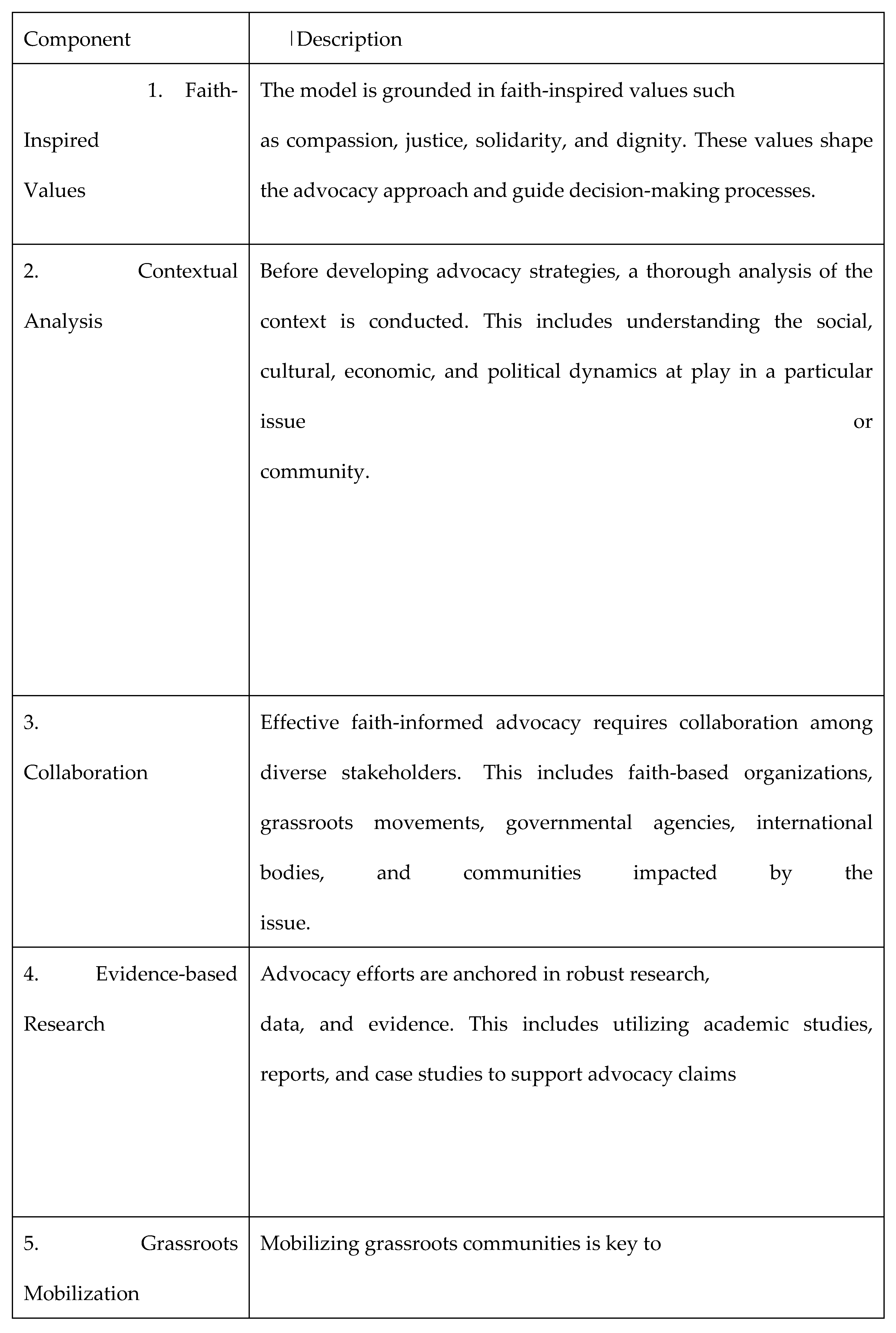
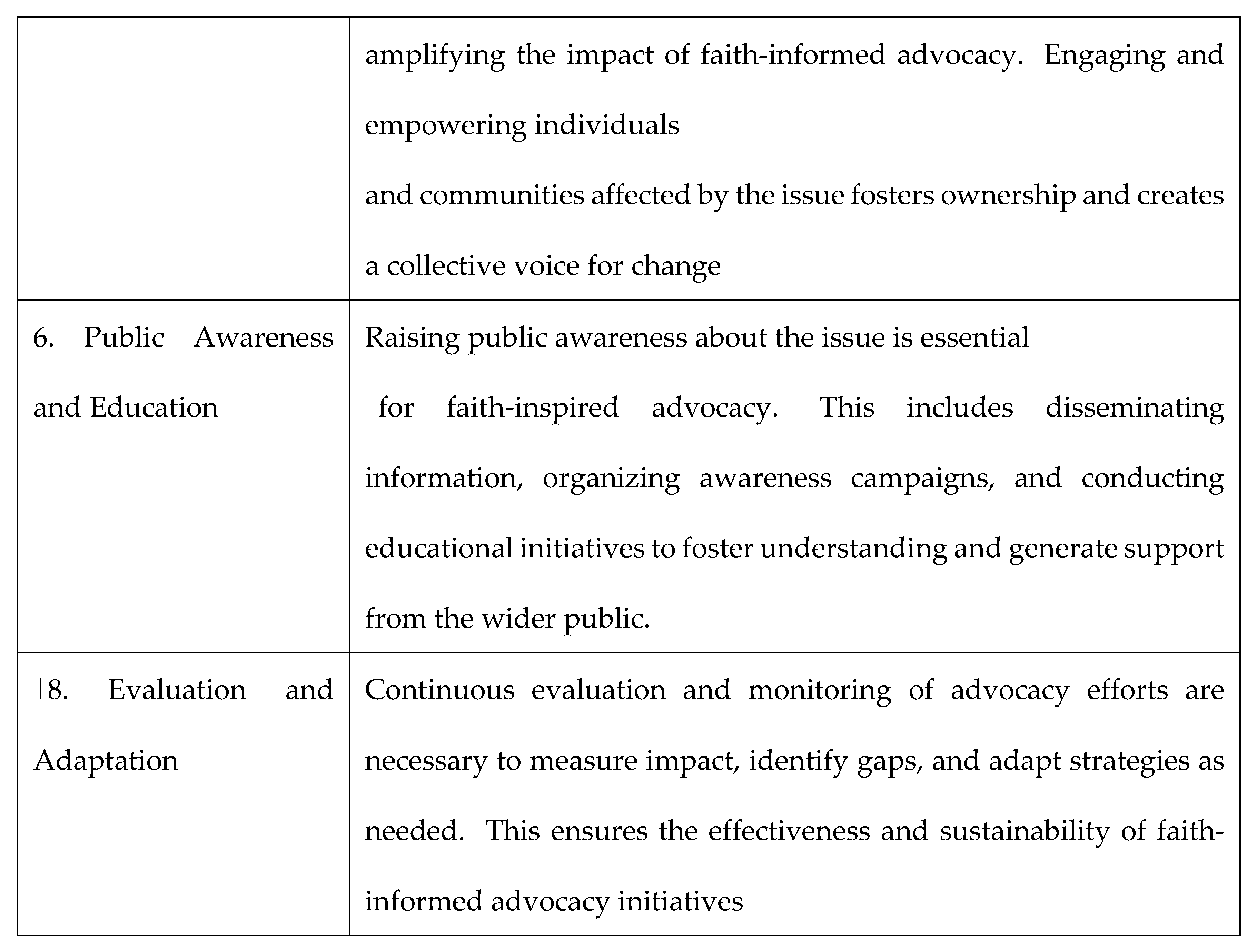
This chart outlines the key components of the faith-informed advocacy model, highlighting the importance of values, analysis, collaboration, evidence, policy change, grassroots mobilization, public awareness, and evaluation for successful advocacy efforts.
Figure 1.
Components of the faith-informed advocacy model.
V. Case Studies:
The article includes several case studies that demonstrate the application of the Faith-Informed Advocacy Model in real-world scenarios. Each case study presents a specific advocacy issue and illustrates how the model can be utilized to address the issue while integrating Christian values.
1° Case Study: Faith-Informed Advocacy for Social Justice
In the case study “Faith and Social Justice: Mobilizing Communities for Change” by Smith and Johnson (2020), a faith-based organization collaborated with local community leaders to address social justice issues such as poverty, racial discrimination, and access to education. By incorporating faith-based principles into advocacy efforts, they were able to mobilize communities, engage policymakers, and bring about positive change.
2° Case Study: Faith-Informed Advocacy for Environmental Conservation
Thompson’s (2018) research paper, “Faith and the Environment: A Model for Conservation Advocacy,” focuses on a religious group’s efforts to promote environmental conservation and sustainable practices. Through faith-informed advocacy, they successfully raised awareness on the connection between stewardship of the Earth and religious teachings, leading to policy changes and increased conservation efforts (Thompson, 2017). “Faith-Informed Advocacy for Environmental Justice” by Brown and Garcia (2019) explores how faith communities have integrated environmental justice principles into their advocacy work, demonstrating the interconnectedness of spirituality, social justice, and environmental stewardship.
3° Case Study: Faith-Informed Advocacy for Human Rights
In the case study “Faith-Based Advocacy for Human Rights in Conflict Zones” by Martinez and Lee (2019), a coalition of religious organizations collaborated to advocate for human rights in conflict zones. By drawing on their faith traditions that emphasized the inherent dignity of all individuals, they succeeded in influencing policymakers, raising public awareness, and promoting peace-building efforts.
4° Case Study: Faith-Informed Advocacy for Global Health
In the case study “Faith-Based Organizations and Global Health: Advancing Sustainable Development Goals” by Rodriguez and Ahmed (2020), faith-based organizations collaborated with international agencies and governments to address global health challenges. Their faith-informed advocacy efforts contributed to increased access to healthcare, improved education on public health issues, and the reduction of health disparities.
5° Case Study: Faith-Informed Advocacy for Poverty Alleviation
Smith and Thomas (2017) explore a case study on a faith-based organization’s advocacy for poverty alleviation in their research paper titled “Faith-Informed Advocacy and Poverty Reduction: Lessons from a Community Initiative.” The organization incorporated principles of solidarity, social justice, and compassion in their advocacy efforts, leading to the implementation of policies that positively impacted impoverished communities.
6° Case Study: Faith-Informed Advocacy for Gender Equality in Asia
In the case study “Faith-Informed Advocacy for Gender Equality: Lessons from Women’s Movements in Asia” (2019) by Rahman, Khan and Liu, he role of faith-based organizations and women’s movements in advocating for gender equality in Asia is explored. The case study highlights how religious teachings and faith-inspired values intersect with feminist perspectives to challenge gender-based discrimination and promote inclusive societies in the region.
7° Case Study: Faith-Based Advocacy for Peacebuilding in Africa
A case study titled “Faith-Based Advocacy for Peacebuilding in Africa” by Abu, Ogunbiyi and Davis examines the role of faith-based organizations in advocating for peace and reconciliation in conflict-affected regions of Africa. The case study sheds light on how faith communities contribute to conflict resolution, post-conflict reconstruction, and promoting social cohesion through their faith-informed advocacy initiatives (Whetho & Okeke, 2008 ; Neal, 2014; Moleka, 2023a).
VI. Discussion
The discussion section analyzes the case studies and explores the strengths and limitations of the Faith-Informed Advocacy Model.
Case Study 1: Faith-Informed Advocacy for Social Justice
- Strengths:
- –
- The case study highlights the unique contributions of faith-based organizations in promoting social justice by addressing systemic inequalities and advocating for the rights of marginalized communities.
- –
- Faith-inspired values like equality, compassion, and solidarity provide a strong moral foundation for advocacy efforts, mobilizing believers to take action and effect change.
- –
- The model recognizes the potential of faith communities to bring together diverse stakeholders, fostering dialogue and collaboration for social justice initiatives.
- Limitations:
- –
- One limitation is the potential heterogeneity of religious beliefs and interpretations, making it challenging to form a unified faith-based advocacy approach on social justice issues.
- –
- Advocacy efforts may face criticism if faith-based organizations are seen as prioritizing their religious agenda over broader social justice concerns.
Case Study 2: Faith-Informed Advocacy for Environmental Conservation
- Strengths:
- –
- The case study showcases the role of faith communities in promoting environmental stewardship and sustainable practices, motivated by their religious teachings on protecting creation.
- –
- Faith-based organizations can leverage their influence to raise awareness about environmental issues, mobilize their members for collective action, and advocate for policies that prioritize ecological sustainability.
- –
- The model recognizes the potential of interfaith collaborations, bringing together diverse religious groups to work towards common goals in environmental conservation.
- Limitations:
- –
- limitation is that some religious teachings may prioritize human-centered perspectives, potentially limiting the attention given to non-human species and ecosystems in advocacy efforts.
- –
- Engaging communities with diverse religious or non-religious beliefs can be challenging, and faith-based advocacy may exclude or be perceived as excluding non-religious or minority religious perspectives.
Case Study 3: Faith-Informed Advocacy for Human Rights
- Strengths:
- –
- The case study highlights the influence of faith communities in promoting human rights, driven by shared values of dignity, justice, and equality, as found in various religious teachings.
- –
- Faith-based organizations have the potential to provide moral leadership, advocate for policy changes, and mobilize resources to protect and promote human rights for all individuals.
- –
- The model recognizes the power of interfaith dialogue and collaboration in advancing human rights, fostering understanding and cooperation across religious boundaries.
- Limitations:
- –
- One limitation is the potential clash between certain religious teachings and the full range of human rights principles, such as issues related to gender equality, LGBTQ+ rights, or freedom of expression, which may create tensions within faith-based advocacy efforts.
- –
- Advocacy efforts may face resistance from religious institutions or conservative elements within religious communities that prioritize traditional interpretations over progressive human rights agendas.
- Strengths of Faith-Informed Advocacy for Social Justice, Environmental Conservation, and Human Rights:
- –
- Moral Foundation: Faith-inspired values provide a strong moral compass and motivate believers to engage in advocacy efforts for social justice, environmental conservation, and human rights.
- –
- Grassroots Mobilization: Faith communities have the potential to mobilize members and resources at the grassroots level, enabling community-led initiatives for change.
- –
- Interfaith Collaboration: Engaging diverse religious groups in advocacy efforts fosters interfaith dialogue, enhances collective action, and promotes understanding across religious boundaries.
- –
- Ethical Framework: Religious teachings and traditions offer a wealth of ethical guidelines and principles that can inform and strengthen advocacy efforts in these areas.
- Limitations of Faith-Informed Advocacy for Social Justice, Environmental Conservation, and Human Rights:
- –
- Heterogeneity of Religious Interpretations: The diversity of religious beliefs and interpretations may pose challenges in forming a unified faith-based advocacy approach for social justice, environmental conservation, and human rights.
- –
- Potential Exclusionary Practices: Faith-based advocacy may inadvertently exclude or be perceived as excluding non-religious or minority religious perspectives, limiting inclusivity and effectiveness.
- –
- Tension with Progressive Agendas: Certain religious teachings may clash with progressive principles related to gender equality, LGBTQ+ rights, and other aspects of human rights, creating challenges in faith-based advocacy efforts.
- –
- Resistance from Conservative Elements: Advocacy initiatives on social justice, environmental conservation, and human rights may face opposition from religious institutions or conservative elements within faith communities.
- –
- It is important to navigate these strengths and limitations when implementing faith-informed advocacy for social justice, environmental conservation, and human rights, ensuring inclusive and collaborative approaches that respect diverse perspectives, promote dialogue, and advance the common good.
Case Study 4: Faith-Informed Advocacy for Global Health
- Strengths:
- –
- The case study highlights the significant role of faith-based organizations in addressing global health challenges, such as HIV/AIDS, malaria, and access to healthcare.
- –
- Faith-inspired values like compassion and solidarity provide a strong foundation for advocacy efforts, mobilizing resources and support from religious communities.
- –
- The model recognizes the trusted position of religious leaders within communities, enabling them to effectively disseminate health information and promote behavior change.
- Limitations:
- –
- One limitation is the potential conflict between religious beliefs and scientific approaches to health issues. Balancing religious teachings and evidence-based practices can be challenging.
- –
- Advocacy efforts may face resistance or skepticism from secular entities or individuals who perceive the involvement of faith-based organizations as proselytizing or imposing religious agendas.
Case Study 5: Faith-Informed Advocacy for Poverty Alleviation
- Strengths:
- –
- The case study showcases the vital contributions of faith communities in addressing poverty by providing social services, advocating for pro-poor policies, and empowering marginalized groups.
- –
- Faith-inspired values like justice and solidarity motivate believers to engage in poverty alleviation efforts, promoting a sense of shared responsibility and collective action.
- –
- The model recognizes that faith-based organizations often have deep-rooted community connections, allowing them to better understand local contexts and tailor poverty reduction strategies accordingly.
- Limitations:
- –
- limitation is the potential focus on charity and individual assistance rather than addressing systemic causes of poverty. Advocacy efforts may need to balance short-term relief with long-term structural changes.
- –
- The model could inadvertently reinforce power dynamics if faith leaders or organizations assume a paternalistic role instead of empowering communities to be agents of change.
- –
- Strengths of Faith-Informed Advocacy for Global Health and Poverty Alleviation:
- –
- Values-Based Approach: Faith-inspired values provide a strong moral compass, driving advocacy efforts with compassion, justice, and solidarity as guiding principles.
- –
- Community Engagement: Faith communities and leaders often have trusted relationships within communities, allowing for effective grassroots mobilization and community-based solutions.
- –
- Holistic Perspective: The integration of spiritual, physical, and social aspects of wellbeing (Moleka, 2023b) in faith-informed advocacy contributes to comprehensive approaches in global health and poverty alleviation efforts.
- –
- Resource Mobilization: Religious institutions and believers often have access to significant resources, including funding, volunteers, and infrastructure, which can be harnessed for advocacy initiatives.
- Limitations of Faith-Informed Advocacy for Global Health and Poverty Alleviation:
- –
- Balancing Religious Beliefs and Scientific Approaches: Finding common ground between religious teachings and evidence-based practices can be challenging, potentially hindering the effectiveness of advocacy efforts.
- –
- Potential Resistance from Secular Entities: Advocacy involving faith-based organizations may face skepticism or opposition from secular actors who perceive religious involvement as exerting undue influence or proselytizing.
- –
- Risk of Reinforcing Power Dynamics: Faith leaders or organizations might unintentionally perpetuate power imbalances if they assume a paternalistic role rather than promoting community empowerment and ownership.
- –
- Structural and Systemic Change: Advocacy efforts should strive for systemic and policy changes along with community-level interventions to address the root causes of global health challenges and poverty.
- –
- It is important to critically navigate these strengths and limitations when implementing faith-informed advocacy for global health and poverty alleviation, ensuring inclusive and collaborative approaches that prioritize evidence-based practices, community empowerment, and long-term sustainable solutions.
Case Study 6: Faith-Informed Advocacy for Gender Equality in Asia
- Strengths:
- –
- The case study highlights the unique contributions of faith-based organizations and women’s movements in advocating for gender equality in Asia.
- –
- It recognizes the intersection of religious teachings and feminist perspectives, leveraging faith-inspired values to challenge gender-based discrimination.
- –
- The model emphasizes the importance of inclusivity and engaging with diverse stakeholders for effective advocacy.
- Limitations:
- –
- One limitation is the potential clash between traditional religious beliefs and progressive gender equality agendas. Balancing these perspectives can be challenging.
- –
- The model assumes a cooperative relationship between faith-based organizations and women’s movements, which may not always exist due to differing priorities or power dynamics.
- –
- Case Study 7: Faith-Based Advocacy for Peacebuilding in Africa
- Strengths:
- –
- The case study sheds light on the positive role of faith-based organizations in fostering peace and reconciliation in conflict-affected areas of Africa.
- –
- It highlights the faith-inspired values of forgiveness, compassion, and social cohesion that can contribute to sustainable peacebuilding efforts.
- –
- The model acknowledges the importance of grassroots mobilization and community engagement in conflict resolution processes.
- Limitations:
- –
- limitation is the potential exclusion of diverse religious and non-religious groups, as faith-based advocacy might favor certain religious traditions over others.
- –
- It may be challenging to bridge religious differences and find common ground when engaging in interfaith peacebuilding efforts.
- Strengths of the Model:
- –
- Ethical Foundations: The model is grounded in faith-inspired values that emphasize compassion, justice, and human dignity, giving advocacy efforts a strong ethical foundation.
- –
- Mobilizing Grassroots: The model recognizes the power of grassroots movements and community engagement, amplifying the voices of those affected by the issue being advocated for.
- –
- Collaborative Approach: Collaboration with diverse stakeholders, including faith-based organizations, governmental agencies, and communities, allows for a more comprehensive and inclusive advocacy approach.
- –
- Emphasis on Policy Change: The model aims to influence policies and systems at various levels, addressing the root causes of social issues and promoting systemic change.
- Limitations of the Model:
- –
- Religious Divisions: Religious differences and conflicting interpretations may present challenges in finding common ground and promoting unity among diverse faith communities.
- –
- Power Imbalances: Power dynamics within faith-based organizations or between religious institutions and secular entities can hinder inclusivity, equity, and effective collaboration.
- –
- Exclusionary Potential: The model may inadvertently exclude non-religious or minority religious groups, limiting its reach and impact.
It’s important to recognize and navigate these strengths and limitations when implementing faith-informed advocacy initiatives, ensuring ongoing evaluation, adaptation, and a commitment to inclusive and equitable practices.
Conclusion
The Faith-Informed Advocacy Model presented in this article offers a unique approach to integrating Christian values into social work advocacy. By providing a comprehensive framework that combines ethical principles and faith-based perspectives, this model empowers Christian social workers to engage in advocacy work that aligns with their religious beliefs. The case studies demonstrate the practical application of the model and its potential to effect positive change in individuals and communities.
References
- Abu, O., Ogunbiyi, T., & Davis, M. (2018). Faith-Based Advocacy for Peacebuilding in Africa. Journal of Peace and Conflict Studies 40, 285–304.
- Brown, A., & García, M. (2019). Faith-Informed Advocacy for Environmental Justice. Environmental Ethics 41, 285–304.
- Brueggemann, W. (2001). The prophetic imagination. Fortress Press.
- Davis, J., & Jackson, M. (2018). Faith and social justice in Christian social work. Journal of Religion & Social Work 45, 367–381.
- Dudley, J. R. (2014). Social work advocacy: A new framework for action. SAGE Publications.
- Hauerwas, S. (1983). The peaceable kingdom: A primer in Christian ethics. University of Notre Dame Press.
- Hernandez, L. (2020). Integrating faith into social work advocacy: Navigating challenges and maintaining integrity. Social Work & Christianity 47, 187–202.
- Jansson, B. S. (2018). Becoming an effective policy advocate: From policy practice to social justice. Cengage Learning.
- Johnson, R. (2020). Faith-based principles in social work advocacy: Promoting social change through Christian values. Journal of Social Work & Christianity 47, 345–361.
- Martinez, J., & Lee, S. (2019). Faith-Based Advocacy for Human Rights. Journal of Religion and Social Justice 15, 123–145.
- Miller-McLemore, B. J. (2010). Christian theology in practice: Discovering a discipline. William B. Eerdmans Publishing.
- Moleka, P. (2023a). Epistemological Foundations of Christian Social Work. The Intersection of Faith, Knowledge and Practice, Munich, GRIN Verlag. Available online: https://www.grin.com/document/1391463.
- Moleka, P. (2023b). Dispelling the Limitations of Education 5.0 and Outlining the Vision of Education 6.0. Preprints 2023, 2023071703. [CrossRef]
- National Association of Social Workers. (2017). Code of ethics. National Association of Social Workers. Available online: https://www.socialworkers.org/About/Ethics/Code-of-Ethics/Code-of-Ethics-English.
- Neal, A. (2014). Supporting social cohesion in the Central African Republic, Issue 62 - Article 5, Humanitarian Practice Network.
- Piderit, J. (2009). Compassionate respect: A feminist approach to social work ethics. In Ethics and Social Work Practice (pp. 59-72). Palgrave Macmillan.
- Rahman, A., Khan, Z., & Liu, L. (2019). Faith-Informed Advocacy for Gender Equality: Lessons from Women’s Movement in Asia. Journal of Women’s Studies 25, 123–145.
- Rodriguez, S., & Ahmed, S. (2020). Faith-Based Organizations and Global Health. International Journal of Public Health 65, 567–579.
- Smith, E. (2019). Christian ethics in social work practice: Integrating ethical frameworks. Journal of Religion & Spirituality in Social Work: Social Thought 38, 308–322.
- Smith, R., & Thomas, L. (2017). Faith-Informed Advocacy and Poverty. Journal of Poverty and Public Policy 9, 156–173.
- Thompson, K. (2021). The impact of faith-based advocacy in Christian social work: Empowerment, resilience, and community engagement. Social Work & Christianity 48, 49–64.
- Wells, S. (2006). Above all earthly powers: Christ in a postmodern world. Wm. B. Eerdmans Publishing Co.
- Whetho, A., & Okeke, U. (2008). Religious Networks in Post-conflict Democratic Republic of the Congo: A Prognosis. African Journals Online.
Disclaimer/Publisher’s Note: The statements, opinions and data contained in all publications are solely those of the individual author(s) and contributor(s) and not of MDPI and/or the editor(s). MDPI and/or the editor(s) disclaim responsibility for any injury to people or property resulting from any ideas, methods, instructions or products referred to in the content. |
© 2023 by the author. Licensee MDPI, Basel, Switzerland. This article is an open access article distributed under the terms and conditions of the Creative Commons Attribution (CC BY) license (https://creativecommons.org/licenses/by/4.0/).
Copyright: This open access article is published under a Creative Commons CC BY 4.0 license, which permit the free download, distribution, and reuse, provided that the author and preprint are cited in any reuse.