

Submitted:
02 October 2023
Posted:
04 October 2023
You are already at the latest version
Abstract
Women's empowerment represents a process in which they are recognized as subjects of rights. Despite advances in women's rights, inequalities persist in various areas. This study aims to validate a psychometric scale of 31 items in seven factors: Participatory Empowerment, Temerity, External Influences, Independence, Social Satisfaction and Equality. The objective is to measure the empowerment of women in the university context. The research was carried out in a transversal and non-experimental manner, with the participants' voluntary collaboration, including the participation of 1,478 university students from four Higher Education Institutions in Zone 4 of Ecuador. The data was analyzed through inferential statistics, including exploratory and confirmatory factor analysis. The results indicated that the instrument for measuring empowerment can be made up of 24 items grouped into six factors, and this model showed a good fit.
Keywords:
Scale validation
; empowerment
; Higher Education
; Gender Equality
1. Introduction
Women's empowerment is reflected in the recognition of their status as individuals with full rights, capable of making decisions that influence their own lives. As highlighted in [1], empowerment is a process that combines both individual and collective aspects, in which women take control and establish goals in response to their needs and challenges. Initially conceived as a political commitment [2], female empowerment has evolved to become one of the Sustainable Development Goals (SDGs) [3]. Countries have assumed the responsibility of implementing public policies that promote this empowerment, and in this context, research plays a fundamental role in shedding light on the reality that prevails in developing nations like Ecuador. These investigations are essential to evaluate progress towards commitments made at the United Nations Assemblies.
Empowerment processes cannot remain mere statements; putting them into practical action is imperative. It involves understanding the realities women face and analyzing the levels of empowerment, both individually and collectively, in various environments, whether in the domestic, community or broader structures at the national level. It is essential to measure and understand factors such as access to resources, capacity for action (agency) and achievements [2,4].
As highlighted by the United Nations report on the Sustainable Development Goals (SDGs) [3], gender inequalities persist [5]; this is manifested in the women's absence of representation in leadership positions and unequal distribution of domestic responsibilities, which continues to be three times greater for women than men.
Empowerment encompasses a variety of approaches, ideologies, movements, interpretations, strategies and interest groups [6,7]. Furthermore, it is closely linked to interdependence [8,9]. As women recognize their potential and value themselves, they join together in collectives with other women who share common goals that affect their lives. It is also defined as expanding people's capacity to make strategic decisions about their lives in a context where this power was previously denied [9]. This process begins in the individual since women can question and reflect on their existence [11]. Formal and non-formal education and cognitive processes of discussion and analysis nourish the changes in this process; therefore, training plays a fundamental role.
Two critical factors in addressing and reducing gender inequalities are education and ongoing training. These tools contribute to women's empowerment in leadership and decision-making and have applications in private and public contexts [12,13]. Throughout history, women have fought tirelessly to achieve autonomy. For example, a salary has allowed them to decide how to use their money, contributing to their financial independence. However, this advancement has also brought with it an overload of work, as responsibilities related to housework and care continue to fall mainly on women [5].
In this context, various authors agree that empowerment is intrinsically linked to the autonomy of women, which stands as the basis for making decisions in their lives, bodies, emotional well-being, economic independence and social relations [14]. Empowerment aligns with socio-economic development and women through access to the same employment and educational opportunities as men [16].
Empowerment is intrinsically linked to participation as a fundamental right that guarantees that women can function in various public and private areas. It is essential to highlight that, as an individual process, it implies that women recognize themselves as holders of rights, capable of making decisions, actively participating in society, accessing services and having resources [17].
A relevant study in Africa indicates that matrilineality is associated with the empowerment of women and the reduction of gender gaps. This study demonstrates that access to resources and education positively influences the greater participation of women in civic and political life [18].
Regarding university policies that encourage the participation of women in the scientific field, a study carried out in Italy shows significant results. This study demonstrates that institutional policies positively impact women's participation in academia and research. These policies reduce disparities and obstacles that often restrict women's participation in these fields [19]. Furthermore, other studies have examined women's participation in political spaces and have concluded that to achieve such participation, many women have had to negotiate with their families [19,20,21].
Empowerment is closely related to leadership since they argue that several synergy points are transformed into common objectives and goals by deconstructing individual beliefs. Hence, the relevance of transformational leadership as a means to achieve empowerment [22]. A study with a gender perspective at a university in Saudi Arabia explored transformational leadership and psychological empowerment in university leaders and subordinates, demonstrating that there are no differences between genders and that female leaders are just as influential as men [23]. However, barriers to leadership persist, such as lack of support, discrimination, pay inequality, and workplace harassment [24]. It refers to the "queen bee" syndrome [25,26], which are women leaders who perpetuate discriminatory imaginaries among those of the same gender to prevent them from occupying similar positions. Additionally, they seek validation from other people, which makes them more sensitive to criticism [27], placing them at a disadvantage compared to the opposite gender.
A study of women's empowerment conducted in Spain found that this is achieved through education, resulting in more balanced decision-making regarding consumption and financial management [28]. Furthermore, strong evidence suggests that promoting gender equality can reduce household poverty and that resources in the hands of women tend to generate positive outcomes in the household [11,29]. Also, measuring empowerment involves evaluating areas of individual character and relationships with other people.
Reviewing the literature on instruments to measure empowerment allowed us to identify scales with different factors. For example, a study validated a scale to evaluate the dimensions of empowerment in pregnant women in Iran. This scale consists of 38 items distributed across three dimensions related to educational empowerment, autonomy, and sociopolitical empowerment and demonstrated high reliability with a Cronbach's alpha coefficient of 0.92 [30].
Furthermore, a scale assessing attitudes towards women's empowerment was found in male and female Pakistani university students, demonstrating a reliability of 0.80. The study performed an exploratory factor analysis using the Kaiser-Meyer-Olkin test, which yielded a value of 0.864 by eliminating items with loadings less than 0.30 and reducing factors. This study concluded that the scale allows for measuring attitudes concerning empowerment [31].
Numerous authors have investigated personal agency, which encompasses factors such as autonomy, self-efficacy, self-control, and self-preparation, among others, being a predominant factor since it implies the freedom to act and achieve goals [32], as well as the ability to make decisions. in all areas of life [10,33,34]. From this perspective, scales have been developed to measure empowerment. For example, the "Reproductive Agency Scale" [35] assesses the capacity for awareness and exercise of economic rights, personal and family decision-making, and freedom of movement. This instrument focuses mainly on the decision-making capacity regarding using their resources.
On the other hand, the "autonomy scale" [36], which evaluates the capacity for self-governance, emotional self-control and decision-making, has allowed us to understand how women can exercise self-control, which in some way influences their personal decisions and labour. In addition, other dimensions of empowerment have been investigated, such as socio-economic, socio-cultural, family/interpersonal, legal and political [16], which affect or contribute to the development of resilience and democratic participation, aspects that are also part of empowerment. A study conducted in Nepal [37] applied an improved version to evaluate the notion of freedom of agency based on Amartya Sen's original tool.
A critical study [38] examined empowerment in migrant married women in Korean societies, analyzing dimensions such as personal ability, group perception, autonomy, and self-determination. Intrapersonal empowerment focuses on autonomy and roles, while political and social empowerment involves aspects related to leadership capacity and political participation. On the other hand, an instrument applied to pregnant women by [30] evaluated empowerment from three dimensions: educational empowerment, autonomy and sociopolitical empowerment, using a 32-item questionnaire.
Various studies have been conducted in Latin America on scales to measure empowerment. For example, at the University of Juárez in Mexico, [39] developed an instrument composed of 34 items to evaluate empowerment through seven factors: participatory empowerment, temerity, external influences, independence, equality, social satisfaction and security. This instrument uses a qualitative scale to measure levels of empowerment, which include high, medium, and low values. This questionnaire was validated with leaders from different states of Mexico and yielded a reliability analysis of 0.863.
On the other hand, [40] from the Autonomous University of Mexico proposed another instrument composed of 47 items distributed in four factors that analyze personal agency, health empowerment, self-awareness and social empowerment in university students. This same scale was presented by [41] in a shorter version with 12 items distributed in the same four factors as the original instrument. Its recommendations focus on measuring the empowerment of students from their entrance to the university for continuous evaluation.
Furthermore, [42] designed a scale to measure community empowerment in women. The dimensions analyzed in this study were related to participation, leadership, community interest and personal control. The results indicated that this scale effectively diagnoses women's empowerment at the community level.
In Ecuador, existing studies on empowerment have focused on issues related to sexual and reproductive empowerment in adolescent women. These studies used data from the Ecuadorian National Health and Nutrition Survey and provided results indicating a lack of sexual empowerment in women who are mothers [43].
Furthermore, [44] conducted a case study in a rural community where the importance of implementing socio-educational processes and socio-economic programs that promote women's mental and physical health was identified. The study aimed to achieve higher security, interdependence and decision-making capacity.
On the other hand, [45] analyzed women's empowerment from the perspective of participation and leadership training in indigenous women. The study concluded that it is essential to reconsider women's organizational autonomy as a crucial means to their empowerment. However, no scientific studies focused on validating scales to measure the empowerment of Ecuadorian women related to training.
Considering the analyzed knowledge gaps, we proposed a scale to measure empowerment in Ecuadorian university women. The scale's reliability and validity were assessed, and the underlying factors were determined using structural equation modelling. The main goal of our study was to evaluate the psychometric aspects of empowerment in the university environment. The aspects considered in the scale included participatory empowerment, equality, external influence, independence, dependence and social satisfaction. The study sample included a total of 1,478 university students belonging to four universities located in Region 4 of Ecuador. This scale, of reduced dimensions, was designed to evaluate the level of empowerment of women in their management and leadership roles.
2. Materials and Methods
2.1. Design
The study is evaluative, analyzing attitudes adopting a transversal and non-experimental approach. This approach is based on the voluntary selection of participants from various university courses belonging to Higher Education Institutions in Zone 4 of Ecuador. Data analysis was carried out following the principles of inferential statistics.
2.2. Participants
A population composed of university students from four Ecuadorian institutions was selected, and their participation in the study was voluntary, guaranteeing the confidentiality of their data. In total, 1478 women took part in the research, distributed as follows: 38.4% from the Universidad Laica Eloy Alfaro de Manabi, 18% from the Universidad Tecnica de Manabi, 28.2% from Escuela Superior Politecnica Agropecuaria de Manabi Manuel Félix López, and 15.4% from the Universidad Estatal del Sur de Manabi.
2.3. Instrument
This scale is derived from a previous study by the University of Juárez-Mexico [39], which addressed empowerment through seven factors: 1. Participatory Empowerment (PD); 2. Temerity (TD); 3. External Influences (EID); 4. Independence (ID); 5. Equality (ED); 6. Social Satisfaction (SSD); and 7. Security (SD). This scale was adapted to the Ecuadorian context, and, following the recommendations of experts in the review and validation, specific language adjustments were made for Ecuador. In addition, the reagents of the Security dimension were unified with the Independence Dimension. 27 items from the original scale were retained, and four items related to significant aspects of the country's regulations were added, such as sexual and reproductive rights, resource management, and women's participation in various areas. This adapted version, " Women's Empowerment Measure" (WoEm-M), consists of 31 items. The instrument offers five levels of assessment: 1, which is equivalent to "Totally disagree" (TD); 2, "Disagree" (D); 3, "Undecided" (U); 4, "Agree" (A); and 5, "Totally agree" (TA). The main objective of the adaptation was to analyze the behaviour of the data and observe possible variations according to the statistical results.
2.4. Procedure
Data collection was carried out online through the Office 365 Forms tool. Permission and support were obtained from the corresponding authorities to designate a person responsible for providing support in collecting information in each Higher Education Institution (HEI).
2.5. Data Analysis
The instrument's content was validated through the evaluation of a panel of scientific experts. They used a scale to evaluate the elements' relevance, opportunity, necessity and indispensability. For data analysis, SPSS software version 27 was used, calculating reliability through Cronbach's Alpha coefficient to evaluate internal consistency.
Regarding the Exploratory Factor Analysis (EFA), the Kaiser-Meyer-Olkin (KMO) test was applied to evaluate the suitability of the sample concerning the study variables. A Factor Reduction Analysis (FRA) was carried out with a varimax rotation involving 250 interactions, which allowed the results to be simplified and interpreted. To carry out the Confirmatory Factor Analysis (CFA), the SPSS AMOS 24 program was used, using structural and multivariate equations.
3. Results
3.1. Validation process
The validation of the content was carried out by experts in Gender and Education from Higher Education Institutions including the Universidad de Sevilla and the Universidad de Cordoba in Spain, as well as the Universidad Tecnica de Manabi and the Universidad Laica Eloy Alfaro de Manabi in Ecuador.
3.1.1. Construct validation and understanding
The wording was reviewed, considering terms that could generate confusion within the Ecuadorian context, considering the sociological, anthropological, psychological and axiological aspects. The validation of the understanding of the instrument was carried out with the participation of 35 female students from the Basic Education program at the Universidad Laica Eloy Alfaro de Manabi. We used Office 365's Forms tool to administer the survey, and the average time to complete it was 16 minutes and 11 seconds, without difficulty. The instrument consisted of 31 items [46]. In the exploratory stage, 739 women participated, with the same number of participants in the confirmatory stage.
3.2. Exploratory Factor Analysis
To perform the Exploratory Factor Analysis (EFA), we evaluated the reliability of the dimensions included in the original instrument. Results of EFA include: The Equality Dimension presented an α coefficient of 0.89, considered good. External Influences obtained an α of 0.74, which is considered acceptable. On the other hand, Participatory Empowerment reached an α of 0.65. The independence dimension recorded an α of 0.61, and Social Satisfaction obtained an α of 0.64. These last three coefficients are considered questionable. Finally, the temerity dimension presented the lowest α coefficient, with a value of 0.55, classified as poor.
In addition to examining reliability, the Cronbach's Alpha coefficient of each item of the instrument was evaluated, which led to the elimination of five items (TD.a Participation in political, social, and professional spheres, but with the need to negotiate with my couple; TD.b Participation in political, social, professional spheres, but with the need to negotiate with a male member of my family; PD.e Participation in different public spaces such as associations, women's social groups, unions, parties politicians, business groups, micro-business networks, etc.; ID.a My partner must always know where I am; ID.f I request approval to change my image or cut my hair. The resulting global α coefficient of 0.864 indicates good internal consistency in the instrument [47,48,49].
The variables were subjected to an Exploratory Factor Analysis (EFA), and the Kaiser-Meyer-Olkin fit test shows a value of 0.865, indicating a high correlation between the variables [50]. Furthermore, the results of Bartlett's test of sphericity showed a significant correlation of 0.00 between the variables. On the other hand, the Explained Variance reached 60.96% [51].
In the analysis process, we decided to eliminate parameters with factorial loadings less than 0.40, which resulted in a reduction of factors using an absolute value coefficient and a varimax rotation with 250 interactions. This procedure led to a reorganization of the variables [46]. Following these criteria, the EFA resulted in the distribution of the instrument into six factors, as detailed in the following table (Table 1):
According to Exploratory Factor Analysis (EFA), empowerment is measured through six factors by reorganizing the variables.
3.2. Confirmatory analysis
According to [52], structural equation modelling is one of the most optimal confirmatory modelling strategies. A survey comprising 26 questions addressed to 739 university students was used to validate and, if necessary, adjust the instrument selected for this study. The AMOS version 24 tool was used to analyze, identify and measure the structural models.
The statistical exercise allowed us to identify two models. In the first model, 26 variables distributed in six factors are included. The results showed the following data: in the Absolute Fit Bond Index, the model does not fit since the Chi-square value is < 0.00, and it should be > 0.05. According to [53], the CMIN/DF value is 3.144, which exceeds the acceptable range of 2 to 3, making this model unacceptable. The Goodness of Fit Index (GFI) is 0.908, suggesting the model could be fitted. The Root Mean Square Error of Approximation (RMSEA) obtained a P value of 0.054, which is not less than <0.05; However, it is a value that suggests that the model could be adjusted. The SRMR and a P value of 0.0607 indicate non-fit [52].
The goodness-of-fit index (AGFI) measures return a value of 0.888, which is less than acceptable (>0.90), indicating poor model fit [52]. Regarding the normed fit index (NFI) measure, a value of 0.866 is obtained, which does not meet the criterion of >0.90, which makes it unacceptable. The Baseline comparison measurements, The Tucker-Lewis coefficient, show a value of 0.891, which does not show an adequate fit. The incremental fit index (IFI) has a value of 0.905, which indicates that the model fits. The comparative fit index (CFI) obtains a value of 0.904, indicating that the model fits. Since Model 1 does not meet all measures, it was decided to make modifications according to the recommendations of several authors [52,53].
A second model was created, and the modifications made are described below based on the factors grouped under AFC. In the Participatory Empowerment dimension, the TDc variable was introduced, related to the exercise of political leadership, and Two bidirectional correlations were established between ξ1 and ξ4 (0.13) and between ξ2 and ξ4 (0.23). These additions contributed significantly to the adjustment of this factor. In the Equality dimension, no modifications were required since the existing factor loading was adequate. In the Independence dimension, the variable ID.e was incorporated, related to decision-making on the use and expenditure of the monthly salary, and a correlation between ξ10 and ξ10 (0.56) was applied to improve the adjustment. The External Influences dimension presented several correlations with ξ15, where the following relationships were observed: ξ15 and ξ17 (0.11), ξ15 and ξ18 (-0.23), and ξ15 and ξ19 (0.08). The Social Satisfaction dimension admitted a correlation between ξ20 and ξ21 (0.11). Finally, the dimension called Dependent Attitudes did not need modifications.
These adaptations allowed the resulting values to be improved. The Chi-square value did not exceed 0.05, indicating good model adaptation. Furthermore, the CMIN/DF value was 2.645, considered acceptable [53]. The absolute and relative goodness indices (RMSEA: 0.047, SRMR: 0.0498, GFI: 0.936, AGFI: 0.917, NFI: 0.909, IFI: 0.941, TLI: 0.929, CFI:0.941) show that the model fits the proposed measures by previous researchers [52]. Therefore, it concluded that the instrument to measure the empowerment of university women can be carried out with six dimensions distributed in 24 items.

Table 2.
Definitive scale according to Confirmatory Factor Analysis and distribution diagram of the variables.
Table 2.
Definitive scale according to Confirmatory Factor Analysis and distribution diagram of the variables.
| DIMENSIONS | CODES | FACTORIAL LOADINGS | ADJUSTED MODEL |
|---|---|---|---|
| Participatory Empowerment | PD.a | 0.720 | 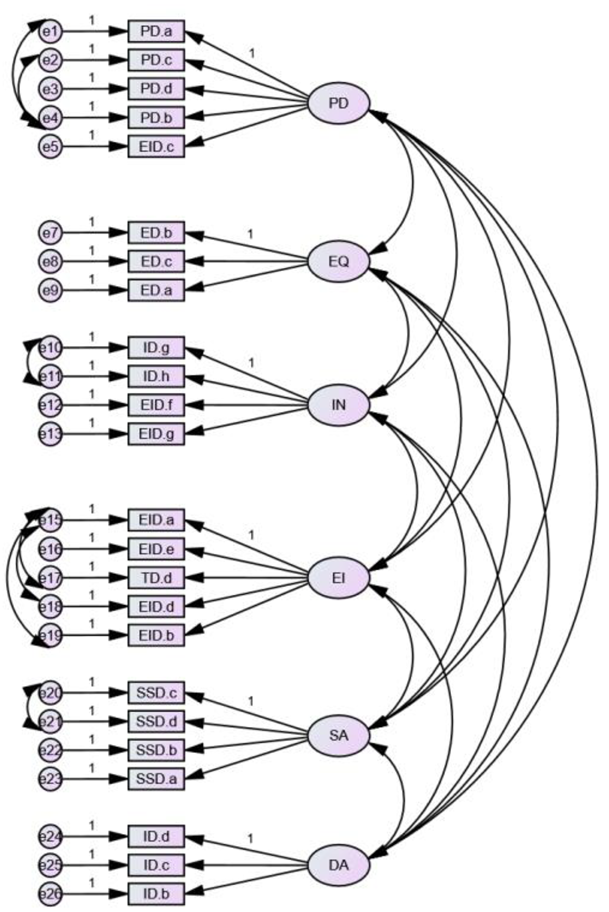 |
| PD.c | 0.620 | ||
| PD.d | 0.780 | ||
| PD.b | 0.520 | ||
| EID.c | 0.560 | ||
| Equality | ED.b | 0.960 | |
| ED.c | 0.830 | ||
| ED.a | 0.800 | ||
| Independence | ID.g | 0.480 | |
| ID.h | 0.500 | ||
| EID.f | 0.890 | ||
| EID.g | 0.890 | ||
| External Influences | EID.a | 0.430 | |
| EID.e | 0.620 | ||
| TD.d | 0.450 | ||
| EID.d | 0.670 | ||
| EID.b | 0.510 | ||
| Social Satisfaction | SSD.c | 0.510 | |
| SSD.d | 0.450 | ||
| SSD.b | 0.580 | ||
| SSD.a | 0.710 | ||
| Dependant Attitudes | ID.d | 0.780 | |
| ID.c | 0.670 | ||
| ID.b | 0.530 |
With this result in the CFA, we determined that the validated scale fits and can be applied to measure the empowerment of university women. This scale consists of 24 items, of which 22 correspond to the original instrument and two items proposed by the authors.
4. Discussion
The results of our research show that it is possible to apply the instrument to measure empowerment [39] in university women, considering several adjustments; however, the instrument shows a good level of validity and reliability. On the other hand, the analysis of the results showed that eliminating some variables in the proposed dimensions improved the instrument's internal consistency (α=0.864).
The Exploratory Factor Analysis distributed 26 variables into six factors and allowed a new redistribution and a new understanding of the dimension that analyses dependency attitudes, which implies a finding between the factors: independent variables and the items as dependent variables [53].
The Participatory Empowerment Dimension is made up of five different variables. For Exploratory Factor Analysis (EFA), we decided to eliminate the variable called "PD.e", which referred to participation in various public spaces, such as associations, women's social groups, unions, political parties, scientific groups or networks, business groups, micro-business networks, among others. The decision to delete this variable is based on its factor loading of less than 0.5, as documented in the previous study [47]. However, it is essential to mention that the researchers initially proposed this variable considering the Ecuadorian legal context [55]. In this way, the dimension is made up of the following remaining variables: "PD.a", which evaluates perseverance as a requirement to exercise effective leadership; "PD.c", which addresses the importance of high activity in the exercise of effective leadership; "PD.d" which focuses on the perception of the importance of women obtaining their economic income; "PD.b" which considers entrepreneurship as a critical characteristic in leadership; and "EID.c" which evaluates the need for women to know to serve in positions of power. Understanding this dimension is intrinsically linked to the concept of participatory empowerment, specifically from the perspective of female leadership. In this context, leadership is the ability to influence other individuals through sustained participation in various settings [68].
The Temerity Dimension was subjected to a reliability analysis, which revealed a Cronbach's alpha coefficient (α) equal to 0.55, indicating an unsatisfactory reliability measure. Consequently, certain variables were eliminated due to their low factor loading. The eliminated variables included: "TD.a", which inquires about participation in political, social and professional spheres but with the need to negotiate with the partner; "TD.b", which focuses on participation in political, social and professional spheres but with the requirement of negotiating with a male member of the family; and "TD.c", which addresses the perception of the qualities necessary to exercise political leadership.
It should be noted that participation is established as a fundamental right in the Ecuadorian constitutional context. As a result of these policies and the commitment of the State, some women have managed to gain access and representation in political spheres. In addition, measures and policies have been implemented aimed at promoting gender equality and safeguarding women's rights. However, in practice, significant limitations remain in achieving the objectives established in the agendas of local governments, which are intrinsically linked to national planning and are in line with the Sustainable Development Goals [5].
From Primary to Higher Education, participation and governance practices in the educational field are carried out by mandatory requirements [69]. However, parallel to this demand lies a web of influence and manipulation intrinsic to a latent patriarchal system. These dynamics are influenced by age, marital status and persistent dependence on gender roles, which can significantly impact participation and performance [65].
Although participation could be considered a prevailing need, this study revealed that some women involved in research do not perceive it as such. The aspiration to access "positions of power" and candidacy in popular elections [55] and education in politics and female leadership have not been government priorities. Although political quotas have been met as stipulated by the Democracy Law [56], few women have reached political leadership positions, even reaching the point where women of the same gender do not provide their support [61], possibly due to the preference for male figures in power. It is essential to highlight that the variable "TD.d" ("It is better that women to make important decisions") demonstrated a more appropriate fit in the dimension of "External Influences" through exploratory factor analysis (EFA) and confirmatory factor analysis (CFA).
Regarding the dimension of External Influences Dimension, the variable EID.c ("Women have the knowledge and skills to participate in positions of power") was eliminated based on the results of the Exploratory Factor Analysis (EFA). Consequently, the dimension has been reconfigured and is now composed of the following variables: EID.a ("The cultural level influences women to function in positions of power and leadership"), EID.e ("The school influences the women to be able to function in a position of power or politics"), TD.d ("Women should make important decisions"), EID.d ("The family educates women so that they have positions of power and leadership"), and EID.b ("I feel comfortable when I am the object of praise or awards"), according to the results of the Confirmatory Factor Analysis (CFA).
Continuing education and training are revealed as crucial elements in women's empowerment, particularly when it comes to participating in political positions, both in the area of popular election and in internal nominations of universities. as pointed out by existing literature [55,56,57]. In this context, the shared responsibility of promoting education in leadership and political power is evident, which must be cultivated from the family nucleus, strengthened in the educational environment and perfected in higher education institutions. This investment in education would enrich participation in political and academic governance and positively impact women's individual lives in decision-making.
Within the Independence Dimension, the variable ID.e ("I make decisions about the use and expenditure of my monthly salary"), a proposal by the authors, was eliminated. This decision is based on the fact that 81.5% of university students declare they depend financially on their families. It is important to note that married, divorced or cohabiting women could, as heads of households, direct their financial resources towards vital needs [58]. As a result of these considerations, it is proposed that this variable is irrelevant as an indicator of empowerment. However, it is crucial to examine their degree of dependence on decision-making as an intrinsic element of their empowerment process since women's historical struggle has been marked by the search for freedom and autonomy, as shown in the report "For the life and freedom of women. "End of femicide" [59], which emphasizes the need to reform policies to improve legal conditions and rights. Another variable that was excluded from the instrument is ID.a ("My partner always has to know where I am"), which is presumed to be a result of the high percentage of single women who participated in the survey.
In the adjustment process of the Independence Dimension, and according to the results of the Confirmatory Factor Analysis (CFA), the following variables have been introduced: ID.g ("I decide when and how to have sexual relations" ), ID.h ("I decide when and how many children to have"), EID.f ("Women can occupy positions of power and leadership"), EID.g ("I would like more women to access positions of power"). From this perspective of independence, women are encouraged to make decisions about their bodies, seek equal opportunities [55], empower themselves economically [60,61] and promote solidarity among women [62]. This redefinition of independence highlights the desire for other women to strengthen their positions and become leaders [63], challenging the patriarchal system that has historically promoted competition between women [64].
Regarding the dimensions of "Equality" and "Social Satisfaction", it has been decided to maintain the variables as they were established in the original instrument. It is crucial to highlight the importance of developing soft skills to empower women seeking significant representation in higher education, as previous research has pointed out [65,66,67].
A significant novelty in this study lies in regrouping three variables previously assigned to the Independence Dimension. These variables have been combined under a new dimension called "Dependent Attitudes". The reason behind this reconfiguration is based on theoretical considerations and the specific context of the study area. The variables that make up this new dimension are the following: ID.d ("I try to fulfil the expectations or desires that my loved ones have for me"), ID.c ("My parents always have to know where I am"), and ID.b ("My parents always have to know where I am"). This phenomenon results from the economic dependence that most university students experience concerning their families and their subjection to the conditions that their fathers or mothers establish. This common practice is part of a deep-rooted patriarchal system [68]. The assignment of roles and the restriction of women's freedom in public spaces are historical manifestations of women's struggle to gain independence and achieve their aspirations [69].
In conclusion, the instrument subjected to Exploratory and Confirmatory Factor Analysis emerges as an essential tool to understand female empowerment from a diverse perspective, which encompasses how women perceive and assimilate concepts such as power, leadership, decision-making, personal development and equal opportunities as subjects with full rights.
Confirmatory Factor Analysis (CFA) offers a solid statistical model of 24 items in six factors. This analysis focuses on exploring female participation, highlighting the importance of authenticity and spontaneity in their involvement, and promoting a progressive process of empowerment from childhood. Likewise, it highlights the need to analyze the dependent attitudes rooted in the imagination and subconscious of women, with a view to their dismantling through training and deconstruction spaces.
Ultimately, this instrument, perfected and validated with robust psychometric characteristics, is presented as a resource applicable in university environments, providing a valuable avenue for research and evaluations related to women's empowerment. In conclusion, the instrument subjected to Exploratory and Confirmatory Factor Analysis allows us to understand that female empowerment must be analyzed from diversity, how women think and understand power, leadership, decision-making, personal development, and equal opportunities as subjects of law.
Author Contributions
Conceptualization, J.SL and MI.A; Methodology, J.SL.; Software, J.SL.; Validation, MI.A and M.OR.; Formal analysis, J.SL and MI.A; Investigation, J.SL.; resources, J.SL.; data curation, J.SL..; writing—original draft preparation, J.Sl.; writing—review and editing MI.A and M.OR.; supervision, MI.A. and M.OR.
Funding
I sincerely thank Fundación Carolina España for its generous support in financing the scholarship that allowed me to pursue my doctoral studies. This opportunity has been invaluable in my academic and professional development, and I am deeply grateful for your commitment to education and talent training. Thanks to your generosity, I have been able to pursue my academic goals and contribute significantly to my field of study. I am enormously grateful for this opportunity that has been given to me.
Institutional Review Board Statement
Not applicable.
Informed Consent Statement
The survey was distributed online through emails sent to university students from four institutions of Ecuador, thus forming the study population. They were voluntarily invited to participate, guaranteeing the confidentiality of the data provided.
Data Availability Statement
Not applicable.
Conflicts of Interest
The authors wish to declare no conflicts of interest in relation to this work. This study results from his doctoral training in the Social and Legal Sciences program at the University of Córdoba in Spain.
References
- Zimmerman, M. A. (2000). Empowerment Theory. Handbook of Community Psychology, 1984, 43–63.
- Organización de las Naciones Unidas. (1995). Declaración y Plataforma de Acción de Beijing. In La Cuarta Conferencia Mundial sobre la Mujer.
- Organización de las Naciones Unidas. (2015). Transforming Our World: The 2030 Agenda for Sustainable Development. In Transforming Our World: The 2030 Agenda for Sustainable Development. [CrossRef]
- Kabeer, N. (1999a). Resources, Agency, Achievements: Reflections on the Measurement of Women's Empowerment. Development and Change, 30(3), 435–464. [CrossRef]
- Organización de las Naciones Unidas. (2019). Informe de los Objetivos de Desarrollo Sostenible 2019. In Informe de los Objetivos de Desarrollo Sostenible 2019. https://unstats.un.org/sdgs/files/report/2018/TheSustainableDevelopmentGoalsReport2018-ES.pdf.
- Weldon, S. L. (2019). Power, exclusion and empowerment: Feminist innovation in political science. Women's Studies International Forum, 72(June 2018), 127–136. [CrossRef]
- Wieringa, S. (1994). Women's Interests and Empowerment: Gender Planning Reconsidered. Development and Change, 25(4), 829–848. [CrossRef]
- Kabeer, N. (1997). 'Can buy me love'? Re-evaluating the empowerment potential of loans to women in rural Bangladesh Institute of Development Studies ,. IDS Discusion Paper 363, 1–89. http://www.ids.ac.uk/idspublication/money-can-t-buy-me-love-re-evaluating-gender-credit-and-empowerment-in-rural-bangladesh.
- Malhotra, A., & Schuler, S. R. (2005). Women's empowerment as a variable in International Development. World Bank.Org, 71–88. http://books.google.com/books?hl=en&lr=&id=BzXyApyTGOYC&pgis=1.
- Kabeer, N. (1999b). Resources, Agency, Achievements : Re ¯ ections on the Measurement of Women' s Empowerment. 30(May), 435–464.
- Kabeer, N. (2005). Gender equality and women's empowerment: A critical analysis of the third millennium development goal 1. Gender & Development, 13(1), 13–24. [CrossRef]
- Aguayo, E. , & Lamelas, N. (2012). Midiendo el empoderamiento femenino en América Latina. Regional and Sectoral Economic Studies, 12, 153–158. [CrossRef]
- Marinho, P. A. S. , & Gonçalves, H. S. (2016). Práticas de empoderamento feminino na América Latina. Revista de Estudios Sociales, 2016(56), 80–90. [CrossRef]
- Dyson, T. , & Moore, M. (1983). On Kinship Structure, Female Autonomy, and Demographic Behavior in India Author ( s ): Tim Dyson and Mick Moore Source : Population and Development Review, Vol. 9, No. 1 ( Mar., 1983 ), pp. 35-60 Published by : Population Council Stable URL : http. Lancet, 09(1), 35–60.
- Jejeebhoy, S. J. , & Sathar, Z. A. (2001). Women's autonomy in India and Pakistan: The influence of religion and region. Population and Development Review, 27(4), 687–712. [CrossRef]
- Malhotra, A., & Schuler, S. R. (2005). Women's empowerment as a variable in International Development. World Bank.Org, 71–88. http://books.google.com/books?hl=en&lr=&id=BzXyApyTGOYC&pgis=1.
- Peterman, A. , Pereira, A., Bleck, J., Palermo, T. M., & Yount, K. M. (2017). Women's individual asset ownership and experience of intimate partner violence: Evidence from 28 international surveys. American Journal of Public Health, 107(5), 747–755. [CrossRef]
- Robinson, A. L. , & Gottlieb, J. (2021). How to Close the Gender Gap in Political Participation: Lessons from Matrilineal Societies in Africa. British Journal of Political Science, 51(1), 68–92. [CrossRef]
- Giuri, P., Grimaldi, R., Kochenkova, A., Munari, F., & Toschi, L. (2020). The effects of university-level policies on women's participation in academic patenting in Italy. Journal of Technology Transfer, 45(1), 122–150. [CrossRef]
- Kabeer, N. (2001). Discussing Women' s Empowerment: Theory and Practice. SIDA Studies, 136. www.sida.se.
- Vissandjee, B. Apale, A., Wieringa, S., Abdool, S., & Dupéré, S. (2005). Empowerment beyond numbers: Substantiating women's political participation. Journal of International Women's Studies, 7(2), 123–139. http://www.scopus.com/inward/record.url?eid=2-s2.0-29144471320&partnerID=tZOtx3y1.
- Jung, D. , & Sosik, J. J. (2002). Transformational leadership in work groups: The role of empowerment, cohesiveness, and collective-efficacy on perceived group performance. Small Group Research, 33(3), 313–336. [CrossRef]
- Bin Bakr, M. , & Alfayez, A. (2021). Transformational leadership and the psychological empowerment of female leaders in Saudi higher education: an empirical study. Higher Education Research and Development, 0(0), 1–16. [CrossRef]
- Diehl, A. B. , & Dzubinski, L. M. (2016). Making the invisible visible: A Cross-Sector Anlysis of Gender-Based Leadership Barriers. Human Resource Development Quarterly, 2(1), 1–9. [CrossRef]
- Ambri, S., Tahir, L. M., & Alias, R. A. (2018). An Overview of Glass Ceiling, Tiara, Imposter, and Queen Bee Barrier Syndromes on Women in the Upper Echelons. Asian Social Science, 15(1), 8. [CrossRef]
- Mavin, S. (2008). Queen bees, wannabees and afraid to bees: No more "best enemies" for women in management? British Journal of Management, 19(SUPPL. 1). [CrossRef]
- Dudău, D. P. (2014). The Relation between Perfectionism and Impostor Phenomenon. Procedia - Social and Behavioral Sciences, 127, 129–133. [CrossRef]
- Albert, C. , & Escardíbul, J.-O. (2017). Education and the empowerment of women in household decision-making in Spain. International Journal of Consumer Studies, 41(2), 158–166. [CrossRef]
- Kabeer, N. (2012b). Women's economic empowerment and inclusive growth: labour markets and enterprise development. International Development Research Centre, 44(0), 1–70.
- Borghei, N. S. , Taghipour, A., Latifnejad Roudsari, R., & Keramat, A. (2015). Development and validation of a new tool to measure Iranian pregnant women's empowerment. Eastern Mediterranean Health Journal, 21(12), 897–905. [CrossRef]
- Shuja, K. H. , Aqeel, M., & Khan, K. R. (2020). Psychometric development and validation of attitude rating scale towards women empowerment: across male and female university population in Pakistan. International Journal of Human Rights in Healthcare, 13(5), 405–420. [CrossRef]
- Sen, A. (1985). The Dewey Lectures 1984. The Journal of Philosophy, 82(4), 169–221.
- Donald, A. , Koolwal, G., Annan, J., Falb, K., & Goldstein, M. (2020). Measuring Women's Agency. Feminist Economics, 26(3), 200–226. [CrossRef]
- Pick, S., Sirkin, J., Ortega, I., Osorio, P., Martínez, R., Xocolotzin, U., & Givaudan, M. (2007). Escala para medir agenda personal y empoderamiento (ESAGE). Revista Interamericana de Psicología, 41(3), 295–304. http://search.proquest.com/docview/622125339?accountid=10422.
- Yount, K. M. , James-Hawkins, L., & Abdul Rahim, H. F. (2020). The Reproductive Agency Scale (RAS-17): Development and validation in a cross-sectional study of pregnant Qatari and non-Qatari Arab Women. BMC Pregnancy and Childbirth, 20(1), 1–15. [CrossRef]
- Anderson, Ruth A, Worthington. Anderson, Wiliam T. & Jennings, G. (1994). The Developtment of an Autonomy Scale. Contemporary Family Therapy, 16(4), 329–345.
- Gram, L. , Morrison, J., Sharma, N., Shrestha, B., Manandhar, D., Costello, A., Saville, N., & Skordis-Worrall, J. (2017). Validating an Agency-based Tool for Measuring Women's Empowerment in a Complex Public Health Trial in Rural Nepal. Journal of Human Development and Capabilities, 18(1), 107–135. [CrossRef]
- 김안나 & 최승아. (2013). 결혼이주여성 임파워먼트 척도 개발에 관한 연구. 한국여성학, 29(2), 189–229.
- Hernández, J., & Falconi, R. (2008). Instrumento para medir el empoderamiento de la mujer. http://cedoc.inmujeres.gob.mx/documentos_download/101158.pdf.
- Solis, U. (2003). El enfoque de derechos: aspectos teóricos y conceptuales (pp. 1–19).
- Padilla, N. , & Cruz, C. (2018). Validación de una escala de empoderamiento y agencia personal en mujeres mexicanas. Revista Digital Internacional de Psicología y Ciencia Social, 4(1), 28–45. [CrossRef]
- Padilla Gámez, N. , Pérez Bautista, Y. Y., & Cruz del Castillo, C. (2020). Propiedades psicométricas de la versión corta de la escala de Empoderamiento y Agencia Personal en estudiantes universitarios. Journal of Behavior, Health & Social Issues, 12(1), 59. [CrossRef]
- Canaval, G. E. (1999). Propiedades psicométricas de una escala para medir percepción del empoderamiento comunitario en mujeres. Colombia Medica, 30(2).
- Quijano-Ruiz, A. , & Faytong-Haro, M. (2021). Maternal sexual empowerment and sexual and reproductive outcomes among female adolescents: Evidence from a cross-sectional study in Ecuador. SSM - Population Health, 14, 100782. [CrossRef]
- Serrano, B. F. , Cabrera, L. Y., Maqueda, R. H., Ballesteros, I., & del Moral, F. (2020). Case study on empowerment with women in Ecuador: Elements for a socio-educational intervention. Revista Internacional de Educacion Para La Justicia Social, 9(2), 151–172. [CrossRef]
- Figueroa Romero, D. (2018). Mujeres Indígenas del Ecuador: la larga marcha por el empoderamiento y la formación de liderazgos. Canadian Journal of Latin American and Caribbean Studies, 43(2), 253–276. [CrossRef]
- Morales, P. (2011). El Análisis Factorial en la construcción e interpretación de tests, escalas y cuestionarios.
- George, D. , & Mallery, P. (2018). IBM SPSS Statistics 25 Step by Step. In IBM SPSS Statistics 25 Step by Step. [CrossRef]
- Gliem, Joserph A.; Gliem, R. R. (2003). Calculating, Interpreting, and Reporting Cronbach's Alpha Reliability Coefficient for Likert-Type Scales. Midwest Research to Practice Conference in Adult, Continuing, and Community Education Calculating,. [CrossRef]
- Oviedo, H. , & Campo, A. (2005). Revista Colombiana de Psiquiatría Aproximación al uso del coeficiente alfa de Cronbach. Revista Colombiana de Psiquiatría, XXXIV(1), 571–580. http://www.redalyc.org/pdf/806/80634409.pdf%0Ahttp://www.redalyc.org/pdf/806/80650839004.pdf.
- Pérez López, C. (2004). Técnicas de Análisis Multivariante de Datos. Aplicaciones con SPSS.
- Henson, R. K. , & Roberts, J. K. (2006). Use of exploratory factor analysis in published research: Common errors and some comment on improved practice. Educational and Psychological Measurement, 66(3), 393–416. [CrossRef]
- Thakkar, J. J. (2020). Structural equation modelling. Application for Research and Practice.
- Tabri, N. , & Elliott, C. M. (2012). Principles and Practice of Structural Equation Modeling. In Canadian Graduate Journal of Sociology and Criminology (Vol. 1, Issue 1). [CrossRef]
- Constitución Política del Ecuador, (2008).
- Ley Orgánica Electoral y Código de Democracia, 1 (2020).
- Ley Orgánica de Educación Superior, 1 Registro Oficial No298 Año1 5 (2010).
- Haque, M., Islam, T. M., Tareque, I., & Mostofa, G. (2011). Women Empowerment or Autonomy : A Comparative View in Bangladesh Context. Bangladesh E-Journal of Sociology, 8(2), 17–30. https://www.bangladeshsociology.net/8.2/2BEJS 8.2-3.pdf.
- Doepke, M. y Tertilt, M. l. (2019). Does Women economic empowerment contribute to economic development. Journal of Economic Growth, 24(4), 309–343.
- Humanos, D. E. D. (n.d.). Sistema universal de protección de derechos humanos. 91–130.
- Archenti, N. , & Tula, M. I. (2014). Cambios normativos y equidad de género. De las cuotas a la paridad en América Latina: los casos de Bolivia y Ecuador. América Latina Hoy, 66, 47-68.
- Lagarde, M. (2009). La política feminista de la sororidad. Mujeres En Red. El Peródico Feminsta, 1–5. http://www.mujeresenred.net/spip.php?article1771.
- Segovia-Pérez, M. , Laguna-Sánchez, P., & de la Fuente-Cabrero, C. (2019). Education for Sustainable Leadership: Fostering Women's Empowerment at the University Level Mónica. Sustainability (Switzerland). [CrossRef]
- Arestoff, F. , & Djemai, E. (2016). Women's Empowerment Across the Life Cycle and Generations: Evidence from Sub-Saharan Africa. World Development, 87, 70–87. [CrossRef]
- Merma-Molina, G. , Urrea-Solano, M., Baena-Morales, S., & Gavilán-Martín, D. (2022). The Satisfactions, Contributions, and Opportunities of Women Academics in the Framework of Sustainable Leadership: A Case Study. Sustainability (Switzerland), 14(14). [CrossRef]
- Loor, J. S. , & Rodríguez, M. O. (2018). Representatividad de las mujeres en los organismos de cogobierno de las instituciones de Educación Superior de Ecuador. El caso de la Universidad Laica Eloy Alfaro de Manabí. International Journal for 21st Century Education, 5(1), 52-62. [CrossRef]
- Ezcurra, T. T. P. , Sevillano, L. M. C., Mejía, Z. E. H., & Burga, R. E. C. (2022). Liderazgo y empoderamiento en las mujeres empresarias en el Perú. Revista de ciencias sociales, 28(5), 234-245.
- Bel Bravo, M. A. (1998). La mujer en la historia (Ediciones).
- De Beauvoir, S. (1967). Memorias de una joven formal. 187.
Table 1.
Rotated component matrix results according to Exploratory Factor Analysis.
| Nº | CODES | ITEMS | F1 | F2 | F3 | F4 | F5 | F6 |
|---|---|---|---|---|---|---|---|---|
| 1 | PD.a | To exercise good leadership, I have to be persistent. | 0.736 | |||||
| 2 | PD.c | To exercise good leadership, I have to be very active | 0.729 | |||||
| 3 | PD.d | Do you think it is essential that women have their economic income? | 0.694 | |||||
| 4 | PD.b | To exercise good leadership, I have to be an entrepreneur. | 0.638 | |||||
| 5 | EID.c | Women have the knowledge and skills to participate in positions of power. | 0.498 | |||||
| 6 | TD.c | To exercise political leadership, I need to have the right qualities | 0.421 | |||||
| 7 | ED.b | Women have the same opportunities as men in accessing decision-making positions. | 0.919 | |||||
| 8 | ED.c | Women have the same opportunities to access jobs of all kinds. | 0.864 | |||||
| 9 | ED.a | Women enjoy the same rights as men to obtain positions of power and leadership. | 0.859 | |||||
| 10 | ID.g | I decide when and how to have sex* | 0.799 | |||||
| 11 | ID.h | I decide when and how many children to have. * | 0.798 | |||||
| 12 | EID.f | Women can occupy positions of power and leadership. | 0.595 | |||||
| 13 | EID.g | I want more women to access positions of power. | 0.565 | |||||
| 14 | ID.e | I make decisions about the use and expense of my monthly salary | 0.421 | |||||
| 15 | EID.a | The cultural level influences women to function in positions of power and leadership. | 0.650 | |||||
| 16 | EID.e | The school influences women to be able to function in a position of power or politics. | 0.649 | |||||
| 17 | TD.d | It is better for important decisions to be made by women. | 0.598 | |||||
| 18 | EID.d | The family educates women to have positions of power and leadership. | 0.552 | |||||
| 19 | EID.b | I feel comfortable when I am the object of praise or awards. | 0.535 | |||||
| 20 | SSD.c | I chose my current career or activity without pressure. | 0.681 | |||||
| 21 | SSD.d | My family sees it as good that I participate socially, even though I spend less time with them. | 0.666 | |||||
| 22 | SSD.b | My work is valued and recognized. | 0.661 | |||||
| 23 | SSD.a | I have the necessary skills to participate socially. | 0.530 | |||||
| 24 | ID.d | I try to meet the expectations or desires that my loved ones have for me. | 0.794 | |||||
| 25 | ID.c | My happiness depends on the happiness of those close to me. | 0.794 | |||||
| 26 | ID.b | My parents always have to know where I am. | 0.670 |
Items of the Instrument to Measure Empowerment (Hernández & García, 2008). Items (*) Suggested by the authors.
Disclaimer/Publisher’s Note: The statements, opinions and data contained in all publications are solely those of the individual author(s) and contributor(s) and not of MDPI and/or the editor(s). MDPI and/or the editor(s) disclaim responsibility for any injury to people or property resulting from any ideas, methods, instructions or products referred to in the content. |
© 2023 by the authors. Licensee MDPI, Basel, Switzerland. This article is an open access article distributed under the terms and conditions of the Creative Commons Attribution (CC BY) license (http://creativecommons.org/licenses/by/4.0/).
Copyright: This open access article is published under a Creative Commons CC BY 4.0 license, which permit the free download, distribution, and reuse, provided that the author and preprint are cited in any reuse.


